Adherence Begins Before Treatment:
5 Strategies You Must Consider to
Drive Effective Patient Interactions

ExL Pharma 2nd Patient Adherence Summit
Philadelphia, PA

February 23, 2012
Meet Your Presenters
Marissa Addalia                                Liz Carden, MPH, CHES
                                                      Manager,
  Vice President
                                                   Health Education


                   ©2012 HealthEd Group, Inc                           3
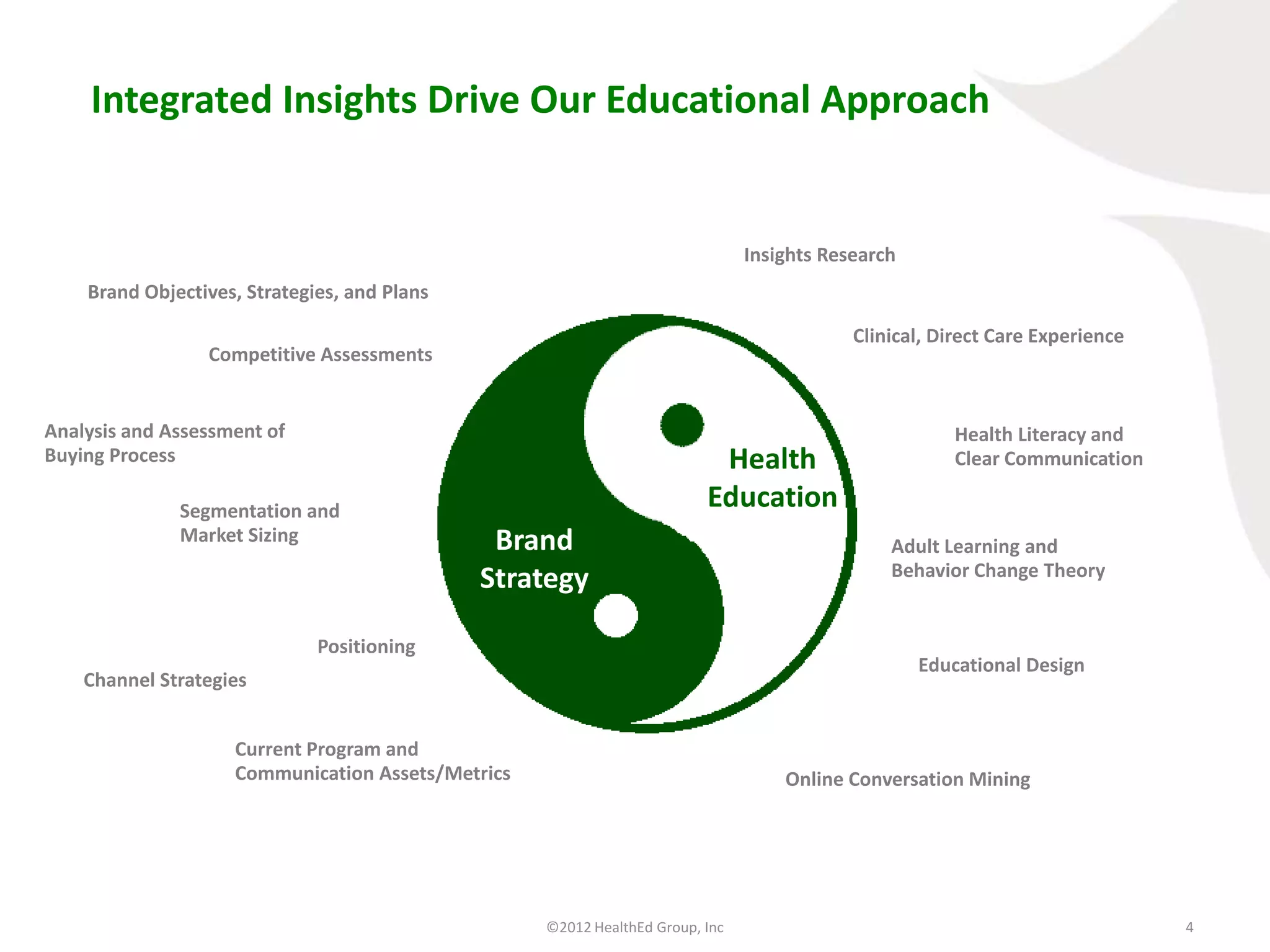
Integrated Insights Drive Our Educational Approach


                                                                               Insights Research
    Brand Objectives, Strategies, and Plans

                                                                                           Clinical, Direct Care Experience
                 Competitive Assessments


Analysis and Assessment of                                                                             Health Literacy and
Buying Process                                                            Health                       Clear Communication

              Segmentation and
                                                                         Education
              Market Sizing                    Brand                                           Adult Learning and
                                                                                               Behavior Change Theory
                                              Strategy

                              Positioning
                                                                                                   Educational Design
    Channel Strategies


                    Current Program and
                    Communication Assets/Metrics                                   Online Conversation Mining


                                                   ©2012 HealthEd Group, Inc                                                  4
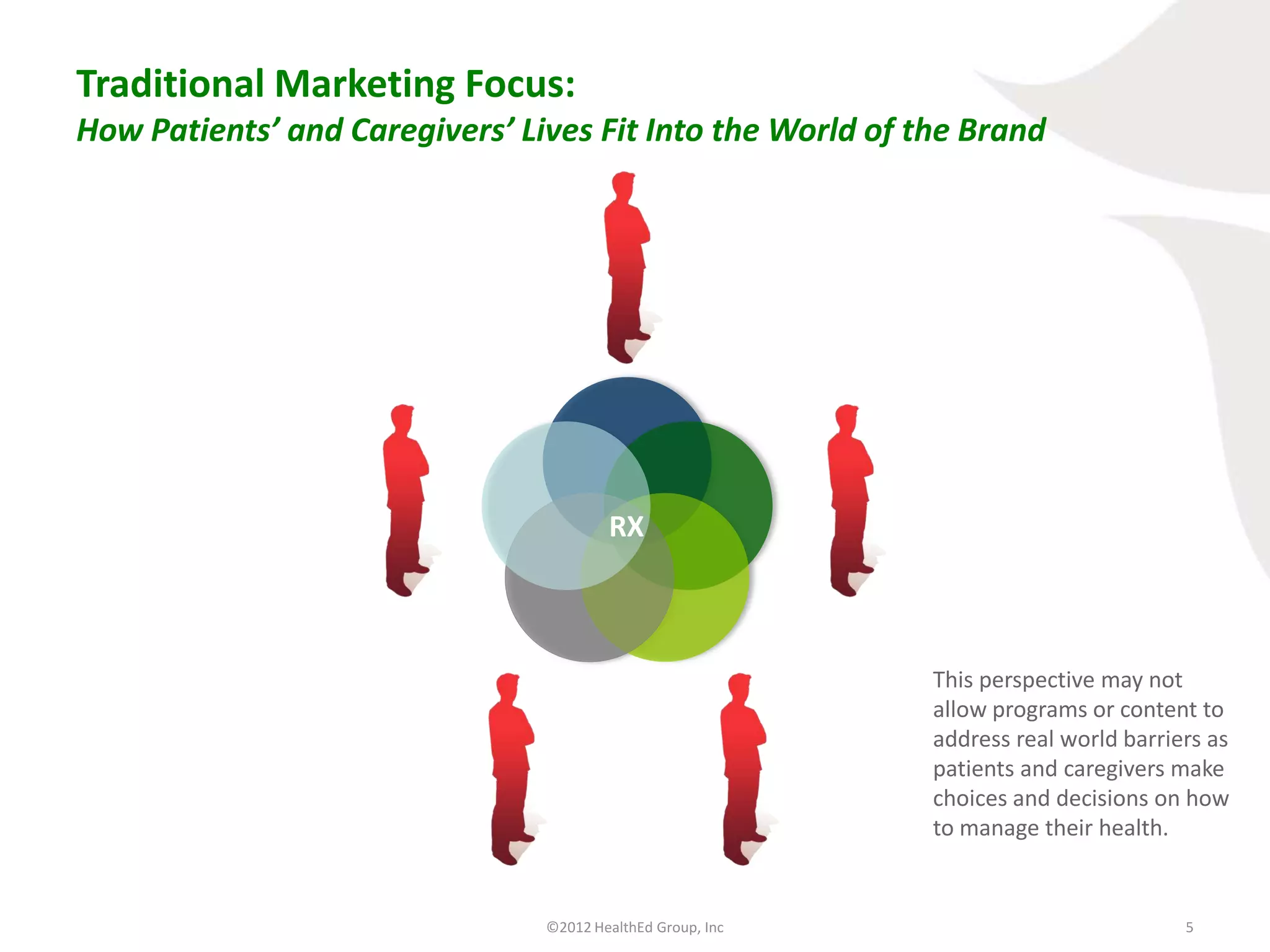
Traditional Marketing Focus:
How Patients’ and Caregivers’ Lives Fit Into the World of the Brand


                                        RX


                                                            This perspective may not
                                                            allow programs or content to
                                                            address real world barriers as
                                                            patients and caregivers make
                                                            choices and decisions on how
                                                            to manage their health.


                                ©2012 HealthEd Group, Inc                            5
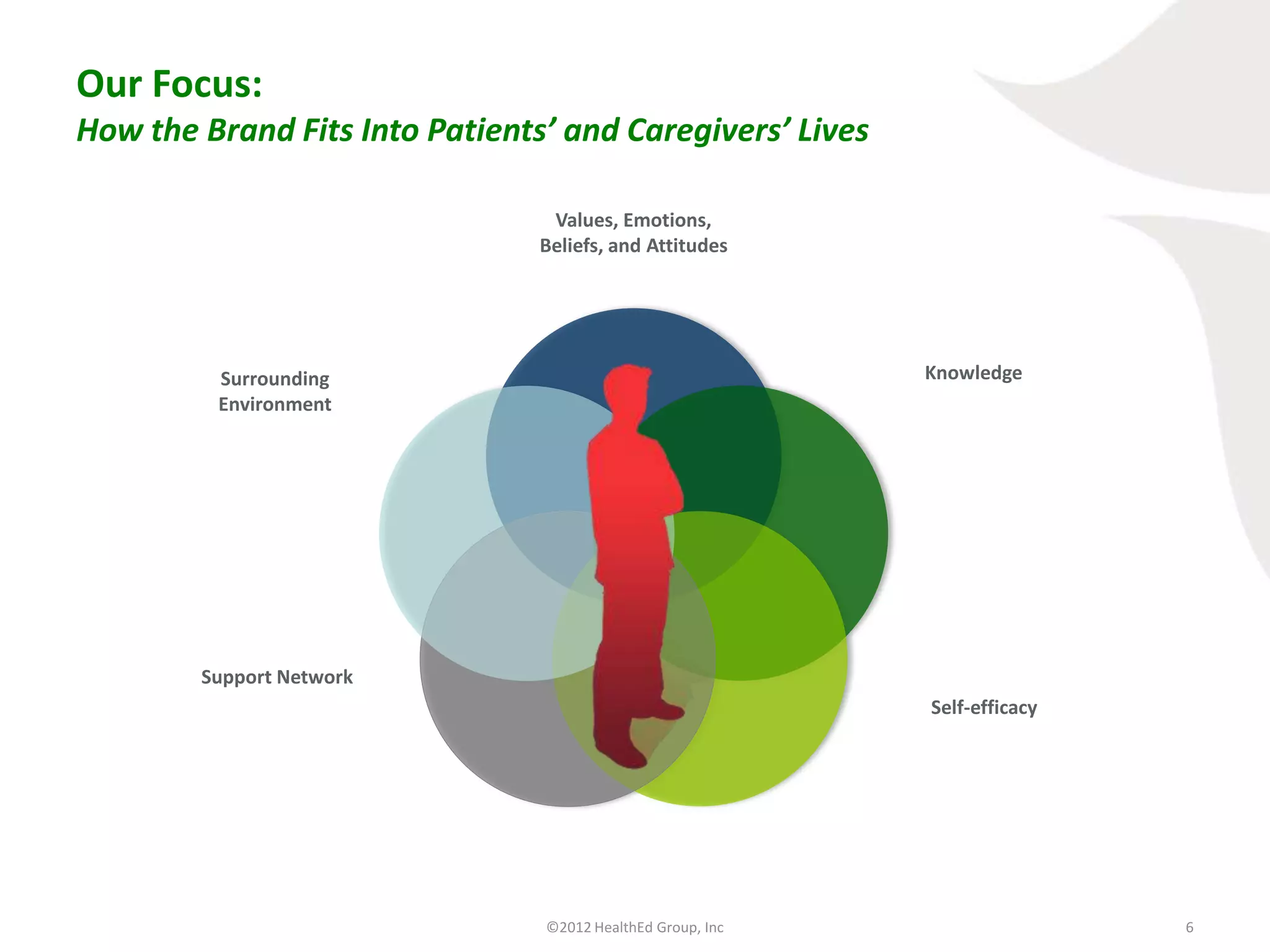
Our Focus:
How the Brand Fits Into Patients’ and Caregivers’ Lives

                                 Values, Emotions,
                                Beliefs, and Attitudes


         Surrounding                                        Knowledge
         Environment


        Support Network
                                                            Self-efficacy


                                ©2012 HealthEd Group, Inc                   6
5 Strategies
              YOU MUST CONSIDER TO
DRIVE EFFECTIVE PATIENT INTERACTIONS
©2012 HealthEd Group, Inc   8
1. Map the Patient Journey

WHY?
Patient journeys distill insights and translate emotional and
environmental barriers to wellness into visual, actionable frameworks


WHAT?
An illustration highlighting:
• Phases of the brand and/or disease journey
• The patient and care partner experience
• Landscape metaphors
• Clinical treatment overview
• Patients’ relationships with core clinicians
• Key leverage points and aligned tactics

                                ©2012 HealthEd Group, Inc               9
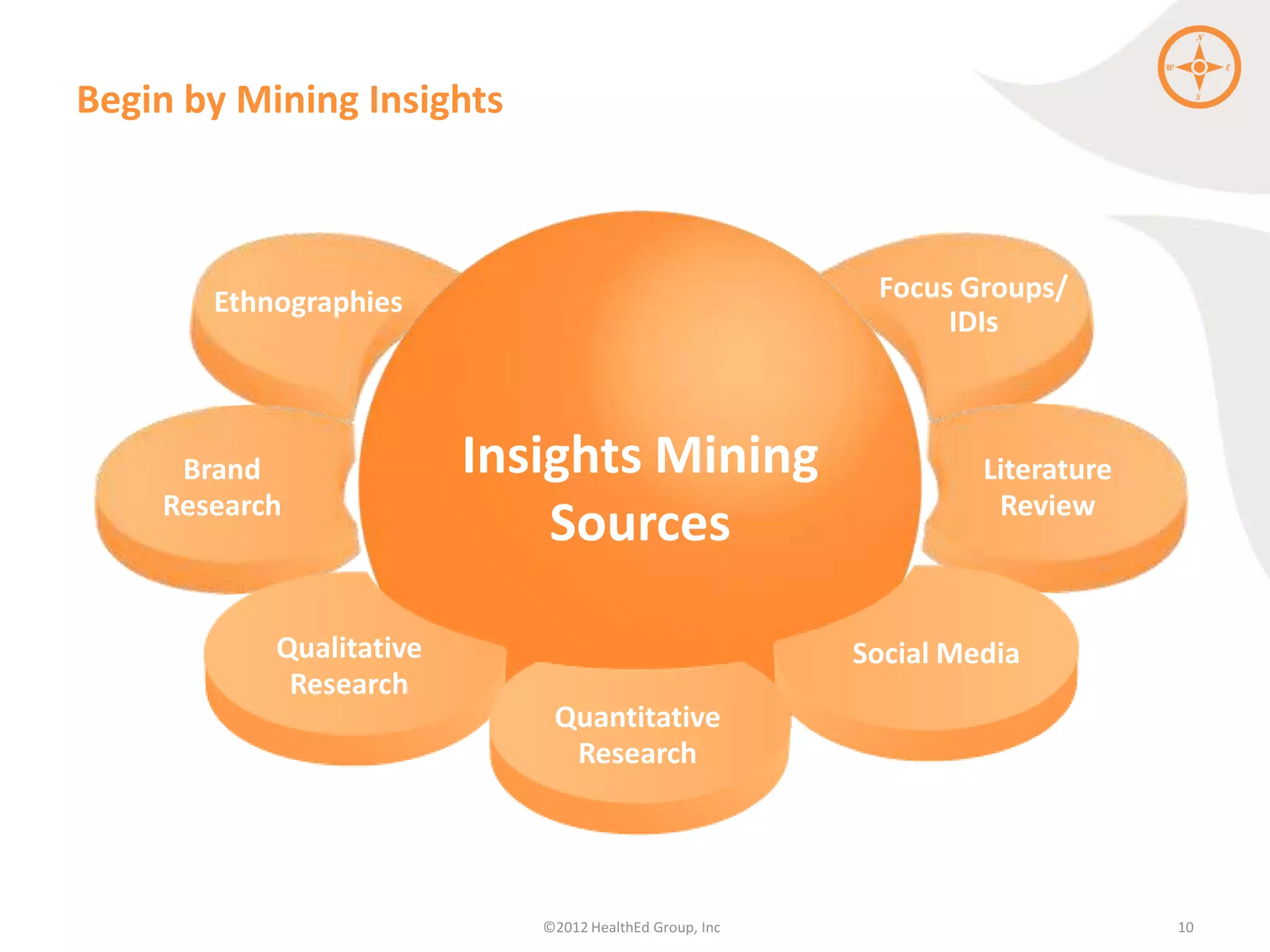
Begin by Mining Insights


       Ethnographies                                     Focus Groups/
                                                              IDIs


      Brand              Insights Mining                         Literature
    Brand
    Research                                                      Review
   Research                  Sources

           Qualitative                                  Social Media
            Research
                             Quantitative
                              Research


                            ©2012 HealthEd Group, Inc                         10
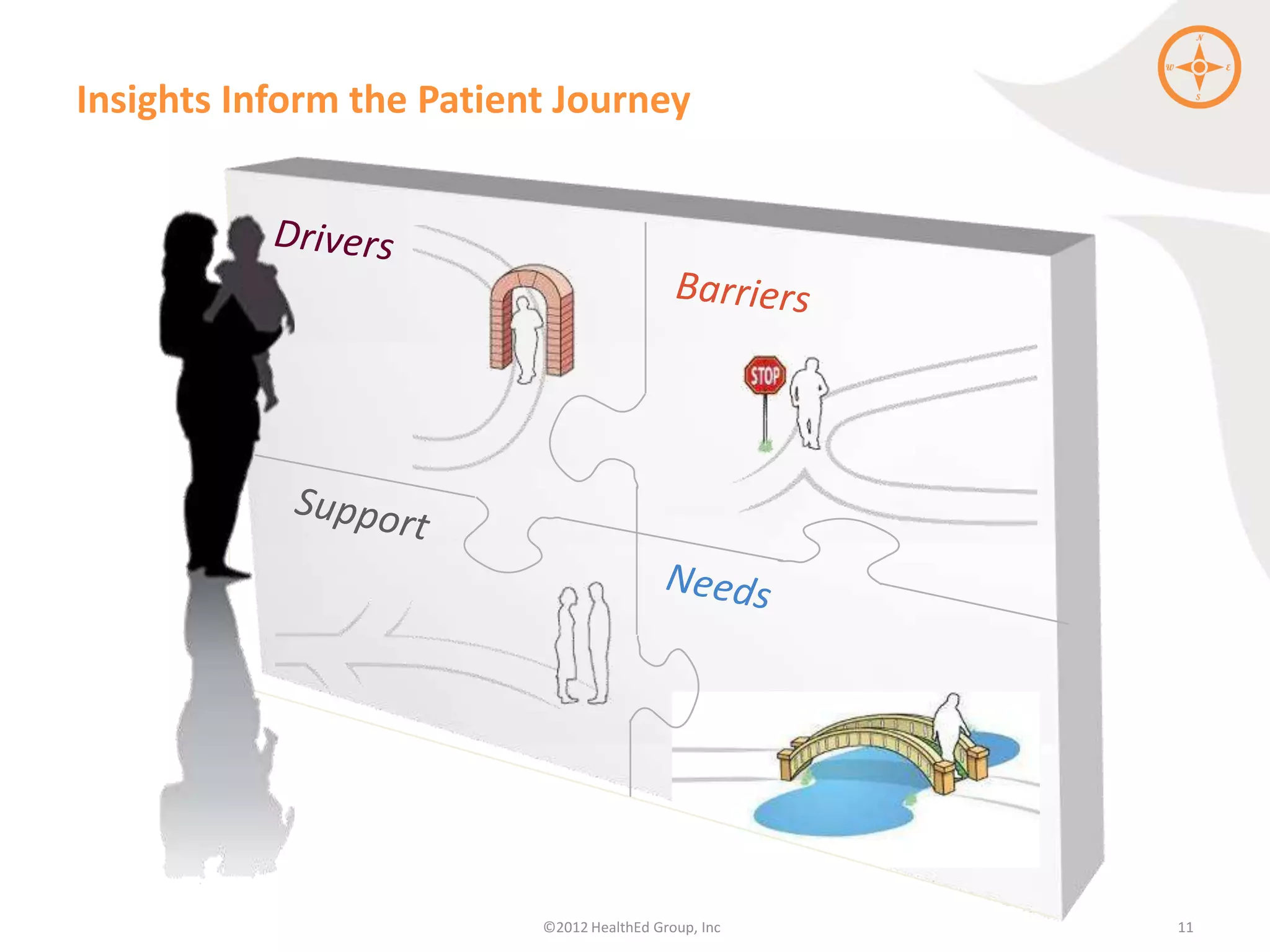
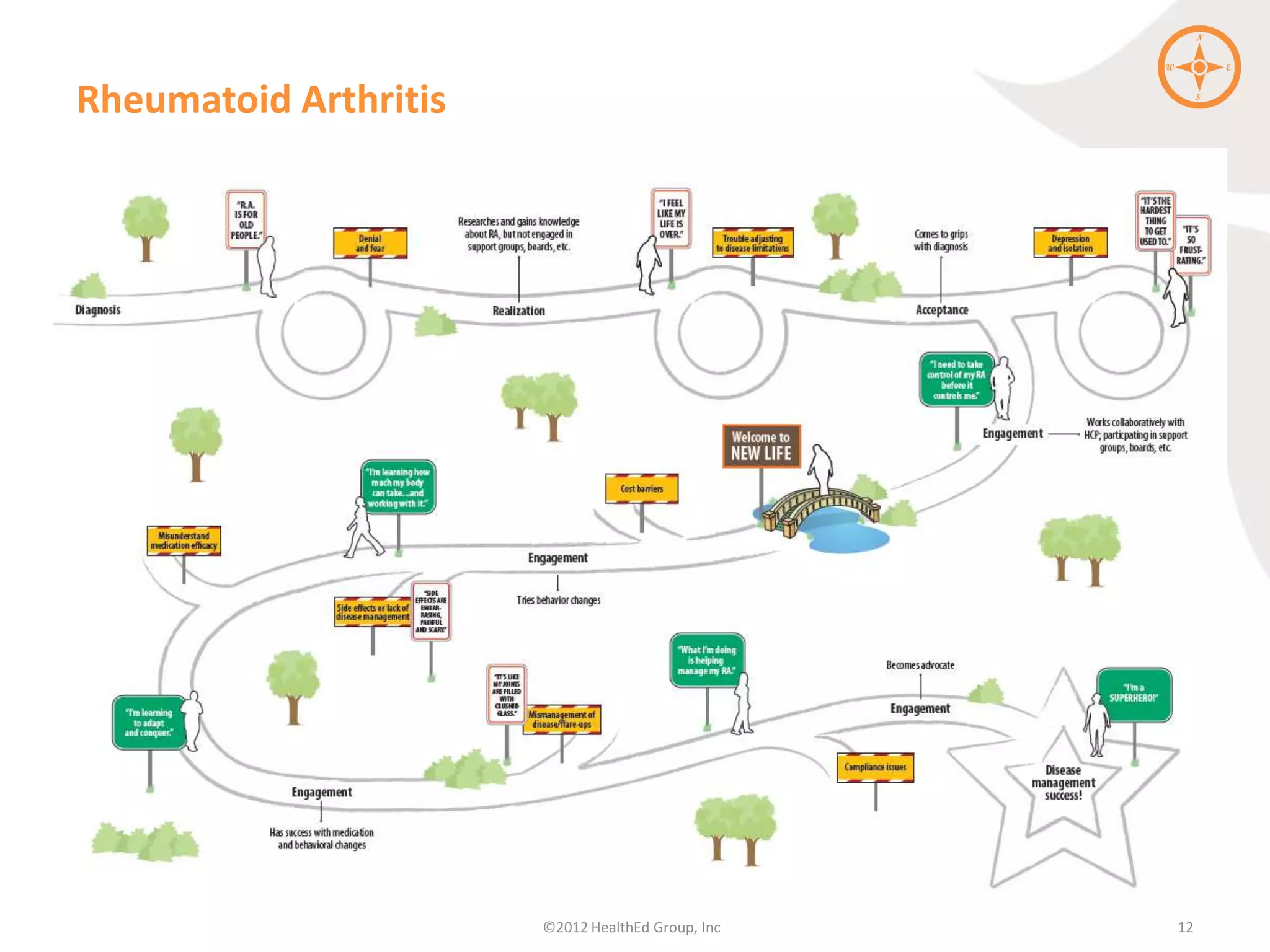
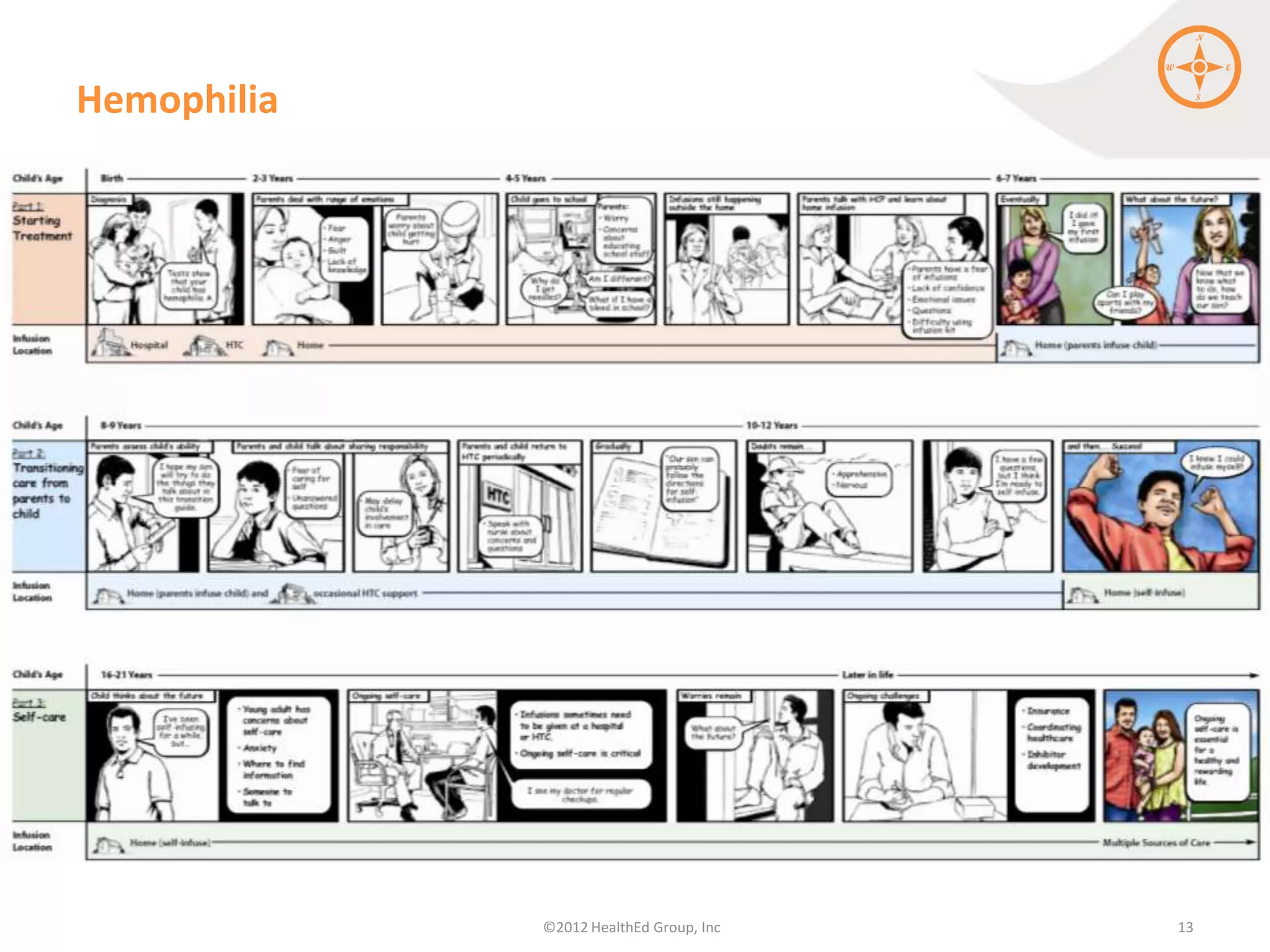
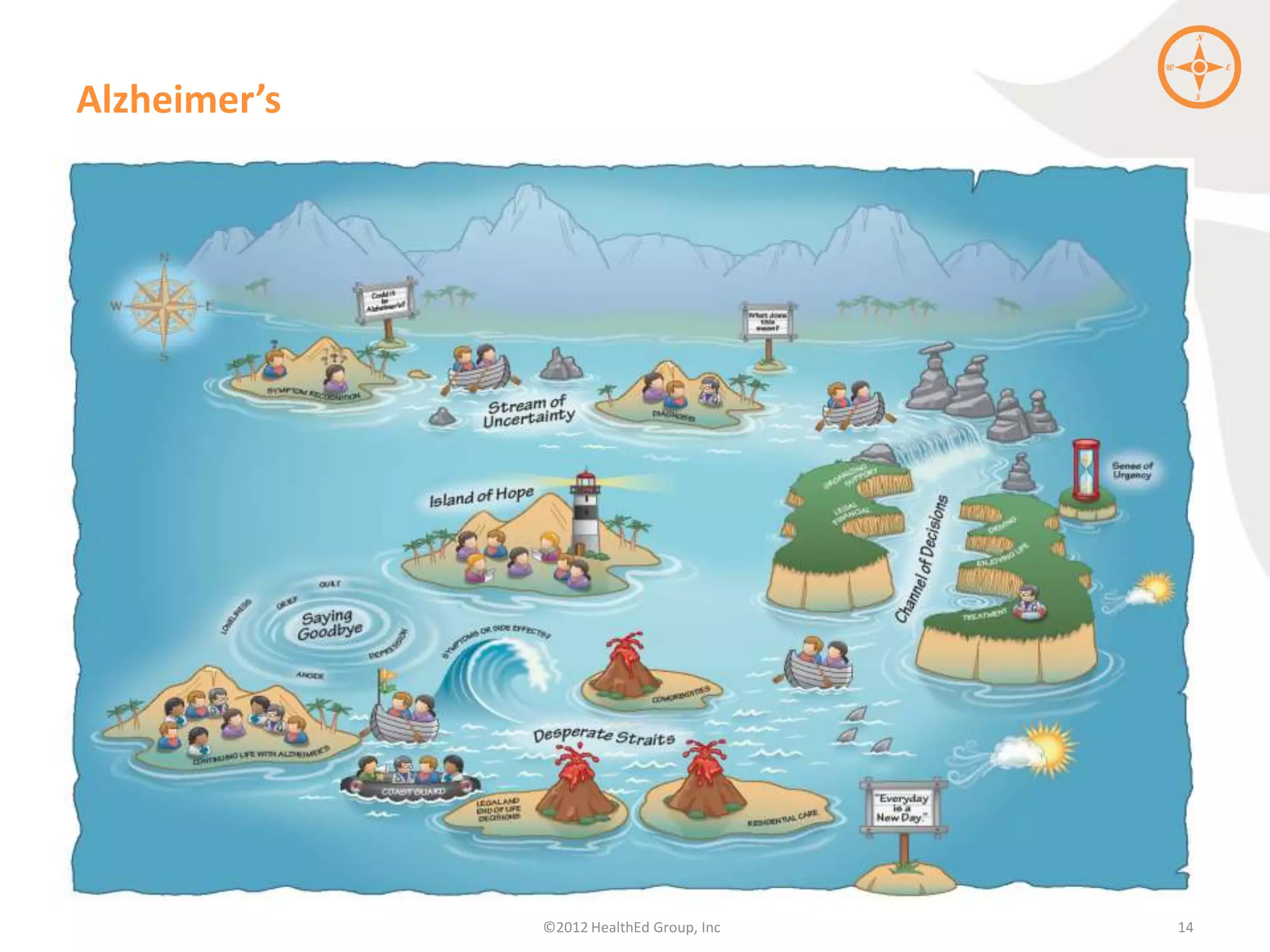
Insights Inform the Patient Journey


                          ©2012 HealthEd Group, Inc   11
Rheumatoid Arthritis


                       ©2012 HealthEd Group, Inc   12
Hemophilia


             ©2012 HealthEd Group, Inc   13
Alzheimer’s


              ©2012 HealthEd Group, Inc   14
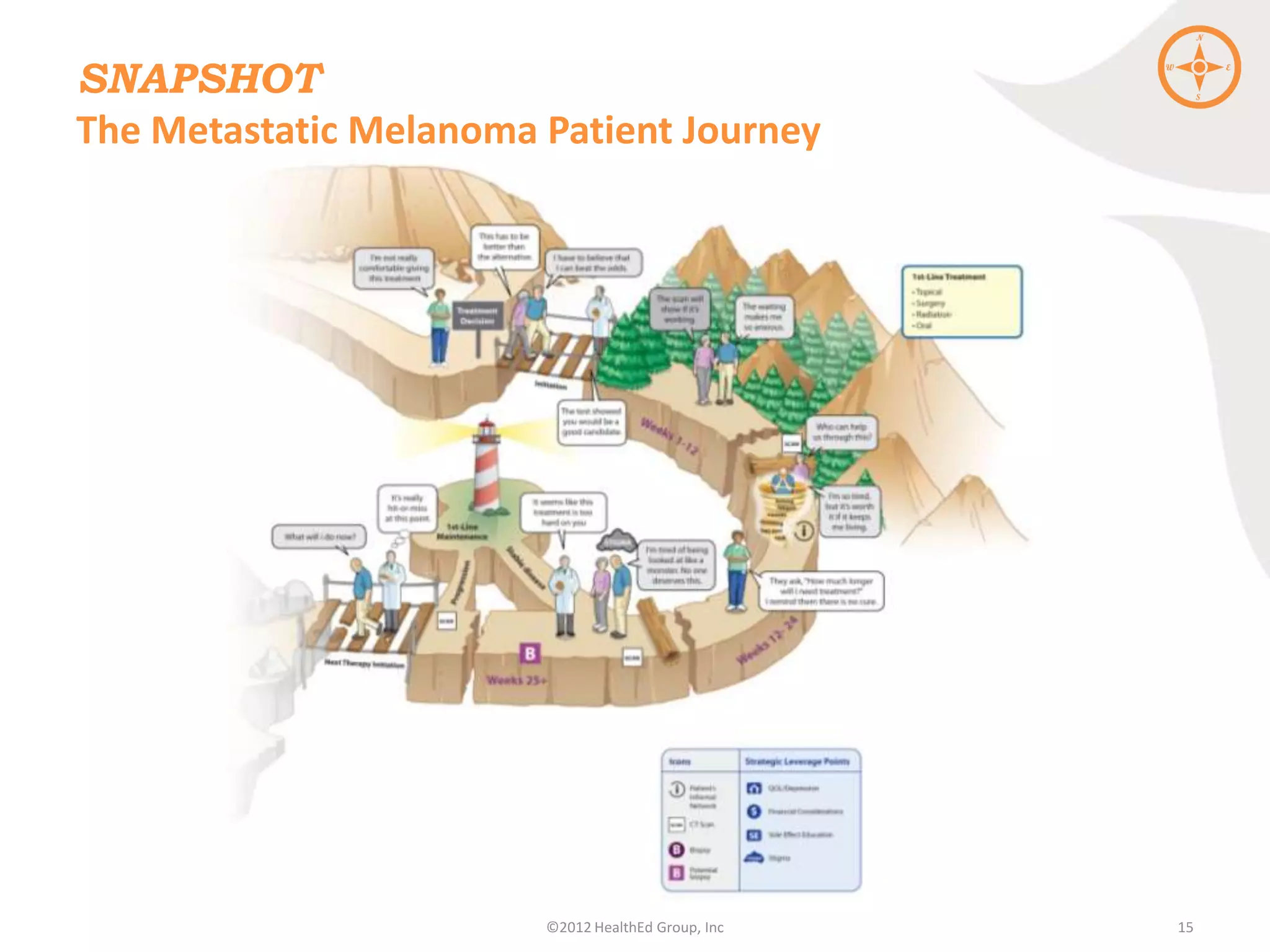
SNAPSHOT
The Metastatic Melanoma Patient Journey


                        ©2012 HealthEd Group, Inc   15
©2012 HealthEd Group, Inc   16
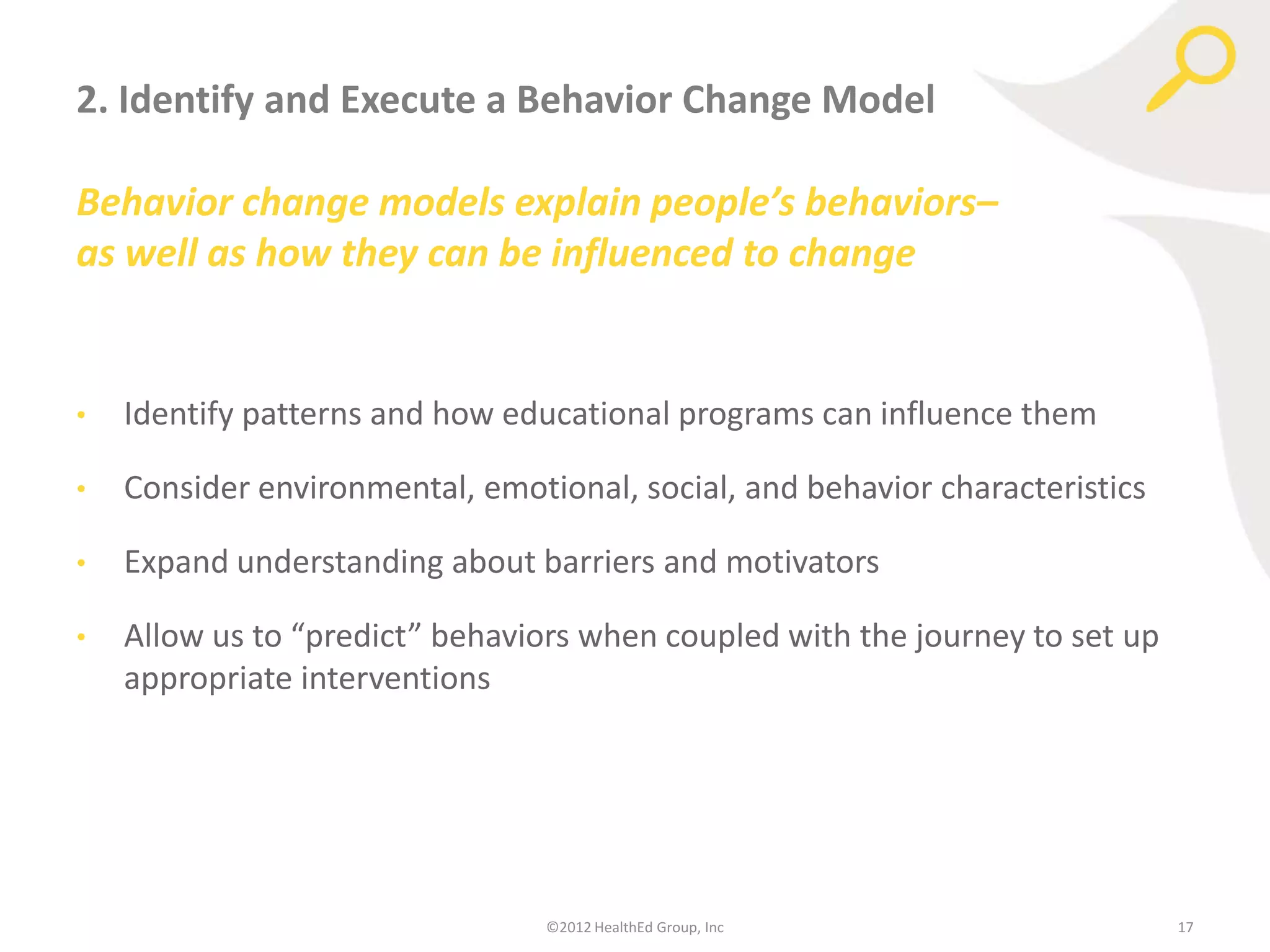
2. Identify and Execute a Behavior Change Model

Behavior change models explain people’s behaviors–
as well as how they can be influenced to change


•   Identify patterns and how educational programs can influence them

•   Consider environmental, emotional, social, and behavior characteristics

•   Expand understanding about barriers and motivators

•   Allow us to “predict” behaviors when coupled with the journey to set up
    appropriate interventions


                                 ©2012 HealthEd Group, Inc                    17
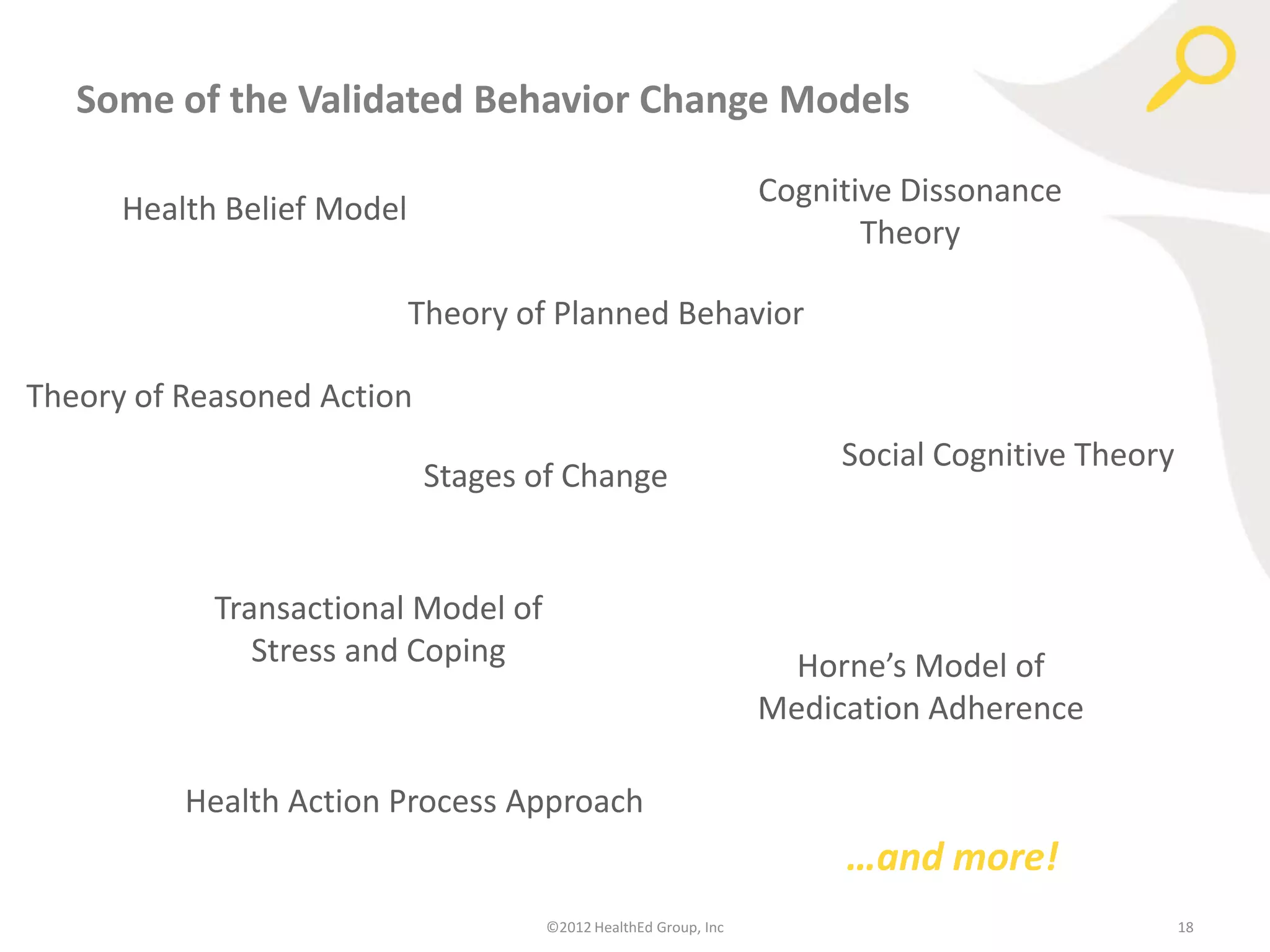
Some of the Validated Behavior Change Models

                                                                 Cognitive Dissonance
      Health Belief Model
                                                                        Theory

                            Theory of Planned Behavior

Theory of Reasoned Action
                                                                      Social Cognitive Theory
                             Stages of Change


            Transactional Model of
               Stress and Coping                                   Horne’s Model of
                                                                 Medication Adherence

          Health Action Process Approach
                                                                      …and more!
                                     ©2012 HealthEd Group, Inc                                  18
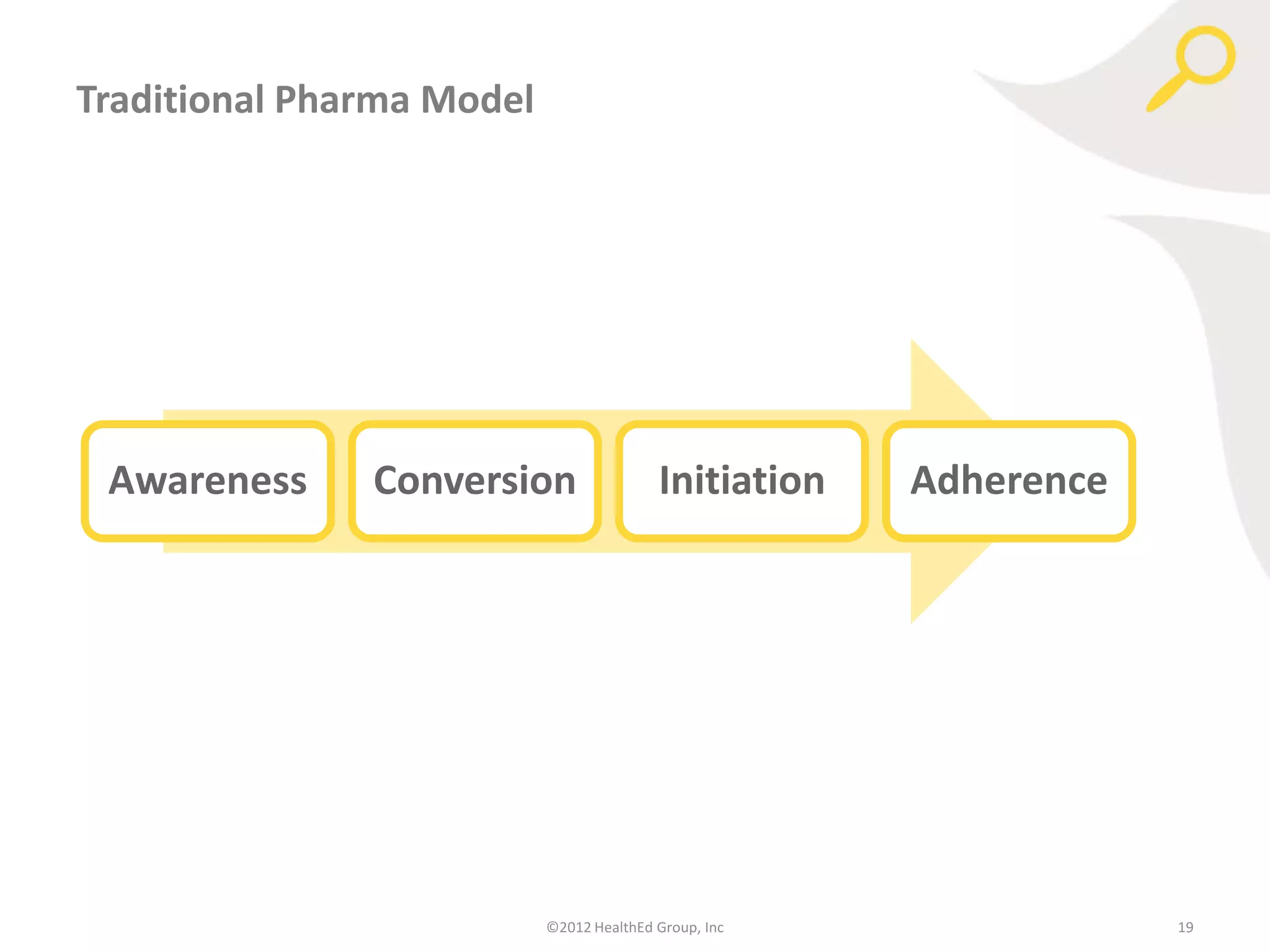
Traditional Pharma Model


 Awareness     Conversion                 Initiation   Adherence


                           ©2012 HealthEd Group, Inc               19
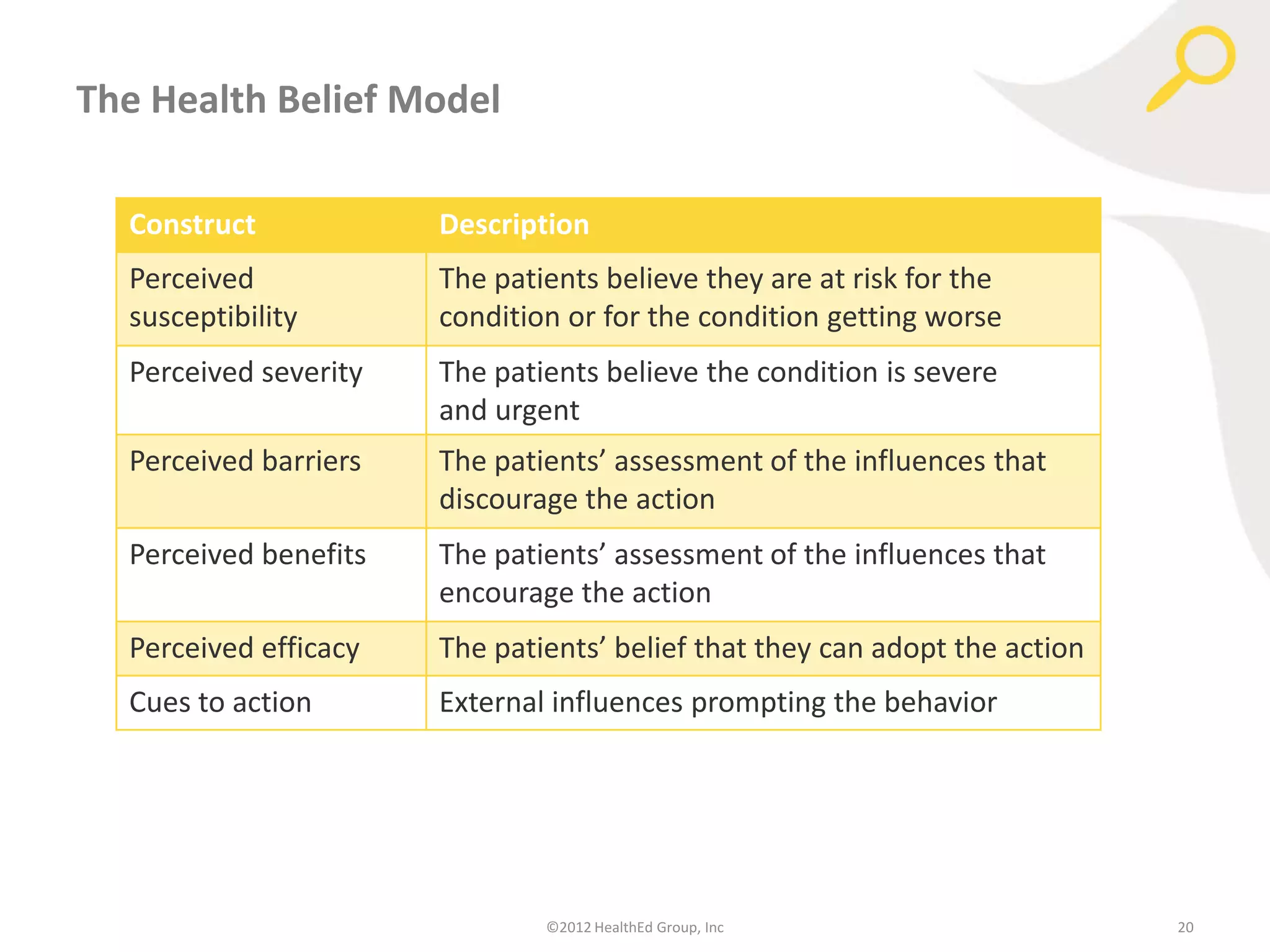
The Health Belief Model

  Construct            Description
  Perceived            The patients believe they are at risk for the
  susceptibility       condition or for the condition getting worse
  Perceived severity   The patients believe the condition is severe
                       and urgent
  Perceived barriers   The patients’ assessment of the influences that
                       discourage the action
  Perceived benefits   The patients’ assessment of the influences that
                       encourage the action
  Perceived efficacy   The patients’ belief that they can adopt the action
  Cues to action       External influences prompting the behavior


                               ©2012 HealthEd Group, Inc                     20
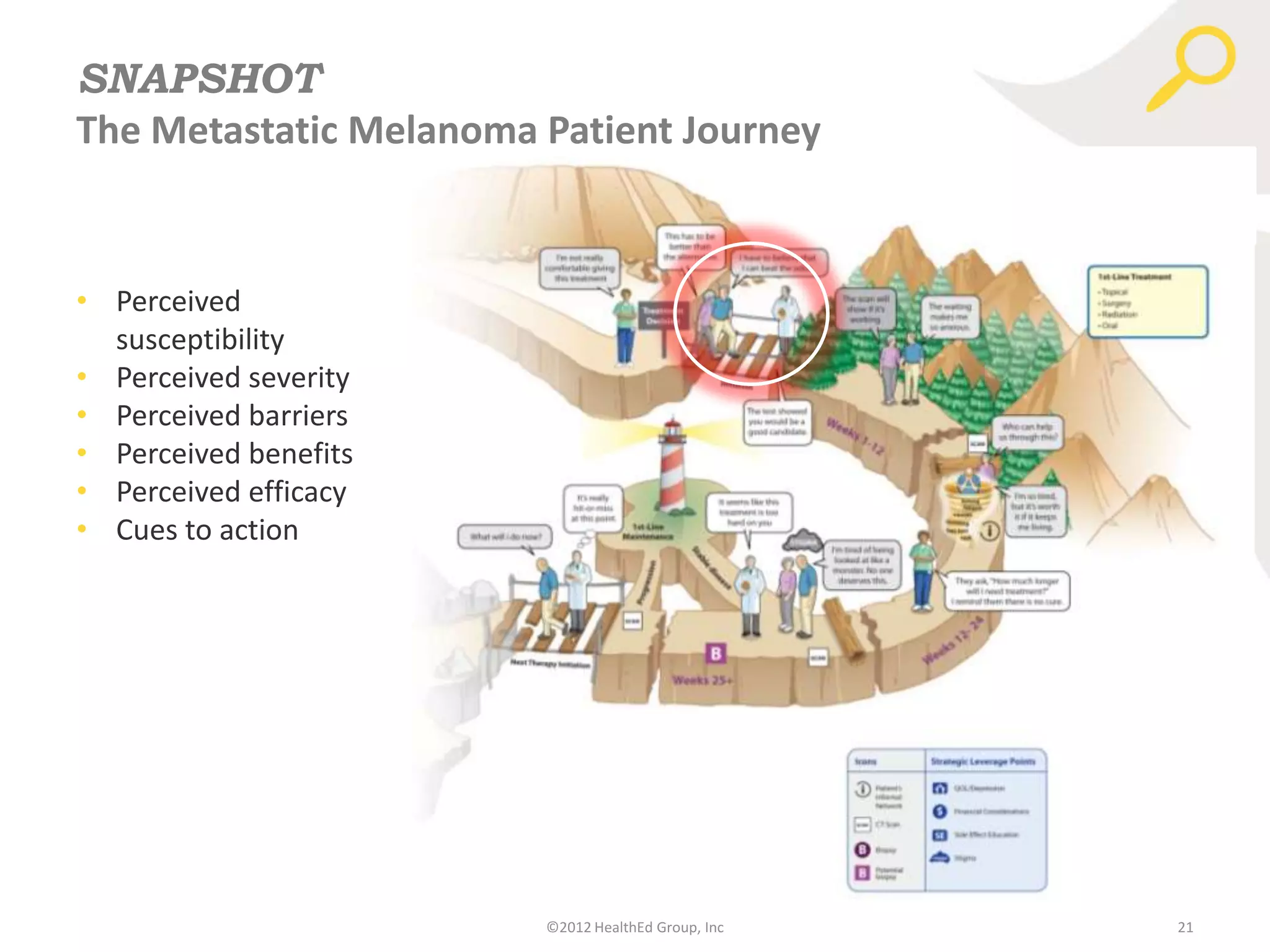
SNAPSHOT
The Metastatic Melanoma Patient Journey


• Perceived
  susceptibility
• Perceived severity
• Perceived barriers
• Perceived benefits
• Perceived efficacy
• Cues to action


                        ©2012 HealthEd Group, Inc   21
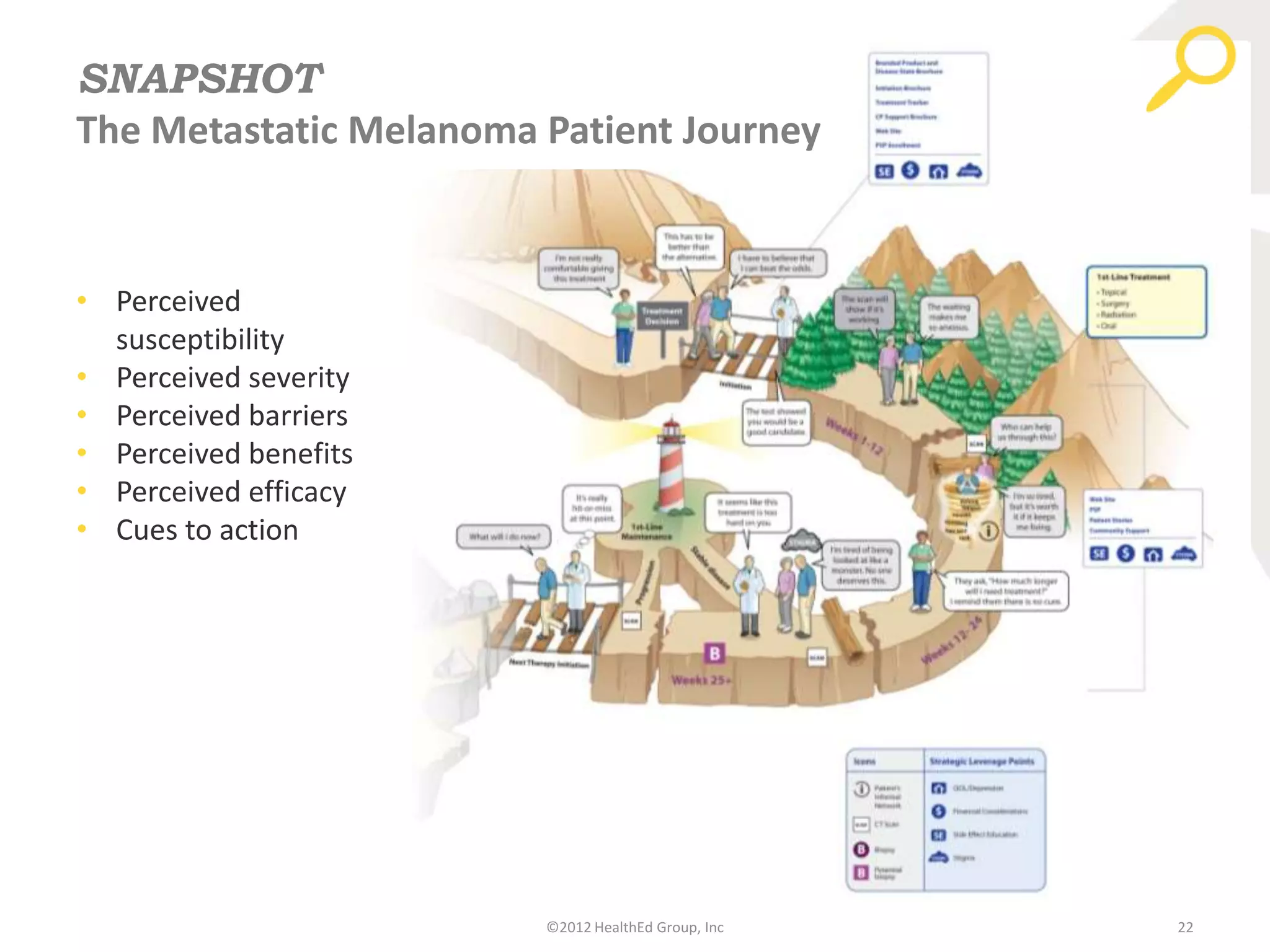
SNAPSHOT
The Metastatic Melanoma Patient Journey


• Perceived
  susceptibility
• Perceived severity
• Perceived barriers
• Perceived benefits
• Perceived efficacy
• Cues to action


                        ©2012 HealthEd Group, Inc   22
©2012 HealthEd Group, Inc   23
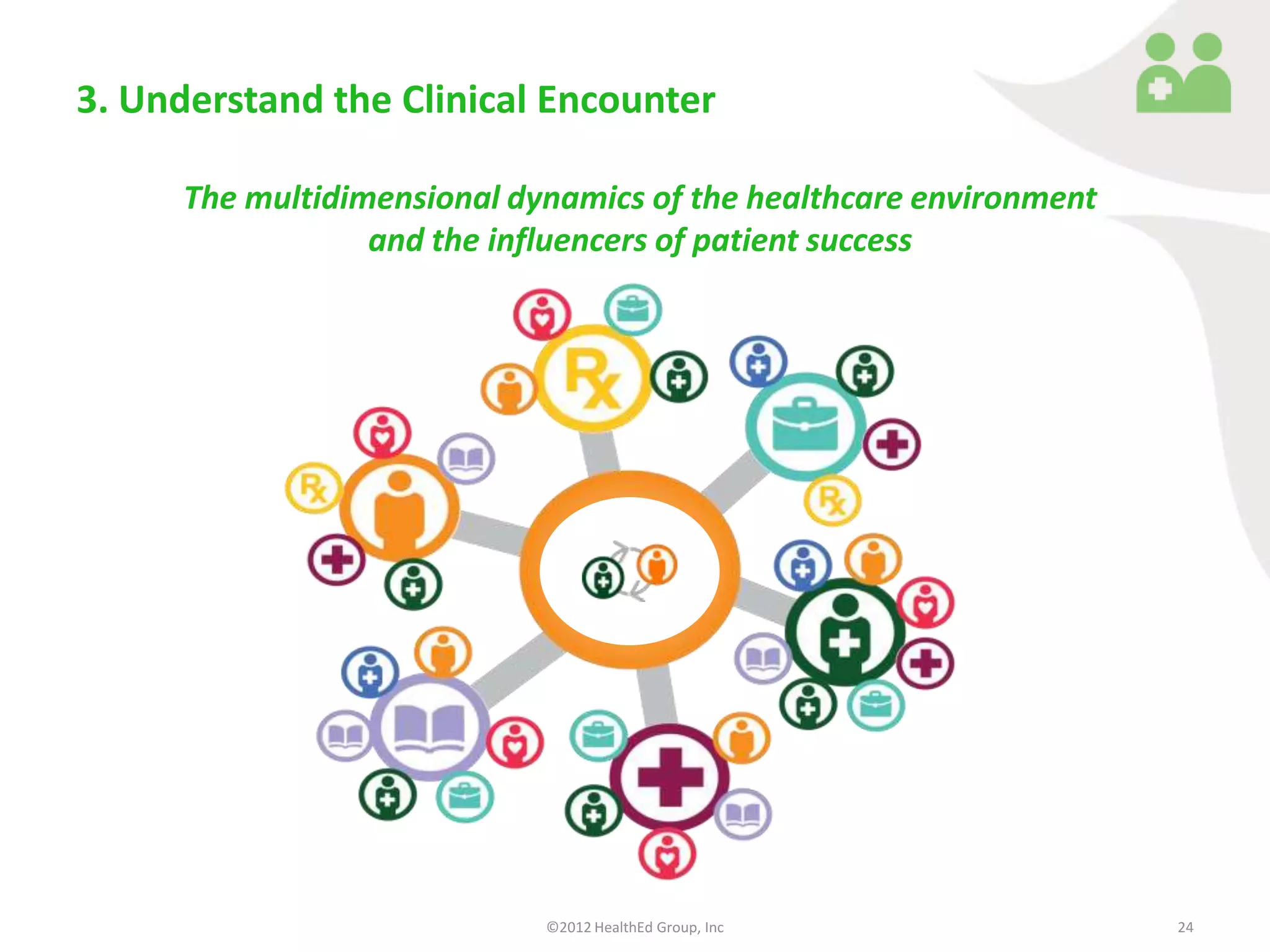
3. Understand the Clinical Encounter

      The multidimensional dynamics of the healthcare environment
                  and the influencers of patient success


                             ©2012 HealthEd Group, Inc              24
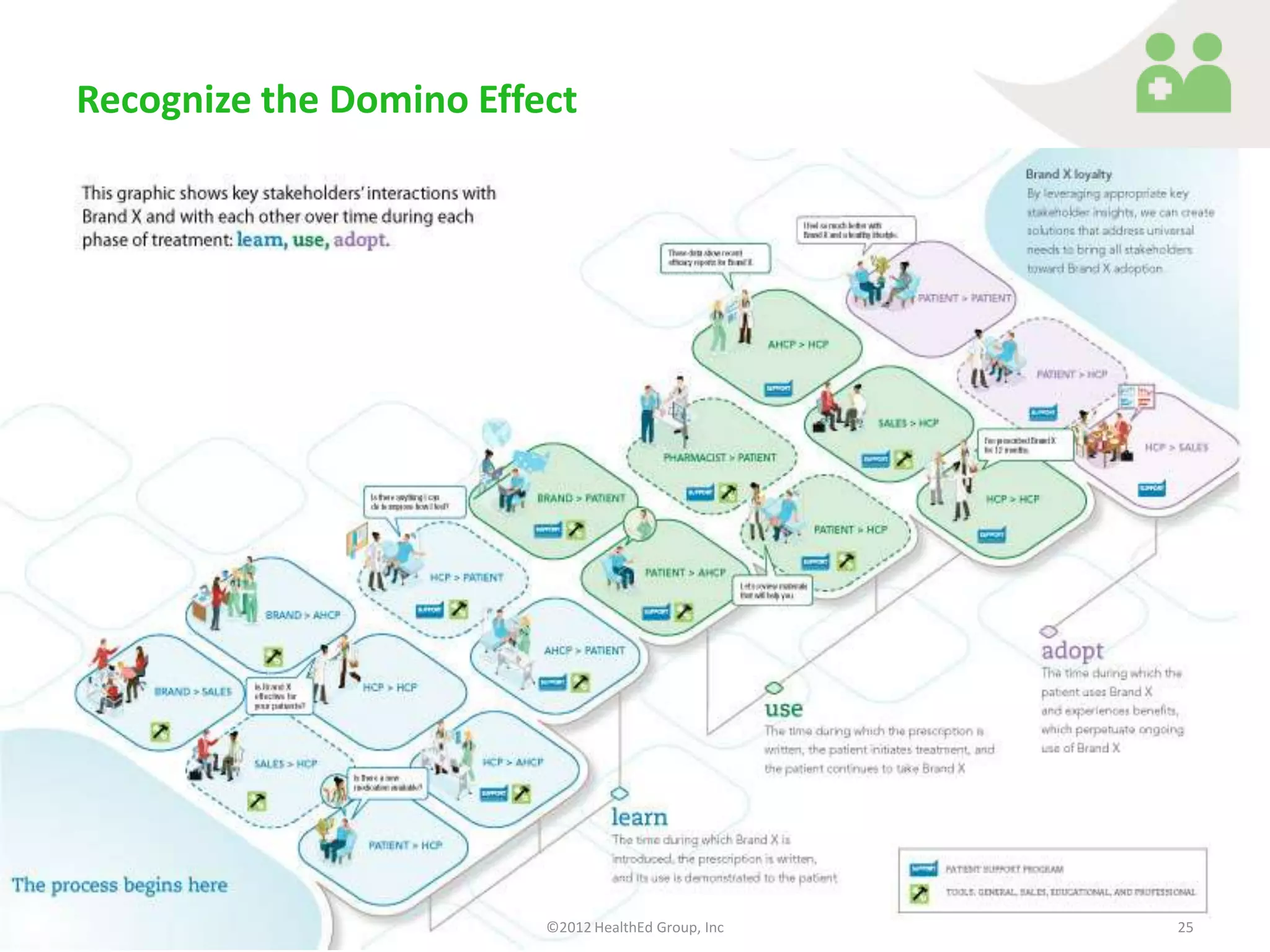
Recognize the Domino Effect


                         ©2012 HealthEd Group, Inc   25
                                                     25
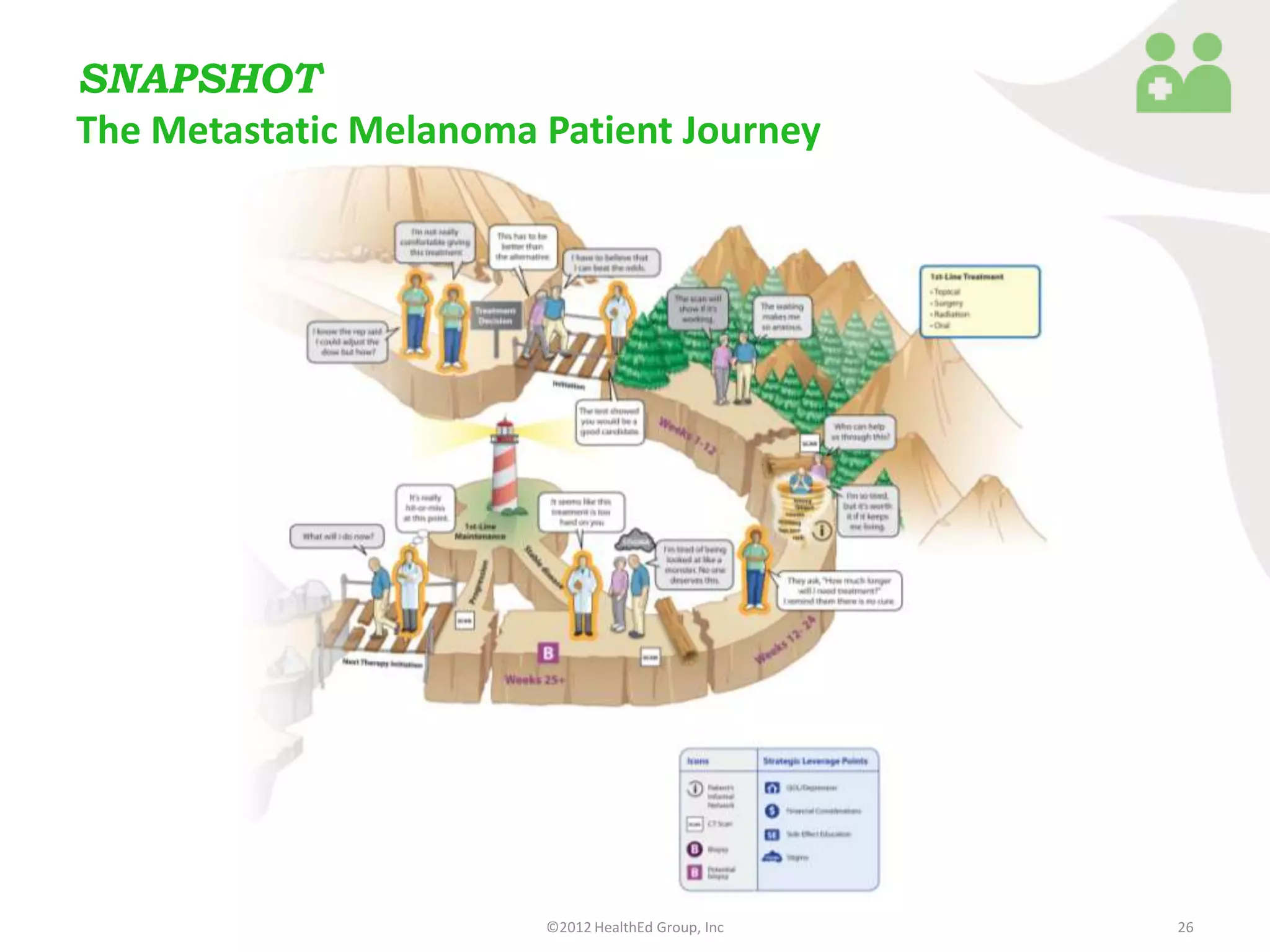
SNAPSHOT
The Metastatic Melanoma Patient Journey


                        ©2012 HealthEd Group, Inc   26
©2012 HealthEd Group, Inc   27
4. Measure Patient Behavior

Focus on showing a measurable incremental positive impact
  •   Change in skills

  •   Change in knowledge

  •   Change in attitudes and behavior model metrics

  •   Change in behavioral intention


                                        ACTIVELY                   ACTIVELY
                                       DISENGAGED                  ENGAGED


                                       ©2012 HealthEd Group, Inc        28
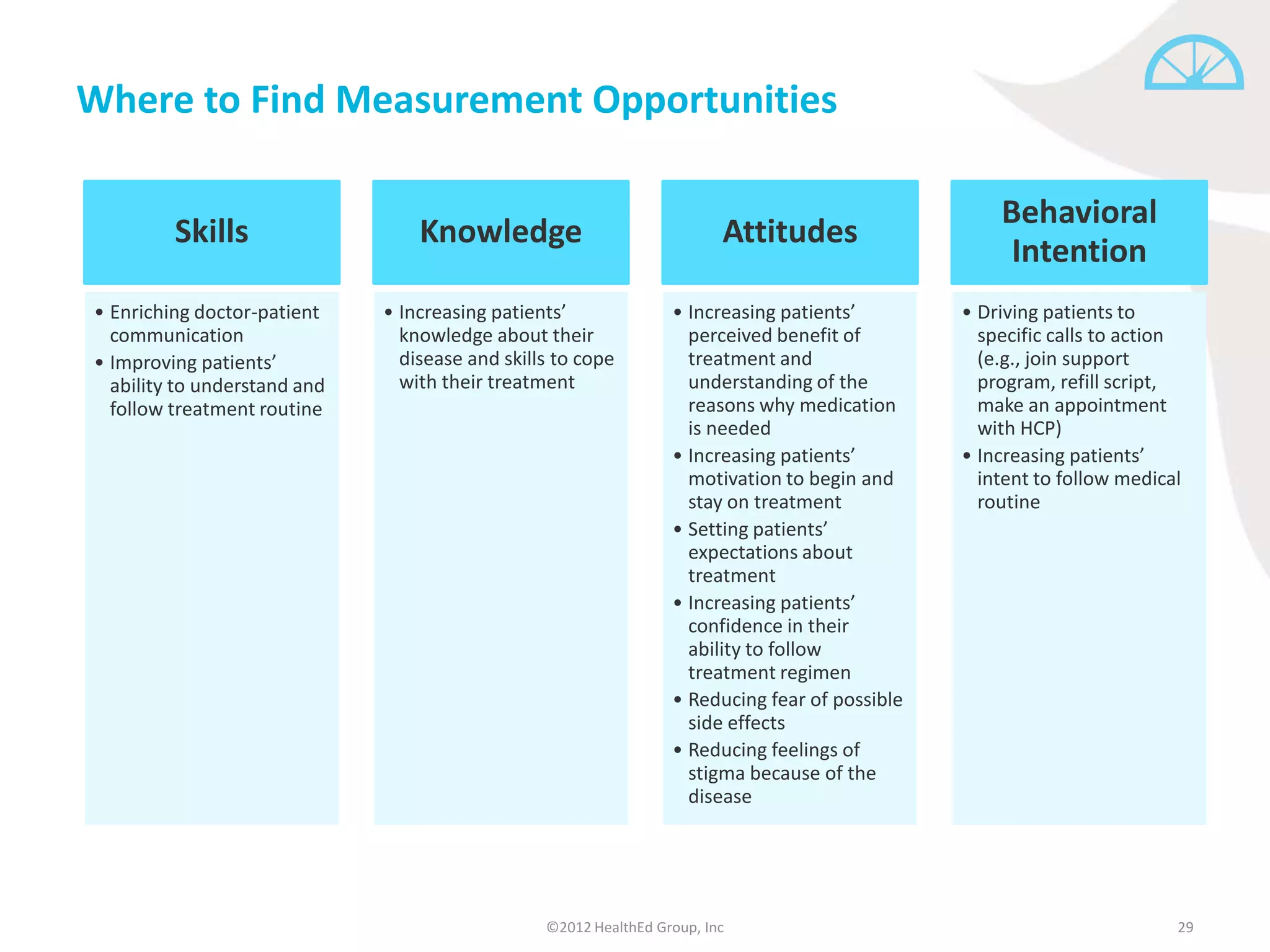
Where to Find Measurement Opportunities

                                                                                                    Behavioral
         Skills                   Knowledge                              Attitudes
                                                                                                     Intention
• Enriching doctor-patient    • Increasing patients’              • Increasing patients’        • Driving patients to
  communication                 knowledge about their               perceived benefit of          specific calls to action
• Improving patients’           disease and skills to cope          treatment and                 (e.g., join support
  ability to understand and     with their treatment                understanding of the          program, refill script,
  follow treatment routine                                          reasons why medication        make an appointment
                                                                    is needed                     with HCP)
                                                                  • Increasing patients’        • Increasing patients’
                                                                    motivation to begin and       intent to follow medical
                                                                    stay on treatment             routine
                                                                  • Setting patients’
                                                                    expectations about
                                                                    treatment
                                                                  • Increasing patients’
                                                                    confidence in their
                                                                    ability to follow
                                                                    treatment regimen
                                                                  • Reducing fear of possible
                                                                    side effects
                                                                  • Reducing feelings of
                                                                    stigma because of the
                                                                    disease


                                                 ©2012 HealthEd Group, Inc                                               29
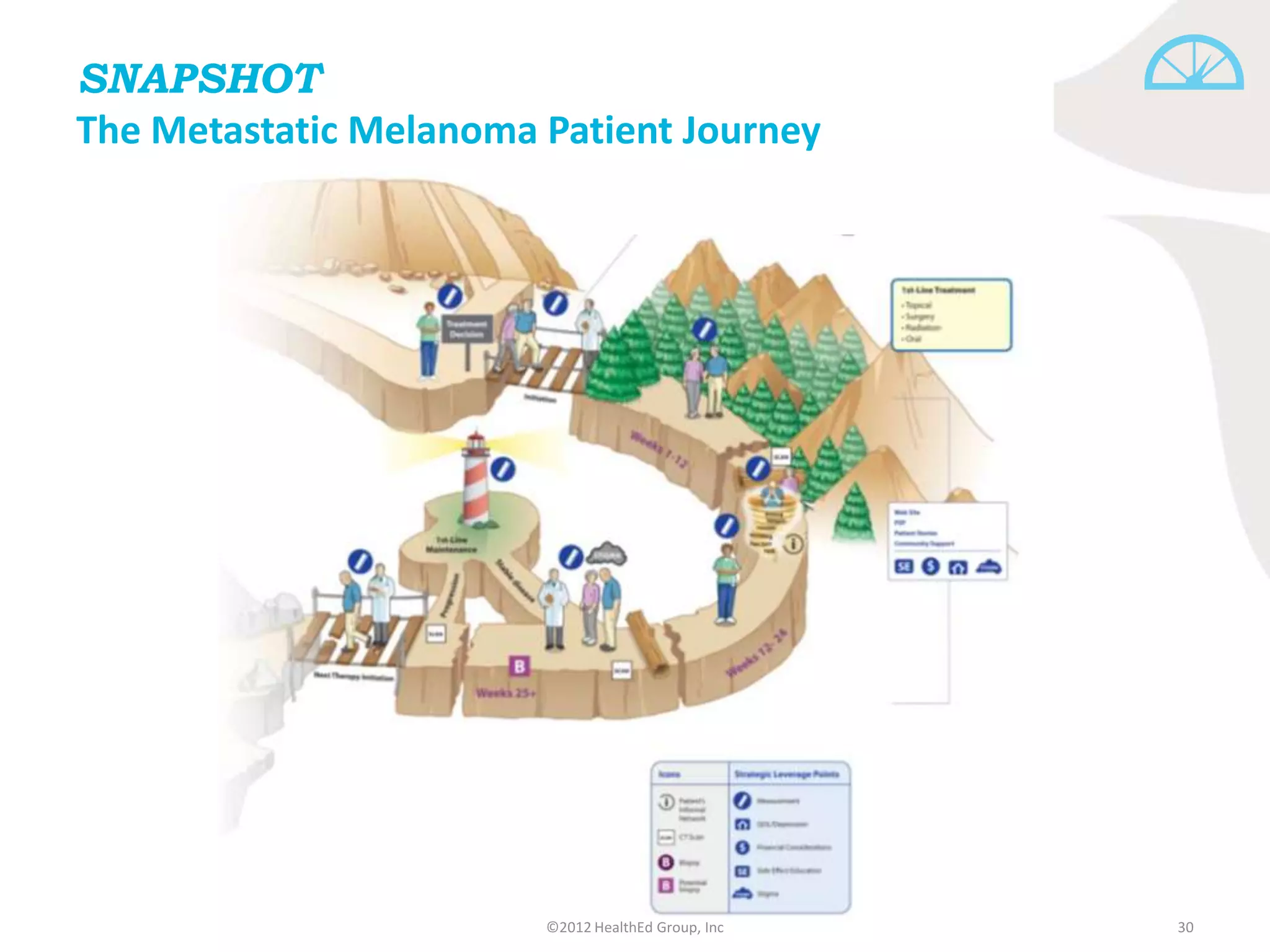
SNAPSHOT
The Metastatic Melanoma Patient Journey


                        ©2012 HealthEd Group, Inc   30
©2012 HealthEd Group, Inc   31
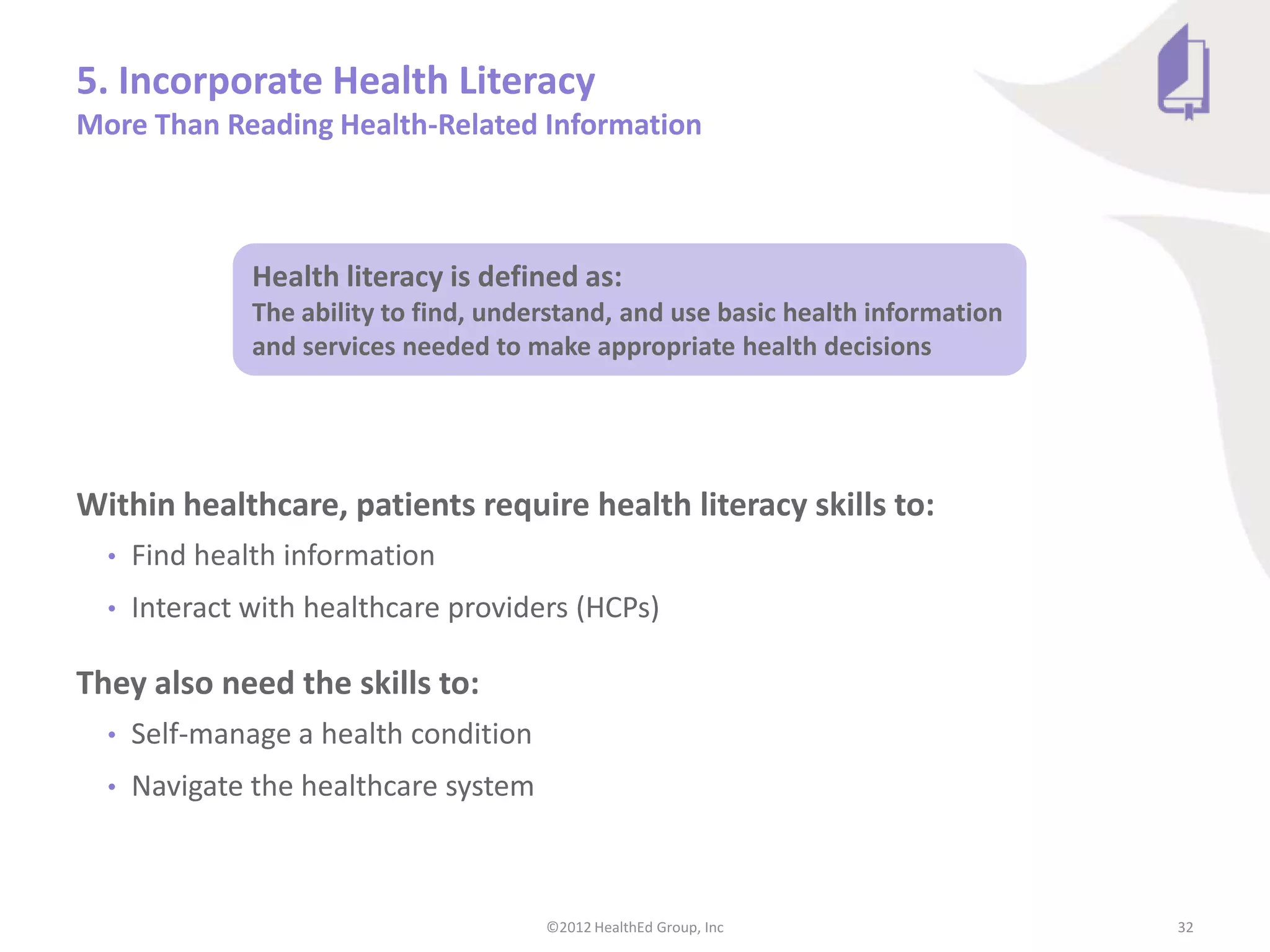
5. Incorporate Health Literacy
More Than Reading Health-Related Information


               Health literacy is defined as:
               The ability to find, understand, and use basic health information
               and services needed to make appropriate health decisions


Within healthcare, patients require health literacy skills to:
  •   Find health information
  •   Interact with healthcare providers (HCPs)

They also need the skills to:
  •   Self-manage a health condition
  •   Navigate the healthcare system


                                        ©2012 HealthEd Group, Inc                  32
Low Health Literacy: An Example


         http://www.youtube.com/watch?v=dMAS2S51bM8


                         ©2012 HealthEd Group, Inc    33
The Impact of Low Health Literacy


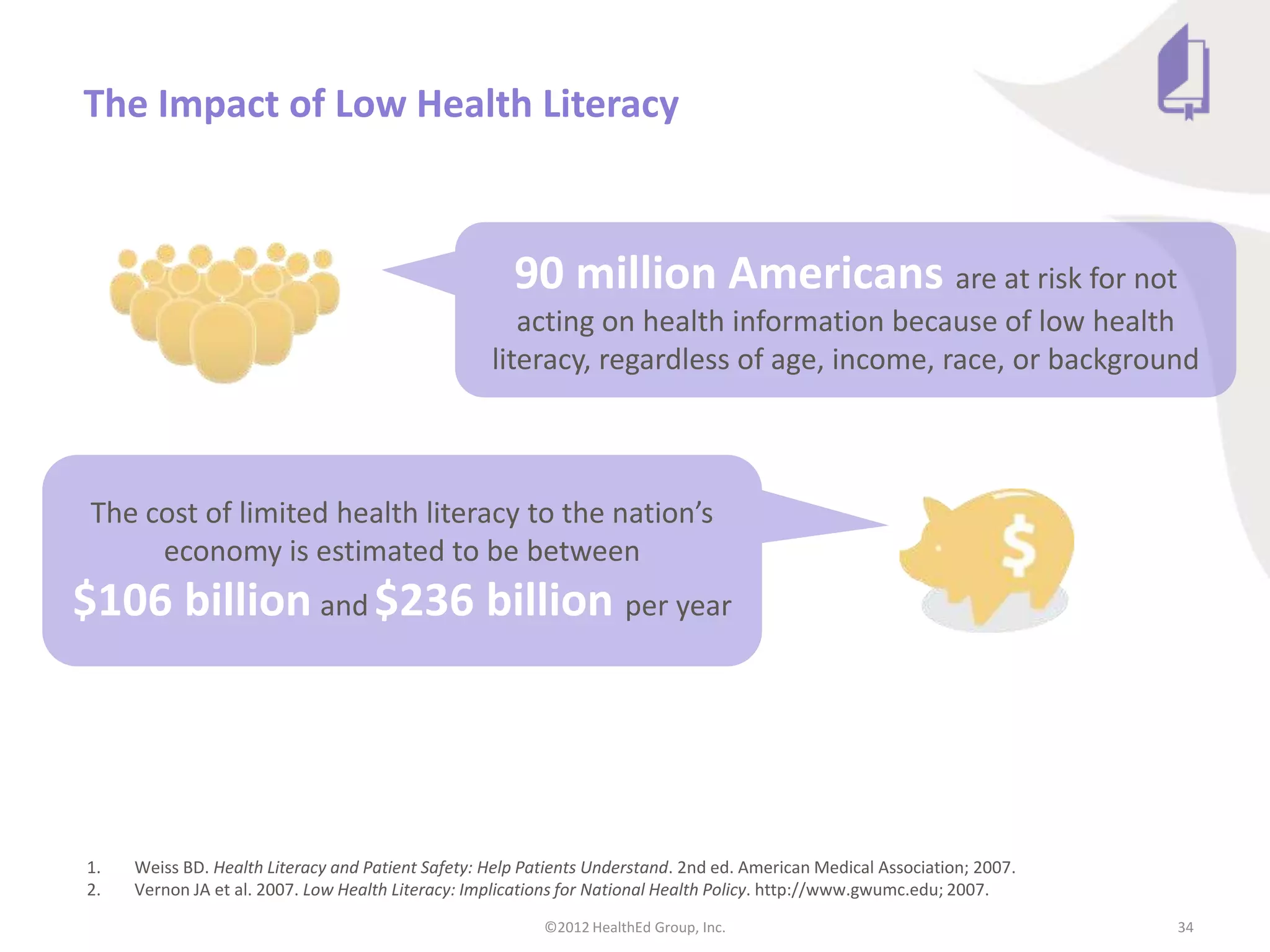
                                                      90 million Americans are at risk for not
                                                      acting on health information because of low health
                                                   literacy, regardless of age, income, race, or background


 The cost of limited health literacy to the nation’s
      economy is estimated to be between
$106 billion and $236 billion per year


1.   Weiss BD. Health Literacy and Patient Safety: Help Patients Understand. 2nd ed. American Medical Association; 2007.
2.   Vernon JA et al. 2007. Low Health Literacy: Implications for National Health Policy. http://www.gwumc.edu; 2007.
                                                          ©2012 HealthEd Group, Inc.                                       34
Why Utilize Health Literacy Principles?

  • Better comprehension = greater adherence
  • Greater financial impact
  • Required by governing bodies


                             ©2012 HealthEd Group, Inc   35
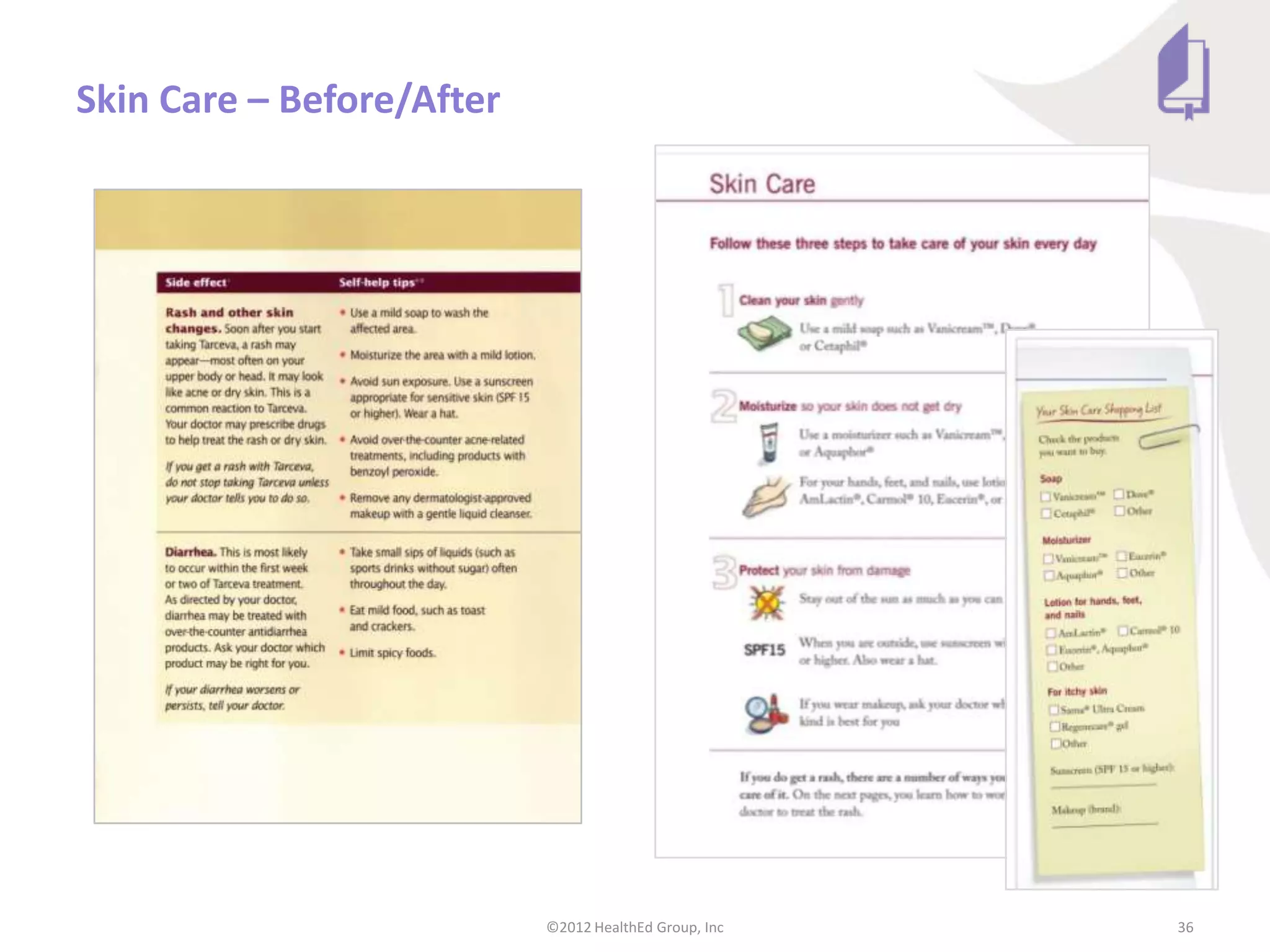
Skin Care – Before/After


                           ©2012 HealthEd Group, Inc   36
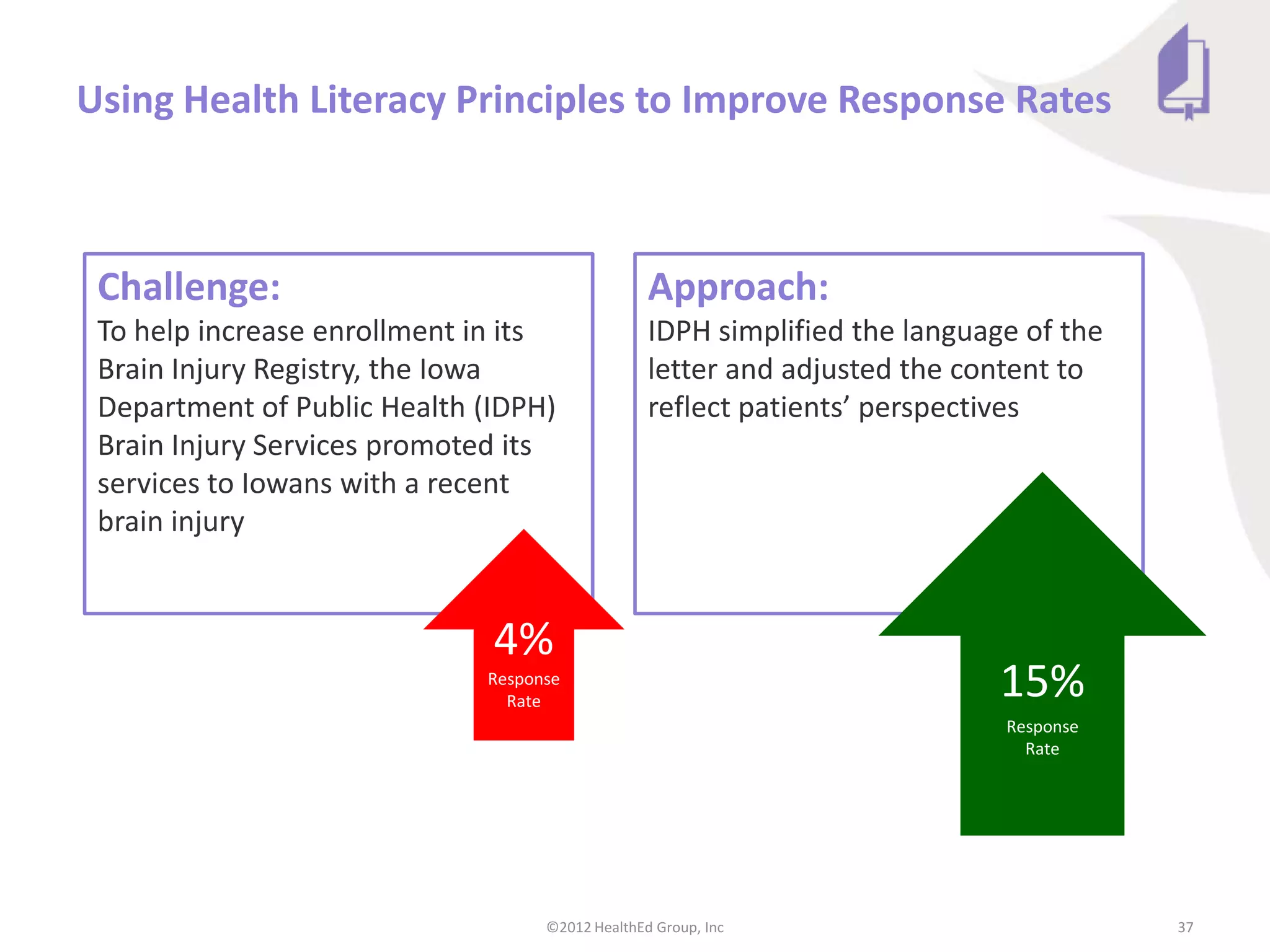
Using Health Literacy Principles to Improve Response Rates


 Challenge:                                      Approach:
 To help increase enrollment in its              IDPH simplified the language of the
 Brain Injury Registry, the Iowa                 letter and adjusted the content to
 Department of Public Health (IDPH)              reflect patients’ perspectives
 Brain Injury Services promoted its
 services to Iowans with a recent
 brain injury


                              4%
                             Response
                               Rate
                                                                            15%
                                                                            Response
                                                                              Rate


                                   ©2012 HealthEd Group, Inc                           37
Health Literacy Resources
       Centers for Disease Control*
       www.cdc.gov/healthliteracy

       Clear Health Communication
       www.pfizerhealthliteracy.com

       Health Resources and Service Administration*
       http://www.hrsa.gov/publichealth/healthliteracy/index.html

       US Department of Health and Human Services
       http://www.health.gov/communication/literacy/

       Health Literacy Missouri
       www.healthliteracymissouri.org

       Florida Literacy Coalition
       www.floridaliteracy.org

       A resource library of health literacy resources is also available at
       SurroundHealth®. Visit www.surroundhealth.net.
*Denotes free training available        ©2012 HealthEd Group, Inc             38
Summary
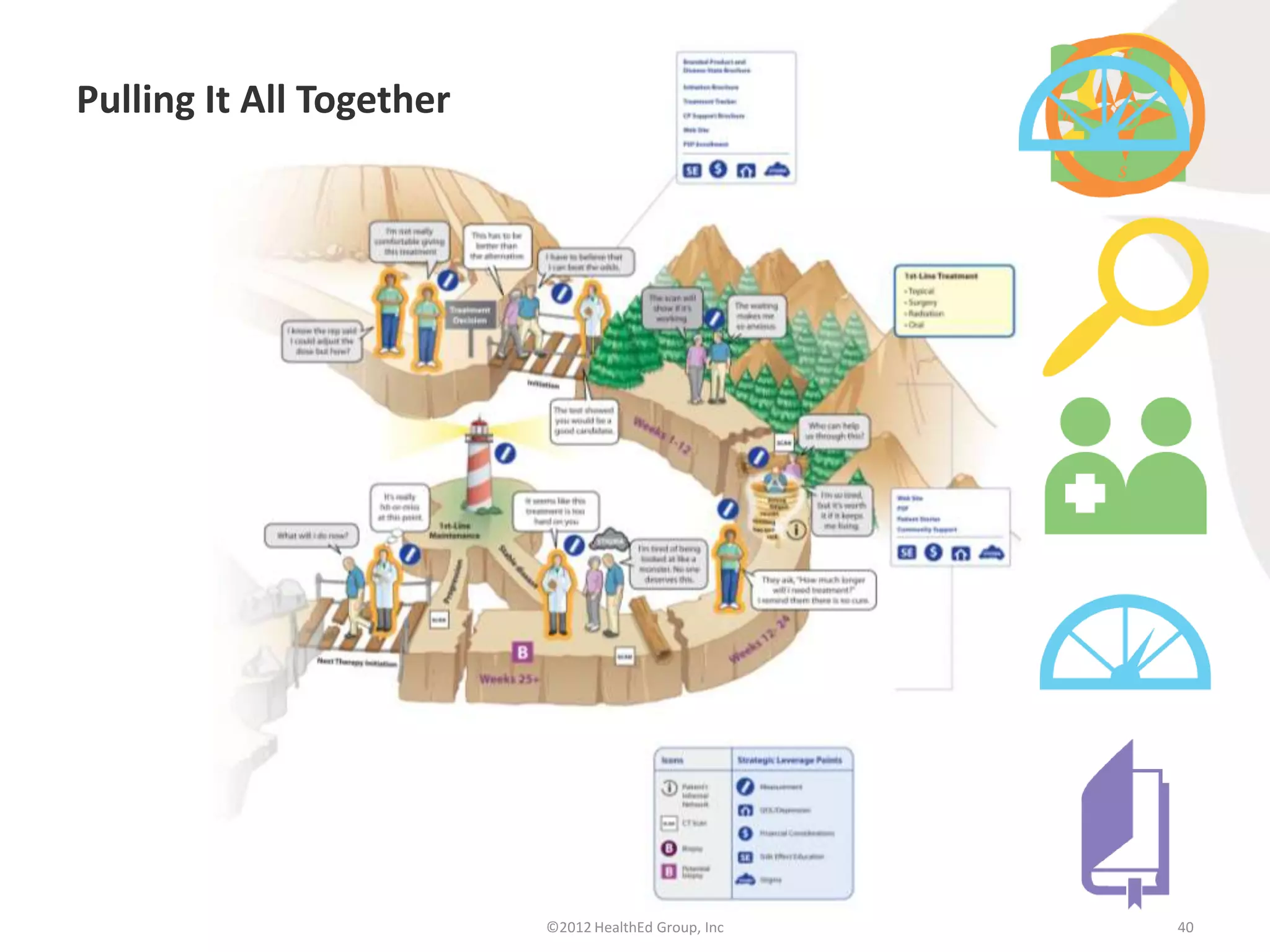
Pulling It All Together
                                                      c


                                                          c
                          ©2012 HealthEd Group, Inc           40
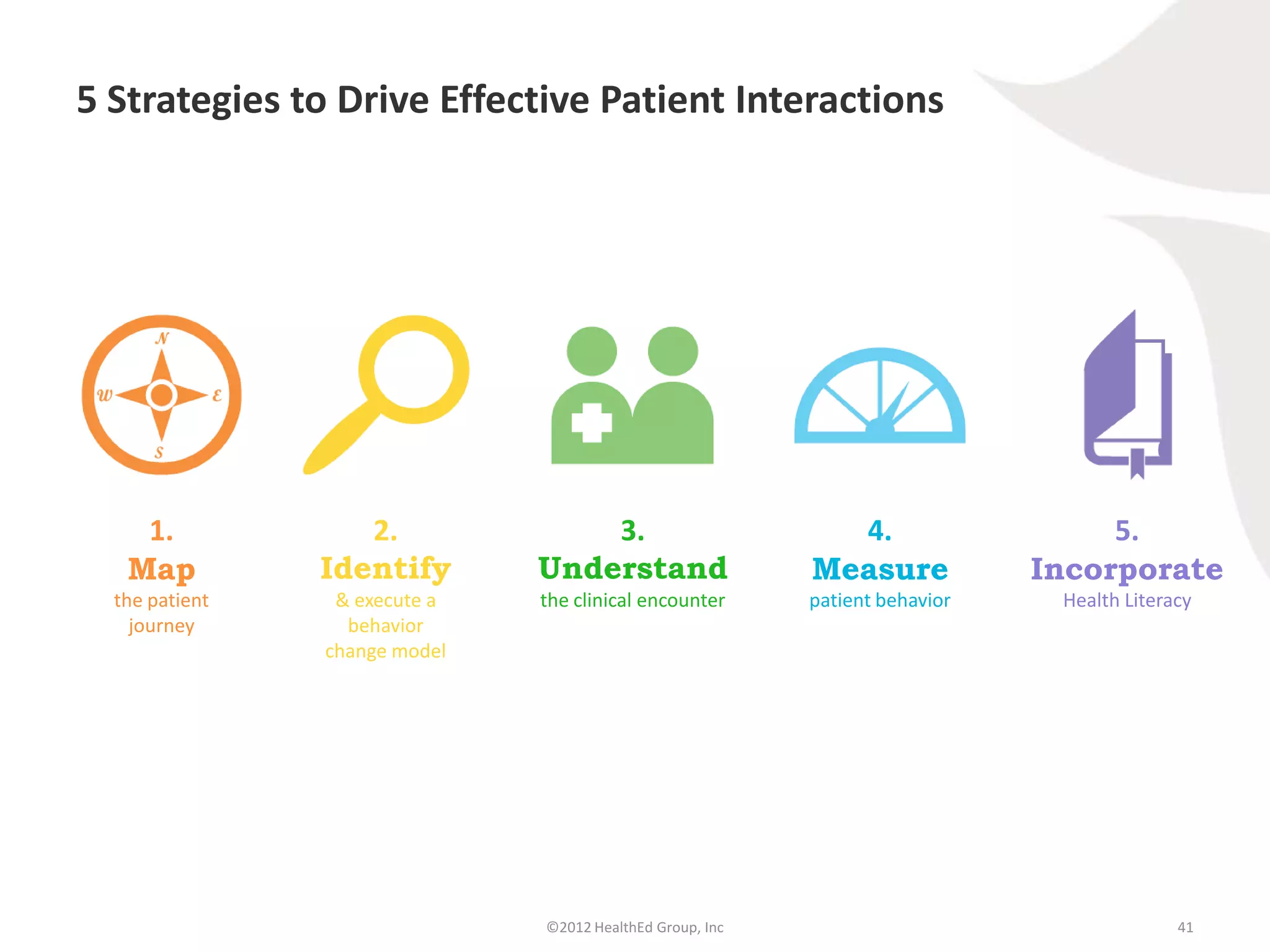
5 Strategies to Drive Effective Patient Interactions


    1.             2.              3.                        4.                    5.
   Map          Identify       Understand                  Measure            Incorporate
  the patient    & execute a   the clinical encounter      patient behavior    Health Literacy
    journey       behavior
                change model


                               ©2012 HealthEd Group, Inc                                    41
Thank You!

                        Liz Carden, MPH, CHES
               e.carden@thehealthedgroup.com


    For More Information, Please Contact:
                           Marissa Addalia
                             Vice President
                             908-379-2018
           m.addalia@thehealthedgroup.com

Adherence Begins Before Treatment: EXL Adherence Summit Presentation

  • 1.
    Adherence Begins BeforeTreatment: 5 Strategies You Must Consider to Drive Effective Patient Interactions ExL Pharma 2nd Patient Adherence Summit Philadelphia, PA February 23, 2012
  • 2.
  • 3.
    Marissa Addalia Liz Carden, MPH, CHES Manager, Vice President Health Education ©2012 HealthEd Group, Inc 3
  • 4.
    Integrated Insights DriveOur Educational Approach Insights Research Brand Objectives, Strategies, and Plans Clinical, Direct Care Experience Competitive Assessments Analysis and Assessment of Health Literacy and Buying Process Health Clear Communication Segmentation and Education Market Sizing Brand Adult Learning and Behavior Change Theory Strategy Positioning Educational Design Channel Strategies Current Program and Communication Assets/Metrics Online Conversation Mining ©2012 HealthEd Group, Inc 4
  • 5.
    Traditional Marketing Focus: HowPatients’ and Caregivers’ Lives Fit Into the World of the Brand RX This perspective may not allow programs or content to address real world barriers as patients and caregivers make choices and decisions on how to manage their health. ©2012 HealthEd Group, Inc 5
  • 6.
    Our Focus: How theBrand Fits Into Patients’ and Caregivers’ Lives Values, Emotions, Beliefs, and Attitudes Surrounding Knowledge Environment Support Network Self-efficacy ©2012 HealthEd Group, Inc 6
  • 7.
    5 Strategies YOU MUST CONSIDER TO DRIVE EFFECTIVE PATIENT INTERACTIONS
  • 8.
  • 9.
    1. Map thePatient Journey WHY? Patient journeys distill insights and translate emotional and environmental barriers to wellness into visual, actionable frameworks WHAT? An illustration highlighting: • Phases of the brand and/or disease journey • The patient and care partner experience • Landscape metaphors • Clinical treatment overview • Patients’ relationships with core clinicians • Key leverage points and aligned tactics ©2012 HealthEd Group, Inc 9
  • 10.
    Begin by MiningInsights Ethnographies Focus Groups/ IDIs Brand Insights Mining Literature Brand Research Review Research Sources Qualitative Social Media Research Quantitative Research ©2012 HealthEd Group, Inc 10
  • 11.
    Insights Inform thePatient Journey ©2012 HealthEd Group, Inc 11
  • 12.
    Rheumatoid Arthritis ©2012 HealthEd Group, Inc 12
  • 13.
    Hemophilia ©2012 HealthEd Group, Inc 13
  • 14.
    Alzheimer’s ©2012 HealthEd Group, Inc 14
  • 15.
    SNAPSHOT The Metastatic MelanomaPatient Journey ©2012 HealthEd Group, Inc 15
  • 16.
  • 17.
    2. Identify andExecute a Behavior Change Model Behavior change models explain people’s behaviors– as well as how they can be influenced to change • Identify patterns and how educational programs can influence them • Consider environmental, emotional, social, and behavior characteristics • Expand understanding about barriers and motivators • Allow us to “predict” behaviors when coupled with the journey to set up appropriate interventions ©2012 HealthEd Group, Inc 17
  • 18.
    Some of theValidated Behavior Change Models Cognitive Dissonance Health Belief Model Theory Theory of Planned Behavior Theory of Reasoned Action Social Cognitive Theory Stages of Change Transactional Model of Stress and Coping Horne’s Model of Medication Adherence Health Action Process Approach …and more! ©2012 HealthEd Group, Inc 18
  • 19.
    Traditional Pharma Model Awareness Conversion Initiation Adherence ©2012 HealthEd Group, Inc 19
  • 20.
    The Health BeliefModel Construct Description Perceived The patients believe they are at risk for the susceptibility condition or for the condition getting worse Perceived severity The patients believe the condition is severe and urgent Perceived barriers The patients’ assessment of the influences that discourage the action Perceived benefits The patients’ assessment of the influences that encourage the action Perceived efficacy The patients’ belief that they can adopt the action Cues to action External influences prompting the behavior ©2012 HealthEd Group, Inc 20
  • 21.
    SNAPSHOT The Metastatic MelanomaPatient Journey • Perceived susceptibility • Perceived severity • Perceived barriers • Perceived benefits • Perceived efficacy • Cues to action ©2012 HealthEd Group, Inc 21
  • 22.
    SNAPSHOT The Metastatic MelanomaPatient Journey • Perceived susceptibility • Perceived severity • Perceived barriers • Perceived benefits • Perceived efficacy • Cues to action ©2012 HealthEd Group, Inc 22
  • 23.
  • 24.
    3. Understand theClinical Encounter The multidimensional dynamics of the healthcare environment and the influencers of patient success ©2012 HealthEd Group, Inc 24
  • 25.
    Recognize the DominoEffect ©2012 HealthEd Group, Inc 25 25
  • 26.
    SNAPSHOT The Metastatic MelanomaPatient Journey ©2012 HealthEd Group, Inc 26
  • 27.
  • 28.
    4. Measure PatientBehavior Focus on showing a measurable incremental positive impact • Change in skills • Change in knowledge • Change in attitudes and behavior model metrics • Change in behavioral intention ACTIVELY ACTIVELY DISENGAGED ENGAGED ©2012 HealthEd Group, Inc 28
  • 29.
    Where to FindMeasurement Opportunities Behavioral Skills Knowledge Attitudes Intention • Enriching doctor-patient • Increasing patients’ • Increasing patients’ • Driving patients to communication knowledge about their perceived benefit of specific calls to action • Improving patients’ disease and skills to cope treatment and (e.g., join support ability to understand and with their treatment understanding of the program, refill script, follow treatment routine reasons why medication make an appointment is needed with HCP) • Increasing patients’ • Increasing patients’ motivation to begin and intent to follow medical stay on treatment routine • Setting patients’ expectations about treatment • Increasing patients’ confidence in their ability to follow treatment regimen • Reducing fear of possible side effects • Reducing feelings of stigma because of the disease ©2012 HealthEd Group, Inc 29
  • 30.
    SNAPSHOT The Metastatic MelanomaPatient Journey ©2012 HealthEd Group, Inc 30
  • 31.
  • 32.
    5. Incorporate HealthLiteracy More Than Reading Health-Related Information Health literacy is defined as: The ability to find, understand, and use basic health information and services needed to make appropriate health decisions Within healthcare, patients require health literacy skills to: • Find health information • Interact with healthcare providers (HCPs) They also need the skills to: • Self-manage a health condition • Navigate the healthcare system ©2012 HealthEd Group, Inc 32
  • 33.
    Low Health Literacy:An Example http://www.youtube.com/watch?v=dMAS2S51bM8 ©2012 HealthEd Group, Inc 33
  • 34.
    The Impact ofLow Health Literacy 90 million Americans are at risk for not acting on health information because of low health literacy, regardless of age, income, race, or background The cost of limited health literacy to the nation’s economy is estimated to be between $106 billion and $236 billion per year 1. Weiss BD. Health Literacy and Patient Safety: Help Patients Understand. 2nd ed. American Medical Association; 2007. 2. Vernon JA et al. 2007. Low Health Literacy: Implications for National Health Policy. http://www.gwumc.edu; 2007. ©2012 HealthEd Group, Inc. 34
  • 35.
    Why Utilize HealthLiteracy Principles? • Better comprehension = greater adherence • Greater financial impact • Required by governing bodies ©2012 HealthEd Group, Inc 35
  • 36.
    Skin Care –Before/After ©2012 HealthEd Group, Inc 36
  • 37.
    Using Health LiteracyPrinciples to Improve Response Rates Challenge: Approach: To help increase enrollment in its IDPH simplified the language of the Brain Injury Registry, the Iowa letter and adjusted the content to Department of Public Health (IDPH) reflect patients’ perspectives Brain Injury Services promoted its services to Iowans with a recent brain injury 4% Response Rate 15% Response Rate ©2012 HealthEd Group, Inc 37
  • 38.
    Health Literacy Resources Centers for Disease Control* www.cdc.gov/healthliteracy Clear Health Communication www.pfizerhealthliteracy.com Health Resources and Service Administration* http://www.hrsa.gov/publichealth/healthliteracy/index.html US Department of Health and Human Services http://www.health.gov/communication/literacy/ Health Literacy Missouri www.healthliteracymissouri.org Florida Literacy Coalition www.floridaliteracy.org A resource library of health literacy resources is also available at SurroundHealth®. Visit www.surroundhealth.net. *Denotes free training available ©2012 HealthEd Group, Inc 38
  • 39.
  • 40.
    Pulling It AllTogether c c ©2012 HealthEd Group, Inc 40
  • 41.
    5 Strategies toDrive Effective Patient Interactions 1. 2. 3. 4. 5. Map Identify Understand Measure Incorporate the patient & execute a the clinical encounter patient behavior Health Literacy journey behavior change model ©2012 HealthEd Group, Inc 41
  • 42.
    Thank You! Liz Carden, MPH, CHES e.carden@thehealthedgroup.com For More Information, Please Contact: Marissa Addalia Vice President 908-379-2018 m.addalia@thehealthedgroup.com

Editor's Notes

  • #7 Instead we suggest a different approach- by placing the patient as the center of the marketing focus and acknowledging and messaging to their values…. (barriers and motivators to behavior), Knowledge (about disease, and rx, treatment experience, gaps and myths), self efficacy (skills and self confidence, practice skills), Support network (family and friends, online discussions and resources, advocacy organizations, and HCP team) and their surrounding environment (socio economic factors, family/other personal, their experience with the disease, and access and coverage)
  • #10 A patient journey supports all phases of the brand experience including adherence to act as a frame work to developMessaging platformsConcept developmentTactical development Suggests timing and cadence needs based on patient experiencesBegins with an understanding of the step by step process or “journey” from initial diagnosis to treatment initiation, to successful treatment, including side effect management and adherenceThe journey features the patient pathway, the relevant insights along the way and maps the educational needs of the patient at each critical stepProvides a “snapshot” in timeHelps identify “key leverageable moments” that can be aligned with tactical interventions
  • #16 To find and fill gaps and needs to build successful adherence, the brand needs to identify what experiences all journeys consider:PhysicalEmotionalSocialClinicalEducationSkillsThe treatments that patients have already experienced with brandsInteractions with caregivers and cliniciansBy recognizing this journey- and in particular for this purpose- at adherence behaviors, we can intervene tactically to combat those barriers a patient is anticipated to face while successfully setting them up for adherence, before they even take the first dose.
  • #18 Overall, behavior models – both theoretical and proven- help to provide a framework to identify and ultimately shape or change behaviors. This includes helping to predict an individuals ability to adhere to a treatment regimine and provide tactics to help encourage adherence.
  • #19 There are many different types of behavior change models and many that could fit into a disease state, but there are 3 factors to consider when working with a behavior change model and a brand- 1. The brand objective, 2. The patients experience and 3. the disease state. Evaluating these factors and validating them with clinical research will help provide your brand with a framework for behavior change.
  • #20 The traditional pharma model is broken into 4 stages and tends to be more superficial. We suggest looking at it a little different
  • #22 We can use the HBM to recognize these areas of concern, for example, when first starting a treatment for metastatic melanoma, if the patient doesn’t believe that the condition is serious, that he wont continue to be susceptible to it- then the chances for him being adherent to the treatment are pretty poor. Thankfully- we can provide tactical interventions to help him successfully start treatment- and provide him with the skills, beliefs and attitudes to remain adherent.
  • #23 After establishing patterns, barriers, motivators and key areas of need, we can intervene tactically
  • #25 Brands need to recognize that the clinical encounter involves more than the doctor to patient interaction. Its actually a series of very dynamic relationships and the true clinical encounter takes into account interactions and communication between multiple stakeholders as well as recognizing, and addressing their needs.
  • #26 Patients are often seen as an extension of the marketing experienceIntricate relationships exist between HCP’s and patients and how they interactBy layering a patient journey with the clinical encounter, we can understand the multidimensional dynamics of the healthcare environment and the influencers of patient successNote that some interactions that should be evaluated include those that are NOT so common or top of mind .For example, patient to patient, patient to caregiver, HCP to pharmacist, or the brand to the pharmacist.
  • #27 Layering on these clinical encounters then can tell us more than just the patient experience- rather it can illustrate the dynamic experience between patients, nurses, doctors, support groups, caregivers and other HCP’s- which can then be messaged to.
  • #33 Great deal of reasons for low health literacy -Stress and anxiety (including in the doctors office)-Use of unfamiliar technical languageLearning disabilitiesLack of educational opportunityCognitive ability reduced with ageESLPatients need to be able to find information:On the Internet, andThrough health and advocacy organizations (to request information and support)They must also be able to:Understand treatment choices and recommendationsInterpret descriptions of treatment efficacy and risks for disease recurrence or progression—many of which use numerical concepts such as percentages and probabilityAsk questions for clarificationUnderstand a risk evaluation and mitigation strategies (REMS)–related consent form that describes the possible risks of taking a product In addition, patients should be able to:Interpret charts and labels Decide when to take a medication and what dose to takeKeep track of medications taken and doctor appointments, symptoms, side effects, and progress
  • #34 Although humorous in nature, not too far from what we experience in real life
  • #35 According to the NAAL study, Only 12% of Americans are proficient in health literacy skills.9 out of ten Americans have difficulty using everyday health information to make good healthcare decisions (including medicine choices, taking medicine, and knowing how to take)And low health literacy does not mean low IQWhen they cannot find or understand that information, the healthcare industry also pays the price
  • #37 Our clients recognized the value in making materials health literacy and addressing comprehension issues to help patients move along their journey and stay adherent. In evaluating the materials against the core health literacy principles of content, layout, interaction, and design, we noticed some key weak points- and then (TRANSITION) revised the materials to meet health literacy principles. The layout now includes a lower reading level, more white space, chunked information, dual coding, and interactivity to name a few. It also includes principles from the behavior model such as self-efficacy, cues to action while overcoming adherence barriers.
  • #39 These resources also contain tools such as measurement tools, guidelines, and checklists
  • #41 The patient journeyThe behavioral modelTactical interventions aligned against the model and journeyThe clinical encounterMeasurementThe dynamic relationship of all 5 considerations drive a strong, targeted and effective brand experience that fosters adherence.
  • #42 Key takeaway: brands can drive more effective patient interactions…when they effectively position patients at the center of their adherence strategyTalk with us or other HealthEd attendees to learn more