
GUIDES IN ADHD
Dr Hussein Abdeldayem, MD
Head of Ped Neurology Unit, Faculty of Medicine
ADHD is the most commonly
neuro- behavioral disorder in childhood


                     ADHD: Clinical Practice Guideline…..
                     American Academy of Pediatric, 2011
Shifts in Conceptualizing ADHD Through the years:
•   1902 Defects in moral character
•   1934 Organically driven
•   1940 Minimal Brain Syndrome
•   1957 Hyperkinetic Impulse Disorder
•   1960 Minimal Brain Dysfunction (MBD)
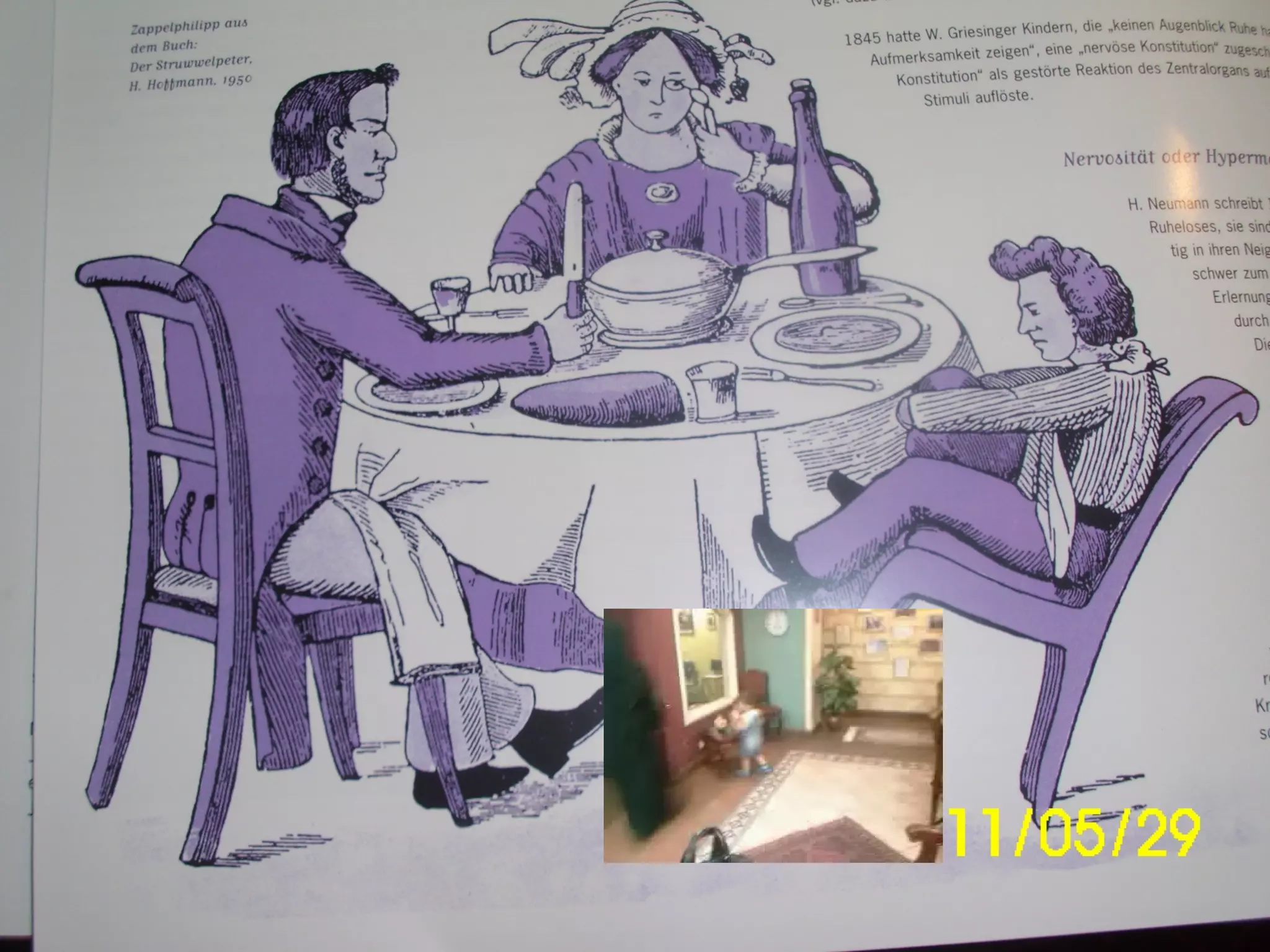
•   1968 Hyperkinetic Reaction of Childhood (DSM II)
• 1980 ADD (DSM III)
  - with hyperactivity - without hyperactivity
  - residual type
• 1987 ADHD (only combined symptoms)
• 1994 AD/HD – 3 TYPES (DSM IV)
  Combined Type ( 50-70%), Inattentive type (~30%),
  Hyperactive-Impulsive Type (~10%)
•
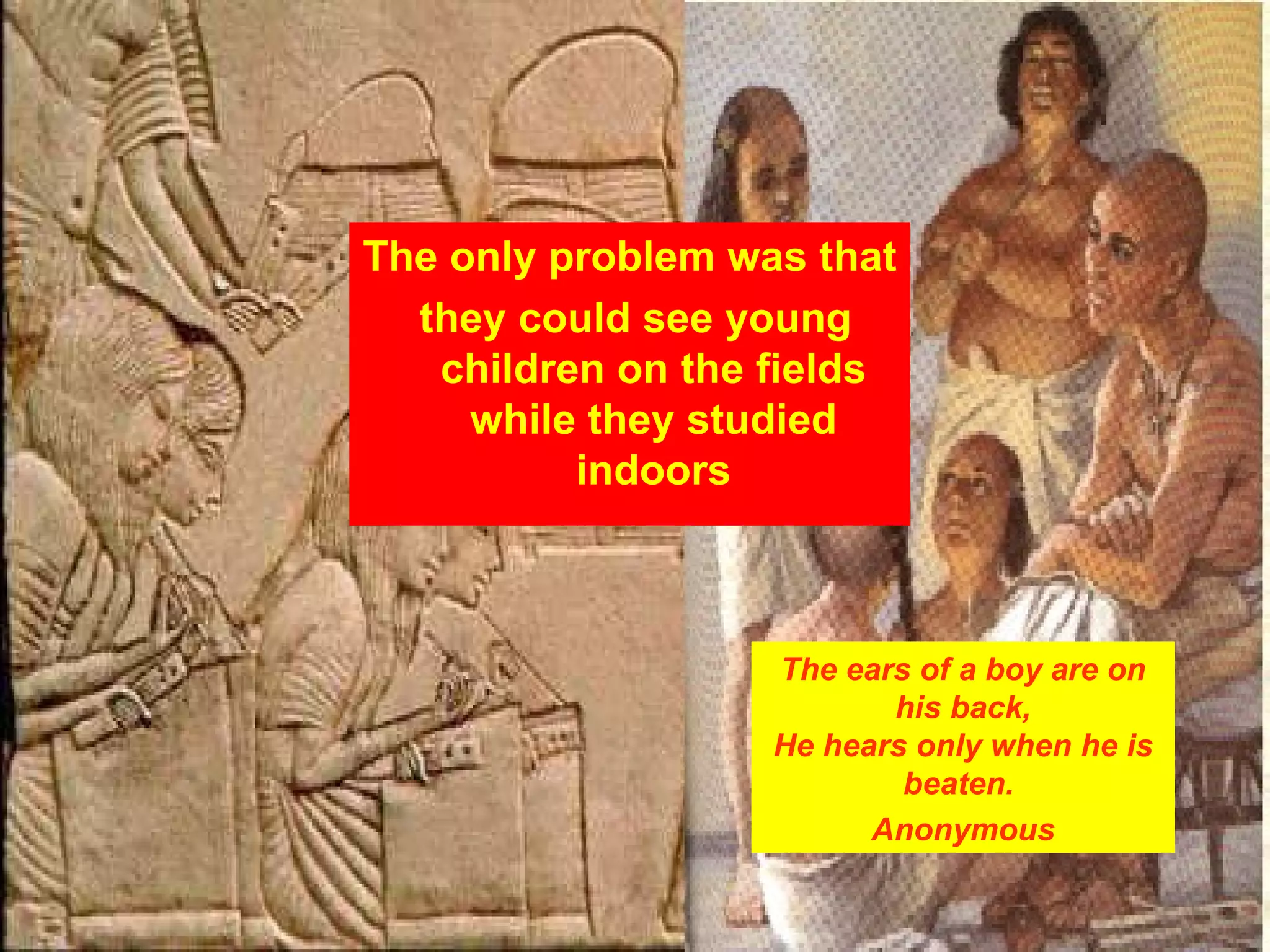
The only problem was that
  they could see young
   children on the fields
     while they studied
          indoors


                   The ears of a boy are on
                          his back,
                   He hears only when he is
                           beaten.
                         Anonymous
• DSM-5: Future of Psychiatric Diagnosis
• Publication of the fifth edition of
• Diagnostic and Statistical Manual of Mental
  Disorders (DSM-5)
• in May 2013
Updated May 1, 2012

A 06 Attention Deficit/Hyperactivity Disorder
                                           Recommendations for severity criteria for
                                           this disorder are forthcoming
AD/HD consists of a pattern of behavior that is present in multiple settings where it
gives rise to social, educational or work performance difficulties.
A. Either (A1) and/or (A2).
A1. Inattention
A2. Hyperactivity and Impulsivity

Six (or more) of the following symptoms have persisted for at least 6 months to a
degree that is inconsistent with developmental level and that impact directly on
social and academic/occupational activities.

A 07 Attention Deficit/Hyperactivity Disorder Not Elsewhere Classified
                                          No severity criteria are being
                                          recommended for this disorder at the
                                          current time
??????ADHD
         Deficient Vz Disturbance

•   %

•   Boys > girls

•   Age onset > 4 yr
7% to 9%
                        ???
•   7-9% of children and adolescents
•   Adults : 4 - 5 % of adults
•   All levels of socioeconomic
•   All levels of IQ


                       Estimates of worldwide prevalence of
                       ADHD among school aged children vary
                       from 2.4–19.8%
                                        Biol Psychiatry 2011
Boys >Girls ????

6 : 1 to 12 : 1 to
        3:1
AD/HD
in school aged children
 Educational disorder


    7 years old age
onset


   >4y


  >2 year
            2010
ADHD
                 Preschoolers
• Y Sleep problems
• S Colic

•   C Constantly in motion
•   C Unresponsive to requests
•   U Trouble staying seated
•   T Demanding of attention
•   D Rapidly shift from one activity to another
•   R Resist passive activities
•   R Wander off alone
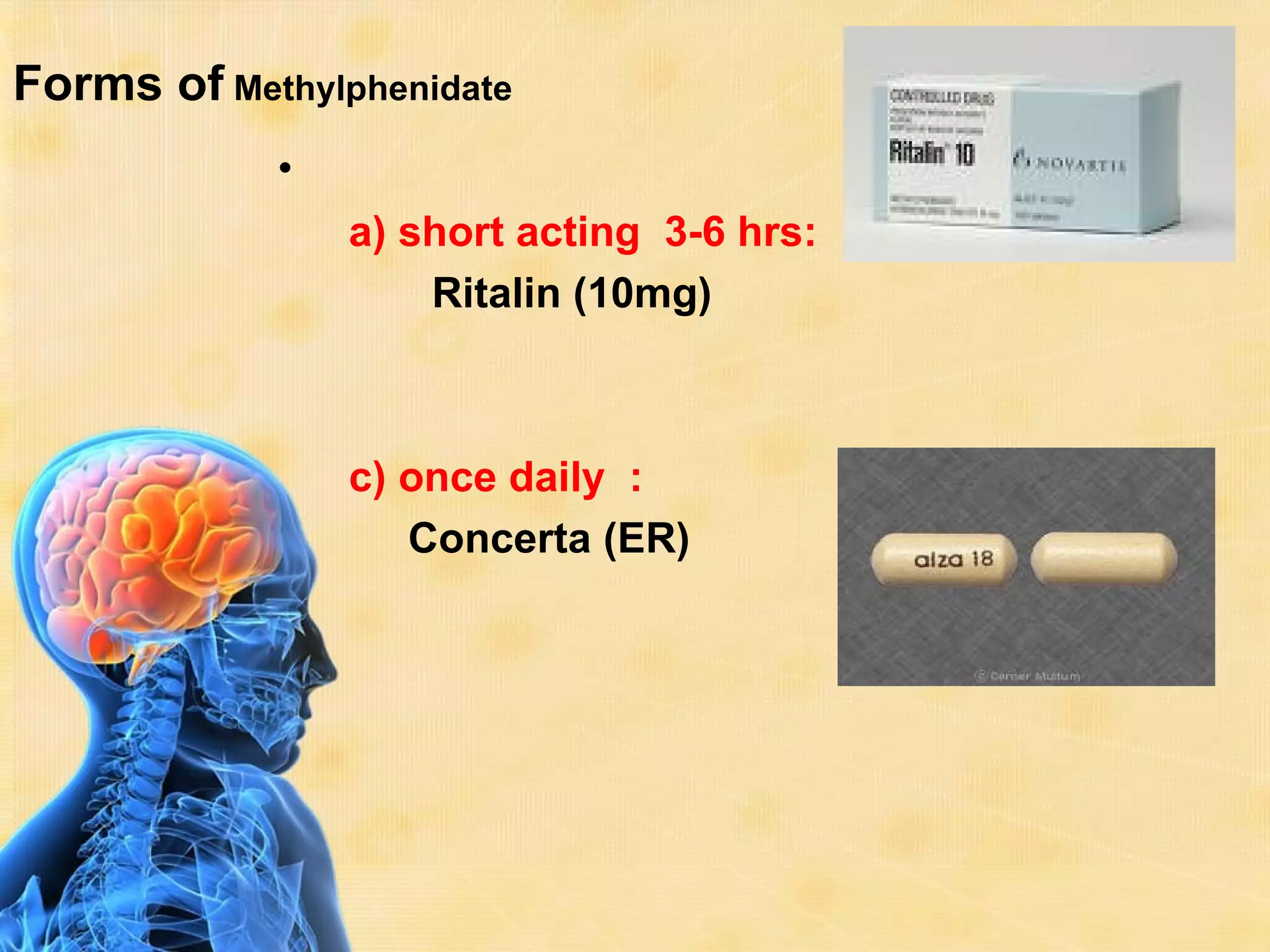
•   W Inappropriate touching/handling objects
‫‪SCHOOL AGE‬‬
        ‫‪ ‬سهولة التشتت بالمثيرات الخارجية‬
                            ‫‪ ‬الحركة الساكنة‬
           ‫‪ ‬عدم القدرة على إتباع التعليمات‬
               ‫‪ ‬عدم القدرة على إنتظار الدور‬
     ‫‪ ‬الستجابة السريعة قبل إكتمال المهمة‬
  ‫‪ ‬عدم القدرة على الحتفاظ بالنتباه للمهمة‬
‫‪ ‬النتقال من مهمة إلى إخرى دون إستكمالها‬


       ‫‪Not time specific‬‬
                             ‫ع3 +‬
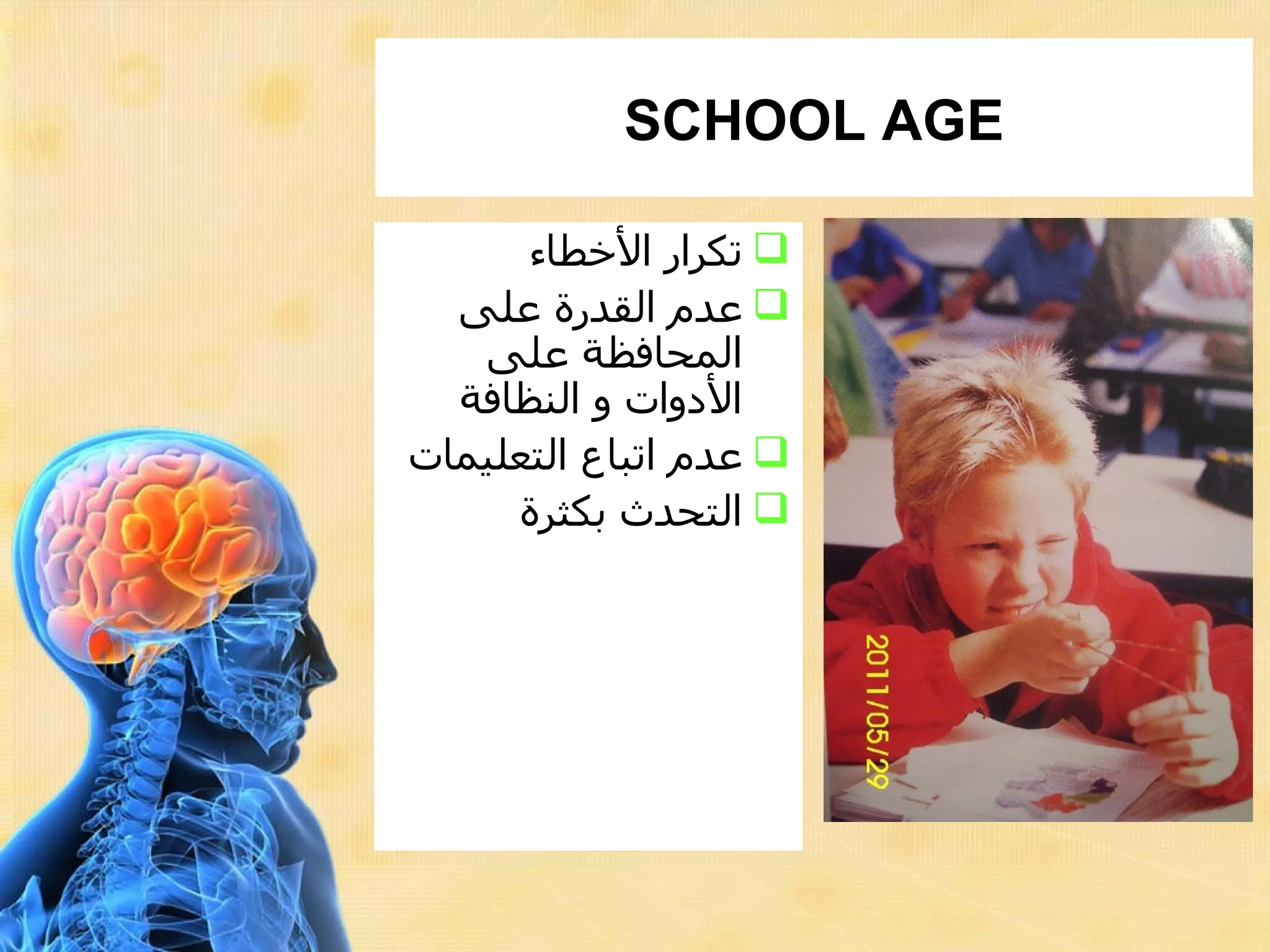
‫‪SCHOOL AGE‬‬

      ‫‪ ‬تكرار الخطاء‬
  ‫‪ ‬عدم القدرة على‬
   ‫المحافظة على‬
  ‫الدوات و النظافة‬
‫‪ ‬عدم اتباع التعليمات‬
     ‫‪ ‬التحدث بكثرة‬
AD/HD
         Adolescence and Adult


                         15%

   85%

         undiagnosed


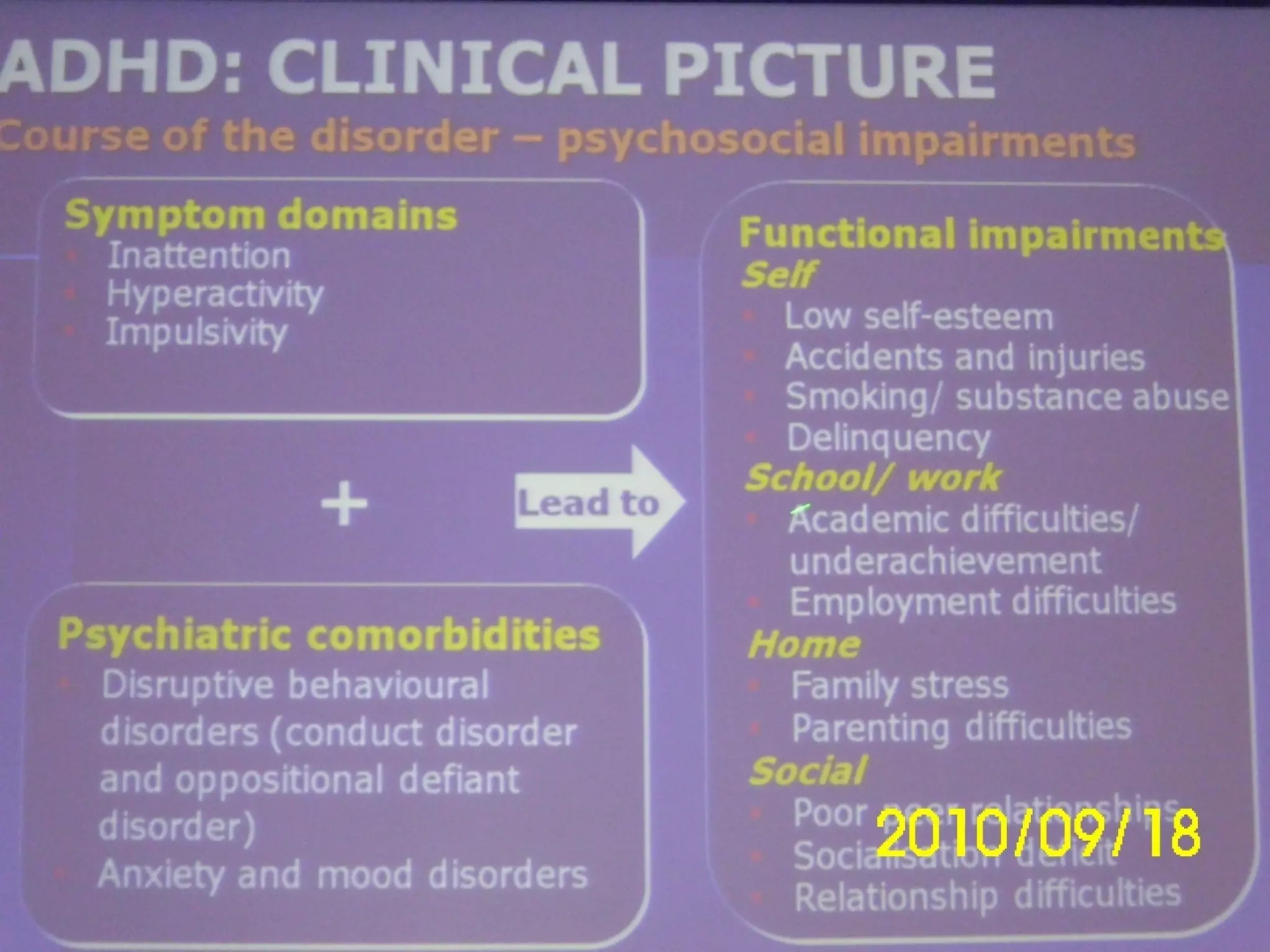
Occupational impairment, increased family
dysfunction, driving risks and SUD
ADHD in Adolescence

•   Low self-esteem
•   Bad interpersonal relationships
•   SUD
•   Delinquency
Adult ADHD
•   Family
•   Work
•   Friends
•   Accident
•   Addiction


    Attention-Deficit Disorder Isn't Just for Kids.
    Why Adults Are Now Being Diagnosed, Too

    Wall Street Journal April 2010
What is ADHD ?
What is ADHD ? EF
Impairment of Executive Function set and
       development ‫المدير التنفيذى‬
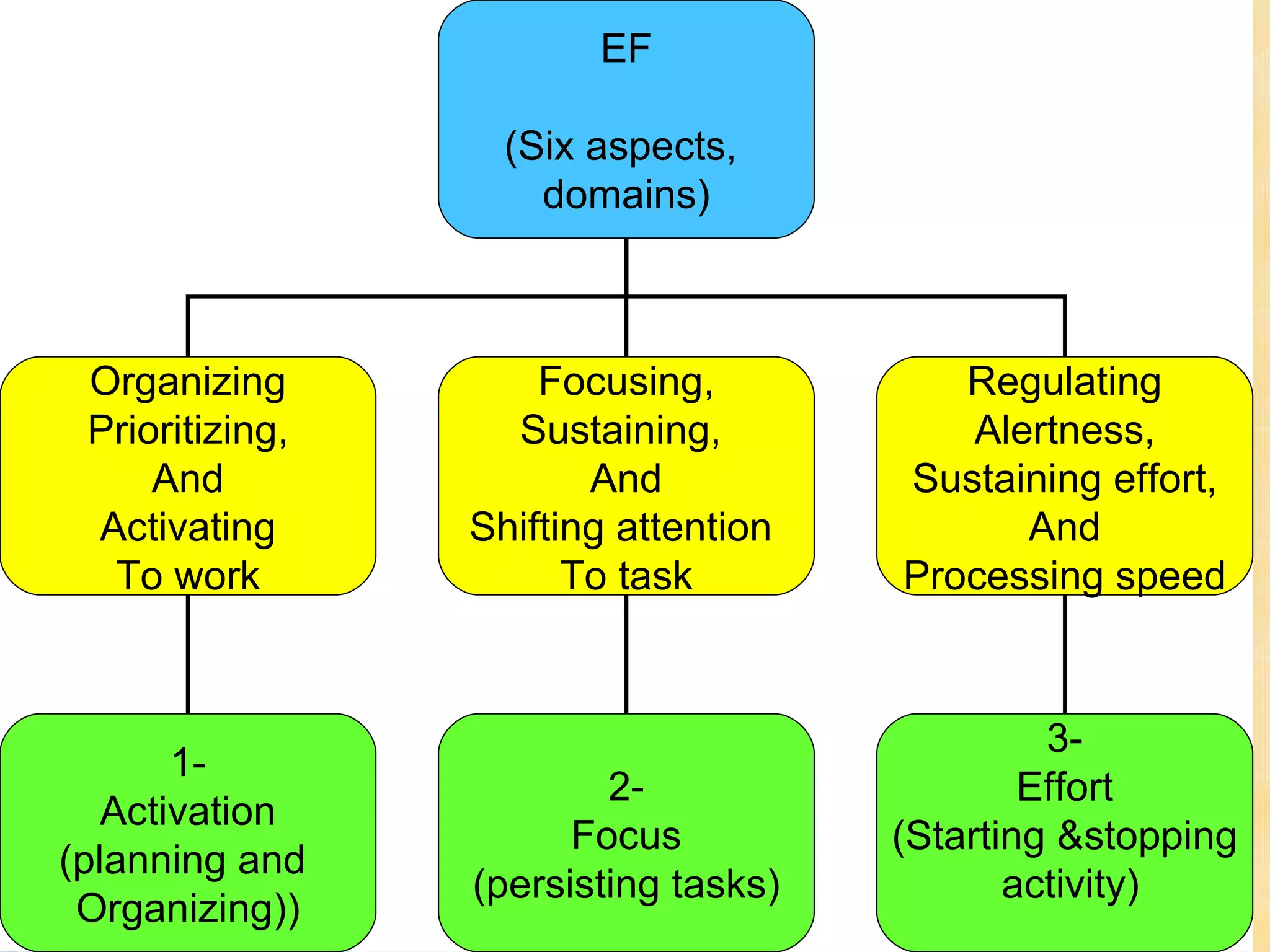
EF

                   (Six aspects,
                     domains)


 Organizing          Focusing,           Regulating
 Prioritizing,     Sustaining,           Alertness,
     And                And           Sustaining effort,
 Activating      Shifting attention         And
  To work              To task        Processing speed


                                               3-
       1-
                         2-                   Effort
   Activation
                       Focus          (Starting &stopping
(planning and
                 (persisting tasks)          activity)
 Organizing))
EF
                            (cont.)


                       Utilizing working
                                             Monitoring
Managing frustration        Memory
                                                  And
        And                    And
                                            Self-regulating
Modulating emotions    Accessing recall
                                                 action


                                                  6-
        4-                     5-
                                                Action
     Emotion                Memory
                                           (Problem solving)
(managing behavior)    (working memory)
Effects of ADHD on EF
1-response inhibition
2- planning
3- time response/set shifting
4- working memory
5- inner talk
6- emotional stability/lability
7- expectation
When are ADHD
impairments Noticeable?
• some: preschool
• Some : middle elementary school
• Some : college or later


               Most in 1ry school
Executive Functions
challenges
may reveal Weakness
• EF weakness may not noticeable until
  one’s self-management is challenged by
  increased demands of adult life


                         EEG
                         ECG
Executive Functions
Development and Demands
• In early childhood, others perform all
  executive functions for the child (parents,
  sibs and other caretakers)
• Thereafter, the child should be able (or is
  forced to) perform these functions for self


                             Onset before 7
PATHOGENESIS
summary
• structural and functional imaging studies
  suggest that dysfunction of cingulate,
  frontal, and parietal cortical regions and
  imbalances in the dopaminergic and
  noradrenergic systems, contribute to the
  pathophysiology of ADHD
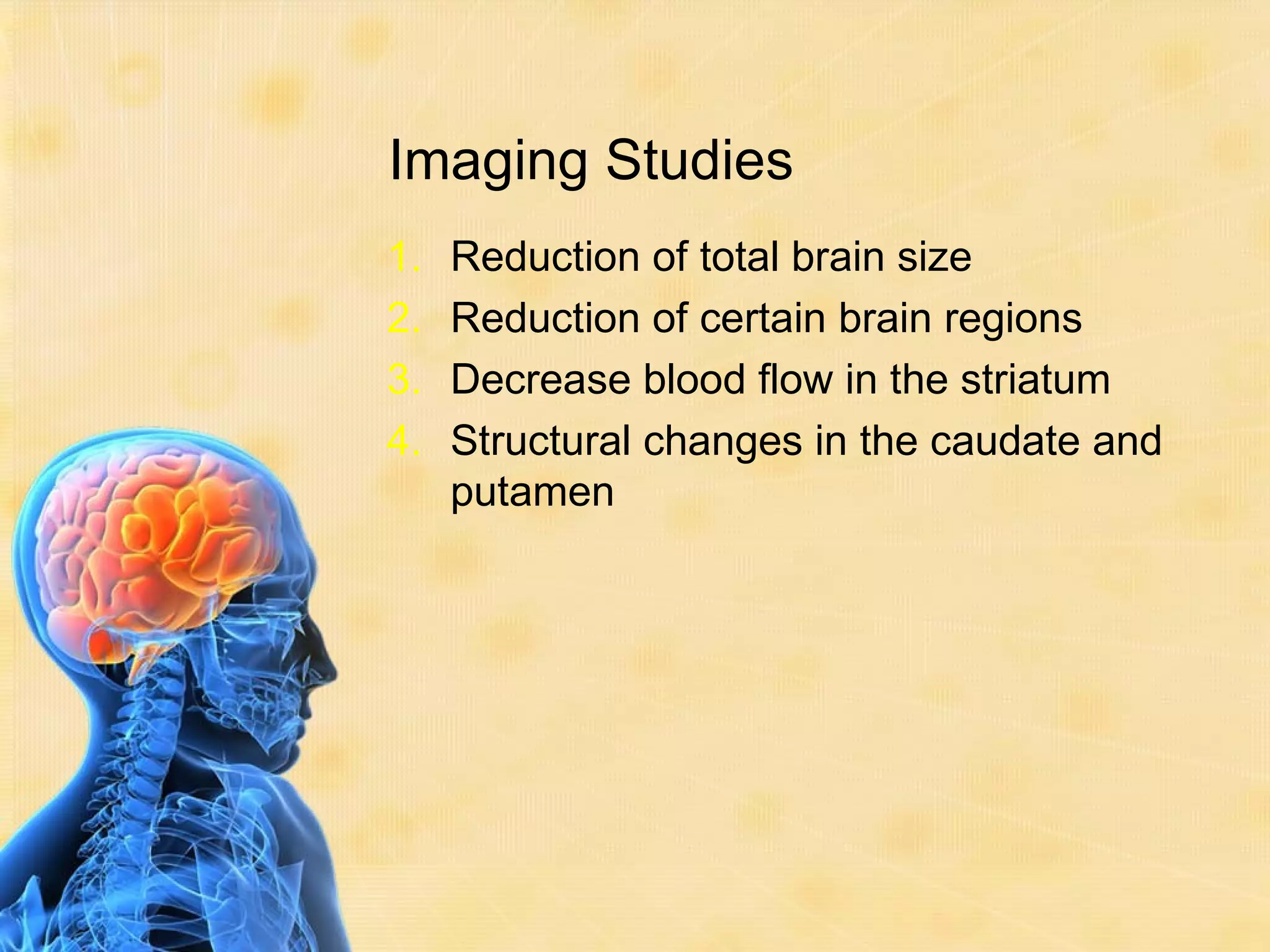
Imaging Studies
1.   Reduction of total brain size
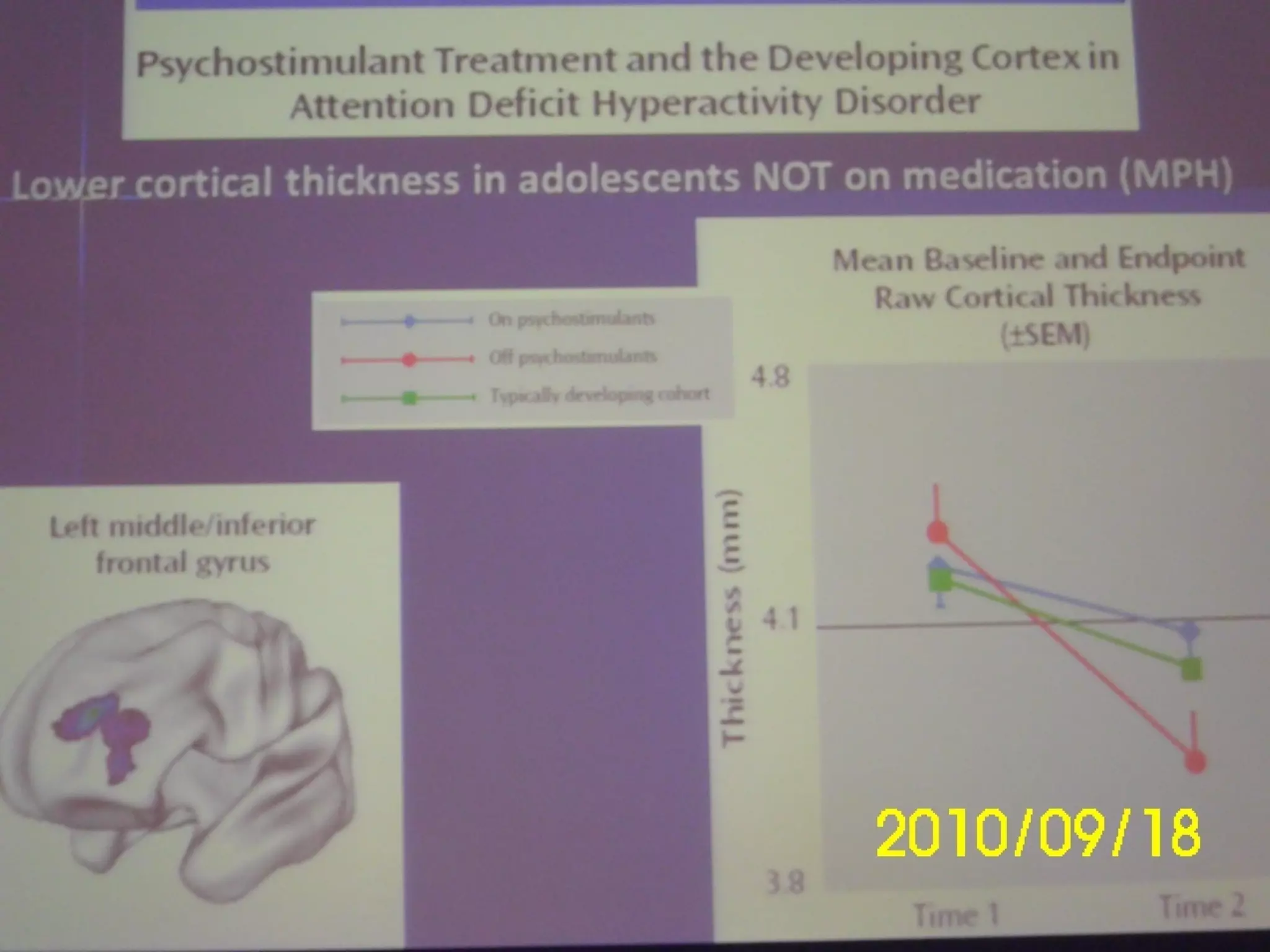
2.   Reduction of certain brain regions
3.   Decrease blood flow in the striatum
4.   Structural changes in the caudate and
     putamen
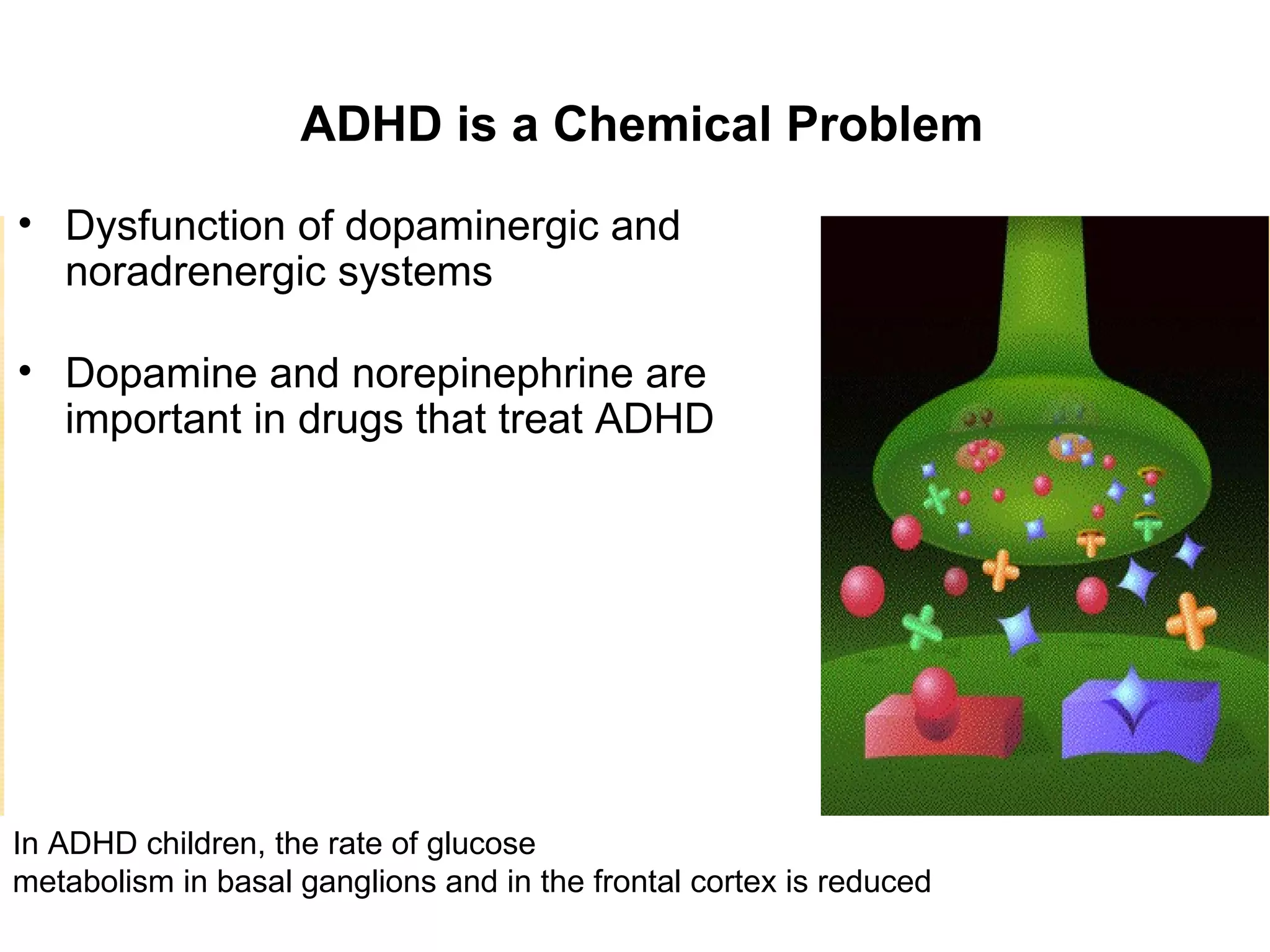
ADHD is a Chemical Problem
• Dysfunction of dopaminergic and
  noradrenergic systems

• Dopamine and norepinephrine are
  important in drugs that treat ADHD


In ADHD children, the rate of glucose
metabolism in basal ganglions and in the frontal cortex is reduced
EF networks depends 1ry
                         on 2 chemicals

Dopamine               Norepinephrine


           Not release and reload effectively
           Medications : slow reuptake so longer in
            contact with receptors
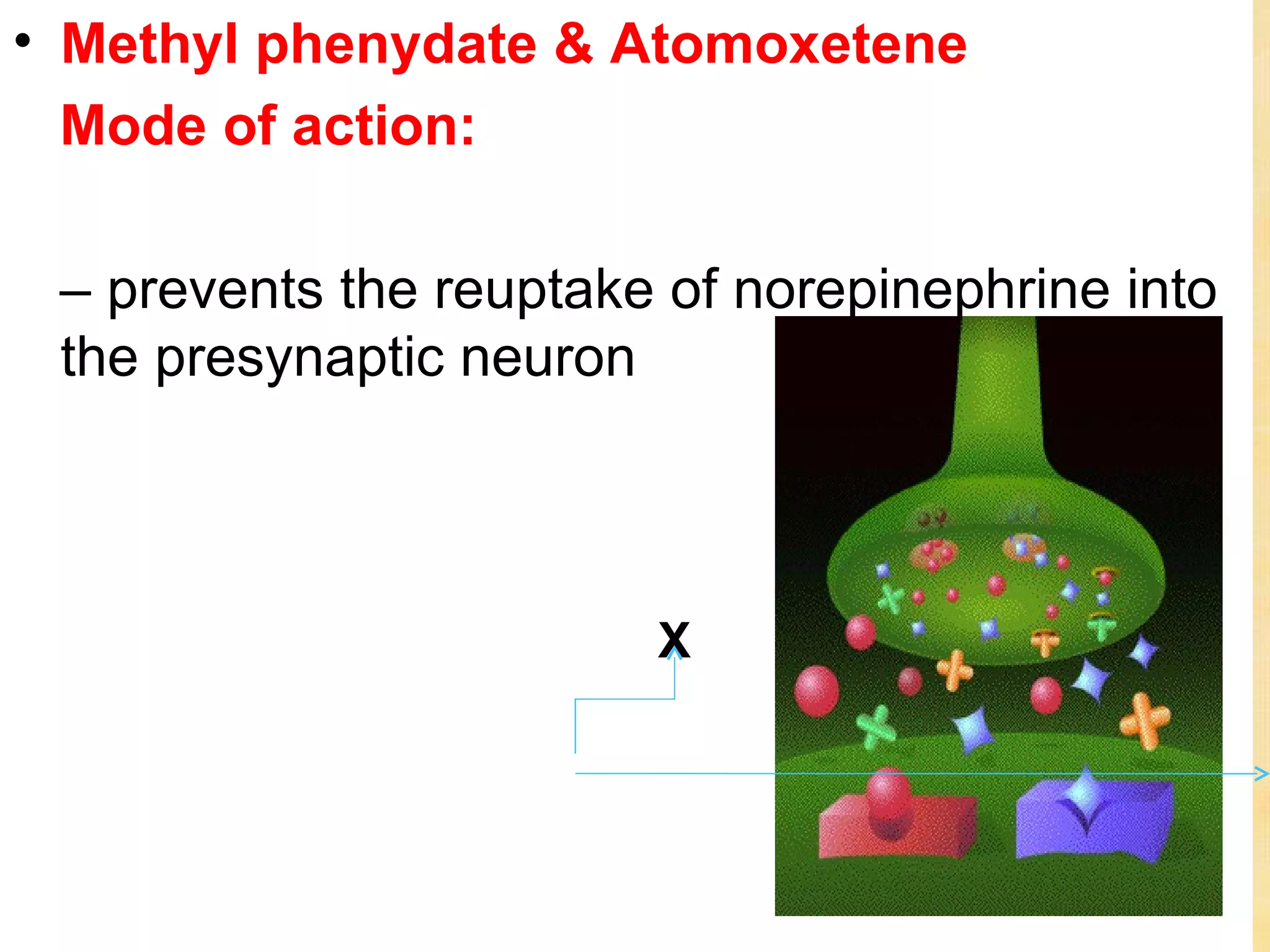
• Methyl phenydate & Atomoxetene
  Mode of action:

 – prevents the reuptake of norepinephrine into
 the presynaptic neuron


                        X
AETIOLOGY
I AM A BUSY MOTHER
            or

WE ARE NOT A GOOD FAMILY
           or

  HE IS A SPOILED BABY
1
1- Hereditary ADHD


Twin. adoption
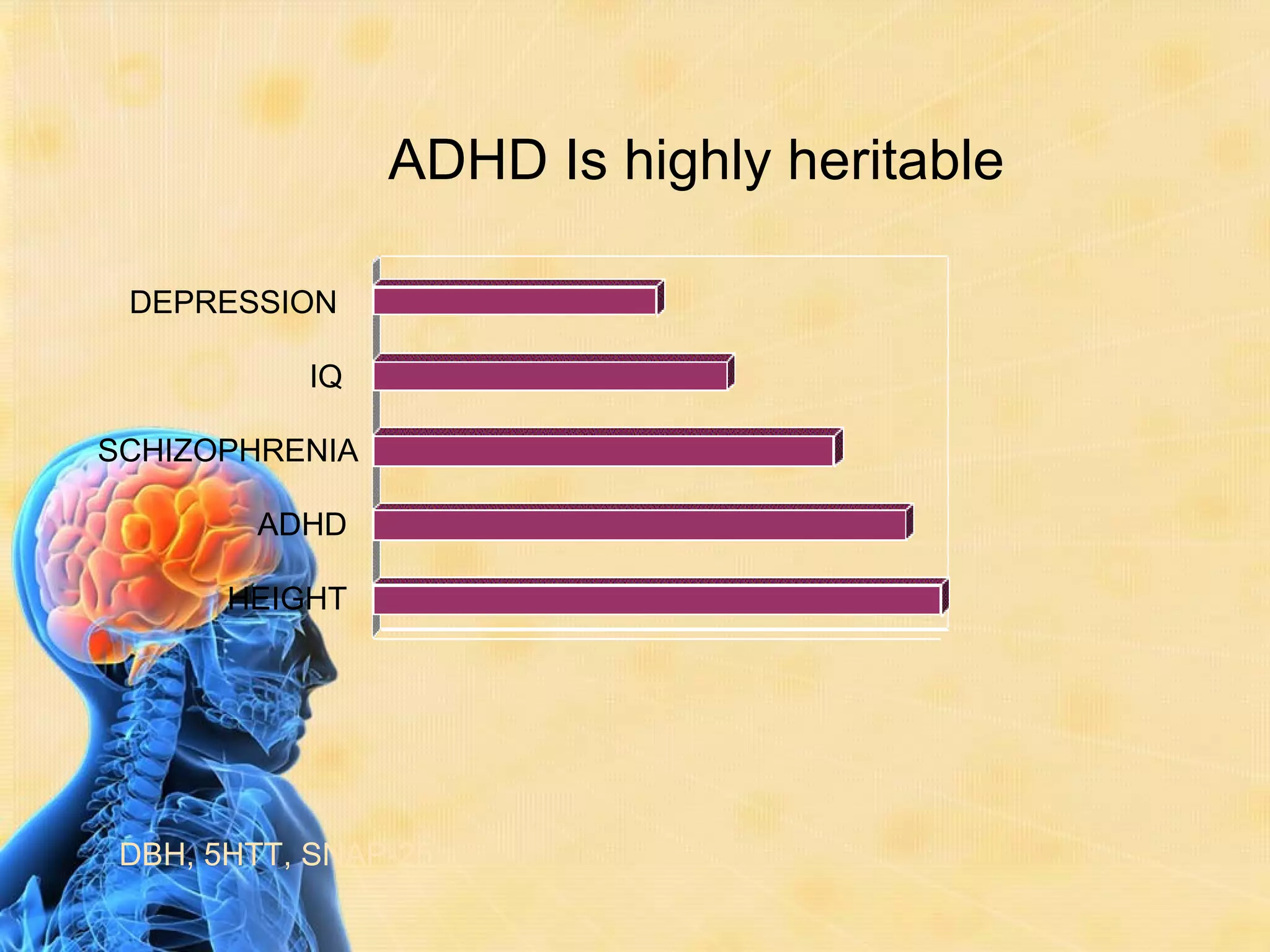
ADHD Is highly heritable

 DEPRESSION

           IQ

SCHIZOPHRENIA

        ADHD

       HEIGHT


 DBH, 5HTT, SNAP-25
= dopamine transporter gene (DAT1)
= dopamine receptor gene (DRD)
      * D4
      *D5
= serotonin transporter gene5HTT
= others: DBH, HTR1Bm SNAP-25
2- Acquired Brain Injury


A. prenatal Factors:
   CNS injury during Fetal Development:
 - Premature babies
 -Trauma/infection/complications
 - Fetal exposure to drugs,
 - maternal smoking and maternal alcohol
 addiction
2- Acquired Brain Injury (cont.)
  B- CNS lesion during labour:
• Type of Delivery can have impact if sudden, or
  extremely long and slow delivery
• Birth anoxia
• Weight at birth if SGA

    C-. Post Birth Factors:
•   Cranial bleed
•   Seizures
•   Concussion/coma
•   Environmental : chronic Lead poison
Environmental factors :
• exposures to neurodevelopmental toxins
  such as heavy metals and organohalide
  pollutants. (lead? mercury? toxins?
  -“teratogens”)
• adverse responses to food additives
• intolerances to foods (sugar ??),
• sensitivities to environmental chemicals,
  molds, and fungi
Organochlorines and Child
  Development

• Dichlorodiphenyl dichloroethylene(p,p'DDE)
  measured in umbilical cord blood.
• Serum levels were negatively associated
  with both mental and psychomotor
  development.
• The higher the serum level, the worse the
  child's development at 13 months old.
Recent studies suggest that causal
    pathways in some cases involve
  complex interactions between
genetic and environmental factors.

                                 2009
Why the Explosion in ADHD?

• Less effective parenting - mother not in home, father working
  more. Everyone more stressed.
• Egypt: educational curriculum and process
• Higher demands on children
• Toxins in the prenatal and early childhood environment (over
  200 contaminants found in umbilical cord blood )
MANAGEMENT
Recognition
and Referral


  OSHA PLAN OF
   MANAGEMENT
  OF ADHD CHILD*

               *Modified from AAP 2011
Recognition
and Referral
  Diagnosis
(Assessment)
   1+2+3
• At present there is no biomedical
  laboratory test for ADHD

           Neuropharmacology 57 (2009) 579–589


             DD 70%
DD for ADHD
•   1- anxiety disorders
•   2- conduct disorder
•   3- oppositional defiant disorder
•   4- impulse-control or mood disorders
•   5- learning disorders
•   6- mental retardation
• 7- gifted children
• 8- pervasive developmental disorders
DD for ADHD (contin.)
    • 9- depression
    • 10-Bipolar disorders, Schizophrenia
    • 11- Drugs : PB, CZP
    • 12- Misfits between the child and
      school, or even the child and
•
      teacher.
•   • 13- substance abuse: stimulants, cocaine
      phenyclidine
    • 14- hyperthyroidism
    • 15- BHL
Bipolar Disorder
Rule outs for the Diagnosis of
ADHD
Myth : ADHD child Can do
• Video Games
• Watch TV
• Computers
• Play Sports
• Build Leggos
Rule outs for the Diagnosis of
ADHD
Myth : 2-respond to medications.
• 20-30% of AD/HD children do NOT
  respond
• Only 50 -55% respond academically when
  medicated.
• 20-25% respond to medications (False
  Positives) in no ADHD children
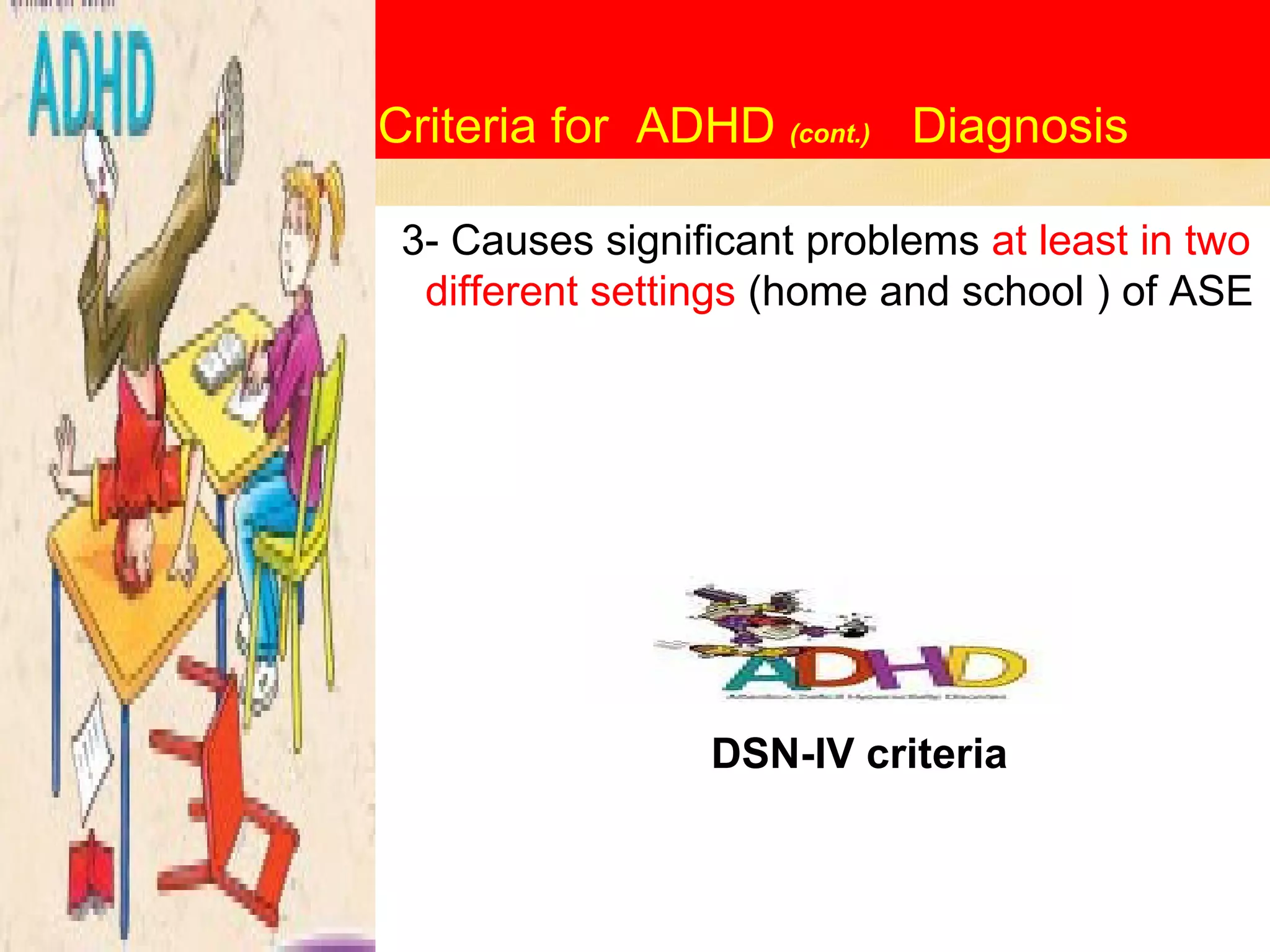
DSM-IV criteria
Criteria for ADHD Diagnosis (cont.)
 1- the symptoms of ADHD must have been
  present for at least 6 months before the
  diagnosis can be established


  2-have an onset before age 7
Criteria for ADHD (cont.) Diagnosis

 3- Causes significant problems at least in two
  different settings (home and school ) of ASE


                 DSN-IV criteria
OSHA TRIANGLE
 ASSESSMENT        Medical


                Environment


CHILD                         FAMILY
OSHA TRIANGLE
                          ASSESSMENT
                                                   Medical
                           DD 70%
                                                             1- DSM 4
                                                             2- conner’s*
psychological Profile
Intellecual and cognitive F
Developmental/academic Skills
learning readiness and achievement
Individual, scholastic and social adjustment
(behav rating scale)                           Environment
Motor adjustment and coordination                   Teacher Q
language and speech assessment and
evaluation including academic language


                           CHILD                                            FAMILY

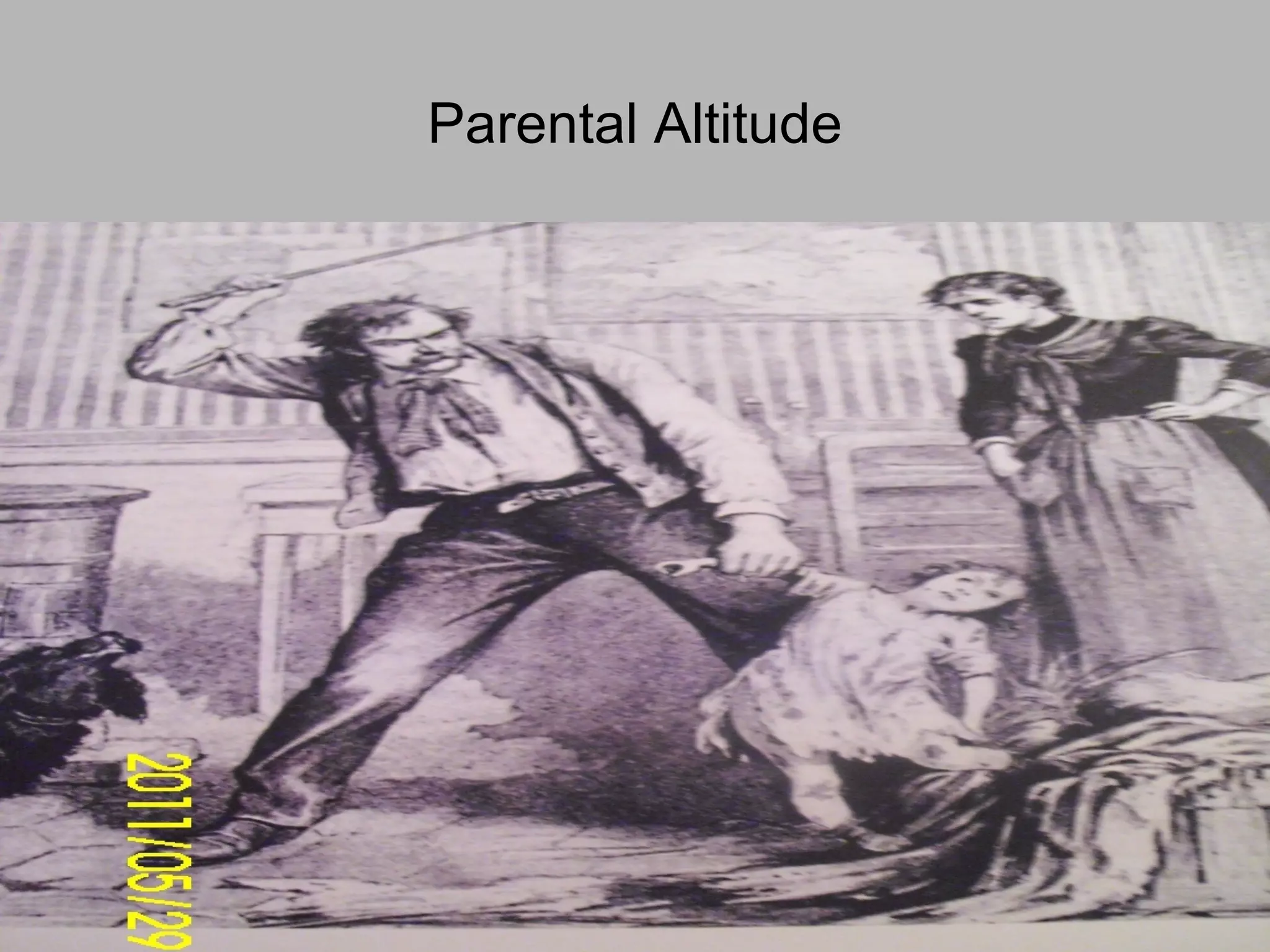
                                               Parental Attitude and Family adjustment
DSM
                     subtypes


60%      30%                       10%
                      60%
                    COMBINED    HYPERKINETIC
      INATTENTIVE
Parental Altitude
OCD
Dyslexia
Dyslexia
anxiety
The Diagnosis of ADHD
                         NO ROLE OF


• Laboratory tests

• Brain CT/MRI
EEG
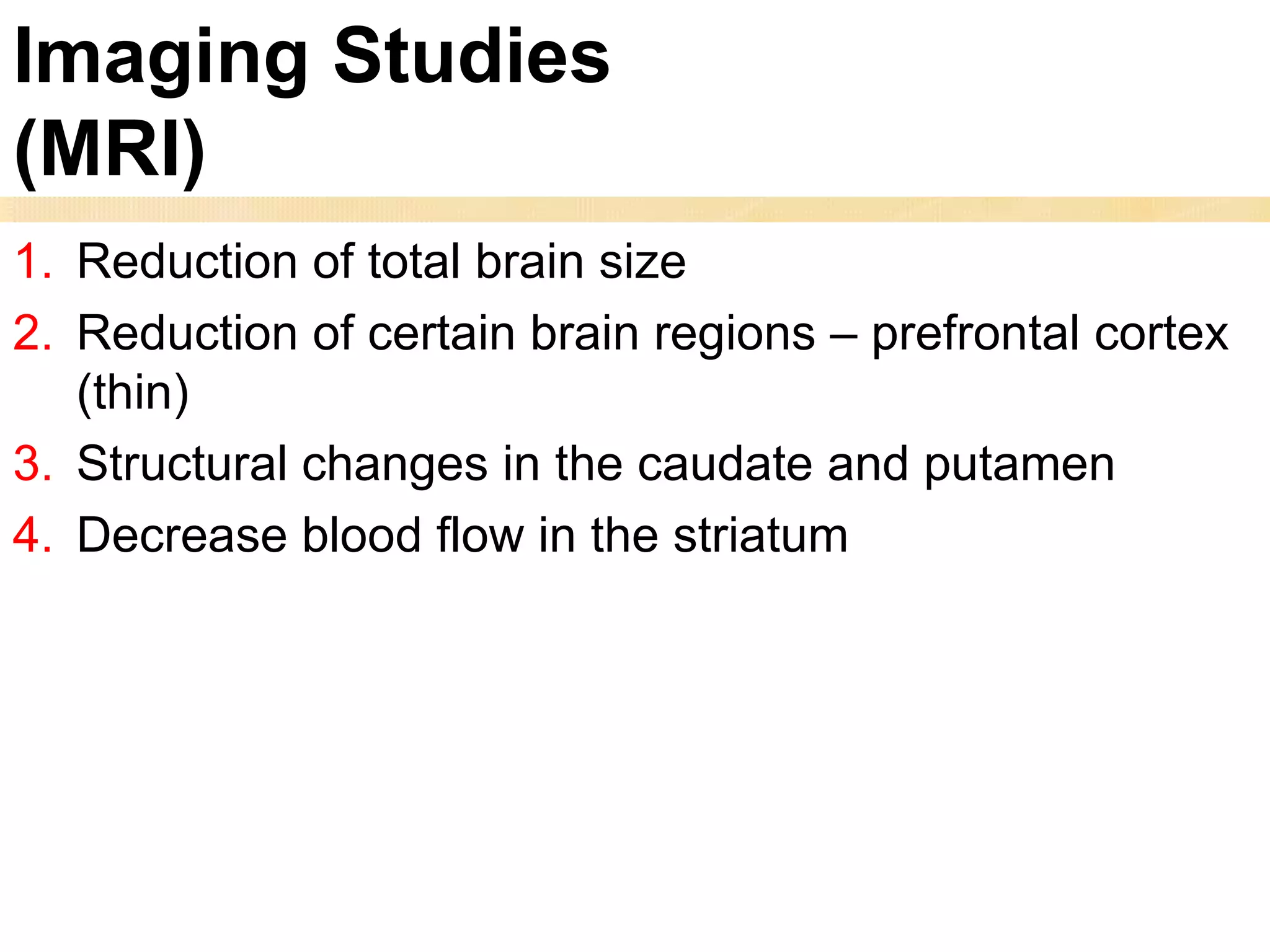
Imaging Studies
(MRI)
1. Reduction of total brain size
2. Reduction of certain brain regions – prefrontal cortex
   (thin)
3. Structural changes in the caudate and putamen
4. Decrease blood flow in the striatum
The Diagnosis of ADHD


• Must get the story from all sides -the child, the family, the
  school, and significant others.
• Careful, thorough exploration of all the issues before leaping to
  conclusions.


                     Assessment Team
Recognition
and Referral

Assessment


 Initiation of
  treatment
Opinion
      Agenda


Should we treat ADHD?

How do we treat ADHD?
Rule 2
Untreated ADHD
Parents’ consequences
• Chronic stressed or worried about child’s ADHD

• Frustration

• Blaming, guilt

• Social isolation

• Parents’ marriage has been negatively affected

• Economic burden
Rule 3

  No “magic cure”
• There is no “quick fix”.


• No single intervention will correct the
  problems for every child-need a toolbox
Rule 4


         Treatment needs to target not
           only the core symptoms but
               also co-morbid and
            coexisting disorders and
               other psychosocial
                   adversities
Role 5
MEDICATION   Parents’ Fear of
             Medications for ADHD:
             • Dependence
             • Change personality or IQ
             • Being labeled, attribution problems
             • Reactions of others – teachers, peers,
               family
             • Use special prescription
             • Cost
             • Lastly: anorexia, insomnia, tics, height,
               suicide
Medicine
                                                          Drug


OSHA Protocol of
B- treatment


                                Environment
        Child role                                               Family
                            Teacher orientation
                                                                  role
                            Class guidance


                 1-Behavior modification sessions
                 2-Academic sessions                     1- Family counseling
                 3- Group therapy ( ADHD DAY)            2- Group therapy
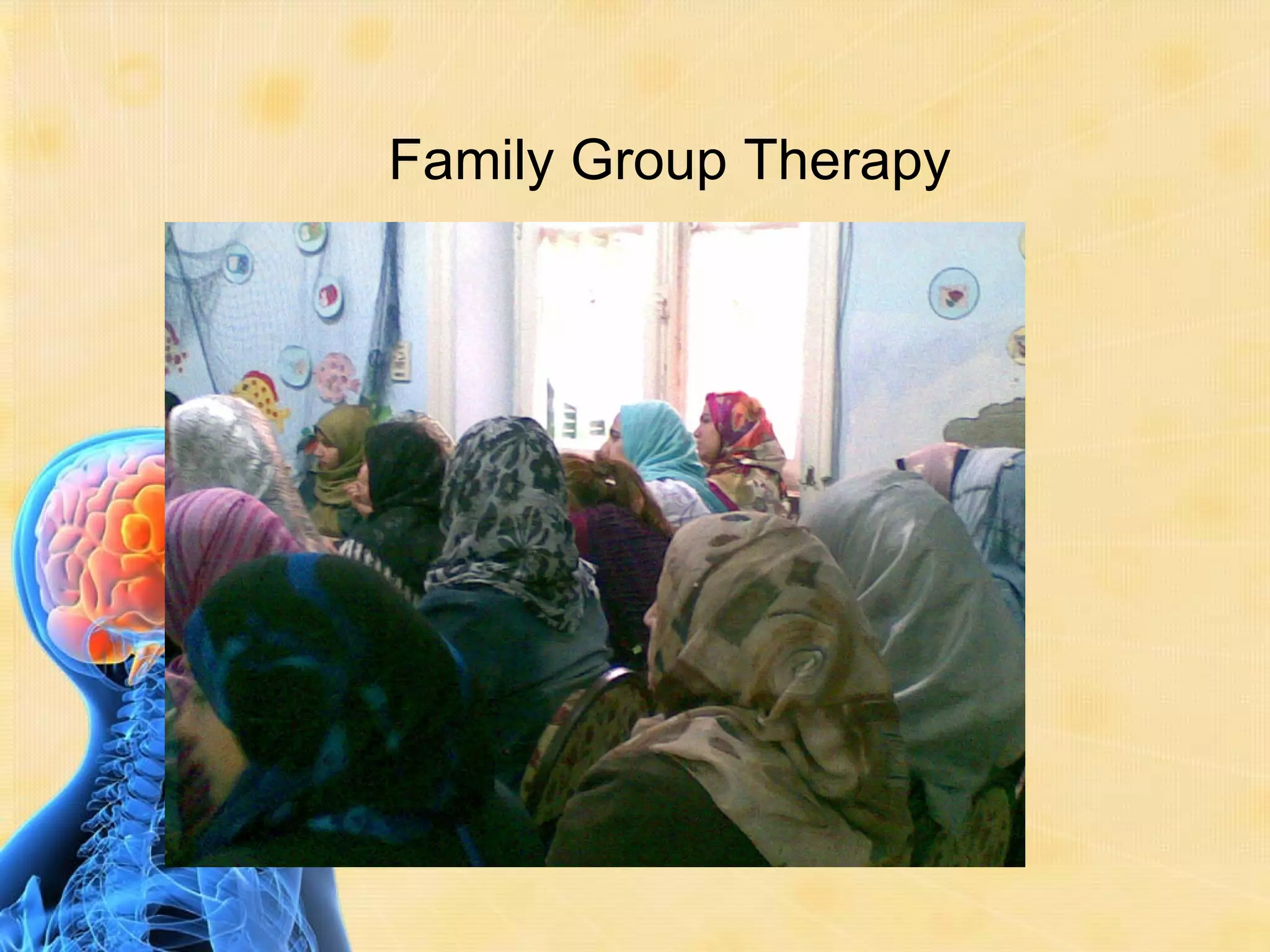
Family Group Therapy
Full Day Activity
MEDICATION
             MEDICINE
             CRITERIA FOR CHOICE
               •   1- not before age 6 years
               •   2- compliance
               •   3- available
               •   4- no other effects
               • 5- specific and not
                 symptomatic
               • 6-   Results of a Pan-European Survey

                   ADHD impact across the day
Medications

 Stimulants                Non-stimulants


Methylphenidate


                  Others
Drugs Used For Treatment   Approved by FDA
Stimulants
  :

  c) Methylphenidate

  b) Dextro-amphetamines ( not available)
Forms of Methylphenidate
            •
                a) short acting 3-6 hrs:
                    Ritalin (10mg)


                c) once daily :
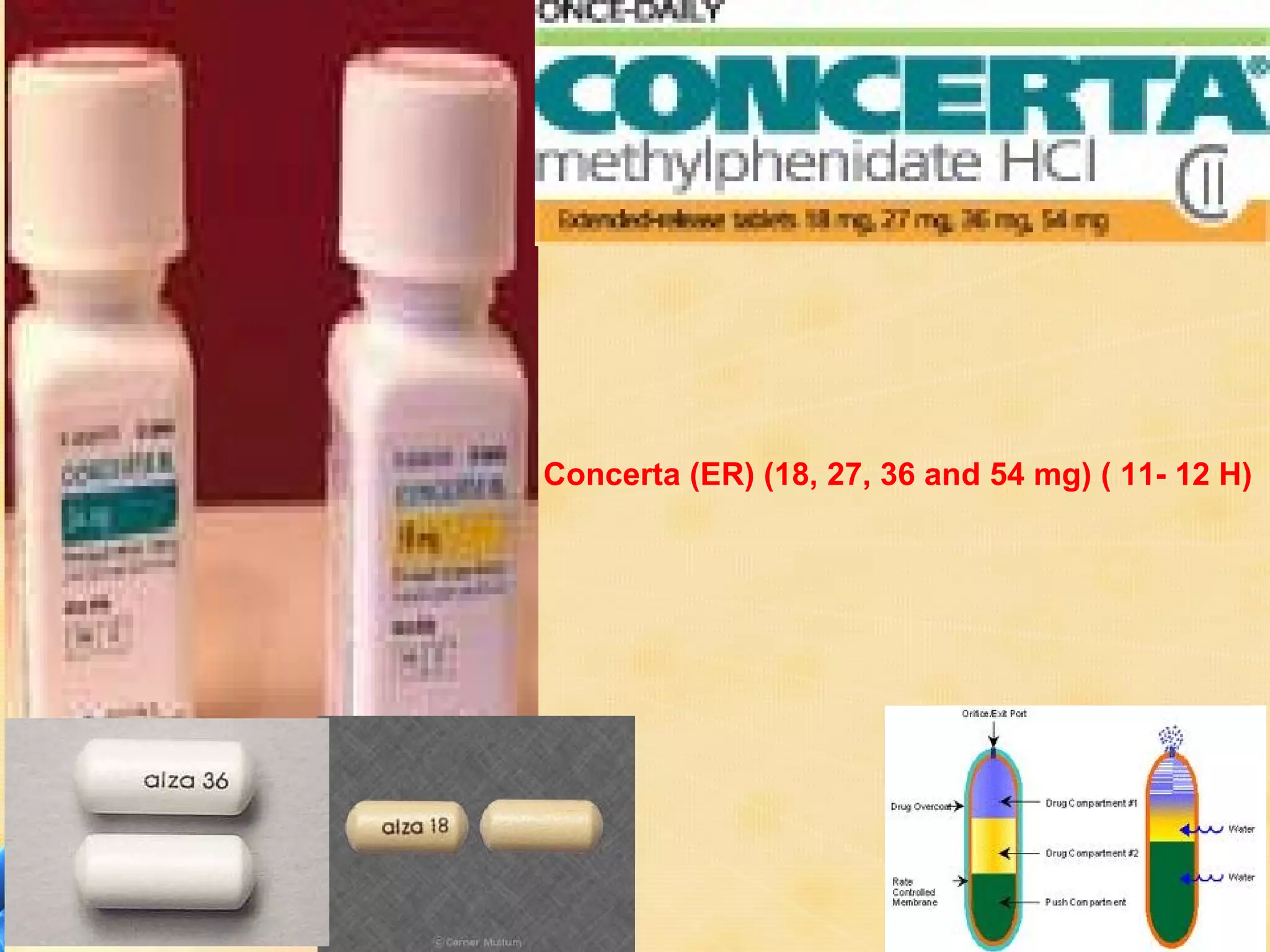
                   Concerta (ER)
Methylphenidate (Ritalin)


action : Increases release of norepinephrine and dopamine in the
  cerebral cortex to reticular activating system
• Onset: 0.5-1hr,
• Maximum: 3 hr
• duration 4-6 hr;
• metabolized by liver;
• excreted by kidneys


                0.3 -0.8 mg/kg/dose
                lowest dose

                7days/week
Ritalin (methylphenidate)
• paradoxical affect to increase attention
   span and calming effect.
• Dose -breakfast and lunch; increase by
   0.1g/kg/ dose or by 5-10mg/dose at
   weekly intervals. Max dose
   2mg/kg/day or 60mg/day.
Concerta (ER) (18, 27, 36 and 54 mg) ( 11- 12 H)
Other Forms of Methylphenidate
 •
     a) short acting 3-6 hrs:
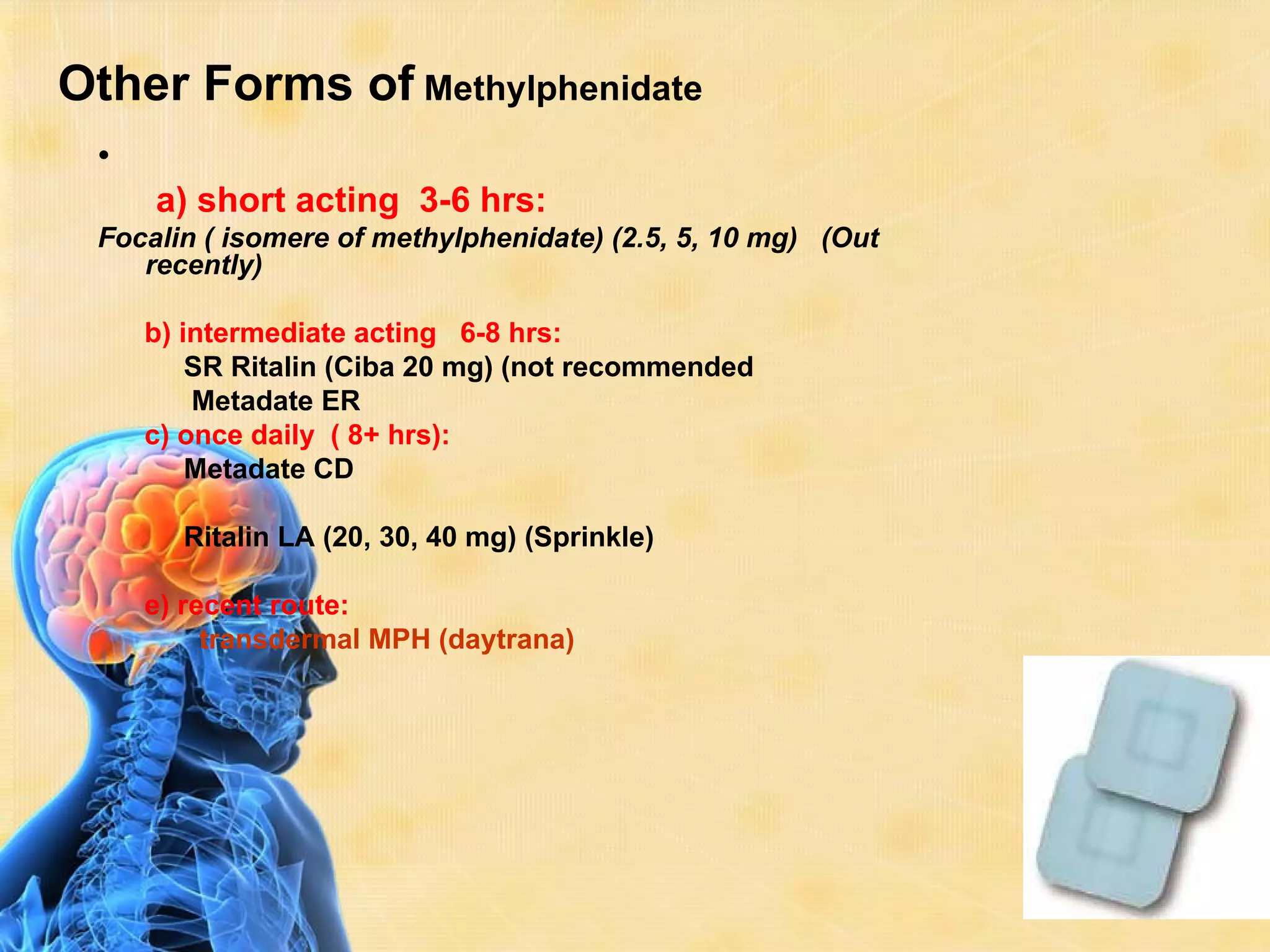
 Focalin ( isomere of methylphenidate) (2.5, 5, 10 mg) (Out
    recently)

     b) intermediate acting 6-8 hrs:
         SR Ritalin (Ciba 20 mg) (not recommended
         Metadate ER
     c) once daily ( 8+ hrs):
         Metadate CD

       Ritalin LA (20, 30, 40 mg) (Sprinkle)

     e) recent route:
          transdermal MPH (daytrana)
Other effects > S/E


rebound agitation or exaggeration of pre-medication symptoms as it is wearing off
contraindications
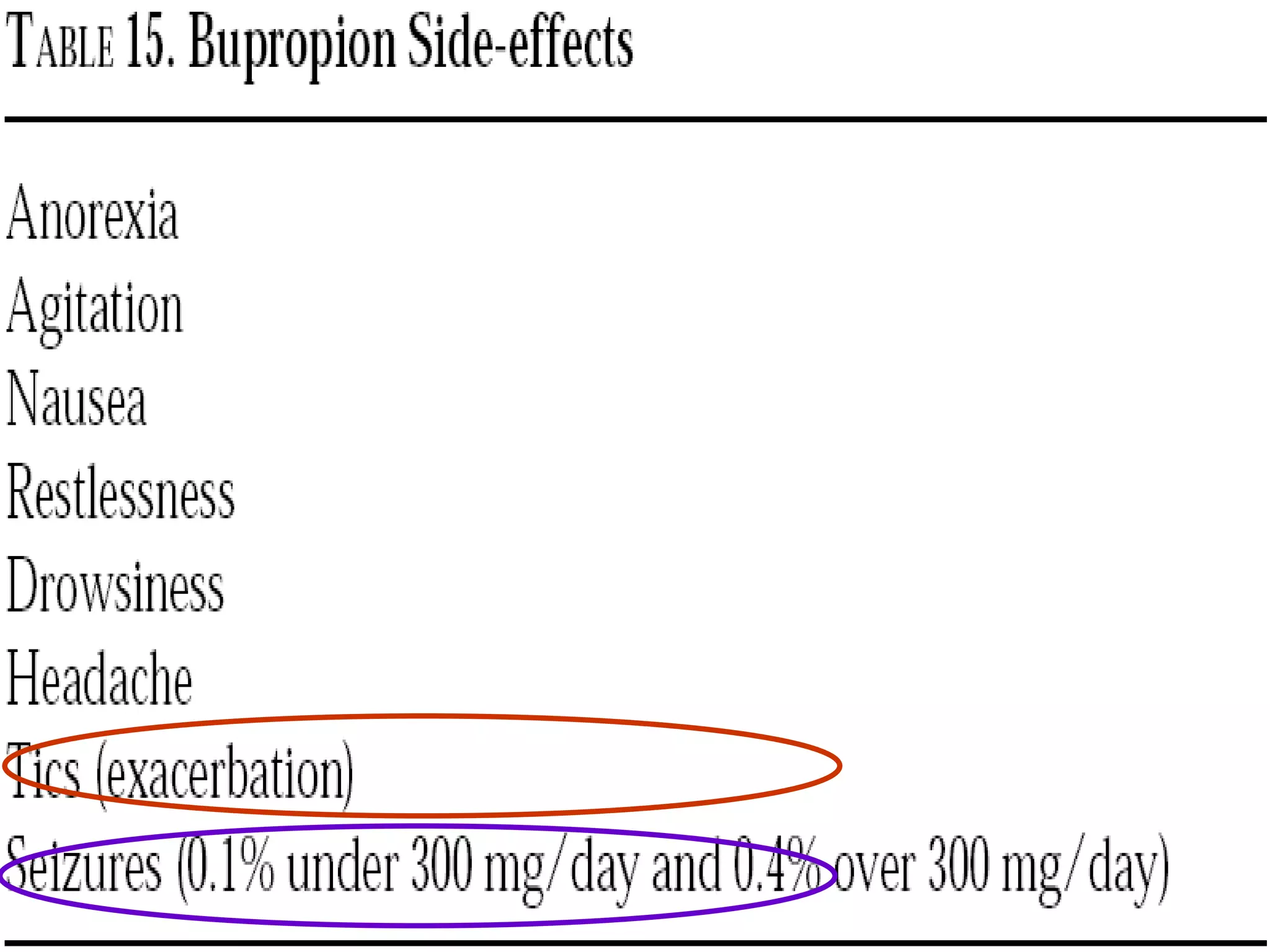
•   Tics
•   Failure to thrive
•   ??? Epilepsy
•   MAO inhibitors ( absolute contraindication)
•   Allergy to ritalin (absolute contraindication)
•   glaucoma

Precautions
   Use cautiously in patients with marked anxiety, motor tics or with family
   history of Tourette syndrome, or history of substance abuse.
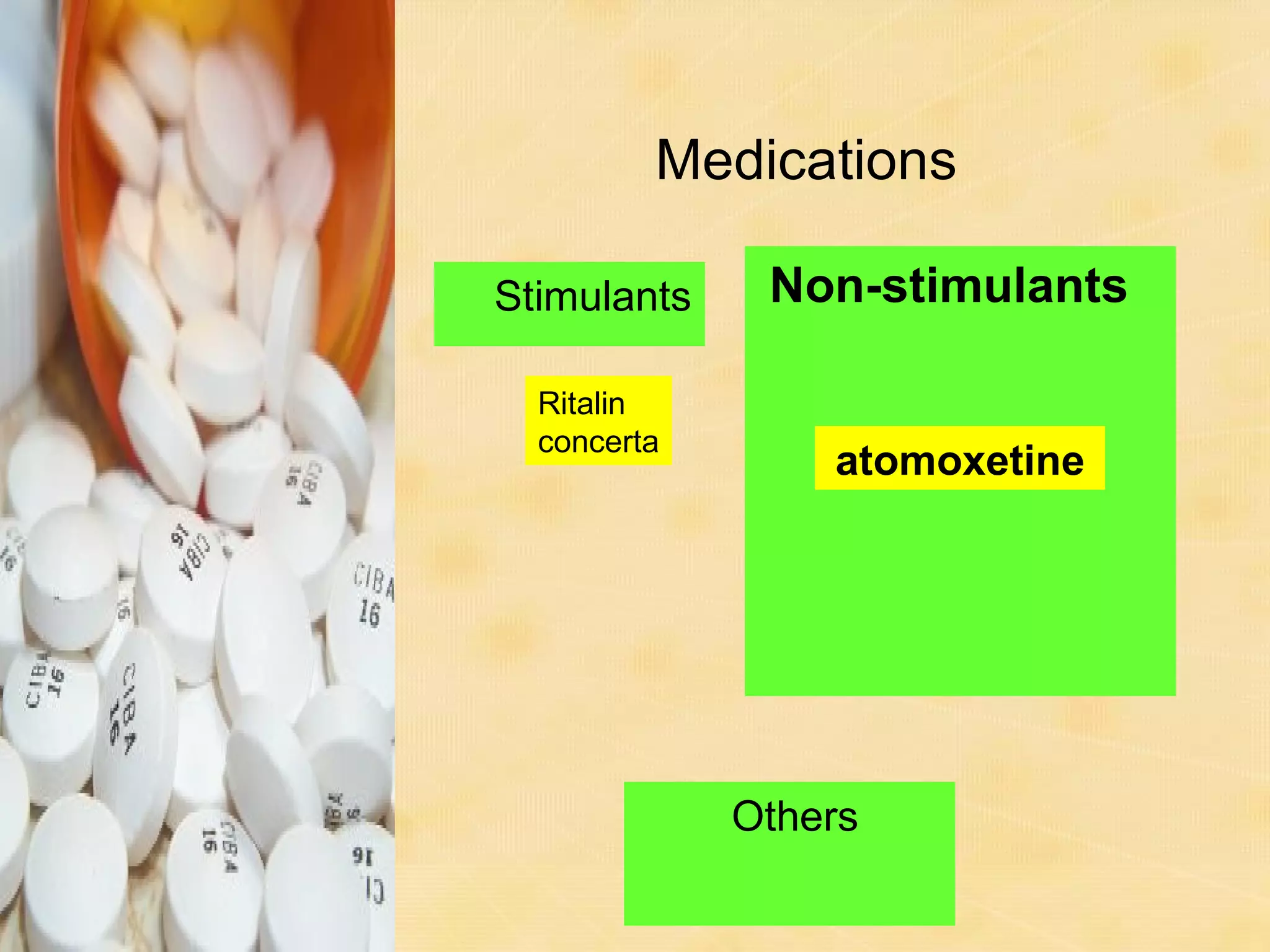
Medications

Stimulants    Non-stimulants

  Ritalin
  concerta
                 atomoxetine


             Others
Drugs Used For Treatment
 FDA approval
              (non stimulant)


    Atomoxetine
    = Selective Nor-epinephrine reuptake inhibitors

    Since 2002
Atomoxetine for ADHD
•   ADHD with epilepsy
•   ADHD with depression
•   ADHD in ASD
•   ADHD with tics
Atomoxetine
                for ADHD
•   Safe
•   Single dose
•   Effective
•   Doses follow mg/kg dosing
•    benefits tend to persist into evening &
    sometimes into morning


                           No insomnia
                           Night concentration
Rational for a non-stimulant medication for
treatment of ADHD
1- poor response or tolerability in some patients
2- act for a maximum of 12 hrs
3- suboptimal response is not uncommon
4- relative or contraindicated for some co-morbid conditions as
   tics, anxiety, substance abuse
5- some parents refuse stimulants
6- risk for abuse
Atomoxetine is
          specific for
          mechanism
           treatment


Can be stopped       Persist after
with still benefit   no medicine
Atomoxetine
              for ADHD
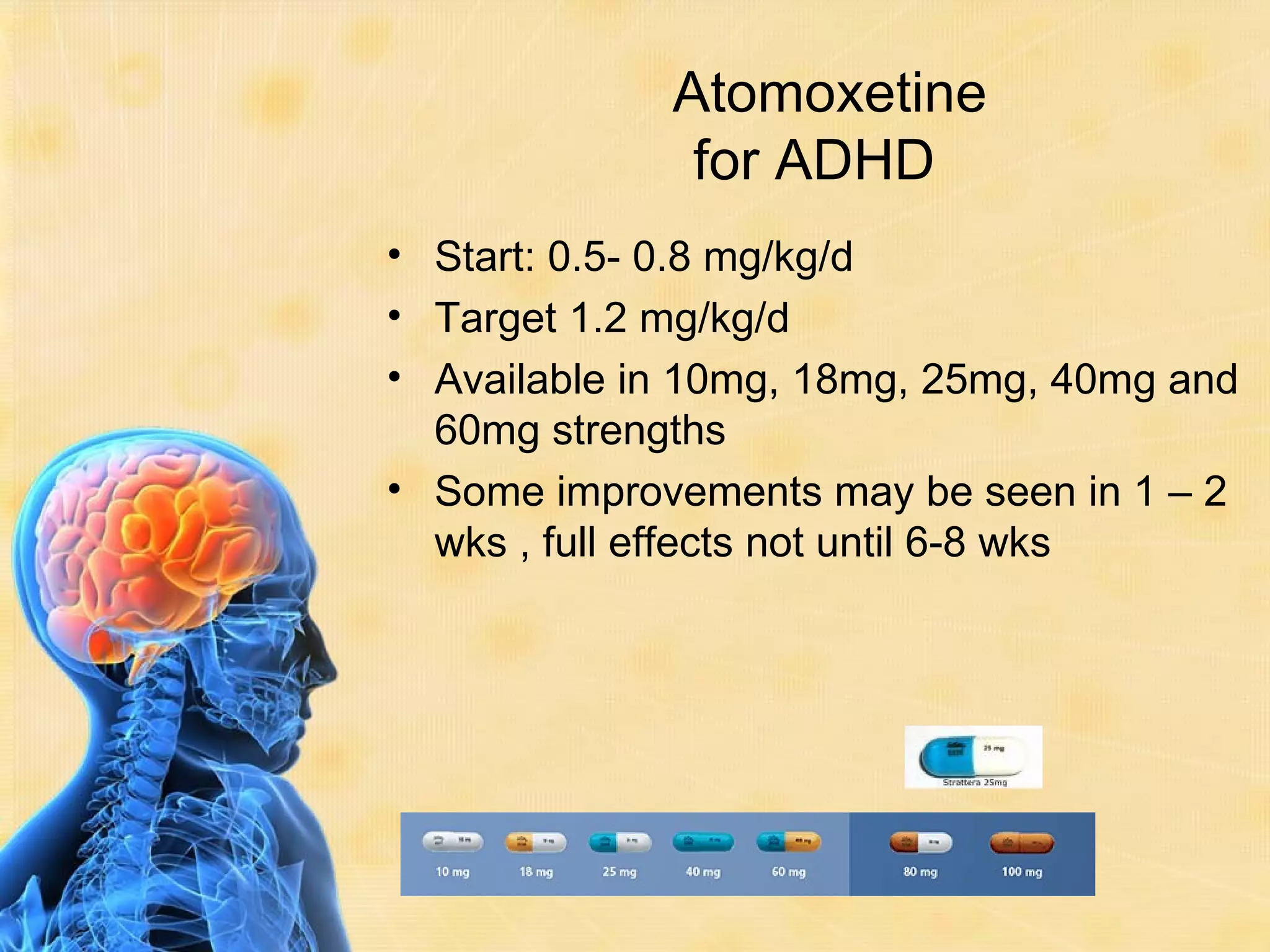
• Start: 0.5- 0.8 mg/kg/d
• Target 1.2 mg/kg/d
• Available in 10mg, 18mg, 25mg, 40mg and
  60mg strengths
• Some improvements may be seen in 1 – 2
  wks , full effects not until 6-8 wks
Atomoxetine
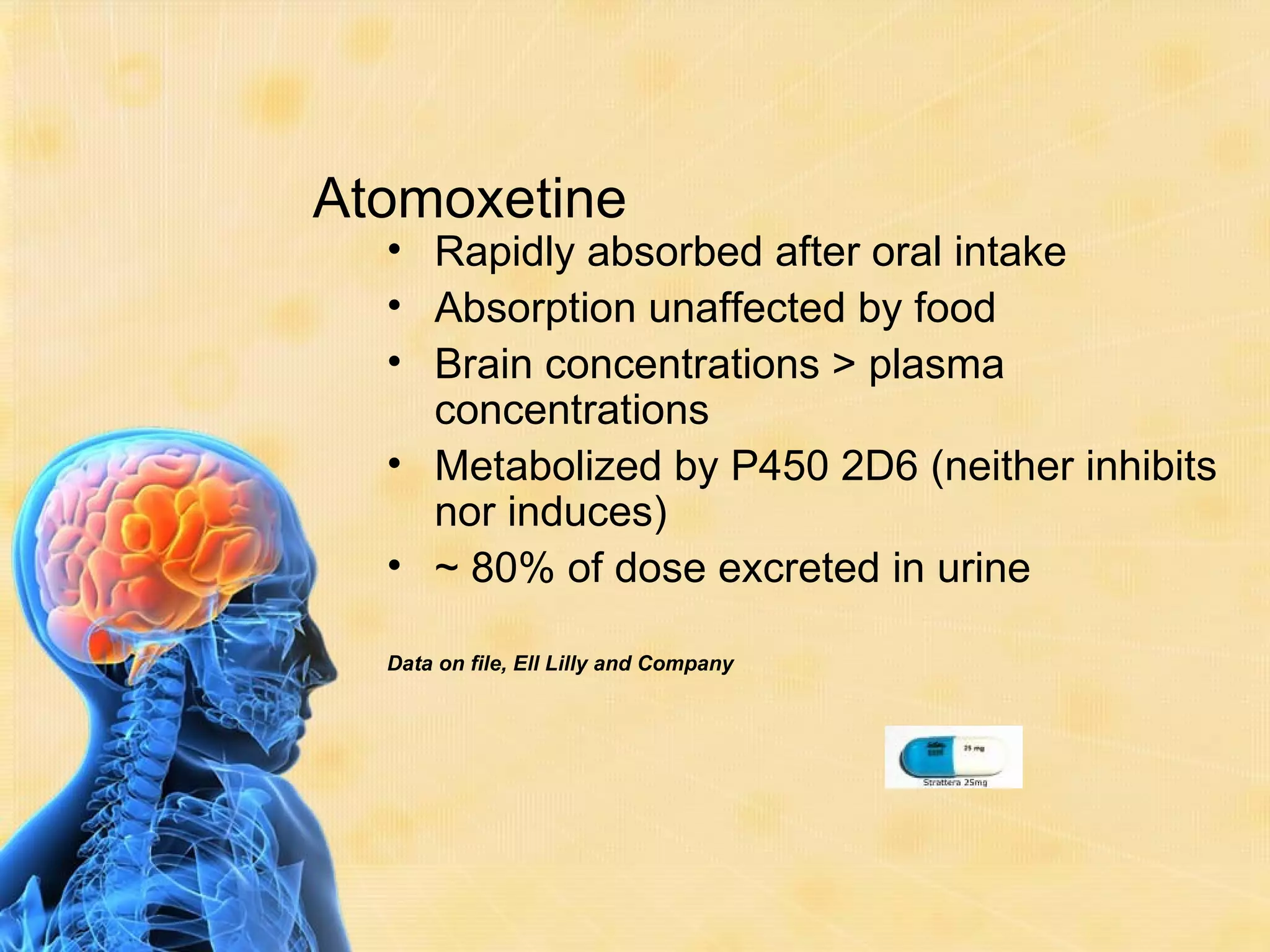
  • Rapidly absorbed after oral intake
  • Absorption unaffected by food
  • Brain concentrations > plasma
    concentrations
  • Metabolized by P450 2D6 (neither inhibits
    nor induces)
  • ~ 80% of dose excreted in urine

  Data on file, Ell Lilly and Company
Side effects of Atomoxetine
•   Anorexia
•   Dyspepsia
•   Nausea
•   Emesis
•   Sedation
•   Fatigue
•   insomnia
•   Dizziness
•   Mood swings
•   Growth delay??


          July 2007 Dev Med Ch Neurol
Medications

Stimulants          Non-stimulants


   Ritalin               atomoxetine
   concerta

              Others
        1- buproprion
        2- resperidone
        3- catapres
        4- ??? Benefit
            - LCPUFA
Drugs Used For Treatment
(others)


                              Antidepressant

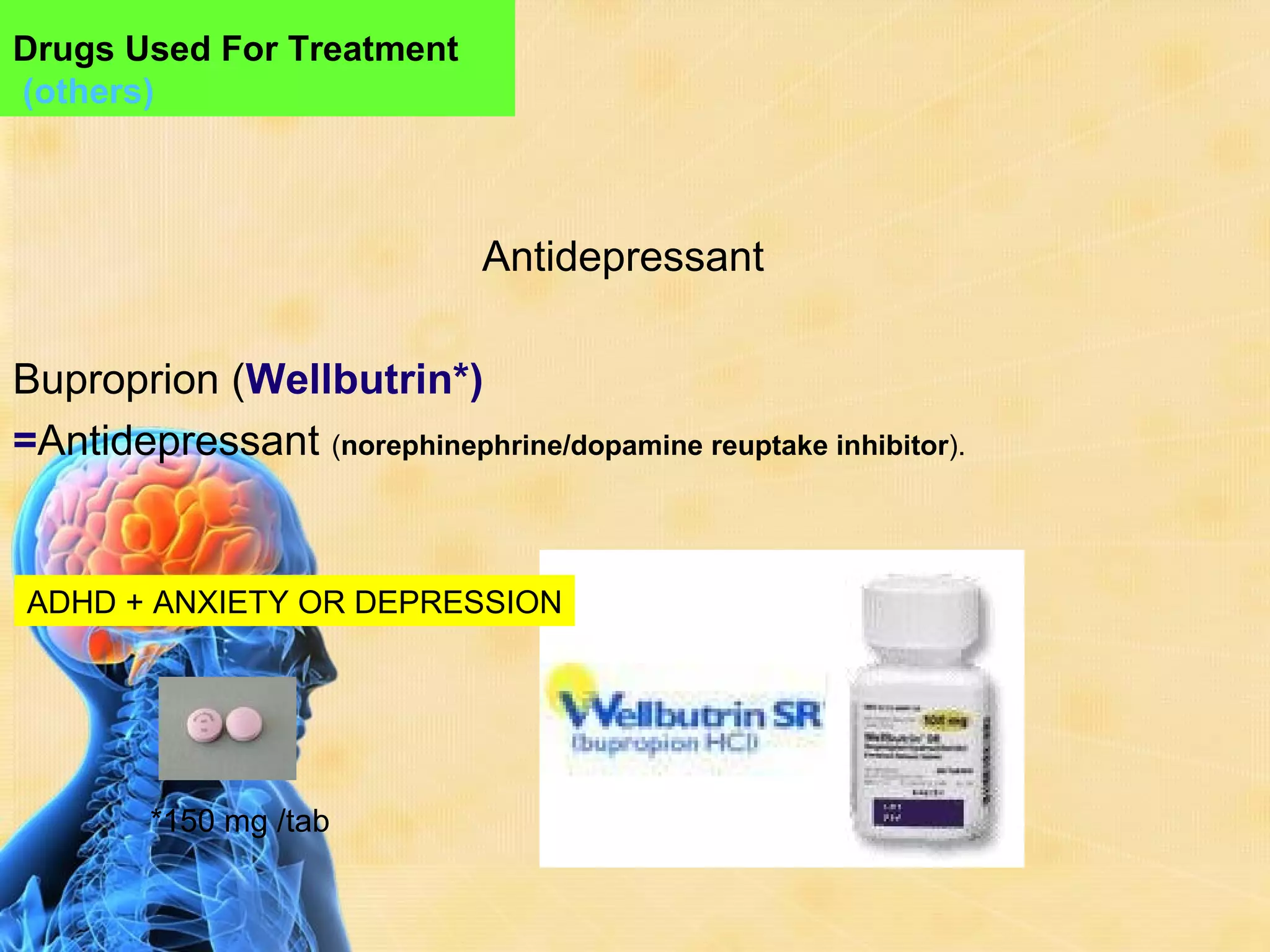
Buproprion (Wellbutrin*)
=Antidepressant (norephinephrine/dopamine reuptake inhibitor).


ADHD + ANXIETY OR DEPRESSION


        *150 mg /tab
Other Antidepressant

Tricyclics :
    imipramine, desipramine, nortriptyline


              Always   monitor cardiovascular side effects
Risperidone
               )


•    Action: Unclear, but may be related to
    antagonism for dopamine and serotonin receptors..
•    Peak plasma level in 1-2 hr,
•    Hepatic metabolism
•    excreted by liver
•    Side effects: dry mouth, stomatitis, taste alteration (rare)


                                         ADHD + ASD
Alpha2 antagonist


• antihypertensives Clonidine (catapres)
• Guanfacine
“Cod Liver Oil “
        LCPUFA


•   cod liver oil contains vitamins A and D and has a
    different concentration of omega3 (EFA)
•   Promotes normal bone formation, vision and
    reproduction
•   Promotes immunity
•   Promotes appetite
•   Promotes concentration amd mental function
•   For : autism, ADHD/ADD
ADHD PRACTICAL POINTS

ADHD PRACTICAL POINTS

  • 1.
    GUIDES IN ADHD DrHussein Abdeldayem, MD Head of Ped Neurology Unit, Faculty of Medicine
  • 2.
    ADHD is themost commonly neuro- behavioral disorder in childhood ADHD: Clinical Practice Guideline….. American Academy of Pediatric, 2011
  • 3.
    Shifts in ConceptualizingADHD Through the years: • 1902 Defects in moral character • 1934 Organically driven • 1940 Minimal Brain Syndrome • 1957 Hyperkinetic Impulse Disorder • 1960 Minimal Brain Dysfunction (MBD) • 1968 Hyperkinetic Reaction of Childhood (DSM II)
  • 4.
    • 1980 ADD(DSM III) - with hyperactivity - without hyperactivity - residual type • 1987 ADHD (only combined symptoms) • 1994 AD/HD – 3 TYPES (DSM IV) Combined Type ( 50-70%), Inattentive type (~30%), Hyperactive-Impulsive Type (~10%) •
  • 5.
    The only problemwas that they could see young children on the fields while they studied indoors The ears of a boy are on his back, He hears only when he is beaten. Anonymous
  • 6.
    • DSM-5: Futureof Psychiatric Diagnosis • Publication of the fifth edition of • Diagnostic and Statistical Manual of Mental Disorders (DSM-5) • in May 2013
  • 7.
    Updated May 1,2012 A 06 Attention Deficit/Hyperactivity Disorder Recommendations for severity criteria for this disorder are forthcoming AD/HD consists of a pattern of behavior that is present in multiple settings where it gives rise to social, educational or work performance difficulties. A. Either (A1) and/or (A2). A1. Inattention A2. Hyperactivity and Impulsivity Six (or more) of the following symptoms have persisted for at least 6 months to a degree that is inconsistent with developmental level and that impact directly on social and academic/occupational activities. A 07 Attention Deficit/Hyperactivity Disorder Not Elsewhere Classified No severity criteria are being recommended for this disorder at the current time
  • 8.
    ??????ADHD Deficient Vz Disturbance • % • Boys > girls • Age onset > 4 yr
  • 9.
    7% to 9% ??? • 7-9% of children and adolescents • Adults : 4 - 5 % of adults • All levels of socioeconomic • All levels of IQ Estimates of worldwide prevalence of ADHD among school aged children vary from 2.4–19.8% Biol Psychiatry 2011
  • 10.
    Boys >Girls ???? 6: 1 to 12 : 1 to 3:1
  • 11.
    AD/HD in school agedchildren Educational disorder 7 years old age
  • 12.
    onset >4y >2 year 2010
  • 13.
    ADHD Preschoolers • Y Sleep problems • S Colic • C Constantly in motion • C Unresponsive to requests • U Trouble staying seated • T Demanding of attention • D Rapidly shift from one activity to another • R Resist passive activities • R Wander off alone • W Inappropriate touching/handling objects
  • 14.
    ‫‪SCHOOL AGE‬‬ ‫‪ ‬سهولة التشتت بالمثيرات الخارجية‬ ‫‪ ‬الحركة الساكنة‬ ‫‪ ‬عدم القدرة على إتباع التعليمات‬ ‫‪ ‬عدم القدرة على إنتظار الدور‬ ‫‪ ‬الستجابة السريعة قبل إكتمال المهمة‬ ‫‪ ‬عدم القدرة على الحتفاظ بالنتباه للمهمة‬ ‫‪ ‬النتقال من مهمة إلى إخرى دون إستكمالها‬ ‫‪Not time specific‬‬ ‫ع3 +‬
  • 15.
    ‫‪SCHOOL AGE‬‬ ‫‪ ‬تكرار الخطاء‬ ‫‪ ‬عدم القدرة على‬ ‫المحافظة على‬ ‫الدوات و النظافة‬ ‫‪ ‬عدم اتباع التعليمات‬ ‫‪ ‬التحدث بكثرة‬
  • 21.
    AD/HD Adolescence and Adult 15% 85% undiagnosed Occupational impairment, increased family dysfunction, driving risks and SUD
  • 22.
    ADHD in Adolescence • Low self-esteem • Bad interpersonal relationships • SUD • Delinquency
  • 23.
    Adult ADHD • Family • Work • Friends • Accident • Addiction Attention-Deficit Disorder Isn't Just for Kids. Why Adults Are Now Being Diagnosed, Too Wall Street Journal April 2010
  • 24.
  • 25.
    What is ADHD? EF Impairment of Executive Function set and development ‫المدير التنفيذى‬
  • 26.
    EF (Six aspects, domains) Organizing Focusing, Regulating Prioritizing, Sustaining, Alertness, And And Sustaining effort, Activating Shifting attention And To work To task Processing speed 3- 1- 2- Effort Activation Focus (Starting &stopping (planning and (persisting tasks) activity) Organizing))
  • 27.
    EF (cont.) Utilizing working Monitoring Managing frustration Memory And And And Self-regulating Modulating emotions Accessing recall action 6- 4- 5- Action Emotion Memory (Problem solving) (managing behavior) (working memory)
  • 28.
    Effects of ADHDon EF 1-response inhibition 2- planning 3- time response/set shifting 4- working memory 5- inner talk 6- emotional stability/lability 7- expectation
  • 29.
    When are ADHD impairmentsNoticeable? • some: preschool • Some : middle elementary school • Some : college or later Most in 1ry school
  • 30.
    Executive Functions challenges may revealWeakness • EF weakness may not noticeable until one’s self-management is challenged by increased demands of adult life EEG ECG
  • 31.
    Executive Functions Development andDemands • In early childhood, others perform all executive functions for the child (parents, sibs and other caretakers) • Thereafter, the child should be able (or is forced to) perform these functions for self Onset before 7
  • 32.
  • 33.
    summary • structural andfunctional imaging studies suggest that dysfunction of cingulate, frontal, and parietal cortical regions and imbalances in the dopaminergic and noradrenergic systems, contribute to the pathophysiology of ADHD
  • 34.
    Imaging Studies 1. Reduction of total brain size 2. Reduction of certain brain regions 3. Decrease blood flow in the striatum 4. Structural changes in the caudate and putamen
  • 36.
    ADHD is aChemical Problem • Dysfunction of dopaminergic and noradrenergic systems • Dopamine and norepinephrine are important in drugs that treat ADHD In ADHD children, the rate of glucose metabolism in basal ganglions and in the frontal cortex is reduced
  • 37.
    EF networks depends1ry on 2 chemicals Dopamine Norepinephrine Not release and reload effectively Medications : slow reuptake so longer in contact with receptors
  • 38.
    • Methyl phenydate& Atomoxetene Mode of action: – prevents the reuptake of norepinephrine into the presynaptic neuron X
  • 39.
  • 40.
    I AM ABUSY MOTHER or WE ARE NOT A GOOD FAMILY or HE IS A SPOILED BABY
  • 41.
  • 42.
  • 43.
    ADHD Is highlyheritable DEPRESSION IQ SCHIZOPHRENIA ADHD HEIGHT DBH, 5HTT, SNAP-25
  • 44.
    = dopamine transportergene (DAT1) = dopamine receptor gene (DRD) * D4 *D5 = serotonin transporter gene5HTT = others: DBH, HTR1Bm SNAP-25
  • 45.
    2- Acquired BrainInjury A. prenatal Factors: CNS injury during Fetal Development: - Premature babies -Trauma/infection/complications - Fetal exposure to drugs, - maternal smoking and maternal alcohol addiction
  • 46.
    2- Acquired BrainInjury (cont.) B- CNS lesion during labour: • Type of Delivery can have impact if sudden, or extremely long and slow delivery • Birth anoxia • Weight at birth if SGA C-. Post Birth Factors: • Cranial bleed • Seizures • Concussion/coma • Environmental : chronic Lead poison
  • 47.
    Environmental factors : •exposures to neurodevelopmental toxins such as heavy metals and organohalide pollutants. (lead? mercury? toxins? -“teratogens”) • adverse responses to food additives • intolerances to foods (sugar ??), • sensitivities to environmental chemicals, molds, and fungi
  • 48.
    Organochlorines and Child Development • Dichlorodiphenyl dichloroethylene(p,p'DDE) measured in umbilical cord blood. • Serum levels were negatively associated with both mental and psychomotor development. • The higher the serum level, the worse the child's development at 13 months old.
  • 49.
    Recent studies suggestthat causal pathways in some cases involve complex interactions between genetic and environmental factors. 2009
  • 50.
    Why the Explosionin ADHD? • Less effective parenting - mother not in home, father working more. Everyone more stressed. • Egypt: educational curriculum and process • Higher demands on children • Toxins in the prenatal and early childhood environment (over 200 contaminants found in umbilical cord blood )
  • 51.
  • 52.
    Recognition and Referral OSHA PLAN OF MANAGEMENT OF ADHD CHILD* *Modified from AAP 2011
  • 53.
    Recognition and Referral Diagnosis (Assessment) 1+2+3
  • 54.
    • At presentthere is no biomedical laboratory test for ADHD Neuropharmacology 57 (2009) 579–589 DD 70%
  • 55.
    DD for ADHD • 1- anxiety disorders • 2- conduct disorder • 3- oppositional defiant disorder • 4- impulse-control or mood disorders • 5- learning disorders • 6- mental retardation • 7- gifted children • 8- pervasive developmental disorders
  • 56.
    DD for ADHD(contin.) • 9- depression • 10-Bipolar disorders, Schizophrenia • 11- Drugs : PB, CZP • 12- Misfits between the child and school, or even the child and • teacher. • • 13- substance abuse: stimulants, cocaine phenyclidine • 14- hyperthyroidism • 15- BHL
  • 57.
  • 58.
    Rule outs forthe Diagnosis of ADHD Myth : ADHD child Can do • Video Games • Watch TV • Computers • Play Sports • Build Leggos
  • 59.
    Rule outs forthe Diagnosis of ADHD Myth : 2-respond to medications. • 20-30% of AD/HD children do NOT respond • Only 50 -55% respond academically when medicated. • 20-25% respond to medications (False Positives) in no ADHD children
  • 60.
    DSM-IV criteria Criteria forADHD Diagnosis (cont.) 1- the symptoms of ADHD must have been present for at least 6 months before the diagnosis can be established 2-have an onset before age 7
  • 61.
    Criteria for ADHD(cont.) Diagnosis 3- Causes significant problems at least in two different settings (home and school ) of ASE DSN-IV criteria
  • 62.
    OSHA TRIANGLE ASSESSMENT Medical Environment CHILD FAMILY
  • 63.
    OSHA TRIANGLE ASSESSMENT Medical DD 70% 1- DSM 4 2- conner’s* psychological Profile Intellecual and cognitive F Developmental/academic Skills learning readiness and achievement Individual, scholastic and social adjustment (behav rating scale) Environment Motor adjustment and coordination Teacher Q language and speech assessment and evaluation including academic language CHILD FAMILY Parental Attitude and Family adjustment
  • 64.
    DSM subtypes 60% 30% 10% 60% COMBINED HYPERKINETIC INATTENTIVE
  • 65.
  • 67.
  • 68.
  • 69.
  • 70.
  • 72.
    The Diagnosis ofADHD NO ROLE OF • Laboratory tests • Brain CT/MRI
  • 73.
  • 74.
    Imaging Studies (MRI) 1. Reductionof total brain size 2. Reduction of certain brain regions – prefrontal cortex (thin) 3. Structural changes in the caudate and putamen 4. Decrease blood flow in the striatum
  • 75.
    The Diagnosis ofADHD • Must get the story from all sides -the child, the family, the school, and significant others. • Careful, thorough exploration of all the issues before leaping to conclusions. Assessment Team
  • 76.
  • 77.
    Opinion Agenda Should we treat ADHD? How do we treat ADHD?
  • 79.
    Rule 2 Untreated ADHD Parents’consequences • Chronic stressed or worried about child’s ADHD • Frustration • Blaming, guilt • Social isolation • Parents’ marriage has been negatively affected • Economic burden
  • 80.
    Rule 3 No “magic cure” • There is no “quick fix”. • No single intervention will correct the problems for every child-need a toolbox
  • 81.
    Rule 4 Treatment needs to target not only the core symptoms but also co-morbid and coexisting disorders and other psychosocial adversities
  • 82.
    Role 5 MEDICATION Parents’ Fear of Medications for ADHD: • Dependence • Change personality or IQ • Being labeled, attribution problems • Reactions of others – teachers, peers, family • Use special prescription • Cost • Lastly: anorexia, insomnia, tics, height, suicide
  • 84.
    Medicine Drug OSHA Protocol of B- treatment Environment Child role Family Teacher orientation role Class guidance 1-Behavior modification sessions 2-Academic sessions 1- Family counseling 3- Group therapy ( ADHD DAY) 2- Group therapy
  • 85.
  • 86.
  • 87.
    MEDICATION MEDICINE CRITERIA FOR CHOICE • 1- not before age 6 years • 2- compliance • 3- available • 4- no other effects • 5- specific and not symptomatic • 6- Results of a Pan-European Survey ADHD impact across the day
  • 88.
    Medications Stimulants Non-stimulants Methylphenidate Others
  • 89.
    Drugs Used ForTreatment Approved by FDA Stimulants : c) Methylphenidate b) Dextro-amphetamines ( not available)
  • 90.
    Forms of Methylphenidate • a) short acting 3-6 hrs: Ritalin (10mg) c) once daily : Concerta (ER)
  • 91.
    Methylphenidate (Ritalin) action :Increases release of norepinephrine and dopamine in the cerebral cortex to reticular activating system • Onset: 0.5-1hr, • Maximum: 3 hr • duration 4-6 hr; • metabolized by liver; • excreted by kidneys 0.3 -0.8 mg/kg/dose lowest dose 7days/week
  • 92.
    Ritalin (methylphenidate) • paradoxicalaffect to increase attention span and calming effect. • Dose -breakfast and lunch; increase by 0.1g/kg/ dose or by 5-10mg/dose at weekly intervals. Max dose 2mg/kg/day or 60mg/day.
  • 93.
    Concerta (ER) (18,27, 36 and 54 mg) ( 11- 12 H)
  • 94.
    Other Forms ofMethylphenidate • a) short acting 3-6 hrs: Focalin ( isomere of methylphenidate) (2.5, 5, 10 mg) (Out recently) b) intermediate acting 6-8 hrs: SR Ritalin (Ciba 20 mg) (not recommended Metadate ER c) once daily ( 8+ hrs): Metadate CD Ritalin LA (20, 30, 40 mg) (Sprinkle) e) recent route: transdermal MPH (daytrana)
  • 95.
    Other effects >S/E rebound agitation or exaggeration of pre-medication symptoms as it is wearing off
  • 96.
    contraindications • Tics • Failure to thrive • ??? Epilepsy • MAO inhibitors ( absolute contraindication) • Allergy to ritalin (absolute contraindication) • glaucoma Precautions Use cautiously in patients with marked anxiety, motor tics or with family history of Tourette syndrome, or history of substance abuse.
  • 97.
    Medications Stimulants Non-stimulants Ritalin concerta atomoxetine Others
  • 98.
    Drugs Used ForTreatment FDA approval (non stimulant) Atomoxetine = Selective Nor-epinephrine reuptake inhibitors Since 2002
  • 99.
    Atomoxetine for ADHD • ADHD with epilepsy • ADHD with depression • ADHD in ASD • ADHD with tics
  • 100.
    Atomoxetine for ADHD • Safe • Single dose • Effective • Doses follow mg/kg dosing • benefits tend to persist into evening & sometimes into morning No insomnia Night concentration
  • 101.
    Rational for anon-stimulant medication for treatment of ADHD 1- poor response or tolerability in some patients 2- act for a maximum of 12 hrs 3- suboptimal response is not uncommon 4- relative or contraindicated for some co-morbid conditions as tics, anxiety, substance abuse 5- some parents refuse stimulants 6- risk for abuse
  • 102.
    Atomoxetine is specific for mechanism treatment Can be stopped Persist after with still benefit no medicine
  • 103.
    Atomoxetine for ADHD • Start: 0.5- 0.8 mg/kg/d • Target 1.2 mg/kg/d • Available in 10mg, 18mg, 25mg, 40mg and 60mg strengths • Some improvements may be seen in 1 – 2 wks , full effects not until 6-8 wks
  • 104.
    Atomoxetine •Rapidly absorbed after oral intake • Absorption unaffected by food • Brain concentrations > plasma concentrations • Metabolized by P450 2D6 (neither inhibits nor induces) • ~ 80% of dose excreted in urine Data on file, Ell Lilly and Company
  • 105.
    Side effects ofAtomoxetine • Anorexia • Dyspepsia • Nausea • Emesis • Sedation • Fatigue • insomnia • Dizziness • Mood swings • Growth delay?? July 2007 Dev Med Ch Neurol
  • 106.
    Medications Stimulants Non-stimulants Ritalin atomoxetine concerta Others 1- buproprion 2- resperidone 3- catapres 4- ??? Benefit - LCPUFA
  • 107.
    Drugs Used ForTreatment (others) Antidepressant Buproprion (Wellbutrin*) =Antidepressant (norephinephrine/dopamine reuptake inhibitor). ADHD + ANXIETY OR DEPRESSION *150 mg /tab
  • 109.
    Other Antidepressant Tricyclics : imipramine, desipramine, nortriptyline Always monitor cardiovascular side effects
  • 110.
    Risperidone ) • Action: Unclear, but may be related to antagonism for dopamine and serotonin receptors.. • Peak plasma level in 1-2 hr, • Hepatic metabolism • excreted by liver • Side effects: dry mouth, stomatitis, taste alteration (rare) ADHD + ASD
  • 111.
    Alpha2 antagonist • antihypertensivesClonidine (catapres) • Guanfacine
  • 113.
    “Cod Liver Oil“ LCPUFA • cod liver oil contains vitamins A and D and has a different concentration of omega3 (EFA) • Promotes normal bone formation, vision and reproduction • Promotes immunity • Promotes appetite • Promotes concentration amd mental function • For : autism, ADHD/ADD

Editor's Notes

  • #3 ADHD is an overwhelming public health problem with a substantial social and economic impact, exerting a significant effect on a broad range of areas including education, employment, and quality of life Attention deficit and hyperactivity disorder (ADHD) is a neuro-psychiatric syndrome [1]. It remains the most common problem in childhood. Attention-deficit/hyperactivity disorder (ADHD) can profoundly affect the academic achievement, well-being, and social interactions of children
  • #4 ADHD was probably first described in 1863 - 1902 by British pediatrician and scholar, Dr. George Still .and drug amrhetamine (dexidrine) since late 1930 Early descriptions centered more on what was thought to be the condition's cause, which included "post-encephalitic syndrome" or "minimal brain damage." Later terminology—for example "the hyperactive child" or "attention-deficit disorder"—focused more on naming the major symptoms than on the etiology—a logical development because what was presumed to be the etiology often had no basis in fact
  • #6 The schools were next to or in the temples They taught by the priests Scholars started training for 5 years when they got to the age of 9.
  • #8 Attention Deficit/Hyperactivity Disorder (ADHD) Not Elsewhere Classified may be coded in cases in which the individuals are below threshold for ADHD or for whom there is insufficient opportunity to verify all criteria. However, ADHD-related symptoms should be associated with impairment, and they are not better explained by any other mental disorder
  • #10 The reported prevalence among school pupils varies between 2 and 20% Medical % from clinics , More in boys 3- 4 times than girls the most common neurobehavioral disorder of childhood. However, the diagnosis and management remains a challenge
  • #11 the ratio of boys to girls varies from 6:1 to 12:1 , , 3:1, suggesting that ADHD in girls tends to be underdiagnosed. On the one hand, girls do not manifest disruptive behaviors to the extent seen in boys; girls with ADHD have half of the rates of conduct disorder and oppositional defiant disorder but are much more likely to have significant social problems.[16] Compared with boys with ADHD, they manifest more emotional distress, have higher rates of depression and anxiety and low cognitive, are highly vulnerable to stress, and have poor self-esteem and a limited sense of control
  • #14 Infants :may have experienced sleeplessness and an unusual degree of fussiness or colic. toddler years : skip learning to walk, literally “took off running,” was always “on the go,” and uncontrollably “into” everything, as if the “motor” never stopped. The preschooler : may be impatient and impulsive and indeed may be ungovernable in the household.
  • #15 Symptoms of ADHD are not time-specific. They can occur in the morning, at school, at bed-time, during school holidays – throughout the full day, every day Thefts, liar, set fires, aggressive against human and animals
  • #17 FAMILY STRESS – PARENTING DIFFICULT - DIVORCE
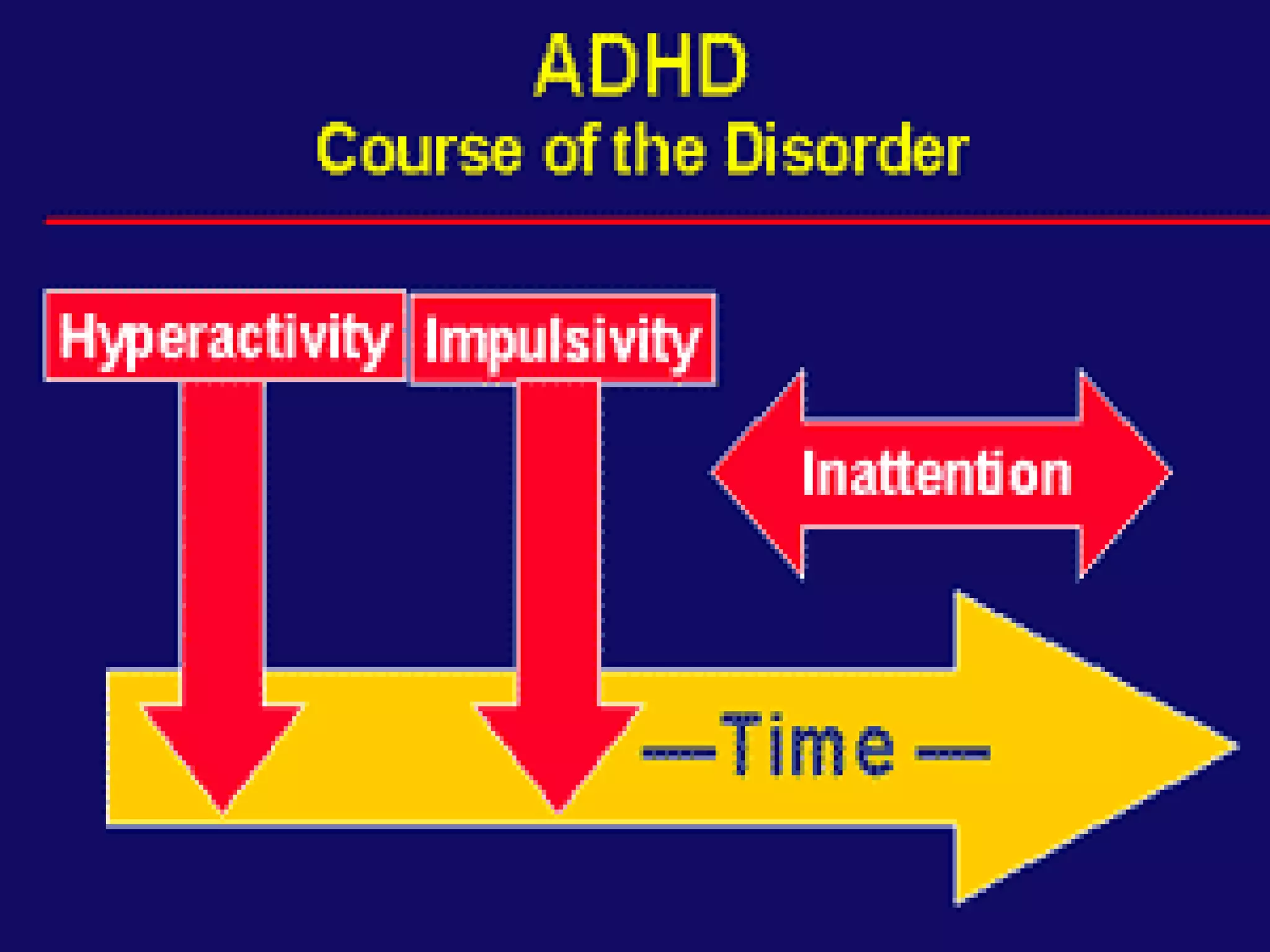
  • #21 30 -60% will be ADHD Adult, over time what you see is hyperactivity diminishing, impulsivity Impulsivity (acting without thinking) diminishing, but inattention does not
  • #22 SUD substance use disorder as alcohol and drug abuse / addiction
  • #23 These adolescents may experience troublesome interpersonal relationships with family members, as well as with peers and their self-esteem is low. They have difficulties in their social life and feel frustrated, with frequent quarrelling with parents, siblings, friends and teachers SUD: smoking Sexual diseases
  • #24 1- family problems: divorce 2- work problems: loss jobs frequently 3- problems with friends 4- drug abuse, smoker 5- accident prone as car accidents
  • #26 اضطراب فى المقدرة التنفيذية اى اضطراب بالتركيز و ليس نقص بالتركيز حيث هناك قدرة على انتقاء التركيز مثل عسكرى مرور ( self management الادارة الذاتية ) فى ميدان متعدد و لكنه احيانا يترك الميدان فيتم اللخبطة اى تركيز انتقائى بدلا من تركيز تلقائى
  • #30 الاغلب فى الابتدائى نظرا لوجود عدد من الاساتذة و اختلاف المواضيع التى يتم دراستها و فى مصر عدد الاطفال فى الفصل SOME R OBVIOUS VERY EARLY AND R NOTICEABLE IN PRESCHOOL YEARS SOME R NOT NOTICEABLE TILL MIDDLE ELEMENTARY OR JUNIOR HIGH SOME R NOT APPARENT TILL CHILD LEAVES HOME TO GO TO COLLEGE OR LATER
  • #31 Cardiac weakness may not be noticeable in ECG takr\\en while lying quite on a table, but after stress exercise. Or EEG after sleep deprivation , hyperventilation and photic stimulation
  • #32 حيث يقوم الاهل بتنظيم كل شئ للطفل مثل مواعيد الاكل و الشرب و الاستحمام و النوم تخطى الشارع و فقط يلاحظ الحركة الزائدة عند الطفل ُ EF capacity develops through childhood into adolescence and beyond . It is not fully present in early childhood Environmental demands for EF increase with age from preschool through adulthood EF impairments often are not noticeable by age 7
  • #35 Imaging studies have delineated gross anatomical changes in brain dimensions associated with ADHD, and a number of excellent reviews exist The most consistent finding is 1- an overall reduction in total brain size that persists into adolescence 2-reduced dimensions of several brain regions including the caudate nucleus, prefrontal cortex white matter (A regional decrease in cortical thickness has been associated with the DRD4 7-repeat allele), corpus callosum and the cerebellar vermis.Swanson et al. (2007) in a review of the literature noted that the caudate nucleus and globus pallidus, which both contain a high density of dopamine receptors are smaller in ADHD than in control groups. 3- Decreases in blood flow in regions of the striatum (striatum – the region most commonly associated with reward Processing and dopamine ) and changes in dopamine transporter binding have been described in the human striatum in ADHD. 4-There are some inconsistencies between different studies in the association of ADHD with structural changes in the caudate and putamen
  • #37 ADHD is fundamentally a chemical problem 1- dysregulation of inhibitory influences (DOPAMINE) of frontal cortical activity, that kind of signal dampening or the shock absorbers in the frontal lobe may be predominantly noradrenergic or noradrenergic influences , that may affect through modeling lower striatal structures which are predominantly dopaminergic. an involvement of the frontal-striatal circuits
  • #38 Brain of person with ADHD makes these chemicals but does not release and reload effectively So control messages often not connecting. For 80% medications improve this problem. Dysregulation of the catecholamine neurotransmitters—norepinephrine and dopamine—particularly in the prefrontal cortex and related structures
  • #39 Amphetamines: Mode of Action – causes a release of norepinephrine Pemoline , – Mode of action - unknown, but may cause an increased production of dopamine
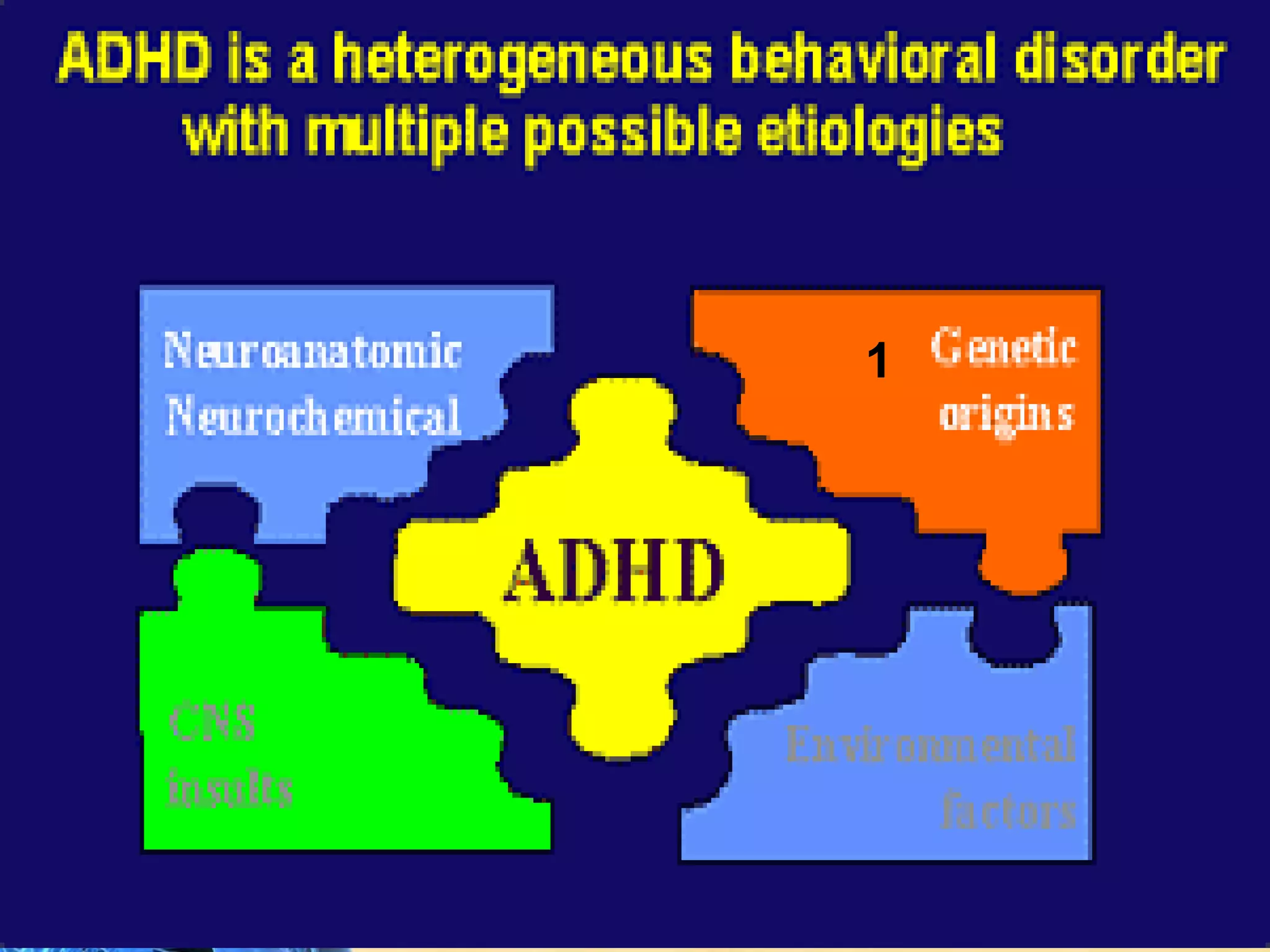
  • #42 There are many ways you get to ADHD. And here you can see, there are genetic contributions, there's CNS insults, in utero exposure to drugs and alcohol, for example, there are other environmental factors that are being mapped out, and then there are certainly a number of neuroanatomic, neurochemical correlates that I think are probably part of the pathophysiology of this condition.( or contribute to ADHD) The mechanisms whereby genes and environment work together to cause ADHD have not been worked out but it is believed that, for some of these risk factors, interactions occur such that some environmental risk factors lead to ADHD only in genetically susceptible people. There is a genetic basis in about 80% of the cases, involving a number of different genes, and in about 20% of the cases, ADHD is the result of an acquired insult to the brain
  • #43 Genetics - there is a strong hereditary link with ADHD like symptoms, of unknown way of transmission for brain chemical disorder Primarily inherited (like height) Genetic factors are thought play an important role in the etiology of ADHD. Family studies have consistently indicated a strong familial genetic contribution. Twin studies have shown heritability estimates of approximately 0.8, varying between 0.6 and 0.9. It is widely acknowledged that genetic factors in ADHD are likely to involve multiple genes of moderate effect. To date no single gene has been discovered to play a major role though several gene associations have been found.
  • #44 This shows that ADHD is among the most of heritable of psychiatric disorders Genes of small effect likely to combine with each other and environmental factors to cause ADHD Manifests itself with different degrees of severity in a given generation,or the various generations
  • #45 The most studied are genetic variations in 5 genes: the dopamine D4 receptor and the dopamine transporter (DAT1). Both of these have consistently been replicated but individually they exert only weak effects and neither is necessary or sufficient for ADHD A recent review of all molecular genetic studies of ADHD from 1991 to 2004 concluded there were significant associations for four genes in ADHD: the dopamine D4 and D5 receptors, and the dopamine and serotonin transporters (Bobb et al., 2006). In addition there is statistically significant evidence of association with DBH, HTR1B and SNAP-25 genes
  • #46 In addition to presence of genetic susceptibility + CNS insults(hypoxia) maternal ,during pregnancy, smoking or alcohol Neuroanatomic/ Neurochemical/brain structures /and chemical imbalances
  • #51 A recent study found over 250 toxins in umbilical cord blood, including mercury, lead pesticides, organochlorines
  • #53 The primary care clinician should initiate an evaluation for ADHD for any child 4 through 18 years of age who presents with academic or behavioral problems and symptoms of inattention, hyperactivity, or impulsivity (quality of evidence B/strong recommendation).
  • #54 To make a diagnosis of ADHD, the primary care clinician should determine that Diagnostic and Statistical Manual of Mental Disorders, Fourth Edition criteria have been met (including documentation of impairment in more than 1 major setting); information should be obtained primarily from reports from parents or guardians, teachers, and other school and mental health clinicians involved in the child’s care. 2-The primary care clinician should also rule out any alternative cause 3- also diagnose comorbid disorders
  • #56 anxiety disorders ( generalized anxiety disorder, separation anxiety) Mentally retarded children may appear more hyperactive and impulsive than normal children of the same age; however, when compared with children of the same developmental age, the hyperactivity of these mentally retarded patients appears normal Autistic children may be extremely hyperactive and distractible and may be very impulsive. Indeed these hyperactive autistic children may get worse if treated with stimulants
  • #57 in mania one sees an exuberance of energy and a pressure to complete tasks, in contrast to the purposelessness and restlessness of a hyperactive child , in depression one sees despair and fatigue, symptoms not typical of ADHD. Children with schizophrenia , especially the catatonic type, may be quite active and impulsive; however, the presence of delusions and bizarre behavior rules out ADHD ** medical problems: hyperthyroidism, Hearing loss
  • #64 ADHD pure should be treated medical (60%) after age 6 DSM4 criteria R are referred for diagnosis ADD and ADHD Several arabic versions to test the degree of ADHD: Conner’s , diagnostic ADHD scale To detect any present or future setting of learning disorders Language of reading and writing is different in all aspects from verbalization in arabic language
  • #65 Two further categories are included in the DSM-IV: ADHD not otherwise specified (less than the full syndrome with some impairment) ADHD in partial remission.
  • #75 Imaging studies have delineated gross anatomical changes in brain dimensions associated with ADHD, and a number of excellent reviews exist The most consistent finding is 1- an overall reduction in total brain size that persists into adolescence 2-reduced dimensions of several brain regions including the caudate nucleus, prefrontal cortex white matter (A regional decrease in cortical thickness has been associated with the DRD4 7-repeat allele), corpus callosum and the cerebellar vermis.Swanson et al. (2007) in a review of the literature noted that the caudate nucleus and globus pallidus, which both contain a high density of dopamine receptorsare smaller in ADHD than in control groups. 3- Decreases in blood flow in regions of the striatum (striatum – the region most commonly associated with reward Processing and dopamine ) and changes in dopamine transporter binding have been described in the human striatum in ADHD. 4-There are some inconsistencies between different studies in the association of ADHD with structural changes in the caudate and putamen
  • #76 Assessment Team
  • #80 Social : Difficult to go places with my child Family’s activities are disrupted
  • #83 Medicating for ADD IS LESS RISKY THAN NOT MEDICATING : school, social, low self esteem sub abuse
  • #90 .* Pemoline is generally held in reserve, given its potential hepatotoxicity. In 1937, he documented improvement in the behavior of hyperactive children who were given racemic amphetamine (benzedrine).2 Bradley's work lay dormant until the 1950s and 60s, when there was a resurgence of stimulant medication trials, first with amphetamines and then with methylphenidate.3,4 Since then, amphetamines and methylphenidate have been staples for treating the core ADHD symptoms
  • #91 . Ritalin is classified as a psychostimulant drug Comes in several forms
  • #92 Its beneficial effect on attention span dysfunction is based on selective binding of the presynaptic dopamine transporter in the CNS striatal and prefrontal areas, leading to rise in extracellular dopamine; it also causes a blockade of the CNS norepinephrine transporter in the norepinephrine system
  • #93 Its beneficial effect on attention span dysfunction is based on selective binding of the presynaptic dopamine transporter in the CNS striatal and prefrontal areas, leading to rise in extracellular dopamine; it also causes a blockade of the CNS norepinephrine transporter in the norepinephrine system
  • #95 . Ritalin is classified as a psychostimulant drug Comes in several forms
  • #99 The psycho-stimulants were the only medications approved by the US Food and Drug Administration (FDA) for ADHD until 2003 when the non-stimulant atomoxetine was approved. Is a novel cyclic compound, dissimilar in structure to all other available antidepressants
  • #101 Some improvements may be seen in 1 – 2 wks , full effects not until 4-6 wks
  • #104 Initial dose should be maintained for a minimum of 7 days prior to upward dose titration according to clinical response and tolerability’ Recommended maintenance dose is approximately 1.2 mglkglday
  • #105 Plasma half life ~ 5hrs ( ~ 20hrs in poor metabolizers)
  • #106 Modest elevations of pulse and BP FDA warnings: liver toxicity, suicidal thoughts in children Safe to growth
  • #108 Wellbutrin : In cases where stimulants offer little benefit or are poorly tolerated, bupropion is a reasonable next step. Treatment may be initiated with the sustained release preparation at a dose of 150 mg in the morning, and then, after four to seven days, increased to 150 mg in the morning and 150 mg in the early afternoon. In the case of depression, it makes sense to kill two birds with one stone by using one medication for both the depression and the ADHD, and here again, bupropion is a reasonable first choice.
  • #109 In large dose it may cause hepatic damage. In the case of depression, it makes sense to kill two birds with one stone by using one medication for both the depression and the ADHD, and here again, bupropion is a reasonable first choice.
  • #110 Of the two tricyclics, desipramine is generally not used in children, given concerns over possible cardiotoxicity. Used if failed ritalin
  • #112 Used if with tic or tourette or failed ritalin.The alpha-2 autoreceptor blockers guanfacine and clonidine are more effective than placebo, but overall their effect is relatively modest, and side-effects such as sedation are often limiting: of these two, guanfacine is better tolerated. Clonidine may be initiated in a total daily dose of 0.1 mg, increasing in similar increments every week until a satisfactory response or unacceptable side-effects occur. This total daily dose should be divided into 3 or 4 doses; most patients respond to a total daily dose of 0.5 mg or less. Patches can be used delivering 0.1-0.3 mg q.d for a week according to size of patch