ADDRESSING MODE
The different ways of specifying the location of an
operand in an instruction are called as addressing
modes.
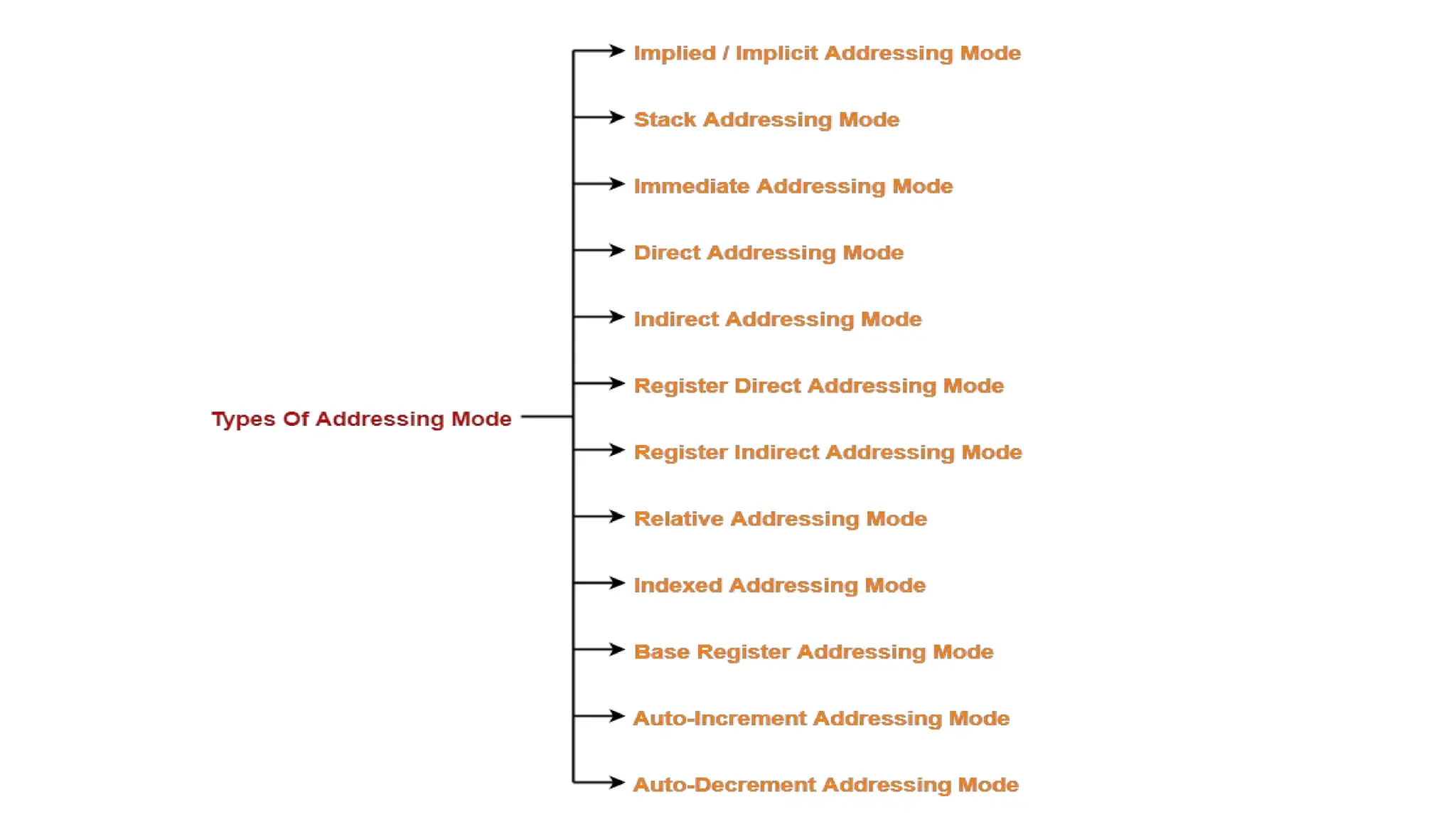
1.Implied / Implicit Addressing Mode
2.Stack Addressing Mode
3.Immediate Addressing Mode
4.Direct Addressing Mode
5.Indirect Addressing Mode
6.Register Direct Addressing Mode
7.Register Indirect Addressing Mode
8.Relative Addressing Mode
9.Indexed Addressing Mode
10.Base Register Addressing Mode
11.Auto-Increment Addressing Mode
12.Auto-Decrement Addressing Mode
1. Implied Addressing Mode-
• In this addressing mode,
• The definition of the instruction itself specify the operands implicitly.
• It is also called as implicit addressing mode
Examples-
• The instruction “Complement Accumulator” is an implied mode
instruction.
• In a stack organized computer, Zero Address Instructions are implied
mode instructions.
• (since operands are always implied to be present on the top of the stack)
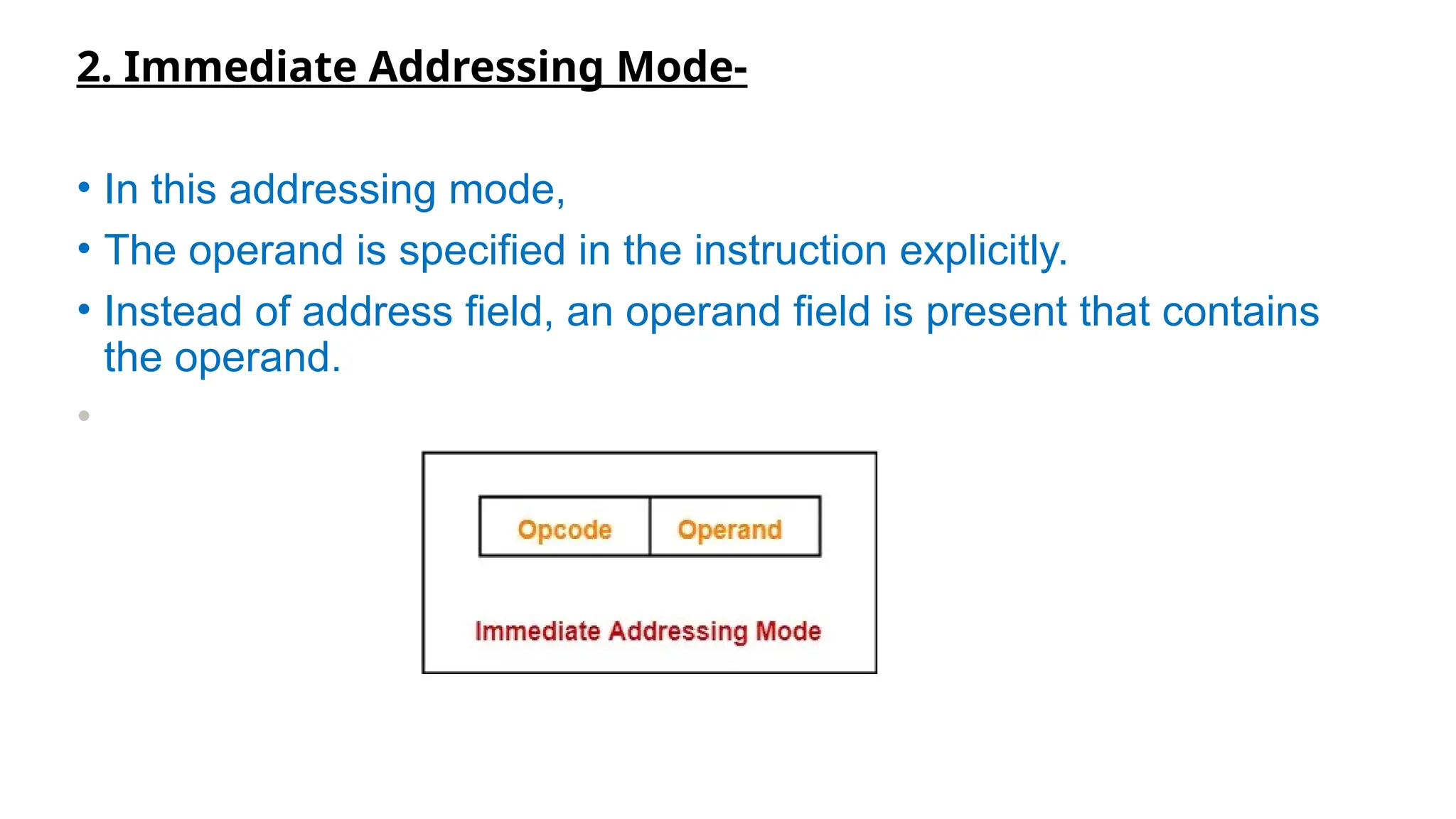
2. Immediate Addressing Mode-
• In this addressing mode,
• The operand is specified in the instruction explicitly.
• Instead of address field, an operand field is present that contains
the operand.
•
3. Direct Addressing Mode-
• In this addressing mode,
• The address field of the instruction contains the effective address of
the operand.
• Only one reference to memory is required to fetch the operand.
• It is also called as absolute addressing mode..
Example-
•
• ADD X will increment the value stored in the
accumulator by the value stored
at memory location X.
AC ← AC + [X]
4. Indirect Addressing Mode-
• In this addressing mode,
• The address field of the instruction specifies the address of memory
location that contains the effective address of the operand.
• Two references to memory are required to fetch the operand.
Example-
•
• ADD X will increment the value
stored in the accumulator
by the value stored at
memory location specified by X.
AC ← AC + [[X]]
5.Stack Addressing Mode-
• In this addressing mode,
• The operand is contained at the top of the stack.
• Example-
• ADD
• This instruction simply pops out two symbols contained at the top
of the stack.
• The addition of those two operands is performed.
• The result so obtained after addition is pushed again at the top of
the stack.
addressing modeLecture3-Intro to Ht.pptx

addressing modeLecture3-Intro to Ht.pptx

  • 1.
  • 2.
    The different waysof specifying the location of an operand in an instruction are called as addressing modes.
  • 4.
    1.Implied / ImplicitAddressing Mode 2.Stack Addressing Mode 3.Immediate Addressing Mode 4.Direct Addressing Mode 5.Indirect Addressing Mode 6.Register Direct Addressing Mode 7.Register Indirect Addressing Mode 8.Relative Addressing Mode 9.Indexed Addressing Mode 10.Base Register Addressing Mode 11.Auto-Increment Addressing Mode 12.Auto-Decrement Addressing Mode
  • 5.
    1. Implied AddressingMode- • In this addressing mode, • The definition of the instruction itself specify the operands implicitly. • It is also called as implicit addressing mode Examples- • The instruction “Complement Accumulator” is an implied mode instruction. • In a stack organized computer, Zero Address Instructions are implied mode instructions. • (since operands are always implied to be present on the top of the stack)
  • 6.
    2. Immediate AddressingMode- • In this addressing mode, • The operand is specified in the instruction explicitly. • Instead of address field, an operand field is present that contains the operand. •
  • 7.
    3. Direct AddressingMode- • In this addressing mode, • The address field of the instruction contains the effective address of the operand. • Only one reference to memory is required to fetch the operand. • It is also called as absolute addressing mode.. Example- • • ADD X will increment the value stored in the accumulator by the value stored at memory location X. AC ← AC + [X]
  • 8.
    4. Indirect AddressingMode- • In this addressing mode, • The address field of the instruction specifies the address of memory location that contains the effective address of the operand. • Two references to memory are required to fetch the operand. Example- • • ADD X will increment the value stored in the accumulator by the value stored at memory location specified by X. AC ← AC + [[X]]
  • 9.
    5.Stack Addressing Mode- •In this addressing mode, • The operand is contained at the top of the stack. • Example- • ADD • This instruction simply pops out two symbols contained at the top of the stack. • The addition of those two operands is performed. • The result so obtained after addition is pushed again at the top of the stack.