Addressing
Modes
Addressing mode
Addressing modes refers to the
different ways in which the location of
an operand is specified in an
instruction.
Instruction Cycle & PC :
 The control unit of a computer is designed to go through an
instruction cycle that is divided into three major phases:
-Fetch the instruction.
-Decode the instruction.
-Execute the instruction.
 PC (program counter) is a register that keeps track of the
instructions in the program stored in the memory. PC holds the
address of the instruction to be executed next and is
incremented each time an instruction is fetched from memory.
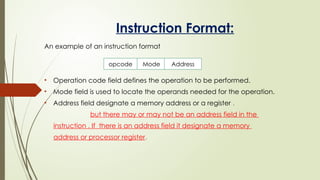
Instruction Format:
An example of an instruction format
• Operation code field defines the operation to be performed.
• Mode field is used to locate the operands needed for the operation.
• Address field designate a memory address or a register .
but there may or may not be an address field in the
instruction . If there is an address field it designate a memory
address or processor register.
opcode Mode Address
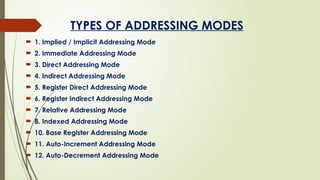
TYPES OF ADDRESSING MODES
 1. Implied / Implicit Addressing Mode
 2. Immediate Addressing Mode
 3. Direct Addressing Mode
 4. Indirect Addressing Mode
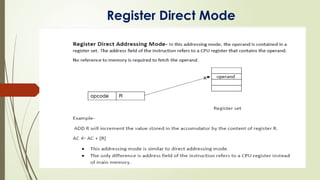
 5. Register Direct Addressing Mode
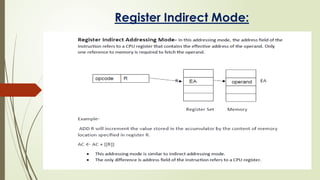
 6. Register Indirect Addressing Mode
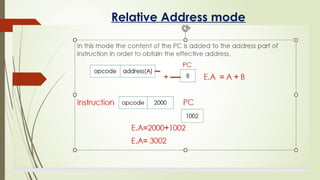
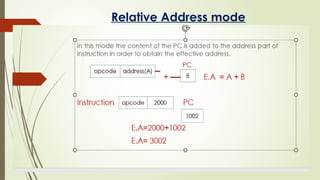
 7. Relative Addressing Mode
 8. Indexed Addressing Mode
 10. Base Register Addressing Mode
 11. Auto-Increment Addressing Mode
 12. Auto-Decrement Addressing Mode
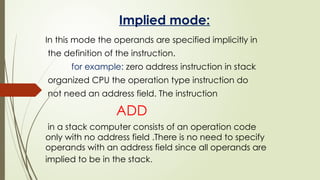
Implied mode:
In this mode the operands are specified implicitly in
the definition of the instruction.
for example: zero address instruction in stack
organized CPU the operation type instruction do
not need an address field. The instruction
ADD
in a stack computer consists of an operation code
only with no address field .There is no need to specify
operands with an address field since all operands are
implied to be in the stack.
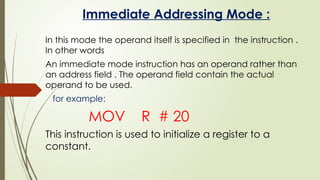
Immediate Addressing Mode :
In this mode the operand itself is specified in the instruction .
In other words
An immediate mode instruction has an operand rather than
an address field . The operand field contain the actual
operand to be used.
for example:
MOV R # 20
This instruction is used to initialize a register to a
constant.
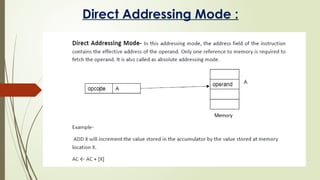
Direct Addressing Mode :
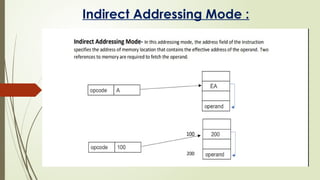
Indirect Addressing Mode :
Register Direct Mode
Relative Address mode
Index Addressing Mode:
In this mode the content of an index register is
added to the address part of the instruction to
obtain the effective address.
• Base Register : It is a special CPU register that contains an index
value.
• Address field of the instruction defines the beginning address of
data are in memory.
• Each operand in array is stored in memory relative to the beginning
address.
• The distance b/w the beginning address and the address of the
operand is the index value stored in the register .
Example:
Instruction IR
1000
1000 1001 1002 1003 1004
[A]
0 1 2 3 4
E.A=1000+3
This type of address mode used to access array element.
opcode
Memory add
/base address
3
operand
The End

Introduction to Addressing modes in computer memory.pptx

  • 1.
  • 2.
    Addressing mode Addressing modesrefers to the different ways in which the location of an operand is specified in an instruction.
  • 3.
    Instruction Cycle &PC :  The control unit of a computer is designed to go through an instruction cycle that is divided into three major phases: -Fetch the instruction. -Decode the instruction. -Execute the instruction.  PC (program counter) is a register that keeps track of the instructions in the program stored in the memory. PC holds the address of the instruction to be executed next and is incremented each time an instruction is fetched from memory.
  • 4.
    Instruction Format: An exampleof an instruction format • Operation code field defines the operation to be performed. • Mode field is used to locate the operands needed for the operation. • Address field designate a memory address or a register . but there may or may not be an address field in the instruction . If there is an address field it designate a memory address or processor register. opcode Mode Address
  • 5.
    TYPES OF ADDRESSINGMODES  1. Implied / Implicit Addressing Mode  2. Immediate Addressing Mode  3. Direct Addressing Mode  4. Indirect Addressing Mode  5. Register Direct Addressing Mode  6. Register Indirect Addressing Mode  7. Relative Addressing Mode  8. Indexed Addressing Mode  10. Base Register Addressing Mode  11. Auto-Increment Addressing Mode  12. Auto-Decrement Addressing Mode
  • 6.
    Implied mode: In thismode the operands are specified implicitly in the definition of the instruction. for example: zero address instruction in stack organized CPU the operation type instruction do not need an address field. The instruction ADD in a stack computer consists of an operation code only with no address field .There is no need to specify operands with an address field since all operands are implied to be in the stack.
  • 7.
    Immediate Addressing Mode: In this mode the operand itself is specified in the instruction . In other words An immediate mode instruction has an operand rather than an address field . The operand field contain the actual operand to be used. for example: MOV R # 20 This instruction is used to initialize a register to a constant.
  • 8.
  • 9.
  • 10.
  • 12.
  • 13.
  • 14.
    Index Addressing Mode: Inthis mode the content of an index register is added to the address part of the instruction to obtain the effective address. • Base Register : It is a special CPU register that contains an index value. • Address field of the instruction defines the beginning address of data are in memory. • Each operand in array is stored in memory relative to the beginning address. • The distance b/w the beginning address and the address of the operand is the index value stored in the register .
  • 15.
    Example: Instruction IR 1000 1000 10011002 1003 1004 [A] 0 1 2 3 4 E.A=1000+3 This type of address mode used to access array element. opcode Memory add /base address 3 operand
  • 16.