Chapter 3 Selections

1

Liang, Introduction to Java Programming, Eighth Edition, (c) 2011 Pearson Education, Inc. All rights reserved. 0132130807
Motivations
If you assigned a negative value for radius in
Listing 2.1, ComputeArea.java, the program would
print an invalid result. If the radius is negative, you
don't want the program to compute the area. How
can you deal with this situation?

2

Liang, Introduction to Java Programming, Eighth Edition, (c) 2011 Pearson Education, Inc. All rights reserved. 0132130807
Objectives
To declare boolean type and write Boolean expressions using comparison operators (§3.2).
To program AdditionQuiz using Boolean expressions (§3.3).
To implement selection control using one-way if statements (§3.4)
To program the GuessBirthday game using one-way if statements (§3.5).
To implement selection control using two-way if statements (§3.6).
To implement selection control using nested if statements (§3.7).
To avoid common errors in if statements (§3.8).
To program using selection statements for a variety of examples (BMI, ComputeTax,
SubtractionQuiz) (§3.9-3.11).
To generate random numbers using the Math.random() method (§3.9).
To combine conditions using logical operators (&&, ||, and !) (§3.12).
To program using selection statements with combined conditions (LeapYear, Lottery) (§§3.13-3.14).
To implement selection control using switch statements (§3.15).
To write expressions using the conditional operator (§3.16).
To format output using the System.out.printf method and to format strings using the String.format
method (§3.17).
To examine the rules governing operator precedence and associativity (§3.18).
(GUI) To get user confirmation using confirmation dialogs (§3.19).

3

Liang, Introduction to Java Programming, Eighth Edition, (c) 2011 Pearson Education, Inc. All rights reserved. 0132130807
The boolean Type and Operators
Often in a program you need to compare two
values, such as whether i is greater than j. Java
provides six comparison operators (also known
as relational operators) that can be used to
compare two values. The result of the
comparison is a Boolean value: true or false.
boolean b = (1 > 2);

4

Liang, Introduction to Java Programming, Eighth Edition, (c) 2011 Pearson Education, Inc. All rights reserved. 0132130807
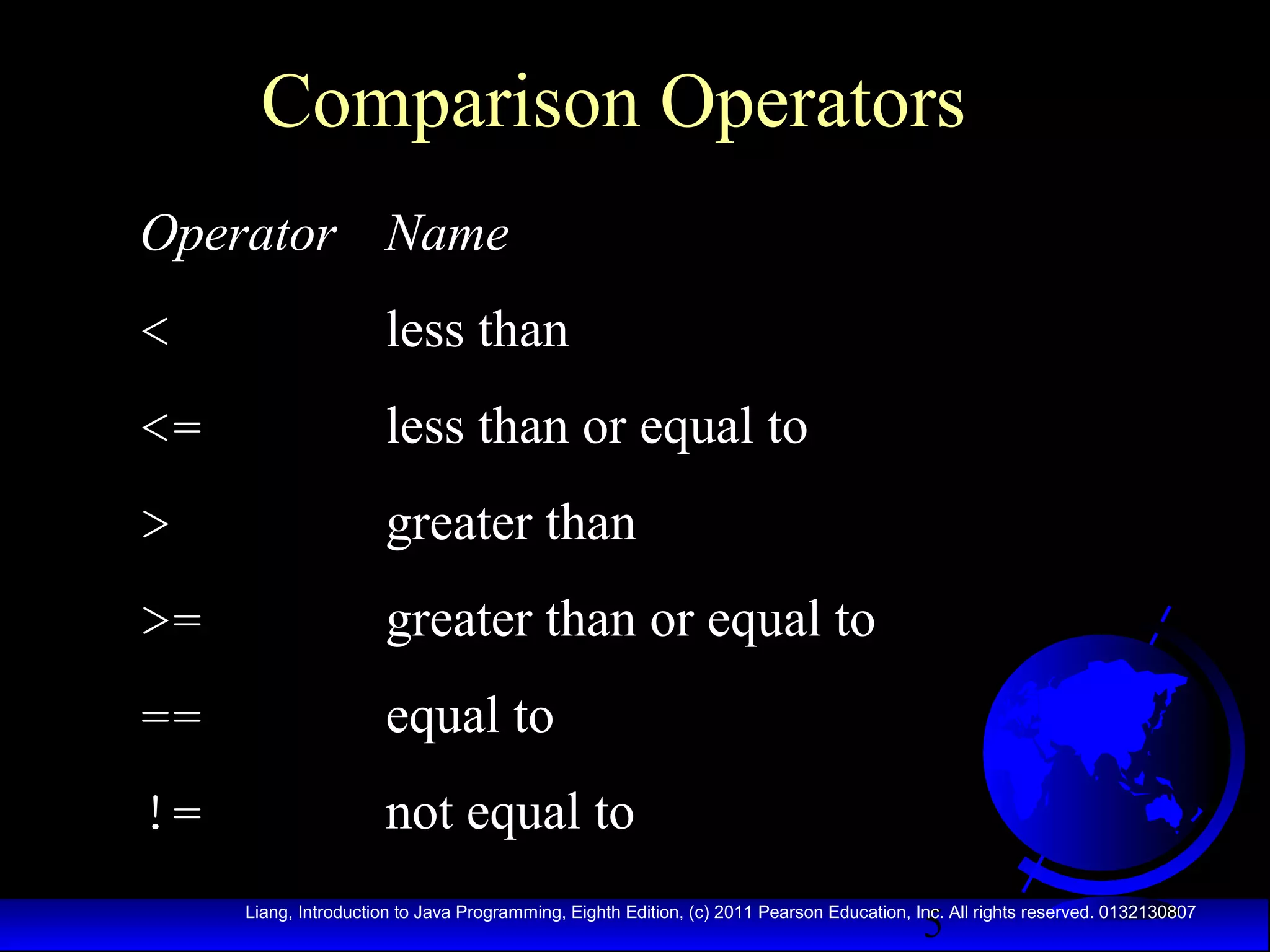
Comparison Operators
Operator Name
<

less than

<=

less than or equal to

>

greater than

>=

greater than or equal to

==

equal to

!=

not equal to
5

Liang, Introduction to Java Programming, Eighth Edition, (c) 2011 Pearson Education, Inc. All rights reserved. 0132130807
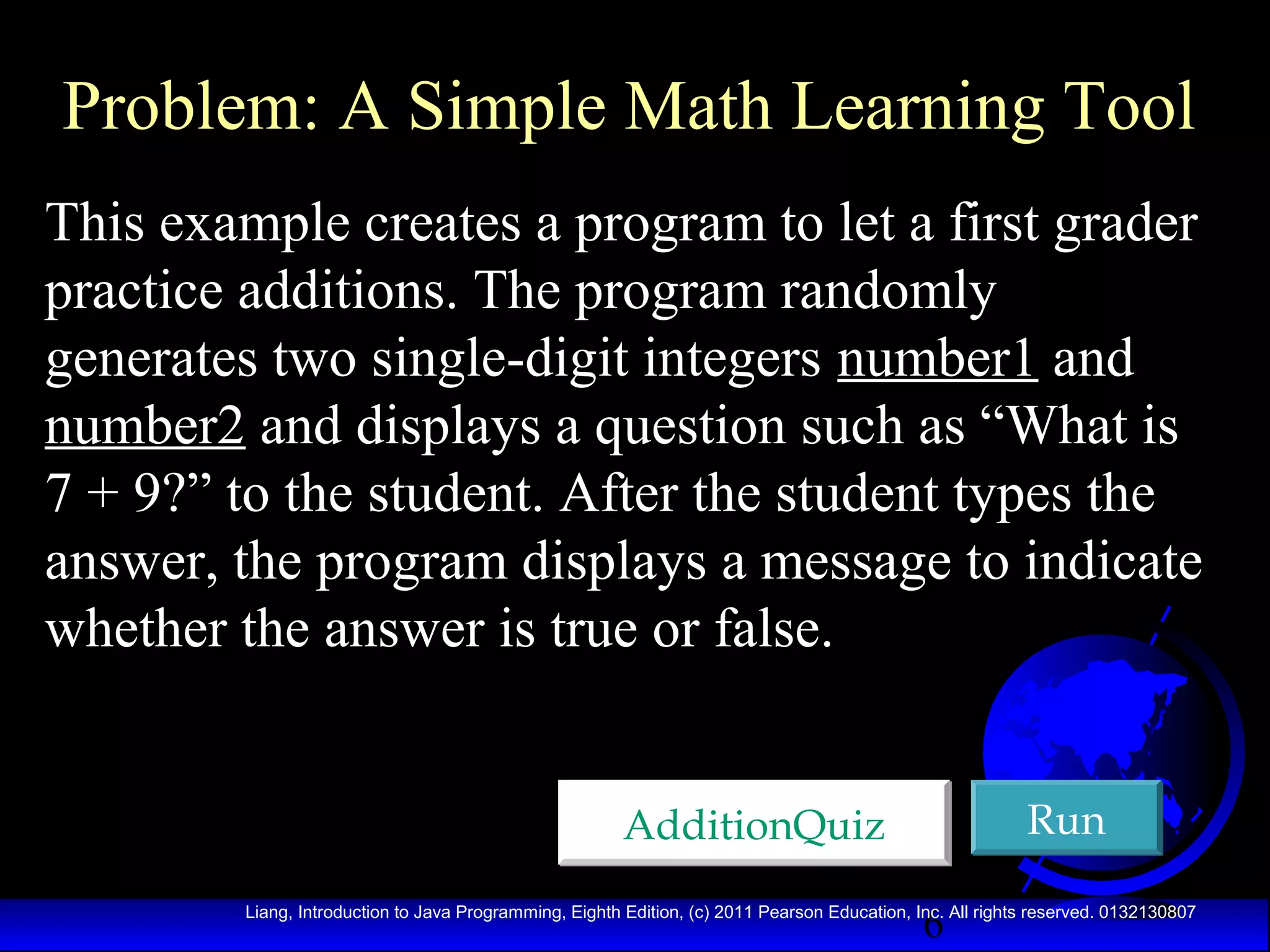
Problem: A Simple Math Learning Tool
This example creates a program to let a first grader
practice additions. The program randomly
generates two single-digit integers number1 and
number2 and displays a question such as “What is
7 + 9?” to the student. After the student types the
answer, the program displays a message to indicate
whether the answer is true or false.
Run

AdditionQuiz
6

Liang, Introduction to Java Programming, Eighth Edition, (c) 2011 Pearson Education, Inc. All rights reserved. 0132130807
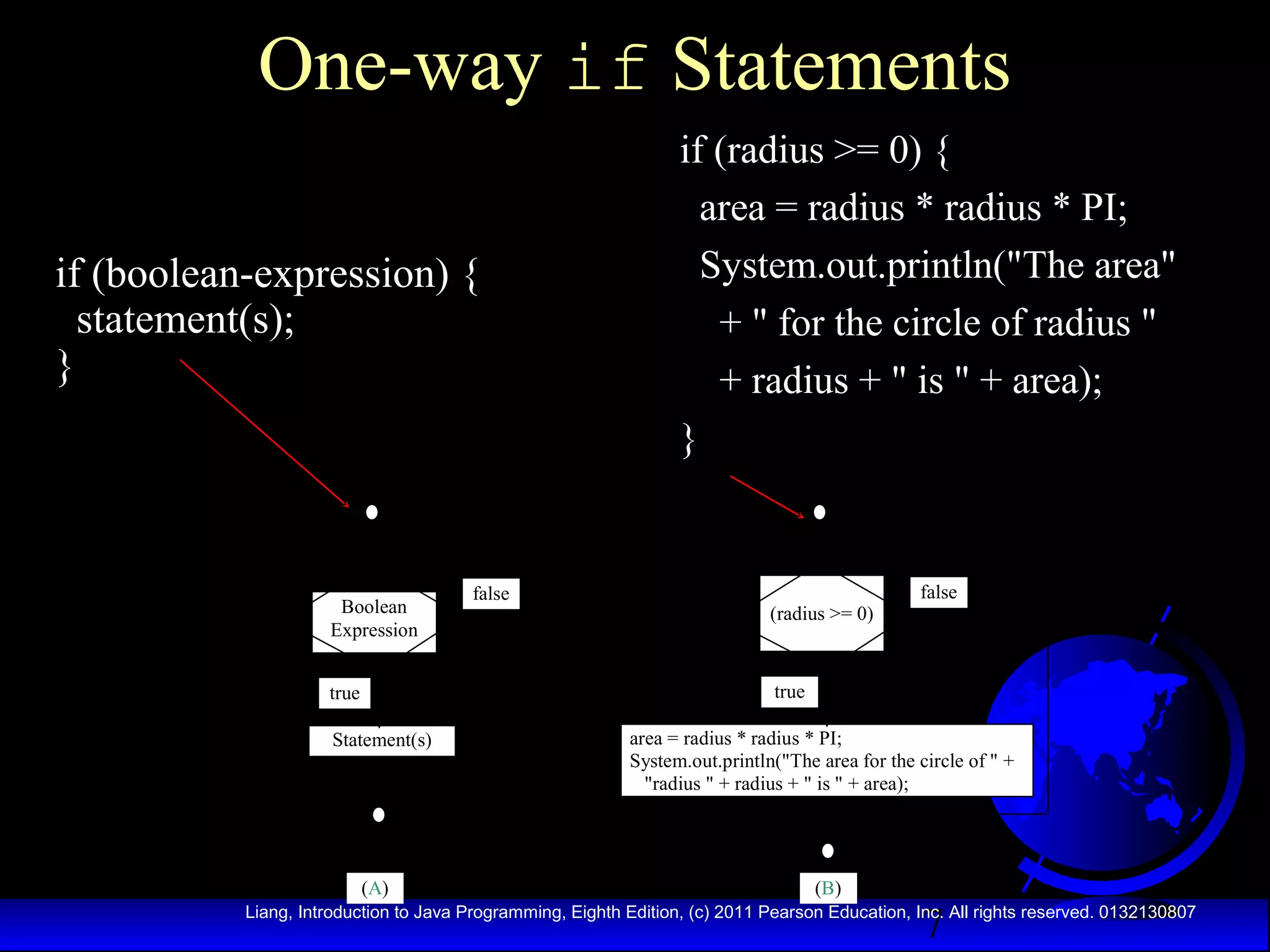
One-way if Statements
if (boolean-expression) {
statement(s);
}

Boolean
Expression

false

if (radius >= 0) {
area = radius * radius * PI;
System.out.println("The area"
+ " for the circle of radius "
+ radius + " is " + area);
}

(radius >= 0)

false

true

true
Statement(s)

(A)

area = radius * radius * PI;
System.out.println("The area for the circle of " +
"radius " + radius + " is " + area);

(B)

7

Liang, Introduction to Java Programming, Eighth Edition, (c) 2011 Pearson Education, Inc. All rights reserved. 0132130807
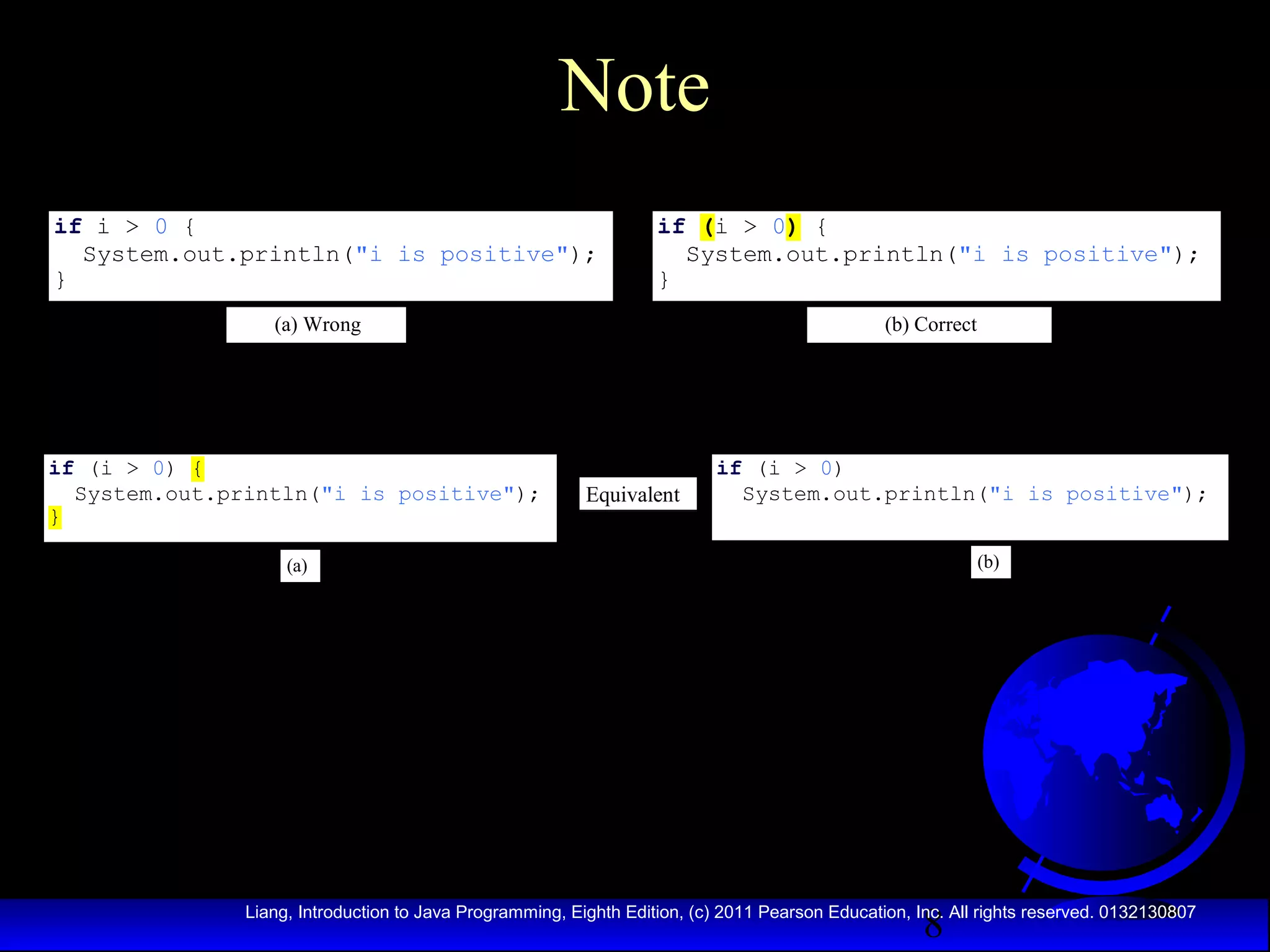
Note
if i > 0 {
System.out.println("i is positive");
}

if (i > 0) {
System.out.println("i is positive");
}

(a) Wrong

if (i > 0) {
System.out.println("i is positive");
}

(b) Correct

Equivalent

if (i > 0)
System.out.println("i is positive");
(b)

(a)

8

Liang, Introduction to Java Programming, Eighth Edition, (c) 2011 Pearson Education, Inc. All rights reserved. 0132130807
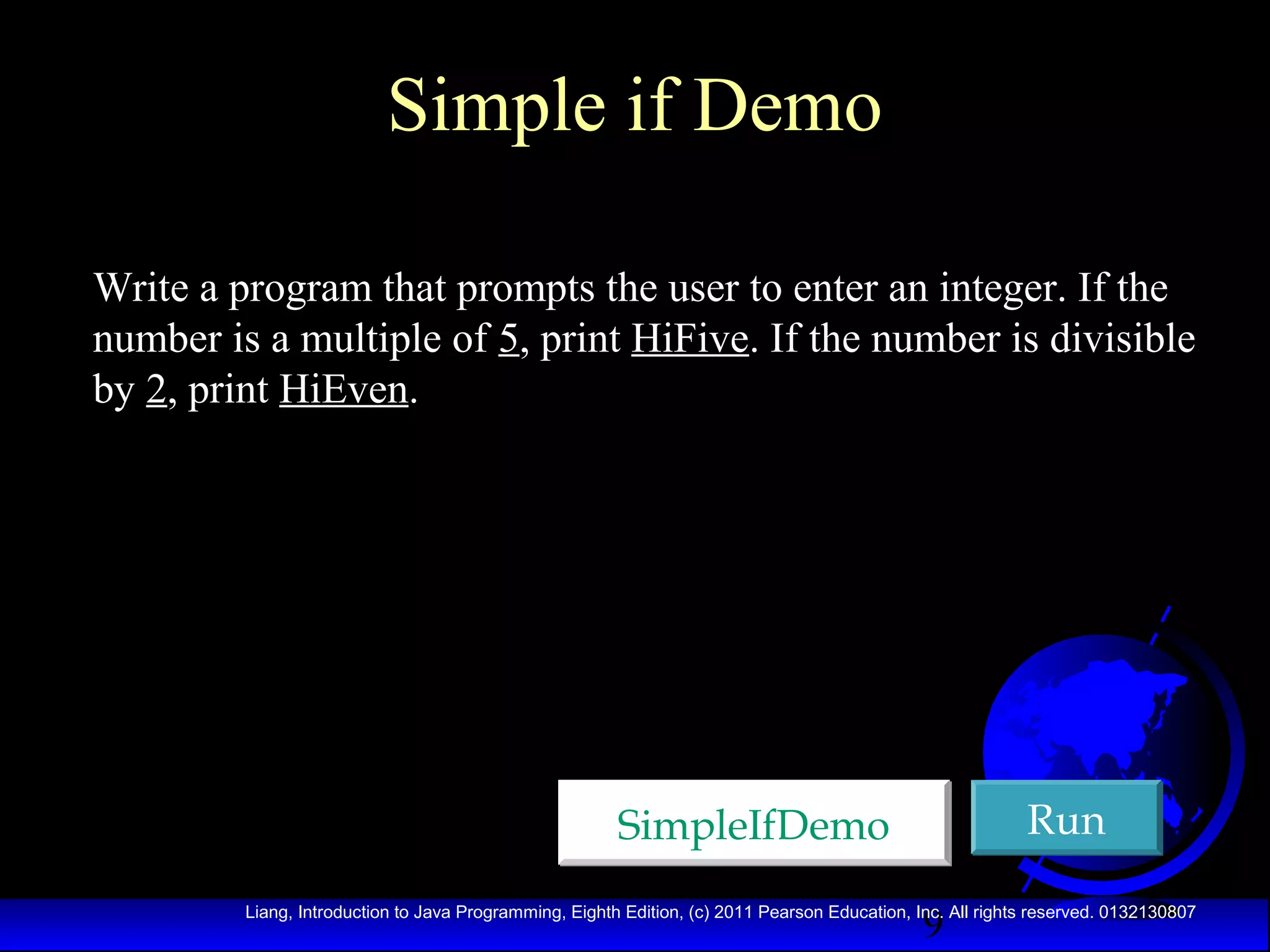
Simple if Demo
Write a program that prompts the user to enter an integer. If the
number is a multiple of 5, print HiFive. If the number is divisible
by 2, print HiEven.

Run

SimpleIfDemo
9

Liang, Introduction to Java Programming, Eighth Edition, (c) 2011 Pearson Education, Inc. All rights reserved. 0132130807
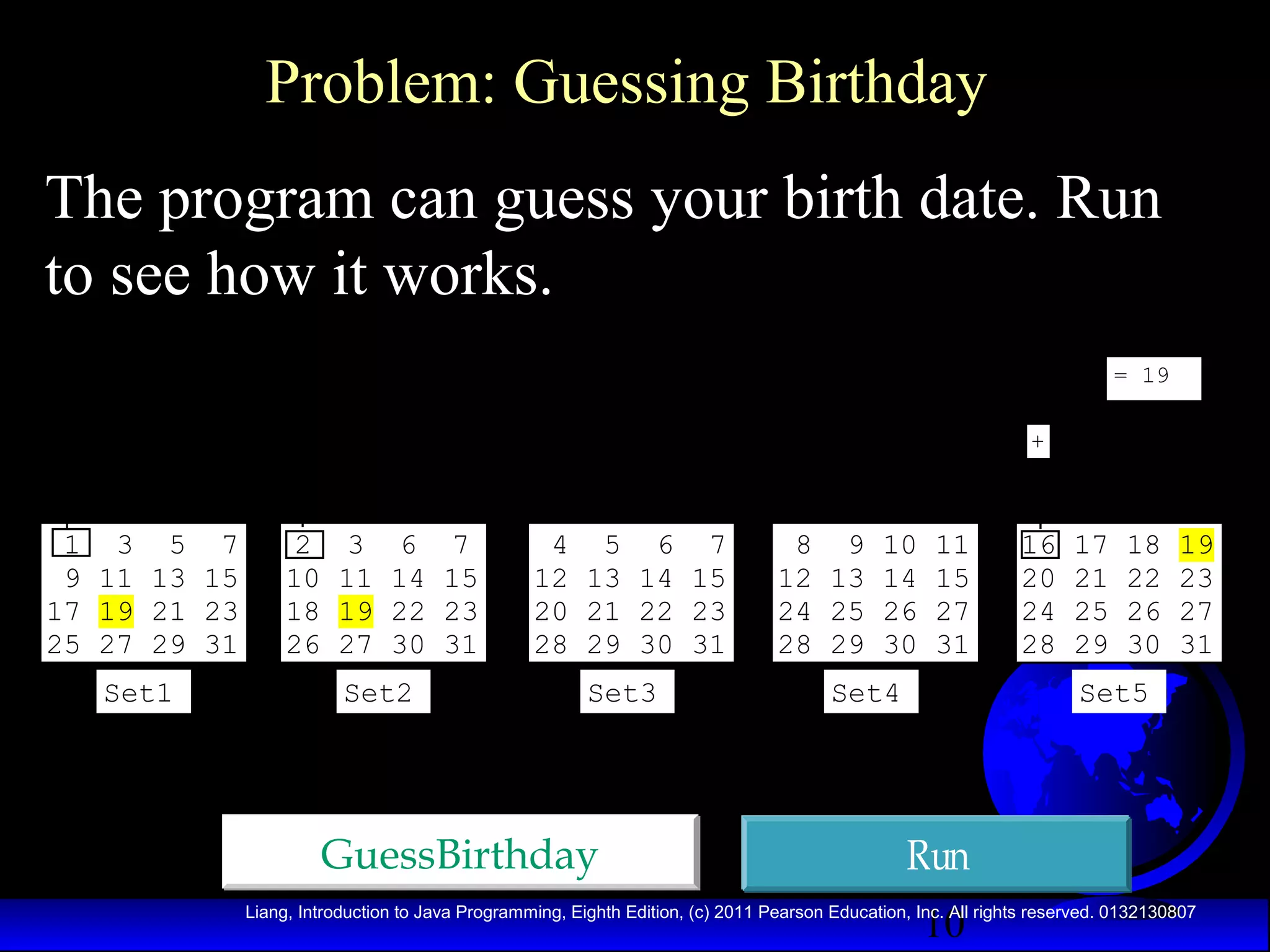
Problem: Guessing Birthday
The program can guess your birth date. Run
to see how it works.
= 19
+

1 3 5 7
9 11 13 15
17 19 21 23
25 27 29 31
Set1

2
10
18
26

3
11
19
27

6
14
22
30

Set2

7
15
23
31

4 5 6 7
12 13 14 15
20 21 22 23
28 29 30 31

8 9 10 11
12 13 14 15
24 25 26 27
28 29 30 31

Set3

Set4

GuessBirthday

16
20
24
28

17
21
25
29

18
22
26
30

19
23
27
31

Set5

Run
10

Liang, Introduction to Java Programming, Eighth Edition, (c) 2011 Pearson Education, Inc. All rights reserved. 0132130807
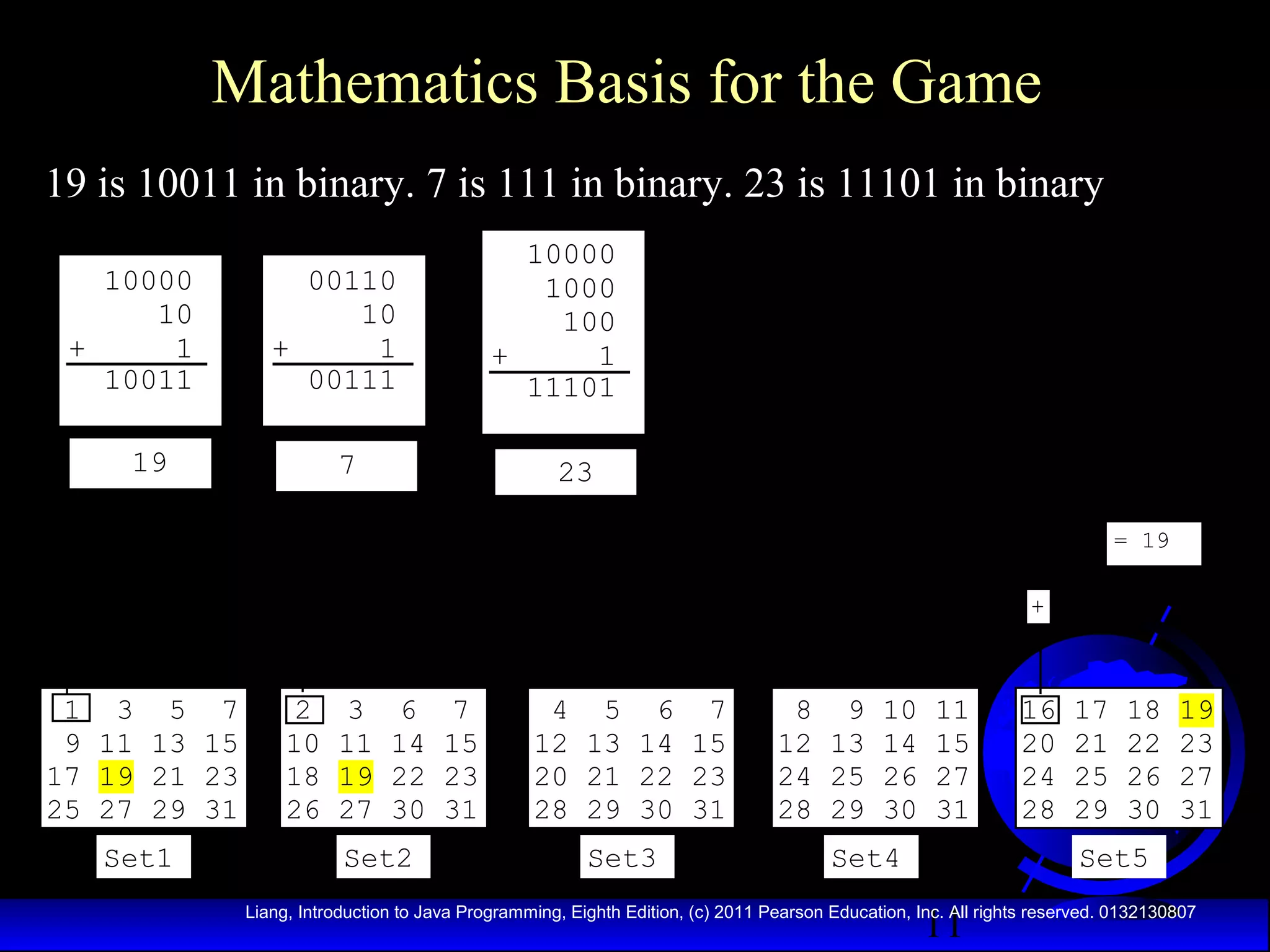
Mathematics Basis for the Game
19 is 10011 in binary. 7 is 111 in binary. 23 is 11101 in binary
10000
10
+
1
10011

10000
1000
100
+
1
11101

00110
10
+
1
00111

19

7

23
= 19
+

1 3 5 7
9 11 13 15
17 19 21 23
25 27 29 31
Set1

2
10
18
26

3
11
19
27

6
14
22
30

Set2

7
15
23
31

4 5 6 7
12 13 14 15
20 21 22 23
28 29 30 31

8 9 10 11
12 13 14 15
24 25 26 27
28 29 30 31

Set3

Set4

16
20
24
28

17
21
25
29

18
22
26
30

19
23
27
31

Set5

11

Liang, Introduction to Java Programming, Eighth Edition, (c) 2011 Pearson Education, Inc. All rights reserved. 0132130807
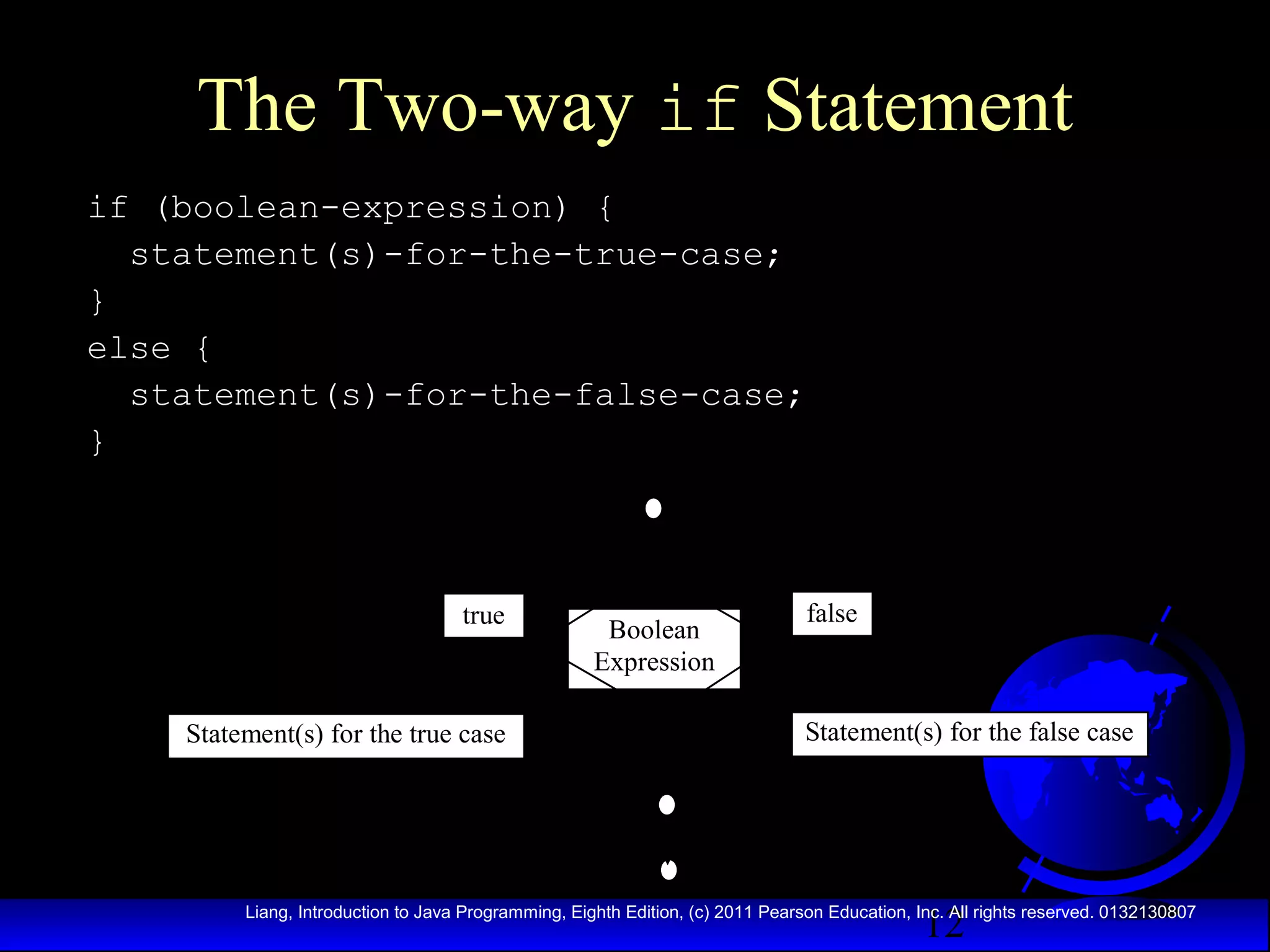
The Two-way if Statement
if (boolean-expression) {
statement(s)-for-the-true-case;
}
else {
statement(s)-for-the-false-case;
}

true

Statement(s) for the true case

Boolean
Expression

false

Statement(s) for the false case

12

Liang, Introduction to Java Programming, Eighth Edition, (c) 2011 Pearson Education, Inc. All rights reserved. 0132130807
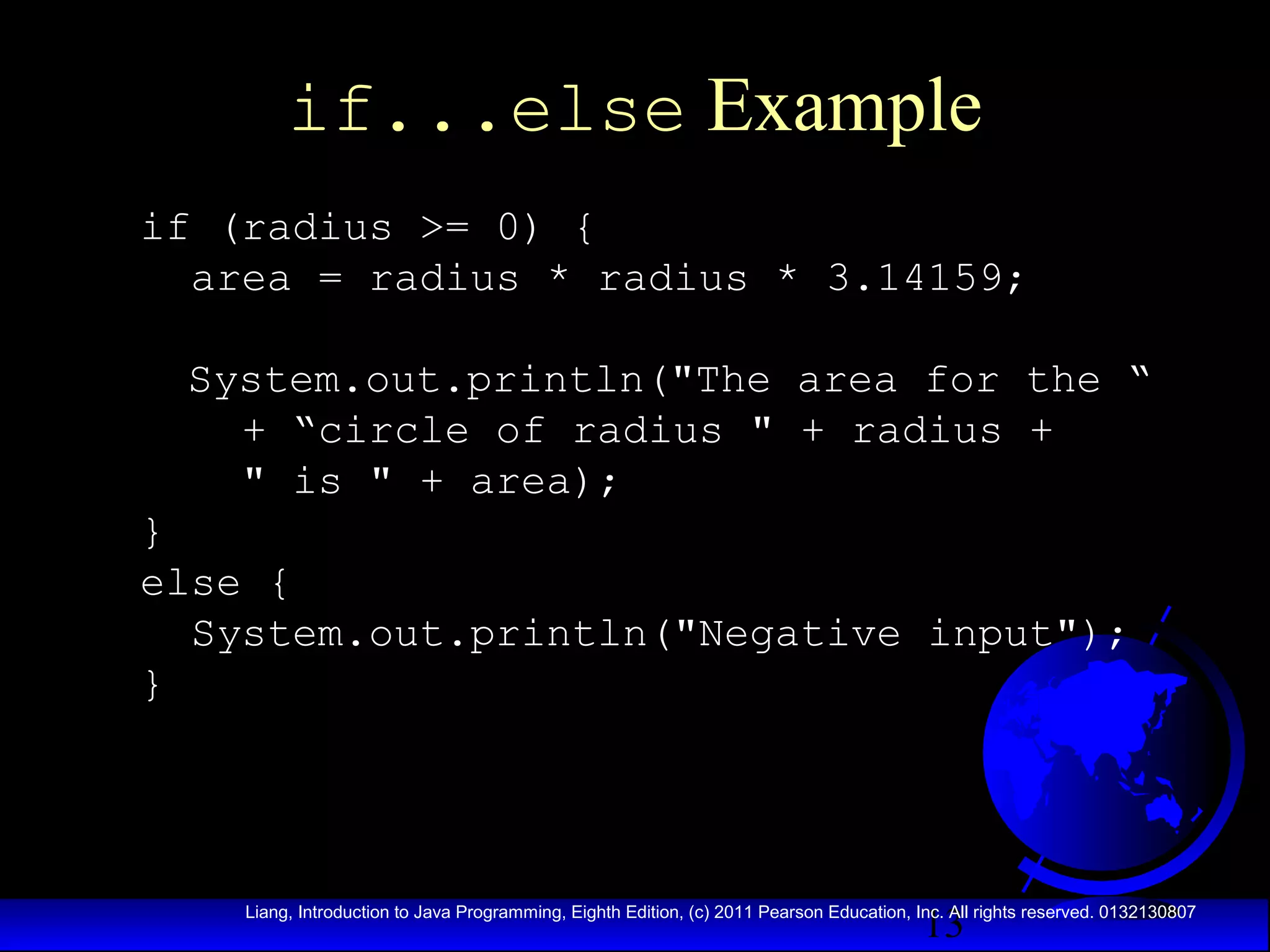
if...else Example
if (radius >= 0) {
area = radius * radius * 3.14159;
System.out.println("The area for the “
+ “circle of radius " + radius +
" is " + area);
}
else {
System.out.println("Negative input");
}

13

Liang, Introduction to Java Programming, Eighth Edition, (c) 2011 Pearson Education, Inc. All rights reserved. 0132130807
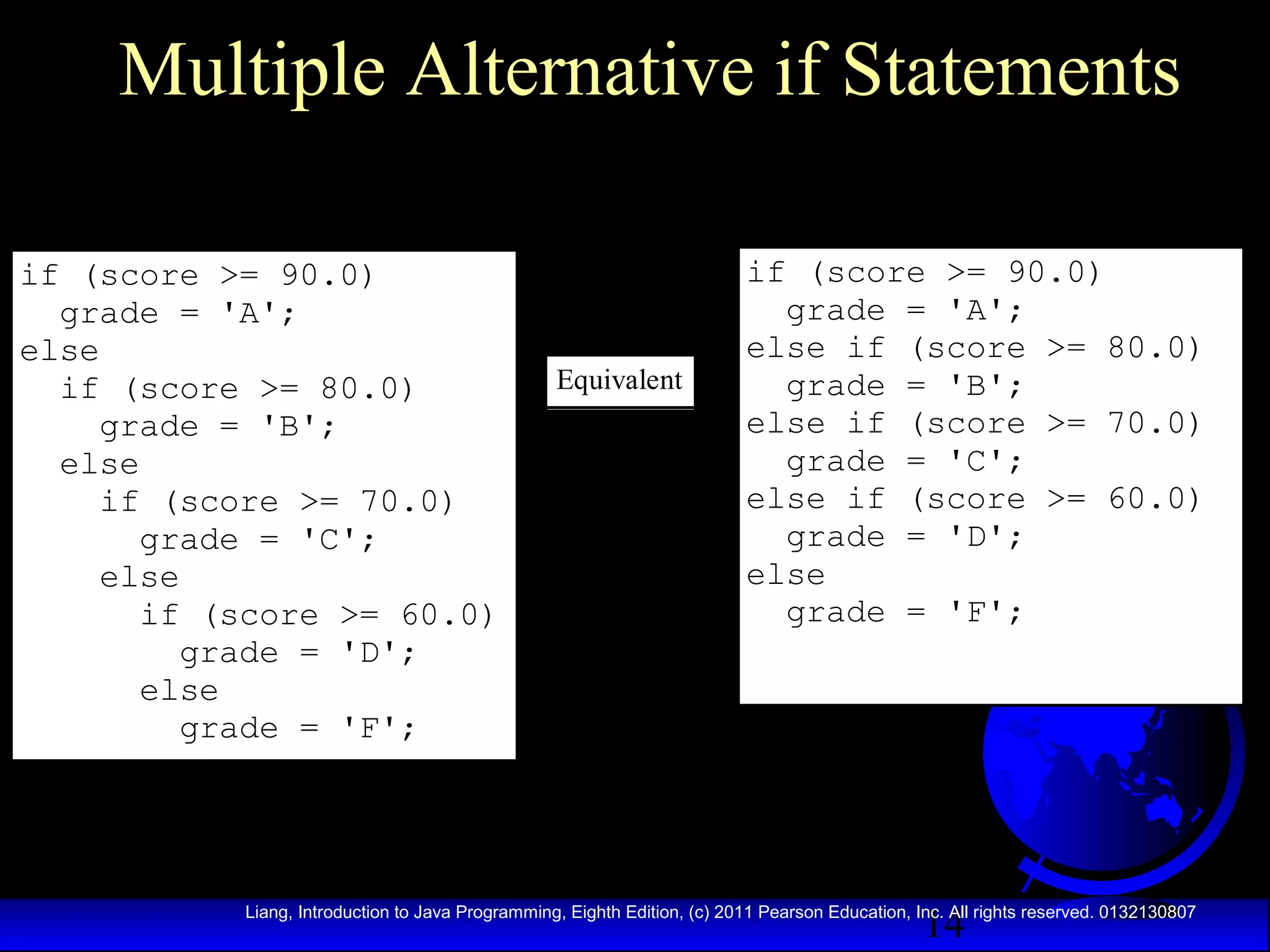
Multiple Alternative if Statements
if (score >= 90.0)
grade = 'A';
else
if (score >= 80.0)
grade = 'B';
else
if (score >= 70.0)
grade = 'C';
else
if (score >= 60.0)
grade = 'D';
else
grade = 'F';

Equivalent

if (score >= 90.0)
grade = 'A';
else if (score >= 80.0)
grade = 'B';
else if (score >= 70.0)
grade = 'C';
else if (score >= 60.0)
grade = 'D';
else
grade = 'F';

14

Liang, Introduction to Java Programming, Eighth Edition, (c) 2011 Pearson Education, Inc. All rights reserved. 0132130807
animation

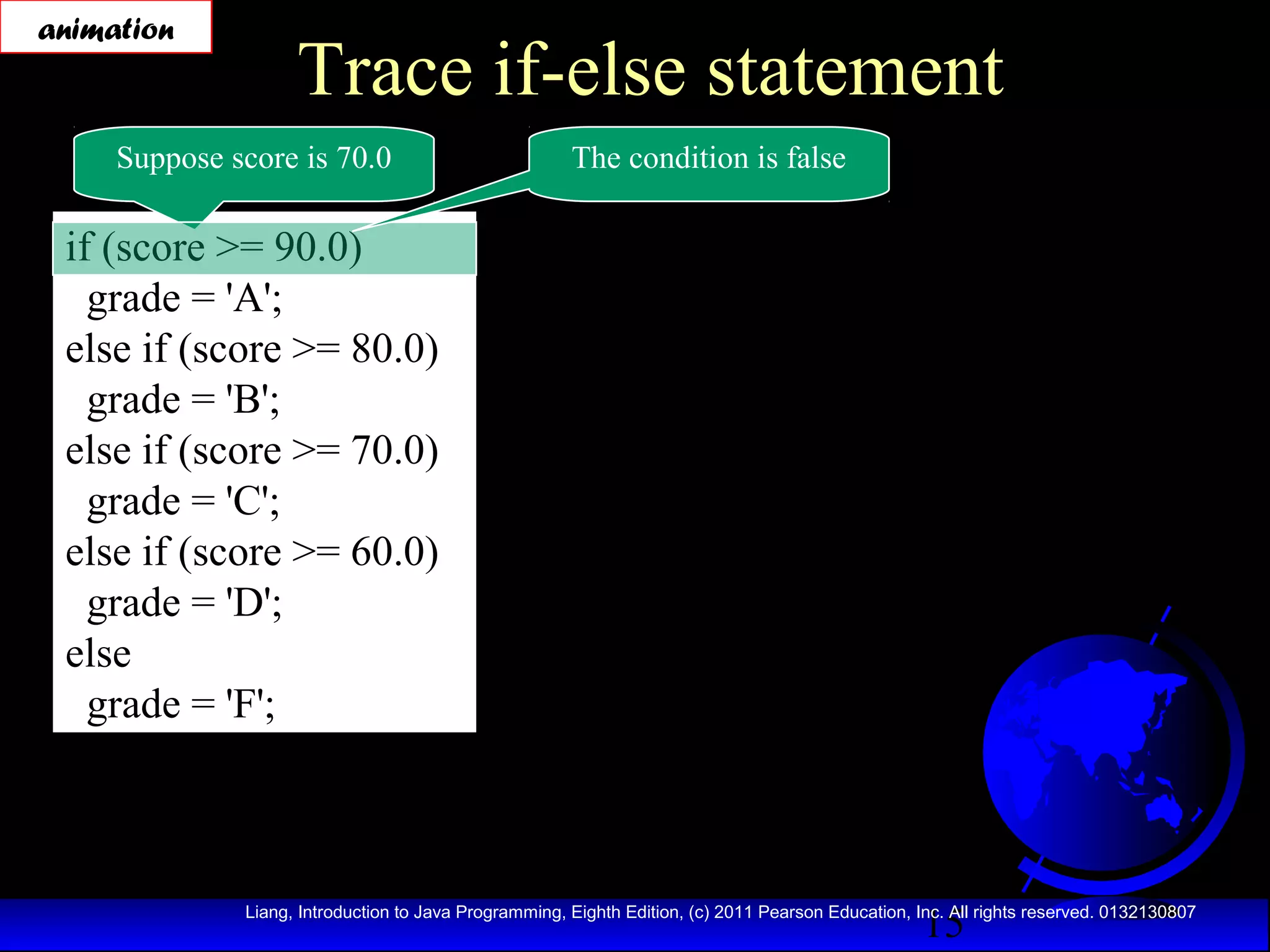
Trace if-else statement

Suppose score is 70.0

The condition is false

if (score >= 90.0)
grade = 'A';
else if (score >= 80.0)
grade = 'B';
else if (score >= 70.0)
grade = 'C';
else if (score >= 60.0)
grade = 'D';
else
grade = 'F';

15

Liang, Introduction to Java Programming, Eighth Edition, (c) 2011 Pearson Education, Inc. All rights reserved. 0132130807
animation

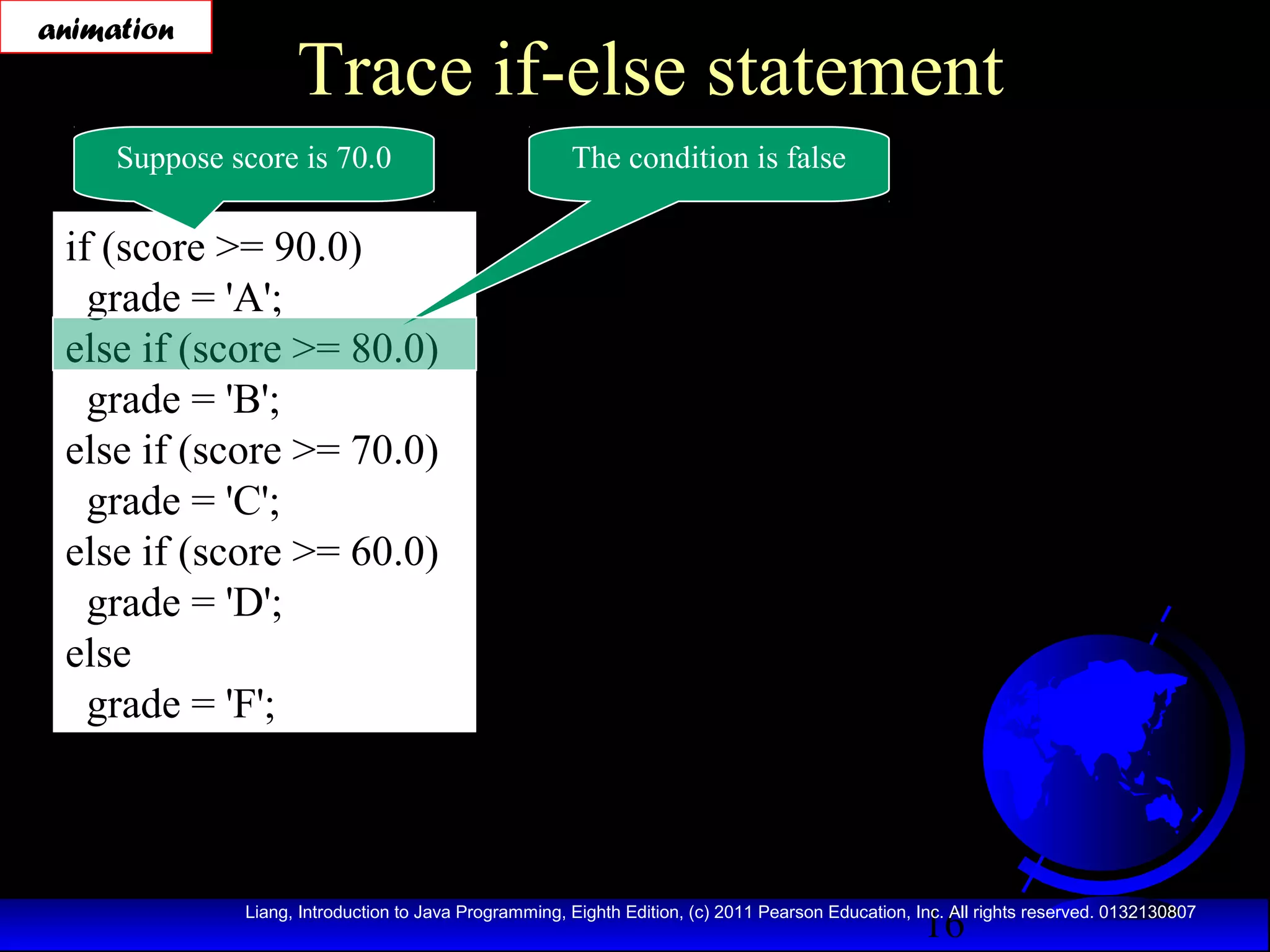
Trace if-else statement

Suppose score is 70.0

The condition is false

if (score >= 90.0)
grade = 'A';
else if (score >= 80.0)
grade = 'B';
else if (score >= 70.0)
grade = 'C';
else if (score >= 60.0)
grade = 'D';
else
grade = 'F';

16

Liang, Introduction to Java Programming, Eighth Edition, (c) 2011 Pearson Education, Inc. All rights reserved. 0132130807
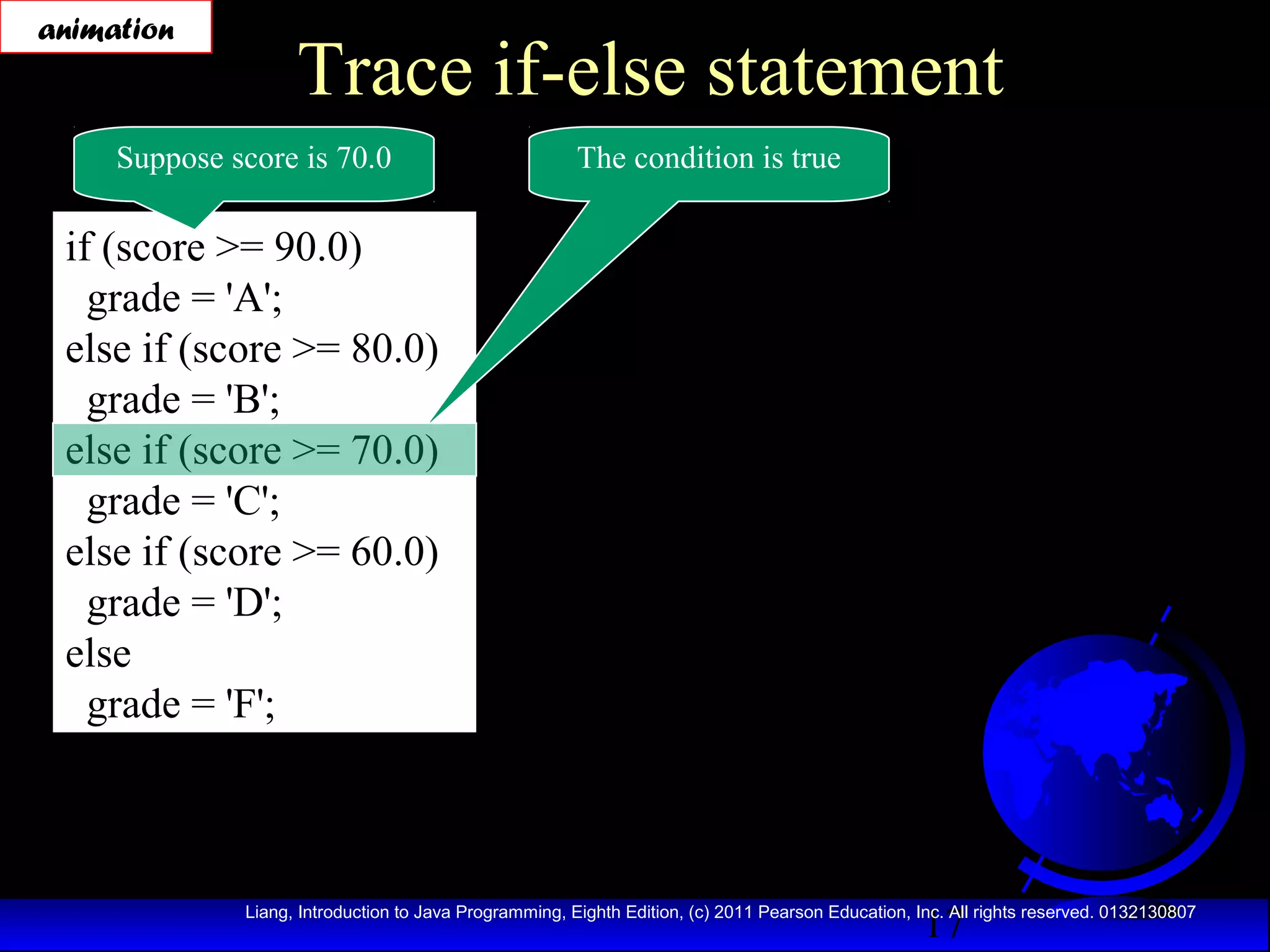
animation

Trace if-else statement

Suppose score is 70.0

The condition is true

if (score >= 90.0)
grade = 'A';
else if (score >= 80.0)
grade = 'B';
else if (score >= 70.0)
grade = 'C';
else if (score >= 60.0)
grade = 'D';
else
grade = 'F';

17

Liang, Introduction to Java Programming, Eighth Edition, (c) 2011 Pearson Education, Inc. All rights reserved. 0132130807
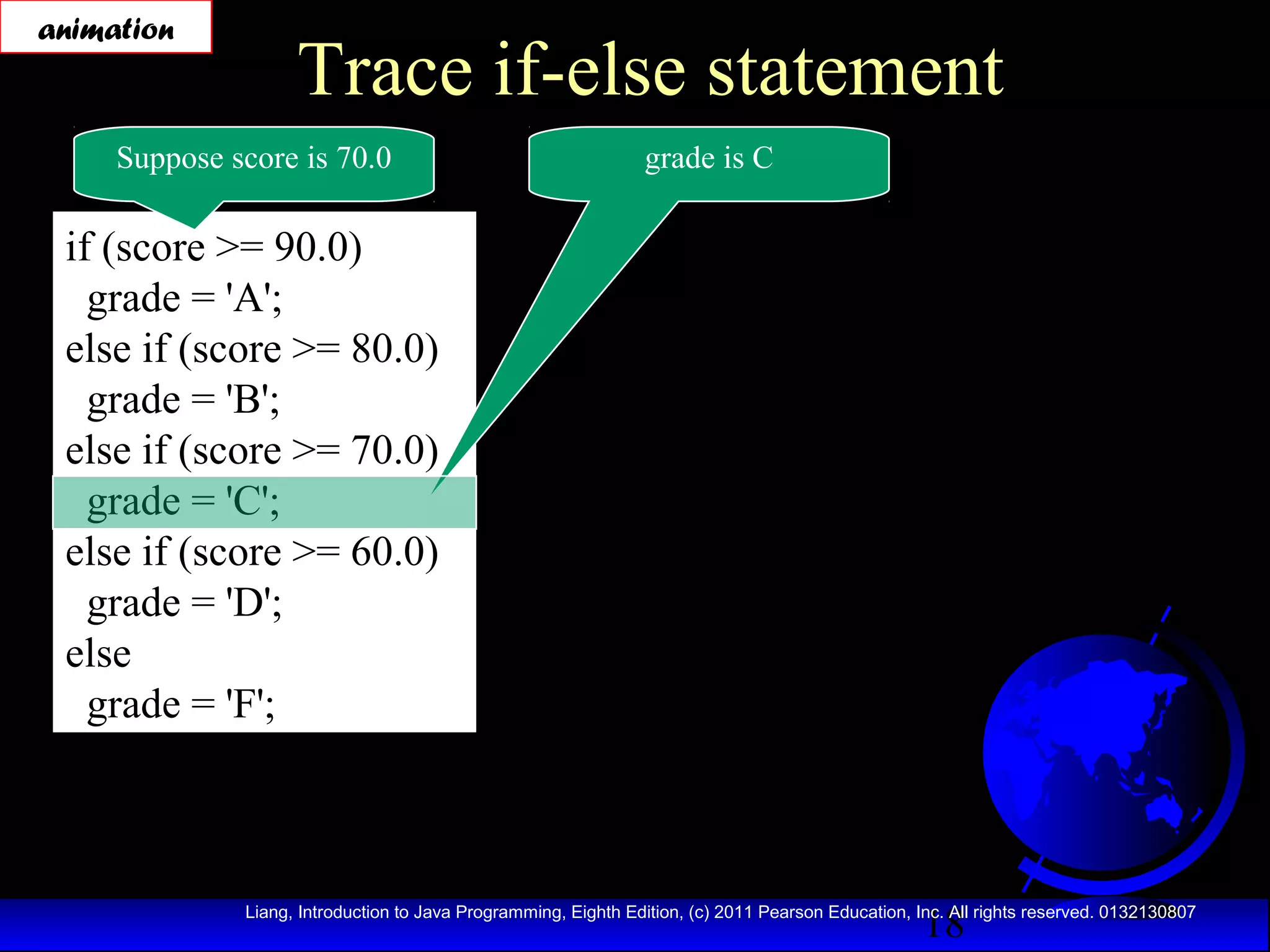
animation

Trace if-else statement

Suppose score is 70.0

grade is C

if (score >= 90.0)
grade = 'A';
else if (score >= 80.0)
grade = 'B';
else if (score >= 70.0)
grade = 'C';
else if (score >= 60.0)
grade = 'D';
else
grade = 'F';

18

Liang, Introduction to Java Programming, Eighth Edition, (c) 2011 Pearson Education, Inc. All rights reserved. 0132130807
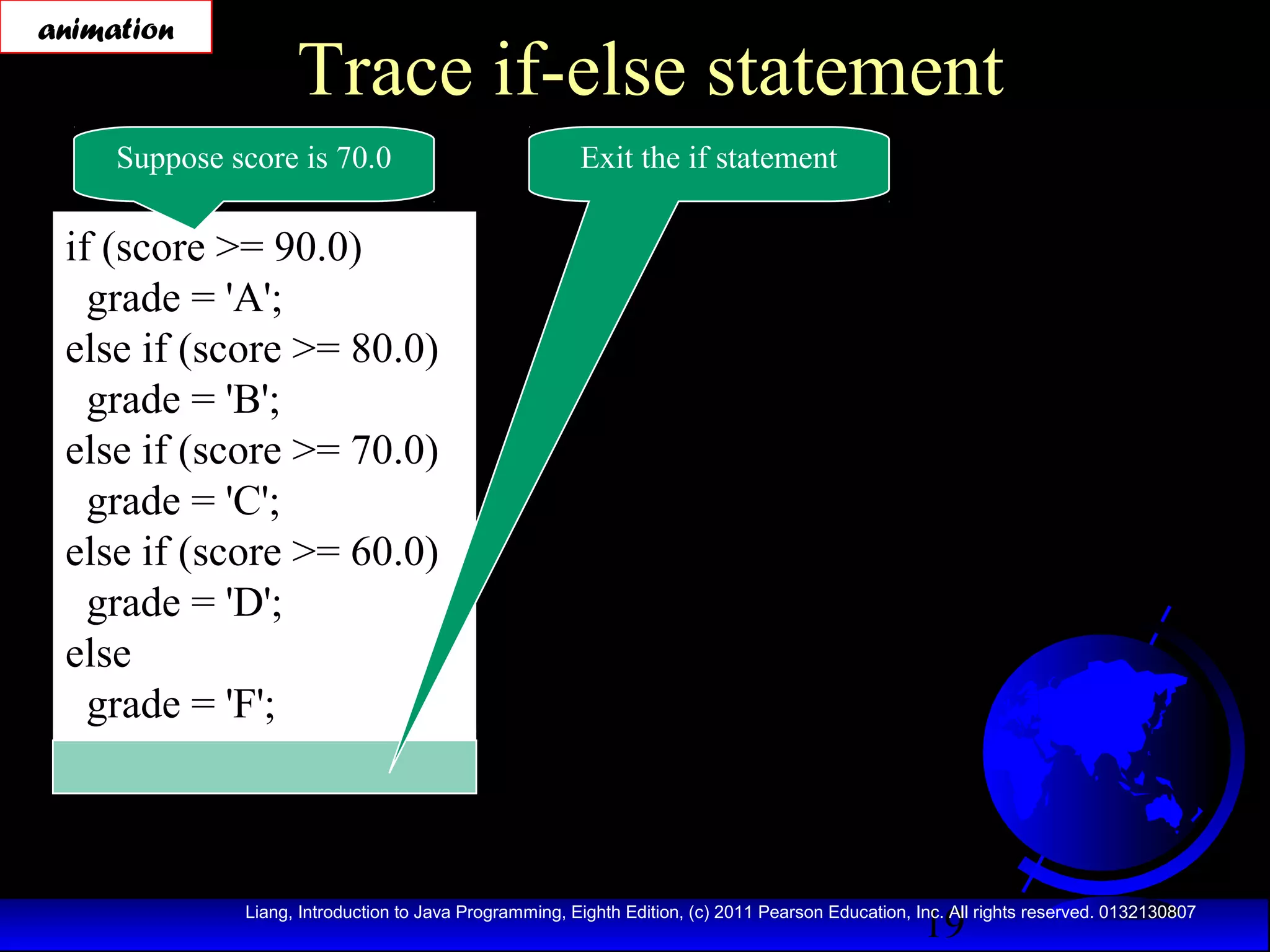
animation

Trace if-else statement

Suppose score is 70.0

Exit the if statement

if (score >= 90.0)
grade = 'A';
else if (score >= 80.0)
grade = 'B';
else if (score >= 70.0)
grade = 'C';
else if (score >= 60.0)
grade = 'D';
else
grade = 'F';

19

Liang, Introduction to Java Programming, Eighth Edition, (c) 2011 Pearson Education, Inc. All rights reserved. 0132130807
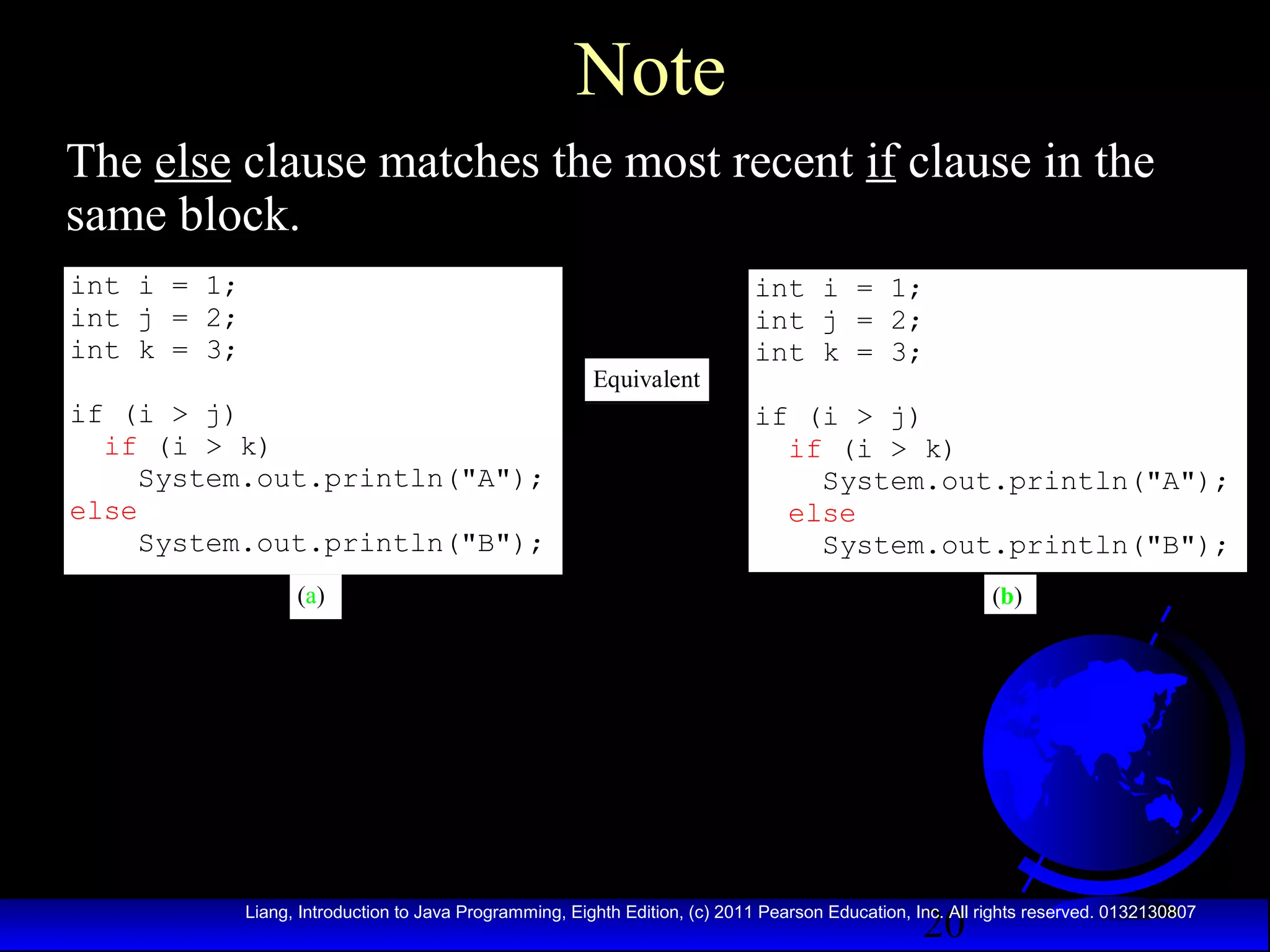
Note
The else clause matches the most recent if clause in the
same block.
int i = 1;
int j = 2;
int k = 3;

Equivalent

if (i > j)
if (i > k)
System.out.println("A");
else
System.out.println("B");

int i = 1;
int j = 2;
int k = 3;
if (i > j)
if (i > k)
System.out.println("A");
else
System.out.println("B");

(a)

(b)

20

Liang, Introduction to Java Programming, Eighth Edition, (c) 2011 Pearson Education, Inc. All rights reserved. 0132130807
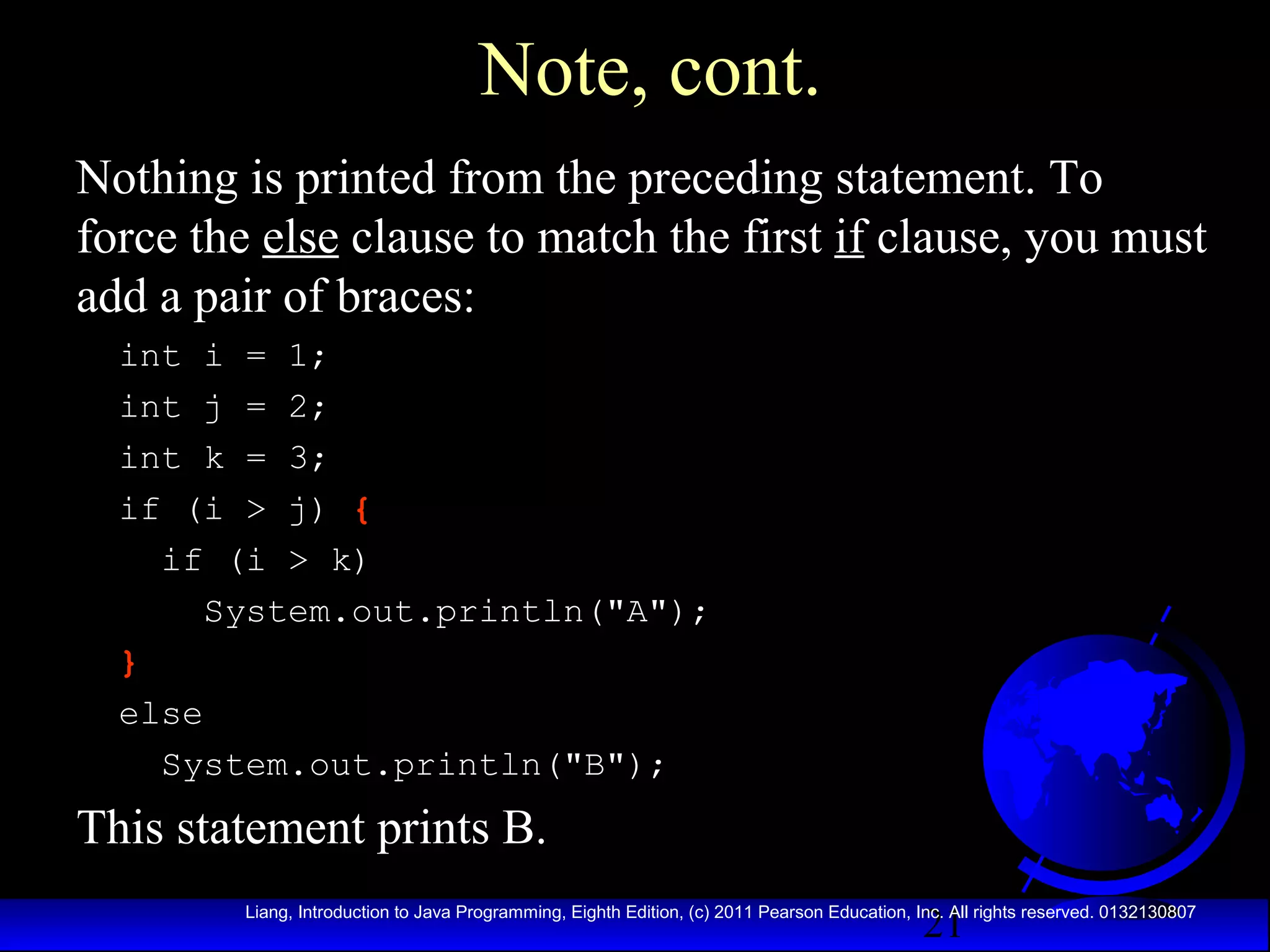
Note, cont.
Nothing is printed from the preceding statement. To
force the else clause to match the first if clause, you must
add a pair of braces:
int i = 1;
int j = 2;
int k = 3;
if (i > j) {
if (i > k)
System.out.println("A");
}
else
System.out.println("B");

This statement prints B.
21

Liang, Introduction to Java Programming, Eighth Edition, (c) 2011 Pearson Education, Inc. All rights reserved. 0132130807
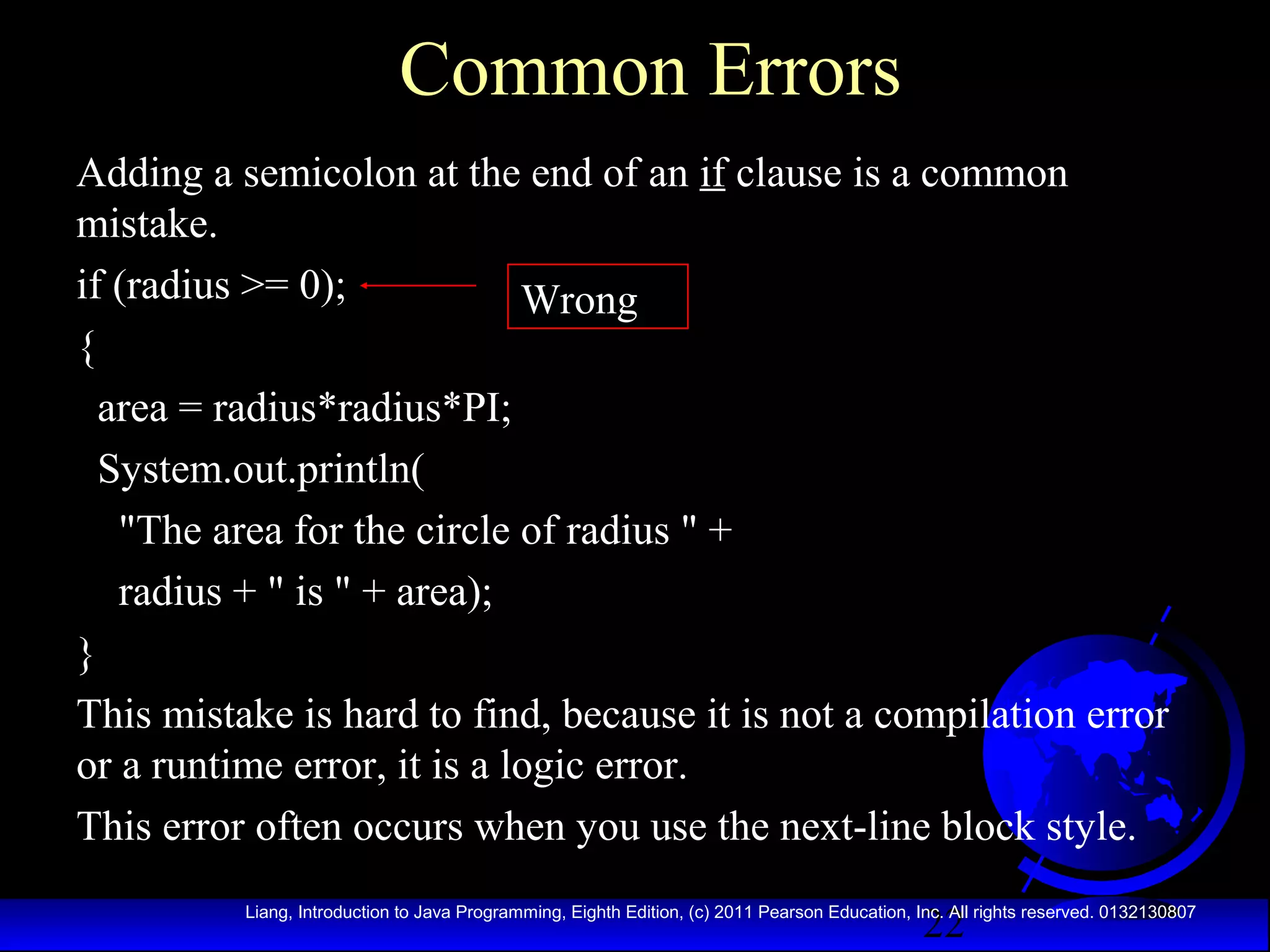
Common Errors
Adding a semicolon at the end of an if clause is a common
mistake.
if (radius >= 0);
Wrong
{
area = radius*radius*PI;
System.out.println(
"The area for the circle of radius " +
radius + " is " + area);
}
This mistake is hard to find, because it is not a compilation error
or a runtime error, it is a logic error.
This error often occurs when you use the next-line block style.
22

Liang, Introduction to Java Programming, Eighth Edition, (c) 2011 Pearson Education, Inc. All rights reserved. 0132130807
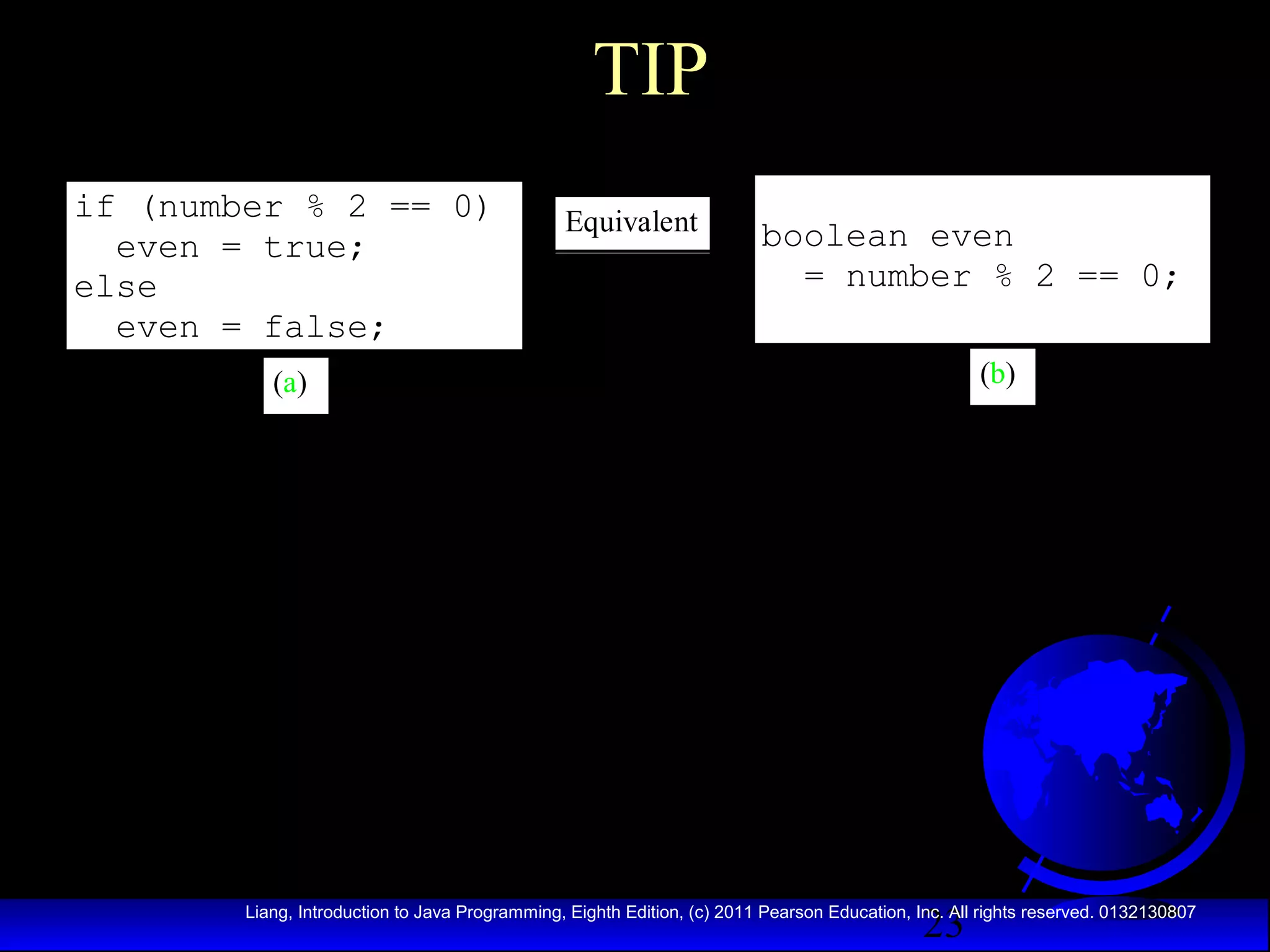
TIP
if (number % 2 == 0)
even = true;
else
even = false;

Equivalent

boolean even
= number % 2 == 0;
(b)

(a)

23

Liang, Introduction to Java Programming, Eighth Edition, (c) 2011 Pearson Education, Inc. All rights reserved. 0132130807
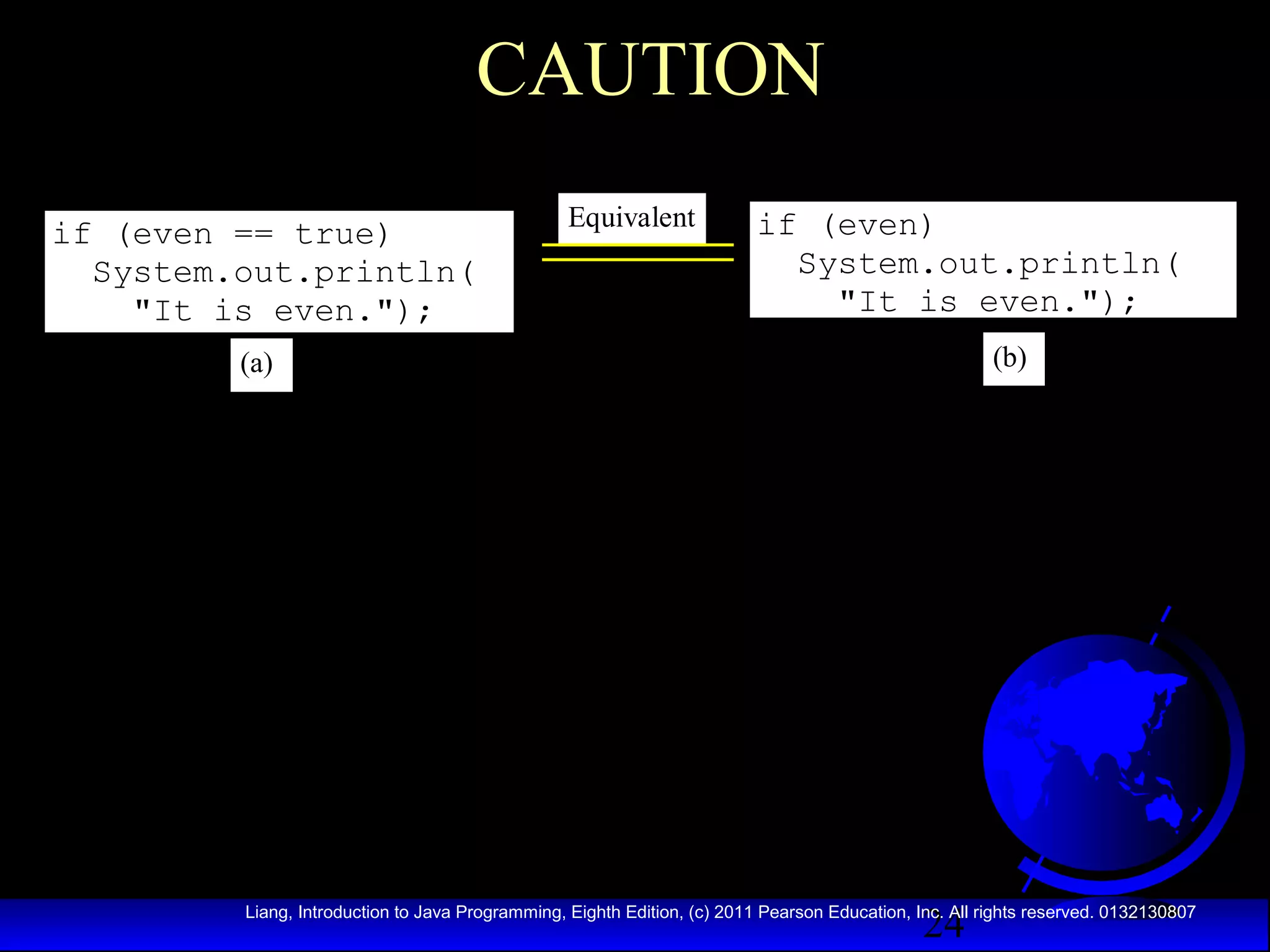
CAUTION
if (even == true)
System.out.println(
"It is even.");

Equivalent

if (even)
System.out.println(
"It is even.");
(b)

(a)

24

Liang, Introduction to Java Programming, Eighth Edition, (c) 2011 Pearson Education, Inc. All rights reserved. 0132130807
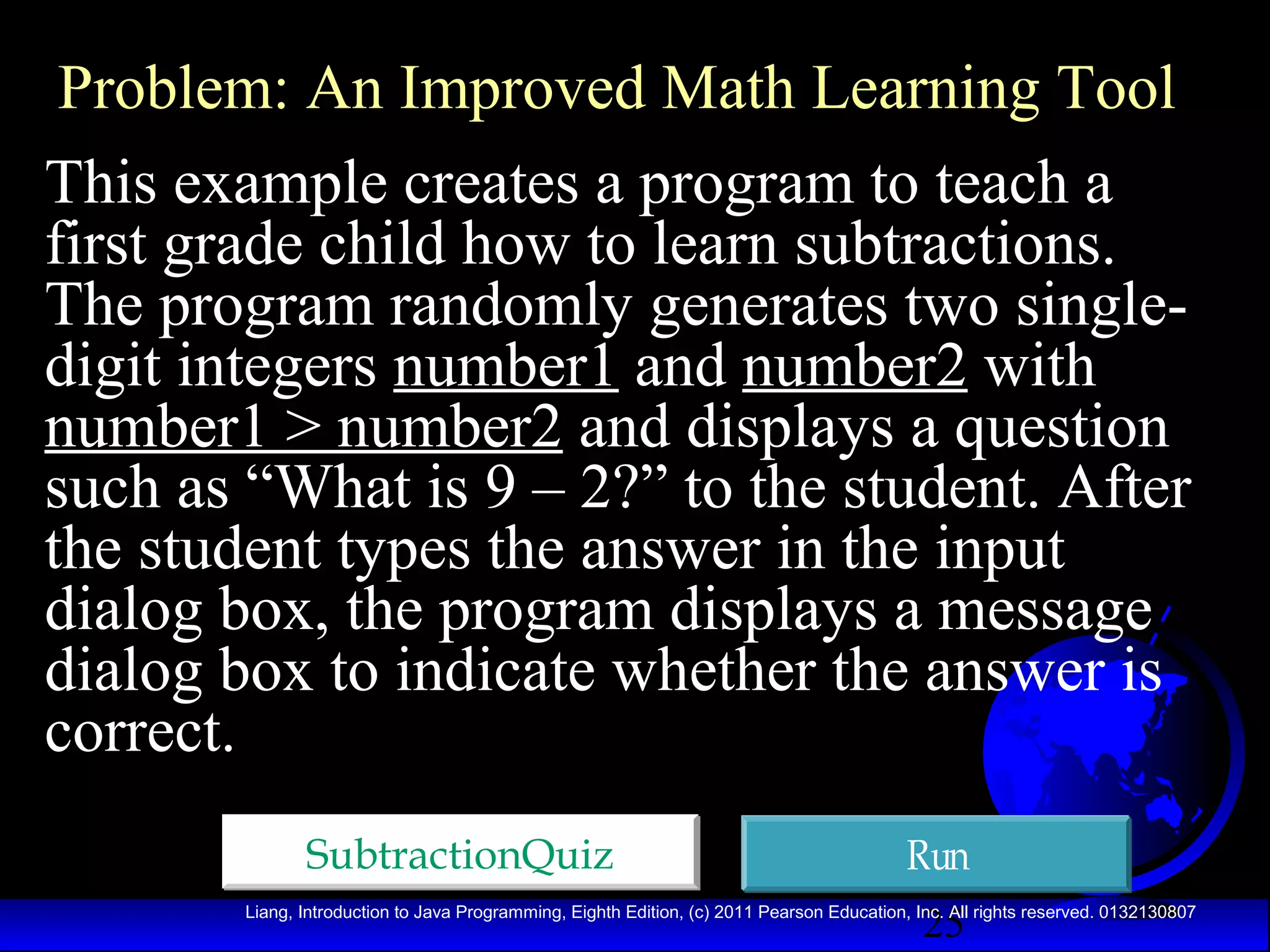
Problem: An Improved Math Learning Tool
This example creates a program to teach a
first grade child how to learn subtractions.
The program randomly generates two singledigit integers number1 and number2 with
number1 > number2 and displays a question
such as “What is 9 – 2?” to the student. After
the student types the answer in the input
dialog box, the program displays a message
dialog box to indicate whether the answer is
correct.
SubtractionQuiz

Run
25

Liang, Introduction to Java Programming, Eighth Edition, (c) 2011 Pearson Education, Inc. All rights reserved. 0132130807
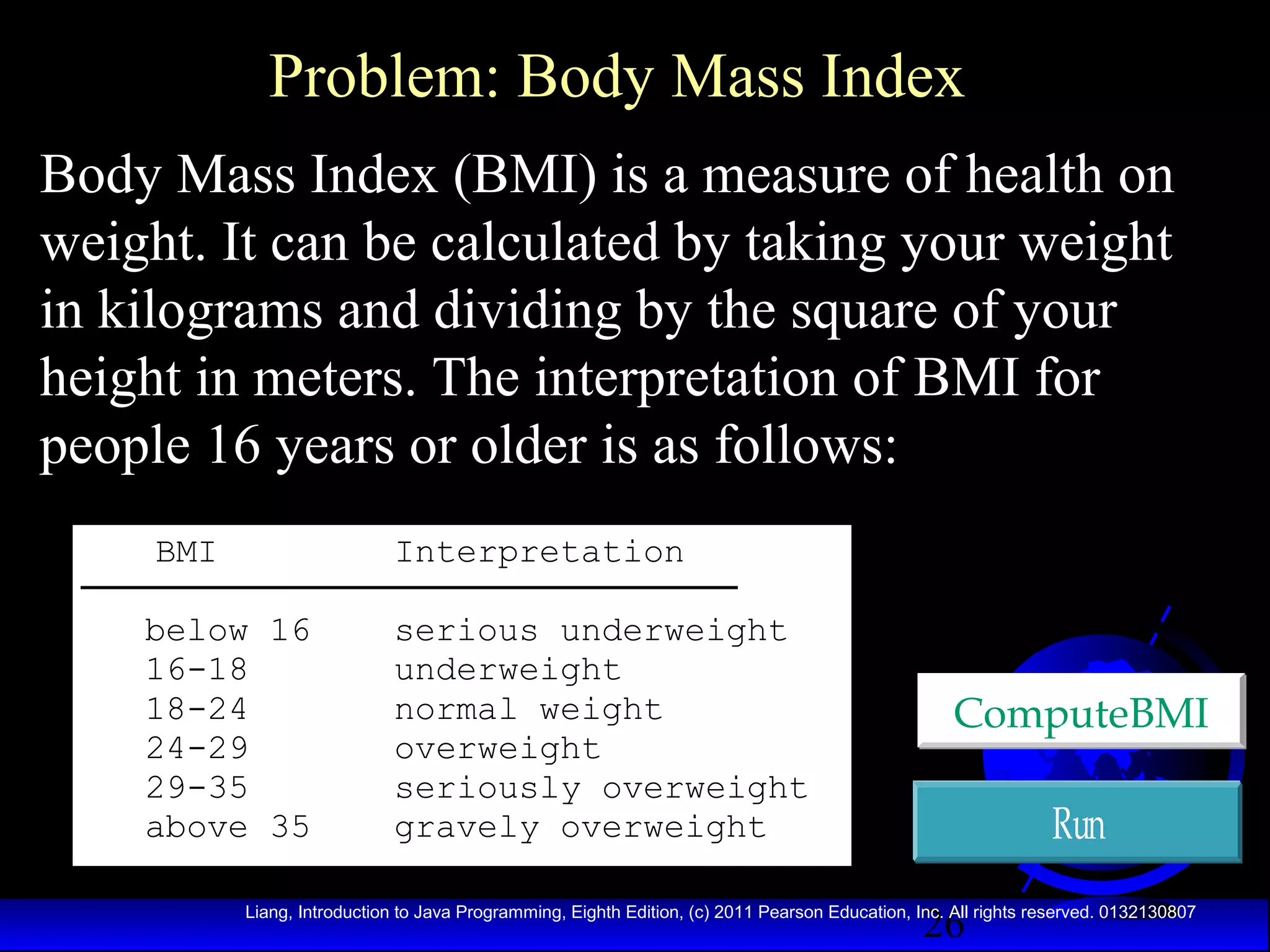
Problem: Body Mass Index
Body Mass Index (BMI) is a measure of health on
weight. It can be calculated by taking your weight
in kilograms and dividing by the square of your
height in meters. The interpretation of BMI for
people 16 years or older is as follows:
BMI

Interpretation

below 16
16-18
18-24
24-29
29-35
above 35

serious underweight
underweight
normal weight
overweight
seriously overweight
gravely overweight

ComputeBMI

Run
26

Liang, Introduction to Java Programming, Eighth Edition, (c) 2011 Pearson Education, Inc. All rights reserved. 0132130807
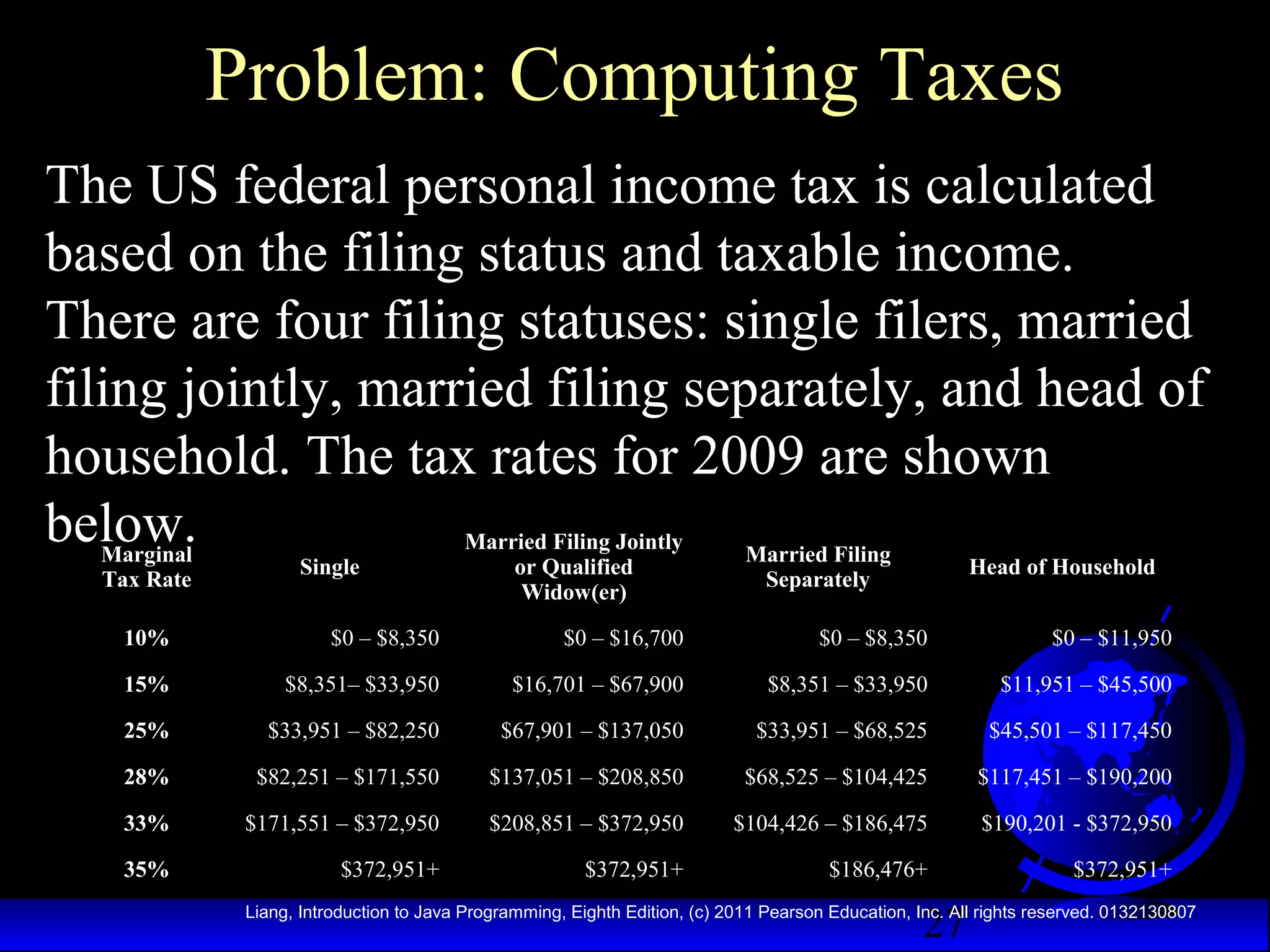
Problem: Computing Taxes
The US federal personal income tax is calculated
based on the filing status and taxable income.
There are four filing statuses: single filers, married
filing jointly, married filing separately, and head of
household. The tax rates for 2009 are shown
below.
Married Filing Jointly
Marginal
Married Filing
Tax Rate

Single

or Qualified
Widow(er)

Head of Household

Separately

10%

$0 – $8,350

$0 – $16,700

$0 – $8,350

$0 – $11,950

15%

$8,351– $33,950

$16,701 – $67,900

$8,351 – $33,950

$11,951 – $45,500

25%

$33,951 – $82,250

$67,901 – $137,050

$33,951 – $68,525

$45,501 – $117,450

28%

$82,251 – $171,550

$137,051 – $208,850

$68,525 – $104,425

$117,451 – $190,200

33%

$171,551 – $372,950

$208,851 – $372,950

$104,426 – $186,475

$190,201 - $372,950

35%

$372,951+

$372,951+

$186,476+

$372,951+

27

Liang, Introduction to Java Programming, Eighth Edition, (c) 2011 Pearson Education, Inc. All rights reserved. 0132130807
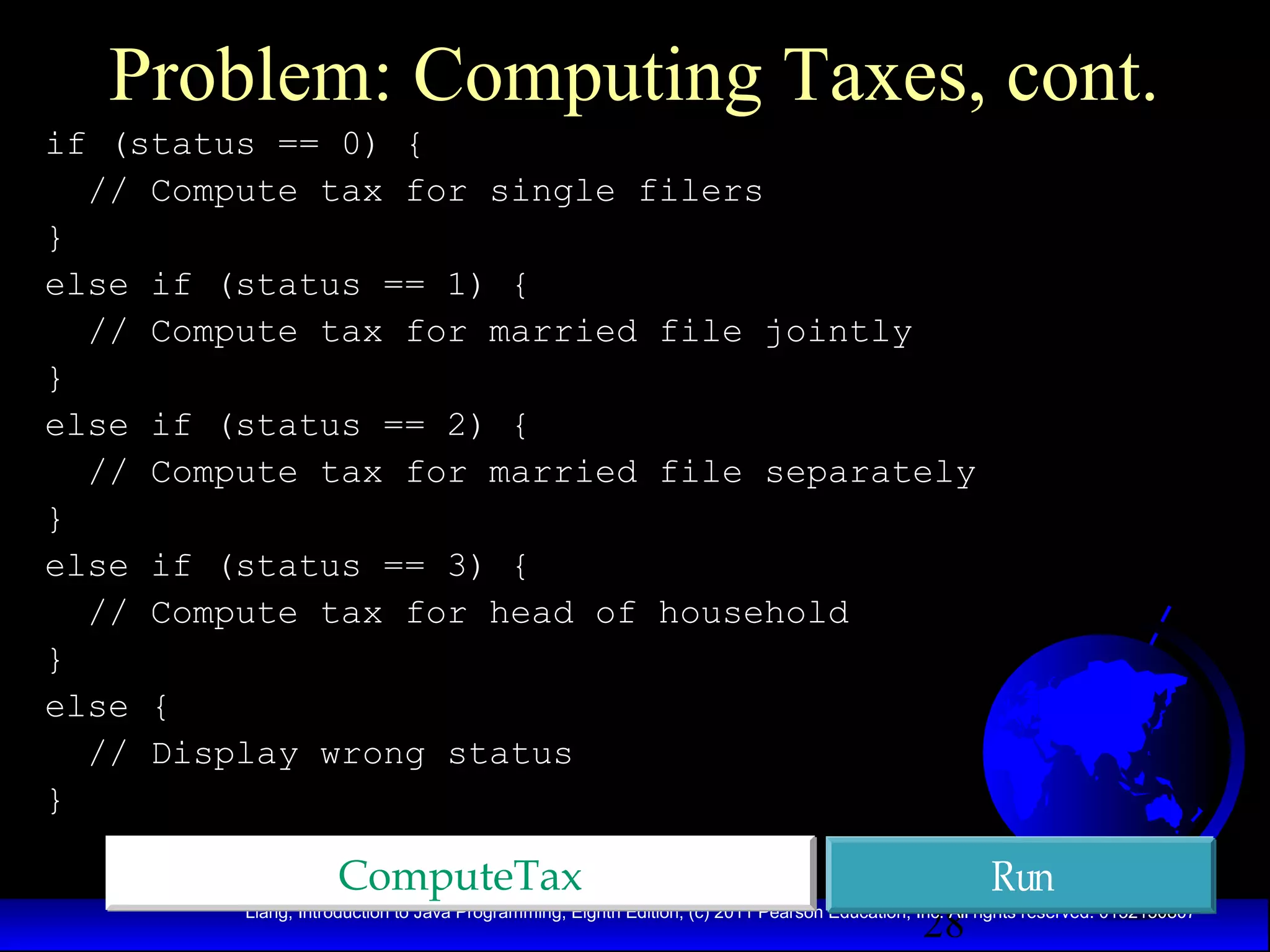
Problem: Computing Taxes, cont.
if (status == 0) {
// Compute tax for single filers
}
else if (status == 1) {
// Compute tax for married file jointly
}
else if (status == 2) {
// Compute tax for married file separately
}
else if (status == 3) {
// Compute tax for head of household
}
else {
// Display wrong status
}

ComputeTax

28

Run

Liang, Introduction to Java Programming, Eighth Edition, (c) 2011 Pearson Education, Inc. All rights reserved. 0132130807
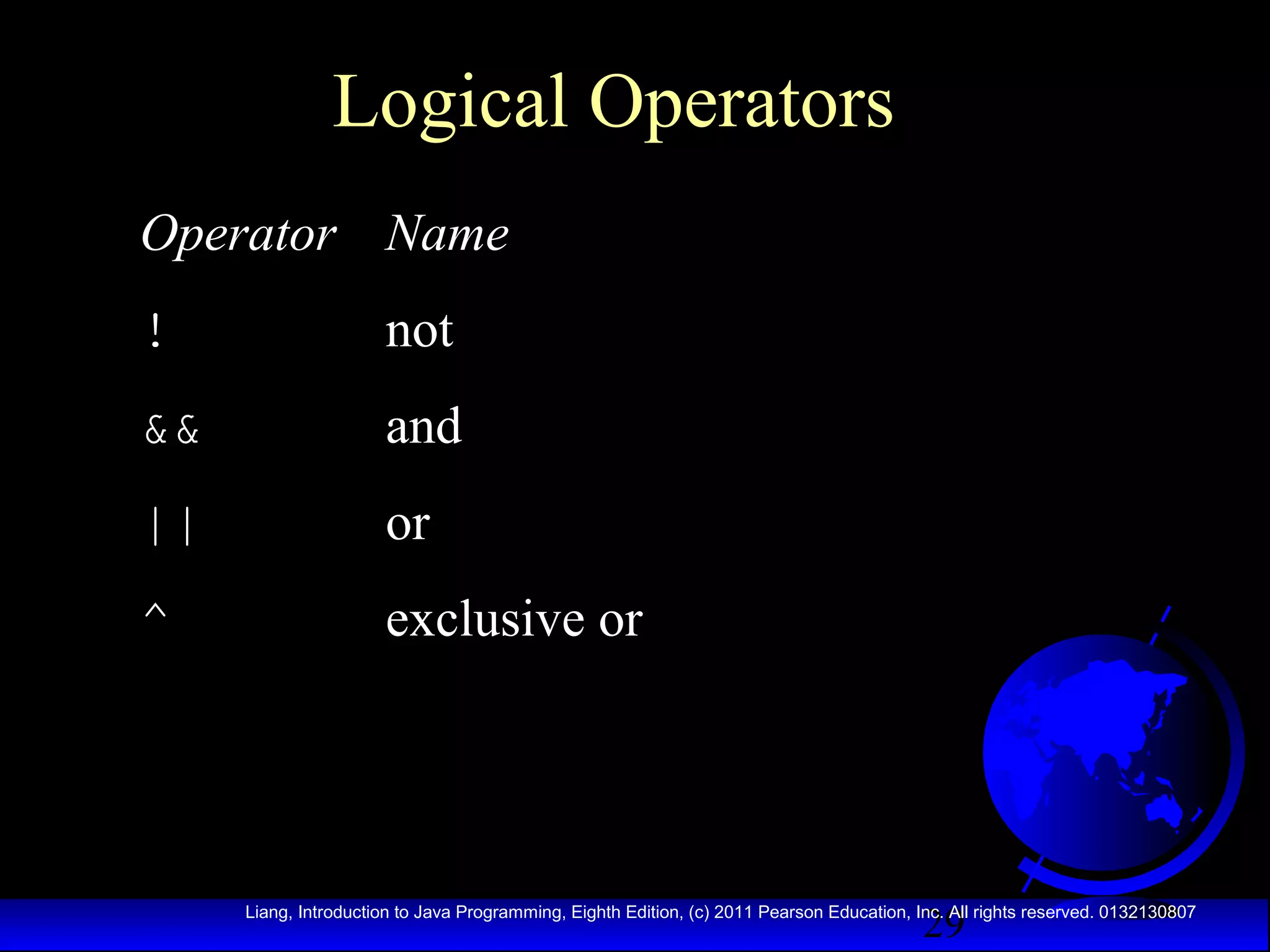
Logical Operators
Operator Name
!

not

&&

and

||

or

^

exclusive or

29

Liang, Introduction to Java Programming, Eighth Edition, (c) 2011 Pearson Education, Inc. All rights reserved. 0132130807
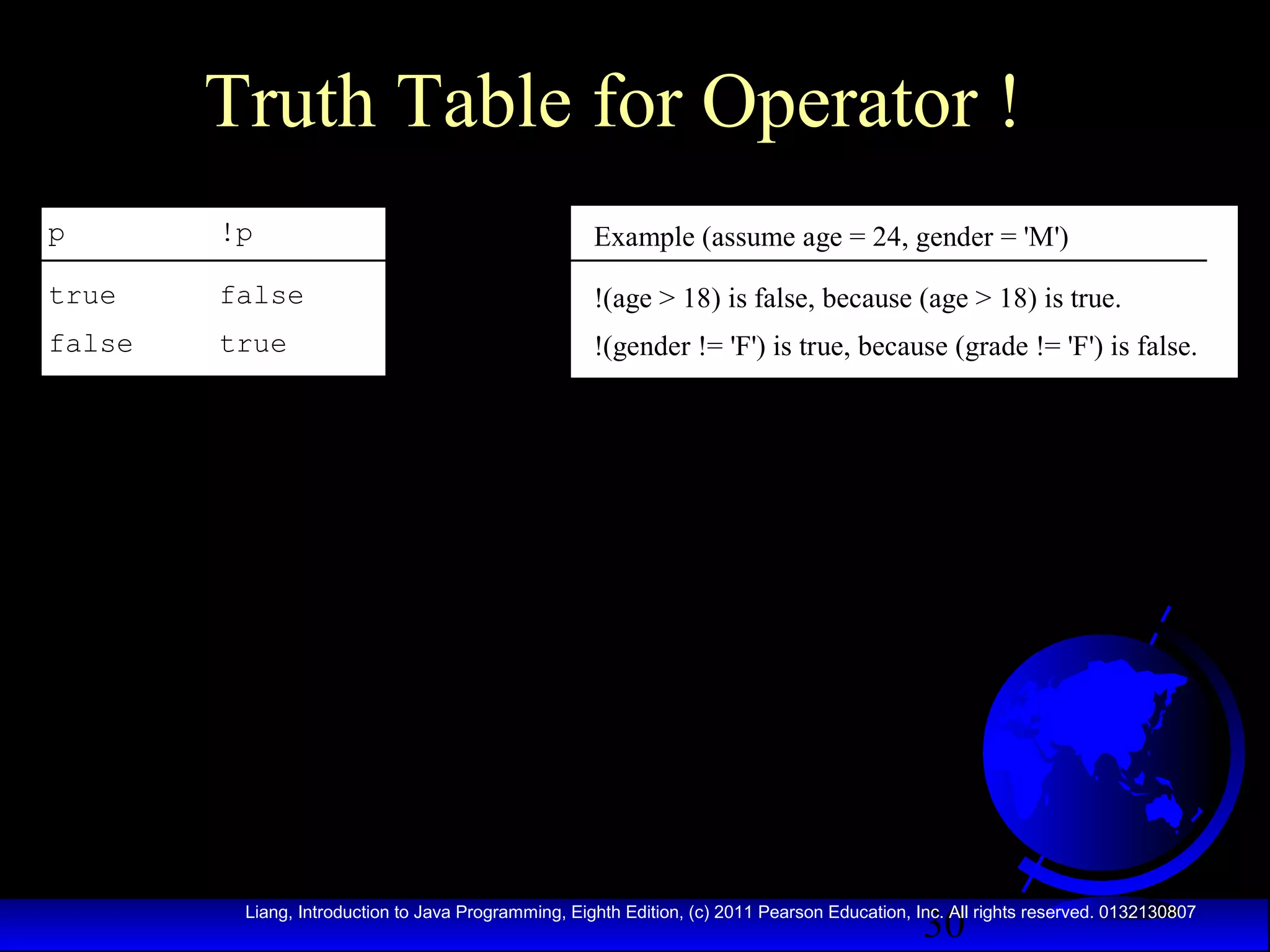
Truth Table for Operator !
p

!p

Example (assume age = 24, gender = 'M')

true

false

!(age > 18) is false, because (age > 18) is true.

false

true

!(gender != 'F') is true, because (grade != 'F') is false.

30

Liang, Introduction to Java Programming, Eighth Edition, (c) 2011 Pearson Education, Inc. All rights reserved. 0132130807
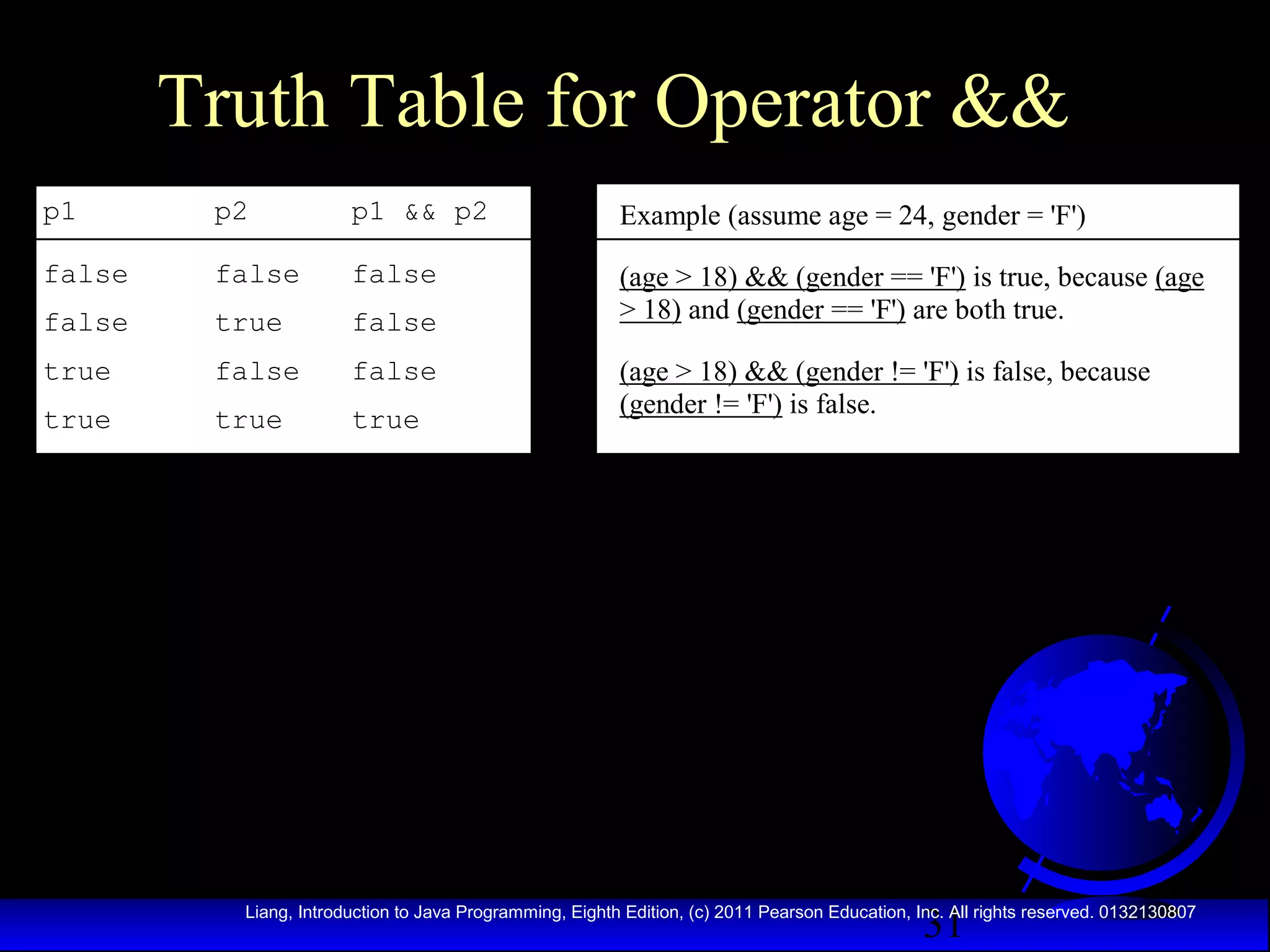
Truth Table for Operator &&
p1

p2

p1 && p2

Example (assume age = 24, gender = 'F')

false

false

false

false

true

false

(age > 18) && (gender == 'F') is true, because (age
> 18) and (gender == 'F') are both true.

true

false

false

true

true

true

(age > 18) && (gender != 'F') is false, because
(gender != 'F') is false.

31

Liang, Introduction to Java Programming, Eighth Edition, (c) 2011 Pearson Education, Inc. All rights reserved. 0132130807
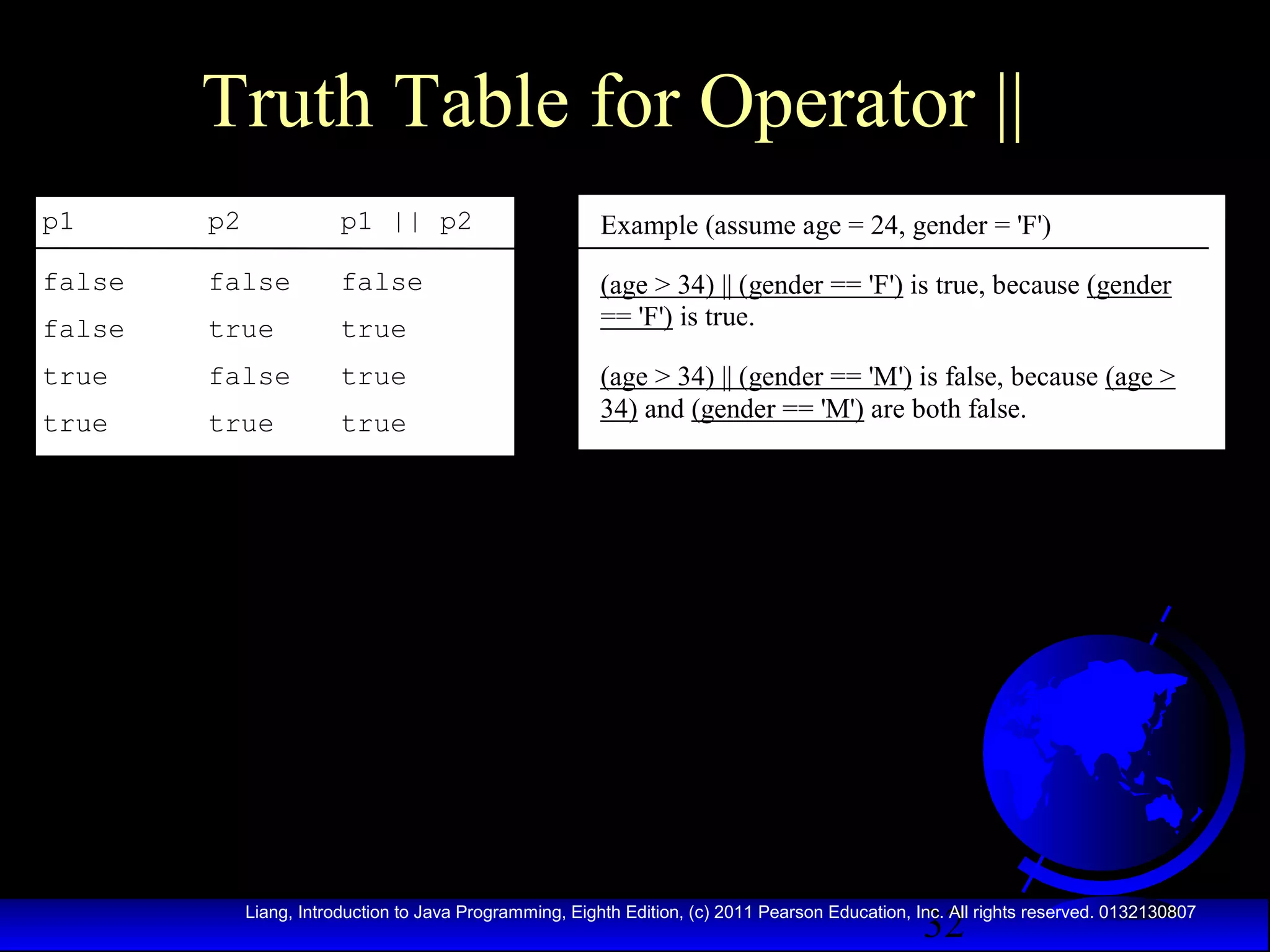
Truth Table for Operator ||
p1

p2

p1 || p2

Example (assume age = 24, gender = 'F')

false

false

false

false

true

true

(age > 34) || (gender == 'F') is true, because (gender
== 'F') is true.

true

false

true

true

true

true

(age > 34) || (gender == 'M') is false, because (age >
34) and (gender == 'M') are both false.

32

Liang, Introduction to Java Programming, Eighth Edition, (c) 2011 Pearson Education, Inc. All rights reserved. 0132130807
Examples
Here is a program that checks whether a number is divisible by 2
and 3, whether a number is divisible by 2 or 3, and whether a
number is divisible by 2 or 3 but not both:

TestBooleanOperators

Run

33

Liang, Introduction to Java Programming, Eighth Edition, (c) 2011 Pearson Education, Inc. All rights reserved. 0132130807
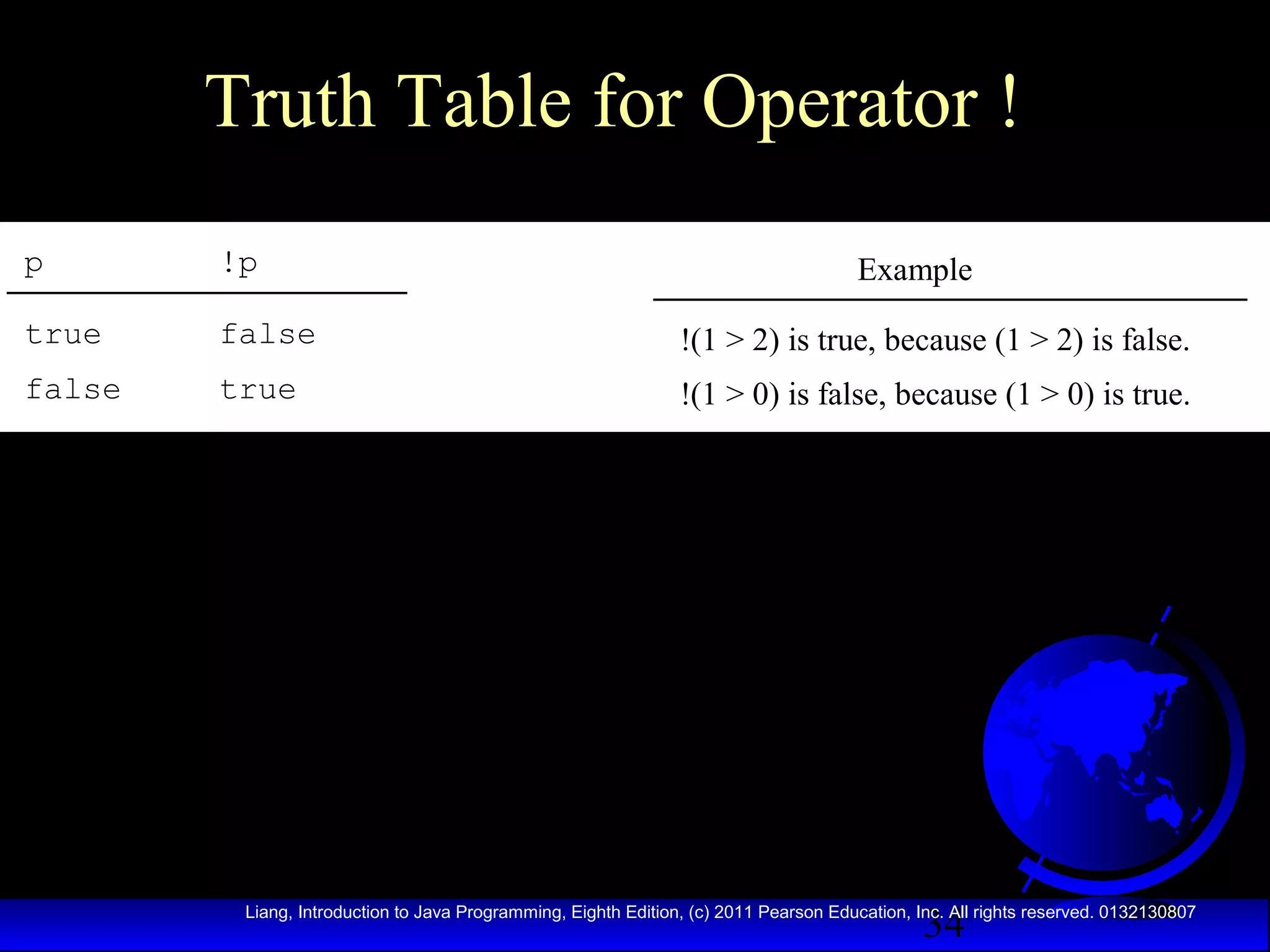
Truth Table for Operator !
p

!p

true

false

!(1 > 2) is true, because (1 > 2) is false.

false

true

!(1 > 0) is false, because (1 > 0) is true.

Example

34

Liang, Introduction to Java Programming, Eighth Edition, (c) 2011 Pearson Education, Inc. All rights reserved. 0132130807
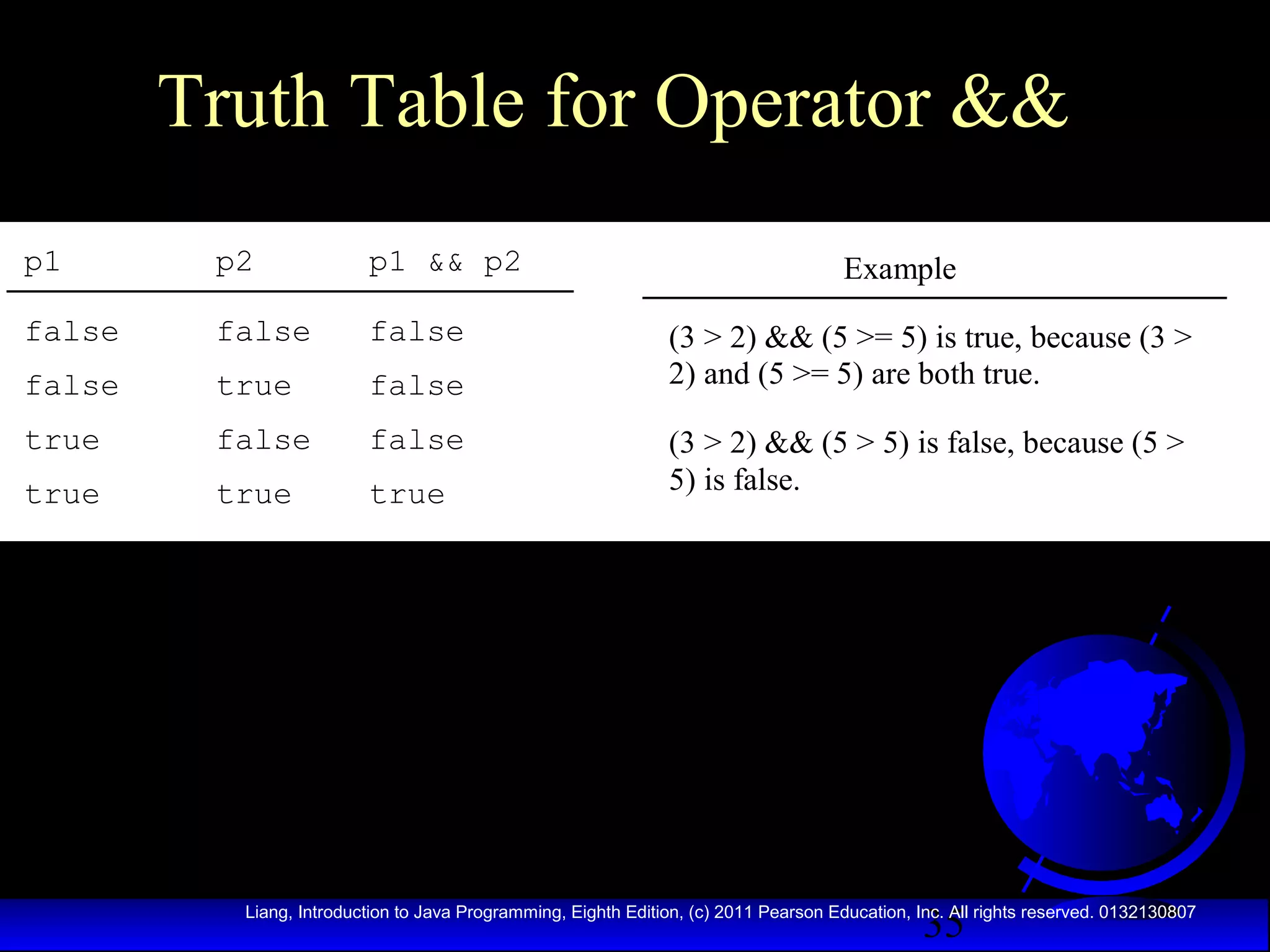
Truth Table for Operator &&
p1

p2

p1 && p2

false

false

false

false

true

false

true

false

false

true

true

true

Example
(3 > 2) && (5 >= 5) is true, because (3 >
2) and (5 >= 5) are both true.
(3 > 2) && (5 > 5) is false, because (5 >
5) is false.

35

Liang, Introduction to Java Programming, Eighth Edition, (c) 2011 Pearson Education, Inc. All rights reserved. 0132130807
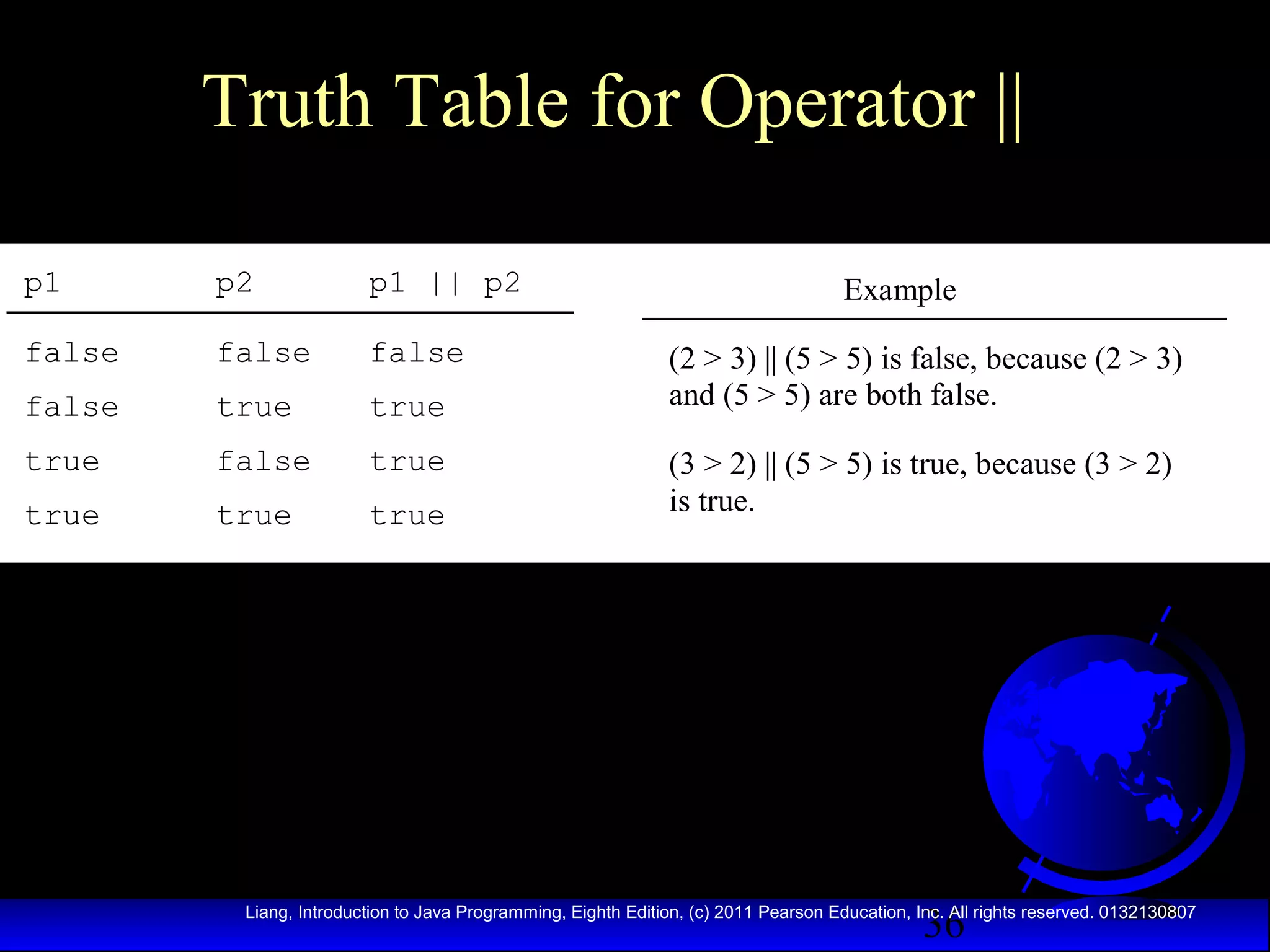
Truth Table for Operator ||
p1

p2

p1 || p2

false

false

false

false

true

true

true

false

true

true

true

true

Example
(2 > 3) || (5 > 5) is false, because (2 > 3)
and (5 > 5) are both false.
(3 > 2) || (5 > 5) is true, because (3 > 2)
is true.

36

Liang, Introduction to Java Programming, Eighth Edition, (c) 2011 Pearson Education, Inc. All rights reserved. 0132130807
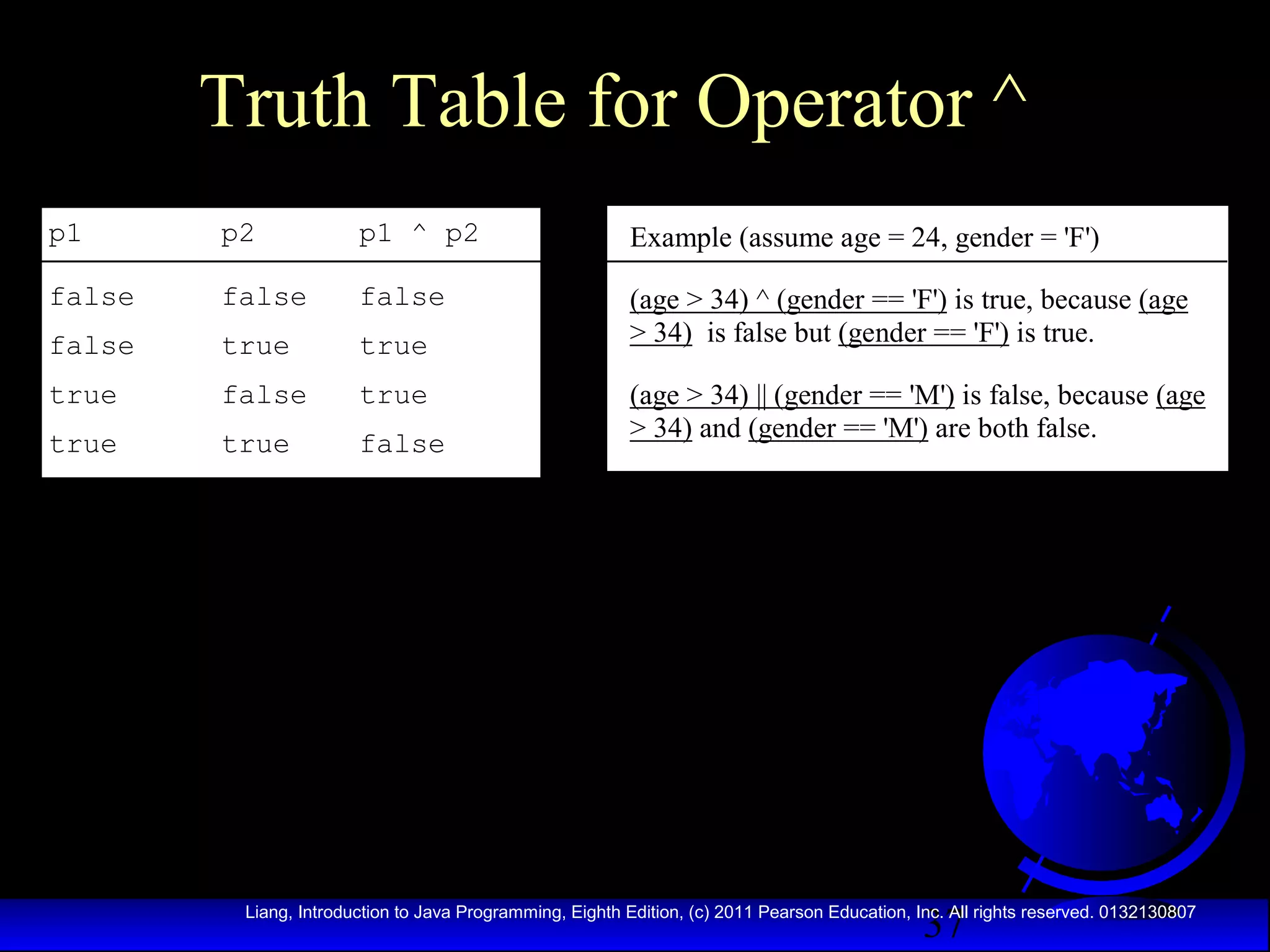
Truth Table for Operator ^
p1

p2

p1 ^ p2

Example (assume age = 24, gender = 'F')

false

false

false

false

true

true

(age > 34) ^ (gender == 'F') is true, because (age
> 34) is false but (gender == 'F') is true.

true

false

true

true

true

false

(age > 34) || (gender == 'M') is false, because (age
> 34) and (gender == 'M') are both false.

37

Liang, Introduction to Java Programming, Eighth Edition, (c) 2011 Pearson Education, Inc. All rights reserved. 0132130807
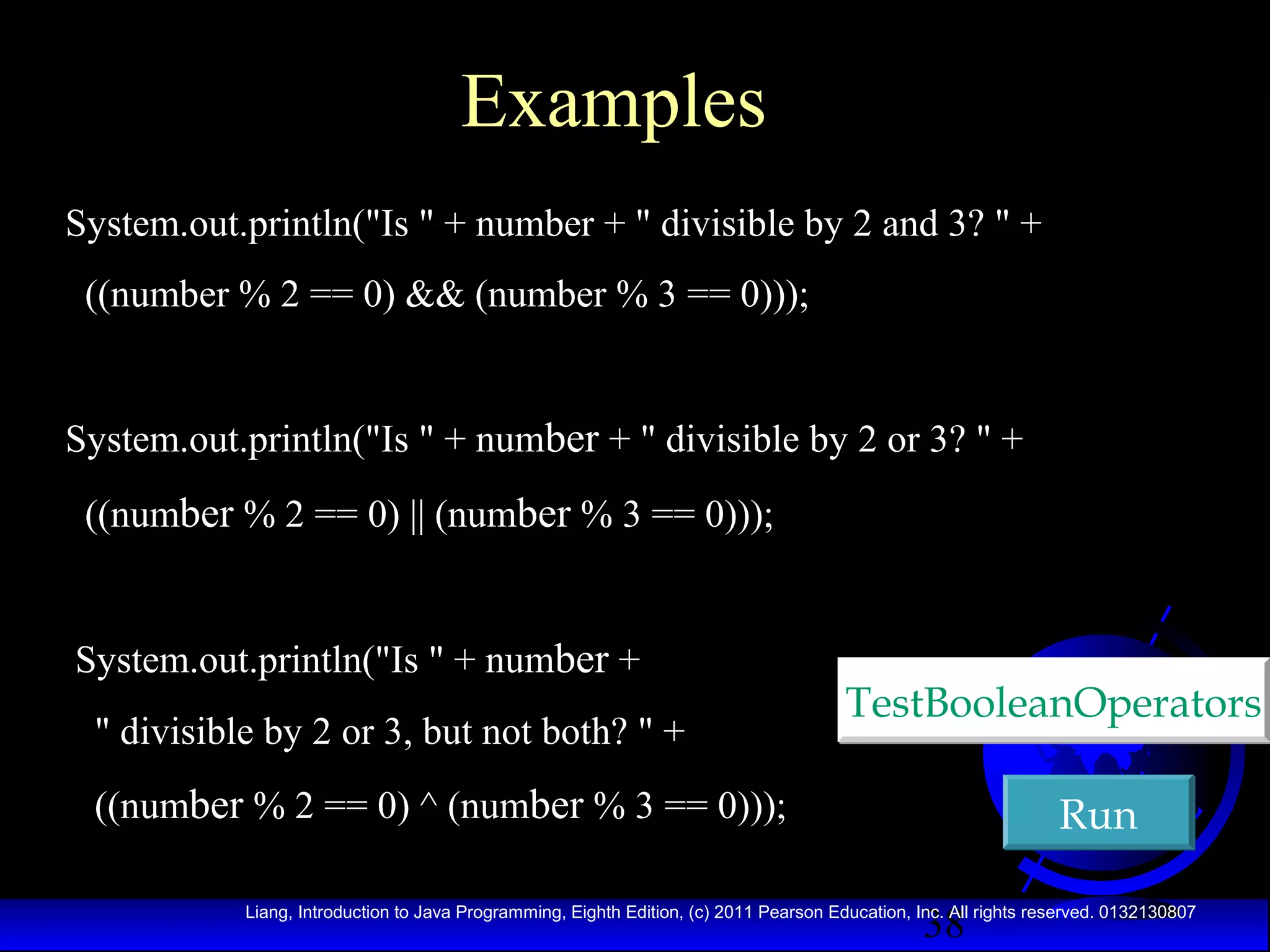
Examples
System.out.println("Is " + number + " divisible by 2 and 3? " +
((number % 2 == 0) && (number % 3 == 0)));

System.out.println("Is " + number + " divisible by 2 or 3? " +
((number % 2 == 0) || (number % 3 == 0)));

System.out.println("Is " + number +
" divisible by 2 or 3, but not both? " +

TestBooleanOperators

((number % 2 == 0) ^ (number % 3 == 0)));

Run
38

Liang, Introduction to Java Programming, Eighth Edition, (c) 2011 Pearson Education, Inc. All rights reserved. 0132130807
Companion
Website

The & and | Operators

Supplement III.B, “The & and | Operators”

39

Liang, Introduction to Java Programming, Eighth Edition, (c) 2011 Pearson Education, Inc. All rights reserved. 0132130807
Companion
Website

The & and | Operators

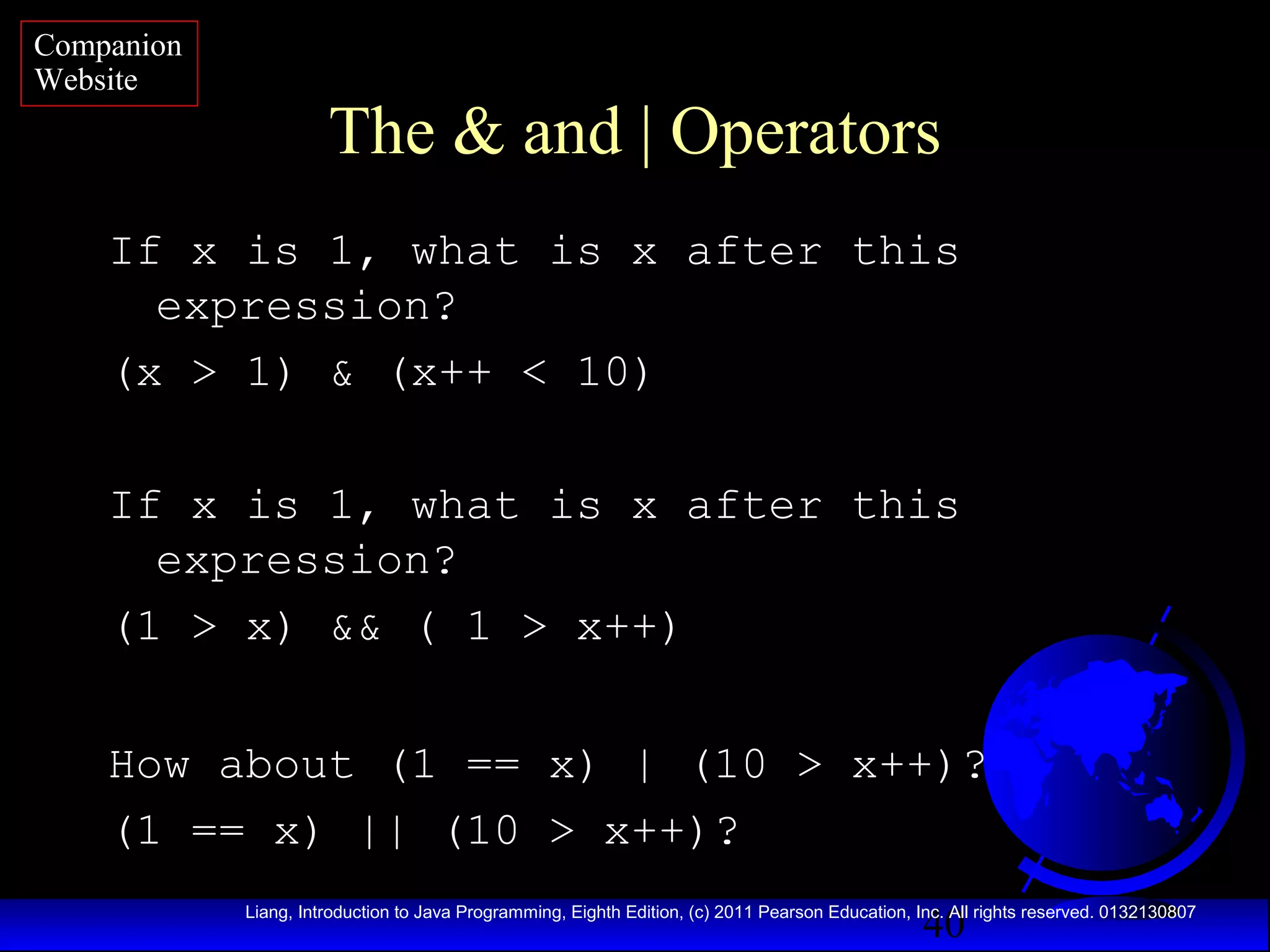
If x is 1, what is x after this
expression?
(x > 1) & (x++ < 10)
If x is 1, what is x after this
expression?
(1 > x) && ( 1 > x++)
How about (1 == x) | (10 > x++)?
(1 == x) || (10 > x++)?
40

Liang, Introduction to Java Programming, Eighth Edition, (c) 2011 Pearson Education, Inc. All rights reserved. 0132130807
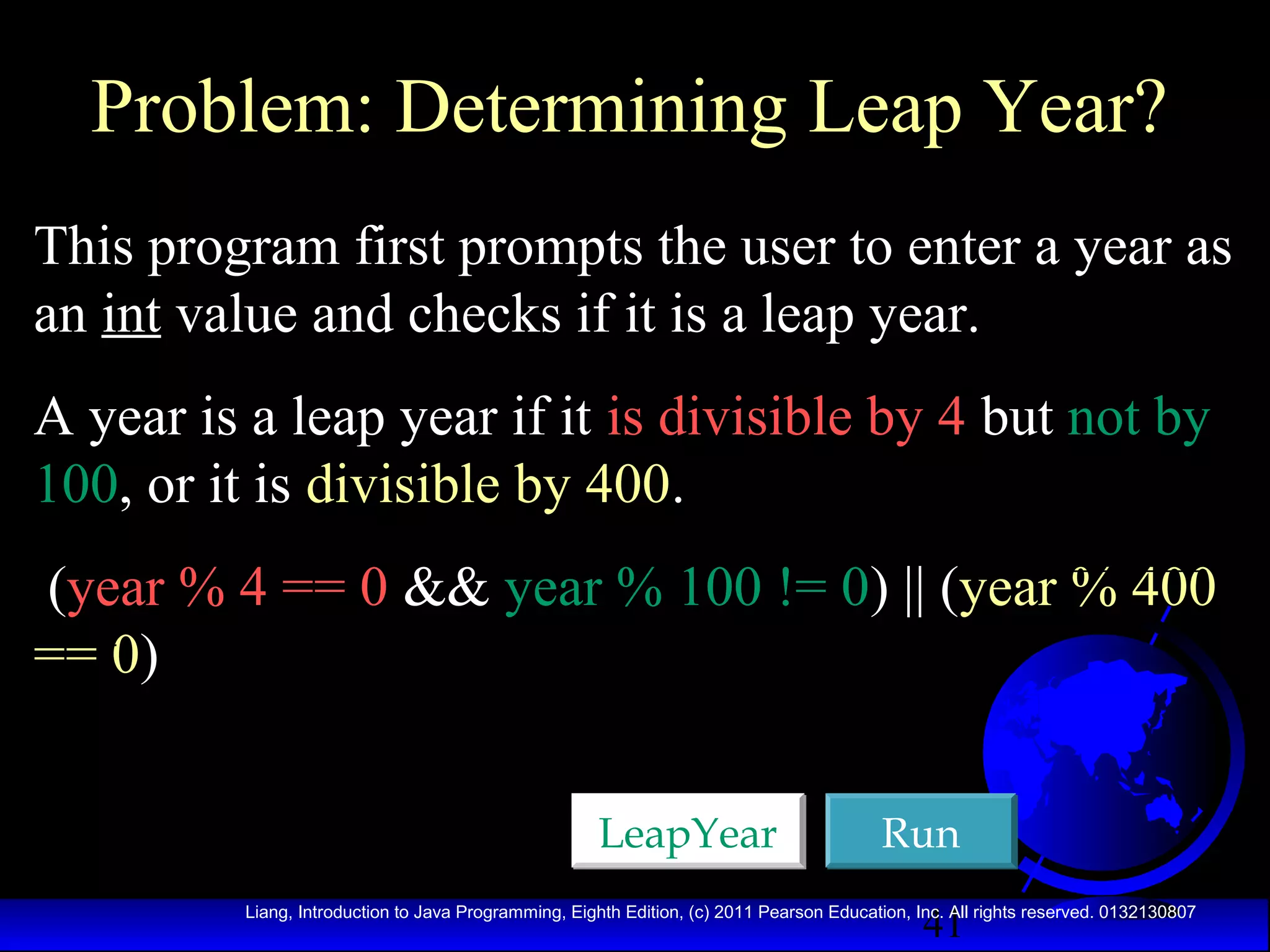
Problem: Determining Leap Year?
This program first prompts the user to enter a year as
an int value and checks if it is a leap year.
A year is a leap year if it is divisible by 4 but not by
100, or it is divisible by 400.
(year % 4 == 0 && year % 100 != 0) || (year % 400
== 0)
LeapYear

Run
41

Liang, Introduction to Java Programming, Eighth Edition, (c) 2011 Pearson Education, Inc. All rights reserved. 0132130807
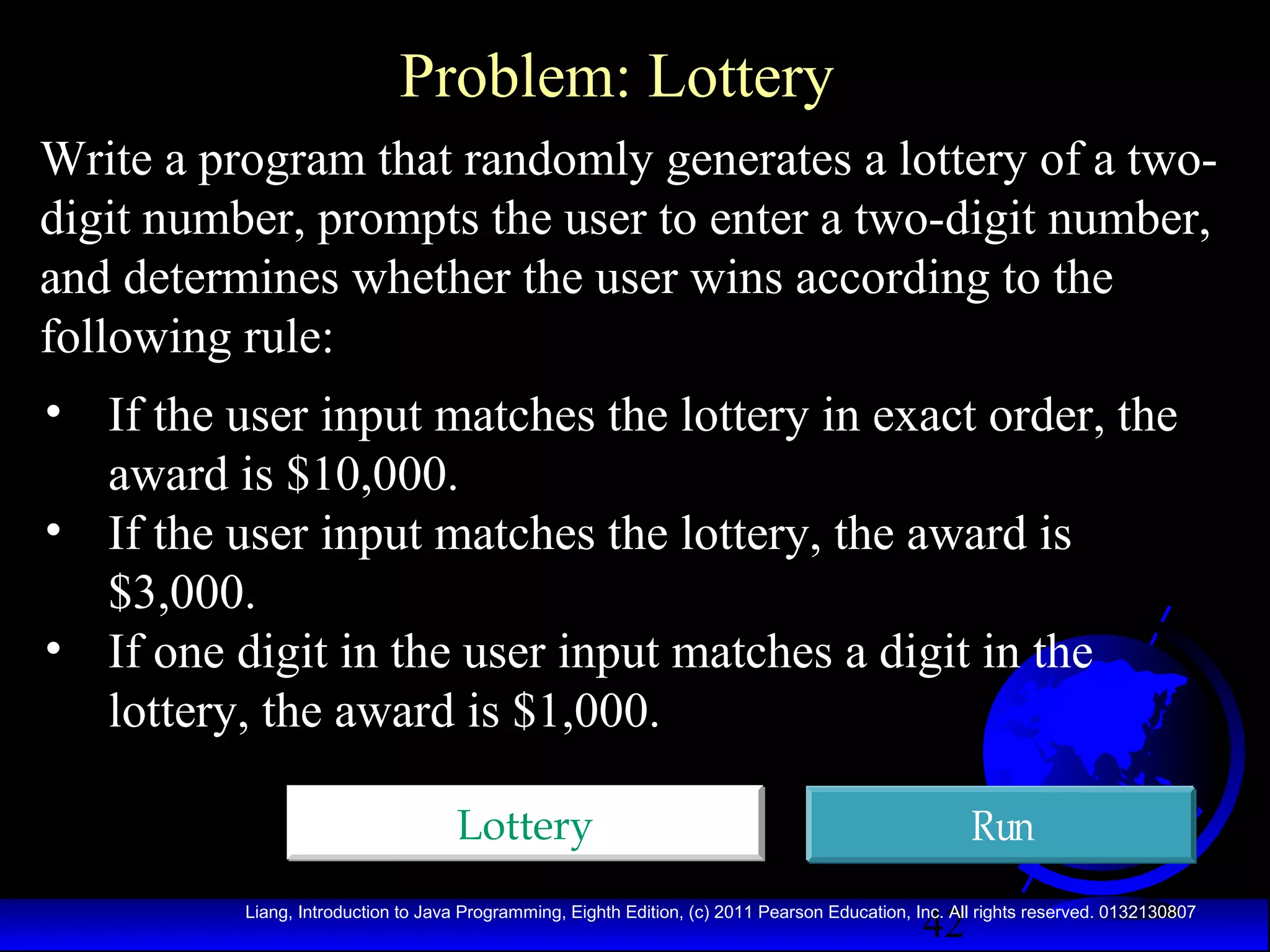
Problem: Lottery
Write a program that randomly generates a lottery of a twodigit number, prompts the user to enter a two-digit number,
and determines whether the user wins according to the
following rule:
• If the user input matches the lottery in exact order, the
award is $10,000.
• If the user input matches the lottery, the award is
$3,000.
• If one digit in the user input matches a digit in the
lottery, the award is $1,000.
Lottery

Run
42

Liang, Introduction to Java Programming, Eighth Edition, (c) 2011 Pearson Education, Inc. All rights reserved. 0132130807
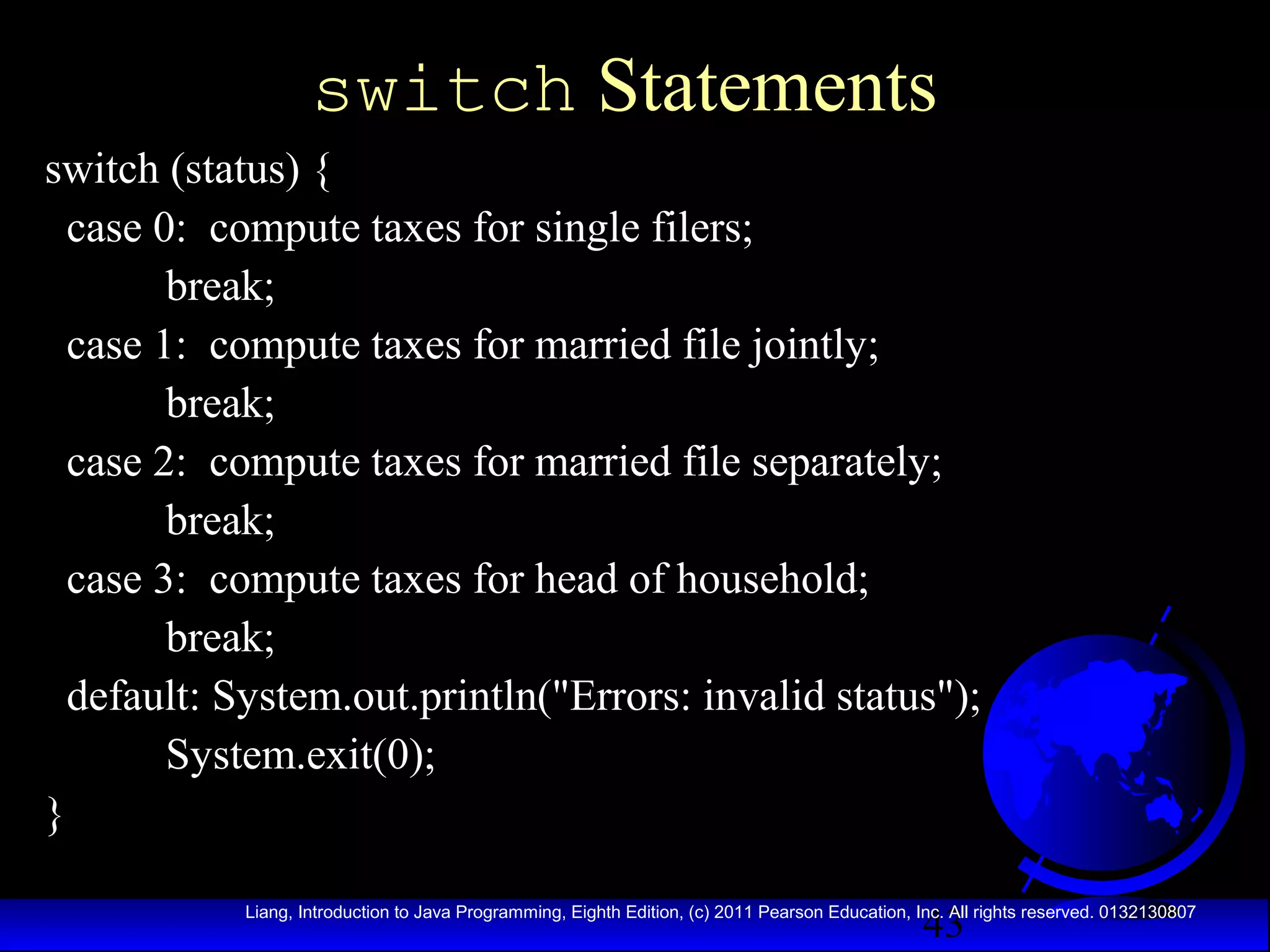
switch Statements
switch (status) {
case 0: compute taxes for single filers;
break;
case 1: compute taxes for married file jointly;
break;
case 2: compute taxes for married file separately;
break;
case 3: compute taxes for head of household;
break;
default: System.out.println("Errors: invalid status");
System.exit(0);
}
43

Liang, Introduction to Java Programming, Eighth Edition, (c) 2011 Pearson Education, Inc. All rights reserved. 0132130807
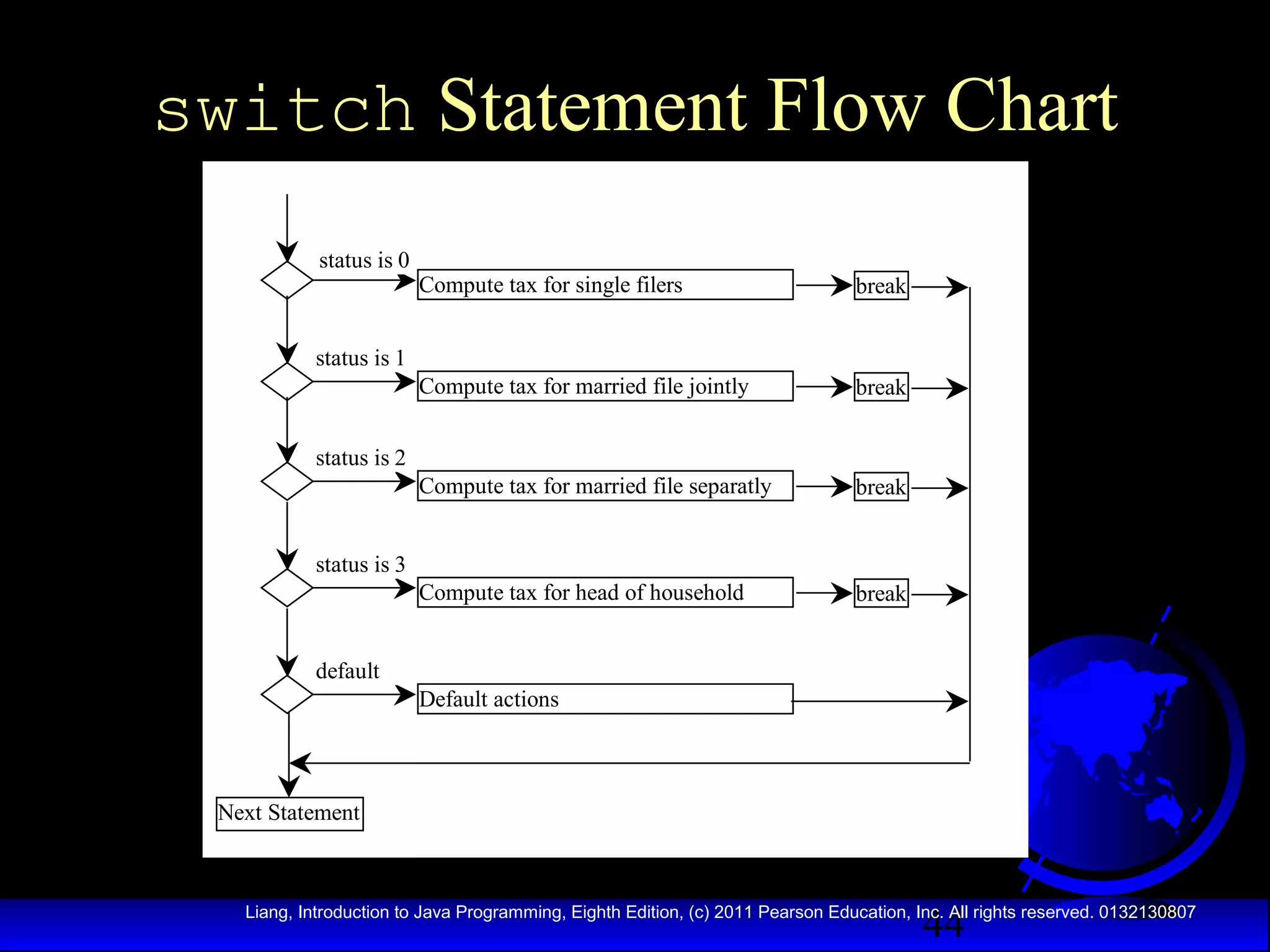
switch Statement Flow Chart
status is 0

Compute tax for single filers

break

Compute tax for married file jointly

break

Compute tax for married file separatly

break

Compute tax for head of household

break

status is 1

status is 2

status is 3

default
Default actions

Next Statement

44

Liang, Introduction to Java Programming, Eighth Edition, (c) 2011 Pearson Education, Inc. All rights reserved. 0132130807
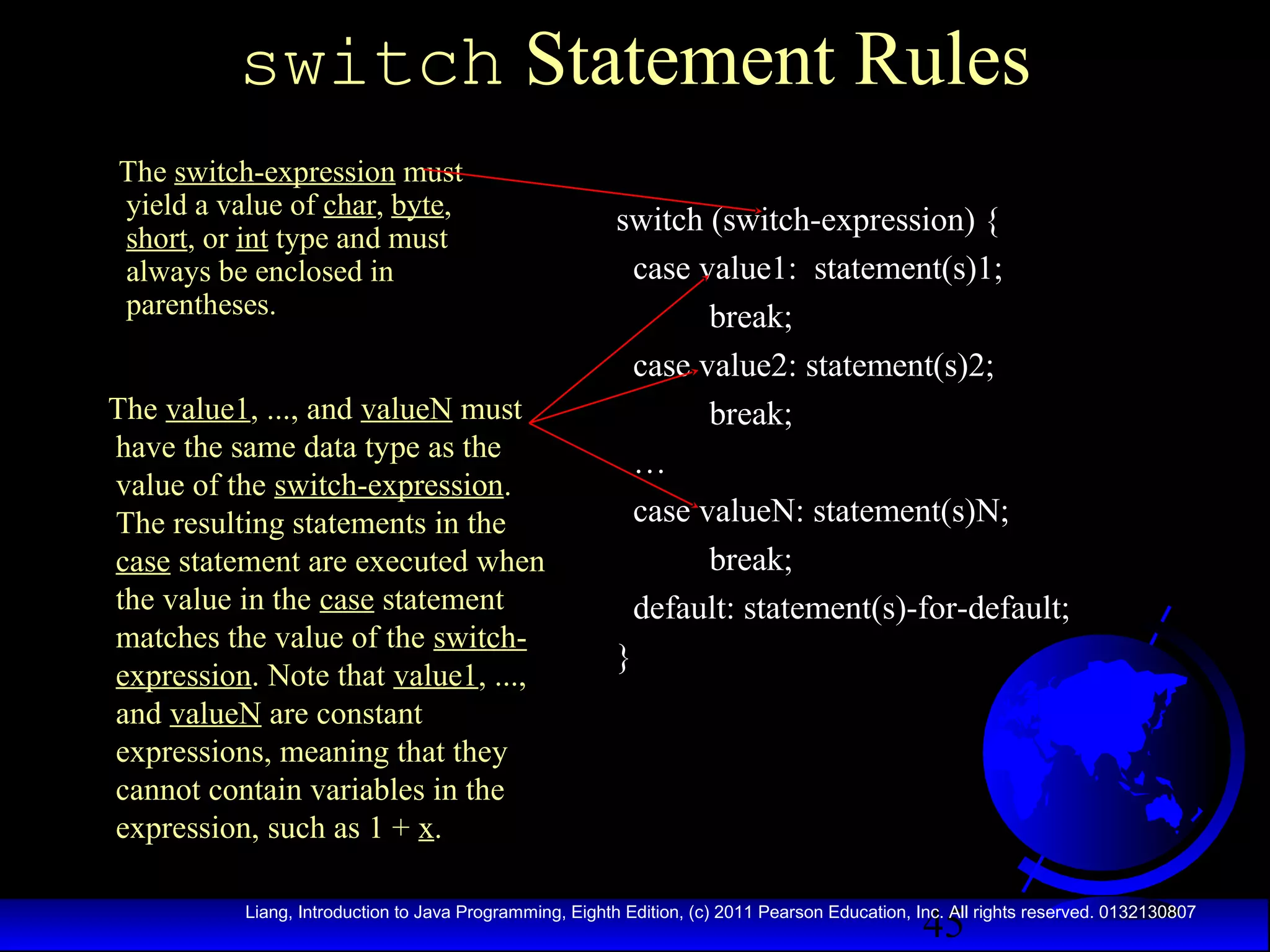
switch Statement Rules
The switch-expression must
yield a value of char, byte,
short, or int type and must
always be enclosed in
parentheses.

The value1, ..., and valueN must
have the same data type as the
value of the switch-expression.
The resulting statements in the
case statement are executed when
the value in the case statement
matches the value of the switchexpression. Note that value1, ...,
and valueN are constant
expressions, meaning that they
cannot contain variables in the
expression, such as 1 + x.

switch (switch-expression) {
case value1: statement(s)1;
break;
case value2: statement(s)2;
break;
…
case valueN: statement(s)N;
break;
default: statement(s)-for-default;
}

45

Liang, Introduction to Java Programming, Eighth Edition, (c) 2011 Pearson Education, Inc. All rights reserved. 0132130807
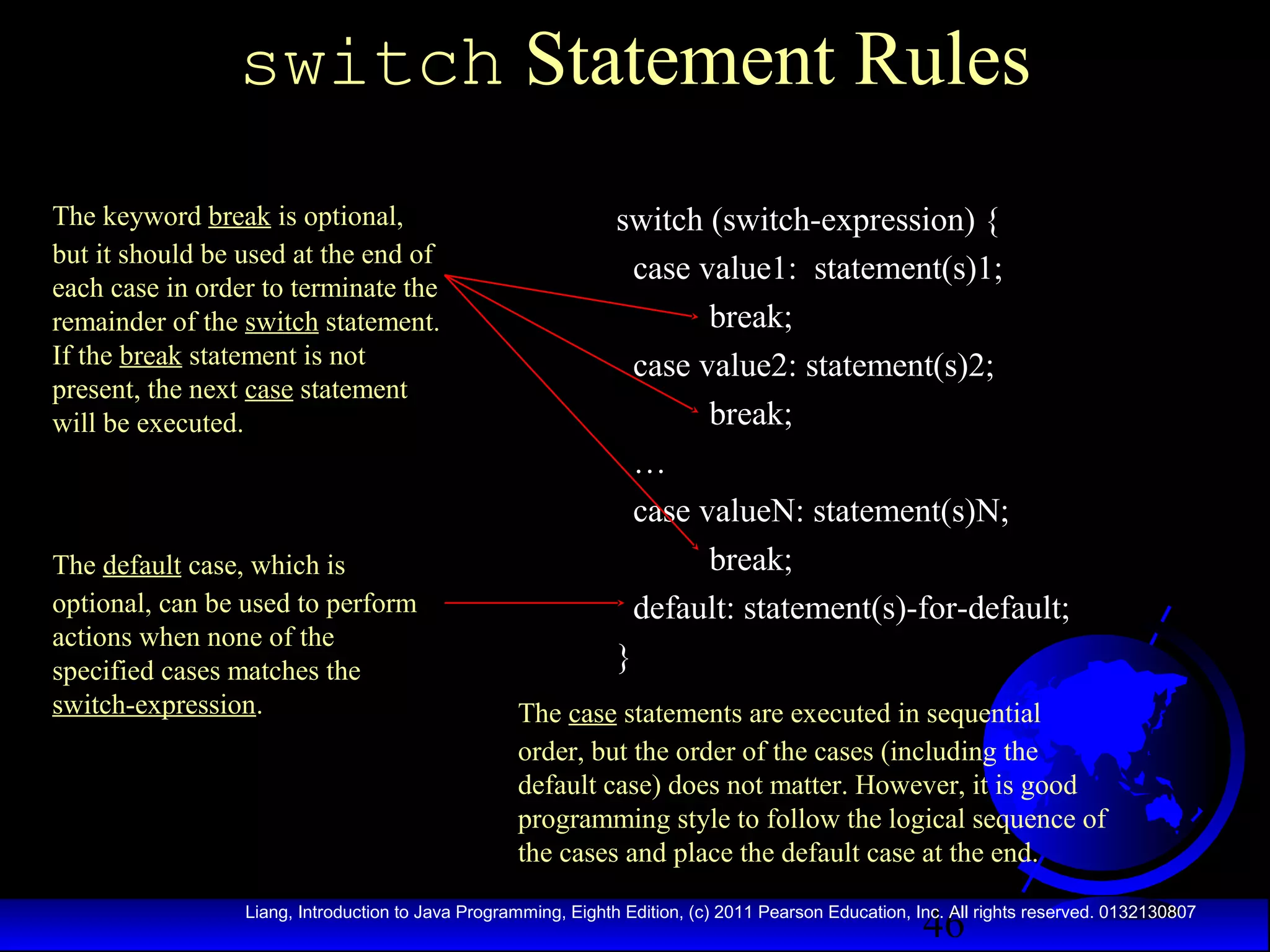
switch Statement Rules
The keyword break is optional,
but it should be used at the end of
each case in order to terminate the
remainder of the switch statement.
If the break statement is not
present, the next case statement
will be executed.

The default case, which is
optional, can be used to perform
actions when none of the
specified cases matches the
switch-expression.

switch (switch-expression) {
case value1: statement(s)1;
break;
case value2: statement(s)2;
break;
…
case valueN: statement(s)N;
break;
default: statement(s)-for-default;
}
The case statements are executed in sequential
order, but the order of the cases (including the
default case) does not matter. However, it is good
programming style to follow the logical sequence of
the cases and place the default case at the end.

46

Liang, Introduction to Java Programming, Eighth Edition, (c) 2011 Pearson Education, Inc. All rights reserved. 0132130807
animation

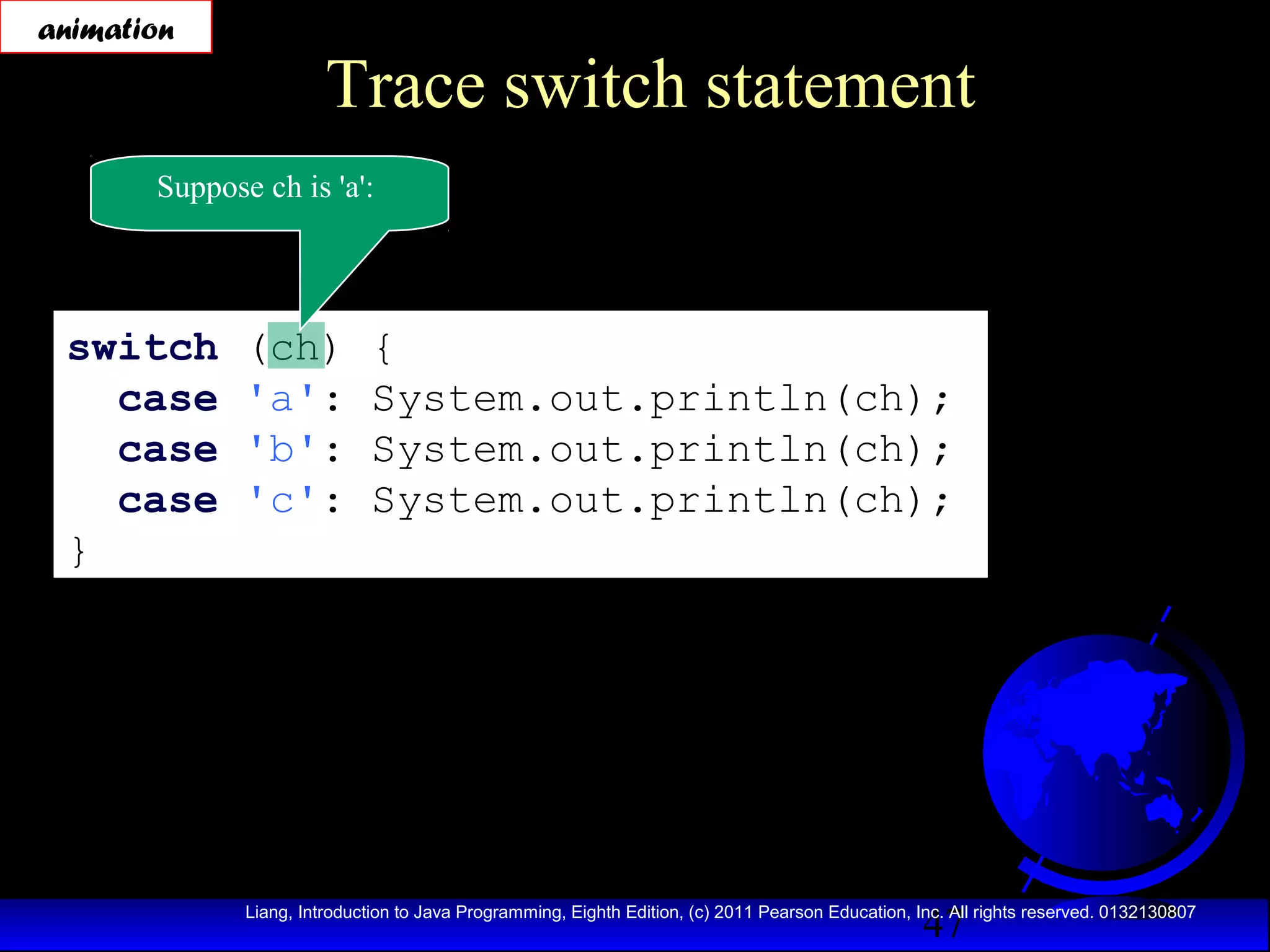
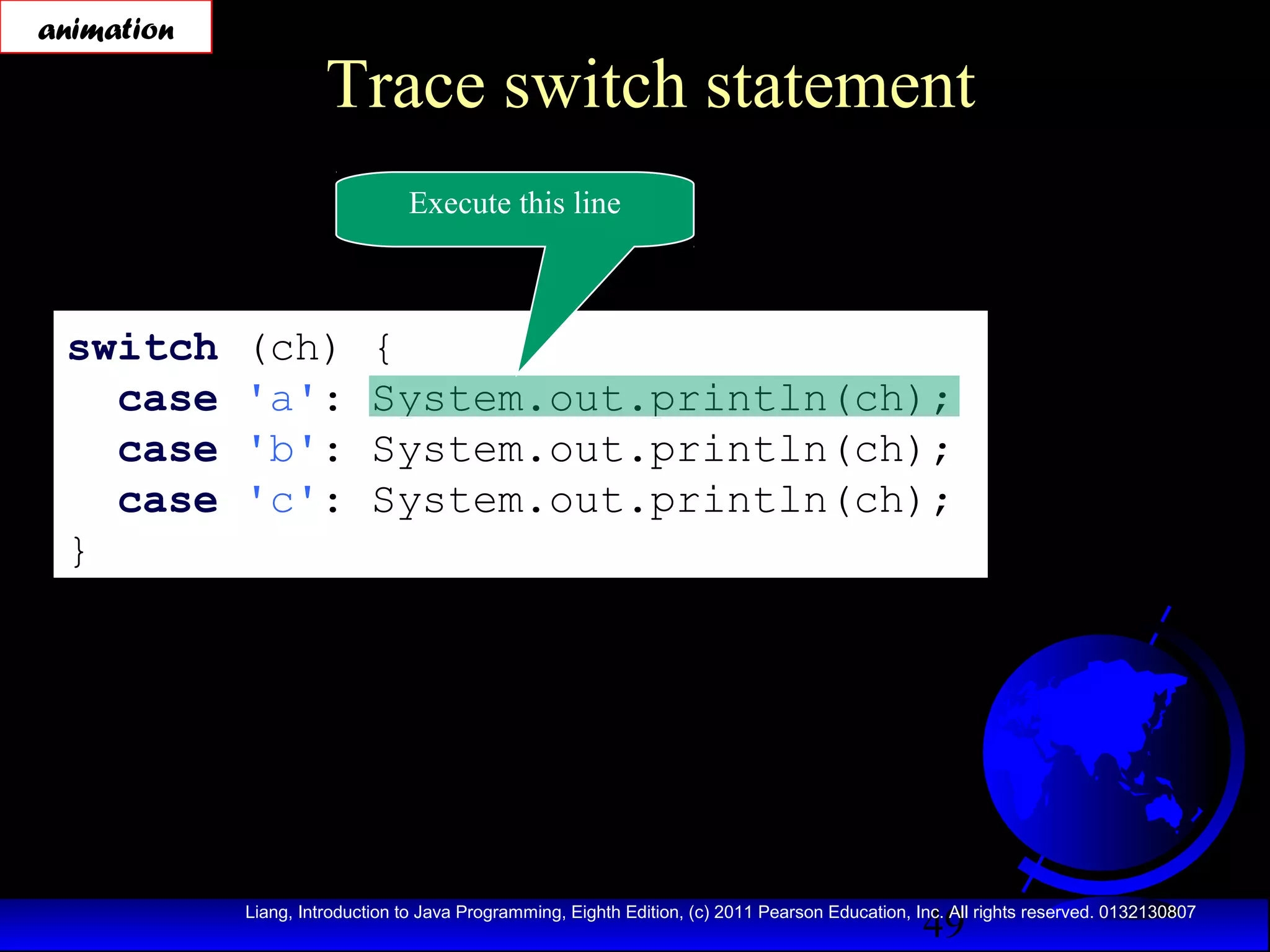
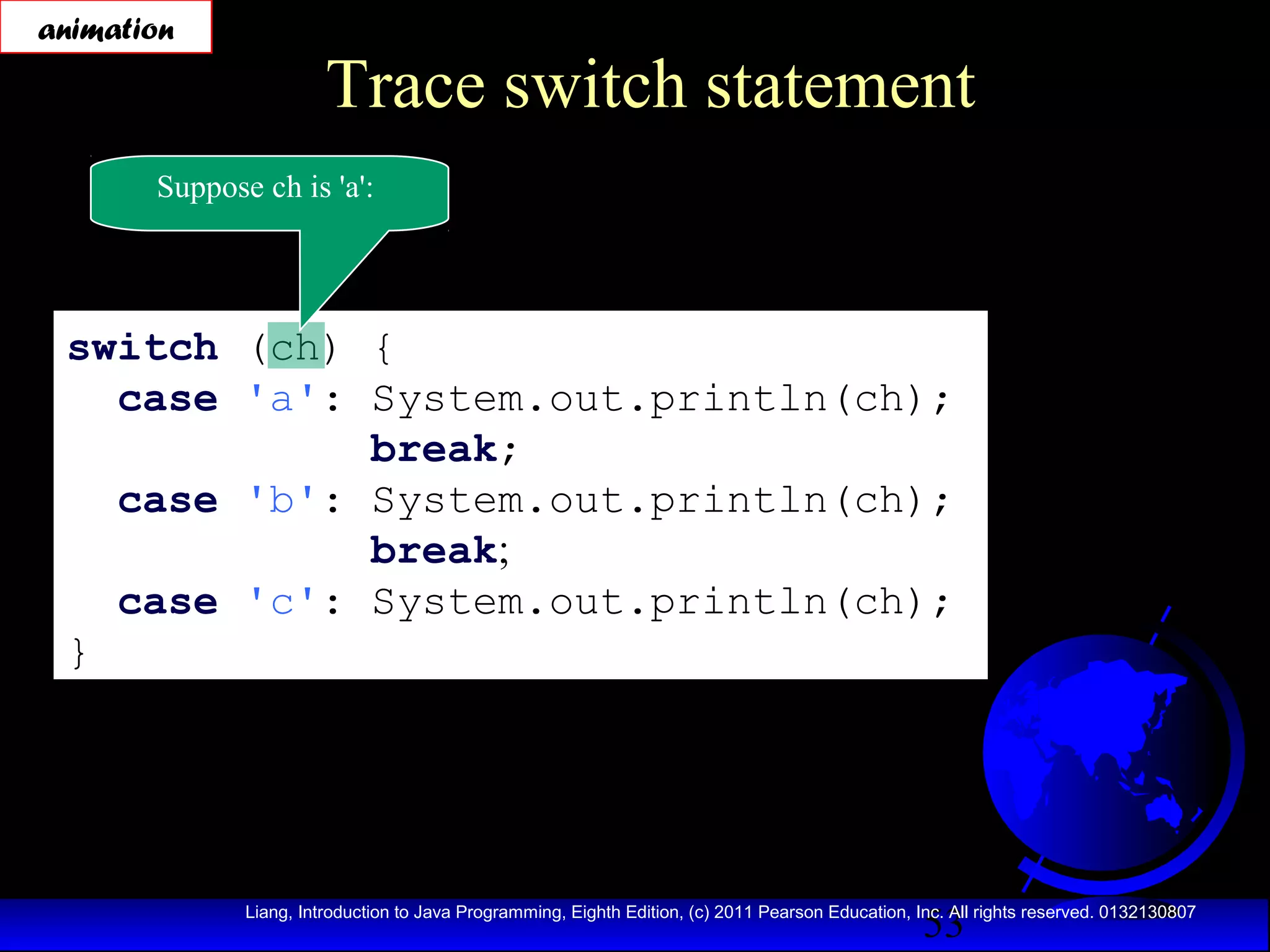
Trace switch statement

Suppose ch is 'a':

switch
case
case
case
}

(ch)
'a':
'b':
'c':

{
System.out.println(ch);

47

Liang, Introduction to Java Programming, Eighth Edition, (c) 2011 Pearson Education, Inc. All rights reserved. 0132130807
animation

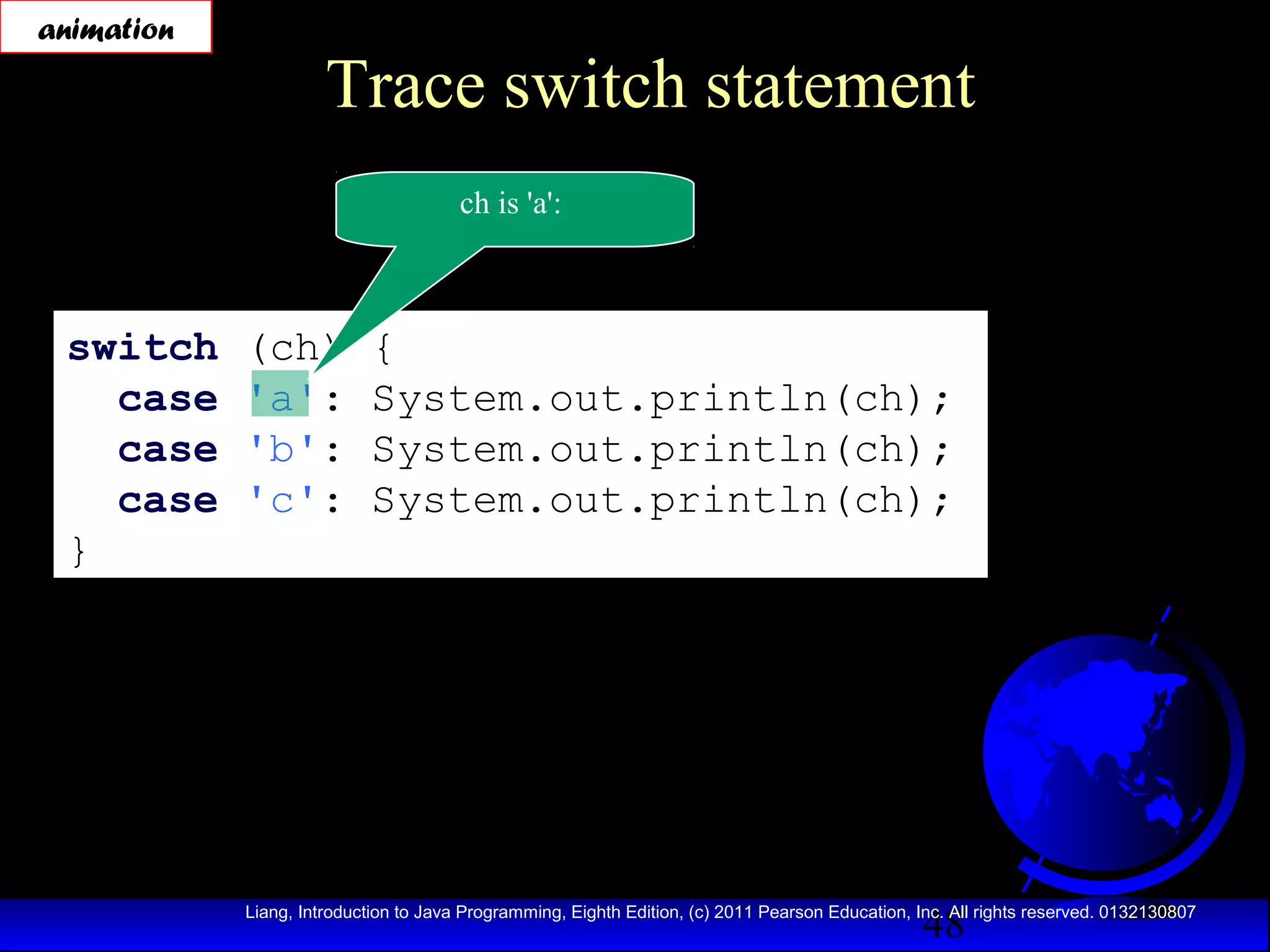
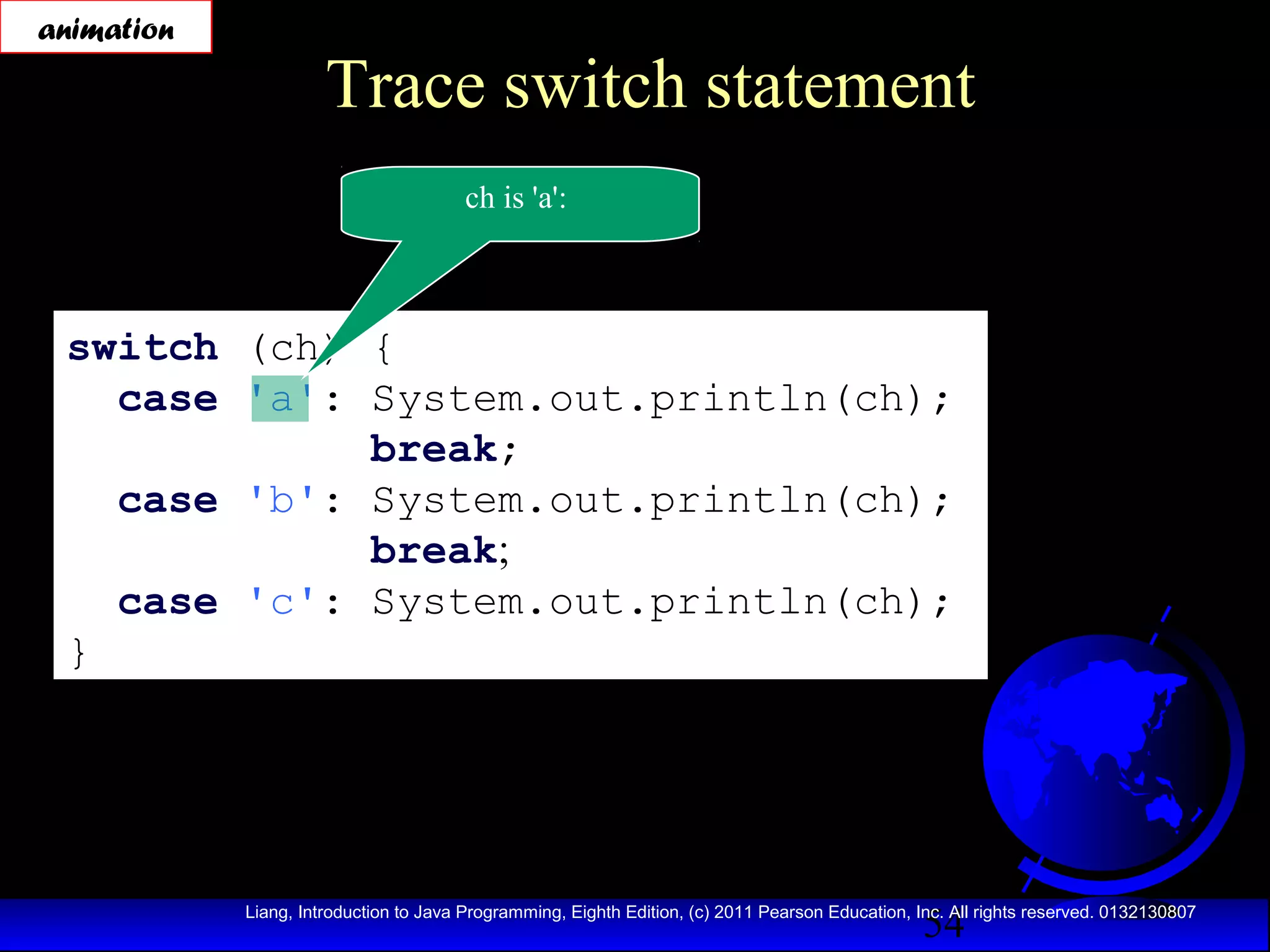
Trace switch statement
ch is 'a':

switch
case
case
case
}

(ch)
'a':
'b':
'c':

{
System.out.println(ch);

48

Liang, Introduction to Java Programming, Eighth Edition, (c) 2011 Pearson Education, Inc. All rights reserved. 0132130807
animation

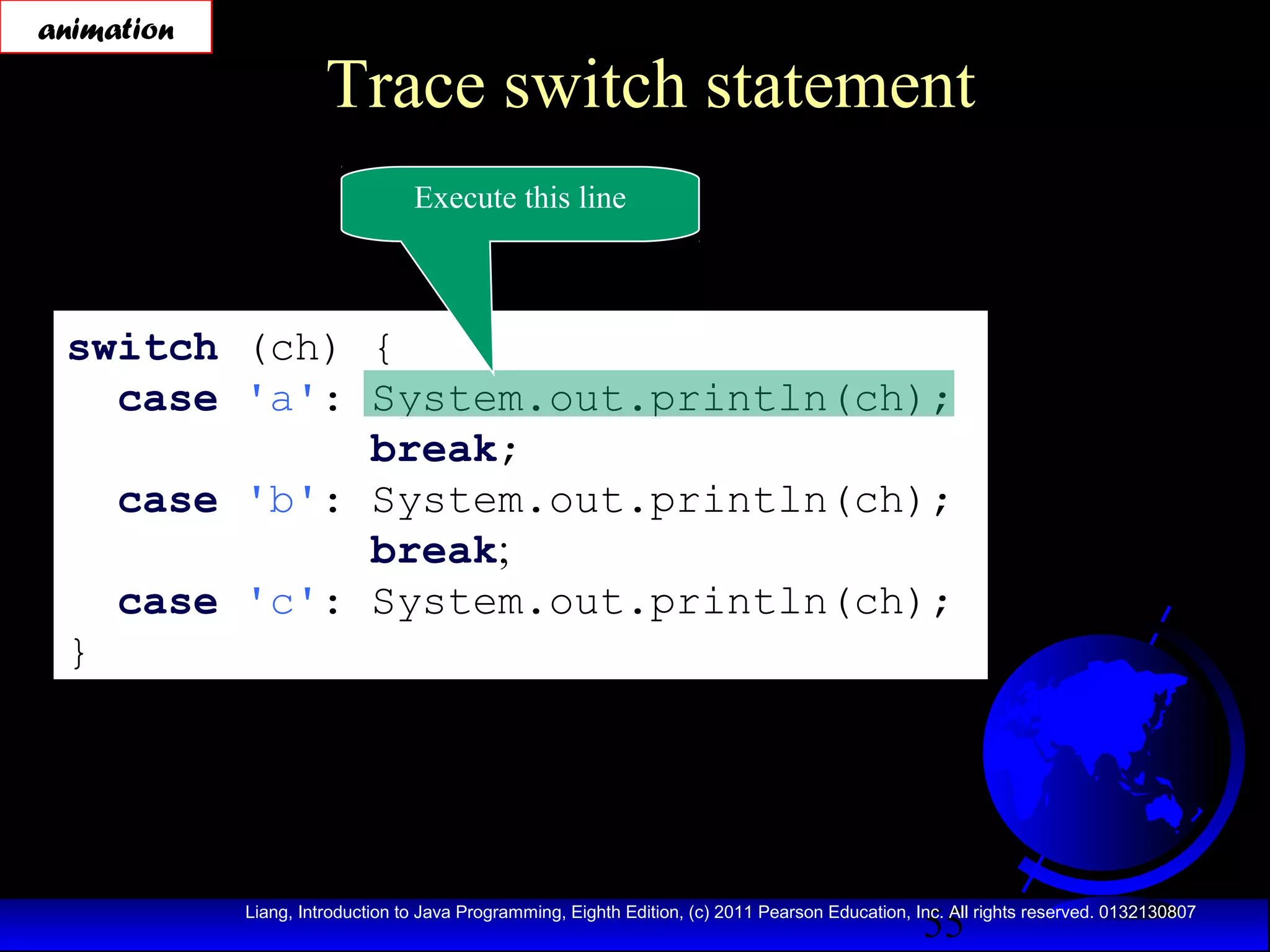
Trace switch statement
Execute this line

switch
case
case
case
}

(ch)
'a':
'b':
'c':

{
System.out.println(ch);

49

Liang, Introduction to Java Programming, Eighth Edition, (c) 2011 Pearson Education, Inc. All rights reserved. 0132130807
animation

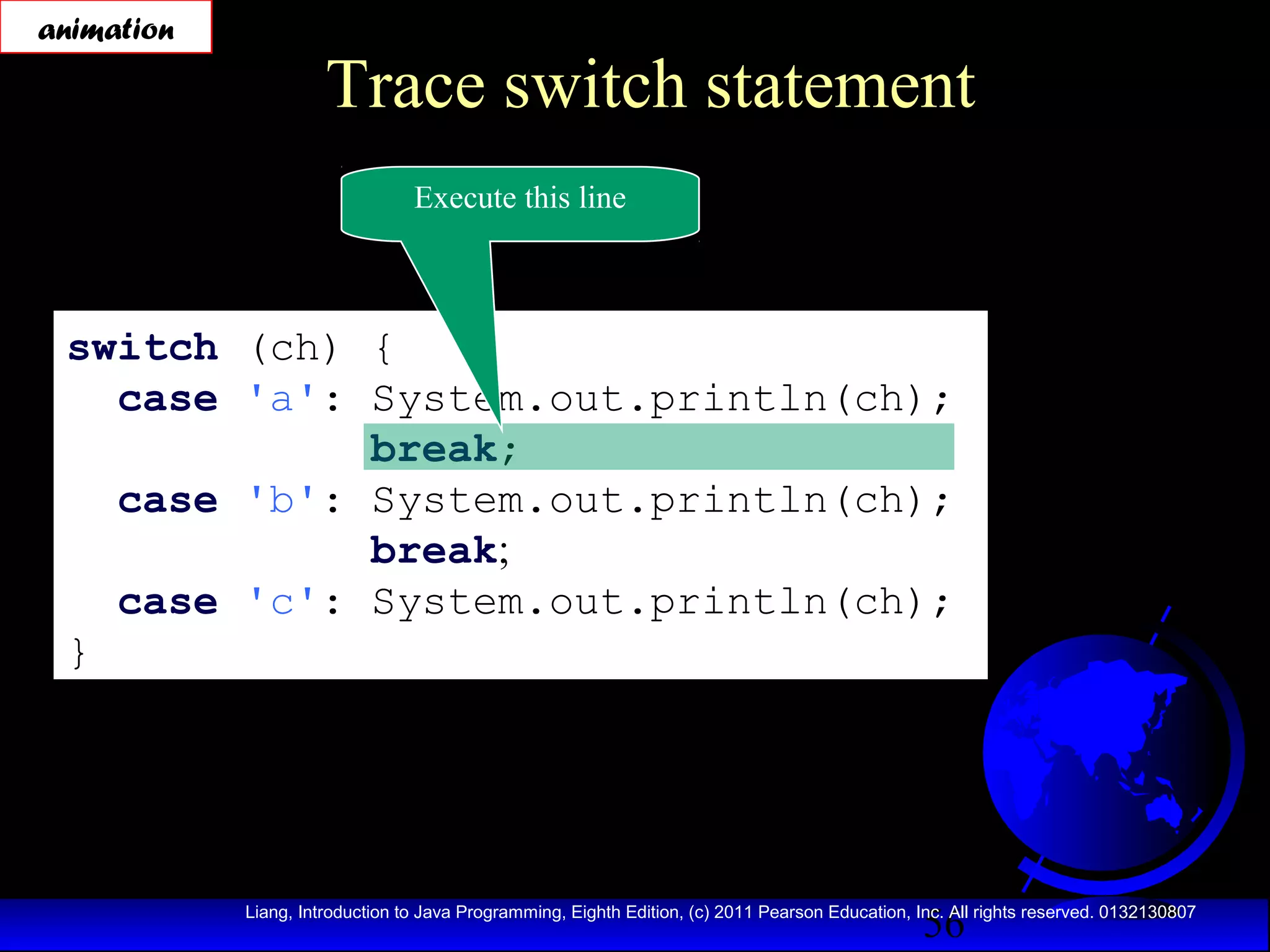
Trace switch statement
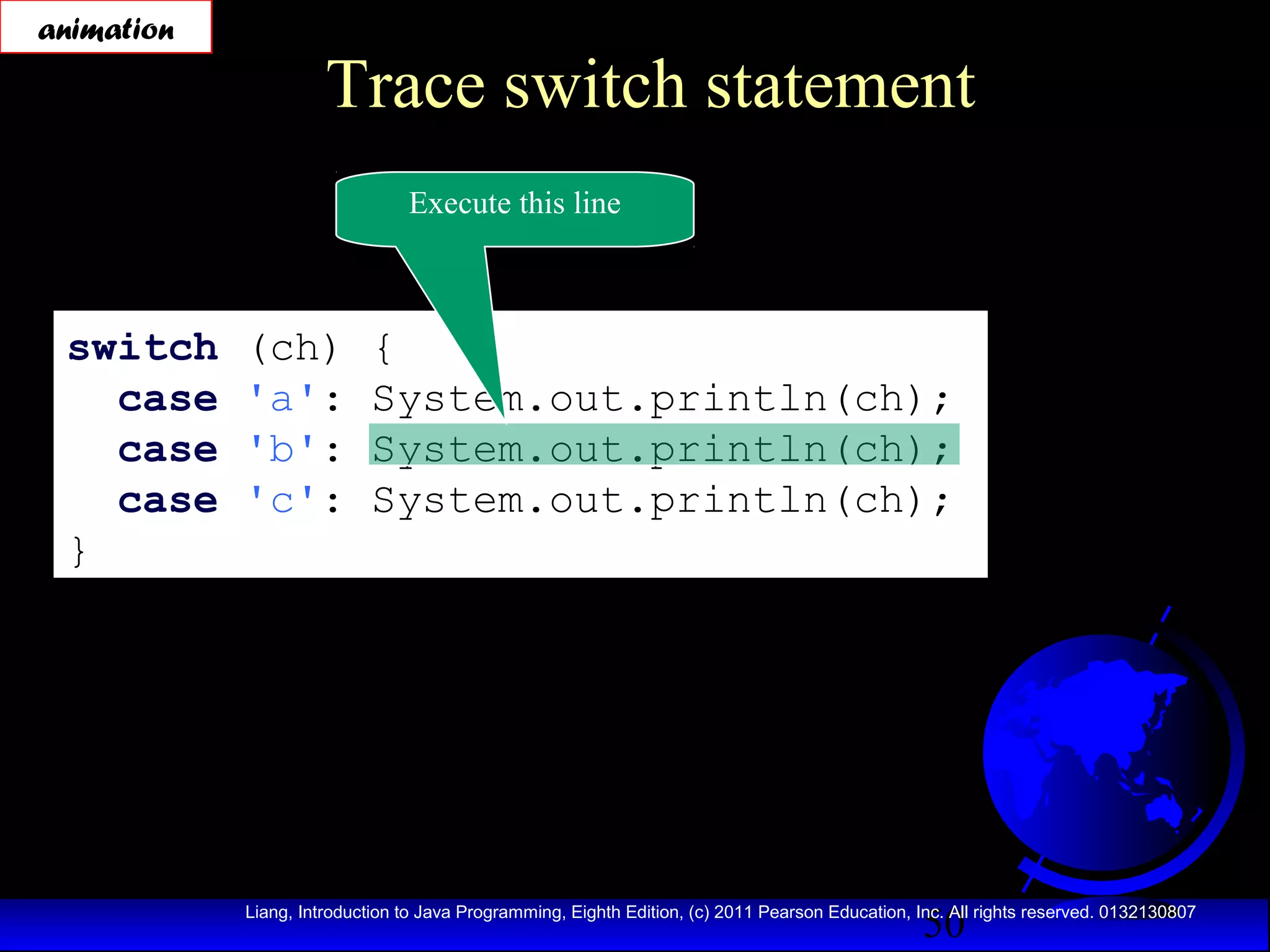
Execute this line

switch
case
case
case
}

(ch)
'a':
'b':
'c':

{
System.out.println(ch);

50

Liang, Introduction to Java Programming, Eighth Edition, (c) 2011 Pearson Education, Inc. All rights reserved. 0132130807
animation

Trace switch statement
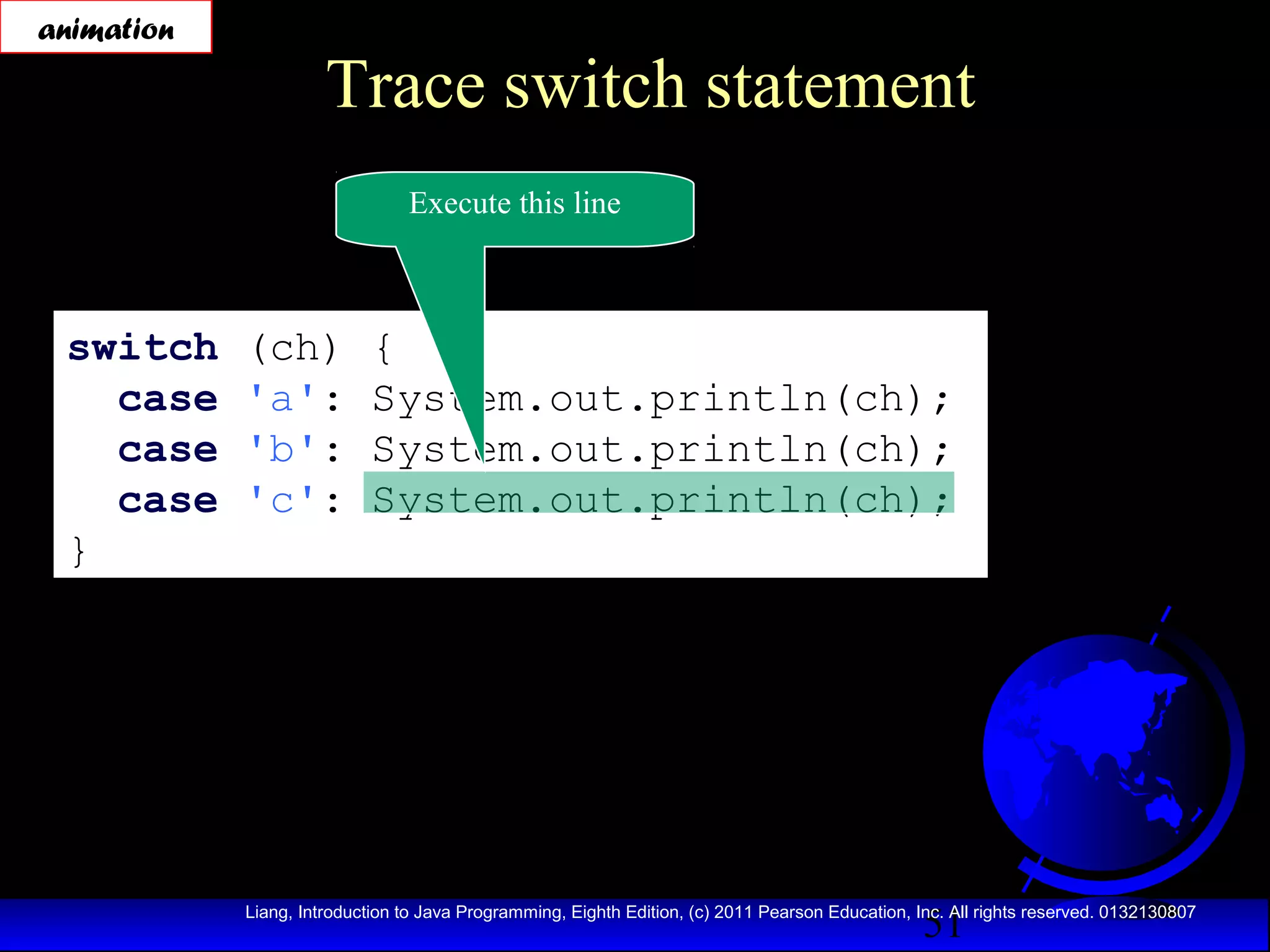
Execute this line

switch
case
case
case
}

(ch)
'a':
'b':
'c':

{
System.out.println(ch);

51

Liang, Introduction to Java Programming, Eighth Edition, (c) 2011 Pearson Education, Inc. All rights reserved. 0132130807
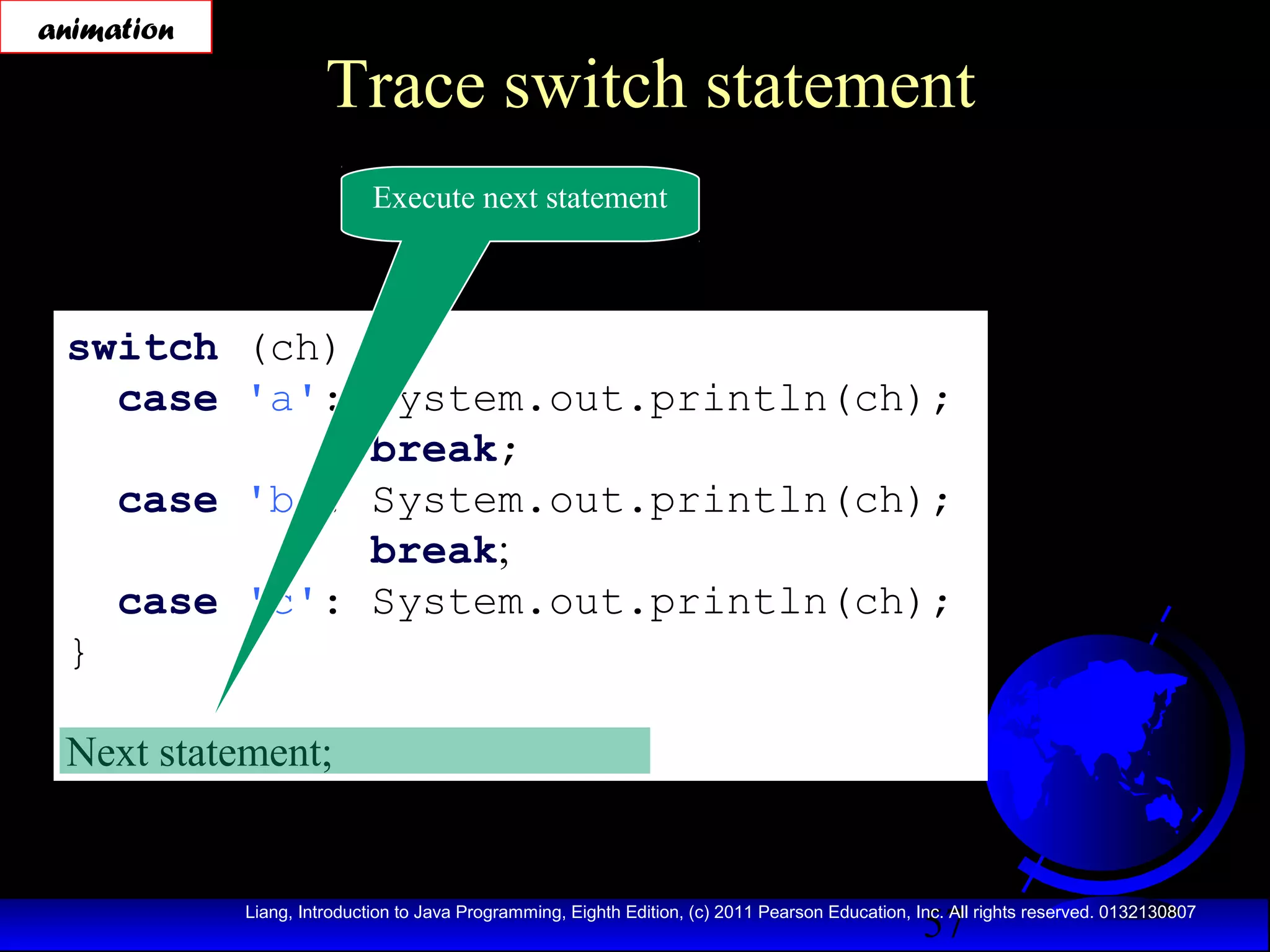
animation

Trace switch statement
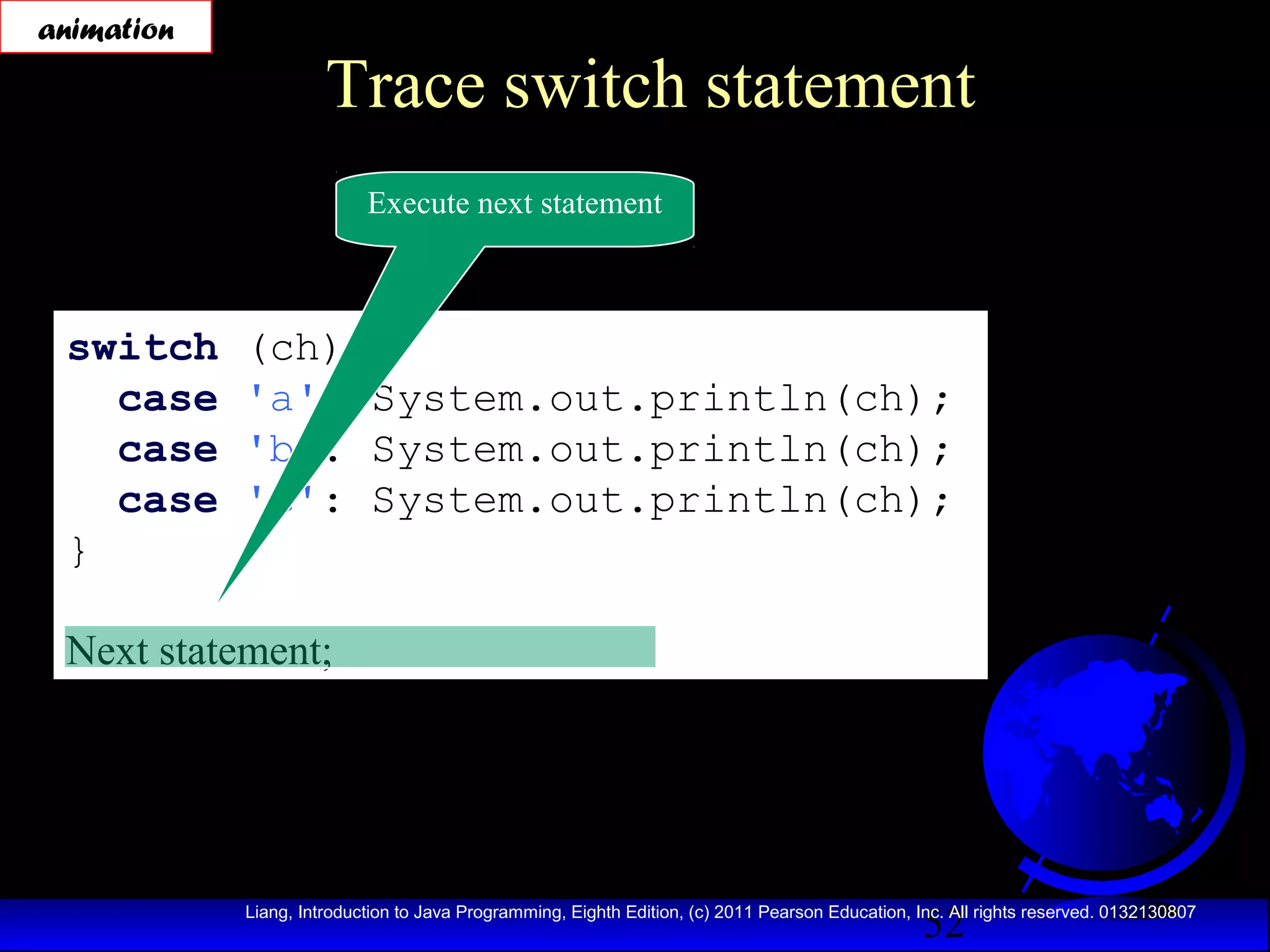
Execute next statement

switch
case
case
case
}

(ch)
'a':
'b':
'c':

{
System.out.println(ch);

Next statement;

52

Liang, Introduction to Java Programming, Eighth Edition, (c) 2011 Pearson Education, Inc. All rights reserved. 0132130807
animation

Trace switch statement

Suppose ch is 'a':

switch (ch) {
case 'a': System.out.println(ch);
break;
case 'b': System.out.println(ch);
break;
case 'c': System.out.println(ch);
}

53

Liang, Introduction to Java Programming, Eighth Edition, (c) 2011 Pearson Education, Inc. All rights reserved. 0132130807
animation

Trace switch statement
ch is 'a':

switch (ch) {
case 'a': System.out.println(ch);
break;
case 'b': System.out.println(ch);
break;
case 'c': System.out.println(ch);
}

54

Liang, Introduction to Java Programming, Eighth Edition, (c) 2011 Pearson Education, Inc. All rights reserved. 0132130807
animation

Trace switch statement
Execute this line

switch (ch) {
case 'a': System.out.println(ch);
break;
case 'b': System.out.println(ch);
break;
case 'c': System.out.println(ch);
}

55

Liang, Introduction to Java Programming, Eighth Edition, (c) 2011 Pearson Education, Inc. All rights reserved. 0132130807
animation

Trace switch statement
Execute this line

switch (ch) {
case 'a': System.out.println(ch);
break;
case 'b': System.out.println(ch);
break;
case 'c': System.out.println(ch);
}

56

Liang, Introduction to Java Programming, Eighth Edition, (c) 2011 Pearson Education, Inc. All rights reserved. 0132130807
animation

Trace switch statement
Execute next statement

switch (ch) {
case 'a': System.out.println(ch);
break;
case 'b': System.out.println(ch);
break;
case 'c': System.out.println(ch);
}
Next statement;

57

Liang, Introduction to Java Programming, Eighth Edition, (c) 2011 Pearson Education, Inc. All rights reserved. 0132130807
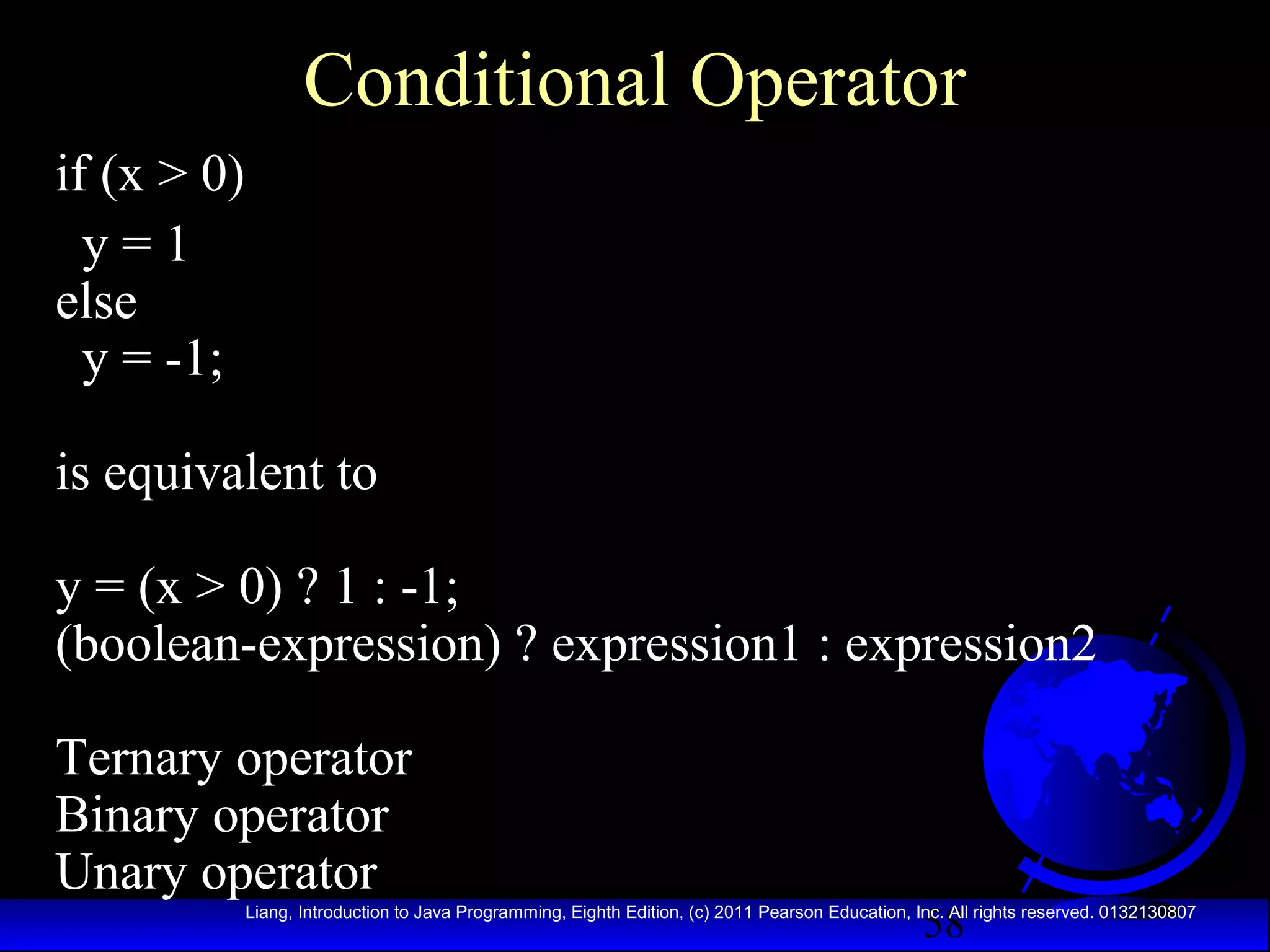
Conditional Operator
if (x > 0)
y=1
else
y = -1;
is equivalent to
y = (x > 0) ? 1 : -1;
(boolean-expression) ? expression1 : expression2
Ternary operator
Binary operator
Unary operator

58

Liang, Introduction to Java Programming, Eighth Edition, (c) 2011 Pearson Education, Inc. All rights reserved. 0132130807
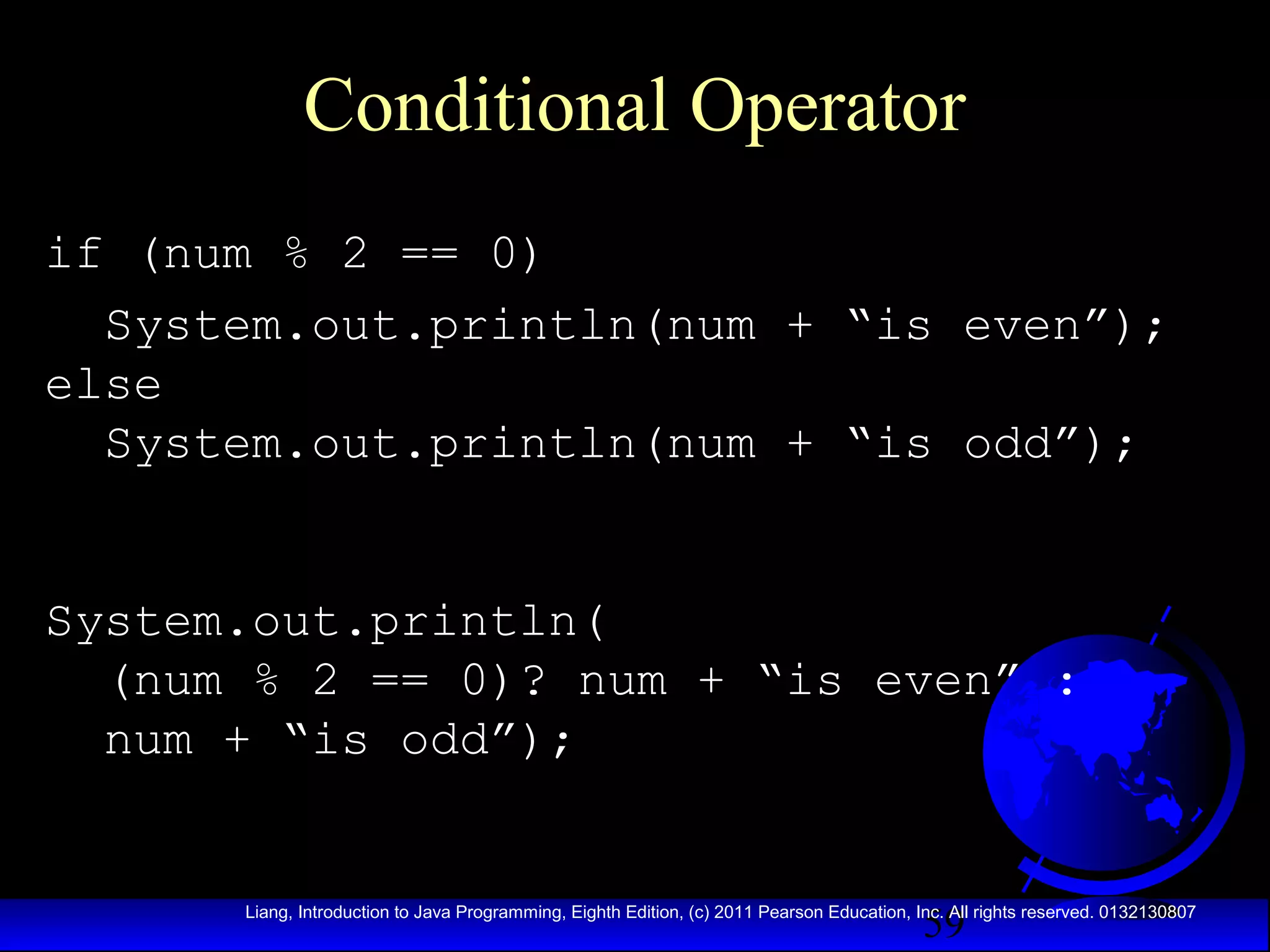
Conditional Operator
if (num % 2 == 0)
System.out.println(num + “is even”);
else
System.out.println(num + “is odd”);
System.out.println(
(num % 2 == 0)? num + “is even” :
num + “is odd”);

59

Liang, Introduction to Java Programming, Eighth Edition, (c) 2011 Pearson Education, Inc. All rights reserved. 0132130807
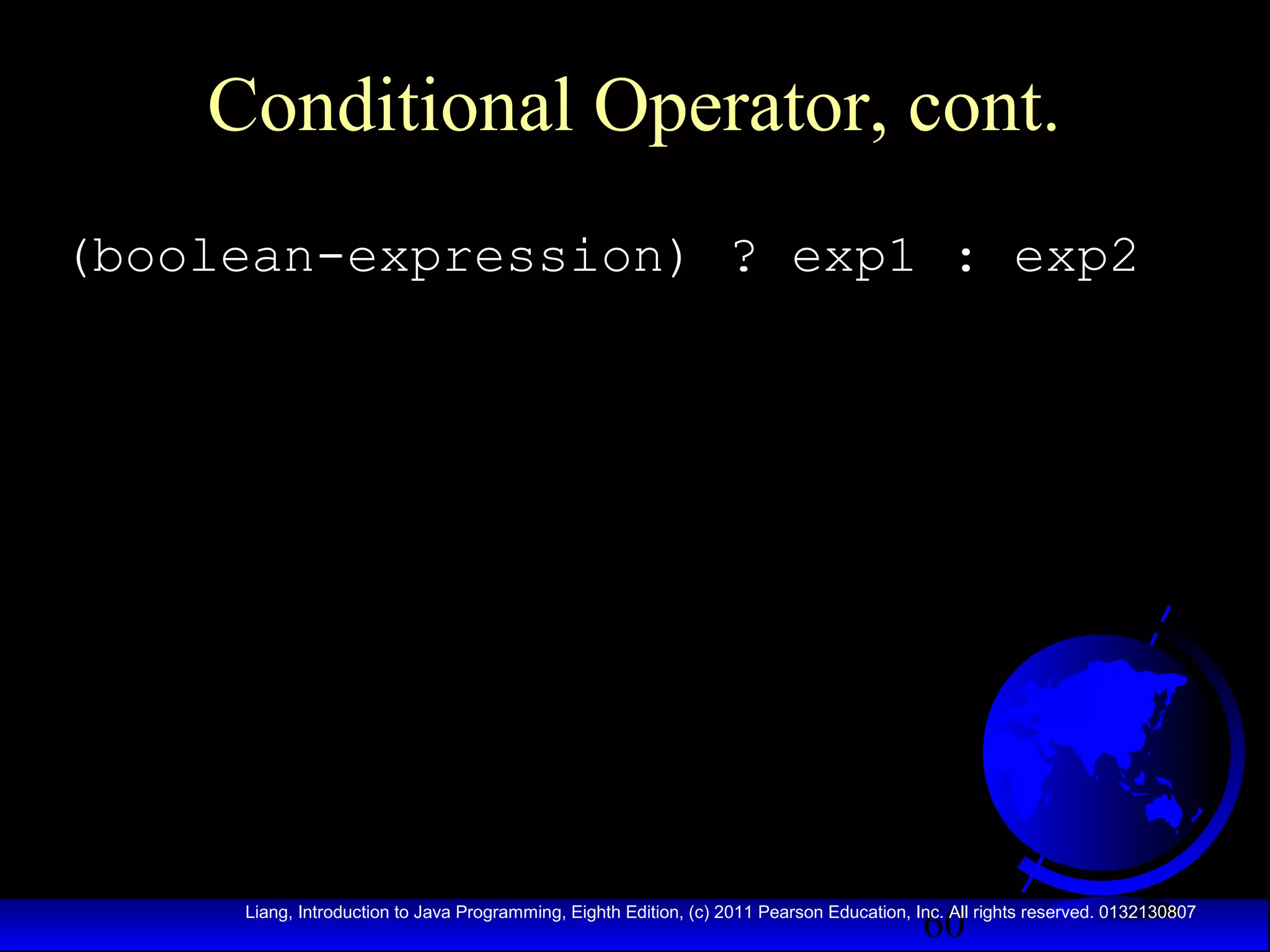
Conditional Operator, cont.
(boolean-expression) ? exp1 : exp2

60

Liang, Introduction to Java Programming, Eighth Edition, (c) 2011 Pearson Education, Inc. All rights reserved. 0132130807
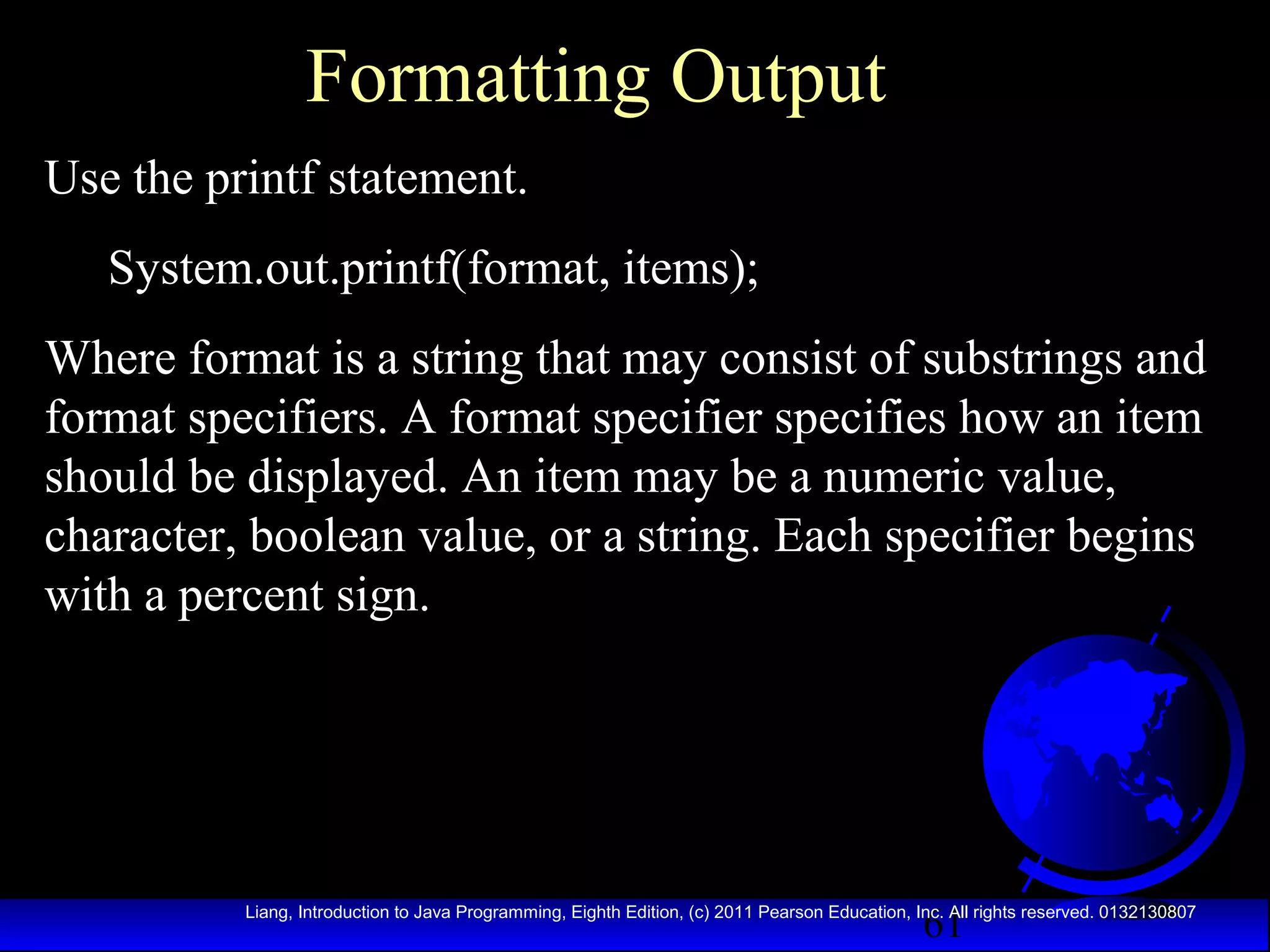
Formatting Output
Use the printf statement.
System.out.printf(format, items);
Where format is a string that may consist of substrings and
format specifiers. A format specifier specifies how an item
should be displayed. An item may be a numeric value,
character, boolean value, or a string. Each specifier begins
with a percent sign.

61

Liang, Introduction to Java Programming, Eighth Edition, (c) 2011 Pearson Education, Inc. All rights reserved. 0132130807
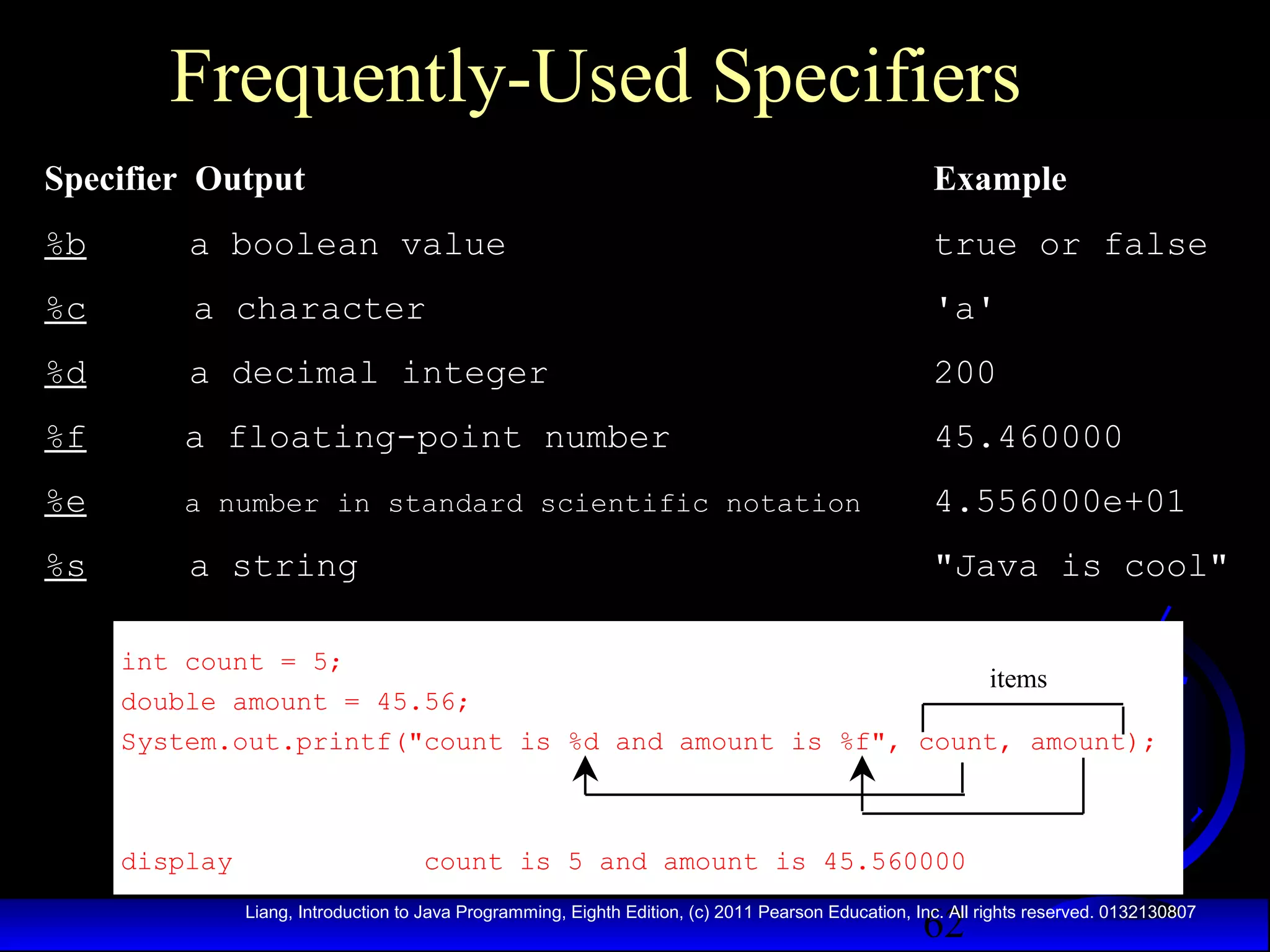
Frequently-Used Specifiers
Specifier Output

Example

%b

a boolean value

true or false

%c

a character

'a'

%d

a decimal integer

200

%f

a floating-point number

45.460000

%e

a number in standard scientific notation

4.556000e+01

%s

a string

"Java is cool"

int count = 5;
items
double amount = 45.56;
System.out.printf("count is %d and amount is %f", count, amount);

display

count is 5 and amount is 45.560000

62

Liang, Introduction to Java Programming, Eighth Edition, (c) 2011 Pearson Education, Inc. All rights reserved. 0132130807
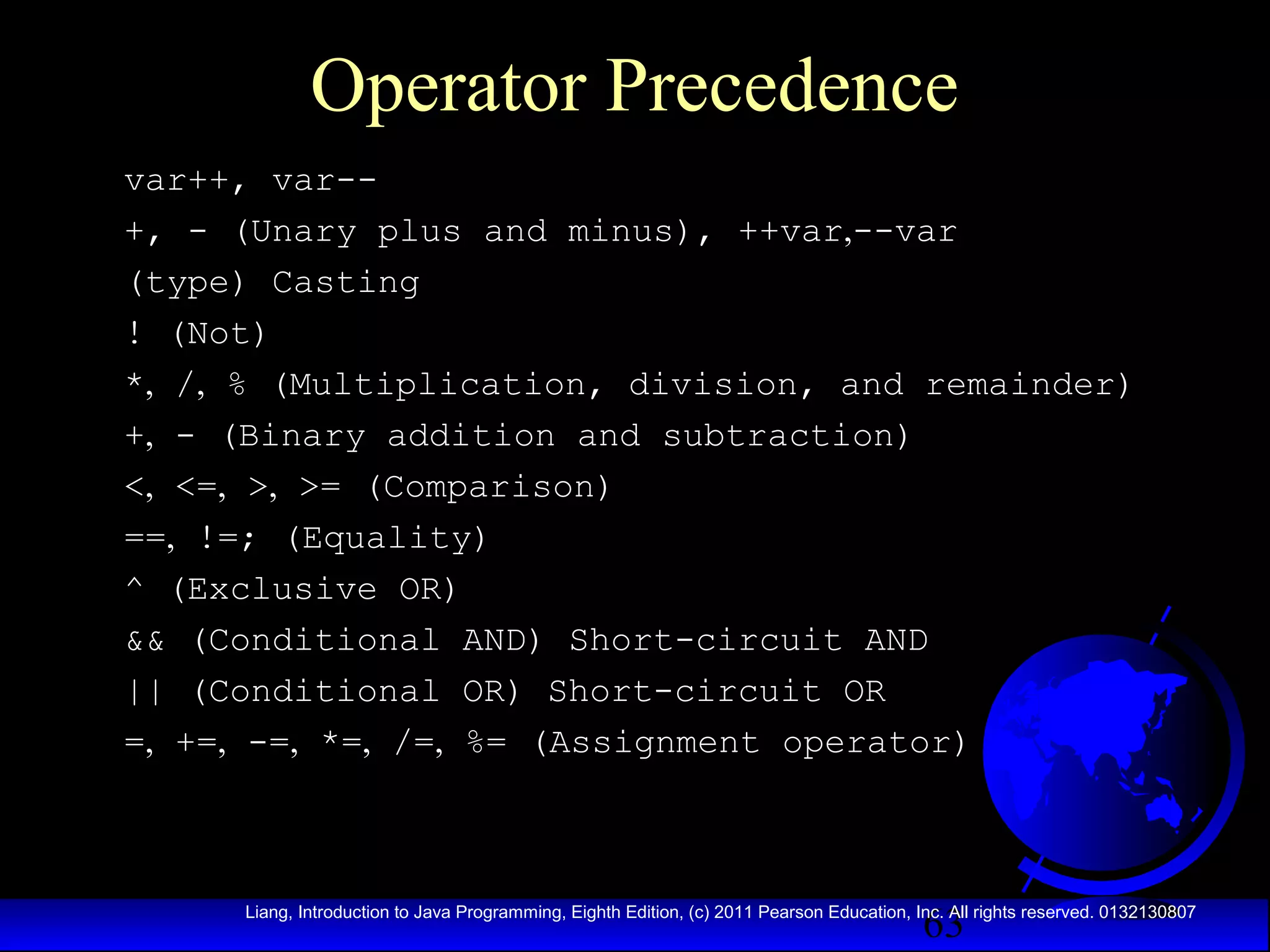
Operator Precedence
var++, var-+, - (Unary plus and minus), ++var,--var
(type) Casting
! (Not)
*, /, % (Multiplication, division, and remainder)
+, - (Binary addition and subtraction)
<, <=, >, >= (Comparison)
==, !=; (Equality)
^ (Exclusive OR)
&& (Conditional AND) Short-circuit AND
|| (Conditional OR) Short-circuit OR
=, +=, -=, *=, /=, %= (Assignment operator)

63

Liang, Introduction to Java Programming, Eighth Edition, (c) 2011 Pearson Education, Inc. All rights reserved. 0132130807
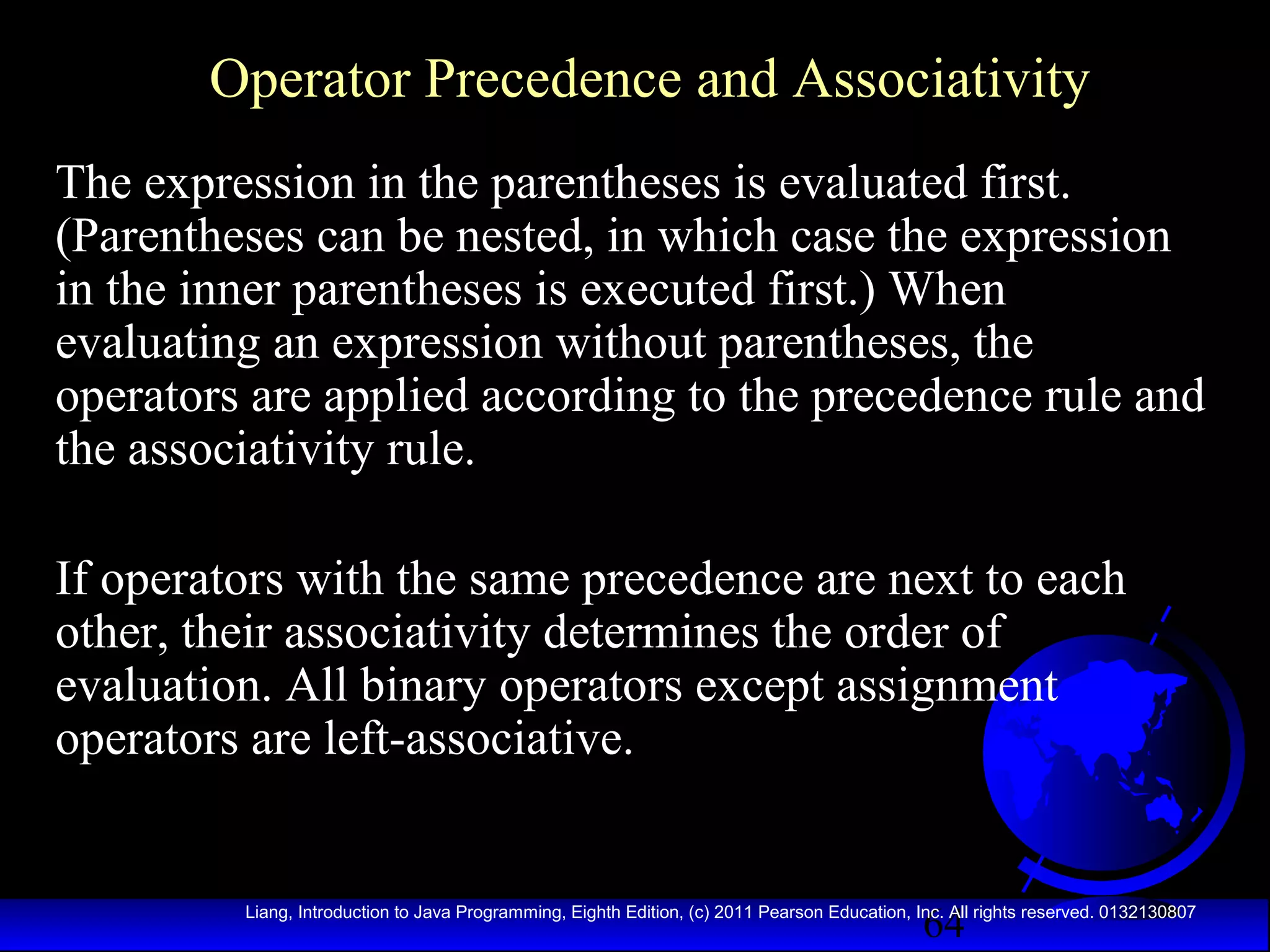
Operator Precedence and Associativity
The expression in the parentheses is evaluated first.
(Parentheses can be nested, in which case the expression
in the inner parentheses is executed first.) When
evaluating an expression without parentheses, the
operators are applied according to the precedence rule and
the associativity rule.
If operators with the same precedence are next to each
other, their associativity determines the order of
evaluation. All binary operators except assignment
operators are left-associative.

64

Liang, Introduction to Java Programming, Eighth Edition, (c) 2011 Pearson Education, Inc. All rights reserved. 0132130807
Operator Associativity
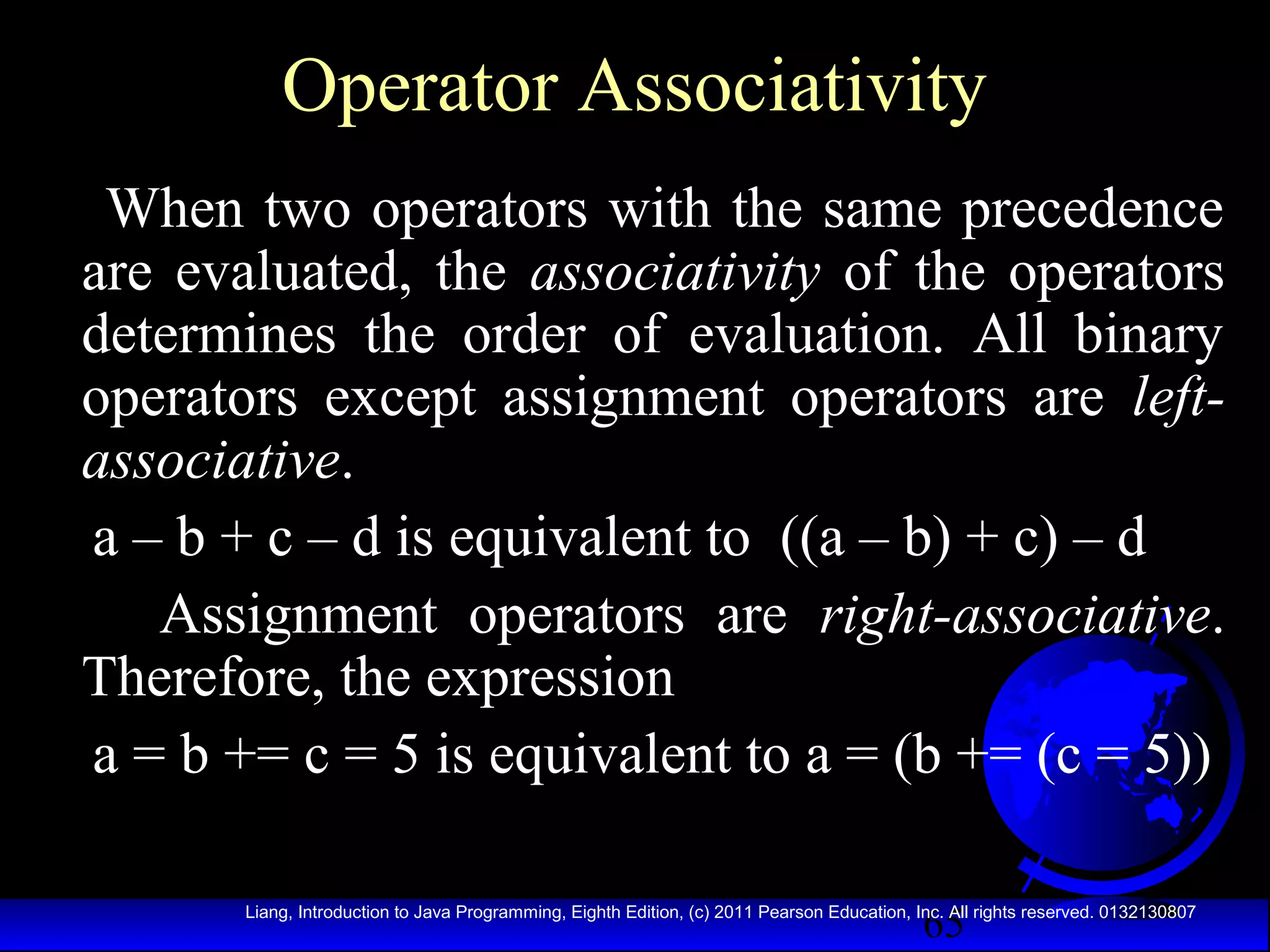
When two operators with the same precedence
are evaluated, the associativity of the operators
determines the order of evaluation. All binary
operators except assignment operators are leftassociative.
a – b + c – d is equivalent to ((a – b) + c) – d
Assignment operators are right-associative.
Therefore, the expression
a = b += c = 5 is equivalent to a = (b += (c = 5))
65

Liang, Introduction to Java Programming, Eighth Edition, (c) 2011 Pearson Education, Inc. All rights reserved. 0132130807
Example
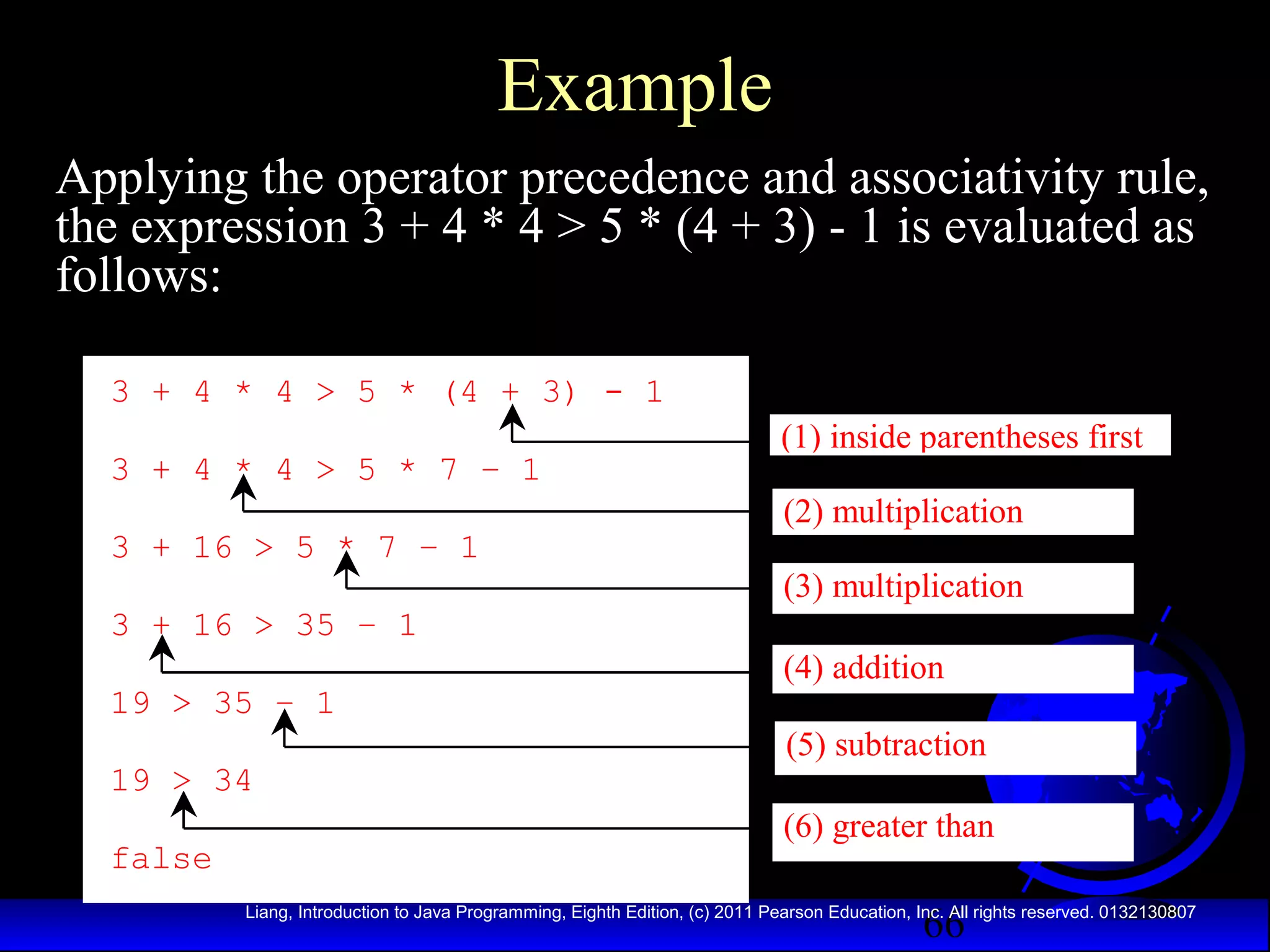
Applying the operator precedence and associativity rule,
the expression 3 + 4 * 4 > 5 * (4 + 3) - 1 is evaluated as
follows:
3 + 4 * 4 > 5 * (4 + 3) - 1
3 + 4 * 4 > 5 * 7 – 1
3 + 16 > 5 * 7 – 1

(1) inside parentheses first
(2) multiplication
(3) multiplication

3 + 16 > 35 – 1
19 > 35 – 1
19 > 34
false

(4) addition
(5) subtraction
(6) greater than

66

Liang, Introduction to Java Programming, Eighth Edition, (c) 2011 Pearson Education, Inc. All rights reserved. 0132130807
Companion
Website

Operand Evaluation Order

Supplement III.A, “Advanced discussions on
how an expression is evaluated in the JVM.”

67

Liang, Introduction to Java Programming, Eighth Edition, (c) 2011 Pearson Education, Inc. All rights reserved. 0132130807
(GUI) Confirmation Dialogs
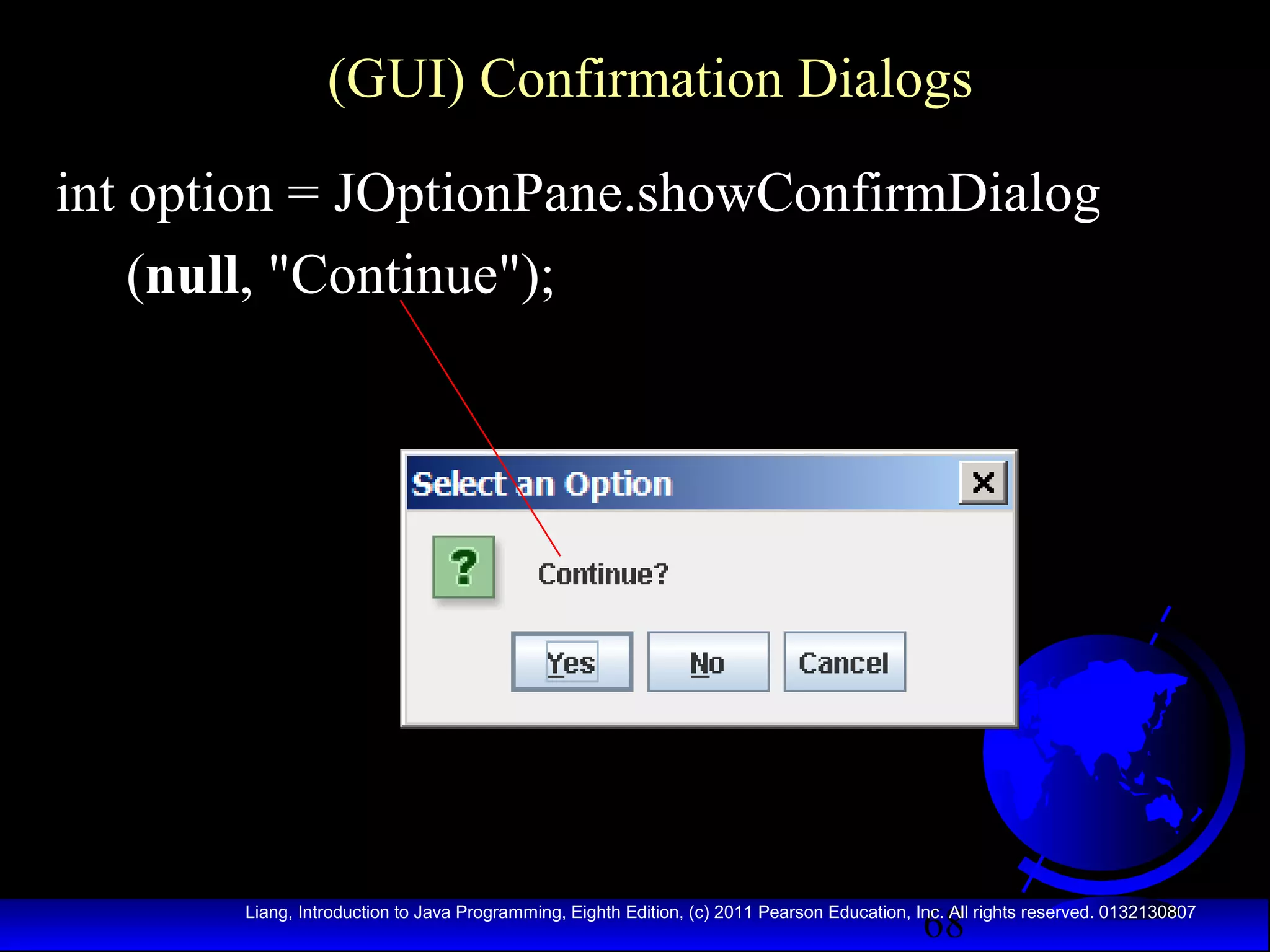
int option = JOptionPane.showConfirmDialog
(null, "Continue");

68

Liang, Introduction to Java Programming, Eighth Edition, (c) 2011 Pearson Education, Inc. All rights reserved. 0132130807
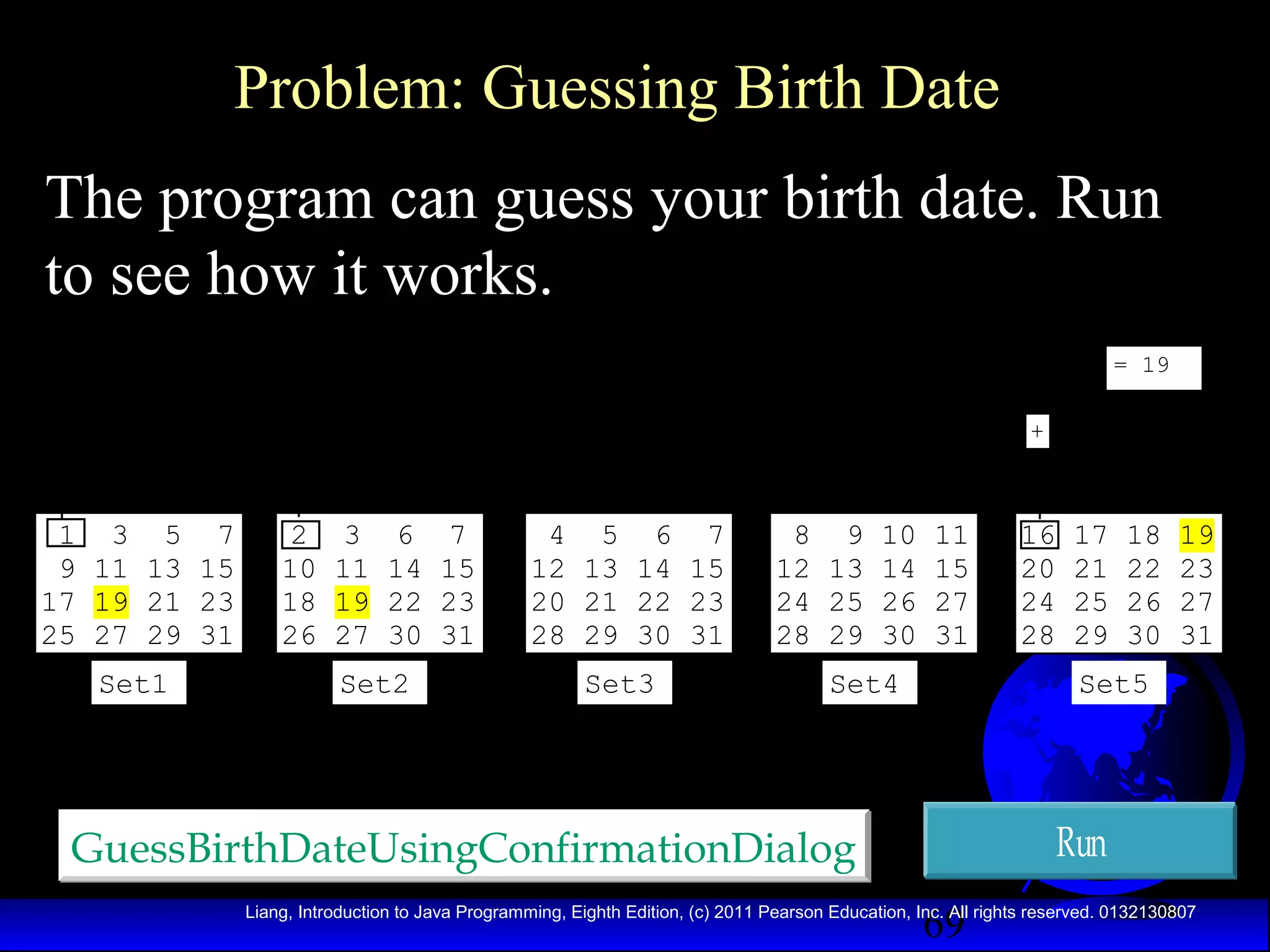
Problem: Guessing Birth Date
The program can guess your birth date. Run
to see how it works.
= 19
+

1 3 5 7
9 11 13 15
17 19 21 23
25 27 29 31
Set1

2
10
18
26

3
11
19
27

6
14
22
30

Set2

7
15
23
31

4 5 6 7
12 13 14 15
20 21 22 23
28 29 30 31

8 9 10 11
12 13 14 15
24 25 26 27
28 29 30 31

Set3

Set4

16
20
24
28

17
21
25
29

18
22
26
30

19
23
27
31

Set5

Run

GuessBirthDateUsingConfirmationDialog
69

Liang, Introduction to Java Programming, Eighth Edition, (c) 2011 Pearson Education, Inc. All rights reserved. 0132130807

Java™ (OOP) - Chapter 3: "Selections"

  • 1.
    Chapter 3 Selections 1 Liang,Introduction to Java Programming, Eighth Edition, (c) 2011 Pearson Education, Inc. All rights reserved. 0132130807
  • 2.
    Motivations If you assigneda negative value for radius in Listing 2.1, ComputeArea.java, the program would print an invalid result. If the radius is negative, you don't want the program to compute the area. How can you deal with this situation? 2 Liang, Introduction to Java Programming, Eighth Edition, (c) 2011 Pearson Education, Inc. All rights reserved. 0132130807
  • 3.
    Objectives To declare booleantype and write Boolean expressions using comparison operators (§3.2). To program AdditionQuiz using Boolean expressions (§3.3). To implement selection control using one-way if statements (§3.4) To program the GuessBirthday game using one-way if statements (§3.5). To implement selection control using two-way if statements (§3.6). To implement selection control using nested if statements (§3.7). To avoid common errors in if statements (§3.8). To program using selection statements for a variety of examples (BMI, ComputeTax, SubtractionQuiz) (§3.9-3.11). To generate random numbers using the Math.random() method (§3.9). To combine conditions using logical operators (&&, ||, and !) (§3.12). To program using selection statements with combined conditions (LeapYear, Lottery) (§§3.13-3.14). To implement selection control using switch statements (§3.15). To write expressions using the conditional operator (§3.16). To format output using the System.out.printf method and to format strings using the String.format method (§3.17). To examine the rules governing operator precedence and associativity (§3.18). (GUI) To get user confirmation using confirmation dialogs (§3.19). 3 Liang, Introduction to Java Programming, Eighth Edition, (c) 2011 Pearson Education, Inc. All rights reserved. 0132130807
  • 4.
    The boolean Typeand Operators Often in a program you need to compare two values, such as whether i is greater than j. Java provides six comparison operators (also known as relational operators) that can be used to compare two values. The result of the comparison is a Boolean value: true or false. boolean b = (1 > 2); 4 Liang, Introduction to Java Programming, Eighth Edition, (c) 2011 Pearson Education, Inc. All rights reserved. 0132130807
  • 5.
    Comparison Operators Operator Name < lessthan <= less than or equal to > greater than >= greater than or equal to == equal to != not equal to 5 Liang, Introduction to Java Programming, Eighth Edition, (c) 2011 Pearson Education, Inc. All rights reserved. 0132130807
  • 6.
    Problem: A SimpleMath Learning Tool This example creates a program to let a first grader practice additions. The program randomly generates two single-digit integers number1 and number2 and displays a question such as “What is 7 + 9?” to the student. After the student types the answer, the program displays a message to indicate whether the answer is true or false. Run AdditionQuiz 6 Liang, Introduction to Java Programming, Eighth Edition, (c) 2011 Pearson Education, Inc. All rights reserved. 0132130807
  • 7.
    One-way if Statements if(boolean-expression) { statement(s); } Boolean Expression false if (radius >= 0) { area = radius * radius * PI; System.out.println("The area" + " for the circle of radius " + radius + " is " + area); } (radius >= 0) false true true Statement(s) (A) area = radius * radius * PI; System.out.println("The area for the circle of " + "radius " + radius + " is " + area); (B) 7 Liang, Introduction to Java Programming, Eighth Edition, (c) 2011 Pearson Education, Inc. All rights reserved. 0132130807
  • 8.
    Note if i >0 { System.out.println("i is positive"); } if (i > 0) { System.out.println("i is positive"); } (a) Wrong if (i > 0) { System.out.println("i is positive"); } (b) Correct Equivalent if (i > 0) System.out.println("i is positive"); (b) (a) 8 Liang, Introduction to Java Programming, Eighth Edition, (c) 2011 Pearson Education, Inc. All rights reserved. 0132130807
  • 9.
    Simple if Demo Writea program that prompts the user to enter an integer. If the number is a multiple of 5, print HiFive. If the number is divisible by 2, print HiEven. Run SimpleIfDemo 9 Liang, Introduction to Java Programming, Eighth Edition, (c) 2011 Pearson Education, Inc. All rights reserved. 0132130807
  • 10.
    Problem: Guessing Birthday Theprogram can guess your birth date. Run to see how it works. = 19 + 1 3 5 7 9 11 13 15 17 19 21 23 25 27 29 31 Set1 2 10 18 26 3 11 19 27 6 14 22 30 Set2 7 15 23 31 4 5 6 7 12 13 14 15 20 21 22 23 28 29 30 31 8 9 10 11 12 13 14 15 24 25 26 27 28 29 30 31 Set3 Set4 GuessBirthday 16 20 24 28 17 21 25 29 18 22 26 30 19 23 27 31 Set5 Run 10 Liang, Introduction to Java Programming, Eighth Edition, (c) 2011 Pearson Education, Inc. All rights reserved. 0132130807
  • 11.
    Mathematics Basis forthe Game 19 is 10011 in binary. 7 is 111 in binary. 23 is 11101 in binary 10000 10 + 1 10011 10000 1000 100 + 1 11101 00110 10 + 1 00111 19 7 23 = 19 + 1 3 5 7 9 11 13 15 17 19 21 23 25 27 29 31 Set1 2 10 18 26 3 11 19 27 6 14 22 30 Set2 7 15 23 31 4 5 6 7 12 13 14 15 20 21 22 23 28 29 30 31 8 9 10 11 12 13 14 15 24 25 26 27 28 29 30 31 Set3 Set4 16 20 24 28 17 21 25 29 18 22 26 30 19 23 27 31 Set5 11 Liang, Introduction to Java Programming, Eighth Edition, (c) 2011 Pearson Education, Inc. All rights reserved. 0132130807
  • 12.
    The Two-way ifStatement if (boolean-expression) { statement(s)-for-the-true-case; } else { statement(s)-for-the-false-case; } true Statement(s) for the true case Boolean Expression false Statement(s) for the false case 12 Liang, Introduction to Java Programming, Eighth Edition, (c) 2011 Pearson Education, Inc. All rights reserved. 0132130807
  • 13.
    if...else Example if (radius>= 0) { area = radius * radius * 3.14159; System.out.println("The area for the “ + “circle of radius " + radius + " is " + area); } else { System.out.println("Negative input"); } 13 Liang, Introduction to Java Programming, Eighth Edition, (c) 2011 Pearson Education, Inc. All rights reserved. 0132130807
  • 14.
    Multiple Alternative ifStatements if (score >= 90.0) grade = 'A'; else if (score >= 80.0) grade = 'B'; else if (score >= 70.0) grade = 'C'; else if (score >= 60.0) grade = 'D'; else grade = 'F'; Equivalent if (score >= 90.0) grade = 'A'; else if (score >= 80.0) grade = 'B'; else if (score >= 70.0) grade = 'C'; else if (score >= 60.0) grade = 'D'; else grade = 'F'; 14 Liang, Introduction to Java Programming, Eighth Edition, (c) 2011 Pearson Education, Inc. All rights reserved. 0132130807
  • 15.
    animation Trace if-else statement Supposescore is 70.0 The condition is false if (score >= 90.0) grade = 'A'; else if (score >= 80.0) grade = 'B'; else if (score >= 70.0) grade = 'C'; else if (score >= 60.0) grade = 'D'; else grade = 'F'; 15 Liang, Introduction to Java Programming, Eighth Edition, (c) 2011 Pearson Education, Inc. All rights reserved. 0132130807
  • 16.
    animation Trace if-else statement Supposescore is 70.0 The condition is false if (score >= 90.0) grade = 'A'; else if (score >= 80.0) grade = 'B'; else if (score >= 70.0) grade = 'C'; else if (score >= 60.0) grade = 'D'; else grade = 'F'; 16 Liang, Introduction to Java Programming, Eighth Edition, (c) 2011 Pearson Education, Inc. All rights reserved. 0132130807
  • 17.
    animation Trace if-else statement Supposescore is 70.0 The condition is true if (score >= 90.0) grade = 'A'; else if (score >= 80.0) grade = 'B'; else if (score >= 70.0) grade = 'C'; else if (score >= 60.0) grade = 'D'; else grade = 'F'; 17 Liang, Introduction to Java Programming, Eighth Edition, (c) 2011 Pearson Education, Inc. All rights reserved. 0132130807
  • 18.
    animation Trace if-else statement Supposescore is 70.0 grade is C if (score >= 90.0) grade = 'A'; else if (score >= 80.0) grade = 'B'; else if (score >= 70.0) grade = 'C'; else if (score >= 60.0) grade = 'D'; else grade = 'F'; 18 Liang, Introduction to Java Programming, Eighth Edition, (c) 2011 Pearson Education, Inc. All rights reserved. 0132130807
  • 19.
    animation Trace if-else statement Supposescore is 70.0 Exit the if statement if (score >= 90.0) grade = 'A'; else if (score >= 80.0) grade = 'B'; else if (score >= 70.0) grade = 'C'; else if (score >= 60.0) grade = 'D'; else grade = 'F'; 19 Liang, Introduction to Java Programming, Eighth Edition, (c) 2011 Pearson Education, Inc. All rights reserved. 0132130807
  • 20.
    Note The else clausematches the most recent if clause in the same block. int i = 1; int j = 2; int k = 3; Equivalent if (i > j) if (i > k) System.out.println("A"); else System.out.println("B"); int i = 1; int j = 2; int k = 3; if (i > j) if (i > k) System.out.println("A"); else System.out.println("B"); (a) (b) 20 Liang, Introduction to Java Programming, Eighth Edition, (c) 2011 Pearson Education, Inc. All rights reserved. 0132130807
  • 21.
    Note, cont. Nothing isprinted from the preceding statement. To force the else clause to match the first if clause, you must add a pair of braces: int i = 1; int j = 2; int k = 3; if (i > j) { if (i > k) System.out.println("A"); } else System.out.println("B"); This statement prints B. 21 Liang, Introduction to Java Programming, Eighth Edition, (c) 2011 Pearson Education, Inc. All rights reserved. 0132130807
  • 22.
    Common Errors Adding asemicolon at the end of an if clause is a common mistake. if (radius >= 0); Wrong { area = radius*radius*PI; System.out.println( "The area for the circle of radius " + radius + " is " + area); } This mistake is hard to find, because it is not a compilation error or a runtime error, it is a logic error. This error often occurs when you use the next-line block style. 22 Liang, Introduction to Java Programming, Eighth Edition, (c) 2011 Pearson Education, Inc. All rights reserved. 0132130807
  • 23.
    TIP if (number %2 == 0) even = true; else even = false; Equivalent boolean even = number % 2 == 0; (b) (a) 23 Liang, Introduction to Java Programming, Eighth Edition, (c) 2011 Pearson Education, Inc. All rights reserved. 0132130807
  • 24.
    CAUTION if (even ==true) System.out.println( "It is even."); Equivalent if (even) System.out.println( "It is even."); (b) (a) 24 Liang, Introduction to Java Programming, Eighth Edition, (c) 2011 Pearson Education, Inc. All rights reserved. 0132130807
  • 25.
    Problem: An ImprovedMath Learning Tool This example creates a program to teach a first grade child how to learn subtractions. The program randomly generates two singledigit integers number1 and number2 with number1 > number2 and displays a question such as “What is 9 – 2?” to the student. After the student types the answer in the input dialog box, the program displays a message dialog box to indicate whether the answer is correct. SubtractionQuiz Run 25 Liang, Introduction to Java Programming, Eighth Edition, (c) 2011 Pearson Education, Inc. All rights reserved. 0132130807
  • 26.
    Problem: Body MassIndex Body Mass Index (BMI) is a measure of health on weight. It can be calculated by taking your weight in kilograms and dividing by the square of your height in meters. The interpretation of BMI for people 16 years or older is as follows: BMI Interpretation below 16 16-18 18-24 24-29 29-35 above 35 serious underweight underweight normal weight overweight seriously overweight gravely overweight ComputeBMI Run 26 Liang, Introduction to Java Programming, Eighth Edition, (c) 2011 Pearson Education, Inc. All rights reserved. 0132130807
  • 27.
    Problem: Computing Taxes TheUS federal personal income tax is calculated based on the filing status and taxable income. There are four filing statuses: single filers, married filing jointly, married filing separately, and head of household. The tax rates for 2009 are shown below. Married Filing Jointly Marginal Married Filing Tax Rate Single or Qualified Widow(er) Head of Household Separately 10% $0 – $8,350 $0 – $16,700 $0 – $8,350 $0 – $11,950 15% $8,351– $33,950 $16,701 – $67,900 $8,351 – $33,950 $11,951 – $45,500 25% $33,951 – $82,250 $67,901 – $137,050 $33,951 – $68,525 $45,501 – $117,450 28% $82,251 – $171,550 $137,051 – $208,850 $68,525 – $104,425 $117,451 – $190,200 33% $171,551 – $372,950 $208,851 – $372,950 $104,426 – $186,475 $190,201 - $372,950 35% $372,951+ $372,951+ $186,476+ $372,951+ 27 Liang, Introduction to Java Programming, Eighth Edition, (c) 2011 Pearson Education, Inc. All rights reserved. 0132130807
  • 28.
    Problem: Computing Taxes,cont. if (status == 0) { // Compute tax for single filers } else if (status == 1) { // Compute tax for married file jointly } else if (status == 2) { // Compute tax for married file separately } else if (status == 3) { // Compute tax for head of household } else { // Display wrong status } ComputeTax 28 Run Liang, Introduction to Java Programming, Eighth Edition, (c) 2011 Pearson Education, Inc. All rights reserved. 0132130807
  • 29.
    Logical Operators Operator Name ! not && and || or ^ exclusiveor 29 Liang, Introduction to Java Programming, Eighth Edition, (c) 2011 Pearson Education, Inc. All rights reserved. 0132130807
  • 30.
    Truth Table forOperator ! p !p Example (assume age = 24, gender = 'M') true false !(age > 18) is false, because (age > 18) is true. false true !(gender != 'F') is true, because (grade != 'F') is false. 30 Liang, Introduction to Java Programming, Eighth Edition, (c) 2011 Pearson Education, Inc. All rights reserved. 0132130807
  • 31.
    Truth Table forOperator && p1 p2 p1 && p2 Example (assume age = 24, gender = 'F') false false false false true false (age > 18) && (gender == 'F') is true, because (age > 18) and (gender == 'F') are both true. true false false true true true (age > 18) && (gender != 'F') is false, because (gender != 'F') is false. 31 Liang, Introduction to Java Programming, Eighth Edition, (c) 2011 Pearson Education, Inc. All rights reserved. 0132130807
  • 32.
    Truth Table forOperator || p1 p2 p1 || p2 Example (assume age = 24, gender = 'F') false false false false true true (age > 34) || (gender == 'F') is true, because (gender == 'F') is true. true false true true true true (age > 34) || (gender == 'M') is false, because (age > 34) and (gender == 'M') are both false. 32 Liang, Introduction to Java Programming, Eighth Edition, (c) 2011 Pearson Education, Inc. All rights reserved. 0132130807
  • 33.
    Examples Here is aprogram that checks whether a number is divisible by 2 and 3, whether a number is divisible by 2 or 3, and whether a number is divisible by 2 or 3 but not both: TestBooleanOperators Run 33 Liang, Introduction to Java Programming, Eighth Edition, (c) 2011 Pearson Education, Inc. All rights reserved. 0132130807
  • 34.
    Truth Table forOperator ! p !p true false !(1 > 2) is true, because (1 > 2) is false. false true !(1 > 0) is false, because (1 > 0) is true. Example 34 Liang, Introduction to Java Programming, Eighth Edition, (c) 2011 Pearson Education, Inc. All rights reserved. 0132130807
  • 35.
    Truth Table forOperator && p1 p2 p1 && p2 false false false false true false true false false true true true Example (3 > 2) && (5 >= 5) is true, because (3 > 2) and (5 >= 5) are both true. (3 > 2) && (5 > 5) is false, because (5 > 5) is false. 35 Liang, Introduction to Java Programming, Eighth Edition, (c) 2011 Pearson Education, Inc. All rights reserved. 0132130807
  • 36.
    Truth Table forOperator || p1 p2 p1 || p2 false false false false true true true false true true true true Example (2 > 3) || (5 > 5) is false, because (2 > 3) and (5 > 5) are both false. (3 > 2) || (5 > 5) is true, because (3 > 2) is true. 36 Liang, Introduction to Java Programming, Eighth Edition, (c) 2011 Pearson Education, Inc. All rights reserved. 0132130807
  • 37.
    Truth Table forOperator ^ p1 p2 p1 ^ p2 Example (assume age = 24, gender = 'F') false false false false true true (age > 34) ^ (gender == 'F') is true, because (age > 34) is false but (gender == 'F') is true. true false true true true false (age > 34) || (gender == 'M') is false, because (age > 34) and (gender == 'M') are both false. 37 Liang, Introduction to Java Programming, Eighth Edition, (c) 2011 Pearson Education, Inc. All rights reserved. 0132130807
  • 38.
    Examples System.out.println("Is " +number + " divisible by 2 and 3? " + ((number % 2 == 0) && (number % 3 == 0))); System.out.println("Is " + number + " divisible by 2 or 3? " + ((number % 2 == 0) || (number % 3 == 0))); System.out.println("Is " + number + " divisible by 2 or 3, but not both? " + TestBooleanOperators ((number % 2 == 0) ^ (number % 3 == 0))); Run 38 Liang, Introduction to Java Programming, Eighth Edition, (c) 2011 Pearson Education, Inc. All rights reserved. 0132130807
  • 39.
    Companion Website The & and| Operators Supplement III.B, “The & and | Operators” 39 Liang, Introduction to Java Programming, Eighth Edition, (c) 2011 Pearson Education, Inc. All rights reserved. 0132130807
  • 40.
    Companion Website The & and| Operators If x is 1, what is x after this expression? (x > 1) & (x++ < 10) If x is 1, what is x after this expression? (1 > x) && ( 1 > x++) How about (1 == x) | (10 > x++)? (1 == x) || (10 > x++)? 40 Liang, Introduction to Java Programming, Eighth Edition, (c) 2011 Pearson Education, Inc. All rights reserved. 0132130807
  • 41.
    Problem: Determining LeapYear? This program first prompts the user to enter a year as an int value and checks if it is a leap year. A year is a leap year if it is divisible by 4 but not by 100, or it is divisible by 400. (year % 4 == 0 && year % 100 != 0) || (year % 400 == 0) LeapYear Run 41 Liang, Introduction to Java Programming, Eighth Edition, (c) 2011 Pearson Education, Inc. All rights reserved. 0132130807
  • 42.
    Problem: Lottery Write aprogram that randomly generates a lottery of a twodigit number, prompts the user to enter a two-digit number, and determines whether the user wins according to the following rule: • If the user input matches the lottery in exact order, the award is $10,000. • If the user input matches the lottery, the award is $3,000. • If one digit in the user input matches a digit in the lottery, the award is $1,000. Lottery Run 42 Liang, Introduction to Java Programming, Eighth Edition, (c) 2011 Pearson Education, Inc. All rights reserved. 0132130807
  • 43.
    switch Statements switch (status){ case 0: compute taxes for single filers; break; case 1: compute taxes for married file jointly; break; case 2: compute taxes for married file separately; break; case 3: compute taxes for head of household; break; default: System.out.println("Errors: invalid status"); System.exit(0); } 43 Liang, Introduction to Java Programming, Eighth Edition, (c) 2011 Pearson Education, Inc. All rights reserved. 0132130807
  • 44.
    switch Statement FlowChart status is 0 Compute tax for single filers break Compute tax for married file jointly break Compute tax for married file separatly break Compute tax for head of household break status is 1 status is 2 status is 3 default Default actions Next Statement 44 Liang, Introduction to Java Programming, Eighth Edition, (c) 2011 Pearson Education, Inc. All rights reserved. 0132130807
  • 45.
    switch Statement Rules Theswitch-expression must yield a value of char, byte, short, or int type and must always be enclosed in parentheses. The value1, ..., and valueN must have the same data type as the value of the switch-expression. The resulting statements in the case statement are executed when the value in the case statement matches the value of the switchexpression. Note that value1, ..., and valueN are constant expressions, meaning that they cannot contain variables in the expression, such as 1 + x. switch (switch-expression) { case value1: statement(s)1; break; case value2: statement(s)2; break; … case valueN: statement(s)N; break; default: statement(s)-for-default; } 45 Liang, Introduction to Java Programming, Eighth Edition, (c) 2011 Pearson Education, Inc. All rights reserved. 0132130807
  • 46.
    switch Statement Rules Thekeyword break is optional, but it should be used at the end of each case in order to terminate the remainder of the switch statement. If the break statement is not present, the next case statement will be executed. The default case, which is optional, can be used to perform actions when none of the specified cases matches the switch-expression. switch (switch-expression) { case value1: statement(s)1; break; case value2: statement(s)2; break; … case valueN: statement(s)N; break; default: statement(s)-for-default; } The case statements are executed in sequential order, but the order of the cases (including the default case) does not matter. However, it is good programming style to follow the logical sequence of the cases and place the default case at the end. 46 Liang, Introduction to Java Programming, Eighth Edition, (c) 2011 Pearson Education, Inc. All rights reserved. 0132130807
  • 47.
    animation Trace switch statement Supposech is 'a': switch case case case } (ch) 'a': 'b': 'c': { System.out.println(ch); System.out.println(ch); System.out.println(ch); 47 Liang, Introduction to Java Programming, Eighth Edition, (c) 2011 Pearson Education, Inc. All rights reserved. 0132130807
  • 48.
    animation Trace switch statement chis 'a': switch case case case } (ch) 'a': 'b': 'c': { System.out.println(ch); System.out.println(ch); System.out.println(ch); 48 Liang, Introduction to Java Programming, Eighth Edition, (c) 2011 Pearson Education, Inc. All rights reserved. 0132130807
  • 49.
    animation Trace switch statement Executethis line switch case case case } (ch) 'a': 'b': 'c': { System.out.println(ch); System.out.println(ch); System.out.println(ch); 49 Liang, Introduction to Java Programming, Eighth Edition, (c) 2011 Pearson Education, Inc. All rights reserved. 0132130807
  • 50.
    animation Trace switch statement Executethis line switch case case case } (ch) 'a': 'b': 'c': { System.out.println(ch); System.out.println(ch); System.out.println(ch); 50 Liang, Introduction to Java Programming, Eighth Edition, (c) 2011 Pearson Education, Inc. All rights reserved. 0132130807
  • 51.
    animation Trace switch statement Executethis line switch case case case } (ch) 'a': 'b': 'c': { System.out.println(ch); System.out.println(ch); System.out.println(ch); 51 Liang, Introduction to Java Programming, Eighth Edition, (c) 2011 Pearson Education, Inc. All rights reserved. 0132130807
  • 52.
    animation Trace switch statement Executenext statement switch case case case } (ch) 'a': 'b': 'c': { System.out.println(ch); System.out.println(ch); System.out.println(ch); Next statement; 52 Liang, Introduction to Java Programming, Eighth Edition, (c) 2011 Pearson Education, Inc. All rights reserved. 0132130807
  • 53.
    animation Trace switch statement Supposech is 'a': switch (ch) { case 'a': System.out.println(ch); break; case 'b': System.out.println(ch); break; case 'c': System.out.println(ch); } 53 Liang, Introduction to Java Programming, Eighth Edition, (c) 2011 Pearson Education, Inc. All rights reserved. 0132130807
  • 54.
    animation Trace switch statement chis 'a': switch (ch) { case 'a': System.out.println(ch); break; case 'b': System.out.println(ch); break; case 'c': System.out.println(ch); } 54 Liang, Introduction to Java Programming, Eighth Edition, (c) 2011 Pearson Education, Inc. All rights reserved. 0132130807
  • 55.
    animation Trace switch statement Executethis line switch (ch) { case 'a': System.out.println(ch); break; case 'b': System.out.println(ch); break; case 'c': System.out.println(ch); } 55 Liang, Introduction to Java Programming, Eighth Edition, (c) 2011 Pearson Education, Inc. All rights reserved. 0132130807
  • 56.
    animation Trace switch statement Executethis line switch (ch) { case 'a': System.out.println(ch); break; case 'b': System.out.println(ch); break; case 'c': System.out.println(ch); } 56 Liang, Introduction to Java Programming, Eighth Edition, (c) 2011 Pearson Education, Inc. All rights reserved. 0132130807
  • 57.
    animation Trace switch statement Executenext statement switch (ch) { case 'a': System.out.println(ch); break; case 'b': System.out.println(ch); break; case 'c': System.out.println(ch); } Next statement; 57 Liang, Introduction to Java Programming, Eighth Edition, (c) 2011 Pearson Education, Inc. All rights reserved. 0132130807
  • 58.
    Conditional Operator if (x> 0) y=1 else y = -1; is equivalent to y = (x > 0) ? 1 : -1; (boolean-expression) ? expression1 : expression2 Ternary operator Binary operator Unary operator 58 Liang, Introduction to Java Programming, Eighth Edition, (c) 2011 Pearson Education, Inc. All rights reserved. 0132130807
  • 59.
    Conditional Operator if (num% 2 == 0) System.out.println(num + “is even”); else System.out.println(num + “is odd”); System.out.println( (num % 2 == 0)? num + “is even” : num + “is odd”); 59 Liang, Introduction to Java Programming, Eighth Edition, (c) 2011 Pearson Education, Inc. All rights reserved. 0132130807
  • 60.
    Conditional Operator, cont. (boolean-expression)? exp1 : exp2 60 Liang, Introduction to Java Programming, Eighth Edition, (c) 2011 Pearson Education, Inc. All rights reserved. 0132130807
  • 61.
    Formatting Output Use theprintf statement. System.out.printf(format, items); Where format is a string that may consist of substrings and format specifiers. A format specifier specifies how an item should be displayed. An item may be a numeric value, character, boolean value, or a string. Each specifier begins with a percent sign. 61 Liang, Introduction to Java Programming, Eighth Edition, (c) 2011 Pearson Education, Inc. All rights reserved. 0132130807
  • 62.
    Frequently-Used Specifiers Specifier Output Example %b aboolean value true or false %c a character 'a' %d a decimal integer 200 %f a floating-point number 45.460000 %e a number in standard scientific notation 4.556000e+01 %s a string "Java is cool" int count = 5; items double amount = 45.56; System.out.printf("count is %d and amount is %f", count, amount); display count is 5 and amount is 45.560000 62 Liang, Introduction to Java Programming, Eighth Edition, (c) 2011 Pearson Education, Inc. All rights reserved. 0132130807
  • 63.
    Operator Precedence var++, var-+,- (Unary plus and minus), ++var,--var (type) Casting ! (Not) *, /, % (Multiplication, division, and remainder) +, - (Binary addition and subtraction) <, <=, >, >= (Comparison) ==, !=; (Equality) ^ (Exclusive OR) && (Conditional AND) Short-circuit AND || (Conditional OR) Short-circuit OR =, +=, -=, *=, /=, %= (Assignment operator) 63 Liang, Introduction to Java Programming, Eighth Edition, (c) 2011 Pearson Education, Inc. All rights reserved. 0132130807
  • 64.
    Operator Precedence andAssociativity The expression in the parentheses is evaluated first. (Parentheses can be nested, in which case the expression in the inner parentheses is executed first.) When evaluating an expression without parentheses, the operators are applied according to the precedence rule and the associativity rule. If operators with the same precedence are next to each other, their associativity determines the order of evaluation. All binary operators except assignment operators are left-associative. 64 Liang, Introduction to Java Programming, Eighth Edition, (c) 2011 Pearson Education, Inc. All rights reserved. 0132130807
  • 65.
    Operator Associativity When twooperators with the same precedence are evaluated, the associativity of the operators determines the order of evaluation. All binary operators except assignment operators are leftassociative. a – b + c – d is equivalent to ((a – b) + c) – d Assignment operators are right-associative. Therefore, the expression a = b += c = 5 is equivalent to a = (b += (c = 5)) 65 Liang, Introduction to Java Programming, Eighth Edition, (c) 2011 Pearson Education, Inc. All rights reserved. 0132130807
  • 66.
    Example Applying the operatorprecedence and associativity rule, the expression 3 + 4 * 4 > 5 * (4 + 3) - 1 is evaluated as follows: 3 + 4 * 4 > 5 * (4 + 3) - 1 3 + 4 * 4 > 5 * 7 – 1 3 + 16 > 5 * 7 – 1 (1) inside parentheses first (2) multiplication (3) multiplication 3 + 16 > 35 – 1 19 > 35 – 1 19 > 34 false (4) addition (5) subtraction (6) greater than 66 Liang, Introduction to Java Programming, Eighth Edition, (c) 2011 Pearson Education, Inc. All rights reserved. 0132130807
  • 67.
    Companion Website Operand Evaluation Order SupplementIII.A, “Advanced discussions on how an expression is evaluated in the JVM.” 67 Liang, Introduction to Java Programming, Eighth Edition, (c) 2011 Pearson Education, Inc. All rights reserved. 0132130807
  • 68.
    (GUI) Confirmation Dialogs intoption = JOptionPane.showConfirmDialog (null, "Continue"); 68 Liang, Introduction to Java Programming, Eighth Edition, (c) 2011 Pearson Education, Inc. All rights reserved. 0132130807
  • 69.
    Problem: Guessing BirthDate The program can guess your birth date. Run to see how it works. = 19 + 1 3 5 7 9 11 13 15 17 19 21 23 25 27 29 31 Set1 2 10 18 26 3 11 19 27 6 14 22 30 Set2 7 15 23 31 4 5 6 7 12 13 14 15 20 21 22 23 28 29 30 31 8 9 10 11 12 13 14 15 24 25 26 27 28 29 30 31 Set3 Set4 16 20 24 28 17 21 25 29 18 22 26 30 19 23 27 31 Set5 Run GuessBirthDateUsingConfirmationDialog 69 Liang, Introduction to Java Programming, Eighth Edition, (c) 2011 Pearson Education, Inc. All rights reserved. 0132130807