"Exploring Geography Teachingand Curriculum" focuses on understanding the strategies,
theories, and practices involved in teaching geography and designing geography curricula.
It aims to explore how geography as a subject can be taught effectively, both in schools and
higher education, while considering global issues, local contexts, and the development of
critical thinking in students.
Here are some key aspects of this field:
3.
Geography as aDiscipline
Physical Geography
Focuses on the natural
environment, including
landforms, climate,
ecosystems, and natural
resources.
Human Geography
Looks at human activities,
including urban
development, migration,
population, and cultural
landscapes.
Geospatial Technologies
The use of tools like GIS
(Geographic Information
Systems) and remote
sensing in both teaching and
research.
4.
Curriculum Development
Content Design:What topics should be
included in the curriculum to provide a
comprehensive understanding of
geography? This can range from physical
geography to urban studies, sustainability,
and environmental management.
Grade-Level Appropriateness: The
curriculum must be tailored to suit
different age groups, ensuring that
complex concepts are introduced at
appropriate levels.
5.
Pedagogy and TeachingMethods
Active Learning: Engaging students with interactive activities, such as fieldwork, maps, and spatial analysis, rather
than traditional rote memorization.
Inquiry-Based Learning: Encouraging students to ask questions, explore solutions, and understand geography by
solving real-world problems.
6.
Skills Development
Critical Thinking:Geography encourages students to critically analyze data, evaluate different perspectives, and
consider the impact of geographical changes.
Spatial Awareness: Students learn to understand spatial relationships and the implications of human actions on
the environment.
7.
Global and LocalIssues
Sustainability and Environmental Issues: Teaching geography often involves exploring how human activities affect
the environment and discussing solutions for sustainability.
Geopolitics: Understanding how political decisions, borders, and relationships between countries are shaped by
geographical factors.
Natural Disasters and Climate Change: Geography often addresses how natural phenomena affect societies and
how human activities exacerbate environmental challenges.
8.
Assessment and Evaluation
•How students’ geographical understanding is assessed (through tests, projects, fieldwork, or digital
assignments).
• The importance of formative assessment in monitoring ongoing learning rather than relying solely on
summative assessments like exams.
9.
The Role ofGeography in a Broader Education
Interdisciplinary Learning: Geography connects with subjects like history, economics, environmental science, and
political science.
Civic Responsibility: Understanding geography can foster a sense of global citizenship and responsibility for local
and global issues.
10.
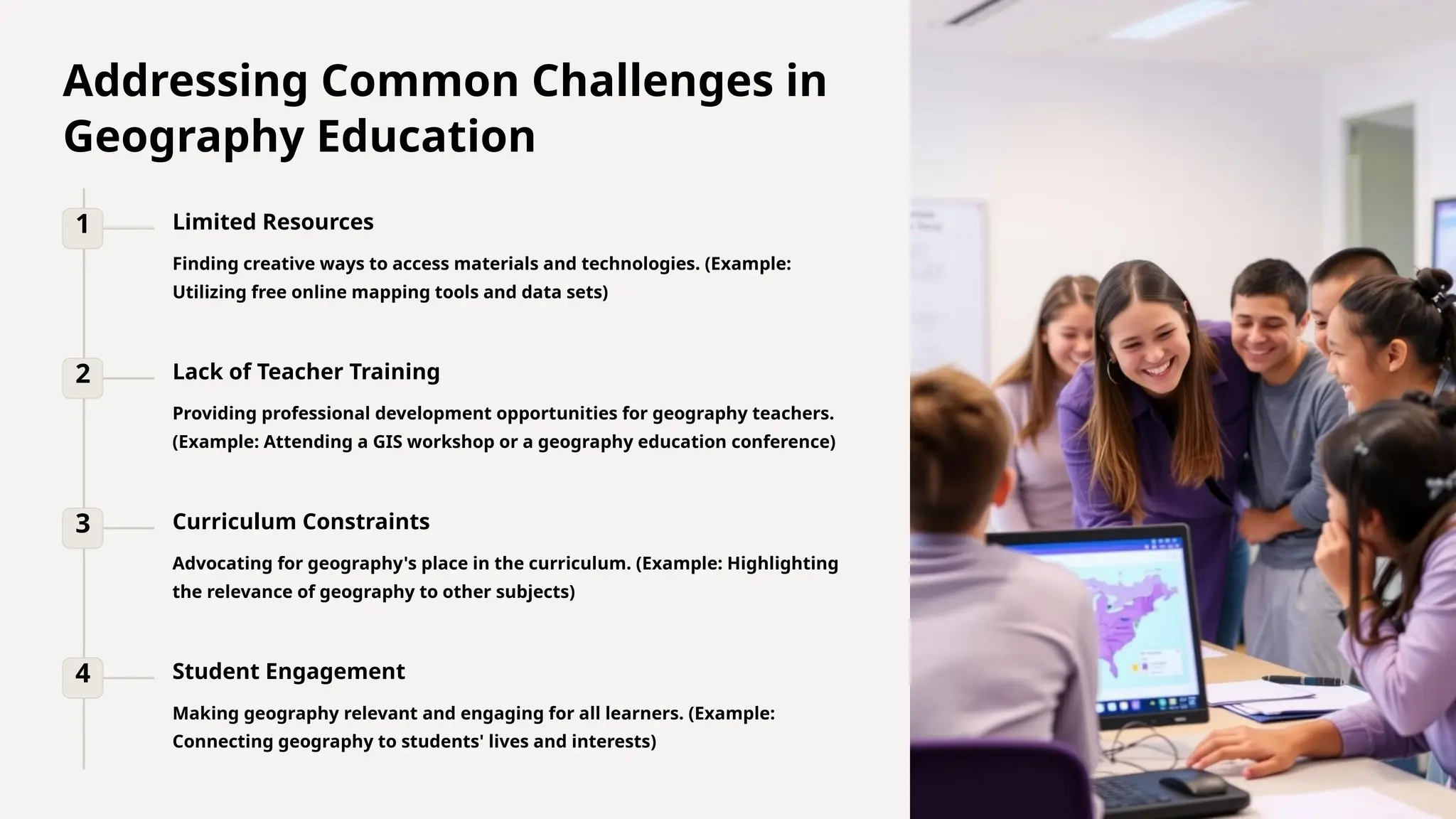
Addressing Common Challengesin
Geography Education
1 Limited Resources
Finding creative ways to access materials and technologies. (Example:
Utilizing free online mapping tools and data sets)
2 Lack of Teacher Training
Providing professional development opportunities for geography teachers.
(Example: Attending a GIS workshop or a geography education conference)
3 Curriculum Constraints
Advocating for geography's place in the curriculum. (Example: Highlighting
the relevance of geography to other subjects)
4 Student Engagement
Making geography relevant and engaging for all learners. (Example:
Connecting geography to students' lives and interests)
11.
"Exploring Geography Teachingand Curriculum" aims to develop effective educational
approaches to geography, ensuring that students not only acquire knowledge about the
world but also develop the skills needed to engage with and address the challenges facing
the planet.