Learning Objectives
By theend of this lesson, you will:
1. Get to know ourselves
2. Understand what Geography is.
3. Connect Geography to real life through
personal experiences.
4. Learn the difference between Physical &
Human Geography.
5. Test our knowledge
3.
Activity 1: WhereHave You Been?
• Name a place you have visited or want
to visit?
• How did you get there? (Car, plane,
train?)
• What was the weather like? (Hot, cold,
rainy?)
• What did you see? (Mountains, rivers,
cities?)
4.
Activity 2: Happeningsin My Daily Life
• What’s the weather like
today?
• How do you get to school
or countryside?
• What do you eat that
comes from another
country?
WHICH ONE DOYOU USE IN REAL LIFE?
• https://weather.com/maps/currentusweather
9.
Therefore, we wereright to
say that:
1. A weather map
2. Visual representation of a
public transport system/A
bus route
3. A bustling marketplace
with local and exotic fruits.
Weather Map Physical
→(things)/
Geography & Climate
A weather map shows temperature, rainfall, storms, and
wind patterns across regions.
Our (Geography) Connections:
– Helps us understand climate (e.g., why some places
are hot, cold, rainy, or dry).
– Explains natural disasters (e.g., hurricanes,
droughts, floods).
– Used in daily life (e.g., deciding what to wear, travel
plans, farming).
💡 Example: Have you ever checked the weather before
going outside?
Has the weather ever influenced your outfit? That’s
Geography!
12.
Bus Route Human
→(Activities)/
Geography & Transport
A bus route is a map showing roads, stops, and
travel directions in a city or town.
Our (Geography) Connection:
– Part of Human Geography (how people move
and use space).
– Shows urban planning (how cities are
designed for transport).
– Helps with map reading skills (knowing
directions, distances).
💡 Example: When you take a bus to school, the
available routes help to plan the best roads and
stops . That’s Geography!
13.
Fruit Market EconomicGeography
→
& Trade
A fruit market sells food grown in different regions
and transported globally.
Our (Geography) Connections:
– Explains where food comes from (bananas from
Ecuador, oranges from Spain, rice from China).
– Shows global trade (how food is
imported/exported).
– Links to climate and agriculture (why certain
crops grow in warm or cold places).
💡 Example: Have you ever eaten a fruit that doesn’t
grow in your country? The fruit market (Geography)
helps to bring food from all over the world!
14.
What if theseactivities and many more can’t be undertaken?
OR
What If Geography Didn’t Exist?
• No weather forecasts = No storm
warnings!
• No maps = People would get lost!
• No transport planning = Traffic chaos!
15.
Understanding Geography
Geography isthe study of the Earth,
land, people, and places.
OR
The study of the Earth’s landscapes,
people, places, and their
interactions(Activities that emerge),
to impact our daily human
experiences.
16.
Physical vs. HumanGeography
Physical Geography: Physical
geography examines natural
features like mountains and rivers,
weather showcasing Earth's physical
environment interactions.
Human Geography: Human
geography focuses on cultural
landscapes, population distribution,
Cities, jobs, cultures and urban
17.
IMPORTANCE GEOGRAPHY INEVERYDAY
LIFE
1. Promotes Critical thinking
It enhances our critical thinking by connecting
our individual experiences to global
geographical contexts.
2. Understanding the Environment
Geography teaches us about different
landforms, weather patterns, and ecosystems.
It helps us to understand natural disasters like
earthquakes, hurricanes, and floods and
prepare us to stay safe.
18.
3. Navigational Skills
Teachesus to know how to read maps, use
a compass, and understand GPS systems
helps us find route and locations easily.
It improves our ability to travel and explore
new places with confidence.
4. Climate and Weather Awareness
Helps us to understand daily weather
patterns and seasons. It guides us in
making decisions like what to wear or when
to carry an umbrella.
19.
5. Cultural Awarenessand Global
Connections
Teaches us about different countries, cultures,
and traditions.
This promotes respect for people from diverse
backgrounds and helps us understand global
events.
6. Economic Importance
Teaches us about how geography affects
businesses, agriculture, and trade. It helps us
to understand why certain crops grow in
specific regions or why some countries are
wealthier than others.
20.
7. Disaster Preparedness
Ithelps us understand how to respond to natural
hazards like floods, tsunamis, and droughts. It
encourages sustainable practices to reduce human
impact on the environment.
5. Natural Resource Management
Geography helps us to understand where resources
like water, minerals, and forests come from. It
encourages us to embark on the responsible use of
natural resources and awareness of environmental
issues like deforestation and pollution.
8. Career Opportunities
Geography opens doors to careers in urban planning,
environmental science, education, tourism, and
meteorology and many more. It helps students
develop skills like research, critical thinking, and
21.
Recall & Reproduction(Basic Understanding)
1. What is the main difference between Physical Geography and
Human Geography?
A) Physical Geography studies the natural world, while Human
Geography studies people and places.
B) Physical Geography is only about weather, while Human
Geography is only about maps.
C) Human Geography studies mountains and rivers, while Physical
Geography studies cultures.
D) There is no difference between Physical and Human Geography.
2. Which of the following is an example of Human Geography?
A) A volcano erupting
B) A river flowing into the ocean
C) A busy city with roads and buildings
D) A rainforest with many animals
3. What do we use a compass for in Geography?
A) To measure temperature
B) To find directions
C) To measure distance on a map
D) To predict the weather
22.
Skills & Concepts(Applying Knowledge)
4. How does climate affect the type of houses people build?
A) It does not affect housing at all.
B) People in hot climates build houses with thick walls to keep heat
inside.
C) People in very cold climates may build houses with insulation to
keep warm.
D) Climate only affects the color of houses, not their structure.
5. If a country is landlocked (surrounded by land), which of the
following is most likely to be true?
A) It has many beaches for tourists.
B) It depends on neighboring countries for sea trade.
C) It has no rivers or lakes.
D) It has the world's largest ocean.
6. What is one way Geography helps people plan for natural disasters?
A) It helps predict where earthquakes, floods, and hurricanes might
happen.
B) It helps change the direction of hurricanes.
C) It can stop earthquakes from happening.
D) It tells people exactly what day a volcano will erupt.
23.
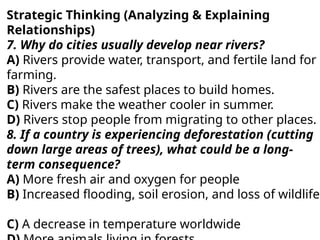
Strategic Thinking (Analyzing& Explaining
Relationships)
7. Why do cities usually develop near rivers?
A) Rivers provide water, transport, and fertile land for
farming.
B) Rivers are the safest places to build homes.
C) Rivers make the weather cooler in summer.
D) Rivers stop people from migrating to other places.
8. If a country is experiencing deforestation (cutting
down large areas of trees), what could be a long-
term consequence?
A) More fresh air and oxygen for people
B) Increased flooding, soil erosion, and loss of wildlife
C) A decrease in temperature worldwide
24.
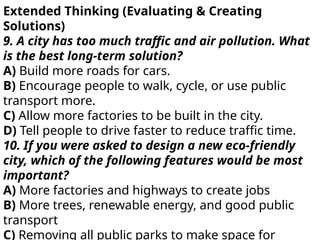
Extended Thinking (Evaluating& Creating
Solutions)
9. A city has too much traffic and air pollution. What
is the best long-term solution?
A) Build more roads for cars.
B) Encourage people to walk, cycle, or use public
transport more.
C) Allow more factories to be built in the city.
D) Tell people to drive faster to reduce traffic time.
10. If you were asked to design a new eco-friendly
city, which of the following features would be most
important?
A) More factories and highways to create jobs
B) More trees, renewable energy, and good public
transport
C) Removing all public parks to make space for
25.
Answers
Recall & Reproduction(Basic Understanding)
1. What is the main difference between Physical Geography and Human Geography?
A) Physical Geography studies the natural world, while Human Geography studies people and places.
2. Which of the following is an example of Human Geography?
C) A busy city with roads and buildings
3. What do we use a compass for in Geography?
B) To find directions
Skills & Concepts (Applying Knowledge)
4. How does climate affect the type of houses people build?
C) People in very cold climates may build houses with insulation to keep warm.
5. If a country is landlocked (surrounded by land), which of the following is most likely to be true?
B) It depends on neighboring countries for sea trade.
6. What is one way Geography helps people plan for natural disasters?
A) It helps predict where earthquakes, floods, and hurricanes might happen.
Strategic Thinking (Analyzing & Explaining Relationships)
7. Why do cities usually develop near rivers?
A) Rivers provide water, transport, and fertile land for farming.
8. If a country is experiencing deforestation (cutting down large areas of trees), what could be a long-term
consequence?
B) Increased flooding, soil erosion, and loss of wildlife.
Extended Thinking (Evaluating & Creating Solutions)
9. A city has too much traffic and air pollution. What is the best long-term solution?
B) Encourage people to walk, cycle, or use public transport more.
10. If you were asked to design a new eco-friendly city, which of the following features would be most
important?
B) More trees, renewable energy, and good public transport.
26.
Homework Challenge
1. Drawand label a simple world
map.
2. Find 3 fun Geography facts.
3. Research one country and its
climate.
Instruction: Choose any one question
27.
Thank You &Next Lesson!
• Next Topic: The Continents & Oceans
• Keep exploring Geography!