CULTURE AND
GEOGRAPHY
Topic contents:
• Overview of Culture and Geography
• Teaching Culture and Geography in
Elementary Grades
Overview of
Culture and Geography
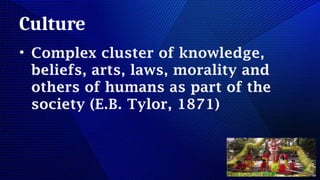
Culture
• Complex cluster of knowledge,
beliefs, arts, laws, morality and
others of humans as part of the
society (E.B. Tylor, 1871)
Functions of Culture:
• act as a physical and social survival mechanism
for humans
• helps people to adapt the demands of
environment
• compensates for some limitations of humans
• helps understanding of different aspects of
human behavior
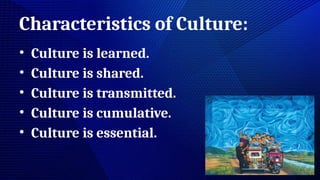
Characteristics of Culture:
• Culture is learned.
• Culture is shared.
• Culture is transmitted.
• Culture is cumulative.
• Culture is essential.
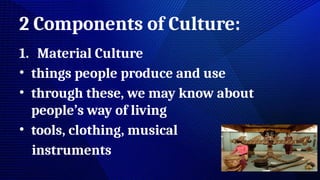
2 Components of Culture:
1. Material Culture
• things people produce and use
• through these, we may know about
people’s way of living
• tools, clothing, musical
instruments
2. Non-material Culture
Consists of:
• Norms- patterns of behavior
• Folkways- customary rules of conduct
• Laws- created and systematized rules
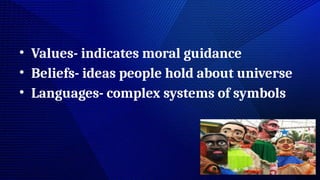
• Values- indicates moral guidance
• Beliefs- ideas people hold about universe
• Languages- complex systems of symbols
Geography
• study of places and the relationships between
people and their environments
• comes from Greek words “geo” means Earth
and “graphia” means writing
• It deals with the space and the content of the
space through Local Ecological Knowledge
(Livelihood dynamics).
Geography
Scopes:
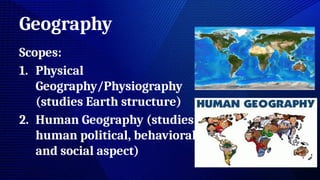
1. Physical
Geography/Physiography
(studies Earth structure)
2. Human Geography (studies
human political, behavioral
and social aspect)
Geography
Scopes:
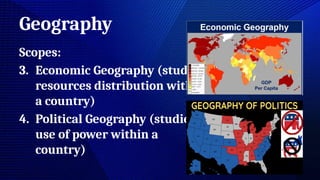
3. Economic Geography (studies
resources distribution within
a country)
4. Political Geography (studies
use of power within a
country)
Geography
Scopes:
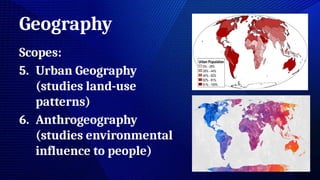
5. Urban Geography
(studies land-use
patterns)
6. Anthrogeography
(studies environmental
influence to people)
Geography
Scopes:
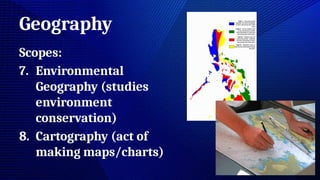
7. Environmental
Geography (studies
environment
conservation)
8. Cartography (act of
making maps/charts)
Teaching Culture and
Geography in Elementary
Grades
Four Main Phases in development of understanding
Culture and Geography
1. Focus on different types of teachers
2. Focus on the context of teaching
3. Focus on teaching-learning reflecting
a shift away from “transmission-
reception” models
4. Offer more complex and complicated
models
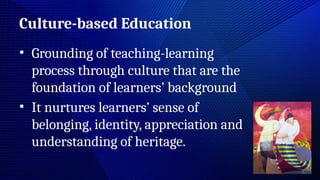
Culture-based Education
• Grounding of teaching-learning
process through culture that are the
foundation of learners’ background
• It nurtures learners’ sense of
belonging, identity, appreciation and
understanding of heritage.
Elements of Culture-based Education:
1. Language: recognizing and using native language.
2. Family and community: involving them in the development of
curricula, everyday learning, and leadership.
3. Context: structuring the school and the classroom in culturally-
appropriate ways.
4. Content: making learning meaningful and relevant through
culturally grounded content and assessment.
5. Data and accountability: gathering and maintaining data using
various methods to insure student progress in culturally
responsible ways
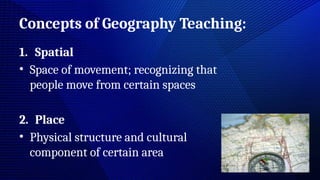
Concepts of Geography Teaching:
1. Spatial
• Space of movement; recognizing that
people move from certain spaces
2. Place
• Physical structure and cultural
component of certain area
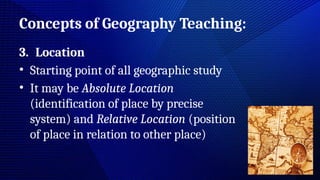
Concepts of Geography Teaching:
3. Location
• Starting point of all geographic study
• It may be Absolute Location
(identification of place by precise
system) and Relative Location (position
of place in relation to other place)
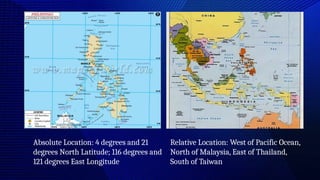
Absolute Location: 4 degrees and 21
degrees North Latitude; 116 degrees and
121 degrees East Longitude
Relative Location: West of Pacific Ocean,
North of Malaysia, East of Thailand,
South of Taiwan
Concepts of Geography Teaching:
4. Direction
• Second universal spatial concept
• It may be Absolute Direction (based
on cardinal points) and Relative
Direction (based on how we
understand maps)
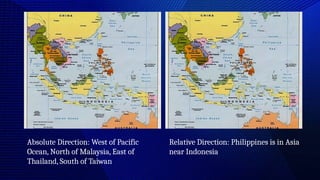
Absolute Direction: West of Pacific
Ocean, North of Malaysia, East of
Thailand, South of Taiwan
Relative Direction: Philippines is in Asia
near Indonesia
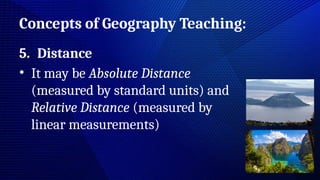
Concepts of Geography Teaching:
5. Distance
• It may be Absolute Distance
(measured by standard units) and
Relative Distance (measured by
linear measurements)
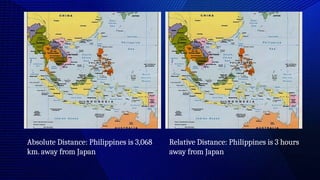
Absolute Distance: Philippines is 3,068
km. away from Japan
Relative Distance: Philippines is 3 hours
away from Japan
Concepts of Geography Teaching:
6. Landscape
• Physical and cultural attributes that
distinguish one place to other
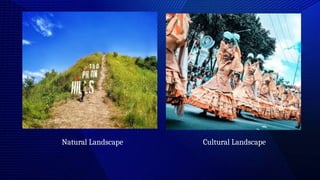
• It may be Natural Landscape (based
on setting) and Cultural Landscape
(based on visible expression)
Natural Landscape Cultural Landscape
Methods of teaching Culture and Geography in
Elementary Grades:
• Observation Method (e.g., fieldtrips, recording)
• Project Method (e.g., exhibits, stage play,
creating models)
• Regional Method (e.g., natural environment,
human adaptation, cultural base)
• ICT Method (e.g., statistical data, viewpoints)
Thank you!
Yosef Eric C. Hipolito, LPT, MAED, MED
Historian, Philippine Historical Association
yoseferichipolito19@gmail.com

Teaching Social Studies in Elementary grades

  • 1.
  • 2.
    Topic contents: • Overviewof Culture and Geography • Teaching Culture and Geography in Elementary Grades
  • 3.
  • 4.
    Culture • Complex clusterof knowledge, beliefs, arts, laws, morality and others of humans as part of the society (E.B. Tylor, 1871)
  • 5.
    Functions of Culture: •act as a physical and social survival mechanism for humans • helps people to adapt the demands of environment • compensates for some limitations of humans • helps understanding of different aspects of human behavior
  • 6.
    Characteristics of Culture: •Culture is learned. • Culture is shared. • Culture is transmitted. • Culture is cumulative. • Culture is essential.
  • 7.
    2 Components ofCulture: 1. Material Culture • things people produce and use • through these, we may know about people’s way of living • tools, clothing, musical instruments
  • 8.
    2. Non-material Culture Consistsof: • Norms- patterns of behavior • Folkways- customary rules of conduct • Laws- created and systematized rules
  • 9.
    • Values- indicatesmoral guidance • Beliefs- ideas people hold about universe • Languages- complex systems of symbols
  • 10.
    Geography • study ofplaces and the relationships between people and their environments • comes from Greek words “geo” means Earth and “graphia” means writing • It deals with the space and the content of the space through Local Ecological Knowledge (Livelihood dynamics).
  • 11.
    Geography Scopes: 1. Physical Geography/Physiography (studies Earthstructure) 2. Human Geography (studies human political, behavioral and social aspect)
  • 12.
    Geography Scopes: 3. Economic Geography(studies resources distribution within a country) 4. Political Geography (studies use of power within a country)
  • 13.
    Geography Scopes: 5. Urban Geography (studiesland-use patterns) 6. Anthrogeography (studies environmental influence to people)
  • 14.
  • 15.
    Teaching Culture and Geographyin Elementary Grades
  • 16.
    Four Main Phasesin development of understanding Culture and Geography 1. Focus on different types of teachers 2. Focus on the context of teaching 3. Focus on teaching-learning reflecting a shift away from “transmission- reception” models 4. Offer more complex and complicated models
  • 17.
    Culture-based Education • Groundingof teaching-learning process through culture that are the foundation of learners’ background • It nurtures learners’ sense of belonging, identity, appreciation and understanding of heritage.
  • 18.
    Elements of Culture-basedEducation: 1. Language: recognizing and using native language. 2. Family and community: involving them in the development of curricula, everyday learning, and leadership. 3. Context: structuring the school and the classroom in culturally- appropriate ways. 4. Content: making learning meaningful and relevant through culturally grounded content and assessment. 5. Data and accountability: gathering and maintaining data using various methods to insure student progress in culturally responsible ways
  • 19.
    Concepts of GeographyTeaching: 1. Spatial • Space of movement; recognizing that people move from certain spaces 2. Place • Physical structure and cultural component of certain area
  • 20.
    Concepts of GeographyTeaching: 3. Location • Starting point of all geographic study • It may be Absolute Location (identification of place by precise system) and Relative Location (position of place in relation to other place)
  • 21.
    Absolute Location: 4degrees and 21 degrees North Latitude; 116 degrees and 121 degrees East Longitude Relative Location: West of Pacific Ocean, North of Malaysia, East of Thailand, South of Taiwan
  • 22.
    Concepts of GeographyTeaching: 4. Direction • Second universal spatial concept • It may be Absolute Direction (based on cardinal points) and Relative Direction (based on how we understand maps)
  • 23.
    Absolute Direction: Westof Pacific Ocean, North of Malaysia, East of Thailand, South of Taiwan Relative Direction: Philippines is in Asia near Indonesia
  • 24.
    Concepts of GeographyTeaching: 5. Distance • It may be Absolute Distance (measured by standard units) and Relative Distance (measured by linear measurements)
  • 25.
    Absolute Distance: Philippinesis 3,068 km. away from Japan Relative Distance: Philippines is 3 hours away from Japan
  • 26.
    Concepts of GeographyTeaching: 6. Landscape • Physical and cultural attributes that distinguish one place to other • It may be Natural Landscape (based on setting) and Cultural Landscape (based on visible expression)
  • 27.
  • 28.
    Methods of teachingCulture and Geography in Elementary Grades: • Observation Method (e.g., fieldtrips, recording) • Project Method (e.g., exhibits, stage play, creating models) • Regional Method (e.g., natural environment, human adaptation, cultural base) • ICT Method (e.g., statistical data, viewpoints)
  • 29.
    Thank you! Yosef EricC. Hipolito, LPT, MAED, MED Historian, Philippine Historical Association yoseferichipolito19@gmail.com