Introduction to
Geography
Geography is the study of our planet, its landscapes, people, places, and
environments. In this presentation, we will explore all the fascinating
aspects of geography.
ZK by Zaigham Kamal
Definitions
Physical Geography
The study of natural landscapes, such as mountains,
forests, oceans, and their interactions with the
atmosphere, hydrosphere, and biosphere.
Human Geography
The study of human societies, cultures, and their
interactions with the environment, including urban areas,
regional development, population, and globalization.
Geographic Information Systems (GIS)
Tools and technology used to capture, store, analyze, and
display geographic data, such as maps, satellite imagery,
and geographic databases.
Cartography
The art and science of mapmaking, including the visual
representation of geographic data, such as symbols,
scales, and projections.
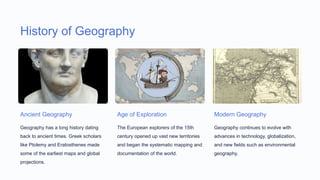
History of Geography
Ancient Geography
Geography has a long history dating
back to ancient times. Greek scholars
like Ptolemy and Eratosthenes made
some of the earliest maps and global
projections.
Age of Exploration
The European explorers of the 15th
century opened up vast new territories
and began the systematic mapping and
documentation of the world.
Modern Geography
Geography continues to evolve with
advances in technology, globalization,
and new fields such as environmental
geography.
Physical Geography
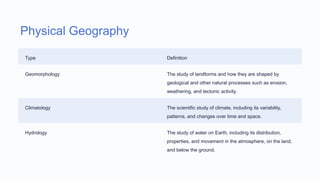
Type Definition
Geomorphology The study of landforms and how they are shaped by
geological and other natural processes such as erosion,
weathering, and tectonic activity.
Climatology The scientific study of climate, including its variability,
patterns, and changes over time and space.
Hydrology The study of water on Earth, including its distribution,
properties, and movement in the atmosphere, on the land,
and below the ground.
Human Geography
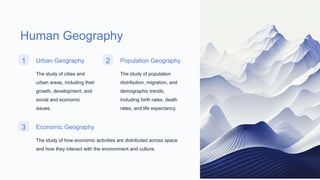
1 Urban Geography
The study of cities and
urban areas, including their
growth, development, and
social and economic
issues.
2 Population Geography
The study of population
distribution, migration, and
demographic trends,
including birth rates, death
rates, and life expectancy.
3 Economic Geography
The study of how economic activities are distributed across space
and how they interact with the environment and culture.
Geographic Tools and Technology
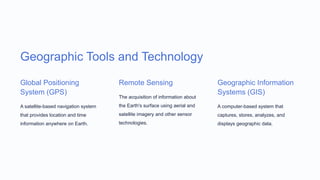
Global Positioning
System (GPS)
A satellite-based navigation system
that provides location and time
information anywhere on Earth.
Remote Sensing
The acquisition of information about
the Earth's surface using aerial and
satellite imagery and other sensor
technologies.
Geographic Information
Systems (GIS)
A computer-based system that
captures, stores, analyzes, and
displays geographic data.
Careers in Geography
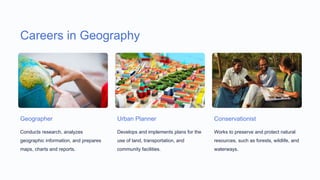
Geographer
Conducts research, analyzes
geographic information, and prepares
maps, charts and reports.
Urban Planner
Develops and implements plans for the
use of land, transportation, and
community facilities.
Conservationist
Works to preserve and protect natural
resources, such as forests, wildlife, and
waterways.
Why Study Geography?
Global Awareness
Geography helps us understand the
interconnected nature of our planet
and the diverse cultures,
economies, and environments
within it.
Career Opportunities
Geography provides valuable skills
and knowledge for a variety of
careers in fields such as
environmental management, urban
planning, and international
business.
Critical Thinking
Geography teaches us to think
critically about complex issues,
such as climate change, political
conflict, and inequality, and to
develop solutions based on
evidence and analysis.
Conclusion
1 Geography Matters
Geography is a fundamental discipline that helps us make sense
of the world we live in and find solutions to the challenges that
face us.
2 Explore More
There is so much more to learn about geography, from the beauty
of remote landscapes to the complexities of global issues. Keep
exploring!

Introduction to Geography

  • 1.
    Introduction to Geography Geography isthe study of our planet, its landscapes, people, places, and environments. In this presentation, we will explore all the fascinating aspects of geography. ZK by Zaigham Kamal
  • 2.
    Definitions Physical Geography The studyof natural landscapes, such as mountains, forests, oceans, and their interactions with the atmosphere, hydrosphere, and biosphere. Human Geography The study of human societies, cultures, and their interactions with the environment, including urban areas, regional development, population, and globalization. Geographic Information Systems (GIS) Tools and technology used to capture, store, analyze, and display geographic data, such as maps, satellite imagery, and geographic databases. Cartography The art and science of mapmaking, including the visual representation of geographic data, such as symbols, scales, and projections.
  • 3.
    History of Geography AncientGeography Geography has a long history dating back to ancient times. Greek scholars like Ptolemy and Eratosthenes made some of the earliest maps and global projections. Age of Exploration The European explorers of the 15th century opened up vast new territories and began the systematic mapping and documentation of the world. Modern Geography Geography continues to evolve with advances in technology, globalization, and new fields such as environmental geography.
  • 4.
    Physical Geography Type Definition GeomorphologyThe study of landforms and how they are shaped by geological and other natural processes such as erosion, weathering, and tectonic activity. Climatology The scientific study of climate, including its variability, patterns, and changes over time and space. Hydrology The study of water on Earth, including its distribution, properties, and movement in the atmosphere, on the land, and below the ground.
  • 5.
    Human Geography 1 UrbanGeography The study of cities and urban areas, including their growth, development, and social and economic issues. 2 Population Geography The study of population distribution, migration, and demographic trends, including birth rates, death rates, and life expectancy. 3 Economic Geography The study of how economic activities are distributed across space and how they interact with the environment and culture.
  • 6.
    Geographic Tools andTechnology Global Positioning System (GPS) A satellite-based navigation system that provides location and time information anywhere on Earth. Remote Sensing The acquisition of information about the Earth's surface using aerial and satellite imagery and other sensor technologies. Geographic Information Systems (GIS) A computer-based system that captures, stores, analyzes, and displays geographic data.
  • 7.
    Careers in Geography Geographer Conductsresearch, analyzes geographic information, and prepares maps, charts and reports. Urban Planner Develops and implements plans for the use of land, transportation, and community facilities. Conservationist Works to preserve and protect natural resources, such as forests, wildlife, and waterways.
  • 8.
    Why Study Geography? GlobalAwareness Geography helps us understand the interconnected nature of our planet and the diverse cultures, economies, and environments within it. Career Opportunities Geography provides valuable skills and knowledge for a variety of careers in fields such as environmental management, urban planning, and international business. Critical Thinking Geography teaches us to think critically about complex issues, such as climate change, political conflict, and inequality, and to develop solutions based on evidence and analysis.
  • 9.
    Conclusion 1 Geography Matters Geographyis a fundamental discipline that helps us make sense of the world we live in and find solutions to the challenges that face us. 2 Explore More There is so much more to learn about geography, from the beauty of remote landscapes to the complexities of global issues. Keep exploring!