Adding Real-time
Features to PHP
Applications
About me
@ronnylt
Ronny López
Technical Lead
Opinions are my own
Agenda
• Concepts and foundations
• Real-time communication patterns
• Implementations
• Examples
Real-time
A system is said to be real-time if the total
correctness of an operation depends not only upon
its logical correctness, but also upon the time in
which it is performed
Real-time
Applications must guarantee response within
specified time constraints, often referred to as
“deadlines”
Real-time
Applications in which the computer must
respond as rapidly as required by the user
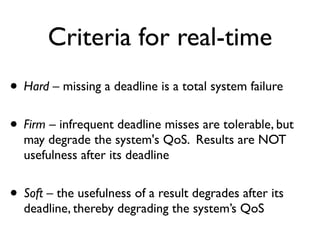
Criteria for real-time
• Hard – missing a deadline is a total system failure

• Firm – infrequent deadline misses are tolerable, but
may degrade the system's QoS. Results are NOT
usefulness after its deadline

• Soft – the usefulness of a result degrades after its
deadline, thereby degrading the system’s QoS
Real-time
Soft real-time
Soft real-time
Typically used to solve issues of concurrent
access and the need to keep a number of
connected systems up-to-date through
changing situations
Soft real-time use cases
• Live audio-video systems
• Users collaboration
• Messaging applications, etc…
• Real-time analytics
• Gaming
• Etc…
The road to 500 million
Symfony downloads
https://symfony.com/500million
Why adding a soft

real-time feature?
• To improve end-user experience
• Due to insufficient scaling capacity
Real-time
Communication on the
Web
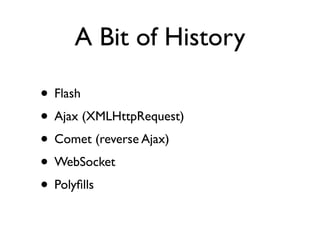
A Bit of History
• Flash
• Ajax (XMLHttpRequest)
• Comet (reverse Ajax)
• WebSocket
• Polyfills
The Modern Web
• WebSockets
• HTTP/2
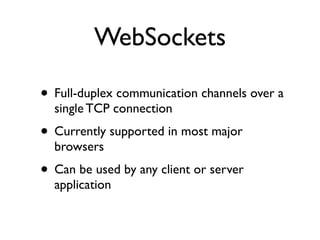
WebSockets
• Full-duplex communication channels over a
single TCP connection
• Currently supported in most major
browsers
• Can be used by any client or server
application
HTTP/2
• Major revision of the HTTP
• Replacement for how HTTP is expressed
“on the wire”
• Focus on performance, end-user perceived
latency, network and server resource usage
The Mobile Internet
• Inestable connections
• HTTP & TCP slow-start are usually not a
good match for constantly dropped
connections
• Network interface kills battery
• Large responses + periodic polling = bad
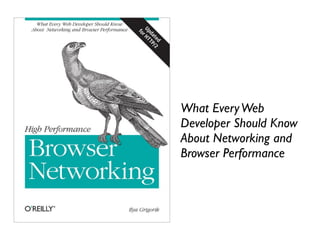
What EveryWeb
Developer Should Know
About Networking and
Browser Performance
Real-time
Communication
Patterns
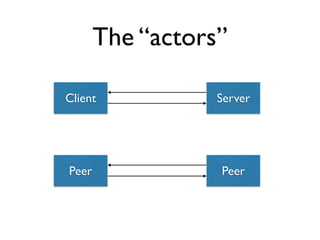
The “actors”
Client Server
Peer Peer
Basic Patterns
• Remote Procedure Call (RPC)
• PUB/SUB
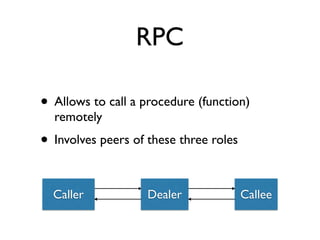
RPC
• Allows to call a procedure (function)
remotely
• Involves peers of these three roles
Caller CalleeDealer
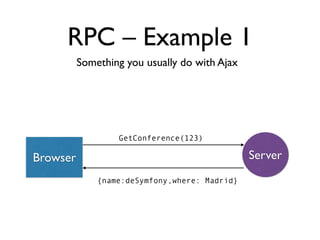
RPC – Example 1
Something you usually do with Ajax
Browser Server
GetConference(123)
{name:deSymfony,where: Madrid}
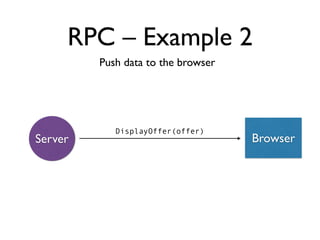
RPC – Example 2
Push data to the browser
BrowserServer
DisplayOffer(offer)
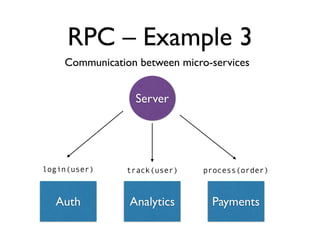
RPC – Example 3
Communication between micro-services
Auth
Server
login(user)
Analytics Payments
track(user) process(order)
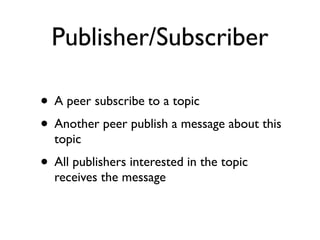
Publisher/Subscriber
• A peer subscribe to a topic
• Another peer publish a message about this
topic
• All publishers interested in the topic
receives the message
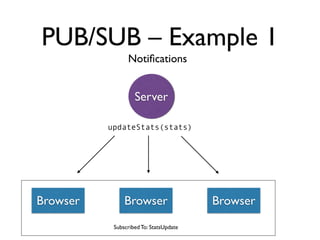
PUB/SUB – Example 1
Notifications
Browser
Server
updateStats(stats)
Browser Browser
Subscribed To: StatsUpdate
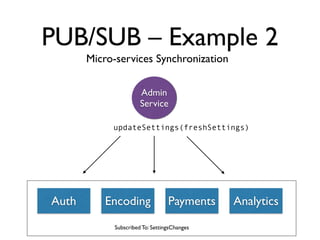
PUB/SUB – Example 2
Micro-services Synchronization
Auth
Admin
Service
updateSettings(freshSettings)
Encoding Payments
Subscribed To: SettingsChanges
Analytics
Web Application Messaging Protocol

http://wamp-proto.org/
Not to be confused with WAMP:
”Windows + Apache + MySQL + PHP"
WAMP
• Open standard WebSocket subprotocol
• Provides two application messaging
patterns in one unified protocol
• Remote Procedure Calls
• Publish & Subscribe
WAMP Features
• Enables different technologies, processes,
machines, etc… to communicate with each
other, in soft real-time
WAMP Features
• Based on modern Web standards:
WebSocket, JSON and URIs
• Designed with first-class support for
different languages in mind (Polyglot)
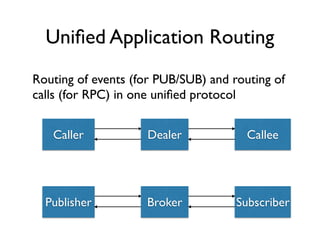
Unified Application Routing
Routing of events (for PUB/SUB) and routing of
calls (for RPC) in one unified protocol
Caller CalleeDealer
Publisher SubscriberBroker
Dealer
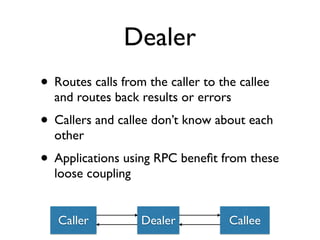
• Routes calls from the caller to the callee
and routes back results or errors
• Callers and callee don’t know about each
other
• Applications using RPC benefit from these
loose coupling
Caller CalleeDealer
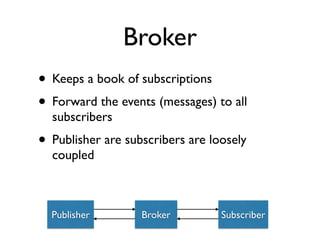
Broker
• Keeps a book of subscriptions
• Forward the events (messages) to all
subscribers
• Publisher are subscribers are loosely
coupled
Publisher SubscriberBroker
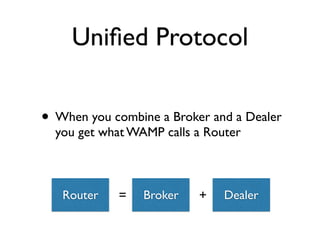
Unified Protocol
• When you combine a Broker and a Dealer
you get what WAMP calls a Router
Router Broker Dealer= +
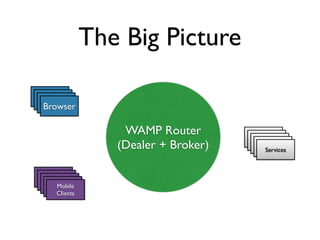
The Big Picture
WAMP Router
(Dealer + Broker)
BrowserBrowserBrowserBrowser
Mobile
Clients
Services
Do we really need
another wheel?
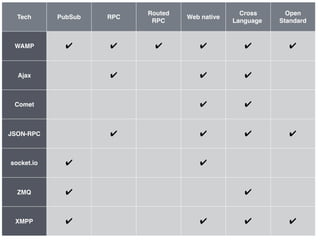
How does WAMMP compare to other technologies
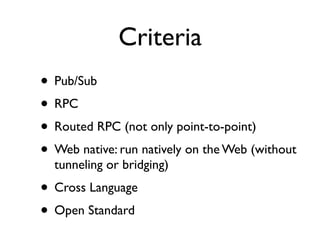
Criteria
• Pub/Sub
• RPC
• Routed RPC (not only point-to-point)
• Web native: run natively on the Web (without
tunneling or bridging)
• Cross Language
• Open Standard
Tech PubSub RPC
Routed
RPC
Web native
Cross
Language
Open
Standard
WAMP ✔ ✔ ✔ ✔ ✔ ✔
Ajax ✔ ✔ ✔
Comet ✔ ✔
JSON-RPC ✔ ✔ ✔ ✔
socket.io ✔ ✔
ZMQ ✔ ✔
XMPP ✔ ✔ ✔ ✔
Implementations
• Client libraries for most popular languages
• Full featured router implementations in
several languages
WAMP Routers
• crossbar.io – Advanced, open-source, full
featured, supported by the creators of
WAMP

• Your own… It’s an open protocol
WAMP Ecosystem
• Thruway – library built in PHP that provides
both a client and a router
• Turnpike – router implemented in Go

• wamp.rt  – router for NodeJS

• Erwa – router implemented in Erlang

Choosing an
implementation
Let’s talk about trade-offs
Is PHP suitable for soft
real-time applications?
Is PHP the right tool
for the job?
No.
No?
Why not?
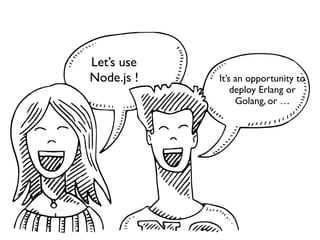
Let’s use
Node.js ! It’s an opportunity to
deploy Erlang or
Golang, or …
Languages War
Conflicts Everywhere
Conflicts everywhere
Trade-offs everywhere
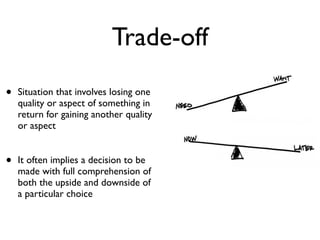
Trade-off
• Situation that involves losing one
quality or aspect of something in
return for gaining another quality
or aspect

• It often implies a decision to be
made with full comprehension of
both the upside and downside of
a particular choice
Is PHP the right tool
for the job?
There is not simple answer
The simpler answer I know is:
“I don’t care”
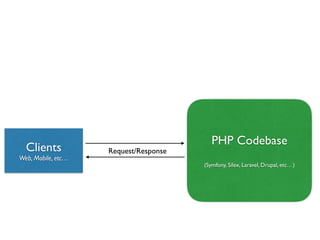
PHP Codebase

(Symfony, Silex, Laravel, Drupal, etc…)
Clients
Web, Mobile, etc…
Request/Response
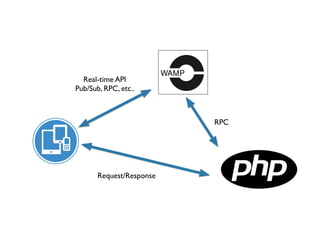
Request/Response
Real-time API

Pub/Sub, RPC, etc..
RPC
• A big ecosystem of thousands of useful
libraries and components easily installable
thanks to Composer
• Very powerful template engines, ORMs,
etc…
• We have implemented very powerful design
patters in PHP coming from Java and other
languages
• We have several thousands of high quality code
running on production
• We have invested multiple hours testing,
refactoring and improving the codebase
It’s here to stay
Remember
Full comprehension of both the upsides and downsides
of a particular choice
Downsides
• We have to introduce a new stack to
provide real-time features
Upsides
• Possibility to introduce real-time features
without deep modifications in the current
codebase
• No need to learn a whole new language/
stack, with the implications it has
• Loosely coupled systems
Upsides cont…
• Opens the door to write reactive, event-
based, distributed architectures
• Scalability is easier to achieve by
distributing messages to multiple systems
Examples
The Stack
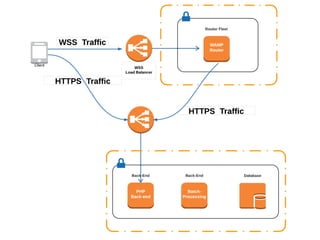
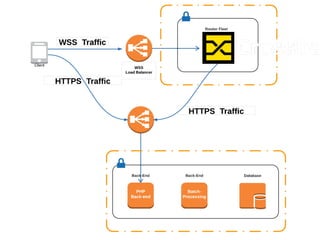
• crossbar.io used as the router (dealer+broker)
• PHP client gathers and publish events
• Silex/Symfony backend serve the data and
contains the biz logic
crossbar.io
• Networking platform for distributed and
micro-services applications
• Full implementation of the WAMP protocol
• Feature rich, scalable, robust and secure
• It takes care of the hard parts of messaging
so you can focus on your app's features
Tips and Tricks
• WSS
• Deadlines
• Timeouts
• Retries with back-off, etc…
• Idempotency
Opinionated
Conclusion
• Understand core concepts and patterns,
technology is volatile
• Question everything: Why?, why not?
• Decide based on several factors: user
experience, scalability, feasibility, developer
experience, maintenance costs/debt, etc…
Don’t Stop Here
• gRPC – A high performance, open-source
universal RPC framework from Google


http://www.grpc.io/

• IoT, WoT, etc… – real world objects
connected to the wider internet
References
• WAMP Proto – http://wamp-proto.org/
• https://github.com/voryx/ThruwayBundle
• https://www.infoq.com/articles/websocket-
and-http2-coexist
Questions
• What about React PHP?
• Multi-Threading in PHP with pthreads?

https://gist.github.com/krakjoe/6437782/
• Micro-services what?
Gracias!
@ronnylt
Work with us!

Adding Real-time Features to PHP Applications