VALUE PROPOSITION 
WIR VERSUS VIRUS ENABLER
MAY 26. 2020
@BENNOLOEWENBERG
Added
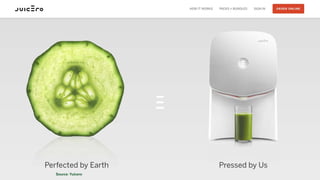
Source: Yuicero
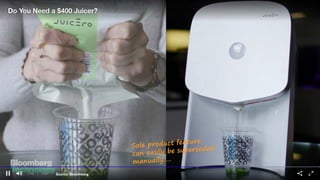
Source: Bloomberg
Sole product feature
can easily be superseded
manually …
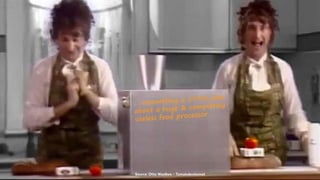
Source: Otto Waalkes – Tomatobrotomat
… resembling a 1970s joke
about a huge & completely
useless food processor
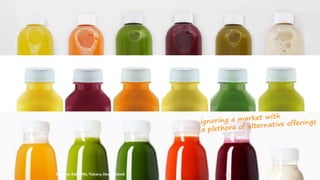
Sources: Kale&Me, Yuicery, Dean&David
ignoring a market with
a plethora of alternative offerings
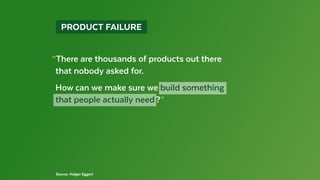
  PRODUCT FAILURE 
Source: Holger Eggert
“There are thousands of products out there
 that nobody asked for.
 How can we make sure we build something
 that people actually need ?”
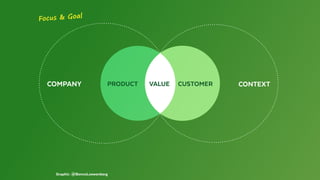
COMPANY CONTEXT
Graphic: @BennoLoewenberg
CUSTOMERPRODUCT VALUE
Focus & Goal
  »TO TEST IF YOUR PRODUCT IS NEEDED, 
	   STUDY THE JOB THAT IT DOES« 
Source: Des Traynor
  VALUE PROPOSITION 
Source: Clayton Christensen
“Think of the Value Proposition as a contract
	 between the customer and your company
	 where the customer ‘hires’ your company
	 to solve a problem.”
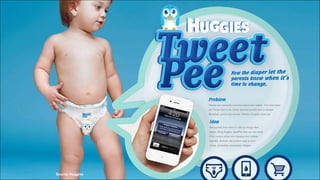
Source: Huggies
Source: Dyhana Scarano
  VAGUE ASSUMPTIONS 
“I’ve experienced this problem, so others must also”
“We’ve already got funding, so it must be a good idea”
“We’re almost ready to launch so it’s a bit late to go back
 to research”
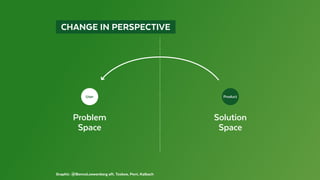
Graphic: @BennoLoewenberg aft. Toxboe, Perri, Kalbach
  CHANGE IN PERSPECTIVE 
ProductUser
Problem
Space
Solution
Space
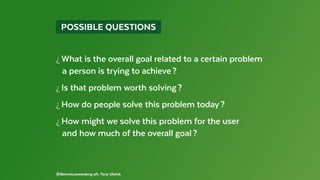
@BennoLoewenberg aft. Tony Ulwick
  POSSIBLE QUESTIONS 
¿ What is the overall goal related to a certain problem
  a person is trying to achieve ?
¿ Is that problem worth solving ?
¿ How do people solve this problem today ?
¿ How might we solve this problem for the user
  and how much of the overall goal ?
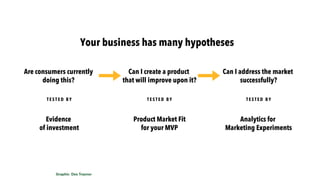
Your business has many hypotheses
Are consumers currently
doing this?
Can I create a product
that will improve upon it?
Can I address the market
successfully?
T E S T E D B Y
Evidence
of investment
T E S T E D B Y
Product Market Fit
for your MVP
Analytics for
Marketing Experiments
T E S T E D B Y
Graphic: Des Traynor
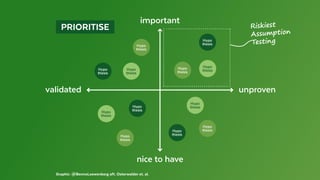
Graphic: @BennoLoewenberg aft. Osterwalder et. al.
 PRIORITISE 
validated unproven
important
nice to have
Hypo
thesisHypo
thesis
Hypo
thesis
Hypo
thesis
Hypo
thesis
Hypo
thesis
Hypo
thesis
Hypo
thesisHypo
thesis
Hypo
thesis
Hypo
thesis
Hypo
thesis
Riskiest
Assumption
Testing
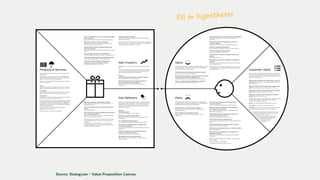
Gain Creators
Describe how your products and services create customer
gains.
How do they create benefits your customer expects, desires
or would be surprised by, including functional utility, social
gains, positive emotions, and cost savings?
Do they…
Create savings that make your customer happy?
(e.g. in terms of time, money and effort, …)
Produce outcomes your customer expects or
that go beyond their expectations?
(e.g. better quality level, more of something, less of
something, …)
Pain Relievers
Copy or outperform current solutions that delight
your customer?
(e.g. regarding specific features, performance, quality, …)
Make your customer’s job or life easier?
(e.g. flatter learning curve, usability, accessibility, more
services, lower cost of ownership, …)
Create positive social consequences that your
customer desires?
(e.g. makes them look good, produces an increase in power,
status, …)
Do something customers are looking for?
(e.g. good design, guarantees, specific or more features, …)
Fulfill something customers are dreaming about?
(e.g. help big achievements, produce big reliefs, …)
Produce positive outcomes matching your
customers success and failure criteria?
(e.g. better performance, lower cost, …)
Help make adoption easier?
(e.g. lower cost, less investments, lower risk, better quality,
performance, design, …)
Rank each gain your products and services create according to
its relevance to your customer. Is it substantial or insignificant?
For each gain indicate how often it occurs.
Describe how your products and services alleviate customer
pains. How do they eliminate or reduce negative emotions,
undesired costs and situations, and risks your customer
experiences or could experience before, during, and after
getting the job done?
Do they…
Produce savings?
(e.g. in terms of time, money, or efforts, …)
Make your customers feel better?
(e.g. kills frustrations, annoyances, things that give them
a headache, …)
Fix underperforming solutions?
(e.g. new features, better performance, better quality, …)
Put an end to difficulties and challenges your
customers encounter?
(e.g. make things easier, helping them get done, eliminate
resistance, …)
Wipe out negative social consequences your
customers encounter or fear?
(e.g. loss of face, power, trust, or status, …)
Eliminate risks your customers fear?
(e.g. financial, social, technical risks, or what could go
awfully wrong, …)
Help your customers better sleep at night?
(e.g. by helping with big issues, diminishing concerns, or
eliminating worries, …)
Limit or eradicate common mistakes customers
make?
(e.g. usage mistakes, …)
Get rid of barriers that are keeping your customer
from adopting solutions?
(e.g. lower or no upfront investment costs, flatter learning
curve, less resistance to change, …)
Rank each pain your products and services kill according
to their intensity for your customer. Is it very intense or
very light?
For each pain indicate how often it occurs. Risks your
customer experiences or could experience before, during,
and after getting the job done?
Products & Services
List all the products and services your value proposition is
built around.
Which products and services do you offer that help your
customer get either a functional, social, or emotional job
done, or help him/her satisfy basic needs?
Which ancillary products and services help your customer
perform the roles of:
Buyer
(e.g. products and services that help customers compare
offers, decide, buy, take delivery of a product or service, …)
Co-creator
(e.g. products and services that help customers co-design
solutions, otherwise contribute value to the solution, …)
Transferrer
(e.g. products and services that help customers dispose of
a product, transfer it to others, or resell, …)
Products and services may either by tangible (e.g. manufac-
tured goods, face-to-face customer service), digital/virtual
(e.g. downloads, online recommendations), intangible (e.g.
copyrights, quality assurance), or financial (e.g. investment
funds, financing services).
Rank all products and services according to their
importance to your customer.
Are they crucial or trivial to your customer?
Gains
Describe the benefits your customer expects, desires or would
be surprised by. This includes functional utility, social gains,
positive emotions, and cost savings.
Which savings would make your customer happy?
(e.g. in terms of time, money and effort, …)
What outcomes does your customer expect and what
would go beyond his/her expectations?
(e.g. quality level, more of something, less of something, …)
How do current solutions delight your customer?
(e.g. specific features, performance, quality, …)
Pains
Customer Job(s)
Describe negative emotions, undesired costs and situations,
and risks that your customer experiences or could experience
before, during, and after getting the job done.
What does your customer find too costly?
(e.g. takes a lot of time, costs too much money, requires
substantial efforts, …)
What makes your customer feel bad?
(e.g. frustrations, annoyances, things that give them a
headache, …)
How are current solutions underperforming
for your customer?
(e.g. lack of features, performance, malfunctioning, …)
What are the main difficulties and challenges
your customer encounters?
(e.g. understanding how things work, difficulties getting
things done, resistance, …)
What negative social consequences does your
customer encounter or fear?
(e.g. loss of face, power, trust, or status, …)
What risks does your customer fear?
(e.g. financial, social, technical risks, or what could go awfully
wrong, …)
What’s keeping your customer awake at night?
(e.g. big issues, concerns, worries, …)
What common mistakes does your customer make?
(e.g. usage mistakes, …)
What barriers are keeping your customer from
adopting solutions?
(e.g. upfront investment costs, learning curve, resistance
to change, …)
Rank each pain according to the intensity it represents for
your customer.
Is it very intense or is it very light.?
For each pain indicate how often it occurs.
Describe what a specific customer segment is trying to get
done. It could be the tasks they are trying to perform and
complete, the problems they are trying to solve, or the needs
they are trying to satisfy.
What functional jobs are you helping your customer
get done? (e.g. perform or complete a specific task, solve a
specific problem, …)
What social jobs are you helping your customer get
done? (e.g. trying to look good, gain power or status, …)
What emotional jobs are you helping your customer
get done? (e.g. esthetics, feel good, security, …)
What basic needs are you helping your customer
satisfy? (e.g. communication, sex, …)
Besides trying to get a core job done, your customer performs
ancillary jobs in different roles. Describe the jobs your
customer is trying to get done as:
Buyer (e.g. trying to look good, gain power or status, …)
Co-creator (e.g. esthetics, feel good, security, …)
Transferrer (e.g. products and services that help customers
dispose of a product, transfer it to others, or resell, …)
Rank each job according to its significance to your
customer. Is it crucial or is it trivial? For each job
indicate how often it occurs.
Outline in which specific context a job
is done, because that may impose
constraints or limitations.
(e.g. while driving,
outside, …)
What would make your customer’s job or life easier?
(e.g. flatter learning curve, more services, lower cost of
ownership, …)
What positive social consequences does your
customer desire?
(e.g. makes them look good, increase in power, status, …)
What are customers looking for?
(e.g. good design, guarantees, specific or more features, …)
What do customers dream about?
(e.g. big achievements, big reliefs, …)
How does your customer measure success and
failure?
(e.g. performance, cost, …)
What would increase the likelihood of adopting a
solution?
(e.g. lower cost, less investments, lower risk, better quality,
performance, design, …)
Rank each gain according to its relevance to your customer.
Is it substantial or is it insignificant? For each gain indicate
how often it occurs.
strategyzer.com
The Value Proposition Canvas
Value Proposition Customer Segment
The makers of Business Model Generation and Strategyzer
Copyright Business Model Foundry AG
Produced by: www.stattys.com
Source: Stategyzer – Value Proposition Canvas
fill in hypotheses
Source: Dyhana Scarano
  TESTABLE HYPOTHESIS 
Based on the insights you observed
Write a statement that is testable [as a prototype]
Make predictions of what you think the outcomes will be
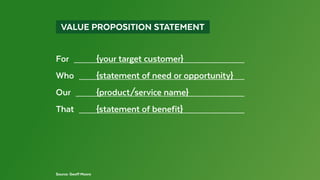
  VALUE PROPOSITION STATEMENT 
Source: Geoff Moore
For  	 {your target customer}	
Who  	 {statement of need or opportunity}	
Our  	 {product/service name}	
That  	 {statement of benefit}
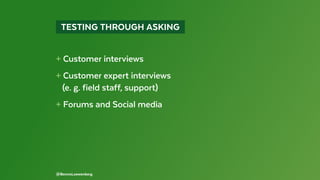
  TESTING THROUGH ASKING 
+ Customer interviews
+ Customer expert interviews
(e. g. field staff, support)
+ Forums and Social media
@BennoLoewenberg
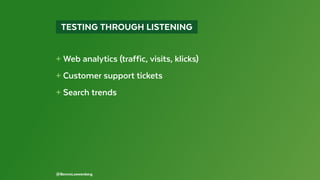
  TESTING THROUGH LISTENING 
+ Web analytics (traffic, visits, klicks)
+ Customer support tickets
+ Search trends
@BennoLoewenberg
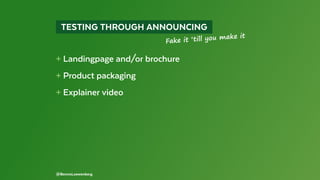
  TESTING THROUGH ANNOUNCING 
+ Landingpage and/or brochure
+ Product packaging
+ Explainer video
@BennoLoewenberg
Fake it ‘till you make it
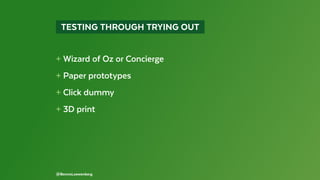
  TESTING THROUGH TRYING OUT 
+ Wizard of Oz or Concierge
+ Paper prototypes
+ Click dummy
+ 3D print
@BennoLoewenberg
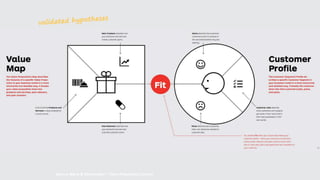
Source: Blank & Osterwalder – Value Proposition Canvas
validated hypotheses
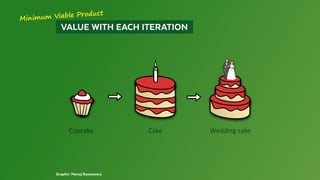
Graphic: Manoj Ranaweera
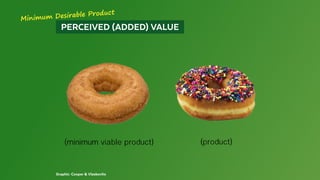
Minimum Viable Product
  VALUE WITH EACH ITERATION 
  PERCEIVED (ADDED) VALUE 
Graphic: Cooper & Vlaskovits
Minimum Desirable Product
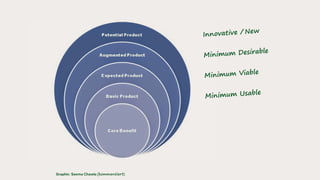
Graphic: Seema Chawla (kommentiert)
Minimum Viable
Minimum Desirable
Minimum Usable
Innovative / New
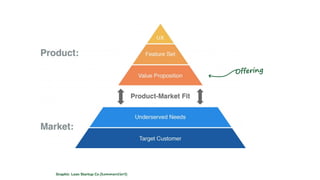
Graphic: Lean Startup Co (kommentiert)
Offering
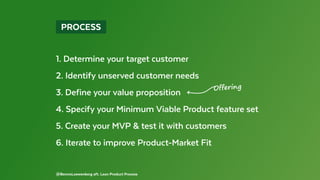
 PROCESS 
@BennoLoewenberg aft. Lean Product Process
1. Determine your target customer
2. Identify unserved customer needs
3. Define your value proposition
4. Specify your Minimum Viable Product feature set
5. Create your MVP & test it with customers
6. Iterate to improve Product-Market Fit
Offering
@BennoLoewenberg
  THE USER PERSPECTIVE COUNTS 
“Talk to your users –
build and test for actual users and for real context of use”
( friends and family are not your users )
  USER PERSPECTIVE 
1. What is this ?
2. Do I trust you ?
3. What are you offering me ?
and if it passed the ›moment of truth‹ positively:
4. How do I get it ?
Source: Seth Godin
  VALUE STATEMENT 
clear, concise, goal-orientated,
trustworthy, sophisticated,
modest
@BennoLoewenberg
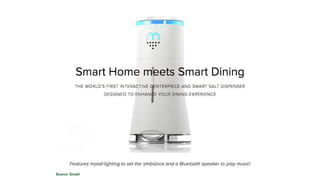
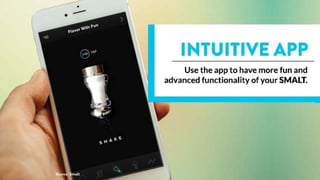
Source: Smalt
Source: Smalt
Sources: Mark Cook & Seth Godin
  DON’T LOVE THE SOLUTION 
“Success is not delivering a feature;
 success is learning how to solve the customers problem”
“Don’t [try to] find customers for your product,
 find a product for your customers.”
What is Customer Jobs? What is a Job to be Done (JTBD)?
A Job to be Done is the process a consumer goes through whenever she evolves
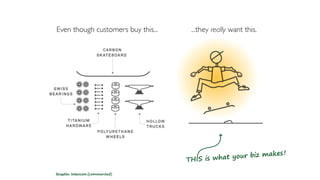
FFIIGGUURREE 55.. TTHHEE DDEESSIIGGNNEERRSS AATT IINNTTEERRCCOOMM ((IINNTTEERRCCOOMM..CCOOMM)) UUSSEE TTHHIISS
IILLLLUUSSTTRRAATTIIOONN TTOO SSHHOOWW WWHHAATT IISS,, AANNDD IISSNN’’TT,, IIMMPPOORRTTAANNTT TTOO CCUUSSTTOOMMEERRSS..
Graphic: Intercom (commented)
THIS is what your biz makes !
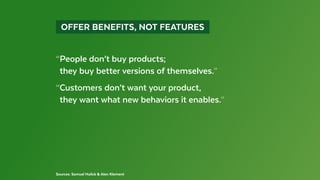
  OFFER BENEFITS, NOT FEATURES 
Sources: Samuel Hulick & Alan Klement
“People don’t buy products;
 they buy better versions of themselves.”
“Customers don’t want your product,
 they want what new behaviors it enables.”
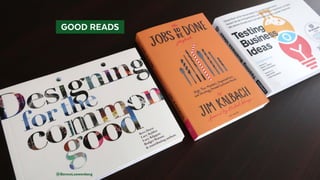
  GOOD READS 
@BennoLoewenberg
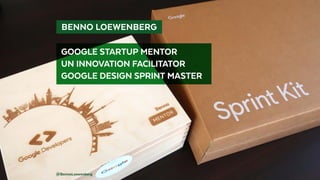
  BENNO LOEWENBERG 
@BennoLoewenberg
GOOGLE STARTUP MENTOR
UN INNOVATION FACILITATOR
GOOGLE DESIGN SPRINT MASTER
  BENNOLOEWENBERG 
 LINKEDIN /  TWITTER
 @

(Added) Value Proposition (english) #WirVsVirus

  • 1.
      VALUE PROPOSITION  WIRVERSUS VIRUS ENABLER MAY 26. 2020 @BENNOLOEWENBERG Added
  • 2.
  • 3.
    Source: Bloomberg Sole productfeature can easily be superseded manually …
  • 4.
    Source: Otto Waalkes– Tomatobrotomat … resembling a 1970s joke about a huge & completely useless food processor
  • 5.
    Sources: Kale&Me, Yuicery,Dean&David ignoring a market with a plethora of alternative offerings
  • 6.
      PRODUCT FAILURE  Source:Holger Eggert “There are thousands of products out there  that nobody asked for.  How can we make sure we build something  that people actually need ?”
  • 7.
  • 8.
      »TO TESTIF YOUR PRODUCT IS NEEDED,    STUDY THE JOB THAT IT DOES«  Source: Des Traynor
  • 9.
      VALUE PROPOSITION  Source:Clayton Christensen “Think of the Value Proposition as a contract between the customer and your company where the customer ‘hires’ your company to solve a problem.”
  • 10.
  • 11.
    Source: Dyhana Scarano  VAGUE ASSUMPTIONS  “I’ve experienced this problem, so others must also” “We’ve already got funding, so it must be a good idea” “We’re almost ready to launch so it’s a bit late to go back  to research”
  • 12.
    Graphic: @BennoLoewenberg aft.Toxboe, Perri, Kalbach   CHANGE IN PERSPECTIVE  ProductUser Problem Space Solution Space
  • 13.
    @BennoLoewenberg aft. TonyUlwick   POSSIBLE QUESTIONS  ¿ What is the overall goal related to a certain problem   a person is trying to achieve ? ¿ Is that problem worth solving ? ¿ How do people solve this problem today ? ¿ How might we solve this problem for the user   and how much of the overall goal ?
  • 14.
    Your business hasmany hypotheses Are consumers currently doing this? Can I create a product that will improve upon it? Can I address the market successfully? T E S T E D B Y Evidence of investment T E S T E D B Y Product Market Fit for your MVP Analytics for Marketing Experiments T E S T E D B Y Graphic: Des Traynor
  • 15.
    Graphic: @BennoLoewenberg aft.Osterwalder et. al.  PRIORITISE  validated unproven important nice to have Hypo thesisHypo thesis Hypo thesis Hypo thesis Hypo thesis Hypo thesis Hypo thesis Hypo thesisHypo thesis Hypo thesis Hypo thesis Hypo thesis Riskiest Assumption Testing
  • 16.
    Gain Creators Describe howyour products and services create customer gains. How do they create benefits your customer expects, desires or would be surprised by, including functional utility, social gains, positive emotions, and cost savings? Do they… Create savings that make your customer happy? (e.g. in terms of time, money and effort, …) Produce outcomes your customer expects or that go beyond their expectations? (e.g. better quality level, more of something, less of something, …) Pain Relievers Copy or outperform current solutions that delight your customer? (e.g. regarding specific features, performance, quality, …) Make your customer’s job or life easier? (e.g. flatter learning curve, usability, accessibility, more services, lower cost of ownership, …) Create positive social consequences that your customer desires? (e.g. makes them look good, produces an increase in power, status, …) Do something customers are looking for? (e.g. good design, guarantees, specific or more features, …) Fulfill something customers are dreaming about? (e.g. help big achievements, produce big reliefs, …) Produce positive outcomes matching your customers success and failure criteria? (e.g. better performance, lower cost, …) Help make adoption easier? (e.g. lower cost, less investments, lower risk, better quality, performance, design, …) Rank each gain your products and services create according to its relevance to your customer. Is it substantial or insignificant? For each gain indicate how often it occurs. Describe how your products and services alleviate customer pains. How do they eliminate or reduce negative emotions, undesired costs and situations, and risks your customer experiences or could experience before, during, and after getting the job done? Do they… Produce savings? (e.g. in terms of time, money, or efforts, …) Make your customers feel better? (e.g. kills frustrations, annoyances, things that give them a headache, …) Fix underperforming solutions? (e.g. new features, better performance, better quality, …) Put an end to difficulties and challenges your customers encounter? (e.g. make things easier, helping them get done, eliminate resistance, …) Wipe out negative social consequences your customers encounter or fear? (e.g. loss of face, power, trust, or status, …) Eliminate risks your customers fear? (e.g. financial, social, technical risks, or what could go awfully wrong, …) Help your customers better sleep at night? (e.g. by helping with big issues, diminishing concerns, or eliminating worries, …) Limit or eradicate common mistakes customers make? (e.g. usage mistakes, …) Get rid of barriers that are keeping your customer from adopting solutions? (e.g. lower or no upfront investment costs, flatter learning curve, less resistance to change, …) Rank each pain your products and services kill according to their intensity for your customer. Is it very intense or very light? For each pain indicate how often it occurs. Risks your customer experiences or could experience before, during, and after getting the job done? Products & Services List all the products and services your value proposition is built around. Which products and services do you offer that help your customer get either a functional, social, or emotional job done, or help him/her satisfy basic needs? Which ancillary products and services help your customer perform the roles of: Buyer (e.g. products and services that help customers compare offers, decide, buy, take delivery of a product or service, …) Co-creator (e.g. products and services that help customers co-design solutions, otherwise contribute value to the solution, …) Transferrer (e.g. products and services that help customers dispose of a product, transfer it to others, or resell, …) Products and services may either by tangible (e.g. manufac- tured goods, face-to-face customer service), digital/virtual (e.g. downloads, online recommendations), intangible (e.g. copyrights, quality assurance), or financial (e.g. investment funds, financing services). Rank all products and services according to their importance to your customer. Are they crucial or trivial to your customer? Gains Describe the benefits your customer expects, desires or would be surprised by. This includes functional utility, social gains, positive emotions, and cost savings. Which savings would make your customer happy? (e.g. in terms of time, money and effort, …) What outcomes does your customer expect and what would go beyond his/her expectations? (e.g. quality level, more of something, less of something, …) How do current solutions delight your customer? (e.g. specific features, performance, quality, …) Pains Customer Job(s) Describe negative emotions, undesired costs and situations, and risks that your customer experiences or could experience before, during, and after getting the job done. What does your customer find too costly? (e.g. takes a lot of time, costs too much money, requires substantial efforts, …) What makes your customer feel bad? (e.g. frustrations, annoyances, things that give them a headache, …) How are current solutions underperforming for your customer? (e.g. lack of features, performance, malfunctioning, …) What are the main difficulties and challenges your customer encounters? (e.g. understanding how things work, difficulties getting things done, resistance, …) What negative social consequences does your customer encounter or fear? (e.g. loss of face, power, trust, or status, …) What risks does your customer fear? (e.g. financial, social, technical risks, or what could go awfully wrong, …) What’s keeping your customer awake at night? (e.g. big issues, concerns, worries, …) What common mistakes does your customer make? (e.g. usage mistakes, …) What barriers are keeping your customer from adopting solutions? (e.g. upfront investment costs, learning curve, resistance to change, …) Rank each pain according to the intensity it represents for your customer. Is it very intense or is it very light.? For each pain indicate how often it occurs. Describe what a specific customer segment is trying to get done. It could be the tasks they are trying to perform and complete, the problems they are trying to solve, or the needs they are trying to satisfy. What functional jobs are you helping your customer get done? (e.g. perform or complete a specific task, solve a specific problem, …) What social jobs are you helping your customer get done? (e.g. trying to look good, gain power or status, …) What emotional jobs are you helping your customer get done? (e.g. esthetics, feel good, security, …) What basic needs are you helping your customer satisfy? (e.g. communication, sex, …) Besides trying to get a core job done, your customer performs ancillary jobs in different roles. Describe the jobs your customer is trying to get done as: Buyer (e.g. trying to look good, gain power or status, …) Co-creator (e.g. esthetics, feel good, security, …) Transferrer (e.g. products and services that help customers dispose of a product, transfer it to others, or resell, …) Rank each job according to its significance to your customer. Is it crucial or is it trivial? For each job indicate how often it occurs. Outline in which specific context a job is done, because that may impose constraints or limitations. (e.g. while driving, outside, …) What would make your customer’s job or life easier? (e.g. flatter learning curve, more services, lower cost of ownership, …) What positive social consequences does your customer desire? (e.g. makes them look good, increase in power, status, …) What are customers looking for? (e.g. good design, guarantees, specific or more features, …) What do customers dream about? (e.g. big achievements, big reliefs, …) How does your customer measure success and failure? (e.g. performance, cost, …) What would increase the likelihood of adopting a solution? (e.g. lower cost, less investments, lower risk, better quality, performance, design, …) Rank each gain according to its relevance to your customer. Is it substantial or is it insignificant? For each gain indicate how often it occurs. strategyzer.com The Value Proposition Canvas Value Proposition Customer Segment The makers of Business Model Generation and Strategyzer Copyright Business Model Foundry AG Produced by: www.stattys.com Source: Stategyzer – Value Proposition Canvas fill in hypotheses
  • 17.
    Source: Dyhana Scarano  TESTABLE HYPOTHESIS  Based on the insights you observed Write a statement that is testable [as a prototype] Make predictions of what you think the outcomes will be
  • 18.
      VALUE PROPOSITIONSTATEMENT  Source: Geoff Moore For  {your target customer} Who  {statement of need or opportunity} Our  {product/service name} That  {statement of benefit}
  • 19.
      TESTING THROUGHASKING  + Customer interviews + Customer expert interviews (e. g. field staff, support) + Forums and Social media @BennoLoewenberg
  • 20.
      TESTING THROUGHLISTENING  + Web analytics (traffic, visits, klicks) + Customer support tickets + Search trends @BennoLoewenberg
  • 21.
      TESTING THROUGHANNOUNCING  + Landingpage and/or brochure + Product packaging + Explainer video @BennoLoewenberg Fake it ‘till you make it
  • 22.
      TESTING THROUGHTRYING OUT  + Wizard of Oz or Concierge + Paper prototypes + Click dummy + 3D print @BennoLoewenberg
  • 23.
    Source: Blank &Osterwalder – Value Proposition Canvas validated hypotheses
  • 24.
    Graphic: Manoj Ranaweera MinimumViable Product   VALUE WITH EACH ITERATION 
  • 25.
      PERCEIVED (ADDED)VALUE  Graphic: Cooper & Vlaskovits Minimum Desirable Product
  • 26.
    Graphic: Seema Chawla(kommentiert) Minimum Viable Minimum Desirable Minimum Usable Innovative / New
  • 27.
    Graphic: Lean StartupCo (kommentiert) Offering
  • 28.
     PROCESS  @BennoLoewenberg aft. LeanProduct Process 1. Determine your target customer 2. Identify unserved customer needs 3. Define your value proposition 4. Specify your Minimum Viable Product feature set 5. Create your MVP & test it with customers 6. Iterate to improve Product-Market Fit Offering
  • 29.
    @BennoLoewenberg   THE USERPERSPECTIVE COUNTS  “Talk to your users – build and test for actual users and for real context of use” ( friends and family are not your users )
  • 30.
      USER PERSPECTIVE  1.What is this ? 2. Do I trust you ? 3. What are you offering me ? and if it passed the ›moment of truth‹ positively: 4. How do I get it ? Source: Seth Godin
  • 31.
      VALUE STATEMENT  clear,concise, goal-orientated, trustworthy, sophisticated, modest @BennoLoewenberg
  • 32.
  • 33.
  • 34.
    Sources: Mark Cook& Seth Godin   DON’T LOVE THE SOLUTION  “Success is not delivering a feature;  success is learning how to solve the customers problem” “Don’t [try to] find customers for your product,  find a product for your customers.”
  • 35.
    What is CustomerJobs? What is a Job to be Done (JTBD)? A Job to be Done is the process a consumer goes through whenever she evolves FFIIGGUURREE 55.. TTHHEE DDEESSIIGGNNEERRSS AATT IINNTTEERRCCOOMM ((IINNTTEERRCCOOMM..CCOOMM)) UUSSEE TTHHIISS IILLLLUUSSTTRRAATTIIOONN TTOO SSHHOOWW WWHHAATT IISS,, AANNDD IISSNN’’TT,, IIMMPPOORRTTAANNTT TTOO CCUUSSTTOOMMEERRSS.. Graphic: Intercom (commented) THIS is what your biz makes !
  • 36.
      OFFER BENEFITS,NOT FEATURES  Sources: Samuel Hulick & Alan Klement “People don’t buy products;  they buy better versions of themselves.” “Customers don’t want your product,  they want what new behaviors it enables.”
  • 37.
  • 38.
      BENNO LOEWENBERG  @BennoLoewenberg GOOGLESTARTUP MENTOR UN INNOVATION FACILITATOR GOOGLE DESIGN SPRINT MASTER
  • 39.