VALUE PROPOSITION 
WIR VERSUS VIRUS ENABLER
26. MAI 2020
@BENNOLOEWENBERG
Added
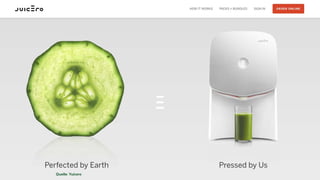
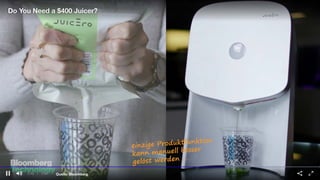
Quelle: Yuicero
Quelle: Bloomberg
einzige Produktfunktion
kann manuell besser
gelöst werden …
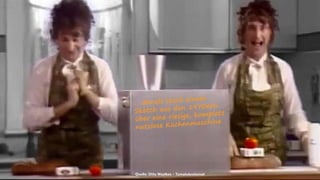
Quelle: Otto Waalkes – Tomatobrotomat
… ähnelt stark einem
Sketch aus den 1970ern
über eine riesige, komplett
nutzlose Küchenmaschine
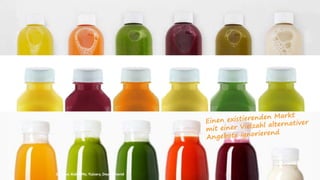
Quelles: Kale&Me, Yuicery, Dean&David
Einen existierenden Markt
mit einer Vielzahl alternativer
Angebote ignorierend
  PRODUCT FAILURE 
»Es werden tausende von Produkten angeboten
	 nach denen niemand fragt.
	 Wie können wir sicherstellen, etwas anzubieten
	 dass Menschen tatsächlich benötigen ?«
Quelle: Holger Eggert
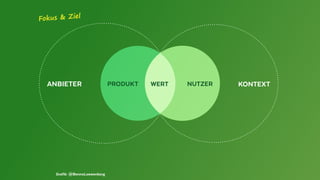
ANBIETER KONTEXT
Grafik: @BennoLoewenberg
NUTZERPRODUKT WERT
Fokus & Ziel
  »TO TEST IF YOUR PRODUCT IS NEEDED, 
	   STUDY THE JOB THAT IT DOES« 
Quelle: Des Traynor
 NUTZENVERSPRECHEN 
Quelle: Clayton Christensen
»Betrachte die Value Proposition als einen Vertrag
	 zwischen Deiner Firma und dem Kunden.
	 Der Kunde gibt Deiner Firma den Job
	 sein Problem zu lösen.«
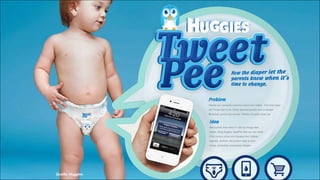
Quelle: Huggies
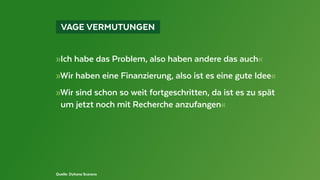
  VAGE VERMUTUNGEN 
»Ich habe das Problem, also haben andere das auch«
»Wir haben eine Finanzierung, also ist es eine gute Idee«
»Wir sind schon so weit fortgeschritten, da ist es zu spät
	 um jetzt noch mit Recherche anzufangen«
Quelle: Dyhana Scarano
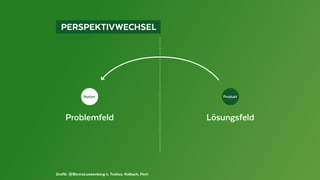
Grafik: @BennoLoewenberg n. Toxboe, Kalbach, Perri
 PERSPEKTIVWECHSEL 
ProduktNutzer
Problemfeld Lösungsfeld
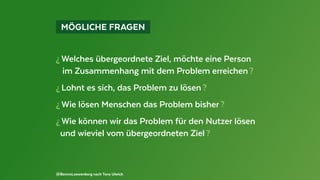
  MÖGLICHE FRAGEN 
¿ Welches übergeordnete Ziel, möchte eine Person
im Zusammenhang mit dem Problem erreichen ?
¿ Lohnt es sich, das Problem zu lösen ?
¿ Wie lösen Menschen das Problem bisher ?
¿ Wie können wir das Problem für den Nutzer lösen
und wieviel vom übergeordneten Ziel ?
@BennoLoewenberg nach Tony Ulwick
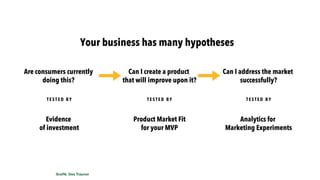
Your business has many hypotheses
Are consumers currently
doing this?
Can I create a product
that will improve upon it?
Can I address the market
successfully?
T E S T E D B Y
Evidence
of investment
T E S T E D B Y
Product Market Fit
for your MVP
Analytics for
Marketing Experiments
T E S T E D B Y
Grafik: Des Traynor
Grafik: @BennoLoewenberg n. Osterwalder et. al.
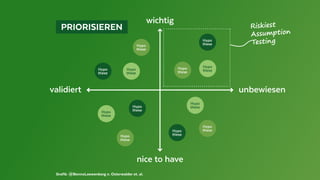
 PRIORISIEREN 
validiert unbewiesen
wichtig
nice to have
Hypo
theseHypo
these
Hypo
these
Hypo
these
Hypo
these
Hypo
these
Hypo
these
Hypo
theseHypo
these
Hypo
these
Hypo
these
Hypo
these
Riskiest
Assumption
Testing
Gain Creators
Describe how your products and services create customer
gains.
How do they create benefits your customer expects, desires
or would be surprised by, including functional utility, social
gains, positive emotions, and cost savings?
Do they…
Create savings that make your customer happy?
(e.g. in terms of time, money and effort, …)
Produce outcomes your customer expects or
that go beyond their expectations?
(e.g. better quality level, more of something, less of
something, …)
Pain Relievers
Copy or outperform current solutions that delight
your customer?
(e.g. regarding specific features, performance, quality, …)
Make your customer’s job or life easier?
(e.g. flatter learning curve, usability, accessibility, more
services, lower cost of ownership, …)
Create positive social consequences that your
customer desires?
(e.g. makes them look good, produces an increase in power,
status, …)
Do something customers are looking for?
(e.g. good design, guarantees, specific or more features, …)
Fulfill something customers are dreaming about?
(e.g. help big achievements, produce big reliefs, …)
Produce positive outcomes matching your
customers success and failure criteria?
(e.g. better performance, lower cost, …)
Help make adoption easier?
(e.g. lower cost, less investments, lower risk, better quality,
performance, design, …)
Rank each gain your products and services create according to
its relevance to your customer. Is it substantial or insignificant?
For each gain indicate how often it occurs.
Describe how your products and services alleviate customer
pains. How do they eliminate or reduce negative emotions,
undesired costs and situations, and risks your customer
experiences or could experience before, during, and after
getting the job done?
Do they…
Produce savings?
(e.g. in terms of time, money, or efforts, …)
Make your customers feel better?
(e.g. kills frustrations, annoyances, things that give them
a headache, …)
Fix underperforming solutions?
(e.g. new features, better performance, better quality, …)
Put an end to difficulties and challenges your
customers encounter?
(e.g. make things easier, helping them get done, eliminate
resistance, …)
Wipe out negative social consequences your
customers encounter or fear?
(e.g. loss of face, power, trust, or status, …)
Eliminate risks your customers fear?
(e.g. financial, social, technical risks, or what could go
awfully wrong, …)
Help your customers better sleep at night?
(e.g. by helping with big issues, diminishing concerns, or
eliminating worries, …)
Limit or eradicate common mistakes customers
make?
(e.g. usage mistakes, …)
Get rid of barriers that are keeping your customer
from adopting solutions?
(e.g. lower or no upfront investment costs, flatter learning
curve, less resistance to change, …)
Rank each pain your products and services kill according
to their intensity for your customer. Is it very intense or
very light?
For each pain indicate how often it occurs. Risks your
customer experiences or could experience before, during,
and after getting the job done?
Products & Services
List all the products and services your value proposition is
built around.
Which products and services do you offer that help your
customer get either a functional, social, or emotional job
done, or help him/her satisfy basic needs?
Which ancillary products and services help your customer
perform the roles of:
Buyer
(e.g. products and services that help customers compare
offers, decide, buy, take delivery of a product or service, …)
Co-creator
(e.g. products and services that help customers co-design
solutions, otherwise contribute value to the solution, …)
Transferrer
(e.g. products and services that help customers dispose of
a product, transfer it to others, or resell, …)
Products and services may either by tangible (e.g. manufac-
tured goods, face-to-face customer service), digital/virtual
(e.g. downloads, online recommendations), intangible (e.g.
copyrights, quality assurance), or financial (e.g. investment
funds, financing services).
Rank all products and services according to their
importance to your customer.
Are they crucial or trivial to your customer?
Gains
Describe the benefits your customer expects, desires or would
be surprised by. This includes functional utility, social gains,
positive emotions, and cost savings.
Which savings would make your customer happy?
(e.g. in terms of time, money and effort, …)
What outcomes does your customer expect and what
would go beyond his/her expectations?
(e.g. quality level, more of something, less of something, …)
How do current solutions delight your customer?
(e.g. specific features, performance, quality, …)
Pains
Customer Job(s)
Describe negative emotions, undesired costs and situations,
and risks that your customer experiences or could experience
before, during, and after getting the job done.
What does your customer find too costly?
(e.g. takes a lot of time, costs too much money, requires
substantial efforts, …)
What makes your customer feel bad?
(e.g. frustrations, annoyances, things that give them a
headache, …)
How are current solutions underperforming
for your customer?
(e.g. lack of features, performance, malfunctioning, …)
What are the main difficulties and challenges
your customer encounters?
(e.g. understanding how things work, difficulties getting
things done, resistance, …)
What negative social consequences does your
customer encounter or fear?
(e.g. loss of face, power, trust, or status, …)
What risks does your customer fear?
(e.g. financial, social, technical risks, or what could go awfully
wrong, …)
What’s keeping your customer awake at night?
(e.g. big issues, concerns, worries, …)
What common mistakes does your customer make?
(e.g. usage mistakes, …)
What barriers are keeping your customer from
adopting solutions?
(e.g. upfront investment costs, learning curve, resistance
to change, …)
Rank each pain according to the intensity it represents for
your customer.
Is it very intense or is it very light.?
For each pain indicate how often it occurs.
Describe what a specific customer segment is trying to get
done. It could be the tasks they are trying to perform and
complete, the problems they are trying to solve, or the needs
they are trying to satisfy.
What functional jobs are you helping your customer
get done? (e.g. perform or complete a specific task, solve a
specific problem, …)
What social jobs are you helping your customer get
done? (e.g. trying to look good, gain power or status, …)
What emotional jobs are you helping your customer
get done? (e.g. esthetics, feel good, security, …)
What basic needs are you helping your customer
satisfy? (e.g. communication, sex, …)
Besides trying to get a core job done, your customer performs
ancillary jobs in different roles. Describe the jobs your
customer is trying to get done as:
Buyer (e.g. trying to look good, gain power or status, …)
Co-creator (e.g. esthetics, feel good, security, …)
Transferrer (e.g. products and services that help customers
dispose of a product, transfer it to others, or resell, …)
Rank each job according to its significance to your
customer. Is it crucial or is it trivial? For each job
indicate how often it occurs.
Outline in which specific context a job
is done, because that may impose
constraints or limitations.
(e.g. while driving,
outside, …)
What would make your customer’s job or life easier?
(e.g. flatter learning curve, more services, lower cost of
ownership, …)
What positive social consequences does your
customer desire?
(e.g. makes them look good, increase in power, status, …)
What are customers looking for?
(e.g. good design, guarantees, specific or more features, …)
What do customers dream about?
(e.g. big achievements, big reliefs, …)
How does your customer measure success and
failure?
(e.g. performance, cost, …)
What would increase the likelihood of adopting a
solution?
(e.g. lower cost, less investments, lower risk, better quality,
performance, design, …)
Rank each gain according to its relevance to your customer.
Is it substantial or is it insignificant? For each gain indicate
how often it occurs.
strategyzer.com
The Value Proposition Canvas
Value Proposition Customer Segment
The makers of Business Model Generation and Strategyzer
Copyright Business Model Foundry AG
Produced by: www.stattys.com
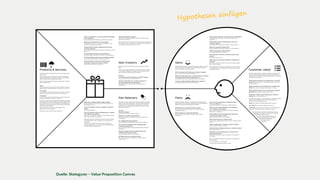
Quelle: Stategyzer – Value Proposition Canvas
Hypothesen einfügen
  ÜBERPRÜFBARE HYPOTHESE 
+ Formuliere ein Statement,
	 welches [als Prototyp] überprüfbar ist
+ basierend auf gemachten Erkenntnissen und
+ treffe eine Vorhersage über das vermutete Ergebnis
Quelle: Dyhana Scarano
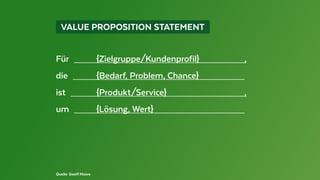
  VALUE PROPOSITION STATEMENT 
Quelle: Geoff Moore
Für  	{Zielgruppe/Kundenprofil}	 ,
die  	 {Bedarf, Problem, Chance}	
ist  	{Produkt/Service}	 ,
um  	 {Lösung, Wert}
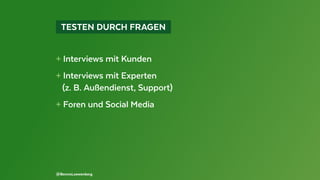
  TESTEN DURCH FRAGEN 
+ Interviews mit Kunden
+ Interviews mit Experten
(z. B. Außendienst, Support)
+ Foren und Social Media
@BennoLoewenberg
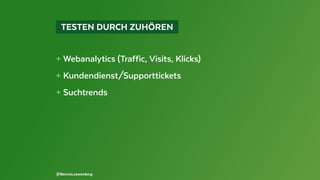
  TESTEN DURCH ZUHÖREN 
+ Webanalytics (Traffic, Visits, Klicks)
+ Kundendienst/Supporttickets
+ Suchtrends
@BennoLoewenberg
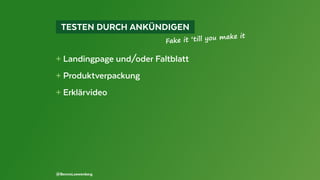
  TESTEN DURCH ANKÜNDIGEN 
+ Landingpage und/oder Faltblatt
+ Produktverpackung
+ Erklärvideo
@BennoLoewenberg
Fake it ‘till you make it
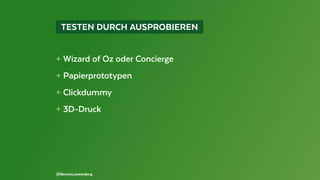
  TESTEN DURCH AUSPROBIEREN 
+ Wizard of Oz oder Concierge
+ Papierprototypen
+ Clickdummy
+ 3D-Druck
@BennoLoewenberg
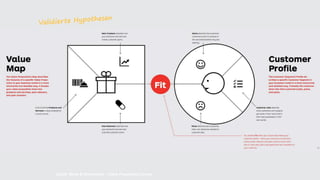
Quelle: Blank & Osterwalder – Value Proposition Canvas
Validierte Hypothesen
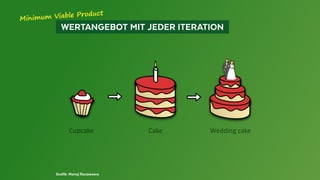
Grafik: Manoj Ranaweera
  WERTANGEBOT MIT JEDER ITERATION 
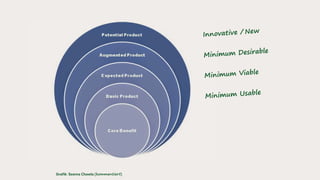
Minimum Viable Product
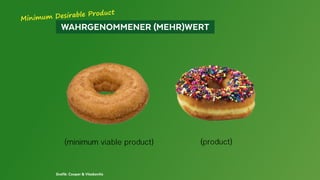
  WAHRGENOMMENER (MEHR)WERT 
Grafik: Cooper & Vlaskovits
Minimum Desirable Product
Grafik: Seema Chawla (kommentiert)
Minimum Viable
Minimum Desirable
Minimum Usable
Innovative / New
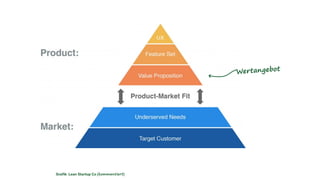
Grafik: Lean Startup Co (kommentiert)
Wertangebot
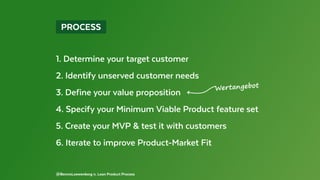
 PROCESS 
@BennoLoewenberg n. Lean Product Process
1. Determine your target customer
2. Identify unserved customer needs
3. Define your value proposition
4. Specify your Minimum Viable Product feature set
5. Create your MVP & test it with customers
6. Iterate to improve Product-Market Fit
Wertangebot
  DIE NUTZERSICHT ZÄHLT 
»Sprechen Sie mit Ihren Nutzern –
	 bauen und testen Sie für echte Nutzer
	 und für tatsächlichen Nutzungskontext.«
( Familie, Freunde und Kollegen sind nicht Ihre Nutzer )
@BennoLoewenberg
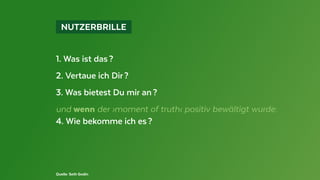
 NUTZERBRILLE 
1. Was ist das ?
2. Vertaue ich Dir ?
3. Was bietest Du mir an ?
und wenn der ›moment of truth‹ positiv bewältigt wurde:
4. Wie bekomme ich es ?
Quelle: Seth Godin
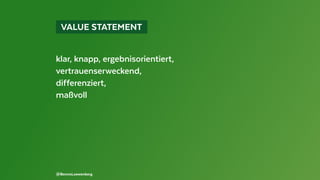
  VALUE STATEMENT 
klar, knapp, ergebnisorientiert,
vertrauenserweckend,
differenziert,
maßvoll
@BennoLoewenberg
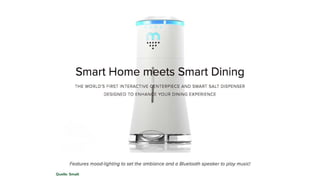
Quelle: Smalt
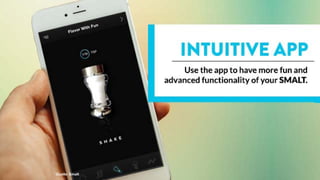
Quelle: Smalt
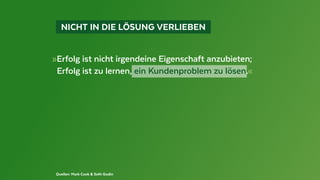
  NICHT IN DIE LÖSUNG VERLIEBEN 
Quellen: Mark Cook & Seth Godin
»Erfolg ist nicht irgendeine Eigenschaft anzubieten;
 	Erfolg ist zu lernen, ein Kundenproblem zu lösen.«
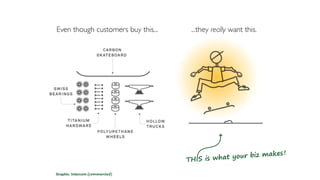
What is Customer Jobs? What is a Job to be Done (JTBD)?
A Job to be Done is the process a consumer goes through whenever she evolves
FFIIGGUURREE 55.. TTHHEE DDEESSIIGGNNEERRSS AATT IINNTTEERRCCOOMM ((IINNTTEERRCCOOMM..CCOOMM)) UUSSEE TTHHIISS
IILLLLUUSSTTRRAATTIIOONN TTOO SSHHOOWW WWHHAATT IISS,, AANNDD IISSNN’’TT,, IIMMPPOORRTTAANNTT TTOO CCUUSSTTOOMMEERRSS..
Graphic: Intercom (commented)
THIS is what your biz makes !
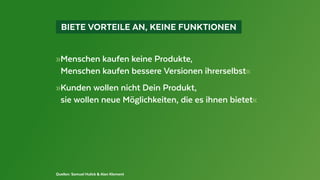
  BIETE VORTEILE AN, KEINE FUNKTIONEN 
»Menschen kaufen keine Produkte,
	 Menschen kaufen bessere Versionen ihrerselbst«
»Kunden wollen nicht Dein Produkt,
	sie wollen neue Möglichkeiten, die es ihnen bietet«
Quellen: Samuel Hulick & Alan Klement
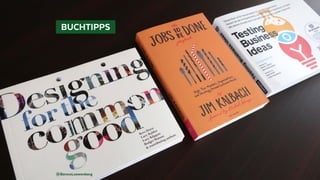
 BUCHTIPPS 
@BennoLoewenberg
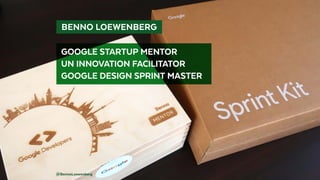
  BENNO LOEWENBERG 
@BennoLoewenberg
GOOGLE STARTUP MENTOR
UN INNOVATION FACILITATOR
GOOGLE DESIGN SPRINT MASTER
  BENNOLOEWENBERG 
 LINKEDIN /  XING /  TWITTER
 @

(Added) Value Proposition (deutsch) #WirVsVirus

  • 1.
      VALUE PROPOSITION  WIRVERSUS VIRUS ENABLER 26. MAI 2020 @BENNOLOEWENBERG Added
  • 2.
  • 3.
    Quelle: Bloomberg einzige Produktfunktion kannmanuell besser gelöst werden …
  • 4.
    Quelle: Otto Waalkes– Tomatobrotomat … ähnelt stark einem Sketch aus den 1970ern über eine riesige, komplett nutzlose Küchenmaschine
  • 5.
    Quelles: Kale&Me, Yuicery,Dean&David Einen existierenden Markt mit einer Vielzahl alternativer Angebote ignorierend
  • 6.
      PRODUCT FAILURE  »Eswerden tausende von Produkten angeboten nach denen niemand fragt. Wie können wir sicherstellen, etwas anzubieten dass Menschen tatsächlich benötigen ?« Quelle: Holger Eggert
  • 7.
  • 8.
      »TO TESTIF YOUR PRODUCT IS NEEDED,    STUDY THE JOB THAT IT DOES«  Quelle: Des Traynor
  • 9.
     NUTZENVERSPRECHEN  Quelle: Clayton Christensen »Betrachtedie Value Proposition als einen Vertrag zwischen Deiner Firma und dem Kunden. Der Kunde gibt Deiner Firma den Job sein Problem zu lösen.«
  • 10.
  • 11.
      VAGE VERMUTUNGEN  »Ichhabe das Problem, also haben andere das auch« »Wir haben eine Finanzierung, also ist es eine gute Idee« »Wir sind schon so weit fortgeschritten, da ist es zu spät um jetzt noch mit Recherche anzufangen« Quelle: Dyhana Scarano
  • 12.
    Grafik: @BennoLoewenberg n.Toxboe, Kalbach, Perri  PERSPEKTIVWECHSEL  ProduktNutzer Problemfeld Lösungsfeld
  • 13.
      MÖGLICHE FRAGEN  ¿ Welchesübergeordnete Ziel, möchte eine Person im Zusammenhang mit dem Problem erreichen ? ¿ Lohnt es sich, das Problem zu lösen ? ¿ Wie lösen Menschen das Problem bisher ? ¿ Wie können wir das Problem für den Nutzer lösen und wieviel vom übergeordneten Ziel ? @BennoLoewenberg nach Tony Ulwick
  • 14.
    Your business hasmany hypotheses Are consumers currently doing this? Can I create a product that will improve upon it? Can I address the market successfully? T E S T E D B Y Evidence of investment T E S T E D B Y Product Market Fit for your MVP Analytics for Marketing Experiments T E S T E D B Y Grafik: Des Traynor
  • 15.
    Grafik: @BennoLoewenberg n.Osterwalder et. al.  PRIORISIEREN  validiert unbewiesen wichtig nice to have Hypo theseHypo these Hypo these Hypo these Hypo these Hypo these Hypo these Hypo theseHypo these Hypo these Hypo these Hypo these Riskiest Assumption Testing
  • 16.
    Gain Creators Describe howyour products and services create customer gains. How do they create benefits your customer expects, desires or would be surprised by, including functional utility, social gains, positive emotions, and cost savings? Do they… Create savings that make your customer happy? (e.g. in terms of time, money and effort, …) Produce outcomes your customer expects or that go beyond their expectations? (e.g. better quality level, more of something, less of something, …) Pain Relievers Copy or outperform current solutions that delight your customer? (e.g. regarding specific features, performance, quality, …) Make your customer’s job or life easier? (e.g. flatter learning curve, usability, accessibility, more services, lower cost of ownership, …) Create positive social consequences that your customer desires? (e.g. makes them look good, produces an increase in power, status, …) Do something customers are looking for? (e.g. good design, guarantees, specific or more features, …) Fulfill something customers are dreaming about? (e.g. help big achievements, produce big reliefs, …) Produce positive outcomes matching your customers success and failure criteria? (e.g. better performance, lower cost, …) Help make adoption easier? (e.g. lower cost, less investments, lower risk, better quality, performance, design, …) Rank each gain your products and services create according to its relevance to your customer. Is it substantial or insignificant? For each gain indicate how often it occurs. Describe how your products and services alleviate customer pains. How do they eliminate or reduce negative emotions, undesired costs and situations, and risks your customer experiences or could experience before, during, and after getting the job done? Do they… Produce savings? (e.g. in terms of time, money, or efforts, …) Make your customers feel better? (e.g. kills frustrations, annoyances, things that give them a headache, …) Fix underperforming solutions? (e.g. new features, better performance, better quality, …) Put an end to difficulties and challenges your customers encounter? (e.g. make things easier, helping them get done, eliminate resistance, …) Wipe out negative social consequences your customers encounter or fear? (e.g. loss of face, power, trust, or status, …) Eliminate risks your customers fear? (e.g. financial, social, technical risks, or what could go awfully wrong, …) Help your customers better sleep at night? (e.g. by helping with big issues, diminishing concerns, or eliminating worries, …) Limit or eradicate common mistakes customers make? (e.g. usage mistakes, …) Get rid of barriers that are keeping your customer from adopting solutions? (e.g. lower or no upfront investment costs, flatter learning curve, less resistance to change, …) Rank each pain your products and services kill according to their intensity for your customer. Is it very intense or very light? For each pain indicate how often it occurs. Risks your customer experiences or could experience before, during, and after getting the job done? Products & Services List all the products and services your value proposition is built around. Which products and services do you offer that help your customer get either a functional, social, or emotional job done, or help him/her satisfy basic needs? Which ancillary products and services help your customer perform the roles of: Buyer (e.g. products and services that help customers compare offers, decide, buy, take delivery of a product or service, …) Co-creator (e.g. products and services that help customers co-design solutions, otherwise contribute value to the solution, …) Transferrer (e.g. products and services that help customers dispose of a product, transfer it to others, or resell, …) Products and services may either by tangible (e.g. manufac- tured goods, face-to-face customer service), digital/virtual (e.g. downloads, online recommendations), intangible (e.g. copyrights, quality assurance), or financial (e.g. investment funds, financing services). Rank all products and services according to their importance to your customer. Are they crucial or trivial to your customer? Gains Describe the benefits your customer expects, desires or would be surprised by. This includes functional utility, social gains, positive emotions, and cost savings. Which savings would make your customer happy? (e.g. in terms of time, money and effort, …) What outcomes does your customer expect and what would go beyond his/her expectations? (e.g. quality level, more of something, less of something, …) How do current solutions delight your customer? (e.g. specific features, performance, quality, …) Pains Customer Job(s) Describe negative emotions, undesired costs and situations, and risks that your customer experiences or could experience before, during, and after getting the job done. What does your customer find too costly? (e.g. takes a lot of time, costs too much money, requires substantial efforts, …) What makes your customer feel bad? (e.g. frustrations, annoyances, things that give them a headache, …) How are current solutions underperforming for your customer? (e.g. lack of features, performance, malfunctioning, …) What are the main difficulties and challenges your customer encounters? (e.g. understanding how things work, difficulties getting things done, resistance, …) What negative social consequences does your customer encounter or fear? (e.g. loss of face, power, trust, or status, …) What risks does your customer fear? (e.g. financial, social, technical risks, or what could go awfully wrong, …) What’s keeping your customer awake at night? (e.g. big issues, concerns, worries, …) What common mistakes does your customer make? (e.g. usage mistakes, …) What barriers are keeping your customer from adopting solutions? (e.g. upfront investment costs, learning curve, resistance to change, …) Rank each pain according to the intensity it represents for your customer. Is it very intense or is it very light.? For each pain indicate how often it occurs. Describe what a specific customer segment is trying to get done. It could be the tasks they are trying to perform and complete, the problems they are trying to solve, or the needs they are trying to satisfy. What functional jobs are you helping your customer get done? (e.g. perform or complete a specific task, solve a specific problem, …) What social jobs are you helping your customer get done? (e.g. trying to look good, gain power or status, …) What emotional jobs are you helping your customer get done? (e.g. esthetics, feel good, security, …) What basic needs are you helping your customer satisfy? (e.g. communication, sex, …) Besides trying to get a core job done, your customer performs ancillary jobs in different roles. Describe the jobs your customer is trying to get done as: Buyer (e.g. trying to look good, gain power or status, …) Co-creator (e.g. esthetics, feel good, security, …) Transferrer (e.g. products and services that help customers dispose of a product, transfer it to others, or resell, …) Rank each job according to its significance to your customer. Is it crucial or is it trivial? For each job indicate how often it occurs. Outline in which specific context a job is done, because that may impose constraints or limitations. (e.g. while driving, outside, …) What would make your customer’s job or life easier? (e.g. flatter learning curve, more services, lower cost of ownership, …) What positive social consequences does your customer desire? (e.g. makes them look good, increase in power, status, …) What are customers looking for? (e.g. good design, guarantees, specific or more features, …) What do customers dream about? (e.g. big achievements, big reliefs, …) How does your customer measure success and failure? (e.g. performance, cost, …) What would increase the likelihood of adopting a solution? (e.g. lower cost, less investments, lower risk, better quality, performance, design, …) Rank each gain according to its relevance to your customer. Is it substantial or is it insignificant? For each gain indicate how often it occurs. strategyzer.com The Value Proposition Canvas Value Proposition Customer Segment The makers of Business Model Generation and Strategyzer Copyright Business Model Foundry AG Produced by: www.stattys.com Quelle: Stategyzer – Value Proposition Canvas Hypothesen einfügen
  • 17.
      ÜBERPRÜFBARE HYPOTHESE  +Formuliere ein Statement, welches [als Prototyp] überprüfbar ist + basierend auf gemachten Erkenntnissen und + treffe eine Vorhersage über das vermutete Ergebnis Quelle: Dyhana Scarano
  • 18.
      VALUE PROPOSITIONSTATEMENT  Quelle: Geoff Moore Für  {Zielgruppe/Kundenprofil} , die  {Bedarf, Problem, Chance} ist  {Produkt/Service} , um  {Lösung, Wert}
  • 19.
      TESTEN DURCHFRAGEN  + Interviews mit Kunden + Interviews mit Experten (z. B. Außendienst, Support) + Foren und Social Media @BennoLoewenberg
  • 20.
      TESTEN DURCHZUHÖREN  + Webanalytics (Traffic, Visits, Klicks) + Kundendienst/Supporttickets + Suchtrends @BennoLoewenberg
  • 21.
      TESTEN DURCHANKÜNDIGEN  + Landingpage und/oder Faltblatt + Produktverpackung + Erklärvideo @BennoLoewenberg Fake it ‘till you make it
  • 22.
      TESTEN DURCHAUSPROBIEREN  + Wizard of Oz oder Concierge + Papierprototypen + Clickdummy + 3D-Druck @BennoLoewenberg
  • 23.
    Quelle: Blank &Osterwalder – Value Proposition Canvas Validierte Hypothesen
  • 24.
    Grafik: Manoj Ranaweera  WERTANGEBOT MIT JEDER ITERATION  Minimum Viable Product
  • 25.
      WAHRGENOMMENER (MEHR)WERT  Grafik:Cooper & Vlaskovits Minimum Desirable Product
  • 26.
    Grafik: Seema Chawla(kommentiert) Minimum Viable Minimum Desirable Minimum Usable Innovative / New
  • 27.
    Grafik: Lean StartupCo (kommentiert) Wertangebot
  • 28.
     PROCESS  @BennoLoewenberg n. LeanProduct Process 1. Determine your target customer 2. Identify unserved customer needs 3. Define your value proposition 4. Specify your Minimum Viable Product feature set 5. Create your MVP & test it with customers 6. Iterate to improve Product-Market Fit Wertangebot
  • 29.
      DIE NUTZERSICHTZÄHLT  »Sprechen Sie mit Ihren Nutzern – bauen und testen Sie für echte Nutzer und für tatsächlichen Nutzungskontext.« ( Familie, Freunde und Kollegen sind nicht Ihre Nutzer ) @BennoLoewenberg
  • 30.
     NUTZERBRILLE  1. Was istdas ? 2. Vertaue ich Dir ? 3. Was bietest Du mir an ? und wenn der ›moment of truth‹ positiv bewältigt wurde: 4. Wie bekomme ich es ? Quelle: Seth Godin
  • 31.
      VALUE STATEMENT  klar,knapp, ergebnisorientiert, vertrauenserweckend, differenziert, maßvoll @BennoLoewenberg
  • 32.
  • 33.
  • 34.
      NICHT INDIE LÖSUNG VERLIEBEN  Quellen: Mark Cook & Seth Godin »Erfolg ist nicht irgendeine Eigenschaft anzubieten;   Erfolg ist zu lernen, ein Kundenproblem zu lösen.«
  • 35.
    What is CustomerJobs? What is a Job to be Done (JTBD)? A Job to be Done is the process a consumer goes through whenever she evolves FFIIGGUURREE 55.. TTHHEE DDEESSIIGGNNEERRSS AATT IINNTTEERRCCOOMM ((IINNTTEERRCCOOMM..CCOOMM)) UUSSEE TTHHIISS IILLLLUUSSTTRRAATTIIOONN TTOO SSHHOOWW WWHHAATT IISS,, AANNDD IISSNN’’TT,, IIMMPPOORRTTAANNTT TTOO CCUUSSTTOOMMEERRSS.. Graphic: Intercom (commented) THIS is what your biz makes !
  • 36.
      BIETE VORTEILEAN, KEINE FUNKTIONEN  »Menschen kaufen keine Produkte, Menschen kaufen bessere Versionen ihrerselbst« »Kunden wollen nicht Dein Produkt, sie wollen neue Möglichkeiten, die es ihnen bietet« Quellen: Samuel Hulick & Alan Klement
  • 37.
  • 38.
      BENNO LOEWENBERG  @BennoLoewenberg GOOGLESTARTUP MENTOR UN INNOVATION FACILITATOR GOOGLE DESIGN SPRINT MASTER
  • 39.
      BENNOLOEWENBERG   LINKEDIN / XING /  TWITTER  @