Expense constrained bidder
optimization in repeated auctions
Ramki Gummadi
Stanford University
(Based on joint work with P. Key and A. Proutiere)
Overview
• Introduction/Motivation
• Budgeted Second Price Auctions
• A General Online Budgeting Framework
• Optimal Bids for Micro-Value Auctions
• Conclusion
Three Aspects of Sponsored Search
1. Sequential setting.
2. Micro-transactions per auction.
3. The long tail of advertisers
is expense constrained.
Modeling Expense Constraints
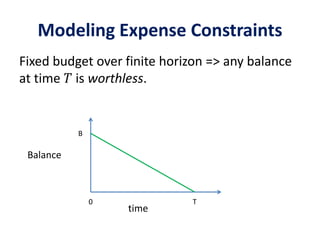
Fixed budget over finite horizon => any balance
at time 𝑇 is worthless.
Balance
time
T0
B
Modeling Expense Constraints
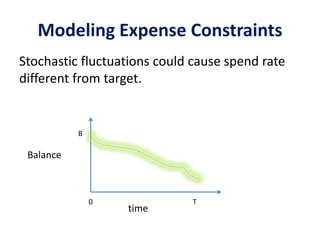
Stochastic fluctuations could cause spend rate
different from target.
Balance
time
T0
B
Modeling Expense Constraints
“…the nature of what this budget limit means for the
bidders themselves is somewhat of a mystery. There
seems to be some risk control element to it, some
purely administrative element to it, some bounded-
rationality element to it, and more…”
-- “Theory research at google”, SIGACT News, 2008.
Modeling Expense Constraints
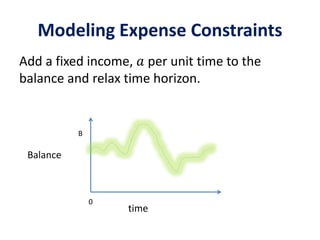
Add a fixed income, 𝑎 per unit time to the
balance and relax time horizon.
Balance
time
0
B
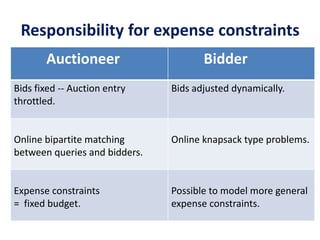
Responsibility for expense constraints
Auctioneer Bidder
Bids fixed -- Auction entry
throttled.
Bids adjusted dynamically.
Online bipartite matching
between queries and bidders.
Online knapsack type problems.
Expense constraints
= fixed budget.
Possible to model more general
expense constraints.
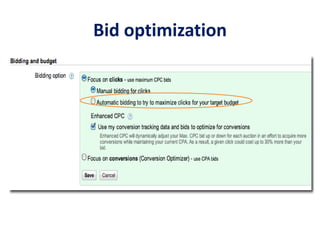
Bid optimization
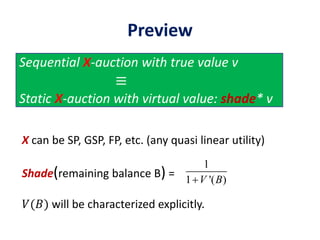
Preview
Sequential X-auction with true value v
≡
Static X-auction with virtual value: shade* v
X can be SP, GSP, FP, etc. (any quasi linear utility)
Shade(remaining balance B) =
𝑉(𝐵) will be characterized explicitly.
1
1 '( )V B
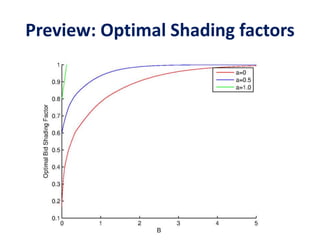
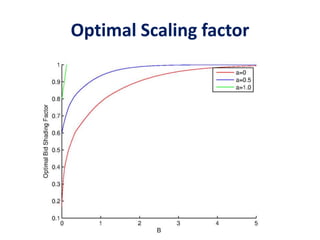
Preview: Optimal Shading factors
Overview
• Introduction
• Budgeted Second Price auctions
• A General Online Budgeting Framework
• Optimal Bids for Micro-Value Auctions
• Conclusion
Model: Budgeted Second Price
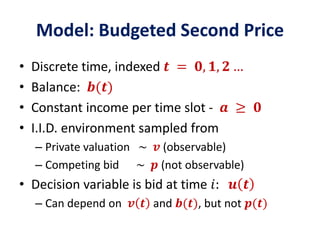
• Discrete time, indexed 𝒕 = 𝟎, 𝟏, 𝟐 …
• Balance: 𝒃(𝒕)
• Constant income per time slot - 𝒂 ≥ 𝟎
• I.I.D. environment sampled from
– Private valuation ~ 𝒗 (observable)
– Competing bid ~ 𝒑 (not observable)
• Decision variable is bid at time 𝑖: 𝒖 𝒕
– Can depend on 𝒗 𝒕 and 𝒃(𝒕), but not 𝒑(𝒕)
Model: Budgeted Second Price
• 𝒃 𝒕 + 𝟏 = 𝒃 𝒕 + 𝒂 – 𝒑 𝒕 𝟏 𝒖 𝒕 > 𝒑 𝒕
Constraint: 𝑏 𝑡 ≥ 0 ∀ 𝑡 a.s.
• Utility: 𝒈 𝒕 = 𝒗 𝒕 − 𝒑 𝒕 𝟏 𝒖 𝒕 > 𝒑 𝒕
• Objective function: 𝒕=𝟎
∞
𝒆−𝜷𝒕
𝔼[𝒈 𝒕 ]
The Value Function
𝒗 𝜷 (𝒃) = 𝒔𝒖𝒑
𝓤 𝒕=𝟎
∞
𝒆−𝜷𝒕
𝔼[𝒈 𝒕 ] | 𝒃 𝟎 = 𝒃
• 𝑣 𝛽 (𝑏) : max utility starting with balance 𝑏
• Can use dynamic programming (“one step look
ahead”) to write out a functional fixed point
relation.
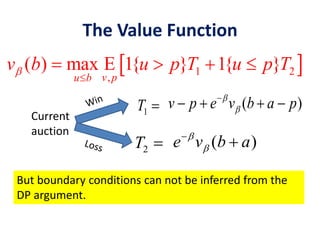
The Value Function
 1 2
,
( ) max E 1{ } 1{ }
v pu b
v b u p T u p T

   
( )v p e v b a p


   
( )e v b a



But boundary conditions can not be inferred from the
DP argument.
Current
auction
1T 
2T 
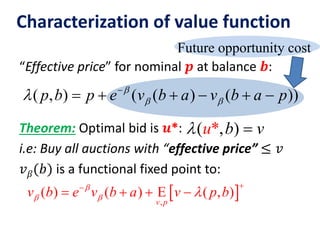
Future opportunity cost
Characterization of value function
“Effective price” for nominal 𝒑 at balance 𝒃:
Theorem: Optimal bid is 𝒖*:
i.e: Buy all auctions with “effective price” ≤ 𝑣
𝑣 𝛽(𝑏) is a functional fixed point to:
( , )*u b v 
 ,
( ) ( ) ( , )
v p
v b e v b a v p b
  

    
( , ) ( ( ) ( ))p b p e v b a v b a p
  
     
1
,
( ) ( ) ( , )i i i
v p
v b e v b a v p b
  
 
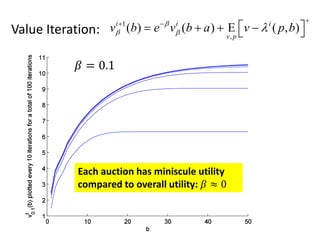
      Value Iteration:
𝛽 = 0.1
Each auction has miniscule utility
compared to overall utility: 𝛽 ≈ 0
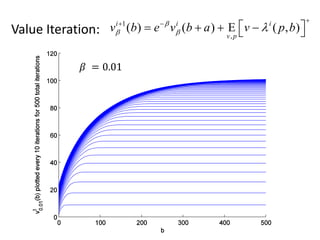
Value Iteration:
𝛽 = 0.01
1
,
( ) ( ) ( , )i i i
v p
v b e v b a v p b
  
 
      
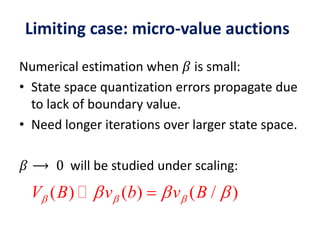
Numerical estimation when 𝛽 is small:
• State space quantization errors propagate due
to lack of boundary value.
• Need longer iterations over larger state space.
𝛽 ⟶ 0 will be studied under scaling:
( ) ( ) ( / )V B v b v B    
Limiting case: micro-value auctions
Overview
• Introduction
• Budgeted Second Price Auctions
• A General Online Budgeting Framework
• Optimal Bids for Micro-Value Auctions
• Conclusion
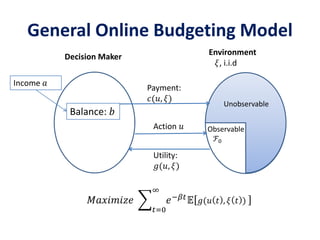
General Online Budgeting Model
Decision Maker
Environment
𝜉, i.i.d
Unobservable
Observable
ℱ0
Balance: 𝑏
Utility:
𝑔(𝑢, 𝜉)
Action 𝑢
Payment:
𝑐(𝑢, 𝜉)
Income 𝑎
𝑀𝑎𝑥𝑖𝑚𝑖𝑧𝑒
𝑡=0
∞
𝑒−𝛽𝑡 𝔼 𝑔(𝑢 𝑡 , 𝜉 𝑡 )
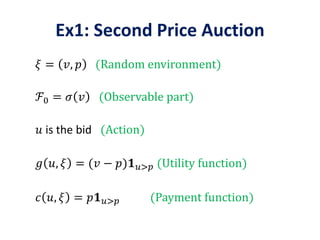
Ex1: Second Price Auction
𝜉 = 𝑣, 𝑝 (Random environment)
ℱ0 = 𝜎 𝑣 (Observable part)
𝑢 is the bid (Action)
𝑔 𝑢, 𝜉 = (𝑣 − 𝑝)𝟏 𝑢>𝑝 (Utility function)
𝑐 𝑢, 𝜉 = 𝑝𝟏 𝑢>𝑝 (Payment function)
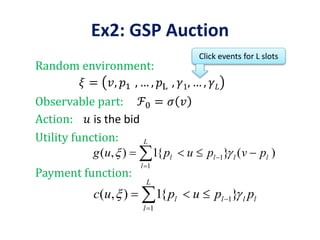
Ex2: GSP Auction
Random environment:
𝜉 = 𝑣, 𝑝1 , … , 𝑝L , 𝛾1, … , 𝛾 𝐿
Observable part: ℱ0 = 𝜎 𝑣
Action: 𝑢 is the bid
Utility function:
Payment function:
1
1
( , ) 1{ } ( )
L
l l l l
l
g u p u p v p 

   
1
1
( , ) 1{ }
L
l l l l
l
c u p u p p 

  
Click events for L slots
Overview
• Introduction
• Budgeted Second Price Auctions
• A General Online Budgeting Framework
• Optimal Bids for Micro-Value Auctions
• Conclusion
Limiting Regime: 𝛽 ⟶ 0
( ) ( ) ( / )V B v b v B    
Notation:
(( ]) [ , )E g ug u 
(( ]) [ , )E c uc u 
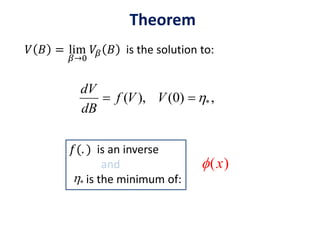
𝑓(. ) is an inverse
and
is the minimum of:
Theorem
*( ), (0) ,
dV
f V V
dB
 
( )x
𝑉 𝐵 = lim
𝛽→0
𝑉𝛽 𝐵 is the solution to:
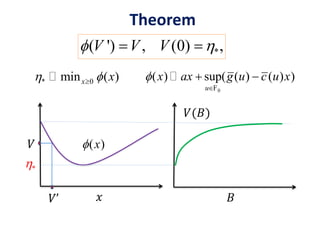
*
*( ') , (0) ,V V V  
0
( ) sup( ( ) ( ) )
u
x ax g u c u x

 
F
* 0min ( )x x 
𝑥
𝑉
𝑉’ 𝐵
𝑉(𝐵)
Theorem
( )x
*
𝜙 𝑥 = 𝑎𝑥 + sup
𝑢∈ℱ0
( 𝑔(𝑢) − 𝑐(𝑢)𝑥)
= 𝑎 𝑥 + sup
𝑢∈𝜎(𝑣)
𝔼 𝟏 𝑢>𝑝(𝑣 − 𝑝 1 + 𝑥 )
= 𝑎 𝑥 + 𝔼 (𝑣 − 𝑝 1 + 𝑥) +
Application to Second Price Auctions
𝐸[𝟏 𝑢>𝑝 𝑣 − 𝑝 ]
𝐸[𝟏 𝑢>𝑝p]
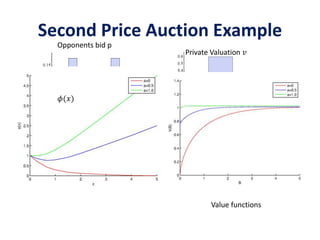
Second Price Auction Example
Opponents bid p
Private Valuation 𝑣
𝜙(𝑥)
Value functions
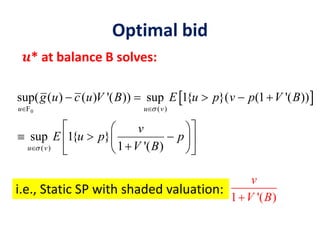
Optimal bid
 
0 ( )
( )
sup( ( ) ( ) '( )) sup 1{ }( (1 '( ))
sup 1{ }
1 '( )
u u v
u v
g u c u V B uE p v p V B
v
u p p
V
E
B


 

    
 
    
 
 
 
F
i.e., Static SP with shaded valuation:
1 '( )
v
V B
𝒖* at balance B solves:
Optimal Scaling factor
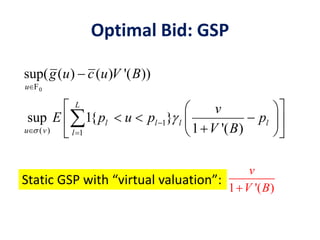
Optimal Bid: GSP
0
1
( ) 1
sup( ( ) ( ) '( ))
sup 1{ }
1 '( )
u
L
l l l l
u v l
g u c u V B
v
p u p p
V
E
B



 

 
   
 
 
  

F
Static GSP with “virtual valuation”:
1 '( )
v
V B
Proof Overview
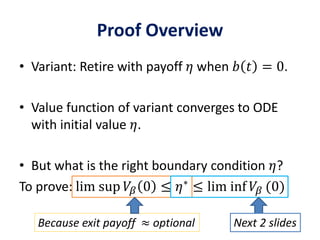
• Variant: Retire with payoff 𝜂 when 𝑏 𝑡 = 0.
• Value function of variant converges to ODE
with initial value 𝜂.
• But what is the right boundary condition 𝜂?
To prove: lim sup 𝑉𝛽 0 ≤ 𝜂∗
≤ lim inf 𝑉𝛽 (0)
Because exit payoff ≈ optional Next 2 slides
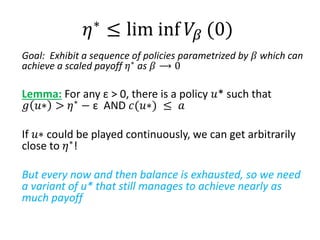
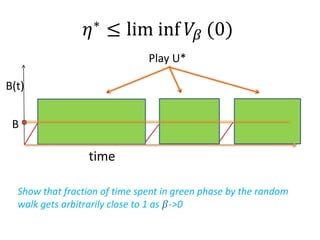
Goal: Exhibit a sequence of policies parametrized by 𝛽 which can
achieve a scaled payoff 𝜂∗
as 𝛽 ⟶ 0
Lemma: For any ε > 0, there is a policy 𝑢* such that
𝑔 𝑢∗ > 𝜂∗
− ε AND 𝑐(𝑢∗) ≤ 𝑎
If 𝑢∗ could be played continuously, we can get arbitrarily
close to 𝜂∗
!
But every now and then balance is exhausted, so we need
a variant of u* that still manages to achieve nearly as
much payoff
𝜂∗ ≤ lim inf 𝑉𝛽 (0)
time
B(t)
B
Play U*
𝜂∗ ≤ lim inf 𝑉𝛽 (0)
Show that fraction of time spent in green phase by the random
walk gets arbitrarily close to 1 as 𝛽->0
Overview
• Introduction
• MDP for budgeted SP auctions
• A General Online Budgeting Framework
• Optimal Bids for Micro-Value Auctions
• Conclusion
Conclusion
• A two parameter model for expense
constraints in online budgeting problems.
• Optimal bid can be mapped to static auction
with a shaded virtual valuation.
• Paper has more contents: MFE analysis and a
finite horizon model.

Adauctions

  • 1.
    Expense constrained bidder optimizationin repeated auctions Ramki Gummadi Stanford University (Based on joint work with P. Key and A. Proutiere)
  • 2.
    Overview • Introduction/Motivation • BudgetedSecond Price Auctions • A General Online Budgeting Framework • Optimal Bids for Micro-Value Auctions • Conclusion
  • 3.
    Three Aspects ofSponsored Search 1. Sequential setting. 2. Micro-transactions per auction. 3. The long tail of advertisers is expense constrained.
  • 4.
    Modeling Expense Constraints Fixedbudget over finite horizon => any balance at time 𝑇 is worthless. Balance time T0 B
  • 5.
    Modeling Expense Constraints Stochasticfluctuations could cause spend rate different from target. Balance time T0 B
  • 6.
    Modeling Expense Constraints “…thenature of what this budget limit means for the bidders themselves is somewhat of a mystery. There seems to be some risk control element to it, some purely administrative element to it, some bounded- rationality element to it, and more…” -- “Theory research at google”, SIGACT News, 2008.
  • 7.
    Modeling Expense Constraints Adda fixed income, 𝑎 per unit time to the balance and relax time horizon. Balance time 0 B
  • 8.
    Responsibility for expenseconstraints Auctioneer Bidder Bids fixed -- Auction entry throttled. Bids adjusted dynamically. Online bipartite matching between queries and bidders. Online knapsack type problems. Expense constraints = fixed budget. Possible to model more general expense constraints.
  • 9.
  • 10.
    Preview Sequential X-auction withtrue value v ≡ Static X-auction with virtual value: shade* v X can be SP, GSP, FP, etc. (any quasi linear utility) Shade(remaining balance B) = 𝑉(𝐵) will be characterized explicitly. 1 1 '( )V B
  • 11.
  • 12.
    Overview • Introduction • BudgetedSecond Price auctions • A General Online Budgeting Framework • Optimal Bids for Micro-Value Auctions • Conclusion
  • 13.
    Model: Budgeted SecondPrice • Discrete time, indexed 𝒕 = 𝟎, 𝟏, 𝟐 … • Balance: 𝒃(𝒕) • Constant income per time slot - 𝒂 ≥ 𝟎 • I.I.D. environment sampled from – Private valuation ~ 𝒗 (observable) – Competing bid ~ 𝒑 (not observable) • Decision variable is bid at time 𝑖: 𝒖 𝒕 – Can depend on 𝒗 𝒕 and 𝒃(𝒕), but not 𝒑(𝒕)
  • 14.
    Model: Budgeted SecondPrice • 𝒃 𝒕 + 𝟏 = 𝒃 𝒕 + 𝒂 – 𝒑 𝒕 𝟏 𝒖 𝒕 > 𝒑 𝒕 Constraint: 𝑏 𝑡 ≥ 0 ∀ 𝑡 a.s. • Utility: 𝒈 𝒕 = 𝒗 𝒕 − 𝒑 𝒕 𝟏 𝒖 𝒕 > 𝒑 𝒕 • Objective function: 𝒕=𝟎 ∞ 𝒆−𝜷𝒕 𝔼[𝒈 𝒕 ]
  • 15.
    The Value Function 𝒗𝜷 (𝒃) = 𝒔𝒖𝒑 𝓤 𝒕=𝟎 ∞ 𝒆−𝜷𝒕 𝔼[𝒈 𝒕 ] | 𝒃 𝟎 = 𝒃 • 𝑣 𝛽 (𝑏) : max utility starting with balance 𝑏 • Can use dynamic programming (“one step look ahead”) to write out a functional fixed point relation.
  • 16.
    The Value Function 1 2 , ( ) max E 1{ } 1{ } v pu b v b u p T u p T      ( )v p e v b a p       ( )e v b a    But boundary conditions can not be inferred from the DP argument. Current auction 1T  2T 
  • 17.
    Future opportunity cost Characterizationof value function “Effective price” for nominal 𝒑 at balance 𝒃: Theorem: Optimal bid is 𝒖*: i.e: Buy all auctions with “effective price” ≤ 𝑣 𝑣 𝛽(𝑏) is a functional fixed point to: ( , )*u b v   , ( ) ( ) ( , ) v p v b e v b a v p b          ( , ) ( ( ) ( ))p b p e v b a v b a p         
  • 18.
    1 , ( ) () ( , )i i i v p v b e v b a v p b            Value Iteration: 𝛽 = 0.1 Each auction has miniscule utility compared to overall utility: 𝛽 ≈ 0
  • 19.
    Value Iteration: 𝛽 =0.01 1 , ( ) ( ) ( , )i i i v p v b e v b a v p b            
  • 20.
    Numerical estimation when𝛽 is small: • State space quantization errors propagate due to lack of boundary value. • Need longer iterations over larger state space. 𝛽 ⟶ 0 will be studied under scaling: ( ) ( ) ( / )V B v b v B     Limiting case: micro-value auctions
  • 21.
    Overview • Introduction • BudgetedSecond Price Auctions • A General Online Budgeting Framework • Optimal Bids for Micro-Value Auctions • Conclusion
  • 22.
    General Online BudgetingModel Decision Maker Environment 𝜉, i.i.d Unobservable Observable ℱ0 Balance: 𝑏 Utility: 𝑔(𝑢, 𝜉) Action 𝑢 Payment: 𝑐(𝑢, 𝜉) Income 𝑎 𝑀𝑎𝑥𝑖𝑚𝑖𝑧𝑒 𝑡=0 ∞ 𝑒−𝛽𝑡 𝔼 𝑔(𝑢 𝑡 , 𝜉 𝑡 )
  • 23.
    Ex1: Second PriceAuction 𝜉 = 𝑣, 𝑝 (Random environment) ℱ0 = 𝜎 𝑣 (Observable part) 𝑢 is the bid (Action) 𝑔 𝑢, 𝜉 = (𝑣 − 𝑝)𝟏 𝑢>𝑝 (Utility function) 𝑐 𝑢, 𝜉 = 𝑝𝟏 𝑢>𝑝 (Payment function)
  • 24.
    Ex2: GSP Auction Randomenvironment: 𝜉 = 𝑣, 𝑝1 , … , 𝑝L , 𝛾1, … , 𝛾 𝐿 Observable part: ℱ0 = 𝜎 𝑣 Action: 𝑢 is the bid Utility function: Payment function: 1 1 ( , ) 1{ } ( ) L l l l l l g u p u p v p       1 1 ( , ) 1{ } L l l l l l c u p u p p      Click events for L slots
  • 25.
    Overview • Introduction • BudgetedSecond Price Auctions • A General Online Budgeting Framework • Optimal Bids for Micro-Value Auctions • Conclusion
  • 26.
    Limiting Regime: 𝛽⟶ 0 ( ) ( ) ( / )V B v b v B     Notation: (( ]) [ , )E g ug u  (( ]) [ , )E c uc u 
  • 27.
    𝑓(. ) isan inverse and is the minimum of: Theorem *( ), (0) , dV f V V dB   ( )x 𝑉 𝐵 = lim 𝛽→0 𝑉𝛽 𝐵 is the solution to: *
  • 28.
    *( ') ,(0) ,V V V   0 ( ) sup( ( ) ( ) ) u x ax g u c u x    F * 0min ( )x x  𝑥 𝑉 𝑉’ 𝐵 𝑉(𝐵) Theorem ( )x *
  • 29.
    𝜙 𝑥 =𝑎𝑥 + sup 𝑢∈ℱ0 ( 𝑔(𝑢) − 𝑐(𝑢)𝑥) = 𝑎 𝑥 + sup 𝑢∈𝜎(𝑣) 𝔼 𝟏 𝑢>𝑝(𝑣 − 𝑝 1 + 𝑥 ) = 𝑎 𝑥 + 𝔼 (𝑣 − 𝑝 1 + 𝑥) + Application to Second Price Auctions 𝐸[𝟏 𝑢>𝑝 𝑣 − 𝑝 ] 𝐸[𝟏 𝑢>𝑝p]
  • 30.
    Second Price AuctionExample Opponents bid p Private Valuation 𝑣 𝜙(𝑥) Value functions
  • 31.
    Optimal bid   0( ) ( ) sup( ( ) ( ) '( )) sup 1{ }( (1 '( )) sup 1{ } 1 '( ) u u v u v g u c u V B uE p v p V B v u p p V E B                        F i.e., Static SP with shaded valuation: 1 '( ) v V B 𝒖* at balance B solves:
  • 32.
  • 33.
    Optimal Bid: GSP 0 1 () 1 sup( ( ) ( ) '( )) sup 1{ } 1 '( ) u L l l l l u v l g u c u V B v p u p p V E B                     F Static GSP with “virtual valuation”: 1 '( ) v V B
  • 34.
    Proof Overview • Variant:Retire with payoff 𝜂 when 𝑏 𝑡 = 0. • Value function of variant converges to ODE with initial value 𝜂. • But what is the right boundary condition 𝜂? To prove: lim sup 𝑉𝛽 0 ≤ 𝜂∗ ≤ lim inf 𝑉𝛽 (0) Because exit payoff ≈ optional Next 2 slides
  • 35.
    Goal: Exhibit asequence of policies parametrized by 𝛽 which can achieve a scaled payoff 𝜂∗ as 𝛽 ⟶ 0 Lemma: For any ε > 0, there is a policy 𝑢* such that 𝑔 𝑢∗ > 𝜂∗ − ε AND 𝑐(𝑢∗) ≤ 𝑎 If 𝑢∗ could be played continuously, we can get arbitrarily close to 𝜂∗ ! But every now and then balance is exhausted, so we need a variant of u* that still manages to achieve nearly as much payoff 𝜂∗ ≤ lim inf 𝑉𝛽 (0)
  • 36.
    time B(t) B Play U* 𝜂∗ ≤lim inf 𝑉𝛽 (0) Show that fraction of time spent in green phase by the random walk gets arbitrarily close to 1 as 𝛽->0
  • 37.
    Overview • Introduction • MDPfor budgeted SP auctions • A General Online Budgeting Framework • Optimal Bids for Micro-Value Auctions • Conclusion
  • 38.
    Conclusion • A twoparameter model for expense constraints in online budgeting problems. • Optimal bid can be mapped to static auction with a shaded virtual valuation. • Paper has more contents: MFE analysis and a finite horizon model.

Editor's Notes

  • #4 Fundamental qn: why bother with additional constraints when utility function we defined is already taking into account the expense. So maybe they exist, but is the effect significant?
  • #5 Fundamental qn: why bother with additional constraints when utility function we defined is already taking into account the expense. So maybe they exist, but is the effect significant?
  • #17 Mention the two types of expense constraints Discount factor interpretation – life time of bidder in the system.
  • #18 Mention parametrization in terms of beta. Well defined quantity, but to solve for it we need to optimize over a huge class of policies.
  • #20 In a sequential setting , when an agent wins an auction, he pays a price equal to b’. But this is actually costlier than b’ in effect. How much costlier is it? So lambda is a function that magnifies the opponent’s bid as a function of the current balance. Mention value iteration interpretation to compute the function numerically.
  • #23 Beta to zero implies the value function is blowing up to infty. But we need to scale the units correctly in terms of beta to understand the right behavior.
  • #30 Phi maps rate of change of value function to the value itself.