Introduction to Algorithmic Trading Strategies
Lecture 3
Trend Following
Haksun Li
haksun.li@numericalmethod.com
www.numericalmethod.com
References
2
 Introduction to Stochastic Calculus with Applications.
Fima C Klebaner. 2nd Edition.
 Estimating continuous time transition matrices from
discretely observed data. Inamura, Yasunari. April
2006.
 Optimal Trend Following Trading Rules. Dai, Min and
Zhang, Qing and Zhu, Qiji Jim. 2011.
Stochastic Calculus
3
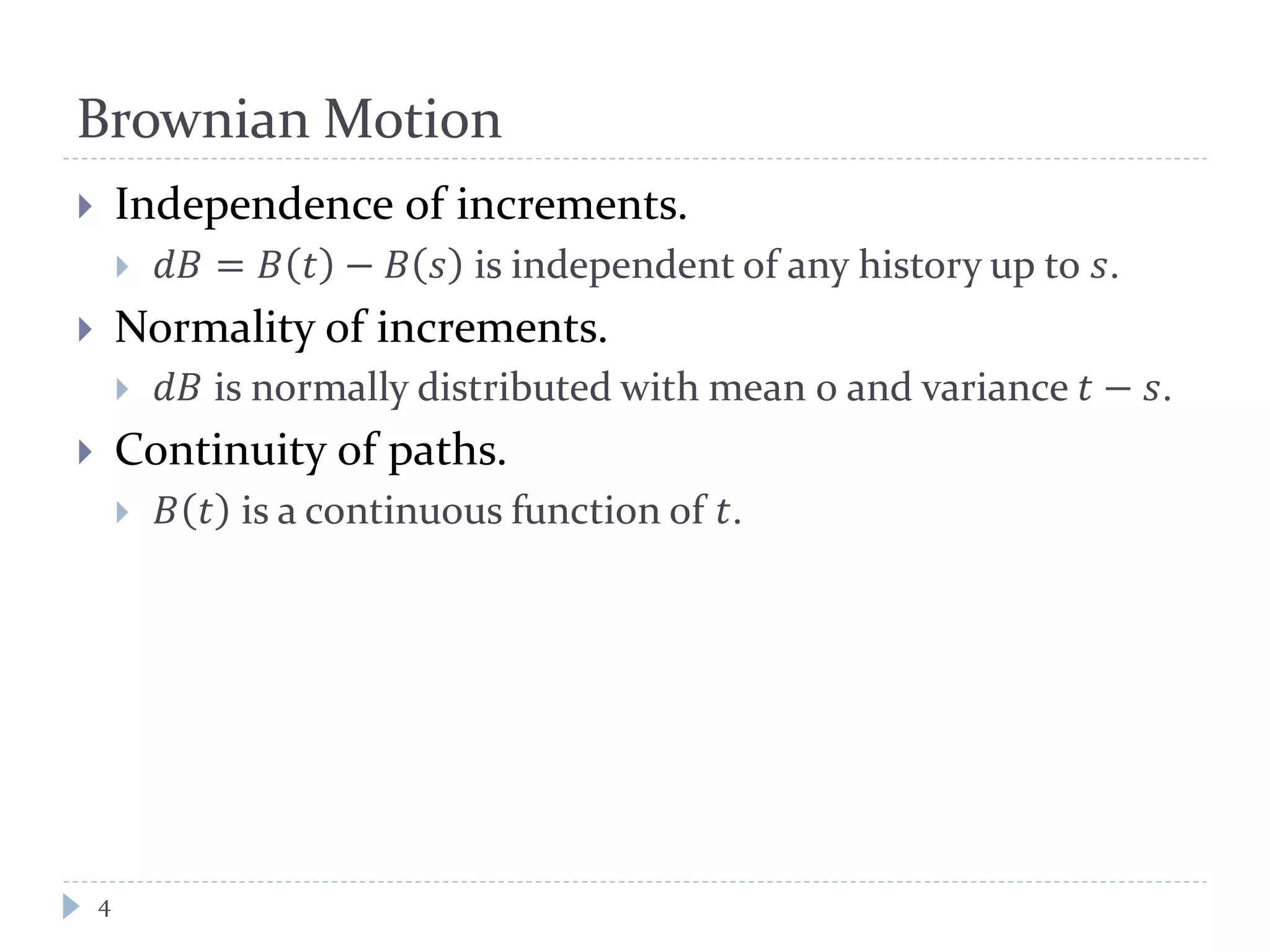
Brownian Motion
4
 Independence of increments.
 𝑑𝑑 = đ” 𝑡 − đ” 𝑠 is independent of any history up to 𝑠.
 Normality of increments.
 𝑑𝑑 is normally distributed with mean 0 and variance 𝑡 − 𝑠.
 Continuity of paths.
 đ” 𝑡 is a continuous function of 𝑡.
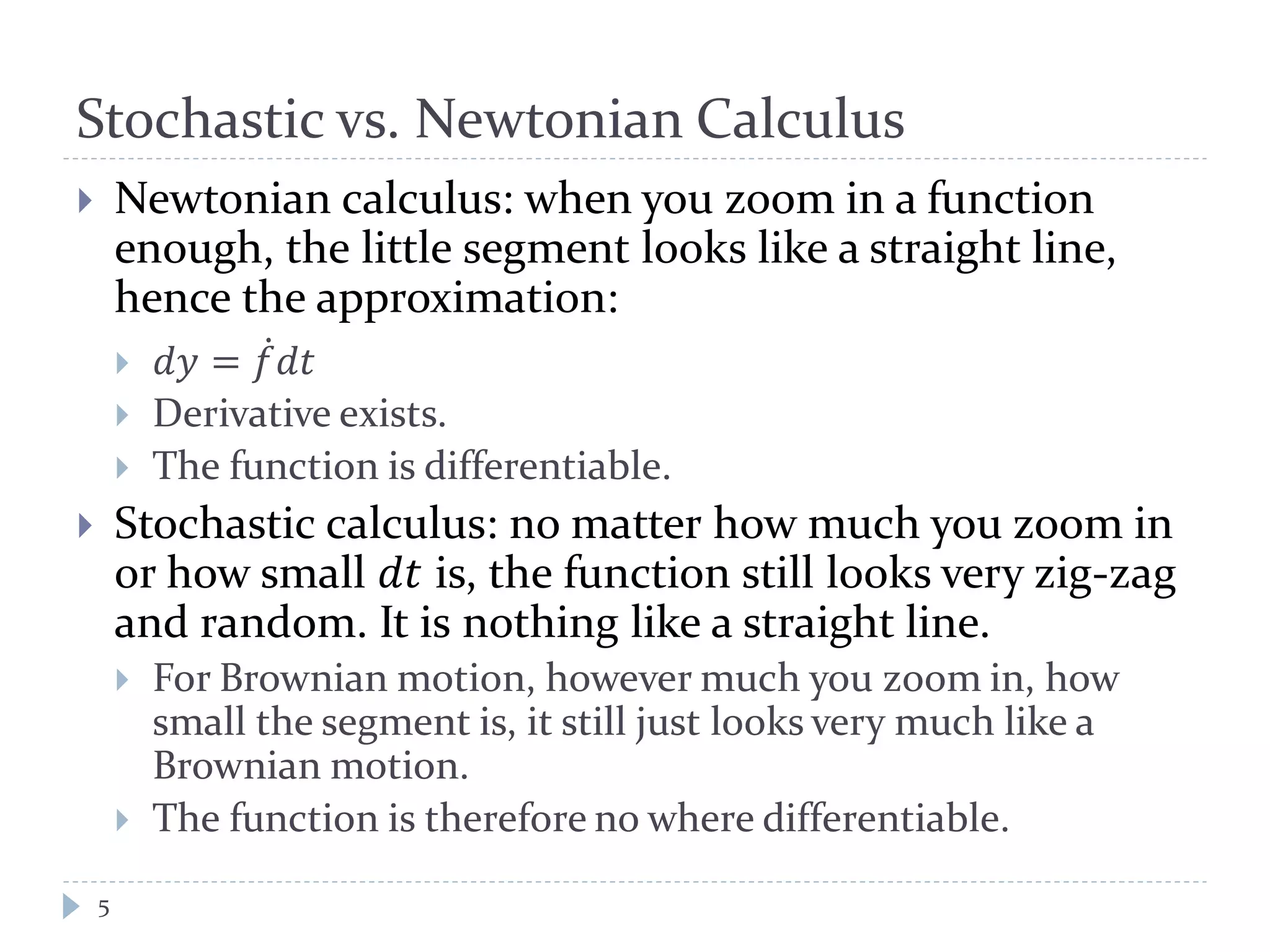
Stochastic vs. Newtonian Calculus
5
 Newtonian calculus: when you zoom in a function
enough, the little segment looks like a straight line,
hence the approximation:
 𝑑𝑑 = đ‘“Ì‡ 𝑑𝑑
 Derivative exists.
 The function is differentiable.
 Stochastic calculus: no matter how much you zoom in
or how small 𝑑𝑑 is, the function still looks very zig-zag
and random. It is nothing like a straight line.
 For Brownian motion, however much you zoom in, how
small the segment is, it still just looks very much like a
Brownian motion.
 The function is therefore no where differentiable.
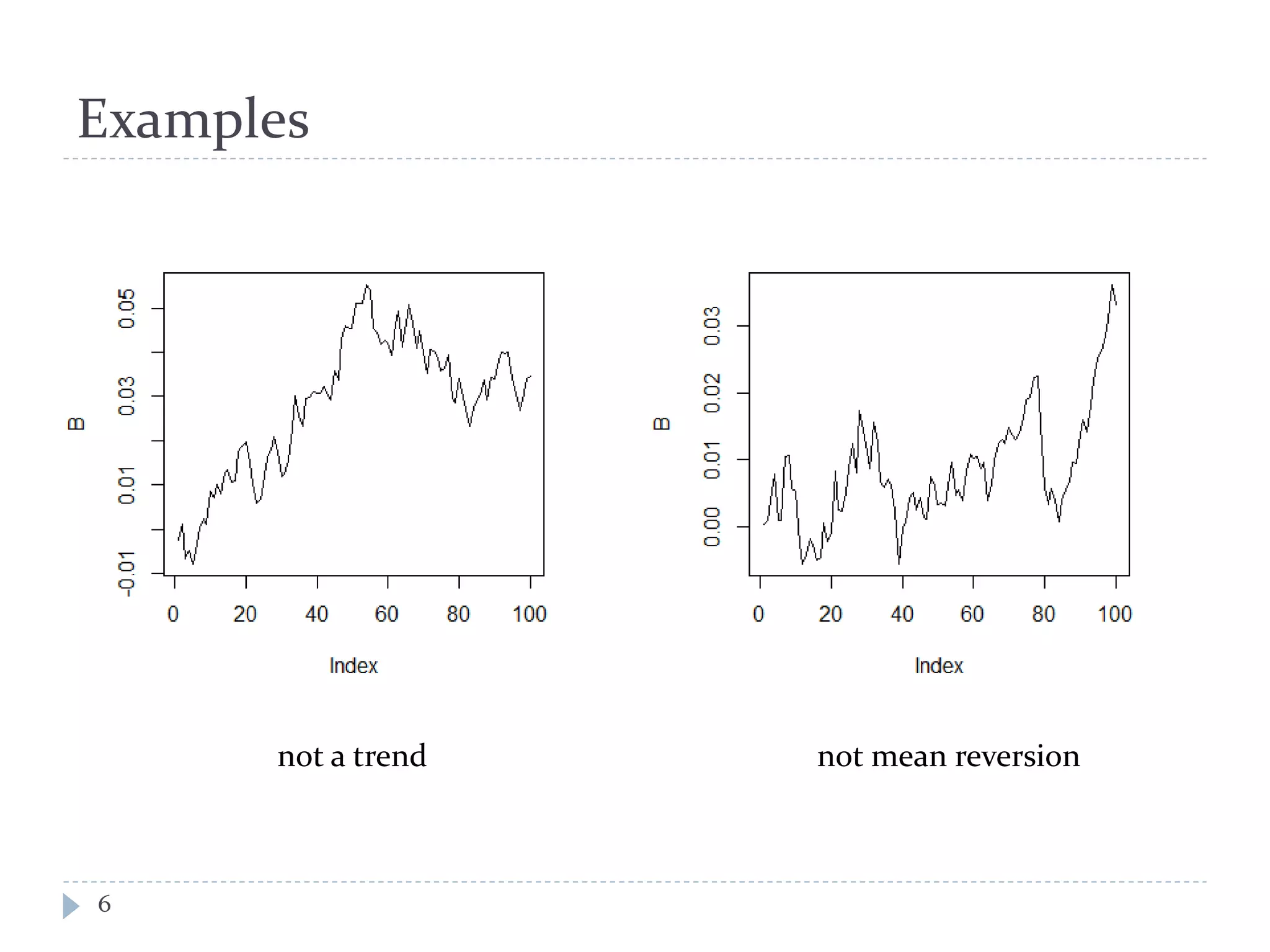
Examples
6
not a trend not mean reversion
dBdB
7
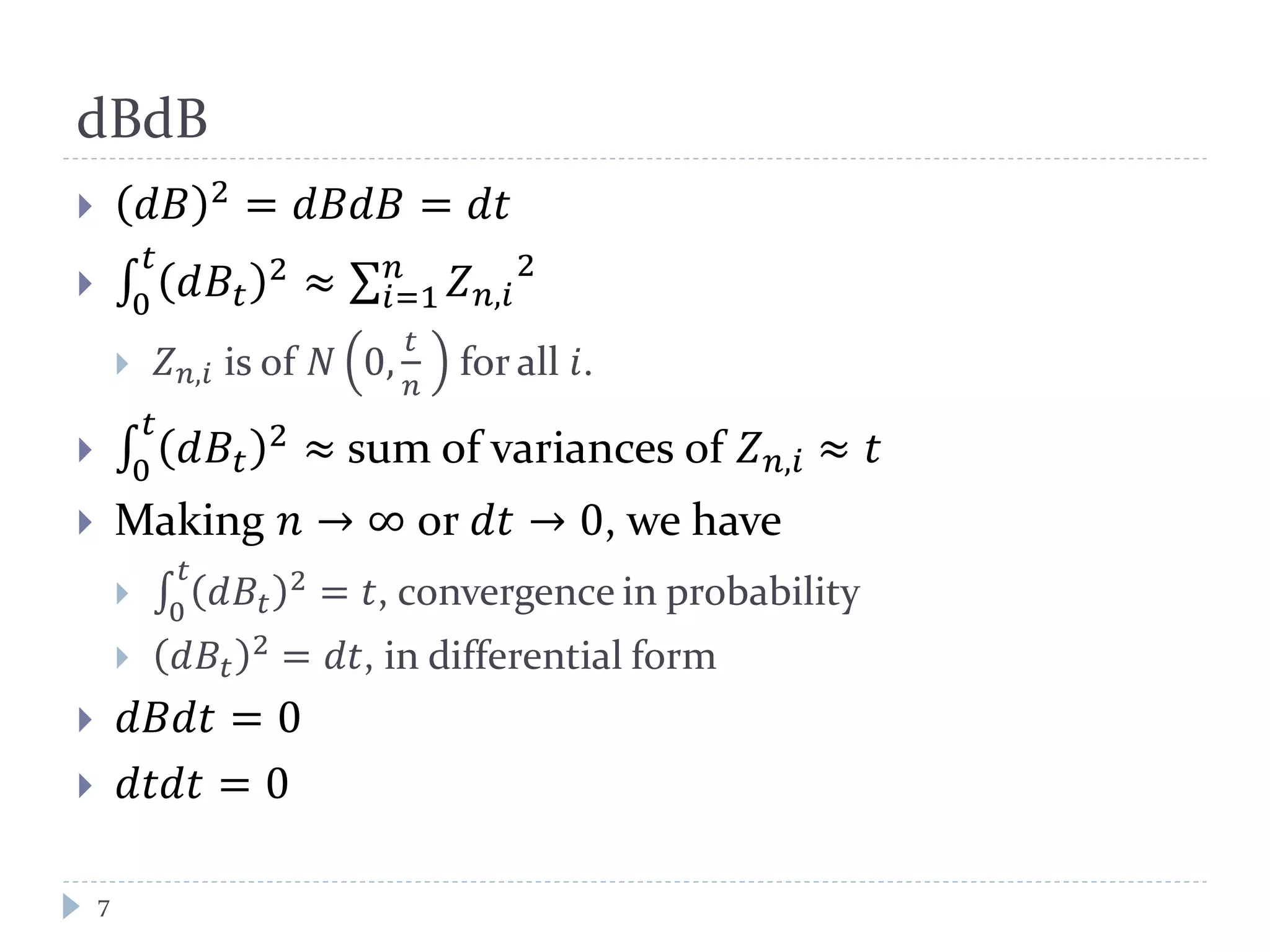
 𝑑𝑑 2 = 𝑑𝑑𝑑𝑑 = 𝑑𝑑
 ∫ đ‘‘đ”đ‘Ą
2𝑡
0
≈ ∑ 𝑍 𝑛,𝑖
2𝑛
𝑖=1
 𝑍 𝑛,𝑖 is of 𝑁 0,
𝑡
𝑛
for all 𝑖.
 ∫ đ‘‘đ”đ‘Ą
2𝑡
0
≈ sum of variances of 𝑍 𝑛,𝑖 ≈ 𝑡
 Making 𝑛 → ∞ or 𝑑𝑑 → 0, we have
 ∫ đ‘‘đ”đ‘Ą
2𝑡
0
= 𝑡, convergence in probability
 đ‘‘đ”đ‘Ą
2 = 𝑑𝑑, in differential form
 𝑑𝑑𝑑𝑡 = 0
 𝑑𝑡𝑑𝑑 = 0
Asset Price Model
8
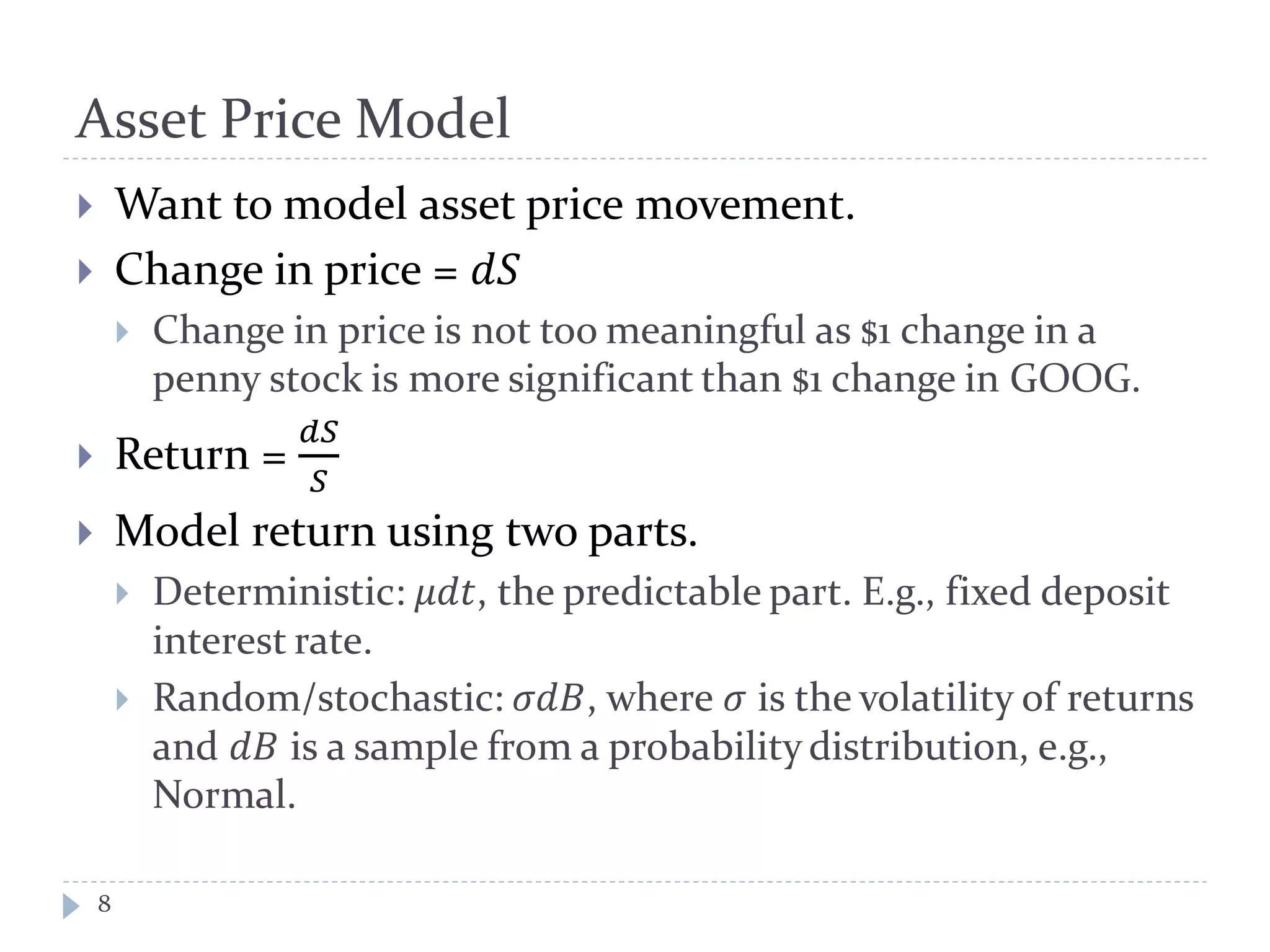
 Want to model asset price movement.
 Change in price = 𝑑𝑑
 Change in price is not too meaningful as $1 change in a
penny stock is more significant than $1 change in GOOG.
 Return =
𝑑𝑑
𝑆
 Model return using two parts.
 Deterministic: 𝜇𝑑𝑑, the predictable part. E.g., fixed deposit
interest rate.
 Random/stochastic: 𝜎𝑑𝑑, where 𝜎 is the volatility of returns
and đ‘‘đ” is a sample from a probability distribution, e.g.,
Normal.
Geometric Brownian Motion
9
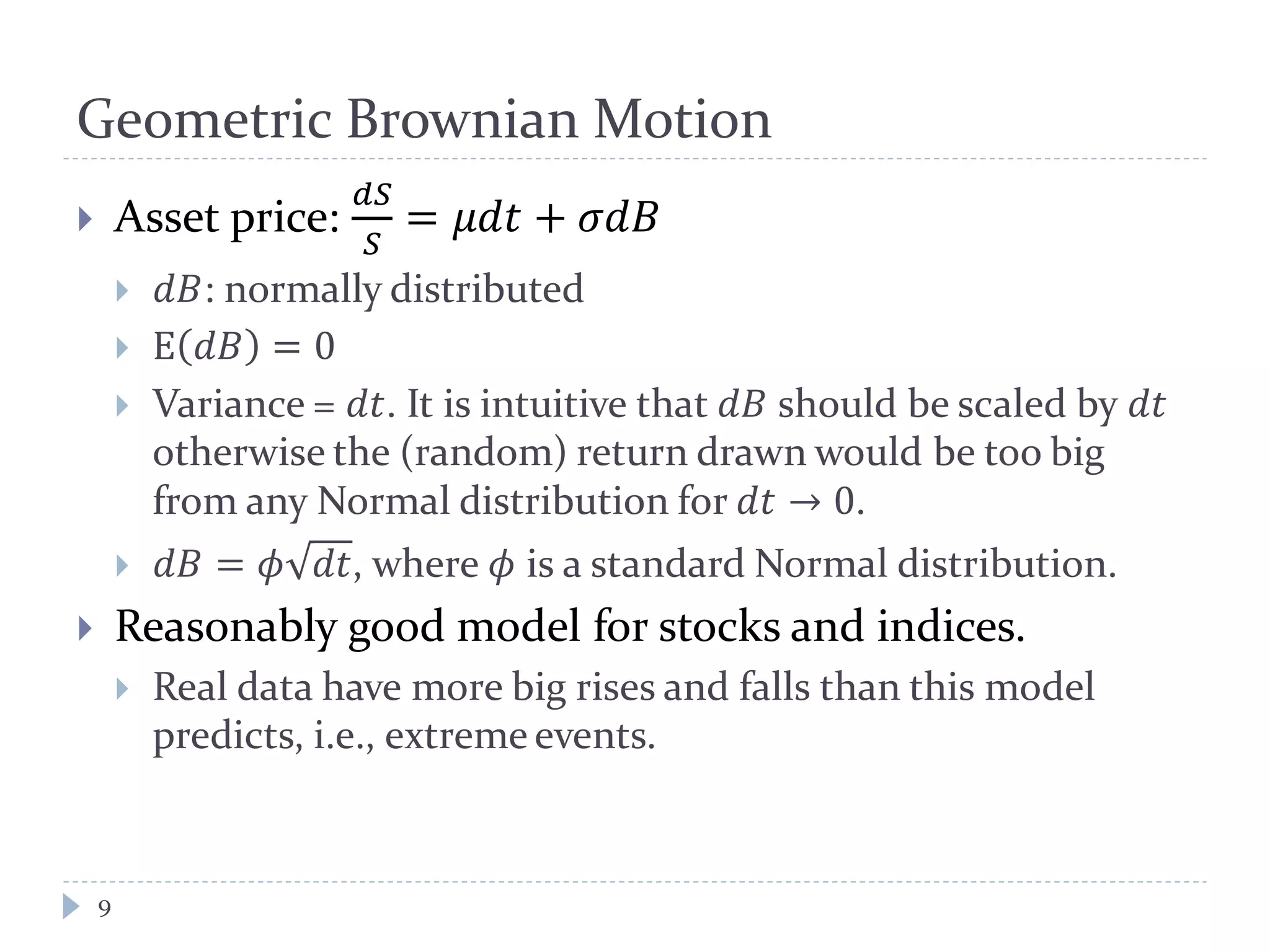
 Asset price:
𝑑𝑑
𝑆
= 𝜇𝜇𝜇 + đœŽđœŽđ”
 đ‘‘đ”: normally distributed
 E đ‘‘đ” = 0
 Variance = 𝑑𝑑. It is intuitive that đ‘‘đ” should be scaled by 𝑑𝑑
otherwise the (random) return drawn would be too big
from any Normal distribution for 𝑑𝑑 → 0.
 đ‘‘đ” = 𝜙 𝑑𝑑, where 𝜙 is a standard Normal distribution.
 Reasonably good model for stocks and indices.
 Real data have more big rises and falls than this model
predicts, i.e., extreme events.
GBM Properties
10
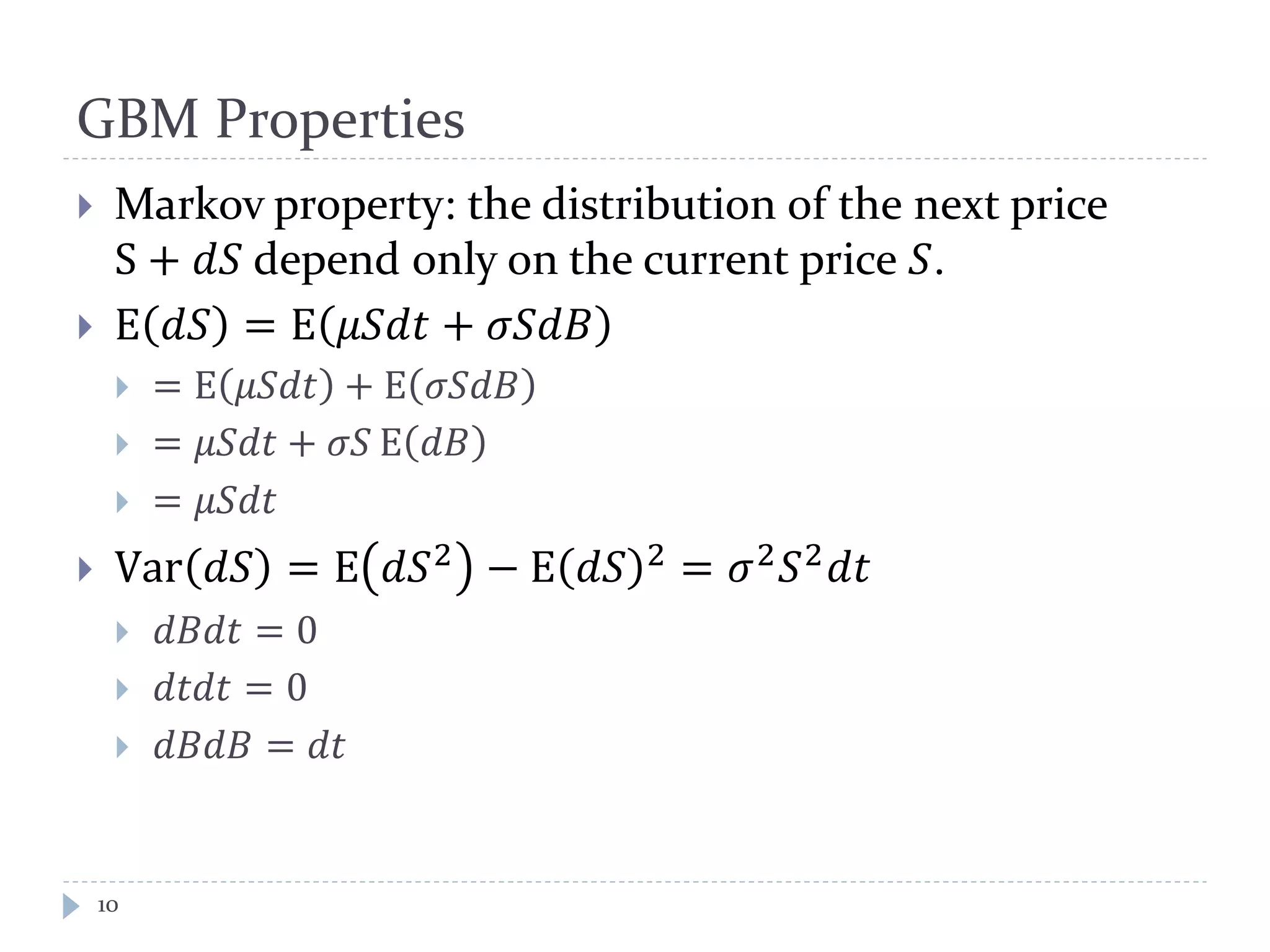
 Markov property: the distribution of the next price
S + 𝑑𝑑 depend only on the current price 𝑆.
 E 𝑑𝑆 = E 𝜇𝑆𝑑𝑑 + đœŽđ‘†đ‘‘đ”
 = E 𝜇𝜇𝜇𝜇 + E đœŽđœŽđœŽđ”
 = 𝜇𝜇𝜇𝜇 + 𝜎𝜎 E đ‘‘đ”
 = 𝜇𝜇𝜇𝜇
 Var 𝑑𝑑 = E 𝑑𝑑2 − E 𝑑𝑑 2 = 𝜎2 𝑆2 𝑑𝑑
 đ‘‘đ”đ‘‘đ‘‘ = 0
 𝑑𝑑𝑑𝑑 = 0
 đ‘‘đ”đ‘‘đ” = 𝑑𝑑
Stochastic Differential Equation
11
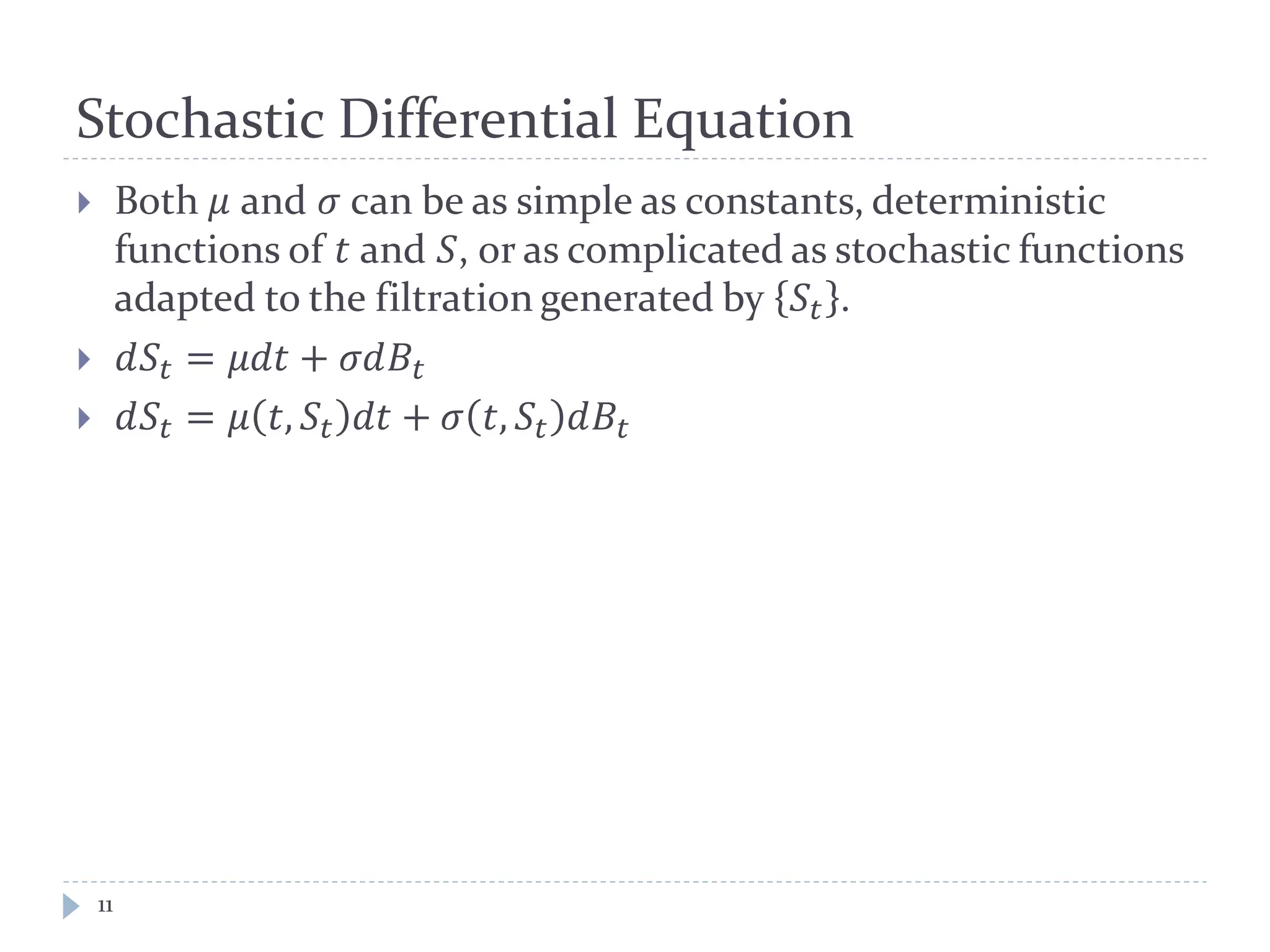
 Both 𝜇 and 𝜎 can be as simple as constants, deterministic
functions of 𝑡 and 𝑆, or as complicated as stochastic functions
adapted to the filtration generated by 𝑆𝑡 .
 𝑑𝑆𝑡 = 𝜇𝜇𝜇 + đœŽđœŽđ”đ‘Ą
 𝑑𝑆𝑡 = 𝜇 𝑡, 𝑆𝑡 𝑑𝑑 + 𝜎 𝑡, 𝑆𝑡 đ‘‘đ”đ‘Ą
Univariate Ito’s Lemma
12
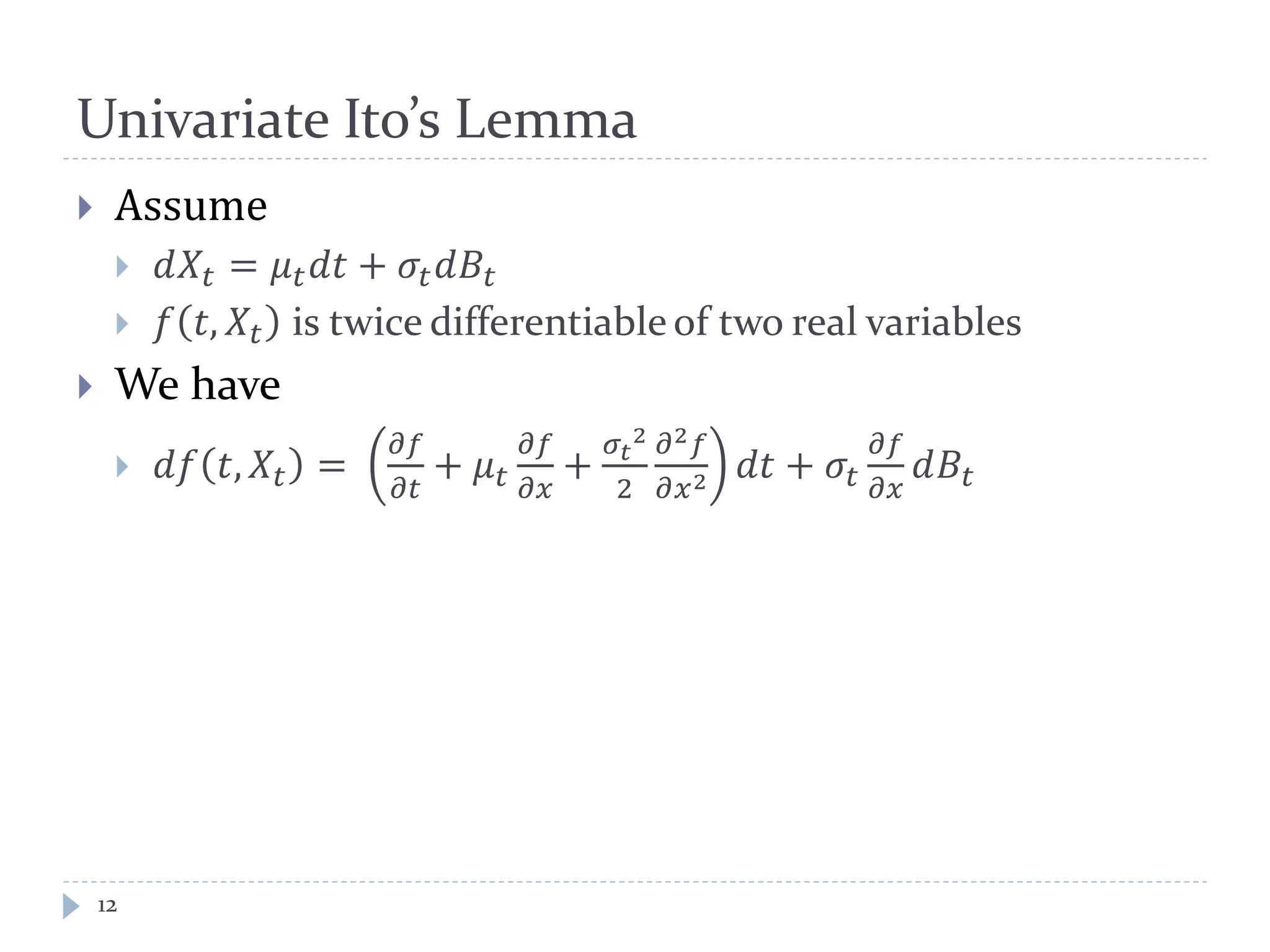
 Assume
 𝑑𝑋𝑡 = 𝜇 𝑡 𝑑𝑑 + 𝜎𝑡 đ‘‘đ”đ‘Ą
 𝑓 𝑡, 𝑋𝑡 is twice differentiable of two real variables
 We have
 𝑑𝑑 𝑡, 𝑋𝑡 =
𝜕𝜕
𝜕𝜕
+ 𝜇 𝑡
𝜕𝜕
𝜕𝜕
+
𝜎𝑡
2
2
𝜕2 𝑓
đœ•đ‘„2 𝑑𝑑 + 𝜎𝑡
𝜕𝜕
𝜕𝜕
đ‘‘đ”đ‘Ą
“Proof”
13
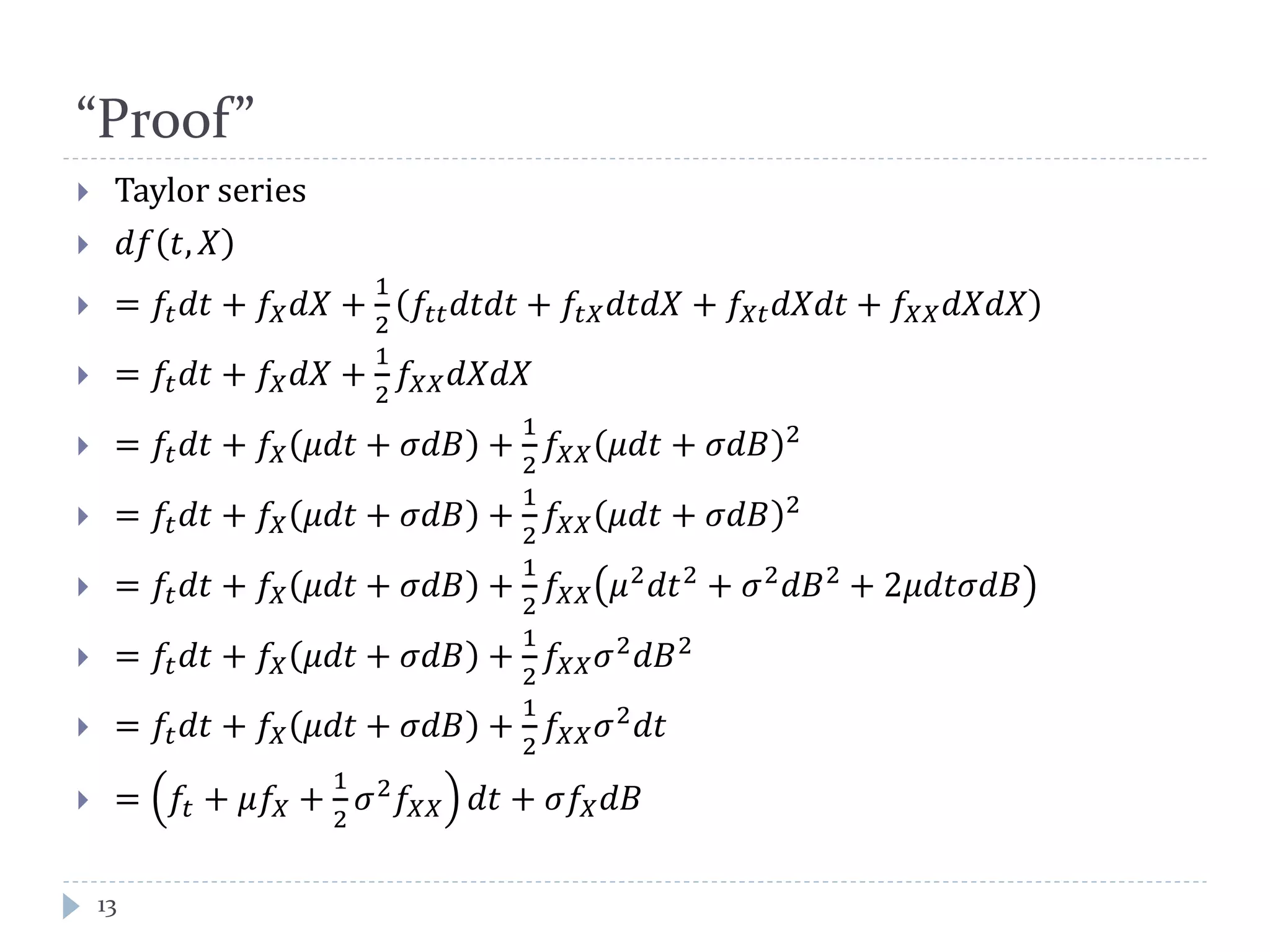
 Taylor series
 𝑑𝑓 𝑡, 𝑋
 = 𝑓𝑡 𝑑𝑑 + 𝑓𝑋 𝑑𝑋 +
1
2
𝑓𝑡𝑡 𝑑𝑑𝑑𝑑 + 𝑓𝑡𝑋 𝑑𝑑𝑑𝑋 + 𝑓𝑋𝑋 𝑑𝑋𝑑𝑡 + 𝑓𝑋𝑋 𝑑𝑑𝑑𝑋
 = 𝑓𝑡 𝑑𝑑 + 𝑓𝑋 𝑑𝑑 +
1
2
𝑓𝑋 𝑋 𝑑𝑑𝑑𝑑
 = 𝑓𝑡 𝑑𝑑 + 𝑓𝑋 𝜇𝑑𝑑 + đœŽđ‘‘đ” +
1
2
𝑓𝑋𝑋 𝜇𝑑𝑑 + 𝜎𝑑𝑑 2
 = 𝑓𝑡 𝑑𝑑 + 𝑓𝑋 𝜇𝑑𝑑 + 𝜎𝑑𝑑 +
1
2
𝑓𝑋𝑋 𝜇𝑑𝑑 + 𝜎𝑑𝑑 2
 = 𝑓𝑡 𝑑𝑑 + 𝑓𝑋 𝜇𝑑𝑑 + 𝜎𝑑𝑑 +
1
2
𝑓𝑋𝑋 𝜇2
𝑑𝑑2
+ 𝜎2
đ‘‘đ”2
+ 2𝜇𝑑𝑑𝜎𝑑𝑑
 = 𝑓𝑡 𝑑𝑑 + 𝑓𝑋 𝜇𝑑𝑑 + 𝜎𝑑𝑑 +
1
2
𝑓𝑋𝑋 𝜎2
𝑑𝑑2
 = 𝑓𝑡 𝑑𝑑 + 𝑓𝑋 𝜇𝑑𝑑 + 𝜎𝑑𝑑 +
1
2
𝑓𝑋𝑋 𝜎2
𝑑𝑑
 = 𝑓𝑡 + 𝜇𝑓𝑋 +
1
2
𝜎2
𝑓𝑋 𝑋 𝑑𝑑 + 𝜎𝑓𝑋 𝑑𝑑
Log Example
14
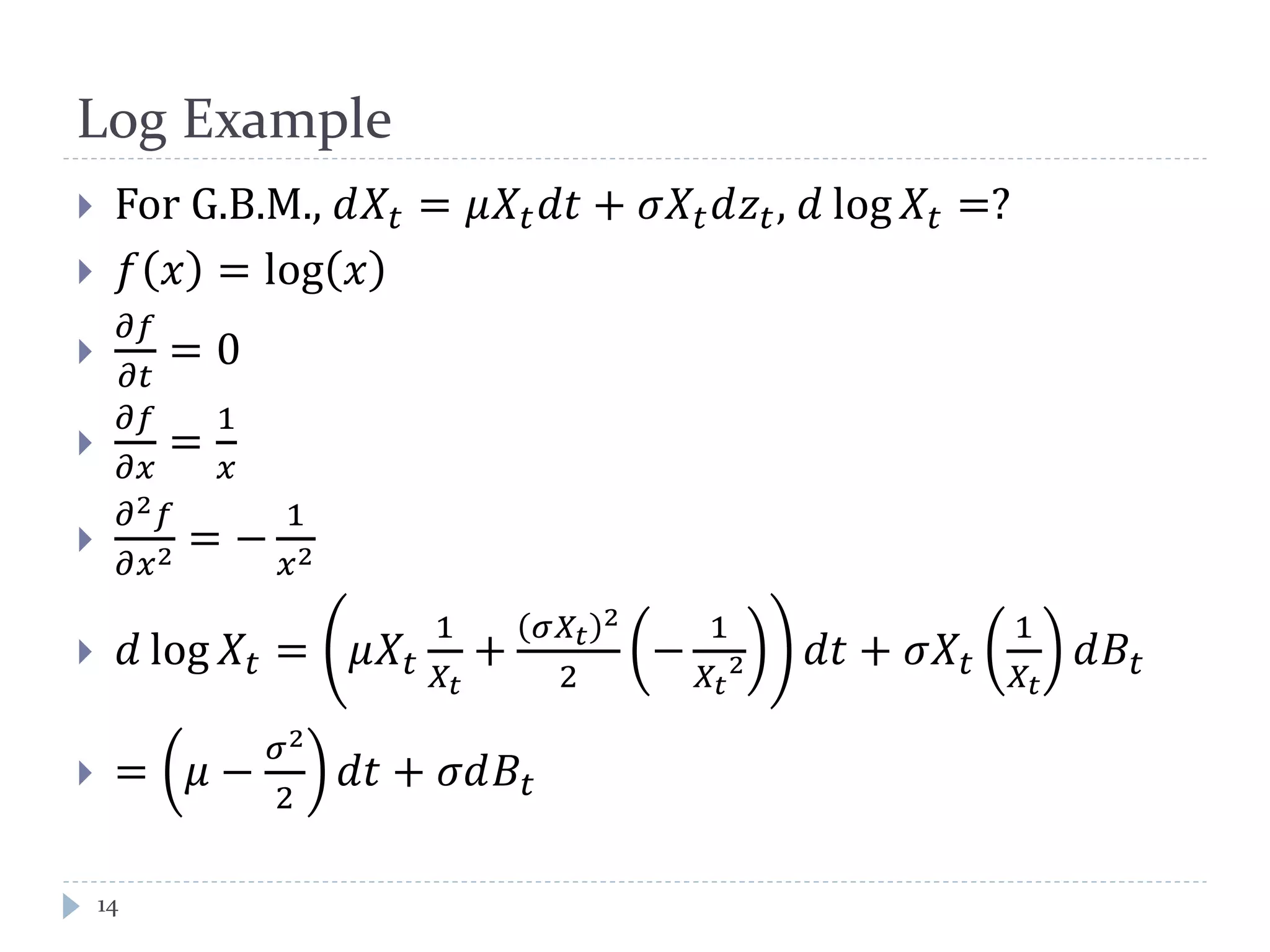
 For G.B.M., 𝑑𝑋𝑡 = 𝜇𝑋𝑡 𝑑𝑑 + 𝜎𝑋𝑡 𝑑𝑧𝑡, 𝑑 log 𝑋𝑡 =?
 𝑓 đ‘„ = log đ‘„

𝜕𝑓
𝜕𝑡
= 0

𝜕𝑓
đœ•đ‘„
=
1
đ‘„

𝜕2 𝑓
đœ•đ‘„2 = −
1
đ‘„2
 𝑑 log 𝑋𝑡 = 𝜇𝑋𝑡
1
𝑋𝑡
+
𝜎𝑋𝑡
2
2
−
1
𝑋𝑡
2 𝑑𝑑 + 𝜎𝑋𝑡
1
𝑋𝑡
đ‘‘đ”đ‘Ą
 = 𝜇 −
𝜎2
2
𝑑𝑑 + đœŽđ‘‘đ”đ‘Ą
Exp Example
15
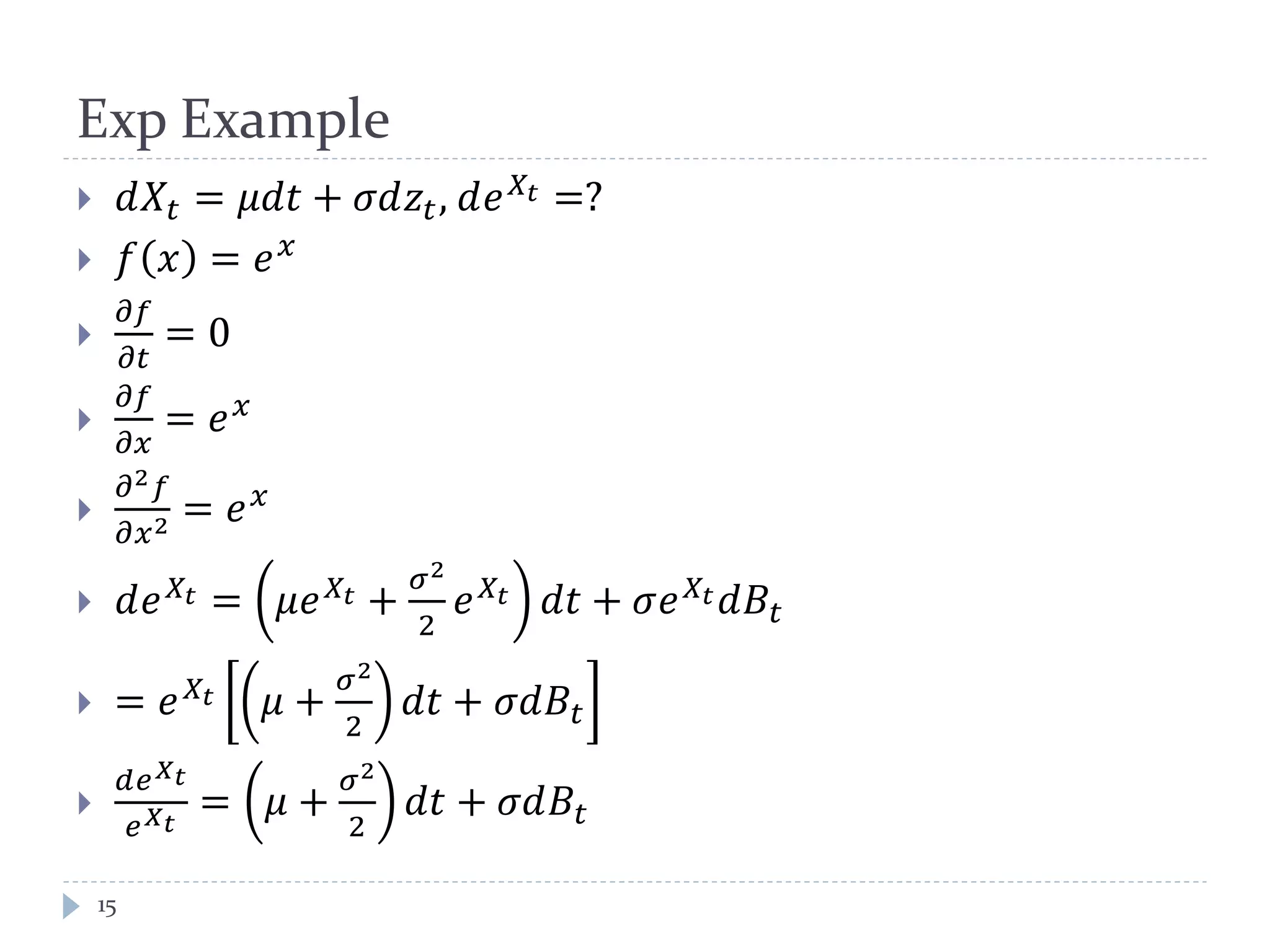
 𝑑𝑋𝑡 = 𝜇𝑑𝑑 + 𝜎𝑑𝑧𝑡, 𝑑𝑒 𝑋𝑡 =?
 𝑓 đ‘„ = 𝑒 đ‘„

𝜕𝑓
𝜕𝑡
= 0

𝜕𝑓
đœ•đ‘„
= 𝑒 đ‘„

𝜕2 𝑓
đœ•đ‘„2 = 𝑒 đ‘„
 𝑑𝑒 𝑋𝑡 = 𝜇𝑒 𝑋𝑡 +
𝜎2
2
𝑒 𝑋𝑡 𝑑𝑑 + 𝜎𝑒 𝑋𝑡 đ‘‘đ”đ‘Ą
 = 𝑒 𝑋𝑡 𝜇 +
𝜎2
2
𝑑𝑑 + đœŽđ‘‘đ”đ‘Ą

𝑑𝑒 𝑋 𝑡
𝑒 𝑋 𝑡
= 𝜇 +
𝜎2
2
𝑑𝑑 + đœŽđ‘‘đ”đ‘Ą
Stopping Time
16
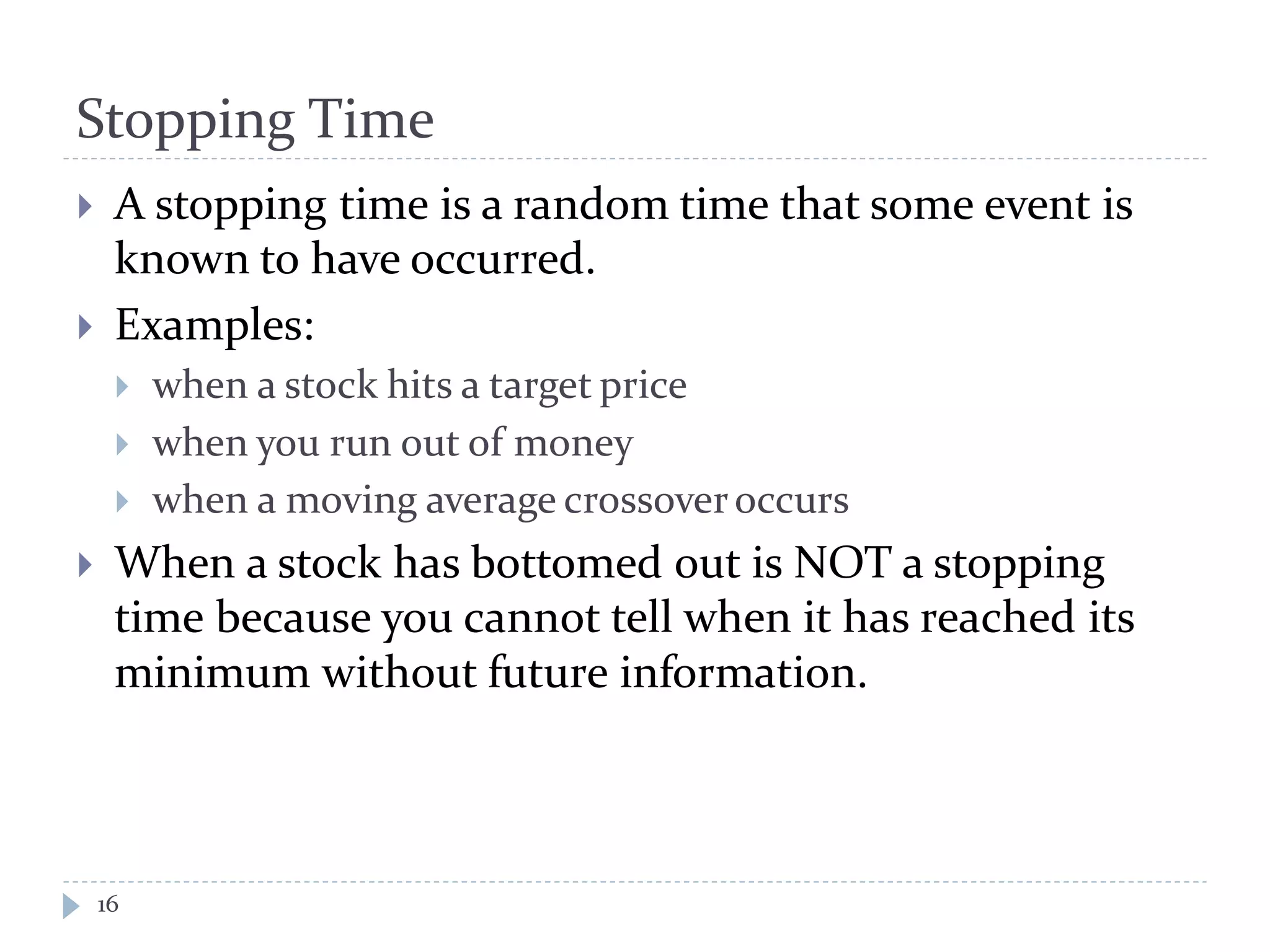
 A stopping time is a random time that some event is
known to have occurred.
 Examples:
 when a stock hits a target price
 when you run out of money
 when a moving average crossoveroccurs
 When a stock has bottomed out is NOT a stopping
time because you cannot tell when it has reached its
minimum without future information.
Optimal Trend Following Strategy
17
Asset Model
18
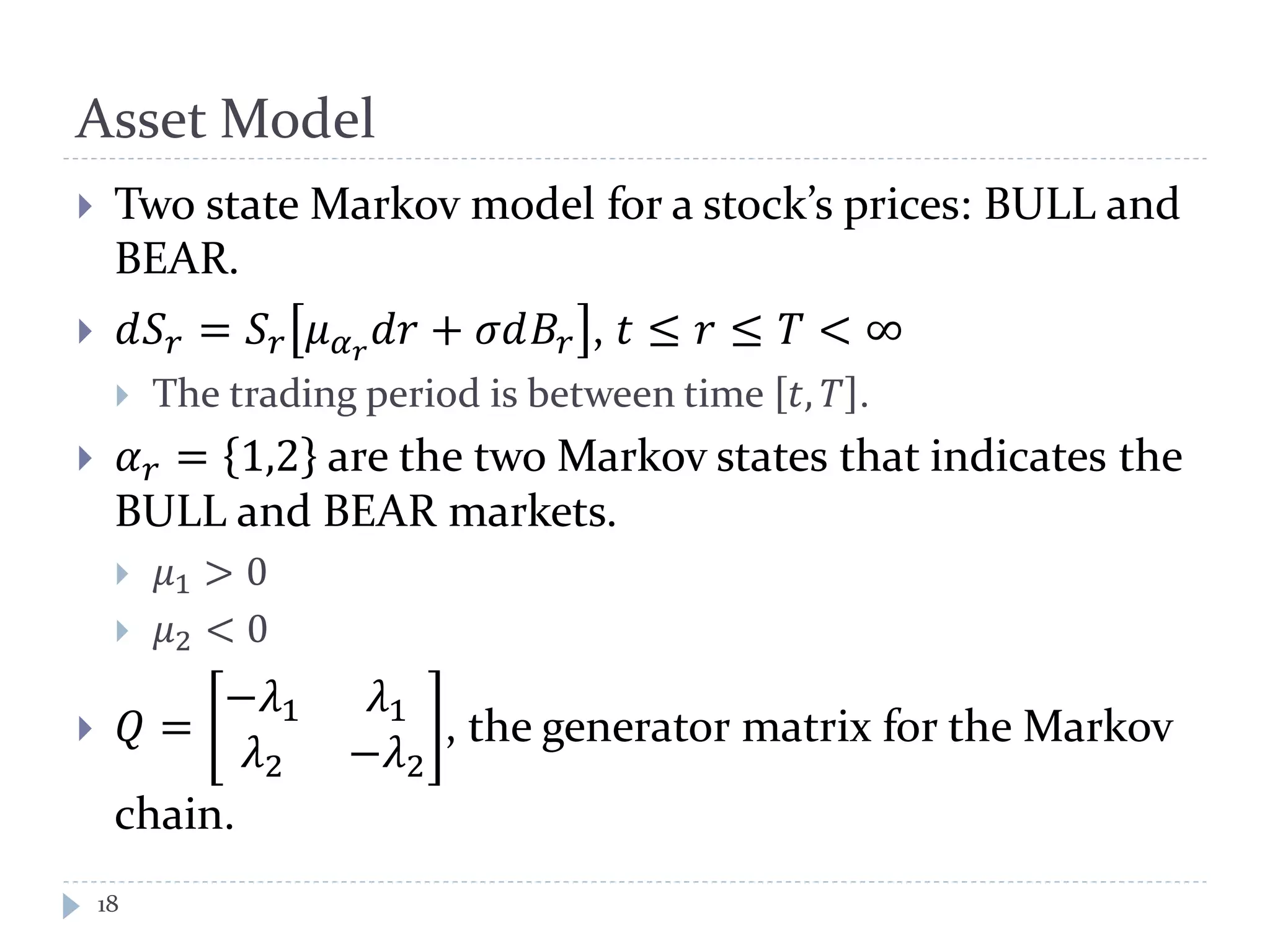
 Two state Markov model for a stock’s prices: BULL and
BEAR.
 𝑑𝑆 𝑟 = 𝑆 𝑟 𝜇 đ›Œ 𝑟
𝑑𝑑 + đœŽđœŽđ”đ‘Ÿ , 𝑡 ≀ 𝑟 ≀ 𝑇 < ∞
 The trading period is between time 𝑡, 𝑇 .
 đ›Œ 𝑟 = 1,2 are the two Markov states that indicates the
BULL and BEAR markets.
 𝜇1 > 0
 𝜇2 < 0
 𝑄 =
−𝜆1 𝜆1
𝜆2 −𝜆2
, the generator matrix for the Markov
chain.
Generator Matrix
19
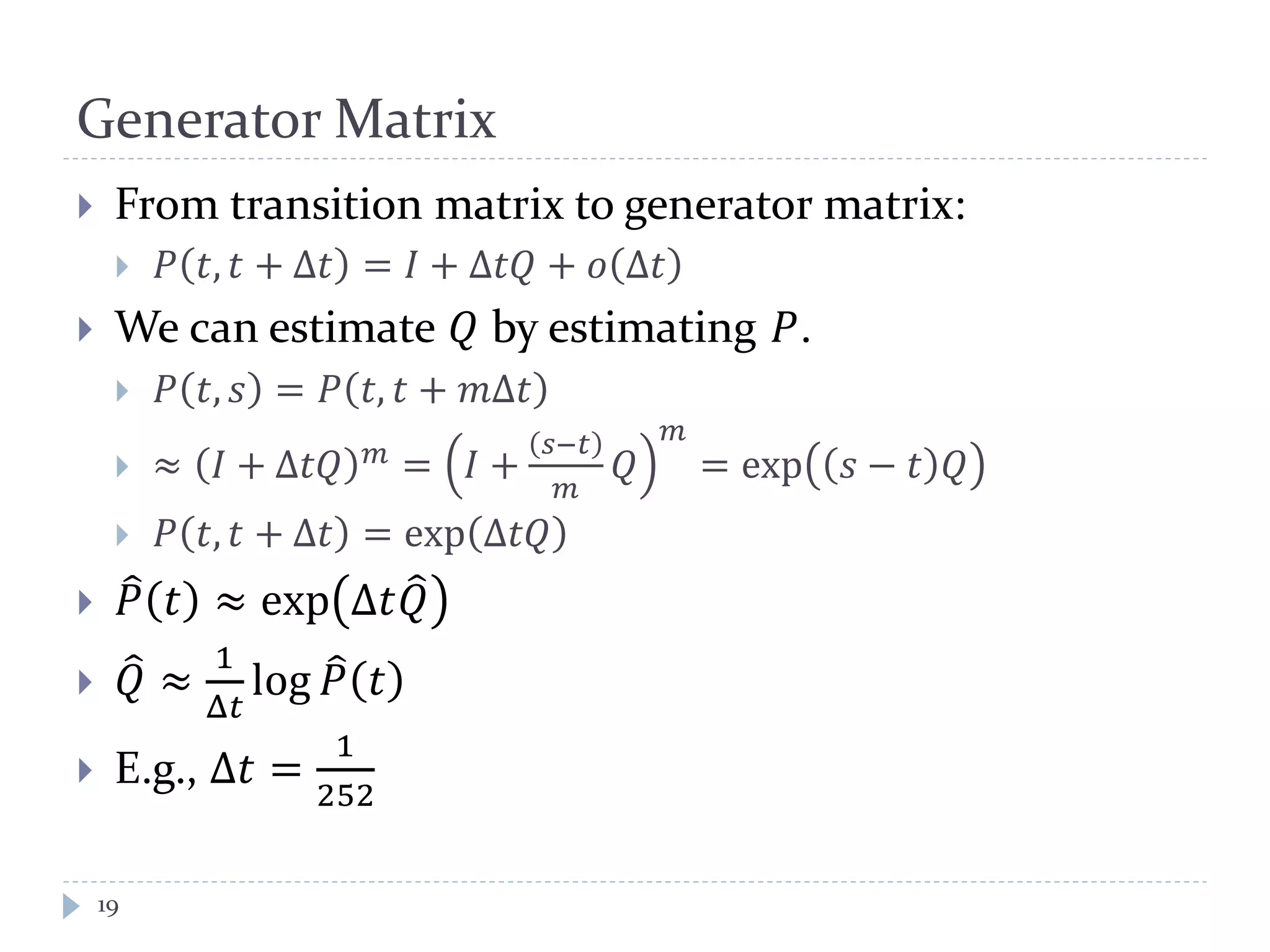
 From transition matrix to generator matrix:
 𝑃 𝑡, 𝑡 + Δ𝑡 = đŒ + Δ𝑡𝑡 + 𝑜 Δ𝑡
 We can estimate 𝑄 by estimating 𝑃.
 𝑃 𝑡, 𝑠 = 𝑃 𝑡, 𝑡 + 𝑚Δ𝑡
 ≈ đŒ + Δ𝑡𝑡 𝑚 = đŒ +
𝑠−𝑡
𝑚
𝑄
𝑚
= exp 𝑠 − 𝑡 𝑄
 𝑃 𝑡, 𝑡 + Δ𝑡 = exp Δ𝑡𝑡
 đ‘ƒïżœ 𝑡 ≈ exp Î”đ‘Ąđ‘„ïżœ
 đ‘„ïżœ ≈
1
Δ𝑡
log đ‘ƒïżœ 𝑡
 E.g., Δ𝑡 =
1
252
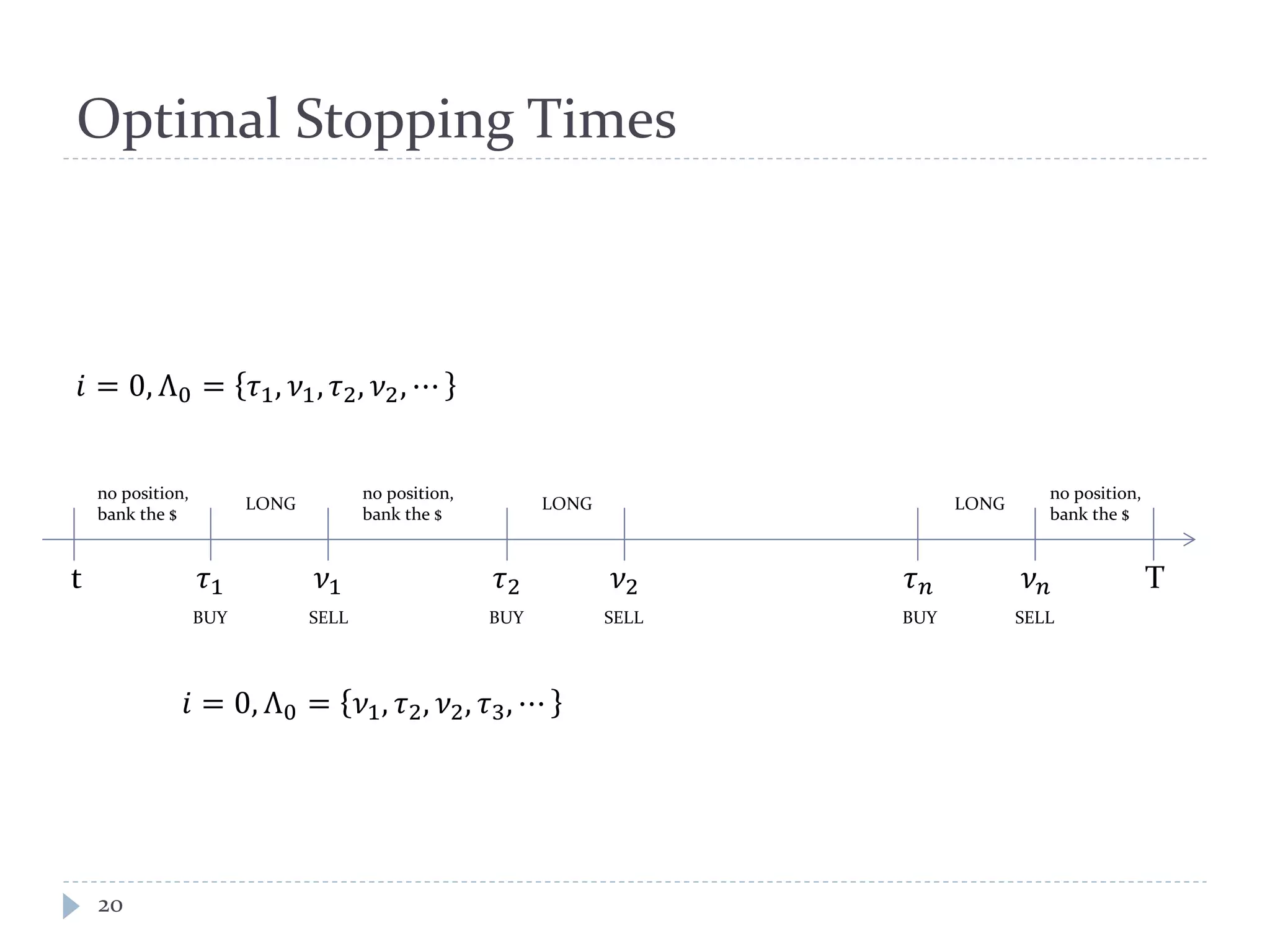
Optimal Stopping Times
20
t T𝜏1 𝜈1 𝜏2 𝜈2 𝜏 𝑛 𝜈 𝑛
𝑖 = 0, Λ0 = 𝜏1, 𝜈1, 𝜏2, 𝜈2, ⋯
𝑖 = 0, Λ0 = 𝜈1, 𝜏2, 𝜈2, 𝜏3, ⋯
BUY BUY BUYSELL SELL SELL
no position,
bank the $
no position,
bank the $
no position,
bank the $
LONG LONG LONG
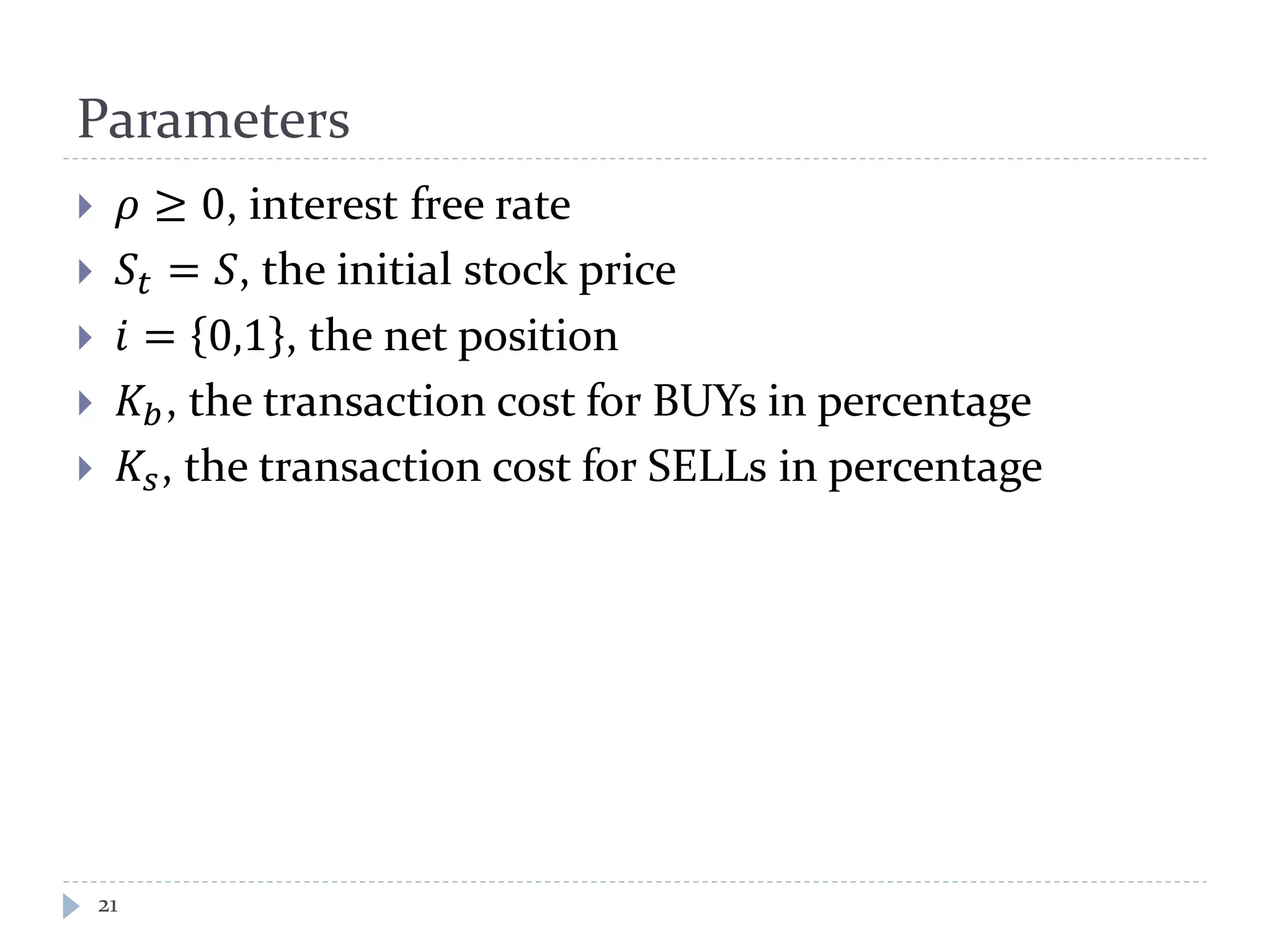
Parameters
21
 𝜌 ≄ 0, interest free rate
 𝑆𝑡 = 𝑆, the initial stock price
 𝑖 = 0,1 , the net position
 đŸđ‘, the transaction cost for BUYs in percentage
 đŸđ‘ , the transaction cost for SELLs in percentage
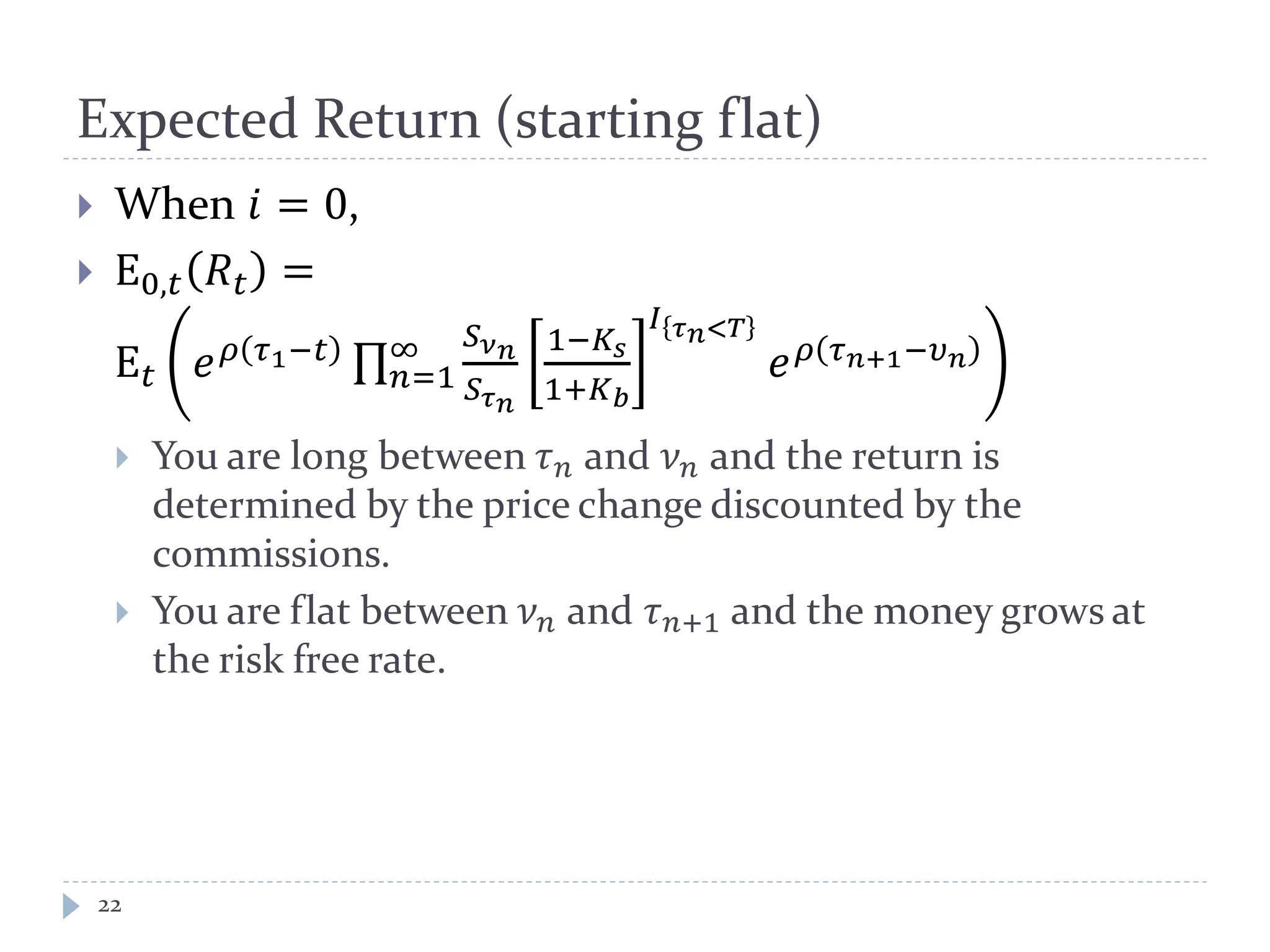
Expected Return (starting flat)
22
 When 𝑖 = 0,
 E0,𝑡 𝑅𝑡 =
E 𝑡 𝑒 𝜌 𝜏1−𝑡 ∏
𝑆 𝜈 𝑛
𝑆 𝜏 𝑛
1âˆ’đŸđ‘ 
1+đŸ 𝑏
đŒ 𝜏 𝑛<𝑇
𝑒 𝜌 𝜏 𝑛+1−𝜐 𝑛∞
𝑛=1
 You are long between 𝜏 𝑛 and 𝜈 𝑛 and the return is
determined by the price change discounted by the
commissions.
 You are flat between 𝜈 𝑛 and 𝜏 𝑛+1 and the money grows at
the risk free rate.
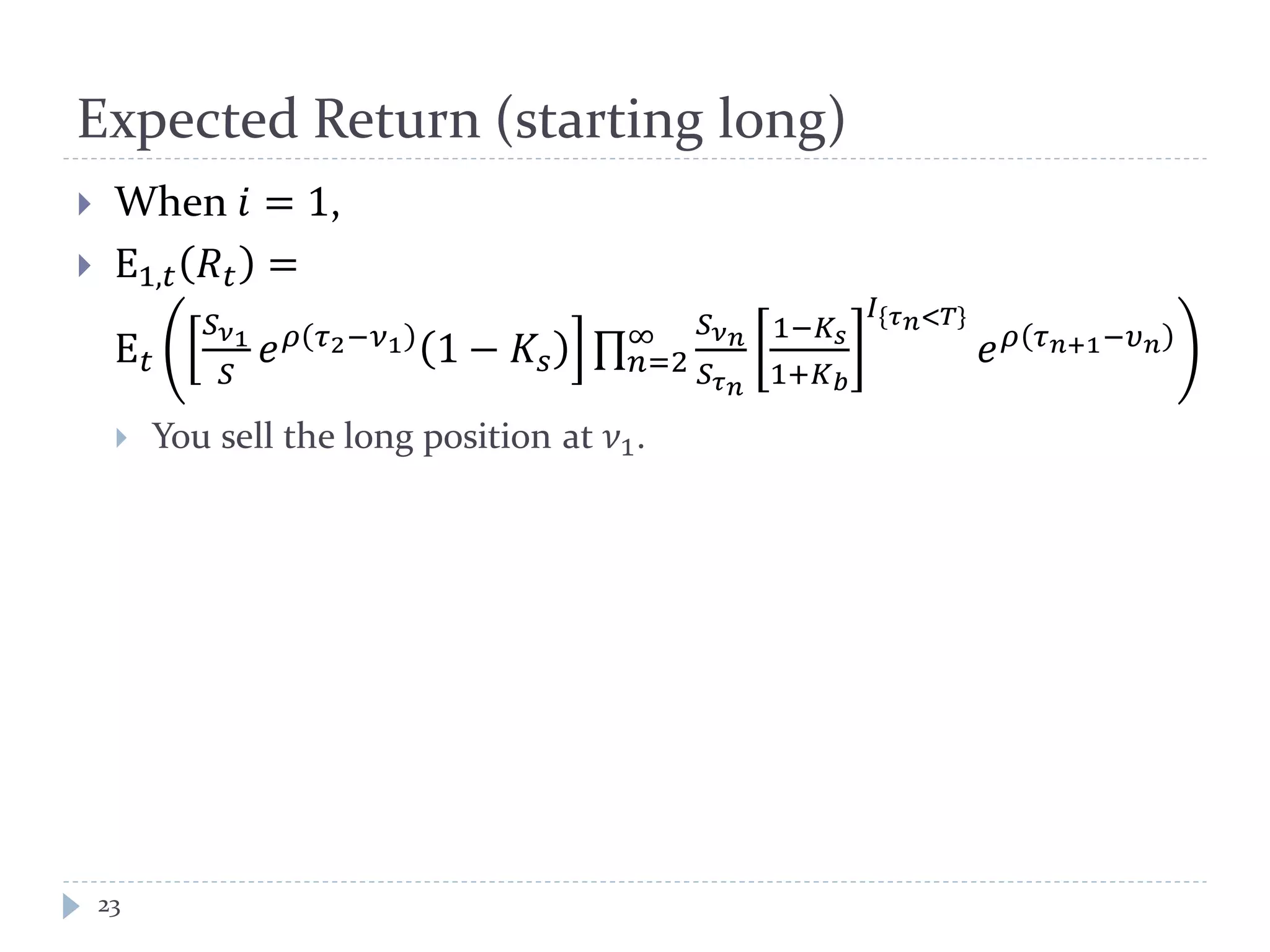
Expected Return (starting long)
23
 When 𝑖 = 1,
 E1,𝑡 𝑅 𝑡 =
E 𝑡
𝑆 𝜈1
𝑆
𝑒 𝜌 𝜏2−𝜈1 1 − đŸđ‘  ∏
𝑆 𝜈 𝑛
𝑆 𝜏 𝑛
1âˆ’đŸđ‘ 
1+đŸ 𝑏
đŒ 𝜏 𝑛<𝑇
𝑒 𝜌 𝜏 𝑛+1−𝜐 𝑛∞
𝑛=2
 You sell the long position at 𝜈1.
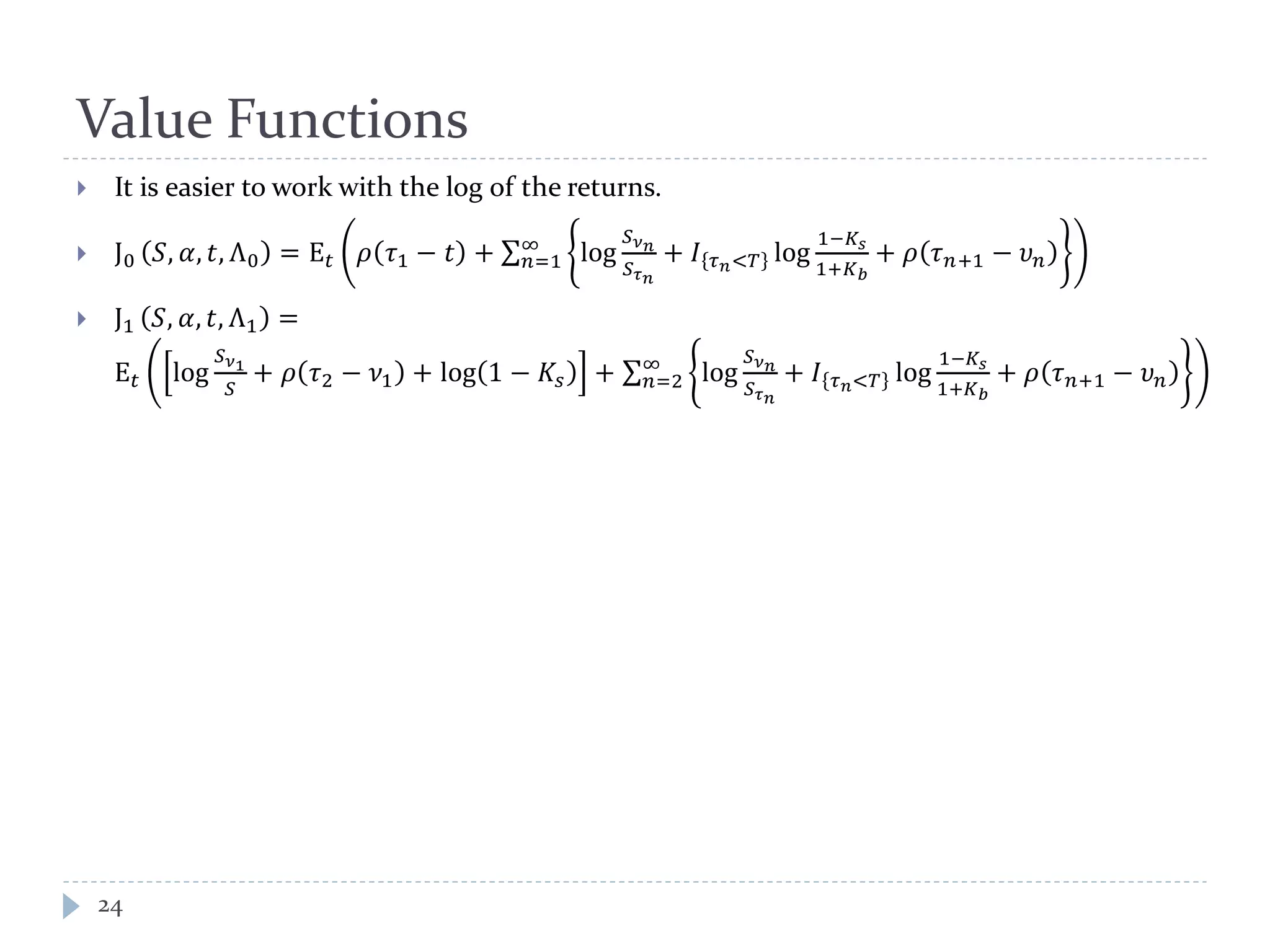
Value Functions
24
 It is easier to work with the log of the returns.
 J0 𝑆, đ›Œ, 𝑡, Λ0 = E 𝑡 𝜌 𝜏1 − 𝑡 + ∑ log
𝑆 𝜈 𝑛
𝑆 𝜏 𝑛
+ đŒ 𝜏 𝑛<𝑇 log
1âˆ’đŸđ‘ 
1+đŸ 𝑏
+ 𝜌 𝜏 𝑛+1 − 𝜐 𝑛
∞
𝑛=1
 J1 𝑆, đ›Œ, 𝑡, Λ1 =
E 𝑡 log
𝑆 𝜈1
𝑆
+ 𝜌 𝜏2 − 𝜈1 + log 1 − đŸđ‘  + ∑ log
𝑆 𝜈 𝑛
𝑆 𝜏 𝑛
+ đŒ 𝜏 𝑛<𝑇 log
1âˆ’đŸđ‘ 
1+đŸ 𝑏
+ 𝜌 𝜏 𝑛+1 − 𝜐 𝑛
∞
𝑛=2
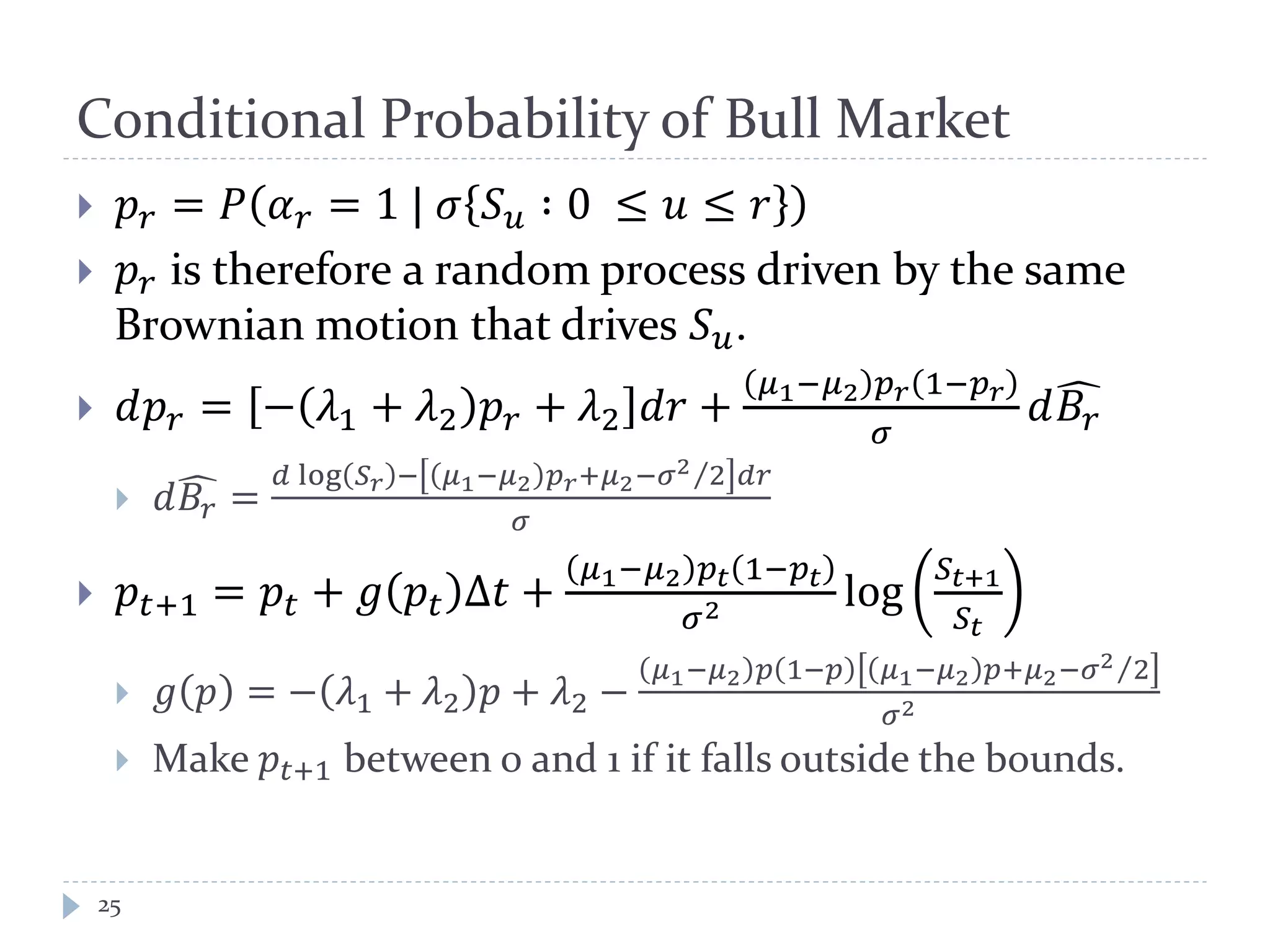
Conditional Probability of Bull Market
25
 𝑝 𝑟 = 𝑃 đ›Œ 𝑟 = 1 | 𝜎 𝑆 𝑱 ∶ 0 ≀ 𝑱 ≀ 𝑟
 𝑝 𝑟 is therefore a random process driven by the same
Brownian motion that drives 𝑆 𝑱.
 𝑑𝑝 𝑟 = − 𝜆1 + 𝜆2 𝑝 𝑟 + 𝜆2 𝑑𝑑 +
𝜇1−𝜇2 𝑝 𝑟 1−𝑝 𝑟
𝜎
đ‘‘đ”đ‘Ÿ
ïżœ
 đ‘‘đ”đ‘Ÿ
ïżœ =
𝑑 log 𝑆 𝑟 − 𝜇1−𝜇2 𝑝 𝑟+𝜇2−𝜎2 2⁄ 𝑑𝑑
𝜎
 𝑝𝑡+1 = 𝑝𝑡 + 𝑔 𝑝𝑡 Δ𝑡 +
𝜇1−𝜇2 𝑝𝑡 1−𝑝𝑡
𝜎2 log
𝑆𝑡+1
𝑆𝑡
 𝑔 𝑝 = − 𝜆1 + 𝜆2 𝑝 + 𝜆2 −
𝜇1−𝜇2 𝑝 1−𝑝 𝜇1−𝜇2 𝑝+𝜇2−𝜎2 2⁄
𝜎2
 Make 𝑝𝑡+1 between 0 and 1 if it falls outside the bounds.
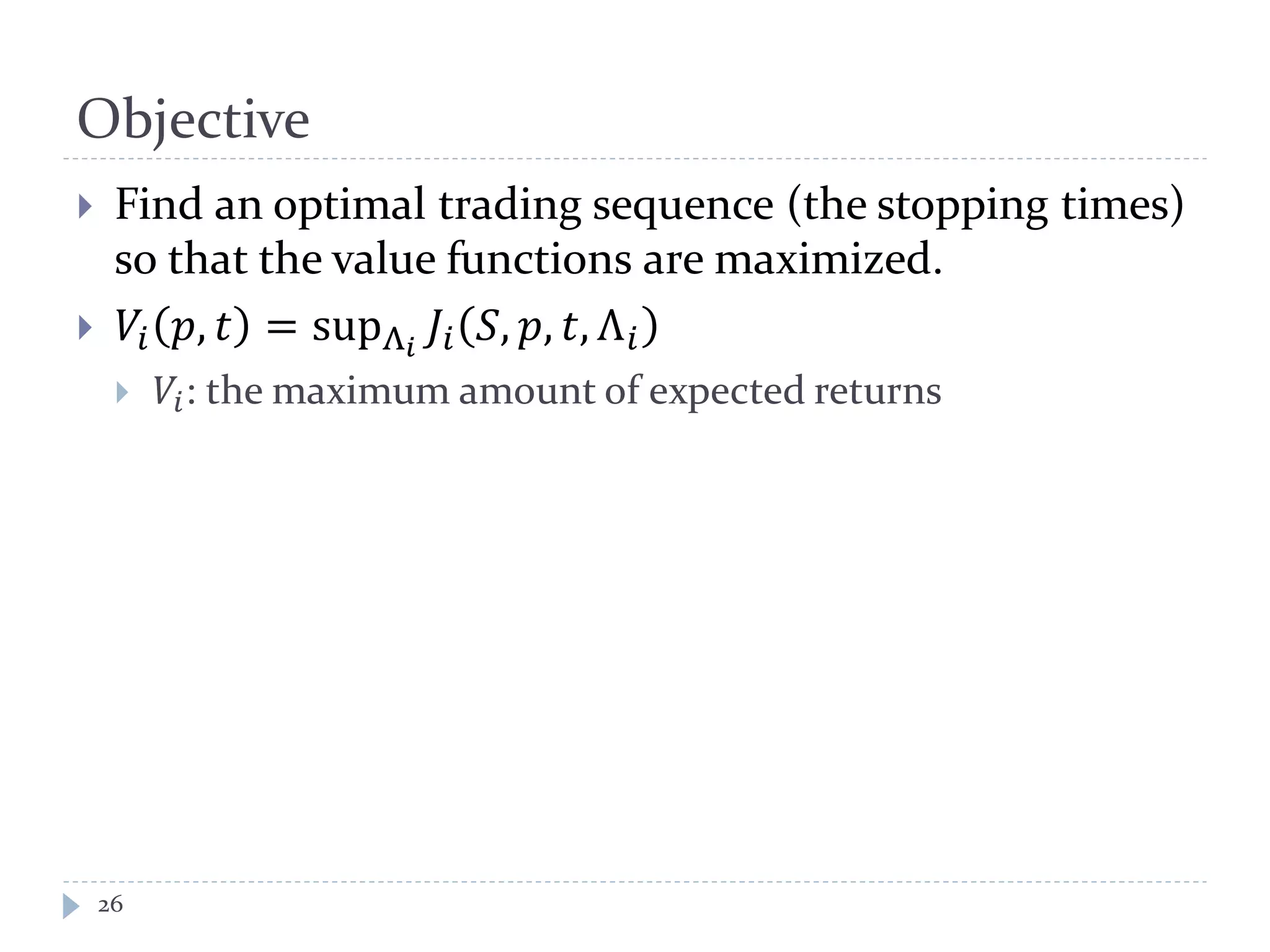
Objective
26
 Find an optimal trading sequence (the stopping times)
so that the value functions are maximized.
 𝑉𝑖 𝑝, 𝑡 = supΛ𝑖
đœđ‘– 𝑆, 𝑝, 𝑡, Λ 𝑖
 𝑉𝑖: the maximum amount of expected returns
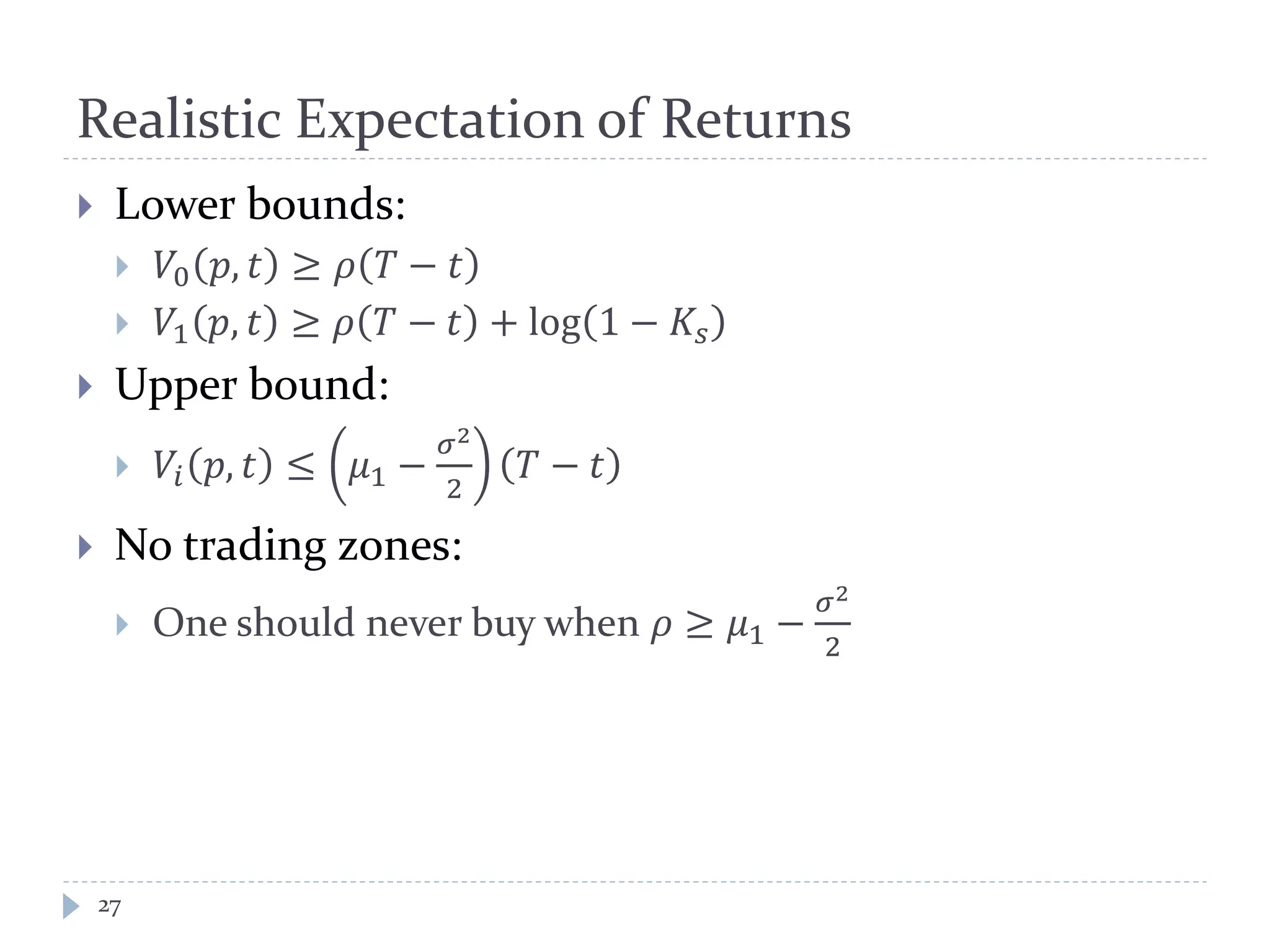
Realistic Expectation of Returns
27
 Lower bounds:
 𝑉0 𝑝, 𝑡 ≄ 𝜌 𝑇 − 𝑡
 𝑉1 𝑝, 𝑡 ≄ 𝜌 𝑇 − 𝑡 + log 1 − đŸđ‘ 
 Upper bound:
 𝑉𝑖 𝑝, 𝑡 ≀ 𝜇1 −
𝜎2
2
𝑇 − 𝑡
 No trading zones:
 One should never buy when 𝜌 ≄ 𝜇1 −
𝜎2
2
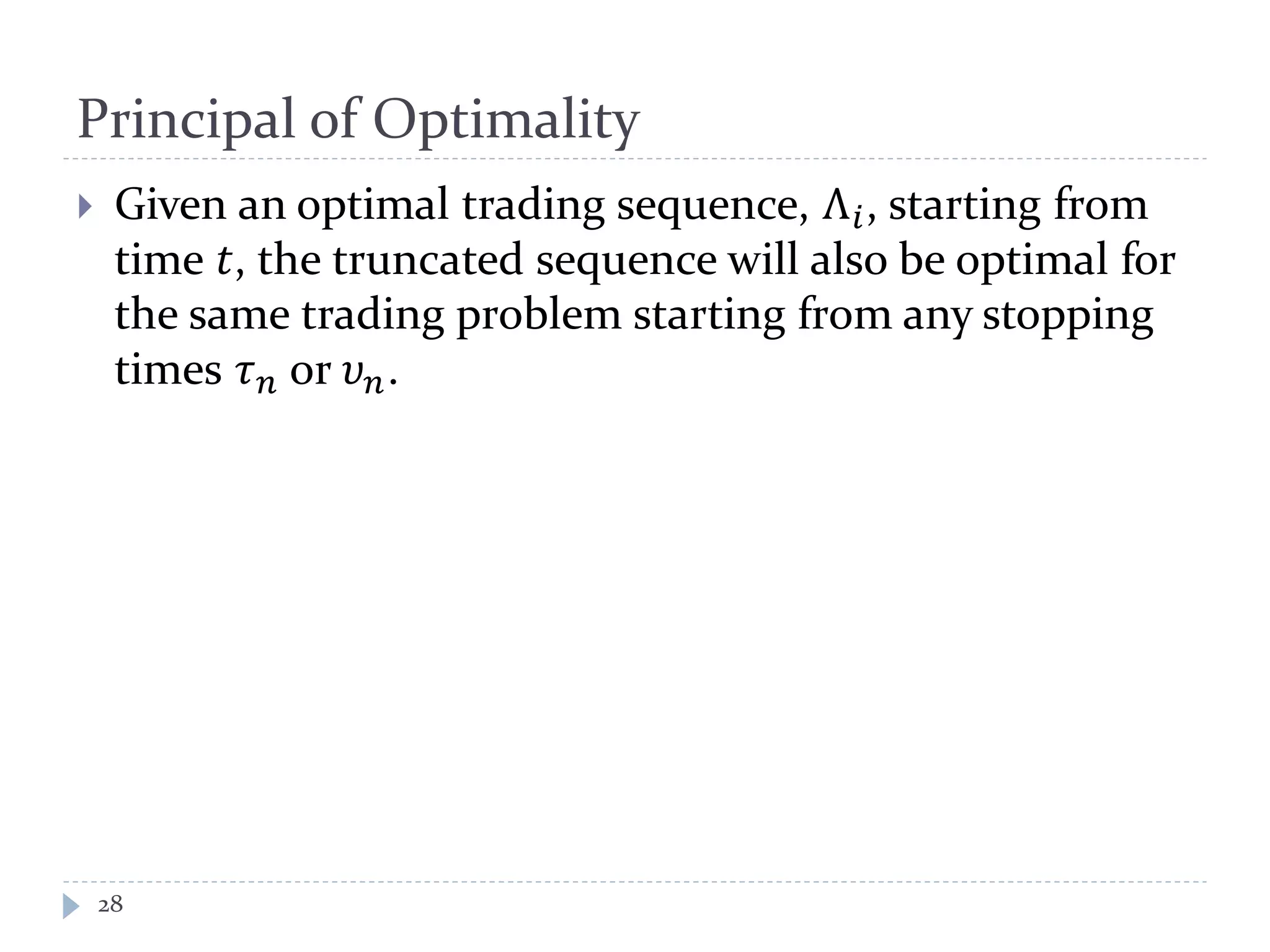
Principal of Optimality
28
 Given an optimal trading sequence, Λ 𝑖, starting from
time 𝑡, the truncated sequence will also be optimal for
the same trading problem starting from any stopping
times 𝜏 𝑛 or 𝜐 𝑛.
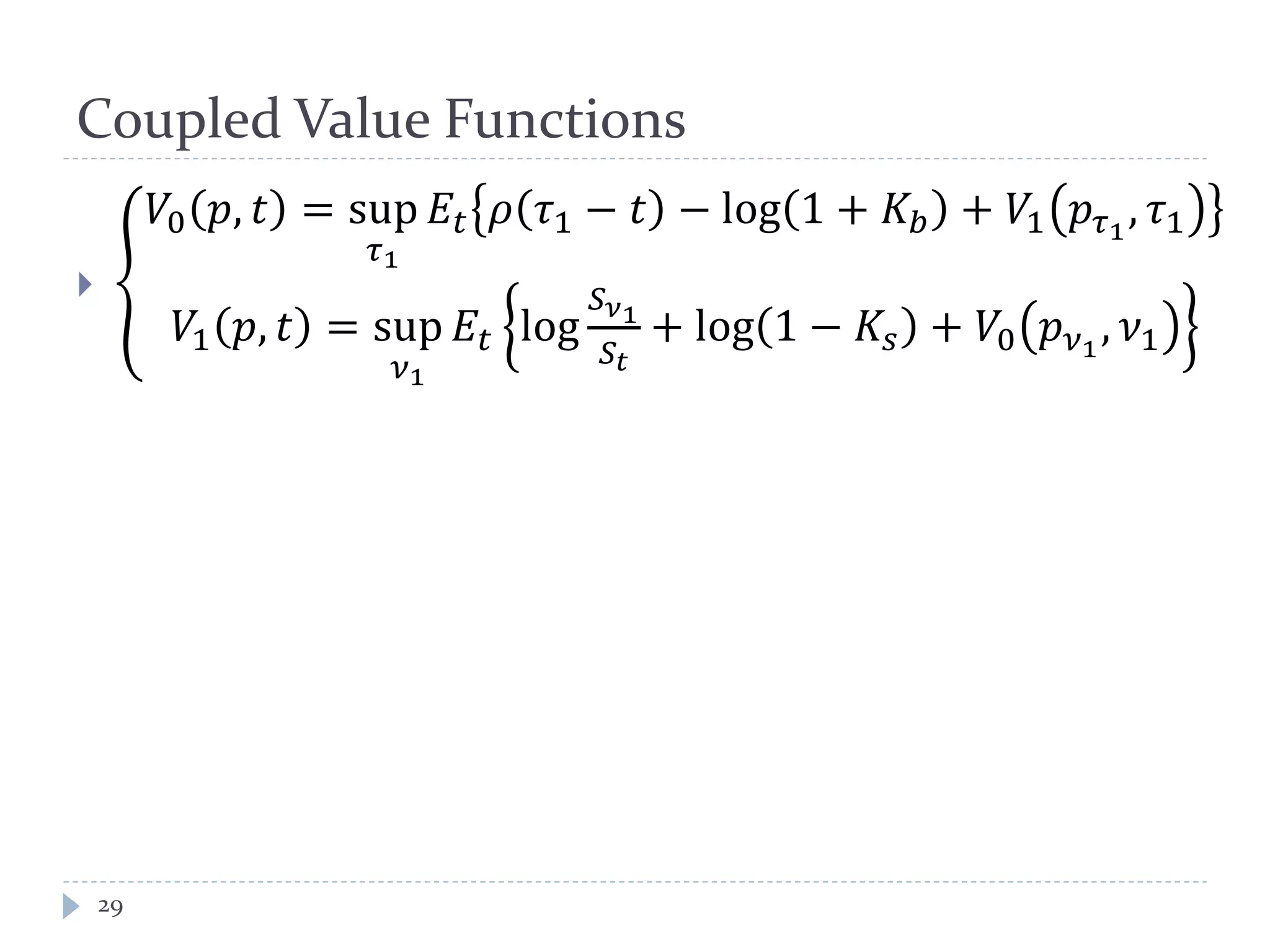
Coupled Value Functions
29
 ïżœ
𝑉0 𝑝, 𝑡 = sup
𝜏1
𝐾𝑡 𝜌 𝜏1 − 𝑡 − log 1 + đŸđ‘ + 𝑉1 𝑝𝜏1
, 𝜏1
𝑉1 𝑝, 𝑡 = sup
𝜈1
𝐾𝑡 log
𝑆 𝜈1
𝑆𝑡
+ log 1 − đŸđ‘  + 𝑉0 𝑝 𝜈1
, 𝜈1
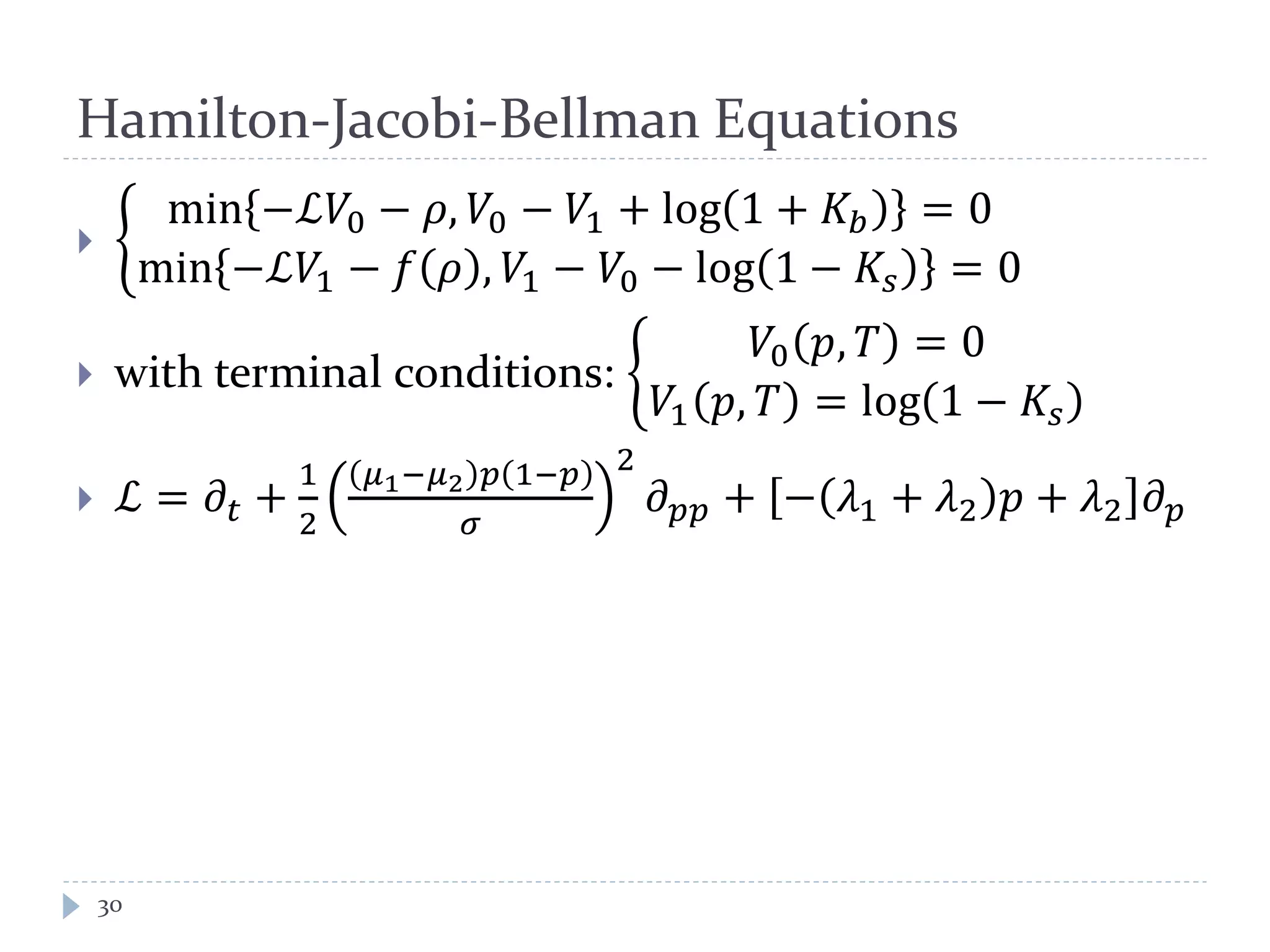
Hamilton-Jacobi-Bellman Equations
30
 ïżœ
min −ℒ𝑉0 − 𝜌, 𝑉0 − 𝑉1 + log 1 + đŸđ‘ = 0
min −ℒ𝑉1 − 𝑓 𝜌 , 𝑉1 − 𝑉0 − log 1 − đŸđ‘  = 0
 with terminal conditions: ïżœ
𝑉0 𝑝, 𝑇 = 0
𝑉1 𝑝, 𝑇 = log 1 − đŸđ‘ 
 ℒ = 𝜕𝑡 +
1
2
𝜇1−𝜇2 𝑝 1−𝑝
𝜎
2
𝜕 𝑝𝑝 + − 𝜆1 + 𝜆2 𝑝 + 𝜆2 𝜕 𝑝
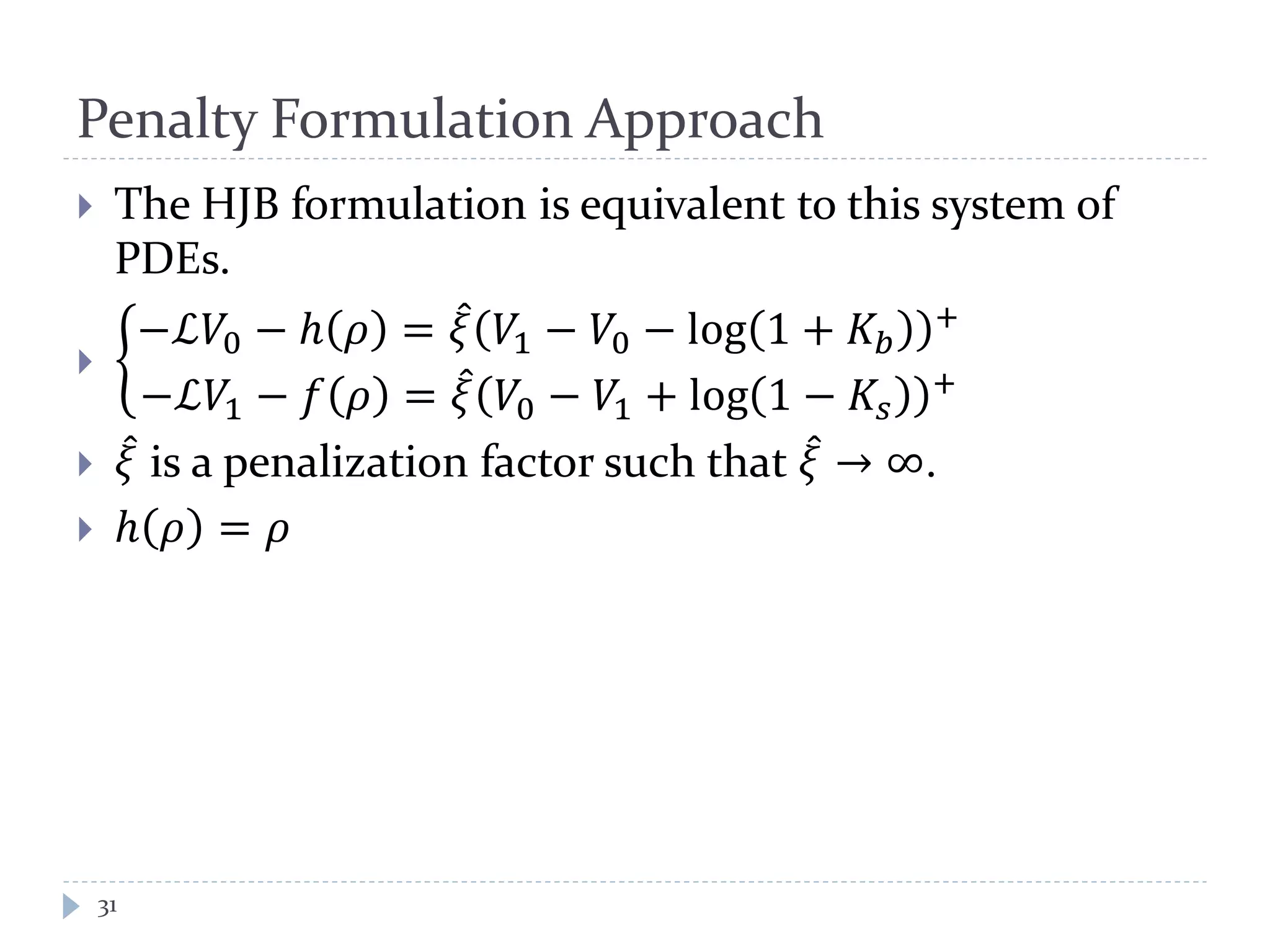
Penalty Formulation Approach
31
 The HJB formulation is equivalent to this system of
PDEs.
 ïżœ
−ℒ𝑉0 − ℎ 𝜌 = đœ‰Ì‚ 𝑉1 − 𝑉0 − log 1 + đŸđ‘
+
−ℒ𝑉1 − 𝑓 𝜌 = đœ‰Ì‚ 𝑉0 − 𝑉1 + log 1 − đŸđ‘ 
+
 đœ‰Ì‚ is a penalization factor such that đœ‰Ì‚ → ∞.
 ℎ 𝜌 = 𝜌
Trading Boundaries
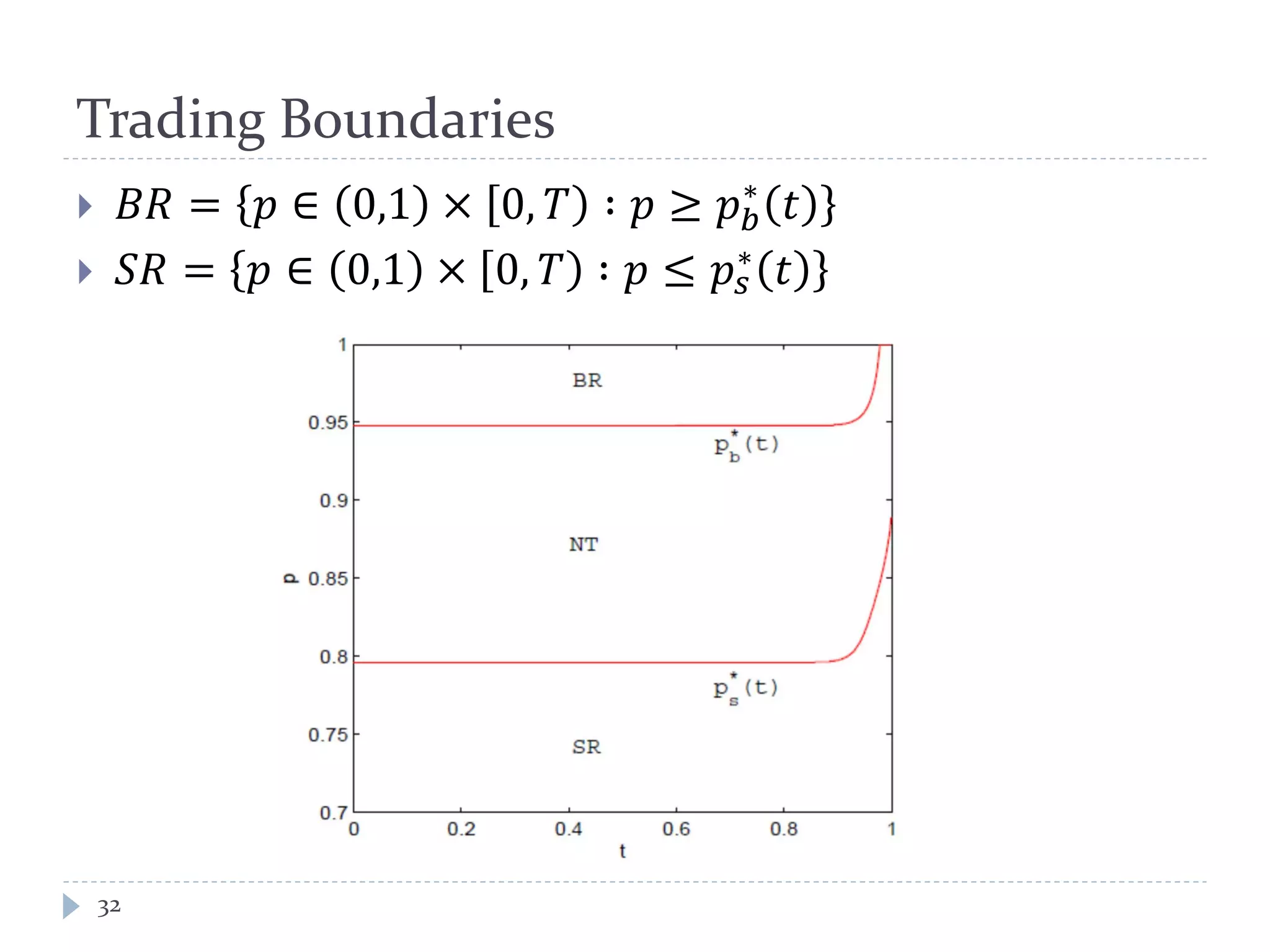
32
 đ”đ” = 𝑝 ∈ 0,1 × [0, 𝑇) ∶ 𝑝 ≄ 𝑝 𝑏
∗
𝑡
 𝑆𝑅 = 𝑝 ∈ 0,1 × [0, 𝑇) ∶ 𝑝 ≀ 𝑝𝑠
∗ 𝑡
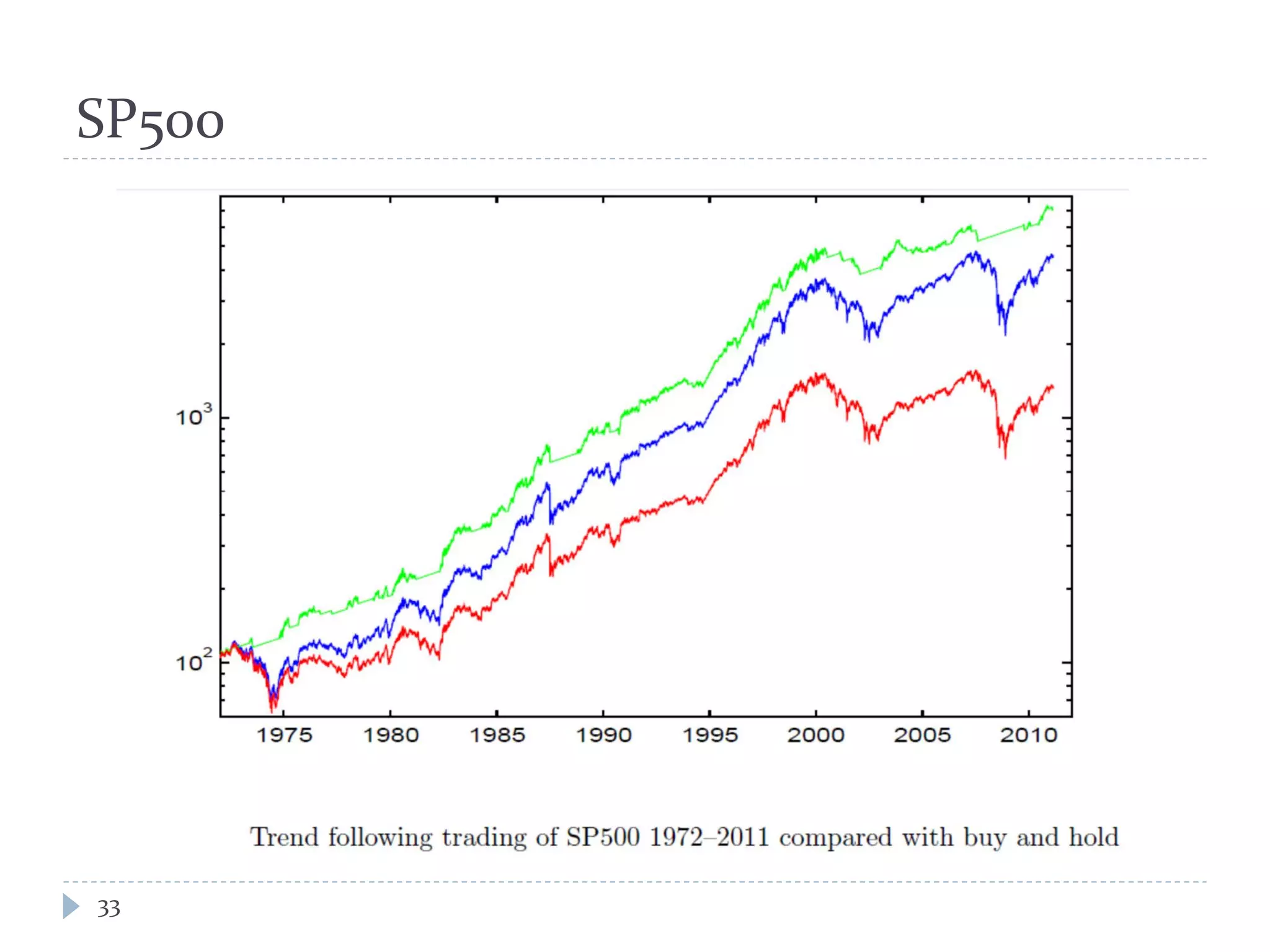
SP500
33
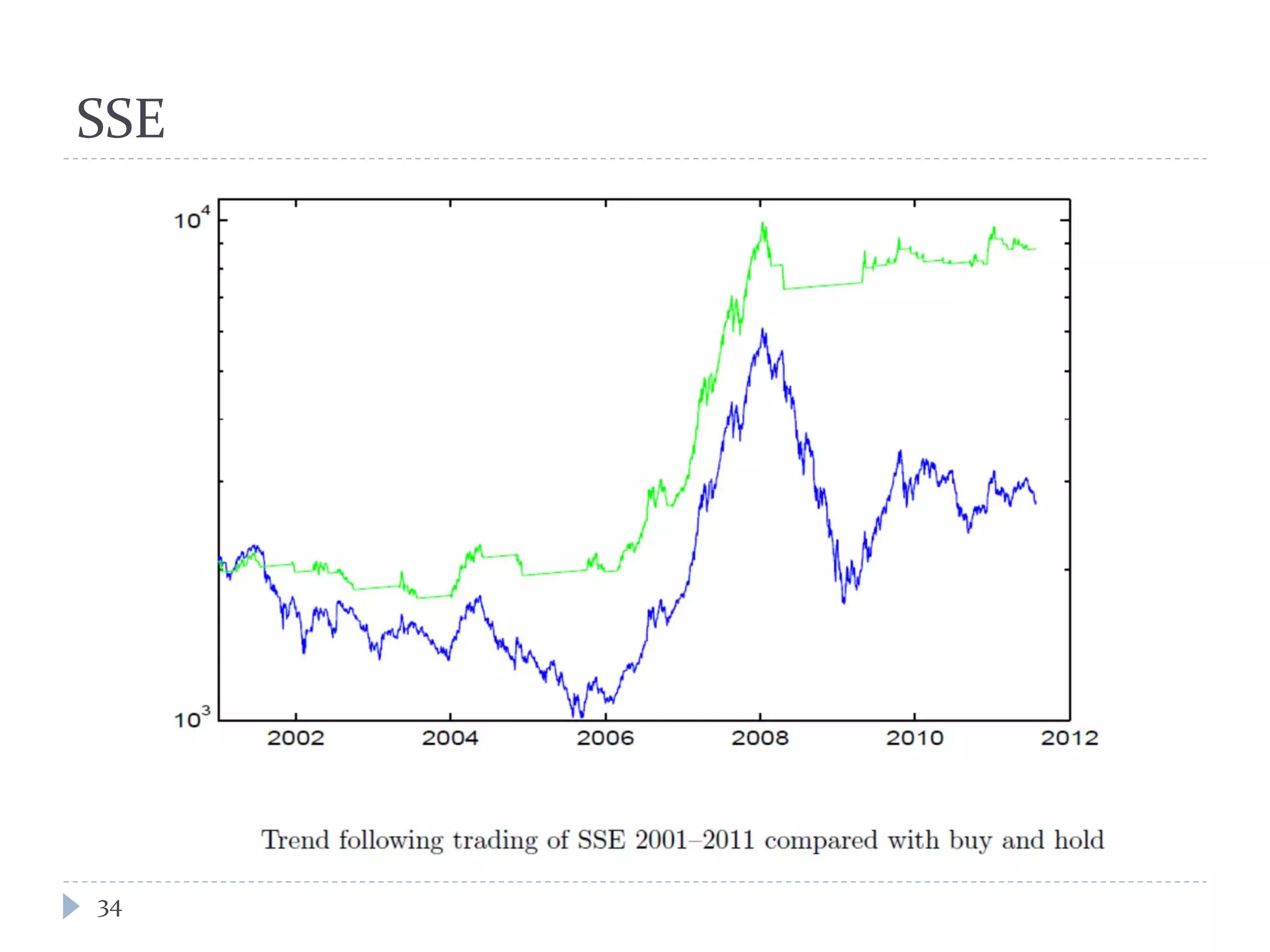
SSE
34
Problems
35
 The buy entry signals are always delayed (as expected).
 The market therefore needs to bull long enough for
the strategy to make profit.
 If the bear market comes in too fast and hard, the exit
entry may not come in soon enough.
 A proper stoploss from max drawdown may help.
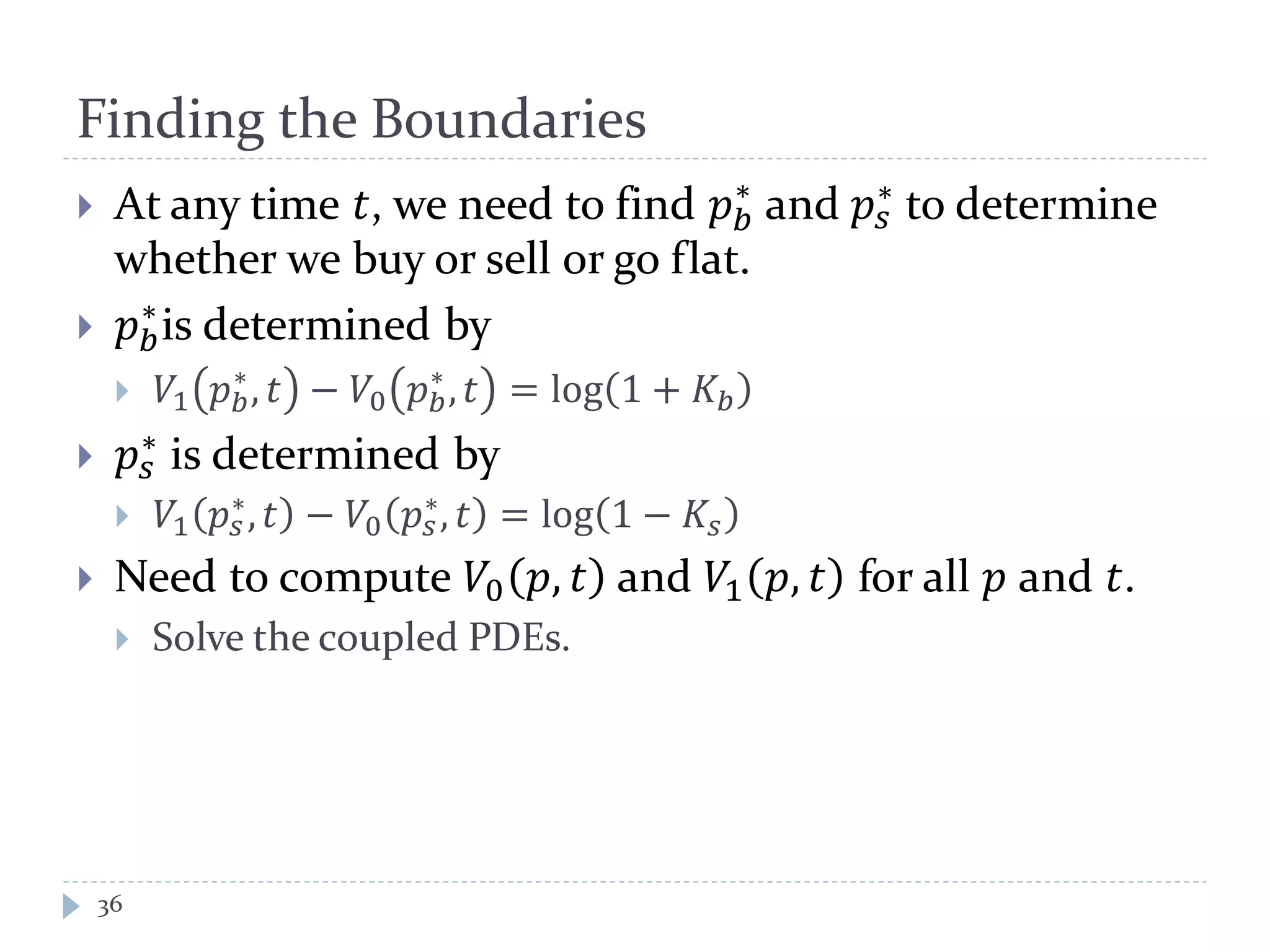
Finding the Boundaries
36
 At any time 𝑡, we need to find 𝑝 𝑏
∗
and 𝑝𝑠
∗ to determine
whether we buy or sell or go flat.
 𝑝 𝑏
∗
is determined by
 𝑉1 𝑝 𝑏
∗
, 𝑡 − 𝑉0 𝑝 𝑏
∗
, 𝑡 = log 1 + đŸđ‘
 𝑝𝑠
∗ is determined by
 𝑉1 𝑝𝑠
∗, 𝑡 − 𝑉0 𝑝𝑠
∗, 𝑡 = log 1 − đŸđ‘ 
 Need to compute 𝑉0 𝑝, 𝑡 and 𝑉1 𝑝, 𝑡 for all 𝑝 and 𝑡.
 Solve the coupled PDEs.
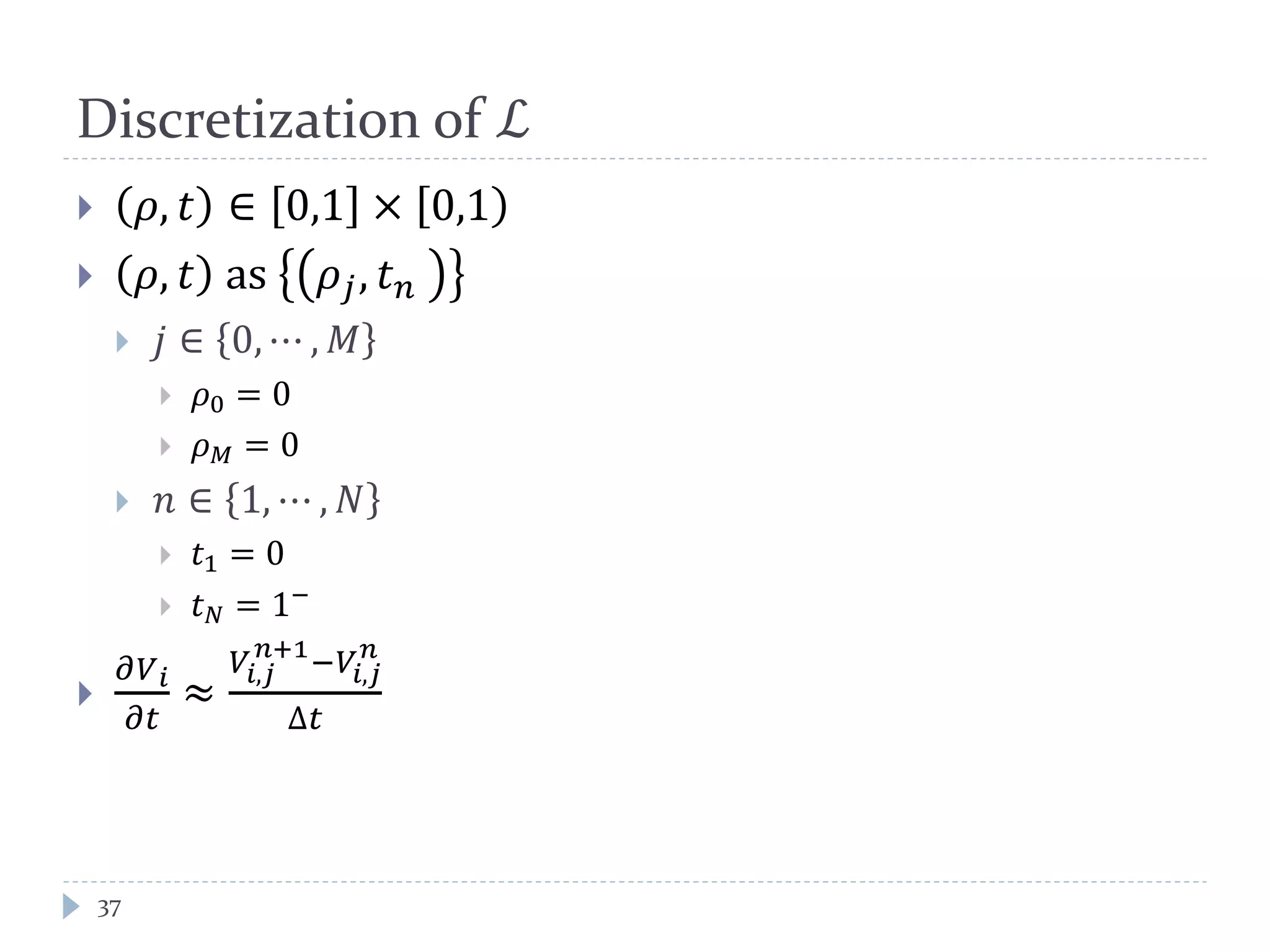
Discretization of ℒ
37
 𝜌, 𝑡 ∈ 0,1 × [0,1)
 𝜌, 𝑡 as 𝜌𝑗, 𝑡 𝑛
 𝑗 ∈ 0, ⋯ , 𝑀
 𝜌0 = 0
 𝜌 𝑀 = 0
 𝑛 ∈ 1, ⋯ , 𝑁
 𝑡1 = 0
 𝑡 𝑁 = 1−

𝜕𝑉 𝑖
𝜕𝑡
≈
𝑉𝑖,𝑗
𝑛+1
−𝑉𝑖,𝑗
𝑛
∆𝑡
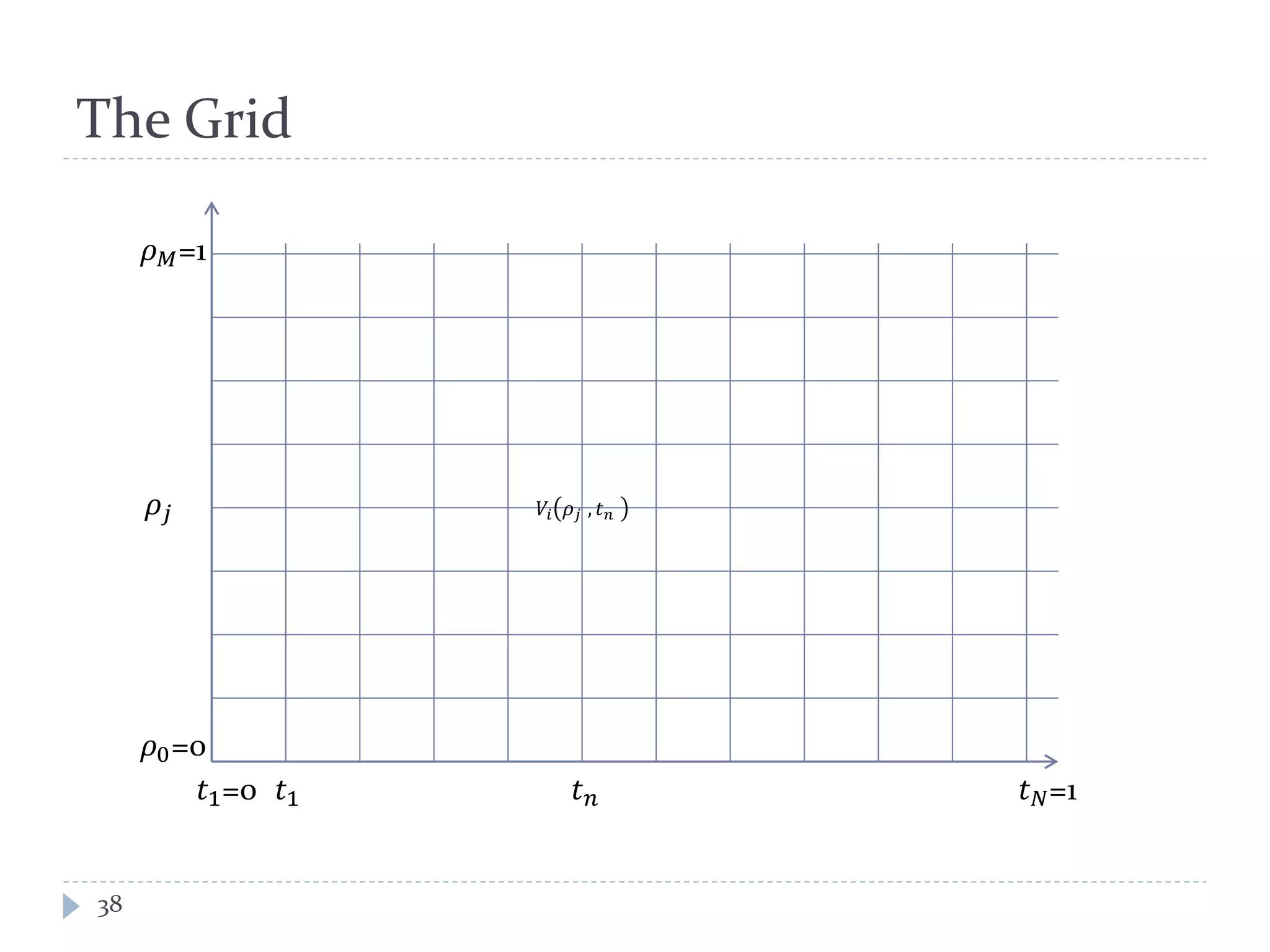
The Grid
38
𝑡1=0 𝑡1 𝑡 𝑁=1𝑡 𝑛
𝜌0=0
𝜌𝑗
𝜌 𝑀=1
𝑉𝑖 𝜌 𝑗 , 𝑡 𝑛
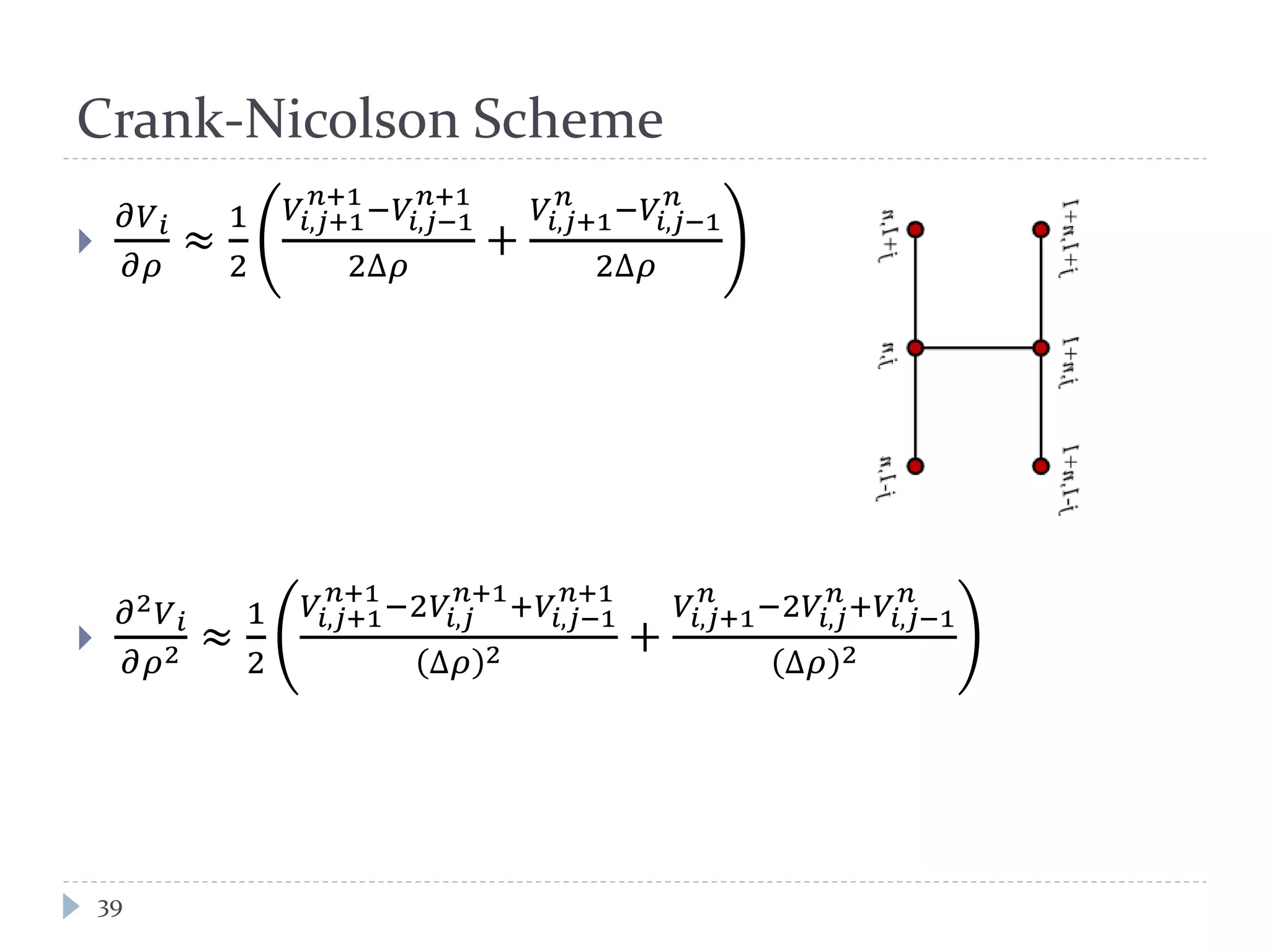
Crank-Nicolson Scheme
39

𝜕𝑉 𝑖
𝜕𝜌
≈
1
2
𝑉𝑖,𝑗+1
𝑛+1
−𝑉𝑖,𝑗−1
𝑛+1
2∆𝜌
+
𝑉𝑖,𝑗+1
𝑛
−𝑉𝑖,𝑗−1
𝑛
2∆𝜌

𝜕2 𝑉 𝑖
𝜕𝜌2 ≈
1
2
𝑉𝑖,𝑗+1
𝑛+1
−2𝑉𝑖,𝑗
𝑛+1
+𝑉𝑖,𝑗−1
𝑛+1
∆𝜌 2 +
𝑉𝑖,𝑗+1
𝑛
−2𝑉𝑖,𝑗
𝑛
+𝑉𝑖,𝑗−1
𝑛
∆𝜌 2
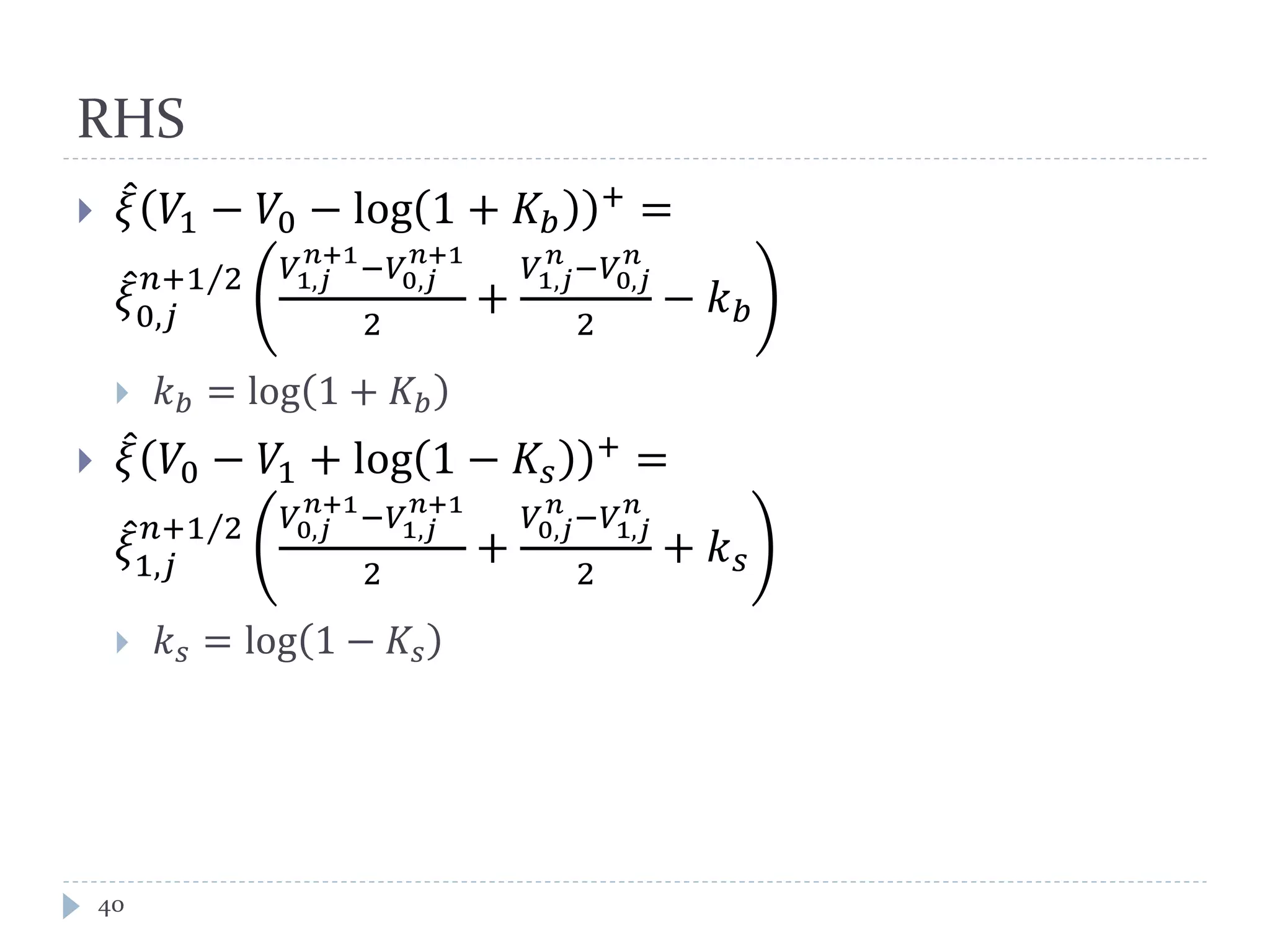
RHS
40
 đœ‰Ì‚ 𝑉1 − 𝑉0 − log 1 + đŸđ‘
+ =
đœ‰Ì‚
0,𝑗
𝑛+1 2⁄ 𝑉1,𝑗
𝑛+1
−𝑉0,𝑗
𝑛+1
2
+
𝑉1,𝑗
𝑛
−𝑉0,𝑗
𝑛
2
− 𝑘 𝑏
 𝑘 𝑏 = log 1 + đŸđ‘
 đœ‰Ì‚ 𝑉0 − 𝑉1 + log 1 − đŸđ‘ 
+ =
đœ‰Ì‚
1,𝑗
𝑛+1 2⁄ 𝑉0,𝑗
𝑛+1
−𝑉1,𝑗
𝑛+1
2
+
𝑉0,𝑗
𝑛
−𝑉1,𝑗
𝑛
2
+ 𝑘 𝑠
 𝑘 𝑠 = log 1 − đŸđ‘ 
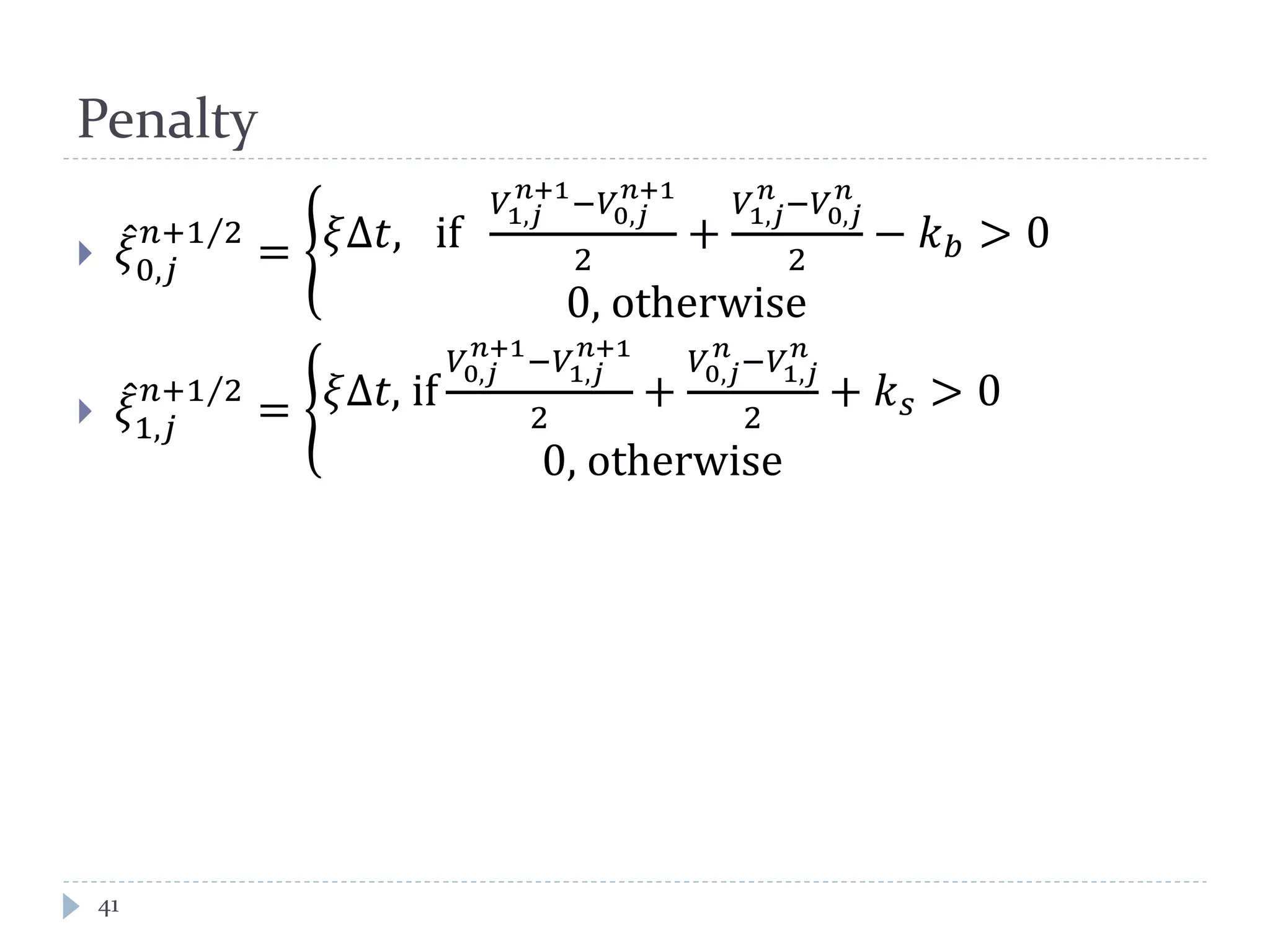
Penalty
41
 đœ‰Ì‚
0,𝑗
𝑛+1 2⁄
= ïżœ 𝜉∆𝑡, if
𝑉1,𝑗
𝑛+1
−𝑉0,𝑗
𝑛+1
2
+
𝑉1,𝑗
𝑛
−𝑉0,𝑗
𝑛
2
− 𝑘 𝑏 > 0
0, otherwise
 đœ‰Ì‚
1,𝑗
𝑛+1 2⁄
= ïżœ 𝜉∆𝑡, if
𝑉0,𝑗
𝑛+1
−𝑉1,𝑗
𝑛+1
2
+
𝑉0,𝑗
𝑛
−𝑉1,𝑗
𝑛
2
+ 𝑘 𝑠 > 0
0, otherwise
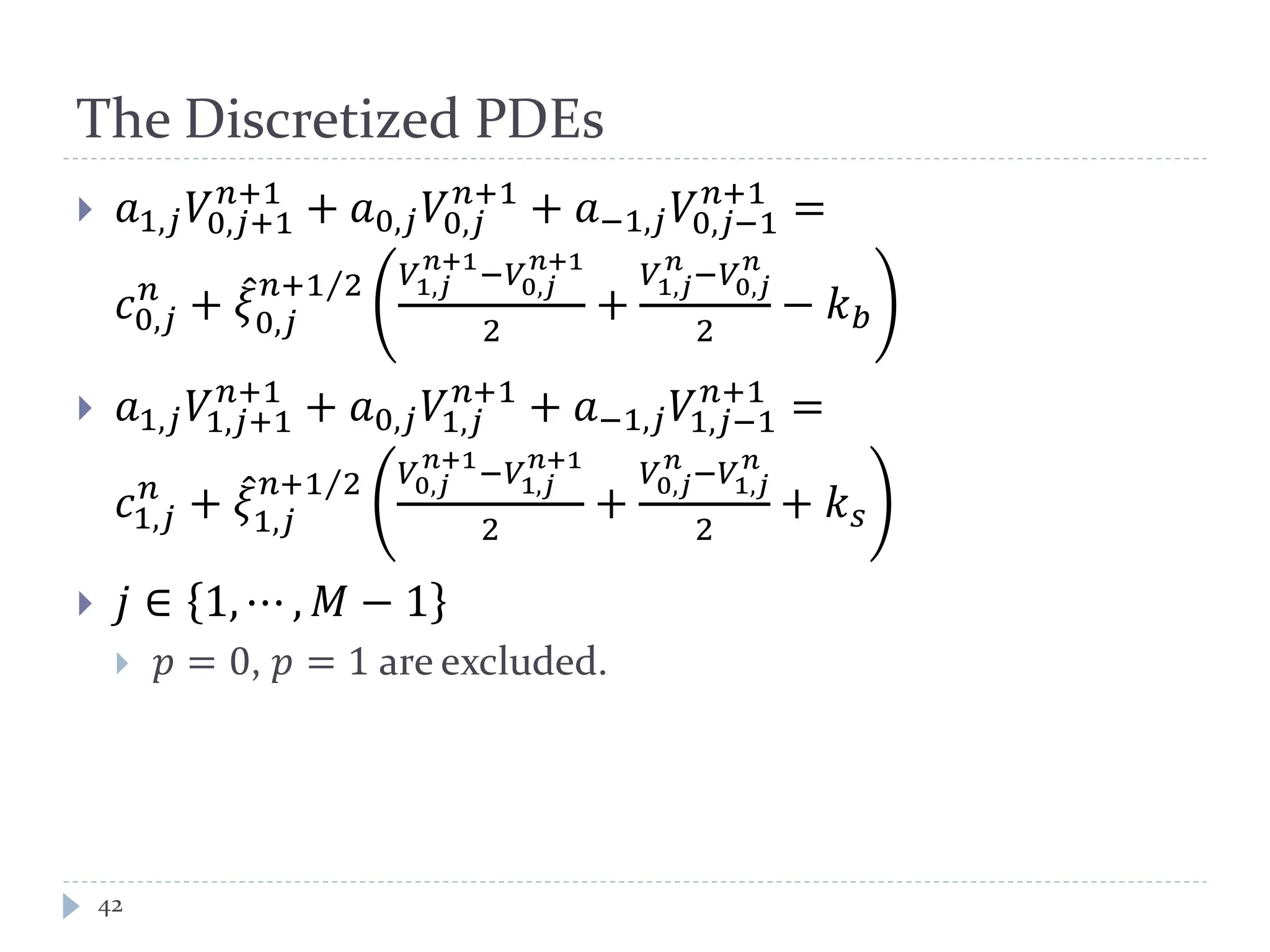
The Discretized PDEs
42
 𝑎1,𝑗 𝑉0,𝑗+1
𝑛+1
+ 𝑎0,𝑗 𝑉0,𝑗
𝑛+1
+ 𝑎−1,𝑗 𝑉0,𝑗−1
𝑛+1
=
𝑐0,𝑗
𝑛
+ đœ‰Ì‚
0,𝑗
𝑛+1 2⁄ 𝑉1,𝑗
𝑛+1
−𝑉0,𝑗
𝑛+1
2
+
𝑉1,𝑗
𝑛
−𝑉0,𝑗
𝑛
2
− 𝑘 𝑏
 𝑎1,𝑗 𝑉1,𝑗+1
𝑛+1
+ 𝑎0,𝑗 𝑉1,𝑗
𝑛+1
+ 𝑎−1,𝑗 𝑉1,𝑗−1
𝑛+1
=
𝑐1,𝑗
𝑛
+ đœ‰Ì‚
1,𝑗
𝑛+1 2⁄ 𝑉0,𝑗
𝑛+1
−𝑉1,𝑗
𝑛+1
2
+
𝑉0,𝑗
𝑛
−𝑉1,𝑗
𝑛
2
+ 𝑘 𝑠
 𝑗 ∈ 1, ⋯ , 𝑀 − 1
 𝑝 = 0, 𝑝 = 1 are excluded.
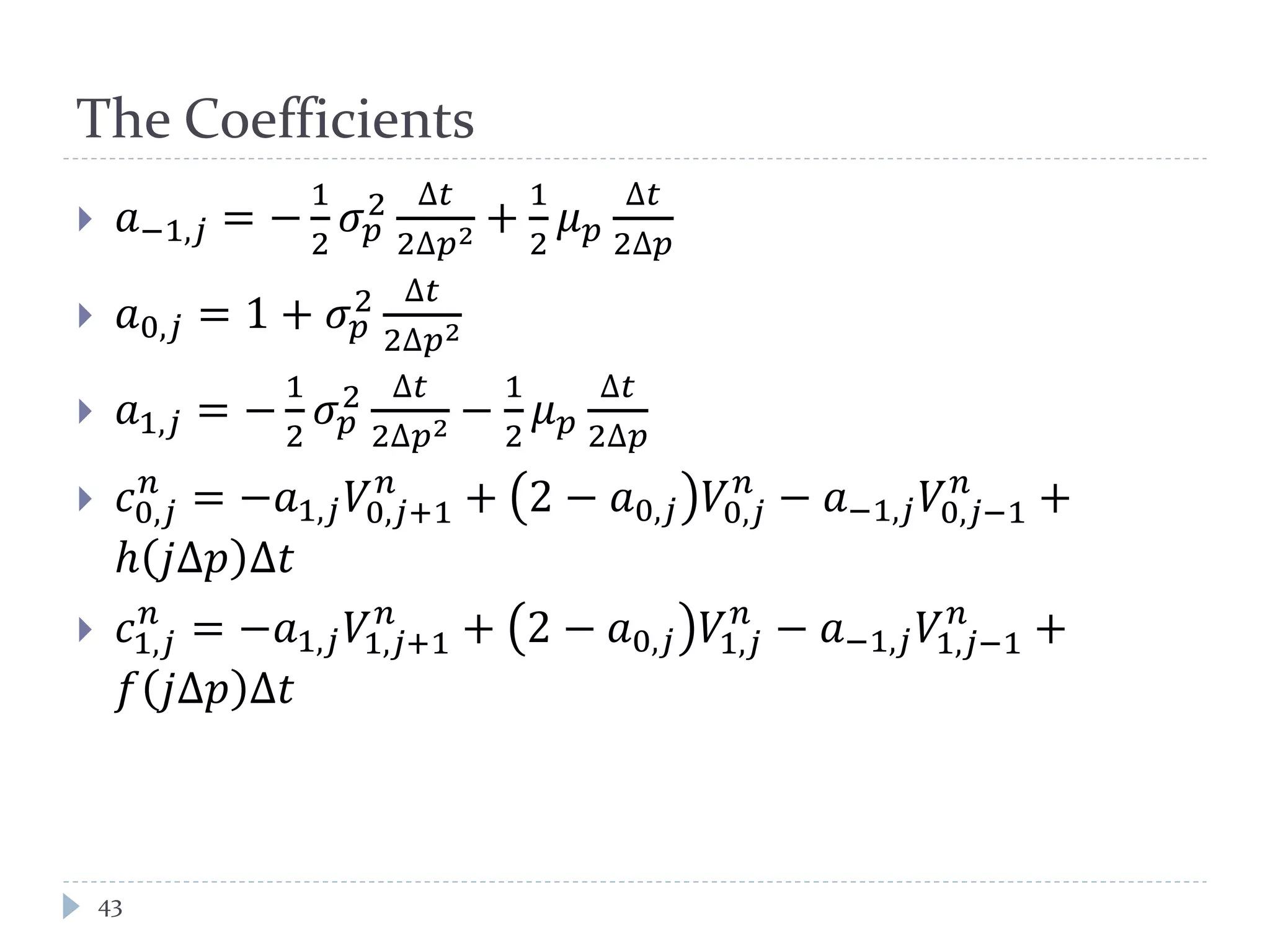
The Coefficients
43
 𝑎−1,𝑗 = −
1
2
𝜎 𝑝
2 ∆𝑡
2∆𝑝2 +
1
2
𝜇 𝑝
∆𝑡
2∆𝑝
 𝑎0,𝑗 = 1 + 𝜎 𝑝
2 ∆𝑡
2∆𝑝2
 𝑎1,𝑗 = −
1
2
𝜎 𝑝
2 ∆𝑡
2∆𝑝2 −
1
2
𝜇 𝑝
∆𝑡
2∆𝑝
 𝑐0,𝑗
𝑛
= −𝑎1,𝑗 𝑉0,𝑗+1
𝑛
+ 2 − 𝑎0,𝑗 𝑉0,𝑗
𝑛
− 𝑎−1,𝑗 𝑉0,𝑗−1
𝑛
+
ℎ 𝑗∆𝑝 ∆𝑡
 𝑐1,𝑗
𝑛
= −𝑎1,𝑗 𝑉1,𝑗+1
𝑛
+ 2 − 𝑎0,𝑗 𝑉1,𝑗
𝑛
− 𝑎−1,𝑗 𝑉1,𝑗−1
𝑛
+
𝑓 𝑗∆𝑝 ∆𝑡
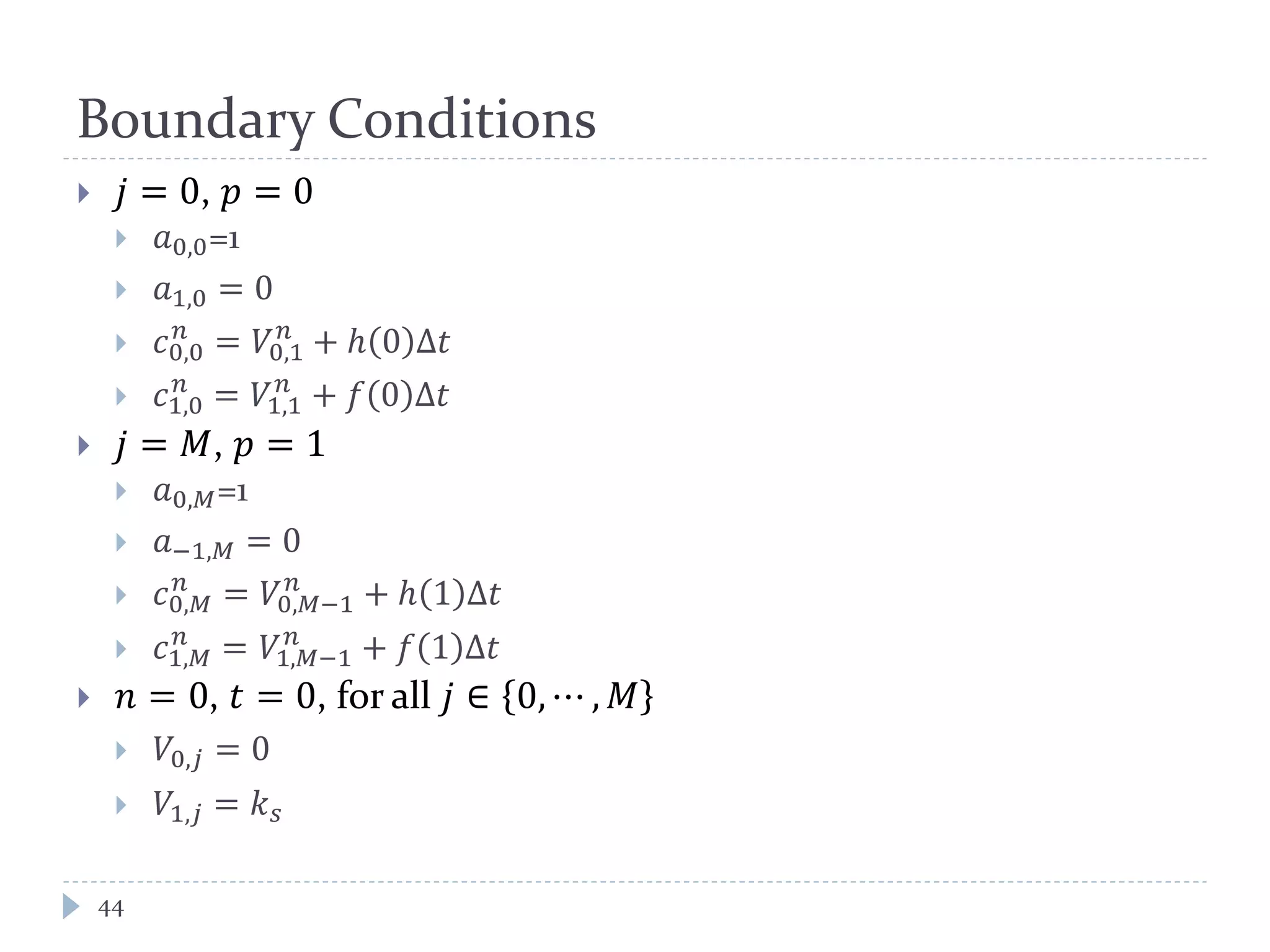
Boundary Conditions
44
 𝑗 = 0, 𝑝 = 0
 𝑎0,0=1
 𝑎1,0 = 0
 𝑐0,0
𝑛
= 𝑉0,1
𝑛
+ ℎ 0 ∆𝑡
 𝑐1,0
𝑛
= 𝑉1,1
𝑛
+ 𝑓 0 ∆𝑡
 𝑗 = 𝑀, 𝑝 = 1
 𝑎0,𝑀=1
 𝑎−1,𝑀 = 0
 𝑐0,𝑀
𝑛
= 𝑉0,𝑀−1
𝑛
+ ℎ 1 ∆𝑡
 𝑐1,𝑀
𝑛
= 𝑉1,𝑀−1
𝑛
+ 𝑓 1 ∆𝑡
 𝑛 = 0, 𝑡 = 0, for all 𝑗 ∈ 0, ⋯ , 𝑀
 𝑉0,𝑗 = 0
 𝑉1,𝑗 = 𝑘 𝑠
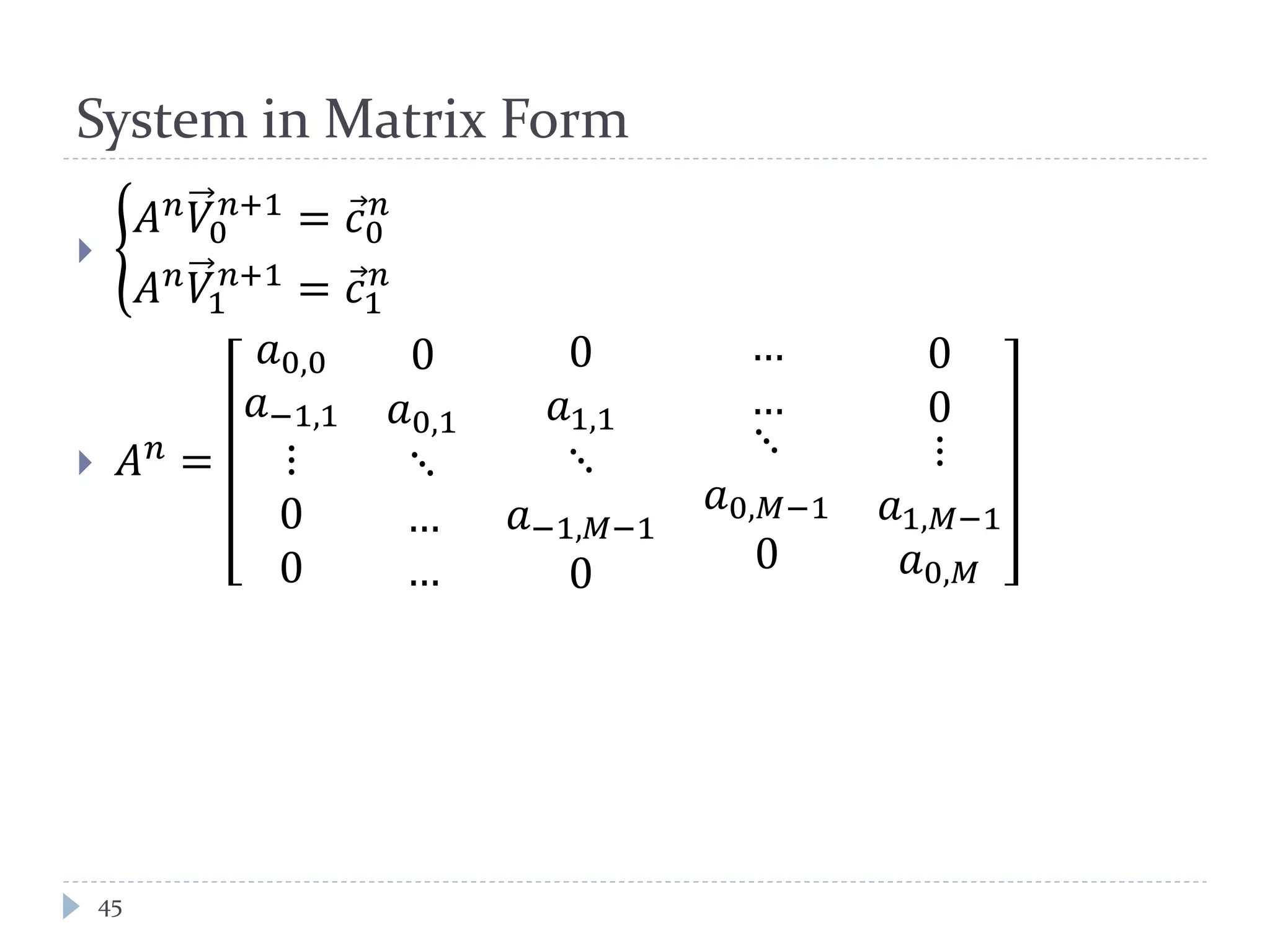
System in Matrix Form
45
 ïżœ
𝐮 𝑛 𝑉0
𝑛+1
= 𝑐⃗0
𝑛
𝐮 𝑛 𝑉1
𝑛+1
= 𝑐⃗1
𝑛
 𝐮 𝑛 =
𝑎0,0
𝑎−1,1
⋼
0
0
0
𝑎0,1
⋱


0
𝑎1,1
⋱
𝑎−1,𝑀−1
0


⋱
𝑎0,𝑀−1
0
0
0
⋼
𝑎1,𝑀−1
𝑎0,𝑀
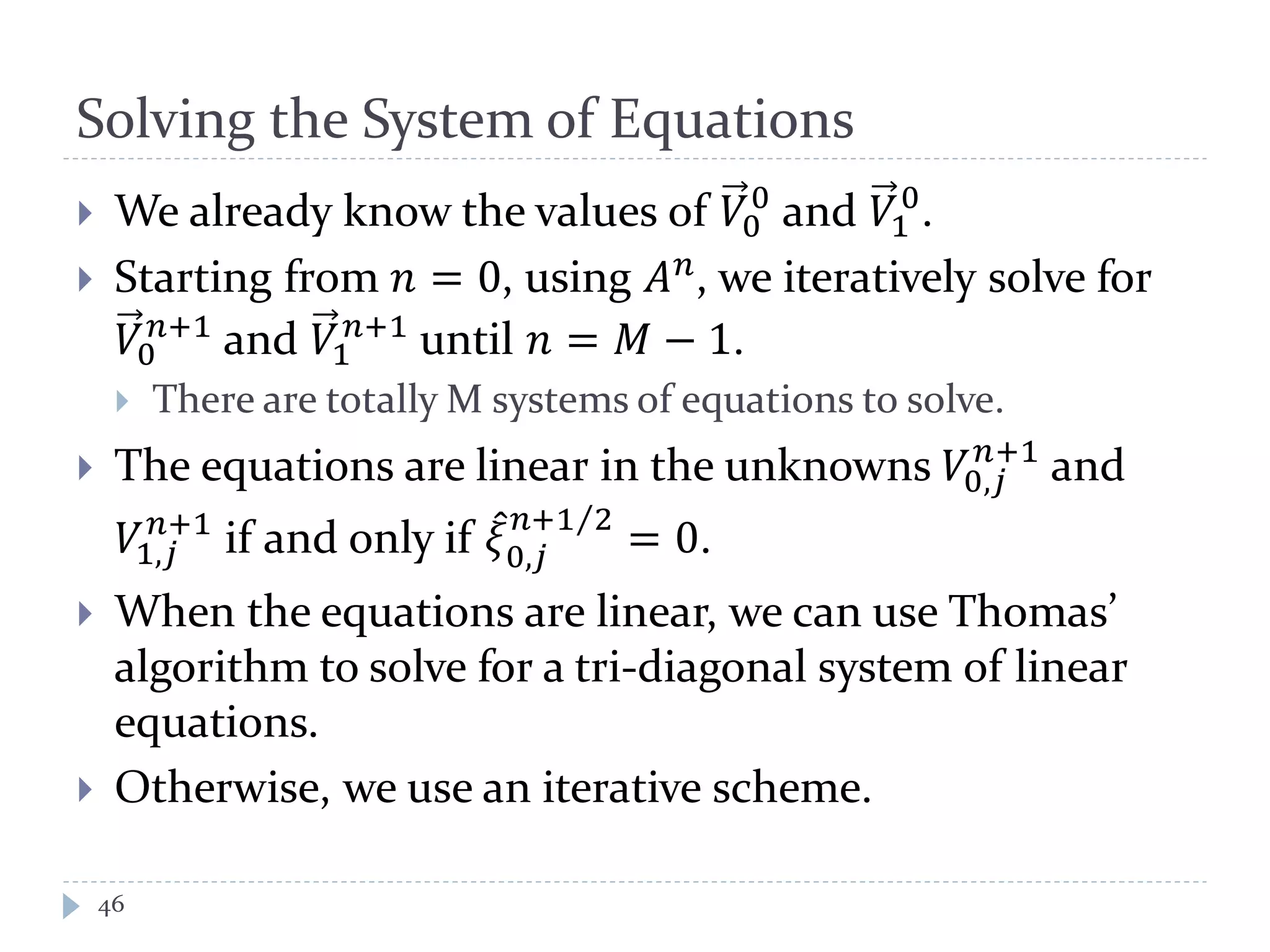
Solving the System of Equations
46
 We already know the values of 𝑉0
0
and 𝑉1
0
.
 Starting from 𝑛 = 0, using 𝐮 𝑛, we iteratively solve for
𝑉0
𝑛+1
and 𝑉1
𝑛+1
until 𝑛 = 𝑀 − 1.
 There are totally M systems of equations to solve.
 The equations are linear in the unknowns 𝑉0,𝑗
𝑛+1
and
𝑉1,𝑗
𝑛+1
if and only if đœ‰Ì‚
0,𝑗
𝑛+1 2⁄
= 0.
 When the equations are linear, we can use Thomas’
algorithm to solve for a tri-diagonal system of linear
equations.
 Otherwise, we use an iterative scheme.
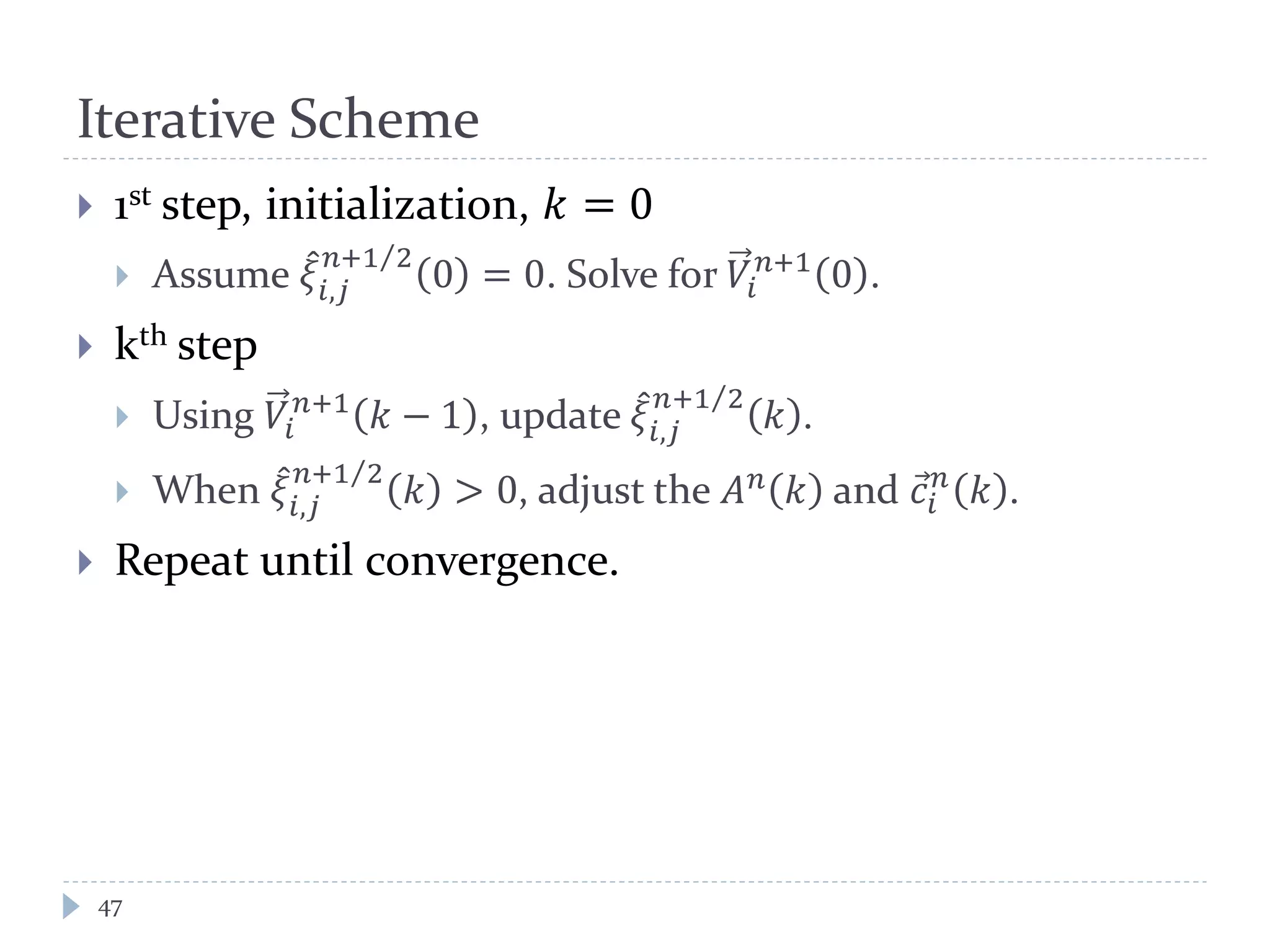
Iterative Scheme
47
 1st step, initialization, 𝑘 = 0
 Assume đœ‰Ì‚
𝑖,𝑗
𝑛+1 2⁄
0 = 0. Solve for 𝑉𝑖
𝑛+1
0 .
 kth step
 Using 𝑉𝑖
𝑛+1
𝑘 − 1 , update đœ‰Ì‚
𝑖,𝑗
𝑛+1 2⁄
𝑘 .
 When đœ‰Ì‚
𝑖,𝑗
𝑛+1 2⁄
𝑘 > 0, adjust the 𝐮 𝑛 𝑘 and 𝑐⃗𝑖
𝑛
𝑘 .
 Repeat until convergence.
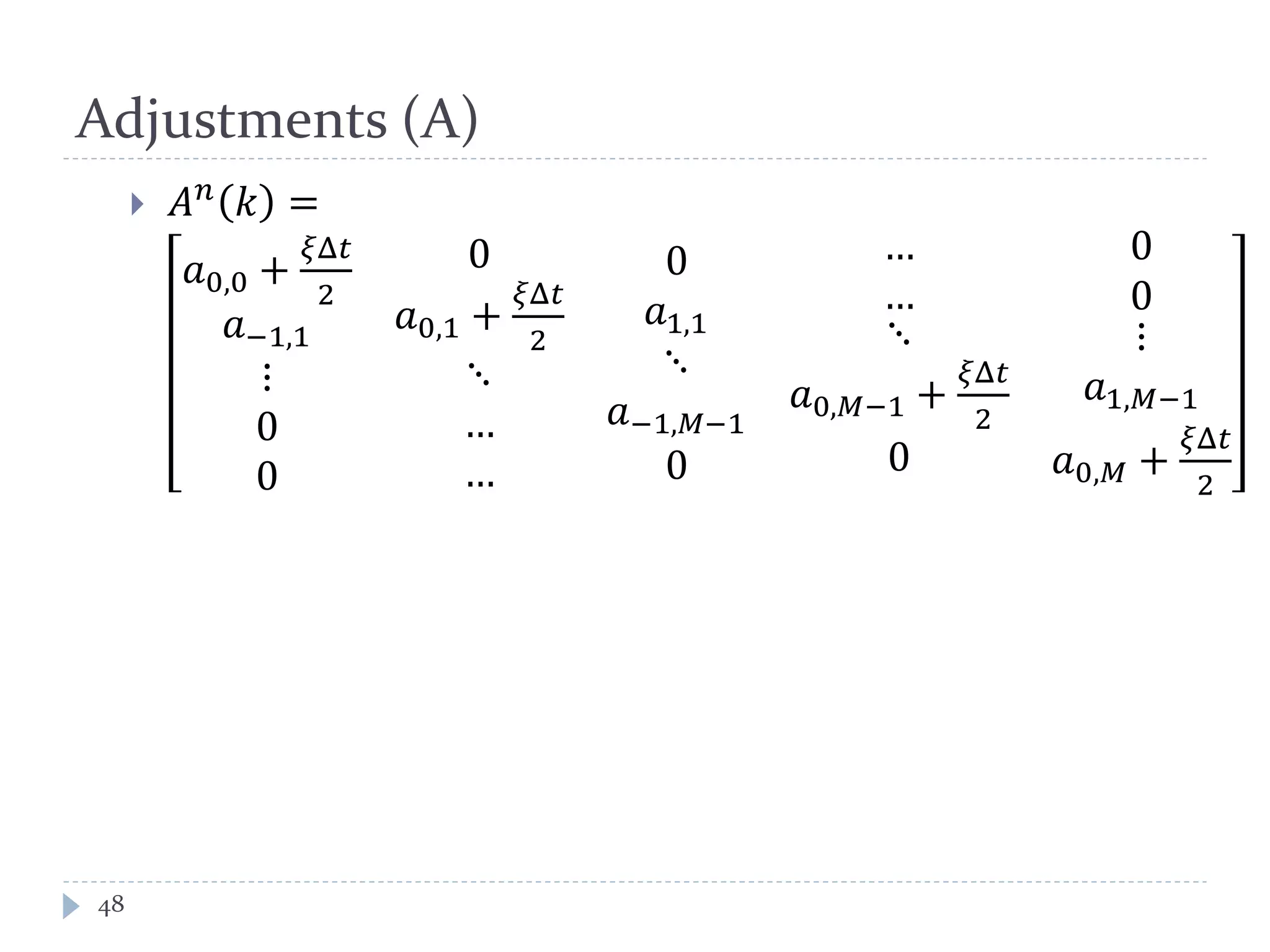
Adjustments (A)
48
 𝐮 𝑛
𝑘 =
𝑎0,0 +
𝜉Δ𝑡
2
𝑎−1,1
⋼
0
0
0
𝑎0,1 +
𝜉Δ𝑡
2
⋱


0
𝑎1,1
⋱
𝑎−1,𝑀−1
0


⋱
𝑎0,𝑀−1 +
𝜉Δ𝑡
2
0
0
0
⋼
𝑎1,𝑀−1
𝑎0,𝑀 +
𝜉Δ𝑡
2
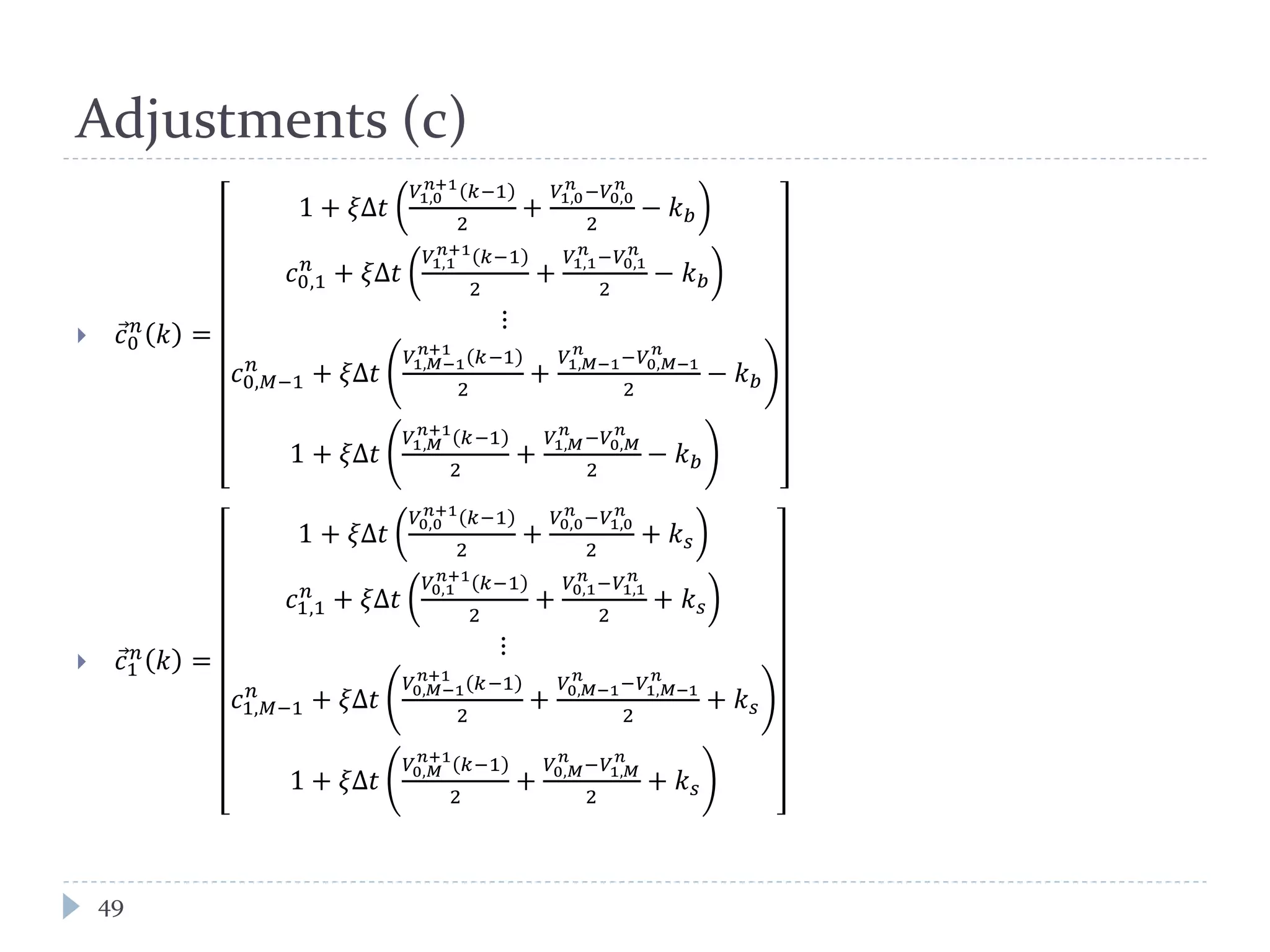
Adjustments (c)
49
 𝑐⃗0
𝑛
𝑘 =
1 + 𝜉Δ𝑡
𝑉1,0
𝑛+1
𝑘−1
2
+
𝑉1,0
𝑛
−𝑉0,0
𝑛
2
− 𝑘 𝑏
𝑐0,1
𝑛
+ 𝜉Δ𝑡
𝑉1,1
𝑛+1
𝑘−1
2
+
𝑉1,1
𝑛
−𝑉0,1
𝑛
2
− 𝑘 𝑏
⋼
𝑐0,𝑀−1
𝑛
+ 𝜉Δ𝑡
𝑉1,𝑀−1
𝑛+1
𝑘−1
2
+
𝑉1,𝑀−1
𝑛
−𝑉0,𝑀−1
𝑛
2
− 𝑘 𝑏
1 + 𝜉Δ𝑡
𝑉1,𝑀
𝑛+1
𝑘−1
2
+
𝑉1,𝑀
𝑛
−𝑉0,𝑀
𝑛
2
− 𝑘 𝑏
 𝑐⃗1
𝑛
𝑘 =
1 + 𝜉Δ𝑡
𝑉0,0
𝑛+1
𝑘−1
2
+
𝑉0,0
𝑛
−𝑉1,0
𝑛
2
+ 𝑘 𝑠
𝑐1,1
𝑛
+ 𝜉Δ𝑡
𝑉0,1
𝑛+1
𝑘−1
2
+
𝑉0,1
𝑛
−𝑉1,1
𝑛
2
+ 𝑘 𝑠
⋼
𝑐1,𝑀−1
𝑛
+ 𝜉Δ𝑡
𝑉0,𝑀−1
𝑛+1
𝑘−1
2
+
𝑉0,𝑀−1
𝑛
−𝑉1,𝑀−1
𝑛
2
+ 𝑘 𝑠
1 + 𝜉Δ𝑡
𝑉0,𝑀
𝑛+1
𝑘−1
2
+
𝑉0,𝑀
𝑛
−𝑉1,𝑀
𝑛
2
+ 𝑘 𝑠
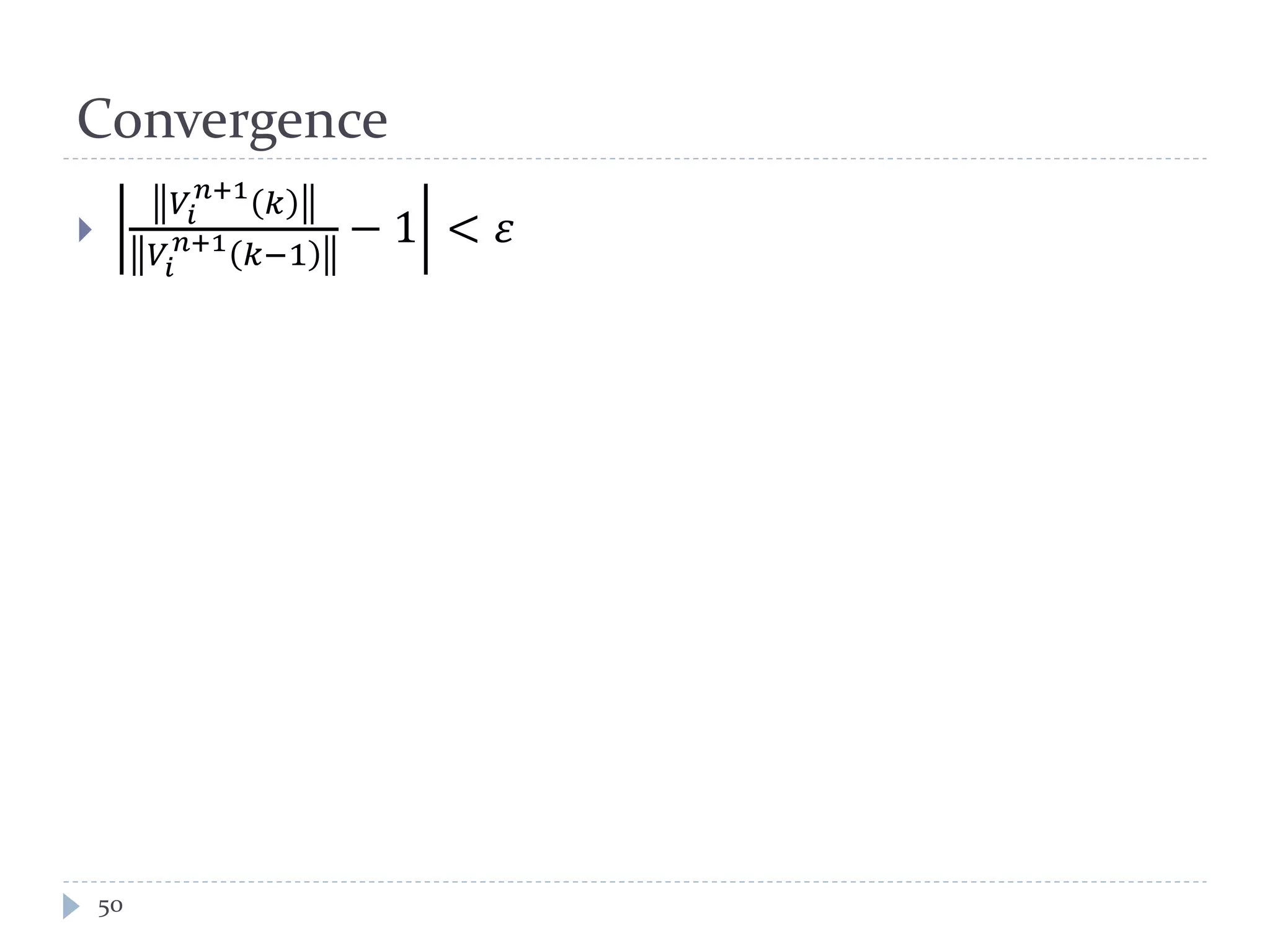
Convergence
50

𝑉𝑖
𝑛+1
𝑘
𝑉𝑖
𝑛+1
𝑘−1
− 1 < 𝜀
Miscellaenous
51
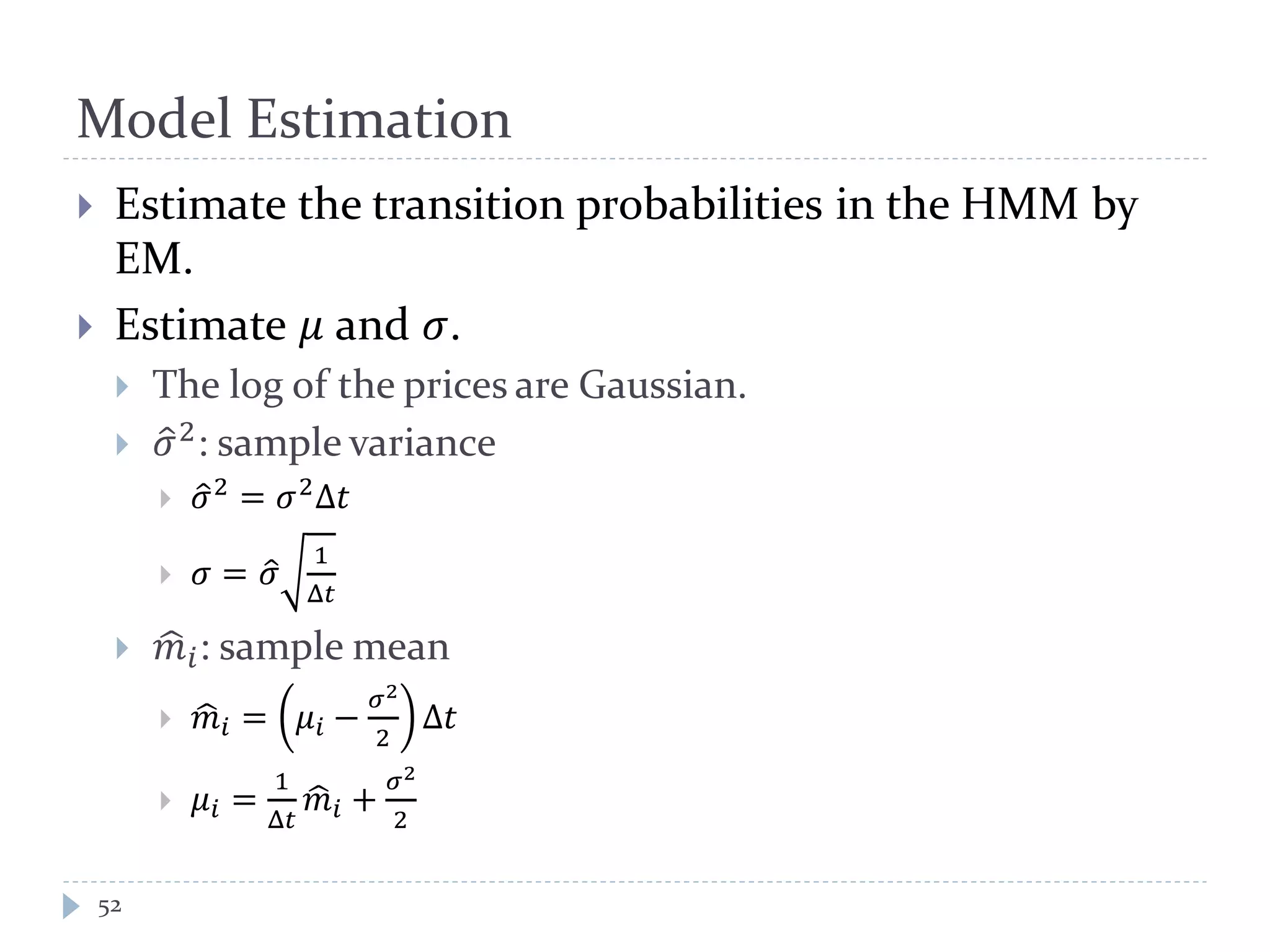
Model Estimation
52
 Estimate the transition probabilities in the HMM by
EM.
 Estimate 𝜇 and 𝜎.
 The log of the prices are Gaussian.
 đœŽïżœ2: sample variance
 đœŽïżœ2
= 𝜎2
Δ𝑡
 𝜎 = đœŽïżœ
1
Δ𝑡
 đ‘šïżœ 𝑖: sample mean
 đ‘šïżœ 𝑖 = 𝜇𝑖 −
𝜎2
2
Δ𝑡
 𝜇𝑖 =
1
Δ𝑡
đ‘šïżœ 𝑖 +
𝜎2
2

Intro to Quant Trading Strategies (Lecture 3 of 10)

  • 1.
    Introduction to AlgorithmicTrading Strategies Lecture 3 Trend Following Haksun Li haksun.li@numericalmethod.com www.numericalmethod.com
  • 2.
    References 2  Introduction toStochastic Calculus with Applications. Fima C Klebaner. 2nd Edition.  Estimating continuous time transition matrices from discretely observed data. Inamura, Yasunari. April 2006.  Optimal Trend Following Trading Rules. Dai, Min and Zhang, Qing and Zhu, Qiji Jim. 2011.
  • 3.
  • 4.
    Brownian Motion 4  Independenceof increments.  𝑑𝑑 = đ” 𝑡 − đ” 𝑠 is independent of any history up to 𝑠.  Normality of increments.  𝑑𝑑 is normally distributed with mean 0 and variance 𝑡 − 𝑠.  Continuity of paths.  đ” 𝑡 is a continuous function of 𝑡.
  • 5.
    Stochastic vs. NewtonianCalculus 5  Newtonian calculus: when you zoom in a function enough, the little segment looks like a straight line, hence the approximation:  𝑑𝑑 = đ‘“Ì‡ 𝑑𝑑  Derivative exists.  The function is differentiable.  Stochastic calculus: no matter how much you zoom in or how small 𝑑𝑑 is, the function still looks very zig-zag and random. It is nothing like a straight line.  For Brownian motion, however much you zoom in, how small the segment is, it still just looks very much like a Brownian motion.  The function is therefore no where differentiable.
  • 6.
    Examples 6 not a trendnot mean reversion
  • 7.
    dBdB 7  𝑑𝑑 2= 𝑑𝑑𝑑𝑑 = 𝑑𝑑  ∫ đ‘‘đ”đ‘Ą 2𝑡 0 ≈ ∑ 𝑍 𝑛,𝑖 2𝑛 𝑖=1  𝑍 𝑛,𝑖 is of 𝑁 0, 𝑡 𝑛 for all 𝑖.  ∫ đ‘‘đ”đ‘Ą 2𝑡 0 ≈ sum of variances of 𝑍 𝑛,𝑖 ≈ 𝑡  Making 𝑛 → ∞ or 𝑑𝑑 → 0, we have  ∫ đ‘‘đ”đ‘Ą 2𝑡 0 = 𝑡, convergence in probability  đ‘‘đ”đ‘Ą 2 = 𝑑𝑑, in differential form  𝑑𝑑𝑑𝑡 = 0  𝑑𝑡𝑑𝑑 = 0
  • 8.
    Asset Price Model 8 Want to model asset price movement.  Change in price = 𝑑𝑑  Change in price is not too meaningful as $1 change in a penny stock is more significant than $1 change in GOOG.  Return = 𝑑𝑑 𝑆  Model return using two parts.  Deterministic: 𝜇𝑑𝑑, the predictable part. E.g., fixed deposit interest rate.  Random/stochastic: 𝜎𝑑𝑑, where 𝜎 is the volatility of returns and đ‘‘đ” is a sample from a probability distribution, e.g., Normal.
  • 9.
    Geometric Brownian Motion 9 Asset price: 𝑑𝑑 𝑆 = 𝜇𝜇𝜇 + đœŽđœŽđ”  đ‘‘đ”: normally distributed  E đ‘‘đ” = 0  Variance = 𝑑𝑑. It is intuitive that đ‘‘đ” should be scaled by 𝑑𝑑 otherwise the (random) return drawn would be too big from any Normal distribution for 𝑑𝑑 → 0.  đ‘‘đ” = 𝜙 𝑑𝑑, where 𝜙 is a standard Normal distribution.  Reasonably good model for stocks and indices.  Real data have more big rises and falls than this model predicts, i.e., extreme events.
  • 10.
    GBM Properties 10  Markovproperty: the distribution of the next price S + 𝑑𝑑 depend only on the current price 𝑆.  E 𝑑𝑆 = E 𝜇𝑆𝑑𝑑 + đœŽđ‘†đ‘‘đ”  = E 𝜇𝜇𝜇𝜇 + E đœŽđœŽđœŽđ”  = 𝜇𝜇𝜇𝜇 + 𝜎𝜎 E đ‘‘đ”  = 𝜇𝜇𝜇𝜇  Var 𝑑𝑑 = E 𝑑𝑑2 − E 𝑑𝑑 2 = 𝜎2 𝑆2 𝑑𝑑  đ‘‘đ”đ‘‘đ‘‘ = 0  𝑑𝑑𝑑𝑑 = 0  đ‘‘đ”đ‘‘đ” = 𝑑𝑑
  • 11.
    Stochastic Differential Equation 11 Both 𝜇 and 𝜎 can be as simple as constants, deterministic functions of 𝑡 and 𝑆, or as complicated as stochastic functions adapted to the filtration generated by 𝑆𝑡 .  𝑑𝑆𝑡 = 𝜇𝜇𝜇 + đœŽđœŽđ”đ‘Ą  𝑑𝑆𝑡 = 𝜇 𝑡, 𝑆𝑡 𝑑𝑑 + 𝜎 𝑡, 𝑆𝑡 đ‘‘đ”đ‘Ą
  • 12.
    Univariate Ito’s Lemma 12 Assume  𝑑𝑋𝑡 = 𝜇 𝑡 𝑑𝑑 + 𝜎𝑡 đ‘‘đ”đ‘Ą  𝑓 𝑡, 𝑋𝑡 is twice differentiable of two real variables  We have  𝑑𝑑 𝑡, 𝑋𝑡 = 𝜕𝜕 𝜕𝜕 + 𝜇 𝑡 𝜕𝜕 𝜕𝜕 + 𝜎𝑡 2 2 𝜕2 𝑓 đœ•đ‘„2 𝑑𝑑 + 𝜎𝑡 𝜕𝜕 𝜕𝜕 đ‘‘đ”đ‘Ą
  • 13.
    “Proof” 13  Taylor series ïœđ‘‘đ‘“ 𝑡, 𝑋  = 𝑓𝑡 𝑑𝑑 + 𝑓𝑋 𝑑𝑋 + 1 2 𝑓𝑡𝑡 𝑑𝑑𝑑𝑑 + 𝑓𝑡𝑋 𝑑𝑑𝑑𝑋 + 𝑓𝑋𝑋 𝑑𝑋𝑑𝑡 + 𝑓𝑋𝑋 𝑑𝑑𝑑𝑋  = 𝑓𝑡 𝑑𝑑 + 𝑓𝑋 𝑑𝑑 + 1 2 𝑓𝑋 𝑋 𝑑𝑑𝑑𝑑  = 𝑓𝑡 𝑑𝑑 + 𝑓𝑋 𝜇𝑑𝑑 + đœŽđ‘‘đ” + 1 2 𝑓𝑋𝑋 𝜇𝑑𝑑 + 𝜎𝑑𝑑 2  = 𝑓𝑡 𝑑𝑑 + 𝑓𝑋 𝜇𝑑𝑑 + 𝜎𝑑𝑑 + 1 2 𝑓𝑋𝑋 𝜇𝑑𝑑 + 𝜎𝑑𝑑 2  = 𝑓𝑡 𝑑𝑑 + 𝑓𝑋 𝜇𝑑𝑑 + 𝜎𝑑𝑑 + 1 2 𝑓𝑋𝑋 𝜇2 𝑑𝑑2 + 𝜎2 đ‘‘đ”2 + 2𝜇𝑑𝑑𝜎𝑑𝑑  = 𝑓𝑡 𝑑𝑑 + 𝑓𝑋 𝜇𝑑𝑑 + 𝜎𝑑𝑑 + 1 2 𝑓𝑋𝑋 𝜎2 𝑑𝑑2  = 𝑓𝑡 𝑑𝑑 + 𝑓𝑋 𝜇𝑑𝑑 + 𝜎𝑑𝑑 + 1 2 𝑓𝑋𝑋 𝜎2 𝑑𝑑  = 𝑓𝑡 + 𝜇𝑓𝑋 + 1 2 𝜎2 𝑓𝑋 𝑋 𝑑𝑑 + 𝜎𝑓𝑋 𝑑𝑑
  • 14.
    Log Example 14  ForG.B.M., 𝑑𝑋𝑡 = 𝜇𝑋𝑡 𝑑𝑑 + 𝜎𝑋𝑡 𝑑𝑧𝑡, 𝑑 log 𝑋𝑡 =?  𝑓 đ‘„ = log đ‘„  𝜕𝑓 𝜕𝑡 = 0  𝜕𝑓 đœ•đ‘„ = 1 đ‘„  𝜕2 𝑓 đœ•đ‘„2 = − 1 đ‘„2  𝑑 log 𝑋𝑡 = 𝜇𝑋𝑡 1 𝑋𝑡 + 𝜎𝑋𝑡 2 2 − 1 𝑋𝑡 2 𝑑𝑑 + 𝜎𝑋𝑡 1 𝑋𝑡 đ‘‘đ”đ‘Ą  = 𝜇 − 𝜎2 2 𝑑𝑑 + đœŽđ‘‘đ”đ‘Ą
  • 15.
    Exp Example 15  𝑑𝑋𝑡= 𝜇𝑑𝑑 + 𝜎𝑑𝑧𝑡, 𝑑𝑒 𝑋𝑡 =?  𝑓 đ‘„ = 𝑒 đ‘„  𝜕𝑓 𝜕𝑡 = 0  𝜕𝑓 đœ•đ‘„ = 𝑒 đ‘„  𝜕2 𝑓 đœ•đ‘„2 = 𝑒 đ‘„  𝑑𝑒 𝑋𝑡 = 𝜇𝑒 𝑋𝑡 + 𝜎2 2 𝑒 𝑋𝑡 𝑑𝑑 + 𝜎𝑒 𝑋𝑡 đ‘‘đ”đ‘Ą  = 𝑒 𝑋𝑡 𝜇 + 𝜎2 2 𝑑𝑑 + đœŽđ‘‘đ”đ‘Ą  𝑑𝑒 𝑋 𝑡 𝑒 𝑋 𝑡 = 𝜇 + 𝜎2 2 𝑑𝑑 + đœŽđ‘‘đ”đ‘Ą
  • 16.
    Stopping Time 16  Astopping time is a random time that some event is known to have occurred.  Examples:  when a stock hits a target price  when you run out of money  when a moving average crossoveroccurs  When a stock has bottomed out is NOT a stopping time because you cannot tell when it has reached its minimum without future information.
  • 17.
  • 18.
    Asset Model 18  Twostate Markov model for a stock’s prices: BULL and BEAR.  𝑑𝑆 𝑟 = 𝑆 𝑟 𝜇 đ›Œ 𝑟 𝑑𝑑 + đœŽđœŽđ”đ‘Ÿ , 𝑡 ≀ 𝑟 ≀ 𝑇 < ∞  The trading period is between time 𝑡, 𝑇 .  đ›Œ 𝑟 = 1,2 are the two Markov states that indicates the BULL and BEAR markets.  𝜇1 > 0  𝜇2 < 0  𝑄 = −𝜆1 𝜆1 𝜆2 −𝜆2 , the generator matrix for the Markov chain.
  • 19.
    Generator Matrix 19  Fromtransition matrix to generator matrix:  𝑃 𝑡, 𝑡 + Δ𝑡 = đŒ + Δ𝑡𝑡 + 𝑜 Δ𝑡  We can estimate 𝑄 by estimating 𝑃.  𝑃 𝑡, 𝑠 = 𝑃 𝑡, 𝑡 + 𝑚Δ𝑡  ≈ đŒ + Δ𝑡𝑡 𝑚 = đŒ + 𝑠−𝑡 𝑚 𝑄 𝑚 = exp 𝑠 − 𝑡 𝑄  𝑃 𝑡, 𝑡 + Δ𝑡 = exp Δ𝑡𝑡  đ‘ƒïżœ 𝑡 ≈ exp Î”đ‘Ąđ‘„ïżœ  đ‘„ïżœ ≈ 1 Δ𝑡 log đ‘ƒïżœ 𝑡  E.g., Δ𝑡 = 1 252
  • 20.
    Optimal Stopping Times 20 tT𝜏1 𝜈1 𝜏2 𝜈2 𝜏 𝑛 𝜈 𝑛 𝑖 = 0, Λ0 = 𝜏1, 𝜈1, 𝜏2, 𝜈2, ⋯ 𝑖 = 0, Λ0 = 𝜈1, 𝜏2, 𝜈2, 𝜏3, ⋯ BUY BUY BUYSELL SELL SELL no position, bank the $ no position, bank the $ no position, bank the $ LONG LONG LONG
  • 21.
    Parameters 21  𝜌 ≄0, interest free rate  𝑆𝑡 = 𝑆, the initial stock price  𝑖 = 0,1 , the net position  đŸđ‘, the transaction cost for BUYs in percentage  đŸđ‘ , the transaction cost for SELLs in percentage
  • 22.
    Expected Return (startingflat) 22  When 𝑖 = 0,  E0,𝑡 𝑅𝑡 = E 𝑡 𝑒 𝜌 𝜏1−𝑡 ∏ 𝑆 𝜈 𝑛 𝑆 𝜏 𝑛 1âˆ’đŸđ‘  1+đŸ 𝑏 đŒ 𝜏 𝑛<𝑇 𝑒 𝜌 𝜏 𝑛+1−𝜐 𝑛∞ 𝑛=1  You are long between 𝜏 𝑛 and 𝜈 𝑛 and the return is determined by the price change discounted by the commissions.  You are flat between 𝜈 𝑛 and 𝜏 𝑛+1 and the money grows at the risk free rate.
  • 23.
    Expected Return (startinglong) 23  When 𝑖 = 1,  E1,𝑡 𝑅 𝑡 = E 𝑡 𝑆 𝜈1 𝑆 𝑒 𝜌 𝜏2−𝜈1 1 − đŸđ‘  ∏ 𝑆 𝜈 𝑛 𝑆 𝜏 𝑛 1âˆ’đŸđ‘  1+đŸ 𝑏 đŒ 𝜏 𝑛<𝑇 𝑒 𝜌 𝜏 𝑛+1−𝜐 𝑛∞ 𝑛=2  You sell the long position at 𝜈1.
  • 24.
    Value Functions 24  Itis easier to work with the log of the returns.  J0 𝑆, đ›Œ, 𝑡, Λ0 = E 𝑡 𝜌 𝜏1 − 𝑡 + ∑ log 𝑆 𝜈 𝑛 𝑆 𝜏 𝑛 + đŒ 𝜏 𝑛<𝑇 log 1âˆ’đŸđ‘  1+đŸ 𝑏 + 𝜌 𝜏 𝑛+1 − 𝜐 𝑛 ∞ 𝑛=1  J1 𝑆, đ›Œ, 𝑡, Λ1 = E 𝑡 log 𝑆 𝜈1 𝑆 + 𝜌 𝜏2 − 𝜈1 + log 1 − đŸđ‘  + ∑ log 𝑆 𝜈 𝑛 𝑆 𝜏 𝑛 + đŒ 𝜏 𝑛<𝑇 log 1âˆ’đŸđ‘  1+đŸ 𝑏 + 𝜌 𝜏 𝑛+1 − 𝜐 𝑛 ∞ 𝑛=2
  • 25.
    Conditional Probability ofBull Market 25  𝑝 𝑟 = 𝑃 đ›Œ 𝑟 = 1 | 𝜎 𝑆 𝑱 ∶ 0 ≀ 𝑱 ≀ 𝑟  𝑝 𝑟 is therefore a random process driven by the same Brownian motion that drives 𝑆 𝑱.  𝑑𝑝 𝑟 = − 𝜆1 + 𝜆2 𝑝 𝑟 + 𝜆2 𝑑𝑑 + 𝜇1−𝜇2 𝑝 𝑟 1−𝑝 𝑟 𝜎 đ‘‘đ”đ‘Ÿ ïżœ  đ‘‘đ”đ‘Ÿ ïżœ = 𝑑 log 𝑆 𝑟 − 𝜇1−𝜇2 𝑝 𝑟+𝜇2−𝜎2 2⁄ 𝑑𝑑 𝜎  𝑝𝑡+1 = 𝑝𝑡 + 𝑔 𝑝𝑡 Δ𝑡 + 𝜇1−𝜇2 𝑝𝑡 1−𝑝𝑡 𝜎2 log 𝑆𝑡+1 𝑆𝑡  𝑔 𝑝 = − 𝜆1 + 𝜆2 𝑝 + 𝜆2 − 𝜇1−𝜇2 𝑝 1−𝑝 𝜇1−𝜇2 𝑝+𝜇2−𝜎2 2⁄ 𝜎2  Make 𝑝𝑡+1 between 0 and 1 if it falls outside the bounds.
  • 26.
    Objective 26  Find anoptimal trading sequence (the stopping times) so that the value functions are maximized.  𝑉𝑖 𝑝, 𝑡 = supΛ𝑖 đœđ‘– 𝑆, 𝑝, 𝑡, Λ 𝑖  𝑉𝑖: the maximum amount of expected returns
  • 27.
    Realistic Expectation ofReturns 27  Lower bounds:  𝑉0 𝑝, 𝑡 ≄ 𝜌 𝑇 − 𝑡  𝑉1 𝑝, 𝑡 ≄ 𝜌 𝑇 − 𝑡 + log 1 − đŸđ‘   Upper bound:  𝑉𝑖 𝑝, 𝑡 ≀ 𝜇1 − 𝜎2 2 𝑇 − 𝑡  No trading zones:  One should never buy when 𝜌 ≄ 𝜇1 − 𝜎2 2
  • 28.
    Principal of Optimality 28 Given an optimal trading sequence, Λ 𝑖, starting from time 𝑡, the truncated sequence will also be optimal for the same trading problem starting from any stopping times 𝜏 𝑛 or 𝜐 𝑛.
  • 29.
    Coupled Value Functions 29 ïœïżœ 𝑉0 𝑝, 𝑡 = sup 𝜏1 𝐾𝑡 𝜌 𝜏1 − 𝑡 − log 1 + đŸđ‘ + 𝑉1 𝑝𝜏1 , 𝜏1 𝑉1 𝑝, 𝑡 = sup 𝜈1 𝐾𝑡 log 𝑆 𝜈1 𝑆𝑡 + log 1 − đŸđ‘  + 𝑉0 𝑝 𝜈1 , 𝜈1
  • 30.
    Hamilton-Jacobi-Bellman Equations 30  ïżœ min−ℒ𝑉0 − 𝜌, 𝑉0 − 𝑉1 + log 1 + đŸđ‘ = 0 min −ℒ𝑉1 − 𝑓 𝜌 , 𝑉1 − 𝑉0 − log 1 − đŸđ‘  = 0  with terminal conditions: ïżœ 𝑉0 𝑝, 𝑇 = 0 𝑉1 𝑝, 𝑇 = log 1 − đŸđ‘   ℒ = 𝜕𝑡 + 1 2 𝜇1−𝜇2 𝑝 1−𝑝 𝜎 2 𝜕 𝑝𝑝 + − 𝜆1 + 𝜆2 𝑝 + 𝜆2 𝜕 𝑝
  • 31.
    Penalty Formulation Approach 31 The HJB formulation is equivalent to this system of PDEs.  ïżœ −ℒ𝑉0 − ℎ 𝜌 = đœ‰Ì‚ 𝑉1 − 𝑉0 − log 1 + đŸđ‘ + −ℒ𝑉1 − 𝑓 𝜌 = đœ‰Ì‚ 𝑉0 − 𝑉1 + log 1 − đŸđ‘  +  đœ‰Ì‚ is a penalization factor such that đœ‰Ì‚ → ∞.  ℎ 𝜌 = 𝜌
  • 32.
    Trading Boundaries 32  đ”đ”= 𝑝 ∈ 0,1 × [0, 𝑇) ∶ 𝑝 ≄ 𝑝 𝑏 ∗ 𝑡  𝑆𝑅 = 𝑝 ∈ 0,1 × [0, 𝑇) ∶ 𝑝 ≀ 𝑝𝑠 ∗ 𝑡
  • 33.
  • 34.
  • 35.
    Problems 35  The buyentry signals are always delayed (as expected).  The market therefore needs to bull long enough for the strategy to make profit.  If the bear market comes in too fast and hard, the exit entry may not come in soon enough.  A proper stoploss from max drawdown may help.
  • 36.
    Finding the Boundaries 36 At any time 𝑡, we need to find 𝑝 𝑏 ∗ and 𝑝𝑠 ∗ to determine whether we buy or sell or go flat.  𝑝 𝑏 ∗ is determined by  𝑉1 𝑝 𝑏 ∗ , 𝑡 − 𝑉0 𝑝 𝑏 ∗ , 𝑡 = log 1 + đŸđ‘  𝑝𝑠 ∗ is determined by  𝑉1 𝑝𝑠 ∗, 𝑡 − 𝑉0 𝑝𝑠 ∗, 𝑡 = log 1 − đŸđ‘   Need to compute 𝑉0 𝑝, 𝑡 and 𝑉1 𝑝, 𝑡 for all 𝑝 and 𝑡.  Solve the coupled PDEs.
  • 37.
    Discretization of ℒ 37 ïœđœŒ, 𝑡 ∈ 0,1 × [0,1)  𝜌, 𝑡 as 𝜌𝑗, 𝑡 𝑛  𝑗 ∈ 0, ⋯ , 𝑀  𝜌0 = 0  𝜌 𝑀 = 0  𝑛 ∈ 1, ⋯ , 𝑁  𝑡1 = 0  𝑡 𝑁 = 1−  𝜕𝑉 𝑖 𝜕𝑡 ≈ 𝑉𝑖,𝑗 𝑛+1 −𝑉𝑖,𝑗 𝑛 ∆𝑡
  • 38.
    The Grid 38 𝑡1=0 𝑡1𝑡 𝑁=1𝑡 𝑛 𝜌0=0 𝜌𝑗 𝜌 𝑀=1 𝑉𝑖 𝜌 𝑗 , 𝑡 𝑛
  • 39.
    Crank-Nicolson Scheme 39  𝜕𝑉 𝑖 𝜕𝜌 ≈ 1 2 𝑉𝑖,𝑗+1 𝑛+1 −𝑉𝑖,𝑗−1 𝑛+1 2∆𝜌 + 𝑉𝑖,𝑗+1 𝑛 −𝑉𝑖,𝑗−1 𝑛 2∆𝜌  𝜕2𝑉 𝑖 𝜕𝜌2 ≈ 1 2 𝑉𝑖,𝑗+1 𝑛+1 −2𝑉𝑖,𝑗 𝑛+1 +𝑉𝑖,𝑗−1 𝑛+1 ∆𝜌 2 + 𝑉𝑖,𝑗+1 𝑛 −2𝑉𝑖,𝑗 𝑛 +𝑉𝑖,𝑗−1 𝑛 ∆𝜌 2
  • 40.
    RHS 40  đœ‰Ì‚ 𝑉1− 𝑉0 − log 1 + đŸđ‘ + = đœ‰Ì‚ 0,𝑗 𝑛+1 2⁄ 𝑉1,𝑗 𝑛+1 −𝑉0,𝑗 𝑛+1 2 + 𝑉1,𝑗 𝑛 −𝑉0,𝑗 𝑛 2 − 𝑘 𝑏  𝑘 𝑏 = log 1 + đŸđ‘  đœ‰Ì‚ 𝑉0 − 𝑉1 + log 1 − đŸđ‘  + = đœ‰Ì‚ 1,𝑗 𝑛+1 2⁄ 𝑉0,𝑗 𝑛+1 −𝑉1,𝑗 𝑛+1 2 + 𝑉0,𝑗 𝑛 −𝑉1,𝑗 𝑛 2 + 𝑘 𝑠  𝑘 𝑠 = log 1 − đŸđ‘ 
  • 41.
    Penalty 41  đœ‰Ì‚ 0,𝑗 𝑛+1 2⁄ =ïżœ 𝜉∆𝑡, if 𝑉1,𝑗 𝑛+1 −𝑉0,𝑗 𝑛+1 2 + 𝑉1,𝑗 𝑛 −𝑉0,𝑗 𝑛 2 − 𝑘 𝑏 > 0 0, otherwise  đœ‰Ì‚ 1,𝑗 𝑛+1 2⁄ = ïżœ 𝜉∆𝑡, if 𝑉0,𝑗 𝑛+1 −𝑉1,𝑗 𝑛+1 2 + 𝑉0,𝑗 𝑛 −𝑉1,𝑗 𝑛 2 + 𝑘 𝑠 > 0 0, otherwise
  • 42.
    The Discretized PDEs 42 ïœđ‘Ž1,𝑗 𝑉0,𝑗+1 𝑛+1 + 𝑎0,𝑗 𝑉0,𝑗 𝑛+1 + 𝑎−1,𝑗 𝑉0,𝑗−1 𝑛+1 = 𝑐0,𝑗 𝑛 + đœ‰Ì‚ 0,𝑗 𝑛+1 2⁄ 𝑉1,𝑗 𝑛+1 −𝑉0,𝑗 𝑛+1 2 + 𝑉1,𝑗 𝑛 −𝑉0,𝑗 𝑛 2 − 𝑘 𝑏  𝑎1,𝑗 𝑉1,𝑗+1 𝑛+1 + 𝑎0,𝑗 𝑉1,𝑗 𝑛+1 + 𝑎−1,𝑗 𝑉1,𝑗−1 𝑛+1 = 𝑐1,𝑗 𝑛 + đœ‰Ì‚ 1,𝑗 𝑛+1 2⁄ 𝑉0,𝑗 𝑛+1 −𝑉1,𝑗 𝑛+1 2 + 𝑉0,𝑗 𝑛 −𝑉1,𝑗 𝑛 2 + 𝑘 𝑠  𝑗 ∈ 1, ⋯ , 𝑀 − 1  𝑝 = 0, 𝑝 = 1 are excluded.
  • 43.
    The Coefficients 43  𝑎−1,𝑗= − 1 2 𝜎 𝑝 2 ∆𝑡 2∆𝑝2 + 1 2 𝜇 𝑝 ∆𝑡 2∆𝑝  𝑎0,𝑗 = 1 + 𝜎 𝑝 2 ∆𝑡 2∆𝑝2  𝑎1,𝑗 = − 1 2 𝜎 𝑝 2 ∆𝑡 2∆𝑝2 − 1 2 𝜇 𝑝 ∆𝑡 2∆𝑝  𝑐0,𝑗 𝑛 = −𝑎1,𝑗 𝑉0,𝑗+1 𝑛 + 2 − 𝑎0,𝑗 𝑉0,𝑗 𝑛 − 𝑎−1,𝑗 𝑉0,𝑗−1 𝑛 + ℎ 𝑗∆𝑝 ∆𝑡  𝑐1,𝑗 𝑛 = −𝑎1,𝑗 𝑉1,𝑗+1 𝑛 + 2 − 𝑎0,𝑗 𝑉1,𝑗 𝑛 − 𝑎−1,𝑗 𝑉1,𝑗−1 𝑛 + 𝑓 𝑗∆𝑝 ∆𝑡
  • 44.
    Boundary Conditions 44  𝑗= 0, 𝑝 = 0  𝑎0,0=1  𝑎1,0 = 0  𝑐0,0 𝑛 = 𝑉0,1 𝑛 + ℎ 0 ∆𝑡  𝑐1,0 𝑛 = 𝑉1,1 𝑛 + 𝑓 0 ∆𝑡  𝑗 = 𝑀, 𝑝 = 1  𝑎0,𝑀=1  𝑎−1,𝑀 = 0  𝑐0,𝑀 𝑛 = 𝑉0,𝑀−1 𝑛 + ℎ 1 ∆𝑡  𝑐1,𝑀 𝑛 = 𝑉1,𝑀−1 𝑛 + 𝑓 1 ∆𝑡  𝑛 = 0, 𝑡 = 0, for all 𝑗 ∈ 0, ⋯ , 𝑀  𝑉0,𝑗 = 0  𝑉1,𝑗 = 𝑘 𝑠
  • 45.
    System in MatrixForm 45  ïżœ 𝐮 𝑛 𝑉0 𝑛+1 = 𝑐⃗0 𝑛 𝐮 𝑛 𝑉1 𝑛+1 = 𝑐⃗1 𝑛  𝐮 𝑛 = 𝑎0,0 𝑎−1,1 ⋼ 0 0 0 𝑎0,1 ⋱ 
 
 0 𝑎1,1 ⋱ 𝑎−1,𝑀−1 0 
 
 ⋱ 𝑎0,𝑀−1 0 0 0 ⋼ 𝑎1,𝑀−1 𝑎0,𝑀
  • 46.
    Solving the Systemof Equations 46  We already know the values of 𝑉0 0 and 𝑉1 0 .  Starting from 𝑛 = 0, using 𝐮 𝑛, we iteratively solve for 𝑉0 𝑛+1 and 𝑉1 𝑛+1 until 𝑛 = 𝑀 − 1.  There are totally M systems of equations to solve.  The equations are linear in the unknowns 𝑉0,𝑗 𝑛+1 and 𝑉1,𝑗 𝑛+1 if and only if đœ‰Ì‚ 0,𝑗 𝑛+1 2⁄ = 0.  When the equations are linear, we can use Thomas’ algorithm to solve for a tri-diagonal system of linear equations.  Otherwise, we use an iterative scheme.
  • 47.
    Iterative Scheme 47  1ststep, initialization, 𝑘 = 0  Assume đœ‰Ì‚ 𝑖,𝑗 𝑛+1 2⁄ 0 = 0. Solve for 𝑉𝑖 𝑛+1 0 .  kth step  Using 𝑉𝑖 𝑛+1 𝑘 − 1 , update đœ‰Ì‚ 𝑖,𝑗 𝑛+1 2⁄ 𝑘 .  When đœ‰Ì‚ 𝑖,𝑗 𝑛+1 2⁄ 𝑘 > 0, adjust the 𝐮 𝑛 𝑘 and 𝑐⃗𝑖 𝑛 𝑘 .  Repeat until convergence.
  • 48.
    Adjustments (A) 48  𝐮𝑛 𝑘 = 𝑎0,0 + 𝜉Δ𝑡 2 𝑎−1,1 ⋼ 0 0 0 𝑎0,1 + 𝜉Δ𝑡 2 ⋱ 
 
 0 𝑎1,1 ⋱ 𝑎−1,𝑀−1 0 
 
 ⋱ 𝑎0,𝑀−1 + 𝜉Δ𝑡 2 0 0 0 ⋼ 𝑎1,𝑀−1 𝑎0,𝑀 + 𝜉Δ𝑡 2
  • 49.
    Adjustments (c) 49  𝑐⃗0 𝑛 𝑘= 1 + 𝜉Δ𝑡 𝑉1,0 𝑛+1 𝑘−1 2 + 𝑉1,0 𝑛 −𝑉0,0 𝑛 2 − 𝑘 𝑏 𝑐0,1 𝑛 + 𝜉Δ𝑡 𝑉1,1 𝑛+1 𝑘−1 2 + 𝑉1,1 𝑛 −𝑉0,1 𝑛 2 − 𝑘 𝑏 ⋼ 𝑐0,𝑀−1 𝑛 + 𝜉Δ𝑡 𝑉1,𝑀−1 𝑛+1 𝑘−1 2 + 𝑉1,𝑀−1 𝑛 −𝑉0,𝑀−1 𝑛 2 − 𝑘 𝑏 1 + 𝜉Δ𝑡 𝑉1,𝑀 𝑛+1 𝑘−1 2 + 𝑉1,𝑀 𝑛 −𝑉0,𝑀 𝑛 2 − 𝑘 𝑏  𝑐⃗1 𝑛 𝑘 = 1 + 𝜉Δ𝑡 𝑉0,0 𝑛+1 𝑘−1 2 + 𝑉0,0 𝑛 −𝑉1,0 𝑛 2 + 𝑘 𝑠 𝑐1,1 𝑛 + 𝜉Δ𝑡 𝑉0,1 𝑛+1 𝑘−1 2 + 𝑉0,1 𝑛 −𝑉1,1 𝑛 2 + 𝑘 𝑠 ⋼ 𝑐1,𝑀−1 𝑛 + 𝜉Δ𝑡 𝑉0,𝑀−1 𝑛+1 𝑘−1 2 + 𝑉0,𝑀−1 𝑛 −𝑉1,𝑀−1 𝑛 2 + 𝑘 𝑠 1 + 𝜉Δ𝑡 𝑉0,𝑀 𝑛+1 𝑘−1 2 + 𝑉0,𝑀 𝑛 −𝑉1,𝑀 𝑛 2 + 𝑘 𝑠
  • 50.
  • 51.
  • 52.
    Model Estimation 52  Estimatethe transition probabilities in the HMM by EM.  Estimate 𝜇 and 𝜎.  The log of the prices are Gaussian.  đœŽïżœ2: sample variance  đœŽïżœ2 = 𝜎2 Δ𝑡  𝜎 = đœŽïżœ 1 Δ𝑡  đ‘šïżœ 𝑖: sample mean  đ‘šïżœ 𝑖 = 𝜇𝑖 − 𝜎2 2 Δ𝑡  𝜇𝑖 = 1 Δ𝑡 đ‘šïżœ 𝑖 + 𝜎2 2