Bob Cohen
WeldComputer Corporation
Copyright © 2014 WeldComputer Corporation
All Rights Reserved
Adaptive Controls for Aerospace
Resistance Welding Applications
Adaptive control is about
 Recognizing when a process variability exists that would affect
the outcome of a production weld
 Identifying the underlying condition responsible for the
variability
 Taking corrective action to compensate for the variability as the
weld is taking place
 The end result is to prevent the occurrence of a bad
weld in the first place and to increase the consistency of
all welds produced
 When it’s impossible to correct the problem and make
a good weld, notify the operation about the problem
 Flattening electrodes
 Surface contamination
 Poor parts fit-up
 Shunt condition and other geometry variations
 Workpiece thickness variation
 Electrode force variation
 Wheel/brush contact resistance variation
 Wheel velocity variation
 Reduce reliance on destructive testing.
 Prevent random problem welds from passing through production
undetected.
 Automatically take corrective pre-conditioning and compensating
actions to prevent out of spec welds from being produced.
 Increase consistency of all welds.
 Substitute in process monitoring in place of manual surface
resistance checks.
 Substitute in-process monitoring of the weld machine in place of
periodical machine inspection.
 4.3.3.3 Contractor may substitute nondestructive
evaluation for routine lot tests upon approval of
the procurement activity provided he can
demonstrate that the evaluation system will
identify welds complying with size or strength
requirements with a 99.5% reliability.
 4.2.6 Control Adjustments: …settings may be
varied by ±5% from the established certification
values, or by ±10% when only one setting is
adjusted.
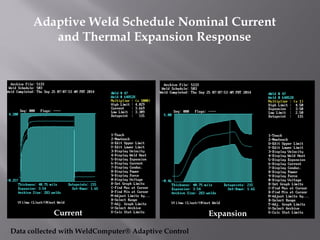
Data collected with WeldComputer® Adaptive Control
Adaptive Weld Schedule Nominal Current
and Thermal Expansion Response
ExpansionCurrent
Data collected with WeldComputer® Adaptive Control
Adaptive schedule detects greater than
normal thermal expansion rate and reduces
current to prevent expulsion from occurring.
Current Expansion
Data collected with WeldComputer® Adaptive Control
Adaptive control increases heat on cycle 6 by
1% in response to low expansion on cycle 5.
Current Expansion
Data collected with WeldComputer® Adaptive Control
Adaptive control increases heat on cycle 4 by
1% in response to low expansion on cycle 3.
Current Expansion
Data collected with WeldComputer® Adaptive Control
Adaptive control increases heat on cycle 4 by 1% in
response to low expansion on cycle 3, and an
additional 1% heat increase on cycle 6 in response
to low expansion response on cycle 5.
Current Expansion
Side view (left) and front view (right) of displacement sensor mounted on seam welder.
 Displacement Monitoring:
 No production slow-down
 Speeds up production when used in conjunction with adaptive
control
 More reliable than destructive testing, because destructive
testing doesn’t measure the size of any weld except the one that
is destroyed.
Ability to meet the 99.5% reliability requirement
demanded by the MIL-SPEC has been demonstrated.
 X-RAY Testing
 Severe impact on productivity.
 Can detect porosity, cracks, lack of fusion. Difficult to determine
weld penetration.
 Ultrasonic Testing
 Severe impact on productivity.
 Can detect porosity, cracks, lack of fusion. Difficult to determine
weld penetration.
Ability to meet the 99.5% reliability requirement demanded by the MIL-
SPEC has not been demonstrated.
 4.3.3.3 Contractor may substitute nondestructive
evaluation for routine lot tests upon approval of
the procurement activity provided he can
demonstrate that the evaluation system will
identify welds complying with size or strength
requirements with a 99.5% reliability.
 4.2.6 Control Adjustments: …settings may be
varied by ±5% from the established certification
values, or by ±10% when only one setting is
adjusted.
 5.2.3 Alternate Testing Requirements As an alternate to the
testing requirements of 5.2.2(1) real time nondestructive system
may be used when approved by the Engineering Authority. As
a minimum the system shall address: part fitup, precleaning,
electrode monitoring, and in-process monitoring of critical
process parameters. This system of controls shall include but is
not limited to, real time adaptive controls or in-process NDT
methods. Destructive testing must still be used to establish and
verify that the capability of this system will identify welds
complying with strength or size requirements with 99.5%
reliability.
 5.1.5 Control Adjustments. The settings may be varied by ±5%
from the established certification values, or by ±10% when only
one setting is adjusted.
 4.2.2.1 Preconditioning steps to compensate for fitup
variations that involve the controlled application of
heat and/or force may be employed.
Current trace (left) & Expansion response trace (right) recorded with WeldView® Monitor.
Current and Expansion Response of Spot
Weld Produced with Conventional Control
ExpansionCurrent
Material thermally
expands while weld
current is applied
Material thermally
contracts after weld
current stops
Current trace (left) & Expansion response trace (right) recorded with WeldView® Monitor.
Spot Weld Produced with Conventional
Control has Slight Fit-Up Problem
Current Expansion
Negative movement
documents parts fitting
together before material
starts to thermally expand
Material has acceptable
thermal response despite
slight fit-up problem
Current trace (left) & Expansion response trace (right) recorded with WeldView® Monitor.
Severe Fit-Up Problem with Conventional
Control Results in Undersized Weld
Weld time is lost
squeezing parts
together
Not enough weld time
remaining after parts
fit together results in
undersized weld
Current Expansion
Data collected with WeldComputer® Adaptive Control
Adaptive Weld Schedule Nominal Current
and Thermal Expansion Response
ExpansionCurrent
Diagnostic/Pre-Conditioning
Heat Pulse
Data collected with WeldComputer® Adaptive Control
Adaptive schedule produces pre-conditioning
pulses to correct fit-up problem before proceeding
to make weld.
Weld heat occurs after 3rd
pre-conditioning pulse
succeeds in correcting fit-up
problem.
Pre-conditioning pulse didn’t fully correct fit-
up problem, so weld heat is inhibited, and a
cool down delay applied before repeating
process.
Pre-
conditioning
heat pulse 1
Pre-
conditioning
heat pulse 2
Pre-
conditioning
heat pulse 3
 5.1.5.1 Control adjustments shall apply from start to
finish of the weld nugget formation.
 5.1.4.2 Use of in-process weld control monitoring
capable of detecting when a micro-ohms shift outside
of the specification range occurs may be substituted for
the surface resistance checks as deemed appropriate by
the Engineering Authority.
Data collected with WeldComputer® Adaptive Control
Substitution of In-Process Micro-Ohm
Measurements
Diagnostic/Pre-Conditioning heat pulse
measures resistance on every weld
Data collected with WeldComputer® Adaptive Control
Current Expansion
Adaptive schedule responds to expulsion
occurrence by instantly terminating weld
current to minimize part damage, then
automatically performs a repair weld operation.
 Instantly cut off heat upon detection of
expulsion.
 Keep electrodes clamped on part and wait for
weld to cool.
 Perform re-weld operation.
 5.1.5.2 Any control adjustment made beyond the
constraints set forth in 5.1.5 taken to minimize part
damage during the occurrence of a welding fault shall
be excluded as a condition that would require the
establishment of a new certified welding procedure.
 Control adjustments beyond the constraints set forth in
5.1.5 may be taken in instances when it can be
demonstrated that not taking such actions would
increase part damage and/or reduce weld consistency.
Current (7" Length Seam)
0
5
10
15
20
25
30
35
1
45
89
133
177
221
265
309
353
397
441
485
529
573
617
661
705
749
793
837
881
925
969
1013
ms
KAmp
Conductance (7" Length Seam)
0
2
4
6
8
10
12
14
16
1
45
89
133
177
221
265
309
353
397
441
485
529
573
617
661
705
749
793
837
881
925
969
1013
ms
KMho
Conductance reveals 3.1
KMho drop after
completing 4.45” of
welding on seam.
Current is consistently
maintained at 29 KA
over length of seam.
 4.3.4 Maintenance of Equipment. For machine
characteristics wherein the behavior of the machine can
be monitored, and criteria exists for those monitored
parameters that would trigger maintenance when
required, such monitoring techniques may be
employed in place of periodical machine inspection.
Total RMS Current (for 22 welds)
3000
4000
5000
6000
7000
8000
1 2 3 4 5 6 7 8 9 10 11 12 13 14 15 16 17 18 19 20 21 22
Weld Number
RMSAmps
Conductance (4.2ms after start of weld)
0
10000
20000
30000
40000
50000
60000
1 2 3 4 5 6 7 8 9 10 11 12 13 14 15 16 17 18 19 20 21 22
Weld Number
Mho
 4.3.3 Jigs and Fixtures. Where shunting cannot be
avoided due to part design, the effects of shunting shall
be factored into the production weld schedule and
necessary adjustments made to ensure acceptable
welds are produced.
I
Use right machine, control, electrodes, force & current to make weld.
I
2nd weld is smaller than 1st because some current shunts through 1st weld.
I
3rd weld is smaller than 2nd because current shunts through
1st & 2nd welds.
I
Subsequent welds are all similarly reduced in size due to current
shunting.
I
Shunting makes welds hotter at start of seam.
 produce smaller nuggets than they really want
throughout the entire length of the seam, in order
to avoid having the first few welds on the seam be
too hot and possibly expulse material,
or
 suffer from having the first few welds be too hot
and expulse material, just so the rest of the welds
in the seam are the size they want.
 Scale heat down for 2nd spot.
 Scale head down more for 1st spot.
All welds occurring at same wheel speed
Welding starts
at slower speed
Welding stops
at slower speed
 Wheel velocity is a major parameter of control,
as significant as force and current.
For a given applied force and current.
 Lower velocity causes hotter welds.
 Higher velocity causes colder welds.
 Upslope heat at start of seam.
 Downslope heat at end of seam.
 Hard to coordinate upslope heat and downslope
heat with increasing and decreasing velocity.
 Hard to synchronize heat profile with velocity
profile.
 Program the control to automatically adjust the
heat up or down, in relation to instantaneous
wheel velocity.
 Heat is always coordinated and synchronized with
wheel velocity.
 Easy to manage because there are no operator
settings or proximity switches to constantly adjust.
Dynamically adjusting weld heat to compensate for velocity
fluctuations increases weld consistency and reduces leakers.
Constant Speed
Edge to edge adaptive control produces gas tight welds over the entire
length of the seam.
 Water heaters
 55 Gallon drums
 Pails
 Aerosol Cans
Plot of wheel rolling up on front tank, across tank, & off back of tank.
Wheel starts
rolling up on
front of part.
Wheel starts
rolling off
back of part.
Data collected with WeldComputer® Adaptive Control.
Current starting here
after wheel is already
rolling up on part
results in undersized
weld on front edge
Wheel starts
rolling up on
part here
Displacement data (top) and current data (bottom) collected with WeldView® Monitor.
Wheel starts
rolling up on
part here
Current starting before
wheel comes in contact
with part overheats
front edge of part.
Displacement data (top) and current data (bottom) collected with WeldView® Monitor.
 Inability to control welds on front edge
 Inability to control welds on back edge
 Inability to prevent hot spots
 Inability to prevent cold spots
 Inability to produce consistent current
Heat envelop is precisely coordinated with front edge of part.
 Current
 Force
 Wheel/Electrode Cooling
 Machine Stability
 Velocity fluctuations: can be
compensated for with adaptive control.
 Force fluctuations: can be compensated
for with adaptive control.
Wheel starts
rolling up on
front of part.
Wheel starts
rolling off
back of part.
Wheel
overshoots
rolling up on
front of part.
Wheel bounces
when it lands
on top of part.
Wheels
bounce
against each
other after
rolling off
back of part.
Displacement of wheel rolling up on front of part triggers current.
Velocity
Each 5ms duration weld current pulse (below) is adjusted every
millisecond to control weld based on displacement, velocity & force.
Data collected and current synthesized with WeldComputer® Adaptive Control.
Wheel bounces when it lands
on top of part.Wheel overshoots rolling
up on front of part.
Velocity
Heat automatically
reduces itself and shuts
off as wheel rolls off part.
Wheels bounce against
each other after rolling
off back of part.
Wheel starts
rolling off back
of part.
Data collected and current synthesized with WeldComputer® Adaptive Control.
 Apply right heat before hitting front edge of part.
 Profile heat envelope rolling up on part.
 Compensate for bounce of wheel landing on
part.
 Compensate for velocity fluctuations.
 Profile heat envelope rolling off back of part.
 Instantly cut off heat rolling off back edge of
part.
 Adjust heat for height variations on part.
 Use control that delivers accurate repeatable
heat.
 Part proximity sensors used to synchronize heat with front
of part entering machine have too much variability to
accurately control welding on the front edge.
 Inability to synchronize heat with back of part leaving
machine.
 Inability to compensate for machine force and velocity
variations.
 SCR based controls have limitations on current wave shape
and regulation.
 Traditional MFDC controls, provide ineffective regulation
and heat repeatability, in applications requiring short
duration high current pulses.
Current trace recorded with WeldView® Monitor.
Process is unregulated when control never reaches programmed
current targets.
Seam performance is compromised when high currents persist
during cool times.
Current trace recorded with WeldView®
Monitor.
Current only decays to 13.5kA at end of
programmed cool time.
Current trace recorded with WeldView® Monitor.
Process is unregulated when unstable current overshoots, has
oscillations, and never reaches programmed current targets.
Current trace recorded with WeldView® Monitor.
Current overshoot followed by current
undershoot represents 73% current
fluctuation during each weld.
Undershoot occurring
8 ms after overshoot. Current never decays to zero during
cool time between impulses.
Peak current fluctuates 15%
from one impulse to the next.
Current trace recorded with WeldView® Monitor.
0
1
2
3
4
5
6
7
8
9
10
1
6
11
16
21
26
31
36
41
46
51
56
61
66
71
76
81
86
91
96
101
106
111
116
121
126
131
136
141
146
151
156
161
166
171
176
181
186
191
196
201
206
211
K-amps
Big current fluctuations
reduces stability of
process
Long current
decay during
cool time means
hotter wheels
Current still rising at
end of programmed
heat means process is
uncontrolled
Current trace recorded with WeldView® Monitor.
Big current fluctuations
caused by MFDC
reduces stability of
process
Long current
decay during
cool time means
hotter wheels
0
5
10
15
20
K-amps
 Big mechanical disturbance from current
fluctuations occurs twice per millisecond of
applied heat.
 Current decay time after each weld diminishes
effectiveness of cool time & causes wheels to
run hotter.
 Magnetizes machine and part.
 Causes heat imbalance from Peltier Effect.
 Asymmetrical electrode wear.
 Limited current adjustment rate.
Current trace recorded with WeldView® Monitor.
0
5
10
15
20
K-amps
Current trace recorded with WeldView® Monitor.
-15
-10
-5
0
5
10
15
K-amps
Current trace recorded with WeldView® Monitor.
0
5
10
15
20
K-amps
Current trace recorded with WeldView® Monitor.
-20
-15
-10
-5
0
5
10
15
20
K-amps
Current trace recorded with WeldView® Monitor.
0
16000
1
Amps
Time
3 ms Weld Produced with 6 Pulses at a 2kHz Switching Frequency
3 ms Weld Produced with 12 Pulses at 4kHz Switching Frequency
0
16000
Time
Amps
3 ms Weld Produced with 24 Pulses at 8kHz Switching Frequency
0
16000
Time
Amps
3 ms Weld Produced with 48 Pulses at 16kHz Switching Frequency
0
16000
Time
Amps
Archive File # Avg. Expansion Avg. Current Avg. Force
983 (sample - left) 5.77 6.77 2.64
982 (part - right) 3.45 6.12 2.88
Sample Actual Part
Bob Cohen
WeldComputer Corporation
Copyright © 2014 WeldComputer Corporation
All Rights Reserved
Adaptive Controls for Aerospace
Resistance Welding Applications

Adaptive Welding Controls for Aerospace Applications

  • 1.
    Bob Cohen WeldComputer Corporation Copyright© 2014 WeldComputer Corporation All Rights Reserved Adaptive Controls for Aerospace Resistance Welding Applications
  • 2.
    Adaptive control isabout  Recognizing when a process variability exists that would affect the outcome of a production weld  Identifying the underlying condition responsible for the variability  Taking corrective action to compensate for the variability as the weld is taking place  The end result is to prevent the occurrence of a bad weld in the first place and to increase the consistency of all welds produced  When it’s impossible to correct the problem and make a good weld, notify the operation about the problem
  • 3.
     Flattening electrodes Surface contamination  Poor parts fit-up  Shunt condition and other geometry variations  Workpiece thickness variation  Electrode force variation  Wheel/brush contact resistance variation  Wheel velocity variation
  • 4.
     Reduce relianceon destructive testing.  Prevent random problem welds from passing through production undetected.  Automatically take corrective pre-conditioning and compensating actions to prevent out of spec welds from being produced.  Increase consistency of all welds.  Substitute in process monitoring in place of manual surface resistance checks.  Substitute in-process monitoring of the weld machine in place of periodical machine inspection.
  • 5.
     4.3.3.3 Contractormay substitute nondestructive evaluation for routine lot tests upon approval of the procurement activity provided he can demonstrate that the evaluation system will identify welds complying with size or strength requirements with a 99.5% reliability.  4.2.6 Control Adjustments: …settings may be varied by ±5% from the established certification values, or by ±10% when only one setting is adjusted.
  • 9.
    Data collected withWeldComputer® Adaptive Control Adaptive Weld Schedule Nominal Current and Thermal Expansion Response ExpansionCurrent
  • 10.
    Data collected withWeldComputer® Adaptive Control Adaptive schedule detects greater than normal thermal expansion rate and reduces current to prevent expulsion from occurring. Current Expansion
  • 11.
    Data collected withWeldComputer® Adaptive Control Adaptive control increases heat on cycle 6 by 1% in response to low expansion on cycle 5. Current Expansion
  • 12.
    Data collected withWeldComputer® Adaptive Control Adaptive control increases heat on cycle 4 by 1% in response to low expansion on cycle 3. Current Expansion
  • 13.
    Data collected withWeldComputer® Adaptive Control Adaptive control increases heat on cycle 4 by 1% in response to low expansion on cycle 3, and an additional 1% heat increase on cycle 6 in response to low expansion response on cycle 5. Current Expansion
  • 17.
    Side view (left)and front view (right) of displacement sensor mounted on seam welder.
  • 18.
     Displacement Monitoring: No production slow-down  Speeds up production when used in conjunction with adaptive control  More reliable than destructive testing, because destructive testing doesn’t measure the size of any weld except the one that is destroyed. Ability to meet the 99.5% reliability requirement demanded by the MIL-SPEC has been demonstrated.
  • 19.
     X-RAY Testing Severe impact on productivity.  Can detect porosity, cracks, lack of fusion. Difficult to determine weld penetration.  Ultrasonic Testing  Severe impact on productivity.  Can detect porosity, cracks, lack of fusion. Difficult to determine weld penetration. Ability to meet the 99.5% reliability requirement demanded by the MIL- SPEC has not been demonstrated.
  • 20.
     4.3.3.3 Contractormay substitute nondestructive evaluation for routine lot tests upon approval of the procurement activity provided he can demonstrate that the evaluation system will identify welds complying with size or strength requirements with a 99.5% reliability.  4.2.6 Control Adjustments: …settings may be varied by ±5% from the established certification values, or by ±10% when only one setting is adjusted.
  • 21.
     5.2.3 AlternateTesting Requirements As an alternate to the testing requirements of 5.2.2(1) real time nondestructive system may be used when approved by the Engineering Authority. As a minimum the system shall address: part fitup, precleaning, electrode monitoring, and in-process monitoring of critical process parameters. This system of controls shall include but is not limited to, real time adaptive controls or in-process NDT methods. Destructive testing must still be used to establish and verify that the capability of this system will identify welds complying with strength or size requirements with 99.5% reliability.  5.1.5 Control Adjustments. The settings may be varied by ±5% from the established certification values, or by ±10% when only one setting is adjusted.
  • 22.
     4.2.2.1 Preconditioningsteps to compensate for fitup variations that involve the controlled application of heat and/or force may be employed.
  • 23.
    Current trace (left)& Expansion response trace (right) recorded with WeldView® Monitor. Current and Expansion Response of Spot Weld Produced with Conventional Control ExpansionCurrent Material thermally expands while weld current is applied Material thermally contracts after weld current stops
  • 24.
    Current trace (left)& Expansion response trace (right) recorded with WeldView® Monitor. Spot Weld Produced with Conventional Control has Slight Fit-Up Problem Current Expansion Negative movement documents parts fitting together before material starts to thermally expand Material has acceptable thermal response despite slight fit-up problem
  • 25.
    Current trace (left)& Expansion response trace (right) recorded with WeldView® Monitor. Severe Fit-Up Problem with Conventional Control Results in Undersized Weld Weld time is lost squeezing parts together Not enough weld time remaining after parts fit together results in undersized weld Current Expansion
  • 26.
    Data collected withWeldComputer® Adaptive Control Adaptive Weld Schedule Nominal Current and Thermal Expansion Response ExpansionCurrent Diagnostic/Pre-Conditioning Heat Pulse
  • 27.
    Data collected withWeldComputer® Adaptive Control Adaptive schedule produces pre-conditioning pulses to correct fit-up problem before proceeding to make weld. Weld heat occurs after 3rd pre-conditioning pulse succeeds in correcting fit-up problem. Pre-conditioning pulse didn’t fully correct fit- up problem, so weld heat is inhibited, and a cool down delay applied before repeating process. Pre- conditioning heat pulse 1 Pre- conditioning heat pulse 2 Pre- conditioning heat pulse 3
  • 28.
     5.1.5.1 Controladjustments shall apply from start to finish of the weld nugget formation.
  • 29.
     5.1.4.2 Useof in-process weld control monitoring capable of detecting when a micro-ohms shift outside of the specification range occurs may be substituted for the surface resistance checks as deemed appropriate by the Engineering Authority.
  • 30.
    Data collected withWeldComputer® Adaptive Control Substitution of In-Process Micro-Ohm Measurements Diagnostic/Pre-Conditioning heat pulse measures resistance on every weld
  • 31.
    Data collected withWeldComputer® Adaptive Control Current Expansion Adaptive schedule responds to expulsion occurrence by instantly terminating weld current to minimize part damage, then automatically performs a repair weld operation.
  • 32.
     Instantly cutoff heat upon detection of expulsion.  Keep electrodes clamped on part and wait for weld to cool.  Perform re-weld operation.
  • 33.
     5.1.5.2 Anycontrol adjustment made beyond the constraints set forth in 5.1.5 taken to minimize part damage during the occurrence of a welding fault shall be excluded as a condition that would require the establishment of a new certified welding procedure.
  • 34.
     Control adjustmentsbeyond the constraints set forth in 5.1.5 may be taken in instances when it can be demonstrated that not taking such actions would increase part damage and/or reduce weld consistency.
  • 35.
    Current (7" LengthSeam) 0 5 10 15 20 25 30 35 1 45 89 133 177 221 265 309 353 397 441 485 529 573 617 661 705 749 793 837 881 925 969 1013 ms KAmp Conductance (7" Length Seam) 0 2 4 6 8 10 12 14 16 1 45 89 133 177 221 265 309 353 397 441 485 529 573 617 661 705 749 793 837 881 925 969 1013 ms KMho Conductance reveals 3.1 KMho drop after completing 4.45” of welding on seam. Current is consistently maintained at 29 KA over length of seam.
  • 36.
     4.3.4 Maintenanceof Equipment. For machine characteristics wherein the behavior of the machine can be monitored, and criteria exists for those monitored parameters that would trigger maintenance when required, such monitoring techniques may be employed in place of periodical machine inspection.
  • 39.
    Total RMS Current(for 22 welds) 3000 4000 5000 6000 7000 8000 1 2 3 4 5 6 7 8 9 10 11 12 13 14 15 16 17 18 19 20 21 22 Weld Number RMSAmps Conductance (4.2ms after start of weld) 0 10000 20000 30000 40000 50000 60000 1 2 3 4 5 6 7 8 9 10 11 12 13 14 15 16 17 18 19 20 21 22 Weld Number Mho
  • 42.
     4.3.3 Jigsand Fixtures. Where shunting cannot be avoided due to part design, the effects of shunting shall be factored into the production weld schedule and necessary adjustments made to ensure acceptable welds are produced.
  • 43.
    I Use right machine,control, electrodes, force & current to make weld.
  • 44.
    I 2nd weld issmaller than 1st because some current shunts through 1st weld.
  • 45.
    I 3rd weld issmaller than 2nd because current shunts through 1st & 2nd welds.
  • 46.
    I Subsequent welds areall similarly reduced in size due to current shunting.
  • 47.
    I Shunting makes weldshotter at start of seam.
  • 48.
     produce smallernuggets than they really want throughout the entire length of the seam, in order to avoid having the first few welds on the seam be too hot and possibly expulse material, or  suffer from having the first few welds be too hot and expulse material, just so the rest of the welds in the seam are the size they want.
  • 49.
     Scale heatdown for 2nd spot.  Scale head down more for 1st spot.
  • 50.
    All welds occurringat same wheel speed
  • 51.
    Welding starts at slowerspeed Welding stops at slower speed
  • 52.
     Wheel velocityis a major parameter of control, as significant as force and current. For a given applied force and current.  Lower velocity causes hotter welds.  Higher velocity causes colder welds.
  • 53.
     Upslope heatat start of seam.  Downslope heat at end of seam.  Hard to coordinate upslope heat and downslope heat with increasing and decreasing velocity.  Hard to synchronize heat profile with velocity profile.
  • 54.
     Program thecontrol to automatically adjust the heat up or down, in relation to instantaneous wheel velocity.  Heat is always coordinated and synchronized with wheel velocity.  Easy to manage because there are no operator settings or proximity switches to constantly adjust.
  • 55.
    Dynamically adjusting weldheat to compensate for velocity fluctuations increases weld consistency and reduces leakers.
  • 56.
    Constant Speed Edge toedge adaptive control produces gas tight welds over the entire length of the seam.
  • 57.
     Water heaters 55 Gallon drums  Pails  Aerosol Cans
  • 58.
    Plot of wheelrolling up on front tank, across tank, & off back of tank. Wheel starts rolling up on front of part. Wheel starts rolling off back of part. Data collected with WeldComputer® Adaptive Control.
  • 60.
    Current starting here afterwheel is already rolling up on part results in undersized weld on front edge Wheel starts rolling up on part here Displacement data (top) and current data (bottom) collected with WeldView® Monitor.
  • 61.
    Wheel starts rolling upon part here Current starting before wheel comes in contact with part overheats front edge of part. Displacement data (top) and current data (bottom) collected with WeldView® Monitor.
  • 62.
     Inability tocontrol welds on front edge  Inability to control welds on back edge  Inability to prevent hot spots  Inability to prevent cold spots  Inability to produce consistent current
  • 63.
    Heat envelop isprecisely coordinated with front edge of part.
  • 64.
     Current  Force Wheel/Electrode Cooling  Machine Stability
  • 65.
     Velocity fluctuations:can be compensated for with adaptive control.  Force fluctuations: can be compensated for with adaptive control.
  • 66.
    Wheel starts rolling upon front of part. Wheel starts rolling off back of part. Wheel overshoots rolling up on front of part. Wheel bounces when it lands on top of part. Wheels bounce against each other after rolling off back of part.
  • 67.
    Displacement of wheelrolling up on front of part triggers current. Velocity Each 5ms duration weld current pulse (below) is adjusted every millisecond to control weld based on displacement, velocity & force. Data collected and current synthesized with WeldComputer® Adaptive Control. Wheel bounces when it lands on top of part.Wheel overshoots rolling up on front of part.
  • 68.
    Velocity Heat automatically reduces itselfand shuts off as wheel rolls off part. Wheels bounce against each other after rolling off back of part. Wheel starts rolling off back of part. Data collected and current synthesized with WeldComputer® Adaptive Control.
  • 69.
     Apply rightheat before hitting front edge of part.  Profile heat envelope rolling up on part.  Compensate for bounce of wheel landing on part.  Compensate for velocity fluctuations.  Profile heat envelope rolling off back of part.  Instantly cut off heat rolling off back edge of part.  Adjust heat for height variations on part.  Use control that delivers accurate repeatable heat.
  • 70.
     Part proximitysensors used to synchronize heat with front of part entering machine have too much variability to accurately control welding on the front edge.  Inability to synchronize heat with back of part leaving machine.  Inability to compensate for machine force and velocity variations.  SCR based controls have limitations on current wave shape and regulation.  Traditional MFDC controls, provide ineffective regulation and heat repeatability, in applications requiring short duration high current pulses.
  • 71.
    Current trace recordedwith WeldView® Monitor.
  • 72.
    Process is unregulatedwhen control never reaches programmed current targets. Seam performance is compromised when high currents persist during cool times. Current trace recorded with WeldView® Monitor. Current only decays to 13.5kA at end of programmed cool time. Current trace recorded with WeldView® Monitor.
  • 73.
    Process is unregulatedwhen unstable current overshoots, has oscillations, and never reaches programmed current targets. Current trace recorded with WeldView® Monitor. Current overshoot followed by current undershoot represents 73% current fluctuation during each weld. Undershoot occurring 8 ms after overshoot. Current never decays to zero during cool time between impulses. Peak current fluctuates 15% from one impulse to the next.
  • 74.
    Current trace recordedwith WeldView® Monitor. 0 1 2 3 4 5 6 7 8 9 10 1 6 11 16 21 26 31 36 41 46 51 56 61 66 71 76 81 86 91 96 101 106 111 116 121 126 131 136 141 146 151 156 161 166 171 176 181 186 191 196 201 206 211 K-amps Big current fluctuations reduces stability of process Long current decay during cool time means hotter wheels Current still rising at end of programmed heat means process is uncontrolled
  • 75.
    Current trace recordedwith WeldView® Monitor. Big current fluctuations caused by MFDC reduces stability of process Long current decay during cool time means hotter wheels 0 5 10 15 20 K-amps
  • 76.
     Big mechanicaldisturbance from current fluctuations occurs twice per millisecond of applied heat.  Current decay time after each weld diminishes effectiveness of cool time & causes wheels to run hotter.  Magnetizes machine and part.  Causes heat imbalance from Peltier Effect.  Asymmetrical electrode wear.  Limited current adjustment rate.
  • 77.
    Current trace recordedwith WeldView® Monitor. 0 5 10 15 20 K-amps
  • 78.
    Current trace recordedwith WeldView® Monitor. -15 -10 -5 0 5 10 15 K-amps
  • 80.
    Current trace recordedwith WeldView® Monitor. 0 5 10 15 20 K-amps
  • 81.
    Current trace recordedwith WeldView® Monitor. -20 -15 -10 -5 0 5 10 15 20 K-amps
  • 82.
    Current trace recordedwith WeldView® Monitor.
  • 83.
    0 16000 1 Amps Time 3 ms WeldProduced with 6 Pulses at a 2kHz Switching Frequency 3 ms Weld Produced with 12 Pulses at 4kHz Switching Frequency 0 16000 Time Amps
  • 84.
    3 ms WeldProduced with 24 Pulses at 8kHz Switching Frequency 0 16000 Time Amps 3 ms Weld Produced with 48 Pulses at 16kHz Switching Frequency 0 16000 Time Amps
  • 86.
    Archive File #Avg. Expansion Avg. Current Avg. Force 983 (sample - left) 5.77 6.77 2.64 982 (part - right) 3.45 6.12 2.88 Sample Actual Part
  • 87.
    Bob Cohen WeldComputer Corporation Copyright© 2014 WeldComputer Corporation All Rights Reserved Adaptive Controls for Aerospace Resistance Welding Applications