
What is a Circular City?
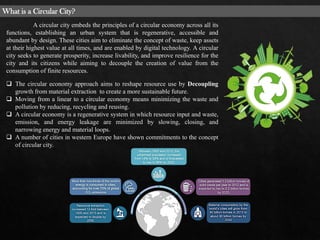
A circular city embeds the principles of a circular economy across all its
functions, establishing an urban system that is regenerative, accessible and
abundant by design. These cities aim to eliminate the concept of waste, keep assets
at their highest value at all times, and are enabled by digital technology. A circular
city seeks to generate prosperity, increase livability, and improve resilience for the
city and its citizens while aiming to decouple the creation of value from the
consumption of finite resources.
❑ The circular economy approach aims to reshape resource use by Decoupling
growth from material extraction to create a more sustainable future.
❑ Moving from a linear to a circular economy means minimizing the waste and
pollution by reducing, recycling and reusing.
❑ A circular economy is a regenerative system in which resource input and waste,
emission, and energy leakage are minimized by slowing, closing, and
narrowing energy and material loops.
❑ A number of cities in western Europe have shown commitments to the concept
of circular city.
To foster economic growth without a similar
increase in the rate of resource consumption (resource
decoupling), and to support the development of urban
infrastructure that reduces environmental impacts (impact
decoupling).
What is the ‘Circular Economy’?
A circular economy describes an economic system that is based on business models which replace the ‘end of-
life’ concept with reducing, alternatively reusing, recycling and recovering materials in production/distribution and
consumption processes, thus operating at the micro level (products, companies, consumers), meso level (eco-industrial
parks) and macro level (city, region, nation and beyond), with the aim to accomplish sustainable development, which
implies creating environmental quality, economic prosperity and social equity, to the benefit of current and future
generations
Monocentric
Towards an adaptive Circular City
as network city
Clusters of poly-centric cities, not
mono-centric: compact, mixed-use
and walkable
Economic Decoupling:
The principles of a Circular Economy
❑ Design out waste and pollution
❑ Keep products and materials in use
❑ Regenerate natural systems
CIRCULAR ECONOMY
LINEAR ECONOMY
INCREASING
CIRCULALITY
SMARTER PRODUCT USE
AND MANUFACTURE
EXTEND LIFESPAN OF
PRODUCT AND ITS PARTS
USEFULAPPLICATION OF
MATERIALS
• R0 Refuse
• R1 Rethink
• R2 Reduce
• R3 Reuse
• R4 Repair
• R5 Refurbish
• R6 Remanufacture
• R7 Repurpose
• R8 Recycle
• R9 Recover
STRATEGIES
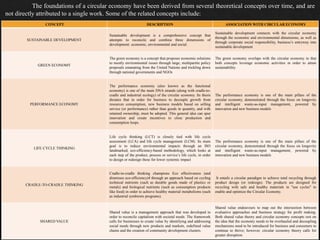
CONCEPT DESCRIPTION ASSOCIATION WITH CIRCULAR ECONOMY
SUSTAINABLE DEVELOPMENT
Sustainable development is a comprehensive concept that
attempts to reconcile and combine three dimensions of
development: economic, environmental and social.
Sustainable development connects with the circular economy
through the economic and environmental dimensions, as well as
through corporate social responsibility, business’s entryway into
sustainable development
GREEN ECONOMY
The green economy is a concept that proposes economic solutions
to mostly environmental issues through large, multipartite policy
proposals emanating from the United Nations and trickling down
through national governments and NGOs
The green economy overlaps with the circular economy in that
both concepts leverage economic activities in order to attain
sustainability.
PERFORMANCE ECONOMY
The performance economy (also known as the functional
economy) is one of the main DNA strands (along with cradle-to-
cradle and industrial ecology) of the circular economy. Its thesis
dictates that in order for business to decouple growth from
resources consumption, new business models based on selling
service (or performance) rather than goods in quantity, and with
retained ownership, must be adopted. This general idea can spur
innovation and create incentives to close production and
consumption loops.
The performance economy is one of the main pillars of the
circular economy, demonstrated through the focus on longevity
and intelligent waste-as‐input management, powered by
innovation and new business models
LIFE CYCLE THINKING
Life cycle thinking (LCT) is closely tied with life cycle
assessment (LCA) and life cycle management (LCM). Its main
goal is to reduce environmental impacts through an ISO
landmarked, eco-efficiency-based methodology, which looks at
each step of the product, process or service’s life cycle, in order
to design or redesign these for lower systemic impact
The performance economy is one of the main pillars of the
circular economy, demonstrated through the focus on longevity
and intelligent waste-as‐input management, powered by
innovation and new business models
CRADLE-TO-CRADLE THINKING
Cradle-to-cradle thinking champions Eco effectiveness (and
dismisses eco-efficiency)4 through an approach based on cycling
technical nutrients (such as durable goods made of plastics or
metals) and biological nutrients (such as consumption products
like food) in order to achieve healthy material metabolisms (such
as industrial symbiosis programs).
It entails a circular paradigm to achieve total recycling through
product design (or redesign). The products are designed for
recycling with safe and healthy materials in "use cycles" to
enable and optimize the Circular Economy.
SHARED VALUE
Shared value is a management approach that was developed in
order to reconcile capitalism with societal needs. The framework
calls for businesses to create value by identifying and addressing
social needs through new products and markets, redefined value
chains and the creation of community development clusters.
Shared value endeavours to map out the intersection between
evaluative approaches and business strategy for profit making.
Both shared value theory and circular economy concepts rest on
the idea that the economy needs to be overhauled and decoupling
mechanisms need to be introduced for business and consumers to
continue to thrive; however, circular economy theory calls for
greater disruption.
The foundations of a circular economy have been derived from several theoretical concepts over time, and are
not directly attributed to a single work. Some of the related concepts include:
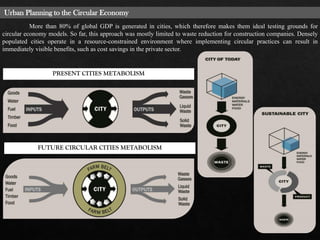
Urban Planning to the Circular Economy
More than 80% of global GDP is generated in cities, which therefore makes them ideal testing grounds for
circular economy models. So far, this approach was mostly limited to waste reduction for construction companies. Densely
populated cities operate in a resource-constrained environment where implementing circular practices can result in
immediately visible benefits, such as cost savings in the private sector.
PRESENT CITIES METABOLISM
FUTURE CIRCULAR CITIES METABOLISM
The infrastructure transition includes new construction as well as retrofitting of existing networked
infrastructure.
For example, increased use of local renewable resources and ecosystem services, and the re-use of waste
products will allow cities to better manage the flows passing through them and achieve decoupling.
4 cases exist:
• Entire new urban developments
• Construction of new networked infrastructures
• Reconfiguring existing cities
• Retrofitting existing infrastructures
The Adaptive Circular City
Transitioning to a circular city:
1) Addressing the Role Of Infrastructure in directing material flows and therefore resource use, productivity and
efficiency in the urban context. The available technologies and innovative solutions need to be “fully integrated” into
the urban systems.
2) Examine cities from a Material Flow Perspective, presenting the city as a living organism with a dynamic and
continuous flow of inputs and outputs as its “Metabolism”.
3) Analyzing Material Flow that links industrial ecology and urban economy; promoting circular flows of resources
rather than the traditional input-output models.
4) To Include Ecosystem Services into future visions of the city that can increase the options for resource decoupling.
5) Environment sensitive Infrastructure Development.
5 steps to guide the systemic transition to Adaptive Circular Cities:
A circular city aims to generate prosperity and economic resilience for itself and its citizens, while decoupling
value creation from the consumption of finite resources.
Amsterdam, one of the leaders in the application of circular economy concepts to city governance, follows seven
principles in its transition towards a circular economy. These principles can be extended to define a vision and an action
roadmap on circularity in cities:
❑ Closed loop – all materials enter into an infinite cycle (technical or biological).
❑ Reduced emissions – all energy comes from renewable sources.
❑ Value generation – resources are used to generate (financial or other) value.
❑ Modular design – modular and flexible design of products and production chains increases adaptability of systems.
❑ Innovative business models – new business models for production, distribution and consumption enable the shift from
possession of goods to (use of) services.
❑ Region-oriented reverse logistics – logistics systems shift to a more region-oriented service with reverse logistics
capabilities.
❑ Natural systems upgradation – human activities positively contribute to ecosystems, ecosystem services and the
reconstruction of “natural capital”.
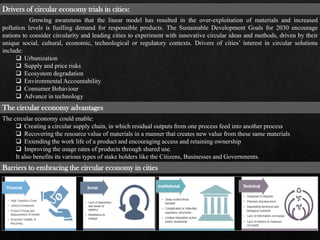
Drivers of circular economy trials in cities:
Growing awareness that the linear model has resulted in the over-exploitation of materials and increased
pollution levels is fuelling demand for responsible products. The Sustainable Development Goals for 2030 encourage
nations to consider circularity and leading cities to experiment with innovative circular ideas and methods, driven by their
unique social, cultural, economic, technological or regulatory contexts. Drivers of cities’ interest in circular solutions
include:
❑ Urbanization
❑ Supply and price risks
❑ Ecosystem degradation
❑ Environmental Accountability
❑ Consumer Behaviour
❑ Advance in technology
The circular economy advantages
The circular economy could enable:
❑ Creating a circular supply chain, in which residual outputs from one process feed into another process
❑ Recovering the resource value of materials in a manner that creates new value from these same materials
❑ Extending the work life of a product and encouraging access and retaining ownership
❑ Improving the usage rates of products through shared use.
It also benefits its various types of stake holders like the Citizens, Businesses and Governments.
Barriers to embracing the circular economy in cities
Materials and Methods: Assessment of circularity for the built environment:
A hybrid deductive and inductive methodology is applied to identify and imply the circularity in an existing built
environment.
I. Theoretical aspects of the circular economy (CE) and circular city models
II. Identifying how cultural heritage contributes to CE implementation
III. Analyzing the practical adaptive reuse
Case Study: De Ceuvel an Industrial area
❑ Location: Amsterdam north
❑ Turned into a sustainable area with use of
innovative technological solutions
❑ Peculiarity of De Ceuvel is use of retrofitted
houseboats which are used as floating houses
❑ Separate collection of urine is also done at a
popular café along with sustainable
agriculture
As the soil is polluted and it was not
possible to create an underground infrastructure,
these boats are provided with dry composting
toilets, a heat pump, solar panels and biofilters
for the treatment of grey water, while the use of
Phyto-remediating plants helps to clean the soil.
Which establish the following goals
•100% renewable heating and electricity supply;
•100% on site wastewater treatment;
•100% organic waste treatment;
•100% on-site drinking water supply
Conclusion:
To keep materials in use for as long as possible and maximizing their economic value and achieve sustainability
the cities need to prioritize a systematic transition from the linear paradigm of production and consumption to adopting
circular model which can only be achieved with the collaborative efforts across the value chain, involving individuals, the
private sector, different levels of government and civil society.
Reference:
1. Prof Steffen Lehmann, March 2018 - The University of Portsmouth (UoP) - ADAPTIVE CIRCULAR CITIES
2. World Economic Forum, February 2018 – White Paper - CIRCULAR ECONOMY IN CITIES
Adaptive circular cities

Adaptive circular cities

  • 2.
    What is aCircular City? A circular city embeds the principles of a circular economy across all its functions, establishing an urban system that is regenerative, accessible and abundant by design. These cities aim to eliminate the concept of waste, keep assets at their highest value at all times, and are enabled by digital technology. A circular city seeks to generate prosperity, increase livability, and improve resilience for the city and its citizens while aiming to decouple the creation of value from the consumption of finite resources. ❑ The circular economy approach aims to reshape resource use by Decoupling growth from material extraction to create a more sustainable future. ❑ Moving from a linear to a circular economy means minimizing the waste and pollution by reducing, recycling and reusing. ❑ A circular economy is a regenerative system in which resource input and waste, emission, and energy leakage are minimized by slowing, closing, and narrowing energy and material loops. ❑ A number of cities in western Europe have shown commitments to the concept of circular city.
  • 3.
    To foster economicgrowth without a similar increase in the rate of resource consumption (resource decoupling), and to support the development of urban infrastructure that reduces environmental impacts (impact decoupling). What is the ‘Circular Economy’? A circular economy describes an economic system that is based on business models which replace the ‘end of- life’ concept with reducing, alternatively reusing, recycling and recovering materials in production/distribution and consumption processes, thus operating at the micro level (products, companies, consumers), meso level (eco-industrial parks) and macro level (city, region, nation and beyond), with the aim to accomplish sustainable development, which implies creating environmental quality, economic prosperity and social equity, to the benefit of current and future generations Monocentric Towards an adaptive Circular City as network city Clusters of poly-centric cities, not mono-centric: compact, mixed-use and walkable Economic Decoupling:
  • 4.
    The principles ofa Circular Economy ❑ Design out waste and pollution ❑ Keep products and materials in use ❑ Regenerate natural systems
  • 6.
    CIRCULAR ECONOMY LINEAR ECONOMY INCREASING CIRCULALITY SMARTERPRODUCT USE AND MANUFACTURE EXTEND LIFESPAN OF PRODUCT AND ITS PARTS USEFULAPPLICATION OF MATERIALS • R0 Refuse • R1 Rethink • R2 Reduce • R3 Reuse • R4 Repair • R5 Refurbish • R6 Remanufacture • R7 Repurpose • R8 Recycle • R9 Recover STRATEGIES
  • 7.
    CONCEPT DESCRIPTION ASSOCIATIONWITH CIRCULAR ECONOMY SUSTAINABLE DEVELOPMENT Sustainable development is a comprehensive concept that attempts to reconcile and combine three dimensions of development: economic, environmental and social. Sustainable development connects with the circular economy through the economic and environmental dimensions, as well as through corporate social responsibility, business’s entryway into sustainable development GREEN ECONOMY The green economy is a concept that proposes economic solutions to mostly environmental issues through large, multipartite policy proposals emanating from the United Nations and trickling down through national governments and NGOs The green economy overlaps with the circular economy in that both concepts leverage economic activities in order to attain sustainability. PERFORMANCE ECONOMY The performance economy (also known as the functional economy) is one of the main DNA strands (along with cradle-to- cradle and industrial ecology) of the circular economy. Its thesis dictates that in order for business to decouple growth from resources consumption, new business models based on selling service (or performance) rather than goods in quantity, and with retained ownership, must be adopted. This general idea can spur innovation and create incentives to close production and consumption loops. The performance economy is one of the main pillars of the circular economy, demonstrated through the focus on longevity and intelligent waste-as‐input management, powered by innovation and new business models LIFE CYCLE THINKING Life cycle thinking (LCT) is closely tied with life cycle assessment (LCA) and life cycle management (LCM). Its main goal is to reduce environmental impacts through an ISO landmarked, eco-efficiency-based methodology, which looks at each step of the product, process or service’s life cycle, in order to design or redesign these for lower systemic impact The performance economy is one of the main pillars of the circular economy, demonstrated through the focus on longevity and intelligent waste-as‐input management, powered by innovation and new business models CRADLE-TO-CRADLE THINKING Cradle-to-cradle thinking champions Eco effectiveness (and dismisses eco-efficiency)4 through an approach based on cycling technical nutrients (such as durable goods made of plastics or metals) and biological nutrients (such as consumption products like food) in order to achieve healthy material metabolisms (such as industrial symbiosis programs). It entails a circular paradigm to achieve total recycling through product design (or redesign). The products are designed for recycling with safe and healthy materials in "use cycles" to enable and optimize the Circular Economy. SHARED VALUE Shared value is a management approach that was developed in order to reconcile capitalism with societal needs. The framework calls for businesses to create value by identifying and addressing social needs through new products and markets, redefined value chains and the creation of community development clusters. Shared value endeavours to map out the intersection between evaluative approaches and business strategy for profit making. Both shared value theory and circular economy concepts rest on the idea that the economy needs to be overhauled and decoupling mechanisms need to be introduced for business and consumers to continue to thrive; however, circular economy theory calls for greater disruption. The foundations of a circular economy have been derived from several theoretical concepts over time, and are not directly attributed to a single work. Some of the related concepts include:
  • 8.
    Urban Planning tothe Circular Economy More than 80% of global GDP is generated in cities, which therefore makes them ideal testing grounds for circular economy models. So far, this approach was mostly limited to waste reduction for construction companies. Densely populated cities operate in a resource-constrained environment where implementing circular practices can result in immediately visible benefits, such as cost savings in the private sector. PRESENT CITIES METABOLISM FUTURE CIRCULAR CITIES METABOLISM
  • 9.
    The infrastructure transitionincludes new construction as well as retrofitting of existing networked infrastructure. For example, increased use of local renewable resources and ecosystem services, and the re-use of waste products will allow cities to better manage the flows passing through them and achieve decoupling. 4 cases exist: • Entire new urban developments • Construction of new networked infrastructures • Reconfiguring existing cities • Retrofitting existing infrastructures The Adaptive Circular City
  • 10.
    Transitioning to acircular city: 1) Addressing the Role Of Infrastructure in directing material flows and therefore resource use, productivity and efficiency in the urban context. The available technologies and innovative solutions need to be “fully integrated” into the urban systems. 2) Examine cities from a Material Flow Perspective, presenting the city as a living organism with a dynamic and continuous flow of inputs and outputs as its “Metabolism”. 3) Analyzing Material Flow that links industrial ecology and urban economy; promoting circular flows of resources rather than the traditional input-output models. 4) To Include Ecosystem Services into future visions of the city that can increase the options for resource decoupling. 5) Environment sensitive Infrastructure Development. 5 steps to guide the systemic transition to Adaptive Circular Cities: A circular city aims to generate prosperity and economic resilience for itself and its citizens, while decoupling value creation from the consumption of finite resources. Amsterdam, one of the leaders in the application of circular economy concepts to city governance, follows seven principles in its transition towards a circular economy. These principles can be extended to define a vision and an action roadmap on circularity in cities: ❑ Closed loop – all materials enter into an infinite cycle (technical or biological). ❑ Reduced emissions – all energy comes from renewable sources. ❑ Value generation – resources are used to generate (financial or other) value. ❑ Modular design – modular and flexible design of products and production chains increases adaptability of systems. ❑ Innovative business models – new business models for production, distribution and consumption enable the shift from possession of goods to (use of) services. ❑ Region-oriented reverse logistics – logistics systems shift to a more region-oriented service with reverse logistics capabilities. ❑ Natural systems upgradation – human activities positively contribute to ecosystems, ecosystem services and the reconstruction of “natural capital”.
  • 11.
    Drivers of circulareconomy trials in cities: Growing awareness that the linear model has resulted in the over-exploitation of materials and increased pollution levels is fuelling demand for responsible products. The Sustainable Development Goals for 2030 encourage nations to consider circularity and leading cities to experiment with innovative circular ideas and methods, driven by their unique social, cultural, economic, technological or regulatory contexts. Drivers of cities’ interest in circular solutions include: ❑ Urbanization ❑ Supply and price risks ❑ Ecosystem degradation ❑ Environmental Accountability ❑ Consumer Behaviour ❑ Advance in technology The circular economy advantages The circular economy could enable: ❑ Creating a circular supply chain, in which residual outputs from one process feed into another process ❑ Recovering the resource value of materials in a manner that creates new value from these same materials ❑ Extending the work life of a product and encouraging access and retaining ownership ❑ Improving the usage rates of products through shared use. It also benefits its various types of stake holders like the Citizens, Businesses and Governments. Barriers to embracing the circular economy in cities
  • 12.
    Materials and Methods:Assessment of circularity for the built environment: A hybrid deductive and inductive methodology is applied to identify and imply the circularity in an existing built environment. I. Theoretical aspects of the circular economy (CE) and circular city models II. Identifying how cultural heritage contributes to CE implementation III. Analyzing the practical adaptive reuse Case Study: De Ceuvel an Industrial area ❑ Location: Amsterdam north ❑ Turned into a sustainable area with use of innovative technological solutions ❑ Peculiarity of De Ceuvel is use of retrofitted houseboats which are used as floating houses ❑ Separate collection of urine is also done at a popular café along with sustainable agriculture As the soil is polluted and it was not possible to create an underground infrastructure, these boats are provided with dry composting toilets, a heat pump, solar panels and biofilters for the treatment of grey water, while the use of Phyto-remediating plants helps to clean the soil. Which establish the following goals •100% renewable heating and electricity supply; •100% on site wastewater treatment; •100% organic waste treatment; •100% on-site drinking water supply
  • 13.
    Conclusion: To keep materialsin use for as long as possible and maximizing their economic value and achieve sustainability the cities need to prioritize a systematic transition from the linear paradigm of production and consumption to adopting circular model which can only be achieved with the collaborative efforts across the value chain, involving individuals, the private sector, different levels of government and civil society. Reference: 1. Prof Steffen Lehmann, March 2018 - The University of Portsmouth (UoP) - ADAPTIVE CIRCULAR CITIES 2. World Economic Forum, February 2018 – White Paper - CIRCULAR ECONOMY IN CITIES