Functions of Kidneys
1: Formation of urine (maintain fluid
balance).
2: Maintain Ionic composition of the body
and H+ concentration. (Homeostasis)
3: Endocrinal functions: Production of
Renin and Erythropoietin.
4: Activation of Vitamin D.
GLOMERULAR FILTERATION RATE (GFR)
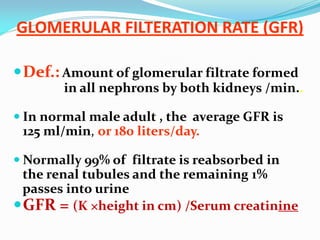
Def.: Amount of glomerular filtrate formed
in all nephrons by both kidneys /min..
 In normal male adult , the average GFR is
125 ml/min, or 180 liters/day.
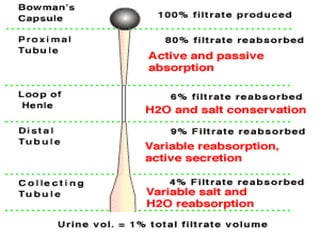
 Normally 99% of filtrate is reabsorbed in
the renal tubules and the remaining 1%
passes into urine
GFR = (K ×height in cm) /Serum creatinine
Acute renal failure in children
Abrupt reduction in kidney function & rapid
decline in GFR over several hours / days.
It results in the disturbance of renal
physiological functions including :
I. Impairment of nitrogenous waste
product excretion(azotemia).
II. Loss of water and electrolyte regulation.
III.Loss of acid-base regulation.
Prerenal causes or ARF
Prerenal azotemia results from either:
A- Volume depletion due to:
 Bleeding (surgery, trauma, GIT).
 GIT fluid loss (vomiting, diarrhoea).
 Urinary (diuretics, diabetes insipidus)
 Cutaneous losses (burns).
B-Decreased effective arterial pressure :
Heart failure, shock, or cirrhosis.
Intrinsic renal causes of ARF
 Vascular :
 Thrombosis (arterial & venous).
 Hemolytic-uremic syndrome (HUS).
 Malignant hypertension.

 Vasculitis e.g. HSP.
 Glomerular: Acute glomerulonephritis ( AGN).
 Tubular and interstitial disease : (ATN) results
from ischemia due to decreased renal perfusion
or injury from tubular nephrotoxins.
 Nephrotoxic agents: -Aminoglycosides.
-Amphotericin B.
- Contrast agents.
-Heme pigments.
All causes of prerenal azotemia
can progress to ATN if renal
perfusion is not restored and/or
nephrotoxic insults are not
withdrawn
Post-renal causes of ARF
 Bilateral urinary tract obstruction .
 Urinary tract obstruction, due to
posterior urethral valve.
 chronic obstructive uropathies.
CLINICAL PRESENTATION
Tachycardia, dry mucosa, sunken eyes, low BP &
decreased skin turgor suggest hypovolemia.
Dysentery with oliguria (<500 ml/1.73 m2 /day in
children & <1 ml/kg / h in infants) or anuria (absent
urine/<0.5ml/kg/h) is consistent with HUS
H/O pharyngitis or impetigo, a few weeks prior to
the onset of gross hematuria suggests post-
infectious glomerulonephritis (AGN)
Nephrotic syndrome, heart failure & liver failure
may result in oedema and other signs of specific
organ dysfunction.
CLINICAL PRESENTATION -Cont..
Hemoptysis suggests pulmonary-renal syndrome.
 Skin findings: malar rash, petechiae, and/or
joint pain , systemic vasculitis, such as SLE or HSP
Anuria or oliguria: in a newborn suggests a major
congenital malformation or genetic disease, like
posterior urethral valve, b/l renal vein thrombosis
or AR kidney disease.
In the hospital, ATN due to hypotension or
nephrotoxic medications (such as
aminoglycosides or amphotericin-B).
Symptoms of uremia
 Lethargy
 Anorexia
 Pericarditis
 Neuropathy
 Nausea and vomiting
 Pruritis
 Dyspnea
EVALUATION & Dx. OF ARF
Serum creatinine .
Serum BUN/creatinine ratio .
Urinalysis.
Urine Na .
Fractional excretion of Na.
Urine osmolality and urine output.
Renal imaging.
Fluid challange.
Others:
CBC, serum Na, K, P and blood gases.
ECG
Value of urinalysis in Dx. of ARF
Normal urine : prerenal disease, urinary tract
obstruction.
Muddy brown/granular & epithelial cell casts: ATN.
Red cell cast: glomerulonephritis.
Pyuria (WBCs), granular, waxy casts & proteinuria:
tubular or interstitial disease or UTI.
Hematuria and pyuria: acute interstitial nephritis,
glomerular disease, vasculitis, obstruction, and
renal infarction.
Urine sodium excretion
 Measurement of the urinary Na is
helpful in distinguishing renal from
prerenal ARF due to effective volume
depletion.
above 30 - 40 meq/l. ATN (renal)
below 10 meq/l. pre renal ARF
Fractional excretion of Na (FENa)
This is defined by the following equation:
 UNa x PCr
FENa (percent) = —————— x 100
PNa x UCr
 UCr & PCr : urine and plasma creatinine .
 UNa & PNa : urine and plasma sodium .
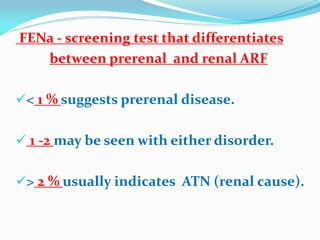
FENa - screening test that differentiates
between prerenal and renal ARF
< 1 % suggests prerenal disease.
 1 -2 may be seen with either disorder.
> 2 % usually indicates ATN (renal cause).
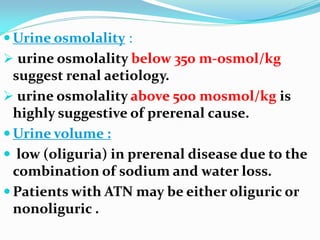
 Urine osmolality :
 urine osmolality below 350 m-osmol/kg
suggest renal aetiology.
 urine osmolality above 500 mosmol/kg is
highly suggestive of prerenal cause.
 Urine volume :
 low (oliguria) in prerenal disease due to the
combination of sodium and water loss.
 Patients with ATN may be either oliguric or
nonoliguric .
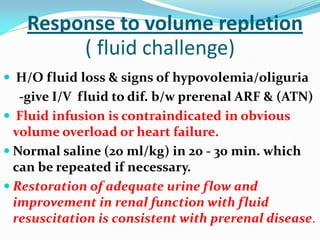
Response to volume repletion
( fluid challenge)
 H/O fluid loss & signs of hypovolemia/oliguria
-give I/V fluid to dif. b/w prerenal ARF & (ATN)
 Fluid infusion is contraindicated in obvious
volume overload or heart failure.
 Normal saline (20 ml/kg) in 20 - 30 min. which
can be repeated if necessary.
 Restoration of adequate urine flow and
improvement in renal function with fluid
resuscitation is consistent with prerenal disease.
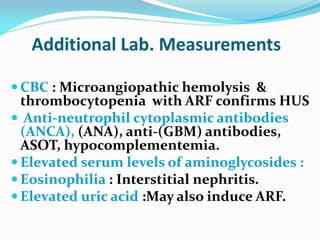
Additional Lab. Measurements
 CBC : Microangiopathic hemolysis &
thrombocytopenia with ARF confirms HUS
 Anti-neutrophil cytoplasmic antibodies
(ANCA), (ANA), anti-(GBM) antibodies,
ASOT, hypocomplementemia.
 Elevated serum levels of aminoglycosides :
 Eosinophilia : Interstitial nephritis.
 Elevated uric acid :May also induce ARF.
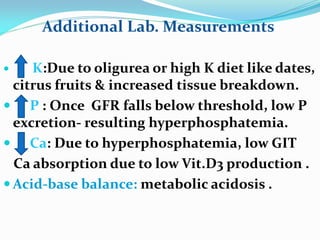
 K:Due to oligurea or high K diet like dates,
citrus fruits & increased tissue breakdown.
 P : Once GFR falls below threshold, low P
excretion- resulting hyperphosphatemia.
 Ca: Due to hyperphosphatemia, low GIT
Ca absorption due to low Vit.D3 production .
 Acid-base balance: metabolic acidosis .
Additional Lab. Measurements
Renal imaging
 Renal ultrasonography:
 All children with ARF of unclear etiology.
 Follow up of renal size and parenchyma .
 Diagnosing urinary tract obstruction or
occlusion of the major renal vessels.
 Renal biopsy: When noninvasive evaluation
unable to establish correct Dx. & etiology
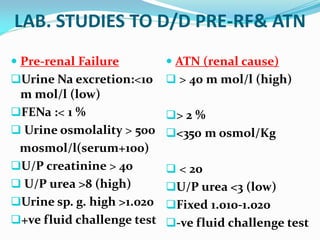
LAB. STUDIES TO D/D PRE-RF& ATN
 Pre-renal Failure
Urine Na excretion:<10
m mol/l (low)
FENa :< 1 %
 Urine osmolality > 500
mosmol/l(serum+100)
U/P creatinine > 40
 U/P urea >8 (high)
Urine sp. g. high >1.020
+ve fluid challenge test
 ATN (renal cause)
 > 40 m mol/l (high)
> 2 %
<350 m osmol/Kg
 < 20
U/P urea <3 (low)
Fixed 1.010-1.020
-ve fluid challenge test
Prevention of ARF
Close monitoring of serum levels of
nephrotoxic drugs.
Adequate fluid repletion in hypovolemia.
 Aggressive hydration and alkalinization of
the urine prior to chemotherapy.
Management of ARF
Maintenance of electrolyte and fluid balance
Adequate nutritional support.
Avoidance of life-threatening complications
e.g. hyperkalemia, acidosis, hypertension, CCF
Treatment of the underlying cause .
Mx. of fluid & electrolyte disturbances
Hyperkalemia
Serum K > 7.0 meq/l is life-threatening & needs
immediate attention and follow up by ECG:
1- I/V calcium , glucose + insulin infusion,
NAHCo3 , beta agonists nebulization to promote
extracellular K movement into the cells.
2-Kayexalate, an anion exchange resin, can
remove excess K
3-Adjust K intake.
4- Renal replacement therapy if medical
management fails to improve hyperkalemia.
Acidosis
 Sodium bicarbonate in life-threatening
acidosis or hyperkalemia.
 Serum NaHCo3 levels > 14 meq /l or arterial
pH >7.2 do not require immediate
intervention.
Intravascular volume
 Child with ARF may be hypo/ eu/
hypervolemic (including pulmonary
edema and heart failure).
 Appropriate evaluation of volume status
and treatment to maintain euvolemia.
 Insert urinary catheter.
 If no response to diuretics after restoration
of I/V volume (CVP), stop diuretics and
start fluids as insensible water loss plus
urine output only.
 Hypertension: result of hypervolemia.
Use antihypertensives.
 Nutrition :
 Adequate calories to promote recovery.
 If sufficient calories cannot be achieved
with oliguria / anuria without causing
hypervolemia, then renal replacement
therapy is recommended.
Renal replacement therapy
INDICATIONS:
1) Signs and symptoms of sever uremia .
2) Azotemia (BUN > 80 - 100 mg/dl).
3) Severe fluid overload refractory to medical
therapy .
4) Severe electrolyte abnormalities (eg.
hyperkalemia and acidosis) that are
refractory to supportive medical therapy
5) Nutritional support in oliguria / anuria.
6) Severe uncontrolled hypertension.
Renal Replacement Therapy
 Hemodialysis, peritoneal dialysis (PD), and
continuous renal replacement
therapy(CAPD).
 The choice of modality is influenced by
-clinical presentation and
-status of the patient including
. presence of multi-organ failure
. indication for renal replacement
therapy.
Prognosis of ARF
The prognosis of ARF depends upon :
 Etiology.
 Age of the patient.
 Clinical Picture.
 Status of the patient.
 Hypotension and need for inotropic
support during renal replacement
therapy are significant poor predictors
for patient survival.
Acute renal failure by dr. rafique

Acute renal failure by dr. rafique

  • 3.
    Functions of Kidneys 1:Formation of urine (maintain fluid balance). 2: Maintain Ionic composition of the body and H+ concentration. (Homeostasis) 3: Endocrinal functions: Production of Renin and Erythropoietin. 4: Activation of Vitamin D.
  • 4.
    GLOMERULAR FILTERATION RATE(GFR) Def.: Amount of glomerular filtrate formed in all nephrons by both kidneys /min..  In normal male adult , the average GFR is 125 ml/min, or 180 liters/day.  Normally 99% of filtrate is reabsorbed in the renal tubules and the remaining 1% passes into urine GFR = (K ×height in cm) /Serum creatinine
  • 6.
    Acute renal failurein children Abrupt reduction in kidney function & rapid decline in GFR over several hours / days. It results in the disturbance of renal physiological functions including : I. Impairment of nitrogenous waste product excretion(azotemia). II. Loss of water and electrolyte regulation. III.Loss of acid-base regulation.
  • 7.
    Prerenal causes orARF Prerenal azotemia results from either: A- Volume depletion due to:  Bleeding (surgery, trauma, GIT).  GIT fluid loss (vomiting, diarrhoea).  Urinary (diuretics, diabetes insipidus)  Cutaneous losses (burns). B-Decreased effective arterial pressure : Heart failure, shock, or cirrhosis.
  • 8.
    Intrinsic renal causesof ARF  Vascular :  Thrombosis (arterial & venous).  Hemolytic-uremic syndrome (HUS).  Malignant hypertension.  Vasculitis e.g. HSP.  Glomerular: Acute glomerulonephritis ( AGN).  Tubular and interstitial disease : (ATN) results from ischemia due to decreased renal perfusion or injury from tubular nephrotoxins.  Nephrotoxic agents: -Aminoglycosides. -Amphotericin B. - Contrast agents. -Heme pigments.
  • 9.
    All causes ofprerenal azotemia can progress to ATN if renal perfusion is not restored and/or nephrotoxic insults are not withdrawn
  • 10.
    Post-renal causes ofARF  Bilateral urinary tract obstruction .  Urinary tract obstruction, due to posterior urethral valve.  chronic obstructive uropathies.
  • 11.
    CLINICAL PRESENTATION Tachycardia, drymucosa, sunken eyes, low BP & decreased skin turgor suggest hypovolemia. Dysentery with oliguria (<500 ml/1.73 m2 /day in children & <1 ml/kg / h in infants) or anuria (absent urine/<0.5ml/kg/h) is consistent with HUS H/O pharyngitis or impetigo, a few weeks prior to the onset of gross hematuria suggests post- infectious glomerulonephritis (AGN) Nephrotic syndrome, heart failure & liver failure may result in oedema and other signs of specific organ dysfunction.
  • 12.
    CLINICAL PRESENTATION -Cont.. Hemoptysissuggests pulmonary-renal syndrome.  Skin findings: malar rash, petechiae, and/or joint pain , systemic vasculitis, such as SLE or HSP Anuria or oliguria: in a newborn suggests a major congenital malformation or genetic disease, like posterior urethral valve, b/l renal vein thrombosis or AR kidney disease. In the hospital, ATN due to hypotension or nephrotoxic medications (such as aminoglycosides or amphotericin-B).
  • 13.
    Symptoms of uremia Lethargy  Anorexia  Pericarditis  Neuropathy  Nausea and vomiting  Pruritis  Dyspnea
  • 15.
    EVALUATION & Dx.OF ARF Serum creatinine . Serum BUN/creatinine ratio . Urinalysis. Urine Na . Fractional excretion of Na. Urine osmolality and urine output. Renal imaging. Fluid challange. Others: CBC, serum Na, K, P and blood gases. ECG
  • 16.
    Value of urinalysisin Dx. of ARF Normal urine : prerenal disease, urinary tract obstruction. Muddy brown/granular & epithelial cell casts: ATN. Red cell cast: glomerulonephritis. Pyuria (WBCs), granular, waxy casts & proteinuria: tubular or interstitial disease or UTI. Hematuria and pyuria: acute interstitial nephritis, glomerular disease, vasculitis, obstruction, and renal infarction.
  • 17.
    Urine sodium excretion Measurement of the urinary Na is helpful in distinguishing renal from prerenal ARF due to effective volume depletion. above 30 - 40 meq/l. ATN (renal) below 10 meq/l. pre renal ARF
  • 18.
    Fractional excretion ofNa (FENa) This is defined by the following equation:  UNa x PCr FENa (percent) = —————— x 100 PNa x UCr  UCr & PCr : urine and plasma creatinine .  UNa & PNa : urine and plasma sodium .
  • 19.
    FENa - screeningtest that differentiates between prerenal and renal ARF < 1 % suggests prerenal disease.  1 -2 may be seen with either disorder. > 2 % usually indicates ATN (renal cause).
  • 20.
     Urine osmolality:  urine osmolality below 350 m-osmol/kg suggest renal aetiology.  urine osmolality above 500 mosmol/kg is highly suggestive of prerenal cause.  Urine volume :  low (oliguria) in prerenal disease due to the combination of sodium and water loss.  Patients with ATN may be either oliguric or nonoliguric .
  • 21.
    Response to volumerepletion ( fluid challenge)  H/O fluid loss & signs of hypovolemia/oliguria -give I/V fluid to dif. b/w prerenal ARF & (ATN)  Fluid infusion is contraindicated in obvious volume overload or heart failure.  Normal saline (20 ml/kg) in 20 - 30 min. which can be repeated if necessary.  Restoration of adequate urine flow and improvement in renal function with fluid resuscitation is consistent with prerenal disease.
  • 22.
    Additional Lab. Measurements CBC : Microangiopathic hemolysis & thrombocytopenia with ARF confirms HUS  Anti-neutrophil cytoplasmic antibodies (ANCA), (ANA), anti-(GBM) antibodies, ASOT, hypocomplementemia.  Elevated serum levels of aminoglycosides :  Eosinophilia : Interstitial nephritis.  Elevated uric acid :May also induce ARF.
  • 23.
     K:Due tooligurea or high K diet like dates, citrus fruits & increased tissue breakdown.  P : Once GFR falls below threshold, low P excretion- resulting hyperphosphatemia.  Ca: Due to hyperphosphatemia, low GIT Ca absorption due to low Vit.D3 production .  Acid-base balance: metabolic acidosis . Additional Lab. Measurements
  • 24.
    Renal imaging  Renalultrasonography:  All children with ARF of unclear etiology.  Follow up of renal size and parenchyma .  Diagnosing urinary tract obstruction or occlusion of the major renal vessels.  Renal biopsy: When noninvasive evaluation unable to establish correct Dx. & etiology
  • 25.
    LAB. STUDIES TOD/D PRE-RF& ATN  Pre-renal Failure Urine Na excretion:<10 m mol/l (low) FENa :< 1 %  Urine osmolality > 500 mosmol/l(serum+100) U/P creatinine > 40  U/P urea >8 (high) Urine sp. g. high >1.020 +ve fluid challenge test  ATN (renal cause)  > 40 m mol/l (high) > 2 % <350 m osmol/Kg  < 20 U/P urea <3 (low) Fixed 1.010-1.020 -ve fluid challenge test
  • 26.
    Prevention of ARF Closemonitoring of serum levels of nephrotoxic drugs. Adequate fluid repletion in hypovolemia.  Aggressive hydration and alkalinization of the urine prior to chemotherapy.
  • 27.
    Management of ARF Maintenanceof electrolyte and fluid balance Adequate nutritional support. Avoidance of life-threatening complications e.g. hyperkalemia, acidosis, hypertension, CCF Treatment of the underlying cause .
  • 28.
    Mx. of fluid& electrolyte disturbances Hyperkalemia Serum K > 7.0 meq/l is life-threatening & needs immediate attention and follow up by ECG: 1- I/V calcium , glucose + insulin infusion, NAHCo3 , beta agonists nebulization to promote extracellular K movement into the cells. 2-Kayexalate, an anion exchange resin, can remove excess K 3-Adjust K intake. 4- Renal replacement therapy if medical management fails to improve hyperkalemia.
  • 29.
    Acidosis  Sodium bicarbonatein life-threatening acidosis or hyperkalemia.  Serum NaHCo3 levels > 14 meq /l or arterial pH >7.2 do not require immediate intervention.
  • 30.
    Intravascular volume  Childwith ARF may be hypo/ eu/ hypervolemic (including pulmonary edema and heart failure).  Appropriate evaluation of volume status and treatment to maintain euvolemia.  Insert urinary catheter.  If no response to diuretics after restoration of I/V volume (CVP), stop diuretics and start fluids as insensible water loss plus urine output only.
  • 31.
     Hypertension: resultof hypervolemia. Use antihypertensives.  Nutrition :  Adequate calories to promote recovery.  If sufficient calories cannot be achieved with oliguria / anuria without causing hypervolemia, then renal replacement therapy is recommended.
  • 32.
    Renal replacement therapy INDICATIONS: 1)Signs and symptoms of sever uremia . 2) Azotemia (BUN > 80 - 100 mg/dl). 3) Severe fluid overload refractory to medical therapy . 4) Severe electrolyte abnormalities (eg. hyperkalemia and acidosis) that are refractory to supportive medical therapy 5) Nutritional support in oliguria / anuria. 6) Severe uncontrolled hypertension.
  • 33.
    Renal Replacement Therapy Hemodialysis, peritoneal dialysis (PD), and continuous renal replacement therapy(CAPD).  The choice of modality is influenced by -clinical presentation and -status of the patient including . presence of multi-organ failure . indication for renal replacement therapy.
  • 35.
    Prognosis of ARF Theprognosis of ARF depends upon :  Etiology.  Age of the patient.  Clinical Picture.  Status of the patient.  Hypotension and need for inotropic support during renal replacement therapy are significant poor predictors for patient survival.