ACUTE LIVER FAILURE
DR. VIJAY YADAV
MD. INTERNAL MEDICINE
LECTURER, NMCTH
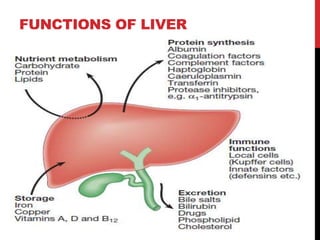
FUNCTIONS OF LIVER
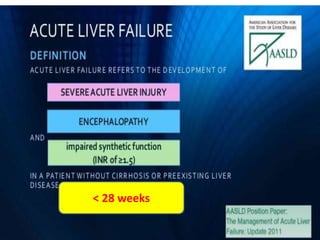
< 28 weeks
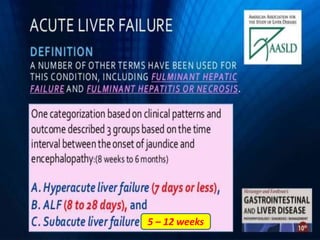
5 – 12 weeks
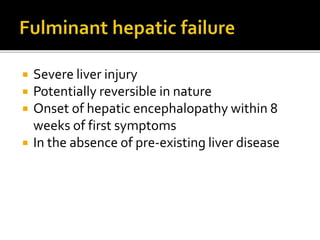
 Severe liver injury
 Potentially reversible in nature
 Onset of hepatic encephalopathy within 8
weeks of first symptoms
 In the absence of pre-existing liver disease
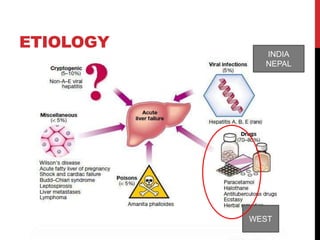
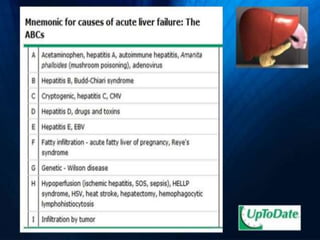
ETIOLOGY
INDIA
NEPAL
WEST
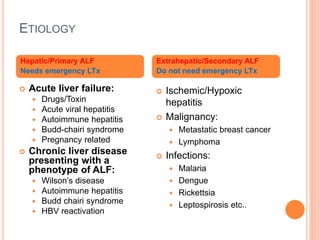
ETIOLOGY
 Acute liver failure:
 Drugs/Toxin
 Acute viral hepatitis
 Autoimmune hepatitis
 Budd-chairi syndrome
 Pregnancy related
 Chronic liver disease
presenting with a
phenotype of ALF:
 Wilson’s disease
 Autoimmune hepatitis
 Budd chairi syndrome
 HBV reactivation
 Ischemic/Hypoxic
hepatitis
 Malignancy:
 Metastatic breast cancer
 Lymphoma
 Infections:
 Malaria
 Dengue
 Rickettsia
 Leptospirosis etc..
Hepatic/Primary ALF
Needs emergency LTx
Extrahepatic/Secondary ALF
Do not need emergency LTx
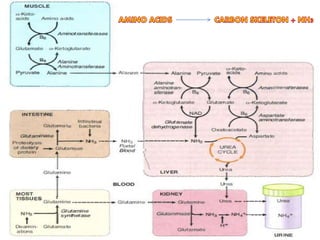
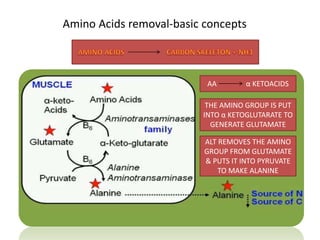
Amino Acids removal-basic concepts
AA α KETOACIDS
THE AMINO GROUP IS PUT
INTO α KETOGLUTARATE TO
GENERATE GLUTAMATE
ALT REMOVES THE AMINO
GROUP FROM GLUTAMATE
& PUTS IT INTO PYRUVATE
TO MAKE ALANINE
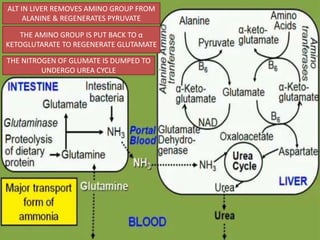
ALT IN LIVER REMOVES AMINO GROUP FROM
ALANINE & REGENERATES PYRUVATE
THE AMINO GROUP IS PUT BACK TO α
KETOGLUTARATE TO REGENERATE GLUTAMATE
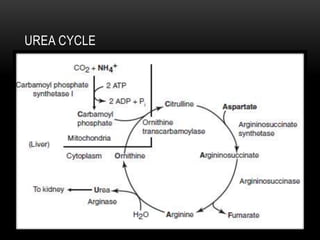
THE NITROGEN OF GLUMATE IS DUMPED TO
UNDERGO UREA CYCLE
UREA CYCLE
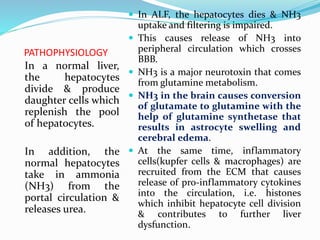
PATHOPHYSIOLOGY
In a normal liver,
the hepatocytes
divide & produce
daughter cells which
replenish the pool
of hepatocytes.
In addition, the
normal hepatocytes
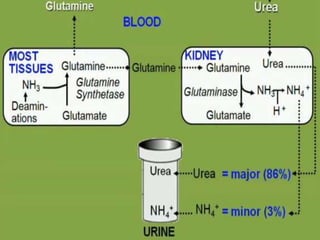
take in ammonia
(NH3) from the
portal circulation &
releases urea.
 In ALF, the hepatocytes dies & NH3
uptake and filtering is impaired.
 This causes release of NH3 into
peripheral circulation which crosses
BBB.
 NH3 is a major neurotoxin that comes
from glutamine metabolism.
 NH3 in the brain causes conversion
of glutamate to glutamine with the
help of glutamine synthetase that
results in astrocyte swelling and
cerebral edema.
 At the same time, inflammatory
cells(kupfer cells & macrophages) are
recruited from the ECM that causes
release of pro-inflammatory cytokines
into the circulation, i.e. histones
which inhibit hepatocyte cell division
& contributes to further liver
dysfunction.
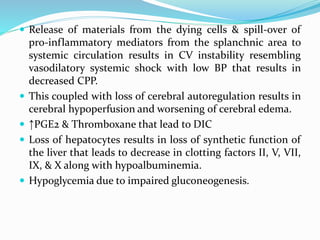
 Release of materials from the dying cells & spill-over of
pro-inflammatory mediators from the splanchnic area to
systemic circulation results in CV instability resembling
vasodilatory systemic shock with low BP that results in
decreased CPP.
 This coupled with loss of cerebral autoregulation results in
cerebral hypoperfusion and worsening of cerebral edema.
 ↑PGE2 & Thromboxane that lead to DIC
 Loss of hepatocytes results in loss of synthetic function of
the liver that leads to decrease in clotting factors II, V, VII,
IX, & X along with hypoalbuminemia.
 Hypoglycemia due to impaired gluconeogenesis.
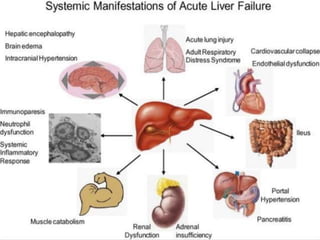
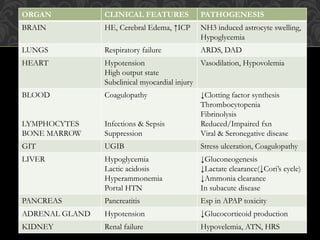
ORGAN CLINICAL FEATURES PATHOGENESIS
BRAIN HE, Cerebral Edema, ↑ICP NH3 induced astrocyte swelling,
Hypoglycemia
LUNGS Respiratory failure ARDS, DAD
HEART Hypotension
High output state
Subclinical myocardial injury
Vasodilation, Hypovolemia
BLOOD
LYMPHOCYTES
BONE MARROW
Coagulopathy
Infections & Sepsis
Suppression
↓Clotting factor synthesis
Thrombocytopenia
Fibrinolysis
Reduced/Impaired fxn
Viral & Seronegative disease
GIT UGIB Stress ulceration, Coagulopathy
LIVER Hypoglycemia
Lactic acidosis
Hyperammonemia
Portal HTN
↓Gluconeogenesis
↓Lactate clearance(↓Cori’s cycle)
↓Ammonia clearance
In subacute disease
PANCREAS Pancreatitis Esp in APAP toxicity
ADRENAL GLAND Hypotension ↓Glucocorticoid production
KIDNEY Renal failure Hypovelemia, ATN, HRS
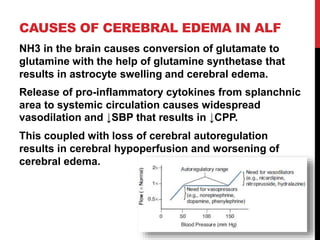
CAUSES OF CEREBRAL EDEMA IN ALF
NH3 in the brain causes conversion of glutamate to
glutamine with the help of glutamine synthetase that
results in astrocyte swelling and cerebral edema.
Release of pro-inflammatory cytokines from splanchnic
area to systemic circulation causes widespread
vasodilation and ↓SBP that results in ↓CPP.
This coupled with loss of cerebral autoregulation
results in cerebral hypoperfusion and worsening of
cerebral edema.
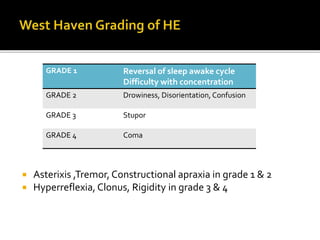
 Asterixis ,Tremor, Constructional apraxia in grade 1 & 2
 Hyperreflexia, Clonus, Rigidity in grade 3 & 4
GRADE 1 Reversal of sleep awake cycle
Difficulty with concentration
GRADE 2 Drowiness, Disorientation, Confusion
GRADE 3 Stupor
GRADE 4 Coma
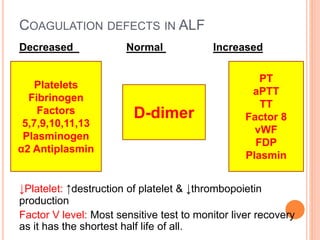
COAGULATION DEFECTS IN ALF
Decreased Normal Increased
↓Platelet: ↑destruction of platelet & ↓thrombopoietin
production
Factor V level: Most sensitive test to monitor liver recovery
as it has the shortest half life of all.
Platelets
Fibrinogen
Factors
5,7,9,10,11,13
Plasminogen
α2 Antiplasmin
D-dimer
PT
aPTT
TT
Factor 8
vWF
FDP
Plasmin
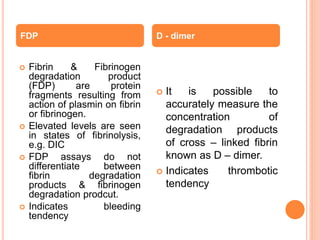
 Fibrin & Fibrinogen
degradation product
(FDP) are protein
fragments resulting from
action of plasmin on fibrin
or fibrinogen.
 Elevated levels are seen
in states of fibrinolysis,
e.g. DIC
 FDP assays do not
differentiate between
fibrin degradation
products & fibrinogen
degradation prodcut.
 Indicates bleeding
tendency
 It is possible to
accurately measure the
concentration of
degradation products
of cross – linked fibrin
known as D – dimer.
 Indicates thrombotic
tendency
FDP D - dimer
INVESTIGATIONS
Complete Blood Counts (CBC) & PBS
Renal Function Tests
Liver Function Tests + PT/INR
PT is the best predictor of prognosis in acute hepatocellular
injury.
PT > 4 sec above normal = ↑risk of hepatic failure
Blood glucose & Electrolytes
Blood grouping & cross matching
Serum APAP levels
ABG + Serum lactate
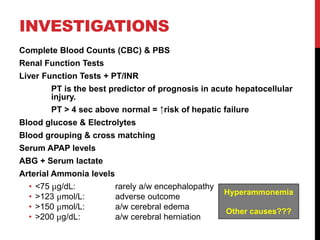
Arterial Ammonia levels
• <75 μg/dL: rarely a/w encephalopathy
• >123 μmol/L: adverse outcome
• >150 μmol/L: a/w cerebral edema
• >200 μg/dL: a/w cerebral herniation
Hyperammonemia
Other causes???
INVESTIGATIONS
CONT..
Viral hepatitis serologies
Autoimmune markers: ANA, ASMA etc…
Serum ceruloplasmin, 24 hour urinary copper
Pregnancy test if female
Toxicology screen of blood & urine
USG of liver & Doppler of hepatic veins
Transjugular liver biopsy : Wilson’s, AH, Malignancy
Percutaneous liver biopsy is contraindicated d/t
coagulopathy.
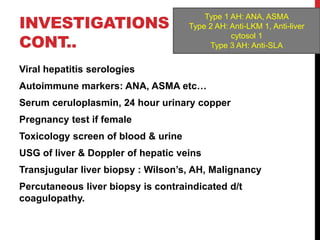
Type 1 AH: ANA, ASMA
Type 2 AH: Anti-LKM 1, Anti-liver
cytosol 1
Type 3 AH: Anti-SLA
Prognosis
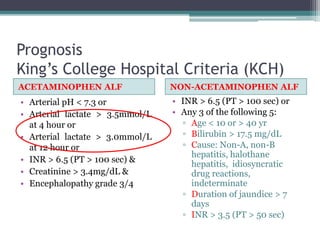
King’s College Hospital Criteria (KCH)
ACETAMINOPHEN ALF NON-ACETAMINOPHEN ALF
• Arterial pH < 7.3 or
• Arterial lactate > 3.5mmol/L
at 4 hour or
• Arterial lactate > 3.0mmol/L
at 12 hour or
• INR > 6.5 (PT > 100 sec) &
• Creatinine > 3.4mg/dL &
• Encephalopathy grade 3/4
• INR > 6.5 (PT > 100 sec) or
• Any 3 of the following 5:
▫ Age < 10 or > 40 yr
▫ Bilirubin > 17.5 mg/dL
▫ Cause: Non-A, non-B
hepatitis, halothane
hepatitis, idiosyncratic
drug reactions,
indeterminate
▫ Duration of jaundice > 7
days
▫ INR > 3.5 (PT > 50 sec)
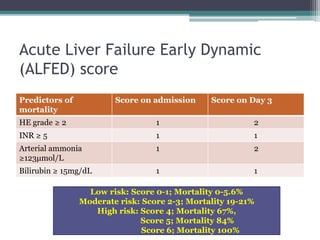
Acute Liver Failure Early Dynamic
(ALFED) score
Predictors of
mortality
Score on admission Score on Day 3
HE grade ≥ 2 1 2
INR ≥ 5 1 1
Arterial ammonia
≥123μmol/L
1 2
Bilirubin ≥ 15mg/dL 1 1
Low risk: Score 0-1; Mortality 0-5.6%
Moderate risk: Score 2-3; Mortality 19-21%
High risk: Score 4; Mortality 67%,
Score 5; Mortality 84%
Score 6; Mortality 100%
MANAGEMENT OF ALF
GENERAL
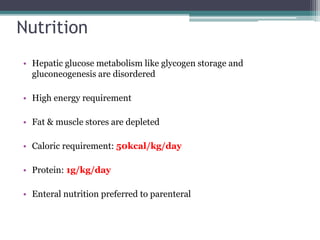
Nutrition
• Hepatic glucose metabolism like glycogen storage and
gluconeogenesis are disordered
• High energy requirement
• Fat & muscle stores are depleted
• Caloric requirement: 50kcal/kg/day
• Protein: 1g/kg/day
• Enteral nutrition preferred to parenteral
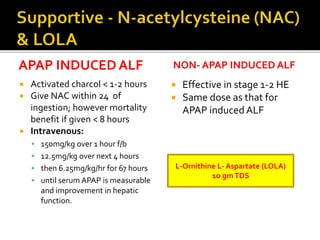
APAP INDUCED ALF
 Activated charcol < 1-2 hours
 Give NAC within 24 of
ingestion; however mortality
benefit if given < 8 hours
 Intravenous:
 150mg/kg over 1 hour f/b
 12.5mg/kg over next 4 hours
 then 6.25mg/kg/hr for 67 hours
 until serum APAP is measurable
and improvement in hepatic
function.
NON- APAP INDUCED ALF
 Effective in stage 1-2 HE
 Same dose as that for
APAP induced ALF
L-Ornithine L- Aspartate (LOLA)
1o gmTDS
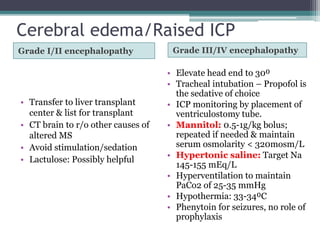
Cerebral edema/Raised ICP
Grade I/II encephalopathy Grade III/IV encephalopathy
• Transfer to liver transplant
center & list for transplant
• CT brain to r/o other causes of
altered MS
• Avoid stimulation/sedation
• Lactulose: Possibly helpful
• Elevate head end to 30⁰
• Tracheal intubation – Propofol is
the sedative of choice
• ICP monitoring by placement of
ventriculostomy tube.
• Mannitol: 0.5-1g/kg bolus;
repeated if needed & maintain
serum osmolarity < 320mosm/L
• Hypertonic saline: Target Na
145-155 mEq/L
• Hyperventilation to maintain
PaCo2 of 25-35 mmHg
• Hypothermia: 33-34⁰C
• Phenytoin for seizures, no role of
prophylaxis
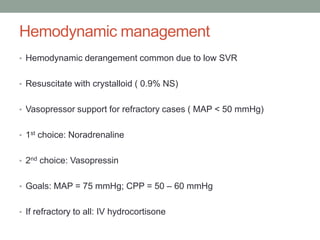
Hemodynamic management
• Hemodynamic derangement common due to low SVR
• Resuscitate with crystalloid ( 0.9% NS)
• Vasopressor support for refractory cases ( MAP < 50 mmHg)
• 1st choice: Noradrenaline
• 2nd choice: Vasopressin
• Goals: MAP = 75 mmHg; CPP = 50 – 60 mmHg
• If refractory to all: IV hydrocortisone
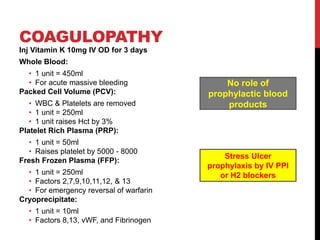
COAGULOPATHY
Inj Vitamin K 10mg IV OD for 3 days
Whole Blood:
• 1 unit = 450ml
• For acute massive bleeding
Packed Cell Volume (PCV):
• WBC & Platelets are removed
• 1 unit = 250ml
• 1 unit raises Hct by 3%
Platelet Rich Plasma (PRP):
• 1 unit = 50ml
• Raises platelet by 5000 - 8000
Fresh Frozen Plasma (FFP):
• 1 unit = 250ml
• Factors 2,7,9,10,11,12, & 13
• For emergency reversal of warfarin
Cryoprecipitate:
• 1 unit = 10ml
• Factors 8,13, vWF, and Fibrinogen
No role of
prophylactic blood
products
Stress Ulcer
prophylaxis by IV PPI
or H2 blockers
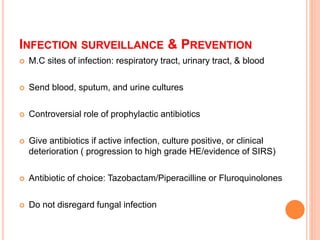
INFECTION SURVEILLANCE & PREVENTION
 M.C sites of infection: respiratory tract, urinary tract, & blood
 Send blood, sputum, and urine cultures
 Controversial role of prophylactic antibiotics
 Give antibiotics if active infection, culture positive, or clinical
deterioration ( progression to high grade HE/evidence of SIRS)
 Antibiotic of choice: Tazobactam/Piperacilline or Fluroquinolones
 Do not disregard fungal infection
 Renal Replacement Therapy (RRT)
 Continuous forms (CVVH) are preferred
Renal Failure
MANAGEMENT OF ALF
Treatment of
underlying
causes
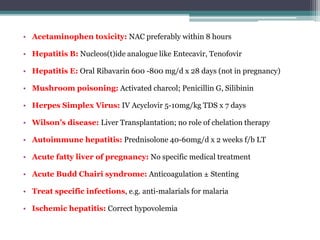
• Acetaminophen toxicity: NAC preferably within 8 hours
• Hepatitis B: Nucleos(t)ide analogue like Entecavir, Tenofovir
• Hepatitis E: Oral Ribavarin 600 -800 mg/d x 28 days (not in pregnancy)
• Mushroom poisoning: Activated charcol; Penicillin G, Silibinin
• Herpes Simplex Virus: IV Acyclovir 5-10mg/kg TDS x 7 days
• Wilson’s disease: Liver Transplantation; no role of chelation therapy
• Autoimmune hepatitis: Prednisolone 40-60mg/d x 2 weeks f/b LT
• Acute fatty liver of pregnancy: No specific medical treatment
• Acute Budd Chairi syndrome: Anticoagulation ± Stenting
• Treat specific infections, e.g. anti-malarials for malaria
• Ischemic hepatitis: Correct hypovolemia
COMPLICATIONS OF ALF
 Cerebral edema & HE
 Hypoglycemia
 Metabolic acidosis
 Infection
 Renal failure
 MODS
 Respiratory failure
THANK
YOU

Acute liver failure

  • 1.
    ACUTE LIVER FAILURE DR.VIJAY YADAV MD. INTERNAL MEDICINE LECTURER, NMCTH
  • 2.
  • 3.
  • 4.
    5 – 12weeks
  • 5.
     Severe liverinjury  Potentially reversible in nature  Onset of hepatic encephalopathy within 8 weeks of first symptoms  In the absence of pre-existing liver disease
  • 6.
  • 8.
    ETIOLOGY  Acute liverfailure:  Drugs/Toxin  Acute viral hepatitis  Autoimmune hepatitis  Budd-chairi syndrome  Pregnancy related  Chronic liver disease presenting with a phenotype of ALF:  Wilson’s disease  Autoimmune hepatitis  Budd chairi syndrome  HBV reactivation  Ischemic/Hypoxic hepatitis  Malignancy:  Metastatic breast cancer  Lymphoma  Infections:  Malaria  Dengue  Rickettsia  Leptospirosis etc.. Hepatic/Primary ALF Needs emergency LTx Extrahepatic/Secondary ALF Do not need emergency LTx
  • 10.
    Amino Acids removal-basicconcepts AA α KETOACIDS THE AMINO GROUP IS PUT INTO α KETOGLUTARATE TO GENERATE GLUTAMATE ALT REMOVES THE AMINO GROUP FROM GLUTAMATE & PUTS IT INTO PYRUVATE TO MAKE ALANINE
  • 11.
    ALT IN LIVERREMOVES AMINO GROUP FROM ALANINE & REGENERATES PYRUVATE THE AMINO GROUP IS PUT BACK TO α KETOGLUTARATE TO REGENERATE GLUTAMATE THE NITROGEN OF GLUMATE IS DUMPED TO UNDERGO UREA CYCLE
  • 13.
  • 14.
    PATHOPHYSIOLOGY In a normalliver, the hepatocytes divide & produce daughter cells which replenish the pool of hepatocytes. In addition, the normal hepatocytes take in ammonia (NH3) from the portal circulation & releases urea.  In ALF, the hepatocytes dies & NH3 uptake and filtering is impaired.  This causes release of NH3 into peripheral circulation which crosses BBB.  NH3 is a major neurotoxin that comes from glutamine metabolism.  NH3 in the brain causes conversion of glutamate to glutamine with the help of glutamine synthetase that results in astrocyte swelling and cerebral edema.  At the same time, inflammatory cells(kupfer cells & macrophages) are recruited from the ECM that causes release of pro-inflammatory cytokines into the circulation, i.e. histones which inhibit hepatocyte cell division & contributes to further liver dysfunction.
  • 15.
     Release ofmaterials from the dying cells & spill-over of pro-inflammatory mediators from the splanchnic area to systemic circulation results in CV instability resembling vasodilatory systemic shock with low BP that results in decreased CPP.  This coupled with loss of cerebral autoregulation results in cerebral hypoperfusion and worsening of cerebral edema.  ↑PGE2 & Thromboxane that lead to DIC  Loss of hepatocytes results in loss of synthetic function of the liver that leads to decrease in clotting factors II, V, VII, IX, & X along with hypoalbuminemia.  Hypoglycemia due to impaired gluconeogenesis.
  • 17.
    ORGAN CLINICAL FEATURESPATHOGENESIS BRAIN HE, Cerebral Edema, ↑ICP NH3 induced astrocyte swelling, Hypoglycemia LUNGS Respiratory failure ARDS, DAD HEART Hypotension High output state Subclinical myocardial injury Vasodilation, Hypovolemia BLOOD LYMPHOCYTES BONE MARROW Coagulopathy Infections & Sepsis Suppression ↓Clotting factor synthesis Thrombocytopenia Fibrinolysis Reduced/Impaired fxn Viral & Seronegative disease GIT UGIB Stress ulceration, Coagulopathy LIVER Hypoglycemia Lactic acidosis Hyperammonemia Portal HTN ↓Gluconeogenesis ↓Lactate clearance(↓Cori’s cycle) ↓Ammonia clearance In subacute disease PANCREAS Pancreatitis Esp in APAP toxicity ADRENAL GLAND Hypotension ↓Glucocorticoid production KIDNEY Renal failure Hypovelemia, ATN, HRS
  • 18.
    CAUSES OF CEREBRALEDEMA IN ALF NH3 in the brain causes conversion of glutamate to glutamine with the help of glutamine synthetase that results in astrocyte swelling and cerebral edema. Release of pro-inflammatory cytokines from splanchnic area to systemic circulation causes widespread vasodilation and ↓SBP that results in ↓CPP. This coupled with loss of cerebral autoregulation results in cerebral hypoperfusion and worsening of cerebral edema.
  • 19.
     Asterixis ,Tremor,Constructional apraxia in grade 1 & 2  Hyperreflexia, Clonus, Rigidity in grade 3 & 4 GRADE 1 Reversal of sleep awake cycle Difficulty with concentration GRADE 2 Drowiness, Disorientation, Confusion GRADE 3 Stupor GRADE 4 Coma
  • 20.
    COAGULATION DEFECTS INALF Decreased Normal Increased ↓Platelet: ↑destruction of platelet & ↓thrombopoietin production Factor V level: Most sensitive test to monitor liver recovery as it has the shortest half life of all. Platelets Fibrinogen Factors 5,7,9,10,11,13 Plasminogen α2 Antiplasmin D-dimer PT aPTT TT Factor 8 vWF FDP Plasmin
  • 21.
     Fibrin &Fibrinogen degradation product (FDP) are protein fragments resulting from action of plasmin on fibrin or fibrinogen.  Elevated levels are seen in states of fibrinolysis, e.g. DIC  FDP assays do not differentiate between fibrin degradation products & fibrinogen degradation prodcut.  Indicates bleeding tendency  It is possible to accurately measure the concentration of degradation products of cross – linked fibrin known as D – dimer.  Indicates thrombotic tendency FDP D - dimer
  • 22.
    INVESTIGATIONS Complete Blood Counts(CBC) & PBS Renal Function Tests Liver Function Tests + PT/INR PT is the best predictor of prognosis in acute hepatocellular injury. PT > 4 sec above normal = ↑risk of hepatic failure Blood glucose & Electrolytes Blood grouping & cross matching Serum APAP levels ABG + Serum lactate Arterial Ammonia levels • <75 μg/dL: rarely a/w encephalopathy • >123 μmol/L: adverse outcome • >150 μmol/L: a/w cerebral edema • >200 μg/dL: a/w cerebral herniation Hyperammonemia Other causes???
  • 23.
    INVESTIGATIONS CONT.. Viral hepatitis serologies Autoimmunemarkers: ANA, ASMA etc… Serum ceruloplasmin, 24 hour urinary copper Pregnancy test if female Toxicology screen of blood & urine USG of liver & Doppler of hepatic veins Transjugular liver biopsy : Wilson’s, AH, Malignancy Percutaneous liver biopsy is contraindicated d/t coagulopathy. Type 1 AH: ANA, ASMA Type 2 AH: Anti-LKM 1, Anti-liver cytosol 1 Type 3 AH: Anti-SLA
  • 24.
    Prognosis King’s College HospitalCriteria (KCH) ACETAMINOPHEN ALF NON-ACETAMINOPHEN ALF • Arterial pH < 7.3 or • Arterial lactate > 3.5mmol/L at 4 hour or • Arterial lactate > 3.0mmol/L at 12 hour or • INR > 6.5 (PT > 100 sec) & • Creatinine > 3.4mg/dL & • Encephalopathy grade 3/4 • INR > 6.5 (PT > 100 sec) or • Any 3 of the following 5: ▫ Age < 10 or > 40 yr ▫ Bilirubin > 17.5 mg/dL ▫ Cause: Non-A, non-B hepatitis, halothane hepatitis, idiosyncratic drug reactions, indeterminate ▫ Duration of jaundice > 7 days ▫ INR > 3.5 (PT > 50 sec)
  • 25.
    Acute Liver FailureEarly Dynamic (ALFED) score Predictors of mortality Score on admission Score on Day 3 HE grade ≥ 2 1 2 INR ≥ 5 1 1 Arterial ammonia ≥123μmol/L 1 2 Bilirubin ≥ 15mg/dL 1 1 Low risk: Score 0-1; Mortality 0-5.6% Moderate risk: Score 2-3; Mortality 19-21% High risk: Score 4; Mortality 67%, Score 5; Mortality 84% Score 6; Mortality 100%
  • 26.
  • 27.
    Nutrition • Hepatic glucosemetabolism like glycogen storage and gluconeogenesis are disordered • High energy requirement • Fat & muscle stores are depleted • Caloric requirement: 50kcal/kg/day • Protein: 1g/kg/day • Enteral nutrition preferred to parenteral
  • 28.
    APAP INDUCED ALF Activated charcol < 1-2 hours  Give NAC within 24 of ingestion; however mortality benefit if given < 8 hours  Intravenous:  150mg/kg over 1 hour f/b  12.5mg/kg over next 4 hours  then 6.25mg/kg/hr for 67 hours  until serum APAP is measurable and improvement in hepatic function. NON- APAP INDUCED ALF  Effective in stage 1-2 HE  Same dose as that for APAP induced ALF L-Ornithine L- Aspartate (LOLA) 1o gmTDS
  • 29.
    Cerebral edema/Raised ICP GradeI/II encephalopathy Grade III/IV encephalopathy • Transfer to liver transplant center & list for transplant • CT brain to r/o other causes of altered MS • Avoid stimulation/sedation • Lactulose: Possibly helpful • Elevate head end to 30⁰ • Tracheal intubation – Propofol is the sedative of choice • ICP monitoring by placement of ventriculostomy tube. • Mannitol: 0.5-1g/kg bolus; repeated if needed & maintain serum osmolarity < 320mosm/L • Hypertonic saline: Target Na 145-155 mEq/L • Hyperventilation to maintain PaCo2 of 25-35 mmHg • Hypothermia: 33-34⁰C • Phenytoin for seizures, no role of prophylaxis
  • 30.
    Hemodynamic management • Hemodynamicderangement common due to low SVR • Resuscitate with crystalloid ( 0.9% NS) • Vasopressor support for refractory cases ( MAP < 50 mmHg) • 1st choice: Noradrenaline • 2nd choice: Vasopressin • Goals: MAP = 75 mmHg; CPP = 50 – 60 mmHg • If refractory to all: IV hydrocortisone
  • 31.
    COAGULOPATHY Inj Vitamin K10mg IV OD for 3 days Whole Blood: • 1 unit = 450ml • For acute massive bleeding Packed Cell Volume (PCV): • WBC & Platelets are removed • 1 unit = 250ml • 1 unit raises Hct by 3% Platelet Rich Plasma (PRP): • 1 unit = 50ml • Raises platelet by 5000 - 8000 Fresh Frozen Plasma (FFP): • 1 unit = 250ml • Factors 2,7,9,10,11,12, & 13 • For emergency reversal of warfarin Cryoprecipitate: • 1 unit = 10ml • Factors 8,13, vWF, and Fibrinogen No role of prophylactic blood products Stress Ulcer prophylaxis by IV PPI or H2 blockers
  • 32.
    INFECTION SURVEILLANCE &PREVENTION  M.C sites of infection: respiratory tract, urinary tract, & blood  Send blood, sputum, and urine cultures  Controversial role of prophylactic antibiotics  Give antibiotics if active infection, culture positive, or clinical deterioration ( progression to high grade HE/evidence of SIRS)  Antibiotic of choice: Tazobactam/Piperacilline or Fluroquinolones  Do not disregard fungal infection
  • 33.
     Renal ReplacementTherapy (RRT)  Continuous forms (CVVH) are preferred Renal Failure
  • 34.
    MANAGEMENT OF ALF Treatmentof underlying causes
  • 35.
    • Acetaminophen toxicity:NAC preferably within 8 hours • Hepatitis B: Nucleos(t)ide analogue like Entecavir, Tenofovir • Hepatitis E: Oral Ribavarin 600 -800 mg/d x 28 days (not in pregnancy) • Mushroom poisoning: Activated charcol; Penicillin G, Silibinin • Herpes Simplex Virus: IV Acyclovir 5-10mg/kg TDS x 7 days • Wilson’s disease: Liver Transplantation; no role of chelation therapy • Autoimmune hepatitis: Prednisolone 40-60mg/d x 2 weeks f/b LT • Acute fatty liver of pregnancy: No specific medical treatment • Acute Budd Chairi syndrome: Anticoagulation ± Stenting • Treat specific infections, e.g. anti-malarials for malaria • Ischemic hepatitis: Correct hypovolemia
  • 36.
    COMPLICATIONS OF ALF Cerebral edema & HE  Hypoglycemia  Metabolic acidosis  Infection  Renal failure  MODS  Respiratory failure
  • 37.