Pancreatic Injuries
Mamoun Nabri
Trauma Fellow
11/24/2009
Pancreas
– The pancreas was first identified by Herophilus
(335-280 BC), a Greek anatomist and surgeon
– Hundred years later, , another Greek anatomist,
Ruphos, gave the pancreas its name.
– The term "pancreas" is derived from the Greek
pan, "all", and kreas, "flesh",
History
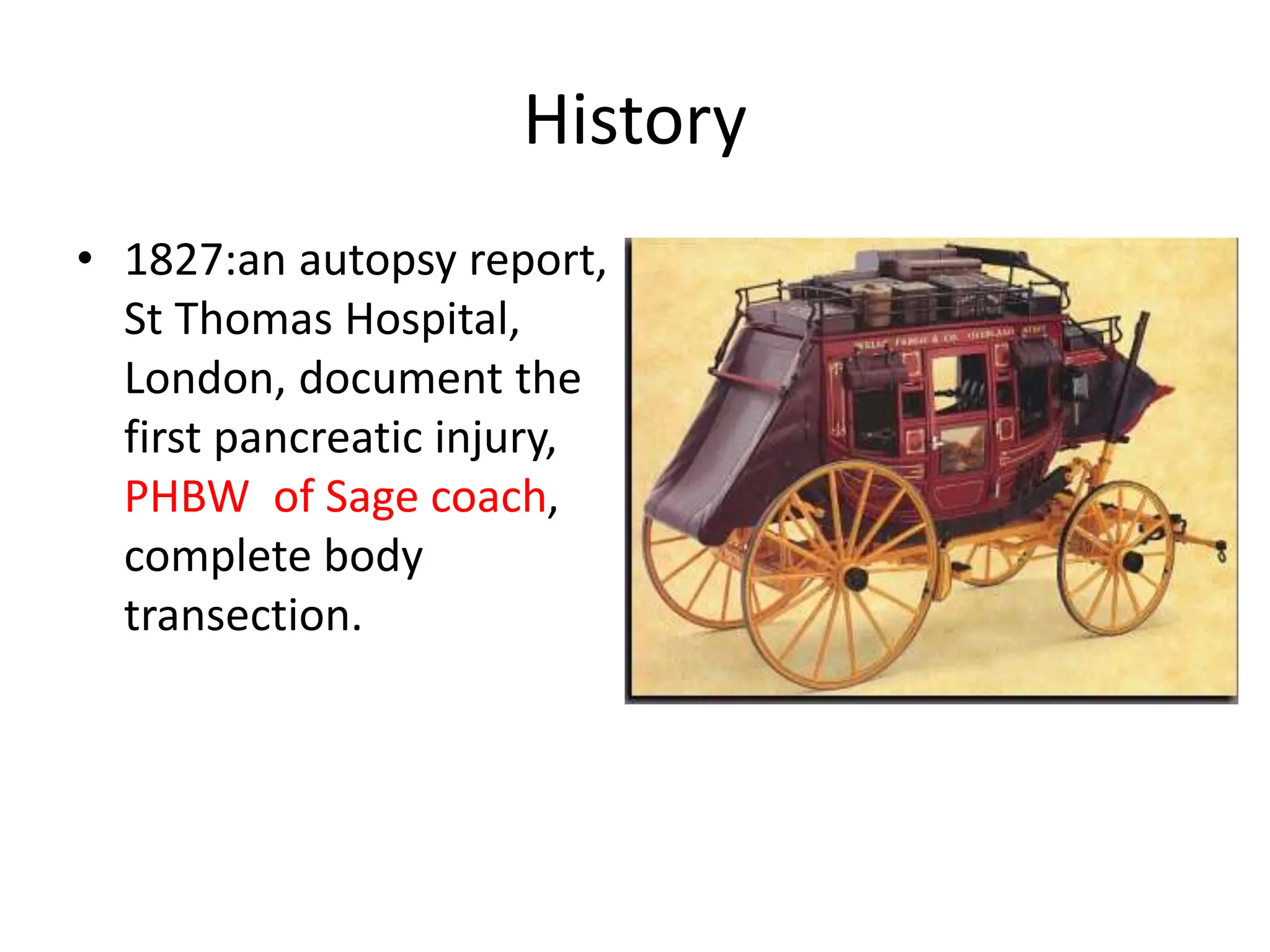
• 1827:an autopsy report,
St Thomas Hospital,
London, document the
first pancreatic injury,
PHBW of Sage coach,
complete body
transection.
History
• Laborderie in 1856 reported the first penetrating
pancreatic injury in the literature.
• Kulenkampff in 1882 reported a patient that
survived blunt injury to the pancreas with the
development of a pseudocyst.
• Kocher, in 1903 described the surgical approach
to the mobilization of the duodenum and head of
the pancreas
• 1903: only 45 cases, 21 penetrating, 24 blunt
• 1905: Korte, pancreatic transection with fistula
Introduction
• Injuries are uncommon, protected deep in
retroperitoneal
• diagnostic dilemma and delay
• When identified early, treatment is
straightforward.
• Accounts for 10% to 12% of all abdominal
injuries.
• Mortality rates 9%-34%; Morbidity 30%-60%
• Approximately 50% of the overall mortality due
to associated major abdominal vascular injuries.
Introduction
• Major abdominal vascular injuries are present, 75% of
cases of penetrating pancreatic trauma
• Sepsis and multiple organ failure account for most of
the late deaths.
• The incidence of pancreatic-related mortality ranges
from 2% to 5% in large urban trauma series.
• WW I, and in WWII only 62 cases of pancreatic trauma
were reported (2% of abdominal injuries) with a 56%
mortality
• Only nine cases of pancreatic injury were reported
from the Korean War (22% mortality)
Pancreas
• It is a combined endocrine and exocrine gland
• Divided into head, neck, body and tail
• Head lies within the curve of the duodenum
• Uncinate process projects from the head
• Superior mesenteric vessels separate the head
from the body
Embryology
Pancreas
• Pancreatic ducts has two ducts
– Main pancreatic duct
– Accessory pancreatic duct
• The main pancreatic duct begins in the tail
• Drains into the second part of the duodenum together with
the common bile duct
• The main duct is also known as the Duct of Wirsung
• Accessory duct begins in the head
• The accessory duct is also known as the Duct of Santorini
• It usually drains into the main duct but can open separately
into the duodenum
Histology/Physiology
• 80 – 90 % of the mass is composed of acinar cells
• These form the exocrine portion of the gland
• Secret alkaline juice, amylase, lipase.(1-1.2 L/day)
• Islets of Langerhans are dispersed within the
gland
• They form islands of endocrine tissue
• The islets consist of Types A (20%), B (70%) and D
(10%) cells
– Type A cells produce glucagons
– Type B produce insulin
– Type D produce somatostatin
Posterior view of duodenum/pancreas
Associated Injuries
90-95% other injuries
• Liver 42-32%
• Spleen 25-40%
• Stomach 20-40%
• Major vessel 25-35%
• Thorax 22-31%
• Bowel 10-29%
• CNS 25%
• Duodenum 18%
Etiology
• The great majority of such injuries are caused
by penetrating mechanisms and are often
associated with significant injuries involving
other intra-abdominal organs.
• Blunt trauma to the abdomen caused by a
direct blow or seat belt injury may compress
the pancreas over the vertebral column and
result in pancreatic disruption
Diagnosis
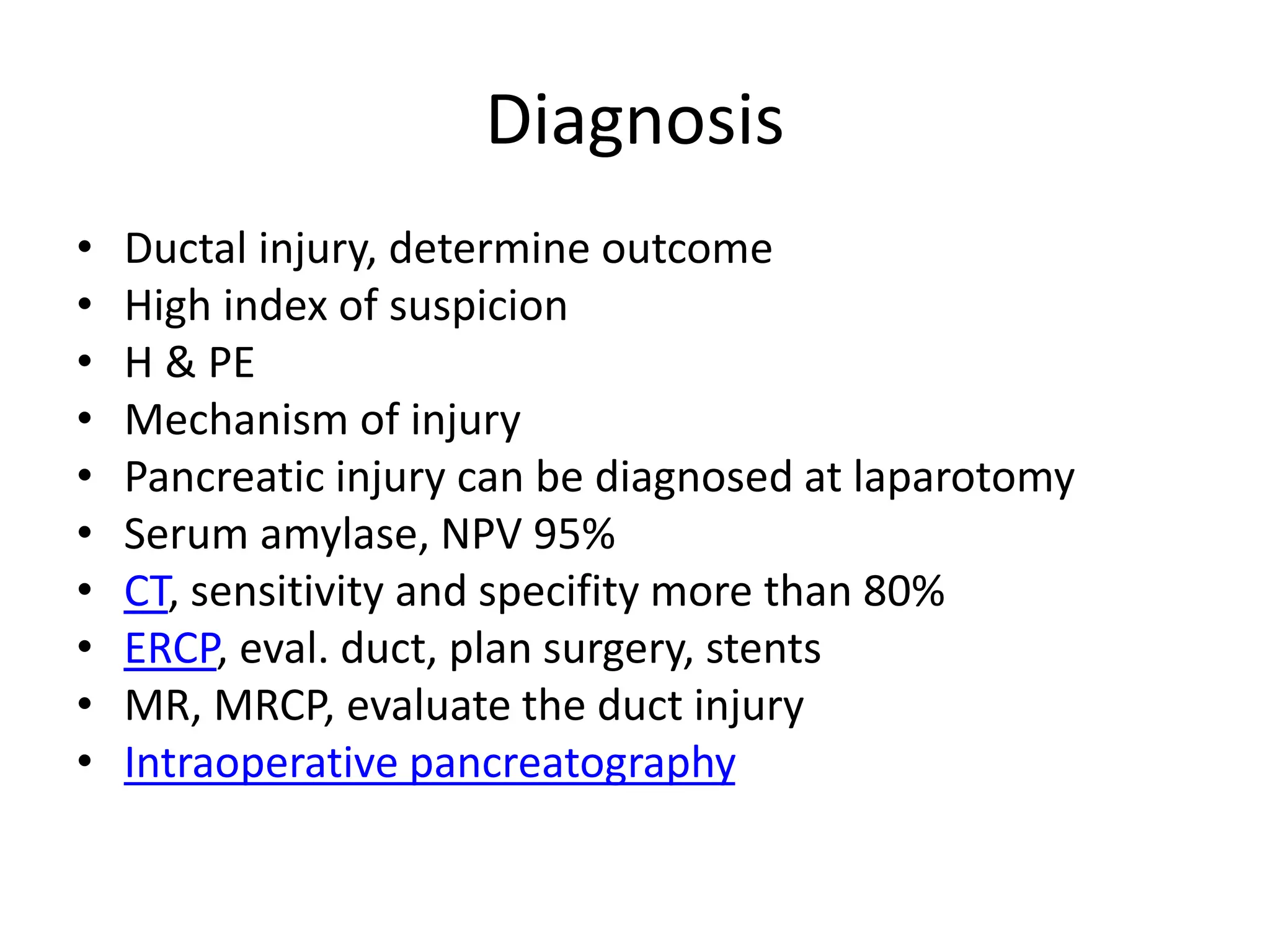
• Ductal injury, determine outcome
• High index of suspicion
• H & PE
• Mechanism of injury
• Pancreatic injury can be diagnosed at laparotomy
• Serum amylase, NPV 95%
• CT, sensitivity and specifity more than 80%
• ERCP, eval. duct, plan surgery, stents
• MR, MRCP, evaluate the duct injury
• Intraoperative pancreatography
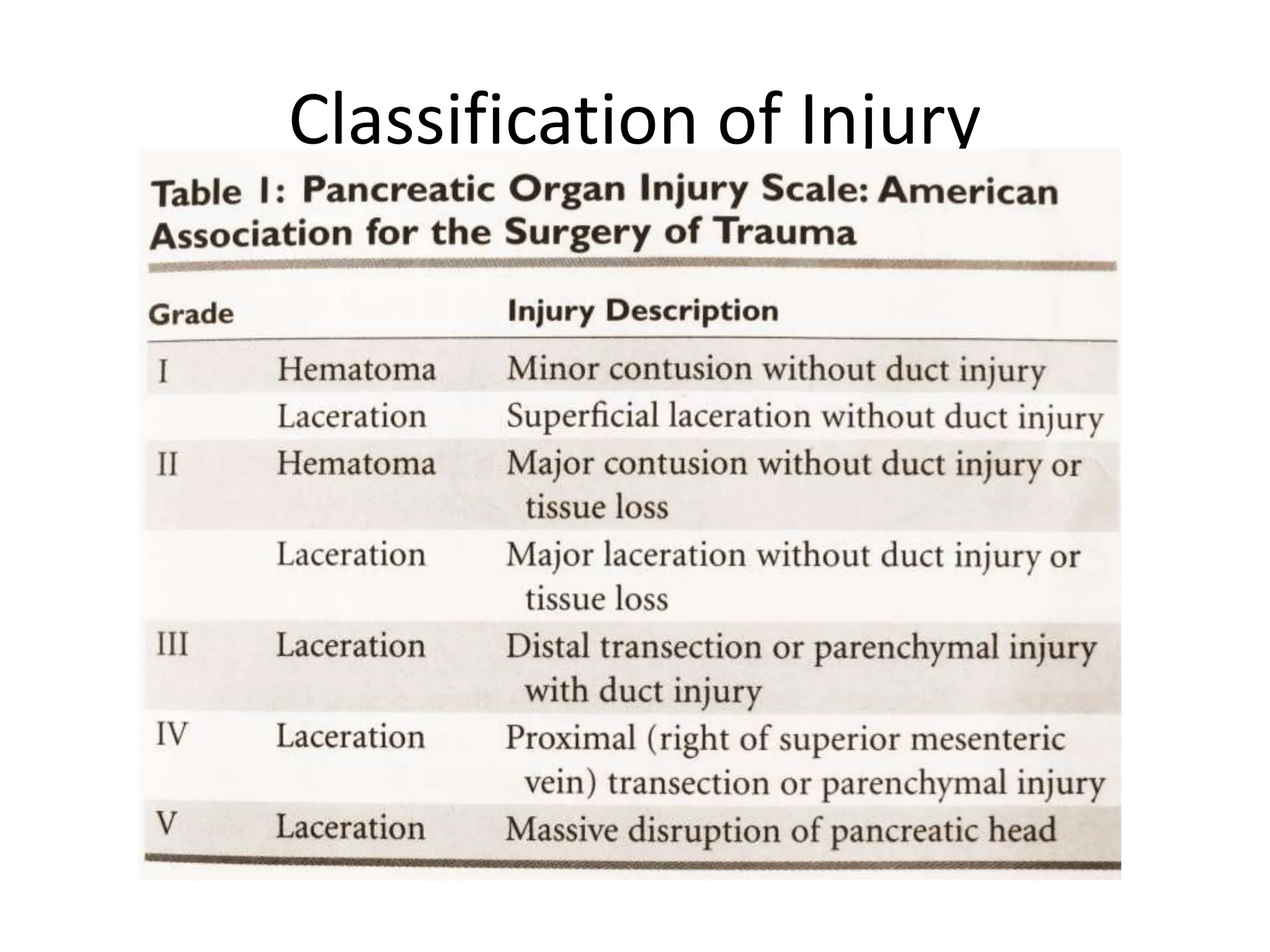
Classification of Injury
Surgical Management
• The primary operative goal of abdominal trauma
to control the hemorrhage and gastrointestinal
contamination.
• Proper exposure.
• Evaluation of pancreas require complete
exposure of the gland.
• Intra-operative pancreatography.
• Normal endocrine and exocrine function has
been reported after 90% pancreatectomy, leave
at least 20%.
Transection of gastrocoloic ligament, body and tail
Kocher maneuver; head and uncinate process
Divide peritoneum lateral to spleen and colon;
posterior ( Aird’s maneuver)
60% of pancreatic injuries, minor contusion, hematoma
and capsular laceration, Grade I
20% of injuries, parenchyma laceration without ductal
disruption, Grade II
Surgical Management
• These injuries, grade I & II, require only
hemostasis and external drainage
• Resist temptation to repair capsular laceration
• External close drainage, for 10 days
• Nutritional support, elemental diets
Distal pancreatic transection, with duct injury, treated
with distal pancreatectomy, Grade III
Surgical Management
• Distal pancreatectomy: Grade III
– Transected duct, closed U, figure of 8, non-
absorbable
– Full thickness interlocking U-stitch
– TA, stapler
– Omental patch
– Close suction drainage
– Feeding jejunostomy
– With or without splenctomy
TA Stapler, distal pancreatectomy, ligate splenic vessels
Spleen preservation distal pancreatectmy
Surgical Management
• Pancreatic head injury: Grade IV
– Define ducal anatomy
– Intraoperative pancreatography
– Wide external drainage with postoperative ERCP
• Ductal anatomy not clear
• Hemodynamically unstability
– Patton and colleague, reported, effectiveness of
drainage alone for proximal injuries, with 37
patients, only 13.5%, fistula or abscess
For injuries of the pancreatic head that involve the pancreatic
duct but spare the common bile duct, central pancreatic
resection with Roux-en-Y pancreaticojejunostomy
Surgical Management
• Combined pancreatic head and duodenal: G V
– Rare, caused by penetrating injuries
– Determine distal CBD and ampulla integrity, IOC
– Associated vascular injuries
– Whipple resection remains, the preferred option
– Harborview MC, Seattle, 6 years, 10 of 117,
underwent Whipple, 4 abscess, 2 pancreatitis, 1
fistula, all 10 patients survived.
pancreas duodenum
pancreas duodenum
Complications
• Most complications are self-limiting and/or
treatable
• Sepsis, MOF: nearly result in 30% of deaths
• Fistula: most common, incidence 7-20%
– < 200ml/d, resolve with adequate drainage
– > 700ml/d, external drainage, nutrition
– Somatostatin, few data support its use in post-
traumatic fistulae
Complications
• Abscess:
– 10-25%
– Subfascial or peripancreatic
– Require drainage, percutaneous or open
– The mortality is 25%
• Pancreatitis:
– 8-18%
– Usually treated conservatively
– Hemorrhagic pancreatitis, occurring in less than 2%
Complications
• Secondary hemorrhage:
– 5-10%
– Require re-exploration or angioembolization
• Pseudocyst:
– Unrecognized pancreatic injury
– Intra-duct, percutaneous drainage
– Injured duct, definitive therapy
– ERCP before drainage
• Exocrine, endocrine insufficiency,
– uncommon,
– only 10-20% of normal pancreatic tissue is needed for
normal function
Conclusion
• Traumatic pancreatic injuries are uncommon
• They are easily missed
• Attention to details that is required to identify
and treat complications
• Diagnosis require high index of suspicion,
pre/intraoperativily, and tests performed in a
timely fashion.
Whatever happens, don’t loose your head
References
• Current Therapy of Trauma and Surgical Critical Care, Juan
A. Asensio, Donald D. Trunkey
• Trauma, David V. Feliciano, Kenneth L. Mattox, Ernest E.
Moore
• Poole H: Wounds of the pancreas. In Coates JJ, DeBakey M,
eds. Surgery in World War II: General Surgery. vol II.
Washington DC: Office of Surgeon General, 1955.
• Culotta R, Howard J, Jordan GJ: Traumatic injuries to the
pancreas. Surgery 40:320, 1956. [PubMed: 13352116]
• PANCREATIC AND DUODENAL INJURIES COMPLEX AND
LETHAL, J. A. Asensio, P. Petrone, G. Roldán, R. Pak-art,
A. Salim, Scandinavian Journal of Surgery 91: 81–86
False Positive

RTC PANCREATIC INJURY.pptx

  • 1.
  • 2.
    Pancreas – The pancreaswas first identified by Herophilus (335-280 BC), a Greek anatomist and surgeon – Hundred years later, , another Greek anatomist, Ruphos, gave the pancreas its name. – The term "pancreas" is derived from the Greek pan, "all", and kreas, "flesh",
  • 3.
    History • 1827:an autopsyreport, St Thomas Hospital, London, document the first pancreatic injury, PHBW of Sage coach, complete body transection.
  • 4.
    History • Laborderie in1856 reported the first penetrating pancreatic injury in the literature. • Kulenkampff in 1882 reported a patient that survived blunt injury to the pancreas with the development of a pseudocyst. • Kocher, in 1903 described the surgical approach to the mobilization of the duodenum and head of the pancreas • 1903: only 45 cases, 21 penetrating, 24 blunt • 1905: Korte, pancreatic transection with fistula
  • 5.
    Introduction • Injuries areuncommon, protected deep in retroperitoneal • diagnostic dilemma and delay • When identified early, treatment is straightforward. • Accounts for 10% to 12% of all abdominal injuries. • Mortality rates 9%-34%; Morbidity 30%-60% • Approximately 50% of the overall mortality due to associated major abdominal vascular injuries.
  • 6.
    Introduction • Major abdominalvascular injuries are present, 75% of cases of penetrating pancreatic trauma • Sepsis and multiple organ failure account for most of the late deaths. • The incidence of pancreatic-related mortality ranges from 2% to 5% in large urban trauma series. • WW I, and in WWII only 62 cases of pancreatic trauma were reported (2% of abdominal injuries) with a 56% mortality • Only nine cases of pancreatic injury were reported from the Korean War (22% mortality)
  • 7.
    Pancreas • It isa combined endocrine and exocrine gland • Divided into head, neck, body and tail • Head lies within the curve of the duodenum • Uncinate process projects from the head • Superior mesenteric vessels separate the head from the body
  • 11.
  • 18.
    Pancreas • Pancreatic ductshas two ducts – Main pancreatic duct – Accessory pancreatic duct • The main pancreatic duct begins in the tail • Drains into the second part of the duodenum together with the common bile duct • The main duct is also known as the Duct of Wirsung • Accessory duct begins in the head • The accessory duct is also known as the Duct of Santorini • It usually drains into the main duct but can open separately into the duodenum
  • 20.
    Histology/Physiology • 80 –90 % of the mass is composed of acinar cells • These form the exocrine portion of the gland • Secret alkaline juice, amylase, lipase.(1-1.2 L/day) • Islets of Langerhans are dispersed within the gland • They form islands of endocrine tissue • The islets consist of Types A (20%), B (70%) and D (10%) cells – Type A cells produce glucagons – Type B produce insulin – Type D produce somatostatin
  • 25.
    Posterior view ofduodenum/pancreas
  • 27.
    Associated Injuries 90-95% otherinjuries • Liver 42-32% • Spleen 25-40% • Stomach 20-40% • Major vessel 25-35% • Thorax 22-31% • Bowel 10-29% • CNS 25% • Duodenum 18%
  • 28.
    Etiology • The greatmajority of such injuries are caused by penetrating mechanisms and are often associated with significant injuries involving other intra-abdominal organs. • Blunt trauma to the abdomen caused by a direct blow or seat belt injury may compress the pancreas over the vertebral column and result in pancreatic disruption
  • 29.
    Diagnosis • Ductal injury,determine outcome • High index of suspicion • H & PE • Mechanism of injury • Pancreatic injury can be diagnosed at laparotomy • Serum amylase, NPV 95% • CT, sensitivity and specifity more than 80% • ERCP, eval. duct, plan surgery, stents • MR, MRCP, evaluate the duct injury • Intraoperative pancreatography
  • 30.
  • 32.
    Surgical Management • Theprimary operative goal of abdominal trauma to control the hemorrhage and gastrointestinal contamination. • Proper exposure. • Evaluation of pancreas require complete exposure of the gland. • Intra-operative pancreatography. • Normal endocrine and exocrine function has been reported after 90% pancreatectomy, leave at least 20%.
  • 33.
    Transection of gastrocoloicligament, body and tail
  • 34.
    Kocher maneuver; headand uncinate process
  • 35.
    Divide peritoneum lateralto spleen and colon; posterior ( Aird’s maneuver)
  • 36.
    60% of pancreaticinjuries, minor contusion, hematoma and capsular laceration, Grade I
  • 37.
    20% of injuries,parenchyma laceration without ductal disruption, Grade II
  • 38.
    Surgical Management • Theseinjuries, grade I & II, require only hemostasis and external drainage • Resist temptation to repair capsular laceration • External close drainage, for 10 days • Nutritional support, elemental diets
  • 40.
    Distal pancreatic transection,with duct injury, treated with distal pancreatectomy, Grade III
  • 41.
    Surgical Management • Distalpancreatectomy: Grade III – Transected duct, closed U, figure of 8, non- absorbable – Full thickness interlocking U-stitch – TA, stapler – Omental patch – Close suction drainage – Feeding jejunostomy – With or without splenctomy
  • 43.
    TA Stapler, distalpancreatectomy, ligate splenic vessels
  • 44.
  • 45.
    Surgical Management • Pancreatichead injury: Grade IV – Define ducal anatomy – Intraoperative pancreatography – Wide external drainage with postoperative ERCP • Ductal anatomy not clear • Hemodynamically unstability – Patton and colleague, reported, effectiveness of drainage alone for proximal injuries, with 37 patients, only 13.5%, fistula or abscess
  • 46.
    For injuries ofthe pancreatic head that involve the pancreatic duct but spare the common bile duct, central pancreatic resection with Roux-en-Y pancreaticojejunostomy
  • 47.
    Surgical Management • Combinedpancreatic head and duodenal: G V – Rare, caused by penetrating injuries – Determine distal CBD and ampulla integrity, IOC – Associated vascular injuries – Whipple resection remains, the preferred option – Harborview MC, Seattle, 6 years, 10 of 117, underwent Whipple, 4 abscess, 2 pancreatitis, 1 fistula, all 10 patients survived.
  • 50.
  • 51.
  • 53.
    Complications • Most complicationsare self-limiting and/or treatable • Sepsis, MOF: nearly result in 30% of deaths • Fistula: most common, incidence 7-20% – < 200ml/d, resolve with adequate drainage – > 700ml/d, external drainage, nutrition – Somatostatin, few data support its use in post- traumatic fistulae
  • 54.
    Complications • Abscess: – 10-25% –Subfascial or peripancreatic – Require drainage, percutaneous or open – The mortality is 25% • Pancreatitis: – 8-18% – Usually treated conservatively – Hemorrhagic pancreatitis, occurring in less than 2%
  • 57.
    Complications • Secondary hemorrhage: –5-10% – Require re-exploration or angioembolization • Pseudocyst: – Unrecognized pancreatic injury – Intra-duct, percutaneous drainage – Injured duct, definitive therapy – ERCP before drainage • Exocrine, endocrine insufficiency, – uncommon, – only 10-20% of normal pancreatic tissue is needed for normal function
  • 60.
    Conclusion • Traumatic pancreaticinjuries are uncommon • They are easily missed • Attention to details that is required to identify and treat complications • Diagnosis require high index of suspicion, pre/intraoperativily, and tests performed in a timely fashion.
  • 61.
  • 62.
    References • Current Therapyof Trauma and Surgical Critical Care, Juan A. Asensio, Donald D. Trunkey • Trauma, David V. Feliciano, Kenneth L. Mattox, Ernest E. Moore • Poole H: Wounds of the pancreas. In Coates JJ, DeBakey M, eds. Surgery in World War II: General Surgery. vol II. Washington DC: Office of Surgeon General, 1955. • Culotta R, Howard J, Jordan GJ: Traumatic injuries to the pancreas. Surgery 40:320, 1956. [PubMed: 13352116] • PANCREATIC AND DUODENAL INJURIES COMPLEX AND LETHAL, J. A. Asensio, P. Petrone, G. Roldán, R. Pak-art, A. Salim, Scandinavian Journal of Surgery 91: 81–86
  • 63.