Actor-based concurrency 
and Akka 
Fundamentals 
Bon Festival 2014 
Ngoc Dao
Benefit of actor in one sentence 
C vs Java: 
You can use memory without having to free 
memory. 
Thread vs actor: 
You can use concurrency without having to 
create threads. 
Don't communicate by sharing memory; 
share memory by communicating.
Actor model 
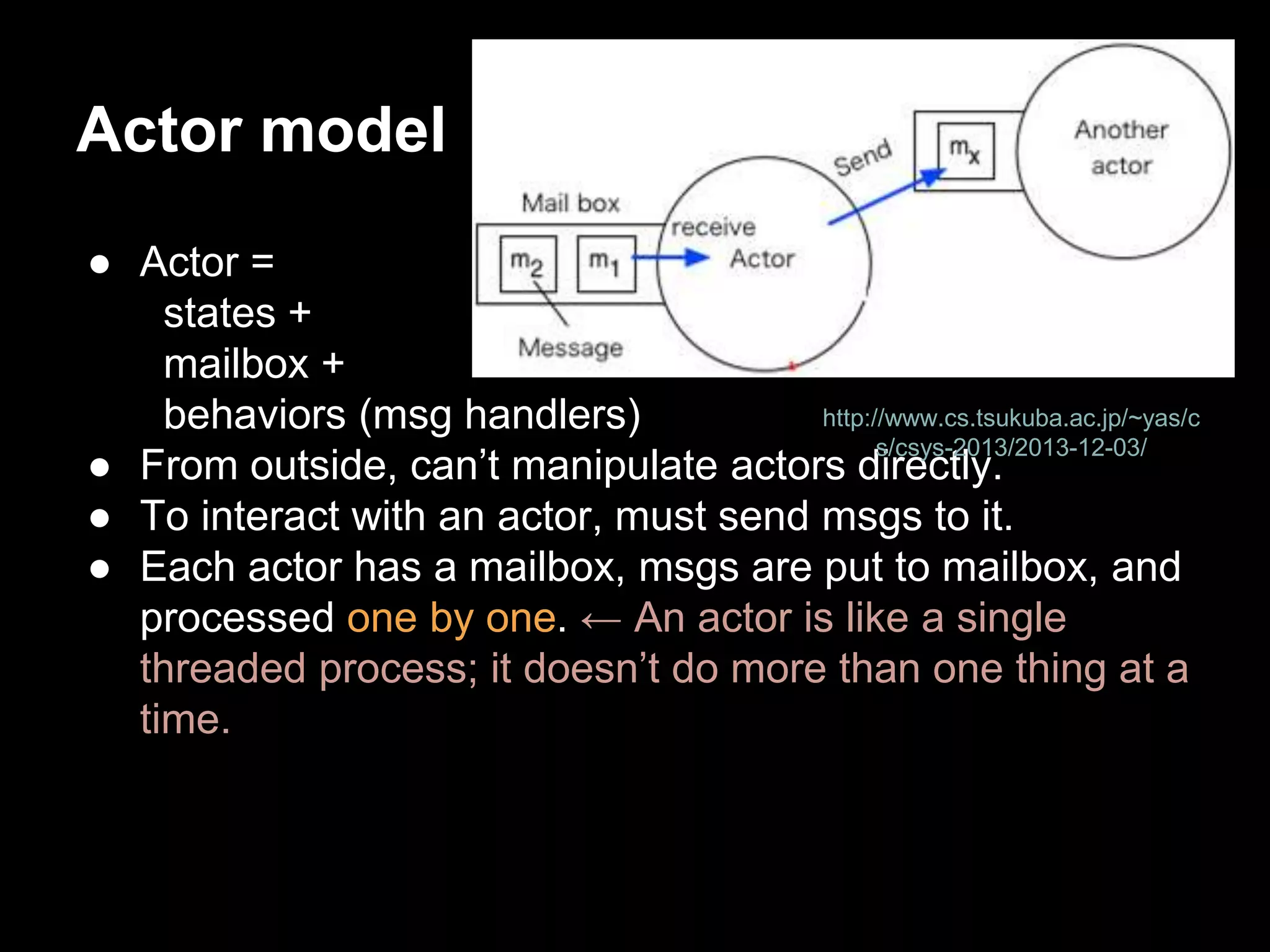
● Actor = 
states + 
mailbox + 
behaviors (msg handlers) 
http://www.cs.tsukuba.ac.jp/~yas/c 
s/csys-2013/2013-12-03/ 
● From outside, can’t manipulate actors directly. 
● To interact with an actor, must send msgs to it. 
● Each actor has a mailbox, msgs are put to mailbox, and 
processed one by one. ← An actor is like a single 
threaded process; it doesn’t do more than one thing at a 
time.
Concurrency: Actor vs Thread 
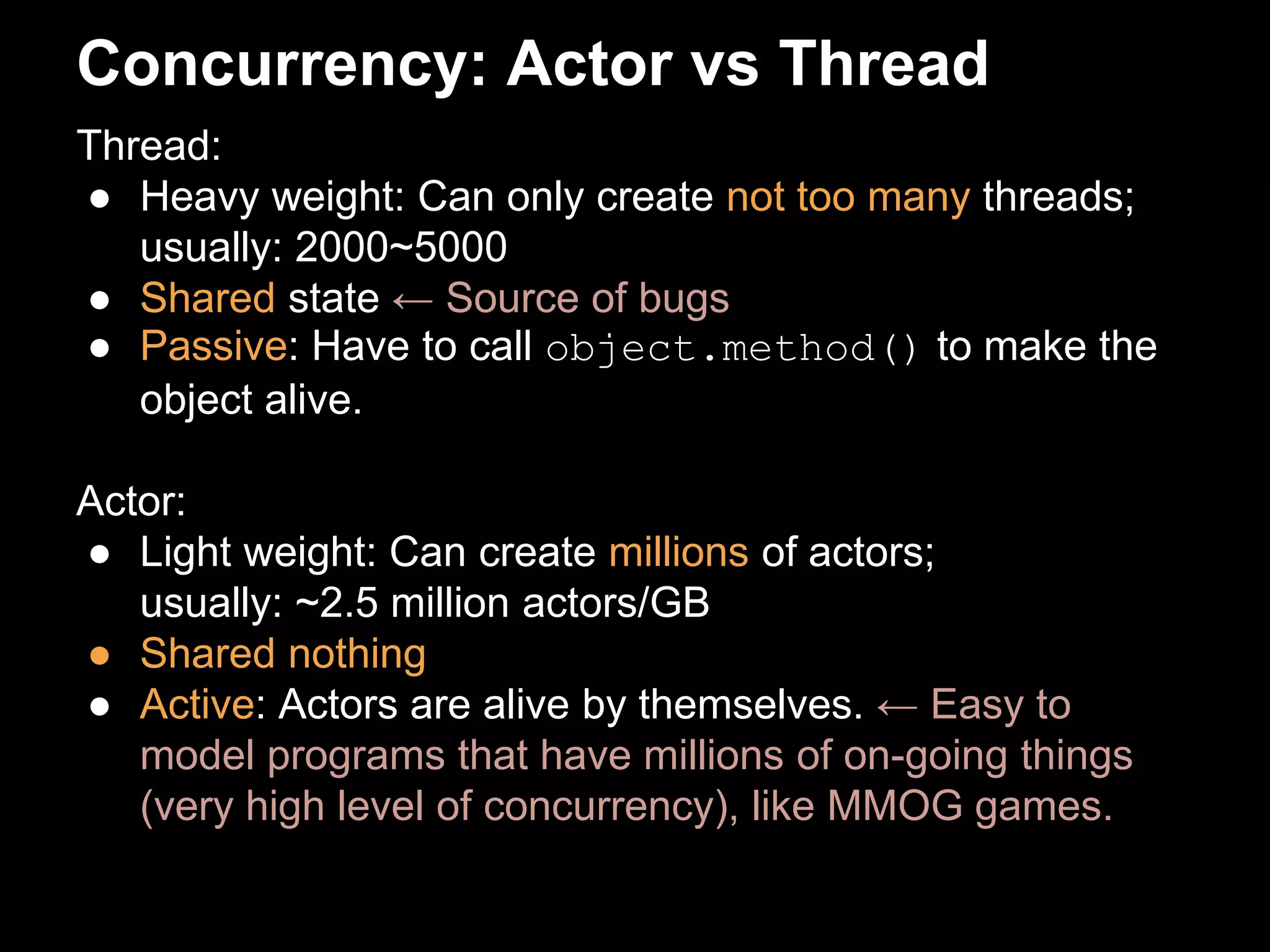
Thread: 
● Heavy weight: Can only create not too many threads; 
usually: 2000~5000 
● Shared state ← Source of bugs 
● Passive: Have to call object.method() to make the 
object alive. 
Actor: 
● Light weight: Can create millions of actors; 
usually: ~2.5 million actors/GB 
● Shared nothing 
● Active: Actors are alive by themselves. ← Easy to 
model programs that have millions of on-going things 
(very high level of concurrency), like MMOG games.
Concurrency: Actor vs Thread 
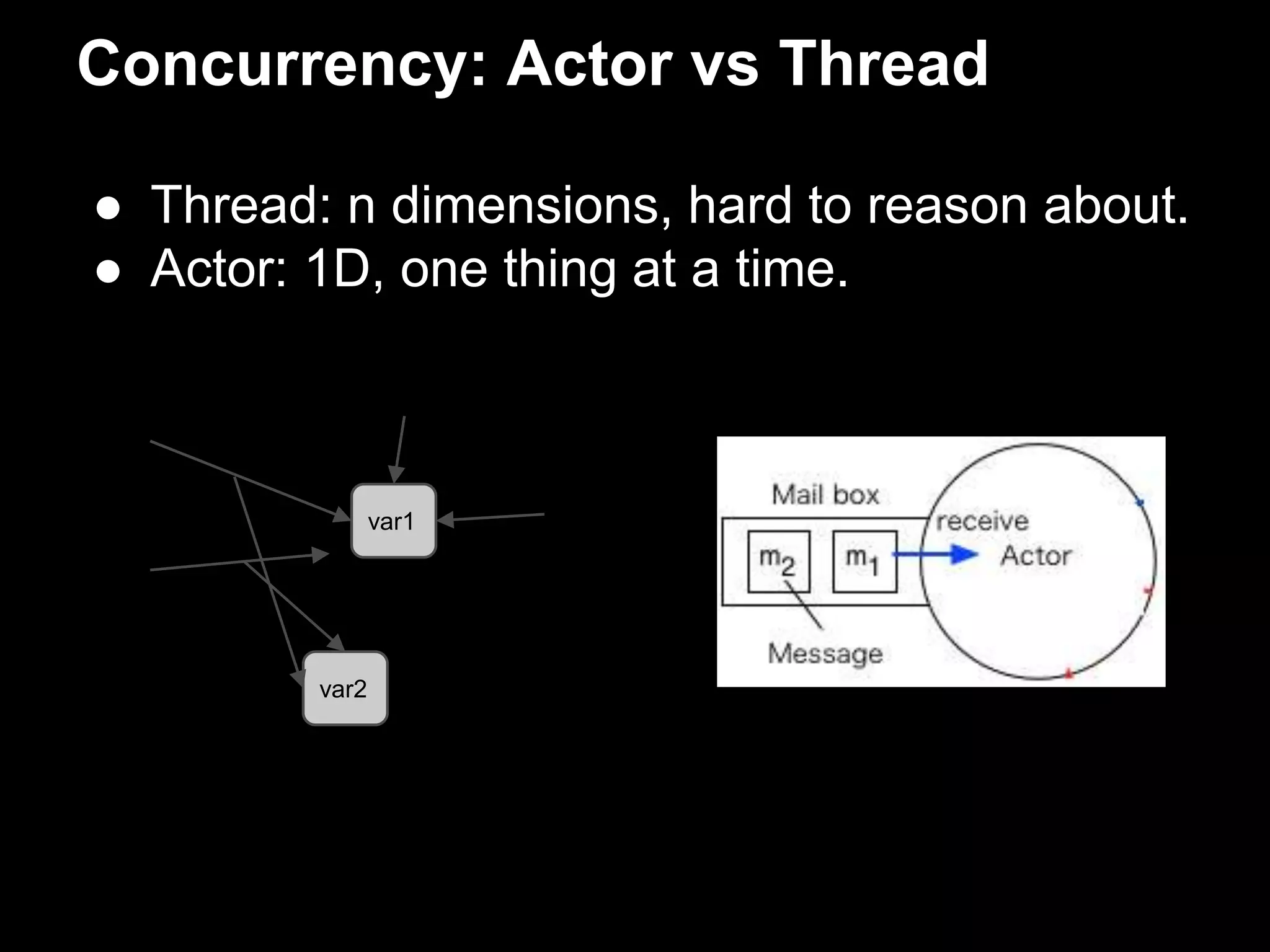
● Thread: n dimensions, hard to reason about. 
● Actor: 1D, one thing at a time. 
var1 
var2
Concurrency: Actor vs Thread 
● Actor is a high level logical way to think, to 
model programs. 
● At lower level, actors run above a thread 
pool.
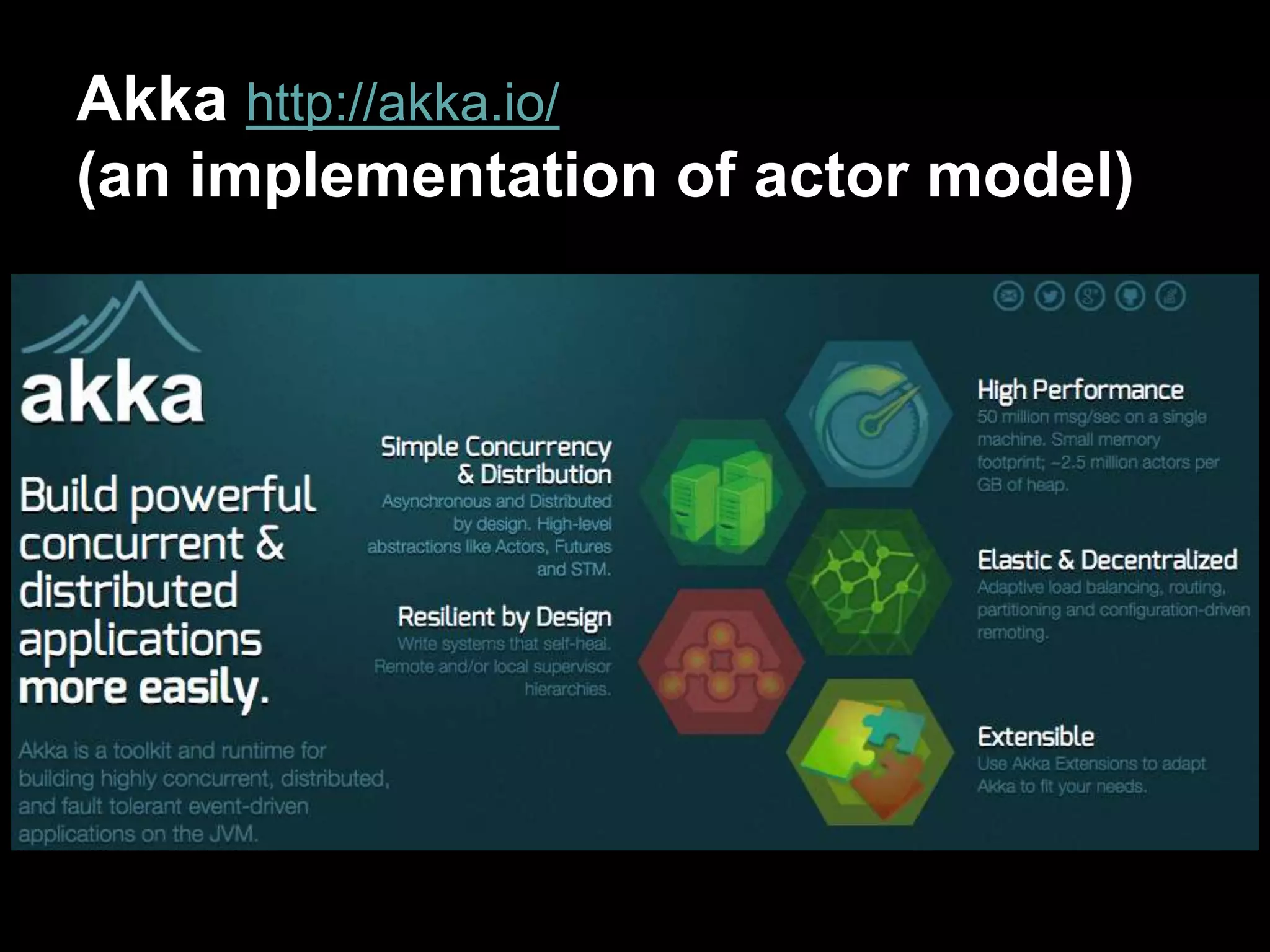
Akka http://akka.io/ 
(an implementation of actor model)
Akka: Demo 
● Live coding demo
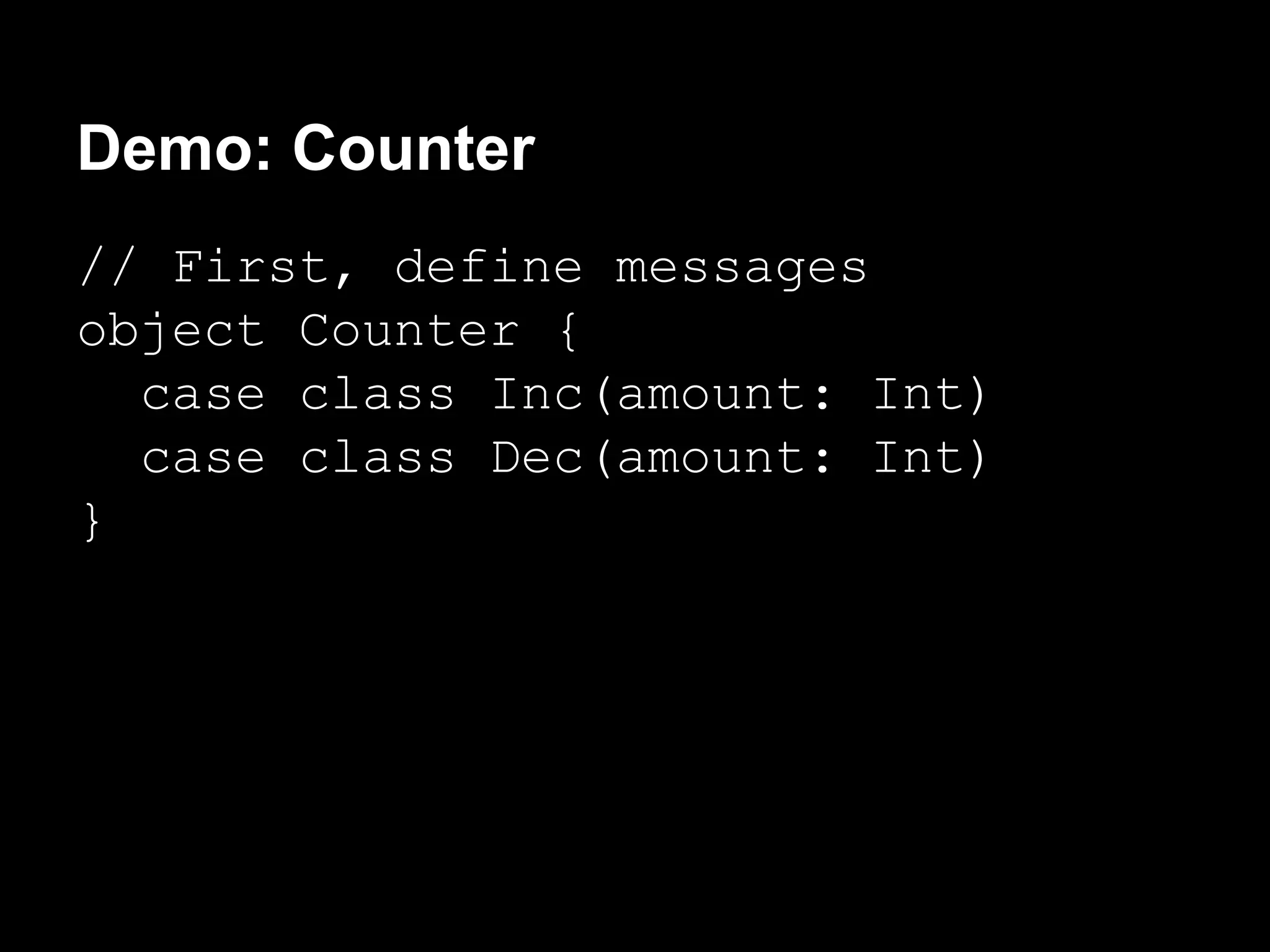
Demo: Counter 
// First, define messages 
object Counter { 
case class Inc(amount: Int) 
case class Dec(amount: Int) 
}
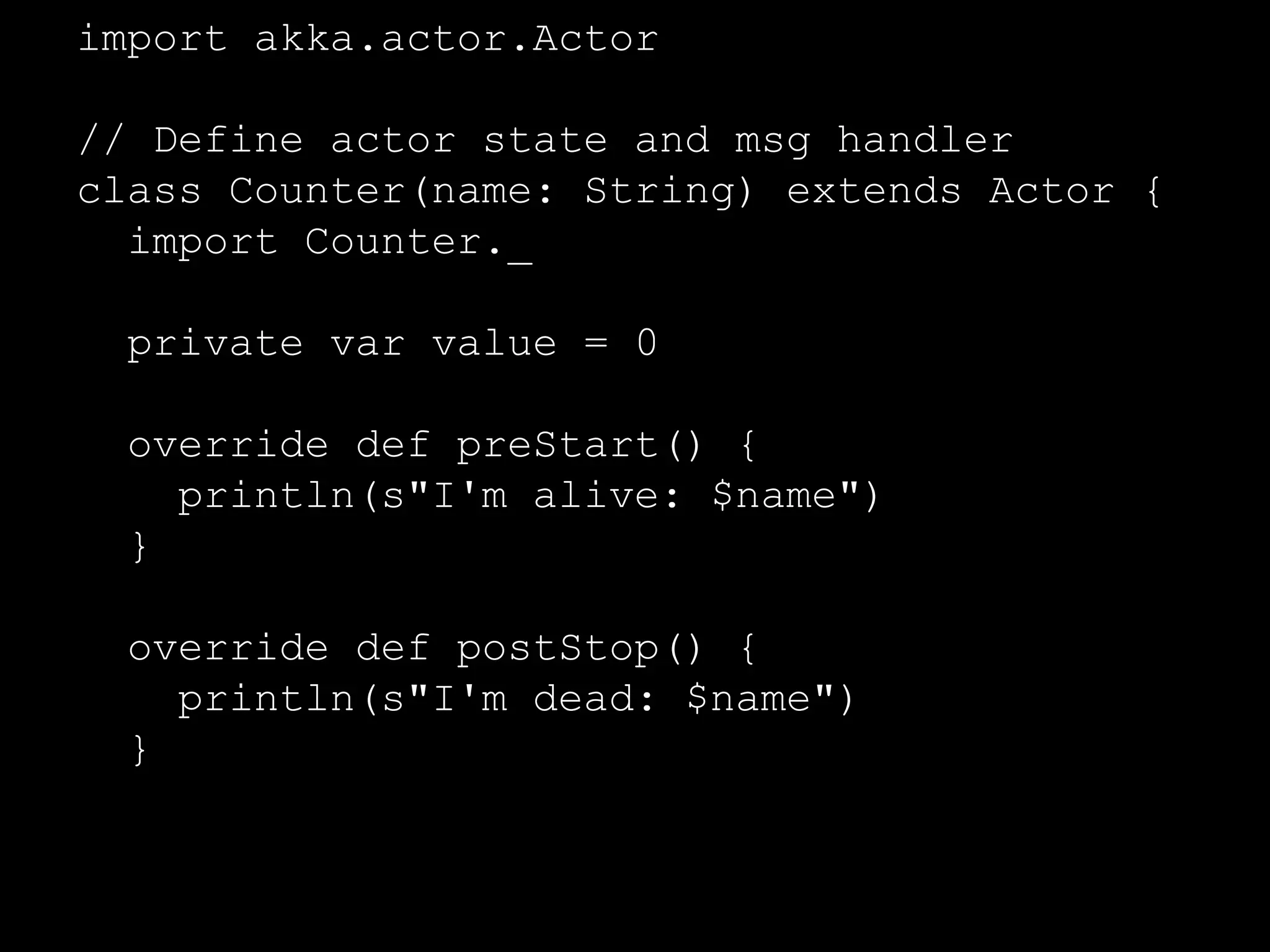
import akka.actor.Actor 
// Define actor state and msg handler 
class Counter(name: String) extends Actor { 
// Actor state 
private var value = 0 
override def preStart() { 
println(s"I'm alive: $name") 
} 
override def postStop() { 
println(s"I'm dead: $name") 
} 
...
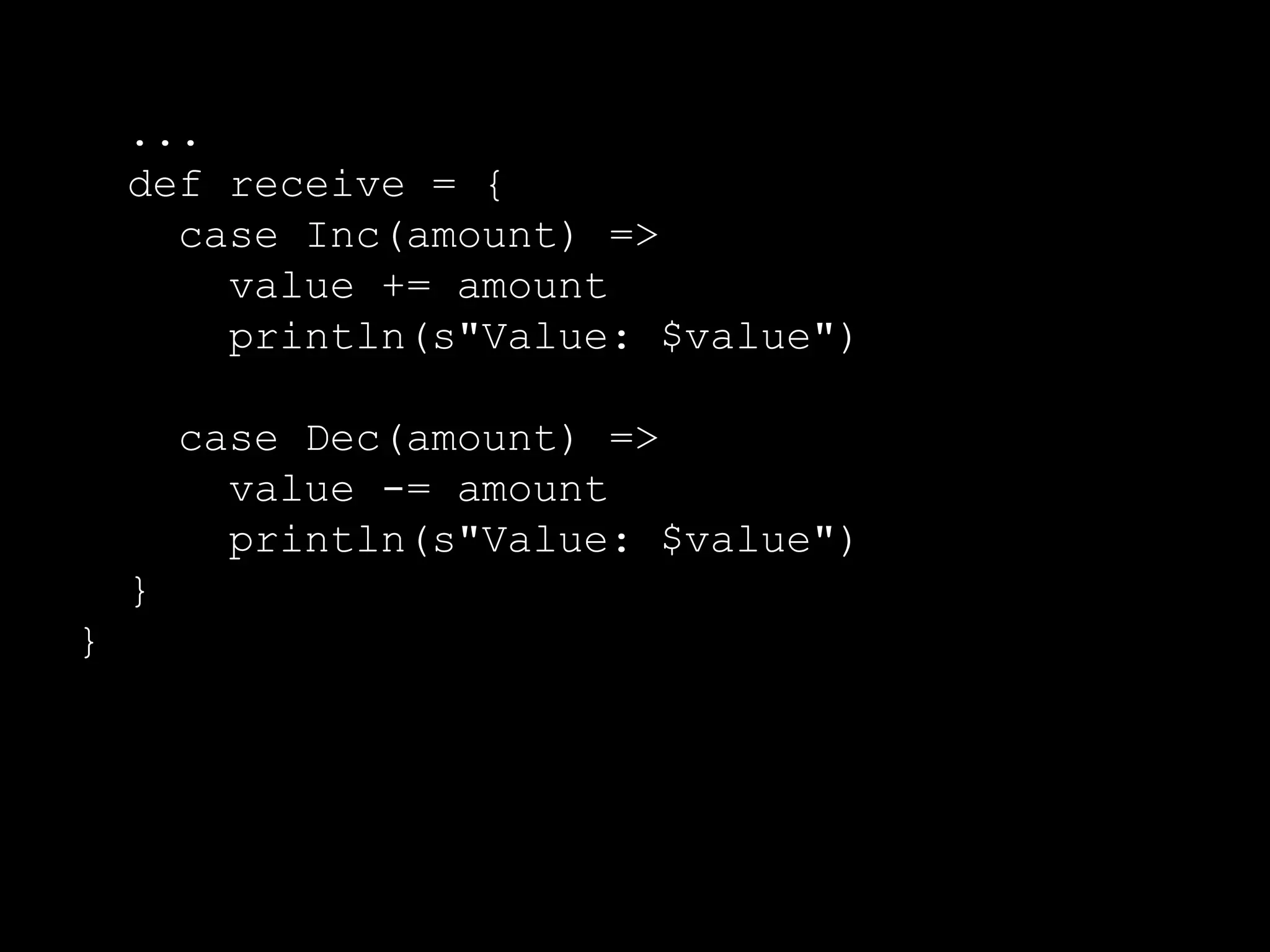
... 
import Counter._ 
// Msg handler 
def receive = { 
case Inc(amount) => 
value += amount 
println(s"Value: $value") 
case Dec(amount) => 
value -= amount 
println(s"Value: $value") 
} 
}
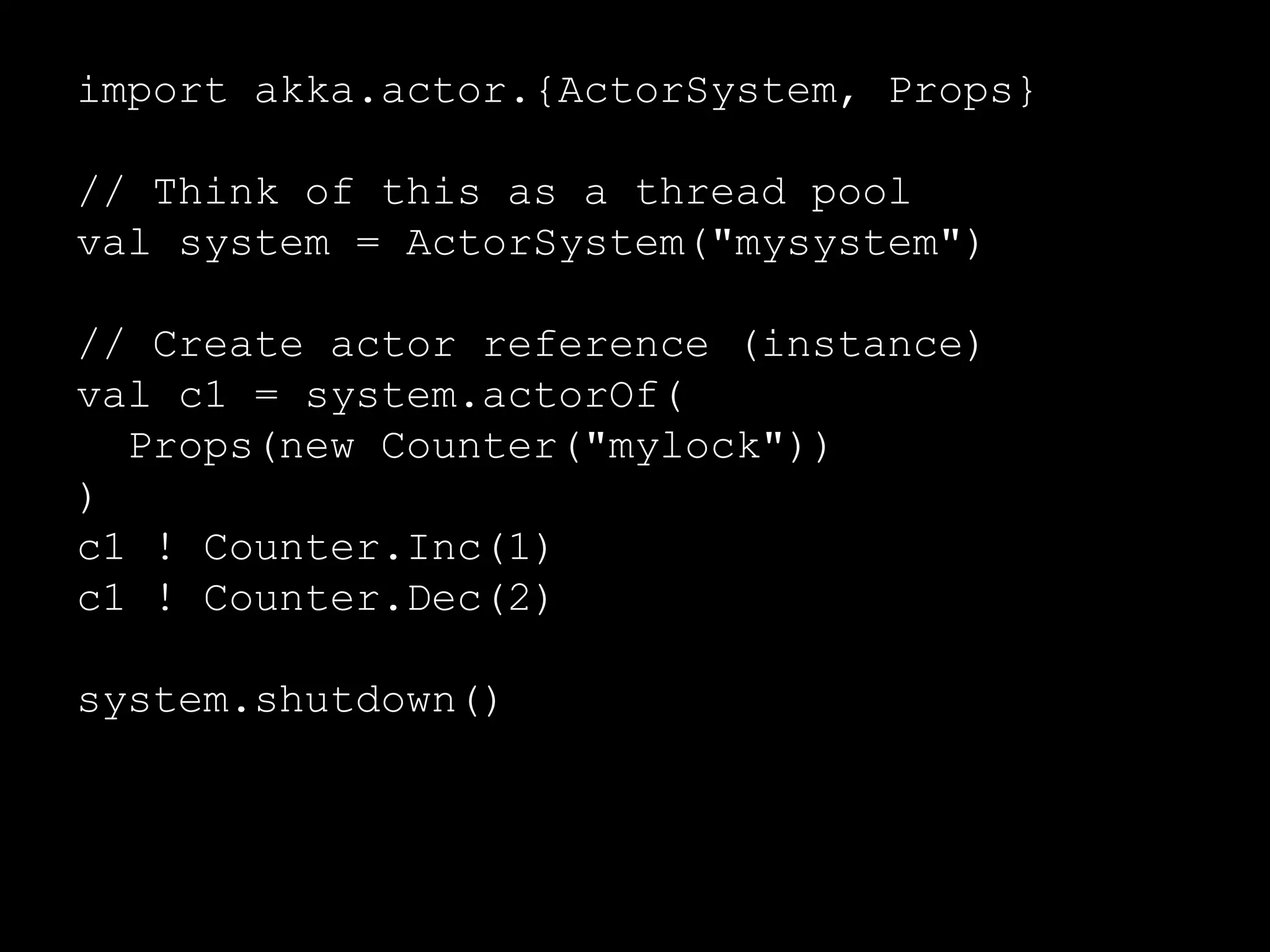
import akka.actor.{ActorSystem, Props} 
// Think of this as a thread pool 
val system = ActorSystem("mysystem") 
// Create actor reference (instance) 
val c1 = system.actorOf( 
Props(new Counter("mylock")) 
) 
// Send messages to the actor 
c1 ! Counter.Inc(1) 
c1 ! Counter.Dec(2)
Demo: Behavior transition 
CodeLock: 
https://github.com/ngocdaothanh/code-lock-fsm-akka
Some actor antipatterns 
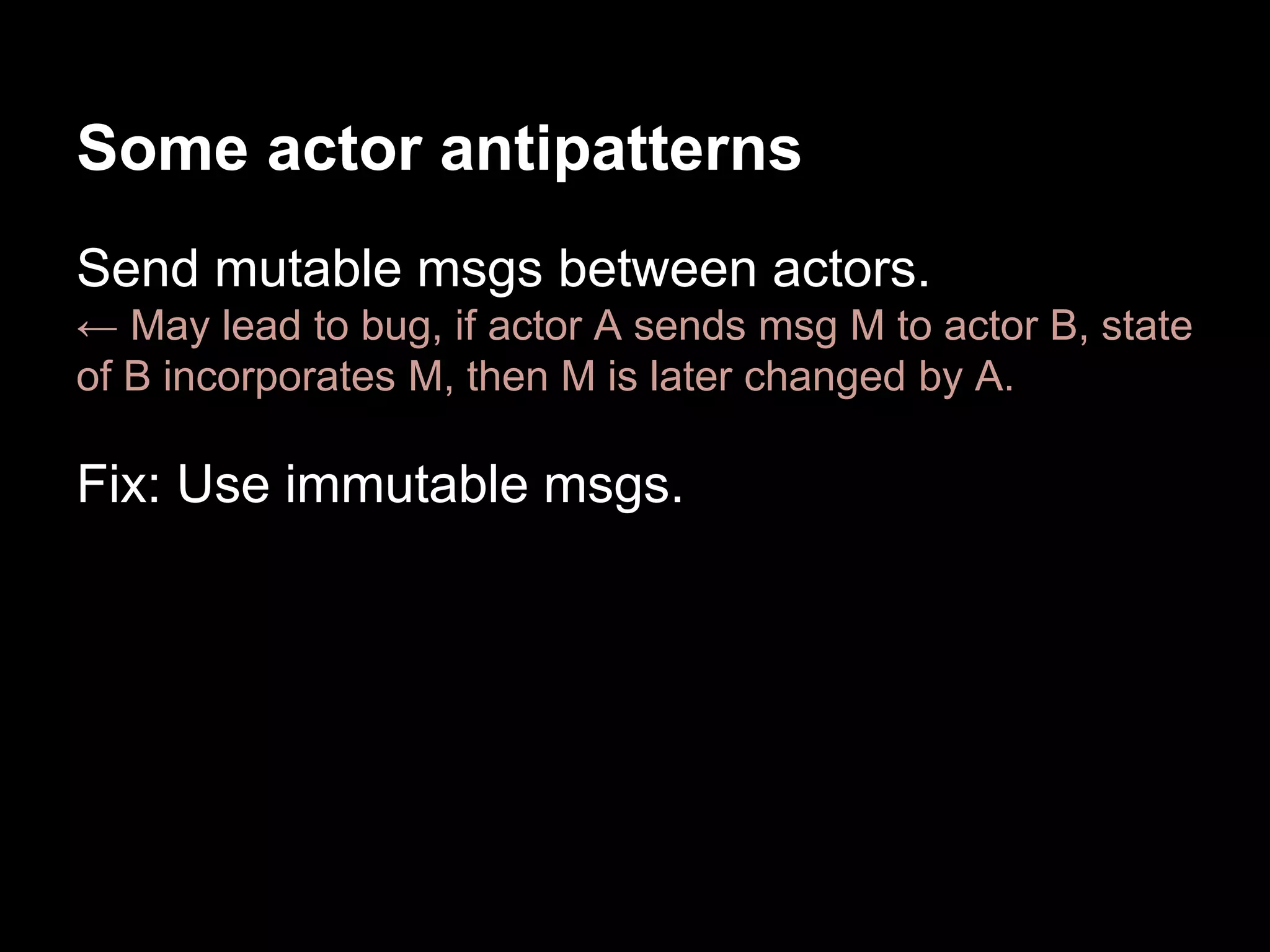
Send mutable msgs between actors. 
← May lead to bug, if actor A sends msg M to actor B, state 
of B incorporates M, then M is later changed by A. 
Fix: Use immutable msgs.
Some actor antipatterns 
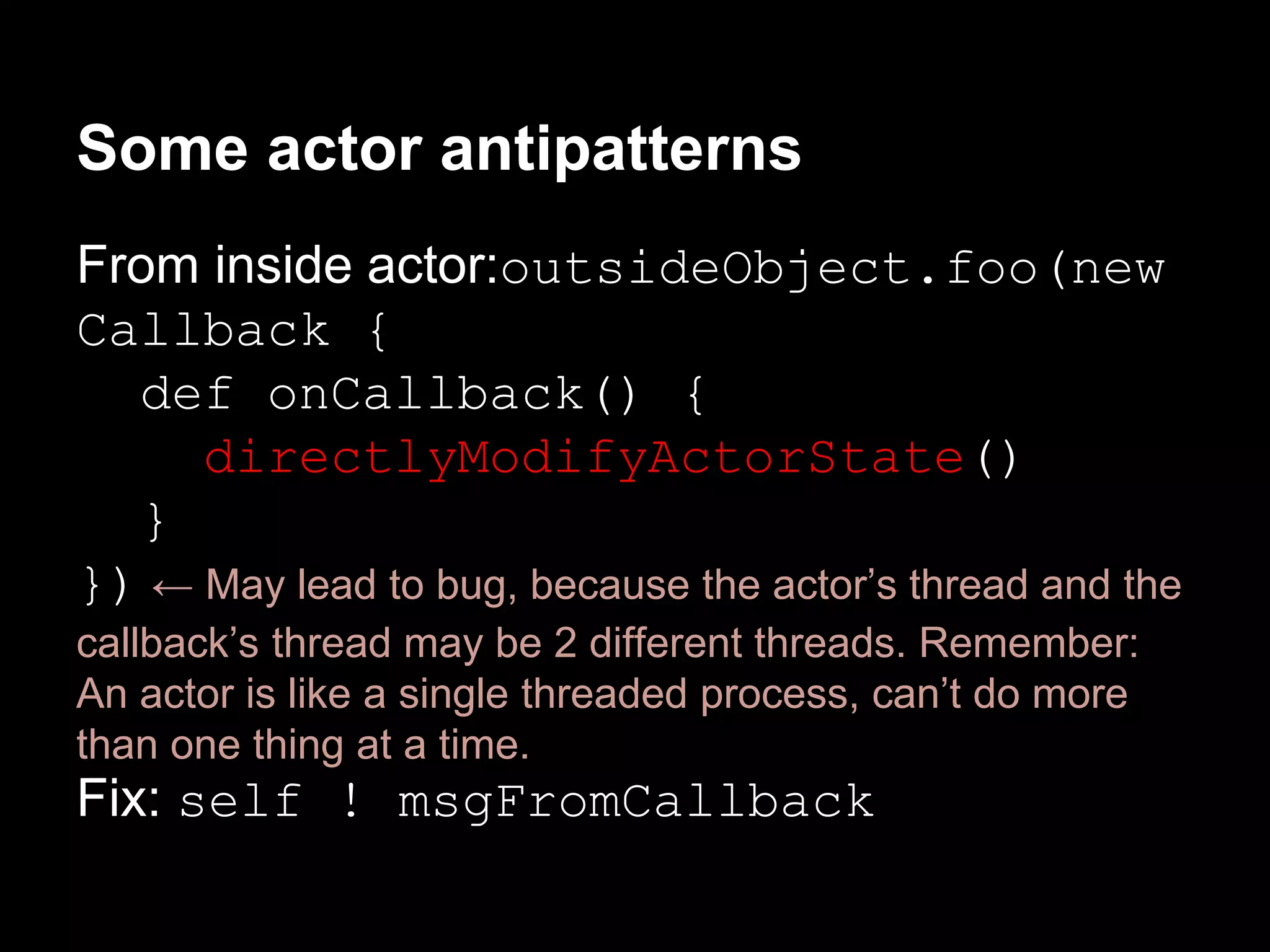
From inside actor:outsideObject.foo(new 
Callback { 
def onCallback() { 
directlyModifyActorState() 
} 
}) ← May lead to bug, because the actor’s thread and the 
callback’s thread may be 2 different threads. Remember: 
An actor is like a single threaded process, can’t do more 
than one thing at a time. 
Fix: self ! msgFromCallback
References 
● Concurrent Programming for Scalable Web 
Architectureshttp://berb.github.io/diploma-thesis/ 
index.html 
● Functions + Messages + Concurrency = 
Erlanghttp://www.infoq.com/presentations/joe-armstrong- 
erlang-qcon08 
● Akka dochttp://doc.akka.io/docs/akka/2.3.5/scala.html

Actor-based concurrency and Akka Fundamentals

  • 1.
    Actor-based concurrency andAkka Fundamentals Bon Festival 2014 Ngoc Dao
  • 2.
    Benefit of actorin one sentence C vs Java: You can use memory without having to free memory. Thread vs actor: You can use concurrency without having to create threads. Don't communicate by sharing memory; share memory by communicating.
  • 3.
    Actor model ●Actor = states + mailbox + behaviors (msg handlers) http://www.cs.tsukuba.ac.jp/~yas/c s/csys-2013/2013-12-03/ ● From outside, can’t manipulate actors directly. ● To interact with an actor, must send msgs to it. ● Each actor has a mailbox, msgs are put to mailbox, and processed one by one. ← An actor is like a single threaded process; it doesn’t do more than one thing at a time.
  • 4.
    Concurrency: Actor vsThread Thread: ● Heavy weight: Can only create not too many threads; usually: 2000~5000 ● Shared state ← Source of bugs ● Passive: Have to call object.method() to make the object alive. Actor: ● Light weight: Can create millions of actors; usually: ~2.5 million actors/GB ● Shared nothing ● Active: Actors are alive by themselves. ← Easy to model programs that have millions of on-going things (very high level of concurrency), like MMOG games.
  • 5.
    Concurrency: Actor vsThread ● Thread: n dimensions, hard to reason about. ● Actor: 1D, one thing at a time. var1 var2
  • 6.
    Concurrency: Actor vsThread ● Actor is a high level logical way to think, to model programs. ● At lower level, actors run above a thread pool.
  • 7.
    Akka http://akka.io/ (animplementation of actor model)
  • 8.
    Akka: Demo ●Live coding demo
  • 9.
    Demo: Counter //First, define messages object Counter { case class Inc(amount: Int) case class Dec(amount: Int) }
  • 10.
    import akka.actor.Actor //Define actor state and msg handler class Counter(name: String) extends Actor { // Actor state private var value = 0 override def preStart() { println(s"I'm alive: $name") } override def postStop() { println(s"I'm dead: $name") } ...
  • 11.
    ... import Counter._ // Msg handler def receive = { case Inc(amount) => value += amount println(s"Value: $value") case Dec(amount) => value -= amount println(s"Value: $value") } }
  • 12.
    import akka.actor.{ActorSystem, Props} // Think of this as a thread pool val system = ActorSystem("mysystem") // Create actor reference (instance) val c1 = system.actorOf( Props(new Counter("mylock")) ) // Send messages to the actor c1 ! Counter.Inc(1) c1 ! Counter.Dec(2)
  • 13.
    Demo: Behavior transition CodeLock: https://github.com/ngocdaothanh/code-lock-fsm-akka
  • 14.
    Some actor antipatterns Send mutable msgs between actors. ← May lead to bug, if actor A sends msg M to actor B, state of B incorporates M, then M is later changed by A. Fix: Use immutable msgs.
  • 15.
    Some actor antipatterns From inside actor:outsideObject.foo(new Callback { def onCallback() { directlyModifyActorState() } }) ← May lead to bug, because the actor’s thread and the callback’s thread may be 2 different threads. Remember: An actor is like a single threaded process, can’t do more than one thing at a time. Fix: self ! msgFromCallback
  • 16.
    References ● ConcurrentProgramming for Scalable Web Architectureshttp://berb.github.io/diploma-thesis/ index.html ● Functions + Messages + Concurrency = Erlanghttp://www.infoq.com/presentations/joe-armstrong- erlang-qcon08 ● Akka dochttp://doc.akka.io/docs/akka/2.3.5/scala.html