oslo.versionedobjects:
Deep Dive
Dan Smith
What is it?
● Object model to solve problems we had in
nova
● Each RPC-visible change is versioned
● Remotable, serializable
● Backportable
What is it? (versioning)
● Attempt to get away from dicts (of madness)
● Fields are defined and typed, with
serialization routines
● Defined at the edges, no embedding code or
class names in the serialized form
● Controlled evolution of object/RPC schema
independent of DB schema over time
What is it? (remotable)
● You implement Indirection API (nova-
conductor implements for nova)
● @remotable methods get called via
indirection
● Self-serializing
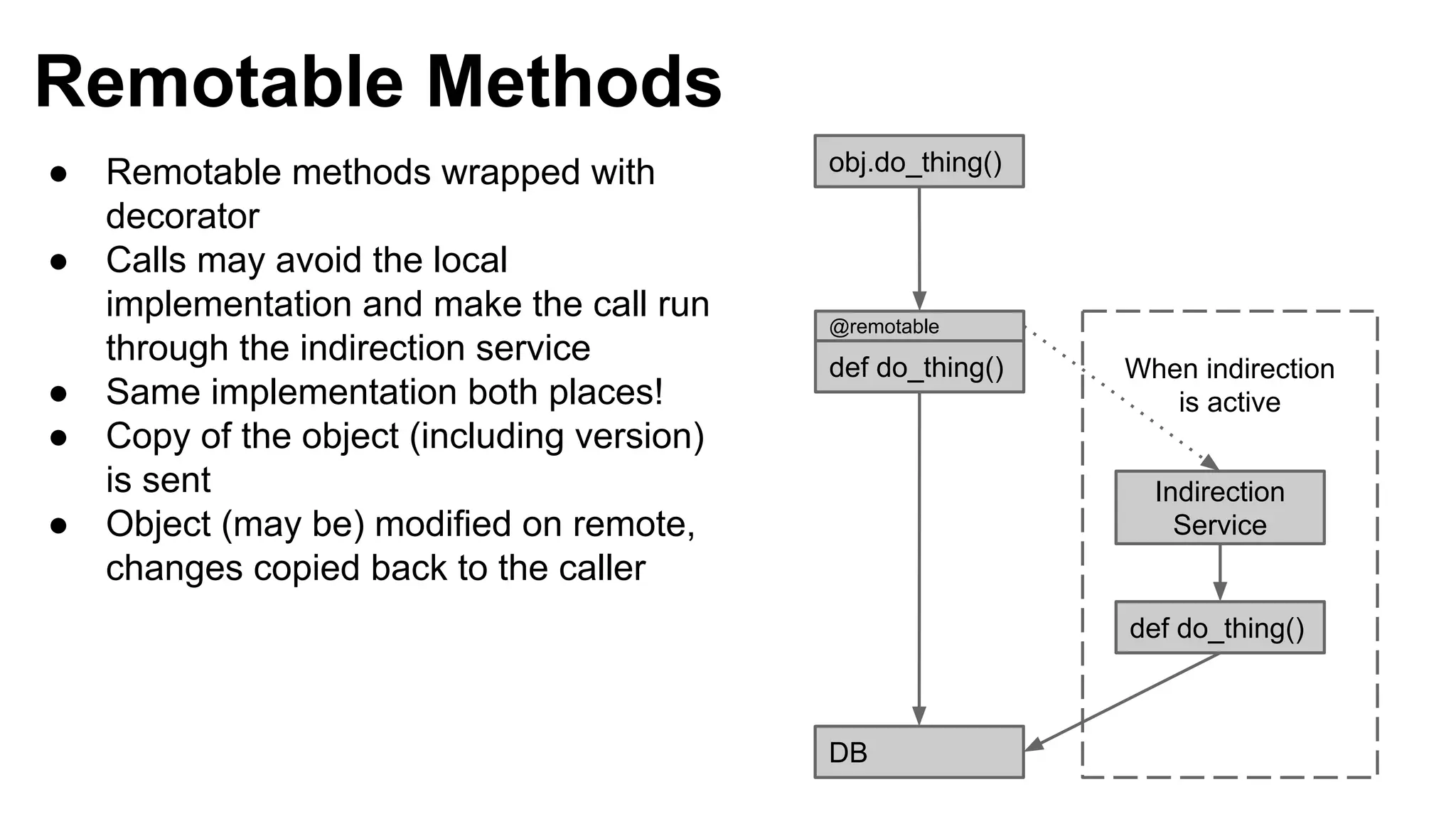
obj.do_thing()
def do_thing()
def do_thing()
DB
Indirection
Service
@remotable
When indirection
is active
● Remotable methods wrapped with
decorator
● Calls may avoid the local
implementation and make the call run
through the indirection service
● Same implementation both places!
● Copy of the object (including version)
is sent
● Object (may be) modified on remote,
changes copied back to the caller
Remotable Methods
What is it not?
● Amazingly novel
● ...going to solve world hunger
● ...going to solve your problems (alone)
● A lemming
from oslo.versionedobjects import base
class MyObject(base.VersionedObject):
# Version 1.0: Initial
# Version 1.1: Added ‘name’ field
VERSION = ‘1.1’
fields = {
‘id’: fields.IntegerField(nullable=False),
‘name’: fields.StringField(nullable=True),
‘metadata’: fields.DictOfStringsField(nullable=True),
}
@base.remotable_classmethod
def get_by_id(cls, context, id):
db_thingy = db.get_thingy(context, id)
obj = cls(context=context,
id=db_thingy[‘id’],
name=db_thingy.get(‘thingy_name’),
metadata=db.get_metadata_for(context, id))
obj.obj_reset_changes()
return obj
Careful, humans will put non-
versioned stuff in here and cause
problems (as humans do)!
class MyObject(base.VersionedObject):
# … continued
@base.remotable
def save(self):
changes = self.obj_what_changed()
db_updates = {}
if ‘id’ in changes:
raise Exception(‘Can’t change the id!’)
if ‘name’ in changes:
db_updates[‘thingy_name’] = self.name
with db.transaction():
if ‘metadata’ in changes:
db.update_metadata_for(self.context, self.id,
self.metadata)
if db_updates:
db.update_thingy(self.context, self.id, db_updates)
self.obj_reset_changes()
Lazy-Loading
● Attributes can be set or unset, independent
of nullability (i.e. “can be None”)
● Loadable attributes handled by a method
● In practice, only some (heavy) attributes are
loadable
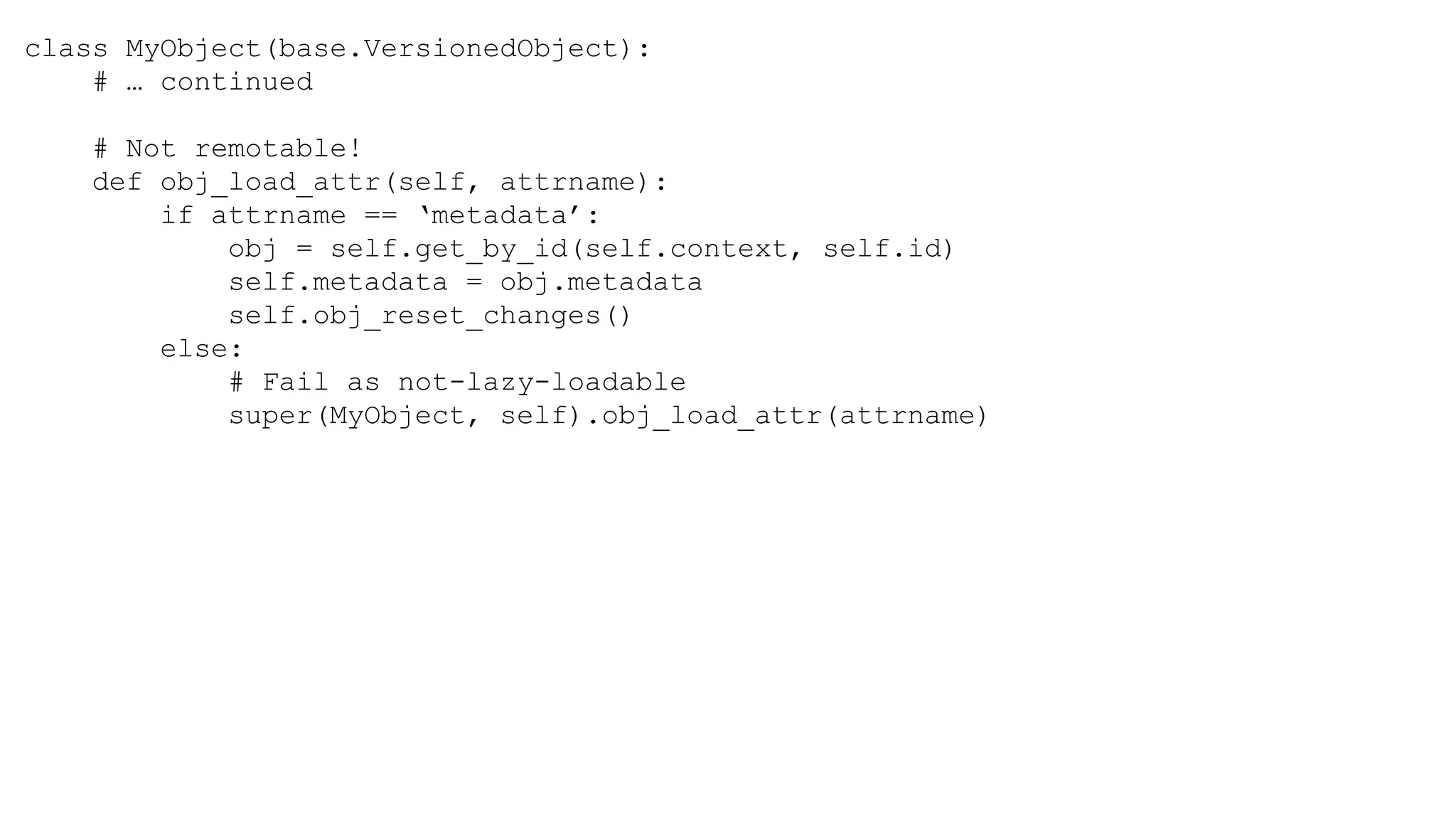
class MyObject(base.VersionedObject):
# … continued
# Not remotable!
def obj_load_attr(self, attrname):
if attrname == ‘metadata’:
obj = self.get_by_id(self.context, self.id)
self.metadata = obj.metadata
self.obj_reset_changes()
else:
# Fail as not-lazy-loadable
super(MyObject, self).obj_load_attr(attrname)
Serialization
● Convert object to/from serialized form
● Field implementations are responsible for
serializing their contents (not your object)
● Serializer object actually produces the result
● Nova uses JSON, but you can do whatever
● Object mentions no classnames or code,
relies on the model to deserialize
Serialization (continued)
● Most services will need to have a request
context for all operations
● Object stores this for ease and security
● Each RPC trip re-attaches the context of the
RPC call, so context is not serialized!
● Can be anything or ignored if you don’t need
it
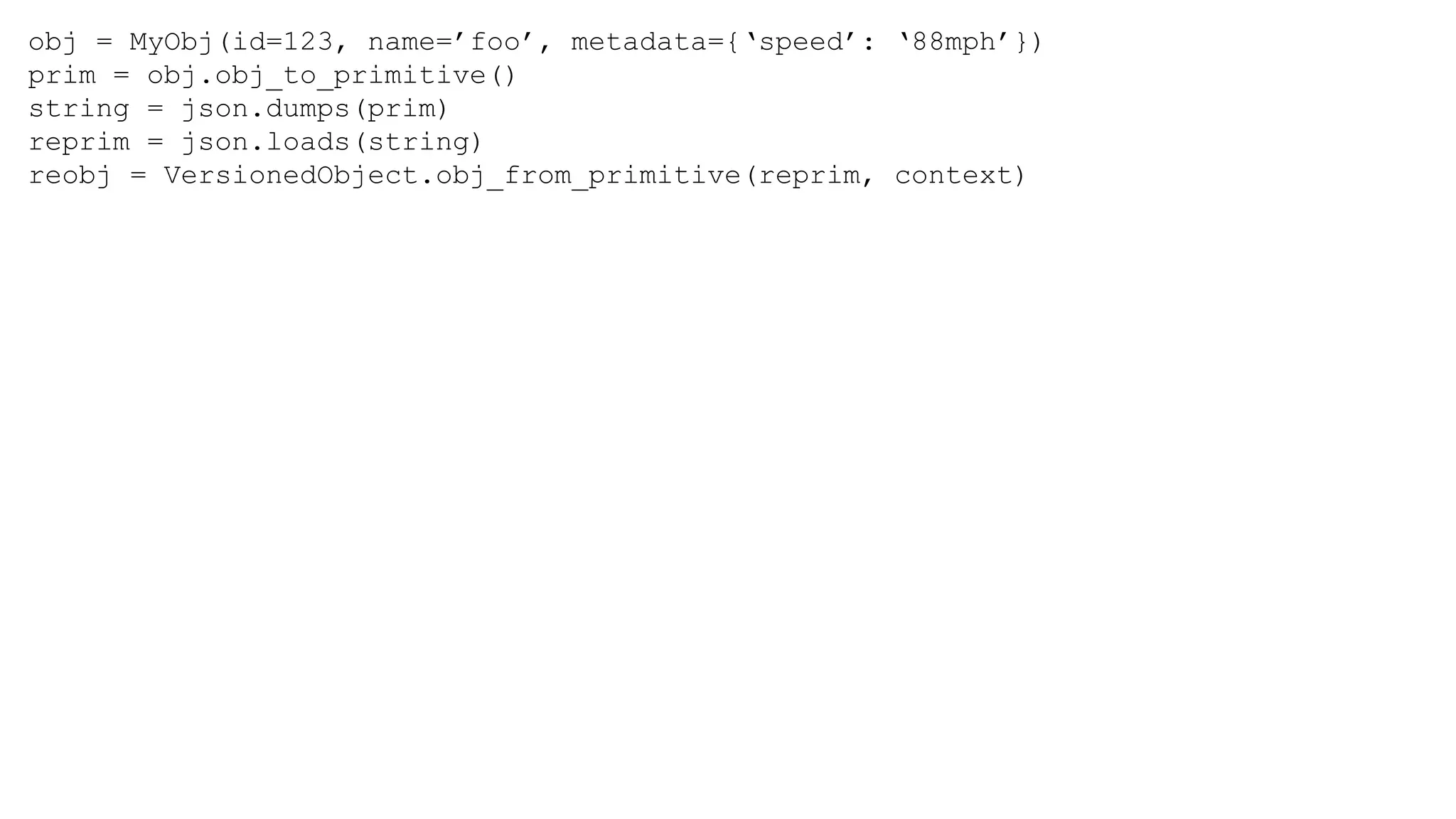
obj = MyObj(id=123, name=’foo’, metadata={‘speed’: ‘88mph’})
prim = obj.obj_to_primitive()
string = json.dumps(prim)
reprim = json.loads(string)
reobj = VersionedObject.obj_from_primitive(reprim, context)
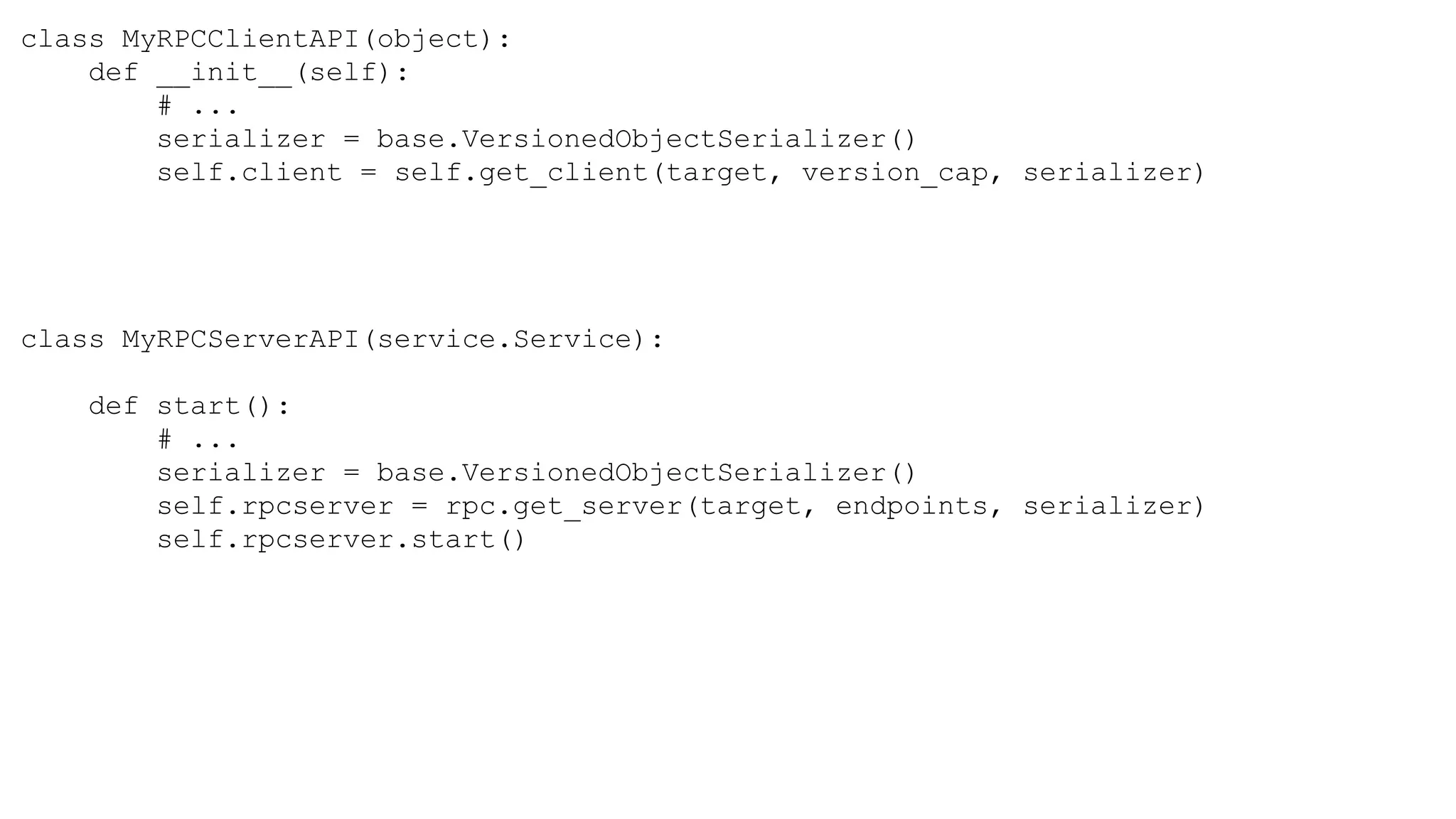
class MyRPCClientAPI(object):
def __init__(self):
# ...
serializer = base.VersionedObjectSerializer()
self.client = self.get_client(target, version_cap, serializer)
class MyRPCServerAPI(service.Service):
def start():
# ...
serializer = base.VersionedObjectSerializer()
self.rpcserver = rpc.get_server(target, endpoints, serializer)
self.rpcserver.start()
Versioning
● Requires diligence (with some tools to help
catch offenders)
● Backwards-compatible changes
● Recipients should honor old versions
● Senders can pre-backport to older versions
● Nova does this automatically, but simply
pinning versions is an easy way
class MyObject(base.VersionedObject):
# … continued
def obj_make_compatible(self, primitive, version):
if version == ‘1.0’:
del primitive[‘name’]
obj = MyObject(id=123, name=’foo’, metadata={‘speed’: ‘88mph’})
prim = obj.obj_to_primitive(target_version=’1.0’)
# Now prim won’t have the ‘name’ field
oldobj = VersionedObject.obj_from_primitive(prim, context)
self.assertFalse(oldobj.obj_attr_is_set(‘name’))
Why do this?
● Get a better handle on what you’re sending
over RPC and what happens if you change
● Decouples the database from services,
allowing DB schema upgrades independent
of object schemas
● Easy serialization without sacrificing rich
typing and bundled methods
Why not do this?
● Because it will magically solve upgrade
problems (it won’t)
● Because you have a better way
● Because it doesn’t fit your model or process
● Because the name is too boring

Oslo.versioned objects - Deep Dive

  • 1.
  • 2.
    What is it? ●Object model to solve problems we had in nova ● Each RPC-visible change is versioned ● Remotable, serializable ● Backportable
  • 3.
    What is it?(versioning) ● Attempt to get away from dicts (of madness) ● Fields are defined and typed, with serialization routines ● Defined at the edges, no embedding code or class names in the serialized form ● Controlled evolution of object/RPC schema independent of DB schema over time
  • 4.
    What is it?(remotable) ● You implement Indirection API (nova- conductor implements for nova) ● @remotable methods get called via indirection ● Self-serializing
  • 5.
    obj.do_thing() def do_thing() def do_thing() DB Indirection Service @remotable Whenindirection is active ● Remotable methods wrapped with decorator ● Calls may avoid the local implementation and make the call run through the indirection service ● Same implementation both places! ● Copy of the object (including version) is sent ● Object (may be) modified on remote, changes copied back to the caller Remotable Methods
  • 6.
    What is itnot? ● Amazingly novel ● ...going to solve world hunger ● ...going to solve your problems (alone) ● A lemming
  • 7.
    from oslo.versionedobjects importbase from oslo.versionedobjects import base class MyObject(base.VersionedObject): # Version 1.0: Initial # Version 1.1: Added ‘name’ field VERSION = ‘1.1’ fields = { ‘id’: fields.IntegerField(nullable=False), ‘name’: fields.StringField(nullable=True), ‘metadata’: fields.DictOfStringsField(nullable=True), } @base.remotable_classmethod def get_by_id(cls, context, id): db_thingy = db.get_thingy(context, id) obj = cls(context=context, id=db_thingy[‘id’], name=db_thingy.get(‘thingy_name’), metadata=db.get_metadata_for(context, id)) obj.obj_reset_changes() return obj Careful, humans will put non- versioned stuff in here and cause problems (as humans do)!
  • 8.
    class MyObject(base.VersionedObject): # …continued @base.remotable def save(self): changes = self.obj_what_changed() db_updates = {} if ‘id’ in changes: raise Exception(‘Can’t change the id!’) if ‘name’ in changes: db_updates[‘thingy_name’] = self.name with db.transaction(): if ‘metadata’ in changes: db.update_metadata_for(self.context, self.id, self.metadata) if db_updates: db.update_thingy(self.context, self.id, db_updates) self.obj_reset_changes()
  • 9.
    Lazy-Loading ● Attributes canbe set or unset, independent of nullability (i.e. “can be None”) ● Loadable attributes handled by a method ● In practice, only some (heavy) attributes are loadable
  • 10.
    class MyObject(base.VersionedObject): # …continued # Not remotable! def obj_load_attr(self, attrname): if attrname == ‘metadata’: obj = self.get_by_id(self.context, self.id) self.metadata = obj.metadata self.obj_reset_changes() else: # Fail as not-lazy-loadable super(MyObject, self).obj_load_attr(attrname)
  • 11.
    Serialization ● Convert objectto/from serialized form ● Field implementations are responsible for serializing their contents (not your object) ● Serializer object actually produces the result ● Nova uses JSON, but you can do whatever ● Object mentions no classnames or code, relies on the model to deserialize
  • 12.
    Serialization (continued) ● Mostservices will need to have a request context for all operations ● Object stores this for ease and security ● Each RPC trip re-attaches the context of the RPC call, so context is not serialized! ● Can be anything or ignored if you don’t need it
  • 13.
    obj = MyObj(id=123,name=’foo’, metadata={‘speed’: ‘88mph’}) prim = obj.obj_to_primitive() string = json.dumps(prim) reprim = json.loads(string) reobj = VersionedObject.obj_from_primitive(reprim, context)
  • 14.
    class MyRPCClientAPI(object): def __init__(self): #... serializer = base.VersionedObjectSerializer() self.client = self.get_client(target, version_cap, serializer) class MyRPCServerAPI(service.Service): def start(): # ... serializer = base.VersionedObjectSerializer() self.rpcserver = rpc.get_server(target, endpoints, serializer) self.rpcserver.start()
  • 15.
    Versioning ● Requires diligence(with some tools to help catch offenders) ● Backwards-compatible changes ● Recipients should honor old versions ● Senders can pre-backport to older versions ● Nova does this automatically, but simply pinning versions is an easy way
  • 16.
    class MyObject(base.VersionedObject): # …continued def obj_make_compatible(self, primitive, version): if version == ‘1.0’: del primitive[‘name’] obj = MyObject(id=123, name=’foo’, metadata={‘speed’: ‘88mph’}) prim = obj.obj_to_primitive(target_version=’1.0’) # Now prim won’t have the ‘name’ field oldobj = VersionedObject.obj_from_primitive(prim, context) self.assertFalse(oldobj.obj_attr_is_set(‘name’))
  • 17.
    Why do this? ●Get a better handle on what you’re sending over RPC and what happens if you change ● Decouples the database from services, allowing DB schema upgrades independent of object schemas ● Easy serialization without sacrificing rich typing and bundled methods
  • 18.
    Why not dothis? ● Because it will magically solve upgrade problems (it won’t) ● Because you have a better way ● Because it doesn’t fit your model or process ● Because the name is too boring