APACHE SLING & FRIENDS TECH MEETUP

BERLIN, 23-25 SEPTEMBER 2013

Inter-Sling communication with a message queue
Tomasz Rękawek
Agenda
•  Code bookmarks
•  http://bit.ly/adaptto-jms
•  Case 1: shared session
•  Running ActiveMQ in Sling
•  JMS connection provider
•  Case 2: JMS-based discovery API
implementation
•  Sling Message Listener
•  Case 3: Reverse replication request
•  Targeting instance by its run mode
adaptTo() 2013
 2	
  
adaptTo() 2013
 3
Solution overview
Shared session
Shared session
•  We have n publishes and the dispatcher
with stickySession enabled
•  We use the servlet session
•  In case one publish stops responding, the
user will be redirected to the other publish
•  We want the session to be transferred too
adaptTo() 2013
 4	
  
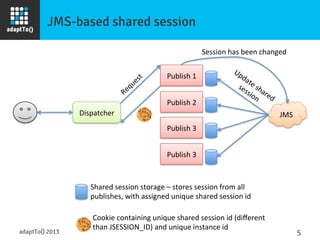
JMS-based shared session
Dispatcher+
Publish+1+
Publish+2+
Publish+3+
Publish+3+
JMS+
Update+shared+
session+
Session+has+been+changed+
Shared+session+storage+–+stores+session+from+all+
publishes,+with+assigned+unique+shared+session+id+
Request+
Cookie+containing+unique+shared+session+id+(different+
than+JSESSION_ID)+and+unique+instance+id+
adaptTo() 2013
 5	
  
Shared session
•  If a publish notices that the instance id in
the cookie is different from its own, it’ll
copy shared session values to the
HttpSession	
  
•  The Administrator can configure names of
the shared session properties (as a list of
regular expressions)	
  
adaptTo() 2013
 6	
  
Shared session – demo
•  Local infrastructure description:
•  One author + two publishes
•  All available under local.cq	
  domain
•  We can switch between publishes using ?publish2	
  
query string
•  http://local.cq/bin/cognifide/session.txt
•  http://local.cq/bin/cognifide/session.txt/add
•  http://local.cq/bin/cognifide/session.txt?
publish2
adaptTo() 2013
 7	
  
adaptTo() 2013
 8
Shared session implementation details
Integrating ActiveMQ
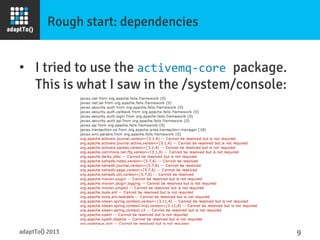
Rough start: dependencies
•  I tried to use the activemq-­‐core	
  package.
This is what I saw in the /system/console:
adaptTo() 2013
 9	
  
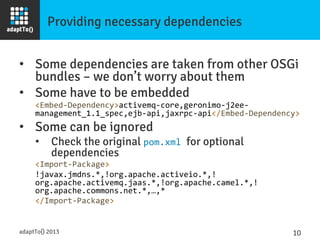
Providing necessary dependencies
•  Some dependencies are taken from other OSGi
bundles – we don’t worry about them
•  Some have to be embedded
<Embed-­‐Dependency>activemq-­‐core,geronimo-­‐j2ee-­‐
management_1.1_spec,ejb-­‐api,jaxrpc-­‐api</Embed-­‐Dependency>	
  
•  Some can be ignored
•  Check the original pom.xml	
  for optional
dependencies
<Import-­‐Package>	
  
!javax.jmdns.*,!org.apache.activeio.*,!
org.apache.activemq.jaas.*,!org.apache.camel.*,!
org.apache.commons.net.*,…,*	
  
</Import-­‐Package>	
  
adaptTo() 2013
 10	
  
Result: sling-­‐jms-­‐activemq	
  
•  We’ve created an OSGi bundle with all
necessary dependencies embedded
•  Optional dependencies are ignored and
marked not-to-import
•  Bundle provides ActiveMQ to any Sling
instance
adaptTo() 2013
 11	
  
adaptTo() 2013
 12
Shared session implementation details
JMS Connection Provider
Creating JMS connection with ActiveMQ
adaptTo() 2013
 13
import	
  javax.jms.Connection;	
  
import	
  org.apache.activemq.ActiveMQConnectionFactory;	


ActiveMQConnectionFactory	
  factory;	
  
factory	
  =	
  new	
  ActiveMQConnectionFactory();	
  
Connection	
  connection	
  =	
  factory.createConnection();	
  
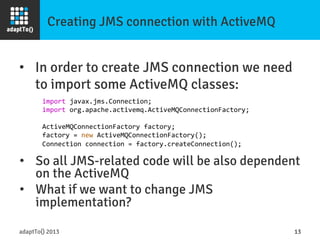
•  In order to create JMS connection we need
to import some ActiveMQ classes:
•  So all JMS-related code will be also dependent
on the ActiveMQ
•  What if we want to change JMS
implementation?
JMS connection provider	
  
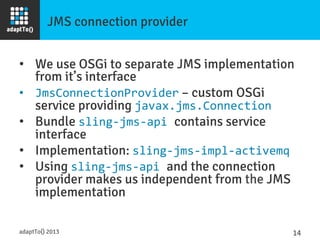
•  We use OSGi to separate JMS implementation
from it’s interface
•  JmsConnectionProvider – custom OSGi
service providing javax.jms.Connection	
  
•  Bundle sling-­‐jms-­‐api	
  contains service
interface
•  Implementation: sling-­‐jms-­‐impl-­‐activemq	
  
•  Using sling-­‐jms-­‐api	
  and the connection
provider makes us independent from the JMS
implementation
adaptTo() 2013
 14	
  
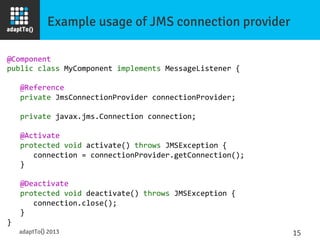
Example usage of JMS connection provider	
  
@Component	
  
public	
  class	
  MyComponent	
  implements	
  MessageListener	
  {	


  @Reference	


  private	
  JmsConnectionProvider	
  connectionProvider;	


  private	
  javax.jms.Connection	
  connection;	


  @Activate	


  protected	
  void	
  activate()	
  throws	
  JMSException	
  {	


  connection	
  =	
  connectionProvider.getConnection();	


  }	


  @Deactivate	


  protected	
  void	
  deactivate()	
  throws	
  JMSException	
  {	


  connection.close();	


  }	
  
}	
  
adaptTo() 2013
 15	
  
adaptTo() 2013
 16
API overview & our JMS implementation
Discovery API
Sling Discovery API
•  New Sling API
•  Each instance can expose a list of key-value
properties to other instances
•  Example usage: metadata for workflow
offloading in CQ
•  Properties are not meant to be messaging
tool, they shouldn’t change too often
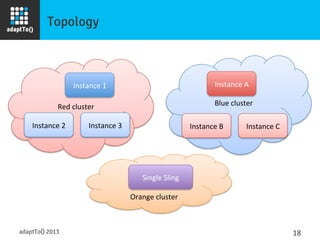
•  Instances are grouped into clusters, each
cluster has elected leader
adaptTo() 2013
 17	
  
Topology
Red$cluster$ Blue$cluster$
$
$
$
Orange$cluster$
Instance$1$
Instance$2$ Instance$3$
Instance$A$
Instance$B$ Instance$C$
Single$Sling$
adaptTo() 2013
 18	
  
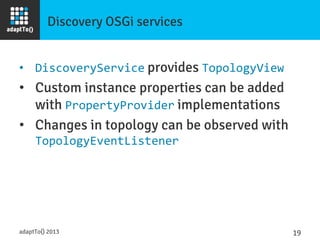
Discovery OSGi services
•  DiscoveryService provides TopologyView	
  
•  Custom instance properties can be added
with PropertyProvider implementations
•  Changes in topology can be observed with
TopologyEventListener
adaptTo() 2013
 19	
  
JMS discovery implementation
•  There is a default HTTP-based
implementation
•  requires providing all instance URLs on each
instance
•  But JMS is a natural choice for the
transport layer here
•  sling-­‐jms-­‐discovery	
  – a new, JMS-based
discovery implementation that doesn’t
require any configuration
adaptTo() 2013
 20	
  
Discovery election
•  If some instance notices there is no leader for
some cluster, it sends message: WHO_IS_LEADER	
  
•  If no one responds in 10 seconds, it sends the
second message: ELECTION	
  
•  Every instance in a given cluster has to
respond with their Sling instance id in the VOTE
message
•  After 5 seconds instance with the smallest id
is chosen and it sends the I_AM_LEADER
message
adaptTo() 2013
 21	
  
Discovery – demo
•  http://local.cq:4503/bin/jms/discovery/info.txt
adaptTo() 2013
 22	
  
adaptTo() 2013
 23
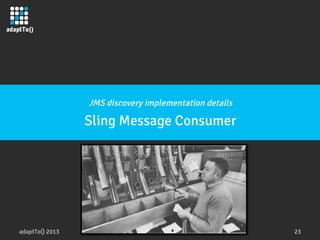
JMS discovery implementation details
Sling Message Consumer
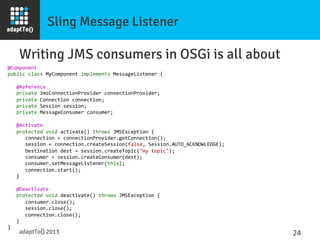
Sling Message Listener
Writing JMS consumers in OSGi is all about
@Component	
  
public	
  class	
  MyComponent	
  implements	
  MessageListener	
  {	


  @Reference	


  private	
  JmsConnectionProvider	
  connectionProvider;	


  private	
  Connection	
  connection;	


  private	
  Session	
  session;	


  private	
  MessageConsumer	
  consumer;	


  @Activate	


  protected	
  void	
  activate()	
  throws	
  JMSException	
  {	


  connection	
  =	
  connectionProvider.getConnection();	


  session	
  =	
  connection.createSession(false,	
  Session.AUTO_ACKNOWLEDGE);	


  Destination	
  dest	
  =	
  session.createTopic("my	
  topic");	


  consumer	
  =	
  session.createConsumer(dest);	


  consumer.setMessageListener(this);	


  connection.start();	


  }	


  @Deactivate	


  protected	
  void	
  deactivate()	
  throws	
  JMSException	
  {	


  consumer.close();	


  session.close();	


  connection.close();	


  }	
  
}	
  
adaptTo() 2013
 24	
  
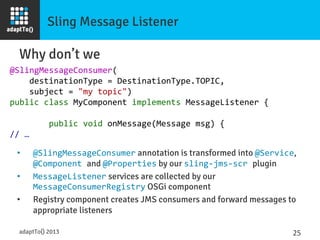
Sling Message Listener
Why don’t we
@SlingMessageConsumer(	


  destinationType	
  =	
  DestinationType.TOPIC,	


  subject	
  =	
  "my	
  topic")	
  
public	
  class	
  MyComponent	
  implements	
  MessageListener	
  {	


  public	
  void	
  onMessage(Message	
  msg)	
  {	
  
//	
  …	
  
adaptTo() 2013
 25	
  
•  @SlingMessageConsumer annotation is transformed into @Service,
@Component	
  and @Properties by our sling-­‐jms-­‐scr	
  plugin	
  
•  MessageListener services are collected by our
MessageConsumerRegistry OSGi component
•  Registry component creates JMS consumers and forward messages to
appropriate listeners
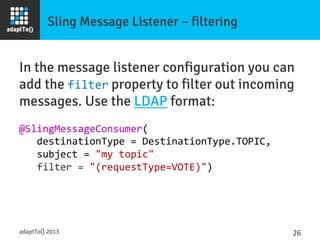
Sling Message Listener – filtering
In the message listener configuration you can
add the filter property to filter out incoming
messages. Use the LDAP format:

@SlingMessageConsumer(	


  destinationType	
  =	
  DestinationType.TOPIC,	


  subject	
  =	
  "my	
  topic"	


  filter	
  =	
  "(requestType=VOTE)")	
  
adaptTo() 2013
 26	
  
adaptTo() 2013
 27
Solution overview
Reverse Replication Request
Reverse replication request
•  In CQ, the Author gathers content from publish
instances every 30 seconds (configurable in the
ReverseReplicator service)
•  Why can’t publish send user-generated content to
the Author (push instead of pull)?
•  Security issues – publishes are often in DMZ
•  But publish can inform the Author there is
something new to pull
adaptTo() 2013
 28	
  
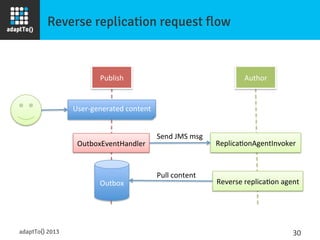
Reverse replication request
•  OutboxEventHandler watches the outbox node
and sends information every time there is
some new content to pull
•  ReplicationAgentInvoker receives this
information and invokes the reverse
replication process
•  It’s a good idea to disable the out-of-the-box
ReverseReplicator service, so we don’t have
two reverse replications at the same moment
adaptTo() 2013
 29	
  
Reverse replication request flow
Author'Publish'
User/generated'content'
OutboxEventHandler' Replica<onAgentInvoker'
Reverse'replica<on'agent'Outbox'
Send'JMS'msg'
Pull'content'
adaptTo() 2013
 30	
  
adaptTo() 2013
 31
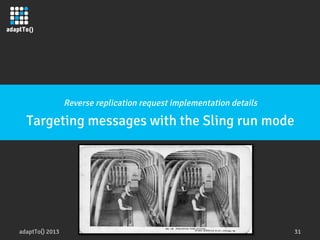
Reverse replication request implementation details
Targeting messages with the Sling run mode
Send messages only to the Author
•  The outbox event handler should send
messages only to the Author
•  We can filter it manually…
•  …or use @SlingMessageConsumer	
  for the
consumer and add
MessageConsumerProperties.DESTINATION_RUN_MODE	
  to
the message properties
•  Messages will be filtered automatically
adaptTo() 2013
 32	
  
adaptTo() 2013
 33
Final remarks
Extra tools created during JMS research
•  Embedded ActiveMQ broker configurable
within the OSGi component
•  Out-of-the-band JCR binaries transfer
•  You can send a message with metadata and
some JCR path and the binary itself will be
sent via HTTP
•  Utilities to deal with serialization problems
when sending ObjectMessage	
  
adaptTo() 2013
 34	
  
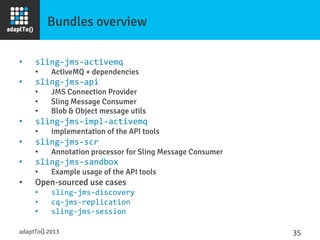
Bundles overview
•  sling-­‐jms-­‐activemq	
  
•  ActiveMQ + dependencies
•  sling-­‐jms-­‐api	
  
•  JMS Connection Provider
•  Sling Message Consumer
•  Blob & Object message utils
•  sling-­‐jms-­‐impl-­‐activemq	
  
•  Implementation of the API tools
•  sling-­‐jms-­‐scr	
  
•  Annotation processor for Sling Message Consumer
•  sling-­‐jms-­‐sandbox	
  
•  Example usage of the API tools
•  Open-sourced use cases
•  sling-­‐jms-­‐discovery	
  
•  cq-­‐jms-­‐replication	
  
•  sling-­‐jms-­‐session	
  
adaptTo() 2013
 35	
  
Try it yourself!
•  https://github.com/Cognifide/PoC-Sling-JMS
•  All bundles
•  Some documentation
•  Temporary repo, will be transferred, so clone it
while you can ;)
adaptTo() 2013
 36	
  
adaptTo() 2013
 37
That’s all folks!

Inter-Sling communication with message queue

  • 1.
    APACHE SLING &FRIENDS TECH MEETUP BERLIN, 23-25 SEPTEMBER 2013 Inter-Sling communication with a message queue Tomasz Rękawek
  • 2.
    Agenda •  Code bookmarks • http://bit.ly/adaptto-jms •  Case 1: shared session •  Running ActiveMQ in Sling •  JMS connection provider •  Case 2: JMS-based discovery API implementation •  Sling Message Listener •  Case 3: Reverse replication request •  Targeting instance by its run mode adaptTo() 2013 2  
  • 3.
    adaptTo() 2013 3 Solutionoverview Shared session
  • 4.
    Shared session •  Wehave n publishes and the dispatcher with stickySession enabled •  We use the servlet session •  In case one publish stops responding, the user will be redirected to the other publish •  We want the session to be transferred too adaptTo() 2013 4  
  • 5.
  • 6.
    Shared session •  Ifa publish notices that the instance id in the cookie is different from its own, it’ll copy shared session values to the HttpSession   •  The Administrator can configure names of the shared session properties (as a list of regular expressions)   adaptTo() 2013 6  
  • 7.
    Shared session –demo •  Local infrastructure description: •  One author + two publishes •  All available under local.cq  domain •  We can switch between publishes using ?publish2   query string •  http://local.cq/bin/cognifide/session.txt •  http://local.cq/bin/cognifide/session.txt/add •  http://local.cq/bin/cognifide/session.txt? publish2 adaptTo() 2013 7  
  • 8.
    adaptTo() 2013 8 Sharedsession implementation details Integrating ActiveMQ
  • 9.
    Rough start: dependencies • I tried to use the activemq-­‐core  package. This is what I saw in the /system/console: adaptTo() 2013 9  
  • 10.
    Providing necessary dependencies • Some dependencies are taken from other OSGi bundles – we don’t worry about them •  Some have to be embedded <Embed-­‐Dependency>activemq-­‐core,geronimo-­‐j2ee-­‐ management_1.1_spec,ejb-­‐api,jaxrpc-­‐api</Embed-­‐Dependency>   •  Some can be ignored •  Check the original pom.xml  for optional dependencies <Import-­‐Package>   !javax.jmdns.*,!org.apache.activeio.*,! org.apache.activemq.jaas.*,!org.apache.camel.*,! org.apache.commons.net.*,…,*   </Import-­‐Package>   adaptTo() 2013 10  
  • 11.
    Result: sling-­‐jms-­‐activemq   • We’ve created an OSGi bundle with all necessary dependencies embedded •  Optional dependencies are ignored and marked not-to-import •  Bundle provides ActiveMQ to any Sling instance adaptTo() 2013 11  
  • 12.
    adaptTo() 2013 12 Sharedsession implementation details JMS Connection Provider
  • 13.
    Creating JMS connectionwith ActiveMQ adaptTo() 2013 13 import  javax.jms.Connection;   import  org.apache.activemq.ActiveMQConnectionFactory;     ActiveMQConnectionFactory  factory;   factory  =  new  ActiveMQConnectionFactory();   Connection  connection  =  factory.createConnection();   •  In order to create JMS connection we need to import some ActiveMQ classes: •  So all JMS-related code will be also dependent on the ActiveMQ •  What if we want to change JMS implementation?
  • 14.
    JMS connection provider   •  We use OSGi to separate JMS implementation from it’s interface •  JmsConnectionProvider – custom OSGi service providing javax.jms.Connection   •  Bundle sling-­‐jms-­‐api  contains service interface •  Implementation: sling-­‐jms-­‐impl-­‐activemq   •  Using sling-­‐jms-­‐api  and the connection provider makes us independent from the JMS implementation adaptTo() 2013 14  
  • 15.
    Example usage ofJMS connection provider   @Component   public  class  MyComponent  implements  MessageListener  {          @Reference        private  JmsConnectionProvider  connectionProvider;          private  javax.jms.Connection  connection;          @Activate        protected  void  activate()  throws  JMSException  {              connection  =  connectionProvider.getConnection();        }          @Deactivate        protected  void  deactivate()  throws  JMSException  {              connection.close();        }   }   adaptTo() 2013 15  
  • 16.
    adaptTo() 2013 16 APIoverview & our JMS implementation Discovery API
  • 17.
    Sling Discovery API • New Sling API •  Each instance can expose a list of key-value properties to other instances •  Example usage: metadata for workflow offloading in CQ •  Properties are not meant to be messaging tool, they shouldn’t change too often •  Instances are grouped into clusters, each cluster has elected leader adaptTo() 2013 17  
  • 18.
  • 19.
    Discovery OSGi services • DiscoveryService provides TopologyView   •  Custom instance properties can be added with PropertyProvider implementations •  Changes in topology can be observed with TopologyEventListener adaptTo() 2013 19  
  • 20.
    JMS discovery implementation • There is a default HTTP-based implementation •  requires providing all instance URLs on each instance •  But JMS is a natural choice for the transport layer here •  sling-­‐jms-­‐discovery  – a new, JMS-based discovery implementation that doesn’t require any configuration adaptTo() 2013 20  
  • 21.
    Discovery election •  Ifsome instance notices there is no leader for some cluster, it sends message: WHO_IS_LEADER   •  If no one responds in 10 seconds, it sends the second message: ELECTION   •  Every instance in a given cluster has to respond with their Sling instance id in the VOTE message •  After 5 seconds instance with the smallest id is chosen and it sends the I_AM_LEADER message adaptTo() 2013 21  
  • 22.
    Discovery – demo • http://local.cq:4503/bin/jms/discovery/info.txt adaptTo() 2013 22  
  • 23.
    adaptTo() 2013 23 JMSdiscovery implementation details Sling Message Consumer
  • 24.
    Sling Message Listener WritingJMS consumers in OSGi is all about @Component   public  class  MyComponent  implements  MessageListener  {          @Reference        private  JmsConnectionProvider  connectionProvider;        private  Connection  connection;        private  Session  session;        private  MessageConsumer  consumer;          @Activate        protected  void  activate()  throws  JMSException  {              connection  =  connectionProvider.getConnection();              session  =  connection.createSession(false,  Session.AUTO_ACKNOWLEDGE);              Destination  dest  =  session.createTopic("my  topic");              consumer  =  session.createConsumer(dest);              consumer.setMessageListener(this);              connection.start();        }          @Deactivate        protected  void  deactivate()  throws  JMSException  {              consumer.close();              session.close();              connection.close();        }   }   adaptTo() 2013 24  
  • 25.
    Sling Message Listener Whydon’t we @SlingMessageConsumer(          destinationType  =  DestinationType.TOPIC,          subject  =  "my  topic")   public  class  MyComponent  implements  MessageListener  {                    public  void  onMessage(Message  msg)  {   //  …   adaptTo() 2013 25   •  @SlingMessageConsumer annotation is transformed into @Service, @Component  and @Properties by our sling-­‐jms-­‐scr  plugin   •  MessageListener services are collected by our MessageConsumerRegistry OSGi component •  Registry component creates JMS consumers and forward messages to appropriate listeners
  • 26.
    Sling Message Listener– filtering In the message listener configuration you can add the filter property to filter out incoming messages. Use the LDAP format: @SlingMessageConsumer(        destinationType  =  DestinationType.TOPIC,        subject  =  "my  topic"        filter  =  "(requestType=VOTE)")   adaptTo() 2013 26  
  • 27.
    adaptTo() 2013 27 Solutionoverview Reverse Replication Request
  • 28.
    Reverse replication request • In CQ, the Author gathers content from publish instances every 30 seconds (configurable in the ReverseReplicator service) •  Why can’t publish send user-generated content to the Author (push instead of pull)? •  Security issues – publishes are often in DMZ •  But publish can inform the Author there is something new to pull adaptTo() 2013 28  
  • 29.
    Reverse replication request • OutboxEventHandler watches the outbox node and sends information every time there is some new content to pull •  ReplicationAgentInvoker receives this information and invokes the reverse replication process •  It’s a good idea to disable the out-of-the-box ReverseReplicator service, so we don’t have two reverse replications at the same moment adaptTo() 2013 29  
  • 30.
    Reverse replication requestflow Author'Publish' User/generated'content' OutboxEventHandler' Replica<onAgentInvoker' Reverse'replica<on'agent'Outbox' Send'JMS'msg' Pull'content' adaptTo() 2013 30  
  • 31.
    adaptTo() 2013 31 Reversereplication request implementation details Targeting messages with the Sling run mode
  • 32.
    Send messages onlyto the Author •  The outbox event handler should send messages only to the Author •  We can filter it manually… •  …or use @SlingMessageConsumer  for the consumer and add MessageConsumerProperties.DESTINATION_RUN_MODE  to the message properties •  Messages will be filtered automatically adaptTo() 2013 32  
  • 33.
  • 34.
    Extra tools createdduring JMS research •  Embedded ActiveMQ broker configurable within the OSGi component •  Out-of-the-band JCR binaries transfer •  You can send a message with metadata and some JCR path and the binary itself will be sent via HTTP •  Utilities to deal with serialization problems when sending ObjectMessage   adaptTo() 2013 34  
  • 35.
    Bundles overview •  sling-­‐jms-­‐activemq   •  ActiveMQ + dependencies •  sling-­‐jms-­‐api   •  JMS Connection Provider •  Sling Message Consumer •  Blob & Object message utils •  sling-­‐jms-­‐impl-­‐activemq   •  Implementation of the API tools •  sling-­‐jms-­‐scr   •  Annotation processor for Sling Message Consumer •  sling-­‐jms-­‐sandbox   •  Example usage of the API tools •  Open-sourced use cases •  sling-­‐jms-­‐discovery   •  cq-­‐jms-­‐replication   •  sling-­‐jms-­‐session   adaptTo() 2013 35  
  • 36.
    Try it yourself! • https://github.com/Cognifide/PoC-Sling-JMS •  All bundles •  Some documentation •  Temporary repo, will be transferred, so clone it while you can ;) adaptTo() 2013 36  
  • 37.