Part-1 Migrations
Active Record
Part -2
Associations
Validations
Callbacks
Part -3
Testing Topics
Migrations
Migration allows you to define  changes  to your  database schema What is migration?
Why Migration? iteratively  improving schema
keep things  synchronized
The  model and scaffold  generators will  create migrations  appropriate for adding a new model. Auto generated migrations
ruby script/generate  model Product  name:string description:text  my_app/db/migrate/001_create_products.rb Creating a model
Migration generated class CreateProducts < ActiveRecord::Migration def  self.up   create_table  : products  do |t|  t.string :name  t.text :description  t.timestamps  end   end def  self.down   drop_table :products   end end
self.up / self.down
ruby script/generate migration  AddPartNumberToProducts   part_number:string my_app/db/migrate/002_AddPartNumberToProducts.rb  Creating a Standalone Migration
Migration generated class AddPartNumberToProducts < ActiveRecord::Migration   def  self.up   add_column :products, :part_number, :string  end  def  self.down   remove_column :products, :part_number  end end
rake   db:migrate also invokes the db:schema:dump task
schema_migrations  table
Other Transformations
def  self.up   create_table  :people do |t| t.string :username, :null => false t.string :fname,lname   t.text :notes   t.timestamps   end end def  self.down   drop_table :people end Creating a table
More transformations rename_column   :people ,  :fname ,  :first_name rename_table   old_name ,  new_name change_column   table_name ,  column_name , type remove_column  table_name ,  column_name add_index   table_name ,  column_name drop_table   table_name
More... change_table   :products  do |t|  t. remove  :description,  :name  t. string  :part_number  t. index  :part_number   t. rename  :upccode, :upc_code end
Rollback rake  db:rollback   rake db:rollback  STEP=3   rake db:migrate  VERSION=20080906120000
ActiveRecord
ActiveRecord is a Module ActiveRecord (note no space) could be classed as a module, since it's an implementation of the Active Record design pattern. (* need to ask)
One Class Per Table CREATE TABLE `people` (
`id` int(11) NOT NULL    auto_increment,
`login` varchar(255),
`email` varchar(255),
`password` varchar(40),
`created_at` datetime default NULL,
`updated_at` datetime default NULL,
PRIMARY KEY (`id`)
) ENGINE=InnoDB
One Object / instance   Per   Row
Table columns   map to   Object attributes
Some Key Points mapping   class names  to  table names .
pluralized  table names.
integer  primary keys.
classname _id as  foreign keys .
Why Active Record for  simplicity  and ease of use
hides  low level implementation
The Basics Select * from people where id='2' limit='1' class Person < ActiveRecord::Base
end
person=Person.find(2)
find method Examples:  User. find (23)  User.find(:first)  User.find(:all, :offset => 10, :limit => 10)  User.find(:first).articles
Find :select list = Person.find(:all,  :select => &quot;fname, lname&quot; )
Find with :conditions Student.find(:all,  :conditions => [‘first_name = ? and status = ?’ ,‘mohit’, 1] ) Why this  ?
Find: Order By Person.find(:all,  :order => ‘updated_at DESC’ ) SQL: SELECT * FROM people ORDER BY created_at;
Find: Group By Person.find(:all,  :group => ‘designation’ ) SQL: SELECT * FROM people GROUP BY designation;
Find:  Limit & Offset Person.find(:all,  :limit => 10, :offset => 0 ) SQL: SELECT * FROM people LIMIT 0, 10
Dynamic find methods person  = Person.find_ by_fname (&quot;mohit&quot;) all_mohit = Person.find_ all_by_fname (&quot;mohit&quot;) person  = Person.find_ by_fname_and_lname (&quot;mohit&quot;,”jain”)
Creating a new record user = User.new user.name = &quot;David&quot; user.occupation = &quot;Code Artist“ user .save OR user =User. new (:name => &quot;David&quot;, :occupation  =>  &quot;Code Artist&quot;) user .save OR user =User .create (:name => &quot;David&quot;,    :occupation  =>  &quot;Code Artist&quot;)
Update a record person = Person.find(123)  person .update_attribute(:name, &quot;Barney&quot; ) OR person= Person.find(123) person .name = &quot;mohit” person.save OR person=Person. update(12, :name => &quot;jigar&quot; , :email => &quot;jigar@vinsol.com&quot; ) update_all and update_attribute bypass the validations.
Delete a record Person. delete (123)  OR person = Person.find_by_name(&quot;Mohit&quot;) person. destroy
Named and Anonymous Scopes
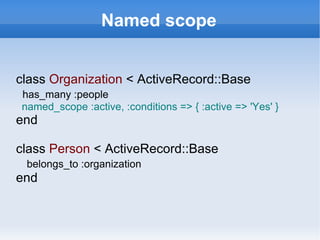
class  Organization  < ActiveRecord::Base  has_many :people named_scope :active, :conditions => { :active => 'Yes' } end class  Person  < ActiveRecord::Base  belongs_to :organization end Named scope
Usage Organization.active Organization.active.people
Named scope example 2 class  Order  < ActiveRecord::Base named_scope :last_n_days, lambda { |days| :condition => ['updated < ?' , days] } named_scope :checks, :conditions => {:pay_type => :check} end orders = Orders.last_n_days(7) orders = Orders.checks.last_n_days(7)
Anonymous scopes in_house = Orders.scoped(:conditions => 'email LIKE &quot;%@pragprog.com&quot;' ) in_house.checks.last_n_days(7)
Thank You.
Associations
belongs_to
has_one
has_many
has_many :through
has_one :through
has_and_belongs_to_many Types of associations
Whats the  need ?
class  Customer  < ActiveRecord::Base  end  class  Order  < ActiveRecord::Base  end  OR class  Customer  < ActiveRecord::Base      has_many :orders, :dependent => :destroy   end  class  Order  < ActiveRecord::Base belongs_to :customer end  Comparison: without and with
The belongs_to Association
The has_one Association
One to One
The has_many Association
One to Many
Its: has_many : orders   and has_one : order
has_many :through
has_and_belongs_to_many
has_and_belongs_to_many  Stories can belong to many categories. Categories can have many stories. Categories_Stories Table story_id | category_id has_many through: -- gives you a  third model  Person can subscribe to many magazines. Magazines can have many subscribers. Subscriptions Table person_id | magazine_id | subscription_type |  subscription_length | subscription_date has_and_belongs_to_many  vs  has_many :through
Many  to  many
has_one :through
has_one:through* class  Magazine  < ActiveRecord::Base has_many :subscriptions end class  Subscription  < ActiveRecord::Base belongs_to :magazine belongs_to :user end class  User  < ActiveRecord::Base has_many :subscriptions has_one :magazine, :through => : subscriptions, :conditions => ['subscriptions.active = ?', true] end
Polymorphic Associations
Self refrentional Joins class  Employee  < ActiveRecord::Base has_many :subordinates ,  :class_name => &quot;Employee&quot; , : foreign_key =>    &quot;manager_id&quot; belongs_to :manager ,  :class_name => &quot;Employee&quot; end
When Things Get Saved class  Order  < ActiveRecord::Base has_one :invoice end class  Invoice  < ActiveRecord::Base belongs_to :order end continue...
When things get saved (continue) If you assign an object to a has_one/has_many association in an existing object, that associated object will be automatically saved. order = Order.find(some_id) an_invoice = Invoice.new(...) order.invoice = an_invoice  # invoice gets saved     continue...
When things get saved (continue) If instead you assign a new object to a belongs_to association, it will never be automatically saved. order = Order.new(...) an_invoice.order = orde r  # Order will not be saved here an_invoice.save   # both the invoice and the order get saved
Validations
validates_acceptance_of validates_confirmation_of validates_length_of validates_numericality_of validates_presence_of Validation Helpers
Example of validator helper class Person < ActiveRecord::Base  validates_presence_of   :name    validates_uniqueness_of  :name,   :on  => :create,   :message => &quot;is already used&quot;   end
When Does Validation Happen? new_record?  instance method
Method triggers validations * create * create! * save * save! * update * update_attributes * update_attributes!
Method skips validations * update_all * update_attribute * update_counters * save(false)
valid?  and  invalid?
Validation Errors errors.add_to_base errors.add errors.clear errors.size
Displaying Validation Errors error_messages error_messages_for
Showing error message OR <%=  error_messages_for  :product %>  <% form_for(@product) do |f| %>  <%= f. error_messages  %> #-----  <% end %>
Callbacks
monitoring the process.   The life cycle of a model object methods that get called at  certain moments  of an object’s lifecycle What are callbacks
Active Record defines  20 callbacks .
18 call backs
after_initialize  and  after_find Rest two callbacks

Ruby on rails