MULTIMODAL APPROACHES FOR
REGENERATIVE STROKE THERAPIES:
        Aurel Popa-Wagner

Medical University Rostock, Germany
University of Medicine and Pharmacy
          Craiova, Romania
Intracerebral vessel occlusion has a strong AGE
                  dependency
Brain of a Patient after MCA Occlusion
Why use aged animals to study rehabilitation after stroke?


Although it is well known that aging is a risk factor for stroke,
the majority of experimental studies of stroke have been performed
 on young animals, and therefore may not fully replicate the effects
 of ischemia on neural tissue in aged subjects.

In this light, the aged post-acute animal model is clinically
 most relevant to stroke rehabilitation and cellular studies,
a recommendation done by the STAIR committee and more
 recently by the Stroke Progress Review Group.
STAIR Criteria
UKM             (Stroke Academic and Industry Round Table)


•     Reproducibility of results proven in many different laboratories wordlwide
•     Efficiency in many different species
•     Testing on aged animals
•     Efficiency in both transient and permanent ischemia
•     Establish the therapeutic time-window

•     Establish the dose-efficiency relationship
•     Monitoring of physiologic parameters during the experiments
•     Does the infarct volume correlate with functional recovery ?
•     Longterm studies of the above parameters (min. 4 Weeks)


                                                                     STAIR 1999
Beam- Young Stroke
Beam- Old Stroke
Young Stroke- Table
Old Stroke- Table
A


    Changes of gene expression in response to stroke.
    (A) Dendrogram of two-dimensional hierarchical clustering
     analysis of all 9,494 transcript-specific probe sets which
    indicate differentially expressed genes
Correspondence analysis. ( left panel) Eigenvalues of the correspondence analysis
and shows that the major factors contributing to the variance of stroketomics analysis
were stroke (52%), post-stroke time (25%) and age (12%).
  A
Buga..Popa-Wagner, JCBFM 2012


Sources of variabilty: stroke and post-stroke time. Samples from young (green) and
aged (red) animals particularly differ in their post-stroke response (illustrated by ellipses.
Transcripts with characteristic expression in naive samples are encircled in black
VENN-Diagram. Note that at 14 days post-stroke, the differences between
the age groups were more pronounced
Transcriptomics of Stroke:
                   Divergent gene expression
after 2 weeks post-stroke
Patterns of gene expression after stroke. Aged animals showed larger
numbers than young of genes that were late-upregulated, persistently
upregulated and persistently downregulated.
The young rats, in contrast, had a much larger number of transiently upregulated
Patterns of gene expression after stroke. Patterns of gene expression for stroke-releva
Most classes of these new genes were upregulated, with the exception of “CNS physiolog
and “Neurogenesis & synaptic plasticity” which also displayed a large number of downregu
To date, all monotherapeutic attempts to prevent or
lessen brain damage following stroke have failed. Since
stroke impacts a wide range of systems in an age-
dependent manner, from CNS physiology to CNS
regeneration and plasticity, the failure of therapies aimed
at only a single target system is perhaps inevitable
Transcriptomics of Stroke. Disregulation of gene expression
required for Neurogenesis & Synaptic plasticity
Transcriptomics of Stroke. Disregulation of gene expression
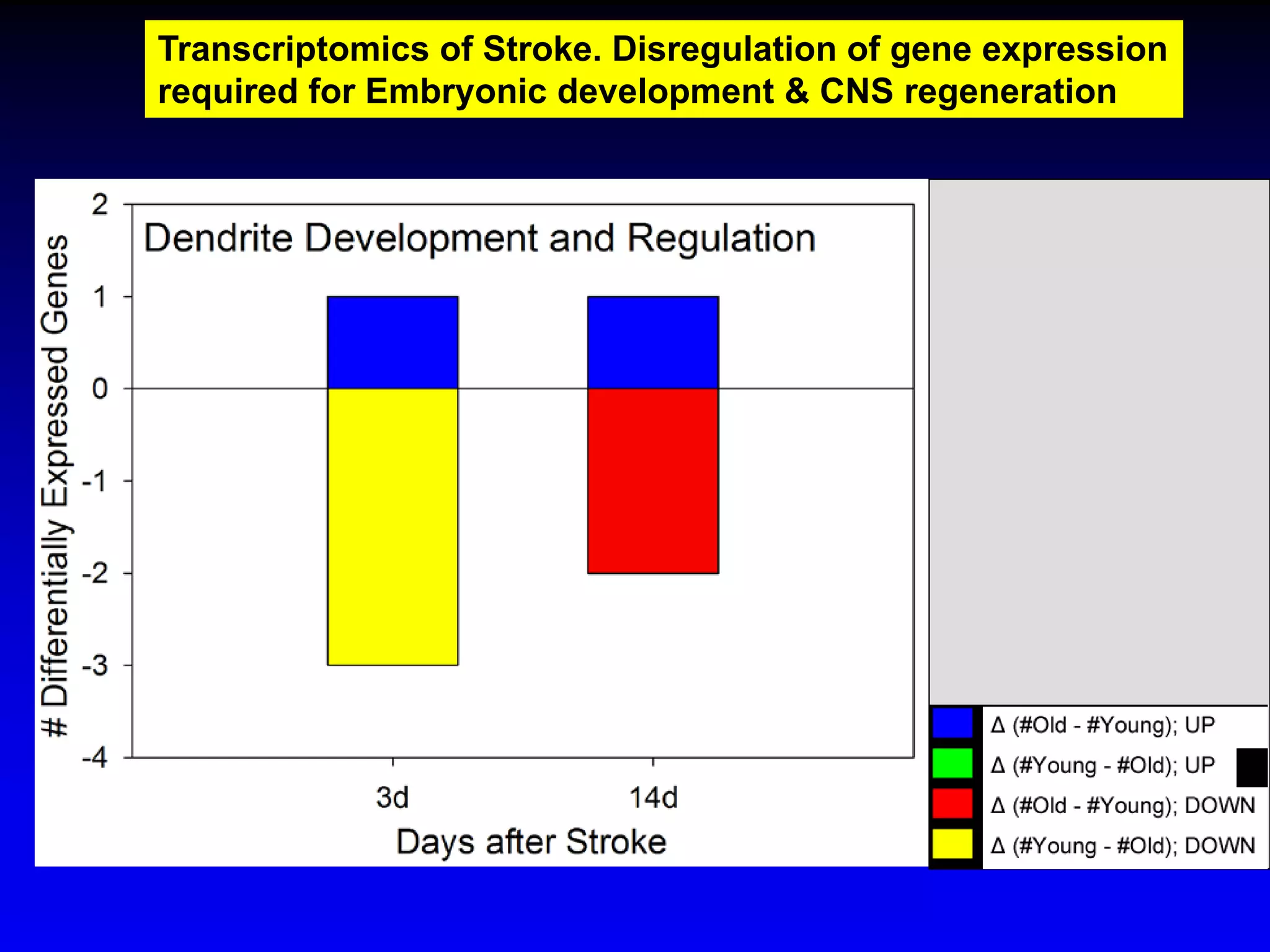
required for Embryonic development & CNS regeneration
Neurogenesis is fully functional in the subventricular zone of the adult brain
Pilot studies aimed at improving recovery of
        function in aged rats after stroke


Stimulation of endogenous neurogenesis
Rat Modell for Cerebral Ischemia
Summary of functional tests after stroke
Rotarod                       T-Maze         Neurol.
                                             Status


Radial Maze     i-Plane     Cylinder Test
G-CSF, multimodale Mechanismen in der Schlaganfalltherapie
UKM


                                            Schäbitz and Schneider 2007
G-CSF treatment after stroke significantly improved mortality rate and
         performance in several but not all functional tests.
Pilot studies aimed at improving recovery of
           function in aged rats after stroke


Daily treatment with G-CSF of aged rats after stroke
significantly reduces the mortality rate
Effect of the G-CSF treatment on cellular proliferation and neurogenesis.
First combination therapy of stroke: G-CSF + Stem Cells

Hypothesis: Our consortium tested the hypothesis that such
a combination is superior to G-CSF or stem cell treatment alone.
Stroke Cell Therapy: flow diagram


           Therapies           Behavioral Analysis
Training


            MCAO


                       MRI#1                MRI#2    Tissue Analysis


-14d        0 6h 3d                           45d          60d
Multimodal Approaches for
                 Regenerative Stroke Therapies (MARS)


   Animal Model and Treatment; 80 ♂ Sprague-Dawley (SD) –Ratten
   Groups:
n=20   G-CSF (30 µg/kg BW) given daily and for 28 days after stroke

n=20   G-CSF + BM MNC (single, 1x10⁶/kg BW) given at 3 hrs after reperfusion

n=20   G-CSF + BMSC (single, 1x10⁶/kg BW) given at 3 hrs after reperfusion

n=20   Glucose (Vehicle, 5%) given daily and for 28 days after stroke
ROUTE of ADMINISTRATION: Jugular Vein
Validity of the administration pathway

Perilesional Area   Some cell enter the brain via the ventricle
The Mortality Rate was low for all treatments


                               Group C: Survival proportions
                   105                           Group          No Deaths
                                                 CTRL                   2
                   100                           G-CSF                  2
Percent survival


                                                 G-CSF + BM MNC2
                    95                           G-CSF + BM MSC 3

                    90

                    85

                    80
                         0            20           40          60            80
                                           Days after stroke
Cell therapy does not reduce the volume of the infarct
Water Maze


             1
4


 3               2
G-CSF Treatment led a significant improvement of spatial memory
G-CSF Treatment alone improves temporarily sensory function
                               (Adhesive Tape Removal Test)

                                       0.9

                                       0.8

                                       0.7


                               Score
                                       0.6                                                       Group CTRL
                                                                                                 Group A
                                       0.5
                                                          * P<0.05
                                       0.4
                                             0   3   7   14 21 28 35 42 49 56
                                                            Day

        0.9                                                               0.9

        0.8                                                               0.8

        0.7                                                               0.7
Score


                                                                  Score
        0.6                                                               0.6
                              Group CTRL                                                       Group C
        0.5                                                               0.5
                              Group B                                                          Group CTRL
        0.4                                                               0.4
              0   3   7   14 21 28 35 42 49 56                                  0   3   7   14 21 28 35 42 49 56
                             Day                                                               Day
Beam-walking test: Both G-CSF alone and the combination therapy
        improved performance vs controls


            6                  * P<0.04
            5

            4
    Score


            3

            2
                                                        GROUP A
            1                                           CTRL

                0   3   7   14 21 28 35 42 49 56
                               Day
        6
                             * P<0.05              * P<0.05               6
        5
                                                                          5
                                                                                      * P<0.05
        4
                                                                          4
Score


        3                                                         Score   3
        2                                                                 2
                                             GROUP B                                                   GROUP C
        1                                                                 1
                                             CTRL                                                      CTRL

                0   3   7    14 21 28 35 42 49 56                             0   3   7   14 21 28 35 42 49 56
                                  Day                                                            Day
Neurogenesis was not impaired in neither group

DCX immunofluorescence (red) is well visible in the Lateral Ventricle of all groups, both ipsilaterally and
contralaterally. BrdU (green) was mainly incorporated into a network of capillaries
At two months post-stroke, G-CSF + BM MSC therapy promotes
               the growth of lymphatic vessel
Pilot studies aimed at improving recovery of
           function in aged rats after stroke


Stimulation of endogeneous neurogenesis
by chemical and by small electrical currents
PTZ before Stroke

      1 st PTZ            2nd PTZ
                                       0
Day   -48                 -24              2- Start behavioral testing                  48


       3x BrdU            3x BrdU
                                                                                        End


       PTZ after Stroke                0
                                           2      7    1 st PTZ          31   2nd PTZ    48
                                                       Or ECS                 Or ECS


                                                   3x BrdU                3x BrdU
                                                                                        End
      Control Groups

      1 st Saline         2nd Saline
                                       0
Day   -48                 -24              2                                             48


       3x BrdU            3x BrdU
                                                                                        End
                                       0
                                           2      7                      31              48


                                                   3x BrdU                3x BrdU
                                                                                        End
Neurogenesis does not significantly improved performance
in

                                Adhesive Tape Removal Test
                     0,6

                     0,4

                     0,2
     time quotient


                     0,0

                     -0,2

                     -0,4
                                                      PTZ before stroke
                     -0,6                             Ctrl
                                                      PTZ after stroke

                     -0,8
                            0       10    20     30       40              50
                                          days
Neurogenesis after stroke significantly improved performance
on the
                                     Inclined Plane
              40
                       PTZ before stroke
                       Ctrl
                       PTZ after stroke
              38


              36
      Angle


              34


              32


              30
                   0            10         20          30   40   50
                                                days
Neurogenesis after stroke significantly improved performance
in

                             Radial Maze

              0,0

              0,2

              0,4
      score


              0,6

              0,8

              1,0                              PTZ before
                                               Ctrl
                                               PTZ after
              1,2
                    0   10    20          30   40           50
                                   days
Stroke Volume of all Groups in the NGS Project

                      30
       x10            25
       Volume [mm3]


                      20
                      15
                      10
                       5
                       0
                                                  Stroke Volume
Control                                               13,38
PTZ before Stroke                                     15,69
PTZ after Stroke                                      17,86
ES after Stroke                                       18,16
Sham                                                  5,49
Number of Doublecortin positive Cells in Hippocampus

                        10

                        8
          Cell Number


                        6

                        4

                        2

                        0
                                 Hippocampus ipsilateral            Hippocampus contralateral
Control                                   1,68                                1,85
PTZ before Stroke                         6,89                                6,21
PTZ after Stroke                          0,85                                0,42
ES after Stroke                           5,48                                3,00
Sham                                      2,13                                1,72

                                                           Tissue
Semiquantitative Evaluation of Doublecortin positive Cells in
                        Subventricular Zone

                    3


                    2
       Cell Score


                    1


                    0
                          Subventricular Zone ipsilateral        Subventricular Zone contralateral
Control                                2,19                                    1,12
PTZ before Stroke                      2,09                                    1,69
PTZ after Stroke                       1,43                                    1,12
ES after Stroke                        2,06                                    1,84
Sham                                   1,52                                    1,36

                                                        Tissue
Number of PSA-NCAM positive cells in Hippocampus


                         10

                         8
           Cell Number


                         6

                         4

                         2

                         0
                                  Hippocampus ipsilateral            Hippocampus contralateral
Control                                    1,84                                1,58
PTZ before Stroke                          6,71                                4,29
PTZ after Stroke                           2,10                                1,28
ES after Stroke                            4,31                                4,31
Sham                                       2,00                                1,68

                                                            Tissue
Electric Stimulation is efficient in increasing the number of early
neurogenesis like Doublecortin (shown in green) in the subven
Increased number of axons in the perilesional area of aged rats following
                     neurogenesis enhancement
Accelerated scar buildup in aged rodents after stroke
(i) Neuroepithelial cells contributing to the glial scar emanate
from desintegrated the blood vessel walls (E, F); (ii) but do
not pass the CC barrier (M)
Neuroepithelial cells contributing to the glial scar originate
mostly in the corpus callosum
Neuroepithelial cells contributing to the glial (D, H) scar
emanate from desintegrated the blood vessel walls; Green:
BrdU nuclei; Violett: Laminin
Early formation of the growth-inhibiting SCAR and late
outgrowth of axons after stroke in aged subjects


                                    SCAR
                                                AXONS
Microglia immunoreactivity is precipitously increased after cerebral ischemia in
pH3 rats. Could anti-inflammatory Drugs Improve Recovery of Function after
 old                                                                       pH10
  Stroke?

        3 days               7 days              14 days              28 days
young
aged


 Note the early activation of microglia in the brains of aged rats (E, F) as well
 as persistent expression of activated microglia in the brains of young rats (C,D).
Eight weeks after stroke the glial scar (RED) region is heavely populated
with infammatory cells (Blue)
H2S-induced Hypothermia Diminish Inflammation and
     Improve Neurorehabilitation after Stroke in Aged
                         Rats
Long-term exposure to hydrogen sulfide induces a torpor-like state
H2S is efficient to induce long-term hypothermia after stroke in aged rats


                                                      80 ppm H2S


                                                       Baltromejus et al., NSL, 2008
Baseline of Temperature and EEG under Normothermic
             and Hypothermic Conditions

                                             40 ppm H2S


             Popa-Wagner et al., J Cereb Blood Flow & Met, 2012
Schematic overview of the experimental design. (B): Timecourse of whole body
cooling after stroke in rats immersed in an atmosphere containing 50 ppm H2S.
On MRI, the ischemic lesion appeared as a hyperintense area on T2-
weighted images. The limits of the lesion are indicated by arrows


                        Popa-Wagner et al., J Cereb Blood Flow & Met, 2012
EEG telemetry data. A representative telemetric recording
for a rat subjected to H2S is presented in a-f.
Oligo DNA array analysis of RNA from aged rats subjected to MCA occlusion
and hypothermia identified annexin a1 as one of the downregulated mRNAs
in the peri-infarct area of hypothermic animals


                        Popa-Wagner et al., J Cereb Blood Flow & Met, 2012
Independent identification of annexin a1 by 2D
electrophoresis and Western Blotting
Phenotype and function of ANXA1 in the rat brain after stroke Phenotypically, ANXA1-
positive cells (red), co-localized with polymorphonuclear-like cells (D). Exposure to
hypothermia led to a large reduction in the number of co-localizations
What is next?
    Combine Nanotherapy with Cell therapy?
                  Day 2                                          Day 7


                                                                                             +


                                                                            BV


magnetic/plasmonic moderate hyperthermia       Cell therapy under mild hyperthermia
(41.8°C). IC = infarct core; PI = perinfarct   (38°C); IC = infarct core; PI = perinfarct;
                                               BV = blood vessel
Take home message (I)

Our present results suggest that H2S-induced
hypothermia, by simultaneously targeting multiple points
of intervention, could have a higher probability of success
in treating stroke.

However, many questions still must be answered
regarding the use of therapeutic hypothermia for ischemia
in clinical practice, such as the H2S concentration, optimal
target temperature and duration, the therapeutic window
in humans, and cost-effectiveness
Take home message (II)

Our findings indicate that the aged brain has still
the capability to mount a neurogenic response to
stroke but this needs to be stimulated for
therapeutic purposes.


Cell therapy of stroke is a promising avenue of
further research. However, it is not cleat how to
overcome the barrier imposed by the fibrotic scar.
Take home message (III)

Our study has identified a number of potential therapeutic targets
acting both during the acute phase and in the post-stroke recovery
phase.

Our results suggest that a multi-stage, multimodal treatment in aged
animals may be more likely to produce positive results.

While a multi-modal therapeutic approach is promising, one
particularly difficult hurdle will be to offset the post-stroke
downregulation of genes such as those involved in normal physiology
and brain plasticity.

Multi-stage, multimodal Approaches for regenerative stroke therapies

  • 1.
    MULTIMODAL APPROACHES FOR REGENERATIVESTROKE THERAPIES: Aurel Popa-Wagner Medical University Rostock, Germany University of Medicine and Pharmacy Craiova, Romania
  • 2.
    Intracerebral vessel occlusionhas a strong AGE dependency
  • 3.
    Brain of aPatient after MCA Occlusion
  • 4.
    Why use agedanimals to study rehabilitation after stroke? Although it is well known that aging is a risk factor for stroke, the majority of experimental studies of stroke have been performed on young animals, and therefore may not fully replicate the effects of ischemia on neural tissue in aged subjects. In this light, the aged post-acute animal model is clinically most relevant to stroke rehabilitation and cellular studies, a recommendation done by the STAIR committee and more recently by the Stroke Progress Review Group.
  • 5.
    STAIR Criteria UKM (Stroke Academic and Industry Round Table) • Reproducibility of results proven in many different laboratories wordlwide • Efficiency in many different species • Testing on aged animals • Efficiency in both transient and permanent ischemia • Establish the therapeutic time-window • Establish the dose-efficiency relationship • Monitoring of physiologic parameters during the experiments • Does the infarct volume correlate with functional recovery ? • Longterm studies of the above parameters (min. 4 Weeks) STAIR 1999
  • 6.
  • 7.
  • 8.
  • 9.
  • 11.
    A Changes of gene expression in response to stroke. (A) Dendrogram of two-dimensional hierarchical clustering analysis of all 9,494 transcript-specific probe sets which indicate differentially expressed genes
  • 12.
    Correspondence analysis. (left panel) Eigenvalues of the correspondence analysis and shows that the major factors contributing to the variance of stroketomics analysis were stroke (52%), post-stroke time (25%) and age (12%). A Buga..Popa-Wagner, JCBFM 2012 Sources of variabilty: stroke and post-stroke time. Samples from young (green) and aged (red) animals particularly differ in their post-stroke response (illustrated by ellipses. Transcripts with characteristic expression in naive samples are encircled in black
  • 13.
    VENN-Diagram. Note thatat 14 days post-stroke, the differences between the age groups were more pronounced
  • 14.
    Transcriptomics of Stroke: Divergent gene expression after 2 weeks post-stroke
  • 15.
    Patterns of geneexpression after stroke. Aged animals showed larger numbers than young of genes that were late-upregulated, persistently upregulated and persistently downregulated. The young rats, in contrast, had a much larger number of transiently upregulated
  • 16.
    Patterns of geneexpression after stroke. Patterns of gene expression for stroke-releva Most classes of these new genes were upregulated, with the exception of “CNS physiolog and “Neurogenesis & synaptic plasticity” which also displayed a large number of downregu
  • 17.
    To date, allmonotherapeutic attempts to prevent or lessen brain damage following stroke have failed. Since stroke impacts a wide range of systems in an age- dependent manner, from CNS physiology to CNS regeneration and plasticity, the failure of therapies aimed at only a single target system is perhaps inevitable
  • 18.
    Transcriptomics of Stroke.Disregulation of gene expression required for Neurogenesis & Synaptic plasticity
  • 19.
    Transcriptomics of Stroke.Disregulation of gene expression required for Embryonic development & CNS regeneration
  • 20.
    Neurogenesis is fullyfunctional in the subventricular zone of the adult brain
  • 21.
    Pilot studies aimedat improving recovery of function in aged rats after stroke Stimulation of endogenous neurogenesis
  • 22.
    Rat Modell forCerebral Ischemia
  • 23.
    Summary of functionaltests after stroke Rotarod T-Maze Neurol. Status Radial Maze i-Plane Cylinder Test
  • 24.
    G-CSF, multimodale Mechanismenin der Schlaganfalltherapie UKM Schäbitz and Schneider 2007
  • 25.
    G-CSF treatment afterstroke significantly improved mortality rate and performance in several but not all functional tests.
  • 26.
    Pilot studies aimedat improving recovery of function in aged rats after stroke Daily treatment with G-CSF of aged rats after stroke significantly reduces the mortality rate
  • 27.
    Effect of theG-CSF treatment on cellular proliferation and neurogenesis.
  • 28.
    First combination therapyof stroke: G-CSF + Stem Cells Hypothesis: Our consortium tested the hypothesis that such a combination is superior to G-CSF or stem cell treatment alone.
  • 29.
    Stroke Cell Therapy:flow diagram Therapies Behavioral Analysis Training MCAO MRI#1 MRI#2 Tissue Analysis -14d 0 6h 3d 45d 60d
  • 30.
    Multimodal Approaches for Regenerative Stroke Therapies (MARS) Animal Model and Treatment; 80 ♂ Sprague-Dawley (SD) –Ratten Groups: n=20 G-CSF (30 µg/kg BW) given daily and for 28 days after stroke n=20 G-CSF + BM MNC (single, 1x10⁶/kg BW) given at 3 hrs after reperfusion n=20 G-CSF + BMSC (single, 1x10⁶/kg BW) given at 3 hrs after reperfusion n=20 Glucose (Vehicle, 5%) given daily and for 28 days after stroke
  • 31.
  • 32.
    Validity of theadministration pathway Perilesional Area Some cell enter the brain via the ventricle
  • 33.
    The Mortality Ratewas low for all treatments Group C: Survival proportions 105 Group No Deaths CTRL 2 100 G-CSF 2 Percent survival G-CSF + BM MNC2 95 G-CSF + BM MSC 3 90 85 80 0 20 40 60 80 Days after stroke
  • 34.
    Cell therapy doesnot reduce the volume of the infarct
  • 35.
    Water Maze 1 4 3 2
  • 36.
    G-CSF Treatment leda significant improvement of spatial memory
  • 37.
    G-CSF Treatment aloneimproves temporarily sensory function (Adhesive Tape Removal Test) 0.9 0.8 0.7 Score 0.6 Group CTRL Group A 0.5 * P<0.05 0.4 0 3 7 14 21 28 35 42 49 56 Day 0.9 0.9 0.8 0.8 0.7 0.7 Score Score 0.6 0.6 Group CTRL Group C 0.5 0.5 Group B Group CTRL 0.4 0.4 0 3 7 14 21 28 35 42 49 56 0 3 7 14 21 28 35 42 49 56 Day Day
  • 38.
    Beam-walking test: BothG-CSF alone and the combination therapy improved performance vs controls 6 * P<0.04 5 4 Score 3 2 GROUP A 1 CTRL 0 3 7 14 21 28 35 42 49 56 Day 6 * P<0.05 * P<0.05 6 5 5 * P<0.05 4 4 Score 3 Score 3 2 2 GROUP B GROUP C 1 1 CTRL CTRL 0 3 7 14 21 28 35 42 49 56 0 3 7 14 21 28 35 42 49 56 Day Day
  • 39.
    Neurogenesis was notimpaired in neither group DCX immunofluorescence (red) is well visible in the Lateral Ventricle of all groups, both ipsilaterally and contralaterally. BrdU (green) was mainly incorporated into a network of capillaries
  • 40.
    At two monthspost-stroke, G-CSF + BM MSC therapy promotes the growth of lymphatic vessel
  • 41.
    Pilot studies aimedat improving recovery of function in aged rats after stroke Stimulation of endogeneous neurogenesis by chemical and by small electrical currents
  • 42.
    PTZ before Stroke 1 st PTZ 2nd PTZ 0 Day -48 -24 2- Start behavioral testing 48 3x BrdU 3x BrdU End PTZ after Stroke 0 2 7 1 st PTZ 31 2nd PTZ 48 Or ECS Or ECS 3x BrdU 3x BrdU End Control Groups 1 st Saline 2nd Saline 0 Day -48 -24 2 48 3x BrdU 3x BrdU End 0 2 7 31 48 3x BrdU 3x BrdU End
  • 43.
    Neurogenesis does notsignificantly improved performance in Adhesive Tape Removal Test 0,6 0,4 0,2 time quotient 0,0 -0,2 -0,4 PTZ before stroke -0,6 Ctrl PTZ after stroke -0,8 0 10 20 30 40 50 days
  • 44.
    Neurogenesis after strokesignificantly improved performance on the Inclined Plane 40 PTZ before stroke Ctrl PTZ after stroke 38 36 Angle 34 32 30 0 10 20 30 40 50 days
  • 45.
    Neurogenesis after strokesignificantly improved performance in Radial Maze 0,0 0,2 0,4 score 0,6 0,8 1,0 PTZ before Ctrl PTZ after 1,2 0 10 20 30 40 50 days
  • 46.
    Stroke Volume ofall Groups in the NGS Project 30 x10 25 Volume [mm3] 20 15 10 5 0 Stroke Volume Control 13,38 PTZ before Stroke 15,69 PTZ after Stroke 17,86 ES after Stroke 18,16 Sham 5,49
  • 47.
    Number of Doublecortinpositive Cells in Hippocampus 10 8 Cell Number 6 4 2 0 Hippocampus ipsilateral Hippocampus contralateral Control 1,68 1,85 PTZ before Stroke 6,89 6,21 PTZ after Stroke 0,85 0,42 ES after Stroke 5,48 3,00 Sham 2,13 1,72 Tissue
  • 48.
    Semiquantitative Evaluation ofDoublecortin positive Cells in Subventricular Zone 3 2 Cell Score 1 0 Subventricular Zone ipsilateral Subventricular Zone contralateral Control 2,19 1,12 PTZ before Stroke 2,09 1,69 PTZ after Stroke 1,43 1,12 ES after Stroke 2,06 1,84 Sham 1,52 1,36 Tissue
  • 49.
    Number of PSA-NCAMpositive cells in Hippocampus 10 8 Cell Number 6 4 2 0 Hippocampus ipsilateral Hippocampus contralateral Control 1,84 1,58 PTZ before Stroke 6,71 4,29 PTZ after Stroke 2,10 1,28 ES after Stroke 4,31 4,31 Sham 2,00 1,68 Tissue
  • 50.
    Electric Stimulation isefficient in increasing the number of early neurogenesis like Doublecortin (shown in green) in the subven
  • 51.
    Increased number ofaxons in the perilesional area of aged rats following neurogenesis enhancement
  • 52.
    Accelerated scar buildupin aged rodents after stroke
  • 53.
    (i) Neuroepithelial cellscontributing to the glial scar emanate from desintegrated the blood vessel walls (E, F); (ii) but do not pass the CC barrier (M)
  • 54.
    Neuroepithelial cells contributingto the glial scar originate mostly in the corpus callosum
  • 55.
    Neuroepithelial cells contributingto the glial (D, H) scar emanate from desintegrated the blood vessel walls; Green: BrdU nuclei; Violett: Laminin
  • 56.
    Early formation ofthe growth-inhibiting SCAR and late outgrowth of axons after stroke in aged subjects SCAR AXONS
  • 57.
    Microglia immunoreactivity isprecipitously increased after cerebral ischemia in pH3 rats. Could anti-inflammatory Drugs Improve Recovery of Function after old pH10 Stroke? 3 days 7 days 14 days 28 days young aged Note the early activation of microglia in the brains of aged rats (E, F) as well as persistent expression of activated microglia in the brains of young rats (C,D).
  • 58.
    Eight weeks afterstroke the glial scar (RED) region is heavely populated with infammatory cells (Blue)
  • 59.
    H2S-induced Hypothermia DiminishInflammation and Improve Neurorehabilitation after Stroke in Aged Rats
  • 60.
    Long-term exposure tohydrogen sulfide induces a torpor-like state
  • 61.
    H2S is efficientto induce long-term hypothermia after stroke in aged rats 80 ppm H2S Baltromejus et al., NSL, 2008
  • 62.
    Baseline of Temperatureand EEG under Normothermic and Hypothermic Conditions 40 ppm H2S Popa-Wagner et al., J Cereb Blood Flow & Met, 2012
  • 63.
    Schematic overview ofthe experimental design. (B): Timecourse of whole body cooling after stroke in rats immersed in an atmosphere containing 50 ppm H2S.
  • 64.
    On MRI, theischemic lesion appeared as a hyperintense area on T2- weighted images. The limits of the lesion are indicated by arrows Popa-Wagner et al., J Cereb Blood Flow & Met, 2012
  • 65.
    EEG telemetry data.A representative telemetric recording for a rat subjected to H2S is presented in a-f.
  • 66.
    Oligo DNA arrayanalysis of RNA from aged rats subjected to MCA occlusion and hypothermia identified annexin a1 as one of the downregulated mRNAs in the peri-infarct area of hypothermic animals Popa-Wagner et al., J Cereb Blood Flow & Met, 2012
  • 67.
    Independent identification ofannexin a1 by 2D electrophoresis and Western Blotting
  • 68.
    Phenotype and functionof ANXA1 in the rat brain after stroke Phenotypically, ANXA1- positive cells (red), co-localized with polymorphonuclear-like cells (D). Exposure to hypothermia led to a large reduction in the number of co-localizations
  • 69.
    What is next? Combine Nanotherapy with Cell therapy? Day 2 Day 7 + BV magnetic/plasmonic moderate hyperthermia Cell therapy under mild hyperthermia (41.8°C). IC = infarct core; PI = perinfarct (38°C); IC = infarct core; PI = perinfarct; BV = blood vessel
  • 70.
    Take home message(I) Our present results suggest that H2S-induced hypothermia, by simultaneously targeting multiple points of intervention, could have a higher probability of success in treating stroke. However, many questions still must be answered regarding the use of therapeutic hypothermia for ischemia in clinical practice, such as the H2S concentration, optimal target temperature and duration, the therapeutic window in humans, and cost-effectiveness
  • 71.
    Take home message(II) Our findings indicate that the aged brain has still the capability to mount a neurogenic response to stroke but this needs to be stimulated for therapeutic purposes. Cell therapy of stroke is a promising avenue of further research. However, it is not cleat how to overcome the barrier imposed by the fibrotic scar.
  • 72.
    Take home message(III) Our study has identified a number of potential therapeutic targets acting both during the acute phase and in the post-stroke recovery phase. Our results suggest that a multi-stage, multimodal treatment in aged animals may be more likely to produce positive results. While a multi-modal therapeutic approach is promising, one particularly difficult hurdle will be to offset the post-stroke downregulation of genes such as those involved in normal physiology and brain plasticity.