ACI – Lab Session 2
Min Max algorithm with
Alpha-Beta pruning
For
Tic Tac Toe
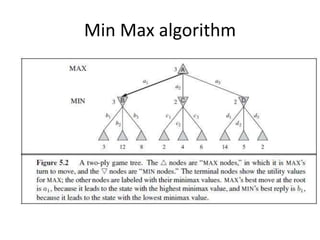
Min Max algorithm
• An algorithm for calculating minimax decisions.
• It returns the action corresponding to the best possible
move, that is, the move that leads to the outcome with
the best utility, under the assumption that the
opponent plays to minimize utility.
• The functions MAX-VALUE and MIN-VALUE go through
the whole game tree, all the way to the leaves, to
determine the backed-up value of a state.
• The notation argmaxa∈ S f(a) computes the element a of
set S that has the maximum value of f(a).
Min Max algorithm
Alpha Beta pruning
• The problem with minimax search is that the
number of game states it has to examine is
exponential in the depth of the tree.
• We can effectively cut it in half without looking at
every node in the game tree.
• The particular technique we examine is called
ALPHA–BETA pruning.
• When applied to a standard PRUNING minimax
tree, it returns the same move as minimax would,
but prunes away branches that cannot possibly
influence the final decision.
Alpha Beta pruning
• α = the value of the best (i.e., highest-value) choice we
have found so far at any choice point along the path for
MAX.
• β = the value of the best (i.e., lowest-value) choice we
have found so far at any choice point along the path for
MIN.
• Alpha–beta search updates the values of α and β as it
goes along and prunes the remaining branches at a
node (i.e., terminates the recursive call) as soon as the
value of the current node is known to be worse than
the current α or β value for MAX or MIN, respectively
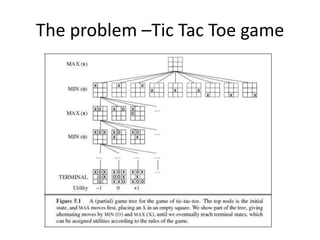
The problem –Tic Tac Toe game
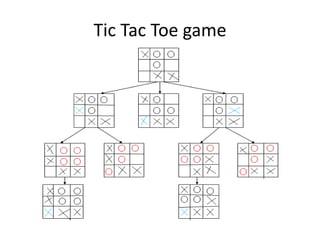
Tic Tac Toe game
TIC TAC TOE WITH MIN MAX
ALGORITHM AND ALPHA BETA
PRUNING IN PYTHON
Code Walk through
#Class TicTacToe
• from math import inf as infinity
• class TicTacToe:
• def __init__(self):
• self.initialize_board()
• def initialize_board(self):
• self.current_state = [['-','-','-'],
• ['-','-','-'],
• ['-','-','-']]
• # Player X always plays first
• self.player_turn = 'X'
#Class TicTacToe – Draw the board
• def draw_board(self):
• for i in range(0, 3):
• for j in range(0, 3):
• print('{}|'.format(self.current_state[i][j]),
end=" ")
• print()
• print()
# Determines if the made move is a
legal move
• def is_validmove(self, px, py):
• if px < 0 or px > 2 or py < 0 or py > 2:
• return False
• elif self.current_state[px][py] != '-':
• return False
• else:
• return True
# Checks if the game has ended and returns the
winner in each case - #is_endofgame() function
• def is_endofgame(self):
• # Check for column-wise win
• for i in range(0, 3):
• if (self.current_state[0][i] != '-' and
• self.current_state[0][i] ==
self.current_state[1][i] and
• self.current_state[1][i] ==
self.current_state[2][i]):
• return self.current_state[0][i]
is_endofgame() function
• # Check for row-wise win
• for i in range(0, 3):
• if (self.current_state[i] == ['X', 'X', 'X']):
• return 'X'
• elif (self.current_state[i] == ['O', 'O',
'O']):
• return 'O'
# is_endofgame() function
• # Check for win over the Main diagonal
• if (self.current_state[0][0] != '-' and
• self.current_state[0][0] ==
self.current_state[1][1] and
• self.current_state[0][0] ==
self.current_state[2][2]):
• return self.current_state[0][0]
# is_endofgame() function
• # Check for win over the Second diagonal
• if (self.current_state[0][2] != '-' and
• self.current_state[0][2] ==
self.current_state[1][1] and
• self.current_state[0][2] ==
self.current_state[2][0]):
• return self.current_state[0][2]
# is_endofgame() function
• # Is whole board full?
• for i in range(0, 3):
• for j in range(0, 3):
• # There's an empty field, we continue the game
• if (self.current_state[i][j] == '-'):
• return None
• # It's a tie!
• return '-'
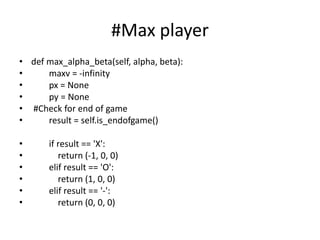
#Max player
• def max_alpha_beta(self, alpha, beta):
• maxv = -infinity
• px = None
• py = None
• #Check for end of game
• result = self.is_endofgame()
• if result == 'X':
• return (-1, 0, 0)
• elif result == 'O':
• return (1, 0, 0)
• elif result == '-':
• return (0, 0, 0)
#Max player - #Testing for best remaining moves,
calculating the utility function and updating alpha
• for i in range(0, 3):
• for j in range(0, 3):
• if self.current_state[i][j] == '-':
• self.current_state[i][j] = 'O'
• (m, min_i, min_j) = self.min_alpha_beta(alpha,
beta)
• if m > maxv: #Update Maxvalue
• maxv = m
• px = i
• py = j
• #After checking reset to empty state
• self.current_state[i][j] = '-'
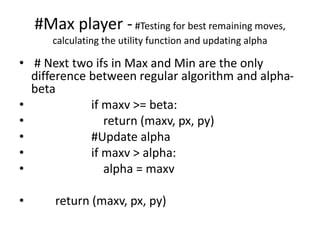
#Max player -#Testing for best remaining moves,
calculating the utility function and updating alpha
• # Next two ifs in Max and Min are the only
difference between regular algorithm and alpha-
beta
• if maxv >= beta:
• return (maxv, px, py)
• #Update alpha
• if maxv > alpha:
• alpha = maxv
• return (maxv, px, py)
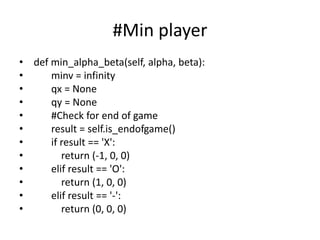
#Min player
• def min_alpha_beta(self, alpha, beta):
• minv = infinity
• qx = None
• qy = None
• #Check for end of game
• result = self.is_endofgame()
• if result == 'X':
• return (-1, 0, 0)
• elif result == 'O':
• return (1, 0, 0)
• elif result == '-':
• return (0, 0, 0)
CALLING ALL GAME
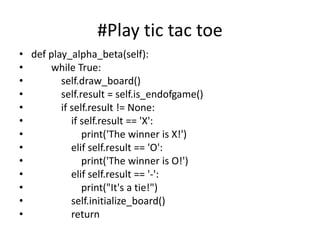
#Play tic tac toe
• def play_alpha_beta(self):
• while True:
• self.draw_board()
• self.result = self.is_endofgame()
• if self.result != None:
• if self.result == 'X':
• print('The winner is X!')
• elif self.result == 'O':
• print('The winner is O!')
• elif self.result == '-':
• print("It's a tie!")
• self.initialize_board()
• return
#Playing the game (Min turn)
• #px, py, qx and qy represent the board positions as x and y
coordinates
• if self.player_turn == 'X':
• while True:
• (m, qx, qy) = self.min_alpha_beta(-infinity, infinity)
• px = int(input('Insert the X coordinate: '))
• py = int(input('Insert the Y coordinate: '))
• qx = px
• qy = py
• if self.is_validmove(px, py):
• self.current_state[px][py] = 'X'
• self.player_turn = 'O'
• break
• else:
• print('The move is not valid! Try again.')
#Playing the game (Max turn)
• else:
• (m, px, py) =
• self.max_alpha_beta(-infinity, infinity)
• self.current_state[px][py] = 'O'
• self.player_turn = 'X'
•
Thank you
That’s all for the day

ACI-Webinar-3-MinMaxAlphaBetaPruning-TicTacToe.pptx

  • 1.
    ACI – LabSession 2 Min Max algorithm with Alpha-Beta pruning For Tic Tac Toe
  • 2.
    Min Max algorithm •An algorithm for calculating minimax decisions. • It returns the action corresponding to the best possible move, that is, the move that leads to the outcome with the best utility, under the assumption that the opponent plays to minimize utility. • The functions MAX-VALUE and MIN-VALUE go through the whole game tree, all the way to the leaves, to determine the backed-up value of a state. • The notation argmaxa∈ S f(a) computes the element a of set S that has the maximum value of f(a).
  • 3.
  • 4.
    Alpha Beta pruning •The problem with minimax search is that the number of game states it has to examine is exponential in the depth of the tree. • We can effectively cut it in half without looking at every node in the game tree. • The particular technique we examine is called ALPHA–BETA pruning. • When applied to a standard PRUNING minimax tree, it returns the same move as minimax would, but prunes away branches that cannot possibly influence the final decision.
  • 5.
    Alpha Beta pruning •α = the value of the best (i.e., highest-value) choice we have found so far at any choice point along the path for MAX. • β = the value of the best (i.e., lowest-value) choice we have found so far at any choice point along the path for MIN. • Alpha–beta search updates the values of α and β as it goes along and prunes the remaining branches at a node (i.e., terminates the recursive call) as soon as the value of the current node is known to be worse than the current α or β value for MAX or MIN, respectively
  • 7.
    The problem –TicTac Toe game
  • 8.
  • 9.
    TIC TAC TOEWITH MIN MAX ALGORITHM AND ALPHA BETA PRUNING IN PYTHON Code Walk through
  • 10.
    #Class TicTacToe • frommath import inf as infinity • class TicTacToe: • def __init__(self): • self.initialize_board() • def initialize_board(self): • self.current_state = [['-','-','-'], • ['-','-','-'], • ['-','-','-']] • # Player X always plays first • self.player_turn = 'X'
  • 11.
    #Class TicTacToe –Draw the board • def draw_board(self): • for i in range(0, 3): • for j in range(0, 3): • print('{}|'.format(self.current_state[i][j]), end=" ") • print() • print()
  • 12.
    # Determines ifthe made move is a legal move • def is_validmove(self, px, py): • if px < 0 or px > 2 or py < 0 or py > 2: • return False • elif self.current_state[px][py] != '-': • return False • else: • return True
  • 13.
    # Checks ifthe game has ended and returns the winner in each case - #is_endofgame() function • def is_endofgame(self): • # Check for column-wise win • for i in range(0, 3): • if (self.current_state[0][i] != '-' and • self.current_state[0][i] == self.current_state[1][i] and • self.current_state[1][i] == self.current_state[2][i]): • return self.current_state[0][i]
  • 14.
    is_endofgame() function • #Check for row-wise win • for i in range(0, 3): • if (self.current_state[i] == ['X', 'X', 'X']): • return 'X' • elif (self.current_state[i] == ['O', 'O', 'O']): • return 'O'
  • 15.
    # is_endofgame() function •# Check for win over the Main diagonal • if (self.current_state[0][0] != '-' and • self.current_state[0][0] == self.current_state[1][1] and • self.current_state[0][0] == self.current_state[2][2]): • return self.current_state[0][0]
  • 16.
    # is_endofgame() function •# Check for win over the Second diagonal • if (self.current_state[0][2] != '-' and • self.current_state[0][2] == self.current_state[1][1] and • self.current_state[0][2] == self.current_state[2][0]): • return self.current_state[0][2]
  • 17.
    # is_endofgame() function •# Is whole board full? • for i in range(0, 3): • for j in range(0, 3): • # There's an empty field, we continue the game • if (self.current_state[i][j] == '-'): • return None • # It's a tie! • return '-'
  • 18.
    #Max player • defmax_alpha_beta(self, alpha, beta): • maxv = -infinity • px = None • py = None • #Check for end of game • result = self.is_endofgame() • if result == 'X': • return (-1, 0, 0) • elif result == 'O': • return (1, 0, 0) • elif result == '-': • return (0, 0, 0)
  • 19.
    #Max player -#Testing for best remaining moves, calculating the utility function and updating alpha • for i in range(0, 3): • for j in range(0, 3): • if self.current_state[i][j] == '-': • self.current_state[i][j] = 'O' • (m, min_i, min_j) = self.min_alpha_beta(alpha, beta) • if m > maxv: #Update Maxvalue • maxv = m • px = i • py = j • #After checking reset to empty state • self.current_state[i][j] = '-'
  • 20.
    #Max player -#Testingfor best remaining moves, calculating the utility function and updating alpha • # Next two ifs in Max and Min are the only difference between regular algorithm and alpha- beta • if maxv >= beta: • return (maxv, px, py) • #Update alpha • if maxv > alpha: • alpha = maxv • return (maxv, px, py)
  • 21.
    #Min player • defmin_alpha_beta(self, alpha, beta): • minv = infinity • qx = None • qy = None • #Check for end of game • result = self.is_endofgame() • if result == 'X': • return (-1, 0, 0) • elif result == 'O': • return (1, 0, 0) • elif result == '-': • return (0, 0, 0)
  • 22.
  • 23.
    #Play tic tactoe • def play_alpha_beta(self): • while True: • self.draw_board() • self.result = self.is_endofgame() • if self.result != None: • if self.result == 'X': • print('The winner is X!') • elif self.result == 'O': • print('The winner is O!') • elif self.result == '-': • print("It's a tie!") • self.initialize_board() • return
  • 24.
    #Playing the game(Min turn) • #px, py, qx and qy represent the board positions as x and y coordinates • if self.player_turn == 'X': • while True: • (m, qx, qy) = self.min_alpha_beta(-infinity, infinity) • px = int(input('Insert the X coordinate: ')) • py = int(input('Insert the Y coordinate: ')) • qx = px • qy = py • if self.is_validmove(px, py): • self.current_state[px][py] = 'X' • self.player_turn = 'O' • break • else: • print('The move is not valid! Try again.')
  • 25.
    #Playing the game(Max turn) • else: • (m, px, py) = • self.max_alpha_beta(-infinity, infinity) • self.current_state[px][py] = 'O' • self.player_turn = 'X' •
  • 26.