Acids, Bases, and Salts
Rev Book Topic 10
Text Chapt 19
Properties of Acids and
Bases
 Certain observations can be made to
identify acids and bases
 These observable properties don’t
explain why acids and bases behave
the way they do.
Characteristic Properties of
Acids
 Dilute solutions of acids taste sour
 Lemons - citric acid
 Vinegar - acetic acid
 Pop - carbonic or phosphoric acid
Characteristic Properties of
Acids
 Aqueous solutions of acids conduct
current
 Recall… substances that conduct an
electric current are called electrolytes.
 If a solution of acid is a good conductor,
we call that acid a strong acid.
 If a solution of acid is a poor conductor,
we call it a weak acid.
Characteristic Properties of
Acids
 Acids react with bases to form water
and a salt.
 This is called a neutralization reaction
(a type of double replacement reaction).
 The salt formed is an ionic substance
composed of polyatomic or metallic
cation and an anion other than the
hydroxide ion.
Characteristic Properties of
Acids
 Acids react with certain metals to
produce hydrogen gas.
 Table J
Characteristic Properties of
Acids
 Acids cause acid-base indicators to
change color.
 Table M
Characteristic Properties of
Bases
 Bases have a bitter taste
 Bases have a slippery or “soapy” feeling
 Bases conduct an electric current
 Bases react with acids to produce
water and a salt
 Bases cause acid base indicators to
change color.
Reference Tables
 Table K - Common Acids
 Table L - Common Bases
 Table M - Indicators
 Table J - Activity Series
pH Scale
 A scale called the pH Scale expresses [H+
]
as a number from 0 to 14.
 A pH of 0 (zero) is strongly acidic.
 A pH of 7 is neutral
 A pHof 14 is strongly basic
pH Scale
 The pH scale is logarithmic. Each
change of a single pH unit represents
a tenfold change in the concentration
of hydrogen ion.
pH = - log [H+
]
[H+
] = 10-pH
pH Scale
 A solution with a pH of 4 has a [H+
]
that is ten times greater than that of
a solution with pH of 5.
Chemistry Lab
Acid Base pH mystery
Models of Acids and Bases
 We need to attempt to develop
explanations for the observable properties
of acids and bases.
 Three models have been developed…
 Arrhenius model
 Bronsted-Lowry Model
 Lewis Model
Worksheet
Models of Acids and Bases
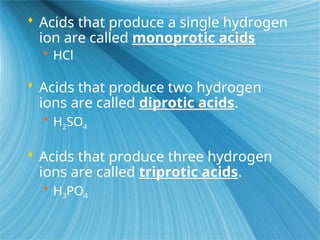
 Acids that produce a single hydrogen
ion are called monoprotic acids
 HCl
 Acids that produce two hydrogen
ions are called diprotic acids.
 H2SO4
 Acids that produce three hydrogen
ions are called triprotic acids.
 H3PO4
Naming Acids and Bases
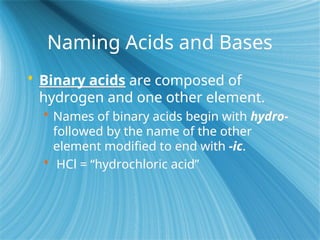
 Binary acids are composed of
hydrogen and one other element.
 Names of binary acids begin with hydro-
followed by the name of the other
element modified to end with -ic.
 HCl = “hydrochloric acid”
Naming Acids and Bases
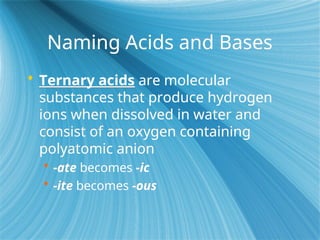
 Ternary acids are molecular
substances that produce hydrogen
ions when dissolved in water and
consist of an oxygen containing
polyatomic anion
 -ate becomes -ic
 -ite becomes -ous
Naming Acids and Bases
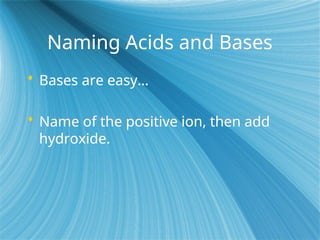
 Bases are easy…
 Name of the positive ion, then add
hydroxide.
Let’s Practice
 Review Book Page 178 #14 and #15
 Same Page #3 - 9
Neutralization Reactions
 Let’s write the neutralization reaction
between Nitric Acid and sodium hydroxide.
 All neutralization reactions have same net
equation.
 In all neutralization reactions, there is a 1:1
ratio between moles of H+
and moles OH-
Titration
 Process used to determine the
unknown concentration of an acid or
base by adding measured volumes of
an acid or base of known
concentration
 The solution of known concentration is
called the standard solution.
Titration
 Let’s revisit molarity
Molarity = moles/volume
Or
Moles = molarity X volume
Titration
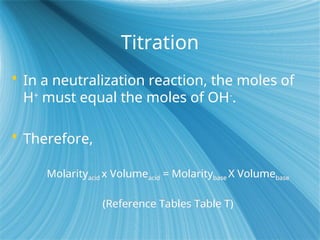
 In a neutralization reaction, the moles of
H+
must equal the moles of OH-
.
 Therefore,
Molarityacid x Volumeacid = Molaritybase X Volumebase
(Reference Tables Table T)
Titration
 Only catch is… we need a way to
know when we’ve reached neutral.
How can we know this???
 Indicators
 pH probes
Titration
 Let’s dot the I’s and cross the T’s….
 Units - the volume can be expressed as mL
(but you must be consistent on both sides)
 Molarity - is strictly speaking the
concentration of H+
or OH-
, not necessarily
the concentration of the acid or base.

Acids_Bases_Salts.ppt for Post Master student

  • 1.
    Acids, Bases, andSalts Rev Book Topic 10 Text Chapt 19
  • 2.
    Properties of Acidsand Bases  Certain observations can be made to identify acids and bases  These observable properties don’t explain why acids and bases behave the way they do.
  • 3.
    Characteristic Properties of Acids Dilute solutions of acids taste sour  Lemons - citric acid  Vinegar - acetic acid  Pop - carbonic or phosphoric acid
  • 4.
    Characteristic Properties of Acids Aqueous solutions of acids conduct current  Recall… substances that conduct an electric current are called electrolytes.  If a solution of acid is a good conductor, we call that acid a strong acid.  If a solution of acid is a poor conductor, we call it a weak acid.
  • 5.
    Characteristic Properties of Acids Acids react with bases to form water and a salt.  This is called a neutralization reaction (a type of double replacement reaction).  The salt formed is an ionic substance composed of polyatomic or metallic cation and an anion other than the hydroxide ion.
  • 6.
    Characteristic Properties of Acids Acids react with certain metals to produce hydrogen gas.  Table J
  • 7.
    Characteristic Properties of Acids Acids cause acid-base indicators to change color.  Table M
  • 8.
    Characteristic Properties of Bases Bases have a bitter taste  Bases have a slippery or “soapy” feeling  Bases conduct an electric current  Bases react with acids to produce water and a salt  Bases cause acid base indicators to change color.
  • 9.
    Reference Tables  TableK - Common Acids  Table L - Common Bases  Table M - Indicators  Table J - Activity Series
  • 10.
    pH Scale  Ascale called the pH Scale expresses [H+ ] as a number from 0 to 14.  A pH of 0 (zero) is strongly acidic.  A pH of 7 is neutral  A pHof 14 is strongly basic
  • 11.
    pH Scale  ThepH scale is logarithmic. Each change of a single pH unit represents a tenfold change in the concentration of hydrogen ion. pH = - log [H+ ] [H+ ] = 10-pH
  • 12.
    pH Scale  Asolution with a pH of 4 has a [H+ ] that is ten times greater than that of a solution with pH of 5.
  • 13.
  • 14.
    Models of Acidsand Bases  We need to attempt to develop explanations for the observable properties of acids and bases.  Three models have been developed…  Arrhenius model  Bronsted-Lowry Model  Lewis Model
  • 15.
  • 16.
     Acids thatproduce a single hydrogen ion are called monoprotic acids  HCl  Acids that produce two hydrogen ions are called diprotic acids.  H2SO4  Acids that produce three hydrogen ions are called triprotic acids.  H3PO4
  • 17.
    Naming Acids andBases  Binary acids are composed of hydrogen and one other element.  Names of binary acids begin with hydro- followed by the name of the other element modified to end with -ic.  HCl = “hydrochloric acid”
  • 18.
    Naming Acids andBases  Ternary acids are molecular substances that produce hydrogen ions when dissolved in water and consist of an oxygen containing polyatomic anion  -ate becomes -ic  -ite becomes -ous
  • 19.
    Naming Acids andBases  Bases are easy…  Name of the positive ion, then add hydroxide.
  • 20.
    Let’s Practice  ReviewBook Page 178 #14 and #15  Same Page #3 - 9
  • 21.
    Neutralization Reactions  Let’swrite the neutralization reaction between Nitric Acid and sodium hydroxide.  All neutralization reactions have same net equation.  In all neutralization reactions, there is a 1:1 ratio between moles of H+ and moles OH-
  • 22.
    Titration  Process usedto determine the unknown concentration of an acid or base by adding measured volumes of an acid or base of known concentration  The solution of known concentration is called the standard solution.
  • 23.
    Titration  Let’s revisitmolarity Molarity = moles/volume Or Moles = molarity X volume
  • 24.
    Titration  In aneutralization reaction, the moles of H+ must equal the moles of OH- .  Therefore, Molarityacid x Volumeacid = Molaritybase X Volumebase (Reference Tables Table T)
  • 25.
    Titration  Only catchis… we need a way to know when we’ve reached neutral. How can we know this???  Indicators  pH probes
  • 26.
    Titration  Let’s dotthe I’s and cross the T’s….  Units - the volume can be expressed as mL (but you must be consistent on both sides)  Molarity - is strictly speaking the concentration of H+ or OH- , not necessarily the concentration of the acid or base.