Acids & Bases
Theyare everywhere..
In your food
In your house
EVEN IN YOU!!!!!
2.
What is anacid?
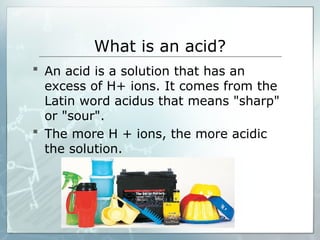
An acid is a solution that has an
excess of H+ ions. It comes from the
Latin word acidus that means "sharp"
or "sour".
The more H + ions, the more acidic
the solution.
3.
Properties of anAcid
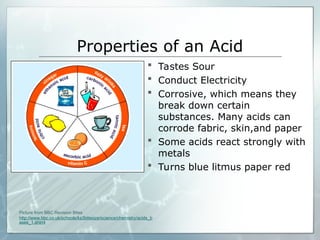
Tastes Sour
Conduct Electricity
Corrosive, which means they
break down certain
substances. Many acids can
corrode fabric, skin,and paper
Some acids react strongly with
metals
Turns blue litmus paper red
Picture from BBC Revision Bites
http://www.bbc.co.uk/schools/ks3bitesize/science/chemistry/acids_b
ases_1.shtml
4.
Uses of Acids
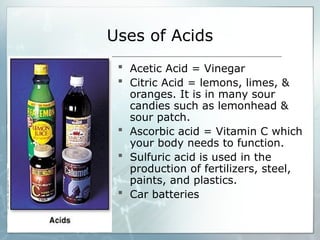
Acetic Acid = Vinegar
Citric Acid = lemons, limes, &
oranges. It is in many sour
candies such as lemonhead &
sour patch.
Ascorbic acid = Vitamin C which
your body needs to function.
Sulfuric acid is used in the
production of fertilizers, steel,
paints, and plastics.
Car batteries
5.
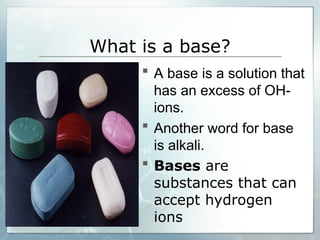
What is abase?
A base is a solution that
has an excess of OH-
ions.
Another word for base
is alkali.
Bases are
substances that can
accept hydrogen
ions
6.
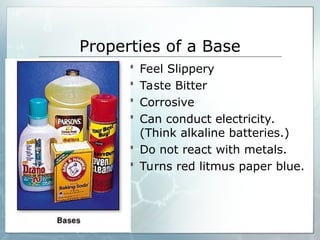
Properties of aBase
Feel Slippery
Taste Bitter
Corrosive
Can conduct electricity.
(Think alkaline batteries.)
Do not react with metals.
Turns red litmus paper blue.
7.
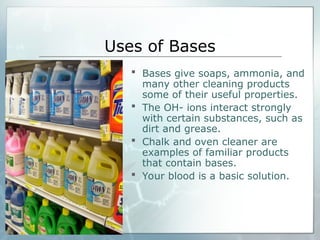
Uses of Bases
Bases give soaps, ammonia, and
many other cleaning products
some of their useful properties.
The OH- ions interact strongly
with certain substances, such as
dirt and grease.
Chalk and oven cleaner are
examples of familiar products
that contain bases.
Your blood is a basic solution.
8.
pH Scale
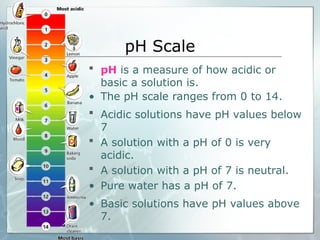
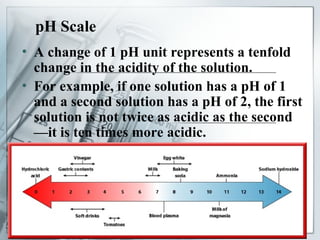
pHis a measure of how acidic or
basic a solution is.
• The pH scale ranges from 0 to 14.
Acidic solutions have pH values below
7
A solution with a pH of 0 is very
acidic.
A solution with a pH of 7 is neutral.
• Pure water has a pH of 7.
• Basic solutions have pH values above
7.
9.
pH Scale
• Achange of 1 pH unit represents a tenfold
change in the acidity of the solution.
• For example, if one solution has a pH of 1
and a second solution has a pH of 2, the first
solution is not twice as acidic as the second
—it is ten times more acidic.
10.
Acid – BaseReactions
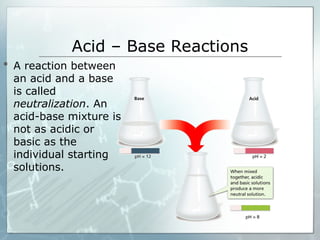
A reaction between
an acid and a base
is called
neutralization. An
acid-base mixture is
not as acidic or
basic as the
individual starting
solutions.
11.
Acid – Basereactions
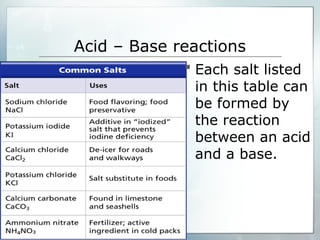
Each salt listed
in this table can
be formed by
the reaction
between an acid
and a base.
12.
Ionization ofacids and bases in water
are not in the same extent with each
other. Some acids completely ionized
or dissociate in water and these are
called strong acids. There are also
acids that partially dissociate with
water. These are referred to as weak
acids.
13.
Just likeacid, when bases
completely ionized or
dissociates with water this is
called strong bases. When
base dissociates partially in
water, it is considered as
weak base.
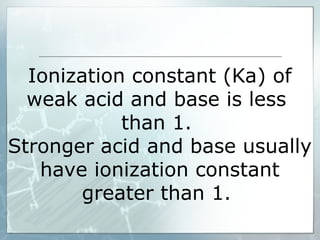
Ionization constant (Ka)of
weak acid and base is less
than 1.
Stronger acid and base usually
have ionization constant
greater than 1.
16.
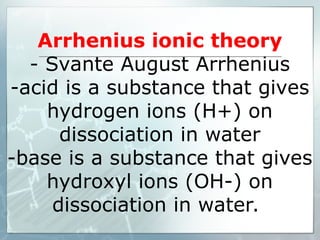
Arrhenius ionic theory
-Svante August Arrhenius
-acid is a substance that gives
hydrogen ions (H+) on
dissociation in water
-base is a substance that gives
hydroxyl ions (OH-) on
dissociation in water.
17.
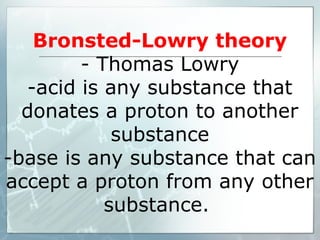
Bronsted-Lowry theory
- ThomasLowry
-acid is any substance that
donates a proton to another
substance
-base is any substance that can
accept a proton from any other
substance.
18.
Evaluation
1. Explain howstrong acids
dissociate in water?
2. Which among the two acids
(phenol and acetic acid) is weaker?
Explain using their ionization
constant.
19.
Evaluation
3. Which amongthe two bases
(diethylamine and pyridine) is
stronger? Explain using their
ionization constant.
20.
Evaluation
4. How canyou tell whether it is a
strong or weak acid and base based
on the ionization constant?
21.
Activity 1:
1.Strong acidsdissociate completelyin water.
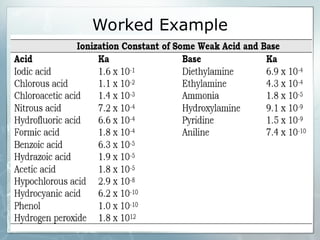
2.Looking at their ionization constant, phenol has 1.0 x 10-
10(0.00000000010) while acetic acid has 1.8 x 10⁻⁵(0.000018)
making phenol the weaker acid between the two.
3.Looking their ionization constant diethylamine has 6.9 x 10⁻⁴ (0.
00069) while pyridine has 1.5 x 10⁻⁹(0.0000000015) making the
diethylamine the stronger base.
4.The ionization constant of acid and base is greater than 1, while for
the weak ones it is usually lesser than 1.
Editor's Notes
#14 Try to compare the relative strength of iodic and benzoic acid. The ionization constant of iodic acid is 1.6 x 10⁻¹ or 0.16 while benzoic acid is 6.3 x 10⁻⁵ or 0.000063. Therefore, you can conclude that benzoic acid is a weaker acid than iodic acid.
Try again comparing the relative strength of ammonia and aniline base. The
ionization constant of ammonia is 1.8 x 10⁻⁵ or 0.000018 while aniline is 7.4 x 10⁻¹⁰
or 0.00000000074. Therefore, ammonia is a stronger base compare to aniline.