IGCSE BUSINESS
STUDIES
Unit 1 – Business Activity
Chapter 1: The Purpose of Business Activity
By Ali Nehan Khan
In this unit you will learn…….
⦿ The economic problem of unlimited wants and
limited resources
⦿ The factors of production
⦿ The development of economic activity and the
use of specialization
⦿ What is meant by a business
⦿ What is meant by “Added Value”
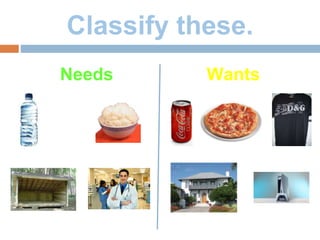
Classify these.
Needs Wants
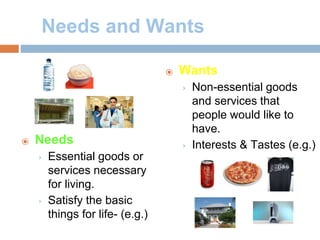
Needs and Wants
⦿ Needs
› Essential goods or
services necessary
for living.
› Satisfy the basic
things for life- (e.g.)
⦿ Wants
› Non-essential goods
and services that
people would like to
have.
› Interests & Tastes (e.g.)
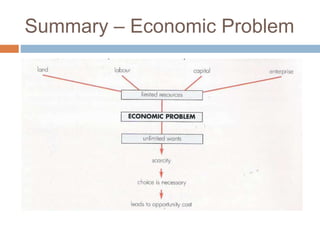
The Economic Problem
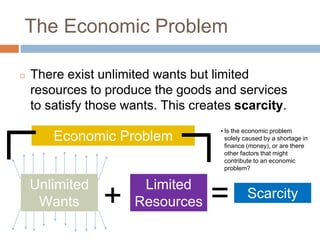
â—» There exist unlimited wants but limited
resources to produce the goods and services
to satisfy those wants. This creates scarcity.
Limited
Resources
Scarcity
+ =
Unlimited
Wants
Economic Problem
Is the economic problem
solely caused by a shortage in
finance (money), or are there
other factors that might
contribute to an economic
problem?
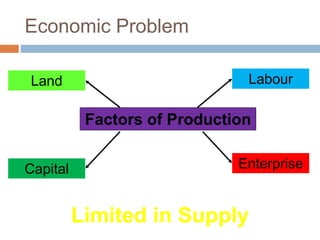
Economic Problem
Limited in Supply
Land Labour
Capital Enterprise
Factors of Production
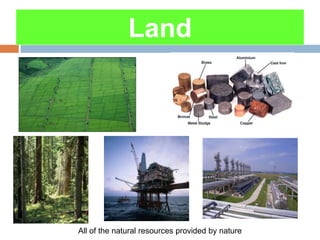
Land
All of the natural resources provided by nature
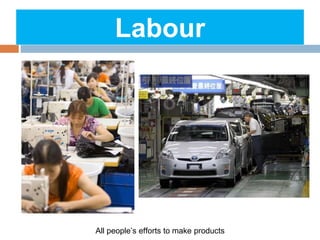
Labour
All people’s efforts to make products
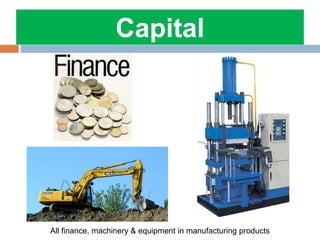
Capital
All finance, machinery & equipment in manufacturing products
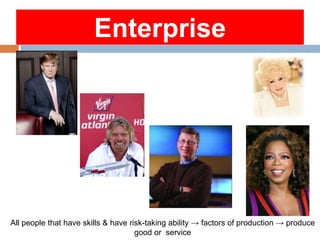
Enterprise
All people that have skills & have risk-taking ability → factors of production → produce
good or service
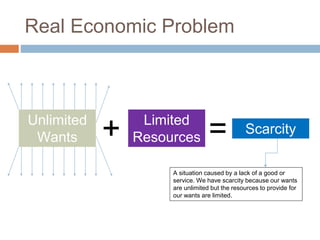
Real Economic Problem
Unlimited
Wants
Limited
Resources
Scarcity
+ =
A situation caused by a lack of a good or
service. We have scarcity because our wants
are unlimited but the resources to provide for
our wants are limited.
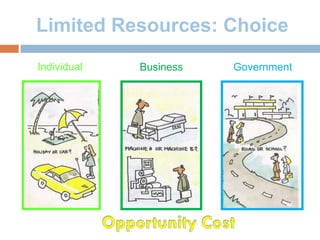
Limited Resources: Choice
Individual Business Government
Opportunity Cost
Opportunity cost is the next best alternative forgone by
choosing another item. Due to scarcity, people are often
forced to make choices. When choices are made it leads to
an opportunity cost.
SCARCITY→ CHOICE →OPPORTUNITY COST
Example – The government has a limited amount of money
(scarcity) and must decide on whether to use it to build a
road or construct a hospital (choice). The government
chooses to construct the hospital instead of the road. The
opportunity cost here are the benefits from the road that they
have sacrificed (opportunity cost).
Summary – Economic Problem
Making the best use of limited
resources
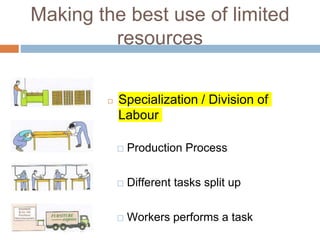
â—» Specialization / Division of
Labour
⬜ Production Process
⬜ Different tasks split up
⬜ Workers performs a task
Making the best use of limited
resources
Specialization occurs when a person or organization concentrates on a task
at which they are best at. Instead of everyone doing every job, the tasks
are divided among people who are skilled and efficient at them.
Advantages
• Workers are trained to do a task and specialize in this- thus increasing efficiency
• Saves time and energy- production is faster by specializing.
• Skill development- workers can develop their skills as they do the same tasks
repeatedly, mastering it.
Disadvantages
• It can get boring for workers, doing the same tasks repeatedly.
• Over-dependency – if worker(s) responsible for a task is absent, the entire
production process may halt since nobody else may be able to do the task.
Making the best use of limited
resources
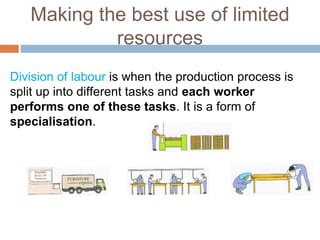
Division of labour is when the production process is
split up into different tasks and each worker
performs one of these tasks. It is a form of
specialisation.
Why business activity is
needed?
Why Business?
So, we’ve gone through factors of production, the
problem of scarcity and specialization, but what is
business?
Business is any organization that uses all the
factors of production (resources) to create goods
and services to satisfy human wants and needs.
Added Value
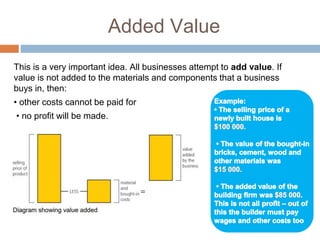
This is a very important idea. All businesses attempt to add value. If
value is not added to the materials and components that a business
buys in, then:
• other costs cannot be paid for
• no profit will be made.
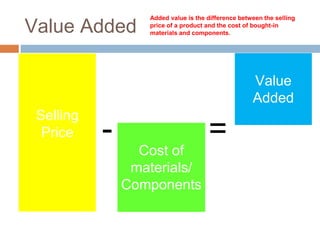
Value Added
Selling
Price
Cost of
materials/
Components
Value
Added
- =
Added value is the difference between the selling
price of a product and the cost of bought-in
materials and components.
Value Added
Added value is the difference between the selling
price of a product and the cost of bought-in
materials and components.
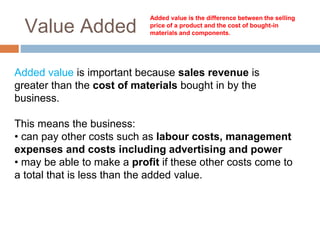
Added value is important because sales revenue is
greater than the cost of materials bought in by the
business.
This means the business:
• can pay other costs such as labour costs, management
expenses and costs including advertising and power
• may be able to make a profit if these other costs come to
a total that is less than the added value.
Value Added
Added value is the difference between the selling
price of a product and the cost of bought-in
materials and components.
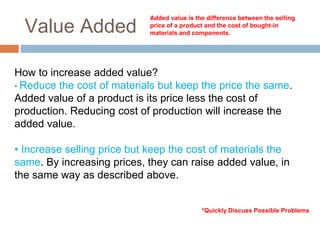
How to increase added value?
• Reduce the cost of materials but keep the price the same.
Added value of a product is its price less the cost of
production. Reducing cost of production will increase the
added value.
• Increase selling price but keep the cost of materials the
same. By increasing prices, they can raise added value, in
the same way as described above.
*Quickly Discuss Possible Problems
Define & Explain the following:
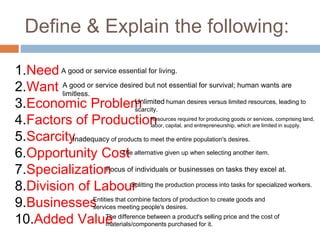
1.Need
2.Want
3.Economic Problem
4.Factors of Production
5.Scarcity
6.Opportunity Cost
7.Specialization
8.Division of Labour
9.Businesses
10.Added Value
The difference between a product's selling price and the cost of
materials/components purchased for it.
A good or service essential for living.
A good or service desired but not essential for survival; human wants are
limitless.
Unlimited human desires versus limited resources, leading to
scarcity.
Resources required for producing goods or services, comprising land,
labor, capital, and entrepreneurship, which are limited in supply.
Inadequacy of products to meet the entire population's desires.
Entities that combine factors of production to create goods and
services meeting people's desires.
Focus of individuals or businesses on tasks they excel at.
Splitting the production process into tasks for specialized workers.
The alternative given up when selecting another item.
High Performance Learning
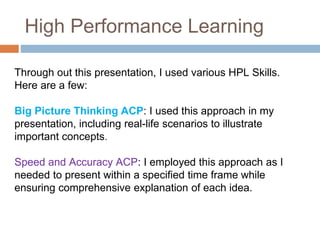
Through out this presentation, I used various HPL Skills.
Here are a few:
Big Picture Thinking ACP: I used this approach in my
presentation, including real-life scenarios to illustrate
important concepts.
Speed and Accuracy ACP: I employed this approach as I
needed to present within a specified time frame while
ensuring comprehensive explanation of each idea.
Chapter 1 PowerPoint Business Studies.pptx

Chapter 1 PowerPoint Business Studies.pptx

  • 1.
    IGCSE BUSINESS STUDIES Unit 1– Business Activity Chapter 1: The Purpose of Business Activity By Ali Nehan Khan
  • 2.
    In this unityou will learn……. ⦿ The economic problem of unlimited wants and limited resources ⦿ The factors of production ⦿ The development of economic activity and the use of specialization ⦿ What is meant by a business ⦿ What is meant by “Added Value”
  • 3.
  • 4.
    Needs and Wants ⦿Needs › Essential goods or services necessary for living. › Satisfy the basic things for life- (e.g.) ⦿ Wants › Non-essential goods and services that people would like to have. › Interests & Tastes (e.g.)
  • 5.
    The Economic Problem â—»There exist unlimited wants but limited resources to produce the goods and services to satisfy those wants. This creates scarcity. Limited Resources Scarcity + = Unlimited Wants Economic Problem Is the economic problem solely caused by a shortage in finance (money), or are there other factors that might contribute to an economic problem?
  • 6.
    Economic Problem Limited inSupply Land Labour Capital Enterprise Factors of Production
  • 7.
    Land All of thenatural resources provided by nature
  • 8.
  • 9.
    Capital All finance, machinery& equipment in manufacturing products
  • 10.
    Enterprise All people thathave skills & have risk-taking ability → factors of production → produce good or service
  • 11.
    Real Economic Problem Unlimited Wants Limited Resources Scarcity += A situation caused by a lack of a good or service. We have scarcity because our wants are unlimited but the resources to provide for our wants are limited.
  • 12.
  • 13.
    Opportunity Cost Opportunity costis the next best alternative forgone by choosing another item. Due to scarcity, people are often forced to make choices. When choices are made it leads to an opportunity cost. SCARCITY→ CHOICE →OPPORTUNITY COST Example – The government has a limited amount of money (scarcity) and must decide on whether to use it to build a road or construct a hospital (choice). The government chooses to construct the hospital instead of the road. The opportunity cost here are the benefits from the road that they have sacrificed (opportunity cost).
  • 14.
  • 15.
    Making the bestuse of limited resources ◻ Specialization / Division of Labour ⬜ Production Process ⬜ Different tasks split up ⬜ Workers performs a task
  • 16.
    Making the bestuse of limited resources Specialization occurs when a person or organization concentrates on a task at which they are best at. Instead of everyone doing every job, the tasks are divided among people who are skilled and efficient at them. Advantages • Workers are trained to do a task and specialize in this- thus increasing efficiency • Saves time and energy- production is faster by specializing. • Skill development- workers can develop their skills as they do the same tasks repeatedly, mastering it. Disadvantages • It can get boring for workers, doing the same tasks repeatedly. • Over-dependency – if worker(s) responsible for a task is absent, the entire production process may halt since nobody else may be able to do the task.
  • 17.
    Making the bestuse of limited resources Division of labour is when the production process is split up into different tasks and each worker performs one of these tasks. It is a form of specialisation.
  • 18.
    Why business activityis needed? Why Business? So, we’ve gone through factors of production, the problem of scarcity and specialization, but what is business? Business is any organization that uses all the factors of production (resources) to create goods and services to satisfy human wants and needs.
  • 19.
    Added Value This isa very important idea. All businesses attempt to add value. If value is not added to the materials and components that a business buys in, then: • other costs cannot be paid for • no profit will be made.
  • 20.
    Value Added Selling Price Cost of materials/ Components Value Added -= Added value is the difference between the selling price of a product and the cost of bought-in materials and components.
  • 21.
    Value Added Added valueis the difference between the selling price of a product and the cost of bought-in materials and components. Added value is important because sales revenue is greater than the cost of materials bought in by the business. This means the business: • can pay other costs such as labour costs, management expenses and costs including advertising and power • may be able to make a profit if these other costs come to a total that is less than the added value.
  • 22.
    Value Added Added valueis the difference between the selling price of a product and the cost of bought-in materials and components. How to increase added value? • Reduce the cost of materials but keep the price the same. Added value of a product is its price less the cost of production. Reducing cost of production will increase the added value. • Increase selling price but keep the cost of materials the same. By increasing prices, they can raise added value, in the same way as described above. *Quickly Discuss Possible Problems
  • 23.
    Define & Explainthe following: 1.Need 2.Want 3.Economic Problem 4.Factors of Production 5.Scarcity 6.Opportunity Cost 7.Specialization 8.Division of Labour 9.Businesses 10.Added Value The difference between a product's selling price and the cost of materials/components purchased for it. A good or service essential for living. A good or service desired but not essential for survival; human wants are limitless. Unlimited human desires versus limited resources, leading to scarcity. Resources required for producing goods or services, comprising land, labor, capital, and entrepreneurship, which are limited in supply. Inadequacy of products to meet the entire population's desires. Entities that combine factors of production to create goods and services meeting people's desires. Focus of individuals or businesses on tasks they excel at. Splitting the production process into tasks for specialized workers. The alternative given up when selecting another item.
  • 24.
    High Performance Learning Throughout this presentation, I used various HPL Skills. Here are a few: Big Picture Thinking ACP: I used this approach in my presentation, including real-life scenarios to illustrate important concepts. Speed and Accuracy ACP: I employed this approach as I needed to present within a specified time frame while ensuring comprehensive explanation of each idea.