Page 1 of 74
Executive Summary
The report began with a brief overview of the purpose and reason behind preparing it. We have
chosen a private limited bank named “Mutual Trust Bank Limited” for the reporting purpose.
The Mutual Trust Bank is a full service scheduled commercial bank. The bank is primarily
driven with a view of creating opportunities and pursuing market niches. The report mainly deals
with “Financial analysis based on accounting framework of Bangladesh”. It covers almost all
necessary information of the respective topic.
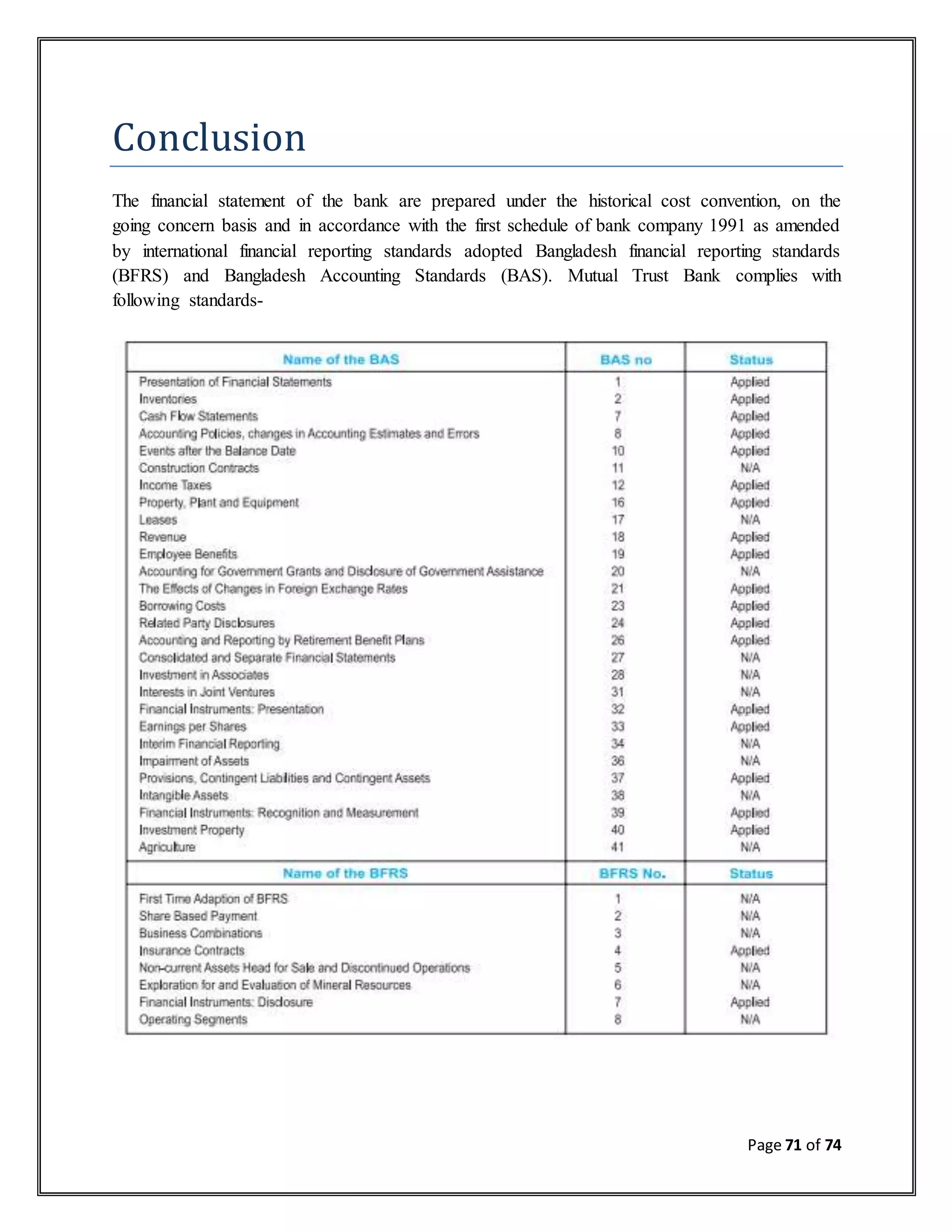
The consolidated financial statement of Mutual Trust Bank for the year ended 2011 have been
prepared where BAS rule of presentation of financial statement , inventories, cash flow
statement, accounting policies, event after reporting period, income tax, leases, PPE, revenue,
employee benefits ,effect of changes in foreign exchange rate, borrowing costs, consolidated and
separate financial statement, earning per share, interest financial reporting, provision, investment
property are applied.
In this consolidated financial statement for the financial statements of disclosure and operating
segments BFRS rules have been applied.
The introductory part ended with the scopes & confinements of the assigned subject. The next
segment of the report started with an elaborate overview of financial statement of the bank
including its establishment related information, their products, mission, vision, principles of
accounting framework they follow to prepare the consolidated financial statement. All the
relevant information related with accounting rules applied during preparing consolidated
financial statement are shown as notes.
Page 2 of 74
Page 3 of 74
1.1. Origin of the Report
This report is prepared as an assignment for our Financial Accounting and Reporting (F-201)
course. While preparing the report, we gave our best effort to incorporate the theoretical aspect
of the subject while emphasizing on the practical implementation of the various strategic efforts
that we learned in our course.
Page 4 of 74
1.2. Objective of the report
The Objective of our report are-
 To fulfill the partial requirement of our course of Financial Accounting and Reporting.
 To achieve the deep knowledge about Bangladesh Accounting Standards .
 To gain practical knowledge of the implications of BFRS regarding the business.
Page 5 of 74
1.3. Methodology
We used the information that we collected from the company website and Mutual Trust Bank
Ltd. annual report.
Page 6 of 74
1.4. Limitations of the study
The limitations are-
 Lack of Experience
 Lack of knowledge
 Time management
Page 7 of 74
Page 8 of 74
1.0. What is financial accounting?
Financial accounting is a process of identifying measuri8ng and communicating economic
information of an entity to others so that they may make decisions on the basis of those
information and assess the stewardship of management.
There are two framework
 framework of accounting.
 Conceptual Regulatory framework of reporting.
1.1. GAAP (Generally accepted accounting Principles)
It defines some guideline that must be followed to prepare financial statement.
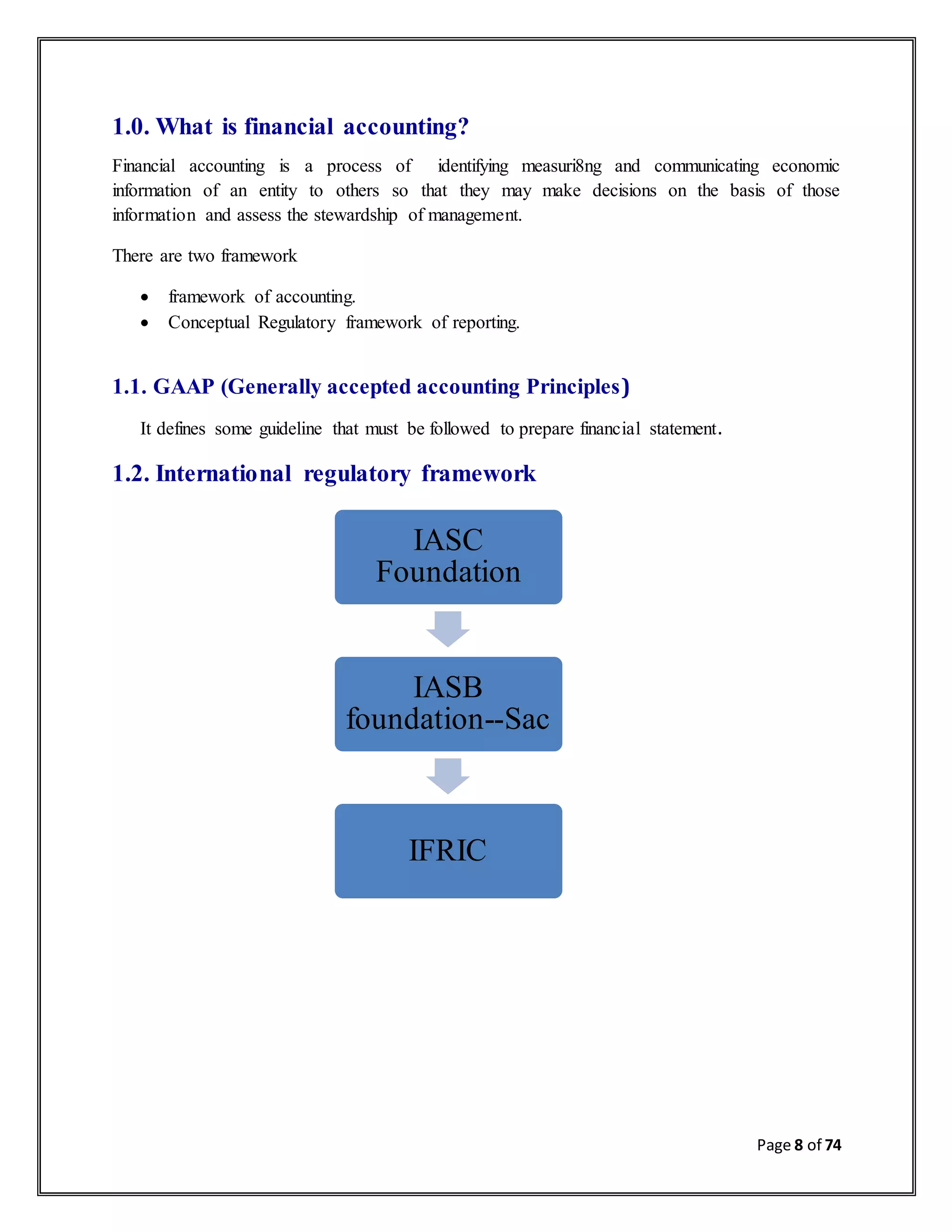
1.2. International regulatory framework
IASC
Foundation
IASB
foundation--Sac
IFRIC
Page 9 of 74
1.3. Regulatory Framwork
Regulatory Framework is influenced by-
1. Company act 1994
2. BSEC Rules
3. Bangladesh Bank circular
4. Income Tax ordinance 1984
5. VAT 1991
1.4. Conceptual framework
It is a coherent system of interrelated objectives and fundamental principles.
It is a framework that prescribes the nature function and limits of accounting and FS.
Conceptual framework covers:
1. Objectives of FS
2. Users and their specific information needs
3. Underlying assumption
4. Element of FS
5. Recognition and measurement of element of FS
6. Concept of capital and cassspital maintenance.
1.5 BAS 1 Presentation of Finacial Statements
1.5.1. Objective
BAS 1 presentation of financial statements prescribes the basis for the presentation of financial
statements so as to ensure comparability with:
The entity’s own financial statements of previous products, and the financial statements of other
entities.
BAS 1 must be applied to all general purpose financial statements prepared in accordance with
BFRSs, i.e. those intended to meet the needs of users who are not in a position to demand reports
tailored to their specific needs. BAS 1 is concerned with overall considerations about the
Page 10 of 74
minimum content of a set of financial statements; detailed rules about recognition, measurement
and disclosures of specific transactions are then contained in other standards.
Whilst the terminology used was designed for profit-oriented business, it can be used, with
modification, for not-for profit activities.
1.5.2 Purposes offinancial statements
The objectives of general purpose fniancial statements s to provide information about the
financial position, financial performance and cash flows of an equity that is useful to a wide
range of users in making economic decisions.They also show the results of management
stewardship of the resources of the entity.
In order to achieve this information is provided about the following aspects of the entity’s result:
 Assets
 Liabilities
 Equity
 Income and expense
 Other changes in equity, and
 Cash flows
1.5.3.Overall considerations
Much of the material in this section details the specific application of the general principles dealt
with in the BFRS Framework. These include:
1.5.4 Fairpresentation
Requires the faithful representation of the effects of transactions, other events and conditions in
accordance with the definitions and rcognition criteria for asstes, liabilities, income and expenses
set out in the framework.
Compliance with BFRS is presumed to result in financial statements that achieve a fair
presentation.
BAS 1 expends in this principle as follows:
 compliance with BFRS should be disclosed
 financial statements can only be described as complying with BFRS if they comply with
all the requirementsof BFRS.
Page 11 of 74
 use of inappropriate accounting policies cannot be be rectified either by disclosure or
explanatory material.
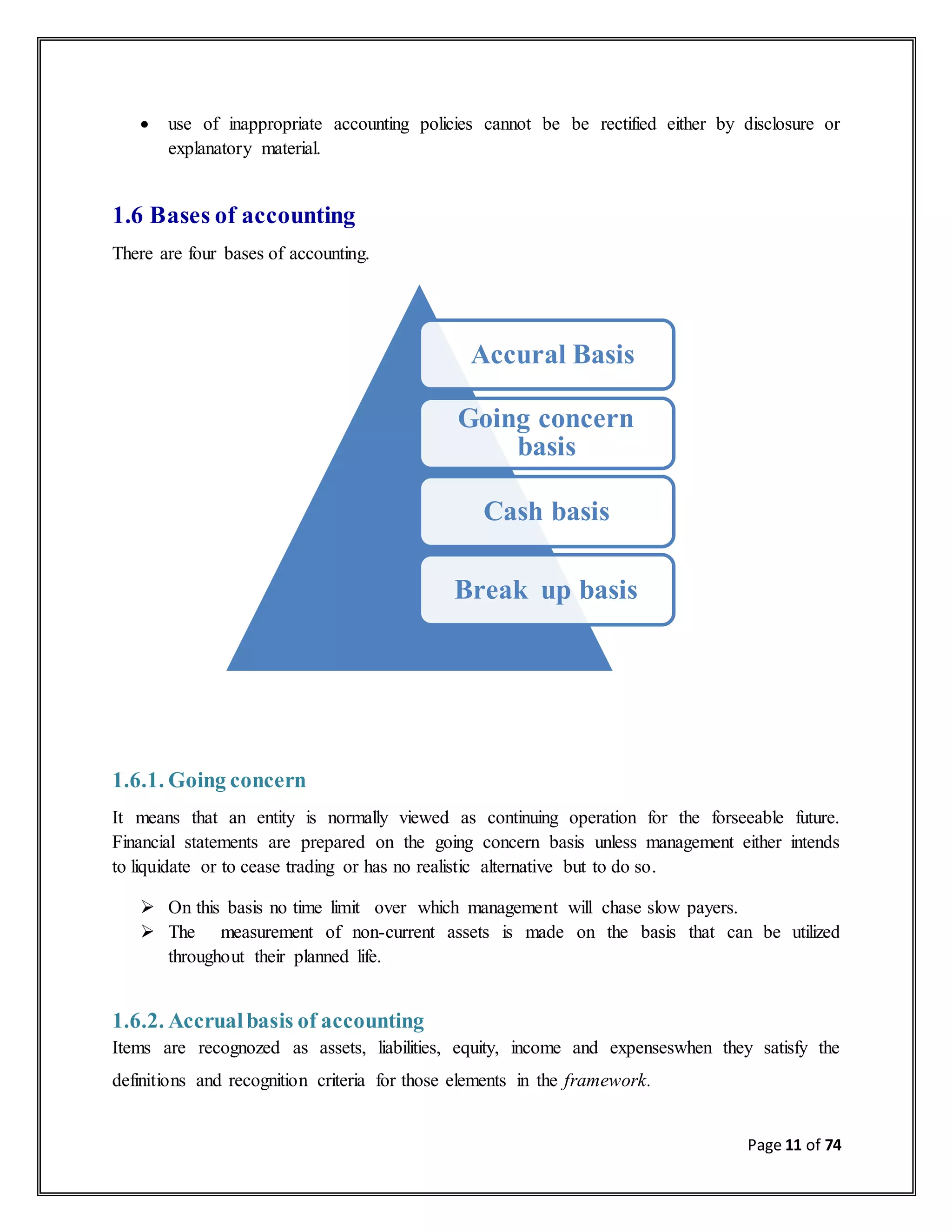
1.6 Bases of accounting
There are four bases of accounting.
1.6.1. Going concern
It means that an entity is normally viewed as continuing operation for the forseeable future.
Financial statements are prepared on the going concern basis unless management either intends
to liquidate or to cease trading or has no realistic alternative but to do so.
 On this basis no time limit over which management will chase slow payers.
 The measurement of non-current assets is made on the basis that can be utilized
throughout their planned life.
1.6.2. Accrualbasis of accounting
Items are recognozed as assets, liabilities, equity, income and expenseswhen they satisfy the
definitions and recognition criteria for those elements in the framework.
Accural Basis
Going concern
basis
Cash basis
Break up basis
Page 12 of 74
 Sales are recorded in the period in which the risks and reward of ownership pass from
seller to buyer, not when the seller received full payment.
 Expenses are recorded on the period when the goods or services are consumed, not when
they are paid for.
1.6.3. Cashbasis
Although it is bases of accounting but the cash basis of accounting is not used in the preparation
of a company balance sheet. Under this assumption only effect s of cash transactions are recorder
.
 Sales are recognized when we get full payment
 Under the cash basis there is no term ‘’ depreciation’’.
Notes: It is not used in the preparation of a company balance sheet and income statement ,
though it is part of bases.
1.6.4 Break-upbasis
Management has the intention/ need to liquidate the business.
 All assets and liabilities would be classified as current rather than non-current.
 Assets would be valued on the basis of the recoverable amount on sale.
Notes: Although it is a part of bases if it faces some financial difficulties such a sale is
needed the cash to pay its creditors. Here this is the case an the alternative method of
accounting must be used ( in accordance with BAS 1 presentation of financial statement. In
this circumstances the financial statements will be prepared on a break-up basis.
1.7 Consistencyofpreparation
To maintain consistency, the presentation and classification of items in the financial statements
should stay tha same from one period to the next. There are two exceptions to this:
 There is a significant change in the nature and operations or a review of the
financial statements presentation which indicates a more appropriate presentation.
 A change inpresentationisrequiredbya BFRS.
 Where a change of presentation and classification is made, figures for the previous
period must be restatedon the new basis, unless this is impracticable.
Page 13 of 74
1.8 Materiality and aggression
Omissions or misstatementof items are materialif they could, individually or collectively,
influence the economic decisions of users taken on the basis of the financial statements.
Materiality depends on the size and nature of the omission or misstatement judged in the
surrounding circumstances.
The assesment of an item as material or immaterial may affect its treatment in the financial
statements. For example, the incoame stateament of a business will show the expenses incurred
by the business grouped under suitable captions. However, in the case of very small expenses it
may be appropriate to lump them together under a caption such as ‘sundry expenses’ , because a
more detailed breakdown would be inapproriate for such immaterial amounts.
1.9 Offsetting
BAS 1 does not allow assets and liabilities to be offset against each other unless such a
treatment is required or permitted by another BFRS.
Income and expenses can be offset only when:
 A BFRS requires or permits it,
 gains, losses and related expenses arising from the same/similar transactions are not
material( in aggregate).
1.10 Comparative information
BAS 1 requires comparative information to be disclosed for the previous period for all
numerical information, unless another BFRS permits/requires otherwise. Comparatives should
also be given in narrative information where relevant to an understanding of the current period’s
financial statements.
Comparatives should be reclassified when the presentation or classification of items in the
financial statements is amended.
1.11 Disclosure of accounting policies
There should be a specific section for accounting policies in the notes to the financial statements
and the following should be disclosed there.
 Measurement bases used in preparing the financial statements
 Each specific accounting policy necessary for a proper understanding of the financial
statements.
Page 14 of 74
Page 15 of 74
2.1Companies Mission
The bank aspire to be the most admired financial institution in the country, recognized as a
dynamic, innovative and client focused company, that offers an array of products and services in
the search for excellence and to create an impressive economic value.
2.2 companies Vision
Mutual Trust Bank's vision is based on a philosophy known as MTB3V. The company envision
MTB to be:
2.0 Incorporation of Mutual Trust Bank
The Company was incorporated as a Public Limited Company in 1999, under the Companies Act
1994, with an Authorized Share Capital of BDT 1,000,000,000 divided into 10,000,000 ordinary
shares of BDT 100 each. At present, the Authorized Share Capital of the company is BDT
10,000,000,000 divided into 1,000,000,000 ordinary shares of BDT 10 each.
The Company was also issued Certificate for Commencement of Business on the same day and
was granted license on October 05, 1999 by Bangladesh Bank under the Banking Companies Act
1991 and started its banking operation on October 24, 1999. As envisaged in the Memorandum
of Association and as licensed by Bangladesh Bank under the provisions of the Banking
Companies Act 1991.
Page 16 of 74
One of the Best Performing Banks in Bangladesh
The Bank of Choice
A Truly World-class Bank
2.3 Subsidiaries:
The subsidiaries of Mutual Trust Bank are shown below:
2.3.1 MTB Securities Limited (MTBSL)
MTBSL is engaged in buying and selling of securities for its customer and margin loan is
extended to the customer against their margin for investment in their listed companies. The
require margin level is monitored daily and margin loan is provided as per established
guidelines. It also undertake investment for the banks fund in the capital market. Separate
Financial Statement of MTB Securities Limited has been drawn up in the report.
2.3.2. MTB Exchange (UK) Limited (MTB UK)
In August 19, 2010 accordance approval to the bank for opening a fully owned subsidiary
company in the named of MTB Exchanged (UK) Limited. The company was incorporated in
June 14,2010 under the company act 2006 of UK with the registration number 7282261 as a
private company limited by share.
The main activities of the exchange house are to carry on the remittance business and to
undertake and participate in transactions, activities and operations commonly carried on or
undertake by remittance and exchange houses. Separate financial Statement of MTB Exchange
(UK) Limited has been drawn up in the reports.
Page 17 of 74
2.3.3 MTB CapitalLimited (MTBCL)
The bank obtained permission to embark upon mercantile Banking from the Bangladesh
Securities and Exchange Commission (BSEC) dated December ^, 2010 under the Sceruties and
Exchange Commission Act ,1993. The operation has started as on April 17, 2011. Separate
Financial statements have been drawn up in the reports.
MTBCL offers the following services to the market:
a) Discretionary and non Discretionary Portfolio Management services to both the retail and
institutional investors under different product lines.
b) Issue Management services to medium and large corporate houses to manage their initial
Public Offer (IPO), secondary offerings, debt issuance and right issuance .
c) Underwriting services for both debt and equity issues.
Besides, MTBCL develops various investment schemes suiting varying objectives and
constractions of different investor classes.
2.4. MTB Financial Highlight 2014
Total operating Profit:
Operating profit before provision for 2014 stood at BDT 2,6303 million,registering a positive
28.50% growth over the previous year(BDT 2,026 million)
Net profit after Tax:
Net profit After tax (NPAT) stood at BDT 962 million in 2014, which was 67.74% higher then
2013(BDT 573 million)
Page 18 of 74
Loans and advances:
MTB risk assets (loans and advances) increased to BDT 77141 million including Offshore
Banking Unit (OBU) and margin loans, which was 29.54% higher than 2013(BDT 59548
million)
Return on Equity:
Return on average shareholder EQUITY went up from the previous year due to increase in Net
Profit After Tax (NPAT) in 2014.
Total Deposits:
MTB Deposits in 2014 increased to BDT 97106 million, registering a growth of 15.09% over
2013(BDT 84373 million)
Net asset value:
Net asset value (NAV) per share increased to 22% which was 12.95% higher than 2013.
Page 19 of 74
Page 20 of 74
3.0. Financial Statements
Financial statements are the means of communicating the information to the people or users or
others. These are the accountants summary of performance of an entity over a particular period
of time and its financial position at a point of time.
A set of financial statements is a structured representation of the financial performance and
financial position of a business and how its financial position changed over time.It is the ultimate
output of an accounting information system and has following six components:
1. Balance Sheet (Statements of Financial Position)
2. Income Statement (Statements of Financial Performance)
3. Statement of Cash Flows
4. Statement of Changes in Equity
5. Notes and Other Disclosures
Financial statements are better understood in context of all other components of the financial
statements. For example a balance sheet will communicate more information if we have the
related income statement and the statement of cash flows too.
3.1 Purposes of Financial Statements:
The objective of financial statements is to provide information about the financial position,
financial performance and cash flows of an entity, to others to make economic decisions. They
also show the results of management stewardship of the resources of the entity.
To achieve this information is provided about the following aspects of the entity’s results:
 Assets
 Liabilities
 Equity
 Income and expenses
 Other changes in equity and
 Cash flows
Additional information is contained in the notes.
Page 21 of 74
3.2 Balance Sheet (Statements of Financial Position)
A balance sheet also known as the statement of financial position tells about the assets, liabilities
and equity of a business at a specific point of time. It is a snapshot of a business.
A balance sheet is an extended form of the accounting equation. An accounting equation is:
Assets = Liabilities + Equity
Assets are the resources controlled by a business, equity is the obligation of the company to its
owners and liabilities are the obligations of parties other than owners.
A balance sheet is named so because it lists all resources owned by the company and shows that
it is equal to the sum of all liabilities and the equity balance.
Rules of preparing balance sheet according to BAS 1 -
 BAS 1 guidelines on the format of the balance sheet
 BAS 1 specifies that certain items must be shown on the face of the balance sheet
 It requires other information to presented on the face of the balance sheet or in the notes
 It requires both assets and liabilities must be separately classified as current and non-
current
3.2.1 Format of balance sheet
BAS 1 suggests a format for the balance sheet. But it does not prescribe the order or format in
which the items listed should be presented.
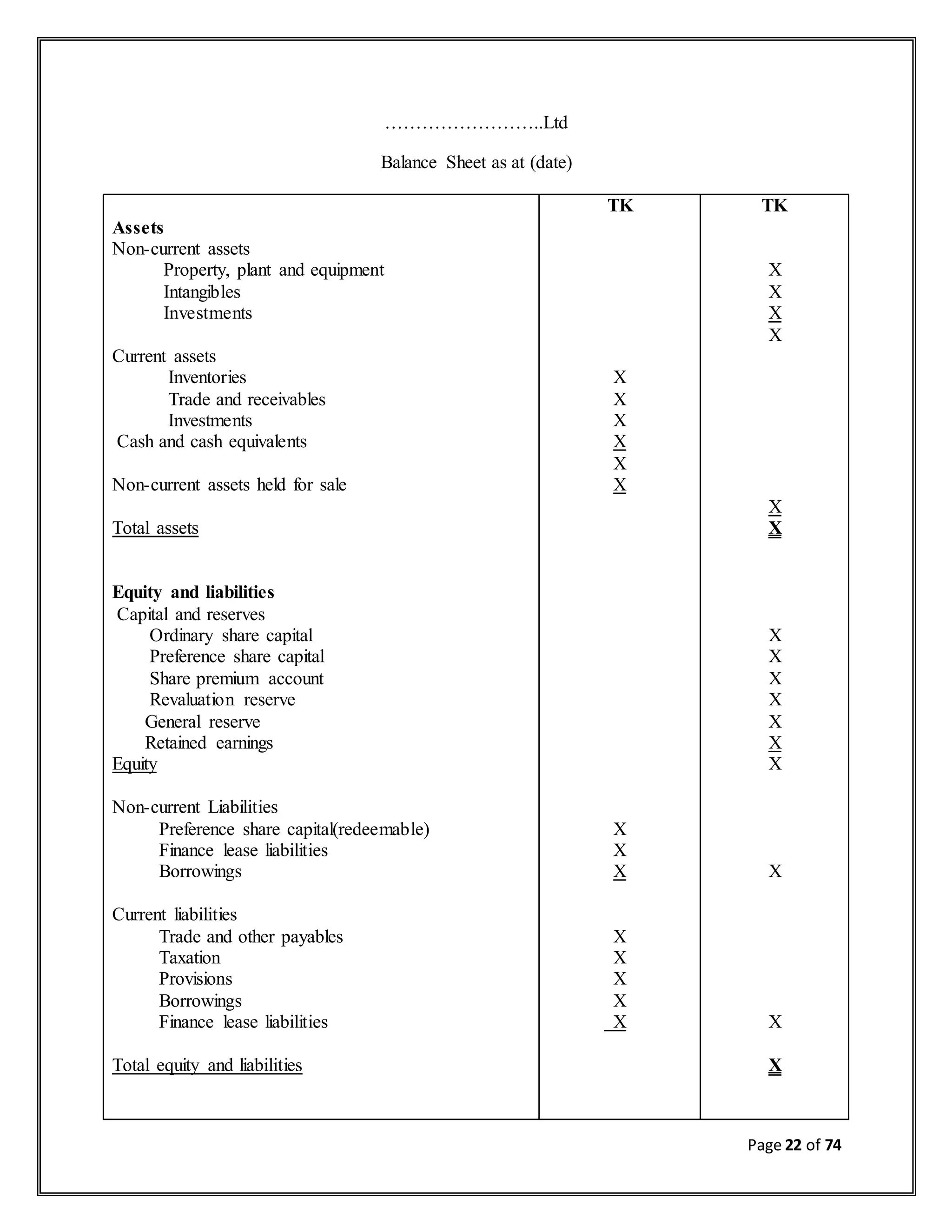
The format of balance sheet is given below which is consistent with the minimum requirements
of BAS 1.
Page 22 of 74
……………………..Ltd
Balance Sheet as at (date)
Assets
Non-current assets
Property, plant and equipment
Intangibles
Investments
Current assets
Inventories
Trade and receivables
Investments
Cash and cash equivalents
Non-current assets held for sale
Total assets
Equity and liabilities
Capital and reserves
Ordinary share capital
Preference share capital
Share premium account
Revaluation reserve
General reserve
Retained earnings
Equity
Non-current Liabilities
Preference share capital(redeemable)
Finance lease liabilities
Borrowings
Current liabilities
Trade and other payables
Taxation
Provisions
Borrowings
Finance lease liabilities
Total equity and liabilities
TK
X
X
X
X
X
X
X
X
X
X
X
X
X
X
TK
X
X
X
X
X
X
X
X
X
X
X
X
X
X
X
X
Page 23 of 74
3.2.2 Information must be appeared on the balance sheet
BAS 1 specifies various items which must appear on the face of the balance sheet.
• Property, plant and equipment
• Investment property
• Intangibles assets
• Financial assets
• Investments accounted for using the equity method
• Assets classified as held for sale
• Inventories
• Trade and other receivables
• Cash and cash equivalents
• Provisions
• Trade and payables
• Financial liabilities
• Issued capital and reserves
3.2.3 Information presented on the face of the balance sheet or in the
notes
Certain information may be presented either on the face of the balance sheet or in the notes to the
financial statements.
These include:
 Further classification of line items.
 Details about each class of share capital.
 Details about each reserve within equity.
Page 24 of 74
3.2.4 Distinction between Current/ non-current assets and liabilities
A entity must present current and non-current assets and liabilities as separate classifications on
the face of balance sheet. This is to separate currents assets from fixed assets and amounts due
within one year from amounts due after more than one year.
Foe all businesses which have a clearly identifiable operating cycle, it is the current/non-current
presentation.
In either case, the entity should disclose any portion of an asset or liability which is expected to
be recovered after more than twelve months.
3.3 Income Statement (Statements of Financial Performance)
Income statement is a summary of a management's performance as reflected in the profitability )
of an organization over a certain period. It itemizes the revenues and expenses of past that led to
the current profit or loss, and indicates what may be done to improve the results.
In contrast to a balance sheet, an income statement depicts what happened over a month, quarter,
or year. It is based on a fundamental accounting equation (Income = Revenue - Expenses) and
shows the rate at which the owners equity is changing for better or worse. Along with balance
sheet and cash flow statement it forms the basic set of financial information required to
manage an organization also called earnings report, operating statement, or profit and
loss account.
Rules of preparing income statement according to BAS 1 -
 BAS 1 suggests two formats for the income statement
 Bas 1 specifies that certain items must be shown on the face of the income statement
3.3.1 Format of income statement
BAS 1 suggests two possible formats for the income statement. The difference between them
being the classification of expenses:
 By function
Page 25 of 74
 By nature
As income statement classifying expenses by function is more common in practice, we presented
a format of this type of income statement.
……………………..Ltd
Income statement for the Year ended (date)
3.3.2 Information presented in income statement
The standard lists the following as the minimum to be disclosed on the face of the income
statement
• Revenue
• Finance costs
Revenue
Cost of sales
Gross profit
Other operating income
Distribution costs
Administrative costs
Profit or loss from operations
Finance cost
Investment income
Profit or loss before tax
Income tax expense
Profit or loss for the period
TK
X
(X)
X
X
(X)
(X)
X
(X)
X
X
(X)
X
X
Page 26 of 74
• Share of profits and losses of associates for using the equity method
• Income tax expense
• Profit or loss
3.3.3 Information presented either on the income statement or in the
notes
These include
Exceptional items
These are material items of income and expense which should be disclosed separately. These
include:
 Write downs of inventories to NRV
 Write down of property, plant and equipment to recoverable amount
 Disposals of property, plant and equipment
 Disposals of investments
 Discontinued operations
 Litigation settlements
 Other reversals of provisions
3.4 Statement of changes in equity
A statement of changes in equity can be explained as a statement that can changes in equity for
corporation features be created for partnerships, sole proprietorships, or corporations. It is
framed as a straightforward measure of financial performance. The key purpose of this statement
is to summarize the activity in take equity accounts for a certain period. Sole proprietorships and
partnerships follow a similar format for their statements of changes in equity. On the contrary,
the statement of changes in equity for a corporation features a slightly different format.
The statement of changes in equity shows the total recognized income and expenses for the
period.
Page 27 of 74
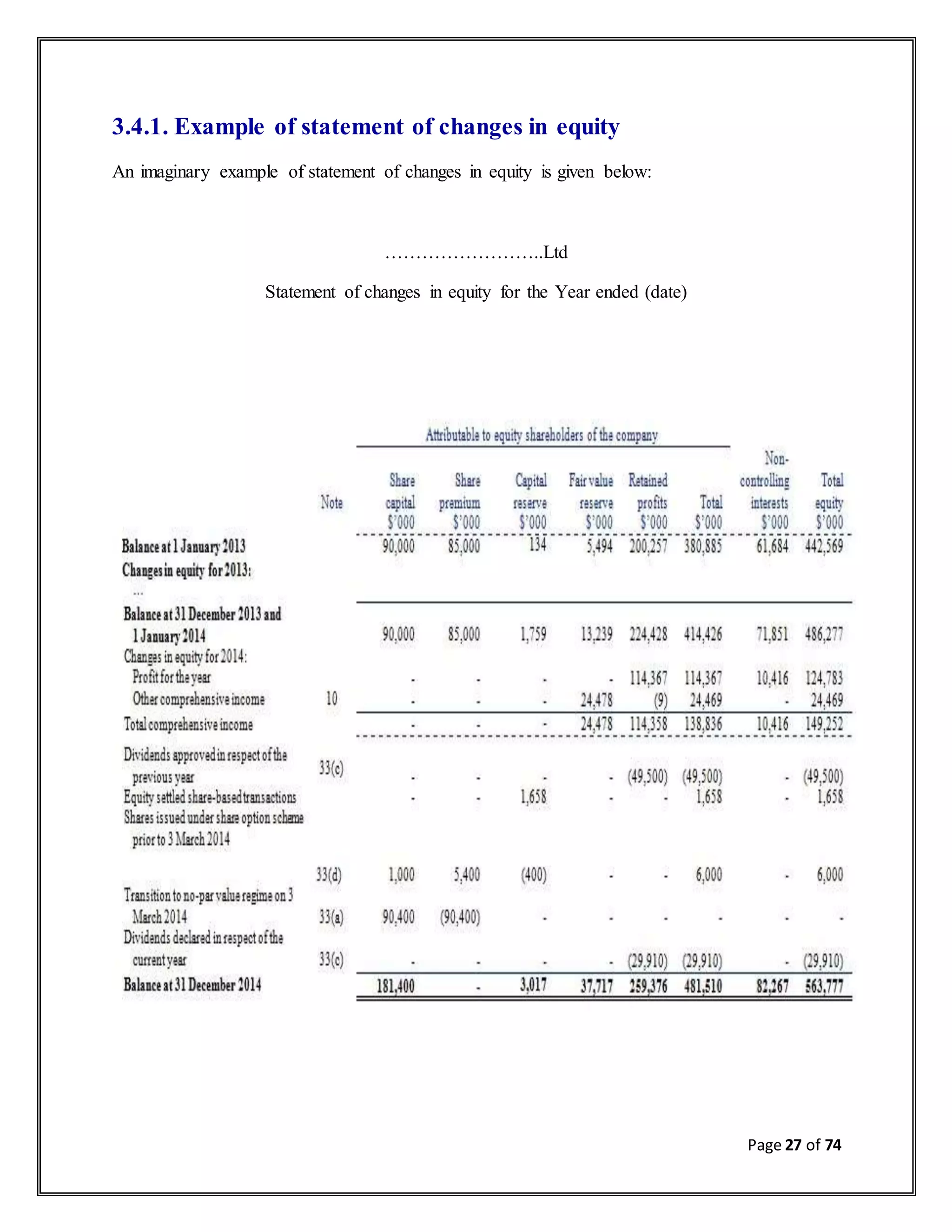
3.4.1. Example of statement of changes in equity
An imaginary example of statement of changes in equity is given below:
……………………..Ltd
Statement of changes in equity for the Year ended (date)
Page 28 of 74
3.4.2. Information presented in the statement of changes in equity
As per BAS 1, the statement of changes in equity is one of the five components of complete
financial statements counting income statement, balance sheet, statement of changes in equity,
notes to financial statements, and cash flow statements. According to IAS, the statement must
include:
 Profit or loss for the specific period
 Every item of income and expenditure for the period which is specified directly in the
equity, rather than in the income statement
 Total income and expense for the period specified (evaluated as the sum of (I) & (II)),
representing individually the total amounts attributable to equity holders of minority
interest besides the parent holder
 The effects of changes in the accounting policies and rectification of errors for each
component of equity where these have been recognized during the period in accordance
with BAS 8.
3.5 Statement of cash flow
A statement of cash flows is a financial statement which summarizes cash transactions of a
business during a given accounting period and classifies them under three heads, namely, cash
flows from operating, investing and financing activities. It shows how cash moved during the
period by indicating whether a particular line item is a cash inflow or cash out-flow. The term
cash as used in the statement of cash flows refers to both cash and cash equivalents. Cash flow
statement provides relevant information in assessing a company's liquidity, quality of earnings
and solvency. All entities are required to prepare a statement of cash flow in compliance with
BAS 7.
3.5.1 Benefits of statement of cash flow
Cash flow statements should be used in conjunction with the rest of the financial statements. It
shows:
Page 29 of 74
the changes in net assets
the entity’s financial position
the entity’s ability to adapt to changing circumstances and opportunities
3.5.2 Presentation of a cash flow statement
Cash flows are classified as
1. Cash Flows from Operating Activities
This section includes cash flows from the principal revenue generation activities such as sale and
purchase of goods and services. Cash flows from operating activities can be computed using two
methods. One is the direct method and the other indirect method. AS 7 prefers direct methods but
does not require it. The standard gives the following example of cash flows from operating
activities:
 Cash receipts from the sale of goods and rendering of services.
 Cash receipts from royalties, fees, commissions and other revenue.
 Cash payments to suppliers for goods and services
 Cash payments to and on behalf of employees.
2. Cash Flows from Investing Activities
Cash flows from investing activities are cash inflows and out-flow related to activities that are
derived from acquisition and disposal of noncurrent assets.
The standard gives the following examples of cash flows which must arise under this heading.
 Cash payment to acquire property, plant and equipment, intangibles and other non-
current assets.
 Cash receipt from sales property, plant and equipment, intangibles and other non-current
assets.
 Cash payment to acquire equity or debt of other entities.
 Cash receipt from sale of equity or debt of other entities.
 Interest received
Page 30 of 74
 Dividend received
3. Cash Flows from Financing Activities
Cash flows from financing activities are the cash flows related to transactions with stockholders
and creditors such as issuance of share capital, purchase of treasury stock, dividend payments
borrowing of the entity etc.
The standard gives the following examples of cash flows which must arise under this heading.
 Cash proceeds from issuing shares
 Cash payments to owners to acquire or redeem the entity’s shares.
 Cash proceeds from issuing debentures, loans, notes, bonds, mortgage and other short
term and long term borrowings.
 Repayment of capital of amount borrowed under finance leases.
 Dividends paid
Page 31 of 74
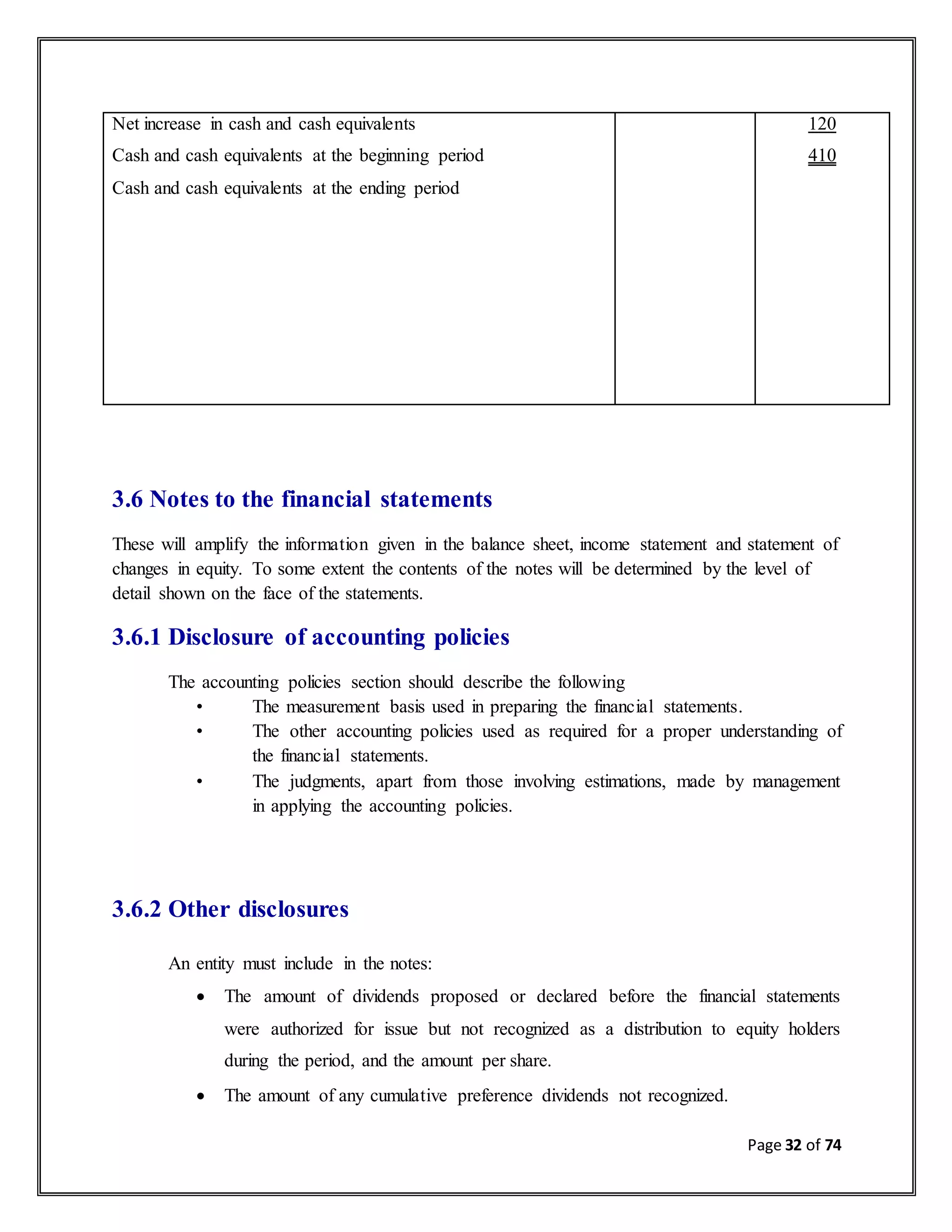
3.5.3. Example of a cash flow statement
Here is an example of cash flow statement
Cash flow statement
Year ended 31 December 2007
Cash flows from operating activities
Cash generated from operations
Interest paid
Income tax
Net cash flows from operating activities
Cash flows from investing activities
Purchase of property, plant and equipment
Proceeds from sales property, plant and equipment assets
Interest received
Dividend received
Net cash flows from investing activities
Cash flows from financing activities
Cash proceeds from issuing shares
Cash proceeds from issuing long term borrowings
Dividend paid
Net cash flows from financing activities
TK
2,730
(270)
(900)
(900)
20
200
200
250
250
(1290)
TK
1560
(480)
(790)
290
Page 32 of 74
Net increase in cash and cash equivalents
Cash and cash equivalents at the beginning period
Cash and cash equivalents at the ending period
120
410
3.6 Notes to the financial statements
These will amplify the information given in the balance sheet, income statement and statement of
changes in equity. To some extent the contents of the notes will be determined by the level of
detail shown on the face of the statements.
3.6.1 Disclosure of accounting policies
The accounting policies section should describe the following
• The measurement basis used in preparing the financial statements.
• The other accounting policies used as required for a proper understanding of
the financial statements.
• The judgments, apart from those involving estimations, made by management
in applying the accounting policies.
3.6.2 Other disclosures
An entity must include in the notes:
 The amount of dividends proposed or declared before the financial statements
were authorized for issue but not recognized as a distribution to equity holders
during the period, and the amount per share.
 The amount of any cumulative preference dividends not recognized.
Page 33 of 74
Page 34 of 74
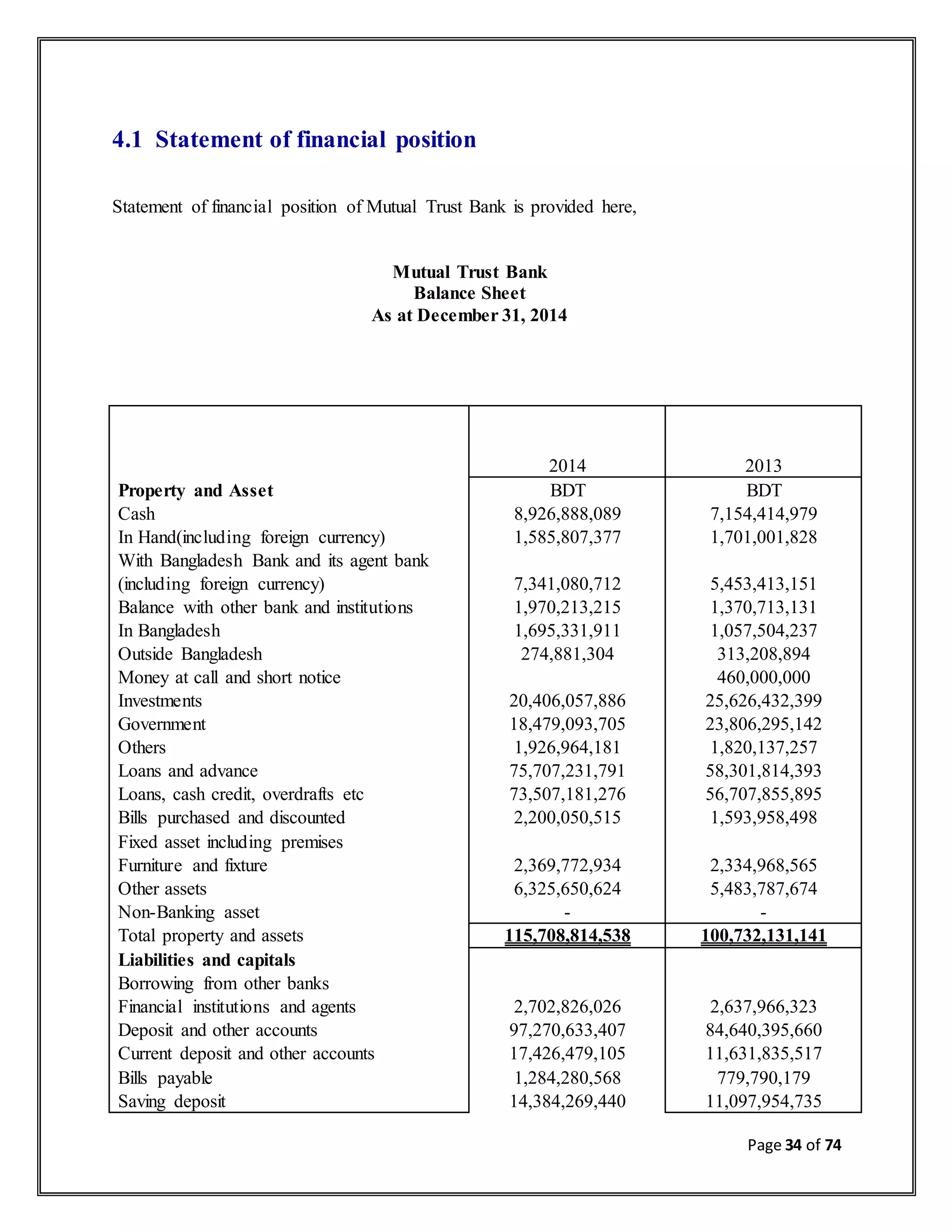
2014 2013
Property and Asset BDT BDT
Cash 8,926,888,089 7,154,414,979
In Hand(including foreign currency) 1,585,807,377 1,701,001,828
With Bangladesh Bank and its agent bank
(including foreign currency) 7,341,080,712 5,453,413,151
Balance with other bank and institutions 1,970,213,215 1,370,713,131
In Bangladesh 1,695,331,911 1,057,504,237
Outside Bangladesh 274,881,304 313,208,894
Money at call and short notice 460,000,000
Investments 20,406,057,886 25,626,432,399
Government 18,479,093,705 23,806,295,142
Others 1,926,964,181 1,820,137,257
Loans and advance 75,707,231,791 58,301,814,393
Loans, cash credit, overdrafts etc 73,507,181,276 56,707,855,895
Bills purchased and discounted 2,200,050,515 1,593,958,498
Fixed asset including premises
Furniture and fixture 2,369,772,934 2,334,968,565
Other assets 6,325,650,624 5,483,787,674
Non-Banking asset - -
Total property and assets 115,708,814,538 100,732,131,141
Liabilities and capitals
Borrowing from other banks
Financial institutions and agents 2,702,826,026 2,637,966,323
Deposit and other accounts 97,270,633,407 84,640,395,660
Current deposit and other accounts 17,426,479,105 11,631,835,517
Bills payable 1,284,280,568 779,790,179
Saving deposit 14,384,269,440 11,097,954,735
4.1 Statement of financial position
Statement of financial position of Mutual Trust Bank is provided here,
Mutual Trust Bank
Balance Sheet
As at December 31, 2014
Page 35 of 74
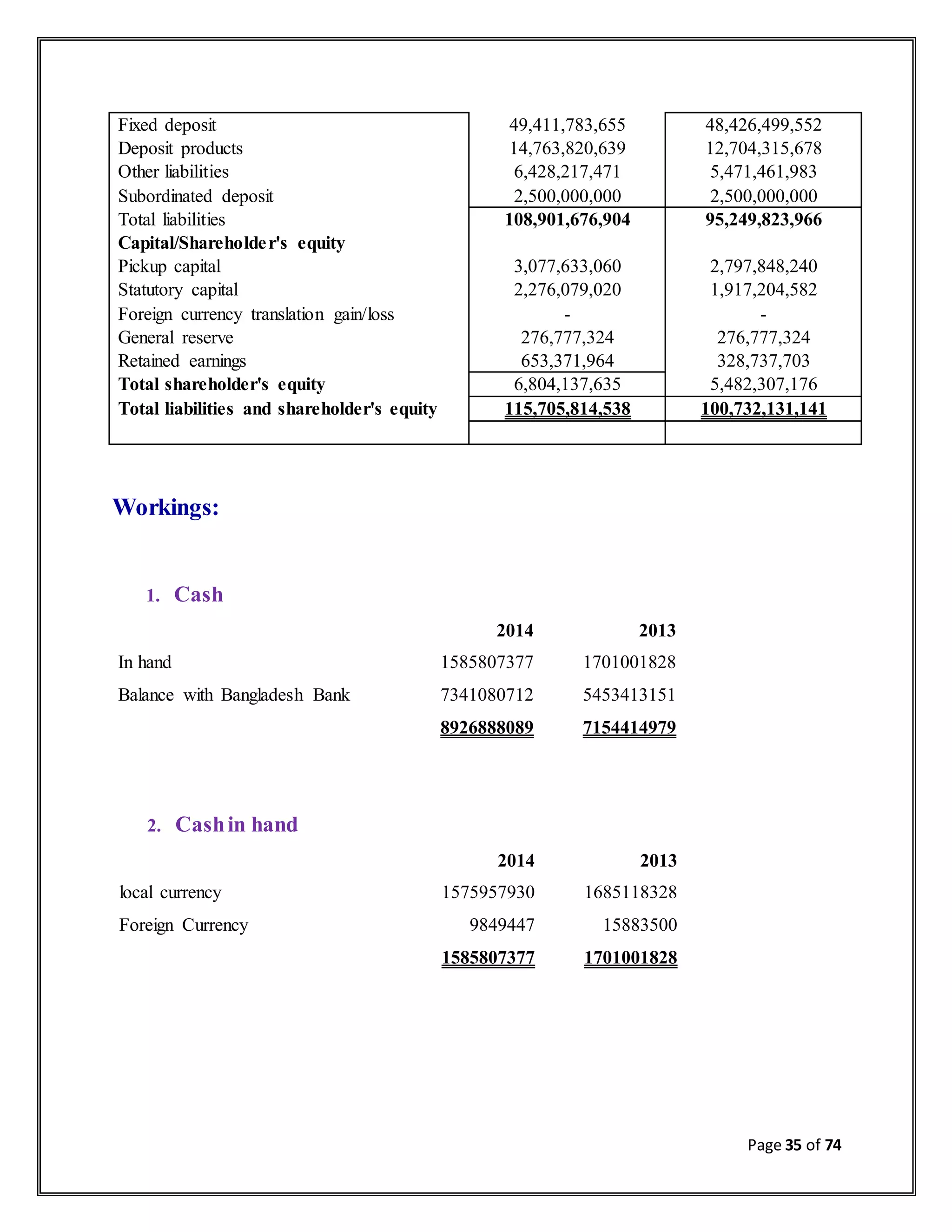
Fixed deposit 49,411,783,655 48,426,499,552
Deposit products 14,763,820,639 12,704,315,678
Other liabilities 6,428,217,471 5,471,461,983
Subordinated deposit 2,500,000,000 2,500,000,000
Total liabilities 108,901,676,904 95,249,823,966
Capital/Shareholder's equity
Pickup capital 3,077,633,060 2,797,848,240
Statutory capital 2,276,079,020 1,917,204,582
Foreign currency translation gain/loss - -
General reserve 276,777,324 276,777,324
Retained earnings 653,371,964 328,737,703
Total shareholder's equity 6,804,137,635 5,482,307,176
Total liabilities and shareholder's equity 115,705,814,538 100,732,131,141
Workings:
1. Cash
2014 2013
In hand 1585807377 1701001828
Balance with Bangladesh Bank 7341080712 5453413151
8926888089 7154414979
2. Cashin hand
2014 2013
local currency 1575957930 1685118328
Foreign Currency 9849447 15883500
1585807377 1701001828
Page 36 of 74
3. Fixed asset
2014 2013
Land 104253000 104253000
Immovable property 995326830 995326830
Furniture & fixtures 1093022070 968869940
Office equipment 1075968599 922560915
Motor vehicles 54649664 48382748
Blocks and periodicals 423974 423974
Intangible assets 70367646 80471004
Leased assets 48455000 48455000
Total cost 3442466783 3168743411
Less: Accumulated depreciation 1072693849 833774846
Book value at the end of the year 2369772934 2334968565
4. Retainedearnings
2014 2013
Opening Balance 328737703 284769050
Add. Profit for the year 963293518 578181250
Less. Bonus share issue (279784819) (254349840)
Less. Transferred to Statutory reserve (358874438) (279862757)
Closing balance 653371964 328737703
Page 37 of 74
4.2 Statement of financial performance
Statement of financial statement of Mutual Trust Bank is provided here,
Mutual Trust Bank Ltd.
Profit and Loss Account
For the year ended December 31, 2014
2014 2013
Particulars BDT BDT
Interest income 9,426,970,071 8,675,511,888
less: interest paid on deposit and borrowing
etc. 7,910,059,642 7,997,883,744
Net interest income 1,516,910,429 677,628,144
Income from investments 2,608,301,690 2,603,854,730
Commission, Exchange and Brokerage 704,561,402 628,696,332
Other operating income 375,563,211 347,061,067
3,688,426,302 3,579,612,129
Total operating income 5,025,336,732 4,257,240,272
less: Operating expenditure
Salary and allowance 1,493,841,751 1,138,200,598
Rent, tax, insurance and electricity 480,218,233 432,273,845
Legal expense 3,160,564 1,563,657
Postage, stamps and telephone 15,567,614 16,553,109
Printing, stationery and advertisement 104,089,036 84,956,292
Managing Director's remuneration 14,999,333 14,039,333
Director's fee 1,409,750 775,000
Audit fees 943,000 930,000
Depreciation on and repair to bank's property 291,679,656 256,152,998
Other expenditure 573,828,105 487,950,114
Total operating expenses 2,879,737,043 2,433,394,946
Profit before provision 2,325,599,689 1,823,845,327
less: provisions against loans and advances
including off balances sheet items 427,530,521 455,899,298
less: provisions against investment in quoted shares 101,227,502 99,147,985
less: provision against other asset 2,469,480 -
Total provision 531,227,503 555,047,283
Page 38 of 74
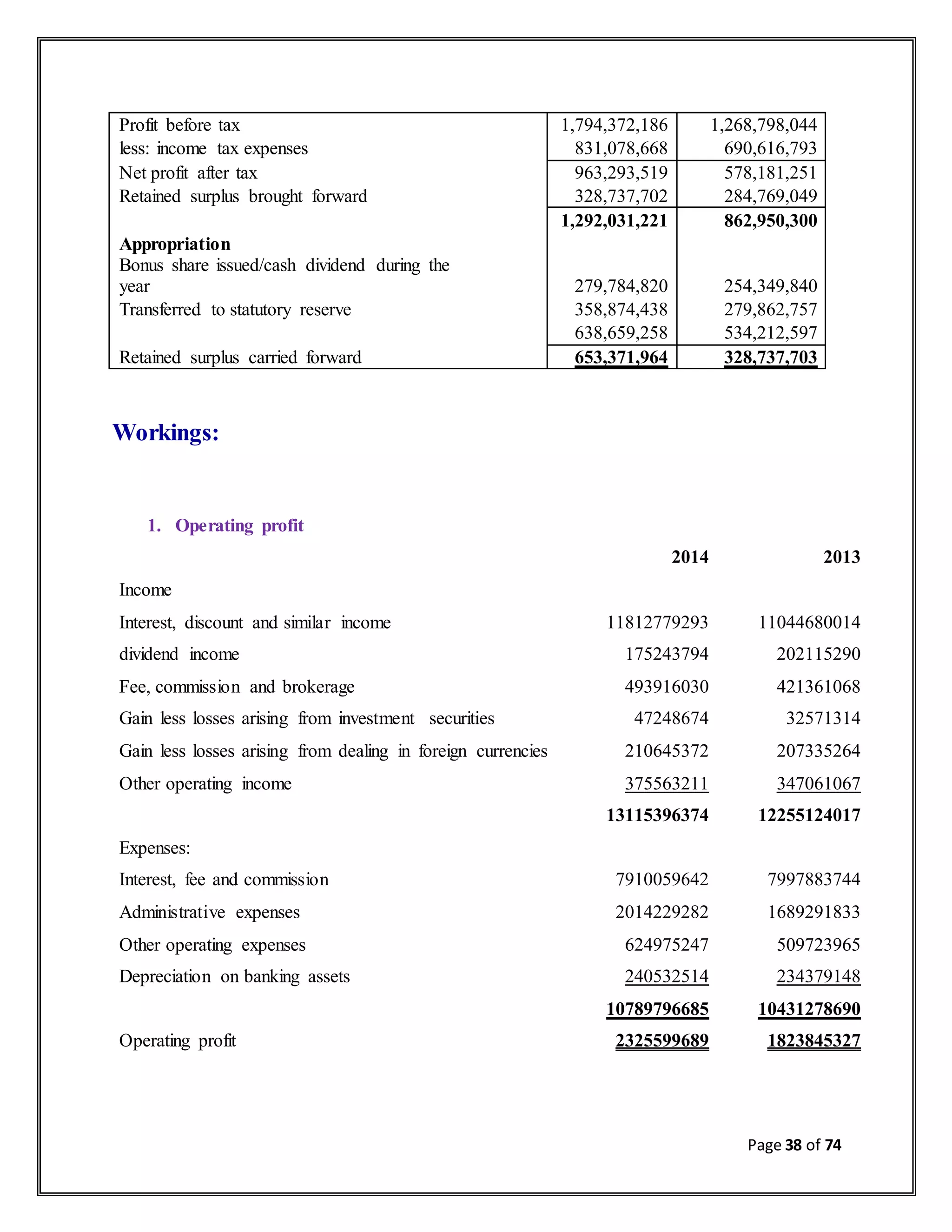
Profit before tax 1,794,372,186 1,268,798,044
less: income tax expenses 831,078,668 690,616,793
Net profit after tax 963,293,519 578,181,251
Retained surplus brought forward 328,737,702 284,769,049
1,292,031,221 862,950,300
Appropriation
Bonus share issued/cash dividend during the
year 279,784,820 254,349,840
Transferred to statutory reserve 358,874,438 279,862,757
638,659,258 534,212,597
Retained surplus carried forward 653,371,964 328,737,703
Workings:
1. Operating profit
2014 2013
Income
Interest, discount and similar income 11812779293 11044680014
dividend income 175243794 202115290
Fee, commission and brokerage 493916030 421361068
Gain less losses arising from investment securities 47248674 32571314
Gain less losses arising from dealing in foreign currencies 210645372 207335264
Other operating income 375563211 347061067
13115396374 12255124017
Expenses:
Interest, fee and commission 7910059642 7997883744
Administrative expenses 2014229282 1689291833
Other operating expenses 624975247 509723965
Depreciation on banking assets 240532514 234379148
10789796685 10431278690
Operating profit 2325599689 1823845327
Page 39 of 74
2. Income from investments 2014 2013
Interest on treasury bill 440337473 555858509
Interest on treasury bond 1932473953 1790553549
Reverse REPO 1572 12653
Gain/(loss) on investment in shares 47248674 32571314
Dividend From subsidiary 119000000 143175000
Prize bond 1000 (500)
Dividend on investment in shares 56243794 58940290
Other investment 12995224 22743915
2608301690 2603854730
4. Depreciation and repairs of bank’s property 2014 2013
Immovable property 23846023 24457479
Furniture & fixture 73164650 70400480
Office equipments 129719254 127935032
Motor vehicles 4171591 1955161
Books & periodicals - -
Leasehold Property 9630996 9630996
240532514 234379148
Repairs on Bank's property 51147142 21773850
291679656 256152998
3. Rent, tax, insurance, electricity etc. 2014 2013
Rent 325858657 301091647
Rent and taxes 2775936 1455158
Insurance 65351577 55648604
Power & electricity 85025283 71302014
Lease Rent 1206780 2740422
480218233 432237845
Page 40 of 74
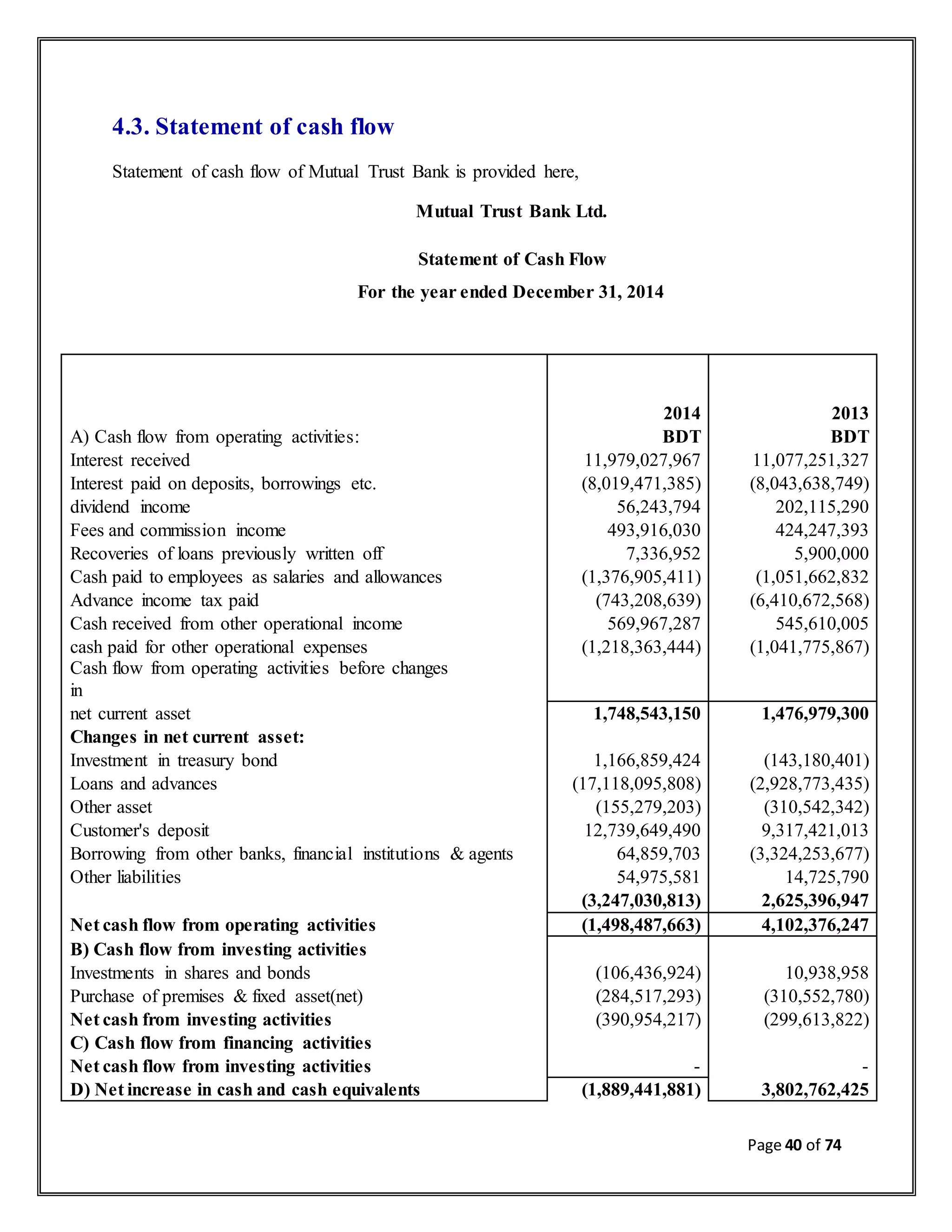
4.3. Statement of cash flow
Statement of cash flow of Mutual Trust Bank is provided here,
Mutual Trust Bank Ltd.
Statement of Cash Flow
For the year ended December 31, 2014
2014 2013
A) Cash flow from operating activities: BDT BDT
Interest received 11,979,027,967 11,077,251,327
Interest paid on deposits, borrowings etc. (8,019,471,385) (8,043,638,749)
dividend income 56,243,794 202,115,290
Fees and commission income 493,916,030 424,247,393
Recoveries of loans previously written off 7,336,952 5,900,000
Cash paid to employees as salaries and allowances (1,376,905,411) (1,051,662,832
Advance income tax paid (743,208,639) (6,410,672,568)
Cash received from other operational income 569,967,287 545,610,005
cash paid for other operational expenses (1,218,363,444) (1,041,775,867)
Cash flow from operating activities before changes
in
net current asset 1,748,543,150 1,476,979,300
Changes in net current asset:
Investment in treasury bond 1,166,859,424 (143,180,401)
Loans and advances (17,118,095,808) (2,928,773,435)
Other asset (155,279,203) (310,542,342)
Customer's deposit 12,739,649,490 9,317,421,013
Borrowing from other banks, financial institutions & agents 64,859,703 (3,324,253,677)
Other liabilities 54,975,581 14,725,790
(3,247,030,813) 2,625,396,947
Net cash flow from operating activities (1,498,487,663) 4,102,376,247
B) Cash flow from investing activities
Investments in shares and bonds (106,436,924) 10,938,958
Purchase of premises & fixed asset(net) (284,517,293) (310,552,780)
Net cash from investing activities (390,954,217) (299,613,822)
C) Cash flow from financing activities
Net cash flow from investing activities - -
D) Net increase in cash and cash equivalents (1,889,441,881) 3,802,762,425
Page 41 of 74
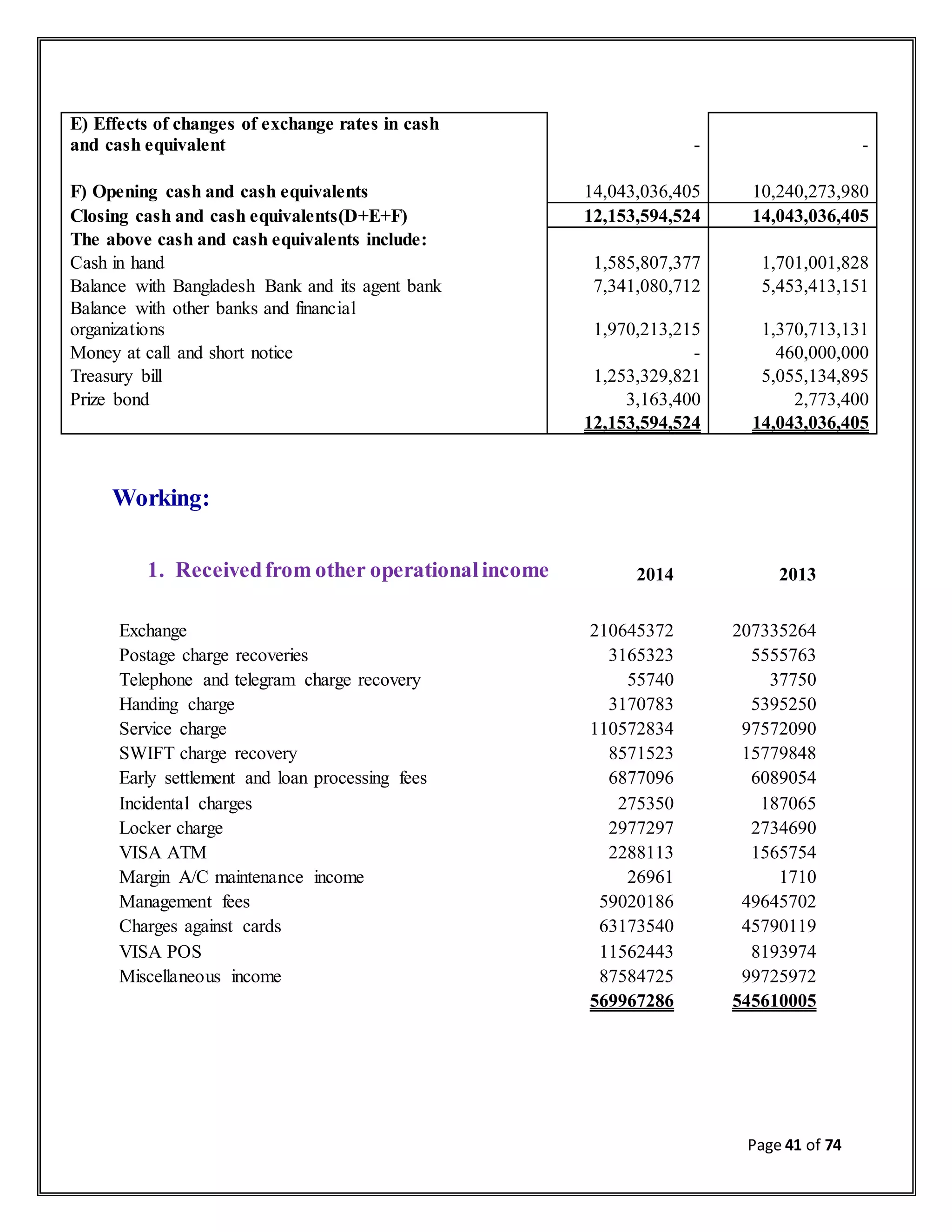
E) Effects of changes of exchange rates in cash
and cash equivalent - -
F) Opening cash and cash equivalents 14,043,036,405 10,240,273,980
Closing cash and cash equivalents(D+E+F) 12,153,594,524 14,043,036,405
The above cash and cash equivalents include:
Cash in hand 1,585,807,377 1,701,001,828
Balance with Bangladesh Bank and its agent bank 7,341,080,712 5,453,413,151
Balance with other banks and financial
organizations 1,970,213,215 1,370,713,131
Money at call and short notice - 460,000,000
Treasury bill 1,253,329,821 5,055,134,895
Prize bond 3,163,400 2,773,400
12,153,594,524 14,043,036,405
Working:
1. Receivedfrom other operationalincome 2014 2013
Exchange 210645372 207335264
Postage charge recoveries 3165323 5555763
Telephone and telegram charge recovery 55740 37750
Handing charge 3170783 5395250
Service charge 110572834 97572090
SWIFT charge recovery 8571523 15779848
Early settlement and loan processing fees 6877096 6089054
Incidental charges 275350 187065
Locker charge 2977297 2734690
VISA ATM 2288113 1565754
Margin A/C maintenance income 26961 1710
Management fees 59020186 49645702
Charges against cards 63173540 45790119
VISA POS 11562443 8193974
Miscellaneous income 87584725 99725972
569967286 545610005
Page 42 of 74
4.4 Comparative analysis:
Property plant and equipment:
Property plant and equipment are the tangible assets which are held for use in the production or
supply of goods or services, for rental to others or for administrative purposes.
BAS 16 provides guidance on the accounting treatment of property plant and equipment.
Recognition: According to BAS 16 property plant and equipment should be recognized when
future economic benefit will flow to the entity and the item’s cost can be measured reliably.
Measurement: According to BAS 16 property plant and equipment should be measured at cost
initially and subsequent cost should be measured at fair value.
Comparison: Property plant and equipment of Mutual Trust Bank is land & building, which is
recognized at cost at the time of acquisition and subsequently measured at fair value.
So we can say Mutual Trust Bank complies with BAS 16 to record property plant and
equipment.
Depreciation:
Bas 16 requires that a systematic basis should be used to allocate the depreciable amount over
assets useful life. A number of methods are introduced. They are Straight line method, reducing
balance method or sum of year digit method.
Comparison: Depreciation is charged at the following rates on reducing balance method on all
fixed assets other than motor vehicles and leased assets.
Category of fixed assets Rates of depreciation
Land Nil
Immovable property 2.50%
Furniture and fixtures 10%
Office equipments 20%
Page 43 of 74
Motor vehicles 20%
Books and periodicals 10%
Leasehold assets 20%
Intangible assets 20%
Lease:
Lease is an agreement whereby the lessor conveys to the lessee in return for a payment or series
of payments the right to use an asset for an agreed period of time. Accounting treatment of lease
should be complies with BAS 17. According to BAS 17 there are two types of lease financial
lease and operating lease.
Comparison:
Asset under finance leases of Mutual Trust Bank are recognized as asset of the bank at their fair
value at the date of acquisition or if lower at the present value of the minimum lease payments.
The corresponding liability to the lessor is included in the balance sheet as a finance lease
obligation. Finance charges are charged against income.
So we can say Mutual Trust Bank complies with BAS 17 to account leases.
Contingent liabilities and assets:
Contingent liabilities and assets are accounted in accordance with BAS 37.
Comparison: The bank recognized provision only when it has a present obligation as a result of
past events and it is probable that an outflow of resources embodying economic benefits will be
required to settle the obligation and when a reliable estimate of the obligation can be made.
So we can say Mutual Trust Bank complies with BAS 37 to account contingent liabilities and
assets.
Page 44 of 74
Other liability is recognized in the balance sheet according to the guideline of Bangladesh Bank
and BAS 37 and internal policy of the banks. Provisions and accrued expenses are recognized in
the financial statements when the bank has a legal or constrictive obligation as a result of past
event, and it is probable that an outflow of resources embodying economic benefits will be
required to settle the obligation and a reliable estimate can be made of the amount of the
obligation.
Revenues:
Revenues are the income arising in the normal course of activities.
BAS 18 provides guidance on the accounting treatment of revenues.
Recognition: According to BAS 18 revenue should be recognized when future economic benefit
will flow to the entity and the benefit can be measured reliably.
Measurement: According to BAS 18 revenue should be measured at the fair value of the
consideration received.
Comparison: Revenue for this year of Mutual Trust Bank has been recognized according to the
provision of BAS 18 as well as Bangladesh Bank guidelines.
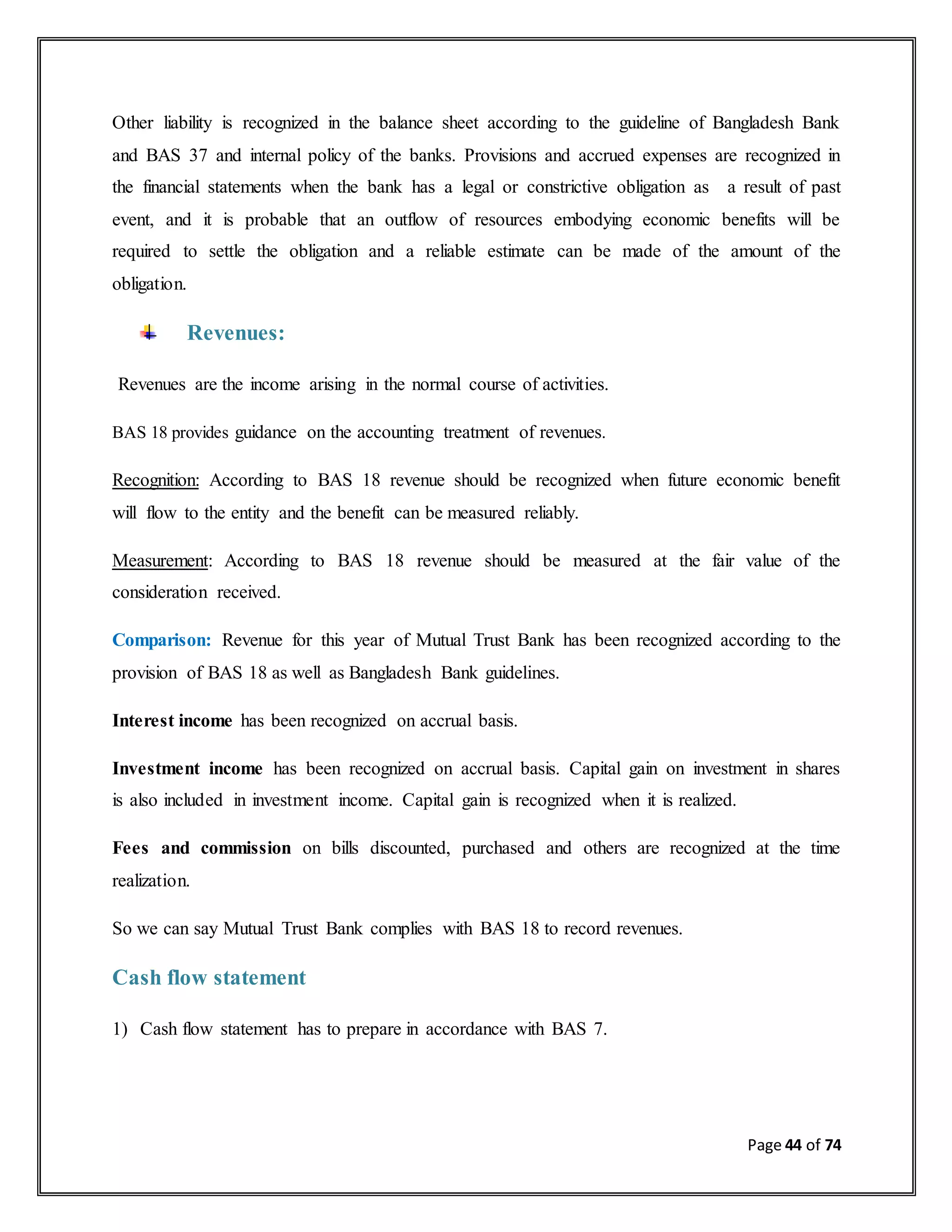
Interest income has been recognized on accrual basis.
Investment income has been recognized on accrual basis. Capital gain on investment in shares
is also included in investment income. Capital gain is recognized when it is realized.
Fees and commission on bills discounted, purchased and others are recognized at the time
realization.
So we can say Mutual Trust Bank complies with BAS 18 to record revenues.
Cash flow statement
1) Cash flow statement has to prepare in accordance with BAS 7.
Page 45 of 74
2) According to BFRSs cash flow statement can be presented either in direct method or in
indirect method. The presentation is selected to present these cash flows in a manner that is
most appropriate for the business or industry. The method is applied consistently.
3) According to Bangladesh Bank as per BRPD circular no. 14 dated 25 June 2003, cash flow
should be a mixture of direct and indirect method.
Comparison:
Here the statement of cash flows of the Mutual Trust Bank has been prepared in accordance with
BAS 7, Statement of cash flows and under the guideline of Bangladesh Bank BRPD circular no.
14 dated 25 June 2003.
The statement shows the structure of changes in cash and cash equivalents during the financial
year.
So we can say the bank complies with BAS 7 to prepare cash flow statement.
Page 46 of 74
Page 47 of 74
5.0. What is a group?
In simple term group is created where one company, the parent (P) buys shares in another
company, the subsidiary (S), such that the parent company controls the subsidiary. A group may
include one or many subsidiaries.
Shareholders
P Ltd.
S1 S2 S3
5.1. What is a subsidiary?
Asubsidiary is an entity, including an unincorporated entity such as a partnership, that is
controlled by another entity.
5.2. Why form a group?
A business may operate in several different markets with different characteristics. These
different markets will present different different issues for management to address in terms of
operations and finance and so on.
It would be possible for different activities to be carried out within a single limited company,
where separate divisions could be established for each activity. The owners would then receive
one set of accounts for that company reflecting all its activities.
Alternatively, each activity could be carried out within a separate company, each of which
controlled by the parent.
There are a number of reasons why the business might be structured this way.
Accountability of each group of managers can be made more precise, as they can be
identified more easily with the activities of the subsidiary which employes them.
Financing may be made easier, as lenders can see audited financial statements for the
individual company for which they are provoding finance.
Page 48 of 74
The assets of one subsidiary can be pledged as security for its borrowings, leaving the
assets of other subsidiaries unpledged.
Disposal of a business may be easier.
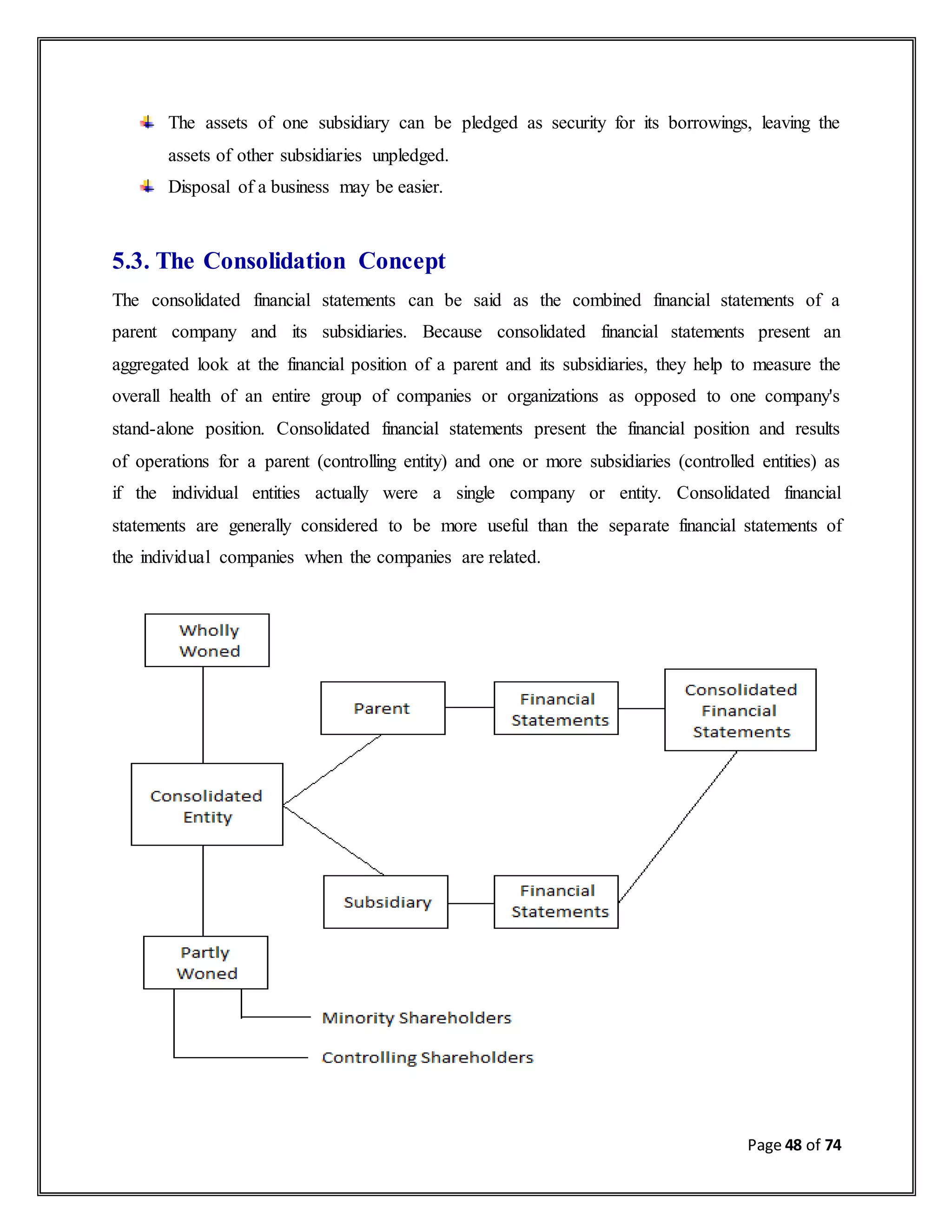
5.3. The Consolidation Concept
The consolidated financial statements can be said as the combined financial statements of a
parent company and its subsidiaries. Because consolidated financial statements present an
aggregated look at the financial position of a parent and its subsidiaries, they help to measure the
overall health of an entire group of companies or organizations as opposed to one company's
stand-alone position. Consolidated financial statements present the financial position and results
of operations for a parent (controlling entity) and one or more subsidiaries (controlled entities) as
if the individual entities actually were a single company or entity. Consolidated financial
statements are generally considered to be more useful than the separate financial statements of
the individual companies when the companies are related.
Page 49 of 74
Whether the subsidiary is acquired or created, each individual company maintains its own
accounting records, but consolidated financial statements are needed to present the companies
together as a single economic entity for general-purpose financial reporting. Some facts of
Consolidation-
Consolidation is done by Parent Entity.
Consolidation should be denominated by Parent’s reporting currency.
Any periodicity gap should be neutralized.
Non-Controlling Interests should be properly addressed.
Mostly Equity Method is used for Consolidation. - Approaches should be selected
appropriately.
5.4. The effect of Consolidated Financial Statement
Consolidated financial statements are presented primarily for the benefit of the investors,
creditors, and other resource providers of the parent. Significantly, consolidated financial
statements often represent the only means of obtaining a clear picture of the total resources of the
combined entity that are under the control of the parent company. Consolidated financial
statements report the financial results of the parent company and all of its subsidiary companies
in one combined report. Some companies own just one subsidiary, while others own many
subsidiaries. The consolidated financial statement includes just one set of financial results. As
each subsidiary reports its financial results to the parent, the accounting staff at the parent
company gathers the individual financial results, eliminates intercompany financial transactions
and consolidates the numbers into one statement. Several benefits exist for companies who create
consolidated financial statements. The Consolidated Financial Statement has following benefits-
1. Broad Picture: The basic advantage when consolidating financial statements is the broad
picture it gives. Investors do not want to go through several different financial statements to add
up information and find out how the corporation is doing overall. The consolidated statements
provided by the parent company accomplish the task automatically and make an excellent
reference point for shareholders, leaders and anyone interested in how all the different parts of
the business are functioning as a whole.
Page 50 of 74
2. Proper Balancing: Consolidating financial statements also lets a corporation effectively
balance its appearance to outside parties. For example, during one period a parent company may
lose revenue and perform poorly, but the subsidiaries may perform very well and increase
revenues. The consolidated statement will balance the poor parent's performance with thepositive
subsidiary performance, allowing the company to show that through its diversification it
remained profitable.
3. Exclusions: According to consolidated financial statement guidelines, a corporation can also
exclude certain divisions from the statements. This is also an advantage; because it allows
investors to see -- and companies to show -- that some financial aspects are not long term. For
example, subsidiaries are exempt if the parent company's ownership of them is temporary or if
the control of the company does not actually rest with the majority owner, which can happen
through bankruptcy.
4. Less Paperwork: Another benefit of consolidated financial statements is the reduced amount
of paperwork created for the statements. When a parent company owns multiple subsidiaries, a
set of financial statements exists for each individual company. Each set of financial statements
includes four separate reports. If a parent company owns nine subsidiaries, the complete set of
individual financial statements includes 40 reports. If the parent company consolidates the
financial statements, the set of financial statements only includes four reports.
5. Simplified: Consolidated financial statements also provide a simplified view of the
organization's results. When one subsidiary sells products to another, it creates an intercompany
transaction. One company records a sale, while another company records a purchase. The sale
and purchase cancel each other out from the complete organization perspective. Consolidated
financial statements eliminate these transactions and simplify the financial statements.
6. Necessity: Consolidated financial statements are required by most governments as an accurate
representation of a parent company's financial activity. In general, tax laws require that a single
accounting entity be represented out of the net resources and operating results of all the divisions
that a company owns. As a result, many companies have become used to producing consolidated
statements for governments, investors and internal analysis.
Page 51 of 74
7. Efficiency: One of the main advantages of the consolidated financial statement is efficiency.
Instead of examining the financial statements of each company in a network of dozens of
companies, an investor or an executive can examine a single financial statement to determine the
financial health of the entire network. Nevertheless, consolidated financial statements are usually
considerably more complex than stand-alone financial statements.
8. Fraud Prevention: Another primary gain for consolidated financial statements is the
prevention of fraud against investors. Without the requirement that parent companies consolidate
their financial statements, companies could easily bury losses from undermperforming divisions
and product lines in a web of subsidiaries and cross-shareholdings. In this case, underperforming
or failing subsidiaries could be draining the finances of the parent company to the point of near
bankruptcy, yet this state of affairs would not become apparent by reading the parent company's
stand-alone financial statement.
The ultimate benefit of consolidated financial statements should be ease of understanding and
analysis of a company's financial condition for investors, creditors, vendors and anyone else who
needs to know how secure the company is with respect to being able to pay its bills and continue
as a profitable enterprise. However, a more sinister benefit of consolidated finances is that they
can be manipulated to hide financial problems. It is extremely difficult to ascertain from these
statements whether there are hidden problems and exactly where they are in the enterprise.
Without consolidated financial statements the process of evaluating a company for investment or
financing purposes would be a long complex affair that might altogether miss important assets or
liabilities. In fact, many of the arguments that occur between company management, accounting
and auditing at year end involve how the consolidation of reports should be done in order to give
the most accurate picture of the company's financial health. It is the auditor's job to make sure
this consolidation of accounting reports accurately reflects the true condition of the company.
5.5. Boundaries of Consolidated Financial Statement
While consolidated financial statements are useful, their limitations also must be kept in mind.
Some information is lost any time data sets are aggregated; this is particularly true when the
information involves an aggregation across companies that have substantially different operating
Page 52 of 74
characteristics. Because subsidiaries are legally separate from their parents, the creditors and
stockholders of a subsidiary generally have no claim on the parent, nor do the stockholders of the
subsidiary share in the profits of the parent. Therefore, consolidated financial statements usually
are of little use to those interested in obtaining information about the assets, capital, or income of
individual subsidiaries. The following clauses are the boundaries of Consolidated Financial
Statements-
1. Lack of Subsidiary Information: The nature of consolidated financial statements is that a
group of companies is viewed as one entity. By this assumption's nature, the details of the
individual companies are not presented. In some cases, this is not important, as some subsidiaries
may not be material to the entire company's operations and results. In other cases, the
amalgamation of financial results can hide unprofitable subsidiaries and ventures. While the
company in whole may be performing well, consolidated statements may not show the entire
picture.
2. Elimination of Intercompany Transactions: Generally accepted accounting principles
require the elimination of intercompany transactions upon consolidation. Because of this rule,
investors are unable to ascertain the flow of funds between subsidiaries. This could be important
in determining which sections of the company are viable in the long term. Furthermore, in
situations where subsidiaries operate using different functional currencies, these eliminations can
lead to complex accounting and tax issues that may be in accordance with accounting principles,
but may be confusing to even seasoned investors.
3. Higher Group Materiality: When looking at a company on a consolidated basis, the
threshold for determining if accounting misstatements are material is generally higher. For
example, if a company had 10 subsidiaries that each had $1 million in annual sales, a $10,000
sale would be more important to those subsidiaries on an individual basis than to the group as a
whole. Because of this, companies and auditors need to implement controls to ensure that the
financial statements are fairly presented taken as a whole. This may mean that companies need to
reconsider an appropriate level of accuracy in the financial statements to reflect an acceptable
amount of misstatement. Many times this amount is in between the subsidiary and group level of
accuracy.
Page 53 of 74
4. Significant Influence vs. Control: A major limitation in the presentation of consolidated
financial statements is the creation of loopholes related to the consolidation of joint ventures,
variable interest entities, and other special purpose entities. While revisions in accounting
standards have started to address these issues, the rules of consolidation have allowed
unscrupulous companies to hide billions of dollars of debt from investors over the last couple of
decades, by creating entities that they do not directly control, but only influence. While the
accounting for these entities is complex, investors should be aware that the phenomenon exists
and should be vigilant if the performance of their investment appears too good to be true.
5. Masks Poor Performance: When income statements are brought together and reported on a
consolidated basis, the revenues, expenses and net profit are presented as combined figures. This
can hide any profitability issues with one or more of the companies. For example, if a subsidiary
lost a substantial amount of money in the year as a result of poor sales, financial statement
readers may not see that information if the loss is combined with profits of the parent company.
6. Hides Inter-company Sales: All inter-company transactions are removed in a consolidation.
On one hand, this presents a truer view of the companies by showing only financial activity with
non-related parties. However, it also hides the level of inter-company transactions. If related
companies spend most of their time and resources selling products or services in the group, an
outside investor will not be able to assess transfer prices or profit-shifting in the group. Both of
these things can be manipulated by companies and can affect income taxes. Consolidation hides
the extent of the inter-company activity.
7. Skews Financial Ratios: One way that investors assess the viability of a company is by its
ratios. Ratios are comparisons between financial statement lines. For example, the current ratio is
current assets divided by current liabilities. This ratio tells investors how well the company will
be able to pay its near-term obligations. In a consolidated financial statement, each company's
assets, liabilities and income are combined. Financial ratios based on combined numbers may not
be representative of each company's ratios. If one of the companies has a high level of debt
compared to the equity of the owners, that leverage would be hidden in a consolidated statement.
Consolidated financial statements do not always give a more accurate picture of the financial
health of an enterprise because the individual accounting reports from the subsidiaries do not
Page 54 of 74
show up anywhere but in the notes section of the consolidated finances. This makes it possible to
hide problems in the subsidiary reports, which is how Enron managed to hide the losses and
liabilities some of its failed projects generated. It just buried them in obscure subsidiaries created
for the purpose of hiding certain financial problems.
5.6. Financial Statements for Subsidiary
A company whose voting stock is more than 50% controlled by another company, usually
referred to as the parent company or holding company. A subsidiary is a company that is partly
or completely owned by another company that holds a controlling interest in the subsidiary
company. If a parent company owns a foreign subsidiary, the company under which the
subsidiary is incorporated must follow the laws of the country where the subsidiary operates, and
the parent company still carries the foreign subsidiary's financials on its books (consolidated
financial statements). For the purposes of liability, taxation and regulation, subsidiaries are
distinct legal entities. Though a Consolidated Financial Statement shows a broad picture of a
company, the parent and the subsidiary both are responsible to prepare their own separate
financial statements according to the rules of recording. Separate financial statements are helpful
to reveal the true environment of each of the subsidiary. Investors can understand which one is
more profitable and which one is not. Consolidated Financial Statements are not able to view the
real state, the just shows the combined picture of the company. So, each separate entity is
responsible to prepare & publish their financial statements.
5.7. Accounting Principles
The key issue underlying group accounts is therefore the need to reflect the economic substance
of the relationship between the companies where one has control over another, which together
comprise a group.
Producing consolidated accounts that present the group as though it were a single economic
entity reflects the economic substance.
Page 55 of 74
5.8. The effect of Consolidation
Group accounts consolidate the results and net assets of group members to represent the group to
the parent's shareholders as a single economic entity. This reflects the economic substance and
contrasts with the legal form, where, each company is a separate legal form.
5.9. Control
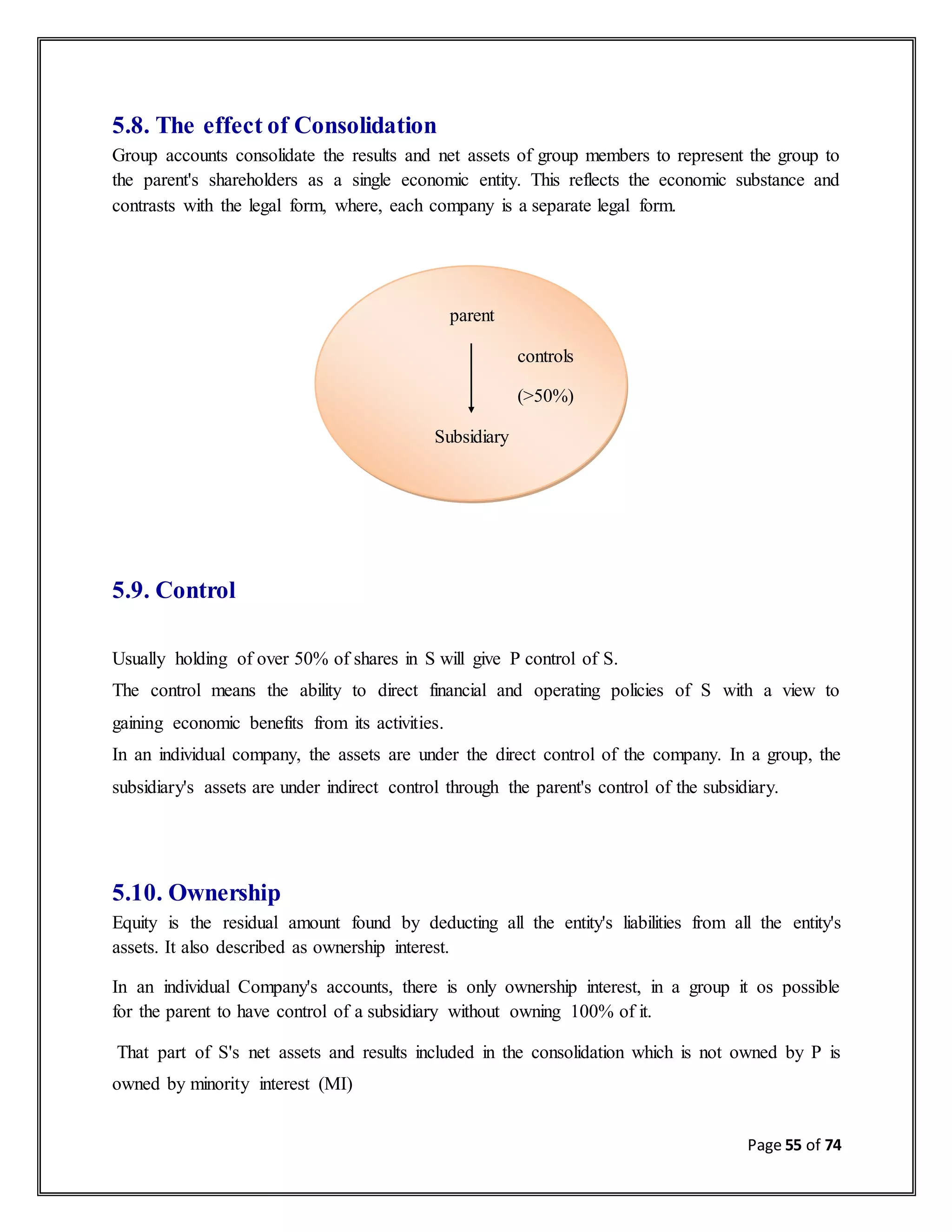
Usually holding of over 50% of shares in S will give P control of S.
The control means the ability to direct financial and operating policies of S with a view to
gaining economic benefits from its activities.
In an individual company, the assets are under the direct control of the company. In a group, the
subsidiary's assets are under indirect control through the parent's control of the subsidiary.
5.10. Ownership
Equity is the residual amount found by deducting all the entity's liabilities from all the entity's
assets. It also described as ownership interest.
In an individual Company's accounts, there is only ownership interest, in a group it os possible
for the parent to have control of a subsidiary without owning 100% of it.
That part of S's net assets and results included in the consolidation which is not owned by P is
owned by minority interest (MI)
parent
controls
(>50%)
Subsidiary
Page 56 of 74
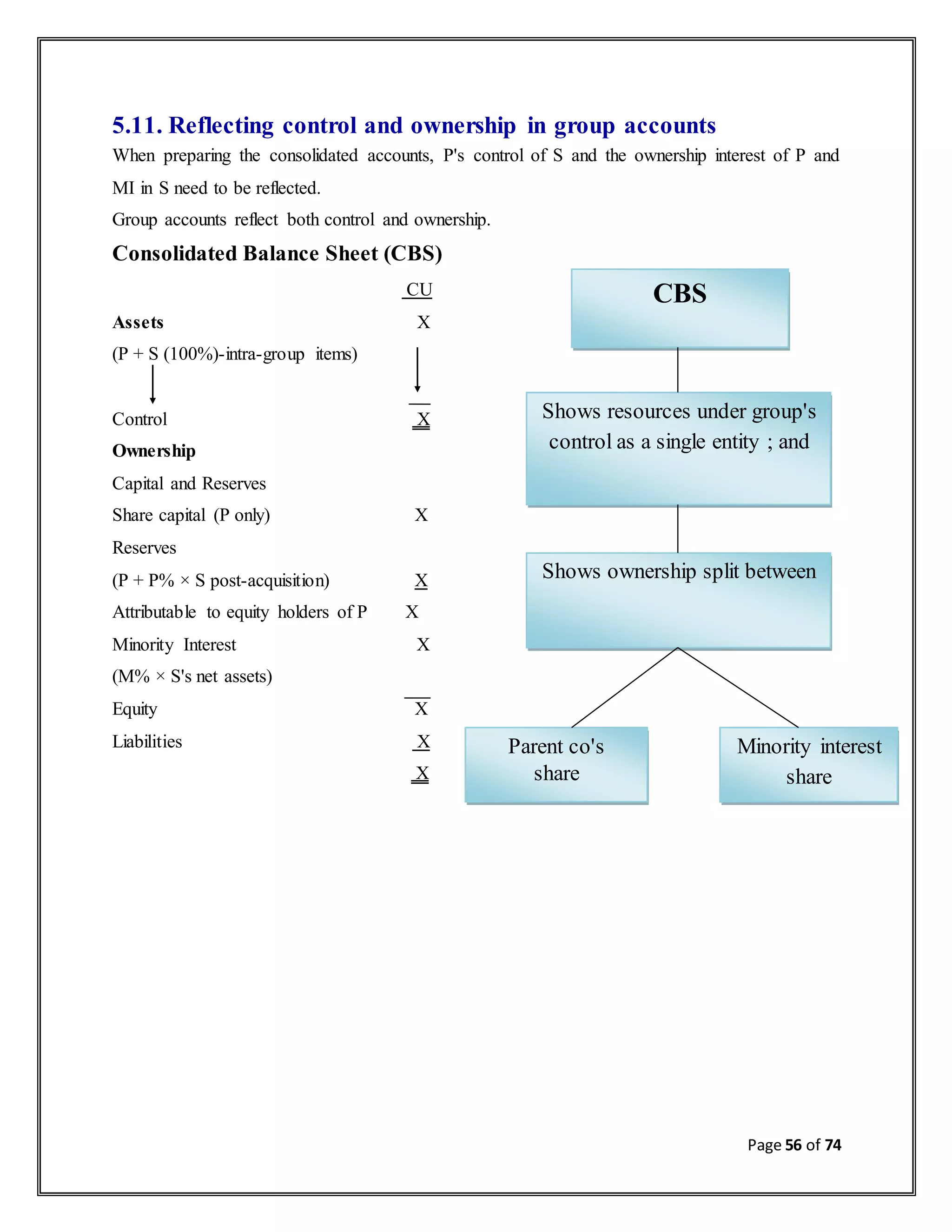
5.11. Reflecting control and ownership in group accounts
When preparing the consolidated accounts, P's control of S and the ownership interest of P and
MI in S need to be reflected.
Group accounts reflect both control and ownership.
Consolidated Balance Sheet (CBS)
CU
Assets X
(P + S (100%)-intra-group items)
Control X
Ownership
Capital and Reserves
Share capital (P only) X
Reserves
(P + P% × S post-acquisition) X
Attributable to equity holders of P X
Minority Interest X
(M% × S's net assets)
Equity X
Liabilities X
X
CBS
Shows resources under group's
control as a single entity ; and
Shows ownership split between
Parent co's
share
Minority interest
share
Page 57 of 74
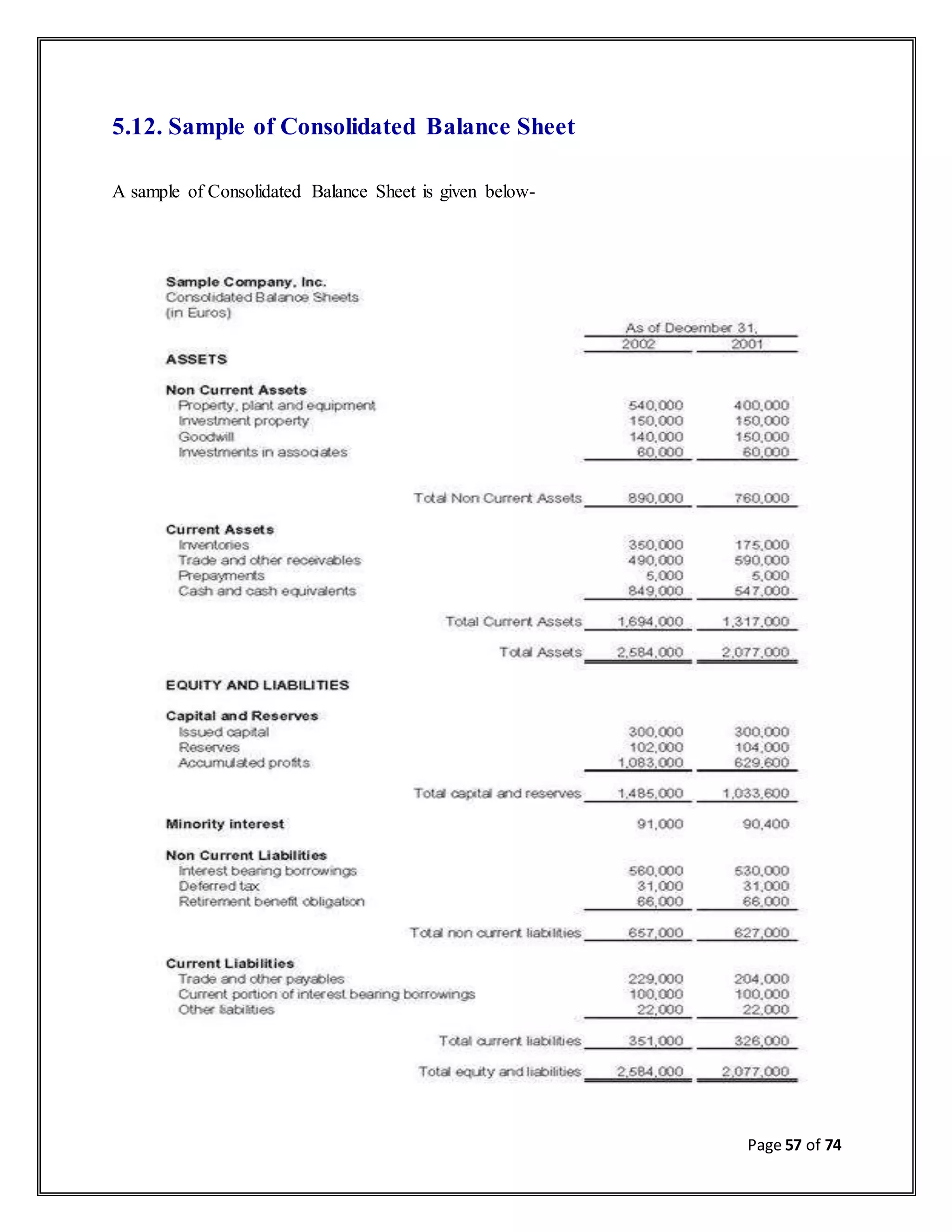
5.12. Sample of Consolidated Balance Sheet
A sample of Consolidated Balance Sheet is given below-
Page 58 of 74
Consolidated Income Statement
CU
Revenue X
(P + S (100%) - intra-group items)
Profit after tax (PAT) (Control) X
Ownership
Attributable to:
Equity holders of P X
Minority Interest (M% of S's PAT) X
x
Ownership: P% = P's share: MI% = MI share
CIS
Shows revenue and expenses
under group's control as a
single entity and
Shows PAT split between
Parents co's share Minority interest
share
Page 59 of 74
5.13. Sample of Consolidated Income Statement
A sample of Consolidated Income Statement is given below-
Page 60 of 74
Page 61 of 74
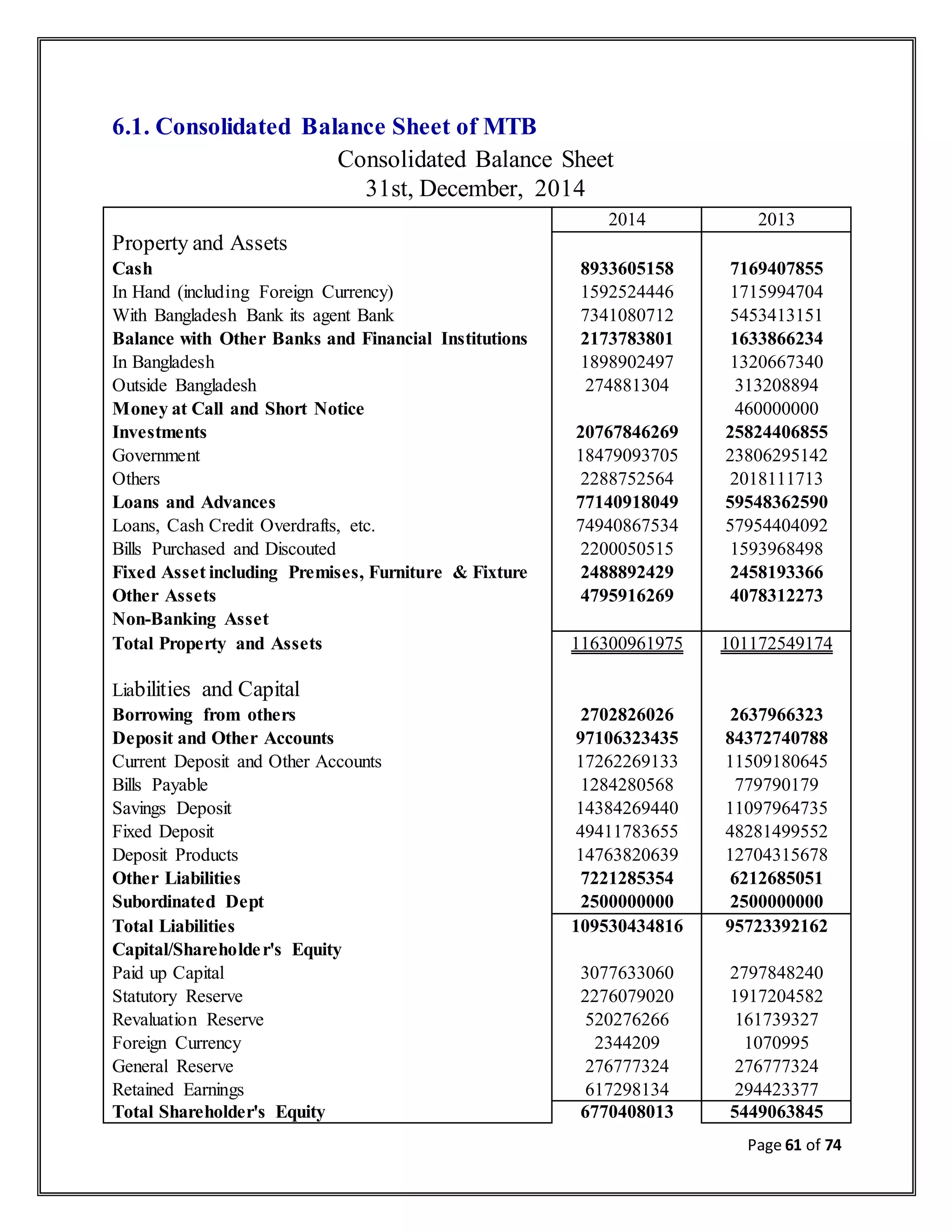
6.1. Consolidated Balance Sheet of MTB
Consolidated Balance Sheet
31st, December, 2014
2014 2013
Property and Assets
Cash 8933605158 7169407855
In Hand (including Foreign Currency) 1592524446 1715994704
With Bangladesh Bank its agent Bank 7341080712 5453413151
Balance with Other Banks and Financial Institutions 2173783801 1633866234
In Bangladesh 1898902497 1320667340
Outside Bangladesh 274881304 313208894
Money at Call and Short Notice 460000000
Investments 20767846269 25824406855
Government 18479093705 23806295142
Others 2288752564 2018111713
Loans and Advances 77140918049 59548362590
Loans, Cash Credit Overdrafts, etc. 74940867534 57954404092
Bills Purchased and Discouted 2200050515 1593968498
Fixed Asset including Premises, Furniture & Fixture 2488892429 2458193366
Other Assets 4795916269 4078312273
Non-Banking Asset
Total Property and Assets 116300961975 101172549174
Liabilities and Capital
Borrowing from others 2702826026 2637966323
Deposit and Other Accounts 97106323435 84372740788
Current Deposit and Other Accounts 17262269133 11509180645
Bills Payable 1284280568 779790179
Savings Deposit 14384269440 11097964735
Fixed Deposit 49411783655 48281499552
Deposit Products 14763820639 12704315678
Other Liabilities 7221285354 6212685051
Subordinated Dept 2500000000 2500000000
Total Liabilities 109530434816 95723392162
Capital/Shareholder's Equity
Paid up Capital 3077633060 2797848240
Statutory Reserve 2276079020 1917204582
Revaluation Reserve 520276266 161739327
Foreign Currency 2344209 1070995
General Reserve 276777324 276777324
Retained Earnings 617298134 294423377
Total Shareholder's Equity 6770408013 5449063845
Page 62 of 74
Workings
1) Consolidated Investment
2014 2013
Government Investment
Mutual Trust Bank Ltd. 18479093705 23806295142
MTB Securities Ltd. - -
MTB Capital Ltd. - -
MTB Exchange Ltd - -
18479093705 23806295142
Other Investments
Mutual Trust Bank Ltd. 1926964181 1820137257
MTB Securities Ltd. 194901851 181555582
MTB Capital Ltd. 166886532 16418874
MTB Exchange Ltd. - -
2288752564 2018111713
20767846269 25824406855
2) Consolidated Fixed Assets including premises, furniture and fixtures
Mutual Trust Bank Ltd.
2014
2369772934
2013
2334968565
MTB Securities Ltd. 109461778 111522217
MTB Capital Ltd. 6923097 8083165
MTB Exchange Ltd. 2734620 8619419
Consolidated net book value 2488892429 2458193366
Minority Interest 119147 93167
Total Liability and Shareholder's Equity 116300961975 101172549174
Page 63 of 74
3) Advance Income Tax
2014 2013
Opening Balance 2257716624 1616649356
Less: Adjustment made during the year - -
Add: Payment during the year 743208639 641067268
Closing Balance 300925263 2257716624
4) Consolidated Advance Income Tax
2014 2013
Mutual Trust BankLtd. 3000925263 2257716624
MTB SecuritiesLtd. 49385089 51929594
MTB Capital Ltd. 4184386 3075711
MTB Exchange Ltd. - -
3054494738 2312721929
5) Consolidated other assets
2014 2013
Mutual Trust Bank Ltd. 6325650624 5483787674
Less: Investment in Subsidiary -1548395800 -1548395800
4777254824 3935391874
MTB Securities Ltd. 125080450 243964420
MTB Capital Ltd. 11042348 40680573
MTB Exchange Ltd. 1538647 1450407
Less: Intra-group receivable and payable -119000000 -143175000
18661445 142920400
4795916269 4078312273
Page 64 of 74
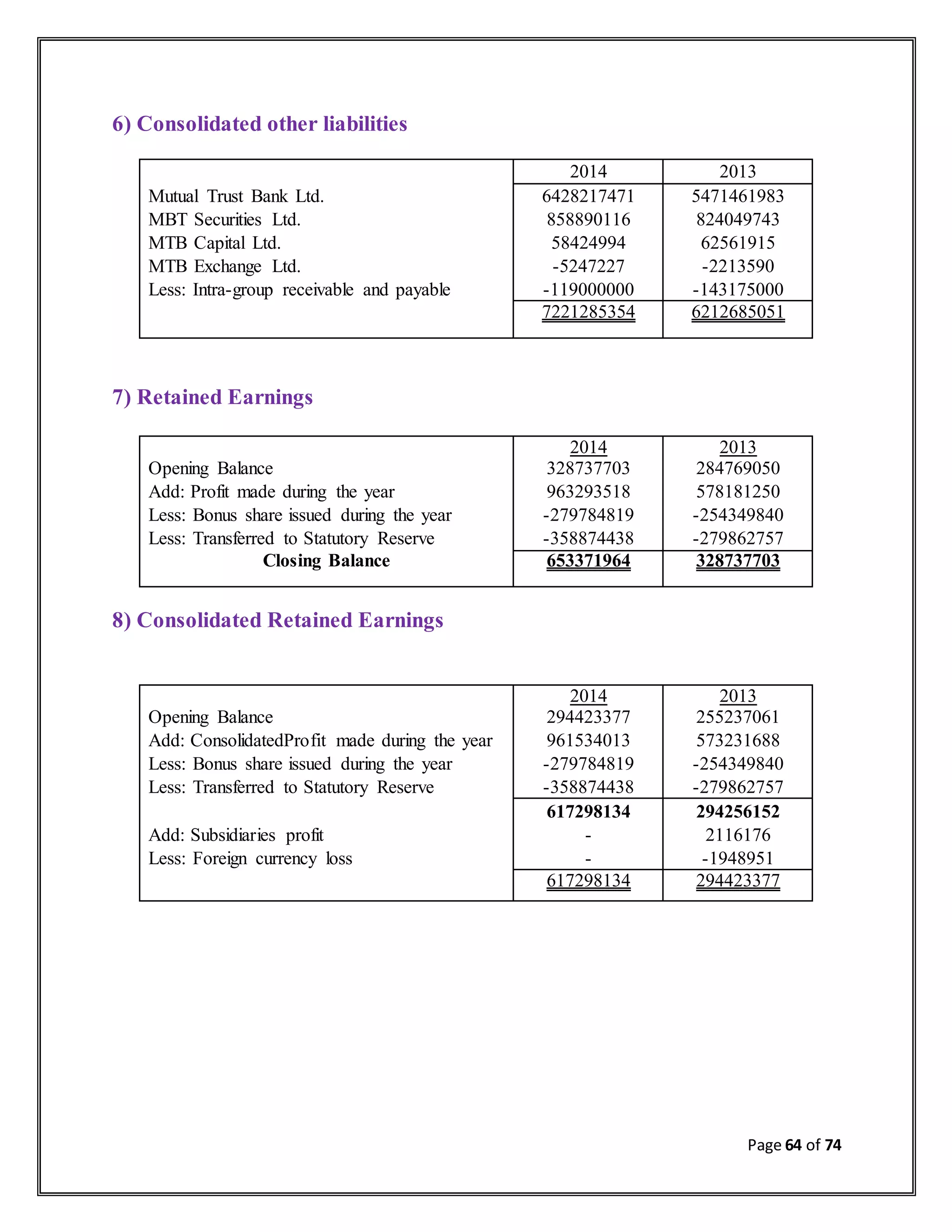
6) Consolidated other liabilities
2014 2013
Mutual Trust Bank Ltd. 6428217471 5471461983
MBT Securities Ltd. 858890116 824049743
MTB Capital Ltd. 58424994 62561915
MTB Exchange Ltd. -5247227 -2213590
Less: Intra-group receivable and payable -119000000 -143175000
7221285354 6212685051
7) Retained Earnings
Opening Balance
2014
328737703
2013
284769050
Add: Profit made during the year 963293518 578181250
Less: Bonus share issued during the year -279784819 -254349840
Less: Transferred to Statutory Reserve -358874438 -279862757
Closing Balance 653371964 328737703
8) Consolidated Retained Earnings
Opening Balance
2014
294423377
2013
255237061
Add: ConsolidatedProfit made during the year 961534013 573231688
Less: Bonus share issued during the year -279784819 -254349840
Less: Transferred to Statutory Reserve -358874438 -279862757
617298134 294256152
Add: Subsidiaries profit - 2116176
Less: Foreign currency loss - -1948951
617298134 294423377
Page 65 of 74
6.2. Consolidated Income Statement of MTB
Consolidated Income Statement
31st December,2014
2014 2013
Interest income 9716735358 8984990174
less: Interest paid on Deposit and Borrowing
etc. 7881712195 7957130247
Net Income 1835023163 1027859927
Income From Investments 2492377440 2466231850
Commision, Exchange and Brokerage 949044250 766744340
Other Operating Income 448337545 358150727
3889759234 3591126917
Total Operating Income 5724782398 4618986844
less: Operating Expenditure:
Salary and Allowance 1480618517 1208377316
Rent, Tax, Insurance and Electricity 525227662 477223454
Legal Expense 3160564 1900320
Postage, Stamps and Telephone 16801240 18169003
Printing, Stationery and Advertisement 105723591 87257490
Managing Director's Remuneration 14999333 14039333
Director's Fee 1409750 775000
Audit Fee 1449419 1396061
Depreciation 305146481 269728113
Other Expenditure 667087417 514259686
Total Operating Expense 3121623975 2593125777
Profit Before Provision 2603158423 2025861067
Less: Provision against Loans and Advances 427530521 455899298
Less: Provision against Investment 243760404 170647985
Less: Provision against Other Asset 2469480
Total Provision 673760405 626547283
Profit Before Tax 1929398019 1399313784
Less: Income Tax Expense 967838025 826061583
Net Profit After Tax 961559993 573252201
Attributable to:
Shareholders of the Bank 961534013 573231689
Minority Interest 25980 20512
961559993 573252201
Page 66 of 74
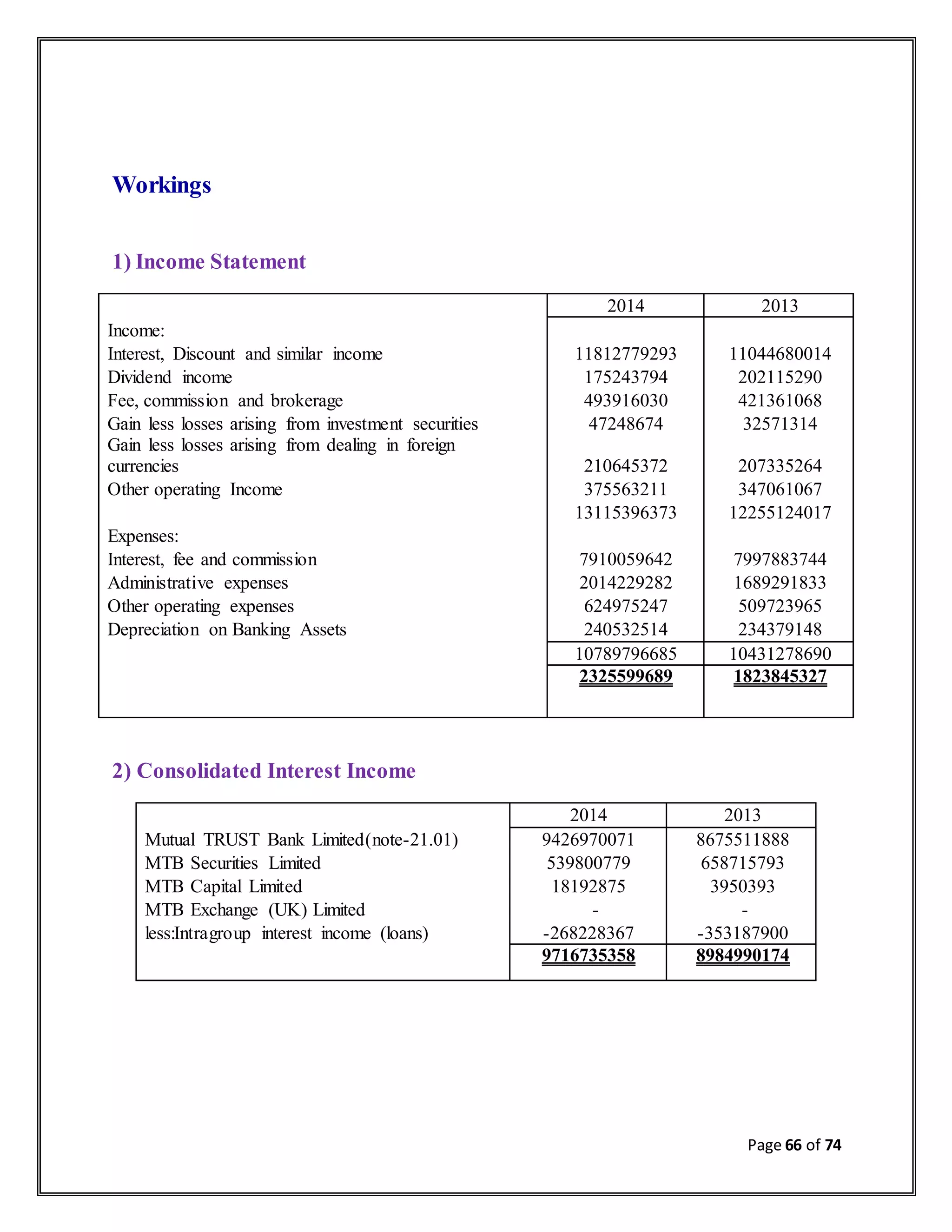
Workings
1) Income Statement
2014 2013
Income:
Interest, Discount and similar income 11812779293 11044680014
Dividend income 175243794 202115290
Fee, commission and brokerage 493916030 421361068
Gain less losses arising from investment securities 47248674 32571314
Gain less losses arising from dealing in foreign
currencies 210645372 207335264
Other operating Income 375563211 347061067
13115396373 12255124017
Expenses:
Interest, fee and commission 7910059642 7997883744
Administrative expenses 2014229282 1689291833
Other operating expenses 624975247 509723965
Depreciation on Banking Assets 240532514 234379148
10789796685 10431278690
2325599689 1823845327
2) Consolidated Interest Income
2014 2013
Mutual TRUST Bank Limited(note-21.01) 9426970071 8675511888
MTB Securities Limited 539800779 658715793
MTB Capital Limited 18192875 3950393
MTB Exchange (UK) Limited - -
less:Intragroup interest income (loans) -268228367 -353187900
9716735358 8984990174
Page 67 of 74
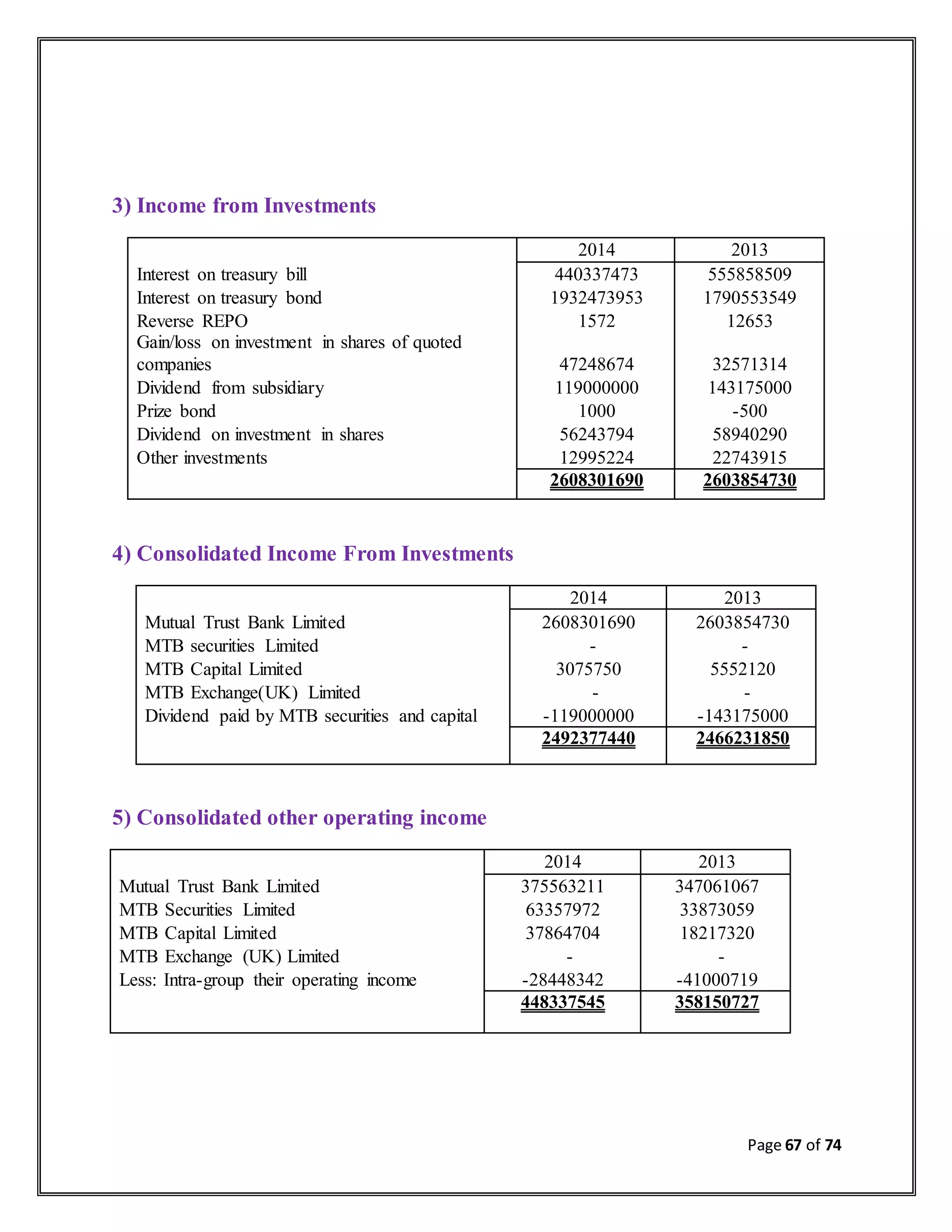
3) Income from Investments
2014 2013
Interest on treasury bill 440337473 555858509
Interest on treasury bond 1932473953 1790553549
Reverse REPO 1572 12653
Gain/loss on investment in shares of quoted
companies 47248674 32571314
Dividend from subsidiary 119000000 143175000
Prize bond 1000 -500
Dividend on investment in shares 56243794 58940290
Other investments 12995224 22743915
2608301690 2603854730
4) Consolidated Income From Investments
2014 2013
Mutual Trust Bank Limited 2608301690 2603854730
MTB securities Limited - -
MTB Capital Limited 3075750 5552120
MTB Exchange(UK) Limited - -
Dividend paid by MTB securities and capital -119000000 -143175000
2492377440 2466231850
5) Consolidated other operating income
2014 2013
Mutual Trust Bank Limited 375563211 347061067
MTB Securities Limited 63357972 33873059
MTB Capital Limited 37864704 18217320
MTB Exchange (UK) Limited - -
Less: Intra-group their operating income -28448342 -41000719
448337545 358150727
Page 68 of 74
6) Consolidated rent, taxes, insurance, electricity, etc.
2014 2013
Mutual Trust Bank Ltd 480218233 432273845
MTB Securities Ltd. 35594060 35656766
MTB Capital Ltd. 2722817 3103656
MTB Exchange Ltd. 6692552 6189187
525227662 477223454
7) Consolidated depreciation and repair of assets
2014 2013
Mutual Trust Bank Ltd. 291679656 256152998
MTB Securities Ltd. 11144137 11217691
MTB Capital Ltd. 1275233 1492005
MTB Exchange Ltd. 1047456 865418
305146481 269728113
8) Consolidated other expenditure
2014 2013
Mutual Trust Bank Ltd. 573828105 487950114
MTB Securities Ltd. 86640904 22544131
MTB Capital Ltd. 3438746 1022112
MTB Exchange Ltd. 3179662 2743329
667087417 514259686
9) Earning Per Share
Net Profit After Tax
2014
961559993
2013
573252200
Number of Ordinary Shares Outstanding 307763306 307763307
Earning Per Share 3.13 1.86
Page 69 of 74
Basis of Consolidation of operations of subsidiaries
The financial statements of the company and its subsidiary has been consolidated in accordance
with Bangladesh Accounting Standard 27 "Consolidated and Separate Financial Statements".
The consolidation of the financial statement has been made after elimination all material inter
company balance, income, expense arising from inter company transactions.
The total profit of the company and its subsidiary are shown in the consolidated statement of
comprehensive income with the portion of profit after taxation. All assets and liabilities of the
company and of its subsidiary is shown in the consolidated statement of financial position. The
consolidated financial statements are prepared to a common financial year ended 31 December
2014.
Comparison:
Here the Consolidated Financial Statements of the Mutual Trust Bank has been prepared in
accordance with BAS 27.
The statements shows the financial position of parent as well as subsidiary
So we can say the bank complies with BAS 27 to prepare consolidated financial statement.
Page 70 of 74
Page 71 of 74
Conclusion
The financial statement of the bank are prepared under the historical cost convention, on the
going concern basis and in accordance with the first schedule of bank company 1991 as amended
by international financial reporting standards adopted Bangladesh financial reporting standards
(BFRS) and Bangladesh Accounting Standards (BAS). Mutual Trust Bank complies with
following standards-
Page 72 of 74
The consolidated financial statements include the financial statements of Mutual Trust Bank
Limited, off shore banking units and its subsidiaries, MTB securities limited, MTB capital
limited and MTB exchange UK. The consolidated financial statement have been prepared in
accordance with the Bangladesh accounting standard, consolidated and separate financial
statements..
All the intra-group transactions, balances, income and expenses are eliminated on consolidation.
Profit and loss resulting from transaction is also eliminated. Investments in securities have been
shown in equity. Investments in market securities have been shown at cost or market price
whichever is lower on an aggregate portfolio basis under Bangladesh Accounting Standards
(BAS) “accounting for standards”.
Page 73 of 74
Page 74 of 74
8.0. Appendix
Reference
1) http://www.mutualtrustbank.com/
2) Manual Study

accounting report on Mutual Trust Bank

  • 1.
    Page 1 of74 Executive Summary The report began with a brief overview of the purpose and reason behind preparing it. We have chosen a private limited bank named “Mutual Trust Bank Limited” for the reporting purpose. The Mutual Trust Bank is a full service scheduled commercial bank. The bank is primarily driven with a view of creating opportunities and pursuing market niches. The report mainly deals with “Financial analysis based on accounting framework of Bangladesh”. It covers almost all necessary information of the respective topic. The consolidated financial statement of Mutual Trust Bank for the year ended 2011 have been prepared where BAS rule of presentation of financial statement , inventories, cash flow statement, accounting policies, event after reporting period, income tax, leases, PPE, revenue, employee benefits ,effect of changes in foreign exchange rate, borrowing costs, consolidated and separate financial statement, earning per share, interest financial reporting, provision, investment property are applied. In this consolidated financial statement for the financial statements of disclosure and operating segments BFRS rules have been applied. The introductory part ended with the scopes & confinements of the assigned subject. The next segment of the report started with an elaborate overview of financial statement of the bank including its establishment related information, their products, mission, vision, principles of accounting framework they follow to prepare the consolidated financial statement. All the relevant information related with accounting rules applied during preparing consolidated financial statement are shown as notes.
  • 2.
  • 3.
    Page 3 of74 1.1. Origin of the Report This report is prepared as an assignment for our Financial Accounting and Reporting (F-201) course. While preparing the report, we gave our best effort to incorporate the theoretical aspect of the subject while emphasizing on the practical implementation of the various strategic efforts that we learned in our course.
  • 4.
    Page 4 of74 1.2. Objective of the report The Objective of our report are-  To fulfill the partial requirement of our course of Financial Accounting and Reporting.  To achieve the deep knowledge about Bangladesh Accounting Standards .  To gain practical knowledge of the implications of BFRS regarding the business.
  • 5.
    Page 5 of74 1.3. Methodology We used the information that we collected from the company website and Mutual Trust Bank Ltd. annual report.
  • 6.
    Page 6 of74 1.4. Limitations of the study The limitations are-  Lack of Experience  Lack of knowledge  Time management
  • 7.
  • 8.
    Page 8 of74 1.0. What is financial accounting? Financial accounting is a process of identifying measuri8ng and communicating economic information of an entity to others so that they may make decisions on the basis of those information and assess the stewardship of management. There are two framework  framework of accounting.  Conceptual Regulatory framework of reporting. 1.1. GAAP (Generally accepted accounting Principles) It defines some guideline that must be followed to prepare financial statement. 1.2. International regulatory framework IASC Foundation IASB foundation--Sac IFRIC
  • 9.
    Page 9 of74 1.3. Regulatory Framwork Regulatory Framework is influenced by- 1. Company act 1994 2. BSEC Rules 3. Bangladesh Bank circular 4. Income Tax ordinance 1984 5. VAT 1991 1.4. Conceptual framework It is a coherent system of interrelated objectives and fundamental principles. It is a framework that prescribes the nature function and limits of accounting and FS. Conceptual framework covers: 1. Objectives of FS 2. Users and their specific information needs 3. Underlying assumption 4. Element of FS 5. Recognition and measurement of element of FS 6. Concept of capital and cassspital maintenance. 1.5 BAS 1 Presentation of Finacial Statements 1.5.1. Objective BAS 1 presentation of financial statements prescribes the basis for the presentation of financial statements so as to ensure comparability with: The entity’s own financial statements of previous products, and the financial statements of other entities. BAS 1 must be applied to all general purpose financial statements prepared in accordance with BFRSs, i.e. those intended to meet the needs of users who are not in a position to demand reports tailored to their specific needs. BAS 1 is concerned with overall considerations about the
  • 10.
    Page 10 of74 minimum content of a set of financial statements; detailed rules about recognition, measurement and disclosures of specific transactions are then contained in other standards. Whilst the terminology used was designed for profit-oriented business, it can be used, with modification, for not-for profit activities. 1.5.2 Purposes offinancial statements The objectives of general purpose fniancial statements s to provide information about the financial position, financial performance and cash flows of an equity that is useful to a wide range of users in making economic decisions.They also show the results of management stewardship of the resources of the entity. In order to achieve this information is provided about the following aspects of the entity’s result:  Assets  Liabilities  Equity  Income and expense  Other changes in equity, and  Cash flows 1.5.3.Overall considerations Much of the material in this section details the specific application of the general principles dealt with in the BFRS Framework. These include: 1.5.4 Fairpresentation Requires the faithful representation of the effects of transactions, other events and conditions in accordance with the definitions and rcognition criteria for asstes, liabilities, income and expenses set out in the framework. Compliance with BFRS is presumed to result in financial statements that achieve a fair presentation. BAS 1 expends in this principle as follows:  compliance with BFRS should be disclosed  financial statements can only be described as complying with BFRS if they comply with all the requirementsof BFRS.
  • 11.
    Page 11 of74  use of inappropriate accounting policies cannot be be rectified either by disclosure or explanatory material. 1.6 Bases of accounting There are four bases of accounting. 1.6.1. Going concern It means that an entity is normally viewed as continuing operation for the forseeable future. Financial statements are prepared on the going concern basis unless management either intends to liquidate or to cease trading or has no realistic alternative but to do so.  On this basis no time limit over which management will chase slow payers.  The measurement of non-current assets is made on the basis that can be utilized throughout their planned life. 1.6.2. Accrualbasis of accounting Items are recognozed as assets, liabilities, equity, income and expenseswhen they satisfy the definitions and recognition criteria for those elements in the framework. Accural Basis Going concern basis Cash basis Break up basis
  • 12.
    Page 12 of74  Sales are recorded in the period in which the risks and reward of ownership pass from seller to buyer, not when the seller received full payment.  Expenses are recorded on the period when the goods or services are consumed, not when they are paid for. 1.6.3. Cashbasis Although it is bases of accounting but the cash basis of accounting is not used in the preparation of a company balance sheet. Under this assumption only effect s of cash transactions are recorder .  Sales are recognized when we get full payment  Under the cash basis there is no term ‘’ depreciation’’. Notes: It is not used in the preparation of a company balance sheet and income statement , though it is part of bases. 1.6.4 Break-upbasis Management has the intention/ need to liquidate the business.  All assets and liabilities would be classified as current rather than non-current.  Assets would be valued on the basis of the recoverable amount on sale. Notes: Although it is a part of bases if it faces some financial difficulties such a sale is needed the cash to pay its creditors. Here this is the case an the alternative method of accounting must be used ( in accordance with BAS 1 presentation of financial statement. In this circumstances the financial statements will be prepared on a break-up basis. 1.7 Consistencyofpreparation To maintain consistency, the presentation and classification of items in the financial statements should stay tha same from one period to the next. There are two exceptions to this:  There is a significant change in the nature and operations or a review of the financial statements presentation which indicates a more appropriate presentation.  A change inpresentationisrequiredbya BFRS.  Where a change of presentation and classification is made, figures for the previous period must be restatedon the new basis, unless this is impracticable.
  • 13.
    Page 13 of74 1.8 Materiality and aggression Omissions or misstatementof items are materialif they could, individually or collectively, influence the economic decisions of users taken on the basis of the financial statements. Materiality depends on the size and nature of the omission or misstatement judged in the surrounding circumstances. The assesment of an item as material or immaterial may affect its treatment in the financial statements. For example, the incoame stateament of a business will show the expenses incurred by the business grouped under suitable captions. However, in the case of very small expenses it may be appropriate to lump them together under a caption such as ‘sundry expenses’ , because a more detailed breakdown would be inapproriate for such immaterial amounts. 1.9 Offsetting BAS 1 does not allow assets and liabilities to be offset against each other unless such a treatment is required or permitted by another BFRS. Income and expenses can be offset only when:  A BFRS requires or permits it,  gains, losses and related expenses arising from the same/similar transactions are not material( in aggregate). 1.10 Comparative information BAS 1 requires comparative information to be disclosed for the previous period for all numerical information, unless another BFRS permits/requires otherwise. Comparatives should also be given in narrative information where relevant to an understanding of the current period’s financial statements. Comparatives should be reclassified when the presentation or classification of items in the financial statements is amended. 1.11 Disclosure of accounting policies There should be a specific section for accounting policies in the notes to the financial statements and the following should be disclosed there.  Measurement bases used in preparing the financial statements  Each specific accounting policy necessary for a proper understanding of the financial statements.
  • 14.
  • 15.
    Page 15 of74 2.1Companies Mission The bank aspire to be the most admired financial institution in the country, recognized as a dynamic, innovative and client focused company, that offers an array of products and services in the search for excellence and to create an impressive economic value. 2.2 companies Vision Mutual Trust Bank's vision is based on a philosophy known as MTB3V. The company envision MTB to be: 2.0 Incorporation of Mutual Trust Bank The Company was incorporated as a Public Limited Company in 1999, under the Companies Act 1994, with an Authorized Share Capital of BDT 1,000,000,000 divided into 10,000,000 ordinary shares of BDT 100 each. At present, the Authorized Share Capital of the company is BDT 10,000,000,000 divided into 1,000,000,000 ordinary shares of BDT 10 each. The Company was also issued Certificate for Commencement of Business on the same day and was granted license on October 05, 1999 by Bangladesh Bank under the Banking Companies Act 1991 and started its banking operation on October 24, 1999. As envisaged in the Memorandum of Association and as licensed by Bangladesh Bank under the provisions of the Banking Companies Act 1991.
  • 16.
    Page 16 of74 One of the Best Performing Banks in Bangladesh The Bank of Choice A Truly World-class Bank 2.3 Subsidiaries: The subsidiaries of Mutual Trust Bank are shown below: 2.3.1 MTB Securities Limited (MTBSL) MTBSL is engaged in buying and selling of securities for its customer and margin loan is extended to the customer against their margin for investment in their listed companies. The require margin level is monitored daily and margin loan is provided as per established guidelines. It also undertake investment for the banks fund in the capital market. Separate Financial Statement of MTB Securities Limited has been drawn up in the report. 2.3.2. MTB Exchange (UK) Limited (MTB UK) In August 19, 2010 accordance approval to the bank for opening a fully owned subsidiary company in the named of MTB Exchanged (UK) Limited. The company was incorporated in June 14,2010 under the company act 2006 of UK with the registration number 7282261 as a private company limited by share. The main activities of the exchange house are to carry on the remittance business and to undertake and participate in transactions, activities and operations commonly carried on or undertake by remittance and exchange houses. Separate financial Statement of MTB Exchange (UK) Limited has been drawn up in the reports.
  • 17.
    Page 17 of74 2.3.3 MTB CapitalLimited (MTBCL) The bank obtained permission to embark upon mercantile Banking from the Bangladesh Securities and Exchange Commission (BSEC) dated December ^, 2010 under the Sceruties and Exchange Commission Act ,1993. The operation has started as on April 17, 2011. Separate Financial statements have been drawn up in the reports. MTBCL offers the following services to the market: a) Discretionary and non Discretionary Portfolio Management services to both the retail and institutional investors under different product lines. b) Issue Management services to medium and large corporate houses to manage their initial Public Offer (IPO), secondary offerings, debt issuance and right issuance . c) Underwriting services for both debt and equity issues. Besides, MTBCL develops various investment schemes suiting varying objectives and constractions of different investor classes. 2.4. MTB Financial Highlight 2014 Total operating Profit: Operating profit before provision for 2014 stood at BDT 2,6303 million,registering a positive 28.50% growth over the previous year(BDT 2,026 million) Net profit after Tax: Net profit After tax (NPAT) stood at BDT 962 million in 2014, which was 67.74% higher then 2013(BDT 573 million)
  • 18.
    Page 18 of74 Loans and advances: MTB risk assets (loans and advances) increased to BDT 77141 million including Offshore Banking Unit (OBU) and margin loans, which was 29.54% higher than 2013(BDT 59548 million) Return on Equity: Return on average shareholder EQUITY went up from the previous year due to increase in Net Profit After Tax (NPAT) in 2014. Total Deposits: MTB Deposits in 2014 increased to BDT 97106 million, registering a growth of 15.09% over 2013(BDT 84373 million) Net asset value: Net asset value (NAV) per share increased to 22% which was 12.95% higher than 2013.
  • 19.
  • 20.
    Page 20 of74 3.0. Financial Statements Financial statements are the means of communicating the information to the people or users or others. These are the accountants summary of performance of an entity over a particular period of time and its financial position at a point of time. A set of financial statements is a structured representation of the financial performance and financial position of a business and how its financial position changed over time.It is the ultimate output of an accounting information system and has following six components: 1. Balance Sheet (Statements of Financial Position) 2. Income Statement (Statements of Financial Performance) 3. Statement of Cash Flows 4. Statement of Changes in Equity 5. Notes and Other Disclosures Financial statements are better understood in context of all other components of the financial statements. For example a balance sheet will communicate more information if we have the related income statement and the statement of cash flows too. 3.1 Purposes of Financial Statements: The objective of financial statements is to provide information about the financial position, financial performance and cash flows of an entity, to others to make economic decisions. They also show the results of management stewardship of the resources of the entity. To achieve this information is provided about the following aspects of the entity’s results:  Assets  Liabilities  Equity  Income and expenses  Other changes in equity and  Cash flows Additional information is contained in the notes.
  • 21.
    Page 21 of74 3.2 Balance Sheet (Statements of Financial Position) A balance sheet also known as the statement of financial position tells about the assets, liabilities and equity of a business at a specific point of time. It is a snapshot of a business. A balance sheet is an extended form of the accounting equation. An accounting equation is: Assets = Liabilities + Equity Assets are the resources controlled by a business, equity is the obligation of the company to its owners and liabilities are the obligations of parties other than owners. A balance sheet is named so because it lists all resources owned by the company and shows that it is equal to the sum of all liabilities and the equity balance. Rules of preparing balance sheet according to BAS 1 -  BAS 1 guidelines on the format of the balance sheet  BAS 1 specifies that certain items must be shown on the face of the balance sheet  It requires other information to presented on the face of the balance sheet or in the notes  It requires both assets and liabilities must be separately classified as current and non- current 3.2.1 Format of balance sheet BAS 1 suggests a format for the balance sheet. But it does not prescribe the order or format in which the items listed should be presented. The format of balance sheet is given below which is consistent with the minimum requirements of BAS 1.
  • 22.
    Page 22 of74 ……………………..Ltd Balance Sheet as at (date) Assets Non-current assets Property, plant and equipment Intangibles Investments Current assets Inventories Trade and receivables Investments Cash and cash equivalents Non-current assets held for sale Total assets Equity and liabilities Capital and reserves Ordinary share capital Preference share capital Share premium account Revaluation reserve General reserve Retained earnings Equity Non-current Liabilities Preference share capital(redeemable) Finance lease liabilities Borrowings Current liabilities Trade and other payables Taxation Provisions Borrowings Finance lease liabilities Total equity and liabilities TK X X X X X X X X X X X X X X TK X X X X X X X X X X X X X X X X
  • 23.
    Page 23 of74 3.2.2 Information must be appeared on the balance sheet BAS 1 specifies various items which must appear on the face of the balance sheet. • Property, plant and equipment • Investment property • Intangibles assets • Financial assets • Investments accounted for using the equity method • Assets classified as held for sale • Inventories • Trade and other receivables • Cash and cash equivalents • Provisions • Trade and payables • Financial liabilities • Issued capital and reserves 3.2.3 Information presented on the face of the balance sheet or in the notes Certain information may be presented either on the face of the balance sheet or in the notes to the financial statements. These include:  Further classification of line items.  Details about each class of share capital.  Details about each reserve within equity.
  • 24.
    Page 24 of74 3.2.4 Distinction between Current/ non-current assets and liabilities A entity must present current and non-current assets and liabilities as separate classifications on the face of balance sheet. This is to separate currents assets from fixed assets and amounts due within one year from amounts due after more than one year. Foe all businesses which have a clearly identifiable operating cycle, it is the current/non-current presentation. In either case, the entity should disclose any portion of an asset or liability which is expected to be recovered after more than twelve months. 3.3 Income Statement (Statements of Financial Performance) Income statement is a summary of a management's performance as reflected in the profitability ) of an organization over a certain period. It itemizes the revenues and expenses of past that led to the current profit or loss, and indicates what may be done to improve the results. In contrast to a balance sheet, an income statement depicts what happened over a month, quarter, or year. It is based on a fundamental accounting equation (Income = Revenue - Expenses) and shows the rate at which the owners equity is changing for better or worse. Along with balance sheet and cash flow statement it forms the basic set of financial information required to manage an organization also called earnings report, operating statement, or profit and loss account. Rules of preparing income statement according to BAS 1 -  BAS 1 suggests two formats for the income statement  Bas 1 specifies that certain items must be shown on the face of the income statement 3.3.1 Format of income statement BAS 1 suggests two possible formats for the income statement. The difference between them being the classification of expenses:  By function
  • 25.
    Page 25 of74  By nature As income statement classifying expenses by function is more common in practice, we presented a format of this type of income statement. ……………………..Ltd Income statement for the Year ended (date) 3.3.2 Information presented in income statement The standard lists the following as the minimum to be disclosed on the face of the income statement • Revenue • Finance costs Revenue Cost of sales Gross profit Other operating income Distribution costs Administrative costs Profit or loss from operations Finance cost Investment income Profit or loss before tax Income tax expense Profit or loss for the period TK X (X) X X (X) (X) X (X) X X (X) X X
  • 26.
    Page 26 of74 • Share of profits and losses of associates for using the equity method • Income tax expense • Profit or loss 3.3.3 Information presented either on the income statement or in the notes These include Exceptional items These are material items of income and expense which should be disclosed separately. These include:  Write downs of inventories to NRV  Write down of property, plant and equipment to recoverable amount  Disposals of property, plant and equipment  Disposals of investments  Discontinued operations  Litigation settlements  Other reversals of provisions 3.4 Statement of changes in equity A statement of changes in equity can be explained as a statement that can changes in equity for corporation features be created for partnerships, sole proprietorships, or corporations. It is framed as a straightforward measure of financial performance. The key purpose of this statement is to summarize the activity in take equity accounts for a certain period. Sole proprietorships and partnerships follow a similar format for their statements of changes in equity. On the contrary, the statement of changes in equity for a corporation features a slightly different format. The statement of changes in equity shows the total recognized income and expenses for the period.
  • 27.
    Page 27 of74 3.4.1. Example of statement of changes in equity An imaginary example of statement of changes in equity is given below: ……………………..Ltd Statement of changes in equity for the Year ended (date)
  • 28.
    Page 28 of74 3.4.2. Information presented in the statement of changes in equity As per BAS 1, the statement of changes in equity is one of the five components of complete financial statements counting income statement, balance sheet, statement of changes in equity, notes to financial statements, and cash flow statements. According to IAS, the statement must include:  Profit or loss for the specific period  Every item of income and expenditure for the period which is specified directly in the equity, rather than in the income statement  Total income and expense for the period specified (evaluated as the sum of (I) & (II)), representing individually the total amounts attributable to equity holders of minority interest besides the parent holder  The effects of changes in the accounting policies and rectification of errors for each component of equity where these have been recognized during the period in accordance with BAS 8. 3.5 Statement of cash flow A statement of cash flows is a financial statement which summarizes cash transactions of a business during a given accounting period and classifies them under three heads, namely, cash flows from operating, investing and financing activities. It shows how cash moved during the period by indicating whether a particular line item is a cash inflow or cash out-flow. The term cash as used in the statement of cash flows refers to both cash and cash equivalents. Cash flow statement provides relevant information in assessing a company's liquidity, quality of earnings and solvency. All entities are required to prepare a statement of cash flow in compliance with BAS 7. 3.5.1 Benefits of statement of cash flow Cash flow statements should be used in conjunction with the rest of the financial statements. It shows:
  • 29.
    Page 29 of74 the changes in net assets the entity’s financial position the entity’s ability to adapt to changing circumstances and opportunities 3.5.2 Presentation of a cash flow statement Cash flows are classified as 1. Cash Flows from Operating Activities This section includes cash flows from the principal revenue generation activities such as sale and purchase of goods and services. Cash flows from operating activities can be computed using two methods. One is the direct method and the other indirect method. AS 7 prefers direct methods but does not require it. The standard gives the following example of cash flows from operating activities:  Cash receipts from the sale of goods and rendering of services.  Cash receipts from royalties, fees, commissions and other revenue.  Cash payments to suppliers for goods and services  Cash payments to and on behalf of employees. 2. Cash Flows from Investing Activities Cash flows from investing activities are cash inflows and out-flow related to activities that are derived from acquisition and disposal of noncurrent assets. The standard gives the following examples of cash flows which must arise under this heading.  Cash payment to acquire property, plant and equipment, intangibles and other non- current assets.  Cash receipt from sales property, plant and equipment, intangibles and other non-current assets.  Cash payment to acquire equity or debt of other entities.  Cash receipt from sale of equity or debt of other entities.  Interest received
  • 30.
    Page 30 of74  Dividend received 3. Cash Flows from Financing Activities Cash flows from financing activities are the cash flows related to transactions with stockholders and creditors such as issuance of share capital, purchase of treasury stock, dividend payments borrowing of the entity etc. The standard gives the following examples of cash flows which must arise under this heading.  Cash proceeds from issuing shares  Cash payments to owners to acquire or redeem the entity’s shares.  Cash proceeds from issuing debentures, loans, notes, bonds, mortgage and other short term and long term borrowings.  Repayment of capital of amount borrowed under finance leases.  Dividends paid
  • 31.
    Page 31 of74 3.5.3. Example of a cash flow statement Here is an example of cash flow statement Cash flow statement Year ended 31 December 2007 Cash flows from operating activities Cash generated from operations Interest paid Income tax Net cash flows from operating activities Cash flows from investing activities Purchase of property, plant and equipment Proceeds from sales property, plant and equipment assets Interest received Dividend received Net cash flows from investing activities Cash flows from financing activities Cash proceeds from issuing shares Cash proceeds from issuing long term borrowings Dividend paid Net cash flows from financing activities TK 2,730 (270) (900) (900) 20 200 200 250 250 (1290) TK 1560 (480) (790) 290
  • 32.
    Page 32 of74 Net increase in cash and cash equivalents Cash and cash equivalents at the beginning period Cash and cash equivalents at the ending period 120 410 3.6 Notes to the financial statements These will amplify the information given in the balance sheet, income statement and statement of changes in equity. To some extent the contents of the notes will be determined by the level of detail shown on the face of the statements. 3.6.1 Disclosure of accounting policies The accounting policies section should describe the following • The measurement basis used in preparing the financial statements. • The other accounting policies used as required for a proper understanding of the financial statements. • The judgments, apart from those involving estimations, made by management in applying the accounting policies. 3.6.2 Other disclosures An entity must include in the notes:  The amount of dividends proposed or declared before the financial statements were authorized for issue but not recognized as a distribution to equity holders during the period, and the amount per share.  The amount of any cumulative preference dividends not recognized.
  • 33.
  • 34.
    Page 34 of74 2014 2013 Property and Asset BDT BDT Cash 8,926,888,089 7,154,414,979 In Hand(including foreign currency) 1,585,807,377 1,701,001,828 With Bangladesh Bank and its agent bank (including foreign currency) 7,341,080,712 5,453,413,151 Balance with other bank and institutions 1,970,213,215 1,370,713,131 In Bangladesh 1,695,331,911 1,057,504,237 Outside Bangladesh 274,881,304 313,208,894 Money at call and short notice 460,000,000 Investments 20,406,057,886 25,626,432,399 Government 18,479,093,705 23,806,295,142 Others 1,926,964,181 1,820,137,257 Loans and advance 75,707,231,791 58,301,814,393 Loans, cash credit, overdrafts etc 73,507,181,276 56,707,855,895 Bills purchased and discounted 2,200,050,515 1,593,958,498 Fixed asset including premises Furniture and fixture 2,369,772,934 2,334,968,565 Other assets 6,325,650,624 5,483,787,674 Non-Banking asset - - Total property and assets 115,708,814,538 100,732,131,141 Liabilities and capitals Borrowing from other banks Financial institutions and agents 2,702,826,026 2,637,966,323 Deposit and other accounts 97,270,633,407 84,640,395,660 Current deposit and other accounts 17,426,479,105 11,631,835,517 Bills payable 1,284,280,568 779,790,179 Saving deposit 14,384,269,440 11,097,954,735 4.1 Statement of financial position Statement of financial position of Mutual Trust Bank is provided here, Mutual Trust Bank Balance Sheet As at December 31, 2014
  • 35.
    Page 35 of74 Fixed deposit 49,411,783,655 48,426,499,552 Deposit products 14,763,820,639 12,704,315,678 Other liabilities 6,428,217,471 5,471,461,983 Subordinated deposit 2,500,000,000 2,500,000,000 Total liabilities 108,901,676,904 95,249,823,966 Capital/Shareholder's equity Pickup capital 3,077,633,060 2,797,848,240 Statutory capital 2,276,079,020 1,917,204,582 Foreign currency translation gain/loss - - General reserve 276,777,324 276,777,324 Retained earnings 653,371,964 328,737,703 Total shareholder's equity 6,804,137,635 5,482,307,176 Total liabilities and shareholder's equity 115,705,814,538 100,732,131,141 Workings: 1. Cash 2014 2013 In hand 1585807377 1701001828 Balance with Bangladesh Bank 7341080712 5453413151 8926888089 7154414979 2. Cashin hand 2014 2013 local currency 1575957930 1685118328 Foreign Currency 9849447 15883500 1585807377 1701001828
  • 36.
    Page 36 of74 3. Fixed asset 2014 2013 Land 104253000 104253000 Immovable property 995326830 995326830 Furniture & fixtures 1093022070 968869940 Office equipment 1075968599 922560915 Motor vehicles 54649664 48382748 Blocks and periodicals 423974 423974 Intangible assets 70367646 80471004 Leased assets 48455000 48455000 Total cost 3442466783 3168743411 Less: Accumulated depreciation 1072693849 833774846 Book value at the end of the year 2369772934 2334968565 4. Retainedearnings 2014 2013 Opening Balance 328737703 284769050 Add. Profit for the year 963293518 578181250 Less. Bonus share issue (279784819) (254349840) Less. Transferred to Statutory reserve (358874438) (279862757) Closing balance 653371964 328737703
  • 37.
    Page 37 of74 4.2 Statement of financial performance Statement of financial statement of Mutual Trust Bank is provided here, Mutual Trust Bank Ltd. Profit and Loss Account For the year ended December 31, 2014 2014 2013 Particulars BDT BDT Interest income 9,426,970,071 8,675,511,888 less: interest paid on deposit and borrowing etc. 7,910,059,642 7,997,883,744 Net interest income 1,516,910,429 677,628,144 Income from investments 2,608,301,690 2,603,854,730 Commission, Exchange and Brokerage 704,561,402 628,696,332 Other operating income 375,563,211 347,061,067 3,688,426,302 3,579,612,129 Total operating income 5,025,336,732 4,257,240,272 less: Operating expenditure Salary and allowance 1,493,841,751 1,138,200,598 Rent, tax, insurance and electricity 480,218,233 432,273,845 Legal expense 3,160,564 1,563,657 Postage, stamps and telephone 15,567,614 16,553,109 Printing, stationery and advertisement 104,089,036 84,956,292 Managing Director's remuneration 14,999,333 14,039,333 Director's fee 1,409,750 775,000 Audit fees 943,000 930,000 Depreciation on and repair to bank's property 291,679,656 256,152,998 Other expenditure 573,828,105 487,950,114 Total operating expenses 2,879,737,043 2,433,394,946 Profit before provision 2,325,599,689 1,823,845,327 less: provisions against loans and advances including off balances sheet items 427,530,521 455,899,298 less: provisions against investment in quoted shares 101,227,502 99,147,985 less: provision against other asset 2,469,480 - Total provision 531,227,503 555,047,283
  • 38.
    Page 38 of74 Profit before tax 1,794,372,186 1,268,798,044 less: income tax expenses 831,078,668 690,616,793 Net profit after tax 963,293,519 578,181,251 Retained surplus brought forward 328,737,702 284,769,049 1,292,031,221 862,950,300 Appropriation Bonus share issued/cash dividend during the year 279,784,820 254,349,840 Transferred to statutory reserve 358,874,438 279,862,757 638,659,258 534,212,597 Retained surplus carried forward 653,371,964 328,737,703 Workings: 1. Operating profit 2014 2013 Income Interest, discount and similar income 11812779293 11044680014 dividend income 175243794 202115290 Fee, commission and brokerage 493916030 421361068 Gain less losses arising from investment securities 47248674 32571314 Gain less losses arising from dealing in foreign currencies 210645372 207335264 Other operating income 375563211 347061067 13115396374 12255124017 Expenses: Interest, fee and commission 7910059642 7997883744 Administrative expenses 2014229282 1689291833 Other operating expenses 624975247 509723965 Depreciation on banking assets 240532514 234379148 10789796685 10431278690 Operating profit 2325599689 1823845327
  • 39.
    Page 39 of74 2. Income from investments 2014 2013 Interest on treasury bill 440337473 555858509 Interest on treasury bond 1932473953 1790553549 Reverse REPO 1572 12653 Gain/(loss) on investment in shares 47248674 32571314 Dividend From subsidiary 119000000 143175000 Prize bond 1000 (500) Dividend on investment in shares 56243794 58940290 Other investment 12995224 22743915 2608301690 2603854730 4. Depreciation and repairs of bank’s property 2014 2013 Immovable property 23846023 24457479 Furniture & fixture 73164650 70400480 Office equipments 129719254 127935032 Motor vehicles 4171591 1955161 Books & periodicals - - Leasehold Property 9630996 9630996 240532514 234379148 Repairs on Bank's property 51147142 21773850 291679656 256152998 3. Rent, tax, insurance, electricity etc. 2014 2013 Rent 325858657 301091647 Rent and taxes 2775936 1455158 Insurance 65351577 55648604 Power & electricity 85025283 71302014 Lease Rent 1206780 2740422 480218233 432237845
  • 40.
    Page 40 of74 4.3. Statement of cash flow Statement of cash flow of Mutual Trust Bank is provided here, Mutual Trust Bank Ltd. Statement of Cash Flow For the year ended December 31, 2014 2014 2013 A) Cash flow from operating activities: BDT BDT Interest received 11,979,027,967 11,077,251,327 Interest paid on deposits, borrowings etc. (8,019,471,385) (8,043,638,749) dividend income 56,243,794 202,115,290 Fees and commission income 493,916,030 424,247,393 Recoveries of loans previously written off 7,336,952 5,900,000 Cash paid to employees as salaries and allowances (1,376,905,411) (1,051,662,832 Advance income tax paid (743,208,639) (6,410,672,568) Cash received from other operational income 569,967,287 545,610,005 cash paid for other operational expenses (1,218,363,444) (1,041,775,867) Cash flow from operating activities before changes in net current asset 1,748,543,150 1,476,979,300 Changes in net current asset: Investment in treasury bond 1,166,859,424 (143,180,401) Loans and advances (17,118,095,808) (2,928,773,435) Other asset (155,279,203) (310,542,342) Customer's deposit 12,739,649,490 9,317,421,013 Borrowing from other banks, financial institutions & agents 64,859,703 (3,324,253,677) Other liabilities 54,975,581 14,725,790 (3,247,030,813) 2,625,396,947 Net cash flow from operating activities (1,498,487,663) 4,102,376,247 B) Cash flow from investing activities Investments in shares and bonds (106,436,924) 10,938,958 Purchase of premises & fixed asset(net) (284,517,293) (310,552,780) Net cash from investing activities (390,954,217) (299,613,822) C) Cash flow from financing activities Net cash flow from investing activities - - D) Net increase in cash and cash equivalents (1,889,441,881) 3,802,762,425
  • 41.
    Page 41 of74 E) Effects of changes of exchange rates in cash and cash equivalent - - F) Opening cash and cash equivalents 14,043,036,405 10,240,273,980 Closing cash and cash equivalents(D+E+F) 12,153,594,524 14,043,036,405 The above cash and cash equivalents include: Cash in hand 1,585,807,377 1,701,001,828 Balance with Bangladesh Bank and its agent bank 7,341,080,712 5,453,413,151 Balance with other banks and financial organizations 1,970,213,215 1,370,713,131 Money at call and short notice - 460,000,000 Treasury bill 1,253,329,821 5,055,134,895 Prize bond 3,163,400 2,773,400 12,153,594,524 14,043,036,405 Working: 1. Receivedfrom other operationalincome 2014 2013 Exchange 210645372 207335264 Postage charge recoveries 3165323 5555763 Telephone and telegram charge recovery 55740 37750 Handing charge 3170783 5395250 Service charge 110572834 97572090 SWIFT charge recovery 8571523 15779848 Early settlement and loan processing fees 6877096 6089054 Incidental charges 275350 187065 Locker charge 2977297 2734690 VISA ATM 2288113 1565754 Margin A/C maintenance income 26961 1710 Management fees 59020186 49645702 Charges against cards 63173540 45790119 VISA POS 11562443 8193974 Miscellaneous income 87584725 99725972 569967286 545610005
  • 42.
    Page 42 of74 4.4 Comparative analysis: Property plant and equipment: Property plant and equipment are the tangible assets which are held for use in the production or supply of goods or services, for rental to others or for administrative purposes. BAS 16 provides guidance on the accounting treatment of property plant and equipment. Recognition: According to BAS 16 property plant and equipment should be recognized when future economic benefit will flow to the entity and the item’s cost can be measured reliably. Measurement: According to BAS 16 property plant and equipment should be measured at cost initially and subsequent cost should be measured at fair value. Comparison: Property plant and equipment of Mutual Trust Bank is land & building, which is recognized at cost at the time of acquisition and subsequently measured at fair value. So we can say Mutual Trust Bank complies with BAS 16 to record property plant and equipment. Depreciation: Bas 16 requires that a systematic basis should be used to allocate the depreciable amount over assets useful life. A number of methods are introduced. They are Straight line method, reducing balance method or sum of year digit method. Comparison: Depreciation is charged at the following rates on reducing balance method on all fixed assets other than motor vehicles and leased assets. Category of fixed assets Rates of depreciation Land Nil Immovable property 2.50% Furniture and fixtures 10% Office equipments 20%
  • 43.
    Page 43 of74 Motor vehicles 20% Books and periodicals 10% Leasehold assets 20% Intangible assets 20% Lease: Lease is an agreement whereby the lessor conveys to the lessee in return for a payment or series of payments the right to use an asset for an agreed period of time. Accounting treatment of lease should be complies with BAS 17. According to BAS 17 there are two types of lease financial lease and operating lease. Comparison: Asset under finance leases of Mutual Trust Bank are recognized as asset of the bank at their fair value at the date of acquisition or if lower at the present value of the minimum lease payments. The corresponding liability to the lessor is included in the balance sheet as a finance lease obligation. Finance charges are charged against income. So we can say Mutual Trust Bank complies with BAS 17 to account leases. Contingent liabilities and assets: Contingent liabilities and assets are accounted in accordance with BAS 37. Comparison: The bank recognized provision only when it has a present obligation as a result of past events and it is probable that an outflow of resources embodying economic benefits will be required to settle the obligation and when a reliable estimate of the obligation can be made. So we can say Mutual Trust Bank complies with BAS 37 to account contingent liabilities and assets.
  • 44.
    Page 44 of74 Other liability is recognized in the balance sheet according to the guideline of Bangladesh Bank and BAS 37 and internal policy of the banks. Provisions and accrued expenses are recognized in the financial statements when the bank has a legal or constrictive obligation as a result of past event, and it is probable that an outflow of resources embodying economic benefits will be required to settle the obligation and a reliable estimate can be made of the amount of the obligation. Revenues: Revenues are the income arising in the normal course of activities. BAS 18 provides guidance on the accounting treatment of revenues. Recognition: According to BAS 18 revenue should be recognized when future economic benefit will flow to the entity and the benefit can be measured reliably. Measurement: According to BAS 18 revenue should be measured at the fair value of the consideration received. Comparison: Revenue for this year of Mutual Trust Bank has been recognized according to the provision of BAS 18 as well as Bangladesh Bank guidelines. Interest income has been recognized on accrual basis. Investment income has been recognized on accrual basis. Capital gain on investment in shares is also included in investment income. Capital gain is recognized when it is realized. Fees and commission on bills discounted, purchased and others are recognized at the time realization. So we can say Mutual Trust Bank complies with BAS 18 to record revenues. Cash flow statement 1) Cash flow statement has to prepare in accordance with BAS 7.
  • 45.
    Page 45 of74 2) According to BFRSs cash flow statement can be presented either in direct method or in indirect method. The presentation is selected to present these cash flows in a manner that is most appropriate for the business or industry. The method is applied consistently. 3) According to Bangladesh Bank as per BRPD circular no. 14 dated 25 June 2003, cash flow should be a mixture of direct and indirect method. Comparison: Here the statement of cash flows of the Mutual Trust Bank has been prepared in accordance with BAS 7, Statement of cash flows and under the guideline of Bangladesh Bank BRPD circular no. 14 dated 25 June 2003. The statement shows the structure of changes in cash and cash equivalents during the financial year. So we can say the bank complies with BAS 7 to prepare cash flow statement.
  • 46.
  • 47.
    Page 47 of74 5.0. What is a group? In simple term group is created where one company, the parent (P) buys shares in another company, the subsidiary (S), such that the parent company controls the subsidiary. A group may include one or many subsidiaries. Shareholders P Ltd. S1 S2 S3 5.1. What is a subsidiary? Asubsidiary is an entity, including an unincorporated entity such as a partnership, that is controlled by another entity. 5.2. Why form a group? A business may operate in several different markets with different characteristics. These different markets will present different different issues for management to address in terms of operations and finance and so on. It would be possible for different activities to be carried out within a single limited company, where separate divisions could be established for each activity. The owners would then receive one set of accounts for that company reflecting all its activities. Alternatively, each activity could be carried out within a separate company, each of which controlled by the parent. There are a number of reasons why the business might be structured this way. Accountability of each group of managers can be made more precise, as they can be identified more easily with the activities of the subsidiary which employes them. Financing may be made easier, as lenders can see audited financial statements for the individual company for which they are provoding finance.
  • 48.
    Page 48 of74 The assets of one subsidiary can be pledged as security for its borrowings, leaving the assets of other subsidiaries unpledged. Disposal of a business may be easier. 5.3. The Consolidation Concept The consolidated financial statements can be said as the combined financial statements of a parent company and its subsidiaries. Because consolidated financial statements present an aggregated look at the financial position of a parent and its subsidiaries, they help to measure the overall health of an entire group of companies or organizations as opposed to one company's stand-alone position. Consolidated financial statements present the financial position and results of operations for a parent (controlling entity) and one or more subsidiaries (controlled entities) as if the individual entities actually were a single company or entity. Consolidated financial statements are generally considered to be more useful than the separate financial statements of the individual companies when the companies are related.
  • 49.
    Page 49 of74 Whether the subsidiary is acquired or created, each individual company maintains its own accounting records, but consolidated financial statements are needed to present the companies together as a single economic entity for general-purpose financial reporting. Some facts of Consolidation- Consolidation is done by Parent Entity. Consolidation should be denominated by Parent’s reporting currency. Any periodicity gap should be neutralized. Non-Controlling Interests should be properly addressed. Mostly Equity Method is used for Consolidation. - Approaches should be selected appropriately. 5.4. The effect of Consolidated Financial Statement Consolidated financial statements are presented primarily for the benefit of the investors, creditors, and other resource providers of the parent. Significantly, consolidated financial statements often represent the only means of obtaining a clear picture of the total resources of the combined entity that are under the control of the parent company. Consolidated financial statements report the financial results of the parent company and all of its subsidiary companies in one combined report. Some companies own just one subsidiary, while others own many subsidiaries. The consolidated financial statement includes just one set of financial results. As each subsidiary reports its financial results to the parent, the accounting staff at the parent company gathers the individual financial results, eliminates intercompany financial transactions and consolidates the numbers into one statement. Several benefits exist for companies who create consolidated financial statements. The Consolidated Financial Statement has following benefits- 1. Broad Picture: The basic advantage when consolidating financial statements is the broad picture it gives. Investors do not want to go through several different financial statements to add up information and find out how the corporation is doing overall. The consolidated statements provided by the parent company accomplish the task automatically and make an excellent reference point for shareholders, leaders and anyone interested in how all the different parts of the business are functioning as a whole.
  • 50.
    Page 50 of74 2. Proper Balancing: Consolidating financial statements also lets a corporation effectively balance its appearance to outside parties. For example, during one period a parent company may lose revenue and perform poorly, but the subsidiaries may perform very well and increase revenues. The consolidated statement will balance the poor parent's performance with thepositive subsidiary performance, allowing the company to show that through its diversification it remained profitable. 3. Exclusions: According to consolidated financial statement guidelines, a corporation can also exclude certain divisions from the statements. This is also an advantage; because it allows investors to see -- and companies to show -- that some financial aspects are not long term. For example, subsidiaries are exempt if the parent company's ownership of them is temporary or if the control of the company does not actually rest with the majority owner, which can happen through bankruptcy. 4. Less Paperwork: Another benefit of consolidated financial statements is the reduced amount of paperwork created for the statements. When a parent company owns multiple subsidiaries, a set of financial statements exists for each individual company. Each set of financial statements includes four separate reports. If a parent company owns nine subsidiaries, the complete set of individual financial statements includes 40 reports. If the parent company consolidates the financial statements, the set of financial statements only includes four reports. 5. Simplified: Consolidated financial statements also provide a simplified view of the organization's results. When one subsidiary sells products to another, it creates an intercompany transaction. One company records a sale, while another company records a purchase. The sale and purchase cancel each other out from the complete organization perspective. Consolidated financial statements eliminate these transactions and simplify the financial statements. 6. Necessity: Consolidated financial statements are required by most governments as an accurate representation of a parent company's financial activity. In general, tax laws require that a single accounting entity be represented out of the net resources and operating results of all the divisions that a company owns. As a result, many companies have become used to producing consolidated statements for governments, investors and internal analysis.
  • 51.
    Page 51 of74 7. Efficiency: One of the main advantages of the consolidated financial statement is efficiency. Instead of examining the financial statements of each company in a network of dozens of companies, an investor or an executive can examine a single financial statement to determine the financial health of the entire network. Nevertheless, consolidated financial statements are usually considerably more complex than stand-alone financial statements. 8. Fraud Prevention: Another primary gain for consolidated financial statements is the prevention of fraud against investors. Without the requirement that parent companies consolidate their financial statements, companies could easily bury losses from undermperforming divisions and product lines in a web of subsidiaries and cross-shareholdings. In this case, underperforming or failing subsidiaries could be draining the finances of the parent company to the point of near bankruptcy, yet this state of affairs would not become apparent by reading the parent company's stand-alone financial statement. The ultimate benefit of consolidated financial statements should be ease of understanding and analysis of a company's financial condition for investors, creditors, vendors and anyone else who needs to know how secure the company is with respect to being able to pay its bills and continue as a profitable enterprise. However, a more sinister benefit of consolidated finances is that they can be manipulated to hide financial problems. It is extremely difficult to ascertain from these statements whether there are hidden problems and exactly where they are in the enterprise. Without consolidated financial statements the process of evaluating a company for investment or financing purposes would be a long complex affair that might altogether miss important assets or liabilities. In fact, many of the arguments that occur between company management, accounting and auditing at year end involve how the consolidation of reports should be done in order to give the most accurate picture of the company's financial health. It is the auditor's job to make sure this consolidation of accounting reports accurately reflects the true condition of the company. 5.5. Boundaries of Consolidated Financial Statement While consolidated financial statements are useful, their limitations also must be kept in mind. Some information is lost any time data sets are aggregated; this is particularly true when the information involves an aggregation across companies that have substantially different operating
  • 52.
    Page 52 of74 characteristics. Because subsidiaries are legally separate from their parents, the creditors and stockholders of a subsidiary generally have no claim on the parent, nor do the stockholders of the subsidiary share in the profits of the parent. Therefore, consolidated financial statements usually are of little use to those interested in obtaining information about the assets, capital, or income of individual subsidiaries. The following clauses are the boundaries of Consolidated Financial Statements- 1. Lack of Subsidiary Information: The nature of consolidated financial statements is that a group of companies is viewed as one entity. By this assumption's nature, the details of the individual companies are not presented. In some cases, this is not important, as some subsidiaries may not be material to the entire company's operations and results. In other cases, the amalgamation of financial results can hide unprofitable subsidiaries and ventures. While the company in whole may be performing well, consolidated statements may not show the entire picture. 2. Elimination of Intercompany Transactions: Generally accepted accounting principles require the elimination of intercompany transactions upon consolidation. Because of this rule, investors are unable to ascertain the flow of funds between subsidiaries. This could be important in determining which sections of the company are viable in the long term. Furthermore, in situations where subsidiaries operate using different functional currencies, these eliminations can lead to complex accounting and tax issues that may be in accordance with accounting principles, but may be confusing to even seasoned investors. 3. Higher Group Materiality: When looking at a company on a consolidated basis, the threshold for determining if accounting misstatements are material is generally higher. For example, if a company had 10 subsidiaries that each had $1 million in annual sales, a $10,000 sale would be more important to those subsidiaries on an individual basis than to the group as a whole. Because of this, companies and auditors need to implement controls to ensure that the financial statements are fairly presented taken as a whole. This may mean that companies need to reconsider an appropriate level of accuracy in the financial statements to reflect an acceptable amount of misstatement. Many times this amount is in between the subsidiary and group level of accuracy.
  • 53.
    Page 53 of74 4. Significant Influence vs. Control: A major limitation in the presentation of consolidated financial statements is the creation of loopholes related to the consolidation of joint ventures, variable interest entities, and other special purpose entities. While revisions in accounting standards have started to address these issues, the rules of consolidation have allowed unscrupulous companies to hide billions of dollars of debt from investors over the last couple of decades, by creating entities that they do not directly control, but only influence. While the accounting for these entities is complex, investors should be aware that the phenomenon exists and should be vigilant if the performance of their investment appears too good to be true. 5. Masks Poor Performance: When income statements are brought together and reported on a consolidated basis, the revenues, expenses and net profit are presented as combined figures. This can hide any profitability issues with one or more of the companies. For example, if a subsidiary lost a substantial amount of money in the year as a result of poor sales, financial statement readers may not see that information if the loss is combined with profits of the parent company. 6. Hides Inter-company Sales: All inter-company transactions are removed in a consolidation. On one hand, this presents a truer view of the companies by showing only financial activity with non-related parties. However, it also hides the level of inter-company transactions. If related companies spend most of their time and resources selling products or services in the group, an outside investor will not be able to assess transfer prices or profit-shifting in the group. Both of these things can be manipulated by companies and can affect income taxes. Consolidation hides the extent of the inter-company activity. 7. Skews Financial Ratios: One way that investors assess the viability of a company is by its ratios. Ratios are comparisons between financial statement lines. For example, the current ratio is current assets divided by current liabilities. This ratio tells investors how well the company will be able to pay its near-term obligations. In a consolidated financial statement, each company's assets, liabilities and income are combined. Financial ratios based on combined numbers may not be representative of each company's ratios. If one of the companies has a high level of debt compared to the equity of the owners, that leverage would be hidden in a consolidated statement. Consolidated financial statements do not always give a more accurate picture of the financial health of an enterprise because the individual accounting reports from the subsidiaries do not
  • 54.
    Page 54 of74 show up anywhere but in the notes section of the consolidated finances. This makes it possible to hide problems in the subsidiary reports, which is how Enron managed to hide the losses and liabilities some of its failed projects generated. It just buried them in obscure subsidiaries created for the purpose of hiding certain financial problems. 5.6. Financial Statements for Subsidiary A company whose voting stock is more than 50% controlled by another company, usually referred to as the parent company or holding company. A subsidiary is a company that is partly or completely owned by another company that holds a controlling interest in the subsidiary company. If a parent company owns a foreign subsidiary, the company under which the subsidiary is incorporated must follow the laws of the country where the subsidiary operates, and the parent company still carries the foreign subsidiary's financials on its books (consolidated financial statements). For the purposes of liability, taxation and regulation, subsidiaries are distinct legal entities. Though a Consolidated Financial Statement shows a broad picture of a company, the parent and the subsidiary both are responsible to prepare their own separate financial statements according to the rules of recording. Separate financial statements are helpful to reveal the true environment of each of the subsidiary. Investors can understand which one is more profitable and which one is not. Consolidated Financial Statements are not able to view the real state, the just shows the combined picture of the company. So, each separate entity is responsible to prepare & publish their financial statements. 5.7. Accounting Principles The key issue underlying group accounts is therefore the need to reflect the economic substance of the relationship between the companies where one has control over another, which together comprise a group. Producing consolidated accounts that present the group as though it were a single economic entity reflects the economic substance.
  • 55.
    Page 55 of74 5.8. The effect of Consolidation Group accounts consolidate the results and net assets of group members to represent the group to the parent's shareholders as a single economic entity. This reflects the economic substance and contrasts with the legal form, where, each company is a separate legal form. 5.9. Control Usually holding of over 50% of shares in S will give P control of S. The control means the ability to direct financial and operating policies of S with a view to gaining economic benefits from its activities. In an individual company, the assets are under the direct control of the company. In a group, the subsidiary's assets are under indirect control through the parent's control of the subsidiary. 5.10. Ownership Equity is the residual amount found by deducting all the entity's liabilities from all the entity's assets. It also described as ownership interest. In an individual Company's accounts, there is only ownership interest, in a group it os possible for the parent to have control of a subsidiary without owning 100% of it. That part of S's net assets and results included in the consolidation which is not owned by P is owned by minority interest (MI) parent controls (>50%) Subsidiary
  • 56.
    Page 56 of74 5.11. Reflecting control and ownership in group accounts When preparing the consolidated accounts, P's control of S and the ownership interest of P and MI in S need to be reflected. Group accounts reflect both control and ownership. Consolidated Balance Sheet (CBS) CU Assets X (P + S (100%)-intra-group items) Control X Ownership Capital and Reserves Share capital (P only) X Reserves (P + P% × S post-acquisition) X Attributable to equity holders of P X Minority Interest X (M% × S's net assets) Equity X Liabilities X X CBS Shows resources under group's control as a single entity ; and Shows ownership split between Parent co's share Minority interest share
  • 57.
    Page 57 of74 5.12. Sample of Consolidated Balance Sheet A sample of Consolidated Balance Sheet is given below-
  • 58.
    Page 58 of74 Consolidated Income Statement CU Revenue X (P + S (100%) - intra-group items) Profit after tax (PAT) (Control) X Ownership Attributable to: Equity holders of P X Minority Interest (M% of S's PAT) X x Ownership: P% = P's share: MI% = MI share CIS Shows revenue and expenses under group's control as a single entity and Shows PAT split between Parents co's share Minority interest share
  • 59.
    Page 59 of74 5.13. Sample of Consolidated Income Statement A sample of Consolidated Income Statement is given below-
  • 60.
  • 61.
    Page 61 of74 6.1. Consolidated Balance Sheet of MTB Consolidated Balance Sheet 31st, December, 2014 2014 2013 Property and Assets Cash 8933605158 7169407855 In Hand (including Foreign Currency) 1592524446 1715994704 With Bangladesh Bank its agent Bank 7341080712 5453413151 Balance with Other Banks and Financial Institutions 2173783801 1633866234 In Bangladesh 1898902497 1320667340 Outside Bangladesh 274881304 313208894 Money at Call and Short Notice 460000000 Investments 20767846269 25824406855 Government 18479093705 23806295142 Others 2288752564 2018111713 Loans and Advances 77140918049 59548362590 Loans, Cash Credit Overdrafts, etc. 74940867534 57954404092 Bills Purchased and Discouted 2200050515 1593968498 Fixed Asset including Premises, Furniture & Fixture 2488892429 2458193366 Other Assets 4795916269 4078312273 Non-Banking Asset Total Property and Assets 116300961975 101172549174 Liabilities and Capital Borrowing from others 2702826026 2637966323 Deposit and Other Accounts 97106323435 84372740788 Current Deposit and Other Accounts 17262269133 11509180645 Bills Payable 1284280568 779790179 Savings Deposit 14384269440 11097964735 Fixed Deposit 49411783655 48281499552 Deposit Products 14763820639 12704315678 Other Liabilities 7221285354 6212685051 Subordinated Dept 2500000000 2500000000 Total Liabilities 109530434816 95723392162 Capital/Shareholder's Equity Paid up Capital 3077633060 2797848240 Statutory Reserve 2276079020 1917204582 Revaluation Reserve 520276266 161739327 Foreign Currency 2344209 1070995 General Reserve 276777324 276777324 Retained Earnings 617298134 294423377 Total Shareholder's Equity 6770408013 5449063845
  • 62.
    Page 62 of74 Workings 1) Consolidated Investment 2014 2013 Government Investment Mutual Trust Bank Ltd. 18479093705 23806295142 MTB Securities Ltd. - - MTB Capital Ltd. - - MTB Exchange Ltd - - 18479093705 23806295142 Other Investments Mutual Trust Bank Ltd. 1926964181 1820137257 MTB Securities Ltd. 194901851 181555582 MTB Capital Ltd. 166886532 16418874 MTB Exchange Ltd. - - 2288752564 2018111713 20767846269 25824406855 2) Consolidated Fixed Assets including premises, furniture and fixtures Mutual Trust Bank Ltd. 2014 2369772934 2013 2334968565 MTB Securities Ltd. 109461778 111522217 MTB Capital Ltd. 6923097 8083165 MTB Exchange Ltd. 2734620 8619419 Consolidated net book value 2488892429 2458193366 Minority Interest 119147 93167 Total Liability and Shareholder's Equity 116300961975 101172549174
  • 63.
    Page 63 of74 3) Advance Income Tax 2014 2013 Opening Balance 2257716624 1616649356 Less: Adjustment made during the year - - Add: Payment during the year 743208639 641067268 Closing Balance 300925263 2257716624 4) Consolidated Advance Income Tax 2014 2013 Mutual Trust BankLtd. 3000925263 2257716624 MTB SecuritiesLtd. 49385089 51929594 MTB Capital Ltd. 4184386 3075711 MTB Exchange Ltd. - - 3054494738 2312721929 5) Consolidated other assets 2014 2013 Mutual Trust Bank Ltd. 6325650624 5483787674 Less: Investment in Subsidiary -1548395800 -1548395800 4777254824 3935391874 MTB Securities Ltd. 125080450 243964420 MTB Capital Ltd. 11042348 40680573 MTB Exchange Ltd. 1538647 1450407 Less: Intra-group receivable and payable -119000000 -143175000 18661445 142920400 4795916269 4078312273
  • 64.
    Page 64 of74 6) Consolidated other liabilities 2014 2013 Mutual Trust Bank Ltd. 6428217471 5471461983 MBT Securities Ltd. 858890116 824049743 MTB Capital Ltd. 58424994 62561915 MTB Exchange Ltd. -5247227 -2213590 Less: Intra-group receivable and payable -119000000 -143175000 7221285354 6212685051 7) Retained Earnings Opening Balance 2014 328737703 2013 284769050 Add: Profit made during the year 963293518 578181250 Less: Bonus share issued during the year -279784819 -254349840 Less: Transferred to Statutory Reserve -358874438 -279862757 Closing Balance 653371964 328737703 8) Consolidated Retained Earnings Opening Balance 2014 294423377 2013 255237061 Add: ConsolidatedProfit made during the year 961534013 573231688 Less: Bonus share issued during the year -279784819 -254349840 Less: Transferred to Statutory Reserve -358874438 -279862757 617298134 294256152 Add: Subsidiaries profit - 2116176 Less: Foreign currency loss - -1948951 617298134 294423377
  • 65.
    Page 65 of74 6.2. Consolidated Income Statement of MTB Consolidated Income Statement 31st December,2014 2014 2013 Interest income 9716735358 8984990174 less: Interest paid on Deposit and Borrowing etc. 7881712195 7957130247 Net Income 1835023163 1027859927 Income From Investments 2492377440 2466231850 Commision, Exchange and Brokerage 949044250 766744340 Other Operating Income 448337545 358150727 3889759234 3591126917 Total Operating Income 5724782398 4618986844 less: Operating Expenditure: Salary and Allowance 1480618517 1208377316 Rent, Tax, Insurance and Electricity 525227662 477223454 Legal Expense 3160564 1900320 Postage, Stamps and Telephone 16801240 18169003 Printing, Stationery and Advertisement 105723591 87257490 Managing Director's Remuneration 14999333 14039333 Director's Fee 1409750 775000 Audit Fee 1449419 1396061 Depreciation 305146481 269728113 Other Expenditure 667087417 514259686 Total Operating Expense 3121623975 2593125777 Profit Before Provision 2603158423 2025861067 Less: Provision against Loans and Advances 427530521 455899298 Less: Provision against Investment 243760404 170647985 Less: Provision against Other Asset 2469480 Total Provision 673760405 626547283 Profit Before Tax 1929398019 1399313784 Less: Income Tax Expense 967838025 826061583 Net Profit After Tax 961559993 573252201 Attributable to: Shareholders of the Bank 961534013 573231689 Minority Interest 25980 20512 961559993 573252201
  • 66.
    Page 66 of74 Workings 1) Income Statement 2014 2013 Income: Interest, Discount and similar income 11812779293 11044680014 Dividend income 175243794 202115290 Fee, commission and brokerage 493916030 421361068 Gain less losses arising from investment securities 47248674 32571314 Gain less losses arising from dealing in foreign currencies 210645372 207335264 Other operating Income 375563211 347061067 13115396373 12255124017 Expenses: Interest, fee and commission 7910059642 7997883744 Administrative expenses 2014229282 1689291833 Other operating expenses 624975247 509723965 Depreciation on Banking Assets 240532514 234379148 10789796685 10431278690 2325599689 1823845327 2) Consolidated Interest Income 2014 2013 Mutual TRUST Bank Limited(note-21.01) 9426970071 8675511888 MTB Securities Limited 539800779 658715793 MTB Capital Limited 18192875 3950393 MTB Exchange (UK) Limited - - less:Intragroup interest income (loans) -268228367 -353187900 9716735358 8984990174
  • 67.
    Page 67 of74 3) Income from Investments 2014 2013 Interest on treasury bill 440337473 555858509 Interest on treasury bond 1932473953 1790553549 Reverse REPO 1572 12653 Gain/loss on investment in shares of quoted companies 47248674 32571314 Dividend from subsidiary 119000000 143175000 Prize bond 1000 -500 Dividend on investment in shares 56243794 58940290 Other investments 12995224 22743915 2608301690 2603854730 4) Consolidated Income From Investments 2014 2013 Mutual Trust Bank Limited 2608301690 2603854730 MTB securities Limited - - MTB Capital Limited 3075750 5552120 MTB Exchange(UK) Limited - - Dividend paid by MTB securities and capital -119000000 -143175000 2492377440 2466231850 5) Consolidated other operating income 2014 2013 Mutual Trust Bank Limited 375563211 347061067 MTB Securities Limited 63357972 33873059 MTB Capital Limited 37864704 18217320 MTB Exchange (UK) Limited - - Less: Intra-group their operating income -28448342 -41000719 448337545 358150727
  • 68.
    Page 68 of74 6) Consolidated rent, taxes, insurance, electricity, etc. 2014 2013 Mutual Trust Bank Ltd 480218233 432273845 MTB Securities Ltd. 35594060 35656766 MTB Capital Ltd. 2722817 3103656 MTB Exchange Ltd. 6692552 6189187 525227662 477223454 7) Consolidated depreciation and repair of assets 2014 2013 Mutual Trust Bank Ltd. 291679656 256152998 MTB Securities Ltd. 11144137 11217691 MTB Capital Ltd. 1275233 1492005 MTB Exchange Ltd. 1047456 865418 305146481 269728113 8) Consolidated other expenditure 2014 2013 Mutual Trust Bank Ltd. 573828105 487950114 MTB Securities Ltd. 86640904 22544131 MTB Capital Ltd. 3438746 1022112 MTB Exchange Ltd. 3179662 2743329 667087417 514259686 9) Earning Per Share Net Profit After Tax 2014 961559993 2013 573252200 Number of Ordinary Shares Outstanding 307763306 307763307 Earning Per Share 3.13 1.86
  • 69.
    Page 69 of74 Basis of Consolidation of operations of subsidiaries The financial statements of the company and its subsidiary has been consolidated in accordance with Bangladesh Accounting Standard 27 "Consolidated and Separate Financial Statements". The consolidation of the financial statement has been made after elimination all material inter company balance, income, expense arising from inter company transactions. The total profit of the company and its subsidiary are shown in the consolidated statement of comprehensive income with the portion of profit after taxation. All assets and liabilities of the company and of its subsidiary is shown in the consolidated statement of financial position. The consolidated financial statements are prepared to a common financial year ended 31 December 2014. Comparison: Here the Consolidated Financial Statements of the Mutual Trust Bank has been prepared in accordance with BAS 27. The statements shows the financial position of parent as well as subsidiary So we can say the bank complies with BAS 27 to prepare consolidated financial statement.
  • 70.
  • 71.
    Page 71 of74 Conclusion The financial statement of the bank are prepared under the historical cost convention, on the going concern basis and in accordance with the first schedule of bank company 1991 as amended by international financial reporting standards adopted Bangladesh financial reporting standards (BFRS) and Bangladesh Accounting Standards (BAS). Mutual Trust Bank complies with following standards-
  • 72.
    Page 72 of74 The consolidated financial statements include the financial statements of Mutual Trust Bank Limited, off shore banking units and its subsidiaries, MTB securities limited, MTB capital limited and MTB exchange UK. The consolidated financial statement have been prepared in accordance with the Bangladesh accounting standard, consolidated and separate financial statements.. All the intra-group transactions, balances, income and expenses are eliminated on consolidation. Profit and loss resulting from transaction is also eliminated. Investments in securities have been shown in equity. Investments in market securities have been shown at cost or market price whichever is lower on an aggregate portfolio basis under Bangladesh Accounting Standards (BAS) “accounting for standards”.
  • 73.
  • 74.
    Page 74 of74 8.0. Appendix Reference 1) http://www.mutualtrustbank.com/ 2) Manual Study