Accountable Care OrganizationsA Look at ACO Design and ImplementationKeith MarpleKeithmarple.com
Accountable Care OrganizationsTheory of ACOsACO ExamplesCMS Shared Savings Program LegislationMy Take
Theory of ACOsDefined by Elliott Fisher, MD/MPH in 2009Seeks to address the following problems:Current Incentives and System 	Fragmentation prevent providers from 	managing the health of their patient populationProvider incomes are tied to service volume and intensityPatients believe that more care is better care
Theory of ACOsFisher’s SolutionACOs care for patient populations using integrated care teams, evidence-based medicine, and a focus on primary care.Legal Provider EntityAttributable and Significant Patient BaseInvisibly assigned by empirical methodsRisk-Adjusted Cost BenchmarksQuality Measurement and ReportingShared Savings
Some ACO ExamplesSome examples I’ll cover…CMS Physician Group Practice Demonstration ProjectGeisinger Health System, Danville, PAMontefiore Medical System, Bronx, NYAnd some in Massachusetts you probably already know about…Commonwealth Care AllianceBCBS Alternative Quality Contract ParticipantsCaritas Christi Health Care
CMS Physician Group Practice Demo2005 Demonstration Program to test ACO concept10 large physician groups chosenFocused on management of diabetes patient populationFee-for-service payment plus payment incentives for cost and quality resultsResults in Year 1All 10 groups improved quality of diabetes management8 of 10 experienced lower cost increases than national average
Geisinger Health SystemIntegrated Delivery Network Located in rural PennsylvaniaIncludes Health Plan with 250,000 covered lives, which allows Geisinger to be financially incentivized for low-cost, high-quality careIntroduced ProvenCare model:Standard, evidence-based care processesSurgical checklistsMoney-back “Warranty” on complicationsIntroduced with CABG surgeries, rolled out to other acute services
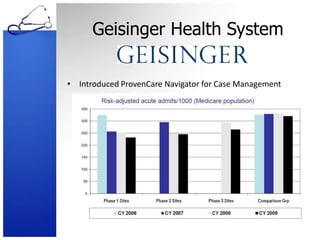
Geisinger Health SystemIntroduced ProvenCare Navigator for Case Management
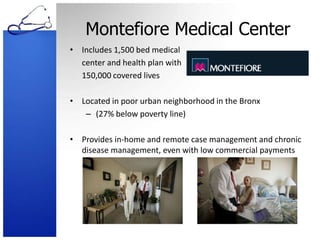
Montefiore Medical CenterIncludes 1,500 bed medical 	center and health plan with 	150,000 covered livesLocated in poor urban neighborhood in the Bronx (27% below poverty line)Provides in-home and remote case management and chronic disease management, even with low commercial payments
ACOs in Practice: The CMS Shared Savings ProgramSection 3022 of the Patient Protection and Affordable Care Act: CMS must establish a “Shared Savings Program” by 1/1/2012Final CMS rule scheduled to be published this December 2010 (Update: actually published 3/31/11)Participants must have:Formal legal structurePCPs with 5000+ Medicare patients3 year commitment to programInformation systems to manage care and reportingProcesses to provide evidence-based care and coordinate care across the ACO
ACOs in Practice: The CMS Shared Savings ProgramACO must take responsibility for >5000 Medicare beneficiariesBeneficiaries must be notified at time of carePatient cannot be limited to ACO provider networkShared savings available in two tiers:Low risk (shared savings in years 1-3, shared losses in 3)Up to 50% of saved dollars above 2% thresholdMore risk (shared savings and losses in years 1-3)Up to 60% of all saved dollars, up to 10% of shared lossesSavings only available when reported quality benchmarks are met, and savings amounts based on total quality score of ACOAnti-trust and kickback laws exempt for shared savings $$HHS estimates $960 million in savings
My Take on Shared Savings Program“Voluntary and Incremental”A good first step.  The lack of a closed network is limiting but…Effects on cost and quality will be muted but still evidentCommercial payers will follow suit, multiplying incentivesExisting providers will be moderately successfulBy improving quality and reducing unnecessary and duplicative servicesBut at the cost of excessive restructuring costs and lossesTightly integrated PCP networks best positioned (Harvard Vanguard)
What’s NextNew capital will be infused in the market for:Reclamation projects of struggling systems including PCP networks(ex. Caritas Christi)With nothing to lose, the change process in these systems will be greatly aidedBrand new systems designed for prevention and low-cost, high-touch mid-level care teamsFollow-on legislation will includeFull capitationLimited networksRate setting?

Accountable Care Organizations: A Look at ACO Design and Implementation

  • 1.
    Accountable Care OrganizationsALook at ACO Design and ImplementationKeith MarpleKeithmarple.com
  • 2.
    Accountable Care OrganizationsTheoryof ACOsACO ExamplesCMS Shared Savings Program LegislationMy Take
  • 3.
    Theory of ACOsDefinedby Elliott Fisher, MD/MPH in 2009Seeks to address the following problems:Current Incentives and System Fragmentation prevent providers from managing the health of their patient populationProvider incomes are tied to service volume and intensityPatients believe that more care is better care
  • 4.
    Theory of ACOsFisher’sSolutionACOs care for patient populations using integrated care teams, evidence-based medicine, and a focus on primary care.Legal Provider EntityAttributable and Significant Patient BaseInvisibly assigned by empirical methodsRisk-Adjusted Cost BenchmarksQuality Measurement and ReportingShared Savings
  • 5.
    Some ACO ExamplesSomeexamples I’ll cover…CMS Physician Group Practice Demonstration ProjectGeisinger Health System, Danville, PAMontefiore Medical System, Bronx, NYAnd some in Massachusetts you probably already know about…Commonwealth Care AllianceBCBS Alternative Quality Contract ParticipantsCaritas Christi Health Care
  • 6.
    CMS Physician GroupPractice Demo2005 Demonstration Program to test ACO concept10 large physician groups chosenFocused on management of diabetes patient populationFee-for-service payment plus payment incentives for cost and quality resultsResults in Year 1All 10 groups improved quality of diabetes management8 of 10 experienced lower cost increases than national average
  • 7.
    Geisinger Health SystemIntegratedDelivery Network Located in rural PennsylvaniaIncludes Health Plan with 250,000 covered lives, which allows Geisinger to be financially incentivized for low-cost, high-quality careIntroduced ProvenCare model:Standard, evidence-based care processesSurgical checklistsMoney-back “Warranty” on complicationsIntroduced with CABG surgeries, rolled out to other acute services
  • 8.
    Geisinger Health SystemIntroducedProvenCare Navigator for Case Management
  • 9.
    Montefiore Medical CenterIncludes1,500 bed medical center and health plan with 150,000 covered livesLocated in poor urban neighborhood in the Bronx (27% below poverty line)Provides in-home and remote case management and chronic disease management, even with low commercial payments
  • 10.
    ACOs in Practice:The CMS Shared Savings ProgramSection 3022 of the Patient Protection and Affordable Care Act: CMS must establish a “Shared Savings Program” by 1/1/2012Final CMS rule scheduled to be published this December 2010 (Update: actually published 3/31/11)Participants must have:Formal legal structurePCPs with 5000+ Medicare patients3 year commitment to programInformation systems to manage care and reportingProcesses to provide evidence-based care and coordinate care across the ACO
  • 11.
    ACOs in Practice:The CMS Shared Savings ProgramACO must take responsibility for >5000 Medicare beneficiariesBeneficiaries must be notified at time of carePatient cannot be limited to ACO provider networkShared savings available in two tiers:Low risk (shared savings in years 1-3, shared losses in 3)Up to 50% of saved dollars above 2% thresholdMore risk (shared savings and losses in years 1-3)Up to 60% of all saved dollars, up to 10% of shared lossesSavings only available when reported quality benchmarks are met, and savings amounts based on total quality score of ACOAnti-trust and kickback laws exempt for shared savings $$HHS estimates $960 million in savings
  • 12.
    My Take onShared Savings Program“Voluntary and Incremental”A good first step. The lack of a closed network is limiting but…Effects on cost and quality will be muted but still evidentCommercial payers will follow suit, multiplying incentivesExisting providers will be moderately successfulBy improving quality and reducing unnecessary and duplicative servicesBut at the cost of excessive restructuring costs and lossesTightly integrated PCP networks best positioned (Harvard Vanguard)
  • 13.
    What’s NextNew capitalwill be infused in the market for:Reclamation projects of struggling systems including PCP networks(ex. Caritas Christi)With nothing to lose, the change process in these systems will be greatly aidedBrand new systems designed for prevention and low-cost, high-touch mid-level care teamsFollow-on legislation will includeFull capitationLimited networksRate setting?