Everything You Wanted to Know to Apply to the
Community-based Care Transitions Program by
             September 3, 2012
                                               Juliana Tiongson
          Social Science Research Analyst and CCTP Program Lead
                     CMS Center for Medicare & Medicaid Innovation

                                                    Ashley Ridlon
            Field Director, Care Transitions, Partnership for Patients,
                    CMS Center for Medicare & Medicaid Innovation
                                                          July 12, 2012


                                                                          1
Dr. Paul McGann, Co-Director
   Partnership for Patients

Why Our BIG PUSH for Many, High-
  Quality Applicants to the CCTP
  Program by September 3, 2012,
           is Important
The Community–based Care
      Transitions Program (CCTP)
• The CCTP, created by section 3026 of the
  Affordable Care Act, provides funding to test
  models for improving care transitions for high
  risk Medicare beneficiaries.

• Our last application review date for CY 2012:
  • September 20, 2012 - Applications must be
    received by September 3rd to be considered for this
    review.
Program Goals

• Improve transitions of beneficiaries from the
  inpatient hospital setting to home or other care
  settings

• Improve quality of care

• Reduce readmissions for high risk beneficiaries

• Document measureable savings to the Medicare
  program
Eligible Applicants

• Are statutorily defined as:
   − Acute Care Hospitals with high readmission rates in
     partnership with an eligible community-based organization
   − Community-based organizations (CBOs) that provide care
     transition services
• There must always be a partnership between at least one
  acute care hospital and one eligible CBO
• Critical access hospitals and specialty hospitals excluded as
  feeder hospitals but could be part of the larger community
  collaboration
Definition of CBO

• Community-based organizations that provide care
  transition services across the continuum of care
  through arrangements with subsection (d) hospitals
   – Governing body with multiple health care stakeholders, including
     consumers
   – Legal entity with taxpayer ID number - for example, a 501(c)3) - so
     they can be paid for services they provide
   – Physically located in the community it proposes to serve
• A self-contained or closed health system does not qualify as
  a CBO
Examples of entities that may be a CBO

• Area Agencies on Aging (AAAs)
• Aging and Disability Resource Center (ADRCs)
• Federally Qualified Health Centers (FQHCs)
• A coalition representing a collaboration of community
  healthcare providers - if a legal entity is formed
• Some post-acute care providers may qualify – with
  evidence that there is board representation that comes
  from outside of that provider entity
Preferences
• Preference will be given to proposals that:
   – Include participation in a program administered by the AoA (ACL) to
     provide concurrent care transition interventions with multiple
     hospitals and practitioners

   – Provide services to medically-underserved populations, small
     communities and rural areas


• Preference means that all other things being equal,
  these factors can improve applicant’s rating by panel
Additional Considerations
• “High-readmission hospital” defined as having 30-day
  readmission rate on at least two of the three hospital
  compare measures (Acute Myocardial Infarction [AMI],
  Heart Failure [HF], Pneumonia [PNEU]) in the fourth
  quartile for its state
   – You can find this data at:
     http://www.cms.gov/DemoProjectsEvalRpts/downloads/C
     CTP_FourthQuartileHospsbyState.pdf
   – The data covers 30 day readmission rates for
     hospitalizations that occurred between July 2006 and
     June 2009
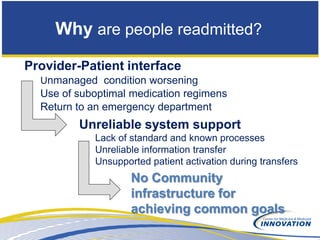
Why are people readmitted?
Provider-Patient interface
  Unmanaged condition worsening
  Use of suboptimal medication regimens
  Return to an emergency department
         Unreliable system support
            Lack of standard and known processes
            Unreliable information transfer
            Unsupported patient activation during transfers
                    No Community
                    infrastructure for
                    achieving common goals
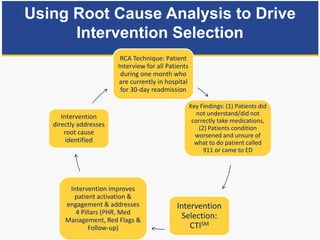
Using Root Cause Analysis to Drive
      Intervention Selection
                         RCA Technique: Patient
                        Interview for all Patients
                         during one month who
                         are currently in hospital
                         for 30-day readmission

                                                     Key Findings: (1) Patients did
      Intervention                                      not understand/did not
                                                      correctly take medications,
   directly addresses
                                                         (2) Patients condition
       root cause                                      worsened and unsure of
        identified                                     what to do patient called
                                                           911 or came to ED


        Intervention improves
         patient activation &
       engagement & addresses                Intervention
          4 Pillars (PHR, Med
       Management, Red Flags &
                                              Selection:
               Follow-up)                        CTISM
CMS Table of Interventions
http://www.cfmc.org/integratingcare/files/Care_Transition_Art
           icle_Remington_Report_Jan_2010.pdf
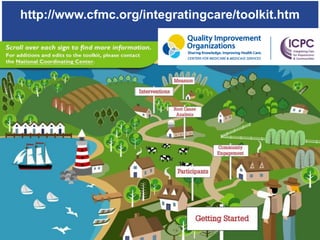
http://www.cfmc.org/integratingcare/toolkit.htm
Application Requirements

• Strategy and Implementation Plan
   – Includes a Community Specific Root Cause
     Analysis (RCA)
• Organizational Structure and Capabilities for the
  applicant and its partners
• Previous Experience
• Budget Proposal
Implementation Plan
• Implementation work plan with milestones

• Identify process for collecting, aggregating, and reporting
  quality measure data to CMS

• Description of how the applicant will align its care transition
  programs with care transition initiatives sponsored by other
  payers in their respective community

• Applicants claiming preference for working in rural areas,
  small communities, or serving medically- underserved
  populations should provide evidence to support that claim
Strategy

• Description of a comprehensive community specific root
  cause analysis including incorporating downstream
  providers as appropriate
• Results of the root cause analysis are used to drive
  selection of the target population and the interventions
• Clear process for identifying high risk Medicare FFS
  beneficiaries to be targeted
• Intervention implementation strategy- including how the
  intervention will be integrated into the discharge process
  without duplicating it
Organizational Structure

• Description of the financial, legal, and organizational
  structure of the partnership between the hospital and the
  CBO
• Process for if and how CBO fees will be shared among
  hospitals and/or other community providers
• Explanation of internal monitoring processes for the
  management and delivery of care transition services
• Include protocols detailing financial controls for Medicare
  payments
Capabilities
• Formal agreements are presented for all downstream providers
  (such as nursing homes, home health agencies, primary care
  providers) identified as partners in the initiative
   – For example, MOUs, Charters, Data-Sharing Agreements
• Applicant provides letters of support signed by the CFO, CEO,
  and operations manager for discharge/case management at each
  hospital named as a partner in the application.
• Justification for applicant to qualify as a CBO
• Support for claiming program preferences as noted above
• Clarity in your narrative is key – don’t make panelists guess
  whether you are eligible/qualified. Tables and charts can help to
  organize information.
Previous Experience
• Description of previous experience implementing care
  transitions interventions
   – Includes evidence on the measurement strategies and outcomes of
     this work
   – Specify where longer-term care coordination or disease management
     intervention focused around the hospital discharge/transition
• Training completed in any of the evidence based care
  transitions interventions (e.g., CTI, BOOST, RED,
  INTERACT, TCM, TCAB, STAAR, H2H, BRIDGE, GRACE)
• Description of other efforts to reduce readmissions
   – May include discharge process redesign or the use of electronic
     health information systems and tools.
Budget Guidance
• CBOs will not be paid for discharge planning services already
  required under the Social Security Act and stipulated in the CMS
  Conditions of Participation
• This is not a grant program; do not structure your budgets as you
  would a grant.
• Under this program, CBOs bill monthly for care transitions services
  they provide and are paid the per-eligible discharge rate per final
  program agreement. CMS acknowledges that there may be
  regional and other reasons for variations in the rates.
• CBOs may only include the direct service costs for the provision of
  care transition services to high risk Medicare beneficiaries
• Do not use the average cost of a hospital admission/readmission
  ($9600) as a starting point for developing proposed rate
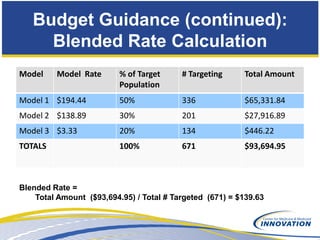
Budget Guidance (continued):
     Blended Rate Calculation
Model    Model Rate       % of Target     # Targeting     Total Amount
                          Population
Model 1 $194.44           50%             336             $65,331.84
Model 2 $138.89           30%             201             $27,916.89
Model 3 $3.33             20%             134             $446.22
TOTALS                    100%            671             $93,694.95


Blended Rate =
    Total Amount ($93,694.95) / Total # Targeted (671) = $139.63
Payment Methodology

• CBOs will be paid a per-eligible discharge rate
 Rate is determined by:
   – the target population
   – the proposed intervention(s)
   – the anticipated patient volume
   – the expected reduction in readmissions (cost savings)
 Rate will not support ongoing disease management or
  chronic care management, which generally require a
  PMPM fee.
Pitfalls to Avoid:
                    Common Errors
• The applicant CBO does not meet the eligibility requirements to be
  a CBO or it is unclear.
   – Board members and their affiliations are not identified
   – CBO appears to be part of closed hospital-system
   – Audit reports are not completed or are incomplete
• Lack of a community-specific RCA.
• The RCA is present, but the methodology for targeting high risk
  beneficiaries and the selected interventions proposed are not tied
  back to the community specific RCA.
• Letters of support or appropriate signatures are missing from the
  application.
• Budget narrative is unclear. What patient-level services does the
  fee cover?
Pitfalls to Avoid:
         Strategy & Implementation
• Insufficient detail
   – Implementation timeline (Hint: tables are helpful, and the sooner you
     are prepared to begin implementation, the better)
   – Staffing and training: Who is trained so far? What kind of training, and
     how many staff? Who/how many do you still need to train, when, and
     what kind?
• Overly broad and/or subjective targeting
• Population targeting not fully addressed
• Readmission risk assessment screening tool not fully described,
  provided or is not evidence-based
• Proposing a hybrid model that has not been tested
• Proposing multiple evidence-based interventions that lack
  integration, appear duplicative, and may be in conflict with one
  another
Pitfalls to Avoid:
      Organizational Structure
• Unclear relationship between partner organizations
• Fee-sharing arrangements not adequately described
• Board of Directors not listed and/or no consumer
  representation
• Excessive lead-time to get started
   – Hiring / training
   – Agreements not finalized
   – Operational protocols in development
Pitfalls to Avoid:
             Previous Experience
• Insufficient detail with previous experience/ pilot
  programs
   – Population, intervention, duration, outcomes, lessons learned
   – Show us the data - all of it (e.g., not just final readmission rate
     of target population after intervention, but how much did all-
     cause readmissions go down both in target population and
     overall in hospital/community, and include both rate and
     counts)
• Broader experience is taken into account, but
  applicant should provide transferrable features
Pitfalls to Avoid:
                    Budget
• Proposing a PMPM instead of a per-eligible discharge rate

• Populating the budget worksheet with numbers and failing
  to provide narrative/justification for numbers elsewhere

• Basing eligible discharge rate on 100% participation

• Using unreasonable assumptions for readmissions
  avoided, which also inflates savings estimates.
Pitfalls to Avoid:
                    Budget
• Building a budget as a grant and including costs for
  training, evaluation, office supplies and equipment, project
  directors, administrative support and so on
• Payments between providers for referrals
• Incentive payments to providers for good will, cooperation,
  and promotion
• Duplication of services or lack of clarity around how
  services are distributed among normal discharge planning
  activities and staff, and what additional services are being
  provided among hospital, CBO, other partner staff
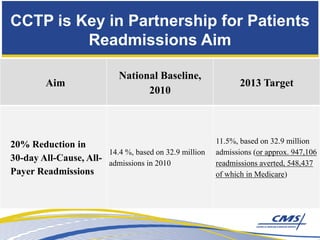
CCTP is Key in Partnership for Patients
         Readmissions Aim

                            National Baseline,
         Aim                                                  2013 Target
                                  2010


20% Reduction in                                       11.5%, based on 32.9 million
                       14.4 %, based on 32.9 million   admissions (or approx. 947,106
30-day All-Cause, All- admissions in 2010              readmissions averted, 548,437
Payer Readmissions                                     of which in Medicare)
Key Thoughts and Requests from
   the Partnership for Patients
1. Focus on effective targeting to reduce more readmissions
2. Collaborate with other payers, including Medicaid, Medicare
   Advantage, Medicaid Managed Care. While CCTP can only
   directly support the Medicare transitions, aim to serve all high
   risk patients and help these other payers achieve better quality
   outcomes at lower costs.
3. Build strategic partnerships with others in your community who
   can bridge gaps – ultimately creating “economies of scale” and
   allowing multiple providers and patients to tap into learning and
   other shared resources.
4. CMS would like to double or triple the impact of this program –
   the goals are far too important not to reach for the stars!
Community-Based Care Transitions -
      Your QIO Can Help!
• Community Coalition Formation

• Community-specific Root Cause Analysis

• Intervention Selection and Implementation

• Assist with Application to Formal Care Transitions Program

For assistance please locate your QIO care transitions contact
at: http://cfmc.org/integratingcare under “Contact Us”
Useful Care Transitions Links
   LEARN:

• QIO National Coordinating Center: www.cfmc.org/integratingcare
• ACL: http://www.adrc-tae.org/tiki-index.php?page=CareTransitions
• CCTP Site Summaries: http://innovations.cms.gov/initiatives/Partnership-
  for-Patients/CCTP/partners.html

              APPLY:

• CCTP: http://innovations.cms.gov/initiatives/Partnership-for-Patients/CCTP

• QIO Help: See “Toolkit” at CFMC.org and Contact Your QIO Directly at
  http://www.cfmc.org/integratingcare/files/ICPC%20Aim%20Lead%20Conta
  cts_022712.pdf
Thank you.


For CCTP Specific Questions, E-mail Us:
    CareTransitions@cms.hhs.gov

Webinar: Community-based Care Transitions Program - How To Apply

  • 1.
    Everything You Wantedto Know to Apply to the Community-based Care Transitions Program by September 3, 2012 Juliana Tiongson Social Science Research Analyst and CCTP Program Lead CMS Center for Medicare & Medicaid Innovation Ashley Ridlon Field Director, Care Transitions, Partnership for Patients, CMS Center for Medicare & Medicaid Innovation July 12, 2012 1
  • 2.
    Dr. Paul McGann,Co-Director Partnership for Patients Why Our BIG PUSH for Many, High- Quality Applicants to the CCTP Program by September 3, 2012, is Important
  • 3.
    The Community–based Care Transitions Program (CCTP) • The CCTP, created by section 3026 of the Affordable Care Act, provides funding to test models for improving care transitions for high risk Medicare beneficiaries. • Our last application review date for CY 2012: • September 20, 2012 - Applications must be received by September 3rd to be considered for this review.
  • 4.
    Program Goals • Improvetransitions of beneficiaries from the inpatient hospital setting to home or other care settings • Improve quality of care • Reduce readmissions for high risk beneficiaries • Document measureable savings to the Medicare program
  • 5.
    Eligible Applicants • Arestatutorily defined as: − Acute Care Hospitals with high readmission rates in partnership with an eligible community-based organization − Community-based organizations (CBOs) that provide care transition services • There must always be a partnership between at least one acute care hospital and one eligible CBO • Critical access hospitals and specialty hospitals excluded as feeder hospitals but could be part of the larger community collaboration
  • 6.
    Definition of CBO •Community-based organizations that provide care transition services across the continuum of care through arrangements with subsection (d) hospitals – Governing body with multiple health care stakeholders, including consumers – Legal entity with taxpayer ID number - for example, a 501(c)3) - so they can be paid for services they provide – Physically located in the community it proposes to serve • A self-contained or closed health system does not qualify as a CBO
  • 7.
    Examples of entitiesthat may be a CBO • Area Agencies on Aging (AAAs) • Aging and Disability Resource Center (ADRCs) • Federally Qualified Health Centers (FQHCs) • A coalition representing a collaboration of community healthcare providers - if a legal entity is formed • Some post-acute care providers may qualify – with evidence that there is board representation that comes from outside of that provider entity
  • 8.
    Preferences • Preference willbe given to proposals that: – Include participation in a program administered by the AoA (ACL) to provide concurrent care transition interventions with multiple hospitals and practitioners – Provide services to medically-underserved populations, small communities and rural areas • Preference means that all other things being equal, these factors can improve applicant’s rating by panel
  • 9.
    Additional Considerations • “High-readmissionhospital” defined as having 30-day readmission rate on at least two of the three hospital compare measures (Acute Myocardial Infarction [AMI], Heart Failure [HF], Pneumonia [PNEU]) in the fourth quartile for its state – You can find this data at: http://www.cms.gov/DemoProjectsEvalRpts/downloads/C CTP_FourthQuartileHospsbyState.pdf – The data covers 30 day readmission rates for hospitalizations that occurred between July 2006 and June 2009
  • 10.
    Why are peoplereadmitted? Provider-Patient interface Unmanaged condition worsening Use of suboptimal medication regimens Return to an emergency department Unreliable system support Lack of standard and known processes Unreliable information transfer Unsupported patient activation during transfers No Community infrastructure for achieving common goals
  • 11.
    Using Root CauseAnalysis to Drive Intervention Selection RCA Technique: Patient Interview for all Patients during one month who are currently in hospital for 30-day readmission Key Findings: (1) Patients did Intervention not understand/did not correctly take medications, directly addresses (2) Patients condition root cause worsened and unsure of identified what to do patient called 911 or came to ED Intervention improves patient activation & engagement & addresses Intervention 4 Pillars (PHR, Med Management, Red Flags & Selection: Follow-up) CTISM
  • 12.
    CMS Table ofInterventions http://www.cfmc.org/integratingcare/files/Care_Transition_Art icle_Remington_Report_Jan_2010.pdf
  • 13.
  • 14.
    Application Requirements • Strategyand Implementation Plan – Includes a Community Specific Root Cause Analysis (RCA) • Organizational Structure and Capabilities for the applicant and its partners • Previous Experience • Budget Proposal
  • 15.
    Implementation Plan • Implementationwork plan with milestones • Identify process for collecting, aggregating, and reporting quality measure data to CMS • Description of how the applicant will align its care transition programs with care transition initiatives sponsored by other payers in their respective community • Applicants claiming preference for working in rural areas, small communities, or serving medically- underserved populations should provide evidence to support that claim
  • 16.
    Strategy • Description ofa comprehensive community specific root cause analysis including incorporating downstream providers as appropriate • Results of the root cause analysis are used to drive selection of the target population and the interventions • Clear process for identifying high risk Medicare FFS beneficiaries to be targeted • Intervention implementation strategy- including how the intervention will be integrated into the discharge process without duplicating it
  • 17.
    Organizational Structure • Descriptionof the financial, legal, and organizational structure of the partnership between the hospital and the CBO • Process for if and how CBO fees will be shared among hospitals and/or other community providers • Explanation of internal monitoring processes for the management and delivery of care transition services • Include protocols detailing financial controls for Medicare payments
  • 18.
    Capabilities • Formal agreementsare presented for all downstream providers (such as nursing homes, home health agencies, primary care providers) identified as partners in the initiative – For example, MOUs, Charters, Data-Sharing Agreements • Applicant provides letters of support signed by the CFO, CEO, and operations manager for discharge/case management at each hospital named as a partner in the application. • Justification for applicant to qualify as a CBO • Support for claiming program preferences as noted above • Clarity in your narrative is key – don’t make panelists guess whether you are eligible/qualified. Tables and charts can help to organize information.
  • 19.
    Previous Experience • Descriptionof previous experience implementing care transitions interventions – Includes evidence on the measurement strategies and outcomes of this work – Specify where longer-term care coordination or disease management intervention focused around the hospital discharge/transition • Training completed in any of the evidence based care transitions interventions (e.g., CTI, BOOST, RED, INTERACT, TCM, TCAB, STAAR, H2H, BRIDGE, GRACE) • Description of other efforts to reduce readmissions – May include discharge process redesign or the use of electronic health information systems and tools.
  • 20.
    Budget Guidance • CBOswill not be paid for discharge planning services already required under the Social Security Act and stipulated in the CMS Conditions of Participation • This is not a grant program; do not structure your budgets as you would a grant. • Under this program, CBOs bill monthly for care transitions services they provide and are paid the per-eligible discharge rate per final program agreement. CMS acknowledges that there may be regional and other reasons for variations in the rates. • CBOs may only include the direct service costs for the provision of care transition services to high risk Medicare beneficiaries • Do not use the average cost of a hospital admission/readmission ($9600) as a starting point for developing proposed rate
  • 21.
    Budget Guidance (continued): Blended Rate Calculation Model Model Rate % of Target # Targeting Total Amount Population Model 1 $194.44 50% 336 $65,331.84 Model 2 $138.89 30% 201 $27,916.89 Model 3 $3.33 20% 134 $446.22 TOTALS 100% 671 $93,694.95 Blended Rate = Total Amount ($93,694.95) / Total # Targeted (671) = $139.63
  • 22.
    Payment Methodology • CBOswill be paid a per-eligible discharge rate  Rate is determined by: – the target population – the proposed intervention(s) – the anticipated patient volume – the expected reduction in readmissions (cost savings)  Rate will not support ongoing disease management or chronic care management, which generally require a PMPM fee.
  • 23.
    Pitfalls to Avoid: Common Errors • The applicant CBO does not meet the eligibility requirements to be a CBO or it is unclear. – Board members and their affiliations are not identified – CBO appears to be part of closed hospital-system – Audit reports are not completed or are incomplete • Lack of a community-specific RCA. • The RCA is present, but the methodology for targeting high risk beneficiaries and the selected interventions proposed are not tied back to the community specific RCA. • Letters of support or appropriate signatures are missing from the application. • Budget narrative is unclear. What patient-level services does the fee cover?
  • 24.
    Pitfalls to Avoid: Strategy & Implementation • Insufficient detail – Implementation timeline (Hint: tables are helpful, and the sooner you are prepared to begin implementation, the better) – Staffing and training: Who is trained so far? What kind of training, and how many staff? Who/how many do you still need to train, when, and what kind? • Overly broad and/or subjective targeting • Population targeting not fully addressed • Readmission risk assessment screening tool not fully described, provided or is not evidence-based • Proposing a hybrid model that has not been tested • Proposing multiple evidence-based interventions that lack integration, appear duplicative, and may be in conflict with one another
  • 25.
    Pitfalls to Avoid: Organizational Structure • Unclear relationship between partner organizations • Fee-sharing arrangements not adequately described • Board of Directors not listed and/or no consumer representation • Excessive lead-time to get started – Hiring / training – Agreements not finalized – Operational protocols in development
  • 26.
    Pitfalls to Avoid: Previous Experience • Insufficient detail with previous experience/ pilot programs – Population, intervention, duration, outcomes, lessons learned – Show us the data - all of it (e.g., not just final readmission rate of target population after intervention, but how much did all- cause readmissions go down both in target population and overall in hospital/community, and include both rate and counts) • Broader experience is taken into account, but applicant should provide transferrable features
  • 27.
    Pitfalls to Avoid: Budget • Proposing a PMPM instead of a per-eligible discharge rate • Populating the budget worksheet with numbers and failing to provide narrative/justification for numbers elsewhere • Basing eligible discharge rate on 100% participation • Using unreasonable assumptions for readmissions avoided, which also inflates savings estimates.
  • 28.
    Pitfalls to Avoid: Budget • Building a budget as a grant and including costs for training, evaluation, office supplies and equipment, project directors, administrative support and so on • Payments between providers for referrals • Incentive payments to providers for good will, cooperation, and promotion • Duplication of services or lack of clarity around how services are distributed among normal discharge planning activities and staff, and what additional services are being provided among hospital, CBO, other partner staff
  • 29.
    CCTP is Keyin Partnership for Patients Readmissions Aim National Baseline, Aim 2013 Target 2010 20% Reduction in 11.5%, based on 32.9 million 14.4 %, based on 32.9 million admissions (or approx. 947,106 30-day All-Cause, All- admissions in 2010 readmissions averted, 548,437 Payer Readmissions of which in Medicare)
  • 30.
    Key Thoughts andRequests from the Partnership for Patients 1. Focus on effective targeting to reduce more readmissions 2. Collaborate with other payers, including Medicaid, Medicare Advantage, Medicaid Managed Care. While CCTP can only directly support the Medicare transitions, aim to serve all high risk patients and help these other payers achieve better quality outcomes at lower costs. 3. Build strategic partnerships with others in your community who can bridge gaps – ultimately creating “economies of scale” and allowing multiple providers and patients to tap into learning and other shared resources. 4. CMS would like to double or triple the impact of this program – the goals are far too important not to reach for the stars!
  • 31.
    Community-Based Care Transitions- Your QIO Can Help! • Community Coalition Formation • Community-specific Root Cause Analysis • Intervention Selection and Implementation • Assist with Application to Formal Care Transitions Program For assistance please locate your QIO care transitions contact at: http://cfmc.org/integratingcare under “Contact Us”
  • 32.
    Useful Care TransitionsLinks LEARN: • QIO National Coordinating Center: www.cfmc.org/integratingcare • ACL: http://www.adrc-tae.org/tiki-index.php?page=CareTransitions • CCTP Site Summaries: http://innovations.cms.gov/initiatives/Partnership- for-Patients/CCTP/partners.html APPLY: • CCTP: http://innovations.cms.gov/initiatives/Partnership-for-Patients/CCTP • QIO Help: See “Toolkit” at CFMC.org and Contact Your QIO Directly at http://www.cfmc.org/integratingcare/files/ICPC%20Aim%20Lead%20Conta cts_022712.pdf
  • 33.
    Thank you. For CCTPSpecific Questions, E-mail Us: CareTransitions@cms.hhs.gov