ENTRANCE ID TECHNOLOGYENTRANCE ID TECHNOLOGY
ACCESS CONTROL SYSTEMS. Access control
systems can range from small, relatively
simple one-door affairs to highly complex,
computer-operated systems capable of
handling hundreds of doors and tens of
thousands of individually encoded
identification credentials. A basic system
usually consists of a central processing unit
(CPU), a input device at each protected door,
and an identification credential assigned to
each user.
ENTRANCE ID TECHNOLOGYENTRANCE ID TECHNOLOGY
A printer is often included to provide a record
of all activity. The CPU is the brains of the
system and is programmed with data on each
user. The data can include an access level,
which determines which doors may be
entered by the user, and time zones, which
define the hours of the day and days of the
week a user may enter a door at a particular
access level.
ENTRANCE ID TECHNOLOGYENTRANCE ID TECHNOLOGY
The two types of systems indicated above fall
into these categories:
STAND-ALONE SYSTEMS. Stand-alone
systems are used to control access at a
single entry point and are available either as
one integral unit or as two separate
components — a reader/keypad and a
controller. While stand-alone systems can be
networked, they generally do not require a
CPU. Data for the entire user population is
stored within the unit. The installation of a
stand-alone system is simple, and thus
cheaper, since there is no need to run wires
to connect the unit(s) to the CPU.
ENTRANCE ID TECHNOLOGYENTRANCE ID TECHNOLOGY
MULTIPLE-PORTAL SYSTEMS. Multiple-portal
systems are part of a large network of
readers and controllers that are connected to
a CPU and that can regulate activities at
more than one entry point at a time. Some
systems are directly under the control of the
CPU, while others are programmed to receive
only periodic programming updates or to
upload data according to a preprogrammed
schedule. Installation costs for these
systems are relatively high because of the
need to interconnect the units to the CPU.
ENTRANCE ID TECHNOLOGYENTRANCE ID TECHNOLOGY
Now that we have taken a fast look at the
overall systems parts lets look at, probably
the most fascinating part of the system, the
different types of input devices used in
today’s systems. We will start with breaking
these devices down into groups.
1. Keypads
2. Card/Token readers
3. Biometric readers
Now let’s take a closer look at each of these
technologies.
ENTRANCE ID TECHNOLOGYENTRANCE ID TECHNOLOGY
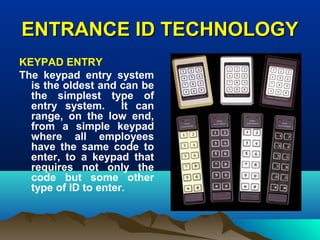
KEYPAD ENTRY
The keypad entry system
is the oldest and can be
the simplest type of
entry system. It can
range, on the low end,
from a simple keypad
where all employees
have the same code to
enter, to a keypad that
requires not only the
code but some other
type of ID to enter.
ENTRANCE ID TECHNOLOGYENTRANCE ID TECHNOLOGY
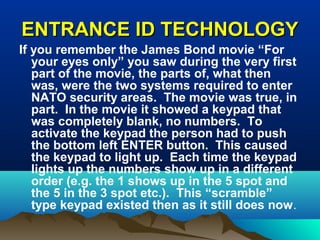
If you remember the James Bond movie “For
your eyes only” you saw during the very first
part of the movie, the parts of, what then
was, were the two systems required to enter
NATO security areas. The movie was true, in
part. In the movie it showed a keypad that
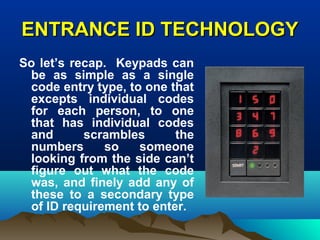
was completely blank, no numbers. To
activate the keypad the person had to push
the bottom left ENTER button. This caused
the keypad to light up. Each time the keypad
lights up the numbers show up in a different
order (e.g. the 1 shows up in the 5 spot and
the 5 in the 3 spot etc.). This “scramble”
type keypad existed then as it still does now.
ENTRANCE ID TECHNOLOGYENTRANCE ID TECHNOLOGY
So let’s recap. Keypads can
be as simple as a single
code entry type, to one that
excepts individual codes
for each person, to one
that has individual codes
and scrambles the
numbers so someone
looking from the side can’t
figure out what the code
was, and finely add any of
these to a secondary type
of ID requirement to enter.
ENTRANCE ID TECHNOLOGYENTRANCE ID TECHNOLOGY
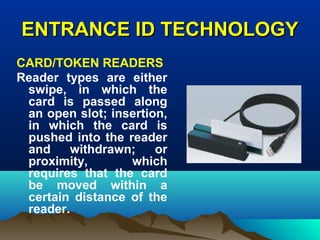
CARD/TOKEN READERS
Reader types are either
swipe, in which the
card is passed along
an open slot; insertion,
in which the card is
pushed into the reader
and withdrawn; or
proximity, which
requires that the card
be moved within a
certain distance of the
reader.
ENTRANCE ID TECHNOLOGYENTRANCE ID TECHNOLOGY
In some card access control systems,
improved security is achieved by requiring
the user to present the card to a reader, as
well as enter a unique passcode, a
personal identification number (PIN), on a
keypad. With this enhancement, the loss
of a card will not compromise the system,
since an unauthorized user would also
need to know the PIN. The added security
afforded by the card/PIN combination
more than offsets the delay that results
from the user having to enter a PIN.
ENTRANCE ID TECHNOLOGYENTRANCE ID TECHNOLOGY
CARD TECHNOLOGIES. There are at least nine
different card-encoding technologies available:
magnetic stripe, Wiegand, proximity, barium
ferrite, infrared, bar code, Hollerith, “smart”
card, and optical storage. The magnetically
based technologies include magnetic stripe,
Wiegand, and barium ferrite.
The optically based technologies are infrared,
bar code, optical storage, and Hollerith.
Proximity cards and some smart cards use
radio signals to communicate with the reader.
Surveys indicate that magnetic stripe,
Weigand, and proximity technologies control
over 80 percent of the market in terms of
usage.
ENTRANCE ID TECHNOLOGYENTRANCE ID TECHNOLOGY
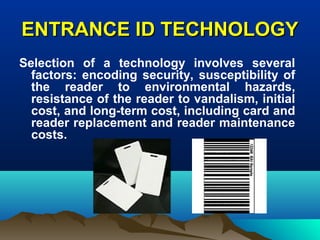
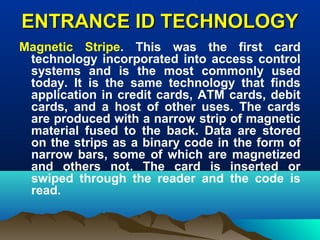
Selection of a technology involves several
factors: encoding security, susceptibility of
the reader to environmental hazards,
resistance of the reader to vandalism, initial
cost, and long-term cost, including card and
reader replacement and reader maintenance
costs.
ENTRANCE ID TECHNOLOGYENTRANCE ID TECHNOLOGY
Magnetic Stripe. This was the first card
technology incorporated into access control
systems and is the most commonly used
today. It is the same technology that finds
application in credit cards, ATM cards, debit
cards, and a host of other uses. The cards
are produced with a narrow strip of magnetic
material fused to the back. Data are stored
on the strips as a binary code in the form of
narrow bars, some of which are magnetized
and others not. The card is inserted or
swiped through the reader and the code is
read.
ENTRANCE ID TECHNOLOGYENTRANCE ID TECHNOLOGY
(A) There are two types of magnetic cards on
the market today: the 300 Oersted and the
4000 Oersted, high coercively card. The code
on a 300 Oersted card can become
scrambled when subjected to a magnetic
field. The 4000 Oersted card is the preferred
card, since the material that comprises the
magnetic stripe retains data better and is
almost invulnerable to magnetic fields.
ENTRANCE ID TECHNOLOGYENTRANCE ID TECHNOLOGY
(B) Although relatively inexpensive and
widely used, magnetic stripe cards are one
of the most insecure cards in use. The
card can be encoded with readily available
encoding devices and, as such, should
only be used in low-security applications.
For higher security applications, the card
should be used in combination with a
passcode.
(C) Since there is direct contact between the
card and reader, both components are
subject to wear. The readers are vulnerable
to weather and the environment, as well as
vandalism, and need regular maintenance.
ENTRANCE ID TECHNOLOGYENTRANCE ID TECHNOLOGY
Wiegand.
(A) The operation of the Wiegand card is
based on the use of short lengths of
small-diameter, ferro-magnetic wires
that have been subjected to a patented
twisting process that imparts unique
magnetic properties to the wires. When
exposed to a magnetic field in a reader,
a current is induced in the wires that
generate a signal for the reader to pick
up.
ENTRANCE ID TECHNOLOGYENTRANCE ID TECHNOLOGY
(B) The Wiegand card provides a very high
degree of security, since it is factory-
encoded and extremely difficult to
counterfeit or alter. It is also immune to
electromagnetic (EM) and radio-frequency
(RF) fields. The reader is completely
sealed, which protects the working parts
from the elements, and is capable of
operating over wide temperature ranges.
Weigand cards are relatively expensive
when compared to other cards. They can
only be encoded once, since the wires
within them can only be magnetized one
time.
ENTRANCE ID TECHNOLOGYENTRANCE ID TECHNOLOGY
Barium Ferrite. The barium ferrite card uses
magnetized spots to create a code on the card
that must match magnets in a reader to close
a micro switch. The card has generally been
used in high-volume, high-turnover
applications, such as parking lots. It affords
high encoding security and is relatively
inexpensive to produce and encode. Older
readers were of the insertion type and subject
to high maintenance costs due to wear and
the environment. Newer, state-of-the-art
readers are of the proximity or “touch” type
and use an array of electronic sensor devices
installed behind a touch plate to read the
magnetic spot patterns on the card.
ENTRANCE ID TECHNOLOGYENTRANCE ID TECHNOLOGY
Infrared.
(A) Data is stored on this card by means of a bar
code written between layers of plastic. The card
is read by passing infrared light through it. The
bar code within the card casts a shadow on the
other side that is read by an array of infrared
light sensors. Encoding security is high
because duplication is almost impossible.
(B) Although they provide a high degree of
security, infrared cards are not in widespread
use for access control because of high card
and maintenance costs. The optical reader
comes in both swipe and insertion styles and is
subject to wear and contamination from the
environment, requiring regular maintenance.
ENTRANCE ID TECHNOLOGYENTRANCE ID TECHNOLOGY
Bar Code.
(A) The bar code card also is not widely used for
access control because encoding security is
very low and the bar code strip can be easily
damaged. Card encoding is accomplished at
relatively low cost. Because the bar code card
is an optical system, periodic cleaning and
servicing of the reader is necessary.
(B) Bar code labels can be applied to magnetic
stripe, Weigand, and other types of cards by
simply affixing the label to an area of the card
that does not contain information. These types
of cards are called dual technology cards.
ENTRANCE ID TECHNOLOGYENTRANCE ID TECHNOLOGY
Optical Storage.
(A) Information is written to an optical storage
card by etching small pits into the surface
of a reflective layer of plastic using a solid-
state infrared laser. The reflective layer is
sandwiched between two protective layers
of plastic. More than four Mega Bytes of
information can be written on the card. The
data is secure from compromise, since the
information on the card is usually in an
encrypted format.
ENTRANCE ID TECHNOLOGYENTRANCE ID TECHNOLOGY
(B) The reader is equipped with a solid-state laser
and generally a transport system that moves
the card past the reader at a steady speed.
Generally, the users are required to enter a
passcode before inserting the card. Data is
read from the card by systematically striking its
surface with an infrared beam of light from the
laser in the reader. A photo sensor reads the
data from fluctuations in the reflected light.
While relatively expensive as compared with
other card technologies, optical storage cards
are reusable. The readers and transport
systems are initially expensive and require
regular maintenance.
ENTRANCE ID TECHNOLOGYENTRANCE ID TECHNOLOGY
Hollerith. The Hollerith card is the oldest
technology in use. Data is written on the
card by punching holes in the card. The
card is read by either passage of light
through the holes or by fine contact
brushes that connect with an electrical
contact on the other side of the card
through the holes. The plastic or paper card
is very inexpensive, but the security is low.
This optical-type card is commonly used in
hotels as a replacement for key systems.
ENTRANCE ID TECHNOLOGYENTRANCE ID TECHNOLOGY
Proximity. Proximity identification credentials
are of two types—active and passive. Both
types of proximity identification credentials
have a micro-miniature electronic tuned
circuit and a switching mechanism buried
within them, while active identification
credentials also have a power source.
(A) Active identification credentials transmit a
coded signal when they come within range of
a proximity reader or when someone
manually activates them. Other identification
credentials transmit a signal continuously.
Generally, a long-life lithium battery is used
as the power source.
ENTRANCE ID TECHNOLOGYENTRANCE ID TECHNOLOGY
(B) Passive identification credentials rely on
an electrostatic field generated by the
proximity reader to cause them to transmit
a unique coded signal that is received by
the reader.
(C) Proximity technology has grown in
popularity because of its convenient
“hands-free” feature. An identification
credential is simply waved in front of a
reader to transmit the code. Operating
ranges are usually from 2 in. to 12 in. The
identification credential is factory-encoded
and difficult to copy or counterfeit and
affords good encoding security.
ENTRANCE ID TECHNOLOGYENTRANCE ID TECHNOLOGY
Since there is no contact with the reader,
identification credential life is generally
long, and the reader can be installed
inside, behind a wall or glass partition,
to afford protection from the elements
and vandals. The electronic circuits in
the identification credentials, however,
can be damaged if handled roughly.
ENTRANCE ID TECHNOLOGYENTRANCE ID TECHNOLOGY
Smart Card. “Smart card” is a generic term
for a single card that serves many
functions. The smart card is the state-of-
the-art in access control technology. The
basic card provides access control and
can double as a photo I.D. card or debit
card, as well as serving other functions.
ENTRANCE ID TECHNOLOGYENTRANCE ID TECHNOLOGY
(A) The card contains an integrated circuit
in which can be stored all the information
needed to identify and permit access,
eliminating the necessity for a CPU. To
function, a passcode must be provided
before the card can be read. Some smart
cards are powered by their own battery,
while others rely on the reader to power
them either directly by a set of external
contacts or electromagnetically.
ENTRANCE ID TECHNOLOGYENTRANCE ID TECHNOLOGY
(B) Because of their relatively high cost, at
present, the smart cards find limited
application. Their use is expected to
grow substantially, since they provide a
high level of security and can serve
many other applications.
ENTRANCE ID TECHNOLOGYENTRANCE ID TECHNOLOGY
BIOMETRIC SYSTEMS
Establishing a person’s identity can be
based on three methods: something
known by an individual (a password),
something possessed by an individual (a
card or key), and something physical
about an individual (a personal
characteristic). Biometric access control
devices, or personal characteristic
verification locks, rely on the latter
method. Since duplication of individual
physical characteristics is very rare,
biometric devices, in theory, could offer
the highest security possible.
ENTRANCE ID TECHNOLOGYENTRANCE ID TECHNOLOGY
BIOMETRIC SYSTEMS cont.
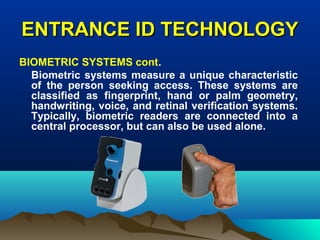
Biometric systems measure a unique characteristic
of the person seeking access. These systems are
classified as fingerprint, hand or palm geometry,
handwriting, voice, and retinal verification systems.
Typically, biometric readers are connected into a
central processor, but can also be used alone.
ENTRANCE ID TECHNOLOGYENTRANCE ID TECHNOLOGY
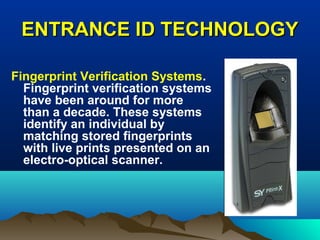
Fingerprint Verification Systems.
Fingerprint verification systems
have been around for more
than a decade. These systems
identify an individual by
matching stored fingerprints
with live prints presented on an
electro-optical scanner.
ENTRANCE ID TECHNOLOGYENTRANCE ID TECHNOLOGY
(A) Two types of systems have been developed
for fingerprint identification. One system
stores a laser picture or hologram on the
access card and compares the user’s print
data to that stored on the card. In the other
system, the fingerprint data is indexed in a
computer and is called up by an access card
or code issued to the user. The user places a
finger onto the scanner, which optically scans
it and compiles, in digital form, a list of
significant features (minutiae) of the
fingerprint and their locations. The minutiae,
which consist of ridge endings and ridge
branches, are then compared with the stored
data.
ENTRANCE ID TECHNOLOGYENTRANCE ID TECHNOLOGY
(B) Fingerprint verification systems are
considered to be very high in their relative
resistance to counterfeiting; in more than
60 years of compiling fingerprints, the FBI
has never found two sets of identical prints.
However, the equipment is very costly and,
according to some accounts, can be
adversely affected by dirt or grime on the
hands. For this reason, most fingerprint
verification systems are programmed to
give the user a second or third try, or
request the use of an alternate finger,
before rejection.
ENTRANCE ID TECHNOLOGYENTRANCE ID TECHNOLOGY
Hand or Palm Geometry Verification
Systems. Hand geometry units identify a
user by measuring the length and
curvature of the fingers of the user’s
hand together with the degree of
translucency of the fingertips and the
webbing between the fingers. These
measurements are then compared to that
stored in a computer. The translucency
test is intended to prevent the use of a
synthetic “forged” hand.
ENTRANCE ID TECHNOLOGYENTRANCE ID TECHNOLOGY
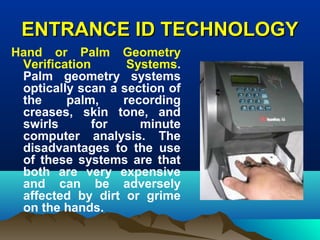
Hand or Palm Geometry
Verification Systems.
Palm geometry systems
optically scan a section of
the palm, recording
creases, skin tone, and
swirls for minute
computer analysis. The
disadvantages to the use
of these systems are that
both are very expensive
and can be adversely
affected by dirt or grime
on the hands.
ENTRANCE ID TECHNOLOGYENTRANCE ID TECHNOLOGY
Handwriting Verification Systems.
Handwriting verification systems are also
referred to as signature dynamics
verification. These systems are based on
an examination of the dynamics of writing,
that is, the speed, rhythm, and peculiar
flourishes of a pen while writing a
signature, rather than the end product of
writing the signature itself. While a forger
may be able to duplicate a signature, the
dynamics of the signature cannot be
falsified for the reason that writing is
considered a ballistic motion that is done
almost “reflexively,” requiring very little
conscious effort.
ENTRANCE ID TECHNOLOGYENTRANCE ID TECHNOLOGY
(A) Two methods are used in handwriting
verification. One method uses a pen
containing an accelerometer to record the
dynamics of the signature and to
compare it to the data stored on a
computer. The other method uses a
sensitive tablet that measures the pen’s
acceleration, pressure, and velocity as it
sweeps through the signature.
ENTRANCE ID TECHNOLOGYENTRANCE ID TECHNOLOGY
(B) The greatest advantage to the use of
handwriting verification systems in
access control is that everyone is
accustomed to and accepts signing their
name to gain a certain privilege, such as
cashing a check or paying with a credit
card. On the other hand, fingerprint (or
palm or hand geometry) verification
carries an association with wrongdoing
that many people may find
objectionable.
ENTRANCE ID TECHNOLOGYENTRANCE ID TECHNOLOGY
(C) The major drawback to the use of
handwriting verification is that of
inconsistencies in writing one’s signature.
As was noted earlier, signature writing is a
ballistic motion that requires little conscious
effort. However, signing in on a verifier could
result in a more conscious effort on the part
of a legitimate user, resulting in
inconsistencies. For this reason,
handwriting verification systems use the
average of three or four signature dynamics
for the data stored in the computer.
Inconsistencies would also come about as a
result of an injury to the hand or fingers
used in signing one’s name.
ENTRANCE ID TECHNOLOGYENTRANCE ID TECHNOLOGY
Voice Verification Systems. Certain
features of a person’s speech, such as
resonance, pitch, and loudness, can be
used to identify the person. In voice
verification systems, also known as
speech recognition systems, the
prospective user is enrolled by speaking
certain key words or phrases into a
microphone connected to a computer
that translates features of the spoken
words into quantitative terms for storage.
ENTRANCE ID TECHNOLOGYENTRANCE ID TECHNOLOGY
Voice Verification Systems cont.
To gain entry, the user speaks the same words
or phrases into a microphone at the access-
control point for comparison with that stored
on the computer. However, because the voice
can vary due to the weather, a cold (illness),
stress, and other factors, voice recognition
systems tend to be error-prone, limiting their
commercial application.
ENTRANCE ID TECHNOLOGYENTRANCE ID TECHNOLOGY
Retinal Verification Systems. Retinal
verification systems use the pattern of
blood vessels within the retina of the
eye, which is unique in everyone, as a
means of identifying an individual. The
user looks into an eyepiece that scans
the retina with a safe low-level infrared
light. The infrared light reflected back is
converted into digital data that is
compared to information stored in a
computer.
ENTRANCE ID TECHNOLOGYENTRANCE ID TECHNOLOGY
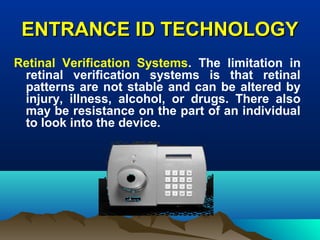
Retinal Verification Systems. The limitation in
retinal verification systems is that retinal
patterns are not stable and can be altered by
injury, illness, alcohol, or drugs. There also
may be resistance on the part of an individual
to look into the device.

Access control basics-3

  • 1.
    ENTRANCE ID TECHNOLOGYENTRANCEID TECHNOLOGY ACCESS CONTROL SYSTEMS. Access control systems can range from small, relatively simple one-door affairs to highly complex, computer-operated systems capable of handling hundreds of doors and tens of thousands of individually encoded identification credentials. A basic system usually consists of a central processing unit (CPU), a input device at each protected door, and an identification credential assigned to each user.
  • 2.
    ENTRANCE ID TECHNOLOGYENTRANCEID TECHNOLOGY A printer is often included to provide a record of all activity. The CPU is the brains of the system and is programmed with data on each user. The data can include an access level, which determines which doors may be entered by the user, and time zones, which define the hours of the day and days of the week a user may enter a door at a particular access level.
  • 3.
    ENTRANCE ID TECHNOLOGYENTRANCEID TECHNOLOGY The two types of systems indicated above fall into these categories: STAND-ALONE SYSTEMS. Stand-alone systems are used to control access at a single entry point and are available either as one integral unit or as two separate components — a reader/keypad and a controller. While stand-alone systems can be networked, they generally do not require a CPU. Data for the entire user population is stored within the unit. The installation of a stand-alone system is simple, and thus cheaper, since there is no need to run wires to connect the unit(s) to the CPU.
  • 4.
    ENTRANCE ID TECHNOLOGYENTRANCEID TECHNOLOGY MULTIPLE-PORTAL SYSTEMS. Multiple-portal systems are part of a large network of readers and controllers that are connected to a CPU and that can regulate activities at more than one entry point at a time. Some systems are directly under the control of the CPU, while others are programmed to receive only periodic programming updates or to upload data according to a preprogrammed schedule. Installation costs for these systems are relatively high because of the need to interconnect the units to the CPU.
  • 5.
    ENTRANCE ID TECHNOLOGYENTRANCEID TECHNOLOGY Now that we have taken a fast look at the overall systems parts lets look at, probably the most fascinating part of the system, the different types of input devices used in today’s systems. We will start with breaking these devices down into groups. 1. Keypads 2. Card/Token readers 3. Biometric readers Now let’s take a closer look at each of these technologies.
  • 6.
    ENTRANCE ID TECHNOLOGYENTRANCEID TECHNOLOGY KEYPAD ENTRY The keypad entry system is the oldest and can be the simplest type of entry system. It can range, on the low end, from a simple keypad where all employees have the same code to enter, to a keypad that requires not only the code but some other type of ID to enter.
  • 7.
    ENTRANCE ID TECHNOLOGYENTRANCEID TECHNOLOGY If you remember the James Bond movie “For your eyes only” you saw during the very first part of the movie, the parts of, what then was, were the two systems required to enter NATO security areas. The movie was true, in part. In the movie it showed a keypad that was completely blank, no numbers. To activate the keypad the person had to push the bottom left ENTER button. This caused the keypad to light up. Each time the keypad lights up the numbers show up in a different order (e.g. the 1 shows up in the 5 spot and the 5 in the 3 spot etc.). This “scramble” type keypad existed then as it still does now.
  • 8.
    ENTRANCE ID TECHNOLOGYENTRANCEID TECHNOLOGY So let’s recap. Keypads can be as simple as a single code entry type, to one that excepts individual codes for each person, to one that has individual codes and scrambles the numbers so someone looking from the side can’t figure out what the code was, and finely add any of these to a secondary type of ID requirement to enter.
  • 9.
    ENTRANCE ID TECHNOLOGYENTRANCEID TECHNOLOGY CARD/TOKEN READERS Reader types are either swipe, in which the card is passed along an open slot; insertion, in which the card is pushed into the reader and withdrawn; or proximity, which requires that the card be moved within a certain distance of the reader.
  • 10.
    ENTRANCE ID TECHNOLOGYENTRANCEID TECHNOLOGY In some card access control systems, improved security is achieved by requiring the user to present the card to a reader, as well as enter a unique passcode, a personal identification number (PIN), on a keypad. With this enhancement, the loss of a card will not compromise the system, since an unauthorized user would also need to know the PIN. The added security afforded by the card/PIN combination more than offsets the delay that results from the user having to enter a PIN.
  • 11.
    ENTRANCE ID TECHNOLOGYENTRANCEID TECHNOLOGY CARD TECHNOLOGIES. There are at least nine different card-encoding technologies available: magnetic stripe, Wiegand, proximity, barium ferrite, infrared, bar code, Hollerith, “smart” card, and optical storage. The magnetically based technologies include magnetic stripe, Wiegand, and barium ferrite. The optically based technologies are infrared, bar code, optical storage, and Hollerith. Proximity cards and some smart cards use radio signals to communicate with the reader. Surveys indicate that magnetic stripe, Weigand, and proximity technologies control over 80 percent of the market in terms of usage.
  • 12.
    ENTRANCE ID TECHNOLOGYENTRANCEID TECHNOLOGY Selection of a technology involves several factors: encoding security, susceptibility of the reader to environmental hazards, resistance of the reader to vandalism, initial cost, and long-term cost, including card and reader replacement and reader maintenance costs.
  • 13.
    ENTRANCE ID TECHNOLOGYENTRANCEID TECHNOLOGY Magnetic Stripe. This was the first card technology incorporated into access control systems and is the most commonly used today. It is the same technology that finds application in credit cards, ATM cards, debit cards, and a host of other uses. The cards are produced with a narrow strip of magnetic material fused to the back. Data are stored on the strips as a binary code in the form of narrow bars, some of which are magnetized and others not. The card is inserted or swiped through the reader and the code is read.
  • 14.
    ENTRANCE ID TECHNOLOGYENTRANCEID TECHNOLOGY (A) There are two types of magnetic cards on the market today: the 300 Oersted and the 4000 Oersted, high coercively card. The code on a 300 Oersted card can become scrambled when subjected to a magnetic field. The 4000 Oersted card is the preferred card, since the material that comprises the magnetic stripe retains data better and is almost invulnerable to magnetic fields.
  • 15.
    ENTRANCE ID TECHNOLOGYENTRANCEID TECHNOLOGY (B) Although relatively inexpensive and widely used, magnetic stripe cards are one of the most insecure cards in use. The card can be encoded with readily available encoding devices and, as such, should only be used in low-security applications. For higher security applications, the card should be used in combination with a passcode. (C) Since there is direct contact between the card and reader, both components are subject to wear. The readers are vulnerable to weather and the environment, as well as vandalism, and need regular maintenance.
  • 16.
    ENTRANCE ID TECHNOLOGYENTRANCEID TECHNOLOGY Wiegand. (A) The operation of the Wiegand card is based on the use of short lengths of small-diameter, ferro-magnetic wires that have been subjected to a patented twisting process that imparts unique magnetic properties to the wires. When exposed to a magnetic field in a reader, a current is induced in the wires that generate a signal for the reader to pick up.
  • 17.
    ENTRANCE ID TECHNOLOGYENTRANCEID TECHNOLOGY (B) The Wiegand card provides a very high degree of security, since it is factory- encoded and extremely difficult to counterfeit or alter. It is also immune to electromagnetic (EM) and radio-frequency (RF) fields. The reader is completely sealed, which protects the working parts from the elements, and is capable of operating over wide temperature ranges. Weigand cards are relatively expensive when compared to other cards. They can only be encoded once, since the wires within them can only be magnetized one time.
  • 18.
    ENTRANCE ID TECHNOLOGYENTRANCEID TECHNOLOGY Barium Ferrite. The barium ferrite card uses magnetized spots to create a code on the card that must match magnets in a reader to close a micro switch. The card has generally been used in high-volume, high-turnover applications, such as parking lots. It affords high encoding security and is relatively inexpensive to produce and encode. Older readers were of the insertion type and subject to high maintenance costs due to wear and the environment. Newer, state-of-the-art readers are of the proximity or “touch” type and use an array of electronic sensor devices installed behind a touch plate to read the magnetic spot patterns on the card.
  • 19.
    ENTRANCE ID TECHNOLOGYENTRANCEID TECHNOLOGY Infrared. (A) Data is stored on this card by means of a bar code written between layers of plastic. The card is read by passing infrared light through it. The bar code within the card casts a shadow on the other side that is read by an array of infrared light sensors. Encoding security is high because duplication is almost impossible. (B) Although they provide a high degree of security, infrared cards are not in widespread use for access control because of high card and maintenance costs. The optical reader comes in both swipe and insertion styles and is subject to wear and contamination from the environment, requiring regular maintenance.
  • 20.
    ENTRANCE ID TECHNOLOGYENTRANCEID TECHNOLOGY Bar Code. (A) The bar code card also is not widely used for access control because encoding security is very low and the bar code strip can be easily damaged. Card encoding is accomplished at relatively low cost. Because the bar code card is an optical system, periodic cleaning and servicing of the reader is necessary. (B) Bar code labels can be applied to magnetic stripe, Weigand, and other types of cards by simply affixing the label to an area of the card that does not contain information. These types of cards are called dual technology cards.
  • 21.
    ENTRANCE ID TECHNOLOGYENTRANCEID TECHNOLOGY Optical Storage. (A) Information is written to an optical storage card by etching small pits into the surface of a reflective layer of plastic using a solid- state infrared laser. The reflective layer is sandwiched between two protective layers of plastic. More than four Mega Bytes of information can be written on the card. The data is secure from compromise, since the information on the card is usually in an encrypted format.
  • 22.
    ENTRANCE ID TECHNOLOGYENTRANCEID TECHNOLOGY (B) The reader is equipped with a solid-state laser and generally a transport system that moves the card past the reader at a steady speed. Generally, the users are required to enter a passcode before inserting the card. Data is read from the card by systematically striking its surface with an infrared beam of light from the laser in the reader. A photo sensor reads the data from fluctuations in the reflected light. While relatively expensive as compared with other card technologies, optical storage cards are reusable. The readers and transport systems are initially expensive and require regular maintenance.
  • 23.
    ENTRANCE ID TECHNOLOGYENTRANCEID TECHNOLOGY Hollerith. The Hollerith card is the oldest technology in use. Data is written on the card by punching holes in the card. The card is read by either passage of light through the holes or by fine contact brushes that connect with an electrical contact on the other side of the card through the holes. The plastic or paper card is very inexpensive, but the security is low. This optical-type card is commonly used in hotels as a replacement for key systems.
  • 24.
    ENTRANCE ID TECHNOLOGYENTRANCEID TECHNOLOGY Proximity. Proximity identification credentials are of two types—active and passive. Both types of proximity identification credentials have a micro-miniature electronic tuned circuit and a switching mechanism buried within them, while active identification credentials also have a power source. (A) Active identification credentials transmit a coded signal when they come within range of a proximity reader or when someone manually activates them. Other identification credentials transmit a signal continuously. Generally, a long-life lithium battery is used as the power source.
  • 25.
    ENTRANCE ID TECHNOLOGYENTRANCEID TECHNOLOGY (B) Passive identification credentials rely on an electrostatic field generated by the proximity reader to cause them to transmit a unique coded signal that is received by the reader. (C) Proximity technology has grown in popularity because of its convenient “hands-free” feature. An identification credential is simply waved in front of a reader to transmit the code. Operating ranges are usually from 2 in. to 12 in. The identification credential is factory-encoded and difficult to copy or counterfeit and affords good encoding security.
  • 26.
    ENTRANCE ID TECHNOLOGYENTRANCEID TECHNOLOGY Since there is no contact with the reader, identification credential life is generally long, and the reader can be installed inside, behind a wall or glass partition, to afford protection from the elements and vandals. The electronic circuits in the identification credentials, however, can be damaged if handled roughly.
  • 27.
    ENTRANCE ID TECHNOLOGYENTRANCEID TECHNOLOGY Smart Card. “Smart card” is a generic term for a single card that serves many functions. The smart card is the state-of- the-art in access control technology. The basic card provides access control and can double as a photo I.D. card or debit card, as well as serving other functions.
  • 28.
    ENTRANCE ID TECHNOLOGYENTRANCEID TECHNOLOGY (A) The card contains an integrated circuit in which can be stored all the information needed to identify and permit access, eliminating the necessity for a CPU. To function, a passcode must be provided before the card can be read. Some smart cards are powered by their own battery, while others rely on the reader to power them either directly by a set of external contacts or electromagnetically.
  • 29.
    ENTRANCE ID TECHNOLOGYENTRANCEID TECHNOLOGY (B) Because of their relatively high cost, at present, the smart cards find limited application. Their use is expected to grow substantially, since they provide a high level of security and can serve many other applications.
  • 30.
    ENTRANCE ID TECHNOLOGYENTRANCEID TECHNOLOGY BIOMETRIC SYSTEMS Establishing a person’s identity can be based on three methods: something known by an individual (a password), something possessed by an individual (a card or key), and something physical about an individual (a personal characteristic). Biometric access control devices, or personal characteristic verification locks, rely on the latter method. Since duplication of individual physical characteristics is very rare, biometric devices, in theory, could offer the highest security possible.
  • 31.
    ENTRANCE ID TECHNOLOGYENTRANCEID TECHNOLOGY BIOMETRIC SYSTEMS cont. Biometric systems measure a unique characteristic of the person seeking access. These systems are classified as fingerprint, hand or palm geometry, handwriting, voice, and retinal verification systems. Typically, biometric readers are connected into a central processor, but can also be used alone.
  • 32.
    ENTRANCE ID TECHNOLOGYENTRANCEID TECHNOLOGY Fingerprint Verification Systems. Fingerprint verification systems have been around for more than a decade. These systems identify an individual by matching stored fingerprints with live prints presented on an electro-optical scanner.
  • 33.
    ENTRANCE ID TECHNOLOGYENTRANCEID TECHNOLOGY (A) Two types of systems have been developed for fingerprint identification. One system stores a laser picture or hologram on the access card and compares the user’s print data to that stored on the card. In the other system, the fingerprint data is indexed in a computer and is called up by an access card or code issued to the user. The user places a finger onto the scanner, which optically scans it and compiles, in digital form, a list of significant features (minutiae) of the fingerprint and their locations. The minutiae, which consist of ridge endings and ridge branches, are then compared with the stored data.
  • 34.
    ENTRANCE ID TECHNOLOGYENTRANCEID TECHNOLOGY (B) Fingerprint verification systems are considered to be very high in their relative resistance to counterfeiting; in more than 60 years of compiling fingerprints, the FBI has never found two sets of identical prints. However, the equipment is very costly and, according to some accounts, can be adversely affected by dirt or grime on the hands. For this reason, most fingerprint verification systems are programmed to give the user a second or third try, or request the use of an alternate finger, before rejection.
  • 35.
    ENTRANCE ID TECHNOLOGYENTRANCEID TECHNOLOGY Hand or Palm Geometry Verification Systems. Hand geometry units identify a user by measuring the length and curvature of the fingers of the user’s hand together with the degree of translucency of the fingertips and the webbing between the fingers. These measurements are then compared to that stored in a computer. The translucency test is intended to prevent the use of a synthetic “forged” hand.
  • 36.
    ENTRANCE ID TECHNOLOGYENTRANCEID TECHNOLOGY Hand or Palm Geometry Verification Systems. Palm geometry systems optically scan a section of the palm, recording creases, skin tone, and swirls for minute computer analysis. The disadvantages to the use of these systems are that both are very expensive and can be adversely affected by dirt or grime on the hands.
  • 37.
    ENTRANCE ID TECHNOLOGYENTRANCEID TECHNOLOGY Handwriting Verification Systems. Handwriting verification systems are also referred to as signature dynamics verification. These systems are based on an examination of the dynamics of writing, that is, the speed, rhythm, and peculiar flourishes of a pen while writing a signature, rather than the end product of writing the signature itself. While a forger may be able to duplicate a signature, the dynamics of the signature cannot be falsified for the reason that writing is considered a ballistic motion that is done almost “reflexively,” requiring very little conscious effort.
  • 38.
    ENTRANCE ID TECHNOLOGYENTRANCEID TECHNOLOGY (A) Two methods are used in handwriting verification. One method uses a pen containing an accelerometer to record the dynamics of the signature and to compare it to the data stored on a computer. The other method uses a sensitive tablet that measures the pen’s acceleration, pressure, and velocity as it sweeps through the signature.
  • 39.
    ENTRANCE ID TECHNOLOGYENTRANCEID TECHNOLOGY (B) The greatest advantage to the use of handwriting verification systems in access control is that everyone is accustomed to and accepts signing their name to gain a certain privilege, such as cashing a check or paying with a credit card. On the other hand, fingerprint (or palm or hand geometry) verification carries an association with wrongdoing that many people may find objectionable.
  • 40.
    ENTRANCE ID TECHNOLOGYENTRANCEID TECHNOLOGY (C) The major drawback to the use of handwriting verification is that of inconsistencies in writing one’s signature. As was noted earlier, signature writing is a ballistic motion that requires little conscious effort. However, signing in on a verifier could result in a more conscious effort on the part of a legitimate user, resulting in inconsistencies. For this reason, handwriting verification systems use the average of three or four signature dynamics for the data stored in the computer. Inconsistencies would also come about as a result of an injury to the hand or fingers used in signing one’s name.
  • 41.
    ENTRANCE ID TECHNOLOGYENTRANCEID TECHNOLOGY Voice Verification Systems. Certain features of a person’s speech, such as resonance, pitch, and loudness, can be used to identify the person. In voice verification systems, also known as speech recognition systems, the prospective user is enrolled by speaking certain key words or phrases into a microphone connected to a computer that translates features of the spoken words into quantitative terms for storage.
  • 42.
    ENTRANCE ID TECHNOLOGYENTRANCEID TECHNOLOGY Voice Verification Systems cont. To gain entry, the user speaks the same words or phrases into a microphone at the access- control point for comparison with that stored on the computer. However, because the voice can vary due to the weather, a cold (illness), stress, and other factors, voice recognition systems tend to be error-prone, limiting their commercial application.
  • 43.
    ENTRANCE ID TECHNOLOGYENTRANCEID TECHNOLOGY Retinal Verification Systems. Retinal verification systems use the pattern of blood vessels within the retina of the eye, which is unique in everyone, as a means of identifying an individual. The user looks into an eyepiece that scans the retina with a safe low-level infrared light. The infrared light reflected back is converted into digital data that is compared to information stored in a computer.
  • 44.
    ENTRANCE ID TECHNOLOGYENTRANCEID TECHNOLOGY Retinal Verification Systems. The limitation in retinal verification systems is that retinal patterns are not stable and can be altered by injury, illness, alcohol, or drugs. There also may be resistance on the part of an individual to look into the device.