Bloomberg Markets
July 2007
The trouble began in
Southern California,
where an army of
mortgage brokers
pushed risky
loans and fed a
Wall Street
money machine.
Now, investors
are paying the price.
The
Subprime
Sinkhole
36
Bloomberg Markets
Month 2007 37
PHOTO ILLUSTRATION BY C.J. BURTON
T
aher Afghani was working for discount retailer
Target Corp. near San Francisco when friends told
him about the riches to be made in California’s
Mortgage Alley.
It was 2004, and the U.S. real estate market was
on fire. Down in Southern California, a hub for lend-
ers specializing in loans to people with weak, or subprime, credit,
Afghani’s pals were making a fortune pushing risky mortgages on
homebuyers. After tagging along with a buddy on a company trip to
Los Cabos, Mexico, Afghani quit Target, headed south and began hus-
tling loans at Costa Mesa–based Secured Funding Corp.
“I had never seen so much money thrown around in one weekend,”
Afghani, 27, says of the Cabo getaway. “It was crazy. All these kids, lit-
erally 18 to 26, were loaded—the best clothes, the cars, the girls, every-
thing.” Soon Afghani, who’d made $58,000 a year managing a Target
distribution center, was pulling down $120,000.
Mortgage salesmen like Afghani, many of them based in Orange
County, near Los Angeles, lie at the heart of the once-profitable
partnership between subprime lenders and Wall Street investment
banks that’s now unraveling into billions of dollars in losses. After
years of easy profits, a chain reaction of delinquency, default and
foreclosure has ripped through the subprime mortgage industry,
which originated $722 billion of loans last year. Since the begin-
ning of 2006, more than 50 U.S. mortgage companies have put
themselves up for sale, closed or declared bankruptcy, according to
data compiled by Bloomberg. Lenders such as Irvine, California–
based New Century Financial Corp.; Orange, California–based
ACC Capital Holdings Inc.; GMAC LLC’s Residential Capital home
lending unit; and General Electric Co.’s WMC Mortgage Corp. di-
vision have slashed more than 5,000 jobs.
The upheaval in Orange County, home of Disneyland and birth-
place of Richard Nixon, has sent shockwaves throughout the financial
world. Brokers are merely the first link in a chain stretching from
mortgage companies, which originate loans; to wholesale lenders,
which bundle them together; to Wall Street banks, which package the
bundles into securities; and finally to commercial banks, hedge funds
and pension funds, which buy these investments. (See “The Ratings
Charade,” page 50, and “The Poison in Your Pension,” page 64.)
The pain has only just begun. As home prices sink and mortgage
defaults climb, bond investors who financed the U.S. housing boom
stand to lose as much as $75 billion on securities backed by sub-
prime mortgages, according to Newport Beach, California–based
Pacific Investment Management Co., which runs the world’s larg-
est bond fund. Companies from Detroit-based General Motors
Corp. to Zurich-based UBS AG have fallen into the subprime sink-
hole. At GM, profit plunged 90 percent during the first three
By Seth Lubove and Daniel Taub
���
���������� �������������
��������������������
�����������������������������������������������������
�������������
�����������������������������������
������������������
�������������������
Bloomberg Markets
July 2007
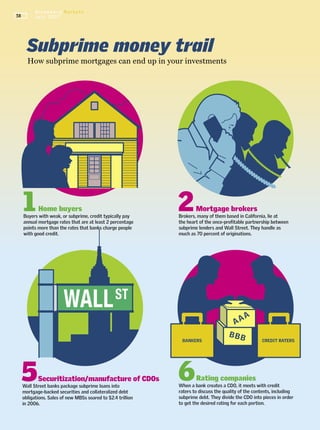
Buyers with weak, or subprime, credit typically pay
annual mortgage rates that are at least 2 percentage
points more than the rates that banks charge people
with good credit.
Brokers, many of them based in California, lie at
the heart of the once-profitable partnership between
subprime lenders and Wall Street. They handle as
much as 70 percent of originations.
Wall Street banks package subprime loans into
mortgage-backed securities and collateralized debt
obligations. Sales of new MBSs soared to $2.4 trillion
in 2006.
When a bank creates a CDO, it meets with credit
raters to discuss the quality of the contents, including
subprime debt. They divide the CDO into pieces in order
to get the desired rating for each portion.
38
Bloomberg Markets
Month 2007 39
����������
�
��������
���������
���������
����������
����������
�
�
�
�
����
������������������
�����������������
�����������������������
�����������
Lenders lure people with exotic mortgages such
as no-doc loans, which don’t require evidence of
income or savings. A record $805 billion of
subprime mortgages were originated in 2005.
Big banks buy the subprime loans. Many banks
then bundle the debt and sell it to Wall Street
firms. Banks such as HSBC Holdings have been
hurt by the subprime bust.
CDOs include a mix of bonds and securities backed
by mortgages and home equity loans. In 2006, an
estimated $100 billion of subprime debt went into
the $375 billion in CDOs sold in the U.S.
Investors like CDOs because they offer potentially
higher returns than bonds with the same rating. Banks,
insurance companies and pension funds take on more
risk in pursuit of yields as high as 20 percent.
40
months of 2007 because of mortgage losses at its
49 percent–owned GMAC finance company.
Swiss banking giant UBS said in May that it
would shut its Dillon Read Capital Management
arm after the hedge fund manager lost 150 mil-
lion Swiss francs ($123 million) in the first quar-
ter, partly on subprime investments. Subprime
originations fell 10.3 percent to $722 billion in
2006 from a record $805 billion in 2005, ac-
cording to JPMorgan Chase & Co. Credit Suisse
predicts a 40–60 percent slide this year.
The party is over in Orange County. These
days, Secured Funding’s once-buzzing office
building in Costa Mesa, near John Wayne Air-
port, is gutted. The imprint of “Secured Fund-
ing” is all that remains of the corporate logo
that once graced the outside of the two-story
building. Above it is a “For Lease” sign advertis-
ing the 82,333-square-foot (7,649-square-
meter) building.
“They cut way back,” a construction worker
says, shrugging.
What little remains of Secured Funding is
now housed in a building across the near-empty
parking lot, where a receptionist tells a caller:
“Our wholesale division is closed. We’re no lon-
ger doing business with brokers.”
The subprime industry—and investors’ loss-
es—would never have gotten so big were it not
for a small army of independent mortgage bro-
kers and hustling salesmen like Afghani, who
was fired in October. He and other subprime
veterans say their job was to reel in borrowers,
period. Never mind whether customers needed
loans or could manage payments. Afghani says
sales pitches typically focused on what a bor-
rower could do with all of that money rather
than on fees buried in paperwork or annual in-
terest rates as high as 10.5 percent at the time,
at least 2 percentage points more than the rates
that banks charge people with good credit.
“Even with explanations, most borrowers
didn’t really understand what types of loans
they were getting,” says Maureen McCormack,
another former Secured Funding employee.
“They just cared about the monthly payment.”
The sales job was made easier with exotic
mortgages such as so-called no-doc loans, which
enable borrowers to get loans without having to
supply evidence of income or savings, and op-
tion ARMs, adjustable-rate mortgages that let
people pick how big a payment they will make
from month to month. The loans offer upfront
teaser rates at the cost of tacking the deferred
payments onto the balance of the loan.
“Heavy sales pressure has been part of the
most-egregious lenders for a while,” says Kurt
Eggert, a professor at Chapman University School
of Law in Orange, California, who has studied the
role of aggressive sales tactics in subprime lend-
ing and sued lenders on behalf of elderly borrow-
ers caught up in home equity scams.
However brokers snared customers, lenders
in California typically sold the loans to big banks
or Wall Street firms. Under U.S. law, investors
who buy mortgages or securities backed by them
are typically not susceptible to lawsuits alleging
fraud on the part of brokers.
uch protection partly explains why the
U.S. mortgage-backed-securities market
has ballooned. The market more than
tripled since 2000; $2.4 trillion of MBSs were
issued last year, according to the Securities In-
dustry and Financial Markets Association in
New York. Last year was the first time more than
half of the securities issued were backed by sub-
prime and other nonconforming loans, accord-
ing to the trade group. “The market is driven by
volume and passing along the risks associated
with it,” says Paul Leonard, director of the Cali-
fornia office of the Center for Responsible Lend-
ing, a Durham, North Carolina–based consumer
advocacy group. “With the appetite of the sec-
ondary market, neither brokers nor originators
had much accountability.”
Lenders push sales of subprime loans as far
down the chain as possible to vast networks of
brokers. While independent brokers account for
about half of all mortgage originations, they
handle as much as 70 percent of subprime origi-
nations, according to the Mortgage Bankers
Association of America.
Many of the biggest subprime casualties, in-
cluding Santa Monica, California–based Fremont
General Corp.; Kansas City, Missouri–based No-
vaStar Financial Inc.; and New Century Finan-
cial, would never have grown as fast as they did
without their ability to outsource the bulk of
their sales to outside brokers and salesmen. New
Century, before tumbling into bankruptcy on
April 2, used a network of 47,000 mortgage bro-
kers and 222 branch offices to grow to $59.8 bil-
lion in annual loans last year from just $400
Bloomberg Markets
July 2007
Investors
could
lose $75
billion
on bonds
backed by
subprime
debt.
41
million in its first year, in 1996, according to
company filings.
Fremont originated a peak of $36.2 billion in
subprime loans in 2005, up from $3.3 billion in
2001, largely through “independent loan bro-
kers,” according to company filings. The com-
pany ended its subprime business in March.
Even before the bottom fell out of the sub-
prime market, NovaStar and other lenders were
defending themselves against lawsuits that ac-
cused the companies of using independent bro-
kers and branch salesmen to exploit borrowers
with high-cost loans. A lawsuit filed against Nova-
Star in federal court in Memphis, Tennessee, in
April 2006, for example, centers on allegations
that NovaStar used mortgage brokers to prey on
minority borrowers, in this case a 61-year-old
black woman who claims to have heard pitches
for “easy money” on a local gospel radio station.
Among other allegations, the plaintiff, Mae
Jackson of Memphis, claims she was never in-
formed about the terms of the loan, including
the amount, the interest rate or the closing
costs. In her complaint, she attacks NovaStar’s
practice of using mortgage brokers who employ
“deceptive high-pressure tactics to foist these
unfair and discriminatory subprime loans onto
unsuspecting minority borrowers.”
In court filings, NovaStar pins the blame on
the mortgage broker, Memphis-based Worldwide
Mortgage Corp., which filed for bankruptcy in
April 2006. In a separate statement, NovaStar
says that contrary to the plaintiff’s portrayal of
herself as naive, Jackson was a “real estate inves-
tor who owned five properties at the same time.”
Neither she nor her attorneys have provided any
evidence of discrimination, NovaStar says. Jack-
son couldn’t be reached for comment.
Like many subprime lenders, NovaStar
spread its tentacles by tapping into a broad
base of mortgage brokers and so-called net
branches. A net branch enables an independent
broker to set up shop under NovaStar’s or some
other company’s banner with little upfront
investment, much less a state license, and
quickly begin brokering loans to kick upstream
to the parent. NovaStar made great use of the
technique: By the end of 2004, it had expand-
ed its number of branches to 432 from four at
the beginning of 2000. At their peak in 2003,
NovaStar’s branches brought in $1.2 billion of
loans, a fifth of the total $6 billion in subprime
Bloomberg Markets
July 2007
FILE
SIZE
NOTES
subta6
55p0 x 21p10
DECORATIVE
��������������������
�������������������������
�������������������
������������������������������������
�������������������������������
�����
������
�����
������
�����
������
�����
������
�����
������
�����
������
�����
������
�����
������
�����
������
�������������
�������
�����������
�����������
��������
����������
����
�����
������
42
loans originated by the company
that year. “The branches represent a
competitive advantage for NovaStar
as we seek greater market share,”
the company said in its 2003 an-
nual report.
Several lawsuits filed against
NovaStar paint a more sinister pic-
ture. They claim the company played
fast and loose with state licensing
requirements in an effort to make
results look better than they might
have without the aid of the branch
loan sales. “NovaStar had woefully
failed to comply with federal and
state regulations as a result of de-
fendants’ efforts to expand the com-
pany’s business at all costs,” alleges
one 94-page complaint filed in No-
vember 2004 in federal court in
Kansas City and certified as a class
action this past February. The firm is
facing at least seven class actions,
according to Bloomberg data.
Among other allegations, the
Kansas City lawsuit claims NovaStar
fraudulently puffed up borrowers’
assets to qualify customers for loans.
One unnamed former employee,
identified as a “loan officer” who
worked in California from 2002 to
’03, told plaintiffs’ lawyers that employees would
apply an “X-Acto knife and some tape” to bor-
rowers’ W-2 forms and paychecks to qualify
them for loans. The same employee said that on
other occasions, the company would temporarily
deposit $5,000 in the bank account of a poten-
tial borrower to inflate his or her assets. Nova-
Star would either take the money back or
increase the loan fees, according to the lawsuit
filed by co-counsel Milberg Weiss & Bershad
LLP of New York. “NovaStar believes it is irre-
sponsible to continue to print the false and in-
flammatory allegations regarding lending
activities contained in this lawsuit, given that the
plaintiffs have never produced any evidence to
support them and they are not actually a part of
the underlying claim,” NovaStar spokesman
Richard Johnson said in a statement.
Johnson says three state and federal licensing
and compliance actions involving the branches
filed against NovaStar that are detailed in the
lawsuit amount to much ado about nothing.
“None of NovaStar’s operations in these states, or
nationwide, were materially affected or in danger
of being materially affected, in any way, and there-
fore those actions did not require disclosure at the
time,” Johnson said in his statement. The com-
pany announced in April it was exploring “a range
of strategic alternatives,” including a sale.
he proliferation of lightly licensed sales
branches was enabled in part by a patch-
work of regulations that cover indepen-
dent mortgage brokers and lenders. While banks
are overseen by federal and state regulators, mort-
gage brokers and independent sales outfits are
overseen by a menagerie of state authorities, some
of which also look after barbers and masseuses.
In California, which accounts for about 40 per-
cent of subprime borrowing in the U.S., no one
even knows how many people are originating
loans, according to an October 2006 report by the
Bloomberg Markets
July 2007
The
upheaval
in Orange
County
has
reverberated
around
the world.
Buried: Salesman Taher Afghani, posing on the beach, says the
good times are over in California’s Mortgage Alley.
MICHAELKELLEY
44
California Association of Mortgage Brokers.
That’s because while the state licenses individual
mortgage brokers, anyone can work for a big
lender under the umbrella of a single corporate
license. The group estimated that a minimum of
600,000 people were peddling loans in the state
last year. “In other words, the corporation can
hire a loan originator right off the street and have
them originating loans that day without any ed-
ucation, licensing or individual accountability,”
the report said.
“That’s the way the law is in California,” says
Mark Leyes, director of communications of the
state’s Department of Corporations. “We license
the entity. They can have people working for
them who are not licensed by us.”
Such loose regulatory oversight, combined
with California’s frenzied real estate market,
helped make the state a natural destination for
the subprime business. Even NovaStar, while
headquartered in Kansas City, maintained a large
presence in Orange County. Half of the 20 big-
gest U.S. subprime lenders were in California,
including three in Orange County’s Irvine, ac-
cording to Inside Mortgage Finance, a Bethesda,
Maryland–based industry newsletter.
Orange County was also the home of Secured
Funding, which specialized in home equity
loans, or second mortgages, to people with lousy
credit. The firm was founded in 1993 by Lorne
Lahodny, who eventually built it into a 1,000-
employee operation in Costa Mesa that closed
more than $1.25 billion of loans by 2005,
according to a company fact sheet. Neither La-
hodny nor his partner in Secured, John Lynch,
responded to messages left by phone and in per-
son at their offices.
Secured Funding’s success was fueled by sales
leads generated by millions of pieces of direct
mail and Internet trolling, Afghani and other
former salesmen say. Typical of the direct mail
was a credit card offer. When potential custom-
ers called to activate the card, they were instead
hooked up with a Secured Funding account exec-
utive such as Afghani.
fghani describes chaotic office scenes
that recall Boiler Room, a 2000 movie
about stock brokers at a Long Island wire
house. To spur sales, Secured Funding broke its
salesmen into color-coded teams. “If you weren’t
turning those calls into applications, they would
drag you out and make your life miserable,” he
says. “The turnover was unbelievable,” says Af-
ghani, who says he watched eight people pass
through the neighboring desk in seven months.
“If you didn’t cut it right off the bat, you were
just fired.”
Dane Marin, who worked at Secured Funding
for a year, says managers harangued everyone.
“If you weren’t on the phone very long, you’d get
an e-mail saying, ‘Get your head out of your ass,’”
he says. Afghani says he and fellow brokers dis-
pensed with details about rates and fees and in-
stead talked up how borrowers could use home
equity loans to pay down other debts. “It was eas-
ier than financing a car,” Afghani says of getting
a mortgage.
At times, Secured Funding salesmen broke
the rules, according to at least three lawsuits
filed last year in federal courts in St. Louis and
Milwaukee. The plaintiffs accuse Secured Fund-
ing of accessing their credit reports without per-
mission for the purpose of sending them
unsolicited loan offers. In one case, Secured
Funding sent the plaintiff a “personalized Plati-
num Equity Card” offering “$50,000 or more in
cash” just for calling Secured’s toll-free telephone
number. In the other two lawsuits, Secured sent
bogus $75,000 checks that reassured the recipi-
ents their “Less Than Perfect Credit Is OK!” Af-
ghani says the firm was blasting consumers with
as many as 4 million pieces of mail a month.
In answers to the complaints, Secured Fund-
ing denied wrongdoing. The company said it fol-
lowed federal regulations when accessing
“consumer reports” to pitch customers.����������������������������������������������������������������
���� �������
���������������
����������������������������������������������������������
������������������������������������������������������������
���
��
��
���� �����
������������
��������������������������������
�������������������������������
����
���
���
��������������
�������������������������
��� ��� ��� ���
����� �����
Subprime
sales
tactics
are now
spilling
out in
lawsuits.
Bloomberg Markets
July 2007
46
Secured Funding’s attorney in the lawsuits,
Richard Gottlieb of the Chicago office of Dykema
Gossett PLLC, resigned in April, citing “irrecon-
cilable professional differences” with Secured
Funding. Gottlieb declined to comment.
However the leads came in, Secured Fund-
ing’s salespeople made sure the fish stayed on
the hook. “You would say anything to get the
loan through,” says Cristopher Pike, who worked
at Secured in 2005 and ’06.
Secured Funding hung photos of sales incen-
tive trips, like the one to Cabo, around the office.
As sales boomed in early 2006, limos would pull
up at the office to take salesmen to Los Angeles
Lakers basketball games, Pike recalls. The park-
ing lot was so clogged with luxury cars that
employees had to valet-park or board a shuttle
bus to get to the office.
Charlyn Cooper, a former Secured underwrit-
er, says she kept an electric scooter in her trunk
to travel as far as a mile from her car to the office.
“They all used to laugh at me,” says Cooper, who
was dismissed in October. “They had a van that
would come by and pick you up from your car,
but the van was always full.”
Cooper’s job was to rein in the
salespeople and make sure paper-
work was legitimate so Secured
Funding could sell its loans up-
stream. She says Secured Funding
unloaded most of the loans on
HSBC Holdings Plc’s HSBC Fi-
nance unit, which has been racked
by the subprime blowup. The
bank, Europe’s largest by market
value, said profit at its U.S. unit
plunged 39 percent during the
first quarter, primarily because of
an increase in U.S. loan defaults,
including the second-lien loans
that were Secured Funding’s spe-
ciality. Provisions set aside for
credit losses almost doubled to
$1.7 billion.
Secured Funding salespeople
didn’t always appreciate Cooper’s
scrutiny of loans, she says. “Sales
guys are always going to cry be-
cause they work on commission,”
she says. Salesmen such as Af-
ghani made as much as $3,250 on
each loan.
Cooper cross-checked borrow-
ers’ stated salaries to, say, weed out
any custodians or maids who
claimed they earned $10,000 a
month. “There’s that push-pull
with sales because they’re like,
‘Why are you arguing with me,’ and
I say, ‘Sorry, a bus driver is not
making $10,000 a month,’” Cooper says.
Many subprime sales techniques are now
spilling out in the lawsuits, advocacy reports
and Congressional hearings that predictably
follow such industry meltdowns. Several law-
suits illustrate the lengths to which the big
wholesalers, and ultimately Wall Street, were
able to outsource the selling of the loans as far
Bloomberg Markets
July 2007
Law professor Kurt Eggert says many subprime lenders use aggressive sales
tactics to snare unwitting borrowers.
MICHAELKELLEY
47
‘It was
easier
than
financing
a car,’
Afghani
says of
getting a
mortgage.
down the chain as possible. Fremont General’s
Fremont Investment & Loan, Wells Fargo &
Co.’s home mortgage unit and a rogue’s gallery
of mortgage brokers come under such scrutiny
in a lawsuit filed in August 2006 in San Mateo
County, California, state court.
Plaintiff Johnnie Damon claims he was
“fraudulently induced” to take out a $484,000
loan from Irvine-based mortgage broker Peak
Funding Inc., which allegedly falsified Damon’s
financial records to qualify him for the loan.
Damon claims he asked for a reverse mortgage,
which enables homeowners to borrow money in
the form of payments charged against their
home equity, and instead got a “traditional refi-
nance loan” without his knowledge.
Also without Damon’s knowledge, the claim
says, the mortgage broker falsified information
on his loan application, such as his monthly
income, to qualify him for the loan. Fremont sold
servicing rights on the loan, which is the right to
process monthly payments, to San Francisco–based
Wells Fargo and flipped the loan itself to Paris-
based Société Générale SA. Wells Fargo is also
named as a defendant for ignoring “fraudulent and
predatory lending practices” in the loans it pur-
chases and services, according to the lawsuit.
The complaint also alleges that Fremont,
prior to its recent decision to exit the subprime
business, was using mortgage brokers to do its
dirty work. “Fremont has a history of inten-
tionally turning a blind eye to fraudulent and
predatory lending practices by the mortgage
brokers who generate home loans for the com-
pany,” the lawsuit alleges without citing any
other specific examples.
Expanding on the accusations, Damon’s attor-
ney, Aaron Myers of Howrey LLP, says Fremont
funded a loan made “by a bunch of crooks who
completely misled the borrower, falsified his in-
come, coerced him into the loan and then tricked
him into sending the loan proceeds back to
the company.”
In answers to the complaint, all of the defen-
dants deny the accusations. “Wells Fargo’s trivial
role in this case is punctuated by the fact that it
has not caused the plaintiff any harm,” Wells Far-
go’s attorneys said in an Oct. 10, 2006, court fil-
ing, adding that they put a hold on the loan after
the dispute erupted. “Wells Fargo does not be-
long in this case.”
Robert Cannone, a former chief financial
officer and director of Peak Funding who’s also
listed as a defendant by name, says the firm
closed last October after it ran out of money.
He neither admits nor denies wrongdoing.
“I’m so embarrassed,” Cannone says in a tele-
phone interview. “I feel really bad.” He says
that of the 100 loans made by Peak, this is the
only one in dispute. He says an employee
connected with the Damon loan “went off
the reservation.”
hen the boom went bust, even peo-
ple on the periphery of the indus-
try got caught in the downdraft.
Carrie Feinman worked in Scottsdale, Arizo-
na, in the wholesale prime lending division of
New Century Financial, which acquired non-
subprime loans from smaller lenders and mort-
gage brokers. The relative health of her side
of the business, which New Century acquired
from Royal Bank of Canada in 2005, couldn’t
stop New Century’s troubled subprime lending
from dragging the entire company into Chap-
ter 11 on April 2.
Feinman says the news that the company was
filing for bankruptcy came out of the blue, leav-
ing her and most other employees out of pocket
on unused vacation time and severance pay. “We
were shocked,” says Feinman, who’s looking for
a job. “If I had quit the week before, I would have
gotten my vacation time. You wonder why no
one is loyal to employers anymore.”
A month after leaving Secured Funding, Af-
ghani took a new job at Irvine-based Solstice
Capital Group Inc., another subprime lender.
HSBC, the same bank that had been buying
loans from Secured Funding, bought Solstice
last year for $50 million.
Afghani quit in April, vowing to find a new
line of work. “Enough is enough,” he says, adding
the good times are long gone. “I’m so rock bottom
I had to move out of my apartment in Irvine and
live rent free with my girlfriend,” he says.
The hard knocks have taught him a lesson,
Afghani says. “It was tough love and a great
learning experience to live within your means
and not end up like the individuals on the other
side of the phone,” he says.„
SETH LUBOVE is chief of the Los Angeles bureau of Bloomberg
News. DANIEL TAUB covers real estate in Los Angeles. With
additional reporting by KAREN GULLO in San Francisco.
slubove@bloomberg.net
dtaub@bloomberg.net
For news stories on the subprime mortgage market, type NI SUBPRIME <Go>.
Bloomberg Markets
July 2007

2038868 (1)

  • 1.
    Bloomberg Markets July 2007 Thetrouble began in Southern California, where an army of mortgage brokers pushed risky loans and fed a Wall Street money machine. Now, investors are paying the price. The Subprime Sinkhole 36
  • 2.
    Bloomberg Markets Month 200737 PHOTO ILLUSTRATION BY C.J. BURTON T aher Afghani was working for discount retailer Target Corp. near San Francisco when friends told him about the riches to be made in California’s Mortgage Alley. It was 2004, and the U.S. real estate market was on fire. Down in Southern California, a hub for lend- ers specializing in loans to people with weak, or subprime, credit, Afghani’s pals were making a fortune pushing risky mortgages on homebuyers. After tagging along with a buddy on a company trip to Los Cabos, Mexico, Afghani quit Target, headed south and began hus- tling loans at Costa Mesa–based Secured Funding Corp. “I had never seen so much money thrown around in one weekend,” Afghani, 27, says of the Cabo getaway. “It was crazy. All these kids, lit- erally 18 to 26, were loaded—the best clothes, the cars, the girls, every- thing.” Soon Afghani, who’d made $58,000 a year managing a Target distribution center, was pulling down $120,000. Mortgage salesmen like Afghani, many of them based in Orange County, near Los Angeles, lie at the heart of the once-profitable partnership between subprime lenders and Wall Street investment banks that’s now unraveling into billions of dollars in losses. After years of easy profits, a chain reaction of delinquency, default and foreclosure has ripped through the subprime mortgage industry, which originated $722 billion of loans last year. Since the begin- ning of 2006, more than 50 U.S. mortgage companies have put themselves up for sale, closed or declared bankruptcy, according to data compiled by Bloomberg. Lenders such as Irvine, California– based New Century Financial Corp.; Orange, California–based ACC Capital Holdings Inc.; GMAC LLC’s Residential Capital home lending unit; and General Electric Co.’s WMC Mortgage Corp. di- vision have slashed more than 5,000 jobs. The upheaval in Orange County, home of Disneyland and birth- place of Richard Nixon, has sent shockwaves throughout the financial world. Brokers are merely the first link in a chain stretching from mortgage companies, which originate loans; to wholesale lenders, which bundle them together; to Wall Street banks, which package the bundles into securities; and finally to commercial banks, hedge funds and pension funds, which buy these investments. (See “The Ratings Charade,” page 50, and “The Poison in Your Pension,” page 64.) The pain has only just begun. As home prices sink and mortgage defaults climb, bond investors who financed the U.S. housing boom stand to lose as much as $75 billion on securities backed by sub- prime mortgages, according to Newport Beach, California–based Pacific Investment Management Co., which runs the world’s larg- est bond fund. Companies from Detroit-based General Motors Corp. to Zurich-based UBS AG have fallen into the subprime sink- hole. At GM, profit plunged 90 percent during the first three By Seth Lubove and Daniel Taub
  • 3.
    ��� ���������� ������������� �������������������� ����������������������������������������������������� ������������� ����������������������������������� ������������������ ������������������� Bloomberg Markets July2007 Buyers with weak, or subprime, credit typically pay annual mortgage rates that are at least 2 percentage points more than the rates that banks charge people with good credit. Brokers, many of them based in California, lie at the heart of the once-profitable partnership between subprime lenders and Wall Street. They handle as much as 70 percent of originations. Wall Street banks package subprime loans into mortgage-backed securities and collateralized debt obligations. Sales of new MBSs soared to $2.4 trillion in 2006. When a bank creates a CDO, it meets with credit raters to discuss the quality of the contents, including subprime debt. They divide the CDO into pieces in order to get the desired rating for each portion. 38
  • 4.
    Bloomberg Markets Month 200739 ���������� � �������� ��������� ��������� ���������� ���������� � � � � ���� ������������������ ����������������� ����������������������� ����������� Lenders lure people with exotic mortgages such as no-doc loans, which don’t require evidence of income or savings. A record $805 billion of subprime mortgages were originated in 2005. Big banks buy the subprime loans. Many banks then bundle the debt and sell it to Wall Street firms. Banks such as HSBC Holdings have been hurt by the subprime bust. CDOs include a mix of bonds and securities backed by mortgages and home equity loans. In 2006, an estimated $100 billion of subprime debt went into the $375 billion in CDOs sold in the U.S. Investors like CDOs because they offer potentially higher returns than bonds with the same rating. Banks, insurance companies and pension funds take on more risk in pursuit of yields as high as 20 percent.
  • 5.
    40 months of 2007because of mortgage losses at its 49 percent–owned GMAC finance company. Swiss banking giant UBS said in May that it would shut its Dillon Read Capital Management arm after the hedge fund manager lost 150 mil- lion Swiss francs ($123 million) in the first quar- ter, partly on subprime investments. Subprime originations fell 10.3 percent to $722 billion in 2006 from a record $805 billion in 2005, ac- cording to JPMorgan Chase & Co. Credit Suisse predicts a 40–60 percent slide this year. The party is over in Orange County. These days, Secured Funding’s once-buzzing office building in Costa Mesa, near John Wayne Air- port, is gutted. The imprint of “Secured Fund- ing” is all that remains of the corporate logo that once graced the outside of the two-story building. Above it is a “For Lease” sign advertis- ing the 82,333-square-foot (7,649-square- meter) building. “They cut way back,” a construction worker says, shrugging. What little remains of Secured Funding is now housed in a building across the near-empty parking lot, where a receptionist tells a caller: “Our wholesale division is closed. We’re no lon- ger doing business with brokers.” The subprime industry—and investors’ loss- es—would never have gotten so big were it not for a small army of independent mortgage bro- kers and hustling salesmen like Afghani, who was fired in October. He and other subprime veterans say their job was to reel in borrowers, period. Never mind whether customers needed loans or could manage payments. Afghani says sales pitches typically focused on what a bor- rower could do with all of that money rather than on fees buried in paperwork or annual in- terest rates as high as 10.5 percent at the time, at least 2 percentage points more than the rates that banks charge people with good credit. “Even with explanations, most borrowers didn’t really understand what types of loans they were getting,” says Maureen McCormack, another former Secured Funding employee. “They just cared about the monthly payment.” The sales job was made easier with exotic mortgages such as so-called no-doc loans, which enable borrowers to get loans without having to supply evidence of income or savings, and op- tion ARMs, adjustable-rate mortgages that let people pick how big a payment they will make from month to month. The loans offer upfront teaser rates at the cost of tacking the deferred payments onto the balance of the loan. “Heavy sales pressure has been part of the most-egregious lenders for a while,” says Kurt Eggert, a professor at Chapman University School of Law in Orange, California, who has studied the role of aggressive sales tactics in subprime lend- ing and sued lenders on behalf of elderly borrow- ers caught up in home equity scams. However brokers snared customers, lenders in California typically sold the loans to big banks or Wall Street firms. Under U.S. law, investors who buy mortgages or securities backed by them are typically not susceptible to lawsuits alleging fraud on the part of brokers. uch protection partly explains why the U.S. mortgage-backed-securities market has ballooned. The market more than tripled since 2000; $2.4 trillion of MBSs were issued last year, according to the Securities In- dustry and Financial Markets Association in New York. Last year was the first time more than half of the securities issued were backed by sub- prime and other nonconforming loans, accord- ing to the trade group. “The market is driven by volume and passing along the risks associated with it,” says Paul Leonard, director of the Cali- fornia office of the Center for Responsible Lend- ing, a Durham, North Carolina–based consumer advocacy group. “With the appetite of the sec- ondary market, neither brokers nor originators had much accountability.” Lenders push sales of subprime loans as far down the chain as possible to vast networks of brokers. While independent brokers account for about half of all mortgage originations, they handle as much as 70 percent of subprime origi- nations, according to the Mortgage Bankers Association of America. Many of the biggest subprime casualties, in- cluding Santa Monica, California–based Fremont General Corp.; Kansas City, Missouri–based No- vaStar Financial Inc.; and New Century Finan- cial, would never have grown as fast as they did without their ability to outsource the bulk of their sales to outside brokers and salesmen. New Century, before tumbling into bankruptcy on April 2, used a network of 47,000 mortgage bro- kers and 222 branch offices to grow to $59.8 bil- lion in annual loans last year from just $400 Bloomberg Markets July 2007 Investors could lose $75 billion on bonds backed by subprime debt.
  • 6.
    41 million in itsfirst year, in 1996, according to company filings. Fremont originated a peak of $36.2 billion in subprime loans in 2005, up from $3.3 billion in 2001, largely through “independent loan bro- kers,” according to company filings. The com- pany ended its subprime business in March. Even before the bottom fell out of the sub- prime market, NovaStar and other lenders were defending themselves against lawsuits that ac- cused the companies of using independent bro- kers and branch salesmen to exploit borrowers with high-cost loans. A lawsuit filed against Nova- Star in federal court in Memphis, Tennessee, in April 2006, for example, centers on allegations that NovaStar used mortgage brokers to prey on minority borrowers, in this case a 61-year-old black woman who claims to have heard pitches for “easy money” on a local gospel radio station. Among other allegations, the plaintiff, Mae Jackson of Memphis, claims she was never in- formed about the terms of the loan, including the amount, the interest rate or the closing costs. In her complaint, she attacks NovaStar’s practice of using mortgage brokers who employ “deceptive high-pressure tactics to foist these unfair and discriminatory subprime loans onto unsuspecting minority borrowers.” In court filings, NovaStar pins the blame on the mortgage broker, Memphis-based Worldwide Mortgage Corp., which filed for bankruptcy in April 2006. In a separate statement, NovaStar says that contrary to the plaintiff’s portrayal of herself as naive, Jackson was a “real estate inves- tor who owned five properties at the same time.” Neither she nor her attorneys have provided any evidence of discrimination, NovaStar says. Jack- son couldn’t be reached for comment. Like many subprime lenders, NovaStar spread its tentacles by tapping into a broad base of mortgage brokers and so-called net branches. A net branch enables an independent broker to set up shop under NovaStar’s or some other company’s banner with little upfront investment, much less a state license, and quickly begin brokering loans to kick upstream to the parent. NovaStar made great use of the technique: By the end of 2004, it had expand- ed its number of branches to 432 from four at the beginning of 2000. At their peak in 2003, NovaStar’s branches brought in $1.2 billion of loans, a fifth of the total $6 billion in subprime Bloomberg Markets July 2007 FILE SIZE NOTES subta6 55p0 x 21p10 DECORATIVE �������������������� ������������������������� ������������������� ������������������������������������ ������������������������������� ����� ������ ����� ������ ����� ������ ����� ������ ����� ������ ����� ������ ����� ������ ����� ������ ����� ������ ������������� ������� ����������� ����������� �������� ���������� ���� ����� ������
  • 7.
    42 loans originated bythe company that year. “The branches represent a competitive advantage for NovaStar as we seek greater market share,” the company said in its 2003 an- nual report. Several lawsuits filed against NovaStar paint a more sinister pic- ture. They claim the company played fast and loose with state licensing requirements in an effort to make results look better than they might have without the aid of the branch loan sales. “NovaStar had woefully failed to comply with federal and state regulations as a result of de- fendants’ efforts to expand the com- pany’s business at all costs,” alleges one 94-page complaint filed in No- vember 2004 in federal court in Kansas City and certified as a class action this past February. The firm is facing at least seven class actions, according to Bloomberg data. Among other allegations, the Kansas City lawsuit claims NovaStar fraudulently puffed up borrowers’ assets to qualify customers for loans. One unnamed former employee, identified as a “loan officer” who worked in California from 2002 to ’03, told plaintiffs’ lawyers that employees would apply an “X-Acto knife and some tape” to bor- rowers’ W-2 forms and paychecks to qualify them for loans. The same employee said that on other occasions, the company would temporarily deposit $5,000 in the bank account of a poten- tial borrower to inflate his or her assets. Nova- Star would either take the money back or increase the loan fees, according to the lawsuit filed by co-counsel Milberg Weiss & Bershad LLP of New York. “NovaStar believes it is irre- sponsible to continue to print the false and in- flammatory allegations regarding lending activities contained in this lawsuit, given that the plaintiffs have never produced any evidence to support them and they are not actually a part of the underlying claim,” NovaStar spokesman Richard Johnson said in a statement. Johnson says three state and federal licensing and compliance actions involving the branches filed against NovaStar that are detailed in the lawsuit amount to much ado about nothing. “None of NovaStar’s operations in these states, or nationwide, were materially affected or in danger of being materially affected, in any way, and there- fore those actions did not require disclosure at the time,” Johnson said in his statement. The com- pany announced in April it was exploring “a range of strategic alternatives,” including a sale. he proliferation of lightly licensed sales branches was enabled in part by a patch- work of regulations that cover indepen- dent mortgage brokers and lenders. While banks are overseen by federal and state regulators, mort- gage brokers and independent sales outfits are overseen by a menagerie of state authorities, some of which also look after barbers and masseuses. In California, which accounts for about 40 per- cent of subprime borrowing in the U.S., no one even knows how many people are originating loans, according to an October 2006 report by the Bloomberg Markets July 2007 The upheaval in Orange County has reverberated around the world. Buried: Salesman Taher Afghani, posing on the beach, says the good times are over in California’s Mortgage Alley. MICHAELKELLEY
  • 8.
    44 California Association ofMortgage Brokers. That’s because while the state licenses individual mortgage brokers, anyone can work for a big lender under the umbrella of a single corporate license. The group estimated that a minimum of 600,000 people were peddling loans in the state last year. “In other words, the corporation can hire a loan originator right off the street and have them originating loans that day without any ed- ucation, licensing or individual accountability,” the report said. “That’s the way the law is in California,” says Mark Leyes, director of communications of the state’s Department of Corporations. “We license the entity. They can have people working for them who are not licensed by us.” Such loose regulatory oversight, combined with California’s frenzied real estate market, helped make the state a natural destination for the subprime business. Even NovaStar, while headquartered in Kansas City, maintained a large presence in Orange County. Half of the 20 big- gest U.S. subprime lenders were in California, including three in Orange County’s Irvine, ac- cording to Inside Mortgage Finance, a Bethesda, Maryland–based industry newsletter. Orange County was also the home of Secured Funding, which specialized in home equity loans, or second mortgages, to people with lousy credit. The firm was founded in 1993 by Lorne Lahodny, who eventually built it into a 1,000- employee operation in Costa Mesa that closed more than $1.25 billion of loans by 2005, according to a company fact sheet. Neither La- hodny nor his partner in Secured, John Lynch, responded to messages left by phone and in per- son at their offices. Secured Funding’s success was fueled by sales leads generated by millions of pieces of direct mail and Internet trolling, Afghani and other former salesmen say. Typical of the direct mail was a credit card offer. When potential custom- ers called to activate the card, they were instead hooked up with a Secured Funding account exec- utive such as Afghani. fghani describes chaotic office scenes that recall Boiler Room, a 2000 movie about stock brokers at a Long Island wire house. To spur sales, Secured Funding broke its salesmen into color-coded teams. “If you weren’t turning those calls into applications, they would drag you out and make your life miserable,” he says. “The turnover was unbelievable,” says Af- ghani, who says he watched eight people pass through the neighboring desk in seven months. “If you didn’t cut it right off the bat, you were just fired.” Dane Marin, who worked at Secured Funding for a year, says managers harangued everyone. “If you weren’t on the phone very long, you’d get an e-mail saying, ‘Get your head out of your ass,’” he says. Afghani says he and fellow brokers dis- pensed with details about rates and fees and in- stead talked up how borrowers could use home equity loans to pay down other debts. “It was eas- ier than financing a car,” Afghani says of getting a mortgage. At times, Secured Funding salesmen broke the rules, according to at least three lawsuits filed last year in federal courts in St. Louis and Milwaukee. The plaintiffs accuse Secured Fund- ing of accessing their credit reports without per- mission for the purpose of sending them unsolicited loan offers. In one case, Secured Funding sent the plaintiff a “personalized Plati- num Equity Card” offering “$50,000 or more in cash” just for calling Secured’s toll-free telephone number. In the other two lawsuits, Secured sent bogus $75,000 checks that reassured the recipi- ents their “Less Than Perfect Credit Is OK!” Af- ghani says the firm was blasting consumers with as many as 4 million pieces of mail a month. In answers to the complaints, Secured Fund- ing denied wrongdoing. The company said it fol- lowed federal regulations when accessing “consumer reports” to pitch customers.���������������������������������������������������������������� ���� ������� ��������������� ���������������������������������������������������������� ������������������������������������������������������������ ��� �� �� ���� ����� ������������ �������������������������������� ������������������������������� ���� ��� ��� �������������� ������������������������� ��� ��� ��� ��� ����� ����� Subprime sales tactics are now spilling out in lawsuits. Bloomberg Markets July 2007
  • 9.
    46 Secured Funding’s attorneyin the lawsuits, Richard Gottlieb of the Chicago office of Dykema Gossett PLLC, resigned in April, citing “irrecon- cilable professional differences” with Secured Funding. Gottlieb declined to comment. However the leads came in, Secured Fund- ing’s salespeople made sure the fish stayed on the hook. “You would say anything to get the loan through,” says Cristopher Pike, who worked at Secured in 2005 and ’06. Secured Funding hung photos of sales incen- tive trips, like the one to Cabo, around the office. As sales boomed in early 2006, limos would pull up at the office to take salesmen to Los Angeles Lakers basketball games, Pike recalls. The park- ing lot was so clogged with luxury cars that employees had to valet-park or board a shuttle bus to get to the office. Charlyn Cooper, a former Secured underwrit- er, says she kept an electric scooter in her trunk to travel as far as a mile from her car to the office. “They all used to laugh at me,” says Cooper, who was dismissed in October. “They had a van that would come by and pick you up from your car, but the van was always full.” Cooper’s job was to rein in the salespeople and make sure paper- work was legitimate so Secured Funding could sell its loans up- stream. She says Secured Funding unloaded most of the loans on HSBC Holdings Plc’s HSBC Fi- nance unit, which has been racked by the subprime blowup. The bank, Europe’s largest by market value, said profit at its U.S. unit plunged 39 percent during the first quarter, primarily because of an increase in U.S. loan defaults, including the second-lien loans that were Secured Funding’s spe- ciality. Provisions set aside for credit losses almost doubled to $1.7 billion. Secured Funding salespeople didn’t always appreciate Cooper’s scrutiny of loans, she says. “Sales guys are always going to cry be- cause they work on commission,” she says. Salesmen such as Af- ghani made as much as $3,250 on each loan. Cooper cross-checked borrow- ers’ stated salaries to, say, weed out any custodians or maids who claimed they earned $10,000 a month. “There’s that push-pull with sales because they’re like, ‘Why are you arguing with me,’ and I say, ‘Sorry, a bus driver is not making $10,000 a month,’” Cooper says. Many subprime sales techniques are now spilling out in the lawsuits, advocacy reports and Congressional hearings that predictably follow such industry meltdowns. Several law- suits illustrate the lengths to which the big wholesalers, and ultimately Wall Street, were able to outsource the selling of the loans as far Bloomberg Markets July 2007 Law professor Kurt Eggert says many subprime lenders use aggressive sales tactics to snare unwitting borrowers. MICHAELKELLEY
  • 10.
    47 ‘It was easier than financing a car,’ Afghani saysof getting a mortgage. down the chain as possible. Fremont General’s Fremont Investment & Loan, Wells Fargo & Co.’s home mortgage unit and a rogue’s gallery of mortgage brokers come under such scrutiny in a lawsuit filed in August 2006 in San Mateo County, California, state court. Plaintiff Johnnie Damon claims he was “fraudulently induced” to take out a $484,000 loan from Irvine-based mortgage broker Peak Funding Inc., which allegedly falsified Damon’s financial records to qualify him for the loan. Damon claims he asked for a reverse mortgage, which enables homeowners to borrow money in the form of payments charged against their home equity, and instead got a “traditional refi- nance loan” without his knowledge. Also without Damon’s knowledge, the claim says, the mortgage broker falsified information on his loan application, such as his monthly income, to qualify him for the loan. Fremont sold servicing rights on the loan, which is the right to process monthly payments, to San Francisco–based Wells Fargo and flipped the loan itself to Paris- based Société Générale SA. Wells Fargo is also named as a defendant for ignoring “fraudulent and predatory lending practices” in the loans it pur- chases and services, according to the lawsuit. The complaint also alleges that Fremont, prior to its recent decision to exit the subprime business, was using mortgage brokers to do its dirty work. “Fremont has a history of inten- tionally turning a blind eye to fraudulent and predatory lending practices by the mortgage brokers who generate home loans for the com- pany,” the lawsuit alleges without citing any other specific examples. Expanding on the accusations, Damon’s attor- ney, Aaron Myers of Howrey LLP, says Fremont funded a loan made “by a bunch of crooks who completely misled the borrower, falsified his in- come, coerced him into the loan and then tricked him into sending the loan proceeds back to the company.” In answers to the complaint, all of the defen- dants deny the accusations. “Wells Fargo’s trivial role in this case is punctuated by the fact that it has not caused the plaintiff any harm,” Wells Far- go’s attorneys said in an Oct. 10, 2006, court fil- ing, adding that they put a hold on the loan after the dispute erupted. “Wells Fargo does not be- long in this case.” Robert Cannone, a former chief financial officer and director of Peak Funding who’s also listed as a defendant by name, says the firm closed last October after it ran out of money. He neither admits nor denies wrongdoing. “I’m so embarrassed,” Cannone says in a tele- phone interview. “I feel really bad.” He says that of the 100 loans made by Peak, this is the only one in dispute. He says an employee connected with the Damon loan “went off the reservation.” hen the boom went bust, even peo- ple on the periphery of the indus- try got caught in the downdraft. Carrie Feinman worked in Scottsdale, Arizo- na, in the wholesale prime lending division of New Century Financial, which acquired non- subprime loans from smaller lenders and mort- gage brokers. The relative health of her side of the business, which New Century acquired from Royal Bank of Canada in 2005, couldn’t stop New Century’s troubled subprime lending from dragging the entire company into Chap- ter 11 on April 2. Feinman says the news that the company was filing for bankruptcy came out of the blue, leav- ing her and most other employees out of pocket on unused vacation time and severance pay. “We were shocked,” says Feinman, who’s looking for a job. “If I had quit the week before, I would have gotten my vacation time. You wonder why no one is loyal to employers anymore.” A month after leaving Secured Funding, Af- ghani took a new job at Irvine-based Solstice Capital Group Inc., another subprime lender. HSBC, the same bank that had been buying loans from Secured Funding, bought Solstice last year for $50 million. Afghani quit in April, vowing to find a new line of work. “Enough is enough,” he says, adding the good times are long gone. “I’m so rock bottom I had to move out of my apartment in Irvine and live rent free with my girlfriend,” he says. The hard knocks have taught him a lesson, Afghani says. “It was tough love and a great learning experience to live within your means and not end up like the individuals on the other side of the phone,” he says.„ SETH LUBOVE is chief of the Los Angeles bureau of Bloomberg News. DANIEL TAUB covers real estate in Los Angeles. With additional reporting by KAREN GULLO in San Francisco. slubove@bloomberg.net dtaub@bloomberg.net For news stories on the subprime mortgage market, type NI SUBPRIME <Go>. Bloomberg Markets July 2007