Introduction to Information-theoreticsecurity and
Cryptography.
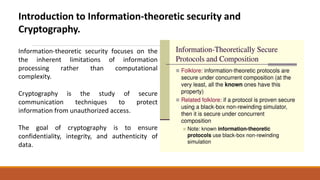
Information-theoretic security focuses on
the
the
inherent limitations of information
processing rather than computational
complexity.
Cryptography is the study of secure
communication techniques to protect
information from unauthorized access.
The goal of cryptography is to ensure
confidentiality, integrity, and authenticity of
data.
4.
Shannon's Perfect Secrecyand Key Distribution.
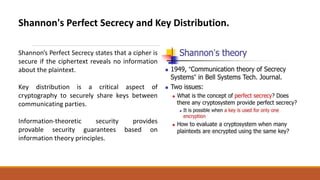
Shannon's Perfect Secrecy states that a cipher is
secure if the ciphertext reveals no information
about the plaintext.
Key distribution is a critical aspect of
cryptography to securely share keys between
communicating parties.
Information-theoretic security provides
provable security guarantees based on
information theory principles.
5.
One-time Pad andUnbreakable Encryption.
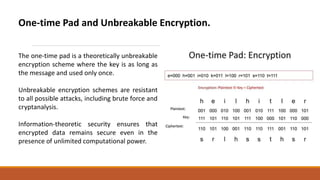
The one-time pad is a theoretically unbreakable
encryption scheme where the key is as long as
the message and used only once.
Unbreakable encryption schemes are resistant
to all possible attacks, including brute force and
cryptanalysis.
Information-theoretic security ensures that
encrypted data remains secure even in the
presence of unlimited computational power.
6.
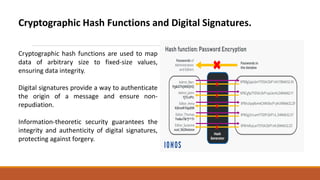
Cryptographic Hash Functionsand Digital Signatures.
Cryptographic hash functions are used to map
data of arbitrary size to fixed-size values,
ensuring data integrity.
Digital signatures provide a way to authenticate
the origin of a message and ensure non-
repudiation.
Information-theoretic security guarantees the
integrity and authenticity of digital signatures,
protecting against forgery.
7.
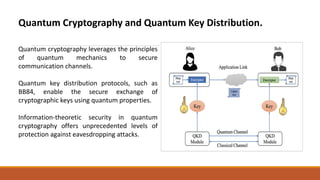
Quantum Cryptography andQuantum Key Distribution.
Quantum cryptography leverages the principles
of quantum mechanics to secure
communication channels.
Quantum key distribution protocols, such as
BB84, enable the secure exchange of
cryptographic keys using quantum properties.
Information-theoretic security in quantum
cryptography offers unprecedented levels of
protection against eavesdropping attacks.
8.
Post-Quantum Cryptography andFuture Challenges.
Post-quantum cryptography aims to develop
encryption algorithms resistant to quantum
computer attacks.
Future challenges in information-theoretic
security include quantum-resistant
cryptography, secure multi-party computation,
and privacy-preserving technologies.
Continuous advancements in cryptography are
essential to address evolving threats and ensure
secure communication in the digital age.
9.
Information-theoretic Security inPractice.
Information-theoretic security principles are
applied in various cryptographic protocols, such
as RSA, AES, and ECC.
Secure communication protocols like TLS/SSL
rely on information-theoretic security to protect
sensitive data during transmission.
Organizations and individuals can enhance their
security posture by implementing information-
theoretic security measures in their systems
and networks.
10.
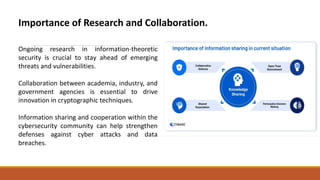
Importance of Researchand Collaboration.
Ongoing research in information-theoretic
security is crucial to stay ahead of emerging
threats and vulnerabilities.
Collaboration between academia, industry, and
government agencies is essential to drive
innovation in cryptographic techniques.
Information sharing and cooperation within the
cybersecurity community can help strengthen
defenses against cyber attacks and data
breaches.
11.
Conclusion.
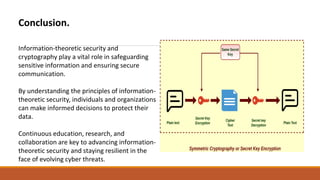
Information-theoretic security and
cryptographyplay a vital role in safeguarding
sensitive information and ensuring secure
communication.
By understanding the principles of information-
theoretic security, individuals and organizations
can make informed decisions to protect their
data.
Continuous education, research, and
collaboration are key to advancing information-
theoretic security and staying resilient in the
face of evolving cyber threats.
Introduction to Diffie-HellmanKey Exchange
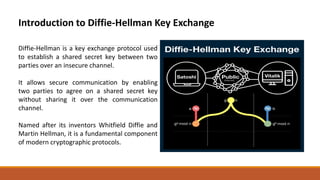
Diffie-Hellman is a key exchange protocol used
to establish a shared secret key between two
parties over an insecure channel.
It allows secure communication by enabling
two parties to agree on a shared secret key
without sharing it over the communication
channel.
Named after its inventors Whitfield Diffie and
Martin Hellman, it is a fundamental component
of modern cryptographic protocols.
14.
Key Concepts ofDiffie-Hellman
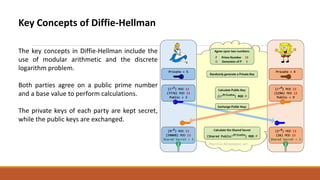
The key concepts in Diffie-Hellman include the
use of modular arithmetic and the discrete
logarithm problem.
Both parties agree on a public prime number
and a base value to perform calculations.
The private keys of each party are kept secret,
while the public keys are exchanged.
15.
Key Generation inDiffie-Hellman
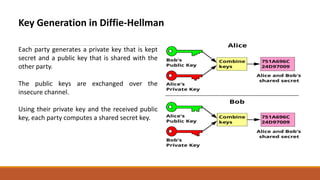
Each party generates a private key that is kept
secret and a public key that is shared with the
other party.
The public keys are exchanged over the
insecure channel.
Using their private key and the received public
key, each party computes a shared secret key.
16.
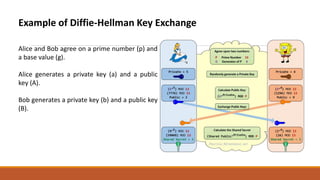
Example of Diffie-HellmanKey Exchange
Alice and Bob agree on a prime number (p) and
a base value (g).
Alice generates a private key (a) and a public
key (A).
Bob generates a private key (b) and a public key
(B).
17.
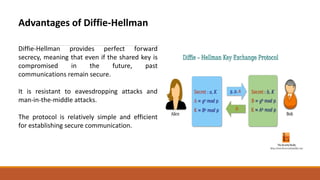
Advantages of Diffie-Hellman
Diffie-Hellmanprovides perfect forward
secrecy, meaning that even if the shared key is
compromised in the future, past
communications remain secure.
It is resistant to eavesdropping attacks and
man-in-the-middle attacks.
The protocol is relatively simple and efficient
for establishing secure communication.
18.
Applications of Diffie-Hellman
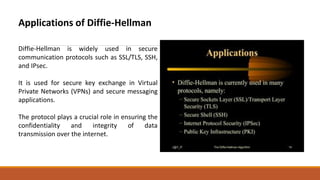
Diffie-Hellmanis widely used in secure
communication protocols such as SSL/TLS, SSH,
and IPsec.
It is used for secure key exchange in Virtual
Private Networks (VPNs) and secure messaging
applications.
The protocol plays a crucial role in ensuring the
confidentiality and integrity of data
transmission over the internet.
19.
Security Considerations inDiffie-Hellman
The security of Diffie-Hellman relies on the
difficulty of solving the discrete logarithm
problem.
The choice of prime numbers and base values is
critical to the security of the key exchange.
Implementation vulnerabilities and weak key
lengths can compromise the security of the
protocol.
20.
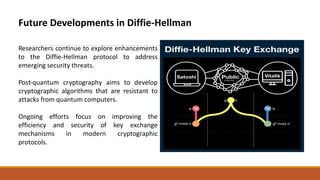
Future Developments inDiffie-Hellman
Researchers continue to explore enhancements
to the Diffie-Hellman protocol to address
emerging security threats.
Post-quantum cryptography aims to develop
cryptographic algorithms that are resistant to
attacks from quantum computers.
Ongoing efforts focus on improving the
efficiency and security of key exchange
mechanisms in modern cryptographic
protocols.
21.
Conclusion
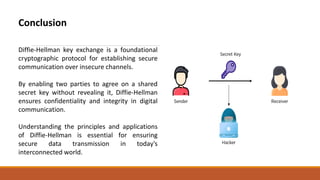
Diffie-Hellman key exchangeis a foundational
cryptographic protocol for establishing secure
communication over insecure channels.
By enabling two parties to agree on a shared
secret key without revealing it, Diffie-Hellman
ensures confidentiality and integrity in digital
communication.
Understanding the principles and applications
of Diffie-Hellman is essential for ensuring
secure data transmission in today's
interconnected world.
1
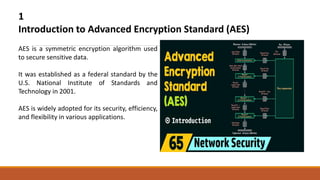
Introduction to AdvancedEncryption Standard (AES)
AES is a symmetric encryption algorithm used
to secure sensitive data.
It was established as a federal standard by the
U.S. National Institute of Standards and
Technology in 2001.
AES is widely adopted for its security, efficiency,
and flexibility in various applications.
24.
2
Key Features ofAES
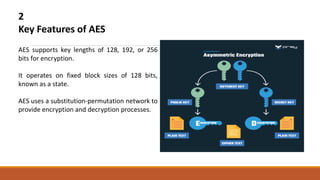
AES supports key lengths of 128, 192, or 256
bits for encryption.
It operates on fixed block sizes of 128 bits,
known as a state.
AES uses a substitution-permutation network to
provide encryption and decryption processes.
25.
3
AES Encryption Process
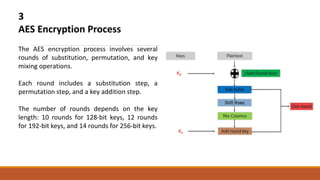
TheAES encryption process involves several
rounds of substitution, permutation, and key
mixing operations.
Each round includes a substitution step, a
permutation step, and a key addition step.
The number of rounds depends on the key
length: 10 rounds for 128-bit keys, 12 rounds
for 192-bit keys, and 14 rounds for 256-bit keys.
26.
4
AES Key Expansion
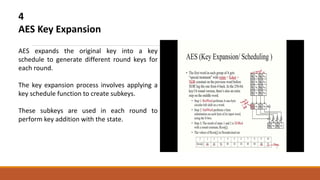
AESexpands the original key into a key
schedule to generate different round keys for
each round.
The key expansion process involves applying a
key schedule function to create subkeys.
These subkeys are used in each round to
perform key addition with the state.
27.
5
AES Decryption Process
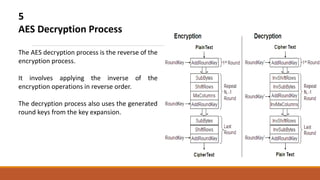
TheAES decryption process is the reverse of the
encryption process.
It involves applying the inverse of the
encryption operations in reverse order.
The decryption process also uses the generated
round keys from the key expansion.
28.
6
Advantages of AES
AESis resistant to various cryptographic
attacks, including differential and linear
cryptanalysis.
It provides a high level of security and has been
extensively analyzed by cryptographers.
AES is efficient in terms of speed and
computational resources, making it suitable for
a wide range of applications.
29.
7
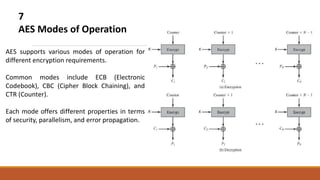
AES Modes ofOperation
AES supports various modes of operation for
different encryption requirements.
Common modes include ECB (Electronic
Codebook), CBC (Cipher Block Chaining), and
CTR (Counter).
Each mode offers different properties in terms
of security, parallelism, and error propagation.
30.
8
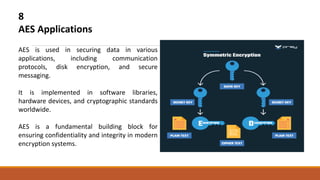
AES Applications
AES isused in securing data in various
applications, including communication
protocols, disk encryption, and secure
messaging.
It is implemented in software libraries,
hardware devices, and cryptographic standards
worldwide.
AES is a fundamental building block for
ensuring confidentiality and integrity in modern
encryption systems.
31.
9
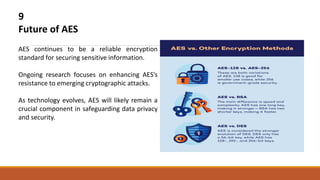
Future of AES
AEScontinues to be a reliable encryption
standard for securing sensitive information.
Ongoing research focuses on enhancing AES's
resistance to emerging cryptographic attacks.
As technology evolves, AES will likely remain a
crucial component in safeguarding data privacy
and security.
Introduction to SideChannel Attacks
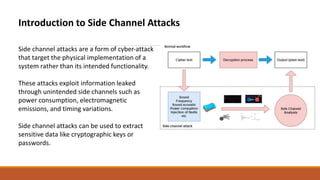
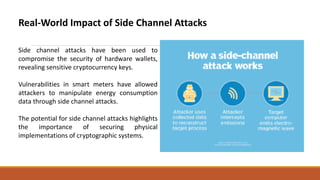
Side channel attacks are a form of cyber-attack
that target the physical implementation of a
system rather than its intended functionality.
These attacks exploit information leaked
through unintended side channels such as
power consumption, electromagnetic
emissions, and timing variations.
Side channel attacks can be used to extract
sensitive data like cryptographic keys or
passwords.
34.
Types of SideChannel Attacks
Power analysis attacks involve analyzing power
consumption to infer information about
cryptographic operations.
Timing attacks exploit variations in the time
taken by a system to perform certain
operations.
Electromagnetic attacks capture
electromagnetic radiation emitted by a device
to deduce internal data.
35.
Common Targets ofSide Channel Attacks
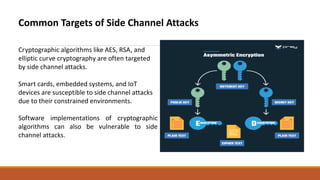
Cryptographic algorithms like AES, RSA, and
elliptic curve cryptography are often targeted
by side channel attacks.
Smart cards, embedded systems, and IoT
devices are susceptible to side channel attacks
due to their constrained environments.
Software implementations of cryptographic
algorithms can also be vulnerable to side
channel attacks.
36.
Mitigation Techniques forSide Channel Attacks
Implementing countermeasures like
randomizing algorithms and data, adding noise
to power consumption, and using masking
techniques can help thwart side channel
attacks.
Physical security measures such as shielding
devices from electromagnetic radiation and
monitoring power consumption can enhance
resistance to side channel attacks.
Regularly updating cryptographic
implementations and using certified secure
hardware can help mitigate the risk of side
channel attacks.
37.
Case Study -The RSA Attack
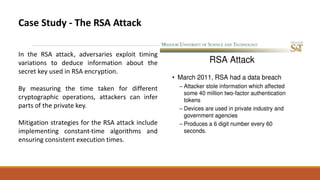
In the RSA attack, adversaries exploit timing
variations to deduce information about the
secret key used in RSA encryption.
By measuring the time taken for different
cryptographic operations, attackers can infer
parts of the private key.
Mitigation strategies for the RSA attack include
implementing constant-time algorithms and
ensuring consistent execution times.
38.
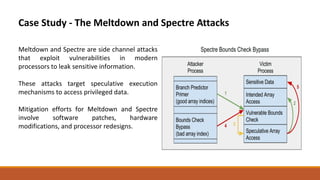
Case Study -The Meltdown and Spectre Attacks
Meltdown and Spectre are side channel attacks
that exploit vulnerabilities in modern
processors to leak sensitive information.
These attacks target speculative execution
mechanisms to access privileged data.
Mitigation efforts for Meltdown and Spectre
involve software patches, hardware
modifications, and processor redesigns.
39.
Real-World Impact ofSide Channel Attacks
Side channel attacks have been used to
compromise the security of hardware wallets,
revealing sensitive cryptocurrency keys.
Vulnerabilities in smart meters have allowed
attackers to manipulate energy consumption
data through side channel attacks.
The potential for side channel attacks highlights
the importance of securing physical
implementations of cryptographic systems.
40.
Ethical Considerations inSide Channel Attacks
Ethical concerns arise when conducting side
channel attacks, especially when targeting
sensitive data or critical infrastructure.
Researchers and practitioners in the field must
adhere to ethical guidelines and legal
frameworks when exploring side channel
vulnerabilities.
Responsible disclosure of side channel
vulnerabilities is essential to ensure that
affected parties can take appropriate mitigation
measures.
41.
Future Challenges andOpportunities in Side Channel Attacks
As technology evolves, new side channel attack
vectors may emerge, requiring continuous
research and innovation in defense
mechanisms.
The proliferation of IoT devices and embedded
systems presents a growing attack surface for
side channel threats.
Collaboration between academia, industry, and
policymakers is crucial to address the evolving
landscape of side channel attacks.
42.
Questions for reference
ExplainSide Channel Attack?
Explain Diffie-Hellman Key exchange?
Explain Light Weight Cryptography in context to IOT devices?
What is elliptic curve cryptography?
What is AES Encryption and how does it work?
Explain in detail elliptical curve cryptography?
Discuss Quantum cryptography and different photon states.
43.
What is ChannelCoding? What are its different types?
Discuss LRC with suitable example.
Find out CRC code for the information 100100 given divisor
1101
Explain Diffie-Hellman key exchange algorithm with suitable
example.
Write a Short note of Light Weight Cryptography.
How does side channel attack work? What attack use side
channel analysis?
44.
What is Lightweight Cryptography? Give its advantage and
disadvantages?
What is Quantum Cryptography? How does it works.