Outsourcing of data storage and data processing to cloud-based service providers promises several advantages such as reduced maintenance
overhead, elastic performance, high availability, and security. Cloud services offer a variety of functionalities for performing different operations
on the data. However, during the processing of data in cloud, security and
privacy may be compromised because of inadequate cryptographic implementation. Conventional encryption methods guarantee security during
transport (data-in-transit) and storage (data-at-rest), but cannot prevent
data leak during an operation on the data (data-in-use). Modern homomorphic encryption methods promise to solve this problem by applying
different operations on encrypted data without knowing or deciphering
the data. Cloud-based implementation of homomorphic cryptography has
seen significant development in the recent past. However, data security,
even with implemented homomorphic cryptography, is still dependant on
the users and the application owners. This exposes the risk of introducing
new attack surfaces. In this paper, we introduce a novel and one of the
early attempts to model such new attack surfaces on the implementation
of homomorphic encryption and map them to STRIDE threat model [1]
which is proliferously used in the industry.
![Threat Modeling of Cloud based Implementation
of Homomorphic Encryption
Satish K Sreenivasaiah & Soumya Maity
REVA University, Bangalore KA 560064, India,
satish.cs01@reva.edu.in
soumya.maity@race.reva.edu.in
September 29, 2020
Abstract
Outsourcing of data storage and data processing to cloud-based ser-
vice providers promises several advantages such as reduced maintenance
overhead, elastic performance, high availability, and security. Cloud ser-
vices offer a variety of functionalities for performing different operations
on the data. However, during the processing of data in cloud, security and
privacy may be compromised because of inadequate cryptographic imple-
mentation. Conventional encryption methods guarantee security during
transport (data-in-transit) and storage (data-at-rest), but cannot prevent
data leak during an operation on the data (data-in-use). Modern homo-
morphic encryption methods promise to solve this problem by applying
different operations on encrypted data without knowing or deciphering
the data. Cloud-based implementation of homomorphic cryptography has
seen significant development in the recent past. However, data security,
even with implemented homomorphic cryptography, is still dependant on
the users and the application owners. This exposes the risk of introducing
new attack surfaces. In this paper, we introduce a novel and one of the
early attempts to model such new attack surfaces on the implementation
of homomorphic encryption and map them to STRIDE threat model [1]
which is proliferously used in the industry.
1 Introduction
Modern cloud services enable efficient computations on various data sets in the
form of Platform or Software-as-a-Service. Data processing and Data analysis
become easy and reliable due to elastic high-performance hardware used by
cloud service providers (CSP). Recent data trends suggest [2] that there is an
exponential increase in the growth rate of data creation. Often, this data is
1
DOI:10.5121/ijcis.2020.10302 19
International Journal on Cryptography and Information Security (IJCIS), Vol. 10, No.3, September 2020
21](https://image.slidesharecdn.com/10320ijcis02-250326102722-9cf7a724/85/Threat-Modeling-of-Cloud-based-Implementation-of-Homomorphic-Encryption-1-320.jpg)
![Threat Modeling of Cloud based Implementation
of Homomorphic Encryption
Satish K Sreenivasaiah & Soumya Maity
REVA University, Bangalore KA 560064, India,
satish.cs01@reva.edu.in
soumya.maity@race.reva.edu.in
September 29, 2020
Abstract
Outsourcing of data storage and data processing to cloud-based ser-
vice providers promises several advantages such as reduced maintenance
overhead, elastic performance, high availability, and security. Cloud ser-
vices offer a variety of functionalities for performing different operations
on the data. However, during the processing of data in cloud, security and
privacy may be compromised because of inadequate cryptographic imple-
mentation. Conventional encryption methods guarantee security during
transport (data-in-transit) and storage (data-at-rest), but cannot prevent
data leak during an operation on the data (data-in-use). Modern homo-
morphic encryption methods promise to solve this problem by applying
different operations on encrypted data without knowing or deciphering
the data. Cloud-based implementation of homomorphic cryptography has
seen significant development in the recent past. However, data security,
even with implemented homomorphic cryptography, is still dependant on
the users and the application owners. This exposes the risk of introducing
new attack surfaces. In this paper, we introduce a novel and one of the
early attempts to model such new attack surfaces on the implementation
of homomorphic encryption and map them to STRIDE threat model [1]
which is proliferously used in the industry.
1 Introduction
Modern cloud services enable efficient computations on various data sets in the
form of Platform or Software-as-a-Service. Data processing and Data analysis
become easy and reliable due to elastic high-performance hardware used by
cloud service providers (CSP). Recent data trends suggest [2] that there is an
exponential increase in the growth rate of data creation. Often, this data is
1
DOI:10.5121/ijcis.2020.10302 19
International Journal on Cryptography and Information Security (IJCIS), Vol. 10, No.3, September 2020
21](https://image.slidesharecdn.com/10320ijcis02-250326102722-9cf7a724/75/Threat-Modeling-of-Cloud-based-Implementation-of-Homomorphic-Encryption-1-2048.jpg)
![shared with multiple parties, such as a CSP or a third-party organization, to
store and process.
Alarmingly, users do not have control over their data and are naturally con-
cerned about data privacy. Furthermore, data is often exposed to breaches,
where sensitive customer information is accessed in an unauthorized manner.
Customers often risk the privacy of their data in exchange for services from
CSPs. Although these CSPs are considered as trusted business partners and are
deterrent from stealing data by service level agreements, non-disclosure agree-
ments, etc., there is a need for proven technology to prevent data to be disclosed
to the cloud operators.
The CSPs can be restricted to access the user data using symmetric key
cryptography like AES or 3-DES, while the data is stored (or, data-at-rest)
in a secure datastore in the cloud [3]. The data-in-transit is secured during
communication using public-key cryptography [4]. However, there is no well-
known technology that can prevent data theft when under process (data-in-use).
While users can encrypt data and store it on the cloud for confidentiality, this
limits any kind of data processing. Therefore, the usual encryption is limited to
data storage alone and does not allow for any meaningful computation. While
doing different operations on the data, the cloud service provider can access the
data and can technically store, share, or replay it. This security issue is very
much predominant in the case of public clouds that are owned and operated by
a third party.
To enable computations while guaranteeing data privacy, researchers are
focusing on privacy-enabled computations or confidential computations. Homo-
morphic encryption (HE) is a promising solution towards that technical prob-
lem without compromising the robustness, scalability, and security [5][6]. As
the name suggests, this is a special type of cryptosystem that has homomor-
phic property[7]. That means, it allows calculations to be performed on the
encrypted data itself, thus the data is never decrypted even while in use.
Encrypted data is stored in a cloud. There they can be searched or processed
without decrypting them. The result is sent back encrypted. The cloud provider
does not know the data or the results. Though HE promises a big gain in data
protection, efficiency and performance are still a major concern, at least for the
early cloud-based implementations of homomorphic encryption (HE) [8] .
Homomorphic encryption, in a simple language, is a normal encryption
scheme (two functions enc and dec to encrypt and decrypt) with one additional
function, eval, such that, eval(enc(m)) = enc(f(m)), and, dec(eval(enc(m))) =
f(m)
where, m is a plaintext data, and user wants to compute f(m).
Diagram 1 explains the operation.
Example: A Search engine is a commonly used Software-as-a-service. When a
user types a string in the text-box, the service provider finds relevant webpages
from a highly dynamic data-store and responds with that list. The request and
response are encrypted using RSA public-key cryptography. So, it is secured
from any eavesdropper. However, the service provider can see the search string
in plaintext. Homomorphic encryption ensures that the service provider receives
2
20
International Journal on Cryptography and Information Security (IJCIS), Vol. 10, No.3, September 2020
22](https://image.slidesharecdn.com/10320ijcis02-250326102722-9cf7a724/85/Threat-Modeling-of-Cloud-based-Implementation-of-Homomorphic-Encryption-2-320.jpg)
![Figure 1: Homomorphic Encryption
an encrypted string, finds an encrypted list of relevant pages without even know-
ing the actual search string, and response. User can decrypt the response and
see the list. The service provider can never know the actual search-string and
the responses, but it still can provide the service seamlessly. Detail explanation
of homomorphic encryption (HE) is discussed in the subsequent sections.
Microsoft’s Azure Confidential Computing introduced in 2019 [9], followed
by Google’s confidential cloud [10], launched as a beta release in July, 2020, are
the first commercial implementations of homomorphic encryption. Other cloud
providers including are also extensively researching the technology to make their
cloud resilient to data-breaches.
HE has been called the ”Swiss Army knife of cryptography” as it is a one-stop
shop solution that can be applied consistently across variety of cryptographic
implementations. It is often believed to be a silver bullet for most of the prob-
lems plaguing the industry today, in terms of protection of Sensitive Personal
Data or Information (SPDI) from third-party cloud providers [11]. However,
challenges persist wherein the insecure implementation and inadequate security
controls around HE could compromise the data and negate the whole purpose of
using HE as a solution to protect SPDI from cloud vendors or third party data
processors. HE, as a cryptosystem, is resilient to data breaches and attacks on
privacy. But, the success of protecting the confidentiality, integrity, and avail-
ability (CIA) depends largely on the implementation and design of the system.
Threat modeling is a well-accepted formal approach to find relevant threats
or attack surfaces of the designed system. To identify these potential threats
and possible attacks early in the life cycle of software product development,
we could employ STRIDE based threat modeling [1] as an effective tool dur-
ing the product design phase. Although thorough cryptanalysis would uncover
these attacks or threats, it is a long drawn process and requires a high level of
expertise. Hence, as a quick alternative for a rigorous cryptanalysis approach,
a threat modeling methodology and tools can be adopted to identify threats
and address them through appropriate mitigation techniques for a secure HE
implementation.
3
21
International Journal on Cryptography and Information Security (IJCIS), Vol. 10, No.3, September 2020
23](https://image.slidesharecdn.com/10320ijcis02-250326102722-9cf7a724/85/Threat-Modeling-of-Cloud-based-Implementation-of-Homomorphic-Encryption-3-320.jpg)
![Research Objective
As mentioned in the abstract, cloud-based implementation of homomorphic
cryptography has seen significant development in the recent past. However,
data security, even with implemented homomorphic cryptography, is still de-
pendent on the users and the application owners. This exposes the risk of
introducing new attack surfaces. In this paper, we introduce a novel and one of
the early attempts to model such new attack surfaces on the implementation of
homomorphic encryption and map them to Microsoft STRIDE threat model [1]
which is proliferously used in the industry
Scope
The scope of the research is to identify threats using Microsoft STRIDE model
in a cloud based homomorphic encryption implementation early in the product
design phase and to plan the adoption of mitigations stated in the paper for the
identified threats.
Limitations:
The limitation of the paper is that it does not delve deep into cryptanalysis
although that is one of the right approaches to find weaknesses in cryptographic
algorithms. As cryptanalysis is a time consuming activity, Threat Modeling
of a HE system is suggested as a quicker alternative to identify threats and
mitigations.
Organization of the Paper
In this paper, we model threats for Cloud-based implementation of HE using
STRIDE. As per our best knowledge and literature survey, this is one of the ear-
liest attempts for mapping attack surfaces of HE implementation with STRIDE.
We have organized this paper into three major sections. In the beginning, in
section 2, we introduce the background of HE along with detail cryptanalysis.
After that, we explain different attack surfaces on the implementation of cloud-
based HE in section 3. How we can map the attack surfaces with the STRIDE
model is explained in section 4. We conclude the paper by pointing on the merit
and future scope of this work.
2 Background
HE is very different from other forms of cryptographic algorithms such as regular
symmetric and asymmetric algorithms in a way that it can do computing on
encrypted data and provide result of the computation as an encrypted output.
This capability of HE is a game changer as it can now preserve the privacy or
confidential data of an individual or corporates by not using plaintext data for
processing.
4
22
International Journal on Cryptography and Information Security (IJCIS), Vol. 10, No.3, September 2020
24](https://image.slidesharecdn.com/10320ijcis02-250326102722-9cf7a724/85/Threat-Modeling-of-Cloud-based-Implementation-of-Homomorphic-Encryption-4-320.jpg)
![2.1 Homomorphic encryption
CPA security does not prevent an attacker from tampering with the encrypted
message, changing for example an encryption of the message x into an encryption
of x with its last bit flipped. Homomorphic encryption takes this to an extreme
and actually requires that it is possible to tamper with the encryption in an
arbitrary way (while still maintaining CPA security!). The question if this is
possible was first raised in 1978 by Rivest, Adleman, and Dertouzos, and over
the years many conjectured that this is in fact impossible. Last year Gentry
gave very strong evidence that such encryptions exist, by constructing such a
scheme that is secure under relatively reasonable computational assumptions.
[Definition] A CPA-secure public key encryption scheme (G, E, D) with one
bit messages is fully homomorphic if,
there exists an algorithm HEnc such that for every (e, d) ← G(1n
), a, b ∈ {0, 1},
and â ← Ee(a), b̂ ← Ee(b),
HEnce(â, b̂) ≈ Ee(aHEncb)
where ≈ denotes statistical indistinguishability (i.e., n−ω(1)
statistical distance),
and aHEncb denotes ¬(a ∧ b).
We stress that the algorithm HEnc does not get the secret key as input. Oth-
erwise it would be trivial: just decrypt â, b̂, compute aHEncb and re-encrypt.
[Universality of HEnc] It’s straightforward to show that every log gate can
be expressed using few HEncs, and so obtain the following claim (left as ex-
ercise): If (G, E, D) is a homomorphic encryption then there is an algorithm
EV AL that for every (e, d) ← G(1n
), x1, . . . , xm ∈ {0, 1}, if x̂i = Ee(xi) and C
is a Boolean circuit mapping {0, 1}m
to {0, 1}, then
EV ALe(C, x̂1, . . . , x̂m) ≈|C|µ(n) Ee(C(x1, . . . , xn))
where we say that D ≈ D0
if their statistical distance is at most , µ is some
negligible function, and |C| denotes the number of gates of C. In particular if C
is polynomial size then these two distributions are statistically indistinguishable.
2.2 Usefulness of homomorphic encryption
Canonical application is “cloud computing”: Alice wants to store her file x ∈
{0, 1}m
on Bob’s server. So she sends Bob Ee(x1) · · · Ee(xm). Then she wants
to do computation on this file. For example, if the file is a database of people
she may want to find out how many of them bought something in the last
month. One way to do so would be for Alice to retrieve the entire file and
do the computation on her own, but if she was able to handle this amount
of communication and computation, perhaps she wouldn’t have needed to use
cloud computing in the first place.
Instead, Alice will ask Bob to perform this operation on the encrypted data,
giving her an encryption of the answer, which she can of course decrypt. There
is an issue of how Alice maintains integrity in this case, this is left as an exercise.
5
23
International Journal on Cryptography and Information Security (IJCIS), Vol. 10, No.3, September 2020
25](https://image.slidesharecdn.com/10320ijcis02-250326102722-9cf7a724/85/Threat-Modeling-of-Cloud-based-Implementation-of-Homomorphic-Encryption-5-320.jpg)
![Step 6 The prover sends d and also the randomness used in producing the
commitment.
This can be shown to preserve soundness, since soundness held even for
computationally unbounded provers, and the commitment scheme is perfectly
binding.
Constructing homomorphic encryption
Homomorphic encryptions can be used to do wonderful things, but the same
holds for perpetual motion machines, cold fusion, unicorns, etc.
So, the question whether we can actually construct such schemes. Since the
question was raised in 1978 by Rivest et al. [12], there have been no significant
candidate for a homomorphic encryption scheme. Almost after 30 years of that
work, Gentry gave the first such construction [5][13]. The construction relies
on somewhat non-standard, but still rather reasonable assumptions. Also, as
mentioned, it is still not practical, requiring at least k8
operation to achieve 2k
security. Hopefully, with time we will see improved constructions, using more
standard assumptions and more efficient. We will see a close variant of Gentry’s
scheme now. We remark that all the applications we saw (zero knowledge, multi-
party computation, private information retrieval) have alternative constructions
that utilize much more standard assumptions.
2.4 Need of HE
In the new age of regulatory compliances and the paramount importance placed
on privacy of individuals across and within nations, it is an imperative need to
protect SPDI from everyone except the data owner. The only person who needs
to have access to the data should be the data owner and not even to the data
processor or any third party processing or administering unit or individuals.
This is a paradox as protecting SPDI from a data processor, be it cloud or
third party on premise vendor, is hard as data needs to be decrypted prior to
processing and decrypted data in the memory is accessible for the cloud provider,
if he wishes to see. Hence, HE is a perfect solution to address the mentioned
paradox and a timely technological intervention without which the only way to
address the case was through legal and contractual obligations between the data
owner and the data processor.
2.5 Types of HE
Now having seen the what and why of HE, we explain different types of HE
in vogue today. The categories of HE are based on the number of mathemat-
ical computations that can be performed on the encrypted text. The major
differences in terms of capability, is tabulated in table 1.
7
25
International Journal on Cryptography and Information Security (IJCIS), Vol. 10, No.3, September 2020
27](https://image.slidesharecdn.com/10320ijcis02-250326102722-9cf7a724/85/Threat-Modeling-of-Cloud-based-Implementation-of-Homomorphic-Encryption-7-320.jpg)
![2.5.1 Partially Homomorphic Encryption (PHE):
It supports computations of mathematical operations such as addition or mul-
tiplication on the encrypted data for unlimited number of times. It allows only
one type of operation to be performed. PHE allows any number of computa-
tions to be performed for only a single type of mathematical operation, be it
addition or multiplication on encrypted data. Ex., it only allows computation
of either additions, such as enc(x + y) for a given enc(x) and enc(y). Similarly
computation for multiplication operation alone such as enc(x ∗ y) for a given
enc(x) and enc(y)
2.5.2 Somewhat Homomorphic Encryption (SHE):
SHE allows a limited number of computations to be performed for both types
of mathematical operations, addition and multiplication on encrypted data.
Ex., it allows computation of additions, such as enc(x + y) and computation of
multiplications operation enc(x ∗ y), for a given enc(x) and enc(y).
2.5.3 Fully Homomorphic Encryption (FHE):
FHE allows any number of computations to be performed for both types of
mathematical operations, addition and multiplication on encrypted data. FHE
allows unlimited additions and multiplications.
Partially homomorphic encryption is fairly easy; eg. RSA has a multiplica-
tive homomorphism: encrypt(x) = Xe
, encrypt(y) = ye
,
So, encrypt(x) ∗ encrypt(y) = (xy)e
= encrypt(xy)
Elliptic curves can offer similar properties with addition. Allowing both
addition and multiplication is, it turns out, significantly harder.
Table 1: Categorization summary of Homomorphic Encryption
HE Types/Operations PHE SHE FHE
Operations Supported Addition
OR
Multiplication
Addition
AND
Multiplication
Addition
AND
Multiplication
Frequency of opera-
tions
Unlimited Limited Unlimited
3 Attacks on a HE implementation
After introducing the conceptual background of HE we introduce different types
of threats or attacks that could be possible on Cloud based or non-cloud based
HE implementations [14].
8
26
International Journal on Cryptography and Information Security (IJCIS), Vol. 10, No.3, September 2020
28](https://image.slidesharecdn.com/10320ijcis02-250326102722-9cf7a724/85/Threat-Modeling-of-Cloud-based-Implementation-of-Homomorphic-Encryption-8-320.jpg)
![3.1 Chosen Cipher-Text Attack
In this kind of attack, the attacker might get decryptions of chosen cipher texts
with restrictions [15]. CCA has all the capabilities of a CPA as detailed in the
above section and also obtain decryptions of the selected encrypted message.
3.2 Encoder Attack
There are different Homomorphic Encryption libraries available today such as
Microsoft SEAL [16] (Simple Encrypted Arithmetic Library), Palisade, HELib,
NFLlib and so on. A few of the encoding methods used in SEAL to convert
integers and floating point numbers are IntegerEncoder () and Batch Encoder
() [17]. IntegerEncoder method is known to leak information and is suggested
not to be used in real applications whereas BatchEncoder () does not seem to
have this vulnerability.
3.3 Side Channel Attack
In this kind of attack, a malicious user does a run time monitoring of encryption
operation to obtain environment details like power consumption for the encryp-
tion process and alternatively the elapsed time for key generation. It provides
sufficient details about the key leading to potential attacks.
3.4 Active Attacks
Active attacks are wherein the adversary plants himself in between the data
sender and the receiver and starts monitoring the data in transit, modifies the
data in motion or at the target environment and also can inflict non availability
for the target server. Active attacks include DoS, DDoS, Session Hijacking and
so on.
3.5 Key Recovery Attack
In this kind of attack, given multiple plaintext/cipher text pairs an attacker can
obtain the secret key from the provided pairs of plaintext/cipher text.
3.6 Network Traffic Interception
Attackers can intrude the network if not secured with the right security controls
for data in transit. There are multiple OSS and COTS tools that can be used for
network sniffing and interception that can impact confidentiality and potential
integrity of the data.
9
27
International Journal on Cryptography and Information Security (IJCIS), Vol. 10, No.3, September 2020
29](https://image.slidesharecdn.com/10320ijcis02-250326102722-9cf7a724/85/Threat-Modeling-of-Cloud-based-Implementation-of-Homomorphic-Encryption-9-320.jpg)
![4 Mapping of Attacks to STRIDE Threat Model
4.1 STRIDE Threat Model
Microsoft STRIDE methodology [1] stands for Spoofing, Tampering, Repudi-
ation, Information Disclosure, Denial of Service and Elevation of Privileges.
There are different kinds of threat modeling approaches such as Attacker cen-
tric, Asset centric and Software or System centric. STRIDE is a system centric
approach where it focuses on the threats that could potentially impact a soft-
ware system.
STRIDE, should be applied during the software design phase of the SDLC
life cycle in order to ensure the identified threats are mitigated upfront during
the product development life cycle.
The table 2 provides definition for each of the STRIDE threat methodol-
ogy along with examples. The last column in the table maps to the impacted
Security Quality Sub Characteristics (QSC) of CIA triad, Authentication, Au-
thorization and Non-repudiation.
Now having understood the STRIDE methodology and the quality sub char-
acteristics it is impacting in a software system, let’s map the potential attacks
to threats and subsequently detail the mitigation for each of these threats or
potential attacks.
4.2 Mapping of potential HE implementation attacks to
STRIDE
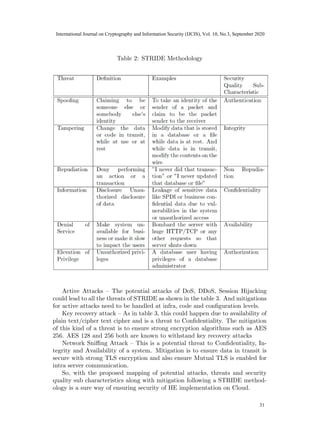
As detailed in the table 3, a CCA in HE implementation, can potentially lead to
Information Disclosure and Tampering threats. With this, the idea of computing
on cipher text in HE that is assumed to be protected from a cloud provider takes
a beating as the adversary has obtained knowledge of some part of plain-text
based on CCA.
The countermeasure or mitigation for this attack is to adopt Authenticated
Encryption (AE) as it withstands the CCA attacks. AE provides Confidentiality
and Authentication at the same time as against a plain encryption implementa-
tion. The product team needs to ensure that they implement AE-Secure solution
during the design phase to avoid threats from CCA attacks.
Encoder Vulnerability in HE library - Integer, Floating number encoding
vulnerabilities in well-known HE libraries as discussed earlier, leads to Informa-
tion Disclosure. The mitigation for these kind of threats is to use Safe libraries
during coding such as BatchEncoder () method as compared to IntegerEncoder
() method. As shown in the table 3, it impacts Confidentiality of the data and
hence needs to be addressed early in the SDLC phase.
Side Channel Attack – could potentially obtain sensitive information through
various parameters discussed in section 2 impacting Confidentiality of the sys-
tem. The mitigation for such attacks are varied and techniques comprise of
jamming the emission channel, inducing random delay in the timing, random-
ization of cipher text and so on.
10
28
International Journal on Cryptography and Information Security (IJCIS), Vol. 10, No.3, September 2020
30](https://image.slidesharecdn.com/10320ijcis02-250326102722-9cf7a724/85/Threat-Modeling-of-Cloud-based-Implementation-of-Homomorphic-Encryption-10-320.jpg)
![Table 3: Categorization summary of Homomorphic Encryption
Attacks S T R I D E Impacted Secu-
rity QSC
Chosen Ciphertext At-
tack
D D Confidentiality
Integrity
Encoder Attack D Confidentiality
Side Channel Attack D Confidentiality
Active Attacks D D D D D CIA,
Authorization
Authentication
Key Recovery Attack D Confidentiality
Network Sniffing At-
tack
D D D CIA
5 Conclusion
In this paper, we introduced a novel approach for doing threat modeling for
cloud-based implementation of homomorphic encryption. We translate the
cryptanalysis based attack models into STRIDE threat model which is easy
to understand by the practitioners. The present state of art in the domain is
still very immature. We are in process of building a framework based on this
approach, which is included as our future scope of work. This work should help
the developers ar architects to build in-depth security implementation of homo-
morphic security in an effective and efficient way and without understanding
the detail mathematical background of this cryptanalysis.
References
[1] A. Shostack, “Experiences threat modeling at microsoft.” MODSEC MoD-
ELS, vol. 2008, 2008.
[2] S. He, G. Manns, J. Saunders, W. Wang, L. Pollock, and M. L. Soffa, “A
statistics-based performance testing methodology for cloud applications,”
in Proceedings of the 2019 27th ACM Joint Meeting on European Software
Engineering Conference and Symposium on the Foundations of Software
Engineering, 2019, pp. 188–199.
[3] C. Wang, K. Ren, W. Lou, and J. Li, “Toward publicly auditable secure
cloud data storage services,” IEEE network, vol. 24, no. 4, pp. 19–24, 2010.
[4] M. E. Hellman, “An overview of public key cryptography,” IEEE Commu-
nications Magazine, vol. 40, no. 5, pp. 42–49, 2002.
[5] C. Gentry, “A fully homomorphic encryption scheme,” Ph.D. dissertation,
Sanford Univeristy, 2009.
12
30
International Journal on Cryptography and Information Security (IJCIS), Vol. 10, No.3, September 2020
32](https://image.slidesharecdn.com/10320ijcis02-250326102722-9cf7a724/85/Threat-Modeling-of-Cloud-based-Implementation-of-Homomorphic-Encryption-12-320.jpg)
![[6] M. Naehrig, K. Lauter, and V. Vaikuntanathan, “Can homomorphic en-
cryption be practical?” in Proceedings of the 3rd ACM workshop on Cloud
computing security workshop, 2011, pp. 113–124.
[7] B. Rossman, “Homomorphism preservation theorems,” Journal of the ACM
(JACM), vol. 55, no. 3, pp. 1–53, 2008.
[8] B. Barak, “Computer science 433 - cryptography, spring 2010,” Accessed
on 10-August-2020. [Online]. Available: https://www.cs.princeton.edu/
courses/archive/spring10/cos433/
[9] Microsoft, “Confidential computing on azure,” Accessed on 10-
August-2020. [Online]. Available: https://docs.microsoft.com/en-us/
azure/confidential-computing/overview
[10] Google, “Google confidential computing,” Accessed on 10-August-2020.
[Online]. Available: https://cloud.google.com/confidential-computing
[11] I. Žliobaitė and B. Custers, “Using sensitive personal data may be neces-
sary for avoiding discrimination in data-driven decision models,” Artificial
Intelligence and Law, vol. 24, no. 2, pp. 183–201, 2016.
[12] R. L. Rivest, L. Adleman, M. L. Dertouzos et al., “On data banks and pri-
vacy homomorphisms,” Foundations of secure computation, vol. 4, no. 11,
pp. 169–180, 1978.
[13] C. Gentry, “Fully homomorphic encryption using ideal lattices,” in Pro-
ceedings of the forty-first annual ACM symposium on Theory of computing,
2009, pp. 169–178.
[14] M. Chase, H. Chen, J. Ding, S. Goldwasser, S. Gorbunov, J. Hoffstein,
K. Lauter, S. Lokam, D. Moody, T. Morrison et al., “Security of homo-
morphic encryption,” HomomorphicEncryption. org, Redmond WA, Tech.
Rep, 2017.
[15] D. Boneh and V. Shoup, “A graduate course in applied cryptography,”
Draft V0.5, 2020.
[16] Microsoft, “Microsoft seal,” Accessed on 10-August-2020. [Online].
Available: https://github.com/Microsoft/SEAL
[17] Z. Peng, “Danger of using fully homomorphic encryption: A look at mi-
crosoft seal,” arXiv preprint arXiv:1906.07127, 2019.
13
31
International Journal on Cryptography and Information Security (IJCIS), Vol. 10, No.3, September 2020
33](https://image.slidesharecdn.com/10320ijcis02-250326102722-9cf7a724/85/Threat-Modeling-of-Cloud-based-Implementation-of-Homomorphic-Encryption-13-320.jpg)


