Application Security
Authorization Models
Adinath Raveendra Raj
UJUG, September 17, 2015
www.acciente.com
Overview
● Introduction
● Historical Context
● Different Authorization Models
● Java Security Frameworks
CIA Principle
● Confidentiality
– Restricting the disclosure of sensitive information to authorized
persons. Can be seen as privacy.
● Integrity
– Ensuring/detecting that sensitive information is not maliciously altered
or tampered by unauthorized or authorized persons.
● Availability
– Ensuring continued access to information. Redundancy. High
availability.
What is an Authorization Model?
What is Authorization?
Authorization vs. Authentication
● Authentication is about verifying the identity of a user
(more generally called a subject).
● Authorization is about controlling what resources a user
has access to, after successful authentication.
● Authorization is not authentication.
What is an Authorization Model?
Authorization Model
A model for granting (or denying) users access
to resources.
Historical Context
● Background
– Emerged in the 1960s and 1970s in DoD systems
– The focus was on confidentiality
● MAC
– Mandatory Access Control
– Centrally administered, non-discretionary (not DAC)
– Most government systems used MAC
● DAC
– Discretionary Access Control
– Delegated authority to administer (not MAC)
– Unix File System permission
Historical Context
●
Background
– Emerging focus on integrity over confidentiality for commercial systems
● ACL
– Access Control List
– Emerged from the need to restrict access at the resource level
● RBAC
– Role-based Access Control
– Defined in 1992 to better address the security needs of commercial organizations
●
ABAC
– Attribute-based Access Control
– Allows incorporating dynamic factors into the access decision, for example, time of day
●
OACC
– Object ACcess Control
– It is the model used by OACC Java Security Framework released in 2014.
Access Control List (ACL)
● How does it work?
– A list of user-permission pairs (the ACL) is associated with a resource.
– An entry in the list is sometimes called an ACE (Access Control Entry).
– Each entry in the list is a user and a permission.
– Example: (john-doe, read)
● Some applications
– File system security in Windows NT, Linux, BSD, Solaris, Mac OS X.
– Network configuration in Amazon EC2.
● Comments
– Efficient to check if a user is authorized to a resource.
– Extremely inefficient to determine all resources a given user has access to.
– Difficult to manage complex topologies.
Role-based Access Control (RBAC)
● How does it work?
– Each user is assigned one or more roles
– Permissions are assigned to roles instead of directly to user
– Essentially the user inherits the permissions from the assigned roles
● The NIST model for RBAC specifies 4 levels of RBAC capability
– Level 1 - Flat RBAC
– Level 2 - Hierarchical RBAC
– Level 3 - Constrained RBAC
– Level 4 - Symmetric RBAC
●
Widespread poor practice
– Users are assigned to roles, and security is checked by checking for membership in the role
● Comments
– Can be centrally administered or distributed
– Complex topologies are easier to maintain than ACL
– Supports all the capabilities of ACL (J. Barkley, 1997)
– RBAC Level 4 supports "before the fact" audits
– Permissions are static compared to ABAC
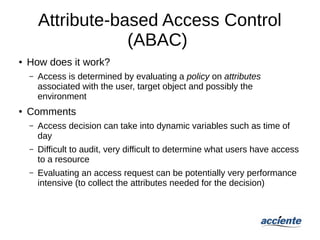
Attribute-based Access Control
(ABAC)
● How does it work?
– Access is determined by evaluating a policy on attributes
associated with the user, target object and possibly the
environment
● Comments
– Access decision can take into dynamic variables such as time of
day
– Difficult to audit, very difficult to determine what users have access
to a resource
– Evaluating an access request can be potentially very performance
intensive (to collect the attributes needed for the decision)
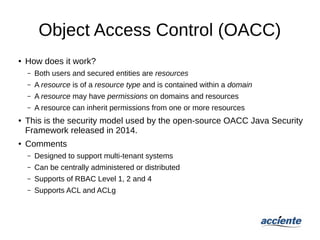
Object Access Control (OACC)
● How does it work?
– Both users and secured entities are resources
– A resource is of a resource type and is contained within a domain
– A resource may have permissions on domains and resources
– A resource can inherit permissions from one or more resources
● This is the security model used by the open-source OACC Java Security
Framework released in 2014.
● Comments
– Designed to support multi-tenant systems
– Can be centrally administered or distributed
– Supports of RBAC Level 1, 2 and 4
– Supports ACL and ACLg
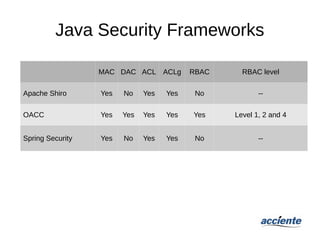
Java Security Frameworks
MAC DAC ACL ACLg RBAC RBAC level
Apache Shiro Yes No Yes Yes No --
OACC Yes Yes Yes Yes Yes Level 1, 2 and 4
Spring Security Yes No Yes Yes No --

Application Security -- Authorization Models

  • 1.
    Application Security Authorization Models AdinathRaveendra Raj UJUG, September 17, 2015 www.acciente.com
  • 2.
    Overview ● Introduction ● HistoricalContext ● Different Authorization Models ● Java Security Frameworks
  • 3.
    CIA Principle ● Confidentiality –Restricting the disclosure of sensitive information to authorized persons. Can be seen as privacy. ● Integrity – Ensuring/detecting that sensitive information is not maliciously altered or tampered by unauthorized or authorized persons. ● Availability – Ensuring continued access to information. Redundancy. High availability.
  • 4.
    What is anAuthorization Model?
  • 5.
  • 6.
    Authorization vs. Authentication ●Authentication is about verifying the identity of a user (more generally called a subject). ● Authorization is about controlling what resources a user has access to, after successful authentication. ● Authorization is not authentication.
  • 7.
    What is anAuthorization Model?
  • 8.
    Authorization Model A modelfor granting (or denying) users access to resources.
  • 9.
    Historical Context ● Background –Emerged in the 1960s and 1970s in DoD systems – The focus was on confidentiality ● MAC – Mandatory Access Control – Centrally administered, non-discretionary (not DAC) – Most government systems used MAC ● DAC – Discretionary Access Control – Delegated authority to administer (not MAC) – Unix File System permission
  • 10.
    Historical Context ● Background – Emergingfocus on integrity over confidentiality for commercial systems ● ACL – Access Control List – Emerged from the need to restrict access at the resource level ● RBAC – Role-based Access Control – Defined in 1992 to better address the security needs of commercial organizations ● ABAC – Attribute-based Access Control – Allows incorporating dynamic factors into the access decision, for example, time of day ● OACC – Object ACcess Control – It is the model used by OACC Java Security Framework released in 2014.
  • 11.
    Access Control List(ACL) ● How does it work? – A list of user-permission pairs (the ACL) is associated with a resource. – An entry in the list is sometimes called an ACE (Access Control Entry). – Each entry in the list is a user and a permission. – Example: (john-doe, read) ● Some applications – File system security in Windows NT, Linux, BSD, Solaris, Mac OS X. – Network configuration in Amazon EC2. ● Comments – Efficient to check if a user is authorized to a resource. – Extremely inefficient to determine all resources a given user has access to. – Difficult to manage complex topologies.
  • 12.
    Role-based Access Control(RBAC) ● How does it work? – Each user is assigned one or more roles – Permissions are assigned to roles instead of directly to user – Essentially the user inherits the permissions from the assigned roles ● The NIST model for RBAC specifies 4 levels of RBAC capability – Level 1 - Flat RBAC – Level 2 - Hierarchical RBAC – Level 3 - Constrained RBAC – Level 4 - Symmetric RBAC ● Widespread poor practice – Users are assigned to roles, and security is checked by checking for membership in the role ● Comments – Can be centrally administered or distributed – Complex topologies are easier to maintain than ACL – Supports all the capabilities of ACL (J. Barkley, 1997) – RBAC Level 4 supports "before the fact" audits – Permissions are static compared to ABAC
  • 13.
    Attribute-based Access Control (ABAC) ●How does it work? – Access is determined by evaluating a policy on attributes associated with the user, target object and possibly the environment ● Comments – Access decision can take into dynamic variables such as time of day – Difficult to audit, very difficult to determine what users have access to a resource – Evaluating an access request can be potentially very performance intensive (to collect the attributes needed for the decision)
  • 14.
    Object Access Control(OACC) ● How does it work? – Both users and secured entities are resources – A resource is of a resource type and is contained within a domain – A resource may have permissions on domains and resources – A resource can inherit permissions from one or more resources ● This is the security model used by the open-source OACC Java Security Framework released in 2014. ● Comments – Designed to support multi-tenant systems – Can be centrally administered or distributed – Supports of RBAC Level 1, 2 and 4 – Supports ACL and ACLg
  • 15.
    Java Security Frameworks MACDAC ACL ACLg RBAC RBAC level Apache Shiro Yes No Yes Yes No -- OACC Yes Yes Yes Yes Yes Level 1, 2 and 4 Spring Security Yes No Yes Yes No --