Top 5
Digital Health Trends
Show the Power of People
Keeping up with changing technology is vital, but it’s
just as important to evolve the consumer experience,
care delivery methods and career development
opportunities for the healthcare workforce.
The Digital Health Technology Vision 2016 reveals
five trends that prove winning in the digital age
hinges on people.
Copyright © 2016 Accenture All rights reserved.
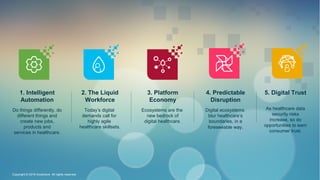
1. Intelligent
Automation
Do things differently, do
different things and
create new jobs,
products and
services in healthcare.
2. The Liquid
Workforce
Today’s digital
demands call for
highly agile
healthcare skillsets.
3. Platform
Economy
Ecosystems are the
new bedrock of
digital healthcare.
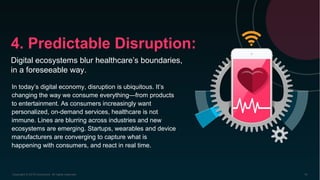
4. Predictable
Disruption
Digital ecosystems
blur healthcare’s
boundaries, in a
foreseeable way.
5. Digital Trust
As healthcare data
security risks
increase, so do
opportunities to earn
consumer trust.
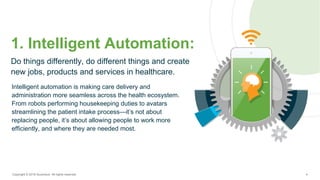
1. Intelligent Automation:
Do things differently, do different things and create
new jobs, products and services in healthcare.
Copyright © 2016 Accenture All rights reserved. 4
Intelligent automation is making care delivery and
administration more seamless across the health ecosystem.
From robots performing housekeeping duties to avatars
streamlining the patient intake process—it’s not about
replacing people, it’s about allowing people to work more
efficiently, and where they are needed most.
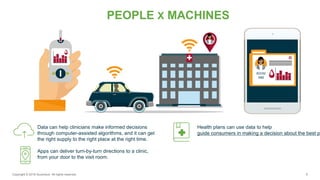
PEOPLE X MACHINES
Data can help clinicians make informed decisions
through computer-assisted algorithms, and it can get
the right supply to the right place at the right time.
Apps can deliver turn-by-turn directions to a clinic,
from your door to the visit room.
Copyright © 2016 Accenture All rights reserved. 5
Health plans can use data to help guide
consumers in making a decision about the
best plan for them.
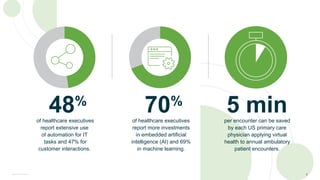
of healthcare executives
report extensive use
of automation for IT
tasks and 47% for
customer interactions.
48%
Copyright © 2016 Accenture All rights reserved. 6
of healthcare executives
report more investments
in embedded artificial
intelligence (AI) and 69%
in machine learning.
70%
per encounter can be saved
by each US primary care
physician applying virtual
health to annual ambulatory
patient encounters.
5 min
7Copyright © 2016 Accenture All rights reserved.
SilverCloud provides an online solution for the treatment of mental
and behavioral health. Its programs allow users to access interactive
content anonymously, and at a pace that suits their schedule. Such
flexibility allows the patient to engage in and take charge of their own
care and provides clinicians with the ability to facilitate up to six times
or more patients than pure face-to-face work, while maintaining the
same level of outcomes. The solution uses analytics and clinical
measurements to report back on progress.
Taking charge of
mental health
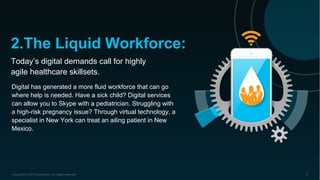
2.The Liquid Workforce:
Today’s digital demands call for highly
agile healthcare skillsets.
Copyright © 2016 Accenture All rights reserved. 8
Digital has generated a more fluid workforce that can go
where help is needed. Have a sick child? Digital services
can allow you to Skype with a pediatrician. Struggling with
a high-risk pregnancy issue? Through virtual technology, a
specialist in New York can treat an ailing patient in New
Mexico.
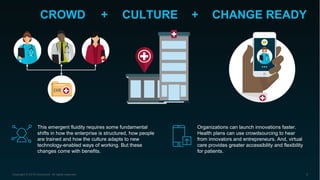
This emergent fluidity requires some fundamental
shifts in how the enterprise is structured, how people
are trained and how the culture adapts to new
technology-enabled ways of working. But these
changes come with benefits.
Copyright © 2016 Accenture All rights reserved. 9
Organizations can launch innovations faster.
Health plans can use crowdsourcing to hear
from innovators and entrepreneurs. And, virtual
care provides greater accessibility and flexibility
for patients.
CROWD CULTURE CHANGE READY+ +
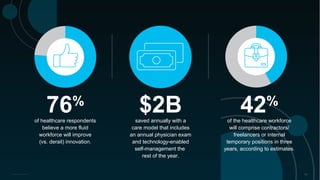
of healthcare respondents
believe a more fluid
workforce will improve
(vs. derail) innovation.
76%
Copyright © 2016 Accenture All rights reserved. 10
saved annually with a
care model that includes
an annual physician exam
and technology-enabled
self-management the
rest of the year.
42%
of the healthcare workforce
will comprise contractors/
freelancers or internal
temporary positions in three
years, according to estimates.
$2B
Copyright © 2016 Accenture All rights reserved. 11
UnitedHealth Group’s Garage program aims to identify, nurture and
accelerate innovative internal business ideas that lead to new health
businesses, products and services. The Garage focuses on a small,
discrete portfolio of seed-stage ideas, putting them through a
disciplined process designed to validate and test business concepts
and provide paths to commercialization. Dedicated “entrepreneurs in
residence” are matched to ideas based on their own knowledge,
talent and passion.
An innovation engine
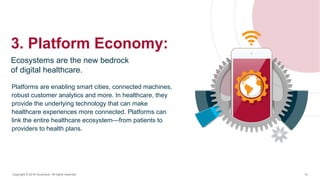
3. Platform Economy:
Ecosystems are the new bedrock
of digital healthcare.
Copyright © 2016 Accenture All rights reserved. 12
Platforms are enabling smart cities, connected
machines, robust customer analytics and more. In
healthcare, they provide the underlying technology that
can make healthcare experiences more connected.
Platforms can link the entire healthcare ecosystem—
from patients to providers to health plans.
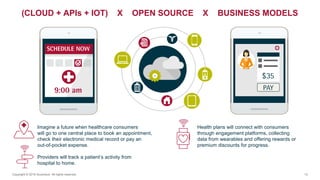
(CLOUD + APIs + IOT) X OPEN SOURCE X BUSINESS MODELS
Imagine a future when healthcare consumers
will go to one central place to book an appointment,
check their electronic medical record or pay an
out-of-pocket expense.
Providers will track a patient’s activity from
hospital to home.
Copyright © 2016 Accenture All rights reserved. 13
Health plans will connect with consumers
through engagement platforms, collecting
data from wearables and offering rewards or
premium discounts for progress.
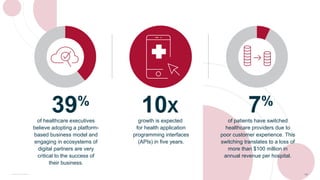
of healthcare executives
believe adopting a platform-
based business model and
engaging in ecosystems of
digital partners are very
critical to the success of
their business.
39%
Copyright © 2016 Accenture All rights reserved. 14
growth is expected
for health application
programming interfaces
(APIs) in five years.
7%
of patients have switched
healthcare providers due to
poor customer experience.
This switching translates to a
loss of more than $100 million
in annual revenue per hospital.
10X
15Copyright © 2016 Accenture All rights reserved.
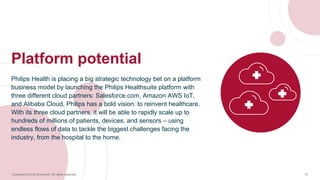
Philips Health is placing a big strategic technology bet on a platform
business model by launching the Philips Healthsuite platform with
three different cloud partners: Salesforce.com, Amazon AWS IoT, and
Alibaba Cloud. Philips has a bold vision: to reinvent healthcare. With
its three cloud partners, it will be able to rapidly scale up to hundreds
of millions of patients, devices, and sensors – using endless flows of
data to tackle the biggest challenges facing the industry, from the
hospital to the home.
Platform potential
4. Predictable Disruption:
Digital ecosystems blur healthcare’s boundaries,
in a foreseeable way.
Copyright © 2016 Accenture All rights reserved. 16
In today’s digital economy, disruption is ubiquitous. It’s
changing the way we consume everything—from products
to entertainment. As consumers increasingly want
personalized, on-demand services, healthcare is not
immune. Lines are blurring across industries and new
ecosystems are emerging. Startups, wearables and
device manufacturers are converging to capture what is
happening with consumers, and react in real time.
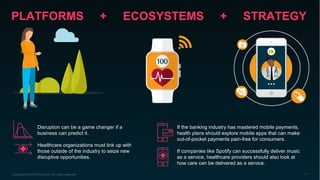
Disruption can be a game changer if a
business can predict it.
Healthcare organizations must link up with
those outside of the industry to seize new
disruptive opportunities.
Copyright © 2016 Accenture All rights reserved. 17
If the banking industry has mastered mobile payments,
health plans should explore mobile apps that can make
out-of-pocket payments pain-free for consumers.
If companies like Spotify can successfully deliver music
as a service, healthcare providers should also look at how
care can be delivered as a service.
PLATFORMS + ECOSYSTEMS + STRATEGY
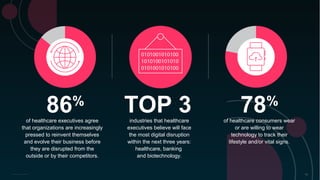
of healthcare executives agree
that organizations are increasingly
pressed to reinvent themselves
and evolve their business before
they are disrupted from the
outside or by their competitors.
86%
Copyright © 2016 Accenture All rights reserved. 18
industries that healthcare
executives believe will face
the most digital disruption
within the next three years:
healthcare, banking
and biotechnology.
78%
of healthcare consumers wear
or are willing to wear
technology to track their
lifestyle and/or vital signs.
TOP 3
Copyright © 2016 Accenture All rights reserved. 19
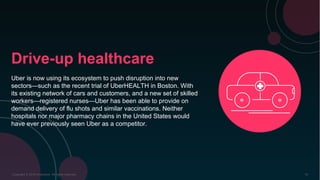
Uber is now using its ecosystem to push disruption into new
sectors—such as the recent trial of UberHEALTH in Boston. With
its existing network of cars and customers, and a new set of skilled
workers—registered nurses—Uber has been able to provide on
demand delivery of flu shots and similar vaccinations. Neither
hospitals nor major pharmacy chains in the United States would
have ever previously seen Uber as a competitor.
Drive-up healthcare
5. Digital Trust:
As healthcare data security risks increase, so do
opportunities to earn consumer trust.
Copyright © 2016 Accenture All rights reserved. 20
Protecting privacy has become table stakes in
healthcare. Now, organizations must figure out how to
responsibly and ethically manage a mass of customer
data that is increasing in volume by the minute. If
handled properly, this treasure trove of data can be a
tool for creating tailored services and building
consumer trust.
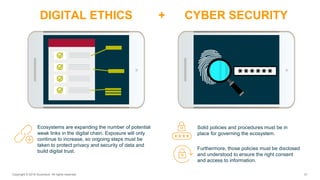
DIGITAL ETHICS + CYBER SECURITY
Ecosystems are expanding the number of potential
weak links in the digital chain. Exposure will only
continue to increase, so ongoing steps must be
taken to protect privacy and security of data and
build digital trust.
Copyright © 2016 Accenture All rights reserved. 21
Solid policies and procedures must be in
place for governing the ecosystem.
Furthermore, those policies must be disclosed
and understood to ensure the right consent
and access to information.
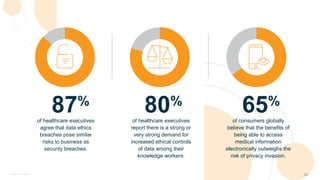
of healthcare executives
agree that data ethics
breaches pose similar
risks to business as
security breaches.
87%
Copyright © 2016 Accenture All rights reserved. 22
of healthcare executives
report there is a strong or
very strong demand for
increased ethical controls
of data among their
knowledge workers.
65%
of consumers globally
believe that the benefits of
being able to access
medical information
electronically outweighs the
risk of privacy invasion.
80%
23Copyright © 2016 Accenture All rights reserved.
After the consumer outcry from its iCloud breach in 2014, Apple
came to understand afresh the importance of trust. Its efforts to be
transparent in how it uses and secures customer data is testimony
to the value this leading brand places on trust. Its new platforms,
such as Apple Pay and HealthKit, are clear beneficiaries of this
trusted-by-design approach because the strong security and ethics
that are ”baked in” give customers confidence that their digital
footprints are secure and private, easing the transition to and
adoption of the Apple ecosystem.
Trusted territory
Kaveh Safavi, M.D., J.D.
kaveh.t.safavi@accenture.com
Brian Kalis
brian.p.kalis@accenture.com
Copyright © 2016 Accenture All rights reserved. 24
Follow us on Twitter @AccentureHealth
Accenture Technology Vision 2016
Fjord Trends 2016
2016 Consumer Survey on Patient Engagement
Virtual health: The untapped opportunity to get
the most out of healthcare
Losing patience: Why healthcare providers must
up their mobile game
For more information: Sources:

The Digital Health Tech Vision 2016

  • 1.
    Top 5 Digital HealthTrends Show the Power of People
  • 2.
    Keeping up withchanging technology is vital, but it’s just as important to evolve the consumer experience, care delivery methods and career development opportunities for the healthcare workforce. The Digital Health Technology Vision 2016 reveals five trends that prove winning in the digital age hinges on people. Copyright © 2016 Accenture All rights reserved.
  • 3.
    Copyright © 2016Accenture All rights reserved. 1. Intelligent Automation Do things differently, do different things and create new jobs, products and services in healthcare. 2. The Liquid Workforce Today’s digital demands call for highly agile healthcare skillsets. 3. Platform Economy Ecosystems are the new bedrock of digital healthcare. 4. Predictable Disruption Digital ecosystems blur healthcare’s boundaries, in a foreseeable way. 5. Digital Trust As healthcare data security risks increase, so do opportunities to earn consumer trust.
  • 4.
    1. Intelligent Automation: Dothings differently, do different things and create new jobs, products and services in healthcare. Copyright © 2016 Accenture All rights reserved. 4 Intelligent automation is making care delivery and administration more seamless across the health ecosystem. From robots performing housekeeping duties to avatars streamlining the patient intake process—it’s not about replacing people, it’s about allowing people to work more efficiently, and where they are needed most.
  • 5.
    PEOPLE X MACHINES Datacan help clinicians make informed decisions through computer-assisted algorithms, and it can get the right supply to the right place at the right time. Apps can deliver turn-by-turn directions to a clinic, from your door to the visit room. Copyright © 2016 Accenture All rights reserved. 5 Health plans can use data to help guide consumers in making a decision about the best plan for them.
  • 6.
    of healthcare executives reportextensive use of automation for IT tasks and 47% for customer interactions. 48% Copyright © 2016 Accenture All rights reserved. 6 of healthcare executives report more investments in embedded artificial intelligence (AI) and 69% in machine learning. 70% per encounter can be saved by each US primary care physician applying virtual health to annual ambulatory patient encounters. 5 min
  • 7.
    7Copyright © 2016Accenture All rights reserved. SilverCloud provides an online solution for the treatment of mental and behavioral health. Its programs allow users to access interactive content anonymously, and at a pace that suits their schedule. Such flexibility allows the patient to engage in and take charge of their own care and provides clinicians with the ability to facilitate up to six times or more patients than pure face-to-face work, while maintaining the same level of outcomes. The solution uses analytics and clinical measurements to report back on progress. Taking charge of mental health
  • 8.
    2.The Liquid Workforce: Today’sdigital demands call for highly agile healthcare skillsets. Copyright © 2016 Accenture All rights reserved. 8 Digital has generated a more fluid workforce that can go where help is needed. Have a sick child? Digital services can allow you to Skype with a pediatrician. Struggling with a high-risk pregnancy issue? Through virtual technology, a specialist in New York can treat an ailing patient in New Mexico.
  • 9.
    This emergent fluidityrequires some fundamental shifts in how the enterprise is structured, how people are trained and how the culture adapts to new technology-enabled ways of working. But these changes come with benefits. Copyright © 2016 Accenture All rights reserved. 9 Organizations can launch innovations faster. Health plans can use crowdsourcing to hear from innovators and entrepreneurs. And, virtual care provides greater accessibility and flexibility for patients. CROWD CULTURE CHANGE READY+ +
  • 10.
    of healthcare respondents believea more fluid workforce will improve (vs. derail) innovation. 76% Copyright © 2016 Accenture All rights reserved. 10 saved annually with a care model that includes an annual physician exam and technology-enabled self-management the rest of the year. 42% of the healthcare workforce will comprise contractors/ freelancers or internal temporary positions in three years, according to estimates. $2B
  • 11.
    Copyright © 2016Accenture All rights reserved. 11 UnitedHealth Group’s Garage program aims to identify, nurture and accelerate innovative internal business ideas that lead to new health businesses, products and services. The Garage focuses on a small, discrete portfolio of seed-stage ideas, putting them through a disciplined process designed to validate and test business concepts and provide paths to commercialization. Dedicated “entrepreneurs in residence” are matched to ideas based on their own knowledge, talent and passion. An innovation engine
  • 12.
    3. Platform Economy: Ecosystemsare the new bedrock of digital healthcare. Copyright © 2016 Accenture All rights reserved. 12 Platforms are enabling smart cities, connected machines, robust customer analytics and more. In healthcare, they provide the underlying technology that can make healthcare experiences more connected. Platforms can link the entire healthcare ecosystem— from patients to providers to health plans.
  • 13.
    (CLOUD + APIs+ IOT) X OPEN SOURCE X BUSINESS MODELS Imagine a future when healthcare consumers will go to one central place to book an appointment, check their electronic medical record or pay an out-of-pocket expense. Providers will track a patient’s activity from hospital to home. Copyright © 2016 Accenture All rights reserved. 13 Health plans will connect with consumers through engagement platforms, collecting data from wearables and offering rewards or premium discounts for progress.
  • 14.
    of healthcare executives believeadopting a platform- based business model and engaging in ecosystems of digital partners are very critical to the success of their business. 39% Copyright © 2016 Accenture All rights reserved. 14 growth is expected for health application programming interfaces (APIs) in five years. 7% of patients have switched healthcare providers due to poor customer experience. This switching translates to a loss of more than $100 million in annual revenue per hospital. 10X
  • 15.
    15Copyright © 2016Accenture All rights reserved. Philips Health is placing a big strategic technology bet on a platform business model by launching the Philips Healthsuite platform with three different cloud partners: Salesforce.com, Amazon AWS IoT, and Alibaba Cloud. Philips has a bold vision: to reinvent healthcare. With its three cloud partners, it will be able to rapidly scale up to hundreds of millions of patients, devices, and sensors – using endless flows of data to tackle the biggest challenges facing the industry, from the hospital to the home. Platform potential
  • 16.
    4. Predictable Disruption: Digitalecosystems blur healthcare’s boundaries, in a foreseeable way. Copyright © 2016 Accenture All rights reserved. 16 In today’s digital economy, disruption is ubiquitous. It’s changing the way we consume everything—from products to entertainment. As consumers increasingly want personalized, on-demand services, healthcare is not immune. Lines are blurring across industries and new ecosystems are emerging. Startups, wearables and device manufacturers are converging to capture what is happening with consumers, and react in real time.
  • 17.
    Disruption can bea game changer if a business can predict it. Healthcare organizations must link up with those outside of the industry to seize new disruptive opportunities. Copyright © 2016 Accenture All rights reserved. 17 If the banking industry has mastered mobile payments, health plans should explore mobile apps that can make out-of-pocket payments pain-free for consumers. If companies like Spotify can successfully deliver music as a service, healthcare providers should also look at how care can be delivered as a service. PLATFORMS + ECOSYSTEMS + STRATEGY
  • 18.
    of healthcare executivesagree that organizations are increasingly pressed to reinvent themselves and evolve their business before they are disrupted from the outside or by their competitors. 86% Copyright © 2016 Accenture All rights reserved. 18 industries that healthcare executives believe will face the most digital disruption within the next three years: healthcare, banking and biotechnology. 78% of healthcare consumers wear or are willing to wear technology to track their lifestyle and/or vital signs. TOP 3
  • 19.
    Copyright © 2016Accenture All rights reserved. 19 Uber is now using its ecosystem to push disruption into new sectors—such as the recent trial of UberHEALTH in Boston. With its existing network of cars and customers, and a new set of skilled workers—registered nurses—Uber has been able to provide on demand delivery of flu shots and similar vaccinations. Neither hospitals nor major pharmacy chains in the United States would have ever previously seen Uber as a competitor. Drive-up healthcare
  • 20.
    5. Digital Trust: Ashealthcare data security risks increase, so do opportunities to earn consumer trust. Copyright © 2016 Accenture All rights reserved. 20 Protecting privacy has become table stakes in healthcare. Now, organizations must figure out how to responsibly and ethically manage a mass of customer data that is increasing in volume by the minute. If handled properly, this treasure trove of data can be a tool for creating tailored services and building consumer trust.
  • 21.
    DIGITAL ETHICS +CYBER SECURITY Ecosystems are expanding the number of potential weak links in the digital chain. Exposure will only continue to increase, so ongoing steps must be taken to protect privacy and security of data and build digital trust. Copyright © 2016 Accenture All rights reserved. 21 Solid policies and procedures must be in place for governing the ecosystem. Furthermore, those policies must be disclosed and understood to ensure the right consent and access to information.
  • 22.
    of healthcare executives agreethat data ethics breaches pose similar risks to business as security breaches. 87% Copyright © 2016 Accenture All rights reserved. 22 of healthcare executives report there is a strong or very strong demand for increased ethical controls of data among their knowledge workers. 65% of consumers globally believe that the benefits of being able to access medical information electronically outweighs the risk of privacy invasion. 80%
  • 23.
    23Copyright © 2016Accenture All rights reserved. After the consumer outcry from its iCloud breach in 2014, Apple came to understand afresh the importance of trust. Its efforts to be transparent in how it uses and secures customer data is testimony to the value this leading brand places on trust. Its new platforms, such as Apple Pay and HealthKit, are clear beneficiaries of this trusted-by-design approach because the strong security and ethics that are ”baked in” give customers confidence that their digital footprints are secure and private, easing the transition to and adoption of the Apple ecosystem. Trusted territory
  • 24.
    Kaveh Safavi, M.D.,J.D. kaveh.t.safavi@accenture.com Brian Kalis brian.p.kalis@accenture.com Copyright © 2016 Accenture All rights reserved. 24 Follow us on Twitter @AccentureHealth Accenture Technology Vision 2016 Fjord Trends 2016 2016 Consumer Survey on Patient Engagement Virtual health: The untapped opportunity to get the most out of healthcare Losing patience: Why healthcare providers must up their mobile game For more information: Sources: