TOPIC
COSTING METHOD
5
1
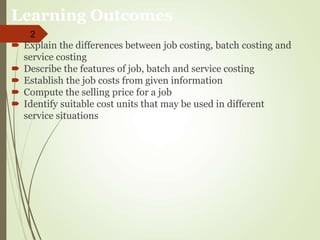
Learning Outcomes
 Explain the differences between job costing, batch costing and
service costing
 Describe the features of job, batch and service costing
 Establish the job costs from given information
 Compute the selling price for a job
 Identify suitable cost units that may be used in different
service situations
2
Costing Methods
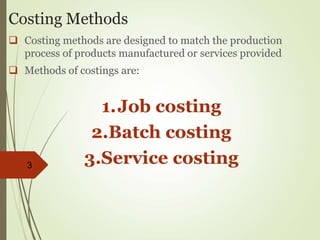
 Costing methods are designed to match the production
process of products manufactured or services provided
 Methods of costings are:
1.Job costing
2.Batch costing
3.Service costing
3
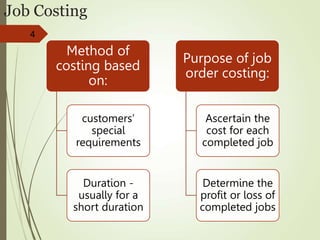
Job Costing
Method of
costing based
on:
customers’
special
requirements
Duration -
usually for a
short duration
Purpose of job
order costing:
Ascertain the
cost for each
completed job
Determine the
profit or loss of
completed jobs
4
Features of Job Costing
 Based on customer’s own specifications
 Production for customer order not for maintaining stock
 Products manufactured are distinguishable
 Every job can be identified clearly
 Every job is charged with its own cost.
 Separate job numbers are allotted to each job.
 A separate cost record is maintained for each job from the
time production begins till it is complete.
 Job is usually carried out in the factory premises.
5
STEPS OF JOBBING THE WORK
Client will
approach
supplier &
indicate
requirements
Taking the
customer
specific order
requirement
Estimate
cost & add
margin to
identify the
selling price
Customer
agree to
the selling
price set
The job will be
carried out
with specific
job order
reference
number.
Prepare
Material
Requisition
Note &
Purchase
Requisition
Note to apply
for material to
be used
When all materials,
labour and
equipment available
in the factory, then
the job can be
started.
Examples of Job Costing
Special orders made for
printing press
Plumbing works
Furniture on customer’s
special requirements
Automobile repairs
7
Ascertaining a Job Cost
Job cost is computed by adding all the costs
pertaining to the completion of a job
At the production stage:
 Sum of the direct costs and absorbed overhead costs makes up the
production/factory cost
At the sales and delivery stage:
 Non-production overheads are charged to the job
 Sum of production costs and non-production costs makes up the total cost
 Difference between selling price and total cost is the profit/loss
8
Batch Costing
A form of job costing whereby identical units are
manufactured in batches.
Each batch of similar units is distinct and separately
identifiable.
The batch is considered as a job and treated as a cost
unit.
Cost per unit in the batch is computed by dividing
the batch cost by the number of good completed
units.
9
Examples of Batch Costing
Production of engineering parts/components
Manufacture of footwear
Manufacture of toys
Manufacture of clothing
Manufacture of food items/drugs
10
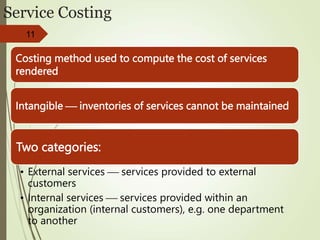
Service Costing
Costing method used to compute the cost of services
rendered
Intangible  inventories of services cannot be maintained
Two categories:
• External services  services provided to external
customers
• Internal services  services provided within an
organization (internal customers), e.g. one department
to another
11
Cost Units in Service Costing
Two categories of cost units:
1. Simple cost units
Simple cost units are based on a single
measurement
• Hotels: guest
• Restaurants: meals served
• Hospitals: patients
• Transport: kilometers
12
Cost Units in Service Costing
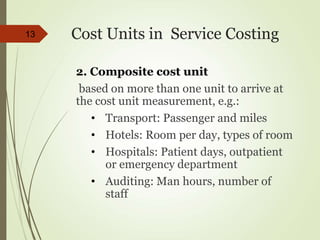
2. Composite cost unit
based on more than one unit to arrive at
the cost unit measurement, e.g.:
• Transport: Passenger and miles
• Hotels: Room per day, types of room
• Hospitals: Patient days, outpatient
or emergency department
• Auditing: Man hours, number of
staff
13
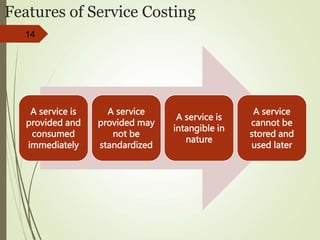
Features of Service Costing
A service is
provided and
consumed
immediately
A service
provided may
not be
standardized
A service is
intangible in
nature
A service
cannot be
stored and
used later
14
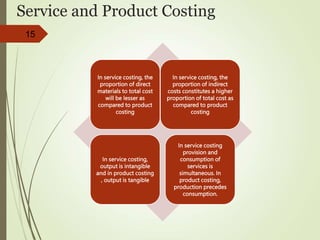
Service and Product Costing
In service costing, the
proportion of direct
materials to total cost
will be lesser as
compared to product
costing
In service costing, the
proportion of indirect
costs constitutes a higher
proportion of total cost as
compared to product
costing
In service costing,
output is intangible
and in product costing
, output is tangible
In service costing
provision and
consumption of
services is
simultaneous. In
product costing,
production precedes
consumption.
15
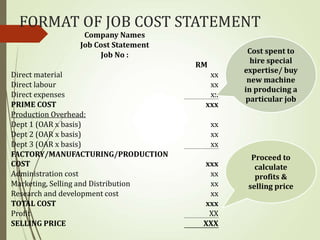
FORMAT OF JOB COST STATEMENT
Company Names
Job Cost Statement
Job No :
RM
Direct material xx
Direct labour xx
Direct expenses xx
PRIME COST xxx
Production Overhead:
Dept 1 (OAR x basis) xx
Dept 2 (OAR x basis) xx
Dept 3 (OAR x basis) xx
FACTORY/MANUFACTURING/PRODUCTION
COST xxx
Administration cost xx
Marketing, Selling and Distribution xx
Research and development cost xx
TOTAL COST xxx
Profit XX
SELLING PRICE XXX
Cost spent to
hire special
expertise/ buy
new machine
in producing a
particular job
Proceed to
calculate
profits &
selling price
PROFIT CALCULATION
1. Margin
• Profit is calculated
based on selling price
• Selling price =
total cost +
(% x selling price)
2. Markup
• Profit is calculated
based on total cost
• Selling price =
total cost +
(% x total cost)
COMPREHENSIVE EXAMPLE
 Agro Best Bhd produces 2 types of products named Design
A & Design B.
 You are required to help the company to determine the
selling price of the products.
 The management has set a profit margin of 20% for Design
B and 20% profit mark up for design A.
Given below the information regarding the
prime costs for both products.
ITEM DESIGN A (RM) DESIGN B (RM)
MATERIAL A 900 600
MATERIAL B 450 550
DIRECT LABOUR 1100 900
DIRECT EXPENSES 180 20
Other relevant data are given as
follows:
DESIGN A DESIGN B
OVERHEAD
ABSORBTION RATE
RM5 PER DIRECT
LABOUR HOUR
RM3 PER MACHINE
HOURS
DIRECT LABOUR
HOURS
100 HOURS 50 HOURS
MACHINE HOURS 130 HOURS 170 HOURS
ADMINISTRATIVE
EXPENSES
RM200 RM200
SELLING EXPENSES RM150 RM170
Required:
Prepare the Job Cost Statement
Calculate the Profit Margin/ Mark-up
Calculate the Selling Price
Format for Job Cost Statement
DESIGN A DESIGN B
(RM) (RM)
DIRECT COSTS:
DIRECT MATERIAL A 900 600
DIRECT MATERIAL B 450 550
DIRECT LABOUR 1100 900
DIRECT EXPENSES 180 20
PRIME COST (DM+DL+DE) 2630 2070
Format Job Cost Statement
DESIGN A DESIGN B
(RM) (RM)
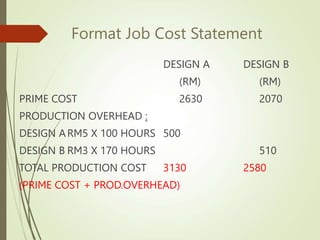
PRIME COST 2630 2070
PRODUCTION OVERHEAD :
DESIGN ARM5 X 100 HOURS 500
DESIGN B RM3 X 170 HOURS 510
TOTAL PRODUCTION COST 3130 2580
(PRIME COST + PROD.OVERHEAD)
Format Job Cost Statement
DESIGN A DESIGN B
(RM) (RM)
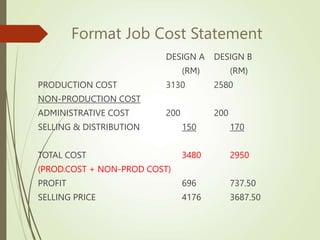
PRODUCTION COST 3130 2580
NON-PRODUCTION COST
ADMINISTRATIVE COST 200 200
SELLING & DISTRIBUTION 150 170
TOTAL COST 3480 2950
(PROD.COST + NON-PROD COST)
PROFIT 696 737.50
SELLING PRICE 4176 3687.50
WORKING TO CALCULATE PROFIT FOR DESIGN
A and B
 DESIGN A: PROFIT IS BASED ON TOTAL COST @ PROFIT MARK-UP.
 FORMULA:
PROFIT = TOTAL COST X % PROFIT
= RM3480 X 20%
= RM696
 DESIGN B: PROFIT IS BASED ON SELLING PRICE @ PROFIT MARGIN
 FORMULA:
PROFIT = [% PROFIT /(100 - PROFIT %)] X TC
= 20/(100 - 20) X RM2950
=( 20 / 80 )X RM2950
= RM737.50
26

Topic 5 - Costing Method_CT.ppt

  • 1.
  • 2.
    Learning Outcomes  Explainthe differences between job costing, batch costing and service costing  Describe the features of job, batch and service costing  Establish the job costs from given information  Compute the selling price for a job  Identify suitable cost units that may be used in different service situations 2
  • 3.
    Costing Methods  Costingmethods are designed to match the production process of products manufactured or services provided  Methods of costings are: 1.Job costing 2.Batch costing 3.Service costing 3
  • 4.
    Job Costing Method of costingbased on: customers’ special requirements Duration - usually for a short duration Purpose of job order costing: Ascertain the cost for each completed job Determine the profit or loss of completed jobs 4
  • 5.
    Features of JobCosting  Based on customer’s own specifications  Production for customer order not for maintaining stock  Products manufactured are distinguishable  Every job can be identified clearly  Every job is charged with its own cost.  Separate job numbers are allotted to each job.  A separate cost record is maintained for each job from the time production begins till it is complete.  Job is usually carried out in the factory premises. 5
  • 6.
    STEPS OF JOBBINGTHE WORK Client will approach supplier & indicate requirements Taking the customer specific order requirement Estimate cost & add margin to identify the selling price Customer agree to the selling price set The job will be carried out with specific job order reference number. Prepare Material Requisition Note & Purchase Requisition Note to apply for material to be used When all materials, labour and equipment available in the factory, then the job can be started.
  • 7.
    Examples of JobCosting Special orders made for printing press Plumbing works Furniture on customer’s special requirements Automobile repairs 7
  • 8.
    Ascertaining a JobCost Job cost is computed by adding all the costs pertaining to the completion of a job At the production stage:  Sum of the direct costs and absorbed overhead costs makes up the production/factory cost At the sales and delivery stage:  Non-production overheads are charged to the job  Sum of production costs and non-production costs makes up the total cost  Difference between selling price and total cost is the profit/loss 8
  • 9.
    Batch Costing A formof job costing whereby identical units are manufactured in batches. Each batch of similar units is distinct and separately identifiable. The batch is considered as a job and treated as a cost unit. Cost per unit in the batch is computed by dividing the batch cost by the number of good completed units. 9
  • 10.
    Examples of BatchCosting Production of engineering parts/components Manufacture of footwear Manufacture of toys Manufacture of clothing Manufacture of food items/drugs 10
  • 11.
    Service Costing Costing methodused to compute the cost of services rendered Intangible  inventories of services cannot be maintained Two categories: • External services  services provided to external customers • Internal services  services provided within an organization (internal customers), e.g. one department to another 11
  • 12.
    Cost Units inService Costing Two categories of cost units: 1. Simple cost units Simple cost units are based on a single measurement • Hotels: guest • Restaurants: meals served • Hospitals: patients • Transport: kilometers 12
  • 13.
    Cost Units inService Costing 2. Composite cost unit based on more than one unit to arrive at the cost unit measurement, e.g.: • Transport: Passenger and miles • Hotels: Room per day, types of room • Hospitals: Patient days, outpatient or emergency department • Auditing: Man hours, number of staff 13
  • 14.
    Features of ServiceCosting A service is provided and consumed immediately A service provided may not be standardized A service is intangible in nature A service cannot be stored and used later 14
  • 15.
    Service and ProductCosting In service costing, the proportion of direct materials to total cost will be lesser as compared to product costing In service costing, the proportion of indirect costs constitutes a higher proportion of total cost as compared to product costing In service costing, output is intangible and in product costing , output is tangible In service costing provision and consumption of services is simultaneous. In product costing, production precedes consumption. 15
  • 16.
    FORMAT OF JOBCOST STATEMENT Company Names Job Cost Statement Job No : RM Direct material xx Direct labour xx Direct expenses xx PRIME COST xxx Production Overhead: Dept 1 (OAR x basis) xx Dept 2 (OAR x basis) xx Dept 3 (OAR x basis) xx FACTORY/MANUFACTURING/PRODUCTION COST xxx Administration cost xx Marketing, Selling and Distribution xx Research and development cost xx TOTAL COST xxx Profit XX SELLING PRICE XXX Cost spent to hire special expertise/ buy new machine in producing a particular job Proceed to calculate profits & selling price
  • 17.
    PROFIT CALCULATION 1. Margin •Profit is calculated based on selling price • Selling price = total cost + (% x selling price) 2. Markup • Profit is calculated based on total cost • Selling price = total cost + (% x total cost)
  • 18.
    COMPREHENSIVE EXAMPLE  AgroBest Bhd produces 2 types of products named Design A & Design B.  You are required to help the company to determine the selling price of the products.  The management has set a profit margin of 20% for Design B and 20% profit mark up for design A.
  • 19.
    Given below theinformation regarding the prime costs for both products. ITEM DESIGN A (RM) DESIGN B (RM) MATERIAL A 900 600 MATERIAL B 450 550 DIRECT LABOUR 1100 900 DIRECT EXPENSES 180 20
  • 20.
    Other relevant dataare given as follows: DESIGN A DESIGN B OVERHEAD ABSORBTION RATE RM5 PER DIRECT LABOUR HOUR RM3 PER MACHINE HOURS DIRECT LABOUR HOURS 100 HOURS 50 HOURS MACHINE HOURS 130 HOURS 170 HOURS ADMINISTRATIVE EXPENSES RM200 RM200 SELLING EXPENSES RM150 RM170
  • 21.
    Required: Prepare the JobCost Statement Calculate the Profit Margin/ Mark-up Calculate the Selling Price
  • 22.
    Format for JobCost Statement DESIGN A DESIGN B (RM) (RM) DIRECT COSTS: DIRECT MATERIAL A 900 600 DIRECT MATERIAL B 450 550 DIRECT LABOUR 1100 900 DIRECT EXPENSES 180 20 PRIME COST (DM+DL+DE) 2630 2070
  • 23.
    Format Job CostStatement DESIGN A DESIGN B (RM) (RM) PRIME COST 2630 2070 PRODUCTION OVERHEAD : DESIGN ARM5 X 100 HOURS 500 DESIGN B RM3 X 170 HOURS 510 TOTAL PRODUCTION COST 3130 2580 (PRIME COST + PROD.OVERHEAD)
  • 24.
    Format Job CostStatement DESIGN A DESIGN B (RM) (RM) PRODUCTION COST 3130 2580 NON-PRODUCTION COST ADMINISTRATIVE COST 200 200 SELLING & DISTRIBUTION 150 170 TOTAL COST 3480 2950 (PROD.COST + NON-PROD COST) PROFIT 696 737.50 SELLING PRICE 4176 3687.50
  • 25.
    WORKING TO CALCULATEPROFIT FOR DESIGN A and B  DESIGN A: PROFIT IS BASED ON TOTAL COST @ PROFIT MARK-UP.  FORMULA: PROFIT = TOTAL COST X % PROFIT = RM3480 X 20% = RM696  DESIGN B: PROFIT IS BASED ON SELLING PRICE @ PROFIT MARGIN  FORMULA: PROFIT = [% PROFIT /(100 - PROFIT %)] X TC = 20/(100 - 20) X RM2950 =( 20 / 80 )X RM2950 = RM737.50
  • 26.

Editor's Notes

  • #7 2. Supplier record down the detail eg quantity, quality, size, colour, date of delivery & other requirements Take example of catering business for weeding ceremony, cloths printing business- adminus corporate shirt