Jennifer Evans
Assistant Director ELA
St. Clair County RESA
Evans.jennifer@sccresa.org
http://www.protopage.com/evans.jennifer#Untitled/Home
Grade 2 Vocabulary Video
 https://www.teachingchannel.org/videos/imp
roving-student-vocabulary?fd=1
 Dr. Anita Archer Podcasts
 http://www.scoe.org/pub/htdocs/archer-
videos.html
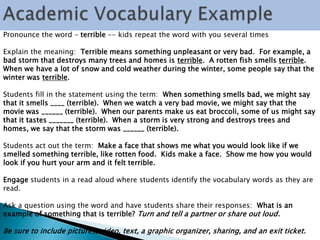
Pronounce the word – terrible -- kids repeat the word with you several times
Explain the meaning: Terrible means something unpleasant or very bad. For example, a
bad storm that destroys many trees and homes is terrible. A rotten fish smells terrible.
When we have a lot of snow and cold weather during the winter, some people say that the
winter was terrible.
Students fill in the statement using the term: When something smells bad, we might say
that it smells ____ (terrible). When we watch a very bad movie, we might say that the
movie was ______ (terrible). When our parents make us eat broccoli, some of us might say
that it tastes _______ (terrible). When a storm is very strong and destroys trees and
homes, we say that the storm was ______ (terrible).
Students act out the term: Make a face that shows me what you would look like if we
smelled something terrible, like rotten food. Kids make a face. Show me how you would
look if you hurt your arm and it felt terrible.
Engage students in a read aloud where students identify the vocabulary words as they are
read.
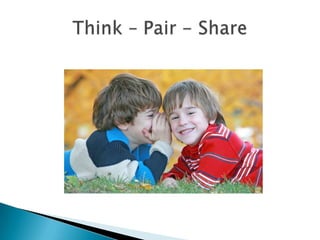
Ask a question using the word and have students share their responses: What is an
example of something that is terrible? Turn and tell a partner or share out loud.
Be sure to include pictures, video, text, a graphic organizer, sharing, and an exit ticket.
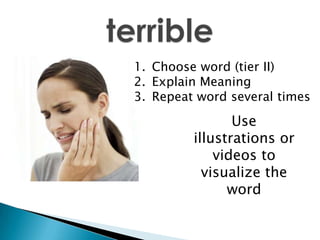
Use
illustrations or
videos to
visualize the
word
1. Choose word (tier II)
2. Explain Meaning
3. Repeat word several times
 Students fill in the statement using the
term: When something smells bad, we
might say that it smells ____ (terrible).
When we watch a very bad movie, we might
say that the movie was ______ (terrible).
When our parents make us eat broccoli,
some of us might say that it tastes _______
(terrible). When a storm is very strong and
destroys trees and homes, we say that the
storm was ______ (terrible).
Students act out the term: Make a face that
shows me what you would look like if we
smelled something terrible, like rotten
food. Kids make a face. Show me how you
would look if you hurt your arm and it felt
terrible.
 Engage students in a read aloud where
students identify the vocabulary words
as they are read.
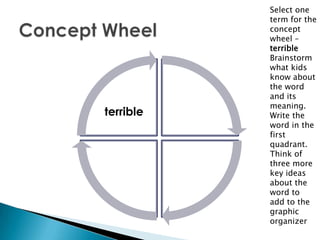
terrible
Select one
term for the
concept
wheel –
terrible
Brainstorm
what kids
know about
the word
and its
meaning.
Write the
word in the
first
quadrant.
Think of
three more
key ideas
about the
word to
add to the
graphic
organizer
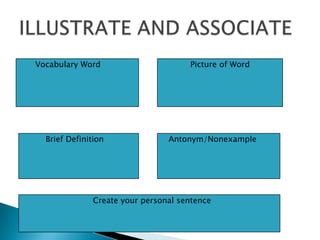
Vocabulary Word Picture of Word
Brief Definition Antonym/Nonexample
Create your personal sentence
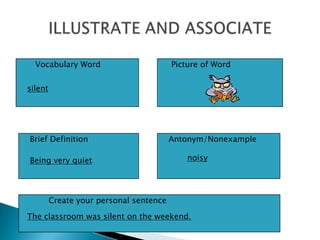
Vocabulary Word Picture of Word
Brief Definition Antonym/Nonexample
Create your personal sentence
silent
Being very quiet noisy
The classroom was silent on the weekend.
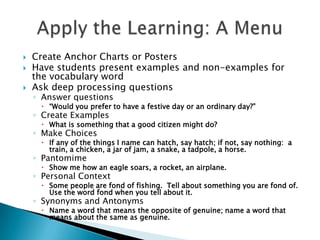
 Create Anchor Charts or Posters
 Have students present examples and non-examples for
the vocabulary word
 Ask deep processing questions
◦ Answer questions
 “Would you prefer to have a festive day or an ordinary day?”
◦ Create Examples
 What is something that a good citizen might do?
◦ Make Choices
 If any of the things I name can hatch, say hatch; if not, say nothing: a
train, a chicken, a jar of jam, a snake, a tadpole, a horse.
◦ Pantomime
 Show me how an eagle soars, a rocket, an airplane.
◦ Personal Context
 Some people are fond of fishing. Tell about something you are fond of.
Use the word fond when you tell about it.
◦ Synonyms and Antonyms
 Name a word that means the opposite of genuine; name a word that
means about the same as genuine.
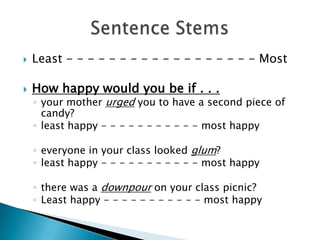
 Least - - - - - - - - - - - - - - - - - - Most
 How happy would you be if . . .
◦ your mother urged you to have a second piece of
candy?
◦ least happy - - - - - - - - - - - most happy
◦ everyone in your class looked glum?
◦ least happy - - - - - - - - - - - most happy
◦ there was a downpour on your class picnic?
◦ Least happy - - - - - - - - - - - most happy
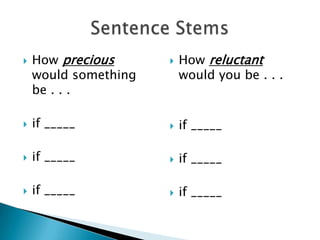
 How precious
would something
be . . .
 if _____
 if _____
 if _____
 How reluctant
would you be . . .
 if _____
 if _____
 if _____
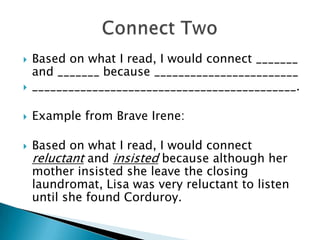
 Based on what I read, I would connect _______
and _______ because ________________________
 ____________________________________________.
 Example from Brave Irene:
 Based on what I read, I would connect
reluctant and insisted because although her
mother insisted she leave the closing
laundromat, Lisa was very reluctant to listen
until she found Corduroy.
Something new that I learned
today is…
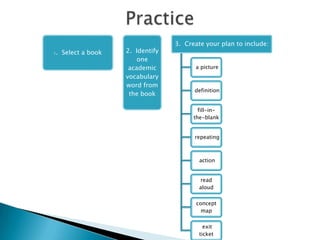
1. Select a book 2. Identify
one
academic
vocabulary
word from
the book
3. Create your plan to include:
a picture
definition
fill-in-
the-blank
repeating
action
read
aloud
concept
map
exit
ticket
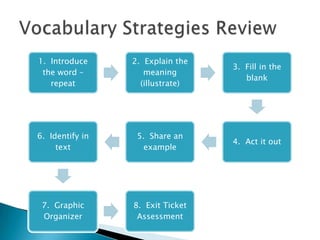
1. Introduce
the word –
repeat
2. Explain the
meaning
(illustrate)
3. Fill in the
blank
4. Act it out
5. Share an
example
6. Identify in
text
7. Graphic
Organizer
8. Exit Ticket
Assessment

Academic vocabulary lesson plan

  • 1.
    Jennifer Evans Assistant DirectorELA St. Clair County RESA Evans.jennifer@sccresa.org http://www.protopage.com/evans.jennifer#Untitled/Home
  • 2.
    Grade 2 VocabularyVideo  https://www.teachingchannel.org/videos/imp roving-student-vocabulary?fd=1  Dr. Anita Archer Podcasts  http://www.scoe.org/pub/htdocs/archer- videos.html
  • 3.
    Pronounce the word– terrible -- kids repeat the word with you several times Explain the meaning: Terrible means something unpleasant or very bad. For example, a bad storm that destroys many trees and homes is terrible. A rotten fish smells terrible. When we have a lot of snow and cold weather during the winter, some people say that the winter was terrible. Students fill in the statement using the term: When something smells bad, we might say that it smells ____ (terrible). When we watch a very bad movie, we might say that the movie was ______ (terrible). When our parents make us eat broccoli, some of us might say that it tastes _______ (terrible). When a storm is very strong and destroys trees and homes, we say that the storm was ______ (terrible). Students act out the term: Make a face that shows me what you would look like if we smelled something terrible, like rotten food. Kids make a face. Show me how you would look if you hurt your arm and it felt terrible. Engage students in a read aloud where students identify the vocabulary words as they are read. Ask a question using the word and have students share their responses: What is an example of something that is terrible? Turn and tell a partner or share out loud. Be sure to include pictures, video, text, a graphic organizer, sharing, and an exit ticket.
  • 4.
    Use illustrations or videos to visualizethe word 1. Choose word (tier II) 2. Explain Meaning 3. Repeat word several times
  • 5.
     Students fillin the statement using the term: When something smells bad, we might say that it smells ____ (terrible). When we watch a very bad movie, we might say that the movie was ______ (terrible). When our parents make us eat broccoli, some of us might say that it tastes _______ (terrible). When a storm is very strong and destroys trees and homes, we say that the storm was ______ (terrible).
  • 6.
    Students act outthe term: Make a face that shows me what you would look like if we smelled something terrible, like rotten food. Kids make a face. Show me how you would look if you hurt your arm and it felt terrible.
  • 8.
     Engage studentsin a read aloud where students identify the vocabulary words as they are read.
  • 9.
    terrible Select one term forthe concept wheel – terrible Brainstorm what kids know about the word and its meaning. Write the word in the first quadrant. Think of three more key ideas about the word to add to the graphic organizer
  • 10.
    Vocabulary Word Pictureof Word Brief Definition Antonym/Nonexample Create your personal sentence
  • 11.
    Vocabulary Word Pictureof Word Brief Definition Antonym/Nonexample Create your personal sentence silent Being very quiet noisy The classroom was silent on the weekend.
  • 12.
     Create AnchorCharts or Posters  Have students present examples and non-examples for the vocabulary word  Ask deep processing questions ◦ Answer questions  “Would you prefer to have a festive day or an ordinary day?” ◦ Create Examples  What is something that a good citizen might do? ◦ Make Choices  If any of the things I name can hatch, say hatch; if not, say nothing: a train, a chicken, a jar of jam, a snake, a tadpole, a horse. ◦ Pantomime  Show me how an eagle soars, a rocket, an airplane. ◦ Personal Context  Some people are fond of fishing. Tell about something you are fond of. Use the word fond when you tell about it. ◦ Synonyms and Antonyms  Name a word that means the opposite of genuine; name a word that means about the same as genuine.
  • 13.
     Least -- - - - - - - - - - - - - - - - - Most  How happy would you be if . . . ◦ your mother urged you to have a second piece of candy? ◦ least happy - - - - - - - - - - - most happy ◦ everyone in your class looked glum? ◦ least happy - - - - - - - - - - - most happy ◦ there was a downpour on your class picnic? ◦ Least happy - - - - - - - - - - - most happy
  • 14.
     How precious wouldsomething be . . .  if _____  if _____  if _____  How reluctant would you be . . .  if _____  if _____  if _____
  • 15.
     Based onwhat I read, I would connect _______ and _______ because ________________________  ____________________________________________.  Example from Brave Irene:  Based on what I read, I would connect reluctant and insisted because although her mother insisted she leave the closing laundromat, Lisa was very reluctant to listen until she found Corduroy.
  • 16.
    Something new thatI learned today is…
  • 17.
    1. Select abook 2. Identify one academic vocabulary word from the book 3. Create your plan to include: a picture definition fill-in- the-blank repeating action read aloud concept map exit ticket
  • 18.
    1. Introduce the word– repeat 2. Explain the meaning (illustrate) 3. Fill in the blank 4. Act it out 5. Share an example 6. Identify in text 7. Graphic Organizer 8. Exit Ticket Assessment

Editor's Notes

  • #5 Pronounce the word – terrible -- kids repeat the word with you several timesExplain the meaning: Terrible means something unpleasant or very bad. For example, a bad storm that destroys many trees and homes is terrible. A rotten fish smells terrible. When we have a lot of snow and cold weather during the winter, some people say that the winter was terrible. Students fill in the statement using the term: When something smells bad, we might say that it smells ____ (terrible). When we watch a very bad movie, we might say that the movie was ______ (terrible). When our parents make us eat broccoli, some of us might say that it tastes _______ (terrible). When a storm is very strong and destroys trees and homes, we say that the storm was ______ (terrible). Students act out the term: Make a face that shows me what you would look like if we smelled something terrible, like rotten food. Kids make a face. Show me how you would look if you hurt your arm and it felt terrible. Ask a question using the word and have students share their responses: What is an example of something that is terrible? Turn and tell a partner or share out loud.
  • #10 Select one term for the concept wheel – disasterBrainstorm what kids know about the word and its meaning (cart on paper)Write the word in the first quadrant – disasterThink of three more key ideas about the word to add to the graphic organizer
  • #12 Switch to document camera and do an example together.
  • #14 Show sentence strip example. Show thumbs up/down. I found my students loved doing this activity and it was very engaging.
  • #17 Kids write one thing they learned today.Additional Resources: http://www.weatherwizkids.com/