Academic integrity: Shining a
light on cheating and
ghostwriting
Ann Wilson, Senior Academic Developer,
Learning, Teaching and Innovation
Agenda for the session
• What is academic integrity?
• Explore some findings and ideas from the Academic Integrity
conference
• Explore the Navitas Academic Integrity framework
What is academic integrity?
We need to talk about cheating and plagiarism
What examples of cheating have you
encountered?
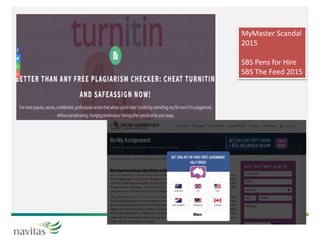
MyMaster Scandal
2015
SBS Pens for Hire
SBS The Feed 2015
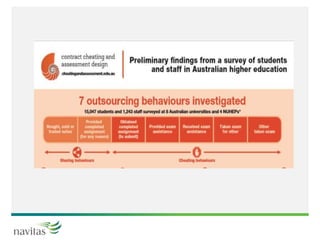
How big is the problem?
• 6 per cent of higher education students in an Australian
nation-wide survey across 10 institutions admitted to cheating
on exams and/or assignments.
• 27 per cent had provided another student with a completed
assignment
• 0.2 per cent (2 000 students) had somebody else take an
exam for them
• 18 per cent of these cases students used a commercial service
Findings from the survey - students
• males account for 54 per cent of cheaters,
• 40 per cent of the entire sample speaking a
language other than English at home.
• Two thirds of cheaters were domestic
students
• 55 per cent of them were at Group of Eight
institutions
Findings from the survey - students
• The survey also found that while well over 90
per cent of honest students thought all
cheating behaviour is wrong some
• 46 per cent did not object to
buying/selling/trading notes.
Findings from the survey - staff
• 68 per cent of surveyed staff suspected some of their students had
outsourced assignments but only 56 per cent of those that did handed the
matter to Academic Integrity staff. An alarming 8 per cent ignored the
issue, with the remainder acting themselves.
• Staff reported that penalties in proved cases of outsourced assignments
range from warnings (37 per cent), through zero marks (27 per cent) to
exclusion (2 per cent). “Penalties seem far more lenient than those
recommended in the literature,” the survey report states.
• In cases of exam “assistance” 46 per cent of students were warned or
counselled, 11 per cent allowed to re-sit, with 36 per cent marked zero
and 12 per cent excluded.
Recommendations from project
• support the development of ‘personalised teaching and
learning relationships’ with students
• recognise the particular needs of international and LOTE
students
• use assessments that are less likely to prompt outsourcing
• ensure processes of breach detection, reporting,
substantiation, penalisation and communication
• support campaigns to get students more concerned about this
problem
• ICAC investigation into corruption in higher education 2016
• TEQSA request to all higher education providers for “assurance of
academic integrity”
• Quality assurance of academic standards and outcomes
• Section 2.9 of the Australian University Provider Category Standards: The
higher education provider has systematic, mature internal processes for
quality assurance and the maintenance of academic standards and
academic integrity.
• Section 3.9 of the Australian University College Provider Category
Standards: The higher education provider has systematic, well developed
internal processes for quality assurance and the maintenance of
academic standards and academic integrity.
•
12
Things to consider – from TEQSA guidelines
• Are systematic processes in place at all levels
to prevent misconduct and maintain academic
integrity?
APCEI conference
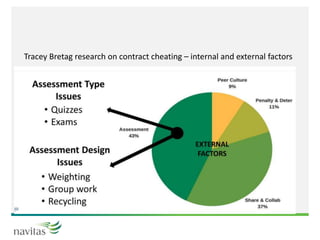
Tracey Bretag research on contract cheating – internal and external factors
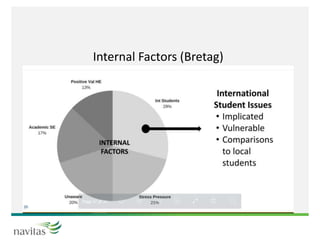
Internal Factors (Bretag)
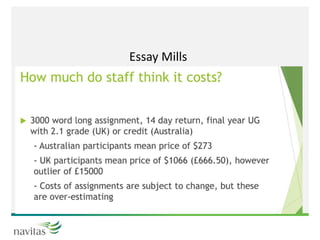
Essay Mills, Ghost writers
How much do you think it costs to produce a
3 000 word essay, 14 day return, final year, credit
level?
Essay Mills
Who writes the essays?
Comments?
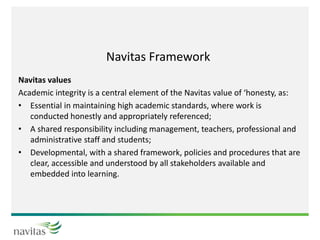
Navitas Framework
Navitas values
Academic integrity is a central element of the Navitas value of ‘honesty, as:
• Essential in maintaining high academic standards, where work is
conducted honestly and appropriately referenced;
• A shared responsibility including management, teachers, professional and
administrative staff and students;
• Developmental, with a shared framework, policies and procedures that are
clear, accessible and understood by all stakeholders available and
embedded into learning.
Principles of Academic Integrity
• Assessment design
The design and structure of assessment is such that academic honesty is
actively supported.
• Student support strategies
Students are provided with a range of resources that will support their
understanding and practice of academic honesty
• Policy and institutional frameworks
There are clear guidelines and policies in place which not only assist in the
identification of plagiarism but also a set out the protocols and procedures
when and if academic honesty is challenged
Checklist for Assessment designers (course coordinators,
teachers)
• the pacing, timing and workload demands of assessment, are spread evenly through the
course. Where no one piece of assessment carries more that 50% of the marks
• consideration is given to the types of questions that are asked in the assessment, more
reflective pieces, which focus on work covered in the class sessions for example, students
writing about how they applied peer feedback, or perhaps scaffolding where students submit
a first draft, or a literature review, which builds into a final piece.
• assessment tasks are reviewed and refreshed each iteration of the course
• Integrated assessment design is practised, where one assessment builds on and uses
materials from other assessment.,
• viva voce is built into tasks, so students are aware that for any piece of assessment they may
be called to answer verbal questions on their assessment, such as how the researched it,
what sources they used, what strategies they used for development.
• Learning journals or logs require students to record the construction of the assessment item,
Checklist for markers
• Strategies identified that will assist markers in
identifying anomalies, for example a student
with usually poor English skills producing work
that is exemplary. This will involve keeping
records and also examples of student work for
comparison.
Checklist for Student support
• Academic integrity modules are developed, delivered online self-paced
that explore the issues, with self-paced quiz, and incentives included such
as badges awarded for completion. Requirements to complete these are
included in course materials, and minor sanctions included for non-
completion.
• To ensure students have the skills and knowledge to underpin academic
integrity, support is provided in the form of discipline based access to
study skills, writing skill workshop, time management making it clear what
the correct procedures are: details about correct referencing, and citation,
Support in how to write in their own voice, rather than in the authors
Checklist for Administrative support
• Clear protocol for those examples of academic dishonesty when detected,
uniformly applied across the program
• The policy and procedures regarding academic integrity are easy to read,
clear and concise and made available to all students on enrolment, and all
teachers and markers on employment
• Students acknowledge that the work is their own and understand that
there would be serious consequences if that turned out not to be the case
• an institutional framework regarding levels and recurrence of academic
dishonesty, with student records, are maintained
• Text-matching software such as Turnitin, or other similarity checkers are
introduced and used as part of educational processes
Checklist for Institutional frameworks
• There is a clear and common understanding amongst students and staff
about what constitutes plagiarism and academic dishonesty
• There are clear guidelines and policies in place which set out the protocols
and procedures when and if academic honesty is challenged and uniformly
applied across the institution
• Strategy in place for the detection of academic dishonesty, for example,
students work and achievement is monitored across the programme
• The materials might include, definition of Academic integrity, institutional
values, what is plagiarism, strategies for paraphrasing, referencing,
citations, quoting, from sources, and from group work with quizzes. There
is a need for a discipline integrated practice session regarding these skills
Questions

Academic integrity: Shining a light on cheating and ghostwriting

  • 1.
    Academic integrity: Shininga light on cheating and ghostwriting Ann Wilson, Senior Academic Developer, Learning, Teaching and Innovation
  • 2.
    Agenda for thesession • What is academic integrity? • Explore some findings and ideas from the Academic Integrity conference • Explore the Navitas Academic Integrity framework
  • 3.
    What is academicintegrity? We need to talk about cheating and plagiarism What examples of cheating have you encountered?
  • 4.
    MyMaster Scandal 2015 SBS Pensfor Hire SBS The Feed 2015
  • 7.
    How big isthe problem? • 6 per cent of higher education students in an Australian nation-wide survey across 10 institutions admitted to cheating on exams and/or assignments. • 27 per cent had provided another student with a completed assignment • 0.2 per cent (2 000 students) had somebody else take an exam for them • 18 per cent of these cases students used a commercial service
  • 8.
    Findings from thesurvey - students • males account for 54 per cent of cheaters, • 40 per cent of the entire sample speaking a language other than English at home. • Two thirds of cheaters were domestic students • 55 per cent of them were at Group of Eight institutions
  • 9.
    Findings from thesurvey - students • The survey also found that while well over 90 per cent of honest students thought all cheating behaviour is wrong some • 46 per cent did not object to buying/selling/trading notes.
  • 10.
    Findings from thesurvey - staff • 68 per cent of surveyed staff suspected some of their students had outsourced assignments but only 56 per cent of those that did handed the matter to Academic Integrity staff. An alarming 8 per cent ignored the issue, with the remainder acting themselves. • Staff reported that penalties in proved cases of outsourced assignments range from warnings (37 per cent), through zero marks (27 per cent) to exclusion (2 per cent). “Penalties seem far more lenient than those recommended in the literature,” the survey report states. • In cases of exam “assistance” 46 per cent of students were warned or counselled, 11 per cent allowed to re-sit, with 36 per cent marked zero and 12 per cent excluded.
  • 11.
    Recommendations from project •support the development of ‘personalised teaching and learning relationships’ with students • recognise the particular needs of international and LOTE students • use assessments that are less likely to prompt outsourcing • ensure processes of breach detection, reporting, substantiation, penalisation and communication • support campaigns to get students more concerned about this problem
  • 12.
    • ICAC investigationinto corruption in higher education 2016 • TEQSA request to all higher education providers for “assurance of academic integrity” • Quality assurance of academic standards and outcomes • Section 2.9 of the Australian University Provider Category Standards: The higher education provider has systematic, mature internal processes for quality assurance and the maintenance of academic standards and academic integrity. • Section 3.9 of the Australian University College Provider Category Standards: The higher education provider has systematic, well developed internal processes for quality assurance and the maintenance of academic standards and academic integrity. • 12
  • 13.
    Things to consider– from TEQSA guidelines • Are systematic processes in place at all levels to prevent misconduct and maintain academic integrity?
  • 14.
  • 15.
    Tracey Bretag researchon contract cheating – internal and external factors
  • 16.
  • 17.
    Essay Mills, Ghostwriters How much do you think it costs to produce a 3 000 word essay, 14 day return, final year, credit level?
  • 18.
  • 19.
  • 20.
  • 21.
    Navitas Framework Navitas values Academicintegrity is a central element of the Navitas value of ‘honesty, as: • Essential in maintaining high academic standards, where work is conducted honestly and appropriately referenced; • A shared responsibility including management, teachers, professional and administrative staff and students; • Developmental, with a shared framework, policies and procedures that are clear, accessible and understood by all stakeholders available and embedded into learning.
  • 22.
    Principles of AcademicIntegrity • Assessment design The design and structure of assessment is such that academic honesty is actively supported. • Student support strategies Students are provided with a range of resources that will support their understanding and practice of academic honesty • Policy and institutional frameworks There are clear guidelines and policies in place which not only assist in the identification of plagiarism but also a set out the protocols and procedures when and if academic honesty is challenged
  • 23.
    Checklist for Assessmentdesigners (course coordinators, teachers) • the pacing, timing and workload demands of assessment, are spread evenly through the course. Where no one piece of assessment carries more that 50% of the marks • consideration is given to the types of questions that are asked in the assessment, more reflective pieces, which focus on work covered in the class sessions for example, students writing about how they applied peer feedback, or perhaps scaffolding where students submit a first draft, or a literature review, which builds into a final piece. • assessment tasks are reviewed and refreshed each iteration of the course • Integrated assessment design is practised, where one assessment builds on and uses materials from other assessment., • viva voce is built into tasks, so students are aware that for any piece of assessment they may be called to answer verbal questions on their assessment, such as how the researched it, what sources they used, what strategies they used for development. • Learning journals or logs require students to record the construction of the assessment item,
  • 24.
    Checklist for markers •Strategies identified that will assist markers in identifying anomalies, for example a student with usually poor English skills producing work that is exemplary. This will involve keeping records and also examples of student work for comparison.
  • 25.
    Checklist for Studentsupport • Academic integrity modules are developed, delivered online self-paced that explore the issues, with self-paced quiz, and incentives included such as badges awarded for completion. Requirements to complete these are included in course materials, and minor sanctions included for non- completion. • To ensure students have the skills and knowledge to underpin academic integrity, support is provided in the form of discipline based access to study skills, writing skill workshop, time management making it clear what the correct procedures are: details about correct referencing, and citation, Support in how to write in their own voice, rather than in the authors
  • 26.
    Checklist for Administrativesupport • Clear protocol for those examples of academic dishonesty when detected, uniformly applied across the program • The policy and procedures regarding academic integrity are easy to read, clear and concise and made available to all students on enrolment, and all teachers and markers on employment • Students acknowledge that the work is their own and understand that there would be serious consequences if that turned out not to be the case • an institutional framework regarding levels and recurrence of academic dishonesty, with student records, are maintained • Text-matching software such as Turnitin, or other similarity checkers are introduced and used as part of educational processes
  • 27.
    Checklist for Institutionalframeworks • There is a clear and common understanding amongst students and staff about what constitutes plagiarism and academic dishonesty • There are clear guidelines and policies in place which set out the protocols and procedures when and if academic honesty is challenged and uniformly applied across the institution • Strategy in place for the detection of academic dishonesty, for example, students work and achievement is monitored across the programme • The materials might include, definition of Academic integrity, institutional values, what is plagiarism, strategies for paraphrasing, referencing, citations, quoting, from sources, and from group work with quizzes. There is a need for a discipline integrated practice session regarding these skills
  • 28.

Editor's Notes

  • #17 Academic self efficacy – not confident in their own ability
  • #20 In Nigeria 510 AUD is monthly income