Absolute monarchy
Politcal and religious changes The 30 years war (1618-1648) confronted catholics and protestants, it finished with the  Westfalia’s Peace,  this meant the rise of France and the decline of Habsburg.
These changes involved… The importance of States-Nation The absolute monarchies  The decline of the supranational like the Hispanic Empire No more religious wars, there were religious liberty for each State. The North Religions were: calvinism, anglican and lutheranism The South was catholic.
Characteristics of the Absolute monarchy In the absolute monarchy, all the authority of the monarch came from God. The power was absolute. The king was the law, the maxim authority of the goverment, the justice’s head and he managed the interior and exterior politics. The king was helped by ministers, advisers, secretaries and a lot of employees.
God The king Ministers, advisers, secretaries, employees
Louis XIV of France Louis XIV  (5 September 1638 – 1 September 1715), known as the  Sun King  (French:  le Roi Soleil ), was  King   of   France  and of  Navarre . His reign, from 1643 to his death in 1715, began at the age of four and lasted seventy-two years, three months, and eighteen days, and is the longest documented reign of any European monarch.
Having been married in 1660, Louis and  Maria  Theresa   of   Spain  had six children. However, only one child, the eldest, survived to adulthood —  Louis, le  Grand   Dauphin , known as " Monseigneur ". Maria Theresa died in 1683. Despite evidence of affection early on in their marriage, Louis did not remain faithful to Maria Theresa for long. He produced numerous illegitimate children, most of whom he married to members of  cadet   branches  of the  royal  family . Louis proved more faithful to his second wife,  Madame de  Maintenon . It is believed that they were married secretly on or around 10 October 1683 at Versailles. This marriage, though never announced or publicly discussed, was an  open   secret  and lasted till his death
Louis XIII of France Anne of Austria Louis XIV of France Maria Theresa of Spain Louis,  le  Grand   Dauphin Princess   Anne   Élisabeth Princess  Marie  Anne Princess  Marie  Thérèse Philippe  Charles,  Duke   of   Anjou Louis  François ,  Duke   of   Anjou
For much of Louis's reign, France stood as the leading European power, engaging in three major wars—the  Franco- Dutch   War , the  War   of  the  League   of   Augsburg , and the  War   of  the  Spanish   Succession —and two minor conflicts—the  War   of   Devolution  and the  War   of  the  Reunions .  Upon his death just days before his 77th. birthday, Louis was succeeded by his 5-year-old great-grandson who became  Louis XV .
 
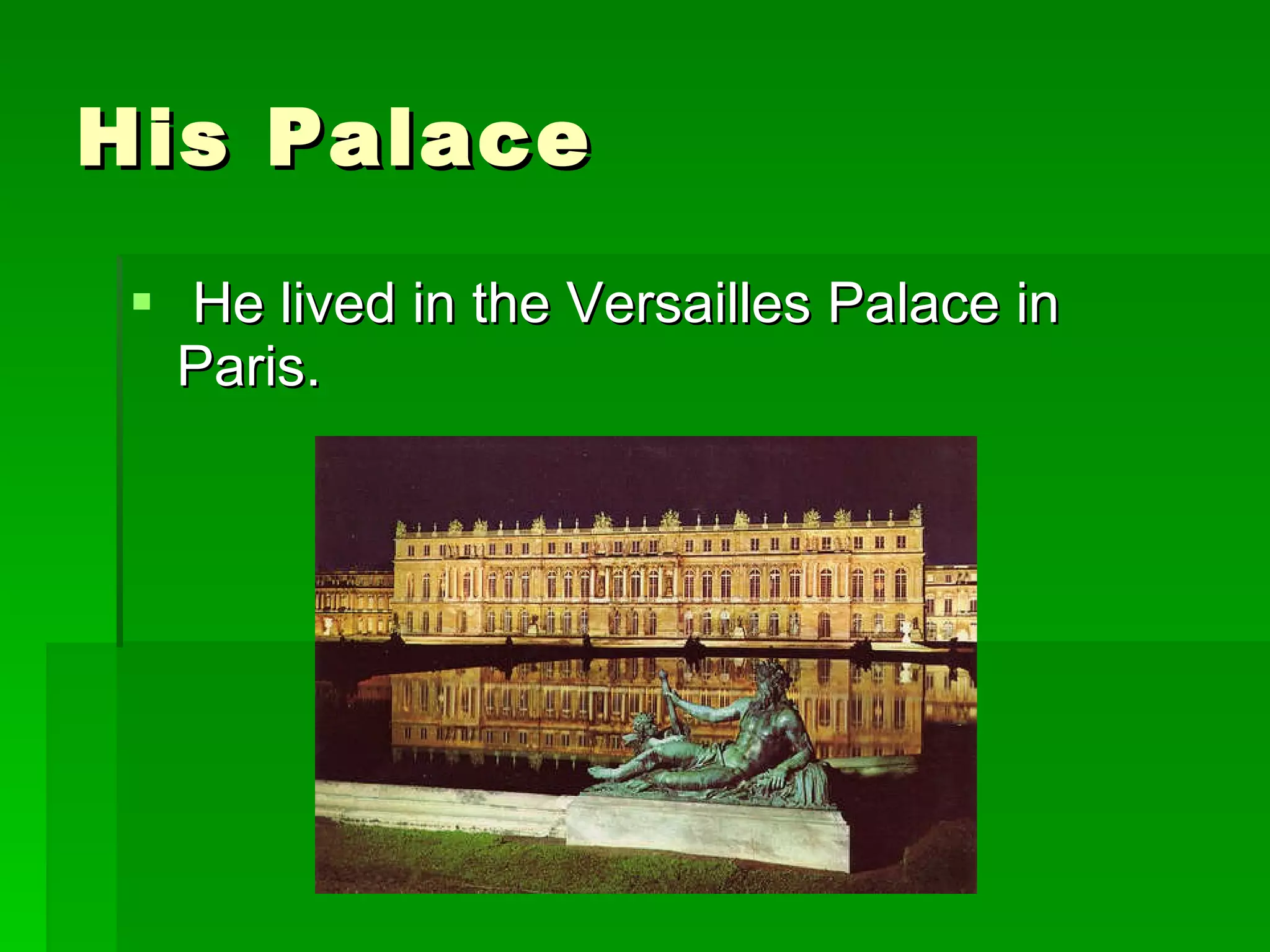
His Palace He lived in the Versailles Palace in Paris.
Ana Jiménez Peinado

Absolute monarchy

  • 1.
  • 2.
    Politcal and religiouschanges The 30 years war (1618-1648) confronted catholics and protestants, it finished with the Westfalia’s Peace, this meant the rise of France and the decline of Habsburg.
  • 3.
    These changes involved…The importance of States-Nation The absolute monarchies The decline of the supranational like the Hispanic Empire No more religious wars, there were religious liberty for each State. The North Religions were: calvinism, anglican and lutheranism The South was catholic.
  • 4.
    Characteristics of theAbsolute monarchy In the absolute monarchy, all the authority of the monarch came from God. The power was absolute. The king was the law, the maxim authority of the goverment, the justice’s head and he managed the interior and exterior politics. The king was helped by ministers, advisers, secretaries and a lot of employees.
  • 5.
    God The kingMinisters, advisers, secretaries, employees
  • 6.
    Louis XIV ofFrance Louis XIV (5 September 1638 – 1 September 1715), known as the Sun King (French: le Roi Soleil ), was King of France and of Navarre . His reign, from 1643 to his death in 1715, began at the age of four and lasted seventy-two years, three months, and eighteen days, and is the longest documented reign of any European monarch.
  • 7.
    Having been marriedin 1660, Louis and Maria Theresa of Spain had six children. However, only one child, the eldest, survived to adulthood — Louis, le Grand Dauphin , known as " Monseigneur ". Maria Theresa died in 1683. Despite evidence of affection early on in their marriage, Louis did not remain faithful to Maria Theresa for long. He produced numerous illegitimate children, most of whom he married to members of cadet branches of the royal family . Louis proved more faithful to his second wife, Madame de Maintenon . It is believed that they were married secretly on or around 10 October 1683 at Versailles. This marriage, though never announced or publicly discussed, was an open secret and lasted till his death
  • 8.
    Louis XIII ofFrance Anne of Austria Louis XIV of France Maria Theresa of Spain Louis, le Grand Dauphin Princess Anne Élisabeth Princess Marie Anne Princess Marie Thérèse Philippe Charles, Duke of Anjou Louis François , Duke of Anjou
  • 9.
    For much ofLouis's reign, France stood as the leading European power, engaging in three major wars—the Franco- Dutch War , the War of the League of Augsburg , and the War of the Spanish Succession —and two minor conflicts—the War of Devolution and the War of the Reunions . Upon his death just days before his 77th. birthday, Louis was succeeded by his 5-year-old great-grandson who became Louis XV .
  • 10.
  • 11.
    His Palace Helived in the Versailles Palace in Paris.
  • 12.