@dataverseorg
Mercè Crosas, Director of Data Science, IQSS, Harvard University
@mercecrosas
Harvard Purdue Data Management Symposium, June 16-17, 2015
New!
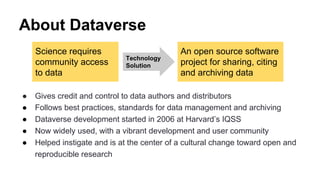
About Dataverse
● Gives credit and control to data authors and distributors
● Follows best practices, standards for data management and archiving
● Dataverse development started in 2006 at Harvard’s IQSS
● Now widely used, with a vibrant development and user community
● Helped instigate and is at the center of a cultural change toward open and
reproducible research
Science requires
community access
to data
An open source software
project for sharing, citing
and archiving data
Technology
Solution
In 2015 ...
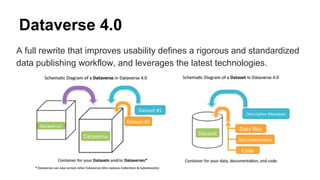
Dataverse 4.0
A full rewrite that improves usability defines a rigorous and standardized
data publishing workflow, and leverages the latest technologies.
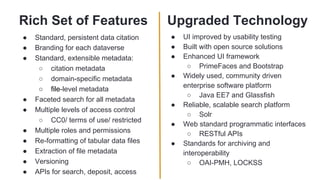
Rich Set of Features
● Standard, persistent data citation
● Branding for each dataverse
● Standard, extensible metadata:
○ citation metadata
○ domain-specific metadata
○ file-level metadata
● Faceted search for all metadata
● Multiple levels of access control
○ CC0/ terms of use/ restricted
● Multiple roles and permissions
● Re-formatting of tabular data files
● Extraction of file metadata
● Versioning
● APIs for search, deposit, access
Upgraded Technology
● UI improved by usability testing
● Built with open source solutions
● Enhanced UI framework
○ PrimeFaces and Bootstrap
● Widely used, community driven
enterprise software platform
○ Java EE7 and Glassfish
● Reliable, scalable search platform
○ Solr
● Web standard programmatic interfaces
○ RESTful APIs
● Standards for archiving and
interoperability
○ OAI-PMH, LOCKSS
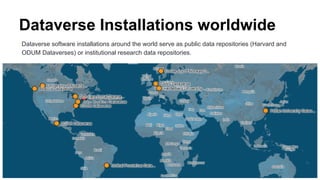
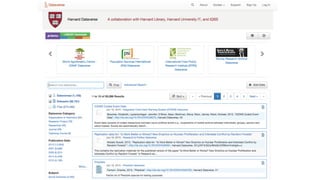
Dataverse Installations worldwide
Dataverse software installations around the world serve as public data repositories (Harvard and
ODUM Dataverses) or institutional research data repositories.
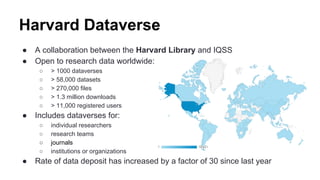
Harvard Dataverse
● A collaboration between the Harvard Library and IQSS
● Open to research data worldwide:
○ > 1000 dataverses
○ > 58,000 datasets
○ > 270,000 files
○ > 1.3 million downloads
○ > 11,000 registered users
● Includes dataverses for:
○ individual researchers
○ research teams
○ journals
○ institutions or organizations
● Rate of data deposit has increased by a factor of 30 since last year
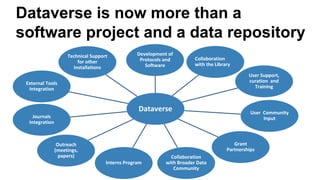
Dataverse is now more than a
software project and a data repository
Dataverse
Development of
Protocols and
Software
Collaboration
with the Library
User Support,
curation and
Training
User Community
Input
Grant
Partnerships
Collaboration
with Broader Data
Community
Interns Program
Outreach
(meetings,
papers)
Journals
Integration
External Tools
Integration
Technical Support
for other
Installations
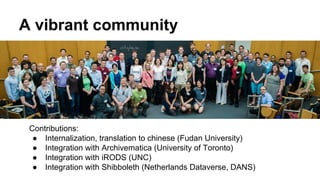
A vibrant community
Contributions:
● Internalization, translation to chinese (Fudan University)
● Integration with Archivematica (University of Toronto)
● Integration with iRODS (UNC)
● Integration with Shibboleth (Netherlands Dataverse, DANS)
What’s next
•Support new data types
•Sensitive information
•Large-scale data (terabytes to petabytes)
•Streaming data (e.g., sensors, cell phones)
•Make datasets shared in Dataverse more reusable
•Extend APIs to build community of app contributors
•Build integrated tools (e.g., data visualization, analysis)
dataverse demo
https://dataverse-demo.iq.harvard.edu
Thanks
@mercecrosas

Dataverse hpdm symposium

  • 1.
    @dataverseorg Mercè Crosas, Directorof Data Science, IQSS, Harvard University @mercecrosas Harvard Purdue Data Management Symposium, June 16-17, 2015 New!
  • 2.
    About Dataverse ● Givescredit and control to data authors and distributors ● Follows best practices, standards for data management and archiving ● Dataverse development started in 2006 at Harvard’s IQSS ● Now widely used, with a vibrant development and user community ● Helped instigate and is at the center of a cultural change toward open and reproducible research Science requires community access to data An open source software project for sharing, citing and archiving data Technology Solution
  • 3.
  • 4.
    Dataverse 4.0 A fullrewrite that improves usability defines a rigorous and standardized data publishing workflow, and leverages the latest technologies.
  • 5.
    Rich Set ofFeatures ● Standard, persistent data citation ● Branding for each dataverse ● Standard, extensible metadata: ○ citation metadata ○ domain-specific metadata ○ file-level metadata ● Faceted search for all metadata ● Multiple levels of access control ○ CC0/ terms of use/ restricted ● Multiple roles and permissions ● Re-formatting of tabular data files ● Extraction of file metadata ● Versioning ● APIs for search, deposit, access Upgraded Technology ● UI improved by usability testing ● Built with open source solutions ● Enhanced UI framework ○ PrimeFaces and Bootstrap ● Widely used, community driven enterprise software platform ○ Java EE7 and Glassfish ● Reliable, scalable search platform ○ Solr ● Web standard programmatic interfaces ○ RESTful APIs ● Standards for archiving and interoperability ○ OAI-PMH, LOCKSS
  • 6.
    Dataverse Installations worldwide Dataversesoftware installations around the world serve as public data repositories (Harvard and ODUM Dataverses) or institutional research data repositories.
  • 7.
    Harvard Dataverse ● Acollaboration between the Harvard Library and IQSS ● Open to research data worldwide: ○ > 1000 dataverses ○ > 58,000 datasets ○ > 270,000 files ○ > 1.3 million downloads ○ > 11,000 registered users ● Includes dataverses for: ○ individual researchers ○ research teams ○ journals ○ institutions or organizations ● Rate of data deposit has increased by a factor of 30 since last year
  • 10.
    Dataverse is nowmore than a software project and a data repository Dataverse Development of Protocols and Software Collaboration with the Library User Support, curation and Training User Community Input Grant Partnerships Collaboration with Broader Data Community Interns Program Outreach (meetings, papers) Journals Integration External Tools Integration Technical Support for other Installations
  • 11.
    A vibrant community Contributions: ●Internalization, translation to chinese (Fudan University) ● Integration with Archivematica (University of Toronto) ● Integration with iRODS (UNC) ● Integration with Shibboleth (Netherlands Dataverse, DANS)
  • 12.
    What’s next •Support newdata types •Sensitive information •Large-scale data (terabytes to petabytes) •Streaming data (e.g., sensors, cell phones) •Make datasets shared in Dataverse more reusable •Extend APIs to build community of app contributors •Build integrated tools (e.g., data visualization, analysis)
  • 13.
  • 14.