ROUTING TECHNIQUES IN
WIRELESS SENSOR NETWORKS:
A
SURVEY
Presented By: Abbas Kazerouni
EE 360 paper presentation, winter 2014,
EE Department, Stanford University
JAMAL N. AL-KARAKI, AHMED E. KAMAL, 2004
1
OUTLINE
 Challenges in WSNs
 Categorization based on Network Structure
 Flat-Based Routing
 Hierarchical-Based Routing
 Location-Based Routing
 Categorization based on Protocol Operation
 Summary
2
CHALLENGES IN WSNS
 No global ID addressing
 IP-based protocols do not apply
 Stationary nodes
 Constraints on energy, storage and processing capacity
 High redundancy in different sensors’ data
3
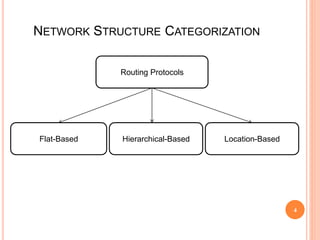
NETWORK STRUCTURE CATEGORIZATION
4
Routing Protocols
Flat-Based Hierarchical-Based Location-Based
5
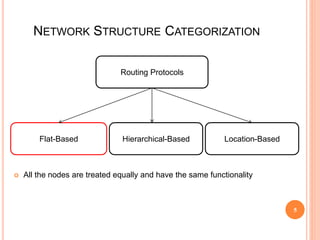
NETWORK STRUCTURE CATEGORIZATION
5
Routing Protocols
Flat-Based Hierarchical-Based Location-Based
 All the nodes are treated equally and have the same functionality
FLAT-BASED ROUTING PROTOCOLS
1. Sensor Protocol for Information Negotiation (SPIN):
• Sending meta-data to neighboring nodes, instead of data
• Requesting for the desired data
 Avoid redundant data transmission
 Adaptation to remaining energy increase network lifetime
2. Directed Diffusion:
• BS continuously sends query to the neighboring nodes
• Node with the desired data transmit all the way back to BS
 Saving energy by selecting the optimal return path
 Not practical for continuous data demand cases
6
7
FLAT-BASED ROUTING PROTOCOLS
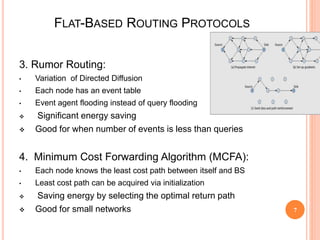
3. Rumor Routing:
• Variation of Directed Diffusion
• Each node has an event table
• Event agent flooding instead of query flooding
 Significant energy saving
 Good for when number of events is less than queries
4. Minimum Cost Forwarding Algorithm (MCFA):
• Each node knows the least cost path between itself and BS
• Least cost path can be acquired via initialization
 Saving energy by selecting the optimal return path
 Good for small networks 7
8
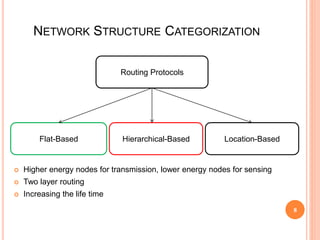
NETWORK STRUCTURE CATEGORIZATION
8
Routing Protocols
Flat-Based Hierarchical-Based Location-Based
 Higher energy nodes for transmission, lower energy nodes for sensing
 Two layer routing
 Increasing the life time
HIERARCHICAL ROUTING
9
1. Low Energy Adaptive Clustering Hierarchy(LEACH):
• Random and variation Cluster Head (CH) selection
• Compression and transmission of arriving data at CHs
 Constant monitoring applications
 Good for small networks
 Extra overhead because of clustering
2. Self Organizing Protocol (SOP):
• Mobile sensors to probe the environment
• Stationary nodes as the routers
• LML algorithm for routing
 Energy consumption is less than SPIN
10
HIERARCHICAL ROUTING
10
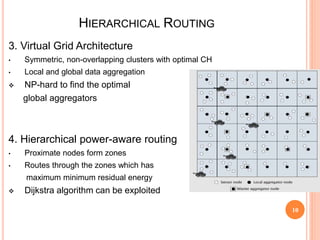
3. Virtual Grid Architecture
• Symmetric, non-overlapping clusters with optimal CH
• Local and global data aggregation
 NP-hard to find the optimal
global aggregators
4. Hierarchical power-aware routing
• Proximate nodes form zones
• Routes through the zones which has
maximum minimum residual energy
 Dijkstra algorithm can be exploited
11
11
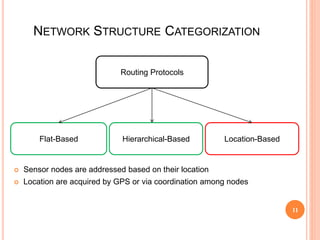
NETWORK STRUCTURE CATEGORIZATION
11
Routing Protocols
Flat-Based Hierarchical-Based Location-Based
 Sensor nodes are addressed based on their location
 Location are acquired by GPS or via coordination among nodes
12
LOCATION-BASED ROUTING
12
1. Geographical Adaptive Fidelity (GAF):
• Network divided into zones
• Only one node is awake in each zone, the rest sleep
 Conserves energy by turning off unnecessary nodes
 Increases the network life time
2. SPAN:
• Some nodes are selected as coordinators based on their positions
• Enough coordinators such that network is three-hop reachable
 Not energy efficient as the others
ROUTING PROTOCOLS BASED ON PROTOCOL
OPERATION
1. Multipath routing
• Increases fault tolerance
• Sophisticated case: have back up paths
2. Query-based routing
• Query transmitted and the date is sent back
3. Negotiation-based routing
• High-level data description
• Elimination of redundant data transmission
4. QoS-baed routing
• Balance between data quality and energy consumption
13
SUMMARY
 WSNs needs have specific characteristics.
 WSNs need specific routing algorithm.
 Large number of algorithms has been designed, but no
optimal one!
 Based on the network structure, routing algorithms can be
categorized into 3 main groups.
 We briefly discussed some examples of each group. 14

abbas.pptx

  • 1.
    ROUTING TECHNIQUES IN WIRELESSSENSOR NETWORKS: A SURVEY Presented By: Abbas Kazerouni EE 360 paper presentation, winter 2014, EE Department, Stanford University JAMAL N. AL-KARAKI, AHMED E. KAMAL, 2004 1
  • 2.
    OUTLINE  Challenges inWSNs  Categorization based on Network Structure  Flat-Based Routing  Hierarchical-Based Routing  Location-Based Routing  Categorization based on Protocol Operation  Summary 2
  • 3.
    CHALLENGES IN WSNS No global ID addressing  IP-based protocols do not apply  Stationary nodes  Constraints on energy, storage and processing capacity  High redundancy in different sensors’ data 3
  • 4.
    NETWORK STRUCTURE CATEGORIZATION 4 RoutingProtocols Flat-Based Hierarchical-Based Location-Based
  • 5.
    5 NETWORK STRUCTURE CATEGORIZATION 5 RoutingProtocols Flat-Based Hierarchical-Based Location-Based  All the nodes are treated equally and have the same functionality
  • 6.
    FLAT-BASED ROUTING PROTOCOLS 1.Sensor Protocol for Information Negotiation (SPIN): • Sending meta-data to neighboring nodes, instead of data • Requesting for the desired data  Avoid redundant data transmission  Adaptation to remaining energy increase network lifetime 2. Directed Diffusion: • BS continuously sends query to the neighboring nodes • Node with the desired data transmit all the way back to BS  Saving energy by selecting the optimal return path  Not practical for continuous data demand cases 6
  • 7.
    7 FLAT-BASED ROUTING PROTOCOLS 3.Rumor Routing: • Variation of Directed Diffusion • Each node has an event table • Event agent flooding instead of query flooding  Significant energy saving  Good for when number of events is less than queries 4. Minimum Cost Forwarding Algorithm (MCFA): • Each node knows the least cost path between itself and BS • Least cost path can be acquired via initialization  Saving energy by selecting the optimal return path  Good for small networks 7
  • 8.
    8 NETWORK STRUCTURE CATEGORIZATION 8 RoutingProtocols Flat-Based Hierarchical-Based Location-Based  Higher energy nodes for transmission, lower energy nodes for sensing  Two layer routing  Increasing the life time
  • 9.
    HIERARCHICAL ROUTING 9 1. LowEnergy Adaptive Clustering Hierarchy(LEACH): • Random and variation Cluster Head (CH) selection • Compression and transmission of arriving data at CHs  Constant monitoring applications  Good for small networks  Extra overhead because of clustering 2. Self Organizing Protocol (SOP): • Mobile sensors to probe the environment • Stationary nodes as the routers • LML algorithm for routing  Energy consumption is less than SPIN
  • 10.
    10 HIERARCHICAL ROUTING 10 3. VirtualGrid Architecture • Symmetric, non-overlapping clusters with optimal CH • Local and global data aggregation  NP-hard to find the optimal global aggregators 4. Hierarchical power-aware routing • Proximate nodes form zones • Routes through the zones which has maximum minimum residual energy  Dijkstra algorithm can be exploited
  • 11.
    11 11 NETWORK STRUCTURE CATEGORIZATION 11 RoutingProtocols Flat-Based Hierarchical-Based Location-Based  Sensor nodes are addressed based on their location  Location are acquired by GPS or via coordination among nodes
  • 12.
    12 LOCATION-BASED ROUTING 12 1. GeographicalAdaptive Fidelity (GAF): • Network divided into zones • Only one node is awake in each zone, the rest sleep  Conserves energy by turning off unnecessary nodes  Increases the network life time 2. SPAN: • Some nodes are selected as coordinators based on their positions • Enough coordinators such that network is three-hop reachable  Not energy efficient as the others
  • 13.
    ROUTING PROTOCOLS BASEDON PROTOCOL OPERATION 1. Multipath routing • Increases fault tolerance • Sophisticated case: have back up paths 2. Query-based routing • Query transmitted and the date is sent back 3. Negotiation-based routing • High-level data description • Elimination of redundant data transmission 4. QoS-baed routing • Balance between data quality and energy consumption 13
  • 14.
    SUMMARY  WSNs needshave specific characteristics.  WSNs need specific routing algorithm.  Large number of algorithms has been designed, but no optimal one!  Based on the network structure, routing algorithms can be categorized into 3 main groups.  We briefly discussed some examples of each group. 14