EARLY AGE STRENGTH AND WORKABILITY OF SLAG PASTES
ACTIVATED BY NaOH AND Na2CO3
F. Collins1
and J.G. Sanjayan
Department of Civil Engineering, Monash University, Clayton, Victoria 3168, Australia
(Received January 16, 1998; in final form February 10, 1998)
ABSTRACT
This paper reports the results of an investigation on activation of blast furnace
slag with the emphasis on achievement of equivalent one-day strength to
Portland cement at normal curing temperatures and reasonable workability.
The effects of varying dosages of activators NaOH and Na2CO3 are discussed
in terms of strength of mini cylinders and also workability by the mini slump
method. The results are mainly based on pastes, but comparisons are also
made with mortar and concrete results. The effects of preblended gypsum
dosage within the slag as well as the effect of ultrafine slag on workability are
reported. The results of trials with various water- reducing admixtures and
superplastisers and their effects on strength and workability are reported.
© 1998 Elsevier Science Ltd
Introduction
Alkali activated slag (AAS) concretes can yield high early strength (a characteristic currently
not achieved by blends of slag ϩ portland cement) while providing lower heat of hydration
and better durability than the Portland cements. Talling and Brandstetr (1) provide a
comprehensive state of the art summary of the subject.
The aim of this investigation was to evaluate the suitability of NaOH and Na2CO3 as
activators for slag to yield equivalent or better one-day strength to ordinary Portland cement
(OPC) at normal curing temperatures (23°C). Equivalent one-day strength to OPC has been
achieved in the past using elevated temperature curing (2,3,4,5) and steam curing (6,7,8).
However, these curing conditions necessitate specialised equipment and facilities and re-
quires attendance by staff. This study therefore concentrated on the achievement of equiv-
alent one-day strength at normal curing conditions. Hakkinen (9) reports one-day concrete
strengths up to 28.3 MPa following normal moist curing. The concretes consisted of 5%
NaOH plus F-admixture and had a water-to-cementitious ratio ranging from 0.25 to 0.30.
However, the initial workability and the loss of workability with time are unreported. Shi (10)
recorded significantly lower one-day strength of NaOH activated slag mortars.
Jolicoeur, et. al. (11) reports the combination of NaOH ϩ Na2CO3 yields comparable
one-day strength to Portland cement. Improved workability was reported with the addition of
1
To whom correspondence should be addressed.
Cement and Concrete Research, Vol. 28, No. 5, pp. 655–664, 1998
Copyright © 1998 Elsevier Science Ltd
Printed in the USA. All rights reserved
0008-8846/98 $19.00 ϩ .00
PII S0008-8846(98)00025-8
655
PAPERS
sodium poly-naphthalene and sodium gluconate. The effect of these chemical admixtures on
one-day strength was not investigated. Wang (12,13) recorded relatively low one-day
strength for slag mortars activated by NaOH.
Experimental Programme
The chemical composition and properties of the cementitious binders are summarised in
Table 1. The binders used are ground granulated blast furnace slag (Slag), ultra fine slag
(UFS), Portland cement (OPC), and 50% ground granulated blast furnace slag ϩ 50%
Portland cement (GB50/50). The term water/binder (w/b) ratio is used instead of the
conventional water/cement ratio, to include all the binders mentioned above. The slag is
supplied with 2% gypsum, which is blended with the slag (although slag samples containing
0% gypsum were also investigated).
The activators and adjuncts investigated were liquid sodium hydroxide (60% solution)
(NaOH) and sodium carbonate powder (decahydrate; i.e., Na2CO3.0H2O).
The chemical admixtures which were investigated were as follows:
NLSNS: Normal-life superplasticiser based on naphthalene sulphonates, which complies
with ASTM C-494 Type F.
TABLE 1
Properties of cementitious materials.
Constituent/Property Slag UFS OPC
GB
50/50
SiO3 (%) N/A N/A N/A 2.6
SiO2 (%) 35.04 33.2 19.9 26.4
Al2O3 (%) 13.91 14.6 4.62 8.4
Fe2O3 (%) 0.29 0.4 3.97 2.4
MgO (%) 6.13 5.5 1.73 3.6
CaO (%) 39.43 42.4 64.27 53.8
Na2O (%) 0.34 0.3
TiO2 (%) 0.42
K2O (%) 0.39 0.44 0.57
P2O5 (%) Ͻ0.1
MnO (%) 0.43
Total Sulphur as SO3 (%) 2.43 0.2 2.56
Sulphide Sulphur as S2Ϫ
0.44
Cl (p.p.m) 80
Fineness (m2
/kg) 460 1496 342
Loss on ignition (%) 1.45 2.9 1.9
Time to initial set (hours) N/A N/A 2.0 2.45
Strength
(MPa) N/A N/A
3 Days 32.7 22.2
7 Days 42.0 36.0
28 Days 54.1 59.1
656 Vol. 28, No. 5F. Collins and J.G. Sanjayan
WRSRL: Water-reducing and set-retarding admixture based on lignosulphonates, which
complies with ASTM C 494 Types B and D.
WRSRSP: Water-reducing and set-retarding admixture based on calcium- complexing sugar-
based material which was primarily sodium gluconate, which complies with ASTM C 494
Type D.
In the case of mortars, the sand:cementitious binder ratio was 3:1. The sand was a locally
produced river sand from Lynhurst.
The size of the paste cylinders for compressive strength testing were 35 mm in diameter
and 70 mm in length. The water to binder (w/b) ratio was fixed to 0.5 to enable reasonable
paste workability. A total of 6 cylinders were tested for each data set. This phase of testing
also enabled the qualitative assessment of paste workability. Activated slag pastes that
appeared to be considerably “stiffer” than an OPC equivalent were therefore rejected for
further assessment (regardless of the one-day strength).
Workability was assessed by the mini-slump test, as reported by Kantro (14). The
dimensions of the mini slump cone mould are: top diameter 19 mm, bottom diameter 38 mm,
and height 57 mm. The mould is placed firmly on a plastic sheet and filled with paste. The
paste is tamped down with a spatula to ensure compaction. When the mould is full, the top
surface is levelled and the excess paste is removed. The mould is removed vertically,
ensuring no lateral disturbance, and the sample is left to harden over 24 h. The outline of the
slump sample is traced onto the underlying plastic sheet with indelible ink and the area of the
base is measured using a planimeter. Each data point shown on the attached figures is the
average of 3 test results, with the exception of the OPC controls which were the average of
6 test results.
The base area of the paste measured 24 h after conducting the test is a better indicator of
workability than the height measurements (14). Perrenchio (15) has established a linear
relationship between the base area of the mini-slump paste and the base area of concrete;
therefore the test lends itself to the estimation of likely concrete workability.
Strength Results
One-day Strength
The range of NaOH and Na2CO3 dosages that was investigated are summarised in Table 2.
The results are compared with the control OPC with w/b of 0.5. As indicated in Table 2, the
range of NaOH dosages, without any addition of Na2CO3, were 3%, 4%, and 5% (% weight
of slag). The test results indicate that at all NaOH dosages (with 0% Na2CO3) the one-day
strength is less than OPC. The worst one-day strength was at the 4% dosage. All of the mixes
with 0% Na2CO3 were observed to be stiffer than OPC at the same w/b.
With the addition of Na2CO3, the results indicate the one-day strength is generally greater
than OPC at the higher dosage levels of NaOH and Na2CO3, and there is a trend of increasing
strength with increasing Na2CO3 dose. The paste was quite stiff at the 1% Na2CO3 dose for
all mixes, and workability improved with increasing Na2CO3 dosage. Based on one-day
strength and (observed) workability, the following activator combinations were considered
for further assessment: (a) 3% NaOH ϩ 4% Na2CO3; (b) 5% NaOH ϩ 4% Na2CO3; (c) 6%
NaOH ϩ 4% Na2CO3. Further mixes were manufactured to assess the strength development
with time. The mixes also include three batches of OPC and one batch of 50% slag blended
Vol. 28, No. 5 657GRANULATED BLAST-FURNACE SLAG, WORKABILITY
cement for comparison with the activated slag pastes. All the mixes were manufactured with
w/b ratio of 0.5. Six cylinders from each batch were tested at 1, 3, 7, and 28 days. The results
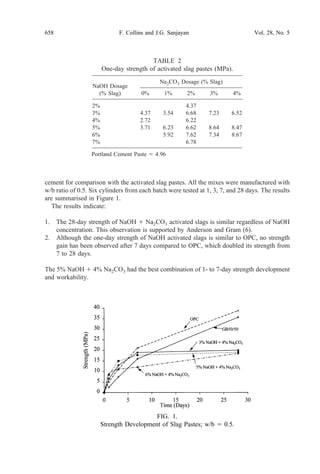
are summarised in Figure 1.
The results indicate:
1. The 28-day strength of NaOH ϩ Na2CO3 activated slags is similar regardless of NaOH
concentration. This observation is supported by Anderson and Gram (6).
2. Although the one-day strength of NaOH activated slags is similar to OPC, no strength
gain has been observed after 7 days compared to OPC, which doubled its strength from
7 to 28 days.
The 5% NaOH ϩ 4% Na2CO3 had the best combination of 1- to 7-day strength development
and workability.
TABLE 2
One-day strength of activated slag pastes (MPa).
NaOH Dosage
(% Slag)
Na2CO3 Dosage (% Slag)
0% 1% 2% 3% 4%
2% 4.37
3% 4.37 3.54 6.68 7.23 6.52
4% 2.72 6.22
5% 3.71 6.23 6.62 8.64 8.47
6% 5.92 7.62 7.34 8.67
7% 6.78
Portland Cement Paste ϭ 4.96
FIG. 1.
Strength Development of Slag Pastes; w/b ϭ 0.5.
658 Vol. 28, No. 5F. Collins and J.G. Sanjayan
Strength Development of Mortars
The strength-vs.-time graphs of pastes do not truly mimic the strength-vs.-time relationship
for concrete, as shown in Figures 2 and 3. The concrete strength test data is reported
separately (16).
Further testing of mini cylinders has been conducted with mortars. The mixes consisted of:
1. OPC, w/b ϭ 0.5, 3 separate batches, 6 cylinders tested at 1, 3, 7 and 28 days;
2. Slag activated by 5%NaOH ϩ 4%Na2CO3, w/b ϭ 0.5, 6 cylinders tested at 1, 3, 7 and
28 days.
Figures 2 and 3 indicate the mortars mimic the concrete strength development curves well.
This indicates the paste samples are very sensitive to local defects acting as stress concen-
trations. Also, the sand acts as nucleation points for cement hydration (and bond strength
development), which also affects the measured strength. Nevertheless, the paste strength test
results are good indicators of likely strength development trends.
FIG. 2.
OPC Strength versus Time; w/b ϭ 0.5.
FIG. 3.
Activated Slag Strength vs Time; w/b ϭ 0.5.
Vol. 28, No. 5 659GRANULATED BLAST-FURNACE SLAG, WORKABILITY
Workability Results
Slump Loss with Time; w/b ‫؍‬ 0.5
Slump loss versus time for OPC pastes at various w/b’s is shown in Figure 4. Figure 4 also
shows loss of workability with time of activated slags. The slag activated by 5% NaOH ϩ
4% Na2CO3 (2% gypsum) displays less workability than OPC at the time of mixing and
displays a mini slump equal to OPC with w/b ϭ 0.4. Significant false set (i.e., the stiffened
paste could be made workable by remixing) is demonstrated with this activator at ages
beyond 30 min. Additions of a lignosulphonate significantly improve workability (to OPC
equivalent w/b ϭ 0.5) at the time of mixing, but slump loss is still evidenced.
Effect of Gypsum
Without gypsum, NaOH ϩ Na2CO3 activated slag shows a significant increase in workabil-
ity, as shown in Figure 4. Nevertheless, false set was still evidenced, even with the addition
of the lignosulphonate-based set retarder (WRSRL). The one-day strength of the paste was
virtually equal to the samples which contained gypsum. Therefore, for this activator, slag
without gypsum was adopted for the lower w/b studies.
NaOH ؉ Na2CO3—Chemical Admixture Sensitivity
At the time of mixing, activated slag with w/b ratio of 0.5 shows almost identical workability
to OPC (Fig. 4). However, slump loss occurred with time and became significant beyond 60
min. The addition of a lignosulphonate based set retarder (WRSRL) showed significant
dispersion at the time of mixing, but showed rapid loss of workability at 30 min. and beyond.
Figure 5 shows the effect of various dosages of water-reducing and set-retarding admixture
FIG. 4.
Workability of Pastes (w/b ϭ 0.5 except where indicated otherwise).
660 Vol. 28, No. 5F. Collins and J.G. Sanjayan
based on calcium-complexing sugar-based material that was primarily sodium gluconate
(WRSRSP) on mini slump over a 2-h period for w/b ϭ 0.5. With increasing dosage, the
dispersion at the time of mixing increases significantly. Workability diminishes with time,
but, at 120 min. the workability is better than OPC. All pastes displayed a high buildup of
bleed water on the top surface (which increased with increasing dosages). The surface few
millimeters of hardened paste were soft and could be easily scraped away. The bulk mass of
the sample was hardened, indicating that the bleed water contains retarder that is prolonging
setting of the surface concrete and reducing the surface strength. The one-day strength of
mortars containing various additions of retarder is shown in Table 3. All dosages show a
significantly lower one-day strength than OPC.
For w/b ϭ 0.4, Table 4 shows less workability of the activated slag at the time of mixing
than the OPC control. The paste demonstrated good workability with additions of normal life
naphthalene sulphonate based superplasticiser (NLSNS).
The workability loss over a 2-h period is shown in Figure 6. At 30 min. the paste rapidly
loses workability and, despite the combination of lignosulphonate based set retarder
(WRSRL) and normal-life naphthalene sulphonate-based superplasticiser (NLSNS), the false
setting phenomenon is apparent. The false setting effect was reduced by utilising a set
retarder based on a water-reducing and set-retarding admixture based on calcium-complexing
TABLE 3
One-day strength of mortars (w/b ϭ 0.5) effects of
calcium complexing retarder.
OPC Slag Activated by 5% NaOH ϩ 4% Na2CO3
(MPa)
MPa Dosages of Retarder WRSRSP (mL/100 kg Slag)
0 20 40 80 130 250
6.73 7.51 3.65 3.46 2.84 2.50 2.13
FIG. 5.
Effects Calcium Complexing Retarder (WRSRSP) on Workability (Dosages indicated in
ml/100 kg Slag; 5% NaOH ϩ 4% Na2CO3; w/b ϭ 0.5).
Vol. 28, No. 5 661GRANULATED BLAST-FURNACE SLAG, WORKABILITY
sugar-based material that was primarily sodium gluconate (WRSRSP) together with normal-
life naphthalene sulphonate-based superplasticiser (NLSNS). This is also shown in Figure 6.
However, the effect of this type of retarder is to significantly reduce the one-day strength and
it was no longer used in this investigation.
Effect of Ultrafine Slag
For the slag activated by NaOH ϩ Na2CO3, Figure 5 shows the replacement of 5% of the slag
by ultrafine slag caused a significant increase in workability at the time of mixing. Slump loss
did occur over a period of 2 h, but the workability was significantly better at 2 h than binders
not containing ultrafine slag. Further work has been reported separately (17).
TABLE 4
Mini slump area at time of mixing (mm2
) (w/b ϭ 0.4).
OPC
Slag Activated by 5% NaOH ϩ 4% Na2CO3; 0%
gypsum;
Dosages of Superplasticiser NLSNS (mL/100 kg Slag)
0 300 600 900 1200 1500
2845 2340 2293 4327 5437 6253 7050
FIG. 6.
Effects of Calcium Complexing Retarder (WRSRSP), Water Reducing Set Retarder
(WRSRL) and Superplasticiser (NLSNS) (Dosages indicated in ml/100 kg Slag) 5% NaOH
ϩ 4% Na2CO3; w/b ϭ 0.4.
662 Vol. 28, No. 5F. Collins and J.G. Sanjayan
Conclusions
The results of this initial investigation indicate:
1. Equivalent one-day compressive strength to OPC is achievable with 100% alkali-
activated slag.
2. The activation of slag with NaOH yielded lower one-day strength than OPC, but NaOH
in combination with Na2CO3 produced equivalent one-day strength. Workability im-
proved with increasing dosages of Na2CO3. Although early age strength growth was
rapid, the 28-day strength was significantly lower than OPC. Regardless of NaOH
dosage, the 28-day strength was similar. The optimum combination for strength and
workability was 5% NaOH ϩ 4% Na2CO3.
3. The slag was supplied pre-blended with 2% gypsum. Without gypsum, the slag activated
by NaOH ϩ Na2CO3 showed significantly better workability than activated slag con-
taining gypsum. The one-day strength was identical regardless of gypsum content.
4. Slag activated by NaOH ϩ Na2CO3 demonstrates false setting. Response to retarders
was reasonable for 30 min., but loss of workability beyond 30 min. was significant. The
best results were achieved by use of a calcium-complexing retarder, but at the expense
of one-day strength (even at minor dosages). Response to conventional superplasticiser
was good.
5. Replacement of the slag by ultrafine slag did not reduce workability (at the 5% and 10%
replacement levels).
Acknowledgments
The financial support for this project is jointly provided by Independent Cement and Lime
Pty Ltd, Blue Circle Southern Cement Ltd and Australian Steel Mill Services. The authors
thank the sponsors especially Alan Dow, Tom Wauer, and Dr. Ihor Hinczak for the guidance
and support. The efforts and assistance with the laboratory work provided by Soo Lim, Eric
Tang, Jeff Doddrell, Roger Doulis, and Peter Dunbar are also gratefully acknowledged.
References
1. B. Talling and J. Brandstetr, Proceedings of the 3rd International Conference on Fly Ash, Slag,
and Natural Pozzolans in Concrete, Trondheim, Norway, ACI SP 114, 2, 1519, 1989.
2. O.E. Gjorv, Proceedings of the 3rd International Conference on Fly Ash, Slag, and Natural
Pozzolans in Concrete, Trondheim, Norway, ACI SP 114, 2, 1501, 1989.
3. C. Qing-Hua and S. Sarkar, Adv. Cem. Based Mat., 1, 178 (1994).
4. B. Talling, Proceedings of the 3rd International Conference on Fly Ash, Slag, and Natural
Pozzolans in Concrete, Trondheim, Norway, ACI SP 114, 2, 1485, 1989.
5. T. Hakkinen, Techn. Res. Centre Finl. Res. Notes 540 (1986).
6. R. Anderson, H.E. Gram, J. Malolepszy, and J. Deja, Swed. Cem. and Conc. Inst. Report 1.88, 9
(1988).
7. J. Malolepszy, 8th International Congress on the Chemistry of Cement, 104, 1986.
8. C. Shi and R.L. Day, Proceedings of the 5th International Conference on Flyash, Silica Fume,
Slag, and Natural Pozzolans in Concrete, Milwaukee, Wisconsin, USA, ACI SP-153, 2, 1165,
1995.
Vol. 28, No. 5 663GRANULATED BLAST-FURNACE SLAG, WORKABILITY
9. T. Hakkinen, Nordic Concrete Research, 11, 55 (1992).
10. C. Shi, Cem. Concr. Res., 26, 1789 (1996).
11. C. Jolicoeur, M. A. Simard, T.C. To, J. Sharman, R. Zamojska, M. Dupuis, N. Spiratos, E.
Douglas, and V.M. Malhotra, Proceedings of the International Conference on Advances in
Concrete Technology, 471, 1992.
12. S.D. Wang, K.L. Scivener, and P.L. Pratt, Cem. Conc. Res., 24, 1033 (1994).
13. S.D. Wang, Alkaline Activation of Slag. London: Imperial College of Science, Technology and
Medicine, University of London; Ph.D. dissertation. 1995.
14. D.L. Kantro, Cem. Conc. Agg., 2, 2, 95 (1980).
15. W.F. Perenchio, D. A. Whiting, and D.L. Kantro, Proceedings of 1st International Symposium on
Superplasticisers in Concrete, ACI SP-62, 137, 1978.
16. F.G. Collins and J.G. Sanjayan, Report 1, Civil Engg, Monash University, Clayton, 1997.
17. F.G. Collins and J.G. Sanjayan, Report 2, Civil Engg, Monash University, Clayton, 1997.
664 Vol. 28, No. 5F. Collins and J.G. Sanjayan

AASC-NaOH-Paper

  • 1.
    EARLY AGE STRENGTHAND WORKABILITY OF SLAG PASTES ACTIVATED BY NaOH AND Na2CO3 F. Collins1 and J.G. Sanjayan Department of Civil Engineering, Monash University, Clayton, Victoria 3168, Australia (Received January 16, 1998; in final form February 10, 1998) ABSTRACT This paper reports the results of an investigation on activation of blast furnace slag with the emphasis on achievement of equivalent one-day strength to Portland cement at normal curing temperatures and reasonable workability. The effects of varying dosages of activators NaOH and Na2CO3 are discussed in terms of strength of mini cylinders and also workability by the mini slump method. The results are mainly based on pastes, but comparisons are also made with mortar and concrete results. The effects of preblended gypsum dosage within the slag as well as the effect of ultrafine slag on workability are reported. The results of trials with various water- reducing admixtures and superplastisers and their effects on strength and workability are reported. © 1998 Elsevier Science Ltd Introduction Alkali activated slag (AAS) concretes can yield high early strength (a characteristic currently not achieved by blends of slag ϩ portland cement) while providing lower heat of hydration and better durability than the Portland cements. Talling and Brandstetr (1) provide a comprehensive state of the art summary of the subject. The aim of this investigation was to evaluate the suitability of NaOH and Na2CO3 as activators for slag to yield equivalent or better one-day strength to ordinary Portland cement (OPC) at normal curing temperatures (23°C). Equivalent one-day strength to OPC has been achieved in the past using elevated temperature curing (2,3,4,5) and steam curing (6,7,8). However, these curing conditions necessitate specialised equipment and facilities and re- quires attendance by staff. This study therefore concentrated on the achievement of equiv- alent one-day strength at normal curing conditions. Hakkinen (9) reports one-day concrete strengths up to 28.3 MPa following normal moist curing. The concretes consisted of 5% NaOH plus F-admixture and had a water-to-cementitious ratio ranging from 0.25 to 0.30. However, the initial workability and the loss of workability with time are unreported. Shi (10) recorded significantly lower one-day strength of NaOH activated slag mortars. Jolicoeur, et. al. (11) reports the combination of NaOH ϩ Na2CO3 yields comparable one-day strength to Portland cement. Improved workability was reported with the addition of 1 To whom correspondence should be addressed. Cement and Concrete Research, Vol. 28, No. 5, pp. 655–664, 1998 Copyright © 1998 Elsevier Science Ltd Printed in the USA. All rights reserved 0008-8846/98 $19.00 ϩ .00 PII S0008-8846(98)00025-8 655 PAPERS
  • 2.
    sodium poly-naphthalene andsodium gluconate. The effect of these chemical admixtures on one-day strength was not investigated. Wang (12,13) recorded relatively low one-day strength for slag mortars activated by NaOH. Experimental Programme The chemical composition and properties of the cementitious binders are summarised in Table 1. The binders used are ground granulated blast furnace slag (Slag), ultra fine slag (UFS), Portland cement (OPC), and 50% ground granulated blast furnace slag ϩ 50% Portland cement (GB50/50). The term water/binder (w/b) ratio is used instead of the conventional water/cement ratio, to include all the binders mentioned above. The slag is supplied with 2% gypsum, which is blended with the slag (although slag samples containing 0% gypsum were also investigated). The activators and adjuncts investigated were liquid sodium hydroxide (60% solution) (NaOH) and sodium carbonate powder (decahydrate; i.e., Na2CO3.0H2O). The chemical admixtures which were investigated were as follows: NLSNS: Normal-life superplasticiser based on naphthalene sulphonates, which complies with ASTM C-494 Type F. TABLE 1 Properties of cementitious materials. Constituent/Property Slag UFS OPC GB 50/50 SiO3 (%) N/A N/A N/A 2.6 SiO2 (%) 35.04 33.2 19.9 26.4 Al2O3 (%) 13.91 14.6 4.62 8.4 Fe2O3 (%) 0.29 0.4 3.97 2.4 MgO (%) 6.13 5.5 1.73 3.6 CaO (%) 39.43 42.4 64.27 53.8 Na2O (%) 0.34 0.3 TiO2 (%) 0.42 K2O (%) 0.39 0.44 0.57 P2O5 (%) Ͻ0.1 MnO (%) 0.43 Total Sulphur as SO3 (%) 2.43 0.2 2.56 Sulphide Sulphur as S2Ϫ 0.44 Cl (p.p.m) 80 Fineness (m2 /kg) 460 1496 342 Loss on ignition (%) 1.45 2.9 1.9 Time to initial set (hours) N/A N/A 2.0 2.45 Strength (MPa) N/A N/A 3 Days 32.7 22.2 7 Days 42.0 36.0 28 Days 54.1 59.1 656 Vol. 28, No. 5F. Collins and J.G. Sanjayan
  • 3.
    WRSRL: Water-reducing andset-retarding admixture based on lignosulphonates, which complies with ASTM C 494 Types B and D. WRSRSP: Water-reducing and set-retarding admixture based on calcium- complexing sugar- based material which was primarily sodium gluconate, which complies with ASTM C 494 Type D. In the case of mortars, the sand:cementitious binder ratio was 3:1. The sand was a locally produced river sand from Lynhurst. The size of the paste cylinders for compressive strength testing were 35 mm in diameter and 70 mm in length. The water to binder (w/b) ratio was fixed to 0.5 to enable reasonable paste workability. A total of 6 cylinders were tested for each data set. This phase of testing also enabled the qualitative assessment of paste workability. Activated slag pastes that appeared to be considerably “stiffer” than an OPC equivalent were therefore rejected for further assessment (regardless of the one-day strength). Workability was assessed by the mini-slump test, as reported by Kantro (14). The dimensions of the mini slump cone mould are: top diameter 19 mm, bottom diameter 38 mm, and height 57 mm. The mould is placed firmly on a plastic sheet and filled with paste. The paste is tamped down with a spatula to ensure compaction. When the mould is full, the top surface is levelled and the excess paste is removed. The mould is removed vertically, ensuring no lateral disturbance, and the sample is left to harden over 24 h. The outline of the slump sample is traced onto the underlying plastic sheet with indelible ink and the area of the base is measured using a planimeter. Each data point shown on the attached figures is the average of 3 test results, with the exception of the OPC controls which were the average of 6 test results. The base area of the paste measured 24 h after conducting the test is a better indicator of workability than the height measurements (14). Perrenchio (15) has established a linear relationship between the base area of the mini-slump paste and the base area of concrete; therefore the test lends itself to the estimation of likely concrete workability. Strength Results One-day Strength The range of NaOH and Na2CO3 dosages that was investigated are summarised in Table 2. The results are compared with the control OPC with w/b of 0.5. As indicated in Table 2, the range of NaOH dosages, without any addition of Na2CO3, were 3%, 4%, and 5% (% weight of slag). The test results indicate that at all NaOH dosages (with 0% Na2CO3) the one-day strength is less than OPC. The worst one-day strength was at the 4% dosage. All of the mixes with 0% Na2CO3 were observed to be stiffer than OPC at the same w/b. With the addition of Na2CO3, the results indicate the one-day strength is generally greater than OPC at the higher dosage levels of NaOH and Na2CO3, and there is a trend of increasing strength with increasing Na2CO3 dose. The paste was quite stiff at the 1% Na2CO3 dose for all mixes, and workability improved with increasing Na2CO3 dosage. Based on one-day strength and (observed) workability, the following activator combinations were considered for further assessment: (a) 3% NaOH ϩ 4% Na2CO3; (b) 5% NaOH ϩ 4% Na2CO3; (c) 6% NaOH ϩ 4% Na2CO3. Further mixes were manufactured to assess the strength development with time. The mixes also include three batches of OPC and one batch of 50% slag blended Vol. 28, No. 5 657GRANULATED BLAST-FURNACE SLAG, WORKABILITY
  • 4.
    cement for comparisonwith the activated slag pastes. All the mixes were manufactured with w/b ratio of 0.5. Six cylinders from each batch were tested at 1, 3, 7, and 28 days. The results are summarised in Figure 1. The results indicate: 1. The 28-day strength of NaOH ϩ Na2CO3 activated slags is similar regardless of NaOH concentration. This observation is supported by Anderson and Gram (6). 2. Although the one-day strength of NaOH activated slags is similar to OPC, no strength gain has been observed after 7 days compared to OPC, which doubled its strength from 7 to 28 days. The 5% NaOH ϩ 4% Na2CO3 had the best combination of 1- to 7-day strength development and workability. TABLE 2 One-day strength of activated slag pastes (MPa). NaOH Dosage (% Slag) Na2CO3 Dosage (% Slag) 0% 1% 2% 3% 4% 2% 4.37 3% 4.37 3.54 6.68 7.23 6.52 4% 2.72 6.22 5% 3.71 6.23 6.62 8.64 8.47 6% 5.92 7.62 7.34 8.67 7% 6.78 Portland Cement Paste ϭ 4.96 FIG. 1. Strength Development of Slag Pastes; w/b ϭ 0.5. 658 Vol. 28, No. 5F. Collins and J.G. Sanjayan
  • 5.
    Strength Development ofMortars The strength-vs.-time graphs of pastes do not truly mimic the strength-vs.-time relationship for concrete, as shown in Figures 2 and 3. The concrete strength test data is reported separately (16). Further testing of mini cylinders has been conducted with mortars. The mixes consisted of: 1. OPC, w/b ϭ 0.5, 3 separate batches, 6 cylinders tested at 1, 3, 7 and 28 days; 2. Slag activated by 5%NaOH ϩ 4%Na2CO3, w/b ϭ 0.5, 6 cylinders tested at 1, 3, 7 and 28 days. Figures 2 and 3 indicate the mortars mimic the concrete strength development curves well. This indicates the paste samples are very sensitive to local defects acting as stress concen- trations. Also, the sand acts as nucleation points for cement hydration (and bond strength development), which also affects the measured strength. Nevertheless, the paste strength test results are good indicators of likely strength development trends. FIG. 2. OPC Strength versus Time; w/b ϭ 0.5. FIG. 3. Activated Slag Strength vs Time; w/b ϭ 0.5. Vol. 28, No. 5 659GRANULATED BLAST-FURNACE SLAG, WORKABILITY
  • 6.
    Workability Results Slump Losswith Time; w/b ‫؍‬ 0.5 Slump loss versus time for OPC pastes at various w/b’s is shown in Figure 4. Figure 4 also shows loss of workability with time of activated slags. The slag activated by 5% NaOH ϩ 4% Na2CO3 (2% gypsum) displays less workability than OPC at the time of mixing and displays a mini slump equal to OPC with w/b ϭ 0.4. Significant false set (i.e., the stiffened paste could be made workable by remixing) is demonstrated with this activator at ages beyond 30 min. Additions of a lignosulphonate significantly improve workability (to OPC equivalent w/b ϭ 0.5) at the time of mixing, but slump loss is still evidenced. Effect of Gypsum Without gypsum, NaOH ϩ Na2CO3 activated slag shows a significant increase in workabil- ity, as shown in Figure 4. Nevertheless, false set was still evidenced, even with the addition of the lignosulphonate-based set retarder (WRSRL). The one-day strength of the paste was virtually equal to the samples which contained gypsum. Therefore, for this activator, slag without gypsum was adopted for the lower w/b studies. NaOH ؉ Na2CO3—Chemical Admixture Sensitivity At the time of mixing, activated slag with w/b ratio of 0.5 shows almost identical workability to OPC (Fig. 4). However, slump loss occurred with time and became significant beyond 60 min. The addition of a lignosulphonate based set retarder (WRSRL) showed significant dispersion at the time of mixing, but showed rapid loss of workability at 30 min. and beyond. Figure 5 shows the effect of various dosages of water-reducing and set-retarding admixture FIG. 4. Workability of Pastes (w/b ϭ 0.5 except where indicated otherwise). 660 Vol. 28, No. 5F. Collins and J.G. Sanjayan
  • 7.
    based on calcium-complexingsugar-based material that was primarily sodium gluconate (WRSRSP) on mini slump over a 2-h period for w/b ϭ 0.5. With increasing dosage, the dispersion at the time of mixing increases significantly. Workability diminishes with time, but, at 120 min. the workability is better than OPC. All pastes displayed a high buildup of bleed water on the top surface (which increased with increasing dosages). The surface few millimeters of hardened paste were soft and could be easily scraped away. The bulk mass of the sample was hardened, indicating that the bleed water contains retarder that is prolonging setting of the surface concrete and reducing the surface strength. The one-day strength of mortars containing various additions of retarder is shown in Table 3. All dosages show a significantly lower one-day strength than OPC. For w/b ϭ 0.4, Table 4 shows less workability of the activated slag at the time of mixing than the OPC control. The paste demonstrated good workability with additions of normal life naphthalene sulphonate based superplasticiser (NLSNS). The workability loss over a 2-h period is shown in Figure 6. At 30 min. the paste rapidly loses workability and, despite the combination of lignosulphonate based set retarder (WRSRL) and normal-life naphthalene sulphonate-based superplasticiser (NLSNS), the false setting phenomenon is apparent. The false setting effect was reduced by utilising a set retarder based on a water-reducing and set-retarding admixture based on calcium-complexing TABLE 3 One-day strength of mortars (w/b ϭ 0.5) effects of calcium complexing retarder. OPC Slag Activated by 5% NaOH ϩ 4% Na2CO3 (MPa) MPa Dosages of Retarder WRSRSP (mL/100 kg Slag) 0 20 40 80 130 250 6.73 7.51 3.65 3.46 2.84 2.50 2.13 FIG. 5. Effects Calcium Complexing Retarder (WRSRSP) on Workability (Dosages indicated in ml/100 kg Slag; 5% NaOH ϩ 4% Na2CO3; w/b ϭ 0.5). Vol. 28, No. 5 661GRANULATED BLAST-FURNACE SLAG, WORKABILITY
  • 8.
    sugar-based material thatwas primarily sodium gluconate (WRSRSP) together with normal- life naphthalene sulphonate-based superplasticiser (NLSNS). This is also shown in Figure 6. However, the effect of this type of retarder is to significantly reduce the one-day strength and it was no longer used in this investigation. Effect of Ultrafine Slag For the slag activated by NaOH ϩ Na2CO3, Figure 5 shows the replacement of 5% of the slag by ultrafine slag caused a significant increase in workability at the time of mixing. Slump loss did occur over a period of 2 h, but the workability was significantly better at 2 h than binders not containing ultrafine slag. Further work has been reported separately (17). TABLE 4 Mini slump area at time of mixing (mm2 ) (w/b ϭ 0.4). OPC Slag Activated by 5% NaOH ϩ 4% Na2CO3; 0% gypsum; Dosages of Superplasticiser NLSNS (mL/100 kg Slag) 0 300 600 900 1200 1500 2845 2340 2293 4327 5437 6253 7050 FIG. 6. Effects of Calcium Complexing Retarder (WRSRSP), Water Reducing Set Retarder (WRSRL) and Superplasticiser (NLSNS) (Dosages indicated in ml/100 kg Slag) 5% NaOH ϩ 4% Na2CO3; w/b ϭ 0.4. 662 Vol. 28, No. 5F. Collins and J.G. Sanjayan
  • 9.
    Conclusions The results ofthis initial investigation indicate: 1. Equivalent one-day compressive strength to OPC is achievable with 100% alkali- activated slag. 2. The activation of slag with NaOH yielded lower one-day strength than OPC, but NaOH in combination with Na2CO3 produced equivalent one-day strength. Workability im- proved with increasing dosages of Na2CO3. Although early age strength growth was rapid, the 28-day strength was significantly lower than OPC. Regardless of NaOH dosage, the 28-day strength was similar. The optimum combination for strength and workability was 5% NaOH ϩ 4% Na2CO3. 3. The slag was supplied pre-blended with 2% gypsum. Without gypsum, the slag activated by NaOH ϩ Na2CO3 showed significantly better workability than activated slag con- taining gypsum. The one-day strength was identical regardless of gypsum content. 4. Slag activated by NaOH ϩ Na2CO3 demonstrates false setting. Response to retarders was reasonable for 30 min., but loss of workability beyond 30 min. was significant. The best results were achieved by use of a calcium-complexing retarder, but at the expense of one-day strength (even at minor dosages). Response to conventional superplasticiser was good. 5. Replacement of the slag by ultrafine slag did not reduce workability (at the 5% and 10% replacement levels). Acknowledgments The financial support for this project is jointly provided by Independent Cement and Lime Pty Ltd, Blue Circle Southern Cement Ltd and Australian Steel Mill Services. The authors thank the sponsors especially Alan Dow, Tom Wauer, and Dr. Ihor Hinczak for the guidance and support. The efforts and assistance with the laboratory work provided by Soo Lim, Eric Tang, Jeff Doddrell, Roger Doulis, and Peter Dunbar are also gratefully acknowledged. References 1. B. Talling and J. Brandstetr, Proceedings of the 3rd International Conference on Fly Ash, Slag, and Natural Pozzolans in Concrete, Trondheim, Norway, ACI SP 114, 2, 1519, 1989. 2. O.E. Gjorv, Proceedings of the 3rd International Conference on Fly Ash, Slag, and Natural Pozzolans in Concrete, Trondheim, Norway, ACI SP 114, 2, 1501, 1989. 3. C. Qing-Hua and S. Sarkar, Adv. Cem. Based Mat., 1, 178 (1994). 4. B. Talling, Proceedings of the 3rd International Conference on Fly Ash, Slag, and Natural Pozzolans in Concrete, Trondheim, Norway, ACI SP 114, 2, 1485, 1989. 5. T. Hakkinen, Techn. Res. Centre Finl. Res. Notes 540 (1986). 6. R. Anderson, H.E. Gram, J. Malolepszy, and J. Deja, Swed. Cem. and Conc. Inst. Report 1.88, 9 (1988). 7. J. Malolepszy, 8th International Congress on the Chemistry of Cement, 104, 1986. 8. C. Shi and R.L. Day, Proceedings of the 5th International Conference on Flyash, Silica Fume, Slag, and Natural Pozzolans in Concrete, Milwaukee, Wisconsin, USA, ACI SP-153, 2, 1165, 1995. Vol. 28, No. 5 663GRANULATED BLAST-FURNACE SLAG, WORKABILITY
  • 10.
    9. T. Hakkinen,Nordic Concrete Research, 11, 55 (1992). 10. C. Shi, Cem. Concr. Res., 26, 1789 (1996). 11. C. Jolicoeur, M. A. Simard, T.C. To, J. Sharman, R. Zamojska, M. Dupuis, N. Spiratos, E. Douglas, and V.M. Malhotra, Proceedings of the International Conference on Advances in Concrete Technology, 471, 1992. 12. S.D. Wang, K.L. Scivener, and P.L. Pratt, Cem. Conc. Res., 24, 1033 (1994). 13. S.D. Wang, Alkaline Activation of Slag. London: Imperial College of Science, Technology and Medicine, University of London; Ph.D. dissertation. 1995. 14. D.L. Kantro, Cem. Conc. Agg., 2, 2, 95 (1980). 15. W.F. Perenchio, D. A. Whiting, and D.L. Kantro, Proceedings of 1st International Symposium on Superplasticisers in Concrete, ACI SP-62, 137, 1978. 16. F.G. Collins and J.G. Sanjayan, Report 1, Civil Engg, Monash University, Clayton, 1997. 17. F.G. Collins and J.G. Sanjayan, Report 2, Civil Engg, Monash University, Clayton, 1997. 664 Vol. 28, No. 5F. Collins and J.G. Sanjayan