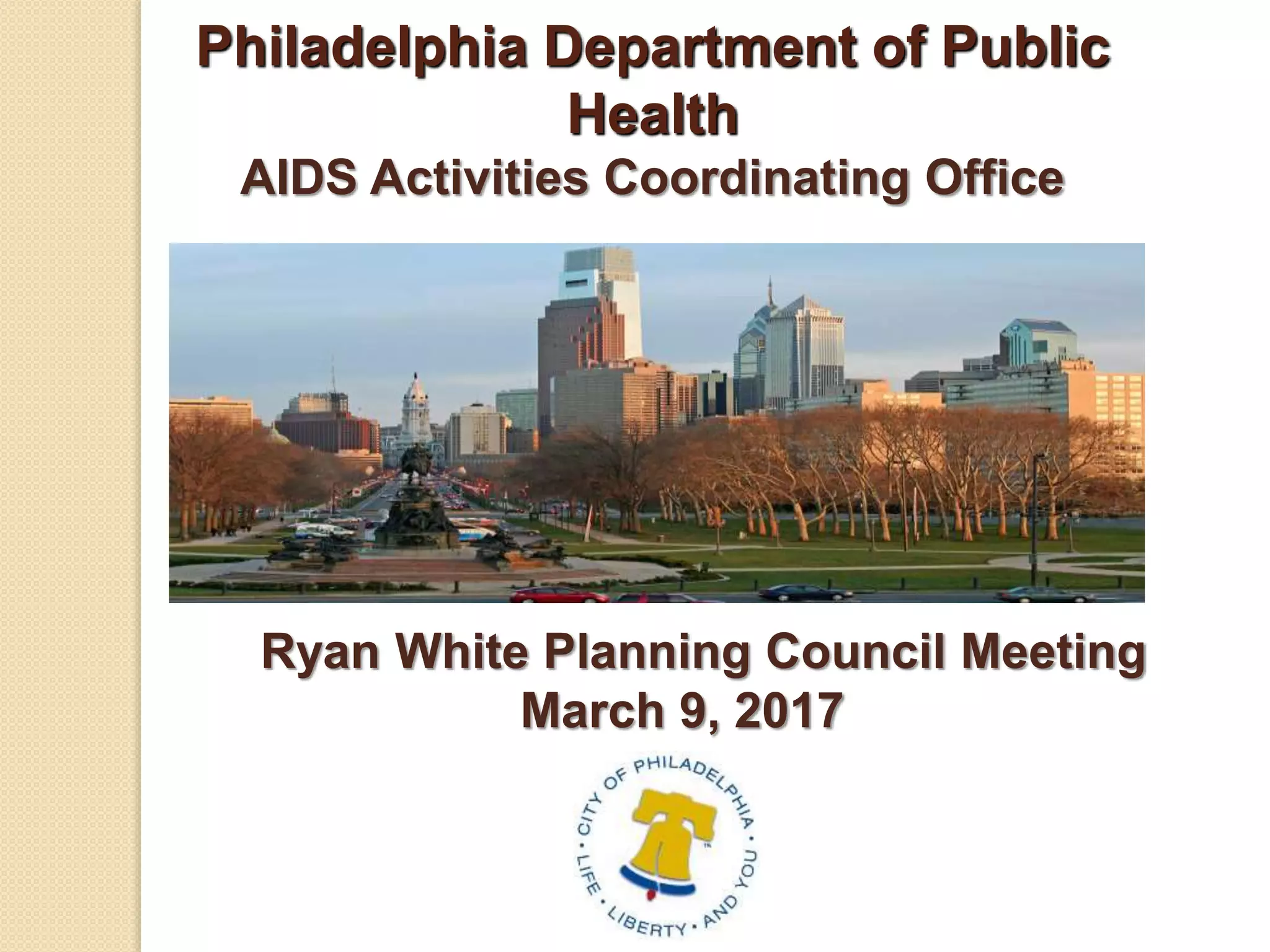
Philadelphia Department of Public
Health
AIDS Activities Coordinating Office
Ryan White Planning Council Meeting
March 9, 2017
Client Services Unit
(CSU)
CSU Mission Help HIV infected and at-risk individuals understand their
needs and make informed decisions about possible
solutions
 Advocate on behalf of those who need special support
 Reinforce clients’ capacity for self-reliance and self-
determination through
◦ education
◦ collaborative planning
◦ problem solving
Key Point of Entry
 Intake services to HIV positive
individuals requesting case
management services
Medical Case Management (MCM)
Services in the Philadelphia EMA
HRSA
MCM Definition
 The provision of a range of client-centered
activities focused on improving health outcomes in
support of the HIV care continuum
 Activities may be prescribed by an interdisciplinary
team that includes other specialty care providers
 Includes all types of encounters (e.g. face-to-face,
phone contact and any other forms of
communication)
HIV/AIDS Bureau Policy 16-02
MCM Key Activities
 Initial assessment of service needs
 Development of a comprehensive, individualized
care plan
 Timely and coordinated access to medically
appropriate levels of health and support services
 Continuous client monitoring to assess the
efficacy of the plan
 HIV treatment adherence counseling
 Client-specific advocacy
 Assessment of client needs is ongoing
 Re-evaluation of the care plan at least every six
months
HIV/AIDS Bureau Policy 16-02
MCM vs. Non-MCM
“Medical Case Management services
have as their objective improving health
care outcomes whereas Non-Medical
Case Management Services have as
their objective providing guidance and
assistance in improving access to
needed services.”
HIV/AIDS Bureau Policy 16-02
MCM Services in the EMA
 Approximately $8.45 million allocated to medical
case management in RW Part A/B and MAI funding
◦ AACO funded subrecipients provided MCM
services to 8,196 unduplicated clients in CY 2015
◦ 1,887 intakes completed through the Client
Services Unit in CY 2016
 21 subrecipients funded throughout the EMA
◦ CBOs/ASOs
◦ Hospital outpatient infectious disease clinics,
including pediatric sites
◦ Stand alone HIV clinics
CSU Responsibilities
 Information and referral services for all
other AACO funded programs
 Process individuals’ requests for
subsidized housing
 Feedback about funded providers
 Local Case Management Coordination
Project
 Health Information Helpline is open 8 a.m. to 5:30 p.m.
Monday through Friday
 800/215-985-2437
 Staffing:
◦ Manager
◦ SW Supervisor
◦ Housing Coordinator
◦ 4 City Social Workers
◦ Training Coordinator
 Staff speak Spanish & French
◦ Other languages available through PDPH
translation services
CSU Information
CSU Wait List
 21people as of 3/7/17
 Followed by CSU Intake Workers
 Emergencies and other priority populations
are immediately referred to MCM providers
◦ SCI Clients
 CSU workers facilitate HIV medical
appointments for all clients reporting no
HIV medical care in last six months
Intake Data
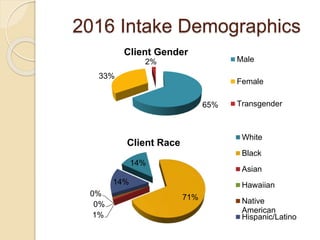
2016 Intake Demographics
65%
33%
2%
Client Gender
Male
Female
Transgender
14%
71%
1%
0%
0%
14%
Client Race
White
Black
Asian
Hawaiian
Native
American
Hispanic/Latino
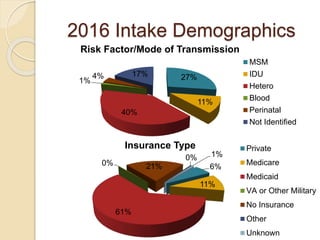
2016 Intake Demographics
27%
11%
40%
1%
4% 17%
Risk Factor/Mode of Transmission
MSM
IDU
Hetero
Blood
Perinatal
Not Identified
6%
11%
61%
0% 21%
0% 1%
Insurance Type Private
Medicare
Medicaid
VA or Other Military
No Insurance
Other
Unknown
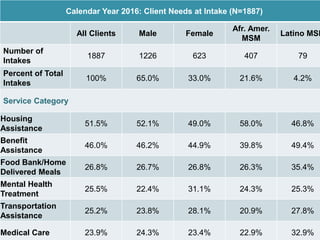
Calendar Year 2016: Client Needs at Intake (N=1887)
All Clients Male Female
Afr. Amer.
MSM
Latino MSM
Number of
Intakes
1887 1226 623 407 79
Percent of Total
Intakes
100% 65.0% 33.0% 21.6% 4.2%
Service Category
Housing
Assistance
51.5% 52.1% 49.0% 58.0% 46.8%
Benefit
Assistance
46.0% 46.2% 44.9% 39.8% 49.4%
Food Bank/Home
Delivered Meals
26.8% 26.7% 26.8% 26.3% 35.4%
Mental Health
Treatment
25.5% 22.4% 31.1% 24.3% 25.3%
Transportation
Assistance
25.2% 23.8% 28.1% 20.9% 27.8%
Medical Care 23.9% 24.3% 23.4% 22.9% 32.9%
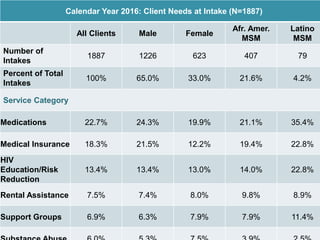
Calendar Year 2016: Client Needs at Intake (N=1887)
All Clients Male Female
Afr. Amer.
MSM
Latino
MSM
Number of
Intakes
1887 1226 623 407 79
Percent of Total
Intakes
100% 65.0% 33.0% 21.6% 4.2%
Service Category
Medications 22.7% 24.3% 19.9% 21.1% 35.4%
Medical Insurance 18.3% 21.5% 12.2% 19.4% 22.8%
HIV
Education/Risk
Reduction
13.4% 13.4% 13.0% 14.0% 22.8%
Rental Assistance 7.5% 7.4% 8.0% 9.8% 8.9%
Support Groups 6.9% 6.3% 7.9% 7.9% 11.4%
Housing Services
Program
(HSP)
HSP Funding
 The AACO Housing Services Program
(HSP) is 100% funded by the Philadelphia
Division of Housing & Community
Development (DHCD)
 The HSP receives $0 from Ryan White
funds
◦ RW funding can not be used to provide
permanent housing
◦ Federal and State funding for housing continues
to decline
What is HSP
 Centralized intake for applicants from
Philadelphia and Delaware Counties
seeking permanent rental assistance
(subsidized housing)
 Bucks, Chester and Montgomery
Counties (Bensalem EMA)
 The main referral source for housing
sponsors providing Housing
Opportunities for People With AIDS
(HOPWA) or HIV/AIDS Shelter Plus Care
(S+C) housing
What HSP Does
 Process and evaluate individual
applications for housing
 Maintain the waiting list
 Provide ongoing TA and training to
service providers
 All services at no cost
 Do not provide emergency housing
HSP Scope
 8 housing sponsors
 686 housing slots
◦ 494 HOPWA
◦ 192 S+C
 72% tenant based
 28% project based
Wait List
 400 applicants on
the wait list as of
4/12/16
◦ Wait time for
homeless
individuals is 18
months or more
◦ Wait time for all
other applicants is
8 years or more
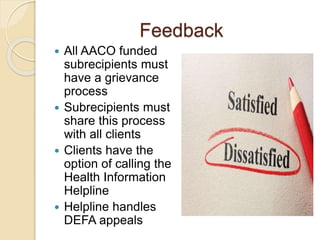
Feedback
 All AACO funded
subrecipients must
have a grievance
process
 Subrecipients must
share this process
with all clients
 Clients have the
option of calling the
Health Information
Helpline

 Helpline handles
DEFA appeals
Quality Management and
MCM Services
What is Quality Management
 The QM process includes:
◦ Quality assurance
◦ Outcomes monitoring and evaluation
◦ Continuous quality improvement
 The goal is to use high quality data to
continually improve access to high quality
clinical HIV care
QM and the Continuum
 In accordance with National Goals
(NHAS), initiatives are being directed at all
stages of the care continuum to promote
retention and viral suppression
 AACO is updating its prevention QI
process to place greater focus on
systems-level interventions around
diagnosis and linkage
 QIPs for MCM and O/AHS are targeting
Gap in Medical Visits and VL suppression
 All RW service categories have outcomes
focusing on the continuum of care
The AACO Quality
Improvement (QI) Process
 Collect and monitor data to assess client
outcomes
◦ Local and HAB performance measures
◦ Other available data
 Use data to improve client outcomes
◦ Ongoing feedback to providers
 Benchmarking
 Trends
◦ QIPs
◦ Regional QI Meetings
◦ Individual TA
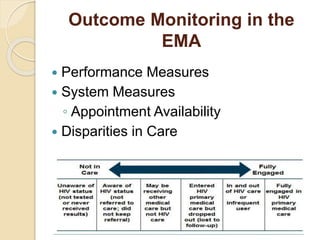
Outcome Monitoring in the
EMA
 Performance Measures
 System Measures
◦ Appointment Availability
 Disparities in Care
Performance Measures
 25 measures for medical (O/AHS)
services
 7 MCM measures
 3 oral health measures
 Measures for all other services
collected through PDE
◦ VL Suppression
◦ Gap in Medical Visits
Monitoring and Feedback
 Strong emphasis on feedback
 Quickly highlights trends, strengths and
needs
 Data visualization is critical in getting
attention of program leadership
 Benchmarking contextualizes data
 Assists in prioritizing QIPs
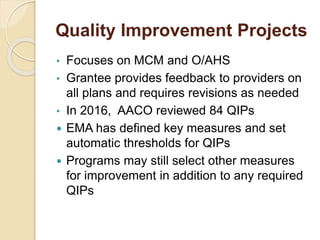
Quality Improvement Projects
• Focuses on MCM and O/AHS
• Grantee provides feedback to providers on
all plans and requires revisions as needed
• In 2016, AACO reviewed 84 QIPs
 EMA has defined key measures and set
automatic thresholds for QIPs
 Programs may still select other measures
for improvement in addition to any required
QIPs
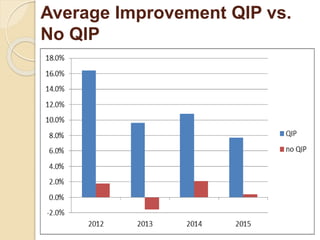
Average Improvement QIP vs.
No QIP
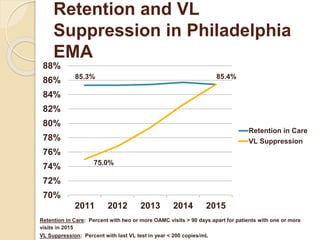
Retention and VL
Suppression in Philadelphia
EMA
85.3% 85.4%
75.0%
70%
72%
74%
76%
78%
80%
82%
84%
86%
88%
2011 2012 2013 2014 2015
Retention in Care
VL Suppression
Retention in Care: Percent with two or more OAMC visits > 90 days apart for patients with one or more
visits in 2015
VL Suppression: Percent with last VL test in year < 200 copies/mL
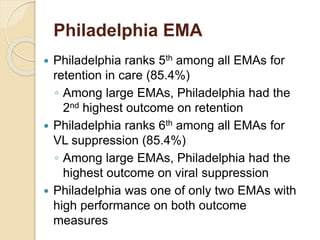
Philadelphia EMA
 Philadelphia ranks 5th among all EMAs for
retention in care (85.4%)
◦ Among large EMAs, Philadelphia had the
2nd highest outcome on retention
 Philadelphia ranks 6th among all EMAs for
VL suppression (85.4%)
◦ Among large EMAs, Philadelphia had the
highest outcome on viral suppression
 Philadelphia was one of only two EMAs with
high performance on both outcome
measures
Consumers and CQI
 PDPH emphasizes consumers in the QI
process
◦ Consumers on QI teams or committees
◦ Obtain input from Consumer Advisory Boards
during key stages of a QI process
◦ Consumer focus groups
◦ Client surveys to obtain client input relating to
causes for low performance or proposed
action steps
 AACO is currently developing a process to
enhance systems-level consumer participation
Questions or Comments

AACO Client Services Presentation

  • 1.
    Philadelphia Department ofPublic Health AIDS Activities Coordinating Office Ryan White Planning Council Meeting March 9, 2017
  • 2.
  • 3.
    CSU Mission HelpHIV infected and at-risk individuals understand their needs and make informed decisions about possible solutions  Advocate on behalf of those who need special support  Reinforce clients’ capacity for self-reliance and self- determination through ◦ education ◦ collaborative planning ◦ problem solving
  • 4.
    Key Point ofEntry  Intake services to HIV positive individuals requesting case management services
  • 5.
    Medical Case Management(MCM) Services in the Philadelphia EMA
  • 6.
    HRSA MCM Definition  Theprovision of a range of client-centered activities focused on improving health outcomes in support of the HIV care continuum  Activities may be prescribed by an interdisciplinary team that includes other specialty care providers  Includes all types of encounters (e.g. face-to-face, phone contact and any other forms of communication) HIV/AIDS Bureau Policy 16-02
  • 7.
    MCM Key Activities Initial assessment of service needs  Development of a comprehensive, individualized care plan  Timely and coordinated access to medically appropriate levels of health and support services  Continuous client monitoring to assess the efficacy of the plan  HIV treatment adherence counseling  Client-specific advocacy  Assessment of client needs is ongoing  Re-evaluation of the care plan at least every six months HIV/AIDS Bureau Policy 16-02
  • 8.
    MCM vs. Non-MCM “MedicalCase Management services have as their objective improving health care outcomes whereas Non-Medical Case Management Services have as their objective providing guidance and assistance in improving access to needed services.” HIV/AIDS Bureau Policy 16-02
  • 9.
    MCM Services inthe EMA  Approximately $8.45 million allocated to medical case management in RW Part A/B and MAI funding ◦ AACO funded subrecipients provided MCM services to 8,196 unduplicated clients in CY 2015 ◦ 1,887 intakes completed through the Client Services Unit in CY 2016  21 subrecipients funded throughout the EMA ◦ CBOs/ASOs ◦ Hospital outpatient infectious disease clinics, including pediatric sites ◦ Stand alone HIV clinics
  • 10.
    CSU Responsibilities  Informationand referral services for all other AACO funded programs  Process individuals’ requests for subsidized housing  Feedback about funded providers  Local Case Management Coordination Project
  • 11.
     Health InformationHelpline is open 8 a.m. to 5:30 p.m. Monday through Friday  800/215-985-2437  Staffing: ◦ Manager ◦ SW Supervisor ◦ Housing Coordinator ◦ 4 City Social Workers ◦ Training Coordinator  Staff speak Spanish & French ◦ Other languages available through PDPH translation services CSU Information
  • 12.
    CSU Wait List 21people as of 3/7/17  Followed by CSU Intake Workers  Emergencies and other priority populations are immediately referred to MCM providers ◦ SCI Clients  CSU workers facilitate HIV medical appointments for all clients reporting no HIV medical care in last six months
  • 13.
  • 14.
    2016 Intake Demographics 65% 33% 2% ClientGender Male Female Transgender 14% 71% 1% 0% 0% 14% Client Race White Black Asian Hawaiian Native American Hispanic/Latino
  • 15.
    2016 Intake Demographics 27% 11% 40% 1% 4%17% Risk Factor/Mode of Transmission MSM IDU Hetero Blood Perinatal Not Identified 6% 11% 61% 0% 21% 0% 1% Insurance Type Private Medicare Medicaid VA or Other Military No Insurance Other Unknown
  • 16.
    Calendar Year 2016:Client Needs at Intake (N=1887) All Clients Male Female Afr. Amer. MSM Latino MSM Number of Intakes 1887 1226 623 407 79 Percent of Total Intakes 100% 65.0% 33.0% 21.6% 4.2% Service Category Housing Assistance 51.5% 52.1% 49.0% 58.0% 46.8% Benefit Assistance 46.0% 46.2% 44.9% 39.8% 49.4% Food Bank/Home Delivered Meals 26.8% 26.7% 26.8% 26.3% 35.4% Mental Health Treatment 25.5% 22.4% 31.1% 24.3% 25.3% Transportation Assistance 25.2% 23.8% 28.1% 20.9% 27.8% Medical Care 23.9% 24.3% 23.4% 22.9% 32.9%
  • 17.
    Calendar Year 2016:Client Needs at Intake (N=1887) All Clients Male Female Afr. Amer. MSM Latino MSM Number of Intakes 1887 1226 623 407 79 Percent of Total Intakes 100% 65.0% 33.0% 21.6% 4.2% Service Category Medications 22.7% 24.3% 19.9% 21.1% 35.4% Medical Insurance 18.3% 21.5% 12.2% 19.4% 22.8% HIV Education/Risk Reduction 13.4% 13.4% 13.0% 14.0% 22.8% Rental Assistance 7.5% 7.4% 8.0% 9.8% 8.9% Support Groups 6.9% 6.3% 7.9% 7.9% 11.4%
  • 18.
  • 19.
    HSP Funding  TheAACO Housing Services Program (HSP) is 100% funded by the Philadelphia Division of Housing & Community Development (DHCD)  The HSP receives $0 from Ryan White funds ◦ RW funding can not be used to provide permanent housing ◦ Federal and State funding for housing continues to decline
  • 20.
    What is HSP Centralized intake for applicants from Philadelphia and Delaware Counties seeking permanent rental assistance (subsidized housing)  Bucks, Chester and Montgomery Counties (Bensalem EMA)  The main referral source for housing sponsors providing Housing Opportunities for People With AIDS (HOPWA) or HIV/AIDS Shelter Plus Care (S+C) housing
  • 21.
    What HSP Does Process and evaluate individual applications for housing  Maintain the waiting list  Provide ongoing TA and training to service providers  All services at no cost  Do not provide emergency housing
  • 22.
    HSP Scope  8housing sponsors  686 housing slots ◦ 494 HOPWA ◦ 192 S+C  72% tenant based  28% project based
  • 23.
    Wait List  400applicants on the wait list as of 4/12/16 ◦ Wait time for homeless individuals is 18 months or more ◦ Wait time for all other applicants is 8 years or more
  • 24.
    Feedback  All AACOfunded subrecipients must have a grievance process  Subrecipients must share this process with all clients  Clients have the option of calling the Health Information Helpline  Helpline handles DEFA appeals
  • 25.
  • 26.
    What is QualityManagement  The QM process includes: ◦ Quality assurance ◦ Outcomes monitoring and evaluation ◦ Continuous quality improvement  The goal is to use high quality data to continually improve access to high quality clinical HIV care
  • 27.
    QM and theContinuum  In accordance with National Goals (NHAS), initiatives are being directed at all stages of the care continuum to promote retention and viral suppression  AACO is updating its prevention QI process to place greater focus on systems-level interventions around diagnosis and linkage  QIPs for MCM and O/AHS are targeting Gap in Medical Visits and VL suppression  All RW service categories have outcomes focusing on the continuum of care
  • 28.
    The AACO Quality Improvement(QI) Process  Collect and monitor data to assess client outcomes ◦ Local and HAB performance measures ◦ Other available data  Use data to improve client outcomes ◦ Ongoing feedback to providers  Benchmarking  Trends ◦ QIPs ◦ Regional QI Meetings ◦ Individual TA
  • 29.
    Outcome Monitoring inthe EMA  Performance Measures  System Measures ◦ Appointment Availability  Disparities in Care
  • 30.
    Performance Measures  25measures for medical (O/AHS) services  7 MCM measures  3 oral health measures  Measures for all other services collected through PDE ◦ VL Suppression ◦ Gap in Medical Visits
  • 31.
    Monitoring and Feedback Strong emphasis on feedback  Quickly highlights trends, strengths and needs  Data visualization is critical in getting attention of program leadership  Benchmarking contextualizes data  Assists in prioritizing QIPs
  • 32.
    Quality Improvement Projects •Focuses on MCM and O/AHS • Grantee provides feedback to providers on all plans and requires revisions as needed • In 2016, AACO reviewed 84 QIPs  EMA has defined key measures and set automatic thresholds for QIPs  Programs may still select other measures for improvement in addition to any required QIPs
  • 33.
  • 34.
    Retention and VL Suppressionin Philadelphia EMA 85.3% 85.4% 75.0% 70% 72% 74% 76% 78% 80% 82% 84% 86% 88% 2011 2012 2013 2014 2015 Retention in Care VL Suppression Retention in Care: Percent with two or more OAMC visits > 90 days apart for patients with one or more visits in 2015 VL Suppression: Percent with last VL test in year < 200 copies/mL
  • 35.
    Philadelphia EMA  Philadelphiaranks 5th among all EMAs for retention in care (85.4%) ◦ Among large EMAs, Philadelphia had the 2nd highest outcome on retention  Philadelphia ranks 6th among all EMAs for VL suppression (85.4%) ◦ Among large EMAs, Philadelphia had the highest outcome on viral suppression  Philadelphia was one of only two EMAs with high performance on both outcome measures
  • 36.
    Consumers and CQI PDPH emphasizes consumers in the QI process ◦ Consumers on QI teams or committees ◦ Obtain input from Consumer Advisory Boards during key stages of a QI process ◦ Consumer focus groups ◦ Client surveys to obtain client input relating to causes for low performance or proposed action steps  AACO is currently developing a process to enhance systems-level consumer participation
  • 37.