Jim Spohrer (IBM)
Friday November 10, 2017
http://www.slideshare.net/spohrer/future-20171110-v14
11/10/2017 1
A look towards the future
AI to IA (Cognitive) Timeline:
Hard unsolved AI problems
• 2012-2017 AI Pattern Recognition and
Learning from Massive Labeled Data
– Speech, image, translation, driverless, games
– Chatbots as digital assistants
• 2018 Video Understanding
• 2021 Episodic Memory
• 2022 Learning from Watching
• 2024 Commonsense Reasoning
• 2026 Learning from Reading
• 2028 Learning from Responsible Doing
• 2030 Fluent Conversation
• 2031-2039 Cognitive Collaborator and
Mediator; Intelligence Augmentation (IA)
11/10/2017 (c) IBM 2017, Cognitive Opentech Group 2
Which experts would be really surprised if it takes less time… and which experts really surprised if it takes longer?
April 2017: TED Arai Todai Robot
11/10/2017 (c) IBM 2017, Cognitive Opentech Group 3
… when will
your smartphone
be capable of
passing a university
entrance exam?
11/10/2017
© IBM UPWard 2016
4
First consider this…
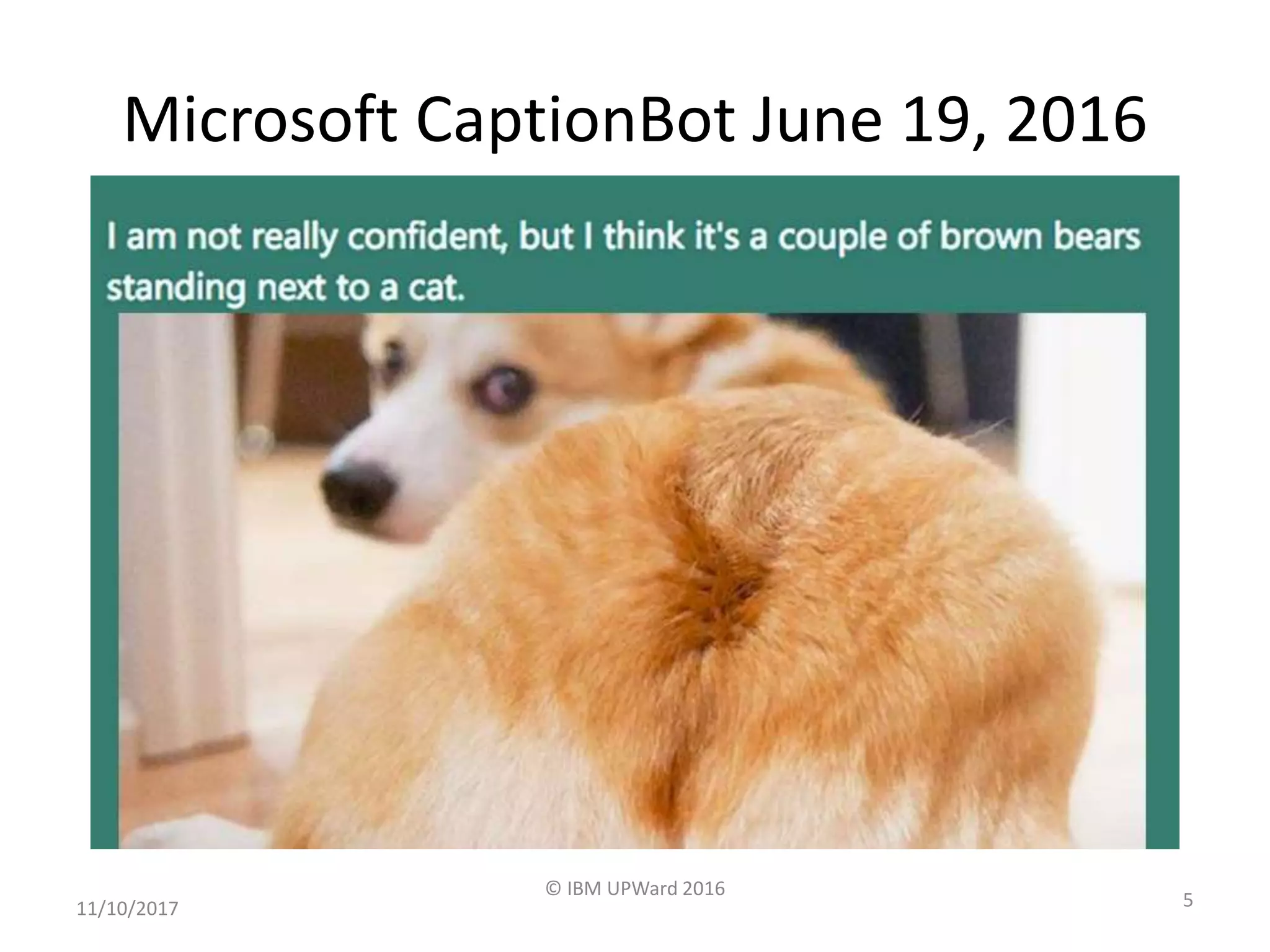
Microsoft CaptionBot June 19, 2016
11/10/2017
© IBM UPWard 2016
5
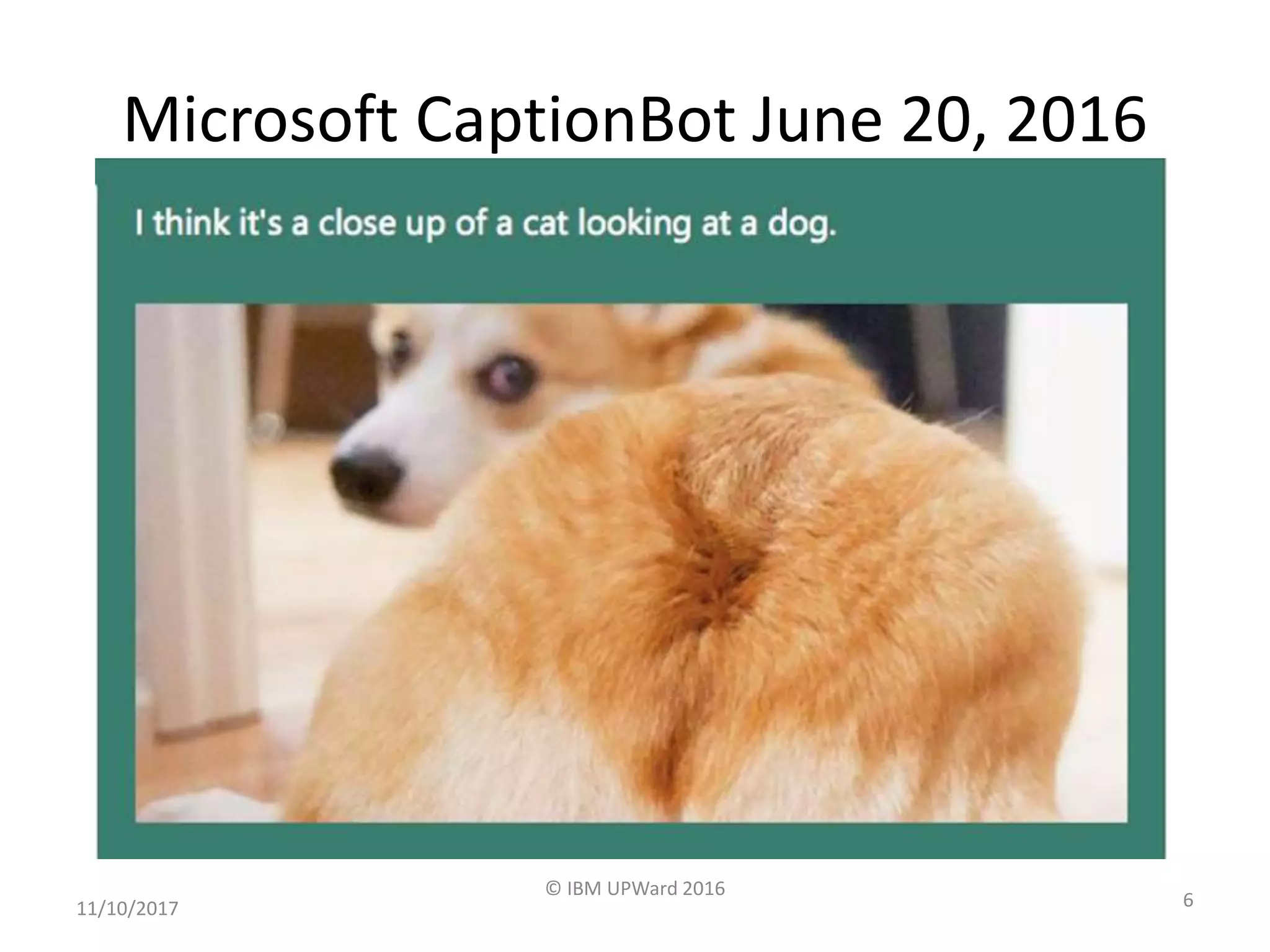
Microsoft CaptionBot June 20, 2016
11/10/2017
© IBM UPWard 2016
6
IBM Image Tagging – June 19, 2016
11/10/2017
© IBM UPWard 2016
7
Today: November 10, 2017
11/10/2017
© IBM DBG COG 2017
8
IBM
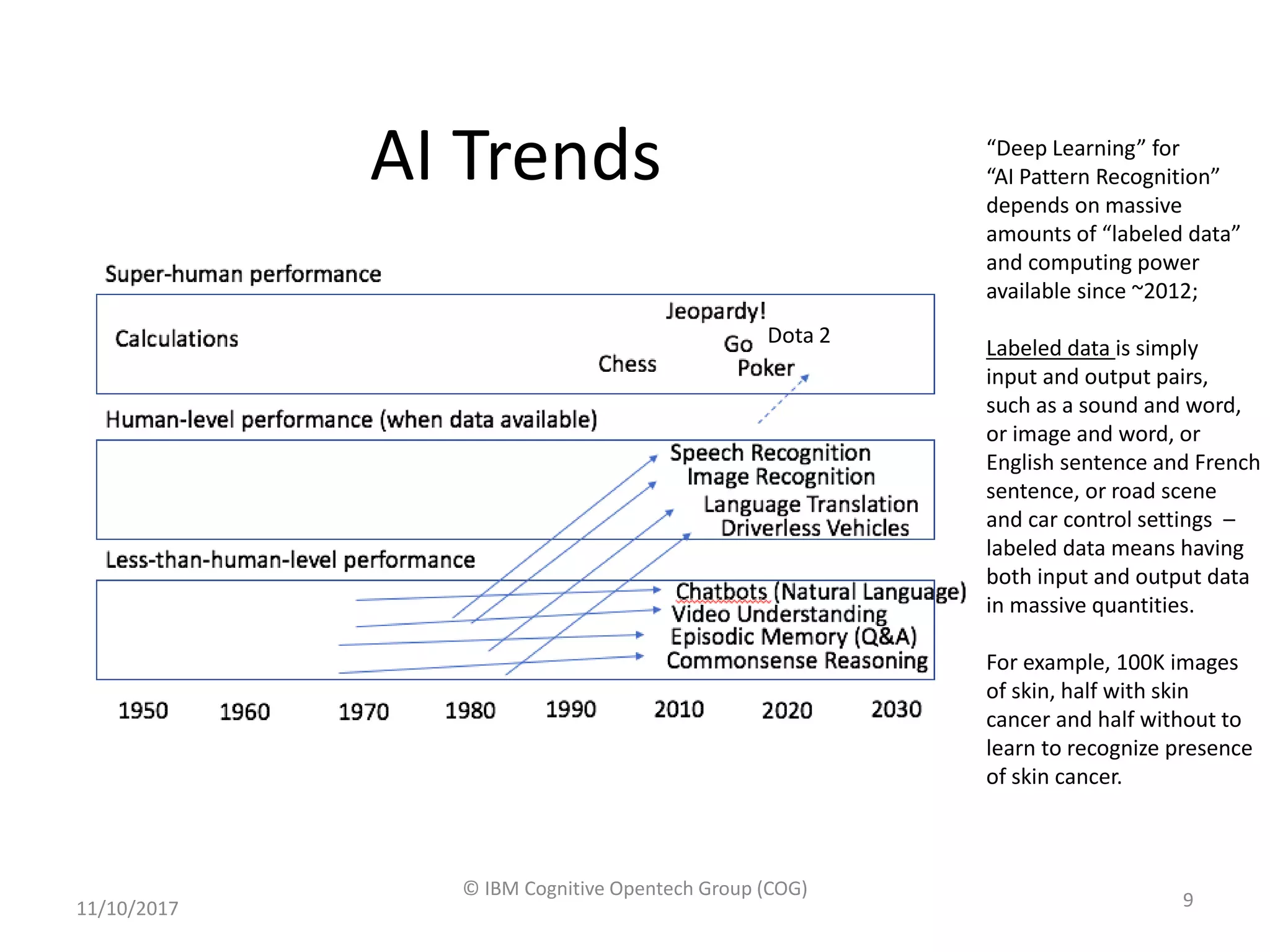
AI Trends
11/10/2017
© IBM Cognitive Opentech Group (COG)
9
Dota 2
“Deep Learning” for
“AI Pattern Recognition”
depends on massive
amounts of “labeled data”
and computing power
available since ~2012;
Labeled data is simply
input and output pairs,
such as a sound and word,
or image and word, or
English sentence and French
sentence, or road scene
and car control settings –
labeled data means having
both input and output data
in massive quantities.
For example, 100K images
of skin, half with skin
cancer and half without to
learn to recognize presence
of skin cancer.
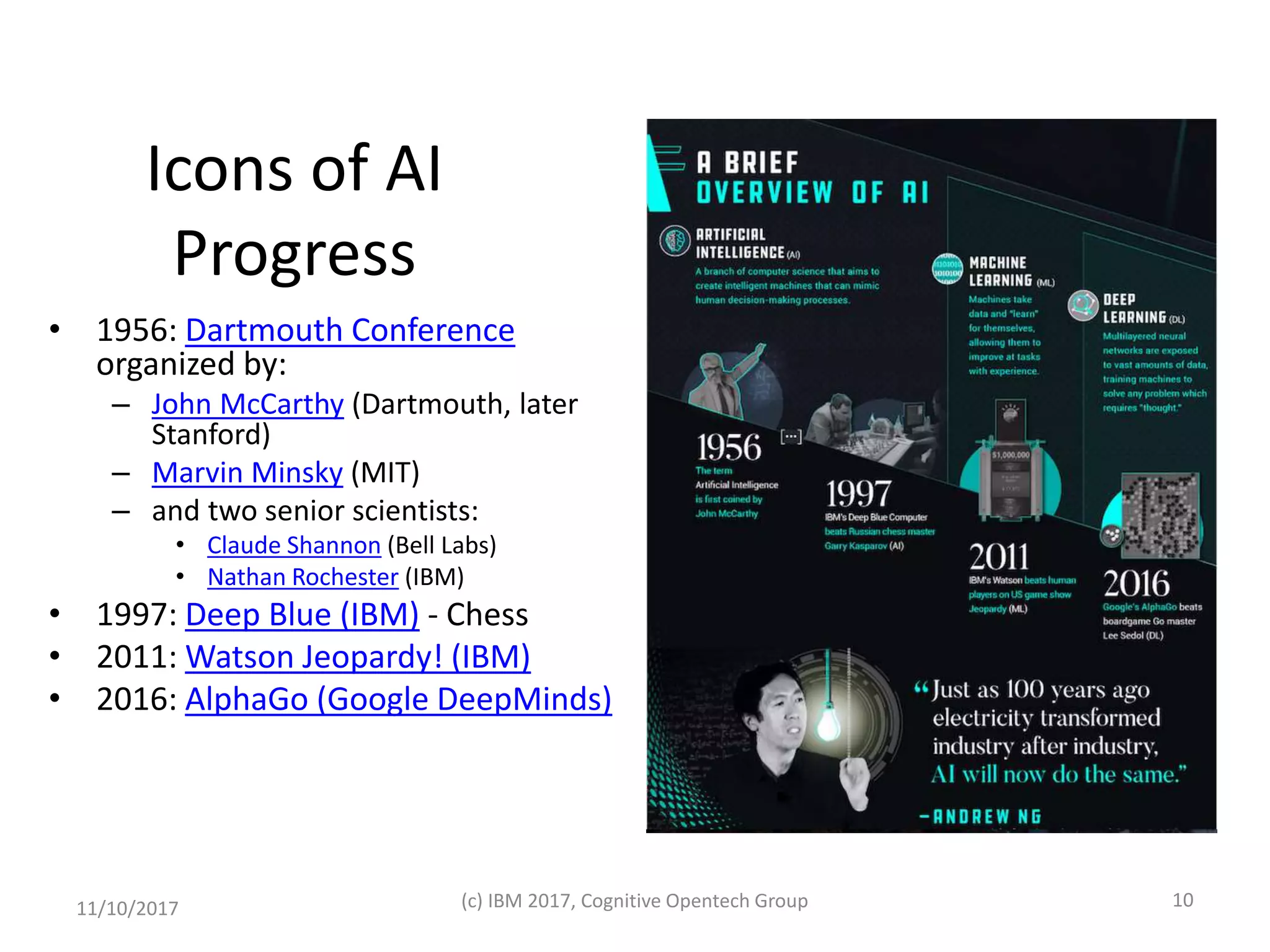
Icons of AI
Progress
• 1956: Dartmouth Conference
organized by:
– John McCarthy (Dartmouth, later
Stanford)
– Marvin Minsky (MIT)
– and two senior scientists:
• Claude Shannon (Bell Labs)
• Nathan Rochester (IBM)
• 1997: Deep Blue (IBM) - Chess
• 2011: Watson Jeopardy! (IBM)
• 2016: AlphaGo (Google DeepMinds)
11/10/2017 (c) IBM 2017, Cognitive Opentech Group 10
11/10/2017 11
1955 1975 1995 2015 2035 2055
A look towards the future…
Cognitive Mediator (2035): Progression from Tool, to Assistant, to Collaborator, to Coach
Questions
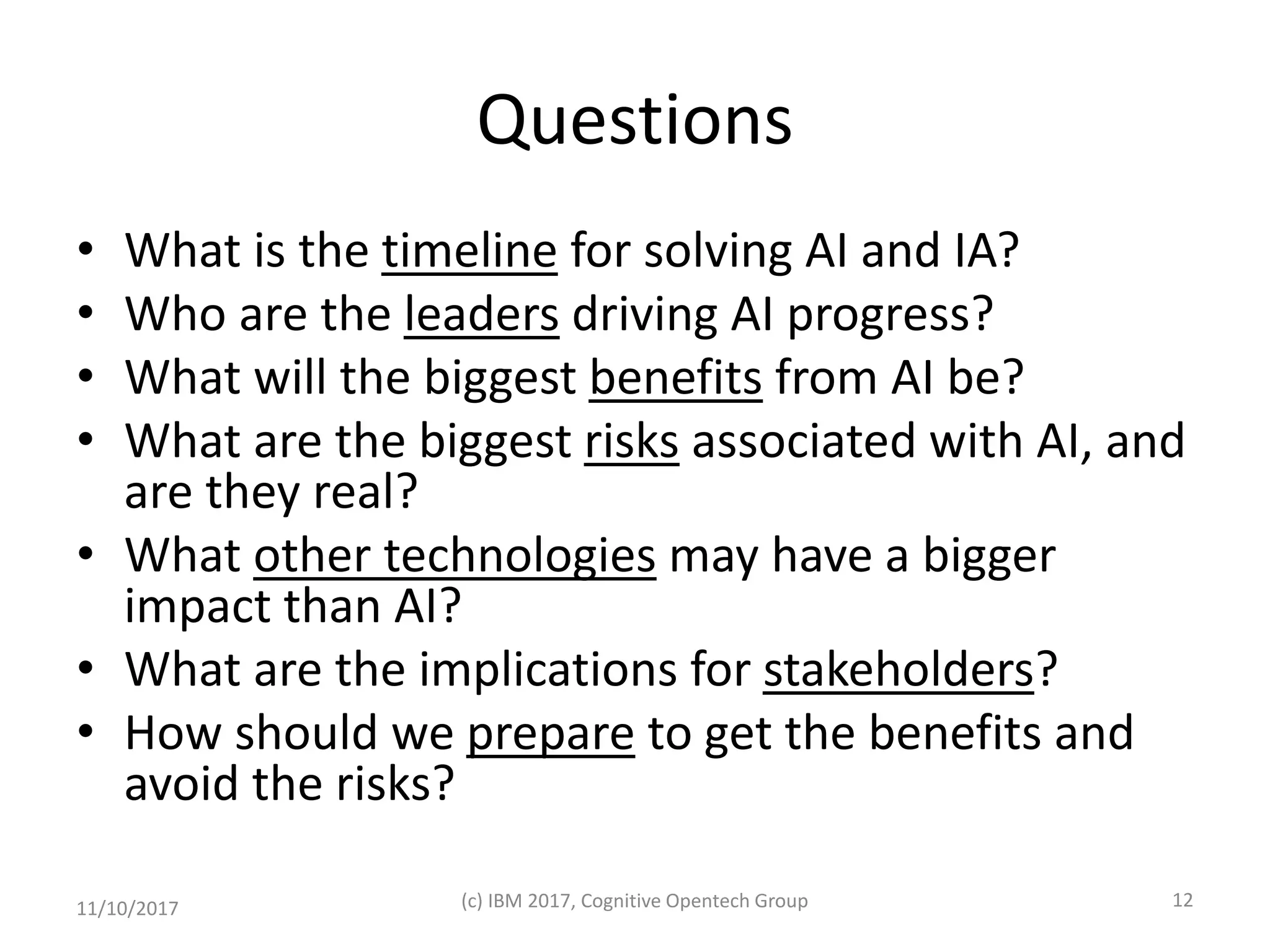
• What is the timeline for solving AI and IA?
• Who are the leaders driving AI progress?
• What will the biggest benefits from AI be?
• What are the biggest risks associated with AI, and
are they real?
• What other technologies may have a bigger
impact than AI?
• What are the implications for stakeholders?
• How should we prepare to get the benefits and
avoid the risks?
11/10/2017 (c) IBM 2017, Cognitive Opentech Group 12
Every 20 years, compute costs are down
by 1000x
• Cost of Digital Workers
– Moore’s Law can be thought of as
lowering costs by a factor of a…
• Thousand times lower
in 20 years
• Million times lower
in 40 years
• Billion times lower
in 60 years
• Smarter Tools (Terascale)
– Terascale (2017) = $3K
– Terascale (2020) = ~$1K
• Narrow Worker (Petascale)
– Recognition (Fast)
– Petascale (2040) = ~$1K
• Broad Worker (Exascale)
– Reasoning (Slow)
– Exascale (2060) = ~$1K
1311/10/2017 (c) IBM 2017, Cognitive Opentech Group
2080204020001960
$1K
$1M
$1B
$1T
206020201980
+/- 10 years
$1
Person Average
Annual Salary
(Living Income)
Super Computer
Cost
Mainframe Cost
Smartphone Cost
T
P
E
T P E
AI Progress on Open Leaderboards
Benchmark Roadmap to solve AI/IA
GPD/Employee
11/10/2017 (c) IBM 2017, Cognitive Opentech Group 14
(Source)
Lower compute costs translate into increasing productivity and GDP/employees for nations
Increasing productivity and GDP/employees should translate into wealthier citizens
AI Progress on Open Leaderboards
Benchmark Roadmap to solve AI/IA
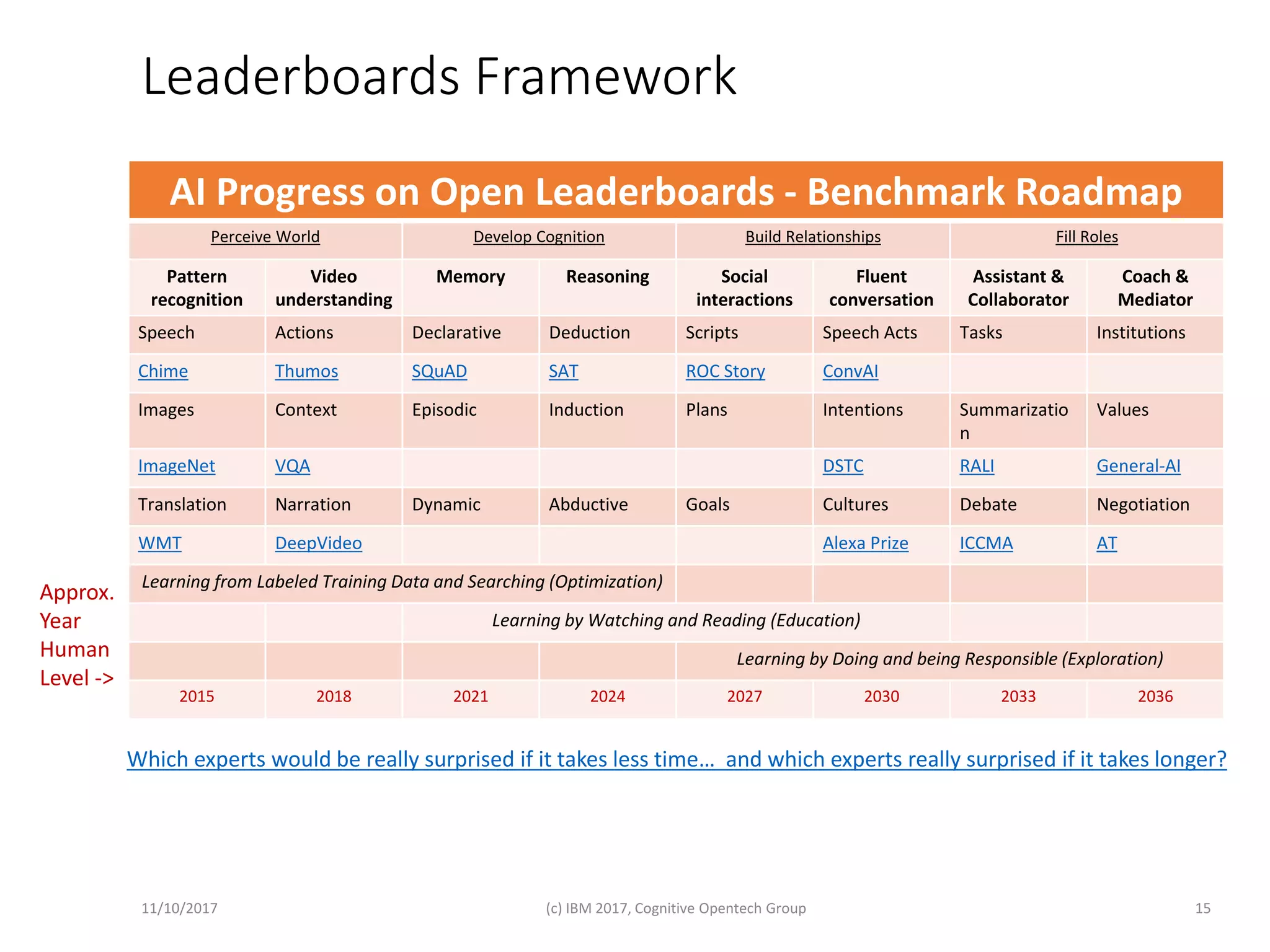
Leaderboards Framework
AI Progress on Open Leaderboards - Benchmark Roadmap
Perceive World Develop Cognition Build Relationships Fill Roles
Pattern
recognition
Video
understanding
Memory Reasoning Social
interactions
Fluent
conversation
Assistant &
Collaborator
Coach &
Mediator
Speech Actions Declarative Deduction Scripts Speech Acts Tasks Institutions
Chime Thumos SQuAD SAT ROC Story ConvAI
Images Context Episodic Induction Plans Intentions Summarizatio
n
Values
ImageNet VQA DSTC RALI General-AI
Translation Narration Dynamic Abductive Goals Cultures Debate Negotiation
WMT DeepVideo Alexa Prize ICCMA AT
Learning from Labeled Training Data and Searching (Optimization)
Learning by Watching and Reading (Education)
Learning by Doing and being Responsible (Exploration)
2015 2018 2021 2024 2027 2030 2033 2036
11/10/2017 (c) IBM 2017, Cognitive Opentech Group 15
Which experts would be really surprised if it takes less time… and which experts really surprised if it takes longer?
Approx.
Year
Human
Level ->
AI Leaders
• Who is winning?
– Regions China vs USA vs EU vs ROW
– Companies Microsoft vs Google vs IBM
• Leaderboards
– SQuAD – Question Answering
– EFF Measuring AI Progress
11/10/2017 (c) IBM 2017, Cognitive Opentech Group 16
AI Benefits
• Access to expertise
– “Insanely great” labor productivity for trusted
service providers
– Digital workers for healthcare, education, finance,
etc.
• Better choices
– ”Insanely great” collaborations with others on
what matters most
– AI for IA = Augmented Intelligence and higher
value co-creation interactions
11/10/2017 (c) IBM 2017, Cognitive Opentech Group 17
AI Risks
• Job Loss
– Shorter term
bigger risk
= de-skilling
• Super-intelligence
– Shorter term
bigger risk
= bad actors
11/10/2017 (c) IBM 2017, Cognitive Opentech Group 18
Other Technologies: Bigger impact?
Yes.
• Augmented Reality (AR)/
Virtual Reality (VR)
– Game worlds
grow-up
• Blockchain/
Security Systems
– Trust and security
immutable
• Advanced Materials/
Energy Systems
– Manufacturing as cheap,
local recycling service
(utility fog, artificial leaf, etc.)
11/10/2017 (c) IBM 2017, Cognitive Opentech Group 19
Stakeholders
• Individuals
• Families
• Businesses and
other Organizations
• Industry Groups
• Regional
Governments:
– Cities
– States
– Nations
11/10/2017 (c) IBM 2017, Cognitive Opentech Group 20
Be Prepared
• Understand open AI code + data +
models + stacks + communities
– Leaderboards
– Ethical conduct
• Learn 3 R’s of IBM’s Cognitive
Opentech Group (COG)
– Read arXiv
– Redo with Github
– Report with Jupyter notebooks on
DSX and/or leaderboards
• Improve your team’s skills of rapidly
rebuilding from scratch
– Build your open code eminence
– Understand open innovation
– Communities + Leaderboards
11/10/2017 (c) IBM 2017, Cognitive Opentech Group 21
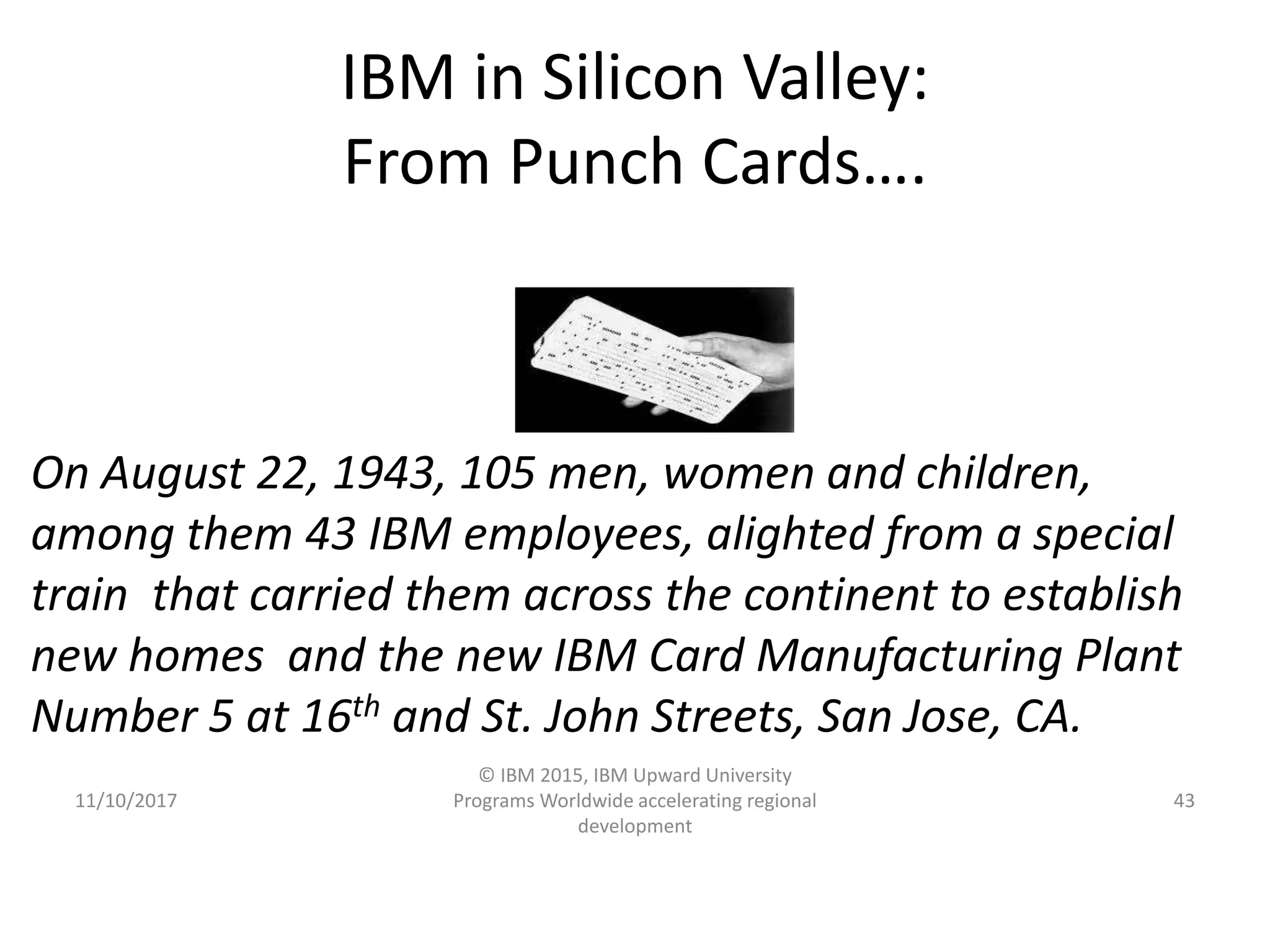
1972 used
Punch cards
2016 used
IBM Watson
Open APIs to win…
Cupertino Teens
• IBM Watson on Bluemix
11/10/2017 (c) IBM 2017, Cognitive Opentech Group 22
AI for NLP
entity identification
Courses
• 2015
– “How to build a cognitive system for Q&A task.”
– 9 months to 40% question answering accuracy
– 1-2 years for 90% accuracy, which questions to reject
• 2025
– “How to use a cognitive system to be a better professional X.”
– Tools to build a student level Q&A from textbook in 1 week
• 2035
– “How to use your cognitive mediator to build a startup.”
– Tools to build faculty level Q&A for textbook in one day
– Cognitive mediator knows a person better than they know themselves
• 2055
– “How to manage your workforce of digital workers.”
– Most people have 100 digital workers.
11/10/2017 23
Take free online cognitive classes today at cognitiveclass.ai
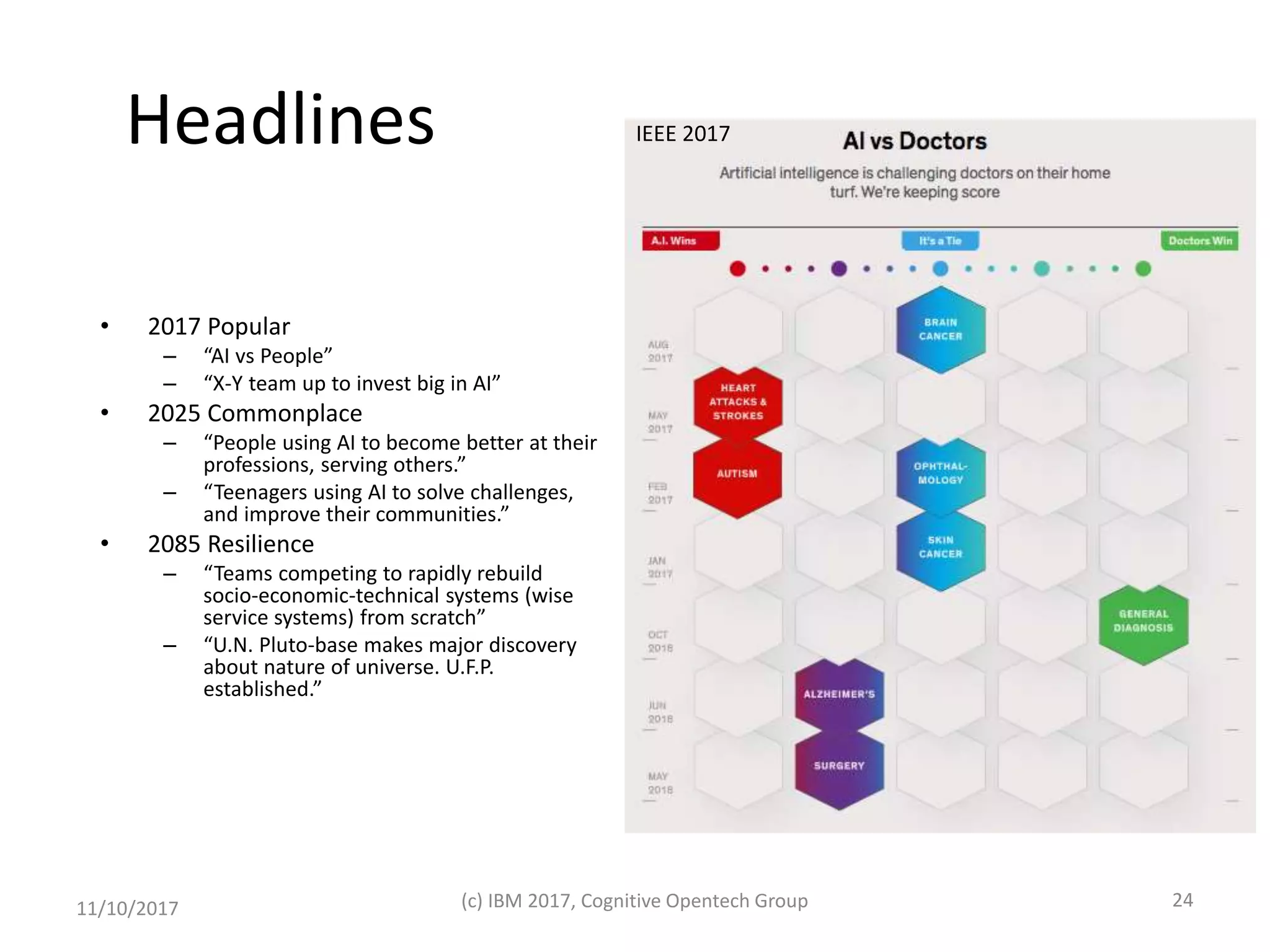
Headlines
• 2017 Popular
– “AI vs People”
– “X-Y team up to invest big in AI”
• 2025 Commonplace
– “People using AI to become better at their
professions, serving others.”
– “Teenagers using AI to solve challenges,
and improve their communities.”
• 2085 Resilience
– “Teams competing to rapidly rebuild
socio-economic-technical systems (wise
service systems) from scratch”
– “U.N. Pluto-base makes major discovery
about nature of universe. U.F.P.
established.”
11/10/2017 (c) IBM 2017, Cognitive Opentech Group 24
IEEE 2017
IBM-MIT $240M over 10 year AI
mission
11/10/2017 (c) IBM 2017, Cognitive Opentech Group 25
11/10/2017
© IBM UPWard 2016
26
11/10/2017
© IBM 2015, IBM Upward University
Programs Worldwide accelerating regional
development
27
Cognitive Mediators
for all people in all roles
Occupations = Many Tasks
11/10/2017
© IBM 2015, IBM Upward University
Programs Worldwide accelerating regional
development
28
Watson Discovery Advisor
11/10/2017
© IBM 2015, IBM Upward University
Programs Worldwide accelerating regional
development
29
Simonite, T. 2014. Software Mines Science Papers to Make New Discoveries. MIT. November 25, 2014.
URL: http://m.technologyreview.com/news/520461/software-mines-science-papers-to-make-new-discoveries/
User Models
11/10/2017
© IBM 2015, IBM Upward University
Programs Worldwide accelerating regional
development
30
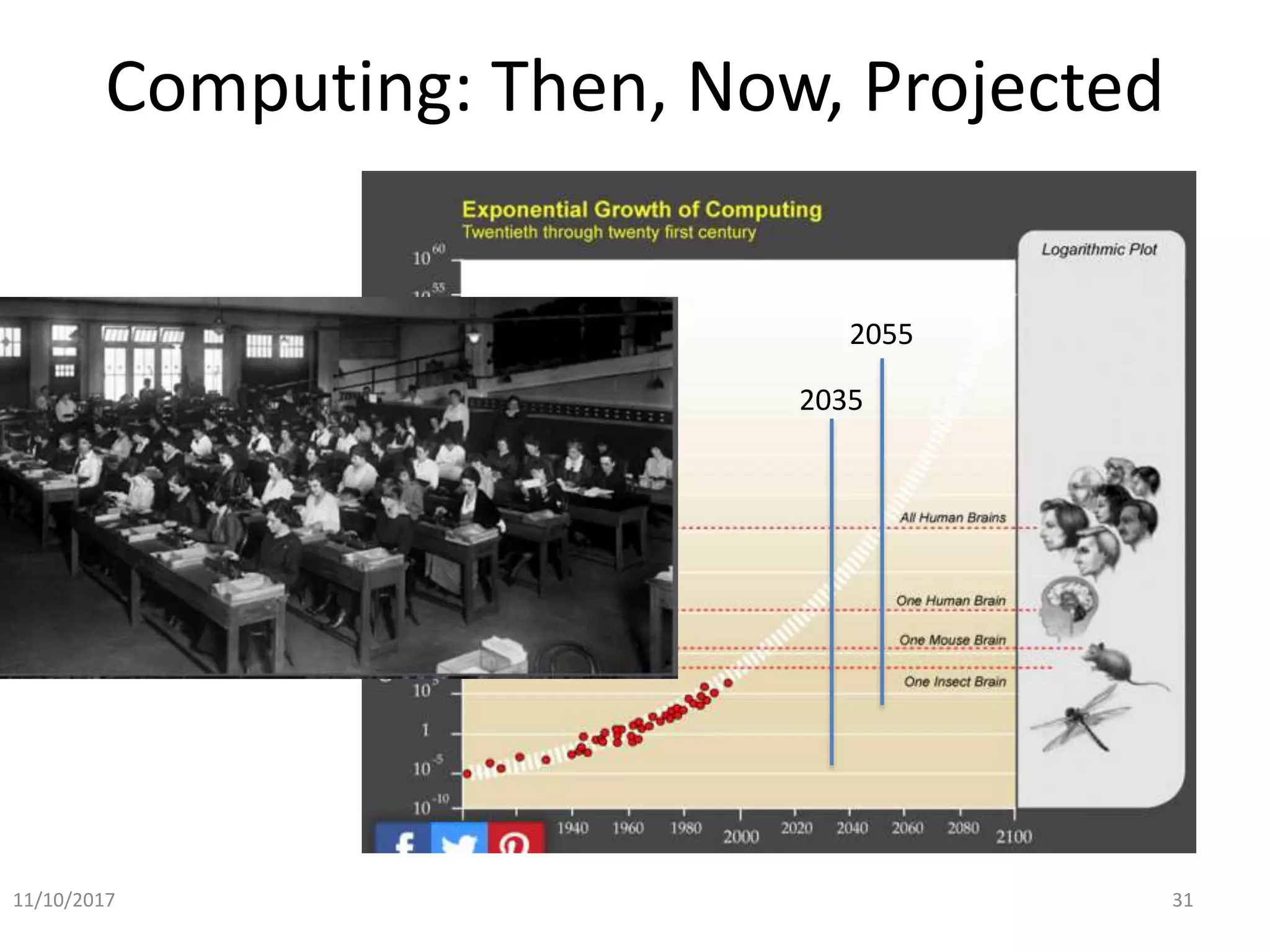
Computing: Then, Now, Projected
11/10/2017 31
2035
2055
11/10/2017
© IBM 2015, IBM Upward University
Programs Worldwide accelerating regional
development
32
Build: 10 million minutes of experience
11/10/2017 Understanding Cognitive Systems 33
Build: 2 million minutes of experience
11/10/2017 Understanding Cognitive Systems 34
Build:
Hardware < Software < Data < Experience < Transformation
11/10/2017 Understanding Cognitive Systems 35
“These amazing technologies must be
able to help people like myself…”
11/10/2017 (c) IBM 2017, Cognitive Opentech Group 36
“AI will change the world?
Who will change AI?”
11/10/2017 (c) IBM 2017, Cognitive Opentech Group 37
11/10/2017
© IBM 2015, IBM Upward University Programs Worldwide
accelerating regional development
38
11/10/2017
© IBM 2015, IBM Upward University
Programs Worldwide accelerating regional
development
39
Future of Skills
Future-Ready T-Shapes
11/10/2017
© IBM UPWard 2016
40
In Summary
11/10/2017
© IBM 2015, IBM Upward University
Programs Worldwide accelerating regional
development
41
“A service science
perspective considers
the evolving ecology of
service system entities,
their value co-creation and
capability co-elevation
interactions, and their
capabilities, constraints,
rights, and responsibilities.”
Cognitive Systems
Entities
Service
Systems
Entities With
Cognitive
Mediators
Add Rights &
Responsibilities
11/10/2017
© IBM UPWard 2016
42
IBM in Silicon Valley:
From Punch Cards….
11/10/2017
© IBM 2015, IBM Upward University
Programs Worldwide accelerating regional
development
43
On August 22, 1943, 105 men, women and children,
among them 43 IBM employees, alighted from a special
train that carried them across the continent to establish
new homes and the new IBM Card Manufacturing Plant
Number 5 at 16th and St. John Streets, San Jose, CA.
11/10/2017
© IBM 2015, IBM Upward University
Programs Worldwide accelerating regional
development
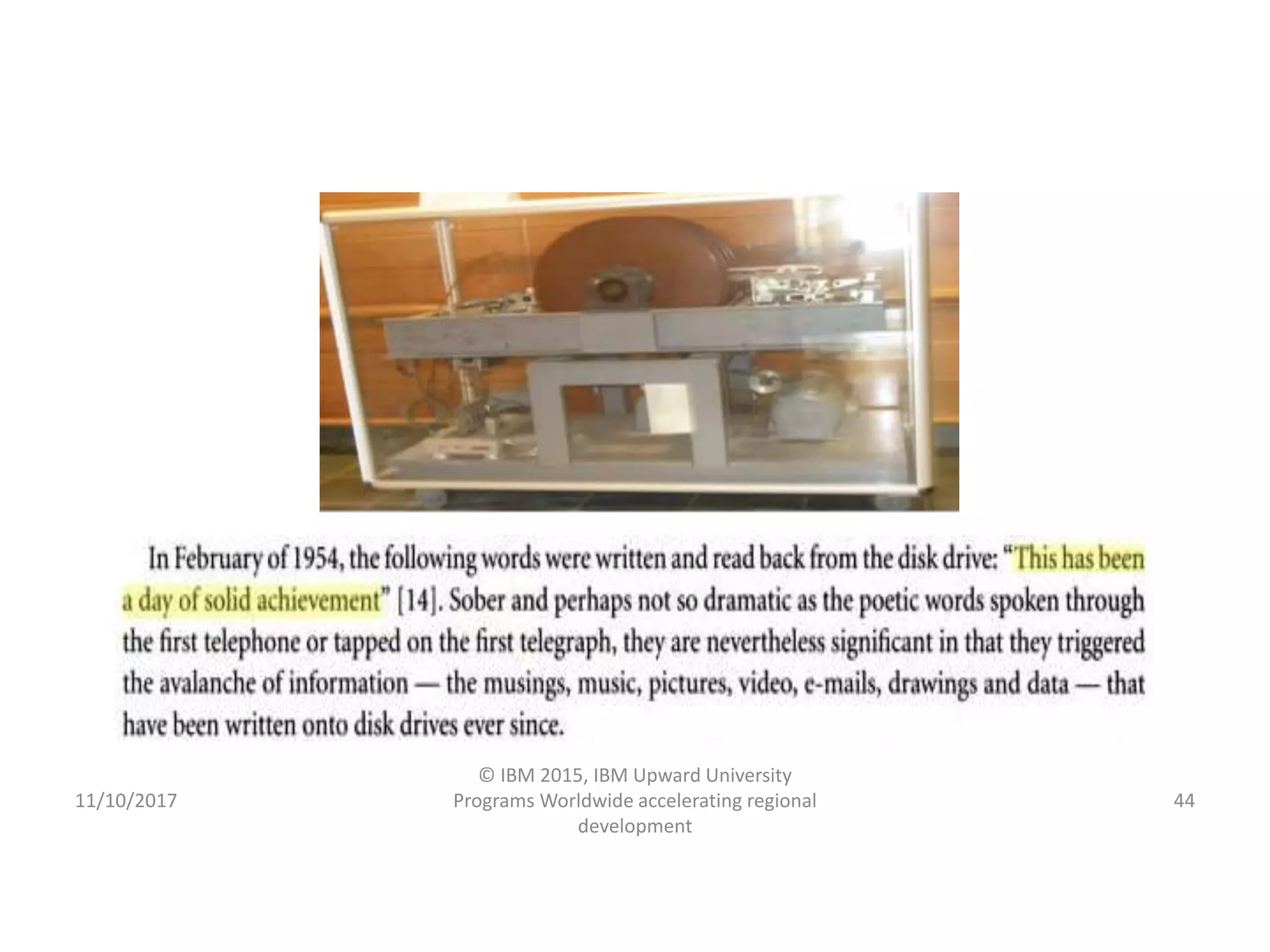
44
Types
• Tool
• Assistant
• Collaborator
• Coach
• Mediator
11/10/2017 Understanding Cognitive Systems 45
Types: Progression of models and capabilities
11/10/2017 Understanding Cognitive Systems 46
Task & World Model/
Planning & Decisions
Self Model/
Self Capacity & Limits
User Model/
User’s Episodic Memory and Identity
Institutions Model/
Trust & Social Acts
Tool + - - -
Assistant ++ + - -
Collaborator +++ ++ + -
Coach ++++ +++ ++ +
Mediator +++++ ++++ +++ ++
tool assistant collaborator coach mediator
Partnership for AI formed
11/10/2017 Understanding Cognitive Systems 47
How fast is Reality 2.0 approaching?
11/10/2017 48
What might it look like?
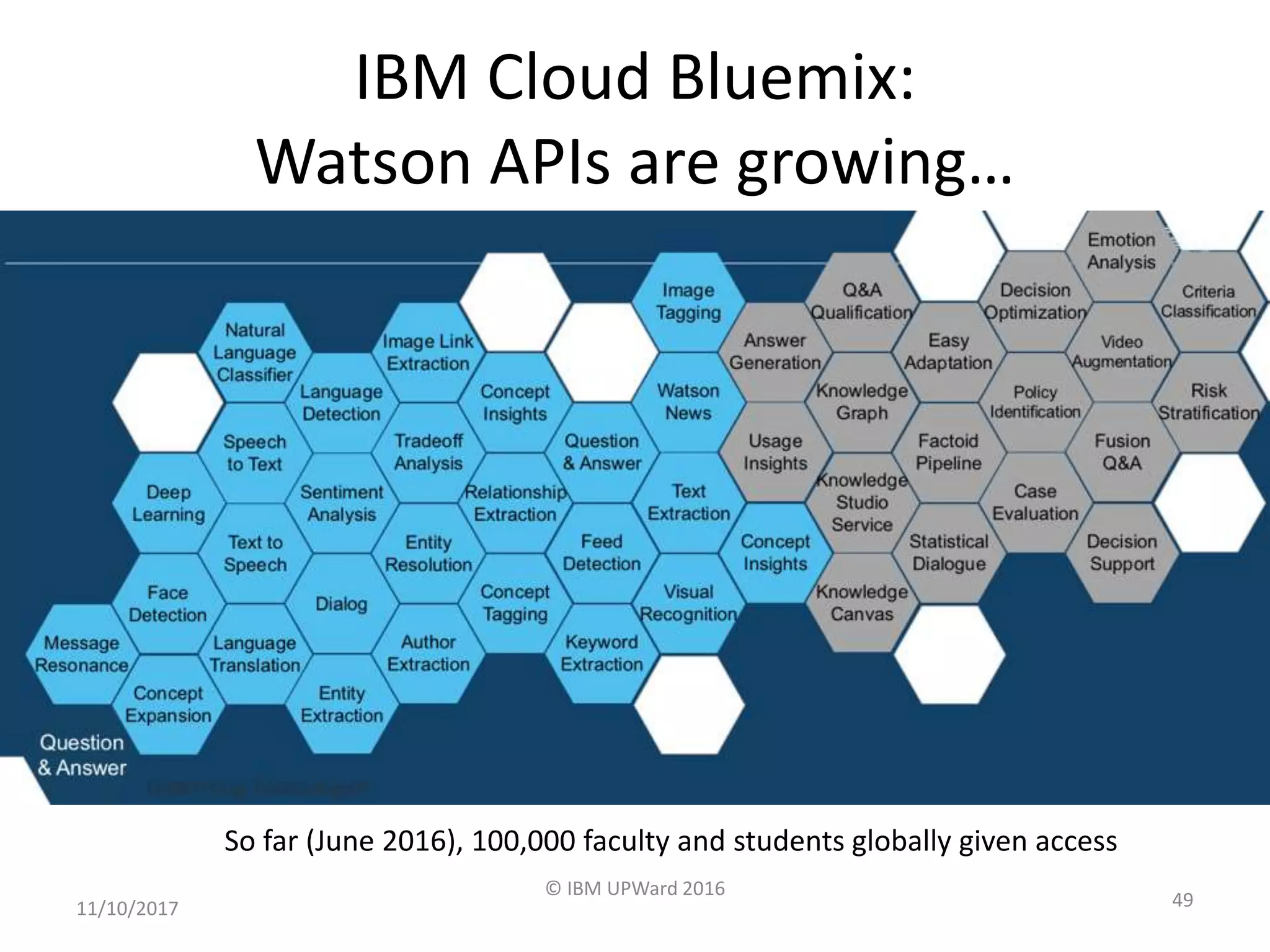
IBM Cloud Bluemix:
Watson APIs are growing…
11/10/2017
© IBM UPWard 2016
49
So far (June 2016), 100,000 faculty and students globally given access
11/10/2017
© IBM 2015, IBM Upward University
Programs Worldwide accelerating regional
development
50
Explain external
phenomena
11/10/2017
© IBM 2015, IBM Upward University
Programs Worldwide accelerating regional
development
51
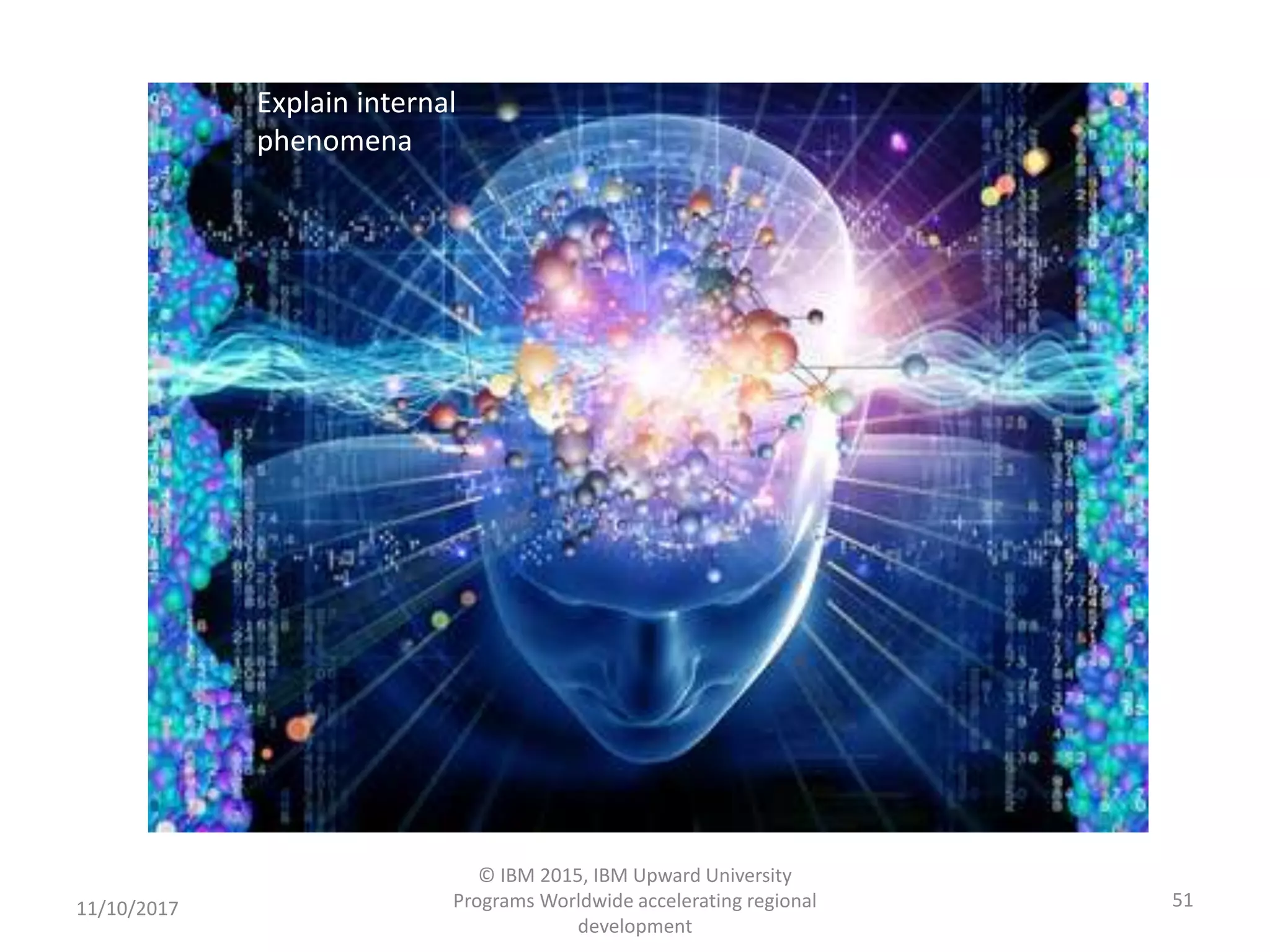
Explain internal
phenomena
11/10/2017
© IBM 2015, IBM Upward University
Programs Worldwide accelerating regional
development
52
Explain
value co-creation
phenomena
11/10/2017
© IBM 2015, IBM Upward University
Programs Worldwide accelerating regional
development
53
Physics Chemistry Biology
Neuroscience Psychology Artificial
Intelligence
Engineering Management Public
Policy
Education Design Humanities
Natural Systems
Cognitive Systems
Service Systems
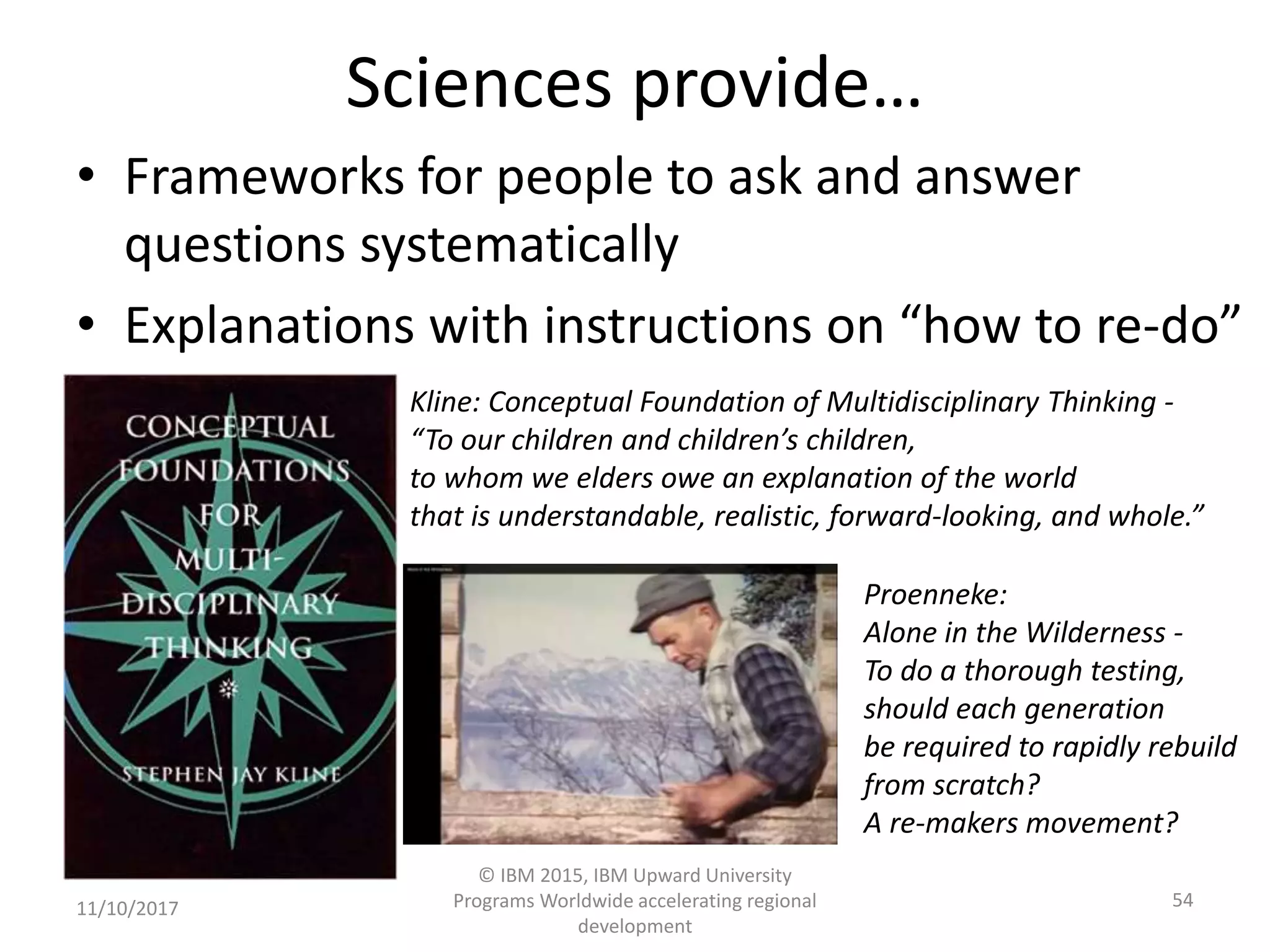
Sciences provide…
• Frameworks for people to ask and answer
questions systematically
• Explanations with instructions on “how to re-do”
11/10/2017
© IBM 2015, IBM Upward University
Programs Worldwide accelerating regional
development
54
Kline: Conceptual Foundation of Multidisciplinary Thinking -
“To our children and children’s children,
to whom we elders owe an explanation of the world
that is understandable, realistic, forward-looking, and whole.”
Proenneke:
Alone in the Wilderness -
To do a thorough testing,
should each generation
be required to rapidly rebuild
from scratch?
A re-makers movement?
Some paths to becoming 64x smarter:
Improving learning and performance
• 2x from Learning sciences (methods)
– Better models of concepts
– Better models of learners
• 2x from Learning technology (tools)
– Guided learning paths
– Elimination of “thrashing”
• 2x from Quantity effect (overlaps)
– More you know, faster you go
– Advanced organizers
• 2x from Lifelong learning (time)
– Longer lives and longer careers
– Keeps “learning-mode” activated
• 2x from Early learning (time)
– Start earlier: Challenged-based approach
– STEM-2D in K-12 (SSME+DAPP Design of Smart Service Systems)
• 2x from Cognitive systems (performance support)
– Technology & Infrastructure Interactions
– Organizations & Others Interactions
Next Generation:
Future-Ready T-Shaped Adaptive Innovators
Many disciplines
Many sectors
Many regions/cultures
(understanding & communications)
Deepinonesector
Deepinoneregion/culture
Deepinonediscipline
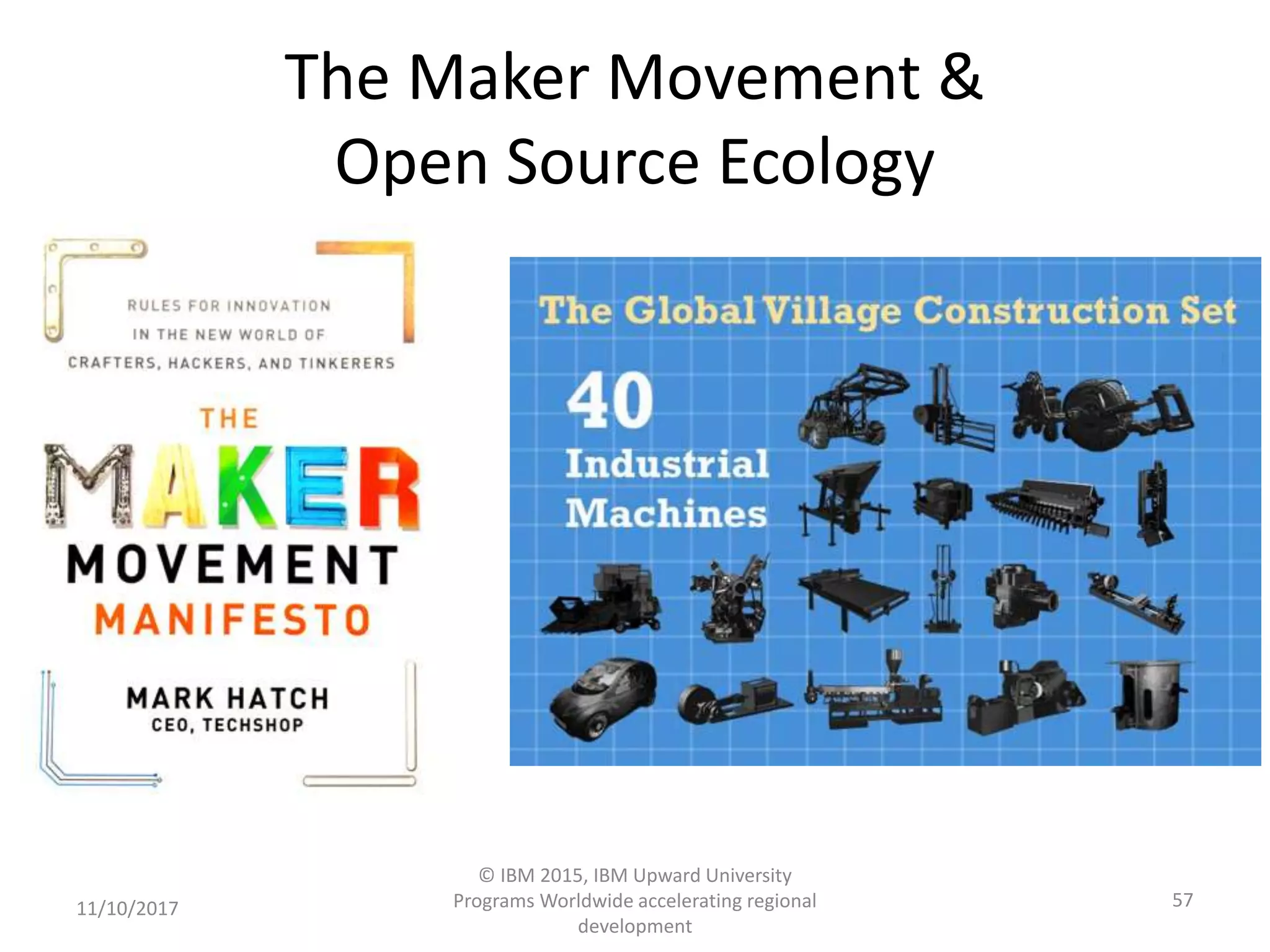
The Maker Movement &
Open Source Ecology
11/10/2017
© IBM 2015, IBM Upward University
Programs Worldwide accelerating regional
development
57
Assisting individuals and organizations
to close their service innovation skills gap
and co-create wiser service systems
empowering employees, customers, citizens
with cognitive mediators
in the collaborative service economy
Dedication: Doug Engelbart
Father of the mouse and
augmentation theory
11/10/2017
© IBM 2015, IBM Upward University
Programs Worldwide accelerating regional
development
59
But this stuff is still really hard…
11/10/2017
© IBM UPWard 2016
60
What is a cognitive system (entity)?
11/10/2017 Understanding Cognitive Systems 61
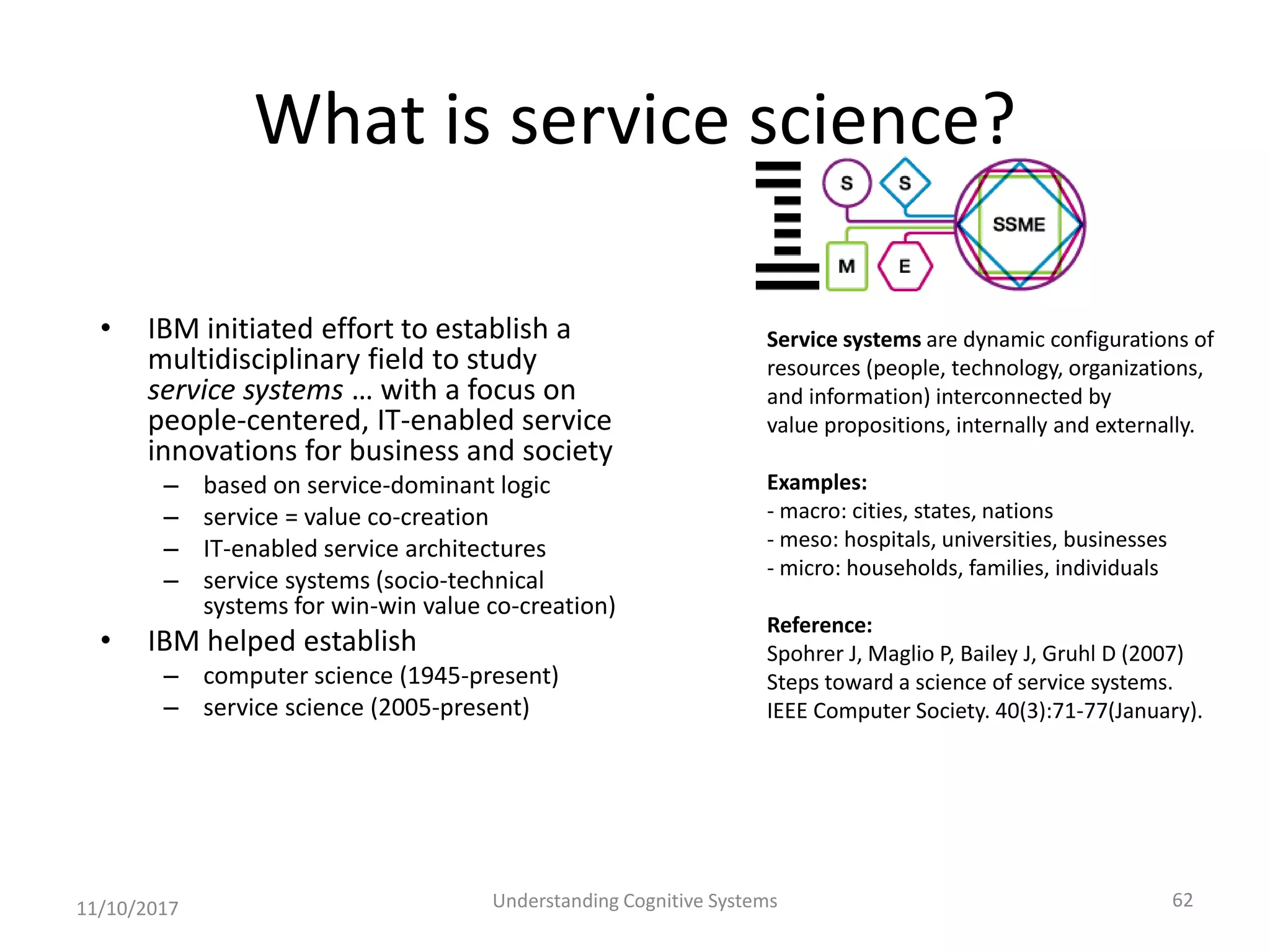
What is service science?
• IBM initiated effort to establish a
multidisciplinary field to study
service systems … with a focus on
people-centered, IT-enabled service
innovations for business and society
– based on service-dominant logic
– service = value co-creation
– IT-enabled service architectures
– service systems (socio-technical
systems for win-win value co-creation)
• IBM helped establish
– computer science (1945-present)
– service science (2005-present)
11/10/2017 Understanding Cognitive Systems 62
Service systems are dynamic configurations of
resources (people, technology, organizations,
and information) interconnected by
value propositions, internally and externally.
Examples:
- macro: cities, states, nations
- meso: hospitals, universities, businesses
- micro: households, families, individuals
Reference:
Spohrer J, Maglio P, Bailey J, Gruhl D (2007)
Steps toward a science of service systems.
IEEE Computer Society. 40(3):71-77(January).
What is service science?
• Now over 500 universities globally teach a more
multidisciplinary approach to service innovation,
including:
– Service management and marketing
– Service engineering and operations
– Service design and arts
– Service public policy and economics
– Service computing and informatics
• SSME + DAPP =
Service Science Management Engineering +
Design Arts Public Policy
– People, technology, organizations, information
interconnected by value propositions.
11/10/2017 Understanding Cognitive Systems 63
Reference:
IfM & IBM (2008). Succeeding through service
innovation: A service perspective for education,
research, business and government.
University of Cambridge Institute for Manufacturing,
Cambridge, UK. 2008.
How to get involved?
• Weekly speaker series
– Service innovation
– Service education & research
– Smart service/cognitive systems
• Discovery summits & book series
• Opportunities
– Institutional memberships
– Leadership & ambassadors
– Volunteer opportunities
– Awards & sponsored
conferences
11/10/2017 Understanding Cognitive Systems 64
ISSIP.org is a non-profit society
International Society of Service Innovation Professionals
Membership:
Over 1000 professionals and students from 40+ countries,
50+ companies and 50+ universities.
How to get involved?
• Journals (INFORMS,
etc.)
• Conferences (HICSS,
etc.)
• Courses (MIT, etc.)
• Funding (NSF, etc.)
• Society (ISSIP, etc.)
11/10/2017 Understanding Cognitive Systems 65
What are the hot topics?
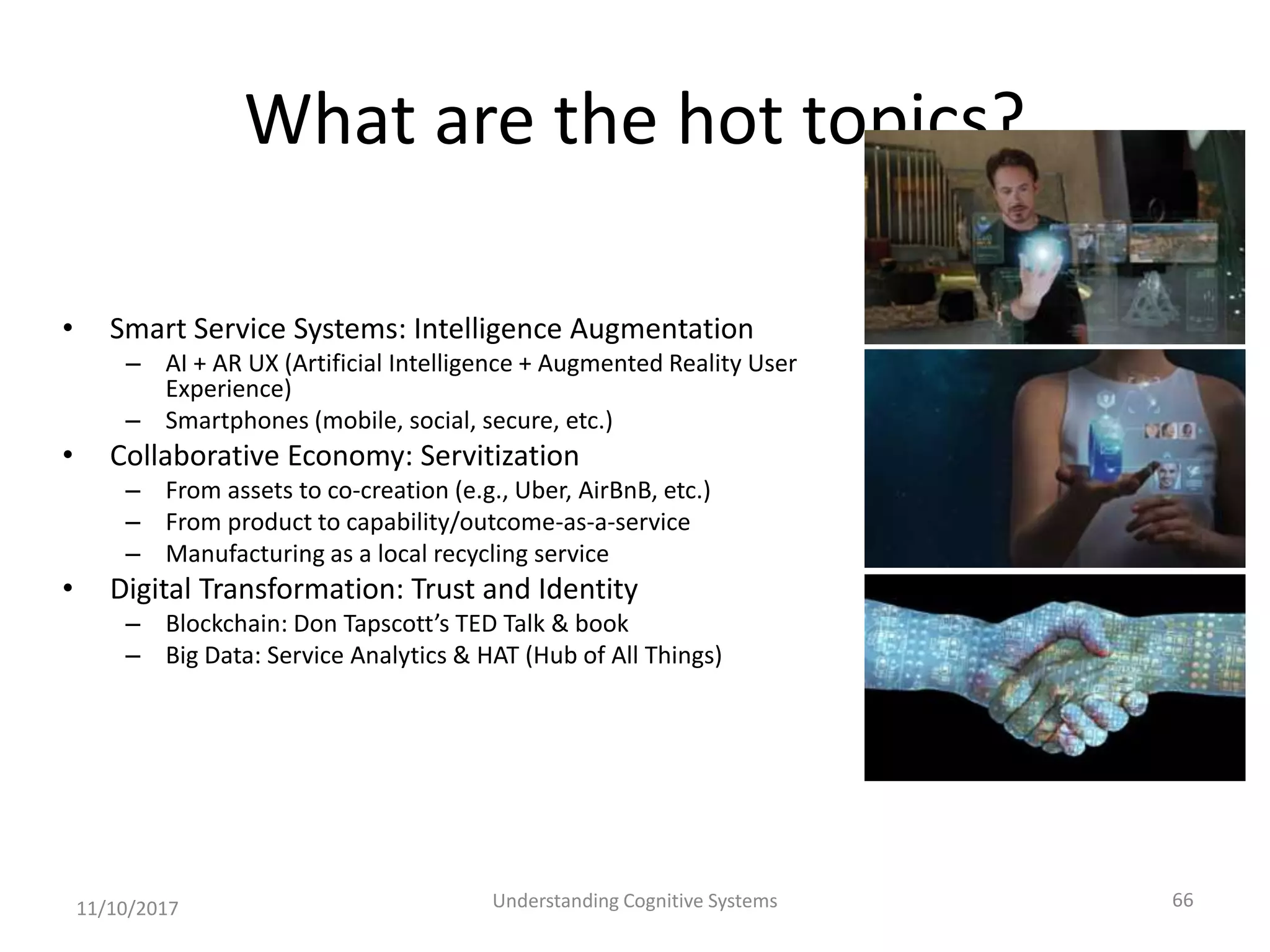
• Smart Service Systems: Intelligence Augmentation
– AI + AR UX (Artificial Intelligence + Augmented Reality User
Experience)
– Smartphones (mobile, social, secure, etc.)
• Collaborative Economy: Servitization
– From assets to co-creation (e.g., Uber, AirBnB, etc.)
– From product to capability/outcome-as-a-service
– Manufacturing as a local recycling service
• Digital Transformation: Trust and Identity
– Blockchain: Don Tapscott’s TED Talk & book
– Big Data: Service Analytics & HAT (Hub of All Things)
11/10/2017 Understanding Cognitive Systems 66
11/10/2017 © IBM Upaward 2016 67
11/10/2017
© IBM UPWard 2016
68
11/10/2017
© IBM UPWard 2016
69

Future 20171110 v14

  • 1.
    Jim Spohrer (IBM) FridayNovember 10, 2017 http://www.slideshare.net/spohrer/future-20171110-v14 11/10/2017 1 A look towards the future
  • 2.
    AI to IA(Cognitive) Timeline: Hard unsolved AI problems • 2012-2017 AI Pattern Recognition and Learning from Massive Labeled Data – Speech, image, translation, driverless, games – Chatbots as digital assistants • 2018 Video Understanding • 2021 Episodic Memory • 2022 Learning from Watching • 2024 Commonsense Reasoning • 2026 Learning from Reading • 2028 Learning from Responsible Doing • 2030 Fluent Conversation • 2031-2039 Cognitive Collaborator and Mediator; Intelligence Augmentation (IA) 11/10/2017 (c) IBM 2017, Cognitive Opentech Group 2 Which experts would be really surprised if it takes less time… and which experts really surprised if it takes longer?
  • 3.
    April 2017: TEDArai Todai Robot 11/10/2017 (c) IBM 2017, Cognitive Opentech Group 3 … when will your smartphone be capable of passing a university entrance exam?
  • 4.
    11/10/2017 © IBM UPWard2016 4 First consider this…
  • 5.
    Microsoft CaptionBot June19, 2016 11/10/2017 © IBM UPWard 2016 5
  • 6.
    Microsoft CaptionBot June20, 2016 11/10/2017 © IBM UPWard 2016 6
  • 7.
    IBM Image Tagging– June 19, 2016 11/10/2017 © IBM UPWard 2016 7
  • 8.
    Today: November 10,2017 11/10/2017 © IBM DBG COG 2017 8 IBM
  • 9.
    AI Trends 11/10/2017 © IBMCognitive Opentech Group (COG) 9 Dota 2 “Deep Learning” for “AI Pattern Recognition” depends on massive amounts of “labeled data” and computing power available since ~2012; Labeled data is simply input and output pairs, such as a sound and word, or image and word, or English sentence and French sentence, or road scene and car control settings – labeled data means having both input and output data in massive quantities. For example, 100K images of skin, half with skin cancer and half without to learn to recognize presence of skin cancer.
  • 10.
    Icons of AI Progress •1956: Dartmouth Conference organized by: – John McCarthy (Dartmouth, later Stanford) – Marvin Minsky (MIT) – and two senior scientists: • Claude Shannon (Bell Labs) • Nathan Rochester (IBM) • 1997: Deep Blue (IBM) - Chess • 2011: Watson Jeopardy! (IBM) • 2016: AlphaGo (Google DeepMinds) 11/10/2017 (c) IBM 2017, Cognitive Opentech Group 10
  • 11.
    11/10/2017 11 1955 19751995 2015 2035 2055 A look towards the future… Cognitive Mediator (2035): Progression from Tool, to Assistant, to Collaborator, to Coach
  • 12.
    Questions • What isthe timeline for solving AI and IA? • Who are the leaders driving AI progress? • What will the biggest benefits from AI be? • What are the biggest risks associated with AI, and are they real? • What other technologies may have a bigger impact than AI? • What are the implications for stakeholders? • How should we prepare to get the benefits and avoid the risks? 11/10/2017 (c) IBM 2017, Cognitive Opentech Group 12
  • 13.
    Every 20 years,compute costs are down by 1000x • Cost of Digital Workers – Moore’s Law can be thought of as lowering costs by a factor of a… • Thousand times lower in 20 years • Million times lower in 40 years • Billion times lower in 60 years • Smarter Tools (Terascale) – Terascale (2017) = $3K – Terascale (2020) = ~$1K • Narrow Worker (Petascale) – Recognition (Fast) – Petascale (2040) = ~$1K • Broad Worker (Exascale) – Reasoning (Slow) – Exascale (2060) = ~$1K 1311/10/2017 (c) IBM 2017, Cognitive Opentech Group 2080204020001960 $1K $1M $1B $1T 206020201980 +/- 10 years $1 Person Average Annual Salary (Living Income) Super Computer Cost Mainframe Cost Smartphone Cost T P E T P E AI Progress on Open Leaderboards Benchmark Roadmap to solve AI/IA
  • 14.
    GPD/Employee 11/10/2017 (c) IBM2017, Cognitive Opentech Group 14 (Source) Lower compute costs translate into increasing productivity and GDP/employees for nations Increasing productivity and GDP/employees should translate into wealthier citizens AI Progress on Open Leaderboards Benchmark Roadmap to solve AI/IA
  • 15.
    Leaderboards Framework AI Progresson Open Leaderboards - Benchmark Roadmap Perceive World Develop Cognition Build Relationships Fill Roles Pattern recognition Video understanding Memory Reasoning Social interactions Fluent conversation Assistant & Collaborator Coach & Mediator Speech Actions Declarative Deduction Scripts Speech Acts Tasks Institutions Chime Thumos SQuAD SAT ROC Story ConvAI Images Context Episodic Induction Plans Intentions Summarizatio n Values ImageNet VQA DSTC RALI General-AI Translation Narration Dynamic Abductive Goals Cultures Debate Negotiation WMT DeepVideo Alexa Prize ICCMA AT Learning from Labeled Training Data and Searching (Optimization) Learning by Watching and Reading (Education) Learning by Doing and being Responsible (Exploration) 2015 2018 2021 2024 2027 2030 2033 2036 11/10/2017 (c) IBM 2017, Cognitive Opentech Group 15 Which experts would be really surprised if it takes less time… and which experts really surprised if it takes longer? Approx. Year Human Level ->
  • 16.
    AI Leaders • Whois winning? – Regions China vs USA vs EU vs ROW – Companies Microsoft vs Google vs IBM • Leaderboards – SQuAD – Question Answering – EFF Measuring AI Progress 11/10/2017 (c) IBM 2017, Cognitive Opentech Group 16
  • 17.
    AI Benefits • Accessto expertise – “Insanely great” labor productivity for trusted service providers – Digital workers for healthcare, education, finance, etc. • Better choices – ”Insanely great” collaborations with others on what matters most – AI for IA = Augmented Intelligence and higher value co-creation interactions 11/10/2017 (c) IBM 2017, Cognitive Opentech Group 17
  • 18.
    AI Risks • JobLoss – Shorter term bigger risk = de-skilling • Super-intelligence – Shorter term bigger risk = bad actors 11/10/2017 (c) IBM 2017, Cognitive Opentech Group 18
  • 19.
    Other Technologies: Biggerimpact? Yes. • Augmented Reality (AR)/ Virtual Reality (VR) – Game worlds grow-up • Blockchain/ Security Systems – Trust and security immutable • Advanced Materials/ Energy Systems – Manufacturing as cheap, local recycling service (utility fog, artificial leaf, etc.) 11/10/2017 (c) IBM 2017, Cognitive Opentech Group 19
  • 20.
    Stakeholders • Individuals • Families •Businesses and other Organizations • Industry Groups • Regional Governments: – Cities – States – Nations 11/10/2017 (c) IBM 2017, Cognitive Opentech Group 20
  • 21.
    Be Prepared • Understandopen AI code + data + models + stacks + communities – Leaderboards – Ethical conduct • Learn 3 R’s of IBM’s Cognitive Opentech Group (COG) – Read arXiv – Redo with Github – Report with Jupyter notebooks on DSX and/or leaderboards • Improve your team’s skills of rapidly rebuilding from scratch – Build your open code eminence – Understand open innovation – Communities + Leaderboards 11/10/2017 (c) IBM 2017, Cognitive Opentech Group 21 1972 used Punch cards 2016 used IBM Watson Open APIs to win…
  • 22.
    Cupertino Teens • IBMWatson on Bluemix 11/10/2017 (c) IBM 2017, Cognitive Opentech Group 22 AI for NLP entity identification
  • 23.
    Courses • 2015 – “Howto build a cognitive system for Q&A task.” – 9 months to 40% question answering accuracy – 1-2 years for 90% accuracy, which questions to reject • 2025 – “How to use a cognitive system to be a better professional X.” – Tools to build a student level Q&A from textbook in 1 week • 2035 – “How to use your cognitive mediator to build a startup.” – Tools to build faculty level Q&A for textbook in one day – Cognitive mediator knows a person better than they know themselves • 2055 – “How to manage your workforce of digital workers.” – Most people have 100 digital workers. 11/10/2017 23 Take free online cognitive classes today at cognitiveclass.ai
  • 24.
    Headlines • 2017 Popular –“AI vs People” – “X-Y team up to invest big in AI” • 2025 Commonplace – “People using AI to become better at their professions, serving others.” – “Teenagers using AI to solve challenges, and improve their communities.” • 2085 Resilience – “Teams competing to rapidly rebuild socio-economic-technical systems (wise service systems) from scratch” – “U.N. Pluto-base makes major discovery about nature of universe. U.F.P. established.” 11/10/2017 (c) IBM 2017, Cognitive Opentech Group 24 IEEE 2017
  • 25.
    IBM-MIT $240M over10 year AI mission 11/10/2017 (c) IBM 2017, Cognitive Opentech Group 25
  • 26.
  • 27.
    11/10/2017 © IBM 2015,IBM Upward University Programs Worldwide accelerating regional development 27 Cognitive Mediators for all people in all roles
  • 28.
    Occupations = ManyTasks 11/10/2017 © IBM 2015, IBM Upward University Programs Worldwide accelerating regional development 28
  • 29.
    Watson Discovery Advisor 11/10/2017 ©IBM 2015, IBM Upward University Programs Worldwide accelerating regional development 29 Simonite, T. 2014. Software Mines Science Papers to Make New Discoveries. MIT. November 25, 2014. URL: http://m.technologyreview.com/news/520461/software-mines-science-papers-to-make-new-discoveries/
  • 30.
    User Models 11/10/2017 © IBM2015, IBM Upward University Programs Worldwide accelerating regional development 30
  • 31.
    Computing: Then, Now,Projected 11/10/2017 31 2035 2055
  • 32.
    11/10/2017 © IBM 2015,IBM Upward University Programs Worldwide accelerating regional development 32
  • 33.
    Build: 10 millionminutes of experience 11/10/2017 Understanding Cognitive Systems 33
  • 34.
    Build: 2 millionminutes of experience 11/10/2017 Understanding Cognitive Systems 34
  • 35.
    Build: Hardware < Software< Data < Experience < Transformation 11/10/2017 Understanding Cognitive Systems 35
  • 36.
    “These amazing technologiesmust be able to help people like myself…” 11/10/2017 (c) IBM 2017, Cognitive Opentech Group 36
  • 37.
    “AI will changethe world? Who will change AI?” 11/10/2017 (c) IBM 2017, Cognitive Opentech Group 37
  • 38.
    11/10/2017 © IBM 2015,IBM Upward University Programs Worldwide accelerating regional development 38
  • 39.
    11/10/2017 © IBM 2015,IBM Upward University Programs Worldwide accelerating regional development 39 Future of Skills
  • 40.
  • 41.
    In Summary 11/10/2017 © IBM2015, IBM Upward University Programs Worldwide accelerating regional development 41 “A service science perspective considers the evolving ecology of service system entities, their value co-creation and capability co-elevation interactions, and their capabilities, constraints, rights, and responsibilities.” Cognitive Systems Entities Service Systems Entities With Cognitive Mediators Add Rights & Responsibilities
  • 42.
  • 43.
    IBM in SiliconValley: From Punch Cards…. 11/10/2017 © IBM 2015, IBM Upward University Programs Worldwide accelerating regional development 43 On August 22, 1943, 105 men, women and children, among them 43 IBM employees, alighted from a special train that carried them across the continent to establish new homes and the new IBM Card Manufacturing Plant Number 5 at 16th and St. John Streets, San Jose, CA.
  • 44.
    11/10/2017 © IBM 2015,IBM Upward University Programs Worldwide accelerating regional development 44
  • 45.
    Types • Tool • Assistant •Collaborator • Coach • Mediator 11/10/2017 Understanding Cognitive Systems 45
  • 46.
    Types: Progression ofmodels and capabilities 11/10/2017 Understanding Cognitive Systems 46 Task & World Model/ Planning & Decisions Self Model/ Self Capacity & Limits User Model/ User’s Episodic Memory and Identity Institutions Model/ Trust & Social Acts Tool + - - - Assistant ++ + - - Collaborator +++ ++ + - Coach ++++ +++ ++ + Mediator +++++ ++++ +++ ++ tool assistant collaborator coach mediator
  • 47.
    Partnership for AIformed 11/10/2017 Understanding Cognitive Systems 47
  • 48.
    How fast isReality 2.0 approaching? 11/10/2017 48 What might it look like?
  • 49.
    IBM Cloud Bluemix: WatsonAPIs are growing… 11/10/2017 © IBM UPWard 2016 49 So far (June 2016), 100,000 faculty and students globally given access
  • 50.
    11/10/2017 © IBM 2015,IBM Upward University Programs Worldwide accelerating regional development 50 Explain external phenomena
  • 51.
    11/10/2017 © IBM 2015,IBM Upward University Programs Worldwide accelerating regional development 51 Explain internal phenomena
  • 52.
    11/10/2017 © IBM 2015,IBM Upward University Programs Worldwide accelerating regional development 52 Explain value co-creation phenomena
  • 53.
    11/10/2017 © IBM 2015,IBM Upward University Programs Worldwide accelerating regional development 53 Physics Chemistry Biology Neuroscience Psychology Artificial Intelligence Engineering Management Public Policy Education Design Humanities Natural Systems Cognitive Systems Service Systems
  • 54.
    Sciences provide… • Frameworksfor people to ask and answer questions systematically • Explanations with instructions on “how to re-do” 11/10/2017 © IBM 2015, IBM Upward University Programs Worldwide accelerating regional development 54 Kline: Conceptual Foundation of Multidisciplinary Thinking - “To our children and children’s children, to whom we elders owe an explanation of the world that is understandable, realistic, forward-looking, and whole.” Proenneke: Alone in the Wilderness - To do a thorough testing, should each generation be required to rapidly rebuild from scratch? A re-makers movement?
  • 55.
    Some paths tobecoming 64x smarter: Improving learning and performance • 2x from Learning sciences (methods) – Better models of concepts – Better models of learners • 2x from Learning technology (tools) – Guided learning paths – Elimination of “thrashing” • 2x from Quantity effect (overlaps) – More you know, faster you go – Advanced organizers • 2x from Lifelong learning (time) – Longer lives and longer careers – Keeps “learning-mode” activated • 2x from Early learning (time) – Start earlier: Challenged-based approach – STEM-2D in K-12 (SSME+DAPP Design of Smart Service Systems) • 2x from Cognitive systems (performance support) – Technology & Infrastructure Interactions – Organizations & Others Interactions
  • 56.
    Next Generation: Future-Ready T-ShapedAdaptive Innovators Many disciplines Many sectors Many regions/cultures (understanding & communications) Deepinonesector Deepinoneregion/culture Deepinonediscipline
  • 57.
    The Maker Movement& Open Source Ecology 11/10/2017 © IBM 2015, IBM Upward University Programs Worldwide accelerating regional development 57
  • 58.
    Assisting individuals andorganizations to close their service innovation skills gap and co-create wiser service systems empowering employees, customers, citizens with cognitive mediators in the collaborative service economy
  • 59.
    Dedication: Doug Engelbart Fatherof the mouse and augmentation theory 11/10/2017 © IBM 2015, IBM Upward University Programs Worldwide accelerating regional development 59
  • 60.
    But this stuffis still really hard… 11/10/2017 © IBM UPWard 2016 60
  • 61.
    What is acognitive system (entity)? 11/10/2017 Understanding Cognitive Systems 61
  • 62.
    What is servicescience? • IBM initiated effort to establish a multidisciplinary field to study service systems … with a focus on people-centered, IT-enabled service innovations for business and society – based on service-dominant logic – service = value co-creation – IT-enabled service architectures – service systems (socio-technical systems for win-win value co-creation) • IBM helped establish – computer science (1945-present) – service science (2005-present) 11/10/2017 Understanding Cognitive Systems 62 Service systems are dynamic configurations of resources (people, technology, organizations, and information) interconnected by value propositions, internally and externally. Examples: - macro: cities, states, nations - meso: hospitals, universities, businesses - micro: households, families, individuals Reference: Spohrer J, Maglio P, Bailey J, Gruhl D (2007) Steps toward a science of service systems. IEEE Computer Society. 40(3):71-77(January).
  • 63.
    What is servicescience? • Now over 500 universities globally teach a more multidisciplinary approach to service innovation, including: – Service management and marketing – Service engineering and operations – Service design and arts – Service public policy and economics – Service computing and informatics • SSME + DAPP = Service Science Management Engineering + Design Arts Public Policy – People, technology, organizations, information interconnected by value propositions. 11/10/2017 Understanding Cognitive Systems 63 Reference: IfM & IBM (2008). Succeeding through service innovation: A service perspective for education, research, business and government. University of Cambridge Institute for Manufacturing, Cambridge, UK. 2008.
  • 64.
    How to getinvolved? • Weekly speaker series – Service innovation – Service education & research – Smart service/cognitive systems • Discovery summits & book series • Opportunities – Institutional memberships – Leadership & ambassadors – Volunteer opportunities – Awards & sponsored conferences 11/10/2017 Understanding Cognitive Systems 64 ISSIP.org is a non-profit society International Society of Service Innovation Professionals Membership: Over 1000 professionals and students from 40+ countries, 50+ companies and 50+ universities.
  • 65.
    How to getinvolved? • Journals (INFORMS, etc.) • Conferences (HICSS, etc.) • Courses (MIT, etc.) • Funding (NSF, etc.) • Society (ISSIP, etc.) 11/10/2017 Understanding Cognitive Systems 65
  • 66.
    What are thehot topics? • Smart Service Systems: Intelligence Augmentation – AI + AR UX (Artificial Intelligence + Augmented Reality User Experience) – Smartphones (mobile, social, secure, etc.) • Collaborative Economy: Servitization – From assets to co-creation (e.g., Uber, AirBnB, etc.) – From product to capability/outcome-as-a-service – Manufacturing as a local recycling service • Digital Transformation: Trust and Identity – Blockchain: Don Tapscott’s TED Talk & book – Big Data: Service Analytics & HAT (Hub of All Things) 11/10/2017 Understanding Cognitive Systems 66
  • 67.
    11/10/2017 © IBMUpaward 2016 67
  • 68.
  • 69.