© Semiconductor Components Industries, LLC, 2016
July, 2016 − Rev. 5
1 Publication Order Number:
EVBUM2130/D
A5191HRTNGEVB
A5191HRTNGEVB
Evaluation Board User's
Manual
Introduction
The A5191HRTNGEVB evaluation board includes all
external components needed for operating the
A5191HRT IC and demonstrates the small PCB surface area
such an implementation requires. The EVB allows easy
design of HART® implementations using A5191HRT.
Overview
The A5191HRT is a single−chip, CMOS modem for use
in highway addressable remote transducer (HART) field
instruments and masters. The modem and a few external
passive components provide all of the functions needed to
satisfy HART physical layer requirements including
modulation, demodulation, receive filtering, carrier detect,
and transmit−signal shaping.
The A5191HRT uses phase continuous frequency shift
keying (FSK) at 1200 bits per second. To conserve power the
receive circuits are disabled during transmit operations and
vice versa. This provides the half−duplex operation used in
HART communications.
Features
• Single−chip, Half−duplex 1200 Bits per Second FSK
Modem
• Bell 202 Shift Frequencies of 1200 Hz and 2200 Hz
• 3.0 V − 5.5 V Power Supply
• Transmit−signal Wave Shaping
• Receive Band−pass Filter
• Low Power: Optimal for Intrinsically Safe Applications
• Compatible with 3.3 V or 5 V Microcontroller
• Internal Oscillator Requires 460.8 kHz Crystal or
Ceramic Resonator
• Meets HART Physical Layer Requirements
• Industrial Temperature Range of −40°C to +85°C
• Available in 28−pin PLCC, 32−pin QFN and 32−pin
LQFP Packages
Applications
• HART Multiplexers
• HART Modem Interfaces
• 4 – 20 mA Loop Powered Transmitters
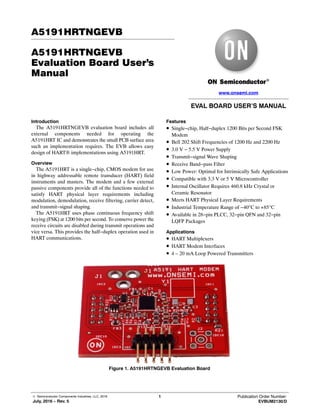
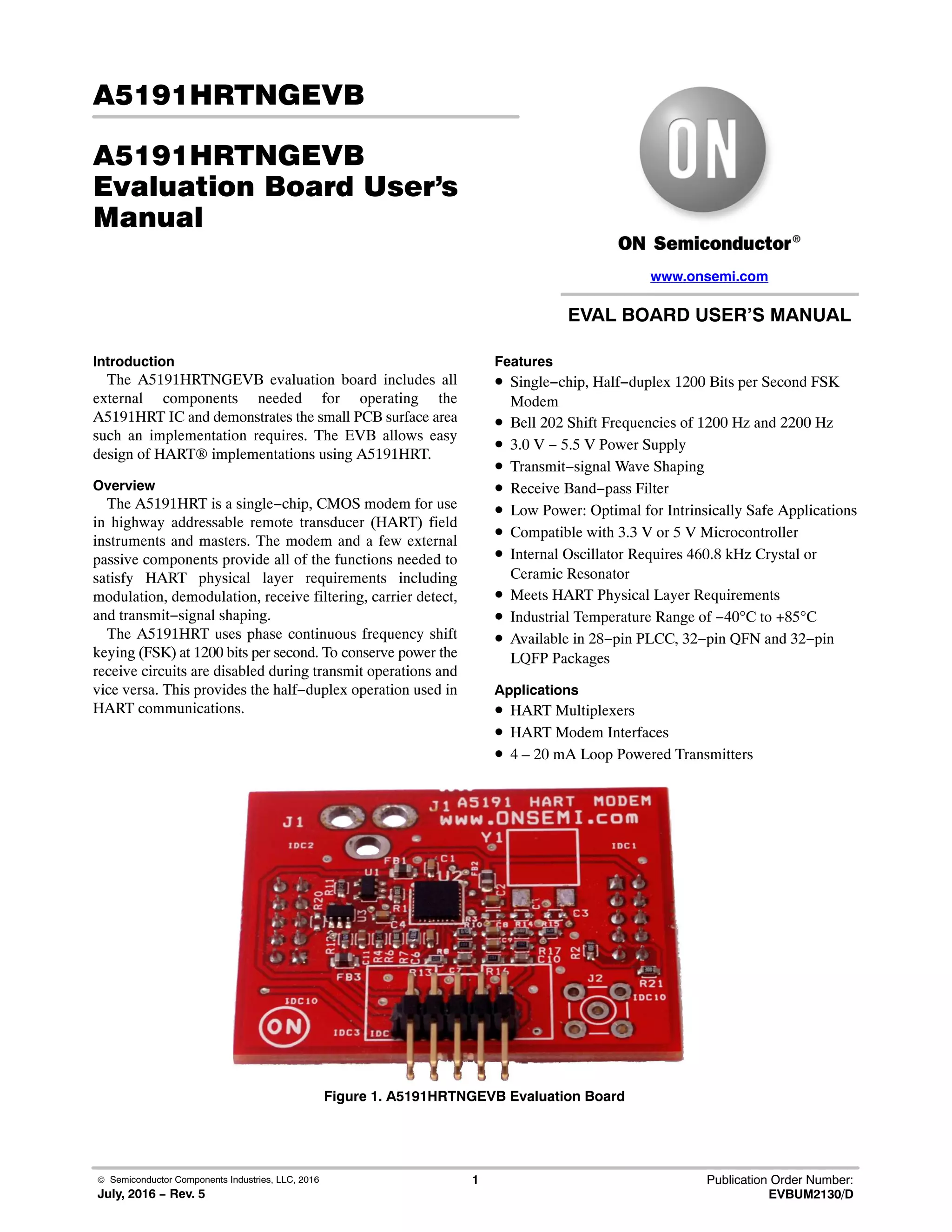
Figure 1. A5191HRTNGEVB Evaluation Board
www.onsemi.com
EVAL BOARD USER’S MANUAL
A5191HRTNGEVB
www.onsemi.com
2
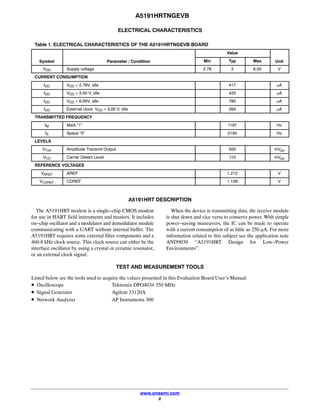
ELECTRICAL CHARACTERISTICS
Table 1. ELECTRICAL CHARACTERISTICS OF THE A5191HRTNGEVB BOARD
Symbol Parameter / Condition
Value
Unit
Min Typ Max
VDD Supply voltage 2.78 3 6.00 V
CURRENT CONSUMPTION
IDD VDD = 2.78V, idle 417 mA
IDD VDD = 3.00 V, idle 420 mA
IDD VDD = 6.00V, idle 780 mA
IDD External clock, VDD = 3.00 V, idle 350 mA
TRANSMITTED FREQUENCY
fM Mark “1” 1197 Hz
fS Space “0” 2194 Hz
LEVELS
VTxA Amplitude Transmit Output 500 mVpp
VCD Carrier Detect Level 110 mVpp
REFERENCE VOLTAGES
VAREF AREF 1.212 V
VCDREF CDREF 1.128 V
A5191HRT DESCRIPTION
The A5191HRT modem is a single−chip CMOS modem
for use in HART field instruments and masters. It includes
on−chip oscillator and a modulator and demodulator module
communicating with a UART without internal buffer. The
A5191HRT requires some external filter components and a
460.8 kHz clock source. This clock source can either be the
interface oscillator by using a crystal or ceramic resonator,
or an external clock signal.
When the device is transmitting data, the receive module
is shut down and vice versa to conserve power. With simple
power−saving maneuvers, the IC can be made to operate
with a current consumption of as little as 250 mA. For more
information related to this subject see the application note
AND9030 “A5191HRT Design for Low−Power
Environments”.
TEST AND MEASUREMENT TOOLS
Listed below are the tools used to acquire the values presented in this Evaluation Board User’s Manual.
• Oscilloscope Tektronix DPO4034 350 MHz
• Signal Generator Agilent 33120A
• Network Analyzer AP Instruments 300
A5191HRTNGEVB
www.onsemi.com
3
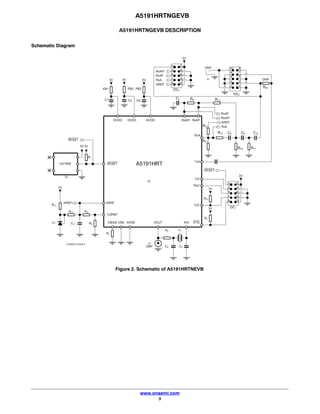
A5191HRTNGEVB DESCRIPTION
Schematic Diagram
Figure 2. Schematic of A5191HRTNEVB
A5191HRTNGEVB
www.onsemi.com
4
BOM List
Table 2. A5191HRTNEVB BILL OF MATERIALS
Quantity Reference Value; Size Manufacturer & Comments
4 C1, C2, C4, C6 100 nF, 0603
3 C3, C5, C7 220 pF, 0603
2 C8, C9 1 nF, 0603
2 C10, C11 470 pF, 0603
3 FB1, FB2, FB3 600Z, 0805
3 IDC1, IDC2, IDC3 0.1” header, 10 pin
1 J1 Barrel connector Not populated
1 J2 SMB connector Not populated
4 R1, R2, R6, R21 200k, 0603
1 R3 0R, 0603
2 R4, R11 14k7, 0603
2 R7, R14 499k, 0603
3 R8, R16, R17 215k, 0603
1 R12 1k, 0603
1 R10 422k, 0603
1 R13 3M, 0603
1 R15 787k, 0603
1 R18 24k, 0603
1 R20 DNP, 0603 Not populated
1 U1 CAT808NTDI−27GT3 ON Semiconductor
1 U2 A5191HRT ON Semiconductor
1 U3 TLV431ASNT1G ON Semiconductor
1 Y1 460.8 kHz ECS Crystal ZTBF−460.8−E
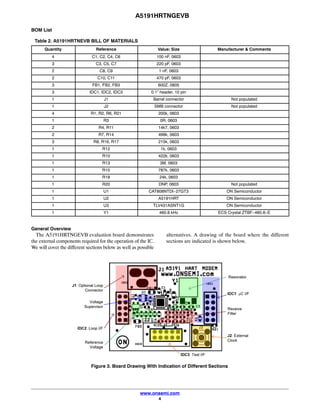
General Overview
The A5191HRTNGEVB evaluation board demonstrates
the external components required for the operation of the IC.
We will cover the different sections below as well as possible
alternatives. A drawing of the board where the different
sections are indicated is shown below.
Figure 3. Board Drawing With Indication of Different Sections
A5191HRTNGEVB
www.onsemi.com
5
Power Supply and References
Power Supply
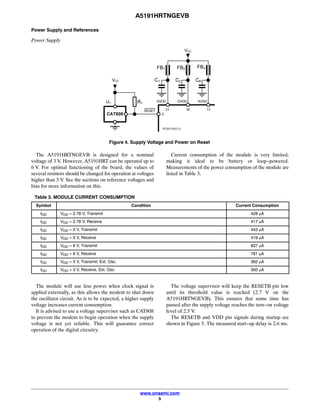
Figure 4. Supply Voltage and Power on Reset
The A5191HRTNGEVB is designed for a nominal
voltage of 3 V. However, A5191HRT can be operated up to
6 V. For optimal functioning of the board, the values of
several resistors should be changed for operation at voltages
higher than 3 V. See the sections on reference voltages and
bias for more information on this.
Current consumption of the module is very limited,
making it ideal to be battery or loop−powered.
Measurements of the power consumption of the module are
listed in Table 3.
Table 3. MODULE CURRENT CONSUMPTION
Symbol Condition Current Consumption
IDD VDD = 2.78 V, Transmit 428 mA
IDD VDD = 2.78 V, Receive 417 mA
IDD VDD = 3 V, Transmit 443 mA
IDD VDD = 3 V, Receive 419 mA
IDD VDD = 6 V, Transmit 837 mA
IDD VDD = 6 V, Receive 781 mA
IDD VDD = 3 V, Transmit, Ext. Osc. 362 mA
IDD VDD = 3 V, Receive, Ext. Osc. 350 mA
The module will use less power when clock signal is
applied externally, as this allows the modem to shut down
the oscillator circuit. As is to be expected, a higher supply
voltage increases current consumption.
It is advised to use a voltage supervisor such as CAT808
to prevent the modem to begin operation when the supply
voltage is not yet reliable. This will guarantee correct
operation of the digital circuitry.
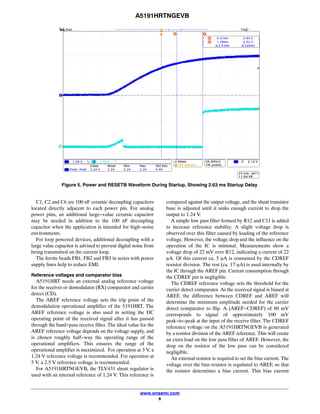
The voltage supervisor will keep the RESETB pin low
until its threshold value is reached (2.7 V on the
A5191HRTNGEVB). This ensures that some time has
passed after the supply voltage reaches the turn−on voltage
level of 2.5 V.
The RESETB and VDD pin signals during startup are
shown in Figure 5. The measured start−up delay is 2.6 ms.
A5191HRTNGEVB
www.onsemi.com
6
Figure 5. Power and RESETB Waveform During Startup, Showing 2.63 ms Startup Delay
C1, C2 and C6 are 100 nF ceramic decoupling capacitors
located directly adjacent to each power pin. For analog
power pins, an additional large−value ceramic capacitor
may be needed in addition to the 100 nF decoupling
capacitor when the application is intended for high−noise
environments.
For loop powered devices, additional decoupling with a
large value capacitor is advised to prevent digital noise from
being transmitted on the current loop.
The ferrite beads FB1, FB2 and FB3 in series with power
supply lines help to reduce EMI.
Reference voltages and comparator bias
A5191HRT needs an external analog reference voltage
for the receiver or demodulator (RX) comparator and carrier
detect (CD).
The AREF reference voltage sets the trip point of the
demodulation operational amplifier of the 5191HRT. The
AREF reference voltage is also used in setting the DC
operating point of the received signal after it has passed
through the band−pass receive filter. The ideal value for the
AREF reference voltage depends on the voltage supply, and
is chosen roughly half−way the operating range of the
operational amplifiers. This ensures the range of the
operational amplifier is maximized. For operation at 3 V, a
1.24 V reference voltage is recommended. For operation at
5 V, a 2.5 V reference voltage is recommended.
For A5191HRTNGEVB, the TLV431 shunt regulator is
used with an internal reference of 1.24 V. This reference is
compared against the output voltage, and the shunt transistor
base is adjusted until it sinks enough current to drop the
output to 1.24 V.
A simple low pass filter formed by R12 and C11 is added
to increase reference stability. A slight voltage drop is
observed over this filter caused by loading of the reference
voltage. However, the voltage drop and the influence on the
operation of the IC is minimal. Measurements show a
voltage drop of 22 mV over R12, indicating a current of 22
mA. Of this current ca. 5 mA is consumed by the CDREF
resistor division. The rest (ca. 17 mA) is used internally by
the IC through the AREF pin. Current consumption through
the CDREF pin is negligible.
The CDREF reference voltage sets the threshold for the
carrier detect comparator. As the received signal is biased at
AREF, the difference between CDREF and AREF will
determine the minimum amplitude needed for the carrier
detect comparator to flip. A (AREF−CDREF) of 80 mV
corresponds to signal of approximately 100 mV
peak−to−peak at the input of the receive filter. The CDREF
reference voltage on the A5191HRTNGEVB is generated
by a resistor division of the AREF reference. This will create
an extra load on the low pass filter of AREF. However, the
drop on the resistor of the low pass can be considered
negligible.
An external resistor is required to set the bias current. The
voltage over the bias resistor is regulated to AREF, so that
the resistor determines a bias current. This bias current
A5191HRTNGEVB
www.onsemi.com
7
controls the operating parameters of the internal operational
amplifiers and comparators and should be set to
approximately 2.5 mA. A bias resistor of 499 kW is used on
the A5191HRTNGEVB. For low cost solutions, a 470 kW is
acceptable with minimal effect on operation.
Table 4. REFERENCE VOLTAGES
Description Value
AREF reference voltage 1.212 V
CDREF reference voltage 1.128 V
Current through R12 22 mA
Figure 6. Reference Voltages Schematic
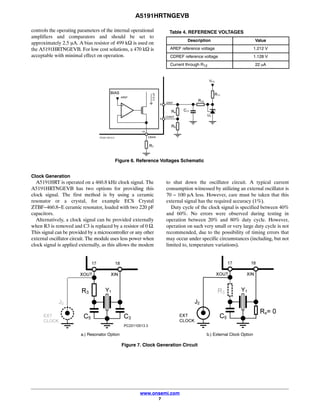
Clock Generation
A5191HRT is operated on a 460.8 kHz clock signal. The
A5191HRTNGEVB has two options for providing this
clock signal. The first method is by using a ceramic
resonator or a crystal, for example ECS Crystal
ZTBF−460.8−E ceramic resonator, loaded with two 220 pF
capacitors.
Alternatively, a clock signal can be provided externally
when R3 is removed and C3 is replaced by a resistor of 0 W.
This signal can be provided by a microcontroller or any other
external oscillator circuit. The module uses less power when
clock signal is applied externally, as this allows the modem
to shut down the oscillator circuit. A typical current
consumption witnessed by utilizing an external oscillator is
70 − 100 mA less. However, care must be taken that this
external signal has the required accuracy (1%).
Duty cycle of the clock signal is specified between 40%
and 60%. No errors were observed during testing in
operation between 20% and 80% duty cycle. However,
operation on such very small or very large duty cycle is not
recommended, due to the possibility of timing errors that
may occur under specific circumstances (including, but not
limited to, temperature variations).
Figure 7. Clock Generation Circuit
a.) Resonator Option b.) External Clock Option
A5191HRTNGEVB
www.onsemi.com
8
Microcontroller Interface IDC1
RESET
R2
1
22
23
25
26
RxD
CD
TxD
RTS
2
3
5
7
9
IDC1
VCC
VCC
R23
PC20110513
.4
Figure 8. Microcontroller Interface
Table 5. MICROCONTROLLER INTERFACE
Pin Number Signal Type Description
1 RST Open drain Reset signal from the voltage supervisor, open drain with pull−up
3 CD Output Carrier Detect
5 RxD Input Receive from microcontroller
7 TxD Output Transmit towards microcontroller
9 RTSB Input Request to send
2, 10 VDD Power 3 V nominal
4, 6, 8 GND Power
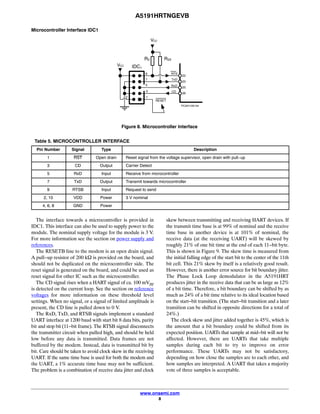
The interface towards a microcontroller is provided in
IDC1. This interface can also be used to supply power to the
module. The nominal supply voltage for the module is 3 V.
For more information see the section on power supply and
references.
The RESETB line to the modem is an open drain signal.
A pull−up resistor of 200 kW is provided on the board, and
should not be duplicated on the microcontroller side. The
reset signal is generated on the board, and could be used as
reset signal for other IC such as the microcontroller.
The CD signal rises when a HART signal of ca. 100 mVpp
is detected on the current loop. See the section on reference
voltages for more information on these threshold level
settings. When no signal, or a signal of limited amplitude is
present, the CD line is pulled down to 0 V.
The RxD, TxD, and RTSB signals implement a standard
UART interface at 1200 baud with start bit 8 data bits, parity
bit and stop bit (11−bit frame). The RTSB signal disconnects
the transmitter circuit when pulled high, and should be held
low before any data is transmitted. Data frames are not
buffered by the modem. Instead, data is transmitted bit by
bit. Care should be taken to avoid clock skew in the receiving
UART. If the same time base is used for both the modem and
the UART, a 1% accurate time base may not be sufficient.
The problem is a combination of receive data jitter and clock
skew between transmitting and receiving HART devices. If
the transmit time base is at 99% of nominal and the receive
time base in another device is at 101% of nominal, the
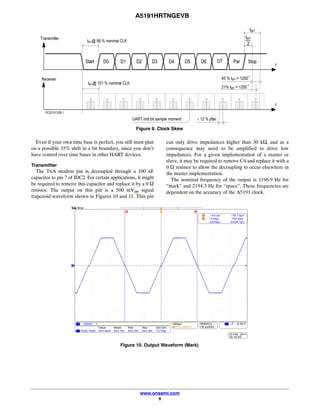
receive data (at the receiving UART) will be skewed by
roughly 21% of one bit time at the end of each 11−bit byte.
This is shown in Figure 9. The skew time is measured from
the initial falling edge of the start bit to the center of the 11th
bit cell. This 21% skew by itself is a relatively good result.
However, there is another error source for bit boundary jitter.
The Phase Lock Loop demodulator in the A5191HRT
produces jitter in the receive data that can be as large as 12%
of a bit time. Therefore, a bit boundary can be shifted by as
much as 24% of a bit time relative to its ideal location based
on the start−bit transition. (The start−bit transition and a later
transition can be shifted in opposite directions for a total of
24%.)
The clock skew and jitter added together is 45%, which is
the amount that a bit boundary could be shifted from its
expected position. UARTs that sample at mid−bit will not be
affected. However, there are UARTs that take multiple
samples during each bit to try to improve on error
performance. These UARTs may not be satisfactory,
depending on how close the samples are to each other, and
how samples are interpreted. A UART that takes a majority
vote of three samples is acceptable.
A5191HRTNGEVB
www.onsemi.com
9
Figure 9. Clock Skew
Even if your own time base is perfect, you still must plan
on a possible 35% shift in a bit boundary, since you don’t
have control over time bases in other HART devices.
Transmitter
The TxA modem pin is decoupled through a 100 nF
capacitor to pin 7 of IDC2. For certain applications, it might
be required to remove this capacitor and replace it by a 0 W
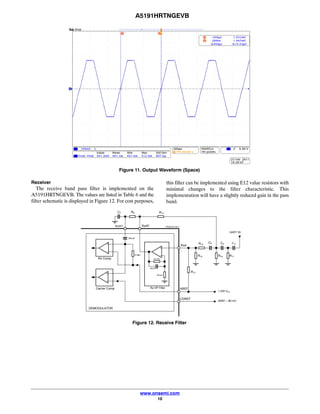
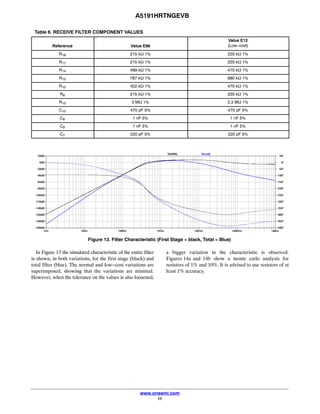
resistor. The output on this pin is a 500 mVpp signal
trapezoid waveform shown in Figures 10 and 11. This pin
can only drive impedances higher than 30 kW, and as a
consequence may need to be amplified to drive low
impedances. For a given implementation of a master or
slave, it may be required to remove C4 and replace it with a
0 W resistor to allow the decoupling to occur elsewhere in
the master implementation.
The nominal frequency of the output is 1196.9 Hz for
“mark” and 2194.3 Hz for “space”. These frequencies are
dependent on the accuracy of the A5191 clock.
Figure 10. Output Waveform (Mark)
A5191HRTNGEVB
www.onsemi.com
10
Figure 11. Output Waveform (Space)
Receiver
The receive band pass filter is implemented on the
A5191HRTNGEVB. The values are listed in Table 6 and the
filter schematic is displayed in Figure 12. For cost purposes,
this filter can be implemented using E12 value resistors with
minimal changes to the filter characteristic. This
implementation will have a slightly reduced gain in the pass
band.
Figure 12. Receive Filter
A5191HRTNGEVB
www.onsemi.com
11
Table 6. RECEIVE FILTER COMPONENT VALUES
Reference Value E96
Value E12
(Low−cost)
R16 215 kW 1% 220 kW 1%
R17 215 kW 1% 220 kW 1%
R14 499 kW 1% 470 kW 1%
R15 787 kW 1% 680 kW 1%
R10 422 kW 1% 470 kW 1%
R8 215 kW 1% 220 kW 1%
R13 3 MW 1% 3.3 MW 1%
C10 470 pF 5% 470 pF 5%
C8 1 nF 5% 1 nF 5%
C9 1 nF 5% 1 nF 5%
C7 220 pF 5% 220 pF 5%
Figure 13. Filter Characteristic (First Stage = black, Total = Blue)
In Figure 13 the simulated characteristic of the entire filter
is shown, in both variations, for the first stage (black) and
total filter (blue). The normal and low−cost variations are
superimposed, showing that the variations are minimal.
However, when the tolerance on the values is also loosened,
a bigger variation in the characteristic is observed.
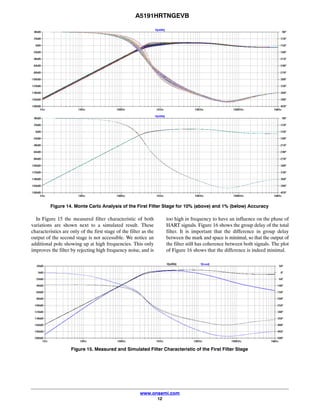
Figures 14a and 14b show a monte carlo analysis for
resistors of 1% and 10%. It is advised to use resistors of at
least 1% accuracy.
A5191HRTNGEVB
www.onsemi.com
12
Figure 14. Monte Carlo Analysis of the First Filter Stage for 10% (above) and 1% (below) Accuracy
In Figure 15 the measured filter characteristic of both
variations are shown next to a simulated result. These
characteristics are only of the first stage of the filter as the
output of the second stage is not accessible. We notice an
additional pole showing up at high frequencies. This only
improves the filter by rejecting high frequency noise, and is
too high in frequency to have an influence on the phase of
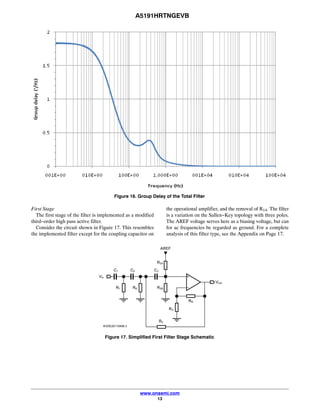
HART signals. Figure 16 shows the group delay of the total
filter. It is important that the difference in group delay
between the mark and space is minimal, so that the output of
the filter still has coherence between both signals. The plot
of Figure 16 shows that the difference is indeed minimal.
Figure 15. Measured and Simulated Filter Characteristic of the First Filter Stage
A5191HRTNGEVB
www.onsemi.com
13
Figure 16. Group Delay of the Total Filter
First Stage
The first stage of the filter is implemented as a modified
third−order high pass active filter.
Consider the circuit shown in Figure 17. This resembles
the implemented filter except for the coupling capacitor on
the operational amplifier, and the removal of R14. The filter
is a variation on the Sallen−Key topology with three poles.
The AREF voltage serves here as a biasing voltage, but can
for ac frequencies be regarded as ground. For a complete
analysis of this filter type, see the Appendix on Page 17.
Figure 17. Simplified First Filter Stage Schematic
A5191HRTNGEVB
www.onsemi.com
14
The transfer function of this type of filter is:
Taking into account the compensation capacitance
present on the operational amplifier between input and
output introduces another high frequency pole and zero pair.
The zero of which can easily be determined to be:
Determining the exact location of the extra pole requires
extra calculation. Indeed, the location of the other poles will
also be shifted by this extra circuit element.
Introducing R14 does not introduce another pole or zero
but changes the denominator of the transfer function, and
thus the location of the poles.
The final transfer function of the first filter stage is thus a
fourth order filter of the form:
The poles of this transfer function are located at:
p1, p2 = 195 Hz
p3 = 1.220 kHz
p4 = 22 kHz
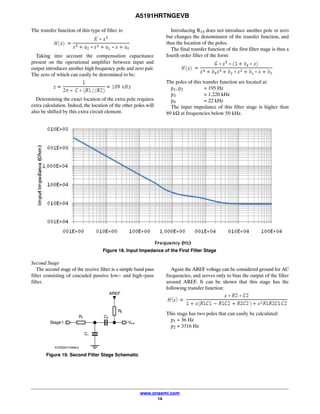
The input impedance of this filter stage is higher than
89 kW at frequencies below 50 kHz.
Figure 18. Input Impedance of the First Filter Stage
Second Stage
The second stage of the receive filter is a simple band pass
filter consisting of cascaded passive low− and high−pass
filter.
AREF
Stage1 Vout
R1
R2
C2
C1
KVDE20110406.4
Figure 19. Second Filter Stage Schematic
Again the AREF voltage can be considered ground for AC
frequencies, and serves only to bias the output of the filter
around AREF. It can be shown that this stage has the
following transfer function:
This stage has two poles that can easily be calculated:
p1 = 36 Hz
p2 = 3316 Hz
A5191HRTNGEVB
www.onsemi.com
15
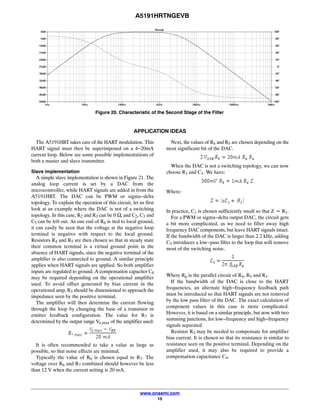
Figure 20. Characteristic of the Second Stage of the Filter
APPLICATION IDEAS
The A5191HRT takes care of the HART modulation. This
HART signal must then be superimposed on a 4−20mA
current loop. Below are some possible implementations of
both a master and slave transmitter.
Slave implementation
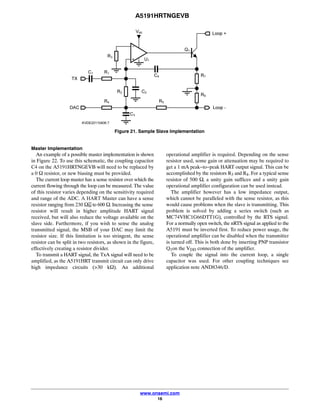
A simple slave implementation is shown in Figure 21. The
analog loop current is set by a DAC from the
microcontroller, while HART signals are added in from the
A5191HRT. The DAC can be PWM or sigma−delta
topology. To explain the operation of this circuit, let us first
look at an example where the DAC is not of a switching
topology. In this case, R2 and R3 can be 0 W, and C2, C3 and
C5 can be left out. As one end of R6 is tied to local ground,
it can easily be seen that the voltage at the negative loop
terminal is negative with respect to the local ground.
Resistors R4 and R5 are then chosen so that in steady state
their common terminal is a virtual ground point in the
absence of HART signals, since the negative terminal of the
amplifier is also connected to ground. A similar principle
applies when HART signals are applied. So both amplifier
inputs are regulated to ground. A compensation capacitor C4
may be required depending on the operational amplifier
used. To avoid offset generated by bias current in the
operational amp, R3 should be dimensioned to approach the
impedance seen by the positive terminal.
The amplifier will then determine the current flowing
through the loop by changing the base of a transistor in
emitter feedback configuration. The value for R7 is
determined by the output range Vo,max of the amplifier used:
It is often recommended to take a value as large as
possible, so that noise effects are minimal.
Typically the value of R6 is chosen equal to R7. The
voltage over R6 and R7 combined should however be less
than 12 V when the current setting is 20 mA.
Next, the values of R4 and R5 are chosen depending on the
most significant bit of the DAC.
When the DAC is not a switching topology, we can now
choose R1 and C1. We have:
Where:
In practice, C1 is chosen sufficiently small so that Z [ R1.
For a PWM or sigma−delta output DAC, the circuit gets
a bit more complicated, as we need to filter away high
frequency DAC components, but leave HART signals intact.
If the bandwidth of the DAC is larger than 2.2 kHz, adding
C3 introduces a low−pass filter to the loop that will remove
most of the switching noise.
Where Rp is the parallel circuit of R4, R5 and R1.
If the bandwidth of the DAC is close to the HART
frequencies, an alternate high−frequency feedback path
must be introduced so that HART signals are not removed
by the low pass filter of the DAC. The exact calculation of
component values in this case is more complicated.
However, it is based on a similar principle, but now with two
summing junctions, for low−frequency and high−frequency
signals separated.
Resistor R3 may be needed to compensate for amplifier
bias current. It is chosen so that its resistance is similar to
resistance seen on the positive terminal. Depending on the
amplifier used, it may also be required to provide a
compensation capacitance C4.
A5191HRTNGEVB
www.onsemi.com
16
Figure 21. Sample Slave Implementation
Master Implementation
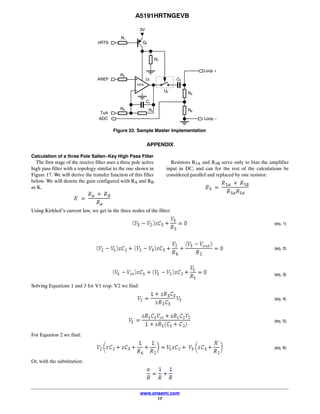
An example of a possible master implementation is shown
in Figure 22. To use this schematic, the coupling capacitor
C4 on the A5191HRTNGEVB will need to be replaced by
a 0 W resistor, or new biasing must be provided.
The current loop master has a sense resistor over which the
current flowing through the loop can be measured. The value
of this resistor varies depending on the sensitivity required
and range of the ADC. A HART Master can have a sense
resistor ranging from 230 W to 600 W. Increasing the sense
resistor will result in higher amplitude HART signal
received, but will also reduce the voltage available on the
slave side. Furthermore, if you wish to sense the analog
transmitted signal, the MSB of your DAC may limit the
resistor size. If this limitation is too stringent, the sense
resistor can be split in two resistors, as shown in the figure,
effectively creating a resistor divider.
To transmit a HART signal, the TxA signal will need to be
amplified, as the A5191HRT transmit circuit can only drive
high impedance circuits (>30 kW). An additional
operational amplifier is required. Depending on the sense
resistor used, some gain or attenuation may be required to
get a 1 mA peak−to−peak HART output signal. This can be
accomplished by the resistors R3 and R4. For a typical sense
resistor of 500 W, a unity gain suffices and a unity gain
operational amplifier configuration can be used instead.
The amplifier however has a low impedance output,
which cannot be paralleled with the sense resistor, as this
would cause problems when the slave is transmitting. This
problem is solved by adding a series switch (such as
MC74VHC1G66DTT1G), controlled by the RTS signal.
For a normally open switch, the nRTS signal as applied to the
A5191 must be inverted first. To reduce power usage, the
operational amplifier can be disabled when the transmitter
is turned off. This is both done by inserting PNP transistor
Q1on the VDD connection of the amplifier.
To couple the signal into the current loop, a single
capacitor was used. For other coupling techniques see
application note AND8346/D.
A5191HRTNGEVB
www.onsemi.com
17
Figure 22. Sample Master Implementation
OPA
3V
R1
R7
R2
R4
R5
R6
Q1
U1
R3
C1
C2
U2
nRTS
AREF
TxA
ADC
Loop +
Loop −
APPENDIX
Calculation of a three Pole Sallen−Key High Pass Filter
The first stage of the receive filter uses a three pole active
high pass filter with a topology similar to the one shown in
Figure 17. We will derive the transfer function of this filter
below. We will denote the gain configured with RA and RB
as K.
Resistors R3A and R3B serve only to bias the amplifier
input in DC, and can for the rest of the calculations be
considered parallel and replaced by one resistor:
Using Kirkhof’s current law, we get in the three nodes of the filter:
(eq. 1)
(eq. 2)
(eq. 3)
Solving Equations 1 and 3 for V1 resp. V2 we find:
(eq. 4)
(eq. 5)
For Equation 2 we find:
(eq. 6)
Or, with the substitution:
A5191HRTNGEVB
www.onsemi.com
18
Equation 6 simplifies to:
(eq. 7)
Substituting V1 and V2 in Equation 7 using Equations 4 and 5, and simplifying we find the transfer function:
Where:
Adding the compensation capacitor on the operational amplifier results in the following transformation on the transfer
function:
Where:
Since K is present in the numerator of the transfer
function, the zero of this factor will be present in the
transformed transfer function. The denominator of the
transformed transfer function is a forth order function with
the following coefficients.
The transfer function now has the following form:
Where:
A5191HRTNGEVB
www.onsemi.com
19
Adding a series resistor to the capacitor results in the following transformation:
Since C3 is not present in the numerator or in the highest−order coefficient, no extra poles or zeros will be introduced by
this transformation. The form of the transfer function hence remains the same.
The transformed coefficients are:
A5191HRTNGEVB
www.onsemi.com
20
EVALUATION BOARD LAYOUT
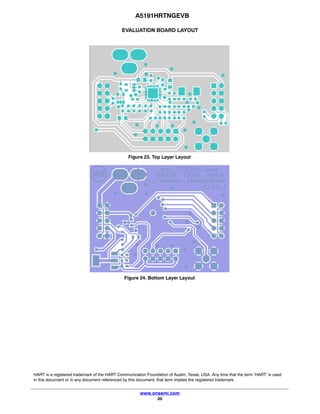
Figure 23. Top Layer Layout
Figure 24. Bottom Layer Layout
HART is a registered trademark of the HART Communication Foundation of Austin, Texas, USA. Any time that the term ‘HART’ is used
in this document or in any document referenced by this document, that term implies the registered trademark.
www.onsemi.com
1
onsemi, , and other names, marks, and brands are registered and/or common law trademarks of Semiconductor Components Industries, LLC dba “onsemi” or its affiliates
and/or subsidiaries in the United States and/or other countries. onsemi owns the rights to a number of patents, trademarks, copyrights, trade secrets, and other intellectual property. A
listing of onsemi’s product/patent coverage may be accessed at www.onsemi.com/site/pdf/Patent−Marking.pdf. onsemi is an Equal Opportunity/Affirmative Action Employer. This
literature is subject to all applicable copyright laws and is not for resale in any manner.
The evaluation board/kit (research and development board/kit) (hereinafter the “board”) is not a finished product and is not available for sale to consumers. The board is only intended
for research, development, demonstration and evaluation purposes and will only be used in laboratory/development areas by persons with an engineering/technical training and familiar
with the risks associated with handling electrical/mechanical components, systems and subsystems. This person assumes full responsibility/liability for proper and safe handling. Any
other use, resale or redistribution for any other purpose is strictly prohibited.
THE BOARD IS PROVIDED BY ONSEMI TO YOU “AS IS” AND WITHOUT ANY REPRESENTATIONS OR WARRANTIES WHATSOEVER. WITHOUT LIMITING THE FOREGOING,
ONSEMI (AND ITS LICENSORS/SUPPLIERS) HEREBY DISCLAIMS ANY AND ALL REPRESENTATIONS AND WARRANTIES IN RELATION TO THE BOARD, ANY
MODIFICATIONS, OR THIS AGREEMENT, WHETHER EXPRESS, IMPLIED, STATUTORY OR OTHERWISE, INCLUDING WITHOUT LIMITATION ANY AND ALL
REPRESENTATIONS AND WARRANTIES OF MERCHANTABILITY, FITNESS FOR A PARTICULAR PURPOSE, TITLE, NON−INFRINGEMENT, AND THOSE ARISING FROM A
COURSE OF DEALING, TRADE USAGE, TRADE CUSTOM OR TRADE PRACTICE.
onsemi reserves the right to make changes without further notice to any board.
You are responsible for determining whether the board will be suitable for your intended use or application or will achieve your intended results. Prior to using or distributing any systems
that have been evaluated, designed or tested using the board, you agree to test and validate your design to confirm the functionality for your application. Any technical, applications or
design information or advice, quality characterization, reliability data or other services provided by onsemi shall not constitute any representation or warranty by onsemi, and no additional
obligations or liabilities shall arise from onsemi having provided such information or services.
onsemi products including the boards are not designed, intended, or authorized for use in life support systems, or any FDA Class 3 medical devices or medical devices with a similar
or equivalent classification in a foreign jurisdiction, or any devices intended for implantation in the human body. You agree to indemnify, defend and hold harmless onsemi, its directors,
officers, employees, representatives, agents, subsidiaries, affiliates, distributors, and assigns, against any and all liabilities, losses, costs, damages, judgments, and expenses, arising
out of any claim, demand, investigation, lawsuit, regulatory action or cause of action arising out of or associated with any unauthorized use, even if such claim alleges that onsemi was
negligent regarding the design or manufacture of any products and/or the board.
This evaluation board/kit does not fall within the scope of the European Union directives regarding electromagnetic compatibility, restricted substances (RoHS), recycling (WEEE), FCC,
CE or UL, and may not meet the technical requirements of these or other related directives.
FCC WARNING – This evaluation board/kit is intended for use for engineering development, demonstration, or evaluation purposes only and is not considered by onsemi to be a finished
end product fit for general consumer use. It may generate, use, or radiate radio frequency energy and has not been tested for compliance with the limits of computing devices pursuant
to part 15 of FCC rules, which are designed to provide reasonable protection against radio frequency interference. Operation of this equipment may cause interference with radio
communications, in which case the user shall be responsible, at its expense, to take whatever measures may be required to correct this interference.
onsemi does not convey any license under its patent rights nor the rights of others.
LIMITATIONS OF LIABILITY: onsemi shall not be liable for any special, consequential, incidental, indirect or punitive damages, including, but not limited to the costs of requalification,
delay, loss of profits or goodwill, arising out of or in connection with the board, even if onsemi is advised of the possibility of such damages. In no event shall onsemi’s aggregate liability
from any obligation arising out of or in connection with the board, under any theory of liability, exceed the purchase price paid for the board, if any.
The board is provided to you subject to the license and other terms per onsemi’s standard terms and conditions of sale. For more information and documentation, please visit
www.onsemi.com.
PUBLICATION ORDERING INFORMATION
TECHNICAL SUPPORT
North American Technical Support:
Voice Mail: 1 800−282−9855 Toll Free USA/Canada
Phone: 011 421 33 790 2910
LITERATURE FULFILLMENT:
Email Requests to: orderlit@onsemi.com
onsemi Website: www.onsemi.com
Europe, Middle East and Africa Technical Support:
Phone: 00421 33 790 2910
For additional information, please contact your local Sales Representative
◊

A5191HRTNGEVB.pdf

  • 1.
    © Semiconductor ComponentsIndustries, LLC, 2016 July, 2016 − Rev. 5 1 Publication Order Number: EVBUM2130/D A5191HRTNGEVB A5191HRTNGEVB Evaluation Board User's Manual Introduction The A5191HRTNGEVB evaluation board includes all external components needed for operating the A5191HRT IC and demonstrates the small PCB surface area such an implementation requires. The EVB allows easy design of HART® implementations using A5191HRT. Overview The A5191HRT is a single−chip, CMOS modem for use in highway addressable remote transducer (HART) field instruments and masters. The modem and a few external passive components provide all of the functions needed to satisfy HART physical layer requirements including modulation, demodulation, receive filtering, carrier detect, and transmit−signal shaping. The A5191HRT uses phase continuous frequency shift keying (FSK) at 1200 bits per second. To conserve power the receive circuits are disabled during transmit operations and vice versa. This provides the half−duplex operation used in HART communications. Features • Single−chip, Half−duplex 1200 Bits per Second FSK Modem • Bell 202 Shift Frequencies of 1200 Hz and 2200 Hz • 3.0 V − 5.5 V Power Supply • Transmit−signal Wave Shaping • Receive Band−pass Filter • Low Power: Optimal for Intrinsically Safe Applications • Compatible with 3.3 V or 5 V Microcontroller • Internal Oscillator Requires 460.8 kHz Crystal or Ceramic Resonator • Meets HART Physical Layer Requirements • Industrial Temperature Range of −40°C to +85°C • Available in 28−pin PLCC, 32−pin QFN and 32−pin LQFP Packages Applications • HART Multiplexers • HART Modem Interfaces • 4 – 20 mA Loop Powered Transmitters Figure 1. A5191HRTNGEVB Evaluation Board www.onsemi.com EVAL BOARD USER’S MANUAL
  • 2.
    A5191HRTNGEVB www.onsemi.com 2 ELECTRICAL CHARACTERISTICS Table 1.ELECTRICAL CHARACTERISTICS OF THE A5191HRTNGEVB BOARD Symbol Parameter / Condition Value Unit Min Typ Max VDD Supply voltage 2.78 3 6.00 V CURRENT CONSUMPTION IDD VDD = 2.78V, idle 417 mA IDD VDD = 3.00 V, idle 420 mA IDD VDD = 6.00V, idle 780 mA IDD External clock, VDD = 3.00 V, idle 350 mA TRANSMITTED FREQUENCY fM Mark “1” 1197 Hz fS Space “0” 2194 Hz LEVELS VTxA Amplitude Transmit Output 500 mVpp VCD Carrier Detect Level 110 mVpp REFERENCE VOLTAGES VAREF AREF 1.212 V VCDREF CDREF 1.128 V A5191HRT DESCRIPTION The A5191HRT modem is a single−chip CMOS modem for use in HART field instruments and masters. It includes on−chip oscillator and a modulator and demodulator module communicating with a UART without internal buffer. The A5191HRT requires some external filter components and a 460.8 kHz clock source. This clock source can either be the interface oscillator by using a crystal or ceramic resonator, or an external clock signal. When the device is transmitting data, the receive module is shut down and vice versa to conserve power. With simple power−saving maneuvers, the IC can be made to operate with a current consumption of as little as 250 mA. For more information related to this subject see the application note AND9030 “A5191HRT Design for Low−Power Environments”. TEST AND MEASUREMENT TOOLS Listed below are the tools used to acquire the values presented in this Evaluation Board User’s Manual. • Oscilloscope Tektronix DPO4034 350 MHz • Signal Generator Agilent 33120A • Network Analyzer AP Instruments 300
  • 3.
  • 4.
    A5191HRTNGEVB www.onsemi.com 4 BOM List Table 2.A5191HRTNEVB BILL OF MATERIALS Quantity Reference Value; Size Manufacturer & Comments 4 C1, C2, C4, C6 100 nF, 0603 3 C3, C5, C7 220 pF, 0603 2 C8, C9 1 nF, 0603 2 C10, C11 470 pF, 0603 3 FB1, FB2, FB3 600Z, 0805 3 IDC1, IDC2, IDC3 0.1” header, 10 pin 1 J1 Barrel connector Not populated 1 J2 SMB connector Not populated 4 R1, R2, R6, R21 200k, 0603 1 R3 0R, 0603 2 R4, R11 14k7, 0603 2 R7, R14 499k, 0603 3 R8, R16, R17 215k, 0603 1 R12 1k, 0603 1 R10 422k, 0603 1 R13 3M, 0603 1 R15 787k, 0603 1 R18 24k, 0603 1 R20 DNP, 0603 Not populated 1 U1 CAT808NTDI−27GT3 ON Semiconductor 1 U2 A5191HRT ON Semiconductor 1 U3 TLV431ASNT1G ON Semiconductor 1 Y1 460.8 kHz ECS Crystal ZTBF−460.8−E General Overview The A5191HRTNGEVB evaluation board demonstrates the external components required for the operation of the IC. We will cover the different sections below as well as possible alternatives. A drawing of the board where the different sections are indicated is shown below. Figure 3. Board Drawing With Indication of Different Sections
  • 5.
    A5191HRTNGEVB www.onsemi.com 5 Power Supply andReferences Power Supply Figure 4. Supply Voltage and Power on Reset The A5191HRTNGEVB is designed for a nominal voltage of 3 V. However, A5191HRT can be operated up to 6 V. For optimal functioning of the board, the values of several resistors should be changed for operation at voltages higher than 3 V. See the sections on reference voltages and bias for more information on this. Current consumption of the module is very limited, making it ideal to be battery or loop−powered. Measurements of the power consumption of the module are listed in Table 3. Table 3. MODULE CURRENT CONSUMPTION Symbol Condition Current Consumption IDD VDD = 2.78 V, Transmit 428 mA IDD VDD = 2.78 V, Receive 417 mA IDD VDD = 3 V, Transmit 443 mA IDD VDD = 3 V, Receive 419 mA IDD VDD = 6 V, Transmit 837 mA IDD VDD = 6 V, Receive 781 mA IDD VDD = 3 V, Transmit, Ext. Osc. 362 mA IDD VDD = 3 V, Receive, Ext. Osc. 350 mA The module will use less power when clock signal is applied externally, as this allows the modem to shut down the oscillator circuit. As is to be expected, a higher supply voltage increases current consumption. It is advised to use a voltage supervisor such as CAT808 to prevent the modem to begin operation when the supply voltage is not yet reliable. This will guarantee correct operation of the digital circuitry. The voltage supervisor will keep the RESETB pin low until its threshold value is reached (2.7 V on the A5191HRTNGEVB). This ensures that some time has passed after the supply voltage reaches the turn−on voltage level of 2.5 V. The RESETB and VDD pin signals during startup are shown in Figure 5. The measured start−up delay is 2.6 ms.
  • 6.
    A5191HRTNGEVB www.onsemi.com 6 Figure 5. Powerand RESETB Waveform During Startup, Showing 2.63 ms Startup Delay C1, C2 and C6 are 100 nF ceramic decoupling capacitors located directly adjacent to each power pin. For analog power pins, an additional large−value ceramic capacitor may be needed in addition to the 100 nF decoupling capacitor when the application is intended for high−noise environments. For loop powered devices, additional decoupling with a large value capacitor is advised to prevent digital noise from being transmitted on the current loop. The ferrite beads FB1, FB2 and FB3 in series with power supply lines help to reduce EMI. Reference voltages and comparator bias A5191HRT needs an external analog reference voltage for the receiver or demodulator (RX) comparator and carrier detect (CD). The AREF reference voltage sets the trip point of the demodulation operational amplifier of the 5191HRT. The AREF reference voltage is also used in setting the DC operating point of the received signal after it has passed through the band−pass receive filter. The ideal value for the AREF reference voltage depends on the voltage supply, and is chosen roughly half−way the operating range of the operational amplifiers. This ensures the range of the operational amplifier is maximized. For operation at 3 V, a 1.24 V reference voltage is recommended. For operation at 5 V, a 2.5 V reference voltage is recommended. For A5191HRTNGEVB, the TLV431 shunt regulator is used with an internal reference of 1.24 V. This reference is compared against the output voltage, and the shunt transistor base is adjusted until it sinks enough current to drop the output to 1.24 V. A simple low pass filter formed by R12 and C11 is added to increase reference stability. A slight voltage drop is observed over this filter caused by loading of the reference voltage. However, the voltage drop and the influence on the operation of the IC is minimal. Measurements show a voltage drop of 22 mV over R12, indicating a current of 22 mA. Of this current ca. 5 mA is consumed by the CDREF resistor division. The rest (ca. 17 mA) is used internally by the IC through the AREF pin. Current consumption through the CDREF pin is negligible. The CDREF reference voltage sets the threshold for the carrier detect comparator. As the received signal is biased at AREF, the difference between CDREF and AREF will determine the minimum amplitude needed for the carrier detect comparator to flip. A (AREF−CDREF) of 80 mV corresponds to signal of approximately 100 mV peak−to−peak at the input of the receive filter. The CDREF reference voltage on the A5191HRTNGEVB is generated by a resistor division of the AREF reference. This will create an extra load on the low pass filter of AREF. However, the drop on the resistor of the low pass can be considered negligible. An external resistor is required to set the bias current. The voltage over the bias resistor is regulated to AREF, so that the resistor determines a bias current. This bias current
  • 7.
    A5191HRTNGEVB www.onsemi.com 7 controls the operatingparameters of the internal operational amplifiers and comparators and should be set to approximately 2.5 mA. A bias resistor of 499 kW is used on the A5191HRTNGEVB. For low cost solutions, a 470 kW is acceptable with minimal effect on operation. Table 4. REFERENCE VOLTAGES Description Value AREF reference voltage 1.212 V CDREF reference voltage 1.128 V Current through R12 22 mA Figure 6. Reference Voltages Schematic Clock Generation A5191HRT is operated on a 460.8 kHz clock signal. The A5191HRTNGEVB has two options for providing this clock signal. The first method is by using a ceramic resonator or a crystal, for example ECS Crystal ZTBF−460.8−E ceramic resonator, loaded with two 220 pF capacitors. Alternatively, a clock signal can be provided externally when R3 is removed and C3 is replaced by a resistor of 0 W. This signal can be provided by a microcontroller or any other external oscillator circuit. The module uses less power when clock signal is applied externally, as this allows the modem to shut down the oscillator circuit. A typical current consumption witnessed by utilizing an external oscillator is 70 − 100 mA less. However, care must be taken that this external signal has the required accuracy (1%). Duty cycle of the clock signal is specified between 40% and 60%. No errors were observed during testing in operation between 20% and 80% duty cycle. However, operation on such very small or very large duty cycle is not recommended, due to the possibility of timing errors that may occur under specific circumstances (including, but not limited to, temperature variations). Figure 7. Clock Generation Circuit a.) Resonator Option b.) External Clock Option
  • 8.
    A5191HRTNGEVB www.onsemi.com 8 Microcontroller Interface IDC1 RESET R2 1 22 23 25 26 RxD CD TxD RTS 2 3 5 7 9 IDC1 VCC VCC R23 PC20110513 .4 Figure8. Microcontroller Interface Table 5. MICROCONTROLLER INTERFACE Pin Number Signal Type Description 1 RST Open drain Reset signal from the voltage supervisor, open drain with pull−up 3 CD Output Carrier Detect 5 RxD Input Receive from microcontroller 7 TxD Output Transmit towards microcontroller 9 RTSB Input Request to send 2, 10 VDD Power 3 V nominal 4, 6, 8 GND Power The interface towards a microcontroller is provided in IDC1. This interface can also be used to supply power to the module. The nominal supply voltage for the module is 3 V. For more information see the section on power supply and references. The RESETB line to the modem is an open drain signal. A pull−up resistor of 200 kW is provided on the board, and should not be duplicated on the microcontroller side. The reset signal is generated on the board, and could be used as reset signal for other IC such as the microcontroller. The CD signal rises when a HART signal of ca. 100 mVpp is detected on the current loop. See the section on reference voltages for more information on these threshold level settings. When no signal, or a signal of limited amplitude is present, the CD line is pulled down to 0 V. The RxD, TxD, and RTSB signals implement a standard UART interface at 1200 baud with start bit 8 data bits, parity bit and stop bit (11−bit frame). The RTSB signal disconnects the transmitter circuit when pulled high, and should be held low before any data is transmitted. Data frames are not buffered by the modem. Instead, data is transmitted bit by bit. Care should be taken to avoid clock skew in the receiving UART. If the same time base is used for both the modem and the UART, a 1% accurate time base may not be sufficient. The problem is a combination of receive data jitter and clock skew between transmitting and receiving HART devices. If the transmit time base is at 99% of nominal and the receive time base in another device is at 101% of nominal, the receive data (at the receiving UART) will be skewed by roughly 21% of one bit time at the end of each 11−bit byte. This is shown in Figure 9. The skew time is measured from the initial falling edge of the start bit to the center of the 11th bit cell. This 21% skew by itself is a relatively good result. However, there is another error source for bit boundary jitter. The Phase Lock Loop demodulator in the A5191HRT produces jitter in the receive data that can be as large as 12% of a bit time. Therefore, a bit boundary can be shifted by as much as 24% of a bit time relative to its ideal location based on the start−bit transition. (The start−bit transition and a later transition can be shifted in opposite directions for a total of 24%.) The clock skew and jitter added together is 45%, which is the amount that a bit boundary could be shifted from its expected position. UARTs that sample at mid−bit will not be affected. However, there are UARTs that take multiple samples during each bit to try to improve on error performance. These UARTs may not be satisfactory, depending on how close the samples are to each other, and how samples are interpreted. A UART that takes a majority vote of three samples is acceptable.
  • 9.
    A5191HRTNGEVB www.onsemi.com 9 Figure 9. ClockSkew Even if your own time base is perfect, you still must plan on a possible 35% shift in a bit boundary, since you don’t have control over time bases in other HART devices. Transmitter The TxA modem pin is decoupled through a 100 nF capacitor to pin 7 of IDC2. For certain applications, it might be required to remove this capacitor and replace it by a 0 W resistor. The output on this pin is a 500 mVpp signal trapezoid waveform shown in Figures 10 and 11. This pin can only drive impedances higher than 30 kW, and as a consequence may need to be amplified to drive low impedances. For a given implementation of a master or slave, it may be required to remove C4 and replace it with a 0 W resistor to allow the decoupling to occur elsewhere in the master implementation. The nominal frequency of the output is 1196.9 Hz for “mark” and 2194.3 Hz for “space”. These frequencies are dependent on the accuracy of the A5191 clock. Figure 10. Output Waveform (Mark)
  • 10.
    A5191HRTNGEVB www.onsemi.com 10 Figure 11. OutputWaveform (Space) Receiver The receive band pass filter is implemented on the A5191HRTNGEVB. The values are listed in Table 6 and the filter schematic is displayed in Figure 12. For cost purposes, this filter can be implemented using E12 value resistors with minimal changes to the filter characteristic. This implementation will have a slightly reduced gain in the pass band. Figure 12. Receive Filter
  • 11.
    A5191HRTNGEVB www.onsemi.com 11 Table 6. RECEIVEFILTER COMPONENT VALUES Reference Value E96 Value E12 (Low−cost) R16 215 kW 1% 220 kW 1% R17 215 kW 1% 220 kW 1% R14 499 kW 1% 470 kW 1% R15 787 kW 1% 680 kW 1% R10 422 kW 1% 470 kW 1% R8 215 kW 1% 220 kW 1% R13 3 MW 1% 3.3 MW 1% C10 470 pF 5% 470 pF 5% C8 1 nF 5% 1 nF 5% C9 1 nF 5% 1 nF 5% C7 220 pF 5% 220 pF 5% Figure 13. Filter Characteristic (First Stage = black, Total = Blue) In Figure 13 the simulated characteristic of the entire filter is shown, in both variations, for the first stage (black) and total filter (blue). The normal and low−cost variations are superimposed, showing that the variations are minimal. However, when the tolerance on the values is also loosened, a bigger variation in the characteristic is observed. Figures 14a and 14b show a monte carlo analysis for resistors of 1% and 10%. It is advised to use resistors of at least 1% accuracy.
  • 12.
    A5191HRTNGEVB www.onsemi.com 12 Figure 14. MonteCarlo Analysis of the First Filter Stage for 10% (above) and 1% (below) Accuracy In Figure 15 the measured filter characteristic of both variations are shown next to a simulated result. These characteristics are only of the first stage of the filter as the output of the second stage is not accessible. We notice an additional pole showing up at high frequencies. This only improves the filter by rejecting high frequency noise, and is too high in frequency to have an influence on the phase of HART signals. Figure 16 shows the group delay of the total filter. It is important that the difference in group delay between the mark and space is minimal, so that the output of the filter still has coherence between both signals. The plot of Figure 16 shows that the difference is indeed minimal. Figure 15. Measured and Simulated Filter Characteristic of the First Filter Stage
  • 13.
    A5191HRTNGEVB www.onsemi.com 13 Figure 16. GroupDelay of the Total Filter First Stage The first stage of the filter is implemented as a modified third−order high pass active filter. Consider the circuit shown in Figure 17. This resembles the implemented filter except for the coupling capacitor on the operational amplifier, and the removal of R14. The filter is a variation on the Sallen−Key topology with three poles. The AREF voltage serves here as a biasing voltage, but can for ac frequencies be regarded as ground. For a complete analysis of this filter type, see the Appendix on Page 17. Figure 17. Simplified First Filter Stage Schematic
  • 14.
    A5191HRTNGEVB www.onsemi.com 14 The transfer functionof this type of filter is: Taking into account the compensation capacitance present on the operational amplifier between input and output introduces another high frequency pole and zero pair. The zero of which can easily be determined to be: Determining the exact location of the extra pole requires extra calculation. Indeed, the location of the other poles will also be shifted by this extra circuit element. Introducing R14 does not introduce another pole or zero but changes the denominator of the transfer function, and thus the location of the poles. The final transfer function of the first filter stage is thus a fourth order filter of the form: The poles of this transfer function are located at: p1, p2 = 195 Hz p3 = 1.220 kHz p4 = 22 kHz The input impedance of this filter stage is higher than 89 kW at frequencies below 50 kHz. Figure 18. Input Impedance of the First Filter Stage Second Stage The second stage of the receive filter is a simple band pass filter consisting of cascaded passive low− and high−pass filter. AREF Stage1 Vout R1 R2 C2 C1 KVDE20110406.4 Figure 19. Second Filter Stage Schematic Again the AREF voltage can be considered ground for AC frequencies, and serves only to bias the output of the filter around AREF. It can be shown that this stage has the following transfer function: This stage has two poles that can easily be calculated: p1 = 36 Hz p2 = 3316 Hz
  • 15.
    A5191HRTNGEVB www.onsemi.com 15 Figure 20. Characteristicof the Second Stage of the Filter APPLICATION IDEAS The A5191HRT takes care of the HART modulation. This HART signal must then be superimposed on a 4−20mA current loop. Below are some possible implementations of both a master and slave transmitter. Slave implementation A simple slave implementation is shown in Figure 21. The analog loop current is set by a DAC from the microcontroller, while HART signals are added in from the A5191HRT. The DAC can be PWM or sigma−delta topology. To explain the operation of this circuit, let us first look at an example where the DAC is not of a switching topology. In this case, R2 and R3 can be 0 W, and C2, C3 and C5 can be left out. As one end of R6 is tied to local ground, it can easily be seen that the voltage at the negative loop terminal is negative with respect to the local ground. Resistors R4 and R5 are then chosen so that in steady state their common terminal is a virtual ground point in the absence of HART signals, since the negative terminal of the amplifier is also connected to ground. A similar principle applies when HART signals are applied. So both amplifier inputs are regulated to ground. A compensation capacitor C4 may be required depending on the operational amplifier used. To avoid offset generated by bias current in the operational amp, R3 should be dimensioned to approach the impedance seen by the positive terminal. The amplifier will then determine the current flowing through the loop by changing the base of a transistor in emitter feedback configuration. The value for R7 is determined by the output range Vo,max of the amplifier used: It is often recommended to take a value as large as possible, so that noise effects are minimal. Typically the value of R6 is chosen equal to R7. The voltage over R6 and R7 combined should however be less than 12 V when the current setting is 20 mA. Next, the values of R4 and R5 are chosen depending on the most significant bit of the DAC. When the DAC is not a switching topology, we can now choose R1 and C1. We have: Where: In practice, C1 is chosen sufficiently small so that Z [ R1. For a PWM or sigma−delta output DAC, the circuit gets a bit more complicated, as we need to filter away high frequency DAC components, but leave HART signals intact. If the bandwidth of the DAC is larger than 2.2 kHz, adding C3 introduces a low−pass filter to the loop that will remove most of the switching noise. Where Rp is the parallel circuit of R4, R5 and R1. If the bandwidth of the DAC is close to the HART frequencies, an alternate high−frequency feedback path must be introduced so that HART signals are not removed by the low pass filter of the DAC. The exact calculation of component values in this case is more complicated. However, it is based on a similar principle, but now with two summing junctions, for low−frequency and high−frequency signals separated. Resistor R3 may be needed to compensate for amplifier bias current. It is chosen so that its resistance is similar to resistance seen on the positive terminal. Depending on the amplifier used, it may also be required to provide a compensation capacitance C4.
  • 16.
    A5191HRTNGEVB www.onsemi.com 16 Figure 21. SampleSlave Implementation Master Implementation An example of a possible master implementation is shown in Figure 22. To use this schematic, the coupling capacitor C4 on the A5191HRTNGEVB will need to be replaced by a 0 W resistor, or new biasing must be provided. The current loop master has a sense resistor over which the current flowing through the loop can be measured. The value of this resistor varies depending on the sensitivity required and range of the ADC. A HART Master can have a sense resistor ranging from 230 W to 600 W. Increasing the sense resistor will result in higher amplitude HART signal received, but will also reduce the voltage available on the slave side. Furthermore, if you wish to sense the analog transmitted signal, the MSB of your DAC may limit the resistor size. If this limitation is too stringent, the sense resistor can be split in two resistors, as shown in the figure, effectively creating a resistor divider. To transmit a HART signal, the TxA signal will need to be amplified, as the A5191HRT transmit circuit can only drive high impedance circuits (>30 kW). An additional operational amplifier is required. Depending on the sense resistor used, some gain or attenuation may be required to get a 1 mA peak−to−peak HART output signal. This can be accomplished by the resistors R3 and R4. For a typical sense resistor of 500 W, a unity gain suffices and a unity gain operational amplifier configuration can be used instead. The amplifier however has a low impedance output, which cannot be paralleled with the sense resistor, as this would cause problems when the slave is transmitting. This problem is solved by adding a series switch (such as MC74VHC1G66DTT1G), controlled by the RTS signal. For a normally open switch, the nRTS signal as applied to the A5191 must be inverted first. To reduce power usage, the operational amplifier can be disabled when the transmitter is turned off. This is both done by inserting PNP transistor Q1on the VDD connection of the amplifier. To couple the signal into the current loop, a single capacitor was used. For other coupling techniques see application note AND8346/D.
  • 17.
    A5191HRTNGEVB www.onsemi.com 17 Figure 22. SampleMaster Implementation OPA 3V R1 R7 R2 R4 R5 R6 Q1 U1 R3 C1 C2 U2 nRTS AREF TxA ADC Loop + Loop − APPENDIX Calculation of a three Pole Sallen−Key High Pass Filter The first stage of the receive filter uses a three pole active high pass filter with a topology similar to the one shown in Figure 17. We will derive the transfer function of this filter below. We will denote the gain configured with RA and RB as K. Resistors R3A and R3B serve only to bias the amplifier input in DC, and can for the rest of the calculations be considered parallel and replaced by one resistor: Using Kirkhof’s current law, we get in the three nodes of the filter: (eq. 1) (eq. 2) (eq. 3) Solving Equations 1 and 3 for V1 resp. V2 we find: (eq. 4) (eq. 5) For Equation 2 we find: (eq. 6) Or, with the substitution:
  • 18.
    A5191HRTNGEVB www.onsemi.com 18 Equation 6 simplifiesto: (eq. 7) Substituting V1 and V2 in Equation 7 using Equations 4 and 5, and simplifying we find the transfer function: Where: Adding the compensation capacitor on the operational amplifier results in the following transformation on the transfer function: Where: Since K is present in the numerator of the transfer function, the zero of this factor will be present in the transformed transfer function. The denominator of the transformed transfer function is a forth order function with the following coefficients. The transfer function now has the following form: Where:
  • 19.
    A5191HRTNGEVB www.onsemi.com 19 Adding a seriesresistor to the capacitor results in the following transformation: Since C3 is not present in the numerator or in the highest−order coefficient, no extra poles or zeros will be introduced by this transformation. The form of the transfer function hence remains the same. The transformed coefficients are:
  • 20.
    A5191HRTNGEVB www.onsemi.com 20 EVALUATION BOARD LAYOUT Figure23. Top Layer Layout Figure 24. Bottom Layer Layout HART is a registered trademark of the HART Communication Foundation of Austin, Texas, USA. Any time that the term ‘HART’ is used in this document or in any document referenced by this document, that term implies the registered trademark.
  • 21.
    www.onsemi.com 1 onsemi, , andother names, marks, and brands are registered and/or common law trademarks of Semiconductor Components Industries, LLC dba “onsemi” or its affiliates and/or subsidiaries in the United States and/or other countries. onsemi owns the rights to a number of patents, trademarks, copyrights, trade secrets, and other intellectual property. A listing of onsemi’s product/patent coverage may be accessed at www.onsemi.com/site/pdf/Patent−Marking.pdf. onsemi is an Equal Opportunity/Affirmative Action Employer. This literature is subject to all applicable copyright laws and is not for resale in any manner. The evaluation board/kit (research and development board/kit) (hereinafter the “board”) is not a finished product and is not available for sale to consumers. The board is only intended for research, development, demonstration and evaluation purposes and will only be used in laboratory/development areas by persons with an engineering/technical training and familiar with the risks associated with handling electrical/mechanical components, systems and subsystems. This person assumes full responsibility/liability for proper and safe handling. Any other use, resale or redistribution for any other purpose is strictly prohibited. THE BOARD IS PROVIDED BY ONSEMI TO YOU “AS IS” AND WITHOUT ANY REPRESENTATIONS OR WARRANTIES WHATSOEVER. WITHOUT LIMITING THE FOREGOING, ONSEMI (AND ITS LICENSORS/SUPPLIERS) HEREBY DISCLAIMS ANY AND ALL REPRESENTATIONS AND WARRANTIES IN RELATION TO THE BOARD, ANY MODIFICATIONS, OR THIS AGREEMENT, WHETHER EXPRESS, IMPLIED, STATUTORY OR OTHERWISE, INCLUDING WITHOUT LIMITATION ANY AND ALL REPRESENTATIONS AND WARRANTIES OF MERCHANTABILITY, FITNESS FOR A PARTICULAR PURPOSE, TITLE, NON−INFRINGEMENT, AND THOSE ARISING FROM A COURSE OF DEALING, TRADE USAGE, TRADE CUSTOM OR TRADE PRACTICE. onsemi reserves the right to make changes without further notice to any board. You are responsible for determining whether the board will be suitable for your intended use or application or will achieve your intended results. Prior to using or distributing any systems that have been evaluated, designed or tested using the board, you agree to test and validate your design to confirm the functionality for your application. Any technical, applications or design information or advice, quality characterization, reliability data or other services provided by onsemi shall not constitute any representation or warranty by onsemi, and no additional obligations or liabilities shall arise from onsemi having provided such information or services. onsemi products including the boards are not designed, intended, or authorized for use in life support systems, or any FDA Class 3 medical devices or medical devices with a similar or equivalent classification in a foreign jurisdiction, or any devices intended for implantation in the human body. You agree to indemnify, defend and hold harmless onsemi, its directors, officers, employees, representatives, agents, subsidiaries, affiliates, distributors, and assigns, against any and all liabilities, losses, costs, damages, judgments, and expenses, arising out of any claim, demand, investigation, lawsuit, regulatory action or cause of action arising out of or associated with any unauthorized use, even if such claim alleges that onsemi was negligent regarding the design or manufacture of any products and/or the board. This evaluation board/kit does not fall within the scope of the European Union directives regarding electromagnetic compatibility, restricted substances (RoHS), recycling (WEEE), FCC, CE or UL, and may not meet the technical requirements of these or other related directives. FCC WARNING – This evaluation board/kit is intended for use for engineering development, demonstration, or evaluation purposes only and is not considered by onsemi to be a finished end product fit for general consumer use. It may generate, use, or radiate radio frequency energy and has not been tested for compliance with the limits of computing devices pursuant to part 15 of FCC rules, which are designed to provide reasonable protection against radio frequency interference. Operation of this equipment may cause interference with radio communications, in which case the user shall be responsible, at its expense, to take whatever measures may be required to correct this interference. onsemi does not convey any license under its patent rights nor the rights of others. LIMITATIONS OF LIABILITY: onsemi shall not be liable for any special, consequential, incidental, indirect or punitive damages, including, but not limited to the costs of requalification, delay, loss of profits or goodwill, arising out of or in connection with the board, even if onsemi is advised of the possibility of such damages. In no event shall onsemi’s aggregate liability from any obligation arising out of or in connection with the board, under any theory of liability, exceed the purchase price paid for the board, if any. The board is provided to you subject to the license and other terms per onsemi’s standard terms and conditions of sale. For more information and documentation, please visit www.onsemi.com. PUBLICATION ORDERING INFORMATION TECHNICAL SUPPORT North American Technical Support: Voice Mail: 1 800−282−9855 Toll Free USA/Canada Phone: 011 421 33 790 2910 LITERATURE FULFILLMENT: Email Requests to: orderlit@onsemi.com onsemi Website: www.onsemi.com Europe, Middle East and Africa Technical Support: Phone: 00421 33 790 2910 For additional information, please contact your local Sales Representative ◊