

Evaluation Question 4How did you use media technologies in the construction, research, planning and evaluation stages?
Technology Used In My ProjectDuring the process of making my music video I have had the pleasure to use a lot of technical facilities.Right from the beginning to the end there is nothing that I could have done for my project that actually didn’t involve using technology, everything I did needed to be recorded in the blog online, the actual product itself was made with new video recording and photography technology, the research into making the products in the first place needed to be researched through the internet, the post production was very much reliant on Adobe programs and even this evaluation has been made using technology. It was clear that without these new technologies the entire Media Studies course would be impossible to take!Let me take you through how these new technologies have helped or hindered my coursework and how we are becoming more reliant on such technologies in the modern world.
Internet
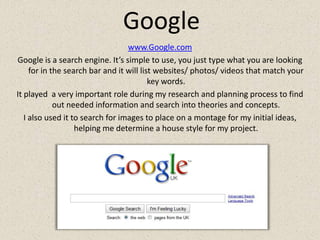
Googlewww.Google.comGoogle is a search engine. It’s simple to use, you just type what you are looking for in the search bar and it will list websites/ photos/ videos that match your key words.It played  a very important role during my research and planning process to find out needed information and search into theories and concepts.I also used it to search for images to place on a montage for my initial ideas, helping me determine a house style for my project.
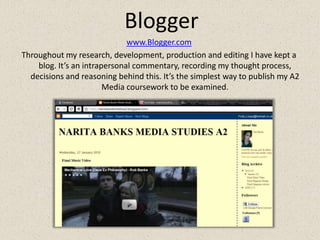
Bloggerwww.Blogger.comThroughout my research, development, production and editing I have kept a blog. It’s an intrapersonal commentary, recordingmy thought process, decisions and reasoning behind this. It’s the simplest way to publish my A2 Media coursework to be examined.
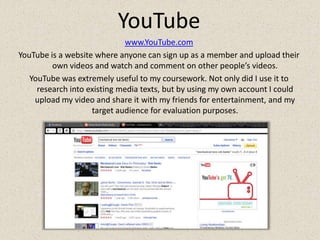
YouTubewww.YouTube.comYouTube is a website where anyone can sign up as a member and upload their own videos and watch and comment on other people’s videos.YouTube was extremely useful to my coursework. Not only did I use it to research into existing media texts, but by using my own account I could upload my video and share it with my friends for entertainment, and my target audience for evaluation purposes.
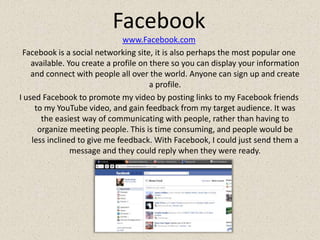
Facebookwww.Facebook.comFacebook is a social networking site, it is also perhaps the most popular one available. You create a profile on there so you can display your information and connect with people all over the world. Anyone can sign up and create a profile.I used Facebook to promote my video by posting links to my Facebook friends to my YouTube video, and gain feedback from my target audience. It was the easiest way of communicating with people, rather than having to organize meeting people. This is time consuming, and people would be less inclined to give me feedback. With Facebook, I could just send them a message and they could reply when they were ready.
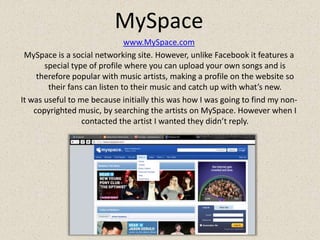
MySpacewww.MySpace.comMySpace is a social networking site. However, unlike Facebook it features a special type of profile where you can upload your own songs and is therefore popular with music artists, making a profile on the website so their fans can listen to their music and catch up with what’s new.It was useful to me because initially this was how I was going to find my non-copyrighted music, by searching the artists on MySpace. However when I contacted the artist I wanted they didn’t reply.
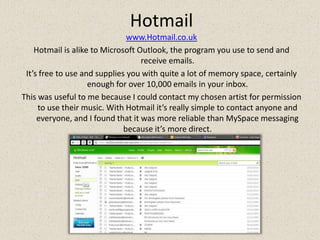
Hotmailwww.Hotmail.co.ukHotmail is alike to Microsoft Outlook, the program you use to send and receive emails. It’s free to use and supplies you with quite a lot of memory space, certainly enough for over 10,000 emails in your inbox. This was useful to me because I could contact my chosen artist for permission to use their music. With Hotmail it’s really simple to contact anyone and everyone, and I found that it was more reliable than MySpace messaging because it’s more direct.
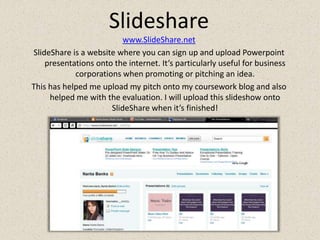
Slidesharewww.SlideShare.netSlideShare is a website where you can sign up and upload Powerpoint presentations onto the internet. It’s particularly useful for business corporations when promoting or pitching an idea.This has helped me upload my pitch onto my coursework blog and also helped me with the evaluation. I will upload this slideshow onto SlideShare when it’s finished!
Equipment
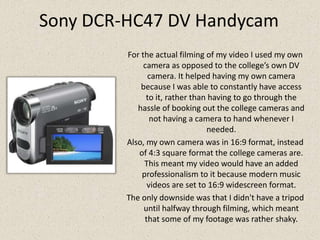
Sony DCR-HC47 DV HandycamFor the actual filming of my video I used my own camera as opposed to the college’s own DV camera. It helped having my own camera because I was able to constantly have access to it, rather than having to go through the hassle of booking out the college cameras and not having a camera to hand whenever I needed.Also, my own camera was in 16:9 format, instead of 4:3 square format the college cameras are. This meant my video would have an added professionalism to it because modern music videos are set to 16:9 widescreen format.The only downside was that I didn't have a tripod until halfway through filming, which meant that some of my footage was rather shaky.
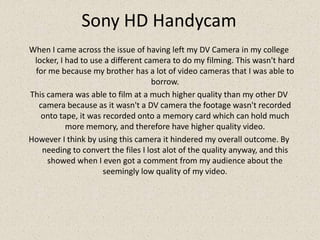
Sony HD HandycamWhen I came across the issue of having left my DV Camera in my college locker, I had to use a different camera to do my filming. This wasn't hard for me because my brother has a lot of video cameras that I was able to borrow. This camera was able to film at a much higher quality than my other DV camera because as it wasn't a DV camera the footage wasn't recorded onto tape, it was recorded onto a memory card which can hold much more memory, and therefore have higher quality video.However I think by using this camera it hindered my overall outcome. By needing to convert the files I lost alot of the quality anyway, and this showed when I even got a comment from my audience about the seemingly low quality of my video.
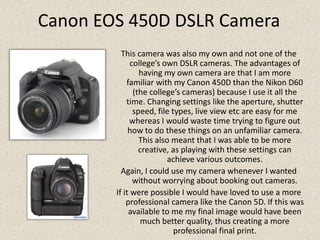
Canon EOS 450D DSLR CameraThis camera was also my own and not one of the college’s own DSLR cameras. The advantages of having my own camera are that I am more familiar with my Canon 450D than the Nikon D60 (the college’s cameras) because I use it all the time. Changing settings like the aperture, shutter speed, file types, live view etc are easy for me whereas I would waste time trying to figure out how to do these things on an unfamiliar camera. This also meant that I was able to be more creative, as playing with these settings can achieve various outcomes.Again, I could use my camera whenever I wanted without worrying about booking out cameras.If it were possible I would have loved to use a more professional camera like the Canon 5D. If this was available to me my final image would have been much better quality, thus creating a more professional final print.
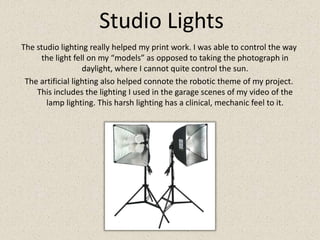
Studio LightsThe studio lighting really helped my print work. I was able to control the way the light fell on my “models” as opposed to taking the photograph in daylight, where I cannot quite control the sun. The artificial lighting also helped connote the robotic theme of my project. This includes the lighting I used in the garage scenes of my video of the lamp lighting. This harsh lighting has a clinical, mechanic feel to it.
Software
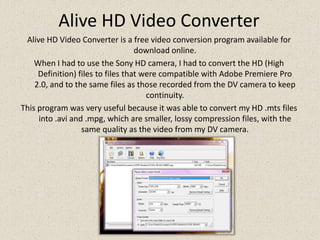
Alive HD Video ConverterAlive HD Video Converter is a free video conversion program available for download online.When I had to use the Sony HD camera, I had to convert the HD (High Definition) files to files that were compatible with Adobe Premiere Pro 2.0, and to the same files as those recorded from the DV camera to keep continuity.This program was very useful because it was able to convert my HD .mtsfiles into .avi and .mpg, which are smaller, lossy compression files, with the same quality as the video from my DV camera.
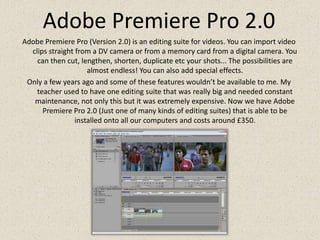
Adobe Premiere Pro 2.0Adobe Premiere Pro (Version 2.0) is an editing suite for videos. You can import video clips straight from a DV camera or from a memory card from a digital camera. You can then cut, lengthen, shorten, duplicate etc your shots... The possibilities are almost endless! You can also add special effects.Only a few years ago and some of these features wouldn’t be available to me. My teacher used to have one editing suite that was really big and needed constant maintenance, not only this but it was extremely expensive. Now we have Adobe Premiere Pro 2.0 (Just one of many kinds of editing suites) that is able to be installed onto all our computers and costs around £350.
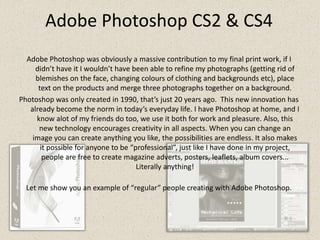
Adobe Photoshop CS2 & CS4Adobe Photoshop was obviously a massive contribution to my final print work, if I didn’t have it I wouldn’t have been able to refine my photographs (getting rid of blemishes on the face, changing colours of clothing and backgrounds etc), place text on the products and merge three photographs together on a background. Photoshop was only created in 1990, that’s just 20 years ago.  This new innovation has already become the norm in today’s everyday life. I have Photoshop at home, and I know alot of my friends do too, we use it both for work and pleasure. Also, this new technology encourages creativity in all aspects. When you can change an image you can create anything you like, the possibilities are endless. It also makes it possible for anyone to be “professional”, just like I have done in my project, people are free to create magazine adverts, posters, leaflets, album covers... Literally anything!Let me show you an example of “regular” people creating with Adobe Photoshop.
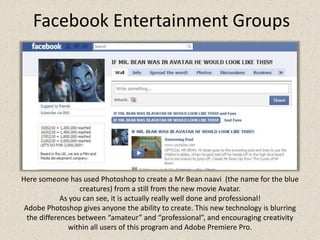
Facebook Entertainment GroupsHere someone has used Photoshop to create a Mr Bean naavi  (the name for the blue creatures) from a still from the new movie Avatar.As you can see, it is actually really well done and professional! Adobe Photoshop gives anyone the ability to create. This new technology is blurring the differences between “amateur” and “professional”, and encouraging creativity within all users of this program and Adobe Premiere Pro.
Media 2.0Media 2.0 (introduced around 2004) is the concept that by using new technologies the audience can actually interact with the media text, allowing them to have their own opinion voiced online, improving their work, thus closing the gap between “amateur” and “professional”. A good example of this is Wikipedia, an online encyclopaedia of almost anything you could ever think of. The twist is that anyone is able to edit, add pictures and reference the articles.Another example is Youtube. Youtube enables ordinary people to upload their work and promote themselves to the wider population, in some cases this makes them “famous” in the Youtube world. There are many famous “Youtubers” like Shane Dawson (ShaneDawsonTV) and Ryan Higa (NigaHiga), who have each gained over 2,000,000 subscribers to their private channels each.This fame on Youtube can also lead onto being spread to different forms of media. A popular television program on channel 4 called “Rudetube” is a showcase of funny/bizarre/interesting videos from Youtube with the highest hits.
END

A2 Evaluation, Question 4

  • 1.
    Evaluation Question 4Howdid you use media technologies in the construction, research, planning and evaluation stages?
  • 2.
    Technology Used InMy ProjectDuring the process of making my music video I have had the pleasure to use a lot of technical facilities.Right from the beginning to the end there is nothing that I could have done for my project that actually didn’t involve using technology, everything I did needed to be recorded in the blog online, the actual product itself was made with new video recording and photography technology, the research into making the products in the first place needed to be researched through the internet, the post production was very much reliant on Adobe programs and even this evaluation has been made using technology. It was clear that without these new technologies the entire Media Studies course would be impossible to take!Let me take you through how these new technologies have helped or hindered my coursework and how we are becoming more reliant on such technologies in the modern world.
  • 3.
  • 4.
    Googlewww.Google.comGoogle is asearch engine. It’s simple to use, you just type what you are looking for in the search bar and it will list websites/ photos/ videos that match your key words.It played a very important role during my research and planning process to find out needed information and search into theories and concepts.I also used it to search for images to place on a montage for my initial ideas, helping me determine a house style for my project.
  • 5.
    Bloggerwww.Blogger.comThroughout my research,development, production and editing I have kept a blog. It’s an intrapersonal commentary, recordingmy thought process, decisions and reasoning behind this. It’s the simplest way to publish my A2 Media coursework to be examined.
  • 6.
    YouTubewww.YouTube.comYouTube is awebsite where anyone can sign up as a member and upload their own videos and watch and comment on other people’s videos.YouTube was extremely useful to my coursework. Not only did I use it to research into existing media texts, but by using my own account I could upload my video and share it with my friends for entertainment, and my target audience for evaluation purposes.
  • 7.
    Facebookwww.Facebook.comFacebook is asocial networking site, it is also perhaps the most popular one available. You create a profile on there so you can display your information and connect with people all over the world. Anyone can sign up and create a profile.I used Facebook to promote my video by posting links to my Facebook friends to my YouTube video, and gain feedback from my target audience. It was the easiest way of communicating with people, rather than having to organize meeting people. This is time consuming, and people would be less inclined to give me feedback. With Facebook, I could just send them a message and they could reply when they were ready.
  • 8.
    MySpacewww.MySpace.comMySpace is asocial networking site. However, unlike Facebook it features a special type of profile where you can upload your own songs and is therefore popular with music artists, making a profile on the website so their fans can listen to their music and catch up with what’s new.It was useful to me because initially this was how I was going to find my non-copyrighted music, by searching the artists on MySpace. However when I contacted the artist I wanted they didn’t reply.
  • 9.
    Hotmailwww.Hotmail.co.ukHotmail is aliketo Microsoft Outlook, the program you use to send and receive emails. It’s free to use and supplies you with quite a lot of memory space, certainly enough for over 10,000 emails in your inbox. This was useful to me because I could contact my chosen artist for permission to use their music. With Hotmail it’s really simple to contact anyone and everyone, and I found that it was more reliable than MySpace messaging because it’s more direct.
  • 10.
    Slidesharewww.SlideShare.netSlideShare is awebsite where you can sign up and upload Powerpoint presentations onto the internet. It’s particularly useful for business corporations when promoting or pitching an idea.This has helped me upload my pitch onto my coursework blog and also helped me with the evaluation. I will upload this slideshow onto SlideShare when it’s finished!
  • 11.
  • 12.
    Sony DCR-HC47 DVHandycamFor the actual filming of my video I used my own camera as opposed to the college’s own DV camera. It helped having my own camera because I was able to constantly have access to it, rather than having to go through the hassle of booking out the college cameras and not having a camera to hand whenever I needed.Also, my own camera was in 16:9 format, instead of 4:3 square format the college cameras are. This meant my video would have an added professionalism to it because modern music videos are set to 16:9 widescreen format.The only downside was that I didn't have a tripod until halfway through filming, which meant that some of my footage was rather shaky.
  • 13.
    Sony HD HandycamWhenI came across the issue of having left my DV Camera in my college locker, I had to use a different camera to do my filming. This wasn't hard for me because my brother has a lot of video cameras that I was able to borrow. This camera was able to film at a much higher quality than my other DV camera because as it wasn't a DV camera the footage wasn't recorded onto tape, it was recorded onto a memory card which can hold much more memory, and therefore have higher quality video.However I think by using this camera it hindered my overall outcome. By needing to convert the files I lost alot of the quality anyway, and this showed when I even got a comment from my audience about the seemingly low quality of my video.
  • 14.
    Canon EOS 450DDSLR CameraThis camera was also my own and not one of the college’s own DSLR cameras. The advantages of having my own camera are that I am more familiar with my Canon 450D than the Nikon D60 (the college’s cameras) because I use it all the time. Changing settings like the aperture, shutter speed, file types, live view etc are easy for me whereas I would waste time trying to figure out how to do these things on an unfamiliar camera. This also meant that I was able to be more creative, as playing with these settings can achieve various outcomes.Again, I could use my camera whenever I wanted without worrying about booking out cameras.If it were possible I would have loved to use a more professional camera like the Canon 5D. If this was available to me my final image would have been much better quality, thus creating a more professional final print.
  • 15.
    Studio LightsThe studiolighting really helped my print work. I was able to control the way the light fell on my “models” as opposed to taking the photograph in daylight, where I cannot quite control the sun. The artificial lighting also helped connote the robotic theme of my project. This includes the lighting I used in the garage scenes of my video of the lamp lighting. This harsh lighting has a clinical, mechanic feel to it.
  • 16.
  • 17.
    Alive HD VideoConverterAlive HD Video Converter is a free video conversion program available for download online.When I had to use the Sony HD camera, I had to convert the HD (High Definition) files to files that were compatible with Adobe Premiere Pro 2.0, and to the same files as those recorded from the DV camera to keep continuity.This program was very useful because it was able to convert my HD .mtsfiles into .avi and .mpg, which are smaller, lossy compression files, with the same quality as the video from my DV camera.
  • 18.
    Adobe Premiere Pro2.0Adobe Premiere Pro (Version 2.0) is an editing suite for videos. You can import video clips straight from a DV camera or from a memory card from a digital camera. You can then cut, lengthen, shorten, duplicate etc your shots... The possibilities are almost endless! You can also add special effects.Only a few years ago and some of these features wouldn’t be available to me. My teacher used to have one editing suite that was really big and needed constant maintenance, not only this but it was extremely expensive. Now we have Adobe Premiere Pro 2.0 (Just one of many kinds of editing suites) that is able to be installed onto all our computers and costs around £350.
  • 19.
    Adobe Photoshop CS2& CS4Adobe Photoshop was obviously a massive contribution to my final print work, if I didn’t have it I wouldn’t have been able to refine my photographs (getting rid of blemishes on the face, changing colours of clothing and backgrounds etc), place text on the products and merge three photographs together on a background. Photoshop was only created in 1990, that’s just 20 years ago. This new innovation has already become the norm in today’s everyday life. I have Photoshop at home, and I know alot of my friends do too, we use it both for work and pleasure. Also, this new technology encourages creativity in all aspects. When you can change an image you can create anything you like, the possibilities are endless. It also makes it possible for anyone to be “professional”, just like I have done in my project, people are free to create magazine adverts, posters, leaflets, album covers... Literally anything!Let me show you an example of “regular” people creating with Adobe Photoshop.
  • 20.
    Facebook Entertainment GroupsHeresomeone has used Photoshop to create a Mr Bean naavi (the name for the blue creatures) from a still from the new movie Avatar.As you can see, it is actually really well done and professional! Adobe Photoshop gives anyone the ability to create. This new technology is blurring the differences between “amateur” and “professional”, and encouraging creativity within all users of this program and Adobe Premiere Pro.
  • 21.
    Media 2.0Media 2.0(introduced around 2004) is the concept that by using new technologies the audience can actually interact with the media text, allowing them to have their own opinion voiced online, improving their work, thus closing the gap between “amateur” and “professional”. A good example of this is Wikipedia, an online encyclopaedia of almost anything you could ever think of. The twist is that anyone is able to edit, add pictures and reference the articles.Another example is Youtube. Youtube enables ordinary people to upload their work and promote themselves to the wider population, in some cases this makes them “famous” in the Youtube world. There are many famous “Youtubers” like Shane Dawson (ShaneDawsonTV) and Ryan Higa (NigaHiga), who have each gained over 2,000,000 subscribers to their private channels each.This fame on Youtube can also lead onto being spread to different forms of media. A popular television program on channel 4 called “Rudetube” is a showcase of funny/bizarre/interesting videos from Youtube with the highest hits.
  • 22.