International Research Journal of Engineering and Technology (IRJET) e-ISSN: 2395-0056
Volume: 04 Issue: 08 | Aug -2017 www.irjet.net p-ISSN: 2395-0072
© 2017, IRJET | Impact Factor value: 5.181 | ISO 9001:2008 Certified Journal | Page 321
“A TRUSTED TPA MODEL, TO IMPROVE SECURITY
& RELIABILITY FOR CLOUD STORAGE”
Nivedita Roy Gupta1, Prof. Umesh Kumar Lilhore2, Prof. Nitin Agrawal3
M. Tech. Research Scholar1, Associate Professor and Head PG2, Associate Professor3
NRI-IIST Bhopal (M.P), India
---------------------------------------------------------------------***---------------------------------------------------------------------
ABSTRACT - In now these days Cloud computing is most
promising technology for optimum utilization of computing
resources. A cloud user can securely store their personal data
on cloud storage server and can access anytime. Cloud service
providers maintain the reliability and integrity of the stored
data over cloud server and ensure cloud user, “Storeddata will
secure”. Day by day the sizes of cloud services are rapidly
growing which increases the number of cloud user. Cloud users
are demanding more secure communication and storage. A
Third party audit (TPA) is used to check the integrity of stored
data over the cloud. Cloud data are available over the web, so
there are possibilities of attack. So always a secure encryption
method is demanding by a cloud user. It attracts cloud
researcher to work in the field of cloud security. This research
paper presents a trusted TPA model (TTM), to improve the
security and reliability for cloud storage. ProposedTTMmodel
is based on two-way security. It providesdatasecurityandwell
as also maintains data integrity. In TTM, AES-256 bit data
encryption and decryption method are used to maintain data
security and SHA-1 method is used to calculate the hashvalues
of the message to maintain the data integrity. For a key
generation, TTM uses Diffie-Hellmen key exchange method.
Proposed TTM and existing AES with MD-5 method both are
implemented over JAVA and various performance comparison
parameters are calculated such as encryption and decryption
time, the time is taken to proceed request and TPA
computation time. The experimentalstudyclearlyshowsthat’s
proposed TTM shows better result over existing MD-5 based
method.
Key Words: TPA, Cloud Computing, Cloud Security, AES,
MD-5, SHA-1, TTM
1. INTRODUCTION
Cloud computing has become a big technology trend either
within the industrial or the Institute field, and most of the
consultants expect that cloud computing can reshape
information technology (IT) processes and the IT market
place. In cloud computing users connect with the
cloud that seems as if it's one entity as critical multiple
servers. Cloud computing is referred as two terms,’Cloud’
and ‘computing’, “Cloud” whichusedhereasa “Metaphor” for
the technique are methodology, “the web or the internet”, so
cloud computing technology is a “type of internetor network
based computing”. Cloud computing based system can
dynamically deliverthecomputing resourcesand capabilities
as a service over the internet web in all over theworld.Cloud
computing is a new technique of computing in which
dynamically scalable and often virtualized resources are
provided as a service over the internet [4]. The wide
adaptation of cloud computing is restricted to its aspects of
proving security and privacy of the user’s data.Data areto be
stored remotely at the cloud server where data are to be
managed at large data centers. The client can get access to
and modify this stored data overthecloudusingthe network.
In cloud computing, a CSP or cloud service providers is a
separate administrative entitywhichavailabletheservicesto
the cloud users.
Data auditing is a new concept introduced in Cloud
computing to deal with secure data storage. Auditing is a
process of verification of user data. It can be carried out
either by the user himself (data owner) or by a TPA. It helps
to maintain the integrity of data stored in the cloud. The
verifier’s role is categorized into two: the first one is private
audit ability, in which only user or data owner is allowed to
check the integrity of the stored data. No other person has
the authority to question the server regardingthedata.Butit
tends to increase verification overhead of the user. Second is
public audit ability, which allows TPA to challenge the cloud
server and performs data verification checks.
Figure 1.1 TPA Audit in Cloud [8]
The TPA is an entity which is used so that it can act on behalf
of the client. It has all the necessary expertise, capabilities,
knowledge and professional skills which are required to
handle the work of integrity verification. It also reduces the
overhead of the client. It is necessary that TPA should
efficiently audit the cloud data. It should have zero
International Research Journal of Engineering and Technology (IRJET) e-ISSN: 2395-0056
Volume: 04 Issue: 08 | Aug -2017 www.irjet.net p-ISSN: 2395-0072
© 2017, IRJET | Impact Factor value: 5.181 | ISO 9001:2008 Certified Journal | Page 322
knowledge about the data stored in the cloud server. It
should not introduce any additional online burden to the
cloud data owner [9].In this research paper, a trusted model
is proposed for cloud security. This paper is organized in
various chapters like cloud computing security, problem
statement and objective, proposed solution and result
comparisons.
2. CLOUD COMPUTING & SECURITY THREATS
“Cloud computing technology is a large scale based
distributed computing andvitalizationbasedtechnologythat
is widely used by and driven by various economies of scale.
In cloud computing, a large pool of servers and computing
resources directly serves to various users on demand, based
on pay per and use, over the network such as web or
internet. Cloud computing provides service such as
abstraction of data, virtualization, dynamically scalable
computing power, platform, and storage”. According to
Armbrust (the year 2009), “Cloud Computing technique
basically refers to all the applications which are delivered as
services directly over the Internet network and the systems
software and hardware applicationsintheclouddata centers
that serve these cloud computing services, referred to as
Software as a Service (SaaS). As per NIST cloud computing
can be defined-“Cloud computing is a model for enabling
ubiquitous, convenient, on-demand network access to a
shared pool of configurable computing resources (e.g.,
networks, servers, storage, applications, and services) that
can be rapidly provisioned and released with minimal
management effort or service provider interaction”.
2.1 Major threats in cloud computing-
Major issues in cloud computing are as follows-
 Data breaches -As enterprises stores vast data in the
cloud, it becomes an attractive target for the hackers. In
a case of security breaches involving financial data,
healthcare data, and revenue details can be more
devastating. It may lead an enterprise to incur fines,face
lawsuits or even criminal charges.
 CompromisingCredentials-Awell-definedIdentityand
Authentication technology where enterprisesprovideto
right access to the right person at the right time.
Sometimes they fail to remove user access even after
they left the organizations which could lead to obtaining
their credentials.
 Hacking Application Programming Interface-To
interacts with the cloud services enterprise uses
interfaces and API. The overall cloud security
(Authentication, access control, monitoring depends
highly on the security of the API).
 Exploiting system vulnerabilities-The multi-tenancy
in cloud computing where enterprises share memory,
databases and other digital resources may create new
attack surfaces. This can become biggersecurityissuesif
hackers could exploit system vulnerabilities or bugs.
 Hijacking the accounts-In Cloud, Computing attackers
can eavesdrop on financial transaction activities change
or could modify it. Multifactor authentication can be a
common defense-in-depth protection strategy.
 Malicious insiders-In cloud computing insider threat
can shatter the complete infrastructure and data
manipulation. Therefore enterprises should control the
encryption process and minimize the user access.
 Advanced Persistent threats-APTS are the parasitical
form of attacks and are difficult to detect. Enterprises
should monitor the costs involved to overcome APT
attacks improper planning would increase the
enterprise's security spending.
 Data Loss-When an authorized user uploads files to the
cloud there are chances for data loss that can be
extremely costly for an enterprise. A recent report from
the Health Information Trust Alliance (HITRUST) total
number of breaches in the healthcare industry "Total
cost of breach - $4.1 billion" Therefore enterprises
should deploy a Data LossPrevention(DLP)systemplan.
 DDoS attacks-In cloud environment enterprises should
be aware of application-level Dos attacks targeting web
server and database vulnerabilities.
Figure 2.1 Cloud security risks [5]
2.2 HASH Vs MAC BASED INTEGRITY
A cryptographic hash function is a completely public,
deterministic hash function which everybody can compute
over arbitrary inputs. It takes as input a sequenceof bits(any
sequence of bits; some hash functions are formally limited to
inputs of, say, less 264 bits, aka "2 millions of terabytes")and
outputs values in a rather small space,typicallya sequenceof
International Research Journal of Engineering and Technology (IRJET) e-ISSN: 2395-0056
Volume: 04 Issue: 08 | Aug -2017 www.irjet.net p-ISSN: 2395-0072
© 2017, IRJET | Impact Factor value: 5.181 | ISO 9001:2008 Certified Journal | Page 323
bits with a fixed size (e.g. always 160 bits with the standard
hash function SHA-1). Good cryptographic hash functions
respect some conditions which boil down to, informally,that
they mix input data so thoroughlythatwecannotfigureit out
afterward.
A message authentication code is an algorithm which takes
as input a message and a secret key and producesa fixed-size
output which can be later on verified to match the message;
the verification also requiresthesamesecretkey.Contraryto
hash functions where everything is known and attackers are
fighting against mathematics, MAC makes sense in models
where there are entities with knowledgeofa secret. Whatwe
expect from a good MAC is unforgeability: it should be
infeasible to compute a pair message +MAC value which
successfully verifies with a given key K without knowing K
exactly and in its entirety.
Hash functions and MAC are thus distinct kind of algorithms
with distinct properties and used in reallydistinctsituations.
Some MAC algorithms (but certainly not all of them) can be
thought of as "hash functions with a key" but this is a
restrictive view. HMAC is a well-known MAC construction,
which itself builds on an underlying hash function in a smart
way. Indeed, security properties and models for hash
functions and MAC are sufficiently distinct from each other
that slapping a hash function and a key together does not
necessarily yield a secure MAC, even if the hash function is
secure (see the length extension attack which illustratesthat
point).
3. PROBLEM STATEMENT AND OBJECTIVE
Cloud service providers maintain the reliabilityandintegrity
of the stored data over cloud server and ensure cloud user,
“Stored data will secure”. Day by day the sizes of cloud
services are rapidly growing which increases the number of
cloud user. Cloud users are demanding more secure
communication and storage. A Third party audit (TPA) is
used to check the integrity of stored data over the cloud.
Cloud data are available over the web, so there are
possibilities of attack. So always a secure encryptionmethod
is demanding by a cloud user. It attracts cloud researcher to
work in the field of cloud security. Existing methods
encounters with several issues such as-
 Encryption and decryption time
 TPA Computation time
 Storage Cost
 Avalanche Effect
 Privacy & Integrity
This research paper presents a trusted TPA model (TTM), to
improve the security and reliability for cloud storage.
Proposed TTM model is based on two-way security. It
provides data security and well as also maintains data
integrity. In TTM, AES-256 bit data encryption and
decryption method are used to maintain data security and
SHA-1 method is used to calculate the hash values of the
message to maintain the data integrity. Proposed TTM
method will be achieved-
 Efficient encryption and decryption
 Better computation time
 Optimum storage cost
 Better avalanche effect
 Better Privacy & Integrity
4. PROPOSED TRUSTED MODEL
Cloud users are demanding more secure communication and
storage. A Third party audit (TPA) is used to check the
integrity of stored data over the cloud. Cloud data are
available over the web, so there are possibilities of attack. So
always a secure encryption method is demanding by a cloud
user. It attracts cloud researcher to work in the field of cloud
security. This research paper presents a trusted TPA model
(TTM), to improve the security and reliability for cloud
storage. Proposed TTM model is based on two-way security.
It provides data security and well as also maintains data
integrity. In TTM, AES-256 bit data encryption and
decryption method are used to maintain data security and
SHA-1 method is used to calculate the hash values of the
message to maintain the data integrity.
4.1 Working with Proposed TTM Model-
The system provides a hash, access list,
encryption/decryption by a trusted third party over the
network in the form of "Software as a Service" (SaaS). The
trusted 3rd party which provides these security services
does not store any data at its ends, and stores the only
master key for each client for data encryption and
decryption, and a hash of the data which is calculated on the
client side. To enhance the security, the communication
between client and securityserverissecuredusingtheDiffie-
Hellmen key, which is used as an input for AES. This division
of responsibility has a big effect, as no single provider has
access to other data and security key, a hash at the same
time. Proposed TTM has following modules-
 Data Upload Module
 Key generation and key exchange (Diffie-Hellman)
module
 Encryption (AES-256)& Hash Generation (SHA-
1)Module
 TPA Verification Module
International Research Journal of Engineering and Technology (IRJET) e-ISSN: 2395-0056
Volume: 04 Issue: 08 | Aug -2017 www.irjet.net p-ISSN: 2395-0072
© 2017, IRJET | Impact Factor value: 5.181 | ISO 9001:2008 Certified Journal | Page 324
4.2 Proposed TTM Algorithm-
TTM Algorithm for Cloud privacy and data integrity-
Key Generation Module-
Steps in the algorithm:
Step-1 Sender and Receiver agree on a prime number p
and a base g.
Step-2 Sender chooses a secret number a, and sends
Receiver (ga mod p).
Step-3 Receiver chooses a secret number b and sends
Sender (gb mod p).
Step-4 Sender computes ((gb mod p)a mod p)
Step-5 Receiver computes ((ga mod p) b mod p)
Both Sender and Receiver can use this number as their key.
Notice that p and g need not be protected.
AES-256 Encryption Module-
Step-1 Key Expansions—round keys are derived from the
cipher key using Rijndael's key schedule. AES requires a
separate 128-bit round key block for each round plus one
more.
Step-2 initial round
2.1 AddRoundKey—each byte of the state is
combined with a block of the round key using bitwise xor.
Step-3 Rounds
3.1 SubBytes—a non-linear substitution step
where each byte is replaced with another
according to a lookup table.
3.2 ShiftRows—a transposition step where the last
three rows of the state are shifted cyclically a
certain number of steps.
3.3 MixColumns—a mixing operation which
operates on the columns of the state, combining
the four bytes in each column.
3. 4 AddRoundKey
Step-4 Final Round (no MixColumns)
4.1 SubBytes
4.2 ShiftRows
4.3 AddRoundKey.
SHA-1 (Hash Generation Module)
Step 1: Append Padding Bits….
The message is “padded” with a 1 and as many 0’s
as necessary to bring the message length to 64 bits
less than an even multiple of 512.
Step 2: Append Length....
64 bits are appended to the end of the padded
message. These bits hold the binary format of 64
bits indicating the length of the original message.
Step 3: Prepare Processing Functions….
SHA1 requires 80 processing functions defined as:
f(t;B,C,D) = (B AND C) OR ((NOT B) AND
D) ( 0 <= t <= 19)
f(t;B,C,D) = B XOR C XOR D
(20 <= t <= 39)
f(t;B,C,D) = (B AND C) OR (B AND D) OR
(C AND D) (40 <= t <=59)
f(t;B,C,D) = B XOR C XOR D
(60 <= t <= 79)
Step 4: Prepare Processing Constants....
SHA1 requires 80 processing constant words
defined as:
K(t) = 0x5A827999 ( 0 <= t <= 19)
K(t) = 0x6ED9EBA1 (20 <= t <= 39)
K(t) = 0x8F1BBCDC (40 <= t <= 59)
K(t) = 0xCA62C1D6 (60 <= t <= 79)
Step 5: Initialize Buffers….
SHA1 requires 160 bits or 5 buffers of words (32
bits):
H0 = 0x67452301
H1 = 0xEFCDAB89
H2 = 0x98BADCFE
H3 = 0x10325476
H4 = 0xC3D2E1F0
Step 6: Processing Message in 512-bit blocks (L blocks in
total message)….
This is the main task of a SHA1 algorithm which
loops through the padded and appended message in 512-
bit blocks.
Input and predefined functions:
M[1, 2, ..., L]: Blocks of the padded and
appended message f(0;B,C,D), f(1,B,C,D), ...,
f(79,B,C,D): 80 Processing Functions K(0),
K(1), ..., K(79): 80 Processing Constant Words
H0, H1, H2, H3, H4, H5: 5 Word buffers
with initial values
Step 6: Pseudo Code….
For loop on k = 1 to L
(W(0),W(1),...,W(15)) = M[k] /* Divide
M[k] into 16 words */
For t = 16 to 79 do:
W(t) = (W(t-3) XOR W(t-8) XOR W(t-
14) XOR W(t-16)) <<< 1
A = H0, B = H1, C = H2, D = H3, E = H4
For t = 0 to 79 do:
TEMP = A<<<5 + f(t;B,C,D) + E + W(t) +
K(t)
E = D, D = C,
C = B<<<30, B = A, A = TEMP
End of for loop
H0 = H0 + A, H1 = H1 + B, H2 = H2 + C, H3 = H3 + D,
H4 = H4 + E
End of for loop
Output: H0, H1, H2, H3, H4, H5: Word buffers with final
message digest
5. IMPLEMENTATION AND RESULT ANALYSIS
In cloud computing security plays a vital role in cloud
performance. Auditing protocols and privacy preserving
International Research Journal of Engineering and Technology (IRJET) e-ISSN: 2395-0056
Volume: 04 Issue: 08 | Aug -2017 www.irjet.net p-ISSN: 2395-0072
© 2017, IRJET | Impact Factor value: 5.181 | ISO 9001:2008 Certified Journal | Page 325
system helps cloud user and cloud service providers to
maintain cloud security and trust. Efficient auditing systems
are always desirable for the cloud. Cryptography methods
are used to encrypt and decrypt stored data over cloud
server.
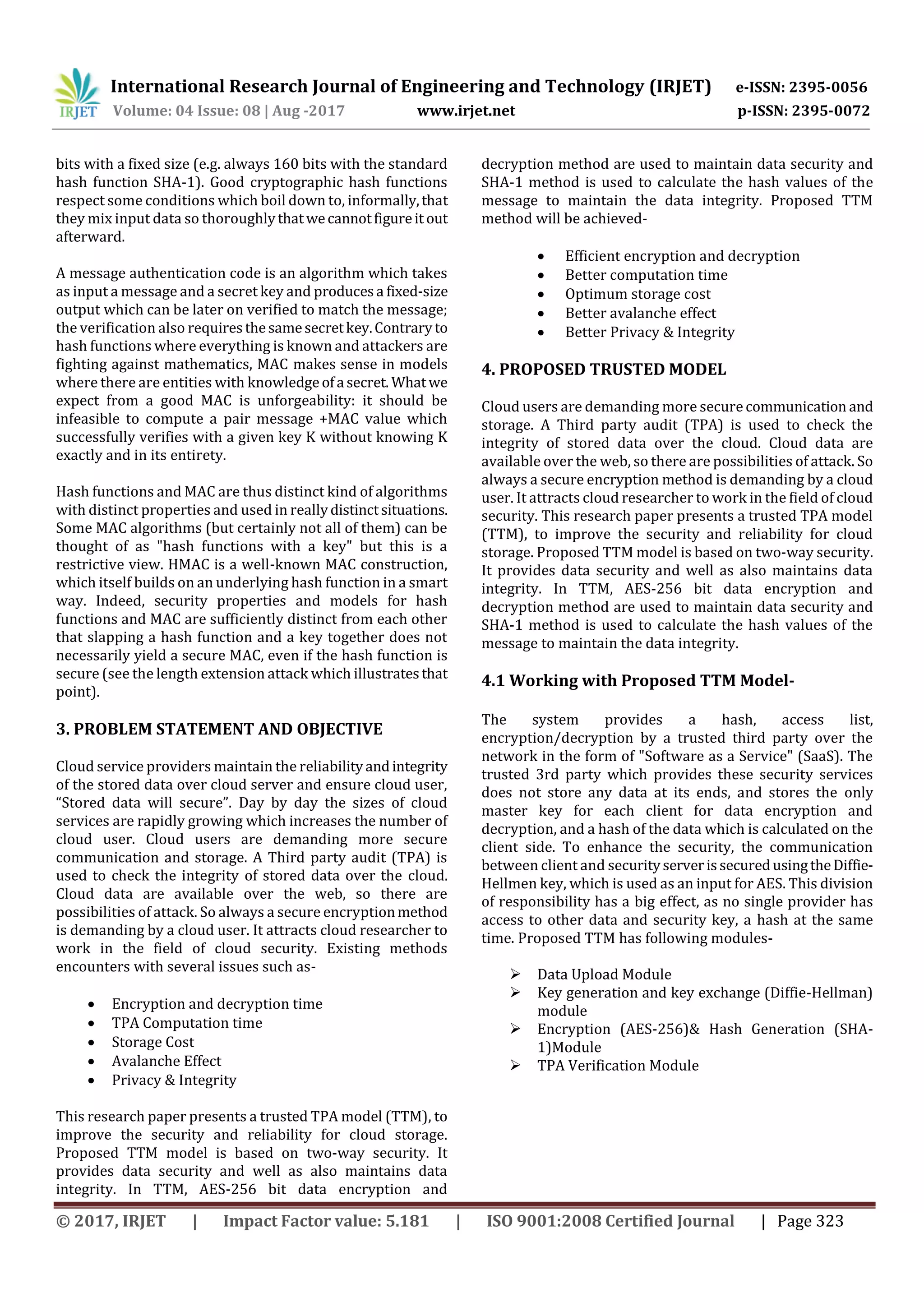
Figure 5.1 Implementation Screenshot for TTM Model
Proposed TTM(SHA-1+AES) andexistingMethod(AES+ MD-
5) both are implanted overJAVANetBeans.Followingresults
were calculated-
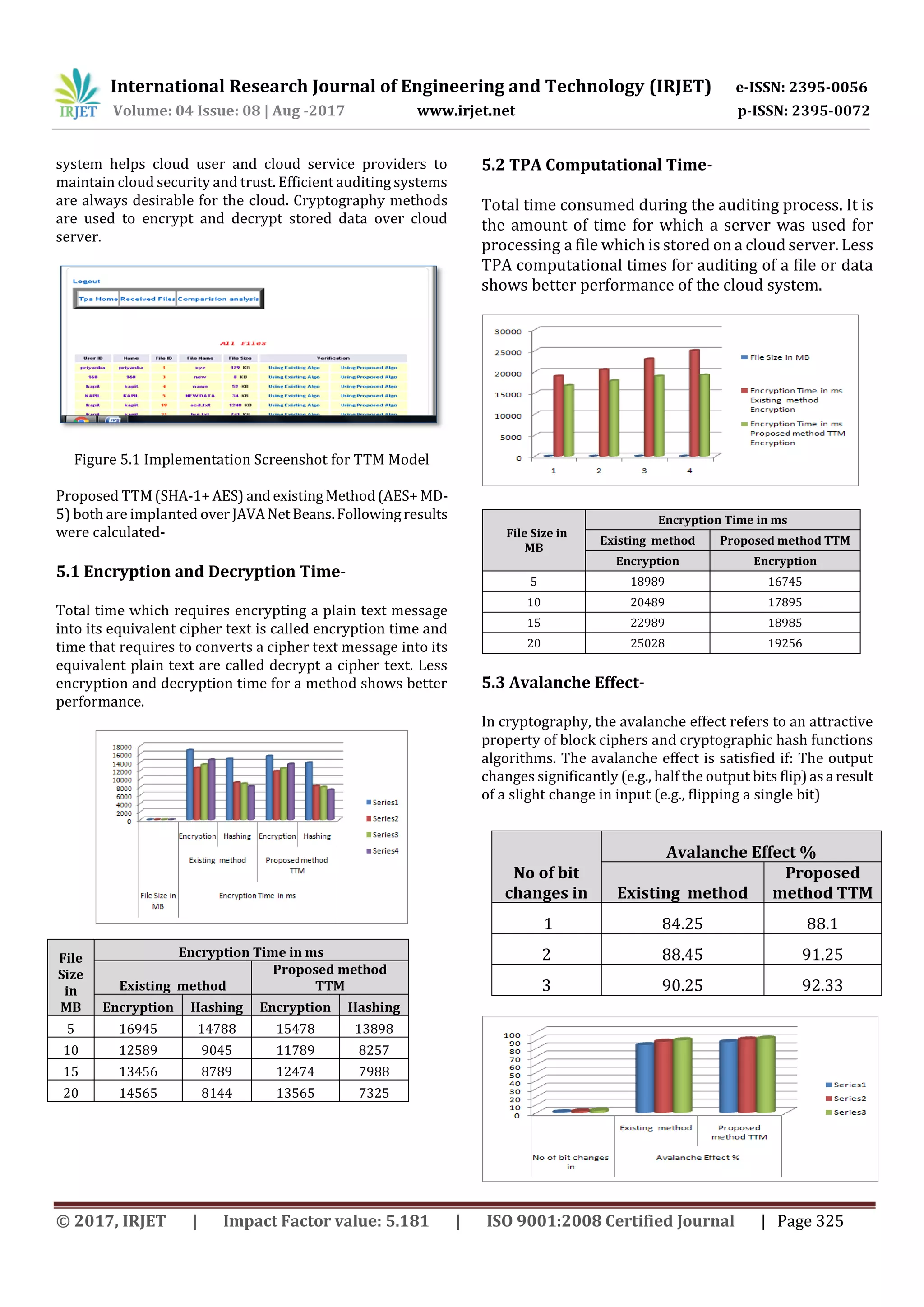
5.1 Encryption and Decryption Time-
Total time which requires encrypting a plain text message
into its equivalent cipher text is called encryption time and
time that requires to converts a cipher text message into its
equivalent plain text are called decrypt a cipher text. Less
encryption and decryption time for a method shows better
performance.
5.2 TPA Computational Time-
Total time consumed during the auditing process. It is
the amount of time for which a server was used for
processing a file which is stored on a cloud server. Less
TPA computational times for auditing of a file or data
shows better performance of the cloud system.
5.3 Avalanche Effect-
In cryptography, the avalanche effect refers to an attractive
property of block ciphers and cryptographic hash functions
algorithms. The avalanche effect is satisfied if: The output
changes significantly (e.g., half the output bits flip)asa result
of a slight change in input (e.g., flipping a single bit)
File
Size
in
MB
Encryption Time in ms
Existing method
Proposed method
TTM
Encryption Hashing Encryption Hashing
5 16945 14788 15478 13898
10 12589 9045 11789 8257
15 13456 8789 12474 7988
20 14565 8144 13565 7325
File Size in
MB
Encryption Time in ms
Existing method Proposed method TTM
Encryption Encryption
5 18989 16745
10 20489 17895
15 22989 18985
20 25028 19256
No of bit
changes in
Avalanche Effect %
Existing method
Proposed
method TTM
1 84.25 88.1
2 88.45 91.25
3 90.25 92.33
International Research Journal of Engineering and Technology (IRJET) e-ISSN: 2395-0056
Volume: 04 Issue: 08 | Aug -2017 www.irjet.net p-ISSN: 2395-0072
© 2017, IRJET | Impact Factor value: 5.181 | ISO 9001:2008 Certified Journal | Page 326
Influence- The above table and graph (section 5.1, 5.2 and
5.3) clearly show that proposed TTM model performs much
better than existing (AES+MD-5) method.
6. CONCLUSIONS & FUTURE WORK
Cloud computing has different security issues in threats in
user view, one can say that lack of security is the only worth
mentioning disadvantage of cloud computing. The bond
between service providers and users is necessary for
providing better cloud security. This paper presented a TPA
based privacy preserving and security model for cloud
computing. Proposed TTM model is based on two-way
security. It provides data security and well as also maintains
data integrity. In TTM, AES-256 bit data encryption and
decryption method are used to maintain data security and
SHA-1 method is used to calculate the hash values of the
message to maintain the data integrity. For a key generation,
TTM uses Diffie-Hellmen key exchange method. The
experimental study clearly shows that proposed method
performs outstandingly in terms of encryption and
decryption time, computation time, avalanche effect over
existing (AES+MD-5) method. In future work, we can
implement proposedmethodwiththe morerealistic scenario
and data, with new standards. And can compare with more
security methods.
REFERENCES:
[1]. Swapnali S. More, Sangita S. Chaudhari,” Secure and
Efficient Public Auditing scheme for Cloud Storage”,
2016 International Conference on Computing,
Analytics and Security Trends (CAST), IEEE College
of Engineering Pune, India.Dec 19-21,2016,PP439-
445.
[2]. Bhale Pradeepkumar Gajendra, VinayKumarSingh,
More Sujeet,” Achieving Cloud Security using Third
Party Auditor, MD5 and Identity-BasedEncryption”,
International Conference on Computing,
Communication and Automation(ICCCA2016)IEEE,
2016, PP1304-1310.
[3]. Rajat Saxena∗ and Somnath Dey,” Cloud Audit: A
Data Integrity Verification Approach for Cloud
Computing, Twelfth International Multi-Conference
on Information Processing-2016 (IMCIP-2016),
Science Direct 2016, PP 142-152
[4]. Swapnali More, Sangita Chaudhari,” Third Party
Public Auditing scheme for Cloud Storage”, 7th
International Conference on Communication,
Computing and Virtualization 2016, ScienceDirect,
PP 69-77
[5]. Shruti Batham, Umesh Lilhore and Sini Shibu
“Improved HLA based encryption process using
fixed size aggregate key generation”, Journal of
Modern Trends in Engineering and Research, vol. 2,
issue 1, Jan 2015.
[6]. Ankita R. Makode, V. B. Bhagat,” Privacy Preserving
For Secure Cloud Storage”, International Journal on
Recent and Innovation Trends in Computing and
Communication ISSN: 2321-8169, Volume, 4 Issue,
4, PP 475-479
[7]. Shruti Batham, Umesh Lilhore, SiniShibu.,” Improve
HLA based Encryption Process using fixed Size
Aggregate Key generation”, IJMTER, International
Journal of Modern Trends in Engineering and
Research Volume 2, Issue 1,(01 - 2015), PP 239-
245.
[8]. F. Seb´ e, J. Domingo-Ferrer, A. Mart´ınez-Ballast, Y.
Deswarte and J.-J. Quisquater, EfficientRemoteData
Possession Checking in Critical Information
Infrastructures, IEEE Trans. Knowl. Data Eng., vol.
20(8), pp. 1034–1038, (2008).
[9]. C. C. Erway, A. K¨ upc¸¨ u, C. Papamanthou and R.
Tamassia, Dynamic Provable Data Possession, In
ACM Conference on Computer and Communications
Security, pp. 213–222, (2009).
[10]. L. Chen, Using Algebraic Signatures to Check Data
Possession in Cloud Storage, Future Generation
Comp. Syst., vol. 29 (7) pp. 1709–1715, (2013).
[11]. A. Jules and B. S. K. Jr., Pors: Proofs of Retrievability
for Large Files, In ACM ConferenceonComputerand
Communications Security, pp. 584–597, (2007).
[12]. H. Shacham and B. Waters, Compact Proofs of
Retrievability, IACR Cryptology print Archive 2008,
vol. 73, (2008).
[13]. Y. Dodis, S. P. Vadhan and D. Wichs, Proofs of
Retrievability via Hardness Amplification, In TCC,
pp. 109–127, (2009).
[14]. K. D. Bowers, A. Juels and A. Oprea, Proofs of
Retrievability: Theory and Implementation, In
Proceedings of the 2009 ACM Workshop on Cloud
Computing security, ACM, pp. 43–54, (2009).
[15]. A. Jules, K. D. Bowers and A. Oprea, Hail: A High-
Availability and Integrity Layer for CloudStorage,In
ACM Conference on Computer and Communications
Security, pp. 187–198, (2009).
[16]. C. Wang, Q. Wang, K. Ren and W. Lou, Privacy-
Preserving Public Auditing forData StorageSecurity
in Cloud Computing, In INFOCOM, pp. 525–533,
(2010).
[17]. Q. Wang, C. Wang, J. Li, K. Ren and W. Lou, Enabling
Public Verifiability and Data Dynamics for Storage
Security in Cloud Computing, InComputerSecurity–
ESORICS 2009, Springer, pp. 355–370, (2009).

A Trusted TPA Model, to Improve Security & Reliability for Cloud Storage

  • 1.
    International Research Journalof Engineering and Technology (IRJET) e-ISSN: 2395-0056 Volume: 04 Issue: 08 | Aug -2017 www.irjet.net p-ISSN: 2395-0072 © 2017, IRJET | Impact Factor value: 5.181 | ISO 9001:2008 Certified Journal | Page 321 “A TRUSTED TPA MODEL, TO IMPROVE SECURITY & RELIABILITY FOR CLOUD STORAGE” Nivedita Roy Gupta1, Prof. Umesh Kumar Lilhore2, Prof. Nitin Agrawal3 M. Tech. Research Scholar1, Associate Professor and Head PG2, Associate Professor3 NRI-IIST Bhopal (M.P), India ---------------------------------------------------------------------***--------------------------------------------------------------------- ABSTRACT - In now these days Cloud computing is most promising technology for optimum utilization of computing resources. A cloud user can securely store their personal data on cloud storage server and can access anytime. Cloud service providers maintain the reliability and integrity of the stored data over cloud server and ensure cloud user, “Storeddata will secure”. Day by day the sizes of cloud services are rapidly growing which increases the number of cloud user. Cloud users are demanding more secure communication and storage. A Third party audit (TPA) is used to check the integrity of stored data over the cloud. Cloud data are available over the web, so there are possibilities of attack. So always a secure encryption method is demanding by a cloud user. It attracts cloud researcher to work in the field of cloud security. This research paper presents a trusted TPA model (TTM), to improve the security and reliability for cloud storage. ProposedTTMmodel is based on two-way security. It providesdatasecurityandwell as also maintains data integrity. In TTM, AES-256 bit data encryption and decryption method are used to maintain data security and SHA-1 method is used to calculate the hashvalues of the message to maintain the data integrity. For a key generation, TTM uses Diffie-Hellmen key exchange method. Proposed TTM and existing AES with MD-5 method both are implemented over JAVA and various performance comparison parameters are calculated such as encryption and decryption time, the time is taken to proceed request and TPA computation time. The experimentalstudyclearlyshowsthat’s proposed TTM shows better result over existing MD-5 based method. Key Words: TPA, Cloud Computing, Cloud Security, AES, MD-5, SHA-1, TTM 1. INTRODUCTION Cloud computing has become a big technology trend either within the industrial or the Institute field, and most of the consultants expect that cloud computing can reshape information technology (IT) processes and the IT market place. In cloud computing users connect with the cloud that seems as if it's one entity as critical multiple servers. Cloud computing is referred as two terms,’Cloud’ and ‘computing’, “Cloud” whichusedhereasa “Metaphor” for the technique are methodology, “the web or the internet”, so cloud computing technology is a “type of internetor network based computing”. Cloud computing based system can dynamically deliverthecomputing resourcesand capabilities as a service over the internet web in all over theworld.Cloud computing is a new technique of computing in which dynamically scalable and often virtualized resources are provided as a service over the internet [4]. The wide adaptation of cloud computing is restricted to its aspects of proving security and privacy of the user’s data.Data areto be stored remotely at the cloud server where data are to be managed at large data centers. The client can get access to and modify this stored data overthecloudusingthe network. In cloud computing, a CSP or cloud service providers is a separate administrative entitywhichavailabletheservicesto the cloud users. Data auditing is a new concept introduced in Cloud computing to deal with secure data storage. Auditing is a process of verification of user data. It can be carried out either by the user himself (data owner) or by a TPA. It helps to maintain the integrity of data stored in the cloud. The verifier’s role is categorized into two: the first one is private audit ability, in which only user or data owner is allowed to check the integrity of the stored data. No other person has the authority to question the server regardingthedata.Butit tends to increase verification overhead of the user. Second is public audit ability, which allows TPA to challenge the cloud server and performs data verification checks. Figure 1.1 TPA Audit in Cloud [8] The TPA is an entity which is used so that it can act on behalf of the client. It has all the necessary expertise, capabilities, knowledge and professional skills which are required to handle the work of integrity verification. It also reduces the overhead of the client. It is necessary that TPA should efficiently audit the cloud data. It should have zero
  • 2.
    International Research Journalof Engineering and Technology (IRJET) e-ISSN: 2395-0056 Volume: 04 Issue: 08 | Aug -2017 www.irjet.net p-ISSN: 2395-0072 © 2017, IRJET | Impact Factor value: 5.181 | ISO 9001:2008 Certified Journal | Page 322 knowledge about the data stored in the cloud server. It should not introduce any additional online burden to the cloud data owner [9].In this research paper, a trusted model is proposed for cloud security. This paper is organized in various chapters like cloud computing security, problem statement and objective, proposed solution and result comparisons. 2. CLOUD COMPUTING & SECURITY THREATS “Cloud computing technology is a large scale based distributed computing andvitalizationbasedtechnologythat is widely used by and driven by various economies of scale. In cloud computing, a large pool of servers and computing resources directly serves to various users on demand, based on pay per and use, over the network such as web or internet. Cloud computing provides service such as abstraction of data, virtualization, dynamically scalable computing power, platform, and storage”. According to Armbrust (the year 2009), “Cloud Computing technique basically refers to all the applications which are delivered as services directly over the Internet network and the systems software and hardware applicationsintheclouddata centers that serve these cloud computing services, referred to as Software as a Service (SaaS). As per NIST cloud computing can be defined-“Cloud computing is a model for enabling ubiquitous, convenient, on-demand network access to a shared pool of configurable computing resources (e.g., networks, servers, storage, applications, and services) that can be rapidly provisioned and released with minimal management effort or service provider interaction”. 2.1 Major threats in cloud computing- Major issues in cloud computing are as follows-  Data breaches -As enterprises stores vast data in the cloud, it becomes an attractive target for the hackers. In a case of security breaches involving financial data, healthcare data, and revenue details can be more devastating. It may lead an enterprise to incur fines,face lawsuits or even criminal charges.  CompromisingCredentials-Awell-definedIdentityand Authentication technology where enterprisesprovideto right access to the right person at the right time. Sometimes they fail to remove user access even after they left the organizations which could lead to obtaining their credentials.  Hacking Application Programming Interface-To interacts with the cloud services enterprise uses interfaces and API. The overall cloud security (Authentication, access control, monitoring depends highly on the security of the API).  Exploiting system vulnerabilities-The multi-tenancy in cloud computing where enterprises share memory, databases and other digital resources may create new attack surfaces. This can become biggersecurityissuesif hackers could exploit system vulnerabilities or bugs.  Hijacking the accounts-In Cloud, Computing attackers can eavesdrop on financial transaction activities change or could modify it. Multifactor authentication can be a common defense-in-depth protection strategy.  Malicious insiders-In cloud computing insider threat can shatter the complete infrastructure and data manipulation. Therefore enterprises should control the encryption process and minimize the user access.  Advanced Persistent threats-APTS are the parasitical form of attacks and are difficult to detect. Enterprises should monitor the costs involved to overcome APT attacks improper planning would increase the enterprise's security spending.  Data Loss-When an authorized user uploads files to the cloud there are chances for data loss that can be extremely costly for an enterprise. A recent report from the Health Information Trust Alliance (HITRUST) total number of breaches in the healthcare industry "Total cost of breach - $4.1 billion" Therefore enterprises should deploy a Data LossPrevention(DLP)systemplan.  DDoS attacks-In cloud environment enterprises should be aware of application-level Dos attacks targeting web server and database vulnerabilities. Figure 2.1 Cloud security risks [5] 2.2 HASH Vs MAC BASED INTEGRITY A cryptographic hash function is a completely public, deterministic hash function which everybody can compute over arbitrary inputs. It takes as input a sequenceof bits(any sequence of bits; some hash functions are formally limited to inputs of, say, less 264 bits, aka "2 millions of terabytes")and outputs values in a rather small space,typicallya sequenceof
  • 3.
    International Research Journalof Engineering and Technology (IRJET) e-ISSN: 2395-0056 Volume: 04 Issue: 08 | Aug -2017 www.irjet.net p-ISSN: 2395-0072 © 2017, IRJET | Impact Factor value: 5.181 | ISO 9001:2008 Certified Journal | Page 323 bits with a fixed size (e.g. always 160 bits with the standard hash function SHA-1). Good cryptographic hash functions respect some conditions which boil down to, informally,that they mix input data so thoroughlythatwecannotfigureit out afterward. A message authentication code is an algorithm which takes as input a message and a secret key and producesa fixed-size output which can be later on verified to match the message; the verification also requiresthesamesecretkey.Contraryto hash functions where everything is known and attackers are fighting against mathematics, MAC makes sense in models where there are entities with knowledgeofa secret. Whatwe expect from a good MAC is unforgeability: it should be infeasible to compute a pair message +MAC value which successfully verifies with a given key K without knowing K exactly and in its entirety. Hash functions and MAC are thus distinct kind of algorithms with distinct properties and used in reallydistinctsituations. Some MAC algorithms (but certainly not all of them) can be thought of as "hash functions with a key" but this is a restrictive view. HMAC is a well-known MAC construction, which itself builds on an underlying hash function in a smart way. Indeed, security properties and models for hash functions and MAC are sufficiently distinct from each other that slapping a hash function and a key together does not necessarily yield a secure MAC, even if the hash function is secure (see the length extension attack which illustratesthat point). 3. PROBLEM STATEMENT AND OBJECTIVE Cloud service providers maintain the reliabilityandintegrity of the stored data over cloud server and ensure cloud user, “Stored data will secure”. Day by day the sizes of cloud services are rapidly growing which increases the number of cloud user. Cloud users are demanding more secure communication and storage. A Third party audit (TPA) is used to check the integrity of stored data over the cloud. Cloud data are available over the web, so there are possibilities of attack. So always a secure encryptionmethod is demanding by a cloud user. It attracts cloud researcher to work in the field of cloud security. Existing methods encounters with several issues such as-  Encryption and decryption time  TPA Computation time  Storage Cost  Avalanche Effect  Privacy & Integrity This research paper presents a trusted TPA model (TTM), to improve the security and reliability for cloud storage. Proposed TTM model is based on two-way security. It provides data security and well as also maintains data integrity. In TTM, AES-256 bit data encryption and decryption method are used to maintain data security and SHA-1 method is used to calculate the hash values of the message to maintain the data integrity. Proposed TTM method will be achieved-  Efficient encryption and decryption  Better computation time  Optimum storage cost  Better avalanche effect  Better Privacy & Integrity 4. PROPOSED TRUSTED MODEL Cloud users are demanding more secure communication and storage. A Third party audit (TPA) is used to check the integrity of stored data over the cloud. Cloud data are available over the web, so there are possibilities of attack. So always a secure encryption method is demanding by a cloud user. It attracts cloud researcher to work in the field of cloud security. This research paper presents a trusted TPA model (TTM), to improve the security and reliability for cloud storage. Proposed TTM model is based on two-way security. It provides data security and well as also maintains data integrity. In TTM, AES-256 bit data encryption and decryption method are used to maintain data security and SHA-1 method is used to calculate the hash values of the message to maintain the data integrity. 4.1 Working with Proposed TTM Model- The system provides a hash, access list, encryption/decryption by a trusted third party over the network in the form of "Software as a Service" (SaaS). The trusted 3rd party which provides these security services does not store any data at its ends, and stores the only master key for each client for data encryption and decryption, and a hash of the data which is calculated on the client side. To enhance the security, the communication between client and securityserverissecuredusingtheDiffie- Hellmen key, which is used as an input for AES. This division of responsibility has a big effect, as no single provider has access to other data and security key, a hash at the same time. Proposed TTM has following modules-  Data Upload Module  Key generation and key exchange (Diffie-Hellman) module  Encryption (AES-256)& Hash Generation (SHA- 1)Module  TPA Verification Module
  • 4.
    International Research Journalof Engineering and Technology (IRJET) e-ISSN: 2395-0056 Volume: 04 Issue: 08 | Aug -2017 www.irjet.net p-ISSN: 2395-0072 © 2017, IRJET | Impact Factor value: 5.181 | ISO 9001:2008 Certified Journal | Page 324 4.2 Proposed TTM Algorithm- TTM Algorithm for Cloud privacy and data integrity- Key Generation Module- Steps in the algorithm: Step-1 Sender and Receiver agree on a prime number p and a base g. Step-2 Sender chooses a secret number a, and sends Receiver (ga mod p). Step-3 Receiver chooses a secret number b and sends Sender (gb mod p). Step-4 Sender computes ((gb mod p)a mod p) Step-5 Receiver computes ((ga mod p) b mod p) Both Sender and Receiver can use this number as their key. Notice that p and g need not be protected. AES-256 Encryption Module- Step-1 Key Expansions—round keys are derived from the cipher key using Rijndael's key schedule. AES requires a separate 128-bit round key block for each round plus one more. Step-2 initial round 2.1 AddRoundKey—each byte of the state is combined with a block of the round key using bitwise xor. Step-3 Rounds 3.1 SubBytes—a non-linear substitution step where each byte is replaced with another according to a lookup table. 3.2 ShiftRows—a transposition step where the last three rows of the state are shifted cyclically a certain number of steps. 3.3 MixColumns—a mixing operation which operates on the columns of the state, combining the four bytes in each column. 3. 4 AddRoundKey Step-4 Final Round (no MixColumns) 4.1 SubBytes 4.2 ShiftRows 4.3 AddRoundKey. SHA-1 (Hash Generation Module) Step 1: Append Padding Bits…. The message is “padded” with a 1 and as many 0’s as necessary to bring the message length to 64 bits less than an even multiple of 512. Step 2: Append Length.... 64 bits are appended to the end of the padded message. These bits hold the binary format of 64 bits indicating the length of the original message. Step 3: Prepare Processing Functions…. SHA1 requires 80 processing functions defined as: f(t;B,C,D) = (B AND C) OR ((NOT B) AND D) ( 0 <= t <= 19) f(t;B,C,D) = B XOR C XOR D (20 <= t <= 39) f(t;B,C,D) = (B AND C) OR (B AND D) OR (C AND D) (40 <= t <=59) f(t;B,C,D) = B XOR C XOR D (60 <= t <= 79) Step 4: Prepare Processing Constants.... SHA1 requires 80 processing constant words defined as: K(t) = 0x5A827999 ( 0 <= t <= 19) K(t) = 0x6ED9EBA1 (20 <= t <= 39) K(t) = 0x8F1BBCDC (40 <= t <= 59) K(t) = 0xCA62C1D6 (60 <= t <= 79) Step 5: Initialize Buffers…. SHA1 requires 160 bits or 5 buffers of words (32 bits): H0 = 0x67452301 H1 = 0xEFCDAB89 H2 = 0x98BADCFE H3 = 0x10325476 H4 = 0xC3D2E1F0 Step 6: Processing Message in 512-bit blocks (L blocks in total message)…. This is the main task of a SHA1 algorithm which loops through the padded and appended message in 512- bit blocks. Input and predefined functions: M[1, 2, ..., L]: Blocks of the padded and appended message f(0;B,C,D), f(1,B,C,D), ..., f(79,B,C,D): 80 Processing Functions K(0), K(1), ..., K(79): 80 Processing Constant Words H0, H1, H2, H3, H4, H5: 5 Word buffers with initial values Step 6: Pseudo Code…. For loop on k = 1 to L (W(0),W(1),...,W(15)) = M[k] /* Divide M[k] into 16 words */ For t = 16 to 79 do: W(t) = (W(t-3) XOR W(t-8) XOR W(t- 14) XOR W(t-16)) <<< 1 A = H0, B = H1, C = H2, D = H3, E = H4 For t = 0 to 79 do: TEMP = A<<<5 + f(t;B,C,D) + E + W(t) + K(t) E = D, D = C, C = B<<<30, B = A, A = TEMP End of for loop H0 = H0 + A, H1 = H1 + B, H2 = H2 + C, H3 = H3 + D, H4 = H4 + E End of for loop Output: H0, H1, H2, H3, H4, H5: Word buffers with final message digest 5. IMPLEMENTATION AND RESULT ANALYSIS In cloud computing security plays a vital role in cloud performance. Auditing protocols and privacy preserving
  • 5.
    International Research Journalof Engineering and Technology (IRJET) e-ISSN: 2395-0056 Volume: 04 Issue: 08 | Aug -2017 www.irjet.net p-ISSN: 2395-0072 © 2017, IRJET | Impact Factor value: 5.181 | ISO 9001:2008 Certified Journal | Page 325 system helps cloud user and cloud service providers to maintain cloud security and trust. Efficient auditing systems are always desirable for the cloud. Cryptography methods are used to encrypt and decrypt stored data over cloud server. Figure 5.1 Implementation Screenshot for TTM Model Proposed TTM(SHA-1+AES) andexistingMethod(AES+ MD- 5) both are implanted overJAVANetBeans.Followingresults were calculated- 5.1 Encryption and Decryption Time- Total time which requires encrypting a plain text message into its equivalent cipher text is called encryption time and time that requires to converts a cipher text message into its equivalent plain text are called decrypt a cipher text. Less encryption and decryption time for a method shows better performance. 5.2 TPA Computational Time- Total time consumed during the auditing process. It is the amount of time for which a server was used for processing a file which is stored on a cloud server. Less TPA computational times for auditing of a file or data shows better performance of the cloud system. 5.3 Avalanche Effect- In cryptography, the avalanche effect refers to an attractive property of block ciphers and cryptographic hash functions algorithms. The avalanche effect is satisfied if: The output changes significantly (e.g., half the output bits flip)asa result of a slight change in input (e.g., flipping a single bit) File Size in MB Encryption Time in ms Existing method Proposed method TTM Encryption Hashing Encryption Hashing 5 16945 14788 15478 13898 10 12589 9045 11789 8257 15 13456 8789 12474 7988 20 14565 8144 13565 7325 File Size in MB Encryption Time in ms Existing method Proposed method TTM Encryption Encryption 5 18989 16745 10 20489 17895 15 22989 18985 20 25028 19256 No of bit changes in Avalanche Effect % Existing method Proposed method TTM 1 84.25 88.1 2 88.45 91.25 3 90.25 92.33
  • 6.
    International Research Journalof Engineering and Technology (IRJET) e-ISSN: 2395-0056 Volume: 04 Issue: 08 | Aug -2017 www.irjet.net p-ISSN: 2395-0072 © 2017, IRJET | Impact Factor value: 5.181 | ISO 9001:2008 Certified Journal | Page 326 Influence- The above table and graph (section 5.1, 5.2 and 5.3) clearly show that proposed TTM model performs much better than existing (AES+MD-5) method. 6. CONCLUSIONS & FUTURE WORK Cloud computing has different security issues in threats in user view, one can say that lack of security is the only worth mentioning disadvantage of cloud computing. The bond between service providers and users is necessary for providing better cloud security. This paper presented a TPA based privacy preserving and security model for cloud computing. Proposed TTM model is based on two-way security. It provides data security and well as also maintains data integrity. In TTM, AES-256 bit data encryption and decryption method are used to maintain data security and SHA-1 method is used to calculate the hash values of the message to maintain the data integrity. For a key generation, TTM uses Diffie-Hellmen key exchange method. The experimental study clearly shows that proposed method performs outstandingly in terms of encryption and decryption time, computation time, avalanche effect over existing (AES+MD-5) method. In future work, we can implement proposedmethodwiththe morerealistic scenario and data, with new standards. And can compare with more security methods. REFERENCES: [1]. Swapnali S. More, Sangita S. Chaudhari,” Secure and Efficient Public Auditing scheme for Cloud Storage”, 2016 International Conference on Computing, Analytics and Security Trends (CAST), IEEE College of Engineering Pune, India.Dec 19-21,2016,PP439- 445. [2]. Bhale Pradeepkumar Gajendra, VinayKumarSingh, More Sujeet,” Achieving Cloud Security using Third Party Auditor, MD5 and Identity-BasedEncryption”, International Conference on Computing, Communication and Automation(ICCCA2016)IEEE, 2016, PP1304-1310. [3]. Rajat Saxena∗ and Somnath Dey,” Cloud Audit: A Data Integrity Verification Approach for Cloud Computing, Twelfth International Multi-Conference on Information Processing-2016 (IMCIP-2016), Science Direct 2016, PP 142-152 [4]. Swapnali More, Sangita Chaudhari,” Third Party Public Auditing scheme for Cloud Storage”, 7th International Conference on Communication, Computing and Virtualization 2016, ScienceDirect, PP 69-77 [5]. Shruti Batham, Umesh Lilhore and Sini Shibu “Improved HLA based encryption process using fixed size aggregate key generation”, Journal of Modern Trends in Engineering and Research, vol. 2, issue 1, Jan 2015. [6]. Ankita R. Makode, V. B. Bhagat,” Privacy Preserving For Secure Cloud Storage”, International Journal on Recent and Innovation Trends in Computing and Communication ISSN: 2321-8169, Volume, 4 Issue, 4, PP 475-479 [7]. Shruti Batham, Umesh Lilhore, SiniShibu.,” Improve HLA based Encryption Process using fixed Size Aggregate Key generation”, IJMTER, International Journal of Modern Trends in Engineering and Research Volume 2, Issue 1,(01 - 2015), PP 239- 245. [8]. F. Seb´ e, J. Domingo-Ferrer, A. Mart´ınez-Ballast, Y. Deswarte and J.-J. Quisquater, EfficientRemoteData Possession Checking in Critical Information Infrastructures, IEEE Trans. Knowl. Data Eng., vol. 20(8), pp. 1034–1038, (2008). [9]. C. C. Erway, A. K¨ upc¸¨ u, C. Papamanthou and R. Tamassia, Dynamic Provable Data Possession, In ACM Conference on Computer and Communications Security, pp. 213–222, (2009). [10]. L. Chen, Using Algebraic Signatures to Check Data Possession in Cloud Storage, Future Generation Comp. Syst., vol. 29 (7) pp. 1709–1715, (2013). [11]. A. Jules and B. S. K. Jr., Pors: Proofs of Retrievability for Large Files, In ACM ConferenceonComputerand Communications Security, pp. 584–597, (2007). [12]. H. Shacham and B. Waters, Compact Proofs of Retrievability, IACR Cryptology print Archive 2008, vol. 73, (2008). [13]. Y. Dodis, S. P. Vadhan and D. Wichs, Proofs of Retrievability via Hardness Amplification, In TCC, pp. 109–127, (2009). [14]. K. D. Bowers, A. Juels and A. Oprea, Proofs of Retrievability: Theory and Implementation, In Proceedings of the 2009 ACM Workshop on Cloud Computing security, ACM, pp. 43–54, (2009). [15]. A. Jules, K. D. Bowers and A. Oprea, Hail: A High- Availability and Integrity Layer for CloudStorage,In ACM Conference on Computer and Communications Security, pp. 187–198, (2009). [16]. C. Wang, Q. Wang, K. Ren and W. Lou, Privacy- Preserving Public Auditing forData StorageSecurity in Cloud Computing, In INFOCOM, pp. 525–533, (2010). [17]. Q. Wang, C. Wang, J. Li, K. Ren and W. Lou, Enabling Public Verifiability and Data Dynamics for Storage Security in Cloud Computing, InComputerSecurity– ESORICS 2009, Springer, pp. 355–370, (2009).