5th Assises of Decentralised Cooperation
Brussels, 11 July 2017
Stefano Marta
Regional Development Policy Division, OECD
EMERGING PARADIGMS IN DECENTRALISED
DEVELOPMENT CO-OPERATION: GOING BEYOND
FINANCIAL FLOWS
Supported by
Agenda
 Emerging Paradigms in DDC
 Objectives and Methodology of the case studies
 Contribution to global agendas, in particular SDGs
 Overview of the four selected case studies
 Take away messages
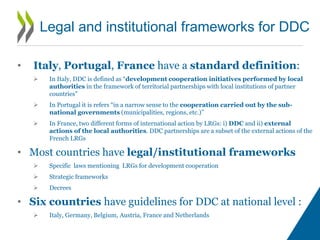
• Italy, Portugal, France have a standard definition:
 In Italy, DDC is defined as “development cooperation initiatives performed by local
authorities in the framework of territorial partnerships with local institutions of partner
countries”
 In Portugal it is refers “in a narrow sense to the cooperation carried out by the sub-
national governments (municipalities, regions, etc.)”
 In France, two different forms of international action by LRGs: i) DDC and ii) external
actions of the local authorities. DDC partnerships are a subset of the external actions of the
French LRGs
• Most countries have legal/institutional frameworks
 Specific laws mentioning LRGs for development cooperation
 Strategic frameworks
 Decrees
• Six countries have guidelines for DDC at national level :
 Italy, Germany, Belgium, Austria, France and Netherlands
Legal and institutional frameworks for DDC
DDC Actors
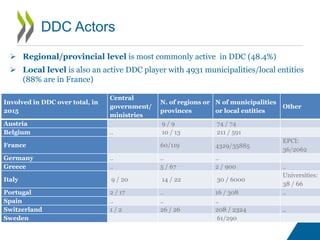
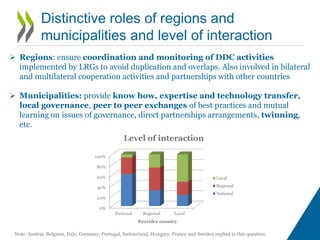
 Regional/provincial level is most commonly active in DDC (48.4%)
 Local level is also an active DDC player with 4931 municipalities/local entities
(88% are in France)
Involved in DDC over total, in
2015
Central
government/
ministries
N. of regions or
provinces
N of municipalities
or local entities
Other
Austria 9 / 9 74 / 74
Belgium .. 10 / 13 211 / 591
France 60/119 4329/35885
EPCI:
36/2062
Germany .. .. ..
Greece .. 5 / 67 2 / 900 ..
Italy 9 / 20 14 / 22 30 / 6000
Universities:
38 / 66
Portugal 2 / 17 .. 16 / 308 ..
Spain .. .. ..
Switzerland 1 / 2 26 / 26 208 / 2324 ..
Sweden 61/290
Distinctive roles of regions and
municipalities and level of interaction
Note: Austria, Belgium, Italy, Germany, Portugal, Switzerland, Hungary, France and Sweden replied to this question.
0%
20%
40%
60%
80%
100%
National Regional Local
Provider country
Level of interaction
Local
Regional
National
 Regions: ensure coordination and monitoring of DDC activities
implemented by LRGs to avoid duplication and overlaps. Also involved in bilateral
and multilateral cooperation activities and partnerships with other countries
 Municipalities: provide know how, expertise and technology transfer,
local governance, peer to peer exchanges of best practices and mutual
learning on issues of governance, direct partnerships arrangements, twinning,
etc.
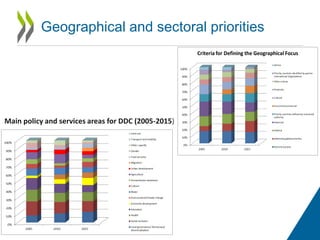
Geographical and sectoral priorities
Main policy and services areas for DDC (2005-2015)
DDC multi-level governance and evaluation
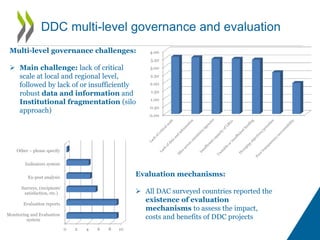
Multi-level governance challenges:
 Main challenge: lack of critical
scale at local and regional level,
followed by lack of or insufficiently
robust data and information and
Institutional fragmentation (silo
approach)
Evaluation mechanisms:
 All DAC surveyed countries reported the
existence of evaluation
mechanisms to assess the impact,
costs and benefits of DDC projects
0.00
0.50
1.00
1.50
2.00
2.50
3.00
3.50
4.00
0 2 4 6 8 10
Monitoring and Evaluation
system
Evaluation reports
Surveys, (recipients’
satisfaction, etc.)
Ex-post analysis
Indicators system
Other – please specify
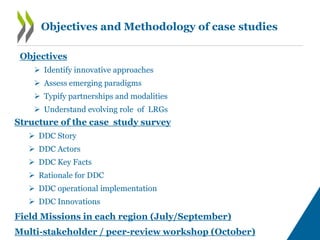
Objectives and Methodology of case studies
Structure of the case study survey
 DDC Story
 DDC Actors
 DDC Key Facts
 Rationale for DDC
 DDC operational implementation
 DDC Innovations
Field Missions in each region (July/September)
Multi-stakeholder / peer-review workshop (October)
Objectives
 Identify innovative approaches
 Assess emerging paradigms
 Typify partnerships and modalities
 Understand evolving role of LRGs
Contribution to Global Agendas - SDGs
• Targeting SDGs:
 Tuscany focuses on all SDGs
 Flanders targets various SDGs: 1, 2, 3, 8, 17
 Basque and France focus on one specific SDGs: 5 and 6
• As emerged from DAC Survey, addressing Global Priorities is now the
main criterion (together with poverty) for defining geographical focus
• General trend: recognition of the importance of a Territorial
Approach to SDGs
• Main challenges:
 Supporting developing countries in achieving SDGs through DDC
 Implementing SDGs in EU countries
 How to monitor SDGs at local level?
Tuscany, Italy : Localising the SDGs
• Geographical focus:
 Nicaragua and Guatemala;
 Dominican Republic and Haiti
 Tunisia (and Mediterranean area)
 China and South Africa
• Key features:
 focus on: i) citizens’ participation in the identification of public policies, ii)
youth policies, iii) organisation and management of local public policies
 recognition of the importance of a Territorial Approach to SDGs
• What is innovative/good practices:
 Proactive role to adapt and implement all SDGs at regional and local level,
focusing on policy coherence
 Implementation and adaptation of “internal” territorial development models
to DDC in partner countries
Flanders, Belgium: DDC for healthcare,
agriculture and food security
• Geographical focus:
 Malawi (agriculture and food security)
 Mozambique (healthcare)
 South Africa (economic growth)
• Key features:
 some features of national donors (e. g. follows global agreement on ODA, work
with multilateral organisations, DDC is mainly ODA, some national
governments as counterpart);
 Focus on specific sectors and priority countries;
 Focus on selected SDGs
• What is innovative/good practices:
 regional actor able to create added value in a fragmented donor landscape,
with potential impact on local actors
 key ingredients: i) long term sectoral focus, ii) upscaling of positive
experiences, iii) avoid overburdening partner country government structure
Basque Country, Spain: DDC for Gender
• Geographical focus:
 No specific geographical focus, although strong relationship with Latin
America
• Key features:
 DDC project mainly implemented through NGOs (almost 90% of the budget
channelled through NGOs)
 Comprehensive governance for DDC (Basque Agency for Development
Cooperation, Basque Council for Dev. Cooperation, etc.)
 Strong focus on gender: 20% of the budget to activities for women
empowerment (5% through feminist organisations)
• What is innovative/good practices:
 Mainstreaming of gender and women empowerment
 Interaction between traditional DDC agents (NGOs) and most active sector of
society with gender capacity and expertise
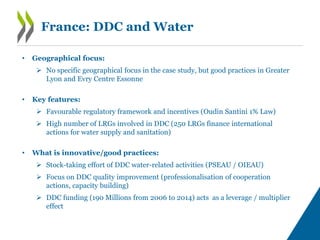
France: DDC and Water
• Geographical focus:
 No specific geographical focus in the case study, but good practices in Greater
Lyon and Evry Centre Essonne
• Key features:
 Favourable regulatory framework and incentives (Oudin Santini 1% Law)
 High number of LRGs involved in DDC (250 LRGs finance international
actions for water supply and sanitation)
• What is innovative/good practices:
 Stock-taking effort of DDC water-related activities (PSEAU / OIEAU)
 Focus on DDC quality improvement (professionalisation of cooperation
actions, capacity building)
 DDC funding (190 Millions from 2006 to 2014) acts as a leverage / multiplier
effect
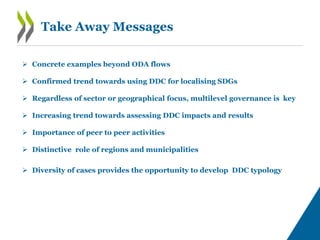
Take Away Messages
 Concrete examples beyond ODA flows
 Confirmed trend towards using DDC for localising SDGs
 Regardless of sector or geographical focus, multilevel governance is key
 Increasing trend towards assessing DDC impacts and results
 Importance of peer to peer activities
 Distinctive role of regions and municipalities
 Diversity of cases provides the opportunity to develop DDC typology

Emerging paradigms in Decentralised Development Cooperation

  • 1.
    5th Assises ofDecentralised Cooperation Brussels, 11 July 2017 Stefano Marta Regional Development Policy Division, OECD EMERGING PARADIGMS IN DECENTRALISED DEVELOPMENT CO-OPERATION: GOING BEYOND FINANCIAL FLOWS Supported by
  • 2.
    Agenda  Emerging Paradigmsin DDC  Objectives and Methodology of the case studies  Contribution to global agendas, in particular SDGs  Overview of the four selected case studies  Take away messages
  • 3.
    • Italy, Portugal,France have a standard definition:  In Italy, DDC is defined as “development cooperation initiatives performed by local authorities in the framework of territorial partnerships with local institutions of partner countries”  In Portugal it is refers “in a narrow sense to the cooperation carried out by the sub- national governments (municipalities, regions, etc.)”  In France, two different forms of international action by LRGs: i) DDC and ii) external actions of the local authorities. DDC partnerships are a subset of the external actions of the French LRGs • Most countries have legal/institutional frameworks  Specific laws mentioning LRGs for development cooperation  Strategic frameworks  Decrees • Six countries have guidelines for DDC at national level :  Italy, Germany, Belgium, Austria, France and Netherlands Legal and institutional frameworks for DDC
  • 4.
    DDC Actors  Regional/provinciallevel is most commonly active in DDC (48.4%)  Local level is also an active DDC player with 4931 municipalities/local entities (88% are in France) Involved in DDC over total, in 2015 Central government/ ministries N. of regions or provinces N of municipalities or local entities Other Austria 9 / 9 74 / 74 Belgium .. 10 / 13 211 / 591 France 60/119 4329/35885 EPCI: 36/2062 Germany .. .. .. Greece .. 5 / 67 2 / 900 .. Italy 9 / 20 14 / 22 30 / 6000 Universities: 38 / 66 Portugal 2 / 17 .. 16 / 308 .. Spain .. .. .. Switzerland 1 / 2 26 / 26 208 / 2324 .. Sweden 61/290
  • 5.
    Distinctive roles ofregions and municipalities and level of interaction Note: Austria, Belgium, Italy, Germany, Portugal, Switzerland, Hungary, France and Sweden replied to this question. 0% 20% 40% 60% 80% 100% National Regional Local Provider country Level of interaction Local Regional National  Regions: ensure coordination and monitoring of DDC activities implemented by LRGs to avoid duplication and overlaps. Also involved in bilateral and multilateral cooperation activities and partnerships with other countries  Municipalities: provide know how, expertise and technology transfer, local governance, peer to peer exchanges of best practices and mutual learning on issues of governance, direct partnerships arrangements, twinning, etc.
  • 6.
    Geographical and sectoralpriorities Main policy and services areas for DDC (2005-2015)
  • 7.
    DDC multi-level governanceand evaluation Multi-level governance challenges:  Main challenge: lack of critical scale at local and regional level, followed by lack of or insufficiently robust data and information and Institutional fragmentation (silo approach) Evaluation mechanisms:  All DAC surveyed countries reported the existence of evaluation mechanisms to assess the impact, costs and benefits of DDC projects 0.00 0.50 1.00 1.50 2.00 2.50 3.00 3.50 4.00 0 2 4 6 8 10 Monitoring and Evaluation system Evaluation reports Surveys, (recipients’ satisfaction, etc.) Ex-post analysis Indicators system Other – please specify
  • 8.
    Objectives and Methodologyof case studies Structure of the case study survey  DDC Story  DDC Actors  DDC Key Facts  Rationale for DDC  DDC operational implementation  DDC Innovations Field Missions in each region (July/September) Multi-stakeholder / peer-review workshop (October) Objectives  Identify innovative approaches  Assess emerging paradigms  Typify partnerships and modalities  Understand evolving role of LRGs
  • 9.
    Contribution to GlobalAgendas - SDGs • Targeting SDGs:  Tuscany focuses on all SDGs  Flanders targets various SDGs: 1, 2, 3, 8, 17  Basque and France focus on one specific SDGs: 5 and 6 • As emerged from DAC Survey, addressing Global Priorities is now the main criterion (together with poverty) for defining geographical focus • General trend: recognition of the importance of a Territorial Approach to SDGs • Main challenges:  Supporting developing countries in achieving SDGs through DDC  Implementing SDGs in EU countries  How to monitor SDGs at local level?
  • 10.
    Tuscany, Italy :Localising the SDGs • Geographical focus:  Nicaragua and Guatemala;  Dominican Republic and Haiti  Tunisia (and Mediterranean area)  China and South Africa • Key features:  focus on: i) citizens’ participation in the identification of public policies, ii) youth policies, iii) organisation and management of local public policies  recognition of the importance of a Territorial Approach to SDGs • What is innovative/good practices:  Proactive role to adapt and implement all SDGs at regional and local level, focusing on policy coherence  Implementation and adaptation of “internal” territorial development models to DDC in partner countries
  • 11.
    Flanders, Belgium: DDCfor healthcare, agriculture and food security • Geographical focus:  Malawi (agriculture and food security)  Mozambique (healthcare)  South Africa (economic growth) • Key features:  some features of national donors (e. g. follows global agreement on ODA, work with multilateral organisations, DDC is mainly ODA, some national governments as counterpart);  Focus on specific sectors and priority countries;  Focus on selected SDGs • What is innovative/good practices:  regional actor able to create added value in a fragmented donor landscape, with potential impact on local actors  key ingredients: i) long term sectoral focus, ii) upscaling of positive experiences, iii) avoid overburdening partner country government structure
  • 12.
    Basque Country, Spain:DDC for Gender • Geographical focus:  No specific geographical focus, although strong relationship with Latin America • Key features:  DDC project mainly implemented through NGOs (almost 90% of the budget channelled through NGOs)  Comprehensive governance for DDC (Basque Agency for Development Cooperation, Basque Council for Dev. Cooperation, etc.)  Strong focus on gender: 20% of the budget to activities for women empowerment (5% through feminist organisations) • What is innovative/good practices:  Mainstreaming of gender and women empowerment  Interaction between traditional DDC agents (NGOs) and most active sector of society with gender capacity and expertise
  • 13.
    France: DDC andWater • Geographical focus:  No specific geographical focus in the case study, but good practices in Greater Lyon and Evry Centre Essonne • Key features:  Favourable regulatory framework and incentives (Oudin Santini 1% Law)  High number of LRGs involved in DDC (250 LRGs finance international actions for water supply and sanitation) • What is innovative/good practices:  Stock-taking effort of DDC water-related activities (PSEAU / OIEAU)  Focus on DDC quality improvement (professionalisation of cooperation actions, capacity building)  DDC funding (190 Millions from 2006 to 2014) acts as a leverage / multiplier effect
  • 14.
    Take Away Messages Concrete examples beyond ODA flows  Confirmed trend towards using DDC for localising SDGs  Regardless of sector or geographical focus, multilevel governance is key  Increasing trend towards assessing DDC impacts and results  Importance of peer to peer activities  Distinctive role of regions and municipalities  Diversity of cases provides the opportunity to develop DDC typology